




Introduction
In recent decades, academia has seen a problematisation of the notion of ‘nativeness’ as well as the concept of ‘native speakers’ and their role in minority language revitalisation (O'Rourke & Pujolar Reference O'Rourke and Pujolar2013). Historically, essentialist perspectives—characterised by an iconic conception of language and identity—were not uncommon, and amongst many, they contributed to an idealisation of ‘native speakers’ as having unique competence and authority (O'Rourke, Pujolar, & Ramallo Reference O'Rourke, Pujolar and Ramallo2015; see also Dunmore Reference Dunmore2021a). In research regarding minority language revitalisation, this entailed a strong focus on intergenerational transmission in the home. This focus is exemplified by Fishman's (Reference Fishman1991, Reference Fishman and Fishman2001) Graded Intergenerational Disruption Scale, an evaluative framework for language endangerment. While this framework also makes reference to education, community, and institutional support, Fishman characterises intergenerational transmission in the home as its ‘fulcrum’ (Reference Fishman and Fishman2001:467). The framework is largely based on the premise that ‘Xmen are not Ymen and that Xish culture … is not Yish culture’ (Fishman Reference Fishman1991:394). Yet, as Dunmore (Reference Dunmore2021a:261) notes, ‘the (theoretical and practical) feasibility of [Fishman's] emphasis on a straightforward relationship of the minority language (“Xish”) to its traditionally defined, ethnolinguistic speaker community (“Xmen”) has been questioned at length by various authors’ (e.g. Romaine Reference Romaine2006; Jaffe Reference Jaffe, Duchêne and Heller2007; see also Hornsby & McLeod Reference Hornsby and McLeod2022). Notably, Fishman's stance regarding the fundamental importance of intergenerational transmission in the home remains influential (e.g. Ballinger, Brouillard, Ahooja, Kircher, Polka, & Byers-Heinlein Reference Kircher, Quirk, Brouillard, Ahooja, Ballinger, Polka and Byers-Heinlein2022; Kircher Reference Kircher2022). Yet, iconic conceptions of language and identity are now mostly contested, and there is a more widespread recognition regarding the importance of other modes of transmission in the process of minority language revitalisation (e.g. Hornsby & McLeod Reference Hornsby and McLeod2022). This has gone hand in hand with the aforementioned problematisation of ‘nativeness’.
In many European contexts, these changes in academic approaches are—at least to a certain extent—reflected in increased provision for minority languages at the community level. Minority languages receive greater institutional support, they are more present in the media and in other public domains, and they are being included as subjects in school curricula (O'Rourke & Pujolar Reference O'Rourke and Pujolar2013). There is thus evidence of planning measures whose focus extends beyond intergenerational transmission in the home. Yet, the fact that numerous minority languages remain endangered despite such measures (e.g. Austin & Sallabank Reference Austin and Sallabank2011; Rehg & Campbell Reference Rehg and Campbell2018) indicates that—at least in some communities—the outcomes of these planning measures fall short of the desired revitalisation objectives. By contrast, the Basque Country constitutes an example of relatively successful revitalisation: since the 1970s, the number of Basque speakers in the autonomous community has increased from 25% to almost 40%, largely as a result of immersion and bilingual education (Urla & Ramallo Reference Urla and Ramallo2022). This highlights the potentially pivotal role of so-called ‘new speakers’ in revitalisation efforts.
New speakers are ‘individuals with little or no home or community exposure to a minority language but who instead acquire it through immersion or bilingual educational programs, revitalization projects or as adult language learners’ (O'Rourke et al. Reference O'Rourke, Pujolar and Ramallo2015:1). Notably, the term ‘new speakers’ has been used to describe individuals with a wide range of competences, ranging from emergent speakers to those with very high proficiency (Ó Murchadha, Hornsby, Smith-Christmas, & Moriarty Reference Ó Murchadha, Hornsby, Smith-Christmas, Moriarty, Smith-Christmas, Murchadha, Hornsby and Moriarty2018). Previously, such individuals would have been labelled as, for example, ‘non-fluent’, ‘non-native’ or ‘L2 speakers’; the introduction of the term ‘new speakers’ constitutes an explicit attempt to move away from the delegitimisation implied by such labels (O'Rourke & Pujolar Reference O'Rourke and Pujolar2013). In many minority language contexts, sizeable groups of new speakers have emerged—and in some cases, they now even outnumber the ‘traditional speakers’ whose communities have been shrinking due to urbanisation, economic modernisation, and globalisation (O'Rourke et al. Reference O'Rourke, Pujolar and Ramallo2015). As a result, it has come to be recognised in the literature that new speakers can be central to minority language revitalisation (e.g. Hornsby Reference Hornsby2015a).
To effectively promote minority language learning amongst new speakers, it is key that planning measures are informed by research regarding new speakers’ language attitudes. Attitudes influence a wide range of linguistic behaviours, including what languages individuals decide to learn (e.g. Gardner & MacIntyre Reference Gardner and MacIntyre1993) and to what extent they use them (e.g. Jongbloed-Faber, Van de Velde, van der Meer, & Klinkenberg Reference Jongbloed-Faber, Van de Velde, van der Meer and Klinkenberg2016). Without knowledge about attitudes, it is thus impossible to predict which language planning measures are likely to achieve their intended aims and which ones are destined to fail (e.g. Spolsky Reference Spolsky2004; see also Kircher Reference Kircher2016a). Moreover, without knowledge regarding the predictors of attitudes, there is a risk that language planning measures are not sufficiently community-specific to be effective (e.g. Kircher & Fox Reference Kircher and Fox2019). However, while it may be common for language policiesFootnote 1 to aim for an improvement of traditional and/or new speakers’ attitudes towards minority languages, it is still not the norm for all planning measures to be informed by knowledge regarding the relevant attitudes (e.g. Provinsje Fryslân Reference Provinsje2021; see also Jaffe Reference Jaffe2015). We thus argue that it would be beneficial for language planners in minority language contexts to more actively engage with science communication regarding such research.
Moreover, we argue that, in order to enable the provision of more comprehensive science communication concerning new speakers, an important knowledge gap needs to be filled: namely that concerning the nature of the connection between (i) new speakers’ attitudes towards minority languages as such, and (ii) their evaluations of the specific minority language varieties that they are taught. Understanding this connection is crucial because the promotion of a particular language is always inextricably connected with the question of which variety of that language should be advanced (e.g. Oakes & Warren Reference Oakes and Warren2007; Kircher Reference Kircher2016a). Yet, there is a paucity of research regarding the connection between (i) people's attitudes towards languages as such, and (ii) their evaluations of specific varieties of these languages; and we know of no such research concerning new speakers in minority language contexts. Notably, new speakers are generally taught standardised varieties of minority languages, which tend to be quite different from those used by traditional speakers. Previous research in a range of contexts has shown that traditional speakers usually deem such standardised varieties—as well as the people who use them—to be inauthentic. Consequently, tensions regarding hierarchies of speakers are frequently found ‘at the heart of new speakerness’ (Hornsby Reference Hornsby2015a:3). These tensions commonly cause new speakers to feel uncertain about the adequacy of the varieties they are taught (e.g. O'Rourke & Ramallo Reference O'Rourke and Ramallo2013) and may even deter them from using minority languages altogether (e.g. McEwan-Fujita Reference McEwan-Fujita2010). Such dynamics highlight the necessity to better understand new speakers’ own evaluations of the minority language varieties they are taught.Footnote 2
The lack of research regarding the connection between (i) new speakers’ attitudes towards minority languages as such, and (ii) their evaluations of the specific minority language varieties they are taught, is likely to be rooted in epistemology—and specifically, in the fact that the latter tend to be investigated from a language ideologies perspective that is rather different from an attitudes approach. In this article, we present a study that investigates this connection with a focus on one particular minority language, namely West Frisian—and below, we provide a more detailed discussion of the aforementioned epistemological differences and the ways in which we tackle them in this study. With the research presented here, we aim to make a theoretical contribution by advancing knowledge that is relevant to the study of language and society in general, in addition to making a practical contribution by laying the foundation for more comprehensive science communication to inform language planning in minority contexts.
The minority language we focus on here, West Frisian, is spoken almost exclusively in the province of Fryslân in the north of the Netherlands. It is related to North and East Frisian, which are both spoken in Germany; however, this article only examines West Frisian, which we henceforth simply refer to as Frisian. The standardised variety of Frisian is taught at the Algemiene Fryske Ûnderrjocht Kommisje—the ‘General Frisian Education Commission’, typically abbreviated as Afûk. By means of a questionnaire, we collected data from 264 new speakers enrolled in Afûk courses. The research questions (RQs) we set out to answer were:
-
RQ1: What attitudes do new speakers hold towards the Frisian language?
-
RQ2: What variables correlate with new speakers’ attitudes towards Frisian, thus constituting potential predictors?
-
RQ3: How do new speakers evaluate the variety of Frisian taught at Afûk?
-
RQ4: Do new speakers’ attitudes towards the Frisian language correlate with their evaluations of the variety of Frisian taught at Afûk, thus constituting potential predictors?
To contextualise the study, we begin by introducing the Frisian context.
Frisian in Fryslân
The number of Frisian speakers in Fryslân is estimated to be 420,000 (Provinsje Fryslân Reference Provinsje2015). Practically all of them are Frisian-Dutch bilinguals, and UNESCO (2010) has classified Frisian as being vulnerable. This vulnerability arose in the last century due to an influx of non-Frisian speakers into the (hitherto homogeneously Frisian-speaking) rural areas of Fryslân, and many Frisian speakers moving to (predominantly Dutch-speaking) urban areas. These trends contributed to—and were in turn exacerbated by—a decline in intergenerational transmission (Gorter & Ytsma Reference Gorter, Ytsma, van Hout and Knops1988). While the rural-urban divide is less clear-cut now, the province's urban areas remain home to far fewer Frisian speakers than the rural areas.
In recent decades, there has been an increase in official support to Frisian. In 1996, the Netherlands ratified the European Charter for Regional or Minority Languages, thereby committing to the protection and promotion of Frisian. In 2005, the Netherlands ratified the Framework Convention for National Minorities, thereby making Frisians the only officially recognised national minority in the country. In 2010, the Dutch parliament decided to anchor the status of Frisian as an official language (alongside Dutch) in the country's constitution. Based on the 2018 Administrative Agreement on Frisian Language and Culture, the implementation of protective measures regarding Frisian is not only the responsibility of the national government but also to a large extent delegated to the provincial government of Fryslân (see Bayat, Kircher, & Van de Velde Reference Bayat, Kircher and Van de Velde2023 for more detail).
The province's strategy to promote the intergenerational transmission of Frisian in the home is exemplified by the taalkado—a ‘language gift’ parents receive when they register their new-born children, which contains practical items to promote children's Frisian acquisition alongside information about multilingual child-rearing to support the parents. The province also aims to promote the acquisition of Frisian more widely through nurseries, primary and secondary schools, and higher education (see Hilton, Jensma, & Visser Reference Hilton, Jensma; and Visser2020 for more detail). However, the focus has been very much on primary, and to a lesser extent secondary schools (Duarte & van der Meij Reference Duarte, van der Meij, Agirdag and Kembel2018). Notably, not all Frisians are aware of, or entirely satisfied with, existing provisions in the education sector (Kuipers-Zandberg & Kircher Reference Kuipers-Zandberg and Kircher2020). Moreover, despite the promotion of Frisian through education and other means, knowledge of the language is not crucial for achieving socioeconomic success in Fryslân.
Language teaching outside the traditional education system takes place primarily at the aforementioned Afûk. As noted above, the standardised variety of Frisian that is codified in Afûk's teaching materials—which we henceforth refer to as Afûk Frisian—is quite different from the varieties used by most traditional speakers. Frisian has three main regional varieties: Súdwesthoeksk, Wâldfrysk, and Klaaifrysk. The latter constituted the main basis for the development of the standard. Notably, concerns regarding the influence of Dutch affected the standardisation process, leading to a preference for forms that are linguistically different from the majority language, and entailing the codification of numerous archaisms. The resulting standard is thus not only different from Súdwesthoeksk and Wâldfrysk but also from the Klaaifrysk of traditional speakers (see Hilton et al. Reference Hilton, Jensma; and Visser2020 for more detail).
Evaluative reactions to language
Research regarding individuals’ evaluative reactions to language is rooted in two rather different epistemological traditions, namely attitudes approaches and ideologies approaches. The two share several important characteristics: for instance, they both draw on beliefs. Attitudes are defined as having a tripartite structure that includes feelings, beliefs, and behaviours (Bohner Reference Bohner, Hewstone and Stroebe2001), and ideologies are defined as ‘sets of beliefs’ (Silverstein Reference Silverstein, Clyne, Hanks and Hofbauer1979:193). Moreover, both attitudes and ideologies approaches are not about language alone. They highlight people's perception of a link between linguistic features such as syntax and lexis, on the one hand, and non-linguistic features such as language users’ social backgrounds and personality traits, on the other hand (e.g. Vessey Reference Vessey2016; Hawkey Reference Hawkey2018). However, language attitudes research is commonly based on a social psychological or sociolinguistic perspective, taking an etic approach and focusing on quantitative data—while language ideologies research is usually based on an anthropological or applied linguistic perspective, taking an emic approach and focusing on qualitative data. There are very few publications that deal with the relationship between attitudes and ideologies, and we are not aware of any pertinent empirical investigations of their connection. Nonetheless, it is generally agreed that they are distinct concepts that should not simply be equated or conflated (see Kircher & Zipp Reference Kircher, Zipp, Kircher and Zipp2022 for more detail).
Notably, there is a long tradition of investigating evaluative reactions towards minority languages in terms of attitudes (see Hawkey Reference Hawkey2018 for more detail). By contrast, evaluative reactions towards specific minority language varieties amongst new speakers are generally examined in terms of ideologies (see O'Rourke et al. Reference O'Rourke, Pujolar and Ramallo2015 for more detail). This poses a challenge to investigating the connection between (i) new speakers’ attitudes towards Frisian, and (ii) their evaluative reactions to Afûk Frisian. To establish whether there is a statistically significant correlation, both need to be examined quantitatively. However, if the latter are operationalised as quantitative, pre-defined measures—can we really justify referring to them as ‘ideologies’? By contrast, if we examine new speakers’ evaluations of Afûk Frisian based on values that are firmly grounded in the relevant ideologies literature—can we really label them as ‘attitudes’ merely because they were elicited quantitatively? We do not deem this a straightforward matter.Footnote 3 It touches on core questions concerning the nature of attitudes and ideologies, and the relationship between the two. Yet, it goes beyond the scope of this article to address these questions, and to propose ways of reconciling the different epistemological positions that are typically associated with attitudes and ideologies approaches. In our discussion of new speakers’ evaluative reactions to Afûk Frisian (and their connection with attitudes towards Frisian as such) we therefore employ the epistemologically neutral term ‘evaluations’. Our study can serve as the basis for future research, based on qualitative as well as quantitative data, that does aim to investigate the relationship between attitudes and ideologies.
In the following sections, we provide an account of the relevant literature concerning Fryslân and other minority language contexts, and we explain how this literature motivated our hypotheses.
Attitudes towards Frisian
Based on their aforementioned tripartite structure, language attitudes are traditionally defined as ‘any affective, cognitive or behavioral index of evaluative reactions’ towards different languages and their users (Ryan, Giles, & Sebastian Reference Ryan, Giles;, Sebastian, Ryan and Giles1982:7). Attitudes towards languages have two main evaluative dimensions: status and solidarity. A language with high status is associated with power, economic opportunity, and upward social mobility; attitudes on the status dimension are thus linked with a language's utilitarian value (e.g. Gardner & Lambert Reference Gardner and Lambert1972). By contrast, a language that is evaluated positively on the solidarity dimension is one that elicits an affective attachment and a sense of belonging; attitudes on the solidarity dimension are thus linked with social identities (e.g. Ryan et al. Reference Ryan, Giles;, Sebastian, Ryan and Giles1982).
Attitudes towards Frisian have been investigated several times since the 1960s, by means of different methods and amongst different segments of the population (e.g. Pietersen Reference Pietersen1969; Gorter, Jelsma, Van der Plank, & De Vos Reference Gorter, Jelsma, Van der Plank and De Vos1984; Ytsma Reference Ytsma1995; Hilton & Gooskens Reference Hilton, Gooskens, Gooskens and van Bezooijen2013; Jongbloed-Faber et al. Reference Jongbloed-Faber, Van de Velde, van der Meer and Klinkenberg2016). These studies revealed positive attitudes towards Frisian amongst traditional speakers who had grown up with the language while evincing rather negative attitudes amongst those who had grown up exclusively with Dutch. The comparatively negative attitudes amongst the latter prevailed despite the aforementioned planning measures that aimed to raise the status and promote the acquisition of Frisian. In fact, Hilton & Gooskens (Reference Hilton, Gooskens, Gooskens and van Bezooijen2013) found that attitudes towards Frisian were just as negative amongst non-Frisian speakers who live in Fryslân, the main locus of these planning measures, as they were amongst non-Frisian speakers elsewhere in the Netherlands. They note that this ‘can only be viewed as disappointing for language policy makers and educators in the province’ (Hilton & Gooskens Reference Hilton, Gooskens, Gooskens and van Bezooijen2013:155–56).
The only study that explicitly set out to examine new speakers in Fryslân is that by Belmar (Reference Belmar2019). This study's participants held less positive attitudes towards Frisian than traditional speakers did—but nonetheless, their attitudes could be described as rather positive. However, none of the previous studies examined attitudes towards Frisian in terms of their evaluative dimensions, status and solidarity; they all treated attitudes as a unitary construct. Yet, an investigation of language attitudes in terms of their evaluative dimensions is crucial for a more comprehensive and nuanced understanding of the situation.
Considering that (a) Frisian is not necessary to achieve socioeconomic success in Fryslân, and that (b) those who decide to learn Frisian despite its low utilitarian value are likely to be doing so because of an affective attachment to the language and its speakers, our hypotheses (Hs) were:
-
H1a: New speakers hold negative attitudes towards Frisian on the status dimension.
-
H1b: New speakers hold positive attitudes towards Frisian on the solidarity dimension.
Previous studies in Fryslân found age and location to be significant predictors of attitudes towards Frisian, with participants in rural areas and older participants holding more positive attitudes (Pietersen Reference Pietersen1969; Gorter et al. Reference Gorter, Jelsma, Van der Plank and De Vos1984). Research from other minority language contexts indicates the potential significance of gender (e.g. Cavanaugh Reference Cavanaugh2006 found more positive attitudes towards the majority language amongst women) and proficiency (e.g. a positive correlation between minority language proficiency and attitudes was found in Kircher Reference Kircher2022). Moreover, research has shown that home languages are not the only types of languages that can play a significant role in individuals’ social identities; languages learnt later on in life can do so, too (e.g. Kircher Reference Kircher, Regan, Diskin and Martyn2016b). It is thus possible that the strength of new speakers’ identity as Frisians, their perceived possibility of becoming a full member of the Frisian-speaking community, and their perceived acceptance in the Frisian-speaking community are also related to their attitudes. We therefore investigated the following potential predictors: location, age, gender, proficiency in Frisian, Frisian identity, perceived possibility of group membership, and perceived acceptance.
In light of (a) the higher number of Frisian speakers in rural communities and the resulting likelihood of the language having higher utilitarian value there, as well as (b) the close link between language and social identity, we hypothesised the following:
-
H2a: For attitudes on the status dimension, the main predictor is location—with new speakers living in rural areas holding more positive attitudes.
-
H2b: For attitudes on the solidarity dimension, the main predictor is Frisian identity—with new speakers who strongly identify as Frisian holding more positive attitudes.
Evaluations of Afûk Frisian
As noted above, new speakers’ evaluative reactions towards minority language varieties tend to be examined in terms of ideologies. Two contrasting, yet interdependent ideologies have emerged as relevant in a wide range of minority language communities: namely authenticity and anonymity (e.g. O'Rourke & Ramallo Reference O'Rourke and Ramallo2013; Costa Reference Costa2015; Dunmore Reference Dunmore2021b). Both of these underpin how speakers can be afforded authority—that is, ‘the right to respect or acceptance of one's word’ (Flexner & Hauck Reference Flexner and Hauck1987:139). As we explained earlier, to establish whether there is a statistically significant correlation between (i) new speakers’ attitudes towards Frisian, and (ii) their evaluative reactions to Afûk Frisian, both need to be elicited quantitatively—which renders reference to the latter as ideologies problematic, leading us to use the epistemologically neutral term ‘evaluations’ for now. Nevertheless, since the quantitative measures we employed to elicit these evaluations are rooted in a tradition of ideologies research, an overview of the pertinent ideologies literature is provided here. There are no known studies of authenticity and anonymity amongst new speakers in Fryslân, but previous research from other contexts reveals clear patterns.
Authenticity locates the value of a variety in relation to the community that speaks it: to hold value, a variety must be perceived as ‘deeply rooted in social and geographic territory’ (Woolard Reference Woolard2016:22). For European minority languages, authenticity has historically been associated with the varieties of traditional speakers (Ó hIfearnáin Reference Ó hIfearnáin2015; but see Dunmore Reference Dunmore2021b for an exception in a transatlantic context). Previous research from a range of minority language contexts has found the varieties of traditional speakers to be perceived as particularly pure, natural, and authentic (e.g. O'Rourke & Ramallo Reference O'Rourke and Ramallo2013; Hornsby Reference Hornsby2015b; Ó hIfearnáin 2015). Notably, the social and territorial roots of the variety act as criteria in the determination of in-group membership (O'Rourke & Pujolar Reference O'Rourke and Pujolar2013)—and unsurprisingly, when a variety is legitimated by authenticity, this often deters new speakers (e.g. McEwan-Fujita Reference McEwan-Fujita2010).
By contrast, anonymity allows speakers to derive authority from speaking in a neutral ‘voice from nowhere’ (Woolard Reference Woolard2016:25). Varieties hold value not because of local associations but because they are associated with standardisation, education, and consequently utilitarian value (O'Rourke, Pujolar, & Frekko Reference O'Rourke, Pujolar, Frekko, O'Rourke and Pujolar2019). The ideology of anonymity thus holds that varieties can be used equally by everyone, and that they can represent anyone, ‘precisely because they belong to no-one-in-particular’ (Woolard Reference Woolard2016:25). Anonymity may therefore offer a way for new speakers to derive authority from the standardised varieties that they are taught. Previous research from a range of contexts has found these varieties to be perceived as literary, bookish, and artificial (e.g. Costa Reference Costa2015; Hornsby Reference Hornsby2015b; O'Rourke et al. Reference O'Rourke, Pujolar and Ramallo2015).
Considering that the variety codified in Afûk's teaching materials is (a) standardised and (b) not socially or geographically grounded, we hypothesised that:
-
H3a: New speakers evaluate Afûk Frisian positively in terms of anonymity.
-
H3b: New speakers evaluate Afûk Frisian negatively in terms of authenticity.
Moreover, in light of the fact that (a) status and authority are linked with utilitarian value, while (b) solidarity and authenticity are connected with social group membership and identity, we hypothesised that:
-
H4a: New speakers’ attitudes towards the Frisian language on the status dimension correlate positively with their evaluations of Afûk Frisian in terms of anonymity.
-
H4b: New speakers’ attitudes towards the Frisian language on the solidarity dimension correlate negatively with their evaluations of Afûk Frisian in terms of authenticity.
Methodology
The data for this study were collected by means of the Language Evaluations amongst New Speakers (LENS) questionnaire, which, prior to the main data collection, was piloted to test the items and instructions. The LENS questionnaire is part of a larger survey—the Sociolinguistics of New Speakers (SNS) survey—by means of which we also investigated new speakers’ language practices (Kircher, Kutlu, & Vellinga Reference Kircher, Kutlu and Vellinga2023) and their motivations for learning Frisian (Kircher & Vellinga Reference Kircher and Vellinga2023b). Here, we focus only on those aspects pertaining to new speakers’ attitudes towards the Frisian language and their evaluations of Afûk Frisian (items 14–28). Our hypotheses and data analysis plan were preregistered. The LENS questionnaire itself, the preregistration, and our R analysis code are available on the project's Open Science Framework page.Footnote 4
Procedure
Data collection took place between November 2020 and February 2022. Initially, the questionnaire was distributed to participants who were taking classes at Afûk in person, via teachers who shared paper copies of it in class. When teaching was moved online due to COVID-19-related restrictions, data collection was also moved online. In addition to distributing an electronic version of the LENS questionnaire to participants taking Afûk classes at that time, we then also shared it via mailing lists for those who had taken classes between 2018 and 2020. To avoid deterring individuals with limited Frisian reading and writing skills from participating, the questionnaire was made available in Dutch and English, and participants could respond in the language of their choice. All eligible participants responded in Dutch, and all provided informed consent.
Items, data transformation, and analyses
Attitudes towards Frisian
Attitudes towards Frisian were elicited with eight items whose response options were five-point Likert scales, with 1 meaning don't agree at all and 5 agree completely. Four of these items were designed to tap status (14, 15, 17, 20) and four to tap solidarity (16, 18, 19, 21). The items were modelled on scales that had been used successfully in attitudes studies in other contexts (e.g. Kircher Reference Kircher2022; Kircher, Quirk, Brouillard, Ahooja, Ballinger, Polka, & Byers-Heinlein Reference Ballinger, Brouillard, Ahooja, Kircher, Polka and Byers-Heinlein2022).
Factor analysis with maximum likelihood factoring and an oblique rotation method (direct oblimin) was employed to ascertain that these items really did tap separate dimensions. The Kaiser-Meyer-Olkin Index (0.86) and Bartlett's Test of Sphericity (sig. < 0.001) indicated that the data were suitable for factor analysis. Parallel analysis revealed two components; the factor correlation matrix demonstrated that the extracted factors were interrelated, and the obliquely rotated solution was thus adequate. Following the convention established by Comrey (Reference Comrey1973), we deemed loadings above 0.44 to be salient. The items designed to tap solidarity all loaded onto factor 1, and the items designed to tap status all loaded onto factor 2 (Table 1). The items that loaded onto each factor had good internal consistency: α = 0.83 and α = 0.74, respectively. This supported the division into separate dimensions.
Factor matrix: Attitudes.
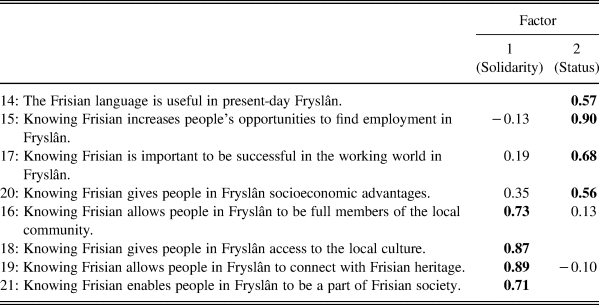
Consequently, the items that loaded onto each factor were combined and their mean was calculated to create an overall value for attitudes on the status dimension and an overall value for attitudes on the solidarity dimension (for all participants who had responded to at least 75% of the items that loaded onto the respective factor, n = 264). To answer RQ1, a Wilcoxon signed-rank test was then used to assess whether there was a significant difference between attitudes on the two dimensions.
Potential predictors
As noted above, seven potential predictors of attitudes towards Frisian were examined: location, age, gender, proficiency in Frisian, Frisian identity, perceived possibility of group membership, and perceived acceptance.
Location was elicited with an open-ended item (2) asking participants where they lived. They were categorised as living either in (a) an urban area or (b) a rural area of Fryslân. Our categorisation was based on the size and linguistic character rather than the official status of municipalities (most of which have different names in Frisian/Dutch). Boalsert/Bolsward, Dokkum, Drachten, Frjentsjer/Franeker, Harns/Harlingen, It Hearrenfean/Heerenveen, Ljouwert/Leeuwarden, and Snits/Sneek all have more than 5,000 inhabitants and they are linguistically quite diverse, with Frisian not usually being inhabitants’ main language. They were categorised as (a) urban. The province's other municipalities have fewer than 5,000 inhabitants and Frisian is much more widespread; these municipalities were categorised as (b) rural.
To elicit participants’ age, an open-ended item (3) asked them how old they were. Gender was elicited with a multiple-choice item (5) with the answer options female, male, and other. Since none of the participants selected other, they were categorised as (a) female and (b) male. Proficiency in Frisian with regard to understanding, speaking, reading, and writing was elicited by means of five-point Likert scales, with 1 meaning not proficient at all and 5 highly proficient (10a, 10b, 10c, and 10d). These ratings were combined and their mean was calculated to create an overall proficiency value (for all participants who had responded to at least 75% of the proficiency items, n = 264).
To investigate the strength of participants’ Frisian identity, we employed a five-point Likert scale item (46) where 1 meant not at all Frisian and 5 very Frisian. To find out whether participants considered it possible for someone who did not grow up speaking the language to be accepted as a full member of the Frisian-speaking community, we used a multiple-choice item (48) with the response options it is possible, it is impossible, and I am not sure. Since there was no meaningful difference between the latter two, we combined these and subsequently only distinguished between (a) those who did perceive it to be possible and (b) those who did not or were unsure. Finally, a five-point Likert scale item (50) was used to examine how accepted participants felt as members of the Frisian-speaking community at the time of data collection, with 1 meaning not accepted at all and 5 fully accepted. To answer RQ2, regressions were performed, establishing which of the potential predictors correlated with attitudes on each dimension.
Evaluations of Afûk Frisian
To elicit participants’ evaluations of Afûk Frisian, we employed eight items whose response options were five-point Likert scales, with 1 meaning not at all [trait] and 5 very [trait]. Four items were designed to tap authenticity (22.1, 22.5, 22.7, 22.8), four to tap anonymity (22.2, 22.3, 22.4, 22.6). The traits were selected based on the aforementioned new speakers research in other minority contexts (e.g. O'Rourke & Ramallo Reference O'Rourke and Ramallo2013; Hornsby Reference Hornsby2015b). As we wanted to avoid using potentially leading terminology such as standard, we asked participants to evaluate ‘the Frisian that is taught at Afûk’.
Again, factor analysis with maximum likelihood factoring and an oblique rotation method (direct oblimin) was employed to ascertain that the items really did tap separate evaluative dimensions. The Kaiser-Meyer-Olkin Index (0.73) and Bartlett's Test of Sphericity (sig. < 0.001) indicated that the data were suitable for factor analysis. Parallel analysis revealed two components; the factor correlation matrix demonstrated that the extracted factors were interrelated and the obliquely rotated solution was thus adequate. With one exception, the items designed to tap authenticity all loaded onto factor 1; and with one exception, the items designed to tap anonymity all loaded onto factor 2 (Table 2). Item 22.8, prestigious, had been included to tap authenticity—but, in fact, it loaded onto the anonymity factor. This was likely due to the (unintentionally ambiguous) choice of terminology: while we had covert prestige in mind, it seems that participants interpreted the item as referring to overt prestige. The latter clearly constitutes a component of anonymity. Item 22.4, correct, had been included to tap anonymity—but, in fact, it loaded onto the authenticity factor. Our assumption that correctness would be linked with anonymity was based on the fact that traditional speakers frequently regard new speakers as ‘linguistic models of correctness’ (O'Rourke et al. Reference O'Rourke, Pujolar and Ramallo2015:12; see also Hornsby Reference Hornsby2015b). However, our findings suggest that the association between correctness and anonymity that is made by traditional speakers is not necessarily shared by new speakers. While further research is necessary to shed light on how exactly new speakers interpret correctness, our results indicated an association with authenticity. Yet, this had no bearing on the overall findings from the factor analysis: namely that a division into authenticity and anonymity as separate evaluative dimensions was supported. Notably, the items that loaded onto each factor had good internal consistency: α = 0.75 for authenticity and α = 0.70 for anonymity.
Factor matrix: Evaluations of Afûk Frisian.
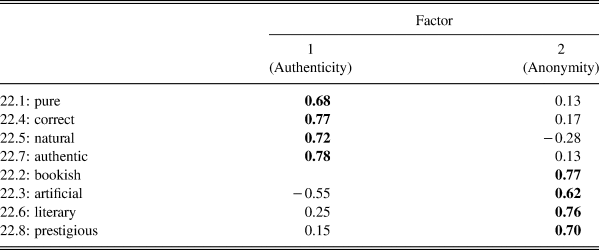
Consequently, the items that loaded onto each factor were combined and their mean was calculated to create an overall value for authenticity and an overall value for anonymity (for all participants who had responded to at least 75% of the items that loaded onto the respective factor, n = 260). To answer RQ3, a Wilcoxon signed-rank test was then used to assess whether there was a significant difference between participants’ evaluations of Afûk Frisian in terms of authenticity and anonymity. To shed further light on participants’ evaluations of Afûk Frisian, we examined the qualitative data they had provided in response to an open-ended item (23) asking them how they would describe ‘the Frisian that is taught at Afûk’. Finally, to answer RQ4, regressions were used to establish whether participants’ attitudes towards the Frisian language on the status and the solidarity dimension constituted predictors of their evaluations of Afûk Frisian in terms of authenticity and anonymity.
Participants
The participant sample whose data we discuss here consisted of 264 new speakers of Frisian—that is, individuals who did not have Frisian as their L1, and who had received little or no home exposure to the Frisian language. All were over the age of eighteen and lived in Fryslân.Footnote 5 9.9% were born in Fryslân, 84.8% elsewhere in the Netherlands, 4.5% outside the Netherlands, and 0.8% did not report their birthplace. 33.0% of participants lived in urban areas and 67.0% in rural areas. Their ages ranged from twenty-three to eighty-two, with a mean age of fifty-five years. 60.2% of participants identified as female, 39.0% as male, and 0.8% did not provide information regarding their gender. A majority of 94.3% had Dutch as their sole L1; 3.8% had Dutch and other languages as their L1s, and a mere 1.9% had only languages other than Dutch as their L1s. The participants’ overall proficiency levels in Frisian ranged from 1 to 4.5, with a mean of 2.5. The strength of their Frisian identity ranged from 1 to 5, with a mean of 2.2. Notably, 70.5% of participants deemed it possible for someone who did not grow up speaking Frisian to be accepted as a full member of the Frisian-speaking community; only 5.7% did not deem this possible, 22.7% were unsure, and 1.1% did not respond. Regarding the participants’ perceived acceptance in the Frisian-speaking community, their ratings ranged from 1 to 5, with a mean of 3.5.
Results
Attitudes towards Frisian
Participants’ attitudes towards Frisian were close to neutral on the status dimension, with a mean of 3.21 (SD = 0.82), and mildly positive on the solidarity dimension, with a mean of 3.76 (SD = 0.85). The Wilcoxon signed-rank test showed that the difference was significant (W = 3711, p < 0.001).Footnote 6
The findings thus did not support H1a (i.e. that new speakers would hold negative status-related attitudes towards Frisian). They indicated that, while the participants did not attribute very high utilitarian value to the language, they at least did not see it as detrimental to achieving socioeconomic success in Fryslân. Unfortunately, it is impossible to establish whether this is a consequence of the aforementioned language planning measures in the province since no comparable data were obtained from new speakers before these measures were implemented.
Our findings did support H1b (i.e. that new speakers would hold positive solidarity-related attitudes towards Frisian). While these attitudes were not quite as positive as one might expect for individuals who have made a commitment to learn the language, the findings nonetheless provided evidence for participants’ affective attachment to Frisian. Moreover, the findings showed that the new speakers in this study held significantly more positive attitudes towards Frisian on the solidarity dimension than on the status dimension.
Multiple regressions were then performed to investigate which of the aforementioned variables correlated with attitudes on each dimension. The reference level for location was urban, the reference level for gender was female. The full model, which contained all variables, did not reveal any significant associations for the status dimension. However, as the significance value for proficiency was close to 0.05, we subsequently ran a pruned model in which we included only proficiency. Here, the association was significant, with higher fluency being associated with more positive status-related attitudes (Table 3). Notably, the results did not support H2a (i.e. that location would be the main predictor for attitudes on the status dimension). We had anticipated that more positive status-related attitudes would be held by new speakers living in rural areas of Fryslân, where Frisian is more widely used. It may be that this was not the case because many inhabitants of rural areas in fact commute to work in urban areas, where Frisian is less prevalent. This would explain why they did not deem the language any more useful than their urban counterparts. Further research is necessary to investigate this.
Multiple regressions: Status dimension.
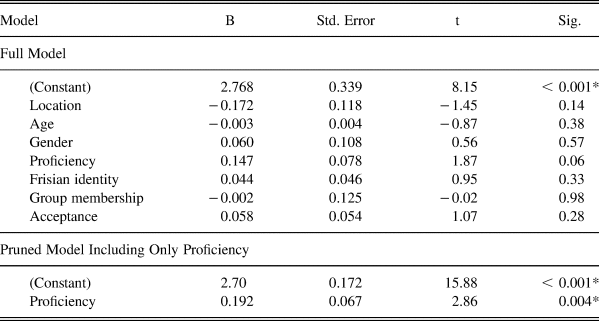
Notes: Full model: R2 = 0.05, Adjusted R2 = 0.02, F(7) = 1.91
Pruned model including only proficiency: R2 = 0.030, Adjusted R2 = 0.026, F(1) = 8.18, p = 0.004
However, a significant association with location did emerge from the results for attitudes on the solidarity dimension—with participants from rural areas holding more positive attitudes towards Frisian than participants in urban areas. This association remained significant when the regression analyses were repeated with a pruned model, including only location as a predictor (Table 4). A potential explanation for this unanticipated finding is that the larger number of Frisian speakers in rural areas provide new speakers with a stronger sense of community, and thus a stronger affective attachment to the language. Since the results did not support H2b (i.e. that Frisian identity would be the main predictor for attitudes on the solidarity dimension), it is possible that the social group with which new speakers identify, and which is at the root of their solidarity-related attitudes, is even more local. Maybe they identify as inhabitants of their particular hamlet or village, rather than as inhabitants of their province. Previous research in other minority language contexts has provided evidence of such localised social identities being linked with language attitudes (Kircher Reference Kircher, Regan, Diskin and Martyn2016b). There is tentative support for this being the case in Fryslân (Kircher & Vellinga Reference Kircher and Vellinga2023b) but more research is needed to confirm.
Multiple regressions: Solidarity dimension.
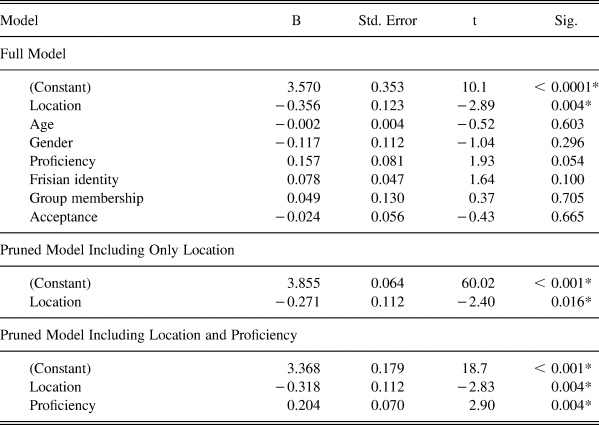
Notes: Full model: R2 = 0.06, Adjusted R2 = 0.04, F(7) = 2.55, p < 0.04
Pruned mode including only location: R2 = 0.021, Adjusted R2 = 0.017, F(1) = 5.78, p = 0.016
Pruned model including location and proficiency: R2 = 0.05, Adjusted R2 = 0.04, F(2) = 7.1, p < 0.0009
Notably, the significance value for proficiency was again close to 0.05 in the full regression model, prompting us to run an additional pruned model in which we included proficiency alongside location—and in this pruned model, the association between proficiency and solidarity-related attitudes was significant. Proficiency thus emerged as a predictor on both attitudinal dimensions.
Evaluations of Afûk Frisian
Evaluations of Afûk Frisian were close to neutral for anonymity, with a mean of 2.99 (SD = 0.64), and mildly positive for authenticity, with a mean of 3.78 (SD = 0.60). The Wilcoxon signed-rank test showed that this difference was significant (W = 22050, p < 0.001).Footnote 7 The results thus supported neither H3a (i.e. that new speakers would evaluate Afûk Frisian positively in terms of anonymity) nor H3b (i.e. that they would evaluate Afûk Frisian negatively in terms of authenticity).
To shed light on these unexpected findings, we examined the qualitative data that participants had provided in response to the open-ended item asking them how they would describe ‘the Frisian that is taught at Afûk’.Footnote 8 These data showed that (at least some) participants did recognise the standardised nature of the variety that is codified in Afûk's teaching materials. They described it as academisch ‘academic’ and labelled it as School Fries ‘School Frisian’ or Standaard Fries ‘Standard Frisian’. The participants’ recognition of the variety's anonymity is also evident from their use of descriptors such as neutraal ‘neutral’, toegangelijk ‘accessible’, and bruikbaar ‘useful’. However, numerous participants also described ‘the Frisian that is taught at Afûk’ in terms that relate to authenticity, including puur ‘pure’, natuurlijk ‘natural’, and authentiek ‘authentic’. They used labels such as geef Frysk ‘unspoilt Frisian’, Klei Fries ‘Clay Frisian’, and Fries uit de Klei ‘Frisian from the Clay region’. A closer look at the data reveals the probable reason why numerous participants evaluated ‘the Frisian that is taught at Afûk’ positively in terms of authenticity: namely because at least some Afûk teachers had in fact been providing their students with an awareness of—and even teaching them—regional variation in their classes. One participant explained, for example, that they were being taught meerdere dialecten van het Fries ‘several dialects of Frisian’; another noted that in class, volgens het boekje maar wel met de nuaces [sic] van de streek waar je woont ‘we follow the book but with the nuances of the region you are living in’; and another elaborated that onze docent had wel aandacht voor regionale varianten ‘our teacher did pay attention to regional varieties’. Participants perceived this positively, as exemplified by this comment: we bespreken de verschillende uitspraken en dat is fijn ‘we discuss different pronunciations and that is nice’. The fact that (at least some) new speakers were being taught (about) the socially and geographically grounded varieties that are commonly associated with traditional speakers constitutes a likely explanation for their positive authenticity-related evaluations of ‘the Frisian that is taught at Afûk’. While we had used this description to refer to the standardised variety codified in Afûk's teaching materials, this is not in fact what the participants were evaluating—or at least not all participants. It is unclear whether all teachers were teaching (about) regional variation. More research is thus needed to tease apart new speakers’ evaluations of the standardised variety of Frisian as compared to varieties with social and territorial roots.
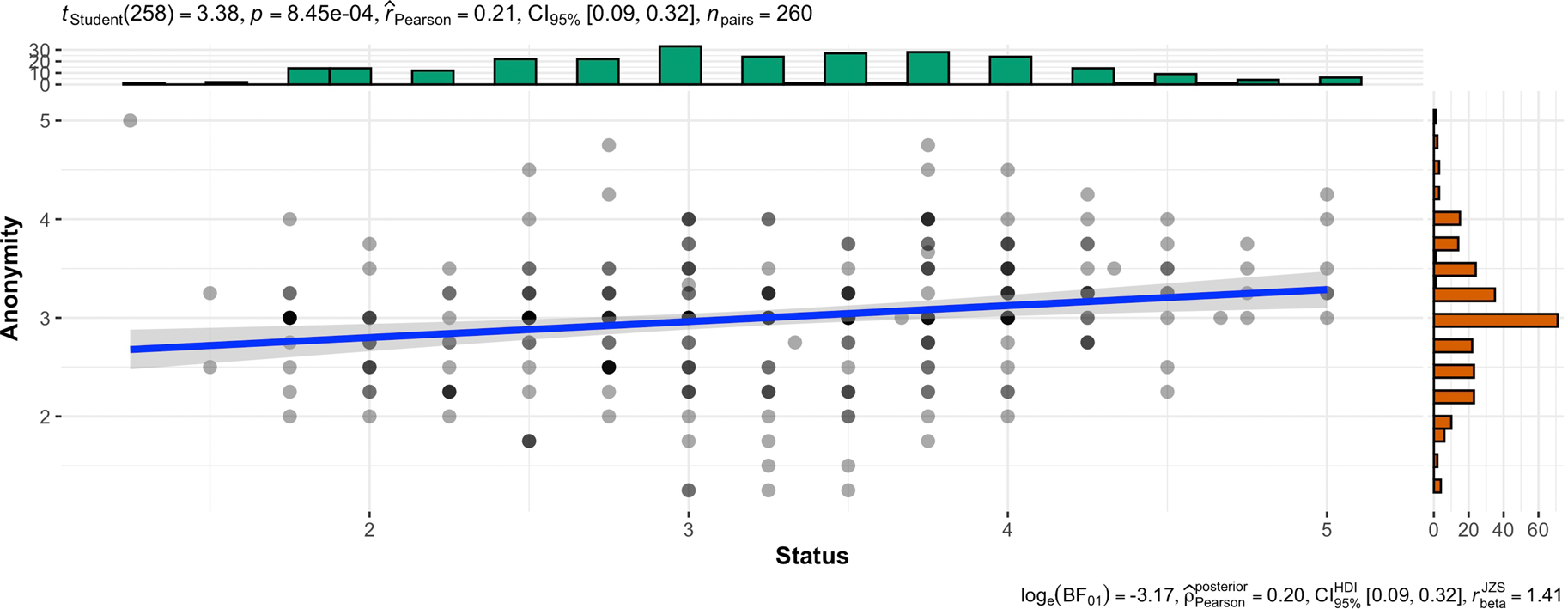
However, this was not a hindrance to assessing whether evaluations of Afûk Frisian in terms of anonymity and authenticity were linked with attitudes towards the Frisian language in terms of status and solidarity. We performed multiple regressions and the results revealed a significant positive association between participants’ status-related attitudes towards Frisian and their anonymity-related evaluations of Afûk Frisian. This association remained significant when the regression analyses were repeated with a pruned model, including only status-related attitudes as a predictor (see Table 5 and Figure 1). The results thus supported H4a. This association can be explained by the fact that both status-related attitudes and anonymity-related evaluations are linked to utilitarian value.
The correlation of status-related attitudes and anonymity-related evaluations.
Multiple regressions: Anonymity.
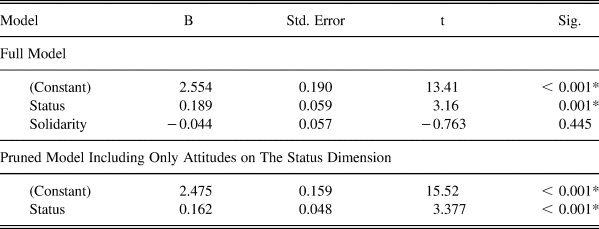
Notes: Full model: R2 = 0.044, Adjusted R2 = 0.037, F(2) = 5.98, p < 0.002
Pruned model including only status: R2 = 0.04, Adjusted R2 = 0.03, F(1) = 11.4, p < 0.001
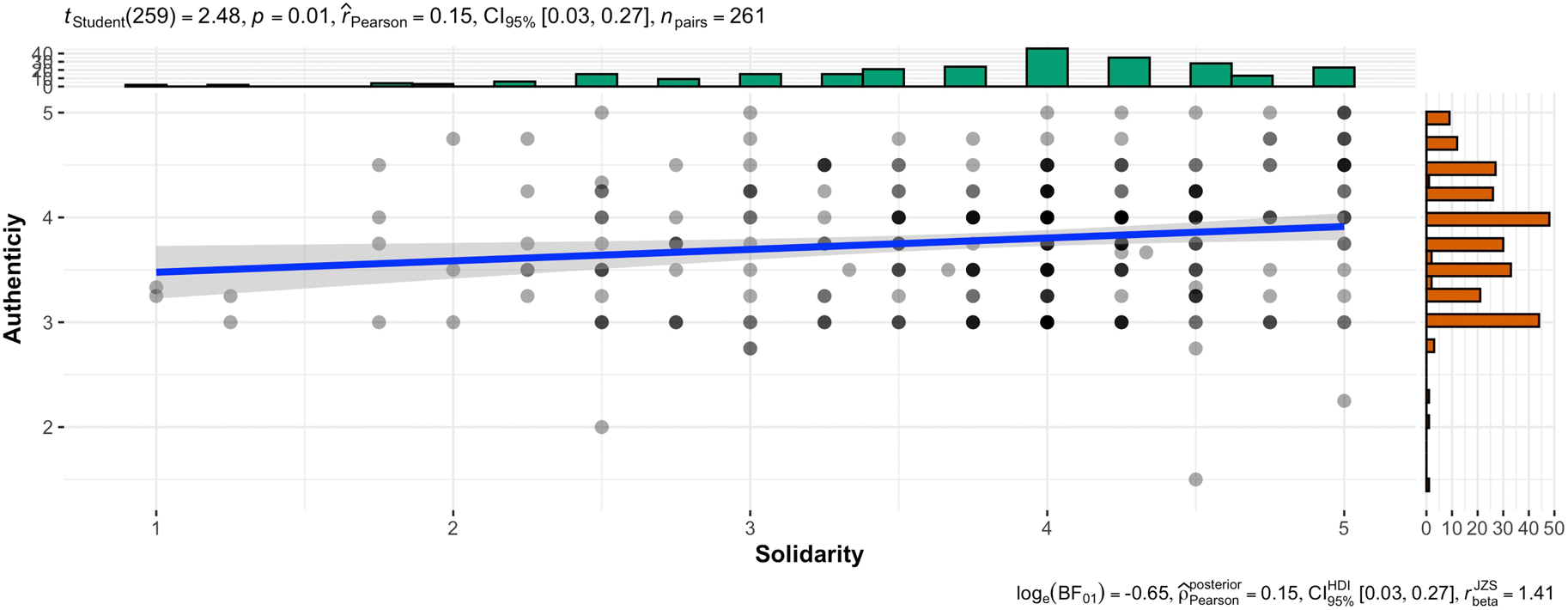
The full model, which contained both status-related and solidarity-related attitudes, did not reveal any significant associations for authenticity-related evaluations of Afûk Frisian. However, since the significance value for solidarity-related attitudes was close to 0.05, we subsequently ran a pruned model in which we included only solidarity-related attitudes. Here, the association was significant (see Table 6 and Figure 2). We had hypothesised that solidarity-related attitudes would correlate negatively with authenticity-related evaluations of Afûk Frisian (H4b); however, in fact, they correlated positively. This can be explained by the aforementioned difference between what we had assumed ‘the variety of Frisian taught at Afûk’ to be (i.e. the standardised variety codified in Afûk's teaching materials) and what the participants had actually evaluated (i.e. socially and geographically grounded regional varieties, alongside the standardised variety). Thus, while H4b was not correct, the underlying idea of our hypothesis was supported: the more positive participants’ solidarity-related attitudes were towards the Frisian language, the more positive their evaluations were of socially and regionally grounded varieties of the language. This association can be explained by the fact that both solidarity-related attitudes and authenticity-related evaluations relate to social group membership and identity.
The correlation of solidarity-related attitudes and authenticity-related evaluations.
Multiple regressions: Authenticity.
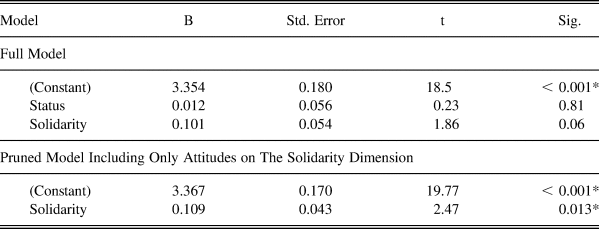
Notes: Full model: R2 = 0.02, Adjusted R2 = 0.01, F(2) = 3.08, p < 0.04
Pruned model including only solidarity: R2 = 0.02, Adjusted R2 = 0.019, F(1) = 6.14, p < 0.013
Discussion
This study investigated (i) new speakers’ attitudes towards their local minority language, namely Frisian; (ii) their evaluations of the specific minority language variety they were taught, namely Afûk Frisian; and the nature of their connection. Our results revealed a systematic and significant relationship between the two, with status-related attitudes towards Frisian correlating positively with anonymity-related evaluations of Afûk Frisian, and solidarity-related attitudes towards Frisian correlating positively with authenticity-related evaluations of Afûk Frisian (RQ4). These correlations can be interpreted as evidence of the conceptual links between new speakers’ attitudes towards the minority language as such, and their evaluations of the specific minority language variety they were taught—based on utilitarian value for status and anonymity, and based on social identity for solidarity and authenticity. While more research is needed to ascertain whether these findings generalise to other minority language contexts and to other speaker groups, our findings from the Frisian context nonetheless provide meaningful insights that advance knowledge relevant to the study of language and society.
Our findings also make a practical contribution by laying the foundation for more comprehensive science communication to inform language planning in minority contexts. The Frisian context serves as a good example. As noted above, to date, revitalisation efforts for Frisian have predominantly taken the form of status planning (i.e. measures that regulate the official role of the language and the domains in which it is used; Kloss Reference Kloss1969) and acquisition planning (i.e. measures that promote knowledge of the language; Cooper Reference Cooper1989). The fact that we found new speakers’ status-related attitudes to be close to neutral and their solidarity-related attitudes to be only mildly positive (RQ1) indicates that these top-down planning measures did not have the necessary support at the grassroots level (cf. Spolsky Reference Spolsky2004). Consequently, a different strategy would be advisable—namely one that focuses on prestige planning (i.e. measures that promote positive attitudes towards the language; Haarmann Reference Haarmann1990). Such a strategy would have two key benefits. Firstly, engendering more positive attitudes towards Frisian amongst individuals who did not grow up with the language would likely lead to higher numbers of new speakers in Fryslân—because, as noted above, language attitudes generally influence language learning (e.g. Gardner & MacIntyre Reference Gardner and MacIntyre1993). Secondly, prestige planning would pave the path for the successful implementation of other types of planning in the future—because ‘[e]very planning effort … has to rely on a kind of psychological background which favors an effective implementation of planning goals and which, ultimately, is the most crucial variable for a long-term success of planning’ (Haarmann Reference Haarmann1990:104).
In the Frisian context, location emerged as a predictor of solidarity-related attitudes (RQ2). While further research is needed to ascertain the precise roots of the more positive solidarity-related attitudes in rural areas, our findings do indicate that prestige planning would be particularly beneficial in urban areas. Moreover, proficiency emerged as a key predictor of both status-related and solidarity-related attitudes in Fryslân (RQ2). The aforementioned promotion of language learning through educational institutions, which is part of the province's existing revitalisation strategy, is therefore going in the right direction—but combining such acquisition planning with prestige planning would most likely enhance its effectiveness.
As noted above, the promotion of a particular language is inextricably connected with the question of which variety of that language should be advanced. Our findings show that new speakers do appreciate being taught (about) regional variation. This suggests that in Fryslân, authority with regard to Frisian is primarily derived from authenticity. However, further research is necessary to tease apart new speakers’ evaluations of (a) the standardised variety of Frisian that is codified in Afûk's teaching materials, and (b) the socially and geographically grounded varieties used by traditional speakers (RQ3). Once more light has been shed on this, it will be possible to formulate advice regarding teaching materials and practices that tie in with the overall prestige and acquisition planning strategies to promote Frisian. For now, we have produced a research report for the provincial government of Fryslân, which includes suggestions for further studies alongside specific policy and planning recommendations based on the findings from our new speakers project (Kircher & Vellinga Reference Kircher and Vellinga2023a).
On the whole, the findings of this study illustrate how knowledge about new speakers’ evaluative reactions to minority languages and their varieties—and the connection between the two—not only advances our general understanding of language in society, but also facilitates the development of more comprehensive science communication to inform language planning in minority contexts. Such knowledge can reveal what type(s) of language planning would likely be effective, it can highlight specific regions and/or subgroups of the population that should receive special consideration, and it can even provide insights into specific practices that would be beneficial. Consequently, knowledge about evaluative reactions to minority languages and their varieties can play an important role in minority language revitalisation.
Strengths, limitations, and directions for future research
The aims of the LENS questionnaire were clearly recognisable, which might have caused responses to be affected by social desirability bias. However, the majority of our data were collected online, and the anonymity offered by online questionnaires reduces the likelihood of social desirability bias. Using a questionnaire enabled us to collect data from a sizable participant sample, thereby allowing us to establish the statistical significance of the connection between (i) new speakers’ attitudes towards Frisian, and (ii) their evaluations of Afûk Frisian. Yet, due to our choice of method, we were unable to follow up on unanticipated findings. Specifically, we were unable to ascertain whether all Afûk instructors teach and/or teach about socially and geographically grounded varieties of Frisian alongside the standardised variety. Additionally, we were unable to tease apart new speakers’ evaluations of these different varieties. It would thus be beneficial for future research to build on our work by using complementary methods such as interviews and focus-groups.
Further research is also needed to ascertain whether our findings generalise to other minority language contexts and to other speaker groups. Moreover, future studies can build on our findings, examining qualitative as well as quantitative data regarding the connection between individuals’ evaluative reactions towards (i) languages as such, and (ii) specific varieties of these languages. In and of itself, such an examination of different data types would not overcome the epistemological challenges involved in establishing a connection between language attitudes and language ideologies. However, an analysis of different data types would certainly enhance our understanding of this connection.


 Open access

