




Non-technical Summary
The earliest Eocene Fur Formation of Denmark (deposited about 55 million years ago) is globally renowned for its exceptionally well-preserved fish fossils. A new species of syngnathiform fish, Gerpegezhus daniaoriundus, from this area, is described herein. The description is based on 17 specimens preserved in either soft diatomite or hard carbonate concretions. Gerpegezhus daniaoriundus n. sp. exhibits a set of diagnostic features of the extinct family Gerpegezhidae and of the genus Gerpegezhus. Based on a number of characteristics it can be clearly separated from the only other known species within this family Gerpegezhus paviai. One of the most striking features of G. daniaoriundus n. sp., is the presence of organic leaf-like appendages protruding from the ventral side of its body. Leaf-like appendages are known in several modern lineages, for example in the seadragons.
Introduction
The Fur Formation and underlying Stolleklint clay of the Ølst Formation of northwestern Denmark document the Paleocene–Eocene Thermal Maximum (PETM) and its immediate aftermath in the North Sea Basin. This time interval is commonly considered one of the best prehistoric analogies of modern climate changes (e.g., Westerhold et al., Reference Westerhold, Röhl, McCarren and Zachos2009; Driese et al., Reference Driese, Nordt, Stinchcomb, Hunt, Egli and Faybishenko2021; Stokke et al., Reference Stokke, Jones, Riber, Haflidason, Midtkandal, Schultz and Svensen2021). The formations contain some of the world’s earliest and best-preserved Cenozoic examples of several modern teleost lineages (Schrøder et al., Reference Schrøder, Rasmussen, Møller and Carnevale2022, Reference Schrøder, Rasmussen, Møller and Carnevale2023a; Schrøder and Carnevale, Reference Schrøder and Carnevale2023, Reference Schrøder and Carnevale2025).
Among these, several syngnathiform taxa assembled from the Eocene Fur Formation are possibly present in the Danish museum’s collections but these have never been taxonomically examined. The interrelationship of the Syngnathiformes have been extensively debated in the last century (e.g., Jungersen, Reference Jungersen1908, Reference Jungersen1910; Pietsch, Reference Pietsch1978; Blot, Reference Blot1980; Johnson and Patterson, Reference Johnson and Patterson1993; Wilson and Orr, Reference Wilson and Orr2011; Stiller et al., Reference Stiller, Short, Hamilton, Saarman, Longo, Wainwright, Rouse and Simison2022). Recently, phylogenetic studies based on morphological and molecular datasets, including both extant and fossil taxa, have largely modified the limits and composition of the Syngnathiformes (e.g., Betancur-R et al., Reference Betancur-R, Broughton, Wiley, Carpenter and López2013; Longo et al., Reference Longo, Faircloth, Meyer, Westneat, Alfaro and Wainwright2017; Santaquiteria et al., Reference Santaquiteria, Siqueira, Duarte-Ribeiro, Carnevale, White, Pogonoski, Baldwin, Ortí, Arcila and Ricardo2021; Murray, Reference Murray2022; Brownstein, Reference Brownstein2023; Near and Thacker, Reference Near and Thacker2024; Thacker and Near, Reference Thacker and Near2025). Phylogenomic analyses concur to resolve the Syngnathiformes as comprising two distinctive clades: (1) the ‘benthic lineages’ comprising Mullidae, Callionymidae, Draconettidae, Dactylopteridae, Pegasidae and Rhamphosidae, and the long-bodied syngnathoids; and (2) the ‘nektonic lineages’, comprising the Syngnathidae, Solenostomidae, Aulostomidae, Fistulariidae, Centriscidae and Macroramphosidae, plus numerous extinct taxa (Santaquiteria et al., Reference Santaquiteria, Siqueira, Duarte-Ribeiro, Carnevale, White, Pogonoski, Baldwin, Ortí, Arcila and Ricardo2021; Stiller et al., Reference Stiller, Short, Hamilton, Saarman, Longo, Wainwright, Rouse and Simison2022; Near and Thacker, Reference Near and Thacker2024; Thacker and Near, Reference Thacker and Near2025). The ‘nektonic lineages’, which contain taxa characterized by very unusual body plans and life histories, share the possession of a small terminal mouth at the end of an elongated tubular snout. The Syngnathoidei includes two major lineages, the first comprising the highly diverse Syngnathidae and Solenostomidae and the second comprising the centriscoids (i.e., the families Macroramphosidae, Centriscidae, and the extinct family Gerpegezhidae), and the aulostomoids (i.e., Aulostomidae and Fistulariidae) (see Bannikov and Carnevale, Reference Bannikov and Carnevale2012; Thacker and Near, Reference Thacker and Near2025), plus several extinct taxa, whose phylogenetic placement is still debated (for an overview, see Sorbini, Reference Sorbini1981; Murray, Reference Murray2022; Brownstein, Reference Brownstein2023; Calzoni et al., Reference Calzoni, Amalfitano, Giusberti, Marramà and Carnevale2023; Near and Thacker, Reference Near and Thacker2024).
The aim of the present paper is to describe a new syngnathiform species referred to the genus Gerpegezhus Bannikov and Carnevale Reference Bannikov and Carnevale2012, G. daniaoriundus n. sp. from the lowermost Eocene Fur Formation in Denmark.
Geological setting
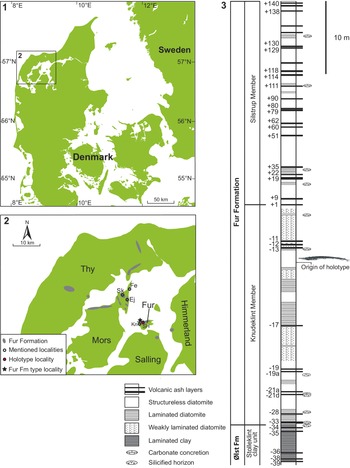
Exposures of the Eocene Fur Formation occur in the western Limfjord area of northern Denmark (Fig. 1.1). Most of the localities are exposed on the islands of Mors and Fur, comprising old digging pits and coastal cliff outcrops. Other important localities and near-surface occurrences are present in the western part of Himmerland, the northern part of Salling, and in the area of Thy (Fig. 1.2). The formation encompasses a fossil-rich, marine argillaceous diatomite, approximately 60 m in thickness. It is interbedded with ~180 ash layers, originating from the volcanic activity related to the opening of the North Atlantic. Bøggild (Reference Bøggild1918) subdivided the ash series into a negative and a positive series from −39 to +140. The two series also reflect the two distinctive members of the Fur Formation: the lower Knudeklint Member, which is mainly laminated with relatively few ash layers, and the upper Silstrup Member, which largely consists of structureless beds with numerous ash layers (Fig. 1.3). Later officially recognized ash layers, not included in the series of Bøggild have been assigned letters alongside the number of the original ash layer (Fig. 1.3; Gry, Reference Gry1940; Pedersen and Surlyk, Reference Pedersen and Surlyk1983; Larsen et al., Reference Larsen, Fitton and Pedersen2003). The formation was presumably deposited in a nutrient-rich upwelling area, causing massive diatom blooms. The laminated beds, overall scarcity of benthic fauna together with other evidence suggest a fluctuating oxygen level, varying from anoxic to slightly dysoxic conditions throughout the sequences (Pedersen, Reference Pedersen1981; Pedersen and Surlyk, Reference Pedersen and Surlyk1983; Heilmann-Clausen et al., Reference Heilmann-Clausen, Nielsen and Gersner1985; Schrøder et al., Reference Schrøder, Rasmussen, Møller and Carnevale2022; Schrøder and Carnevale, Reference Schrøder and Carnevale2023). Today, the ash series from −39 to −34 is considered part of the lowermost section of the Haslund Member of the Ølst Formation, the Stolleklint clay unit (Heilmann-Clausen et al., Reference Heilmann-Clausen, Nielsen and Gersner1985; Heilmann-Clausen, Reference Heilmann-Clausen1995), which also crosses the Paleogene–Eocene boundary (P/E), evident from the onset of the carbon isotope excursion (CIE; Schmitz et al., Reference Schmitz, Peucker-Ehrenbrink, Heilmann-Clausen, Åberg, Asaro and Lee2004; Stokke et al., Reference Stokke, Liu and Jones2020, Reference Stokke, Jones, Riber, Haflidason, Midtkandal, Schultz and Svensen2021).
(1) Map of Denmark showing the area where the Fur Formation is present. (2) Outcrop localities and near-surface occurrences of the Fur Formation. Circles mark the locations from where the studied specimens have been collected. Sk = Skarrehage moclay pit; Ej = Ejerslev moclay pit; Fe = Feggeklit; Kn = Knuden; SH = Stendal Høje, which is also the type locality of the holotype. (3) Sedimentological log showing the positive- and negative-ash series throughout the Stolleklint clay unit of the Ølst Formation and the Fur Formation in the western Limfjord area. The stratigraphic position of the holotype is indicated. Modified from Schrøder and Carnevale (Reference Schrøder and Carnevale2023).

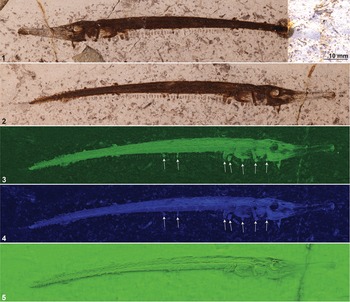
Gerpegezhus daniaoriundus n. sp., holotype FUM-N-14039, nearly complete, well-preserved part and counterpart in soft diatomite, collected from ‘Graven’, the centrally located moclay pit, at the Stendal Høje locality (locality SH in Fig. 1.2), 2 meters below ash layer −13, Knudeklint Member (Fig. 1.3). (1) High-resolution photo image of the holotypic part, FUM-N-14039a, combined with a mosaic image in a different illumination to highlight the caudal-fin impressions and missing parts of the posterior body section. (2) High-resolution photo image of the holotypic counterpart, FUM-N-14039b, which contains the most preserved details of the body morphology. (3) FUM-N-14039b, phosphorous distribution map shown in dark green color. Note the visible leaf-like appendages; some exhibit a strong phosphorous signal, indicated by arrows (compare with Fig. 2.2). (4) FUM-N-14039b, calcium distribution map shown in blue color. The leaf-like appendages are less obvious in this map, however, as in the phosphorous map, several of them exhibit a strong calcium signal. The phosphorous and calcium contents of the leaf-like appendages originate from the bone matrix in the otherwise fragile structures. (5) Image showing the backscatter continuum, where the reflected waves do not originate from a specific element, however the resulting image clearly shows the knobs of the armor plates in medial view, especially evident in the posterior half of the body. The scale bar applies to all images.

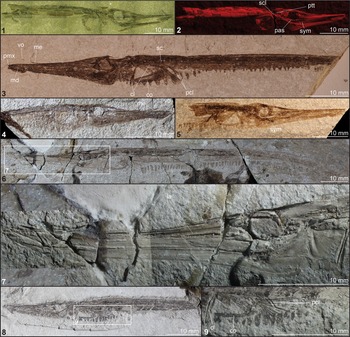
Gerpegezhus daniaoriundus n. sp., paratypes. (1, 2) Paratype MM-65, high-resolution photo image; (2) strontium distribution map of MM-65 shown in red; articulation of the posttemporal (ptt) and supracleithrum (scl) is visible; nearly the entire length of the parasphenoid (pas) and the symplectic (sym) are also visible in this map. (3) Paratype NHMD-1811938; this is the only paratype where all the major parts of the pectoral girdle are visible, including the scapula (sc), left and right postcleithra (pcl), entire cleithrum (cl), comprising both the vertical and horizontal bone elements, and the coracoid (co); the premaxilla (pmx) with a tiny ascending process and the triangular mandible (md) are also recognizable; the mesethmoid (me) and vomer (vo) are preserved slightly disarticulated from the neurocranium with an upright bend. (4) Paratype NHMUK PV P 22178, both the mesethmoid and vomer are slightly disarticulated from the neurocranium as in paratype NHMD-1811938 (3). (5) High-resolution photo image of paratype FUM-N-17055b where the palatine, ectopterygoid, and endopterygoid are visible. The reconstruction in Figure 5 is partly based on this specimen for this reason. (6, 7) Paratype NHMUK PV P 22165 has exquisitely preserved ornamented bones of the head skeleton; (7) enlarged image of the head skeleton of NHMUK PV P 22165, composed of four high-resolution photographs stitched together, showing the ornamentation of the posterodorsal section of the neurocranium, the lachrymal, the preopercle, and the opercle; note particularly the prominent ridges and minute pustules of the lachrymal (la). (8, 9) Paratype NHMUK PV P 22179; the insert of the pectoral girdle is enlarged in (9), showing that the dorsal portion of the cleithrum and the scapula are hidden beneath the uppermost series of bony armor plates; this is the case for all the investigated material with exception of paratype NHMD-1811938 in (3); both the left and right postcleithra are visible as impressions in NHMUK PV P 22179.

The soft diatomite sediment of the Fur Formation consists of approximately 10% volcanic ash, 30–45% clay minerals, and 45–65% diatoms. Fossils preserved in this lithology are commonly preserved as flattened or shallow carbonaceous 3D impressions, where the original elements of the fossils have been completely dispersed to the surrounding pore spaces of the diatomite matrix. Even when bone fragments are still present, the elemental signature of the fossil structures and enclosing matrix is nearly identical (see Schrøder et al., Reference Schrøder, Wielandt, Rasmussen, Carnevale and Storey2023b, fig. 9A–F). However, fossils from certain horizons comprising soft diatomite, such as sequences close to −19, may still display some traces of the original elements emanating from the anatomical structures of the fossil specimens. Such elements may be relevant for exposing anatomical structures not readily available by conventional methods (see Schrøder et al., Reference Schrøder, Wielandt, Rasmussen, Carnevale and Storey2023b, fig. 9G–J).
The calcareous carbonate concretions present in some horizons throughout the formation (Fig. 1.3) were formed just below the sea-floor surface by precipitation of calcite before compaction of the surrounding sediment. Based on δ13C-values the carbonate of the concretions is generally of bacterial origin, and the concretionary CaCO3 content is 75–90 wt% in the core, 70–90 wt% toward the margins, while the calcite is low-Mg calcite (Pedersen and Buchardt, Reference Pedersen and Buchardt1996). The concretions occasionally formed and grew around dead organisms, leaving the fossils within predominantly preserved as calcium-phosphate or calcite fossils (Pedersen and Buchardt, Reference Pedersen and Buchardt1996; Pedersen et al., Reference Pedersen, Pedersen, Steffensen and Pedersen2004) that also contain several other original elements such as Sr and Ti, which directly relate to the body anatomy of the organisms (Schrøder et al., Reference Schrøder, Wielandt, Rasmussen, Carnevale and Storey2023b). The fossils in carbonate concretions, especially the fishes, are usually exquisitely preserved, frequently almost complete, retaining much of their original three-dimensional shape (Schrøder et al., Reference Schrøder, Rasmussen, Møller and Carnevale2022, Reference Schrøder, Rasmussen, Møller and Carnevale2023a, Reference Schrøder, Wielandt, Rasmussen, Carnevale and Storeyb; Schrøder and Carnevale, Reference Schrøder and Carnevale2023).
Material and methods
The present study is based on museum collection material from the earliest Eocene Fur Formation of northwestern Denmark. The material is kept in the collections of the Fur Museum and Museum Mors in northern Denmark, and in the collections of the Natural History Museum, London (United Kingdom). A single specimen from the Natural History Museum of Denmark was also examined. The material housed at the Natural History Museum, London, is part of the Walter Kühne collection. Walter Kühne and his first wife, Charlotte Petsche, collected the material from the soft diatomite of the Fur Formation at the island of Mors (Fig. 1.2, 1.3). Kühne sold the collection to the British Museum in the late 1930s. Only locality information, without precise stratigraphic data, is known concerning this material kept in London.
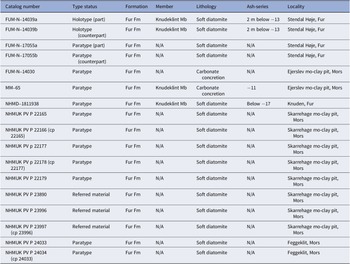
Seventeen specimens from the Fur Formation were examined in this study (Table 1). The material comprises one nearly complete specimen, preserved in soft diatomite (the holotype, part and counterpart, designated herein) and two incomplete specimens preserved in carbonate concretions. The remaining specimens, part of the Walter Kühne collection, the Fur Museum collection, and the vertebrate paleontology collection of the Natural History Museum of Denmark, are all incomplete specimens preserved in soft diatomite (Table 1). Specimens belonging to the new taxon described herein have been reported from the Knudeklint Member only by Danish amateur geologists, and from data in Danish collection databases; hence, it seems highly likely that this species may only be present in the Knudeklint Member of the Fur Formation. The material from the Natural History Museum, London, with no specific stratigraphic data registered, may therefore also all originate from the negative ash series.
Type series, referred material and relevant collection data, cp = counterpart

The material was examined with a Leica M80 stereomicroscope equipped with a camera lucida drawing arm, and selected samples were subjected to μXRF-element mapping (see Schrøder and Carnevale, Reference Schrøder and Carnevale2023; Schrøder et al., Reference Schrøder, Wielandt, Rasmussen, Carnevale and Storey2023b). Fossil acanthomorph fishes preserved in the soft diatomite of the Fur Formation rarely yield element signals applicable for taxonomical purposes (see Schrøder et al., Reference Schrøder, Wielandt, Rasmussen, Carnevale and Storey2023b, p. 18, fig. 9A–E). However, the exceptional preservation of the holotype, made it possible to retrieve element outlines exposing some of the intricate taxonomic details relating in particular to the body armor and leaf-like appendages. We followed the procedures, settings, and equipment outlined in Schrøder and Carnevale (Reference Schrøder and Carnevale2023) (i.e., applying a Bruker M4 Tornado Plus Amics at the Department of Geosciences and Natural Resource Management, Copenhagen University, with a maximum acceleration of 50 kV and an anode current of 600 μA). Morphometric measurements were obtained either directly on the specimens with a digital caliper or with ImageJ due to the very delicate preservation of some of the specimens. Anatomical terminology and measurements follow Bannikov and Carnevale (Reference Bannikov and Carnevale2012).
Anatomical abbreviations
aa = anguloarticular; cl = cleithrum; co = coracoid; dn = dentary; ect = ectopterygoid; endt = endopterygoid; fr = frontal; hyo = hyomandibula; la = lachrymal; le = lateral ethmoid; md = mandible; me = mesethmoid; mtp = metapterygoid; mx = maxilla; na = nasal; op = opercle; pal = palatine; par = parietal; pas = parasphenoid; pcl = postcleithrum; pmx = premaxilla; pop = preopercle; ptt = posttemporal; qu = quadrate; scl = supracleithrum; sph = sphenotic; soc = supraoccipital; sym = symplectic; vo = vomer.
Morphometric abbreviations
AFB = anal-fin base; CPD = caudal peduncle depth; CPL = caudal peduncle length; DFB = dorsal-fin base; DPA = distance between pectoral and anal fins; HD = head depth; HL = head length; LAFR = length of longest anal-fin ray; LDFR = length of longest dorsal-fin ray; MBD = maximum body depth; ML = mandible length; MXBA = Maximum depth of body armor; MXLA = Maximum depth of leaf-like appendage; OD = orbit diameter (measured horizontally); PDD = predorsal distance; POD = preorbital distance; PoOD = postorbital distance; POPL = preopercle length; PPD = prepectoral distance; QL = quadrate length; SL = standard length.
Repository and Institutional Abbreviations
The material examined and figured in this study is deposited in the following institutions: FUM-N = Fur Museum, division of Museum Salling (Denmark); MM = Fossil- and Moclay Museum, division of Museum Mors (Denmark); NHMD = Natural History Museum of Denmark, University of Copenhagen; NHMUK PV P = Natural History Museum, London (United Kingdom), PV P refers to ‘Palaeontology Vertebrates, Pisces’.
Systematic paleontology
Order Syngnathiformes Bleeker, Reference Bleeker1859
Suborder Syngnathoidei Regan, Reference Regan1909
Infraorder Macroramphosa Pietsch, Reference Pietsch1978
Superfamily Centriscoidea Rafinesque, Reference Rafinesque1810
Family Gerpegezhidae Bannikov and Carnevale, Reference Bannikov and Carnevale2012
Genus Gerpegezhus Bannikov and Carnevale, Reference Bannikov and Carnevale2012
Type species
Gerpegezhus paviai, from the Gerpegezh village, Republic of Kabardino-Balkaria, Northern Caucasus, Russia.
Emended diagnosis
A genus unique in having the following combination of characters: body elongate and slender, with maximum body depth contained up to 10 or 15 times in SL; head elongate, anteriorly tubular, its length contained slightly less than four times in SL; 34 (13+21), or up to 40, vertebrae; elongate and slender ossified myoseptal tendons present epaxially and hypaxially with longitudinal arrangement throughout the caudal portion of the vertebral column; 8–16 principal caudal-fin rays; procurrent caudal-fin rays absent; dorsal-fin and anal-fin spines absent; dorsal- and anal-fin rays 5–8 and 16–17, respectively; pelvic fin and girdle absent; anterior part of the body encased by strong bony plates with finely ornamented outer surface; dorsal component of the bony armor comprises two bilateral series of plates of 21–40 narrow and 22–36 subrectangular plates; ventral component of body armor either reduced to a short series of at least six unpaired, flat rectangular plates, or completely absent; posterior part of the body either naked or almost covered by plates for its entire length.
Gerpegezhus daniaoriundus new species
Reference Bonde1987 Syngnathiformes, Bonde, p. 37.
Reference Madsen and Rasmussen2021 Pipefish, Madsen and Rasmussen, p. 47.
Holotype
FUM-N-14039a+b. Well-preserved and nearly complete articulated skeleton preserved in soft diatomite, in part and counterpart, 128.5 mm in SL. Except for a small, glued area near the anal fin, the specimen has not been prepared with or coated by protective chemical substances (Fig. 2, Tables 1–3).
Paratypes
FUM-N-14030, incomplete articulated skeleton with well-preserved body armor of the central part of the body, comprising the body section posterior to the postcleithrum and anterior to the anal fin, preserved in a small slab of carbonate concretion; MM-65, moderately preserved head and anteriormost section of the body, preserved in carbonate concretion, right lateral view; NHMD-1811938, well-preserved head and anterior half of body, preserved in soft diatomite, left lateral view; NHMUK PV P 22165 + NHMUK PV P 22166, well-preserved, incomplete articulated skeleton comprising the head and postcranial skeleton up to the anal-fin insertion, preserved in soft diatomite, in part and counterpart; NHMUK PV P 22177 + NHMUK PV P 22178, well-preserved head and anteriormost part of body, including the pectoral girdle and fin, preserved in soft diatomite, in part and counterpart; NHMUK PV P 22179, well-preserved head and anteriormost part of body; NHMUK PV P 24033 + NHMUK PV P 24034, well-preserved central part of body (head and caudal parts are missing), preserved in soft diatomite, in part and counterpart (Table 1).
Referred material
NHMUK PV P 23996 + NHMUK PV P 23997, incomplete moderately preserved head, preserved in soft diatomite, in part and counterpart; NHMUK PV P 23890, moderately preserved incomplete head and anteriormost part of body, preserved in soft diatomite.
Diagnosis
Gerpegezhus daniaoriundus n. sp. is unique in having the following combination of characters: body extremely elongate and slender, its depth contained about 15 times in SL; 39 or 40 vertebrae; caudal fin with 16 unbranched rays; dorsal fin with five rays; anal fin with 16 rays; pectoral fin with eight unbranched and unsegmented rays; body surface covered by two dorsal bilateral series of interconnected bony plates; dorsal component of the bony armor comprises two bilateral series of plates of 40 narrow and 36 subrectangular plates; ventral component of the body armor absent; up to 59 unpaired leaf-like appendages protruding from ventral part of body.
Known occurrence
Ypresian (earliest Eocene) Knudeklint Member of the Fur Formation, northwestern Denmark (Fig. 1).
Type locality of holotype
Knudeklint Member of the Fur Formation, lowermost Eocene. Collected from Graven at Stendal Høje, on the island of Fur, northwestern Limfjord area, Denmark (Fig. 1.2). ‘Graven’ (= pit) refers to the centrally located moclay pit on Fur (Fig. 1.2). The holotype was collected 2 meters below ash layer −13 (Fig. 1.3).
Description
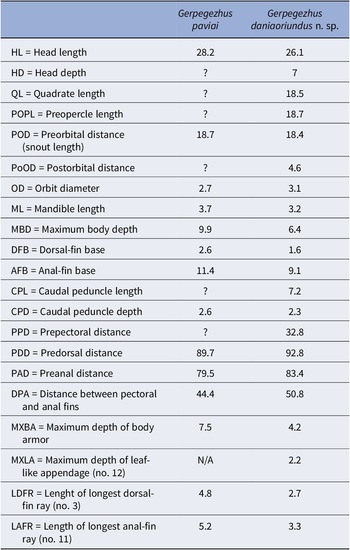
The body is elongate and slender. The maximum body depth is approximately 6.4% of SL, measured immediately posterior to the head. The head is greatly elongated and contained about four times in SL. The snout is contained slightly more than five times in SL. The quadrate occupies 70.2% of the head length. The mouth is small, toothless, and terminal. The orbit is almost circular, its diameter occupies almost 12% of the head length, representing 3.1% of SL. The bones of the head skeleton are delicate, feebly ossified, papery, and often characterized by a slightly cancellous texture.
Neurocranium
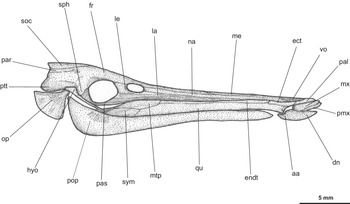
The neurocranium is slender, strongly elongate, and narrowed (Figs. 2–5). The bones of the posterolateral area of the neurocranium are difficult to recognize in the majority of the specimens due to the ornamentation and cancellous structures of this area. However, based on μXRF maps of the holotype FUM-N-14039 (Fig. 2.1–2.4) and paratype MM-65 (Fig. 3.1, 3.2), it is possible to disclose some details. The surface of the supraoccipital forms the posteriormost part of the skull roof and appears to be almost flattened dorsally; it articulates anteriorly with the frontals, and laterally with the parietals. The exact outline of the bones in this region of the neurocranium is difficult to recognize; however, it appears that the parietal is narrow and articulates with the pterotic laterally. The frontals are elongate, laterally expanded posterodorsally to the orbit, and tapering anteriorly; posterolaterally, the frontals articulate with the pterotic and sphenotic, anteriorly with the mesethmoid, approximately at the mid-length of the snout, and with the nasals and lateral ethmoids anterolaterally. The lateral ethmoid constitutes the anterior border of the orbit, while the frontal forms the dorsal border. The posterior border of the orbit was formed by the sphenotic, but the outline of this bone is often difficult to recognize; it appears that the sphenotic articulates with the pterotic posteriorly. The mesethmoid is elongate and narrow and articulates laterally with the nasals. The vomer is slender and elongate. Due to the delicate nature of the bones, both the mesethmoid and vomer are occasionally preserved slightly disarticulated from the neurocranium with an upright bend (Fig. 3.3, 3.4). The nasals are narrow and greatly elongated; medially, the nasal articulates with the mesethmoid, anteriorly with the vomer, posteriorly with the frontal, and posteromedially with the lachrymal. What appears to be remnants of the nasal capsule is bordered by the nasal, frontal, lateral ethmoid, and the lachrymals (Figs. 2, 3.3–3.5). The parasphenoid is slender and gently curved posteriorly; it is visible in the ventral half of the orbit, and extends anteriorly behind the lachrymal, reaching the ventral boarder of the lateral ethmoids (Figs. 2, 3.1–3.5).
Circumorbital bones
The infraorbital series is reduced to only the lachrymal; it is prominent and finely ornamented with horizontal ridges dorsally. Towards its ventral margin, the ridges are slightly higher than the dorsal ones and finely sculptured with minute pustules (Fig. 3.6, 3.7).
Jaws
The mouth is diminutive, terminal, and toothless. The upper jaws comprise what appears to be a very reduced, minute rod-like premaxilla with a very tiny ascending process, only recognizable in a few paratypes (Fig. 3.3, 3.5), and a very small maxilla. There is no supramaxilla. The mandible is small, compact, and triangular in outline. The suture between the dentary and the anguloarticular is difficult to recognize (Fig. 3.3, 3.5). The dentary exhibits a small coronoid process, and the anguloarticular exhibits a distinctive articular facet for the articular condyle of the quadrate.
Suspensorium
The hyomandibula is very thin, elongate, with an expanded articular head (Figs. 2, 3.3, 3.5); it appears to be nearly parallel to the anterior margin of the vertical arm of the preopercle. The metapterygoid is moderately developed, ovoid in outline with a gently rounded dorsal margin (Fig. 3.4, 3.5). The symplectic is visible in paratype MM-65 (Fig. 3.2), contacting ventrally the preopercle. It appears, however, more massive in paratype FUM-N-17055 (Fig. 3.5). The quadrate is massive and almost rectangular in outline, occupying 70.2% of HL; its anteroventral margin is particularly thickened, terminating into a prominent articular condyle for the mandible; it articulates with the dorsal margin of the preopercle (Fig. 3.3, 3.6, 3.7). The endopterygoid, ectopterygoid, and palatine are recognizable in paratype FUM-N-17055 (Fig. 3.5).
Opercular series
The preopercle is prominent with laminar horizontal and vertical arms, occupying approximately 72% of the head length, and 18.7% of SL. Anteroventrally, the preopercle is rather slender, while the posteroventral laminar portion is expanded; the dorsal and ventral margins are thickened, forming a lower and upper prominent ridge, and the upper lateral surface of the horizonal arm is ornamented with minute knobs (Fig. 3.7); the convergence of the horizontal and vertical arms results in an angle of about 125°, and the outer surface of this area is ornamented by up to 15 short ridges diverging from the dorsal margin of the preopercle; the horizonal arm articulates with the ventral border of the massive quadrate, while the posterior laminar margin of the vertical arm is smooth and gently rounded. The opercle is thin and laminar, exhibiting a distinctly rounded ventral outline and a slightly concave dorsal border; its lateral surface is ornamented with radiating ridges, originating from the anterodorsal corner, where a minor articular condyle is also present (Fig. 3.3, 3.4, 3.6, 3.7). The subopercle and interopercle cannot be recognized in the examined material.
Hyoid apparatus and branchial skeleton
No bones of the hyoid apparatus or the branchial skeleton are properly exposed in the available material.
Vertebral column and intermuscular bones
In all examined specimens, the vertebral column is covered by thick interconnected bony plates that form the body armor. Bannikov and Carnevale (Reference Bannikov and Carnevale2012) hypothesized that in Gerpegezhidae there is a one-to-one relationship between armor plates and vertebrae, based on comparison with extant centriscids (see Jungersen, Reference Jungersen1908; Bannikov and Carnevale, Reference Bannikov and Carnevale2012). Following this criterium, it is possible to estimate that 39 or 40 vertebrae were present in Gerpegezhus daniaoriundus n. sp.; however, in the holotype, it is possible to recognize the impression of the vertebral centra, and/or the neural and haemal spines of the posterior 21 vertebrae, which also correlate with their corresponding plates (Fig. 2.2–2.5). The vertebral centra decrease in length posteriorly in the series, being subrectangular in outline, longer than high. Elongate and slender myoseptal ossified tendons are visible in the posterior half of the body, along the dorsal and ventral margins of the dermal plates.
Caudal skeleton and fin
The caudal skeleton is incompletely preserved, and solely in the holotype, in which it is possible to recognize an autogenous parhypural, a hypural plate with dorsal and ventral lobes separated by a notch, and a single autogenous epural. The caudal fin appears to be rounded and consists of 16 unbranched caudal-fin rays. Dorsal and ventral procurrent rays are absent.
Median fins and supports
Both the dorsal and anal fins are incompletely preserved in the holotype. The dorsal fin is extremely short-based, occupying 1.6% of SL, the predorsal distance is approximately 93% of SL. At least five unbranched and unsegmented rays are present, and there is no evidence of dorsal-fin spines. Remnants of at least five dorsal-fin pterygiophores can be recognized. The longest dorsal-fin ray is 2.7% of SL, hence longer than the dorsal-fin base, which is 1.6% of SL. The anal fin is comparatively long-based, approximately 9% of SL, the preanal distance is approximately 83.4% of SL. It appears to contain 16 unbranched and unsegmented rays, supported by 16 pterygiophores. The 11th ray is the longest, representing 3.3% of SL.
Paired fins and girdles
The posttemporal appears to be small, stout and ovoid in outline; it is located immediately ventrally to the pterotic, incorporated into the neurocranium; it articulates with the supracleithrum (Fig. 3.1, 3.2). The vertical process of the cleithrum is distinctly visible in most of the available specimens, immediately posterior to the opercle. The remaining dorsal portion of the cleithrum and the scapula are hidden beneath the uppermost series of bony armor plates (Fig. 3.8, 3.9), except for paratype NHMD-1811938 (Fig. 3.3). The scapula is nearly oval, pierced by a large scapular foramen. The horizontal portion of the cleithrum appears to be anteriorly expanded and gently rounded, articulating with the scapula (Fig. 3.3). The vertical arm of the cleithrum is prominent and elongated with thickened anterior and posterior margins, extending ventrally almost until the distal end of the leaf-like appendages placed directly below it, where it articulates with the horizontal portion of the coracoid (Fig. 3.3, 3.8). The vertical portion of the coracoid is obscured by the pectoral rays, although it appears to be expanded towards the articulation with the scapula. The postcleithrum is thin, with a pointed distal end, and is characterized by a distinct abrupt ventral, rounded curvature. Both the left and right postcleithra are visible in several of the paratypes (Fig. 3.3, 3.8, 3.9). The pectoral fin is rounded and contains eight unbranched and unsegmented rays.
Pelvic fins and girdles are absent.
Squamation
Most of the body is covered by thick, strong, interconnected bony plates, which extend backward until the second preural vertebra (Fig. 2). This body armor is composed of two bilateral and parallel series of dermal plates (Figs. 3, 4), corresponding to those of the dorsal component of the almost coeval Gerpegezhus paviai (see Bannikov and Carnevale, Reference Bannikov and Carnevale2012). The plates of both series are finely ornamented by a vermiform pattern formed by minute irregular longitudinal ridges and grooves (Figs. 3.9, 4.1–4.6).
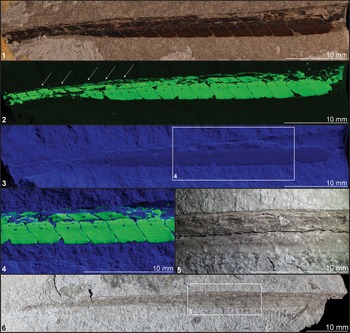
Gerpegezhus daniaoriundus n. sp., paratypes. (1–4) Paratype FUM-N-14030; (1, 2) High-resolution photo image of paratype FUM-N-14030, incomplete articulated skeleton with well-preserved body armor of the central part of the body, and (2) phosphorous distribution map, in dark green color, showing subrectangular outline of the plates and the vermiform pattern formed by minute irregular longitudinal ridges and grooves; the plate knobs appear as small holes in this map, because they lack phosphorous; the ossified myoseptal tendons are indicated by arrows; (3) calcium element distribution map of FUM-N-14030, shown in blue; note the small, slightly pointed knobs rich in calcium; (4) enlarged armor section of FUM-N-14030, proportions indicated by the frame in (3); combined phosphorous and calcium maps, highlighting the intricate plate ornamentation and the intact posterior zig-zag profile of the lower dorsal series. (5, 6) Magnified section of the body armor in paratype NHMUK PV P 24033, showing the lower series, broken at the level of the zig-zag interconnection and high-resolution photo image of the entire paratype; the frame in (6) indicates the enlarged area shown in (5).

Gerpegezhus daniaoriundus n. sp. Reconstruction of the head, based primarily on paratypes FUM-N-17055b and NHMUK PV P 22165. Anguloarticular (aa); dentary (dn); ectopterygoid (ect); endopterygoid (endt); frontal (fr); hyomandibula (hyo); lachrymal (la); lateral ethmoid (le); maxilla (mx); mesethmoid (me); metapterygoid (mtp); nasal (na); opercle (op); palatine (pal); parasphenoid (pas); parietal (par); premaxilla (pmx); preopercle (pop); posttemporal (ppt); quadrate (qu); sphenotic (sph); supraoccipital (soc); symplectic (sym); vomer (vo).

The first plate of the upper series originates above the posterior third of the opercle (Fig. 3.6, 3.7). A central knob can be observed from the second plate throughout the dorsal series (Figs. 2.5, 3.6). The exact outlines of the anterior plates of the upper series are difficult to determine, however, they appear to have slightly rounded margins and are oblong to polygonal in outline (Figs. 2–4). Above the pectoral girdle they seem to become elongate and subrectangular, much longer than high. Along the upper series, they become anteroposteriorly compressed, and, at the level of the anal fin, they are more compressed and rhomboid in outline (Figs. 2.5, 3.6, 3.8, 4.1–4.6).
The plates of the lower series originate at the level of the pectoral-fin base, thereby leaving the abdominal region apparently naked. The plates of the lower series are almost subrectangular, with rounded posterior margins. They bear a superficial centrally located small knob, and approximately at the level of it, the posterior margin of the plate has a short posterior zig-zag profile; the portion of the plate dorsal to this zig-zag profile exhibits two additional knobs closer to the anterior and posterior margins of the plate, respectively (Fig. 4.1–4.4). Most of the plates of the lower series are usually broken at the level of the zig-zag interconnection (Fig. 4.5, 4.6). Anteriorly in the series, the plates are much longer than high. Towards the anal fin, however, they become anteroposteriorly compressed and extremely reduced in height, bearing only a single, central knob laterally overlying the haemal spines. Towards the caudal fin, the plates are nearly quadrangular. There is no ventral component of the body armor.
Unpaired and extremely delicate leaf-like appendages, with a straight dorsal margin and a rounded ventral margin protrude from the ventral side of the body. In the holotype, at least 59 of these can be recognized. The deepest of the leaf-like appendages is located ventrally to, or slightly behind, the pectoral-fin base. Hence, the deepest one can be either the 10th, 11th, or 12th in the series. Their maximum depth is slightly more than 2% of SL.
The leaf-like appendages are predominantly preserved as carbonaceous structures, but it appears that they probably were composed of both organic components, e.g., connective fibers, and bony matrix as evinced by the phosphorous signals in the holotype (Fig. 2.3).
Etymology
The name is the contraction of the two words Dania, which is Latin for ‘Denmark’, and oriundus, meaning ‘descending from’ or ‘originating from’ in Latin.
Remarks
Gerpegezhus daniaoriundus n. sp. is currently known only from the Eocene Fur Formation, exposed in northern Denmark. The species is predominantly known from the soft diatomites, and presumably only present in the Knudeklint Member based on database registrations and reports from Danish fossil hunters to the authors. The not uncommon presence of this new species in the Knudeklint Member has also been reported by Bonde (Reference Bonde1987, p. 37). The different modes of fossil preservation related to the lithologies of the Fur Formation concerning this taxon (i.e., soft diatomite- or carbonate concreted-preservation) result in a different degree of completeness of the morphological details of G. daniaoriundus n. sp., which may be fully preserved in one lithology, but not in the other. A remarkable example of this relates to the unpaired leaf-like appendages evident from the specimens of G. daniaoriundus n. sp. preserved in the soft diatomite. These structures are, surprisingly, not preserved in the carbonate concretions. This is most likely due to the fragility and possibly stronger organic components of the structures, leaving little to no element signals behind from the bony matrix. This is supported by the μXRF analyses of the holotype, delicately preserved in soft diatomite, where only a few of these structures are visible in the phosphorous and calcium maps. However, this clearly indicates the original presence of bony matrix within the structures (Fig. 2).
Discussion
As discussed above, recent phylogenomic studies (e.g., Santaquiteria et al., Reference Santaquiteria, Siqueira, Duarte-Ribeiro, Carnevale, White, Pogonoski, Baldwin, Ortí, Arcila and Ricardo2021) have resolved the Syngnathiformes as comprising two major, but very distinctive clades, exhibiting different ecologies and morphological traits, referred to as the ‘benthic clade’ and ‘the more nektonic clade’ by Thacker and Near (Reference Thacker and Near2025). This reorganization of the composition of Syngnathiformes currently lacks clear morphological evidence uniting the two clades within. However, the second major clade, that is characterized by a wide range of morphological variation and ecological adaptations, comprises Syngnathidae, Solenostomidae, Aulostomidae, Fistulariidae, Centriscidae, and Macroramphosidae (Thacker and Near, Reference Thacker and Near2025), which exhibits some of the iconic traits traditionally associated with Syngnathiformes.
The second, nektonic clade roughly corresponds to the suborder Syngnathoidei (Pietsch, Reference Pietsch1978; Sorbini, Reference Sorbini1981; Johnson and Patterson, Reference Johnson and Patterson1993; Orr, Reference Orr1995; Wiley and Johnson, Reference Wiley, Johnson, Nelson, Schultze and Wilson2010; Wilson and Orr, Reference Wilson and Orr2011; Bannikov and Carnevale, Reference Bannikov and Carnevale2012; Betancur-R et al., Reference Betancur-R, Wiley, Arratia, Acero, Bailly, Miya, Lecointre and Ortí2017; Santaquiteria et al., Reference Santaquiteria, Siqueira, Duarte-Ribeiro, Carnevale, White, Pogonoski, Baldwin, Ortí, Arcila and Ricardo2021; Stiller et al., Reference Stiller, Short, Hamilton, Saarman, Longo, Wainwright, Rouse and Simison2022; Thacker and Near, Reference Thacker and Near2025). This clade is currently considered to be composed of two major lineages comprising: (1) the highly diverse Syngnathidae and Solenostomidae and (2) the centriscoids (i.e., the two extant families Macroramphosidae and Centriscidae) and the aulostomoids (i.e., Aulostomidae and Fistulariidae). The new species described herein displays a set of the iconic syngnathoid features, such as a small and toothless terminal mouth at the end of an elongated tubular snout, reduction of the infraorbital series, and strong body armor composed of dermal plates.
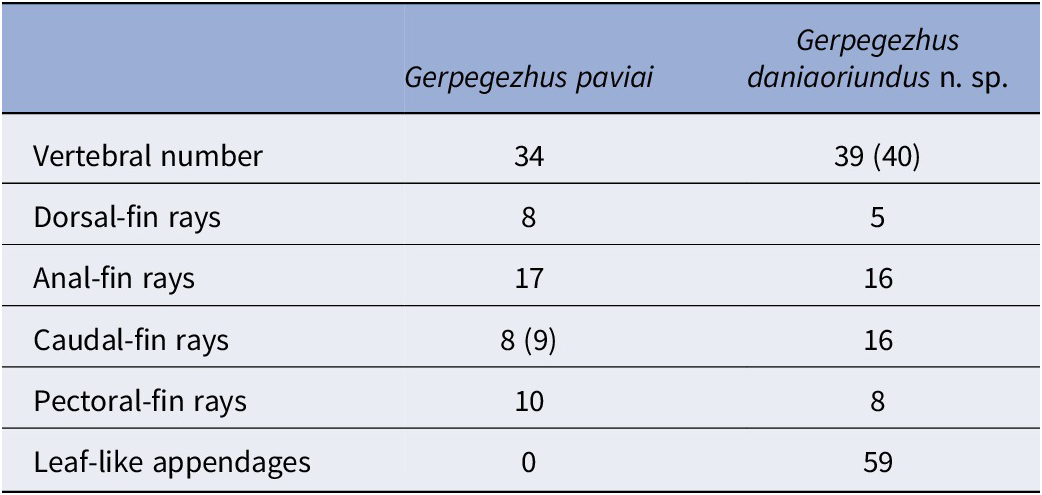
Following Bannikov and Carnevale (Reference Bannikov and Carnevale2012), the centriscoids comprise two extant families, the Macroramphosidae and the Centriscidae, and a couple of extinct families, the Gerpegezhidae and Paraeoliscidae (e.g., Blot, Reference Blot1980; Orr, Reference Orr1995; Thacker and Near, Reference Thacker and Near2025). Gerpegezhus daniaoriundus n. sp., possesses distinct morphological characters that places it within this lineage (Bannikov and Carnevale, Reference Bannikov and Carnevale2012), including (1) sphenotic articulating posteroventrally with the hyomandibula, (2) preopercle posteroventrally expanded, (3) anterior part of body (partly) encased by interconnected dermal plates, (4) parietal present, (5) infraorbitals reduced to the lachrymal, and (6) upper procurrent caudal-fin rays absent. Moreover, the new species exhibits a set of features that are diagnostic of the extinct family Gerpegezhidae and of the sole included genus Gerpegezhus, such as the greatly elongated body, presence of ossified myoseptal tendons, lower procurrent caudal-fin rays absent, dorsal- and anal-fin spines absent, and pelvic fin and girdle absent. Two other diagnostic characters were listed in the original description of the genus Gerpegezhus: the ventral component of the body armor reduced, and the body naked posteriorly. In G. daniaoriundus n. sp. the ventral component of the body armor is completely absent, and the dermal armor plates are present almost throughout the entire length of the body, with only a smaller area of the abdominal region being naked. In addition, Gerpegezhus daniaoriundus n. sp. can be clearly separated from Gerpegezhus paviai by having a much slenderer body bearing unpaired leaf-like appendages protruding from its ventral side and completely different meristic and morphometric values (see Tables 2, 3).
Synopsis of meristic values of Gerpegezhus species. Includes both new data and data from Bannikov and Carnevale (Reference Bannikov and Carnevale2012)

Synopsis of morphometric values (as % of SL) of the Gerpegezhus species. Includes both new data and data from Bannikov and Carnevale (Reference Bannikov and Carnevale2012).

The presence of leaf-like appendages emerging along the ventral part of the body represents one of the most remarkable features of G. daniaoriundus n. sp. Leaf-like appendages or leaf-like structures are known in other syngnathoid fishes, including three extant species of seadragons, i.e., the weedy seadragon Phyllopteryx taeniolatus (Lacepède, Reference Lacepède1804), the leafy seadragon Phycodurus eques (Günther, Reference Günther1865), and the ruby seadragon Phyllopteryx dewysea Stiller, Wilson and Rouse, Reference Stiller, Wilson and Rouse2015. In the ruby seadragon these structures are more stumpy lobes than elongate leaf-like structures (Stiller et al., Reference Stiller, Wilson and Rouse2015).
The long leaf-like appendages of seadragons consist of both connective tissue enriched in collagenous fibers and bone matrix (Qu et al., Reference Qu, Liu, Zhang, Wan and Ravi2021), responsible for the flexibility of the structures, which are thought to have evolved as a camouflage, mimicking seaweeds (Stiller et al., Reference Stiller, Wilson and Rouse2015). Similar structures, referred to as cristae, protruding from the ventral side of the body have also been described in the extinct pipefish genus Hipposyngnathus Daniltshenko, Reference Daniltshenko1960 (Přikryl et al., Reference Přikryl, Krzemiński and Kania2011), which is currently considered part of the subfamily Hipposyngnathinae Fritzsche, Reference Fritzsche1980. These leaf-like appendages or structures homoplasiously occur within different syngnathid lineages (Wilson and Rouse, Reference Wilson and Rouse2010) and Gerpegezhus daniaoriundus n. sp.
As a final comment, it is interesting to note that even though the ichthyofauna of the Fur Formation appears to be characterized by significant endemism (e.g., Bonde, Reference Bonde1997, Reference Bonde, Calvin, Longbottom and Richter2008; Schrøder et al., Reference Schrøder, Rasmussen, Møller and Carnevale2022, Reference Schrøder, Rasmussen, Møller and Carnevale2023a; Schrøder and Carnevale, Reference Schrøder and Carnevale2023), the occurrence of the genus Gerpegezhus documented herein provides a remarkable example of the biogeographic relationships between the North Sea realm and the Tethys during the earliest Eocene.
Acknowledgments
Our sincere thanks to K. Szilas for access to the μXRF facilities and equipment at the Department of Geosciences and Natural Resource Management, Copenhagen University. R.L. Sylvestersen and B. Schultz (Fur Museum, Museum Salling) are cordially thanked for organizing and authorizing the loan of specimens FUM-N-14030, FUM-N-14039a+b, FUM-N-17055a+b, and for detailing info regarding the holotype locality. F. Osbæck is warmly thanked for removing the wooden edges of the box encasing the holotypic counterpart, in order for us to perform μXRF-analyses, and for providing other relevant preparational data on the holotype specimen. H. Madsen is cordially thanked for authorizing the loan of MM-65. Special thanks to E. Bernard (NHMUK) for providing access to the collection material of W. Kühne kept in London. AES also wishes to thank A. Illum (NHMD) and B.E.K. Lindow (NHMD) for technical assistance and for authorizing access to the facilities, including the photolab, at the Zoological Museum (Copenhagen University). The research of AES was supported by Carlsberg Foundation grant no. CF23-1059. The research of GC was supported by grants (ex-60% 2024) from the Università degli Studi di Torino. We greatly appreciate the comments and suggestions by A.F. Bannikov and one anonymous reviewer, and for recommendation by associate editor A. Murray.
Competing interests
The authors have no competing interests to declare.

 Open access

