





Introduction
Behavioral problems, typically characterized by internalizing and externalizing problems (Achenbach et al., Reference Achenbach, Ivanova, Rescorla, Turner and Althoff2016), are prevalent in grade school (Centers for Disease Control and Prevention, Reference Perou, Bitsko, Blumberg, Pastor, Ghandour, Gfroerer, Hedden, Crosby, Visser, Schieve, Parks, Hall, Brody, Simile, Thompson, Baio, Avenevoli, Kogan and Huang2013) and pose significant risks for peer difficulties (Fanti & Henrich, Reference Fanti and Henrich2010), poor academic performance (Deighton et al., Reference Deighton, Humphrey, Belsky, Boehnke, Vostanis and Patalay2018; Shi & Ettekal, Reference Shi and Ettekal2021), suicidal ideation and behaviors (Commisso et al., Reference Commisso, Temcheff, Orri, Poirier, Lau, Côté, Vitaro, Turecki, Tremblay and Geoffroy2023; Duprey et al., Reference Duprey, Oshri and Liu2020), and various psychopathologies in children and adolescents (Blain-Arcaro & Vaillancourt, Reference Blain-Arcaro and Vaillancourt2019; Danneel et al., Reference Danneel, Nelemans, Spithoven, Bastin, Bijttebier, Colpin, Van Den Noortgate, Van Leeuwen, Verschueren and Goossens2019). Internalizing problems reflect overinhibited or internally focused behaviors, such as anxiety, depression, and social withdrawal, whereas externalizing problems involve disinhibited or externally focused behaviors, including aggressive, disruptive, and delinquent behaviors (Achenbach et al., Reference Achenbach, Ivanova, Rescorla, Turner and Althoff2016). Despite the distinct symptoms associated with internalizing and externalizing problems, longitudinal evidence suggests that these problems are closely related and tend to co-occur starting early childhood (Nivard et al., Reference Nivard, Lubke, Dolan, Evans, St. Pourcain, Munafo and Middeldorp2017; Willner et al., Reference Willner, Gatzke-Kopp and Bray2016). Internalizing and externalizing problems also share etiological mechanisms, including environmental toxins and individual deficits, such as low levels of executive function (EF; McNeilly et al., Reference McNeilly, Peverill, Jung and McLaughlin2021; Nelson et al., Reference Nelson, Kidwell, Nelson, Tomaso, Hankey and Espy2018; Wang & Liu, Reference Wang and Liu2021).
However, questions remain regarding whether different aspects of EF, particularly hot and cool EF, are uniquely associated with the development of internalizing and externalizing problems, and whether their associations reflect stable individual differences at the trait level or situational fluctuations at the state level. To address these questions, this longitudinal study examines the unique associations between hot and cool EF skills and behavioral problems in grade school by differentiating the between- and within-individual effects in the development of internalizing and externalizing problems over time. This investigation is situated in the framework of Developmental Psychopathology (Rutter & Sroufe, Reference Rutter and Sroufe2000; Rutter, Reference Rutter2013), which suggests that risk factors in individual characteristics can initiate a pathway to adjustment problems by promoting aversive experiences. Within this perspective, low levels of EF may represent a risk factor in children’s neurocognitive processes that could potentially set in motion children’s difficulties in daily functioning, which subsequently may facilitate the development of behavioral problems as children navigate the grade school.
Differentiating hot and cool executive function
EF refers to the deliberate, top-down processes that are involved in the goal-directed control of thoughts, behaviors, and emotions (Miyake et al., Reference Miyake, Friedman, Emerson, Witzki, Howerter and Wager2000; Miyake & Friedman, Reference Miyake and Friedman2012). Under the umbrella term of self-regulation, EF largely overlaps with effortful control in early (Schmidt et al., Reference Schmidt, Daseking, Gawrilow, Karbach and Kerner auch Koerner2022) and middle childhood (Rea-Sandin et al., Reference Rea-Sandin, Clifford, Doane, Davis, Grimm, Russell and Lemery-Chalfant2023), both tapping into the same underlying self-regulation construct. Recent literature has introduced a distinction between the hot and cool aspects of EF (Lensing & Elsner, Reference Lensing and Elsner2018; Peterson & Welsh, Reference Peterson, Welsh, Goldstein and Naglieri2014; Zezalo, Reference Zelazo2020; Zelazo & Carlson, Reference Zelazo and Carlson2012). Cool EF, overlapping with the traditional conceptualization of EF, encompasses goal-directed cognitive skills, including inhibition, working memory, sustained attention, and cognitive flexibility. These skills are evident in decontextualized, neutral, and non-emotional tasks that lack emotional or motivational components (Peterson & Welsh, Reference Peterson, Welsh, Goldstein and Naglieri2014; Zelazo & Carlson, Reference Zelazo and Carlson2012), such as the Continuous Performance Task (Beck et al., Reference Rosvold, Mirsky, Sarason, Bransome and Beck1956), the classic Stroop Task (Stroop, Reference Stroop1992), and the Dimensional Change Card Sort (Zezalo, Reference Zelazo2006). In contrast, hot EF is conceptualized as a top-down self-regulatory process that operates in emotionally and motivationally salient contexts (Zezalo, Reference Zelazo2020; Zelazo & Carlson, Reference Zelazo and Carlson2012). It involves deliberate regulation that modulates approach-avoidance reactions in the tension between immediate gratification and long-term rewards (Peterson & Welsh, Reference Peterson, Welsh, Goldstein and Naglieri2014). An example of hot EF is manifested in the Delay of Gratification task (Mischel et al., Reference Mischel, Shoda, Rodriguez, Loewenstein and Elster1992).
The theoretical distinction between the hot and cool aspects of EF has gained accumulating empirical evidence. The analysis of the EF structure prefers a two-factor model consisting of hot and cool factors as early as preschool years (Kim et al., Reference Kim, Nordling, Yoon, Boldt and Kochanska2013; Montroy et al., Reference Montroy, Merz, Williams, Landry, Johnson, Zucker, Assel, Taylor, Lonigan, Phillips, Clancy-Menchetti, Barnes, Eisenberg, Spinrad, Valiente, de Villiers and de Villiers2019). Deficits in hot EF can occur in the absence of deficits in cool EF, and vice versa, particularly in clinical samples (Bechara, Reference Bechara2004; Eslinger et al., Reference Eslinger, Flaherty-Craig and Benton2004). Beyond early childhood, hot and cool EF skills develop independently and follow distinct trajectories, with hot EF developing relatively slowly compared to cool EF (Lensing & Elsner, Reference Lensing and Elsner2018; Prencipe et al., Reference Prencipe, Kesek, Cohen, Lamm, Lewis and Zelazo2011). Furthermore, neuroimaging studies have demonstrated that hot and cool EF are associated with distinct neural mechanisms. Hot EF involves brain regions such as the orbitofrontal and ventromedial prefrontal cortices, whereas cool EF involves the lateral prefrontal, parietal, and anterior cingulate cortices (Zelazo, Reference Zelazo2020). In cool EF tasks, children exhibit stronger activation in the prefrontal region compared to hot EF tasks, and prefrontal activation during cool EF tasks do not correlate with those during hot EF tasks (Moriguchi, Reference Moriguchi2021). However, it should also be noted that the literature is mixed with a small body of studies reporting that hot and cool EF skills cannot be differentiated with affective salience alone in preschoolers (Allan & Lonigan, Reference Allan and Lonigan2014). Overall, although the distinction between hot and cool EF skills has been proposed and tested, few studies have investigated whether they may be differentially related to the development of children’s behavioral problems. This study examined this.
Hot and cool executive function and behavioral adjustment
Global and key components of EF (e.g., working memory and inhibition) have been negatively associated with children’s behavioral problems concurrently and longitudinally (Hatoum et al., Reference Hatoum, Rhee, Corley, Hewitt and Friedman2018; Huang-Pollock et al., Reference Huang-Pollock, Shapiro, Galloway-Long and Weigard2017; McNeilly et al., Reference McNeilly, Peverill, Jung and McLaughlin2021; Nelson et al., Reference Nelson, Kidwell, Nelson, Tomaso, Hankey and Espy2018; Wang & Liu, Reference Wang and Liu2021; Wang & Zhou, Reference Wang and Zhou2019). However, despite the well-established link between EF skills and children’s behavioral problems, there is still a need to fully understand the differential contributions of hot and cool EF skills to behavioral adjustment. This need is emphasized in the Iterative Reprocessing Model (Cunningham & Zezalo, Reference Cunningham and Zelazo2007; Zezalo, Reference Zelazo2020), which proposes that hot and cool EF skills may be particularly prominent to promote optimal social functioning in emotionally and motivationally salient (hot) and neutral (cool) contexts, respectively. Indeed, initial studies have shown that hot EF, rather than cool EF, is closely related to preschoolers’ social competence and behavioral problems, while cool EF is particularly influential in academic performance (Kim et al., Reference Kim, Nordling, Yoon, Boldt and Kochanska2013; Willoughby et al., Reference Willoughby, Kupersmidt, Voegler-Lee and Bryant2011).
But the existing literature has several limitations. First, most studies regarding EF and behavioral problems have mainly focused on the cool aspect of EF (Hatoum et al., Reference Hatoum, Rhee, Corley, Hewitt and Friedman2018; Huang-Pollock et al., Reference Huang-Pollock, Shapiro, Galloway-Long and Weigard2017; McNeilly et al., Reference McNeilly, Peverill, Jung and McLaughlin2021; Wang & Liu, Reference Wang and Liu2021) and have failed to distinguish the unique contributions of hot and cool EF skills. Presumably, hot and cool EF skills are context-dependent and are differentially associated with children’s behavioral problems, consistent with the Iterative Reprocessing Model (Zezalo, Reference Zelazo2020). In the context of behavioral problems, children are faced with emotionally arousing information. They may struggle with regulating overwhelming emotions and disengaging cognitively from aversive arousals, as evidenced by rumination, a cognitive precursor of internalizing problems (Hilt et al., Reference Hilt, Armstrong and Essex2017). Similarly, externalizing problems often involve difficulties inhibiting the tendency to attribute hostile intentions to others and respond impulsively (Iselin et al., Reference Iselin, McVey, Ehatt, Beauchaine and Hinshaw2016; Weiss & Luciana, Reference Weiss and Luciana2022). Therefore, it is reasonable to assume that low levels of hot EF skills may be particularly salient to children’s behavioral problems compared to cool EF skills.
Second, while most existing studies tend to use traditional longitudinal data analysis to examine the association between EF and behavioral problems (e.g., Hatoum et al., Reference Hatoum, Rhee, Corley, Hewitt and Friedman2018; McNeilly et al., Reference McNeilly, Peverill, Jung and McLaughlin2021; Wang & Zhou, Reference Wang and Zhou2019), it is rare to examine this relation of interest by segregating between- and within-individual effects in behavioral problems. To the best of our knowledge, only one study made this attempt and reported that EF and behavioral problems were moderately related from ages 4 to 16 at the between-individual trait level (Li et al., 2022). However, they relied on a high-risk regional sample and only investigated the relation between the cool aspect of EF and externalizing problems. It remains unclear whether hot and cool EF skills would be differentially associated with the development of internalizing and externalizing problems over time at the individual trait level when adjusting for within-individual fluctuations. Expanding the scope of the initial effort and relying on a national sample, this study addressed this issue.
Third, most existing studies on hot and cool EF skills and children’s behavioral adjustment have mainly focused on preschoolers (Denham et al., Reference Denham, Warren-Khot, Bassett, Wyatt and Perna2012; Kim et al., Reference Kim, Nordling, Yoon, Boldt and Kochanska2013; Willoughby et al., Reference Willoughby, Kupersmidt, Voegler-Lee and Bryant2011), with limited studies exploring parts of these associations beyond the preschool years (Li et al., 2022). Consequently, it remains unknown whether the differential associations between hot and cool EF skills and behavioral problems are present as children grow. Considering above limitations, this investigation aims to address these gaps by segregating the between- and within-individual effects in the development of behavioral problems and by differentiating the unique contributions of hot and cool EF to the development of behavioral problems as children navigate the grade school.
Interrelations between internalizing and externalizing problems
Recent studies have revealed that internalizing and externalizing problems tend to develop simultaneously and overlap in children and adolescents (Fanti & Henrich, Reference Fanti and Henrich2010; Nivard et al., Reference Nivard, Lubke, Dolan, Evans, St. Pourcain, Munafo and Middeldorp2017; Shi & Ettekal, Reference Shi and Ettekal2021), challenging the traditional view that they are distinct processes. Using growth modeling, studies have shown that the initial levels and rates of change in internalizing and externalizing problems are related (Gilliom & Shaw, Reference Gilliom and Shaw2004; Wang & Liu, Reference Wang and Liu2021). Additionally, investigations examining joint developmental trajectories have consistently identified patterns characterized by chronic co-occurring of internalizing and externalizing problems (Fanti & Henrich, Reference Fanti and Henrich2010; Nivard et al., Reference Nivard, Lubke, Dolan, Evans, St. Pourcain, Munafo and Middeldorp2017; Shi & Ettekal, Reference Shi and Ettekal2021). But it is less often to segregate between- and within-individual effects when examining the co-development between internalizing and externalizing problems. As far as we know, only one study did this and showed that mother-reported internalizing and externalizing problems were positively related at both the between- and within-levels in grade school (Keskin et al., Reference Keskin, Lougheed and Duncan2022). Considering that teachers may be more knowledgeable than mothers about children’s behavioral problems in school settings and that cross-informant discrepancies exist in the evaluations of behavioral problems (Thöne et a., Reference Thöne, Junghänel, Görtz-Dorten, Dose, Hautmann, Jendreizik, Treier, Vetter, von Wirth, Banaschewski, Becker, Brandeis, Dürrwächter, Geissler, Hebebrand, Hohmann, Holtmann, Huss, Jans and Döpfner2021), it is necessary to include teacher-reported data to elucidate the relation between internalizing and externalizing problems. Thus, expanding on these initial efforts, this study explored the interrelations between teacher-reported internalizing and externalizing problems by segregating between- and within-individual effects over time.
The present study
This study aimed to elucidate the unique associations between hot and cool EF skills and the development of behavioral problems in grade school by differentiating the between- and within-individual effects in the development of internalizing and externalizing problems. The research goals and hypotheses are twofold. First, it was expected that internalizing and externalizing problems would co-occur in grade school and be significantly related at the between-individual trait level when adjusting for fluctuations at the within-individual level. Second, the present study examined whether hot and cool EF skills would have unique and independent associations with the development of behavioral problems across grade school. Based on previous studies, it was hypothesized that hot EF in particular, rather than cool EF, would negatively predict the development of both internalizing and externalizing problems over time at the between-individual level.
Method
Data
Data were obtained from the NICHD Study of Early Child Care and Youth Development (NICHD Early Child Care Research Network, 1999), which included participants from ten cities in the United States (Little Rock, AR; Irving, CA; Lawrence, KS; Boston, MA; Philadelphia, PA; Pittsburgh, PA; Charlottesville, VA; Morganton, NC; Seattle, MA; Madison, WI, USA). The initial sample consisted of 1,364 participants. After excluding cases with missing data on all 14 measures, the final analytic sample included 1,140 participants. Comparison between the excluded cases and the analytical sample revealed that mothers in the analytic sample had higher educational levels (F (1,1351) = 37.28, p < .001, η 2 = 0.03) and household income-to-needs ratio (F (1,1264) = 13.09, p < .001, η 2 = 0.01). But they did not differ in the children’s sex (χ (1) 2 = 1.50, ns) or race (χ (1) 2 = 3.63, ns). Therefore, mothers’ education and household income-to-needs ratio related to differential attributions were included as covariates in the analyses. This study was declared exempt by the research ethics committee because of the use of secondary data.
In the analytic sample, 50.4% of the children were boys, 81.4% were European Americans, 11.8% were African Americans, and 1.9% were Asian Americans. The average age of the mothers was 29 years old (SD = 5.54), and they, on average, had 14 years of education (SD = 2.47). In these families, 86.8% were married, and the average household income-to-needs ratio was 2.98 (SD = 2.57; a ratio above 2 indicates a slightly advantaged status).
Procedure
Hot and cool EF skills were assessed using tasks, standardized tests, and questionnaires. When children were at 54-month, hot EF skills were evaluated with the Delay of Gratification task and with questionnaires responded by mothers. When children were in the first grade, cool EF skills were assessed using the Continuous Performance Task and the standardized tests. These data were collected in laboratory settings in separate sessions. Throughout the study, research assistants were well trained to ensure the reliable administration of all measures and to guard against variability in practices across 10 sites. Data on behavioral problems were collected once a year across grade school. These data were collected at schools and through questionnaires administered to teachers. Demographic covariates – children’s sex, mother’s education, and household income-to-needs ratio – were collected during the home visit at one month.
Measures
Hot executive function
First, following Zezalo (2020), the Delay of Gratification task (Mischel et al., Reference Mischel, Shoda, Rodriguez, Loewenstein and Elster1992) was used to measure hot EF. In this task, children were asked to choose their favorite snack (e.g., animal crackers and pretzels). They could wait until the experimenter returned to the laboratory on their own (7 min) and receive a larger quantity of the favorite snack, or they could ring a bell at any time and receive a smaller quantity. The length of time children waited by themselves was used to indicate hot EF. While children’s performance in the Delay of Gratification may reflect self-regulation in general, it taps in their hot EF skills more precisely. As a key component of self-regulation, hot EF is characterized by flexibly reappraising whether to approach or avoid a salient stimulus (Rolls, Reference Rolls2004). The Delay of Gratification is a classic and effective measure of hot EF (Zezalo, Reference Zelazo2020) and requires for a reappraisal of the value of an immediate reward relative to a larger delayed reward, which is salient to hot EF skills. This task has been used in previous studies to reflect hot EF and has established its reliability and validity (Ahmed et al., Reference Ahmed, Tang, Waters and Davis-Kean2019; Mehsen et al., 2021).
Second, following prior studies (Montroy et al., Reference Montroy, Merz, Williams, Landry, Johnson, Zucker, Assel, Taylor, Lonigan, Phillips, Clancy-Menchetti, Barnes, Eisenberg, Spinrad, Valiente, de Villiers and de Villiers2019; Sulik et al., Reference Sulik, Huerta, Zerr, Eisenberg, Spinrad, Valiente, Giunta, Pina, Eggum, Sallquist, Edwards, Kupfer, Lonigan, Phillips, Wilson, Clancy-Menchetti, Landry, Swank, Assel and Taylor2010), children’s hot EF in emotionally salient situations was reported by mothers at 54 months. Ratings by mothers likely tap in children’s hot EF skills across various contexts and therefore considered as a meaningful addition to laboratory assessments of hot EF. They rated children’s hot EF with the inhibitory control (10 items; e.g., “is usually able to resist temptation when told s/he is not supposed to do something”) and the attentional focusing (8 items; e.g., “is easily distracted when listening to a story”) subscales of the Children’s Behavior Questionnaire (CBQ; Rothbart et al., Reference Rothbart, Ahadi and Hershey1994) on a 7-point scale (1 = extremely untrue, 7 = extremely true). Some items were reflected, with higher scores indicating better hot EF. Both subscales had satisfactory internal consistency (attention focusing: α = .80; inhibitory control: α = .85).
Cool executive function
Following Zezalo (2020), the key components of cool EF – inhibition, sustained attention, and working memory – were measured using tasks and standardized tests in the first grade. First, to assess inhibition and sustained attention, the Continuous Performance Task (CPT; Beck et al., Reference Rosvold, Mirsky, Sarason, Bransome and Beck1956) was administered. In the CPT, pictures of familiar objects were presented in 30 blocks, with 10 in each block. Each stimulus appeared for 200 ms, with an interstimulus interval of 1,500 ms. Children were instructed to press a button immediately after the appearance of the target stimulus (letter X), which randomly appeared twice in each block. The number of button-press responses to nontarget stimuli indicated inhibition, while the number of times children failed to press the button when the target stimulus appeared reflected sustained attention. Scores were reflected with higher values reflecting better skills in both measures. Measures of the CPT displayed adequate retest-retest reliability (r range = .65 to .74; NICHD, 2003).
Second, working memory was evaluated using the Memory for Sentences subtest from the Woodcock-Johnson Psycho-Educational Battery (Woodcock & Johnson, Reference Woodcock and Johnson1989). Children were required to remember and verbally repeat simple words, phrases, and sentences that were presented through tape players. This subset demonstrated excellent test-retest reliability (r = .94).
Extracting hot and cool executive function
A principal component analysis was conducted by entering all measures of hot and cool EF. Two factors emerged (eigenvalue of factor 1 = 2.21; eigenvalue of factor 2 = 1.63). The factor 1 was highly loaded on components of cool EF, such as sustained attention and inhibitory control, whereas the factor 2 was highly loaded on components of hot EF, including two scales of the CBQ and the delay of gratification. Working memory comparably contributed to both factors. As expected, the results supported that hot and cool EF can be distinguished based on our measures.
Considering that all measures of hot and cool EF may contribute to the extracted factors if they are entered all together, we conducted another two sets of principal component analyses, one for the hot EF measures exclusively and the other for the cool EF measures, to extract factors that tap into unique hot and cool EF skills. First, for hot EF skills, a principal component analysis was conducted using the indicators from the Delay of Gratification task and the CBQ. The results revealed one factor with an eigenvalue larger than one (eigenvalue = 1.73), which explained 57.53% of the total variance. This factor loaded significantly on all three indicators and was extracted to represent children’s hot EF skills. Second, for cool EF skills, indicators of inhibition, working memory, and sustained attention from the CPT and standardized tests were entered in another principal component analysis. The extracted factor (eigenvalue = 2.05) contributed to 68.23% of the variance and was used to represent children’s cool EF.
Behavioral problems
Children’s internalizing and externalizing problems were assessed in the first, second, third, fourth, fifth, and sixth grades. Using the Teacher’s Report Form (TRF; Achenbach, Reference Achenbach1991), teachers evaluated the extent to which certain behaviors described the child on a 3-point scale (0 = not true, 2 = very true or often true). In each grade, internalizing problems were measured by the sum of three subscales: the anxiety and depressive mood (18 items; e.g., sad, feeling lonely and worthless), withdrawal (nine items; e.g., shy, would rather be alone), and somatic complaints (nine items; e.g., tired, headaches). Externalizing problems were assessed based on two subscales: the delinquent behavior (nine items; e.g., cheating and stealing) and aggressive behavior (25 items; e.g., fighting, attacking, and being defiant). All subscales demonstrated high internal consistency across waves (Cronbach’s αs = .85–.95).
Across the grade school, the percentage of children that were above the cutoff for clinically relevant symptoms (T-score = 63; Achenbach, Reference Achenbach1991; Achenbach & Rescorla, Reference Achenbach and Rescorla2001) ranged from 7% to 11.3% for internalizing problems and from 7.3% to 9.1% for externalizing problems. The percentage of children in the borderline clinical range (T-score = 60-63; Achenbach, Reference Achenbach1991; & Rescorla, Reference Achenbach and Rescorla2001) were from 4.3% to 7.9% for internalizing problems and from 4.5% to 6.1% for externalizing problems.
Covariates
To address potential bias in the association between hot and cool EF and behavioral problems, we controlled for four demographic covariates, including children’s sex (1 = boy, 2 = girl), mothers’ education, household income-to-need ratio, and location of data collection. Children’s sex was controlled because it is closely linked to behavioral problems (Gutman & Codiroli McMaster, Reference Gutman and Codiroli McMaster2020). Mothers’ education and household income-to-needs ratio were adjusted because they were related to differential attribution in the data and because they have been shown to correlate with children EF and behavioral problems (Harding, Reference Harding2015; McNeilly et al., Reference McNeilly, Peverill, Jung and McLaughlin2021). Location of data collection was controlled as recommended by the NICHD Study of Early Child Care and Youth Development.
Missing data
The missing rates for key constructs ranged from 11.7% to 25%. The full information maximum likelihood estimation was used in Mplus to utilize all available data. Little’s missing completely at random (MCAR) test indicated that our data did not meet the MCAR assumption (χ (967) 2 = 1063.80, p < .05). To fulfill the assumption of missing at random, demographic factors related to missingness (mothers’ education and household income-to-need ratio) were included as auxiliary variables in the analyses, which are effective in addressing the issue of differential attrition (Graham, Reference Graham2003).
Analytic plan
Using Mplus version 8.4 (Muthén & Muthén, 1998-2017), we constructed a random intercept cross-lagged panel model (RI-CLPM; Mulder & Hamaker, Reference Mulder and Hamaker2021) to investigate the longitudinal associations between children’s hot and cool EF and the development of their behavioral problems in grade school. The RI-CLPM approach allows us to distinguish between associations at the between- and within-individual levels, which is crucial for understanding whether these associations reflect meaningful individual trait differences (between-individual variance) or individuals’ state fluctuations from time to time (within-individual variance).
Data analyses proceeded in three steps. First, preliminary analyses were conducted to examine the bivariate correlations and descriptive statistics of the major study variables. Second, a set of basic RI-CLPMs were constructed sequentially. Starting with the baseline RI-CLPM (Model 1), equality constraints were placed on the autoregressive paths (Model 2), cross-lagged paths (Model 3), and correlated changes (Model 4). Equality constraints that did not significantly worsen the model fit in the previous steps were incorporated into the final basic RI-CLPM (Model 5). The basic RI-CLPM aimed to investigate Hypothesis 1 by examining the relations between internalizing and externalizing problems at the between-individua level. Third, based on Model 5, an extended RI-CLPM was constructed by including hot and cool EF as predictors (Model 6). This allowed us to explore the unique association between hot and cool EF skills and the development of children’s internalizing and externalizing problems in grade school (Hypothesis 2).
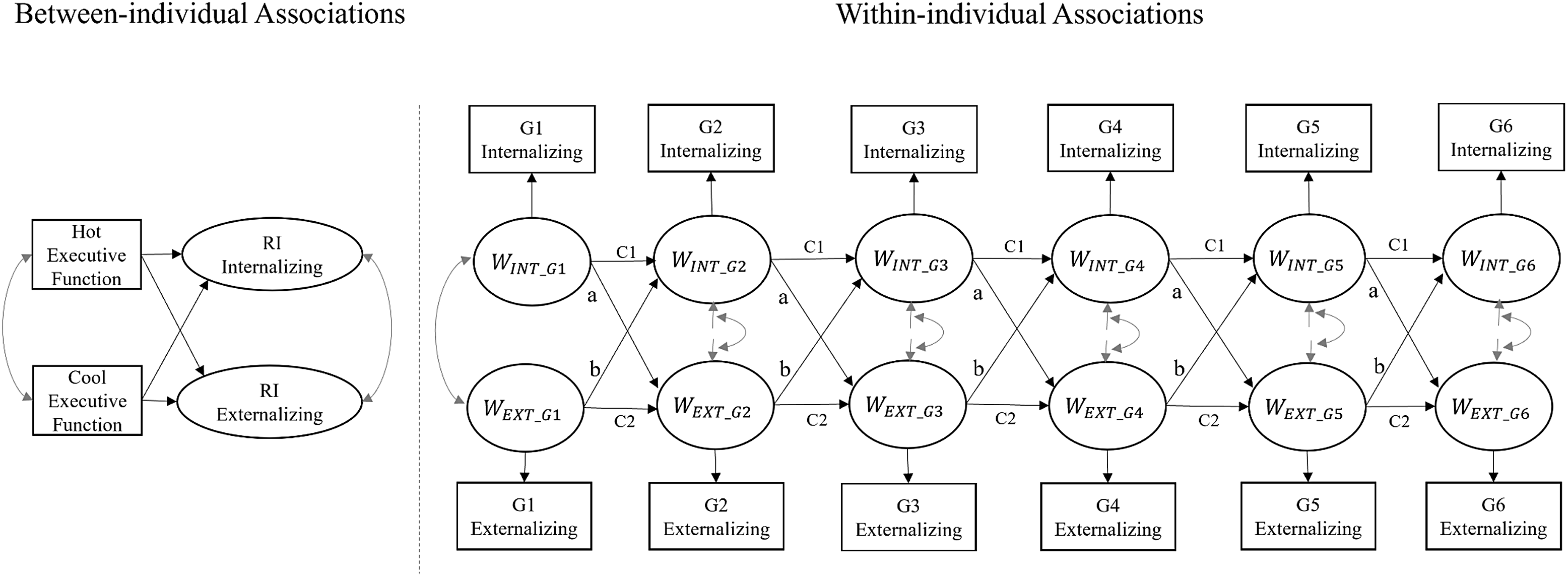
The analytical model of the extended RI-CLPM (Model 6) is shown in Figure 1. In the RI-CLPM, observed variables were decomposed into grand means, stable between-individual components, and temporal within-individual components (Mulder & Hamaker, Reference Mulder and Hamaker2021). Grand means represented the means of internalizing and externalizing problems at each wave. Between-individual components, indicated by the latent random intercepts of internalizing and externalizing problems, captured individuals’ trait deviations from the grand means. Random intercepts were created using all indicators across waves with fixed loadings set to one. Within-individual components (e.g., Wint_G1, Wext_G1) were represented by the differences between an individual’s observed score and the expected score based on the grand mean and random intercept. The autoregressive paths of C1 and C2 reflected the within-individual stability of internalizing and externalizing problems, respectively. The cross-lagged paths (e.g., paths a and b) indicated the within-individual bidirectional relations between internalizing and externalizing problems. Hot and cool EF were included as predictors of the random intercepts of internalizing and externalizing problems at the between-individual level. Model fitting indices, including chi-square (χ 2), comparative fit indices (CFI), and root mean square error of approximation (RMSEA) with its 90% confidence interval (CI), were reported following Bentler (2007). The robust maximum likelihood estimation was used to estimate the RI-CLPM. Although data and materials are not publicly available, the analysis code of this study may be obtained from the corresponding author upon request.
The extended random intercept cross-lagged panel model with hot and cool executive function predicting random intercepts of internalizing and externalizing problems in grade school (Model 6). RI = random intercept. G1 = 1st grade. G2 = 2nd grade. G3 = 3rd grade. G4 = 4th grade. G5 = 5th grade. G6 = 6th grade.
Results
Preliminary analyses
Table 1 presents the descriptive statistics and bivariate correlations of the main study variables. As hypothesized, the extracted factors of hot and cool EF were negatively and weakly correlated with teacher-reported internalizing (r range = −.17–−.11) and externalizing problems (r range = −.39–−.17) across waves, and the magnitudes of the associations between hot and cool EF and externalizing problems were generally stronger than those between hot and cool EF and internalizing problems. Measures of internalizing (r range = .16–.29) and externalizing (r range = .43–.63) problems exhibited moderate and high stability across time, respectively. Most measures of internalizing and externalizing problems across waves exhibited weak to moderate correlations (r range = .08–.37).
Bivariate correlation and descriptive statistics of major variables
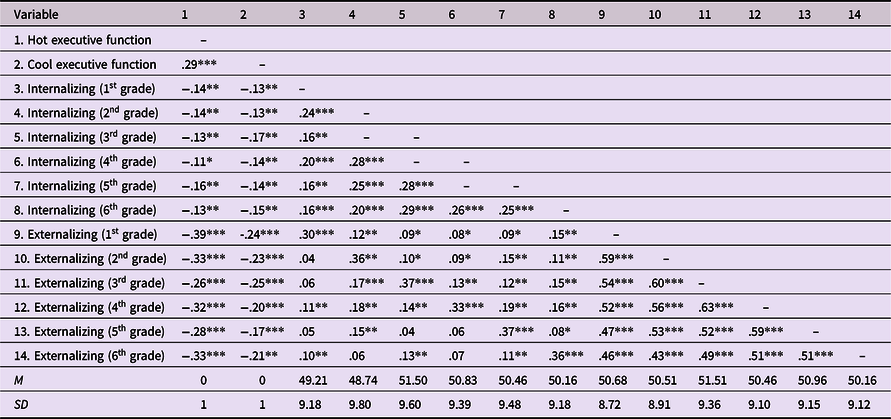
Note. * p < .05. ** p < .01. *** p < .001.
Additionally, although not reported in the table, the correlations among covariates (e.g., mothers’ education, and household income-to-needs ratio) and major study variables were examined. Mothers’ education exhibited negative and weak correlations with all teacher-reported internalizing (r range = −.18–−.11) and externalizing problems (r range = −.16–−.11), and exhibited positive and weak correlations with hot (r = .15) and cool EF (r = .08). Household income-to-needs ratio was negatively and weakly correlated with most measures of internalizing (r range = −.12–−.07) and externalizing problems (r range = −.16–−.12), and was positively and weakly correlated with hot (r = .21) and cool EF (r = .11).
Basic RI-CLPM
To test Hypothesis 1, a series of basic RI-CLPM were examined sequentially. The fitting indices and model comparisons are presented in Table 2. Although all basic RI-CLPMs fit the data well, the Sattora-Bentler scaled chi-square difference tests revealed that models with fixed autoregressive paths over time (Model 2) and with time-invariant correlated changes between internalizing and externalizing problems (Model 4) did not significantly worsen the fitting indices relative to the baseline model. Therefore, these two sets of equality constraints were incorporated into the final basic RI-CLPM (Model 5).
Fitting indices and model comparisons of RI-CLPM
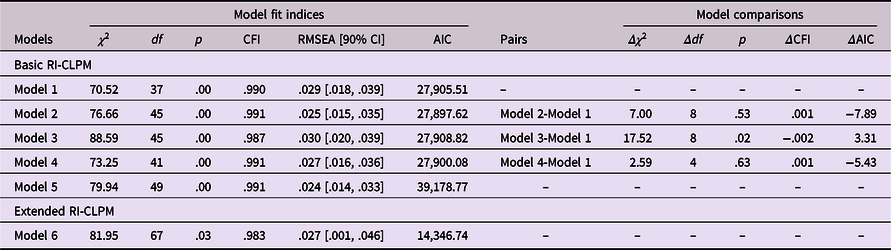
Note. Model 1 = unconstrained baseline model; Model 2 = model with time-invariant autoregressive paths; Model 3 = model with time-invariant cross-lagged paths; Model 4 = model with time-invariant correlated changes from the third to sixth grades; Model 5 = the final basic RI-CLPM with time-invariant autoregressive paths and correlated changes; Model 6 = the extended RI-CLPM with hot and cool executive function predicting random intercepts of internalizing and externalizing problems. RI-CLPM = random intercept cross-lagged panel model. df = degree of freedom; CFI = Comparative Fit Indices; RMSEA = Root Mean Square Error of Approximation; AIC = Akaike’s information criterion; $\Delta \chi ^{2}$
= parameters with the Sattora-Bentler scaled chi-square difference test.
$\Delta \chi ^{2}$
= parameters with the Sattora-Bentler scaled chi-square difference test.
The standardized coefficients of Model 5 are shown in Table 3. The results showed that the random intercepts of internalizing and externalizing problems were significantly related at the between-individual level (β = .11, p < .001), suggesting the co-occurrence of these problems in grade school. At the within-individual level, both externalizing (βs = .19, p < .001)and internalizing (βs = .05, p < .05) problems showed stability across waves. Furthermore, concurrent internalizing and externalizing problems at each wave were positively related at the within-individual level (β range = .21 to .24, p < .001), suggesting a tendency for them to co-vary. These results thus support Hypothesis 1.
Standardized estimates in the final basic random intercept cross-lagged panel model (Model 5)
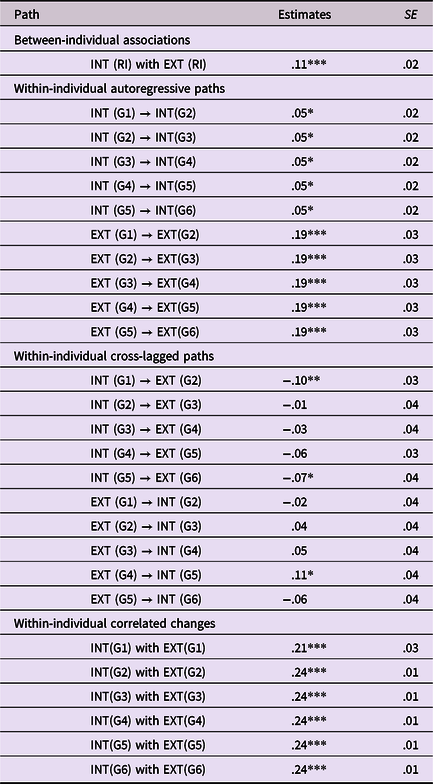
Note. EF = executive function; INT = internalizing problems; EXT = externalizing problems; RI = random intercept; G1 = 1st grade; G2 = 2nd grade; G3 = 3rd grade; G4 = 4th grade; G5 = 5th grade; G6 = 6th grade; SE = standard errors. * p < .05. ** p < .01. *** p < .001.
Extended RI-CLPM
Based on Model 5, an extended RI-CLPM (Model 6) was conducted to examine the unique associations between hot and cool EF skills and the development of behavioral problems in grade school (Hypothesis 2). This extended RI-CLPM fit the data adequately (Table 2). The standardized estimates are displayed in Table 4. The results showed that both hot and cool EF skills were negatively predictive of the random intercepts of internalizing (for hot EF, β = −.15, p < .05; for cool EF, β = −.25, p < .001) and externalizing problems (for hot EF, β = −.37, p < .001; for cool EF, β = −.23, p < .001) at the between-individual level, adjusting for within-individual effects in the development of both problems. These findings support Hypothesis 2 and demonstrate that both aspects of EF play unique roles in the development of behavioral problems in grade school.
Standardized estimates in the final extended random intercept cross-lagged panel model (Model 6)
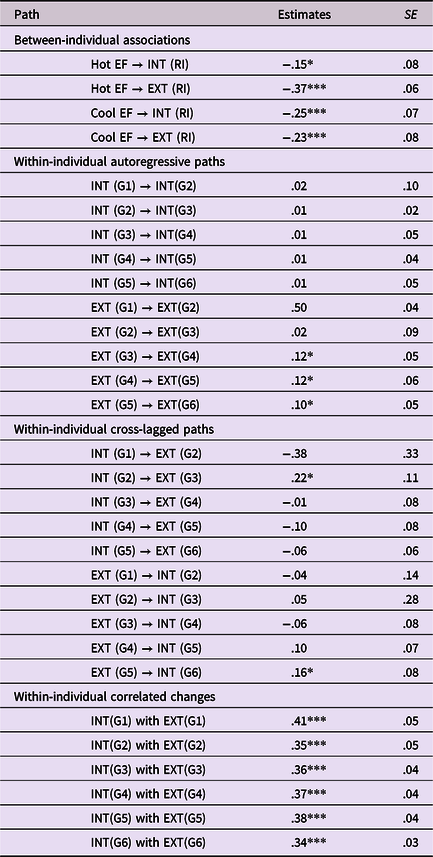
Note. EF = executive function; INT = internalizing problems; EXT = externalizing problems; RI = random intercept; G1 = 1st grade; G2 = 2nd grade; G3 = 3rd grade; G4 = 4th grade; G5 = 5th grade; G6 = 6th grade; SE = standard errors; * p < .05. ** p < .01. *** p < .001.
Discussion
Despite the well-established link between children’s EF and behavioral adjustment, it remains unclear whether the recently emerged distinction between the hot and cool aspects of EF is uniquely associated with children’s behavioral problems. This longitudinal study aimed to elucidate the relations between hot and cool EF skills and the development of behavioral problems in school-age children. Using the RI-CLPM approach to segregate the between- and within-individual effects in the development of behavioral problems, this study provides insights into the unique associations between the hot and cool aspects of EF and the development of internalizing and externalizing problems in grade school. Independent to each other, hot and cool EF skills were uniquely and negatively related to the development of internalizing and externalizing problems over time at the between-individual trait level, adjusting for situational fluctuations at the within-individual level. The results also showed that internalizing and externalizing problems were positively related at the between-individual level across the grade school, accounting for within-individual fluctuations over time. This investigation contributes empirical evidence to clarify the relations between hot and cool EF skills and children’s behavioral problems and highlights the importance of considering both aspects of EF in understanding the development of behavioral problems in school-age children.
Although a distinction between hot and cool EF skills has been proposed in recent literature (Peterson & Welsh, Reference Peterson, Welsh, Goldstein and Naglieri2014; Zezalo, Reference Zelazo2020; Zelazo & Carlson, Reference Zelazo and Carlson2012), there is limited empirical evidence regarding the unique associations between the hot and cool aspects of EF and children’s behavioral problems, particularly beyond the preschool years. Expanding on previous research examining the associations between general EF and children’s behavioral problems with traditional longitudinal data analysis (McNeilly et al., Reference McNeilly, Peverill, Jung and McLaughlin2021; Nelson et al., Reference Nelson, Kidwell, Nelson, Tomaso, Hankey and Espy2018; Wang & Liu, Reference Wang and Liu2021), this study made contributions to differentiating the unique roles of hot and cool EF skills in the development of behavioral problems and to demonstrating that their associations reflect stable and meaningful individual trait differences. Additionally, using a national sample and expanding the scope of a prior study that utilized the RI-CLPM to examine the relation between cool EF skills and externalizing problems (Li et al., 2022), we observed similar patterns that hot and cool EF skills at school entry were uniquely and independently associated with the development of both problems at the individual trait level, regardless of situational fluctuations over time. This study thus provided much needed empirical evidence to corroborate the link between hot and cool EF and the development of behavioral problems in school-age children.
Consistent with the perspective of Developmental Psychopathology (Rutter & Sroufe, Reference Rutter and Sroufe2000; Rutter, Reference Rutter2013), the findings supported the importance of EF skills to behavioral adjustment and revealed that EF skills, both hot and cool, were important to understand the development of internalizing and externalizing problems across grade school. Given that said, hot and cool EF skills may tap in different aspects of regulatory processes in the context of behavioral problems. On the one hand, cool EF is important in regulating cognitive components closely related to behavioral problems (Zezalo, Reference Zelazo2020). Poor cool EF may contribute to difficulties in inhibiting repetitive ruminations and negatively biased cognitive styles, making children more susceptible to internalizing symptoms (Hyde et al., Reference Hyde, Mezulis and Abramson2008). Regarding externalizing problems, cool EF may be negatively related to children’s difficulty in inhibiting hostile attributions to others and impulsive responses, as well as generating, maintaining, and comparing adaptive response options in the working memory, all are predicative of externalizing problems (Crick & Dodge, Reference Crick and Dodge1994). On the other hand, hot EF is needed to regulate affective and motivational salient stimuli (Zezalo, Reference Zelazo2020). Low levels of hot EF may lead to difficulties in down regulating negative emotional arousal elicited by aversive experiences and in overcoming their lack of motivation to approach, both are highly associated with internalizing problems (Carver et al., Reference Carver, Johnson and Joormann2008; Hostinar & Cicchetti, Reference Hostinar, Cicchetti, Beauchaine and Crowell2020). Similarly, poor hot EF may be related to children’s difficulty in regulating negative emotion and strong motivation to approach, implicated in reactive externalizing problems (Eisenberg et al., Reference Eisenberg, Spinrad and Eggum2010). Therefore, poor hot and cool EF skills may work together to disrupt children’s adaptive self-regulatory processes in the context of behavioral problems.
In addition, partially supporting the Iterative Reprocessing Model (Zezalo, Reference Zelazo2020) and initial studies (Denham et al., Reference Denham, Warren-Khot, Bassett, Wyatt and Perna2012; Kim et al., Reference Kim, Nordling, Yoon, Boldt and Kochanska2013; Willoughby et al., Reference Willoughby, Kupersmidt, Voegler-Lee and Bryant2011), we also observed that the magnitudes of the associations between hot EF and behavioral problems were relatively larger compared to those between cool EF and both problems, externalizing problems in particular. This may suggest that hot EF may be particularly prominent in the context of externalizing problems, probably because of its role to regulate impulsive reactions and strong tendency to approach (Zezalo, Reference Zelazo2020) that primes externalizing problems (Crick & Dodge, Reference Crick and Dodge1994).
Building upon limited research that has examined the association between hot and cool EF and behavioral problems in preschoolers (Kim et al., Reference Kim, Nordling, Yoon, Boldt and Kochanska2013; Willoughby et al., Reference Willoughby, Kupersmidt, Voegler-Lee and Bryant2011), this study explored this association in grade school and demonstrated that low levels of hot EF prior to starting school was associated with children’s development of internalizing and externalizing problems in grade school. However, in contrast to initial studies with preschoolers, we also observed that, independent to hot EF, cool EF skills were also uniquely and negatively associated with behavioral problems in school-age children. This discrepancy may be attributed to the rapid development of EF skills during the preschool years. EF skills show high malleability and undergo significant changes during this period (Diamond & Lee, Reference Diamond and Lee2011), coinciding with the developing prefrontal cortex (Otero & Barker, Reference Otero, Barker, Goldstein and Naglieri2014). As children’s EF skills improve, the association between cool EF skills and behavioral adjustment becomes noticeable. Additionally, this discrepancy is not surprising considering the conceptual and assessment overlap between cool EF and general EF (Zezalo, Reference Zelazo2020; Zelazo & Carlson, Reference Zelazo and Carlson2012). The traditional concept of EF has emphasized on the cool aspect, measured through decontextualized and non-emotional tasks (Miyake & Friedman, Reference Miyake and Friedman2012), which aligns closely with cool EF (Zelazo & Carlson, Reference Zelazo and Carlson2012). Given the well-established link between general EF and behavioral problems (McNeilly et al., Reference McNeilly, Peverill, Jung and McLaughlin2021; Nelson et al., Reference Nelson, Kidwell, Nelson, Tomaso, Hankey and Espy2018; Wang & Liu, Reference Wang and Liu2021), it is reasonable to observe the contribution of cool EF to children’s behavioral problems.
Moreover, this study not only supported the interrelations between internalizing and externalizing problems but also distinguished the associations at the between- and within-individual levels. This finding aligns with prior studies that have shown the co-occurrence of internalizing and externalizing problems with traditional longitudinal data analysis (Fanti & Henrich, Reference Fanti and Henrich2010; Gong et al., 2023; Nivard et al., Reference Nivard, Lubke, Dolan, Evans, St. Pourcain, Munafo and Middeldorp2017; Shi & Ettekal, Reference Shi and Ettekal2021) and with the RI-CLPM (Keskin et al., Reference Keskin, Lougheed and Duncan2022). Using teacher-reported behavioral problems across grade school, we observed a similar co-occurring pattern between internalizing and externalizing problems over time at the between- and within-individual levels, which is consistent with a previous study using mother-reported data (Keskin et al., Reference Keskin, Lougheed and Duncan2022). This further confirms that the observed co-occurring pattern reflects meaningful associations between internalizing and externalizing problems, adjusting for situational fluctuations over time and being consistent across informants (e.g., mothers and teachers). This co-occurring pattern may reflect the common risk factors associated with internalizing and externalizing problems. Children with a family history of mental illness, adverse childhood experiences, and interpersonal conflicts may be particularly vulnerable to both problems (Caspi & Moffitt, Reference Caspi and Moffitt2018).
The findings of this study should be interpreted in light of several limitations. First, although we used a national sample, this study was based on a Western community sample that consisted of slightly advantaged families, which may limit the generalizability of the observed relations between hot and cool EF and behavioral problems to clinical populations (e.g., children diagnosed with major depression and conduct disorders). Generalization of the findings to children from diverse cultural and socioeconomic backgrounds should also be done cautiously since the development of EF and its relation to child outcomes may be better understood from an asset-based and contextual lens that recognizes children’s unique cultural and socioeconomic contexts (Frankenhuis & Nettle, Reference Frankenhuis and Nettle2020; Miller-Cotto et al., 2021). Second, although the use of the RI-CLPM approach allowed for accurate estimations by segregating between- and within-individual effects, it is important to note that the observed longitudinal associations are correlational in nature. Therefore, causal interpretation cannot be made based on these findings. Third, regarding the measures of hot and cool EF, while there is evidence that EF skills tend to remain stable across time beyond preschool (Zelazo & Carlson, Reference Zelazo and Carlson2012), hot and cool EF skills was assessed only once before or at school entry. This limits our ability to examine the dynamics between hot and cool EF skills and behavioral problems over time. Relatedly, hot and cool EF skills were measured when children were at 54 month and in the first grade, respectively. Although it is ideal to assess hot and cool EF skills at the same time point, the results may not be related to the issue of time proximity between cool EF and behavioral problems since the unique role of hot EF was consistently observed for the development of both problems. Fourth, in this study, both internalizing and externalizing problems were rated by teachers. However, as children grow, there may be a lack of concordance between teacher-reported and self-reported internalizing problems (von der Embse et al., Reference von der Embse, Kim, Ross, Kilgus and Koza2023), and therefore, self-reported internalizing problems may be ideal for reflecting children’s inner states.
Despite these limitations, this study contributed longitudinal evidence to enhance our understanding of the associations between hot and cool EF skills and the development of behavioral problems in grade school. The findings emphasize the importance of children’s self-regulatory neurocognitive processes, encompassing both hot and cool EF skills, in understanding the development of internalizing and externalizing problems across grade school. Intervention efforts targeting children’s behavioral problems may benefit addressing hot and cool EF skills, and early intervention before grade school may be particularly important.
Author note
This study was not preregistered. Although data and materials are not publicly available, the analysis code may be obtained from the corresponding author upon request. This study has not been previously disseminated.
Funding statement
This work was supported by the STI 2030-Major Projects 2021ZD0200500.
Competing interests
None.


 Open access

