




Introduction
Desert kites are dry stone-walled structures often several hundred metres in length, present in arid and semi-arid areas across Eurasia. They are characterised by three main elements: one or more driving lines, converging toward an enclosure flanked by one or more cells (cf. Crassard et al. Reference Crassard2022: 3). Recognised in the early twentieth century, desert kites were initially thought to be restricted to the deserts of Jordan and Syria. With the release of open-source high-resolution satellite imagery, the phenomenon is now understood to cover a much larger area spanning the Arabian Peninsula, the Levant and northern Mesopotamia, the Caucasus and Central Asia (cf. Globalkites project: https://www.globalkites.fr/; see also synthesis in Crassard et al. Reference Crassard2022).
The date and function of desert kites continues to be debated; few of the features have been ground-truthed and associated artefacts are scarce. New excavations support a hypothesis of their employment in wild-game hunting (Zeder et al. Reference Zeder2013; Crassard et al. Reference Crassard2022) and, while dating remains challenging, associated fossil guides (Morandi Bonaccossi Reference Morandi Bonaccossi and Morandi Bonaccossi2014) and absolute dating of materials associated with desert kites and kite depictions (Abu Azizeh et al. Reference Abu Azizeh, Betts and van Pelt2021; Crassard et al. Reference Crassard2023) are pushing back earlier estimates of the origins of the phenomenon into the eighth–sixth millennia BC.
This article presents new evidence from the Şanlıurfa Archaeological Survey Project (ŞAYA) for some of the earliest desert kites in South-west Asia. Focusing on the highlands west of the Harran Plain, Türkiye, ŞAYA is part of Taş Tepeler (‘stone hills’ in Turkish), a new programme run by the Turkish Ministry of Culture investigating the origins of sedentism and agropastoral lifeways at the northern edges of the Fertile Crescent (Karul Reference Karul2022; Şahin et al. Reference Şahin, Uludağ, Özçelik and Sevindik2023). Taş Tepeler includes new excavation of Pre-Pottery Neolithic (PPN, c. 9500–7000 BC) settlements neighbouring the UNESCO World Heritage Site of Göbeklitepe, as well as regional surveys and palaeoenvironmental research. Here, we suggest that the desert kites under analysis belong to the same broad chronological horizon, allowing us to assess them in the context of incipient sedentism and domestication.
The Şanlıurfa desert kites
Collation of evidence from the Globalkites project, previous archaeological survey (Çelik & Tolon Reference Çelik and Tolon2018) and satellite imagery identified 307 desert kites around the Harran Plain (Figure 1), including 34 previously unrecorded. In 2021–2022, 14 were ground-truthed using photography, aerial imagery and systematic surface collection of archaeological material from inside and outside the structures.
Identified desert kites and known PPN sites in Şanlıurfa (figure by authors).

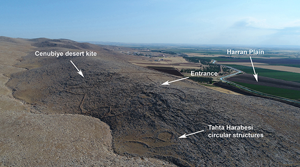
Şanlıurfa desert kites are similar to known examples elsewhere, including the basic structural elements (driving lines/antennae, enclosures and cells), points and cells that tend to be lower than the entrance to facilitate pushing the herds toward the funnel extremities (Figure 2) and dry-stone masonry generally 0.5–0.7m high (Figure 3b). They also have close spatial connections to seasonal streams and, in most cases, enclosures are oriented toward the streams or the valley floors, suggesting hunting strategies that corralled animals from watering areas up toward the traps.
The Cenubiye desert kite and Tahta Harabesi circular structures viewed from the south (figure by authors).

Cenubiye desert kite: a) cell detail; b) masonry; c) aerial view of the northern wing's terminal portion with cells; d) Tahta Harabesi aerial view of circular structures (figure by authors).

As with examples further north, the Şanlıurfa desert kites actively incorporate cliffs or rock outcrops and make use of local topography to corral the wild herds toward the enclosure. Driving lines are present in only 30 per cent of well-preserved kites. Stone-built, semi-underground cells (3–5m in diameter, Figure 3a) are always present at the end of the enclosure points, which funnel animals toward them. While excavation has demonstrated the function of cells as pit-traps elsewhere (Crassard et al. Reference Crassard2022), some Şanlıurfa examples (the so-called “tangential” type, Crassard et al. Reference Crassard2022: 23) have no obvious funnelling system (Figure 3c). We thus propose that these may have functioned as hunter hideouts (cf. Helms & Betts Reference Helms and Betts1987: 49 for the function of different cell types as pit-traps and hideouts). Several of the Şanlıurfa desert kites are also flanked by semi-underground sub-circular structures (20–30m in diameter) that are broadly contemporary with them (below) and often closer to streams (e.g. Figures 2 & 3d). While the function of these structures is currently unclear, association with the desert kites might suggest that they were temporary camps or butchering areas.
Enclosures range between 2ha and 3.5ha in size and are thus larger overall than Levantine specimens (cf. Crassard et al. Reference Crassard2022: 33). Enclosure shape varies and the absence of antennae/driving lines is distinctive. Beyond the simple V-shaped examples (Figure 4b), many enclosures bear a clear resemblance to Levantine and, to a lesser extent, Armenian/Kazakh examples (Figure 4d–e & 4c, respectively, cf. Bouzid & Barge Reference Bouzid and Barge2022).
Examples of Şanlıurfa desert kites: a) Şanlıurfa type; b) V-shaped kites; c) Armenian/Kazakh type; d) Levantine type 1; e) Levantine type 2 (figure by authors).

Intensive collection reveals a wealth of ad hoc chert implements (Figure 5) that are difficult to date but find parallels at nearby surveyed and excavated PPN sites, including Çakmaktepe, a project led by one of the authors. No pottery or later chert artefacts have been recovered in the desert kites, and none of the 50-plus sites identified so far by ŞAYA can be dated later than the end of the Pottery Neolithic (Şahin et al. Reference Şahin, Uludağ, Özçelik and Sevindik2023), suggesting a change in land use of the broader region after the seventh millennium BC.
Chert artefacts from desert kites—Cenubiye (1–3), Mermer (10–16), Cudi Deresi (17–23), Obalı (24–28)—and the circular structures at Tahta Harabesi (4–9) (figure by authors).

Many kites have been subsequently modified, including partitioning of the enclosure (Figure 6). This implies a functional shift in the reuse of standing structures from hunting to herding, though the date at which this occurred is currently unclear.
Modification and re-use (red detail) of desert kites (figure by authors).

Implications
In advance of excavation and a clearer understanding of the broader landscape palimpsest, our results support a PPN beginning for the desert kite phenomenon in a region that was experimenting with sedentism and domestication at that time.
The PPNB (8500–7200 BC) gazelle-dominated zooarchaeological assemblages at Göbeklitepe indicate that gazelle were hunted between mid-summer and early autumn (Lang et al. Reference Lang2013), likely with mass-hunting traps; therefore, the kites described here were probably contemporaneous with Göbeklitepe's main occupation phase. The brief hunting season has wider implications for our understanding of the long-term storage and consumption of meat, and thus also for how improving conservation and storage techniques may have affected sedentary behaviour and complemented incipient agropastoral economies.
The large size of the desert kites further makes them one of the earliest forms of (horizontal, extensive) monumentality in South-west Asia, and their powerful symbology is highlighted by depictions in rock engravings elsewhere (cf. Crassard et al. Reference Crassard2023). It is tempting to imagine that technical and organisational knowledge could have been shared between the construction of mass-hunting traps and the development of collective, up-built monumental architecture at sites such as Göbeklitepe and Karahantepe.
Acknowledgements
We thank the Turkish Ministry of Culture and the Şanlıurfa Archaeology Museum for the administrative support, Douglas Baird and Eşref Erbil for their generous comments and Galipcan Olcay for help with the satellite imagery analysis.
Funding statement
The authors received funding from the Turkish Ministry of Culture and Tourism for the 2021–2022 seasons of ŞAYA.


 Open access

