




Introduction
The origins of writing in South-west Asia are often sought in the accounting systems that developed over the course of the fourth millennium BC, which physically documented transactions using tokens, tags and bullae (clay balls), numerical tablets and seals (Nissen et al. Reference Nissen, Damerow and Englund1993). Proto-cuneiform, first attested on clay tablets at the city of Uruk in southern Iraq c. 3350–3000 BC (Table 1, Uruk IV and III script phases), is a complex accounting system with hundreds of iconographic signs, many of which still defy interpretation. Elaboration of tokens, long used throughout South-west Asia, may have both stimulated the development of proto-cuneiform and served as models for several signs (Schmandt-Besserat Reference Schmandt-Besserat1992: 140–49) but token-to-sign comparisons, numerical notations aside, are rarely demonstrable (Englund Reference Englund1993; Zimansky Reference Zimansky1993) and the origin of sign forms is likely to be diverse, emerging from the multimedia environment of visual expression (Michalowski Reference Michalowski1990: 59).
Periodisation of the fourth millennium BC in Mesopotamia. Absolute and relative dating between sites is problematic (Dahl et al. Reference Dahl, Petrie, Potts and Petrie2013).
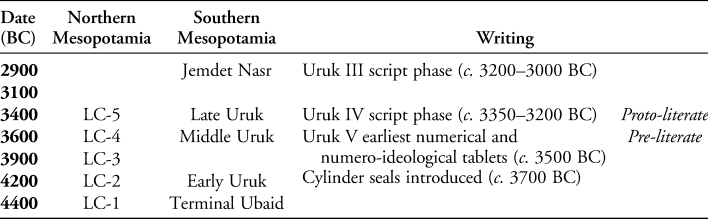
We refer to Late Chalcolithic 4 (LC-4)/Uruk V/Susa Acropole 1.18 dating or earlier as pre-literate and LC-5/Susa Acropole 1.17a–b, with Uruk IV script as proto-literate. Many seals are difficult to date as securely pre- or proto-literate.
Specific symbolic precursors to signs, apart from tokens, have not been the subject of concerted research, despite the potential importance that their identification could have for our understanding of the evolution of symbol systems and writing. Visual parallels to sign forms have been sought in the Uruk Vase of the Uruk IV period (see Table 1; Cooper Reference Cooper and Taylor2008; Hockmann Reference Hockmann2009; Selz Reference Selz and Wengrow2022) and broadly contemporaneous cylinder seal images. While Uruk-period seal imagery might be seen as a semiotic “forerunner to script” (Pittman Reference Pittman and Zsolnay2023: 238), with clear parallels between some seal and sign forms, relationships remain difficult to define (Pittman Reference Pittman and Ferioli1994: 190–91) and it is possible that the ‘pictography’ observed in seals is unrelated to the development of writing (Glassner Reference Glassner2003: 166–77).
In this article, we present a more nuanced perspective on the origins of the script through the exploration of promising correlations between proto-cuneiform signs and earlier, pre-literate seal motifs from sites associated with the Uruk phenomenon of the late fourth millennium BC. Our analysis offers evidence for the contribution of seals and sealing practices to the incipient use and form of proto-cuneiform signs. The motifs we discuss showcase the common interest of seal-bearing administrators and scribes in documenting the movement of textiles and vessels within or between cities.
Information technologies and the Uruk phenomenon
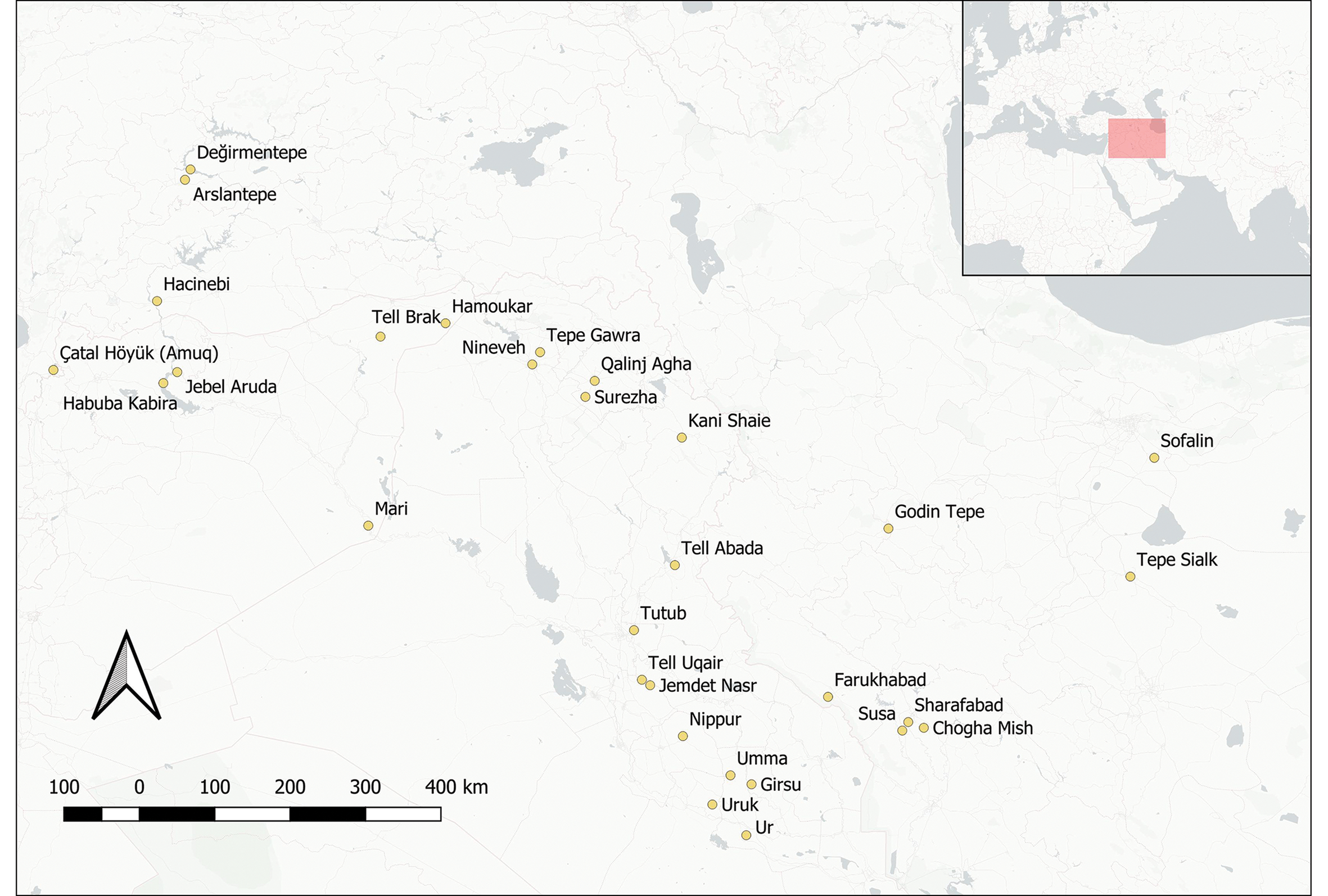
Proto-cuneiform appears in the latter part of the Uruk phenomenon, an almost millennium-long sharing of material culture from south-west Iran to south-east Türkiye (Figure 1). Urban complexity developed substantially during this period, although trajectories varied even in neighbouring regions (Rothman Reference Rothman2001; Postgate Reference Postgate2002). In southern Iraq, where cities were bolstered by irrigation agriculture and marsh resources (Pournelle & Algaze Reference Pournelle, Algaze, McMahon and Crawford2014), Uruk became a centre of immense importance with the Tigris and Euphrates rivers facilitating the long-distance movement of people and goods. Exports from Uruk may have included dried fish and textiles (Crawford Reference Crawford1973), and communities were established far to the north, east and west for the import of wood, stone and metal, resources scarce in the south (Algaze Reference Algaze1989; Oates Reference Oates1993; Butterlin Reference Butterlin2003).
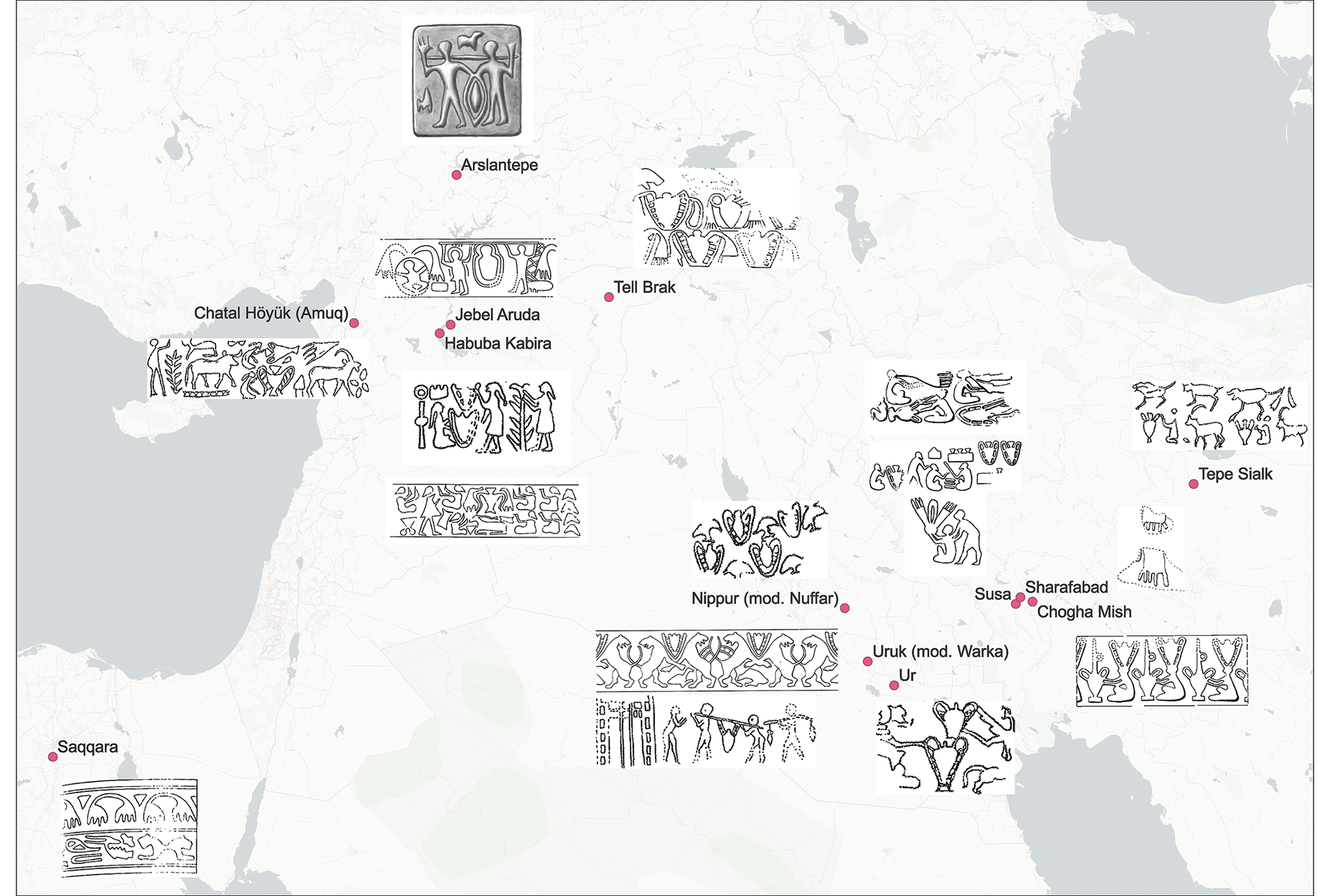
Map of archaeological sites with pre- and proto-literate seals corpora included in this study. For further details, see OSM (figure by authors).
Across the wide area of the Uruk phenomenon, seals and clay accounting technologies were a key cultural touchpoint; the shared symbolic conventions supported networks of elites both locally and inter-regionally (Sauer & Sürenhagen Reference Sauer, Sürenhagen, Balke and Tsouparopoulou2016). Trace element and isotopic analyses indicate the local scale of clay vessel production and practices for sealing and also the long-distance movement of the vessels and their seals (Minc & Emberling Reference Minc and Emberling2016).
Stamp seals were used on clay for administrative purposes from the late seventh millennium BC in northern Mesopotamia and were widely adopted and adapted in the following millennia. By the mid-fourth millennium, the cylinder seal was in use in Iran, Iraq and Syria (Pittman Reference Pittman and Zsolnay2023). In addition to sealing lumps of clay to secure containers and doors, seals covered the surface of clay balls (bullae)—which could bear numerical impressions and enclose tokens—and were eventually used on blank or numerical tablets. Cylinder seals and impressed objects with Uruk-related iconography appear in Iran, Iraq, Syria and Türkiye.
Seals were used in myriad ways, identifying institutions or production units, the senders of goods, specific administrative events, or products and their destinations (Le Brun & Vallat Reference Le Brun and Vallat1978; Brandes Reference Brandes1979; Dittmann Reference Dittmann, Finkbeiner and Röllig1986, Reference Dittmann, Kämmerer and Rogge2013; Nissen et al. Reference Nissen, Damerow and Englund1993; Pittman Reference Pittman and Ferioli1994, Reference Pittman, Ameri, Kielt Costello, Jamison and Jarmer Scott2018, Reference Pittman and Zsolnay2023). Although some motifs illustrate production and exchange, seals represent cultural ideals as much as realities (Breniquet Reference Breniquet2016a). Sealing facilitated control over products, with the shared iconography of the Uruk period suggesting “an inter-related if not integrated administrative system” (Pittman Reference Pittman and Ferioli1994: 191) involving goods and people who are themselves sometimes depicted on seals.
Shared seal imagery may have contributed to the maintenance of inter-regional connections as a form of fourth-millennium ‘commodity branding’ (Wengrow Reference Wengrow2007), and the movement of goods stored or transported in sealed vessels may have helped construct the social world (Collins Reference Collins2001; Englehardt Reference Enghlehardt2013; Balke & Tsouparopoulou Reference Balke and Tsouparopoulou2016). People are sometimes depicted on seals in front of elaborate buildings—probably temples—receiving products, suggesting that some commoditisation practices involved the movement of goods through sacred institutions. Although seals in this period did not (with rare exception) bear proto-cuneiform inscriptions, a ‘priest/ruler’ figure appearing in ritual scenes on seals has been linked to the title En which appears in proto-cuneiform texts as the sign EN. The proto-cuneiform sign is also used to characterise products, for example possibly marking an ‘EN-quality textile’. In many cases, goods listed on clay tablets are understood as ‘offerings’ to deities represented by their cult symbols (Szarzyńska Reference Szarzyńska1997: 58–77).
Inter-related systems of symbols
Although seals are widespread, proto-cuneiform is attested only in southern Iraq. The earliest currently known proto-cuneiform tablets are associated with the archaeological level Eanna IVa at Uruk, approximately Late Chalcolithic (LC-5) in broader regional terms (Table 1). The stimulation for this innovation remains enigmatic, though it is possible that the growth of the urban population at Uruk may have created organisational challenges that proto-cuneiform addressed (Algaze Reference Algaze2008: 139–41; Nissen Reference Nissen2016).
The development of proto-cuneiform signs relied on pre-literate administrative practices, including numerical notations (Englund Reference Englund, Yushu and Yiyi2006: 28–30), while extending their recording potential (Nissen Reference Nissen, Selz and Wagensonner2011). The practice of sealing tablets and other clay devices continues after the introduction of proto-cuneiform, though a smaller number of tablets are sealed (Matthews Reference Matthews1993). Motifs on tablet seals are difficult to correlate with tablet contents, an undertaking that is further hampered by poor understanding of the script. A single Uruk IV tablet, in which the script and seal impression both reference boars (Brandes Reference Brandes1979: 29–30), provides marginal evidence for the use of signs to reiterate seal information. Nonetheless, iconographic and use patterns may hint at shifting functions for seals after writing was invented (Scott Reference Scott, Ameri, Kielt Costello, Jamison and Jarmer Scott2018; Pittman Reference Pittman and Zsolnay2023), perhaps implying that writing adopted some functions formerly performed by seals.
Many of the approximately 800 proto-cuneiform signs remain poorly understood, with the iconic referent of more than half either contested or unidentified. Proto-cuneiform signs mentioned in this article are listed in Figure 2. All proto-cuneiform signs may depict objects, even if we cannot recognise each one (Englund Reference Englund, Bauer, Englund and Krebernik1998: 55), or there may have been any number of “totally abstract signs” (Nissen Reference Nissen2016: 44). Schematic signs, such as UDU (‘sheep, wool’), may have been inspired by token traditions (Schmandt-Besserat Reference Schmandt-Besserat1992), but there has been no systematic assessment of the extent to which earlier or contemporaneous visual arts or other symbolic systems are recognisable in the sign shapes.
Images and suggested meanings of proto-cuneiform signs mentioned in the article. Signs are referenced by their conventional label derived from later Sumerian or when especially contested or unknown, by their ZATU number (Green & Nissen Reference Green and Nissen1987). For further details, see OSM. (Sign and tablet images courtesy of the Cuneiform Digital Library Initiative (https://cdli.mpiwg-berlin.mpg.de/) (figure by authors).

Most signs are probably functional, indicating products, offices, people, administrative processes or events like festivals (Englund Reference Englund, Bauer, Englund and Krebernik1998; Johnson Reference Johnson, Dittmann, Selz and Rehm2015). This recalls the functions proposed for Uruk seal motifs, although Pittman (Reference Pittman and Zsolnay2023) contends that seals in this period did not identify specific individuals. Where identifiable, proto-cuneiform administrative content further highlights the inter-related functions of these two information technologies. Proto-cuneiform tablets, like sealing practices, were primarily used to track goods. Some pre- and proto-literate seal iconography, particularly from the Susiana region in Iran (Pittman Reference Pittman and Petrie2013), depicts agricultural and textile production, grain storage and animal husbandry, all of which are also important themes in proto-cuneiform texts.
Comparing seals and signs
Interpreting seal images and signs and understanding their connection is challenging. Simple comparisons of shape lack a sound methodological basis. For example, the ‘loops’ extending from human heads in a late pre-literate seal impression from Susa, the administrative capital of Susiana, have been interpreted as strings of dried fruit related to a proto-cuneiform sign (Le Brun & Vallat Reference Le Brun and Vallat1978: 26–7) or a belt loom (Breniquet Reference Breniquet2008: 313). Equally a proto-cuneiform ‘house’ sign (E2/ZATU129) with parallels in seal imagery may depict either a temple façade (e.g. Charvát Reference Charvát1998: 23) or a loom (Glassner Reference Glassner2003: 153), or it may be deliberately ambiguous, drawing on associations between weaving and important households (Breniquet Reference Breniquet2008: 306–12).
Nevertheless, defining context-supported correlations between seal motifs and proto-cuneiform signs can help to determine the role of seals in stimulating the invention of writing, as well as clarifying the subsequent parallel development of these recording systems. The potential for the interaction of scribes and seal carvers (Ross Reference Ross, Brown and Feldman2014) means that some contested proto-cuneiform signs may be understood through seal iconography, as much as texts may elucidate seal imagery. Similarities of shape may reflect shared referents to objects that provide detail on shared administrative concerns. For pre-literate motifs, comparisons might reveal functional transformations from seal to sign, where aspects of the administrative scope of a motif are carried over into writing. Signs, nonetheless, become symbols with new definitions in script (see caution in Michalowski Reference Michalowski and Keller-Cohen1994: 54–5) and such ‘symbol-hopping’ remains difficult to confirm. Contextual evidence can, however, strengthen this analysis.
Late pre-literate seal motifs and proto-cuneiform correlates
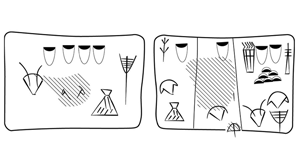
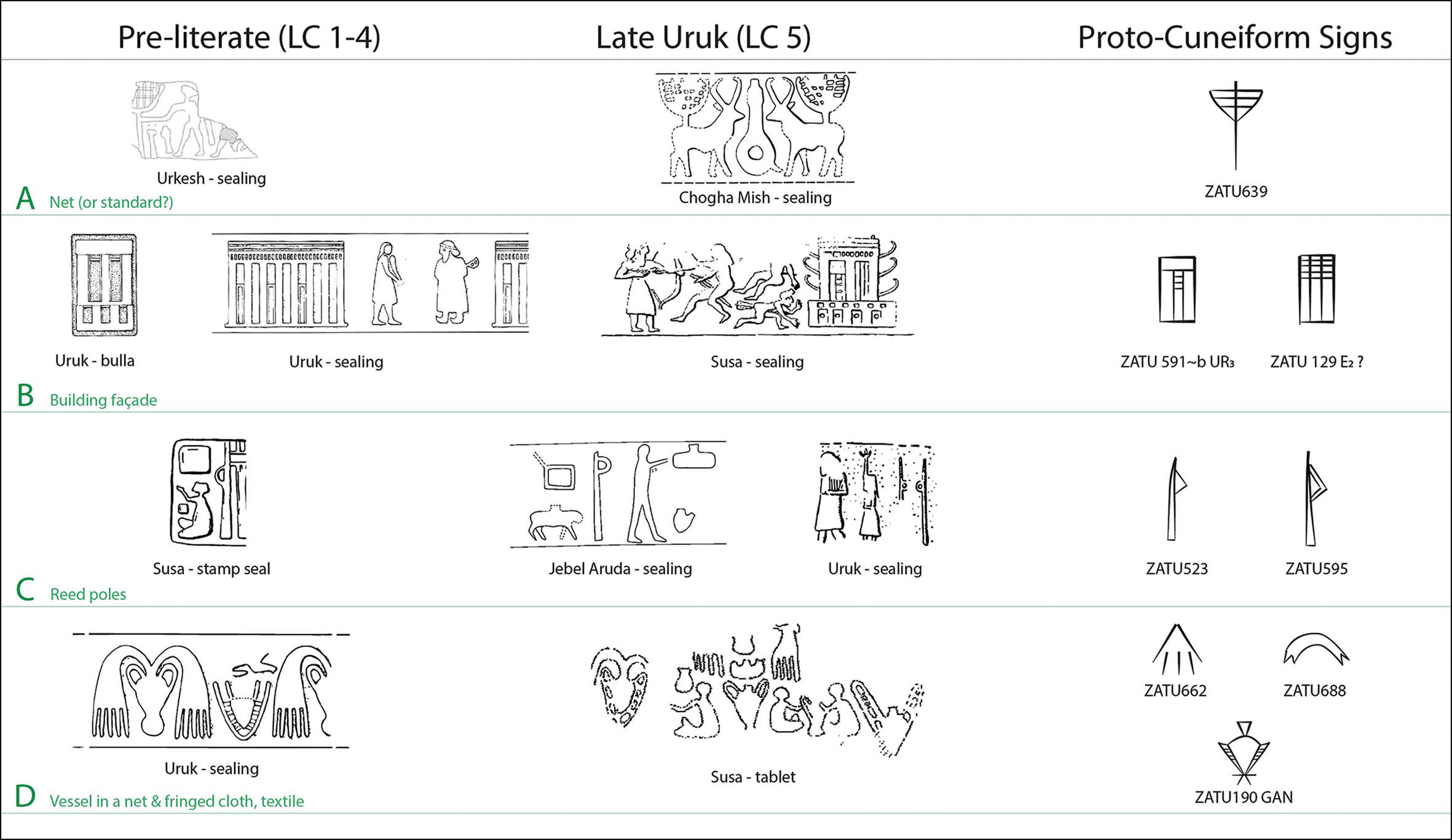
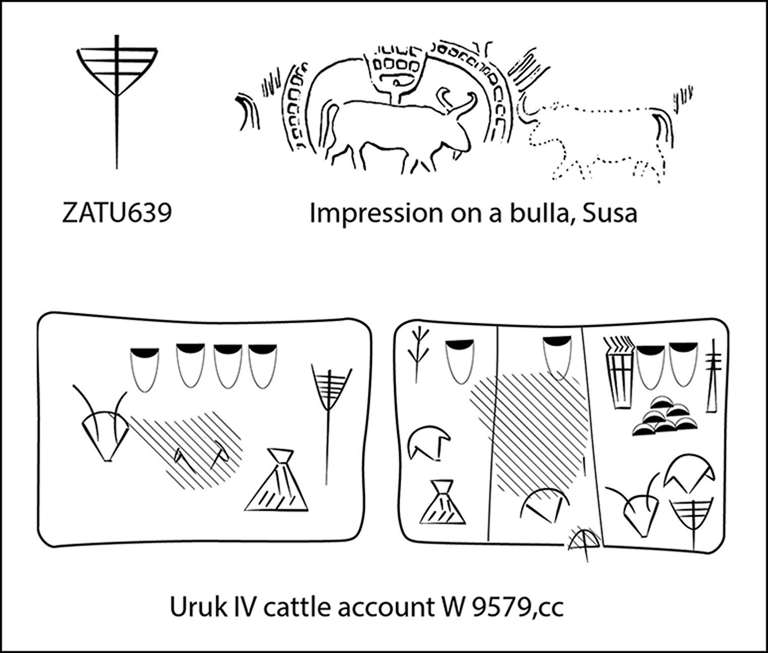
Survey of a corpus of seals from LC-1 to LC-4 contexts (c. 4400–3400 BC) from across South-west Asia (Figure 1) reveals a small number of convincing parallels between pre-literate seal elements and proto-cuneiform signs, supported by contextual clues (Figure 3). For example, a ‘pole and net’ sign (ZATU639) that appears alongside cattle signs in tablets is similar to an object sometimes shown with cattle in pre- and proto-literate seals (Figure 4).
Comparisons of proto-cuneiform signs with pre-literate seal elements. Signs are rotated for comparison with iconography. For further details, see OSM (figure by authors).
ZATU639 is comparable in both shape and context to an impressed bulla from Susa. For further details, see OSM (figure by authors).
The ‘façade and flag’/pole motif, in which the pole may be a cultic element (Dittmann Reference Dittmann, Kämmerer and Rogge2013), is also reflected in proto-cuneiform signs (Szarzyńska Reference Szarzyńska1997: 58–107). Notably, this motif was already in use shortly before the invention of writing. The façade finds parallels in the rectilinear proto-cuneiform signs, including the ‘house’ sign (E2/ZATU129, Figure 3B), and the flag/pole parallels a ‘generic’ pole sign (ZATU523/URI3) and the god Nanna's cult icon (ZATU595/ŠEŠ, Figure 3C) (Michalowski Reference Michalowski, Rainey and Kutscher1993: 120–1; Steinkeller Reference Steinkeller, Szarzyńska and Braun1998; cf. Green & Nissen Reference Green and Nissen1987). In seals, products are often depicted being carried towards the façade and, in an example from Jebel Aruda in northern Syria (Figure 3C), a pole appears beside a human and objects including a zoomorphic vessel resembling cosmetic or essence containers from Susa (Alvarez-Mon Reference Álvarez-Mon2020: pl. 21–22). Such portrayals suggest that seals tracked the movement of valued goods.
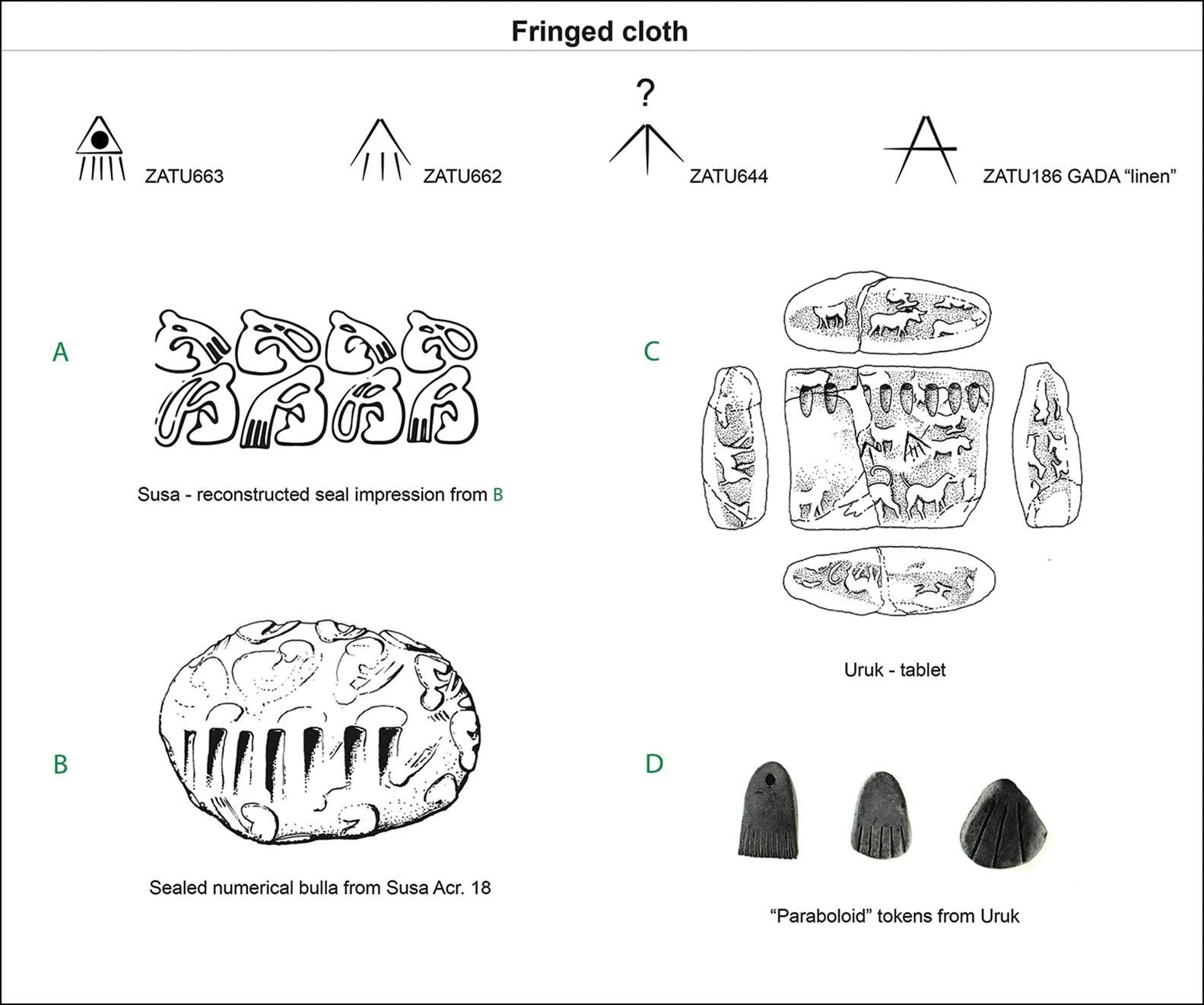
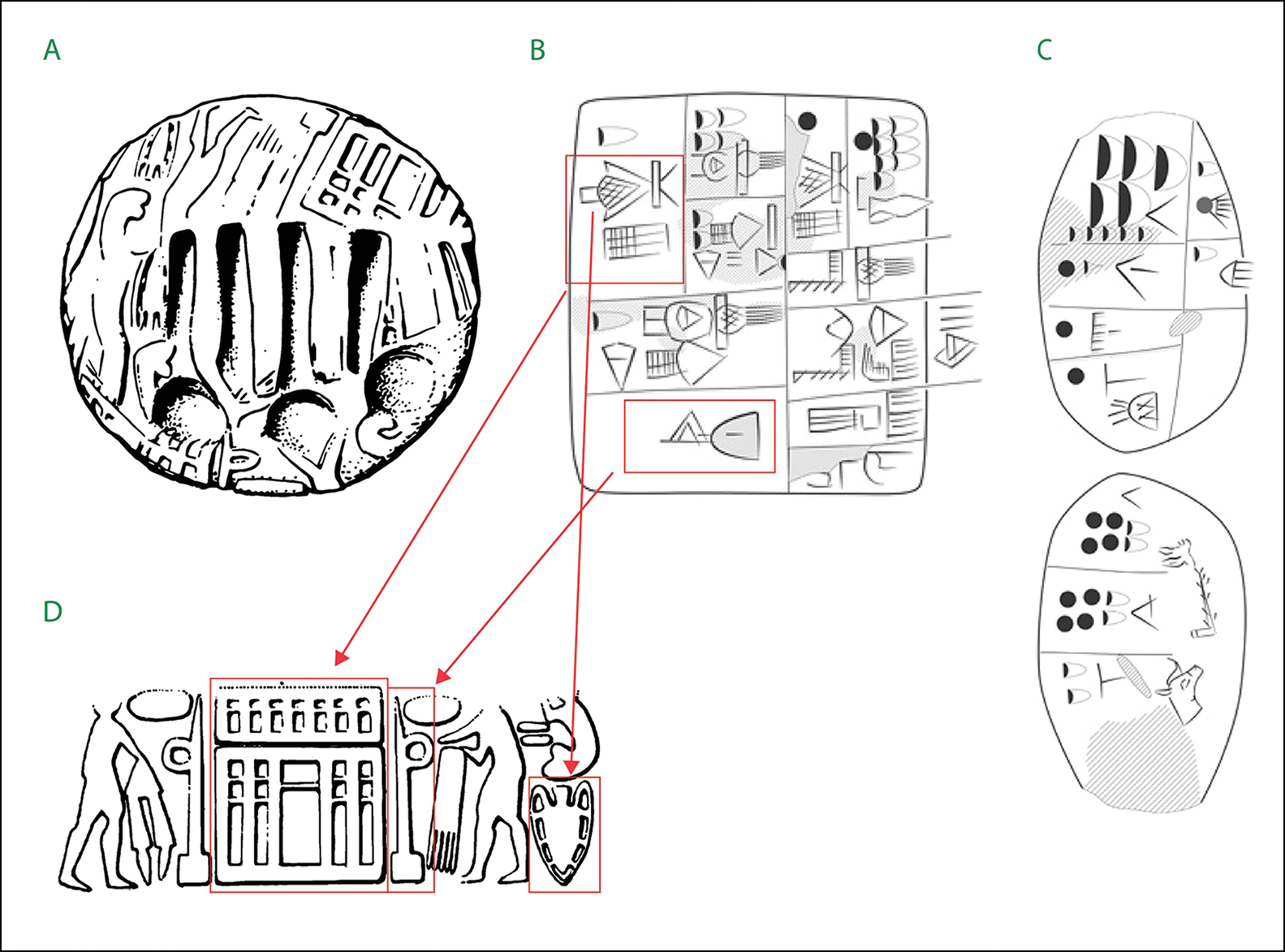
A compelling case for the transformation of pre-literate administrative symbols into proto-cuneiform signs can also be made for a related pair of motifs—the fringed cloth (Figure 5) and the vessel in a net (Figure 6). These appear widely among the ‘inter-regional’ motifs (Dittmann Reference Dittmann, Finkbeiner and Röllig1986; Pittman Reference Pittman and Petrie2013) on clay sealings, bullae and numerical tablets (see online supplementary material (OSM) Appendix 1). Their presence on numerical tablets, in particular—a document type marking the transition between pre-literate accounting and proto-literate writing—argues for a trajectory of symbolic representation from seals to inscribed signs. Comparable shapes may be seen in the proto-cuneiform textile or fringed cloth sign ZATU662 (and perhaps others, e.g. ZATU663, Figure 5), and what we identify here as a netted/suspended vessel sign (ZATU190 and ZATU191–194, Figure 2).
Comparison of the ‘fringed cloth’ motif and proto-cuneiform signs. For further details, see OSM (figure by authors).
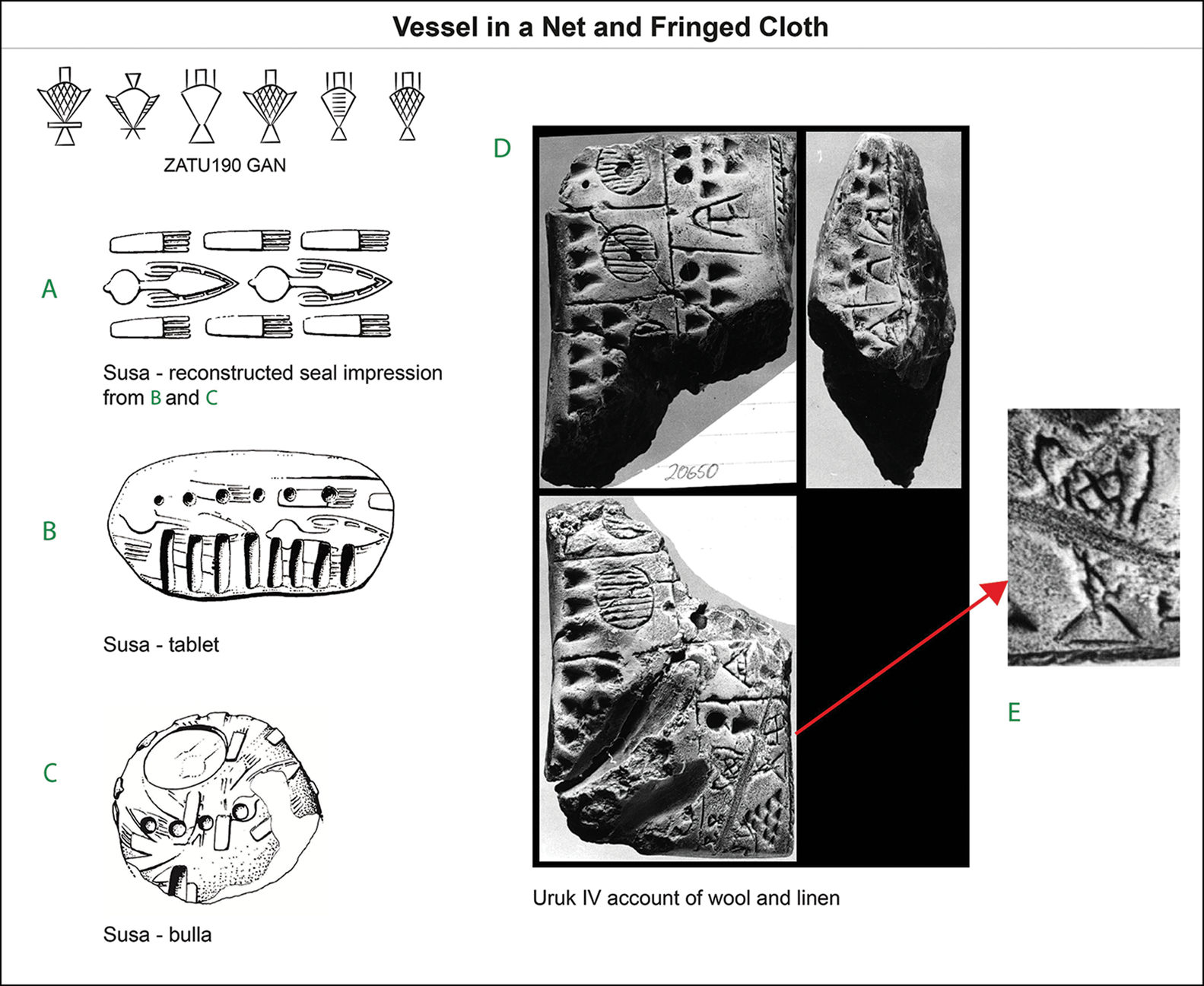
Examples of the netted-vessel and fringed cloth motifs from pre-literate documents (A–C) and a proto-cuneiform account of wool/garments and linen (D & E). For further details, see OSM (figure by authors).
The fringed cloth (ZATU662) and a similar shape (ZATU644) are used at Susa and Uruk in two ‘numero-ideographic’ tablets and are thus early signs that appear to have been schematic from the outset. It is possible that some late pre- or proto-literate tokens of the ‘paraboloid’ group (Schmandt-Besserat Reference Schmandt-Besserat1992: 146/31.21–22) are related representations (Figure 5D). In fact, triangular tokens may be reflected in several different proto-cuneiform textile-related signs, but specific correlations are difficult. The sign we identify with fringed cloth, originating in seal motifs, could represent a hide/pelt or a woollen skirt related to later depictions of Sumerian attire (Szarzyńska Reference Szarzyńska2002), the so-called kaunakes (Breniquet Reference Breniquet2016b).
Similarly shaped textile signs may have had different meanings (Figure 5): a v-shape with single dissecting line (ZATU644) is interpreted as Sumerian sumun or ‘old’ (for heirloom garments?) (Szarzyńska Reference Szarzyńska1997: 154–67), while a different v-shape (ZATU186) is securely identified as a forerunner to gada, ‘linen’ (possibly depicting a flax-airing tool used in the production of linen, Englund Reference Englund, Bauer, Englund and Krebernik1998: N. 353). The collection and redistribution of garments, both domestically and for trading abroad, was an important activity in urban households of early Mesopotamia from the Late Uruk period onwards (Englund Reference Englund, Bauer, Englund and Krebernik1998: 150–53).
We suggest that ZATU190 (Figure 6) depicts a ‘netted-vessel’ comparable to the common seal motif (Boehmer Reference Boehmer1999: 29–33). The sign is recognisable as a vessel enclosed in a net (represented by cross-hatching) and either set in a base or fitted with ropes for suspension (sometimes without the hatching). Although the conventional proto-cuneiform sign label is GAN, this is probably an anachronism derived from the later cuneiform sign form (Deimel Reference Deimel1922: no. 644) which eschews clear indication of the netting and handles and prominently depicts the stand, and has the syllabic value/gan/ (cf. Akkadian kannu, ‘pot-stand’ CAD 8, 154 with possible reflex in Sumerian, Cohen Reference Cohen2023: 431). Similar netted vessels occur in third millennium BC seals and plaques from southern and central Iraq, where they may have contained oils (Potts Reference Potts1997: 147). Variation in proto-cuneiform vessel signs may have both general and specific semantic implications; the inclusion of spouts, for example, may indicate liquid products (Englund Reference Englund, Bauer, Englund and Krebernik1998: N. 371). We can thus propose that a category of vessel signs depicting nets/suspension/stands might reflect their contents, transportation or assignment (e.g. ‘vessel delivery’, perhaps).
In seals, the fringed cloth and netted-vessel often appear individually or together in scenes of production, transport and presentation to a building/person, or in heraldic configurations (Figure 7, full list in OSM Appendix 1). The cloth emerges from the vessel or grows out of humans or animals. These are productive motifs with dozens of examples showing variation, and are found at pre-literate Susa and Uruk, pre- or proto-literate Jebel Aruda, Habuba Kabira and Chogha Mish, and many sites in the proto-literate period. A variation in the fringed cloth is even found at Saqqara in Egypt on a cylinder seal from the Naqada IId period (c. 3450–3325) (Figure 7 and ZATU688 Figure 3D), approximately contemporary with the emergence of proto-cuneiform signs.
Distribution of netted-vessel and fringed cloth motifs. For further details, see OSM (figure by authors).
The range of products indicated by these seal images and signs is unclear. The vessel with rope suspension may be inscribed with the NI (dairy oil, perhaps clarified butter) sign (Englund Reference Englund, Bauer, Englund and Krebernik1998: 168) (Figures 2 & 8B) or with the DIN (wine?) sign, among others. The NI sign is among the few signs that have a plausible complex token parallel that was actually found inside a bulla (from Uruk, Schmandt-Besserat Reference Schmandt-Besserat1992: 122). Dairy products represented by vessels are often recorded alongside textiles on proto-cuneiform tablets. Historically, lanolin (derived from wool) and other oils used to treat fibres are also associated with textile production. The accounting link between products in vessels and textiles can be seen in an important practice text, the ‘List of Vessels’, which first mentions containers of dairy oils followed by netted-vessels, and moves on to textile designations, starting precisely with fringed cloths (ZATU663–2). However, further clarification is still needed. An Uruk IV account of wool/garments and v-shaped textile signs, including gada (linen) (Figure 6D), finishes with a reference to an EN-official and UDUa GANb (‘sheep/wool’, ‘netted-vessel’), which may suggest that textiles could be transported in the netted-vessels (Collon Reference Collon1987: 16).
Alternately, the fringed cloth and netted-vessel might reference linen and linseed oil, noting a parallel from Egypt where the two were brought together as temple offerings (Boehmer Reference Boehmer1999: 29–32). The fringed cloth sign ZATU662 (Figure 5) looks similar to the linen sign, and seal impressions from Habuba Kabira in northern Syria and Chatal Höyük (Amuq) in southern Türkiye show the cloth and netted-vessel motif associated with humans and a plant that may be flax (Figure 7). Flax, from which both linen and linseed oil are derived, was cultivated widely across South-west Asia in the fourth millennium BC, and its importance in southern Iraq is highlighted on the Uruk Vase (Miller et al. Reference Miller, Jones and Pittman2016). Linseed oil, derived from flax, is consumable and also a base for paints and lacquer among other uses. It has been argued that fourth millennium South-west Asia experienced a shift away from linen production towards wool, with dramatic consequences on labour, social organisation and regional trade dynamics (McCorriston Reference McCorriston1997; Algaze Reference Algaze2008: 77–79). If the netted-vessel sign sometimes references linseed oil, this pushes back the earliest known textual evidence for the use of this resource (cf. Waedzolt Reference Waedzolt1985).
Despite the uncertainties, a relationship between these motifs and signs is demonstrable through several close associations (Figure 8). The netted-vessel sign is found alongside the façade and flagpole, echoing combinations in seals (Figure 8B & D). A delivery of dairy oils is documented on an Uruk III tablet in association with the signs E2 GAN (‘house’, ‘netted vessel’)—perhaps a ‘vessel delivery’ to an institution/temple. The account also references a household by a flag/pole on a hut (ZATU648, Englund Reference Englund, Bauer, Englund and Krebernik1998: 102; compare Figure 9G) and lists an EN-official associated with a textile (ZATU753), which is seen elsewhere with the fringed textile (Figure 8C). These sign correlations are mirrored in a Susian seal impression on a numerical tablet and a bulla which combines a façade, flag/pole, netted vessel and fringed textile motif (Figure 8A & D).
Comparison of inter-regional motifs from pre-literate seal imagery and proto-cuneiform tablets. For further details, see OSM (figure by authors).
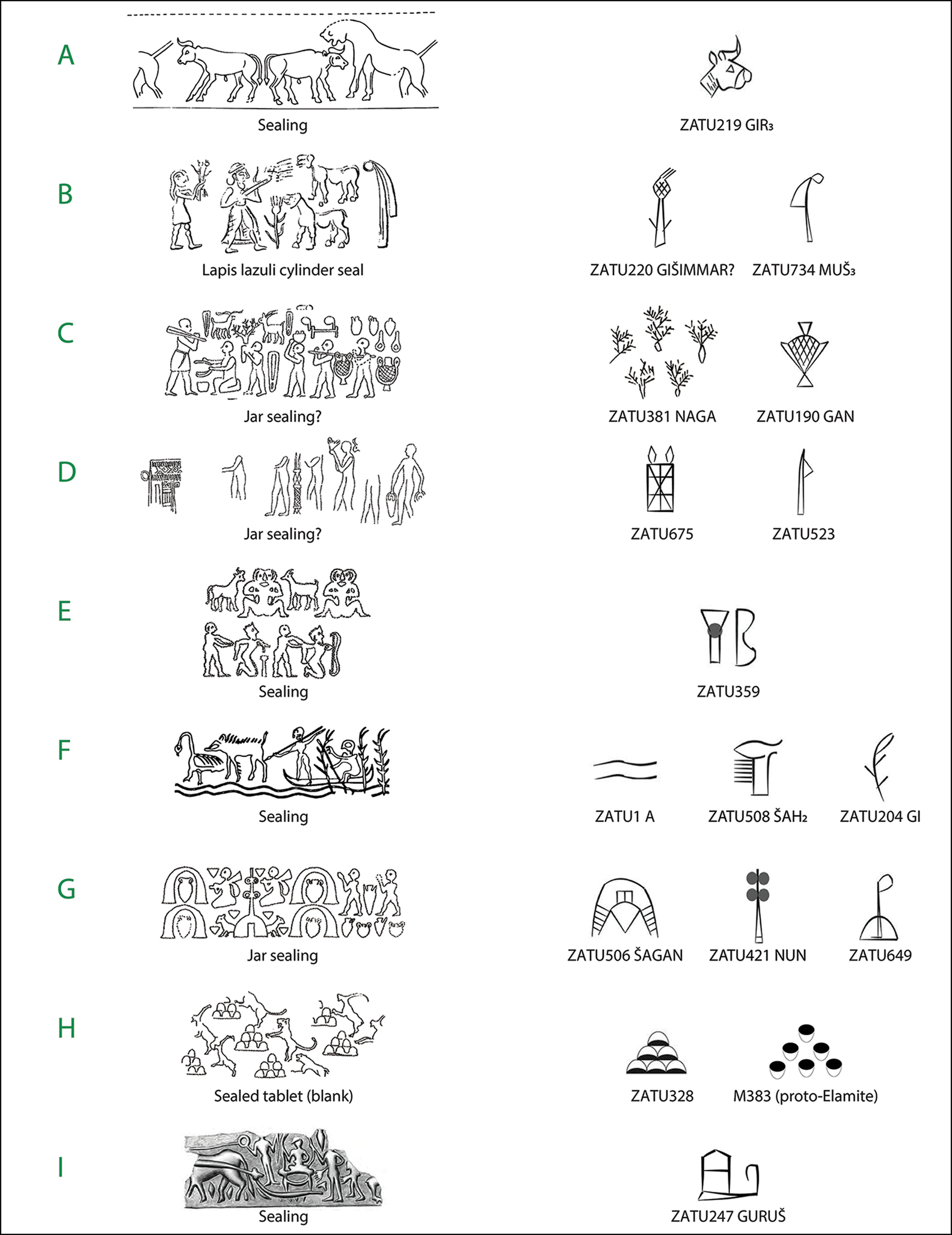
Examples of parallels between proto-literate seals and signs. For further details, see OSM (figure by authors).
Thus, a picture emerges in which seals and texts operate synergistically to document the delivery of similar products to temple households. Crucially, these seal motifs pre-date the introduction of proto-cuneiform and appear on transitional types of records (bullae and numerical tablets). Their adoption in script draws a specific continuity between pre-literate symbol systems and the invention of writing.
Symbol-sharing in the proto-literate period
More broadly, there is the potential for considerable interplay between seals and early script in the late fourth millennium BC (Figure 9). For example, a vessel sign with a cloth covering (ZATU506) has a clear proto-literate seal parallel (Figure 9G). This sign may reference a type of priest (Selz Reference Selz and Wengrow2022: 220; cf. Greco Reference Greco2014: 368–74), perhaps in charge of certain consumables (Englund Reference Englund, Høyrup and Damerow2001: 25), and may belong to a similar administrative context as the netted vessel sign.
Plant shapes reveal connections between script and seals beginning with the proto-literate material (Figure 9B & C), and the water in a boar-hunting scene parallels the proto-cuneiform sign ZATU1 (Figure 9F). Stylistic similarities are also suggestive: compare, for example, the bovine head on a seal impression from Nineveh and ZATU219 on an Uruk IV tag (Figure 9A). Elements in seals that find comparison with signs are often built into scenes in natural ways, such as the mace and bow(?) among kneeling prisoners that might parallel a rare proto-cuneiform sign (ZATU359, Figure 9E). Combining contextual evidence from seals and signs may even aid further interpretation. The undeciphered sign ZATU675 (Figure 9D) appears to be a schematic representation of an object in a proto-literate seal from Uruk, perhaps a cult statue (cf. also ZATU25, Green & Nissen Reference Green and Nissen1987: 320).
Many seal-sign comparisons draw on seal motifs first found in the proto-literate period. Reed poles (ZATU523 and ZATU595, Figures 2 & 3C) appear already in late pre-literate seals but the pole with shawl or tassel, representing the goddess Inana (MUŠ3/ZATU374, Figure 9B), is not found in seals before the proto-literate period. Seals and signs may also represent architectural embellishments with cultic significance (van Dijk-Coombes Reference Van Dijk-Coombes2024; cf. Szarzyńska Reference Szarzyńska1997) (Figure 9G). A ‘heap’ or mountain corresponding to ZATU328/LAM appears in an impression on an uninscribed proto-literate tablet from Uruk. The motif later proliferates, especially in the proto-Elamite seals and writing from Iran (Figure 9H). The introduction of these new motifs into seals alongside the invention of writing shows how seals and writing reflect each other in stylistic preferences.
Despite this reflexivity, seals and script retain their independence. With few exceptions (Matthews Reference Matthews1993; Nissen et al. Reference Nissen, Damerow and Englund1993: fig. 18; Pittman Reference Pittman and Zsolnay2023: fig. 9.14) seals do not contain signs. Images of humans and quadrupeds illustrate one of many ways in which the systems adopt different iconographic strategies: whole figures are frequently represented in seals, whereas proto-cuneiform depicts only separate body parts. In script, tools can represent humans (e.g. the threshing sledge for agricultural workers, Figure 9I) and women are represented by vulvas (compare an early alabaster plaque from Mari on the Euphrates in eastern Syria, Steinkeller Reference Steinkeller, Chambon, Guichard and Langlois2019), while seals depict whole, clothed individuals.
Seals and writing in (inter-)regional context
A set of ‘city seals’, bearing symbols representing cities, appear impressed on Uruk III tablets originating from two southern Mesopotamian cities. The tablets record small numbers of commodities, including dried fruits. By the Jemdet Nasr period, therefore, seals appear to have been used in combination with proto-cuneiform tablets to record the exchange of goods, probably as cultic offerings, that maintained relationships between Uruk and other cities of southern and central Iraq (Matthews Reference Matthews1993; Steinkeller Reference Steinkeller and Abusch2002; see also Michalowski Reference Michalowski, Rainey and Kutscher1993 on these seal inscriptions as a separate symbol system from proto-cuneiform). Such exchanges could be seen as a strategy for strengthening ties as inter-regional connections weakened following the Uruk phenomenon (Matthews & Richardson Reference Matthews and Richardson2018).
Similar inter-city cultic exchanges may contribute to the invention of writing in the Uruk IV phase, but the extent is unclear. The small-scale numerical notations on bullae and numerical tablets may point towards local economic concerns (Englund Reference Englund, Yushu and Yiyi2006: 30) and a focus on agriculture and local industries in tablets may be emphasised (Nissen Reference Nissen2016). Yet proto-cuneiform grew from the administrative techniques that structured communities living at great distances from one another, from southern Iraq through to south-eastern Türkiye. Seal use and imagery demonstrate a shared articulation of the production and movement of commodities across this region, prominent among which are netted-vessels and cloth, sometimes in the presence of temple façades or before important individuals (Figure 10B). It is not clear whether these motifs represent commodity processing enacted locally or imply long-distance or inter-city exchanges. The modest offerings marked with ‘city seals’ suggest that even small exchanges could be inter-regional.
Comparisons between netted-vessels, a distinctive plant, and a priest/ruler(?) in proto-cuneiform (A & C) and seal imagery (B). For further details, see OSM (figure by authors).
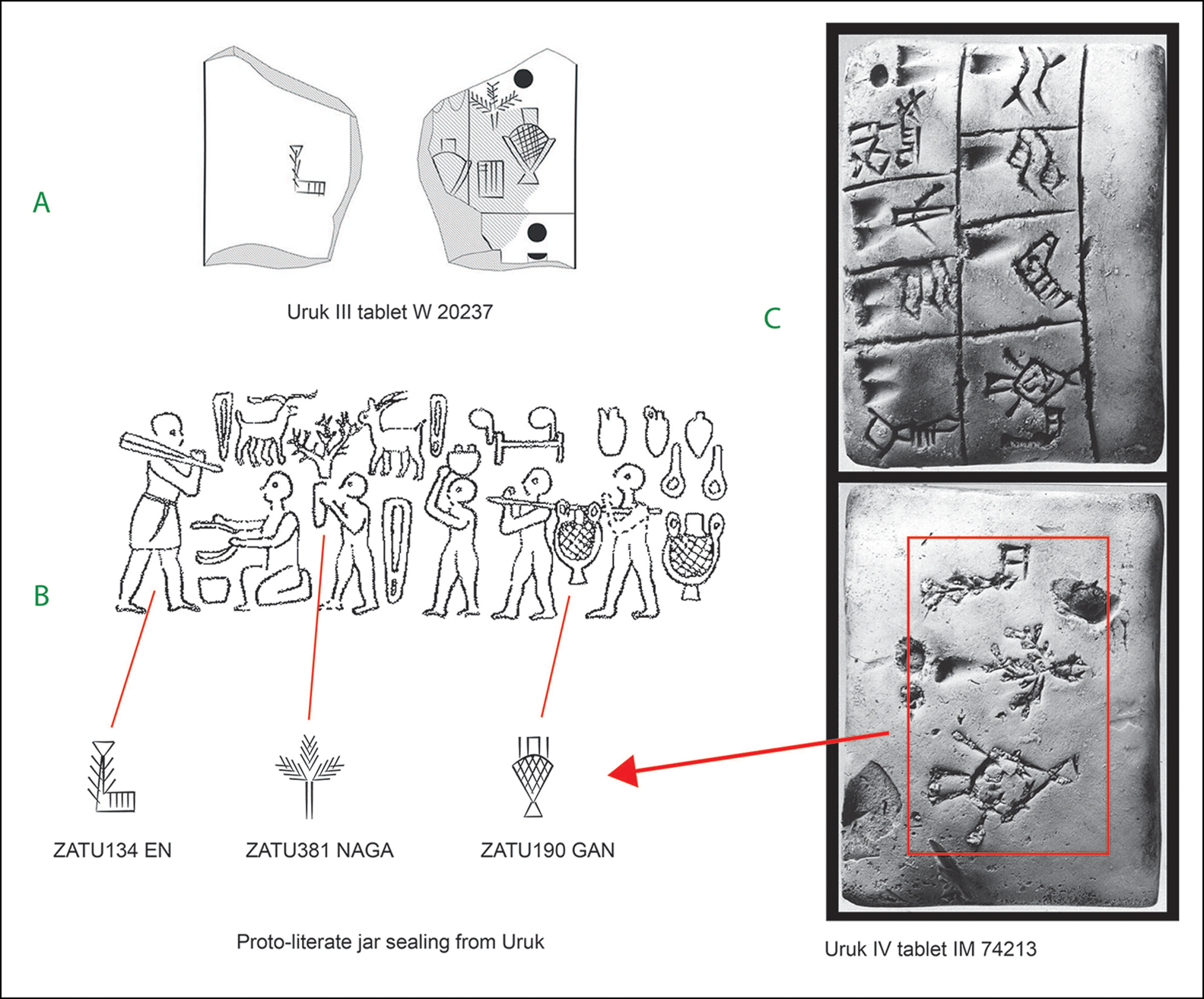
A striking correlation between sets of signs and pre-literate seal motifs emerges from the comparison of a jar sealing from Uruk and an Uruk IV tablet accounting 21 products or ‘vessel deliveries’ (Figure 10C). The vessels might have contained honey, syrup or wine since HI ‘sweet’ (or GIŠ) DIN are inscribed inside (Figure 10C top image, bottom right panel) (on DIN as perhaps wine see Englund Reference Englund, Bauer, Englund and Krebernik1998: n. 116; on regional trade in wine during the Uruk period see Algaze Reference Algaze, McGovern, Fleming and Katz1996). Seven deliveries are possibly associated with different officials, including one that uses a symbol later also used for the city Adab in the ‘city seals’. On the reverse, an unusual, linear summary line (cf. Green Reference Green1981) appears to mimic a rolled-out cylinder seal, offering the sequence ‘suspended vessel’–‘alkaline plant’(?)–EN (Soriga Reference Soriga, Gaspa, Michel and Nosch2017). Alkaline plants are associated with textile processing, but this proto-cuneiform sign (ZATU381/NAGA) can also reference an administrative office, as well as the ancient city EREŠ2 (location unknown).
Substituting the EN sign for a large official-looking figure (compare Steinkeller Reference Steinkeller, Chambon, Guichard and Langlois2019), the summary line on the Uruk IV tablet therefore parallels important elements on the contemporary jar sealing (Figure 10B). An Uruk III tablet fragment similarly correlates the ‘temple vessel delivery’ (E2 GAN) with the alkaline plant and EN (Figure 10A). Thus, although interpretative questions remain, some correspondence between seals and writing may be seen during the era of script development, when symbols and some of their semantic associations were likely reflected in signs. Correlations between tablets and seals also suggest that Uruk IV writing may have sometimes connected cities through the movement of goods in a tradition that has antecedents in seal iconography and a possible successor in Uruk III ‘city seals’.
Conclusion: seals and the invention of writing
Seals are a key consideration on the path towards writing in South-west Asia. At times, shared seal and sign shapes may reflect common referents in the real world. Though the schematic forms of proto-cuneiform may obscure a myriad of connections with seal motifs from modern eyes, recognising commonalities can elucidate the respective cultural traditions. The fringed textiles and netted-vessels show how pre-literate motifs could be transformed into signs in script through a process in which they retained some of their semantic associations. The correlation of fringed textile and netted-vessel signs with ‘façade’ and ‘pole’ signs on tablets strengthens their connection to late pre-literate administrative traditions that connected Uruk with cities across South-west Asia, adding to our understanding of the stimuli for the invention of writing in southern Iraq. Early in the development of writing, seals and signs continued to share shapes and reflect each other, while remaining highly distinct information systems. Documenting the extent of shape sharing helps build a more integrated, cohesive and, ultimately, more compelling explanation for the development of writing. Such investigation casts light on the late fourth millennium as a time of intense technological innovation, during which different modes of communication were not only exploited in new ways but were also deployed in synergy.
Funding statement
This article is funded by the European Research Council INSCRIBE Invention of Scripts and their Beginnings, awarded to Silvia Ferrara. The project has received funding from the European Research Council (ERC) under the European Union's Horizon 2020 research and innovation program, Grant Agreement No. 771127.
Online supplementary material (OSM)
To view supplementary material for this article, please visit https://doi.org/10.15184/aqy.2024.165 and select the supplementary materials tab.


 Open access

