





Introduction
In 1525, Inquisition officials in Gran Canaria produced a list of 355 “Moriscos, Jews, and new Christians” residing on the island, accompanied by descriptions indicating whether individuals were enslaved or free, whether they could competently perform Christian rites and prayers, and in some cases, the approximate dates and locations of their baptisms. Many were described as moriscos or moriscas, and a few as Jews or indigenous Canary Islanders, but over half were described as ‘black.’ Although some had been baptized in the Canary Islands, several indicated that their initial experiences of Christianity took place elsewhere. An enslaved woman owned by a tavernkeeper and identified only as “Catalina negra” had been baptized in the Azores fourteen years earlier, in approximately 1511; other enslaved black women were baptized in Madeira in ca. 1515 and 1520. A twenty-year-old woman named Catalina had been baptized twice: first as a child in São Tomé, and the second time on the island of Gran Canaria. Enslaved women named Leonor and Madalena had been baptized in the Cape Verde Islands in ca. 1512 and 1520, respectively, and an enslaved man named Juan had likewise become a Christian in the Cape Verde Islands five years earlier at the age of 35.Footnote 1
This vignette provides a brief glimpse of Africans and people of African descent in the early sixteenth-century Canary Islands who had previously resided in one of the Portuguese Atlantic archipelagos. From the vantage points of these women and men – and presumably those of the merchants and mariners who had transported them – these insular Atlantic spaces were contiguous and overlapping, linked by commercial activities that included the traffic of enslaved Africans.Footnote 2 Previous studies of Atlantic slaving during the early 1500s often emphasize the degree to which it served as a precursor or differed from the transatlantic slave trade in later periods.Footnote 3 But in addition to its function within slaving historiographies, this sixteenth-century traffic can inform microhistories addressing contemporaneous events, processes, and individual trajectories of transregional or even global scope; it also offers a useful framework for comparing and connecting the histories of maritime spaces claimed by Iberian monarchs within a period widely understood as the beginning of the early modern (or colonial) era.Footnote 4 As the above example from Gran Canaria suggests, attention to the sixteenth-century slave trade can provide considerable insight into the formation of Iberian Atlantic societies and economies not only in relation to the objectives of European monarchs and administrators, but also in relation to one another.
Complicating linear narratives of imperial expansion, the traffic of black Africans during the early 1500s created multiple points of connection between territories claimed by the Portuguese and Castilian crowns, often involving actors of diverse origin.Footnote 5 Sources generated in the Caribbean and Canary Islands substantially improve our knowledge of this transimperial and multinational traffic. First, they reveal that the earliest slaving voyages to sail directly from Africa to the Americas departed from Arguin in present-day Mauritania in the late 1510s and early 1520s.Footnote 6 Although these ships were probably fitted out in Seville or the Bay of Cádiz, and embarked captives in Arguin (rather than Lisbon) by order of Portuguese monarch Manuel I, these little-known voyages indicate that the transatlantic slave trade was initially rooted in older forms of commerce between Christians and Muslims. Secondly, Spanish-language records demonstrate that the slave trade from the Gulf of Guinea to the Caribbean was more expansive and began several years sooner than previously believed. They show that the early São Tomé-Caribbean traffic thrived in tandem with parallel circuits in the eastern Atlantic, rather than developing later as an offshoot of older slave routes. The Cape Verde Islands’ extensive maritime connections to both the Canary Islands and the Caribbean represent a third pattern attesting to the collaborative and transimperial nature of the Atlantic slave trade. Hispanic merchants and mariners were often involved in the organization and operation of slaving voyages from the Cape Verde Islands, and Spanish records depict multistage itineraries involving the transportation of merchandise from the Canaries to Santiago Island, Upper Guinean captives from the Cape Verde Islands to the Caribbean, and Caribbean products to Iberia. Such voyages amply illustrate the slave trade’s integration into maritime and commercial circuits spanning both Portuguese and Castilian jurisdictions. Iberian monarchs and administrators certainly contributed to, and heavily benefited from, the rise of the transatlantic slave trade, but royal agendas pertaining to the commerce in enslaved Africans should also be seen in light of these older and broader trends. To treat this early Atlantic traffic as an exclusively “Portuguese” or “Spanish” enterprise stemming chiefly from crown directives would be a vast oversimplification.
Arguin
Arguin Island, immediately off the northern coast of present-day Mauritania, played a little-known but important role in the origins of the transatlantic slave trade to the Americas. First established in the 1440s, Arguin (or Arguim) was the first Portuguese feitoria in West Africa; forming part of the diocese of Funchal (Madeira), it predated Portuguese settlement in the Cape Verde Islands and served as a model for São Jorge da Mina.Footnote 7 The Arguin outpost’s main objective was to access trans-Saharan trade, diverting merchandise – particularly gold – from inland caravan routes towards the coast.Footnote 8 Over the following century, mariners from western Europe and the Cape Verde Islands would transport wheat, textiles, garments, coral beads, silver, utensils, and other commodities to the fortress at Arguin. In exchange, merchants typically described in European sources as ‘Moors’ provided gold, gum, other goods, and African captives.Footnote 9 It quickly became clear that the most profitable trade at Arguin was not in gold, but in slaves.Footnote 10 The east-west route linking Arguin to Waddan (Ouadane), which was located on a major trans-Saharan thoroughfare, was of interest to both Portuguese and Mauritanian merchants, and many captives leaving Arguin may have been siphoned off from the trans-Saharan trade.Footnote 11 Others were likely Wolofs, Serers, and Mande peoples brought directly from the Jolof empire in Senegambia by “Azenegue” (e.g. Sanhaja, most likely Zwaya) merchants, who acquired them in exchange for horses.Footnote 12 A large share of enslaved Africans arriving in Lisbon, Valencia, Seville, and Barcelona prior to 1540 were trafficked from Arguin, and by the 1520s-1530s, an estimated 2,000 captives reached Portugal from Arguin annually.Footnote 13
Activities undertaken by residents of the Canary Islands could alternately challenge or complement Portuguese commercial influence in Arguin. In 1478 the señor of Lanzarote built the small castle of Santa Cruz de Mar Pequeña on the Moroccan coast near Fuerteventura, perhaps aiming to compete with Portuguese trade farther south during the War of Castilian Succession; the tower was reestablished by Gran Canaria’s governor in 1496 but abandoned by the 1520s.Footnote 14 Yet throughout the 1500s, vessels departing from the Canaries sailed to Arguin Island and the surrounding coast to fish and trade, occasionally supplying Arguin with bread and cereals – some re-exported from Madeira or the Azores – in exchange for captives.Footnote 15 Although they usually refrained from conducting slaving and plundering expeditions known as cabalgadas in the vicinity of the Portuguese fortress, Canary Islanders frequently carried out these raids elsewhere, often in violation of the Iberian monarchs’ agreement to limit Castilian presence in Africa to areas north of Cape Bojador.Footnote 16 As late as 1549, a letter written by Arguin’s chief administrator noted that local inhabitants known as Narziguas complained about continual raids launched from the Canary Islands, and that in exchange for protection, they were willing to offer the Portuguese 1,000 cows per year. He also requested that a patrol ship be sent from Portugal, observing that the Canary Islanders were heavily involved in coastal trade throughout the region.Footnote 17
Although they were preceded by voyages from Seville that carried small numbers of enslaved people along with merchandise and passengers, the Arguin-Caribbean itineraries of four vessels in 1519-1521 constitute our earliest evidence of slave ships sailing directly from Africa to the Americas.Footnote 18 These voyages were associated with Charles V’s grant of 4,000 “licenses” in August 1518 to Laurent de Gorrevod, who ultimately subcontracted the asiento to a consortium of Genoese merchants (Vivaldi, Fornari, Centurión, and others) based in Seville. The Genoese group worked closely with Burgalese merchant Juan Fernández de Castro, who on their behalf secured permission from the Portuguese crown to buy 4,000 or 4,300 captives from the feitoria at Arguin Island, but would later complain that he was only able to obtain approximately 700.Footnote 19 In 1520 for example, according to Fernández de Castro, the four ships Santa María de la Luz, Santi Espiritus, San Miguel, and Santa Cruz were sent to Arguin to embark 800 captives but received a total of only 105 (in groups of 61, 31, and 13).Footnote 20 Understandably, some historians have expressed doubt as to whether the planned traffic from Arguin to the early Spanish Caribbean ever took place.Footnote 21
But accounts kept by Puerto Rico’s officials and by slave trade factor Francisco de Toro confirm that 116 or 117 “piezas de esclavos de Argin” were disembarked on the Caribbean island in 1519 and 1520, and that at least seven captives died soon after arrival.Footnote 22 De Toro, who had previously spent nine years as Fernández de Castro’s factor “in Arguin and Guinea and Cabo Verde in the traffic of slaves and other things,” was described in Puerto Rico as having “come to this island and brought blacks from Arguin.”Footnote 23 He continued to work for Fernández de Castro until 1526, and during this time, three ships in addition to his first voyage (presumably in 1519) transported enslaved Africans from Arguin to Puerto Rico. Sailing from Arguin on the caravel Santa María de la Luz, on 15 November 1520, shipmaster Francisco or Fernando de Rosa disembarked 44 captives in San Juan, where import taxes were paid on behalf of Fernández de Castro. De Rosa landed ten additional captives in San Germán in 1521, either early that year on the same voyage or on a separate, second voyage “from Arguin” that returned to San Juan with an unspecified number of captives on 10 October 1521.Footnote 24 In between de Rosa’s voyages, the caravel San Miguel “came from Arguin” and docked in San Juan on 9 May 1521. Its shipmaster Martín de Urquiza disembarked at least 79 captives on behalf of Juan Fernández de Castro and Gaspar Centurión.Footnote 25
Although they or other vessels may have taken additional captives to Hispaniola, these voyages from Arguin to Puerto Rico were few in number and took place within the space of just three years or less. But despite its ephemeral nature, this Arguin-Caribbean traffic raises significant new possibilities for understanding the origins of the transatlantic slave trade. First, it indicates that the earliest slaving voyages from Africa to the Americas could have redirected captives away from trans-Saharan routes, an eventuality that would be highly unlikely in later centuries due to Islam’s role in limiting the spread of the Atlantic slave trade in West Africa.Footnote 26 Secondly, the 1519-1521 voyages are significant as an outcome of interfaith commercial relations and coexistence, which may have been an aspect of everyday life at Arguin. Some of the island’s original inhabitants were killed or enslaved when the Portuguese first arrived, but many of those who fled may have returned soon afterwards; by the dawn of the sixteenth century, the island contained “some 70 or more houses of Moors… known as Azenegues” in addition to the Portuguese outpost.Footnote 27 Monod notes that the feitoria itself may have been under “Muslim” control at one point later, and that while no Christian tomb has yet been found on the island, there were two cemeteries, including a Muslim burial ground near the fortress.Footnote 28
Portuguese feitoria officials’ evident cooperation with Mauritanian merchants in the trafficking of enslaved black Africans at Arguin – despite Muslim-Christian conflict and Iberian conquests of coastal towns in nearby Morocco during the same period – strongly echoes the “common culture of slavery” shared by Christians and Muslims in the late medieval Mediterranean.Footnote 29 In addition to representing the birth of the transatlantic slave trade, these Arguin-Caribbean voyages provide grounds for viewing the early Atlantic traffic as an extension or adaptation of Mediterranean slaving practices. Although these contexts differed in several important ways, the comparison can be extended beyond this trade’s transconfessional nature. Not unlike those of the western Mediterranean, enslaved populations in the Spanish Caribbean had been ethnically diverse during the late 1400s and early 1500s, including not only black Africans, people of African descent, and very small numbers of Iberian moriscos and North African berberiscos, but also Amerindian captives of widely different origins.Footnote 30 Taking place almost precisely during a period in which enslaved populations in western Mediterranean ports such as Barcelona were becoming less diverse and more prominently comprised of enslaved black Africans, the Arguin-Caribbean voyages of 1519-1521 marked the beginnings of a similar transformation in the Greater Antilles.Footnote 31
São Tomé
By 1526 the reconfigured Genoese consortium had not managed to deliver 4,000 captives to the Caribbean, ostensibly due to a lack of supply in Arguin, but arranged to embark enslaved Africans on the island of São Tomé instead.Footnote 32 As part of this arrangement, shipmaster Polo de Spíndola, a Genoese resident of Málaga, was hired to transport 300 captives.Footnote 33 Many aspects of his voyage to São Tomé, Puerto Rico, and Hispaniola on the ship Santa María de Begoña are richly documented in Spanish-language records. After embarking at least 333 enslaved Africans in São Tomé in early 1527, Spíndola sailed for the Caribbean, disembarking several captives in Puerto Rico before finally entering the harbour of Santo Domingo on 15 June in the same year.Footnote 34 In a subsequent legal suit, Genoese merchant Agustín de Vivaldo complained that Spíndola had delivered only 257 captives; Spíndola’s receipts confirm that only 278 Africans had been embarked on behalf of the voyage backers, while over 50 additional captives were earmarked for Spíndola, other mariners, or Spanish Caribbean officials. When questioned in Santo Domingo, crew members could not state with precision how many enslaved Africans they had brought from São Tomé because some had died of illness, and others “fell and threw themselves intentionally into the sea.”Footnote 35
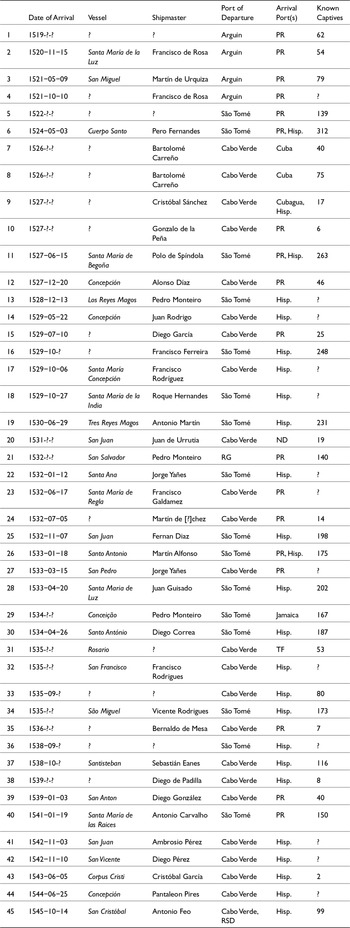
Known to historians since the 1960s, the Santa María de Begoña was until recently considered the earliest slaving voyage to sail directly from Africa to the Americas, and one of eight described in Portuguese sources as transporting captives from São Tomé to the Caribbean during the late 1520s and 1530s.Footnote 36 Shipping, tax, and judicial records from the Caribbean indicate that this traffic was at least twice as large as previously believed. A minimum of eight additional ships arriving in the Greater Antilles before 1542 had sailed from São Tomé, with the first, as documented by Jalil Sued Badillo and Ángel López Cantos, landing 139 enslaved Africans in Puerto Rico in 1522.Footnote 37 The Cuerpo Santo (or Corpo Santo), a second vessel which “came from the island of Santo Tomé loaded with blacks” (and civet cats, parrots, rice, textiles, sugar, and furniture), docked in Puerto Rico in May 1524.Footnote 38 Recent research by Rafael Pérez García shows that this vessel had embarked no less than 360 captives, six of whom managed to escape in São Tomé prior to its departure. At least 37 died at sea, and 67 were sold or entrusted to royal officials in Puerto Rico; the remaining 251 African women, men, and children were disembarked in Santo Domingo.Footnote 39 These three São Tomé voyages were followed by at least 13 others arriving in Hispaniola, Puerto Rico, or Jamaica in 1528-1541 (Table 1). Although slaves continued to arrive in accordance with the 4,000 “licenses” acquired by the Genoese consortium, others were transported under the auspices of a 1528 asiento undertaken by agents of the Welser family, often described in Caribbean sources as “the Germans.”Footnote 40
Slaving Voyages from Africa arriving in the Spanish Caribbean, 1519-1545

Table 1 Long description
The table details voyages from Africa to the Spanish Caribbean between 1519 and 1545, focusing on the transport of enslaved Africans. Key departure ports include São Tomé and Cabo Verde, with Hispaniola and Puerto Rico as frequent arrival destinations. Notable voyages include the 1524 journey of Cuerpo Santo, which transported 312 captives, and the 1530 voyage of Tres Reyes Magos, which carried 231 captives. The data reveals a trend of increasing numbers of captives over time, with some voyages resulting in significant loss of life during transit. The table also highlights the uncertainty in some records, with several entries lacking specific details on captives or shipmasters.
Hisp. = Hispaniola; ND = Nombre de Dios; PR = Puerto Rico; RG = Rios de Guinea; RSD = Rio de São Domingos; TF = Tierra Firme
Sources and Notes
1.AGI-Indiferente 1382A, s/n. At least two voyages from Arguin brought 116 captives to Puerto Rico in 1519 and 1520; Francisco de Rosa’s voyage with 54 captives in 1520 was likely one of these. I assume the remaining 62 enslaved Africans from Arguin arrived on a single vessel in 1519. See also TSTD 43009.
2.AGI-Patronato 175, r.9, fols. 141r, 150r; AGI-Justicia 711, n.9, pieza 2, sin folio [image 127]; Eagle and Wheat, “Early Iberian,” 50-51; TSTD 42987. This vessel disembarked 44 captives in San Juan, but de Rosa landed ten additional captives in San Germán on an unspecified date in 1521. I assume the ten captives arrived on this voyage, but they may have arrived on de Rosa’s Arguin-Puerto Rico voyage in late 1521. If the latter case, ten additional captives should be added to the 1519 Arguin voyage (for a total of 72).
3.AGI-Ctdra 1073, n.3, fol. 138r; AGI-Patronato 175, r.9, fol. 152v; AGI-Justicia 711, n.9, pieza 2, sin folio [image 127]; Eagle and Wheat, “Early Iberian,” 51.
4.AGI-Ctdra 1073, n.3, fol. 139r; AGI-Justicia 711, n.9, pieza 2, sin folio [image 127].
5.AGI-Indiferente 1382A, s/n, fol. 2v; Sued Badillo and López Cantos, Puerto Rico Negro, 74.
6.AGI-Ctdra 1073, n.2, r.2, fols. 81r, 95r-96r; Eagle and Wheat, “Early Iberian,” 53; Pérez García, “El capitalismo,” 433-7.
7.Saco, Historia de la esclavitud (volumen IV), 117; Pike, Enterprise, 172; TSTD 11297.
8.Saco, Historia de la esclavitud (volumen IV), 117; Pike, Enterprise, 172; TSTD 11298.
9.AGI-Indiferente 421, L.12, fol. 277v; Eagle, “Caribbean Pathways,” 156; Eagle and Wheat, “Early Iberian,” 50, 68. Denied entry at Cubagua, the vessel went to Hispaniola instead.
10.AGI-SD 2280, L.2, fol. 16v.
11.AGI-Justicia, 7, n.3; ANTT-CC-2, maço 133, n.115; AGI-Ctdra 1050, n.2, fol. 408r; Rodríguez Morel, Cuentas, vol. 2: 152; Braudel, La Méditerranée, vol. I: 134; Mendes, “Foundations,” 71; Eagle and Wheat, “Early Iberian,” 59; Pérez García, “El capitalismo,” 421-8; TSTD 46473.
12.AGI-Ctdra 1073, n.5, fols. 193r, 259v-260r; AGI-SD 2280, L.2, fols. 15v-16r; Tanodi, Documentos, vol. 2: 228; Sued Badillo and López Cantos, Puerto Rico Negro, 75-6; TSTD 99027. See also AGI-Justicia 7, n.9, pieza 2, sin folio [image 143].
13.AGI-Ctdra 1050, n.2, fol. 421r; Rodríguez Morel, Cuentas, vol. 2: 167. “Traxo negros.” Rodríguez Morel lists arrival date as October 13.
14.AGI-Ctdra 1050, n.2, fol. 422v; Rodríguez Morel, Cuentas, vol. 2: 168. Vessel brought “mercaderias e otras cosas y negros.”
15.AGI-Ctdra 1073, n.6, fols. 345r, 678v, 679v-680r; AGI-SD 2280, L.2, fols. 10v, 14v-16v.
16.AGI-Justicia 973, n.1, r.1, fols. 4r-9r.
17.AGI-Indiferente 1962, L.4, fol.13r; AGI-Ctdra 1050, n.2, fol. 426r; Rodríguez Morel, Cuentas, vol. 2: 172; Chaunu and Chaunu, Séville et l’Atlantique, vol. 2: 216-7.
18.AGI-Ctdra 1050, n.2, fol. 426r; Rodríguez Morel, Cuentas, vol. 2: 172. “Vino con negros de los alemanes, de Santo Tomé.”
19.AGI-Ctdra 1050, n.2, fol. 429r; AGI-Justicia 973, n.1, r.1, fols. 15v-22v; Rodríguez Morel, Cuentas, vol. 2: 175. The sources provide two arrival dates: June 29 and July 1, 1530.
20.AGI-Panamá 234, L.5, fols. 111r, 197v.
21.AGI-SD 2280, L.1, fols. 155v, 163r, 167r-167v; ibid., L.2, fol. 11r; Sued Badillo and López Cantos, Puerto Rico Negro, 116 (citing AGI-SD 166); Eagle and Wheat, “Early Iberian,” 58.
22.AGI-Ctdra 1050, n.2, fol. 443v; Rodríguez Morel, Cuentas, vol. 2: 190. “Vino con negros de Santo Tome para los alemanes.” See also Eagle, “Caribbean Pathways,” 142.
23.AGI-Ctdra 1073, n.6, fol. 355r; Tanodi, Documentos, vol. 2: 287; TSTD 44292. This ship “arrived from Cabo Verde” with unspecified “merchandise” which may not have included enslaved Africans, but according to Seville notarial records it was supposed to have embarked 50 captives in the Cape Verde Islands; see Pérez García and Fernández Chaves, “Sevilla y la trata,” 605.
24.AGI-Ctdra 1073, n.6, fols. 422v-423r; Tanodi, Documentos, vol. 2: 321-2; TSTD 28994.
25.AGI-Ctdra 1050, n.2, fol. 449r; Rodríguez Morel, Cuentas, vol. 2: 195. See also ANTT-CC-2, maço 182, n.76; maço 205, n.13; Mendes, “Foundations,” 71; TSTD 46478. Of 231 captives embarked, 33 died during the voyage.
26.AGI-Ctdra 1050, n.2, fol. 449v; Rodríguez Morel, Cuentas, vol. 2: 196. See also ANTT-CC-2, maço 180, n.19 and 21; maço 205, n.13; Godinho, Os descobrimentos, vol. 4: 176-7; Mendes, “Foundations,” 71; TSTD 11293. According to Godinho, 201 captives were embarked in São Tomé.
27.AGI-Ctdra 1073, n.6, fol. 358v; Tanodi, Documentos, vol. 2: 289; TSTD 28215.
28.AGI-Ctdra 1050, n.2, fol. 450r; Rodríguez Morel, Cuentas, vol. 2: 197; Godinho, Os descobrimentos, vol. 4: 177. See also ANTT-CC-2, maço 181, n.67; maço 205, n.13; Mendes, “Foundations,” 71; TSTD 46479. 38 captives died at sea.
29.ANTT-CC-2, maço 190, n.50; maço 209, n.85; Godinho, Os descobrimentos, vol. 4: 177; Mendes, “Foundations,” 71; TSTD 46480. Monteiro evidently embarked 250 “peças” but 83 died before reaching Jamaica. This is the only voyage in this list that cannot yet be confirmed by corresponding Spanish-language sources.
30.AGI-Ctdra 1050, n.2, fol. 458r; AGI-SD 10, n.12; Rodríguez Morel, Cuentas, vol. 2: 204. See also ANTT-CC-2, maço 187, n.82; maço 210, n.91, fol. 3r; Mendes, “Foundations,” 71; TSTD 46476. I assume voyages ascribed to João Eanes (captain and pilot) and Diego Correa (maestre) are the same.
31.AGI-SD 2280, L.2, fol. 165v. Destination in “Tierra Firme” is not specified.
32.AGI-Indiferente 1092, n.118; Chaunu and Chaunu, Séville et l’Atlantique, vol. 2: 262-3.
33.Altman, “Key to the Indies,” 10 (citing AGI-SD 77, n.82). Since this ship reached Puerto Plata in September 1535, it likely is not the same as the San Francisco, which departed from Hispaniola, stopped in Lisbon, and arrived in Seville by November 17.
34.AGI-SD 10, n.12. The vessel’s captain on this voyage was João Guizado. See also ANTT-CC-2, maço 196, n.147; maço 209, n.50; maço 210, n.91, fol. 4r; Godinho, Os descobrimentos, vol. 4: 177; Mendes, “Foundations,” 71; TSTD 46477. 201 captives had been embarked in São Tomé.
35.AGI-SD 2280, L.2, fol. 95v; Sued Badillo and López Cantos, Puerto Rico Negro, 99.
36.AGI-Justicia 16, n.1, r.1, fol. 1r.
37.AGI-SD 74, r.1, n.46; AGI-SD 868, L.1, fols. 154v-155r; AGI-Ctdra 1051, n.1, 152v. Date of arrival is approximate; alternate ship name was San Sebastián.
38.AGI-SD 868, L.1, fol. 158v.
39.AGI-Ctdra 1073, n.6, fols. 584v-585r, 680v-681r; Tanodi, Documentos, vol. 2: 442-3; TSTD 5085.
40.AGI-Justicia 991, n.1, r.4; AGI-SD 868, L.2, fols. 71v, 116r; Eagle, “Caribbean Pathways,” 145-6; TSTD 42994.
41.AGI-Ctdra 1051, n.1, fols. 117r-117v.
42.AGI-Ctdra 1051, n.1, fols. 117r-117v.
43.AGI-Justicia 827, n.5, fols. 14r-17v.
44.AGI-Ctdra 1051, n.2, fol. 5r.
45.AGI-Justicia 1177, n.6, fols.1r-2v.
Cooperation between the Castilian and Portuguese crowns in the transatlantic slave trade during this period was largely tacit, with merchants of diverse European origin making separate arrangements within the administrative apparatus of each monarch. In the 1530s, Spanish royal directives concerning the Casa de la Contratación’s limited ability to control voyages moving between ostensibly Castilian and Portuguese jurisdictions provide further details about vessels arriving in the Caribbean from São Tomé. In October 1533, Charles V notified the Audiencia of Santo Domingo that ships “from the kingdom of Portugal and elsewhere” had been taking enslaved Africans to Hispaniola to sell them in exchange for “gold and other merchandise,” then returning to Europe without stopping in Seville to register their voyage or pay taxes. According to this decree and a second cédula issued in 1534, from that time forward shipmasters were required to pledge that they would sail directly from Hispaniola to Seville, providing insurance equal in value to their profits; otherwise they would face arrest and confiscation of any merchandise or proceeds. In response, Santo Domingo officials presented evidence of their implementation of the new policy, including a petition by João Eanes, captain and pilot of the Santo António, who in May 1534 had requested clearance for departure. Having arrived from São Tomé with 187 captives less than two weeks earlier, he aimed to return to Lisbon, then “bring slaves to this city again” on a new voyage. In order to bypass the stricter departure requirements, his ship would leave carrying only ballast.Footnote 41
But the oidores’ report also indicated that enforcement of the policy was hampered by local resistance based on logistical considerations. Departure requests submitted in 1535 by João Guizado and Vicente Rodrigues, captain and maestre of the nao San Miguel which had brought 173 captives from São Tomé that year, indicate that slaving voyages also allowed Spanish Caribbean merchants to export products to Iberia. Petitioning to sail to Castile with merchandise and passengers “just like the other ships that go to Spain,” Guizado observed that there was no comparably-sized Castilian vessel in Santo Domingo’s port capable of making the journey at that time. Guizado’s petition was reinforced by a statement signed by six merchants, five of whom – García de Báscones, Diego de Toledo, Álvar Arias, Pedro Hernández de Utrera, Juan de Jaén – bore surnames suggesting Spanish origins. They requested authorization for “the Portuguese ship named San Miguel, of which Vicente Rodrigues is shipmaster” and Guizado was captain, to depart for Seville with its cargo of “much sugar, hides, and other merchandise” already loaded on their behalf.Footnote 42 Their requests evidently swayed Audiencia officials; Rodrigues arrived in Seville on the San Miguel later that year.Footnote 43
Traffic toward the Caribbean was only one of several Sãotomean slaving routes during the early 1500s; others included the importation of captives from the Kingdoms of Benin and Kongo and elsewhere; slave exports to Lisbon; and the delivery of enslaved Africans to São Jorge da Mina for sale to African buyers.Footnote 44 But these circuits should not be viewed as entirely separate. Some Iberian seafarers undoubtedly specialized in one route or another.Footnote 45 But others who transported captives from São Tomé to the Caribbean undertook multiple voyages; for example Fernán Díaz, pilot of the Santa María de Begoña in 1527, was likely the same Fernán Díaz who returned to Hispaniola as maestre and captain of the San Juan in 1532.Footnote 46 Although some cases may involve different individuals sharing the same name, abundant examples indicate that mariners also participated in multiple slaving circuits. Between his voyages from São Tomé to Santo Domingo (1528) and Jamaica (1534), Pero Monteiro transported captives to Lisbon in 1529.Footnote 47 The Santa María de Begoña’s contramaestre Juan do Porto may have been the same João do Porto who piloted a voyage from São Tomé to São Jorge da Mina in 1519.Footnote 48 “Diego Correa,” who alongside João Eanes brought 187 enslaved Africans from São Tomé to Hispaniola in 1534 as maestre of the Santo António, was probably the same Diogo Correa who one year later piloted a vessel from São Tomé to Mpinda and back, returning with 369 captives.Footnote 49
Whereas scholars previously assumed that a “decline of the São Tomé-Elmina slave trade” led to “the shift in the traffic to direct shipment across the Atlantic,”Footnote 50 the chronological distribution of slaving voyages from São Tomé to the early Spanish Caribbean (1522-1541) closely matches the peak years of traffic from São Tomé to São Jorge da Mina (1520s-early 1530s) and available data for voyages from São Tomé to Lisbon (1519-1535). Differences in the frequency and volume of these circuits ensured their compatibility. Approximately one voyage per year carried captives from São Tomé to Lisbon, typically in addition to sugar and other commodities. On average these voyages embarked 65 captives but delivered only 45 or 46, with mortality rates often reaching 30% or higher.Footnote 51 The São Tomé-São Jorge da Mina traffic was larger, with 48 vessels disembarking at least 3,631 enslaved Africans, along with blue beads known as coris and other merchandise, at Elmina between 1515 and 1536.Footnote 52 Thus at least two ships per year took captives from São Tomé to São Jorge da Mina, each landing an average of 75 or 76 captives (although this figure is probably low for the 1520s and early 1530s, when “three to six separate vessels were kept continually busy hauling slaves to Mina”).Footnote 53 With the exception of years in which two ships arrived – 1529, 1532, 1533 – slaving voyages from São Tomé to the Caribbean were staggered farther apart than those of the other slave routes, with one voyage every 15 months or so. But these were higher volume enterprises. Twelve known São Tomé-Caribbean voyages disembarked a total of 2,445 captives, suggesting an average of 203-204 surviving captives per voyage. The actual numbers may have been higher, since arrival information for all but two of these voyages is only available for a single port. Other ships’ itineraries may have resembled that of the Cuerpo Santo, which in 1524 landed 61 captives in Puerto Rico and then 251 in Hispaniola.
In short, while residents of São Tomé and Príncipe had participated in slaving voyages within the Gulf of Guinea since the 1490s, slaving circuits to Lisbon, São Jorge da Mina, and the Caribbean (especially the latter routes) flourished simultaneously in the 1520s and 1530s. In addition to commencing earlier than previously believed, the São Tomé-Caribbean traffic featured volume levels approaching that of the São Tomé-Mina traffic, with larger numbers of captives on fewer voyages. Compatible voyage frequencies, mariners’ familiarity with multiple routes to and from São Tomé, and Caribbean merchants’ reliance on ships arriving from São Tomé to send goods to Iberia all point to the São Tomé-Caribbean trade as one segment within a broader constellation of contemporaneous maritime circuits. The new Caribbean data also indicates that the total volume of slave exports from early sixteenth-century São Tomé must have been larger than previously estimated. That a multidirectional surge in trafficking from São Tomé took place precisely during the period associated with the rise of the island’s sugar industry – a development widely viewed as the origin of the Atlantic sugar complexFootnote 54 – not only suggests that these processes were closely related, but also raises questions about the relative importance of each within São Tomé’s contribution to the sixteenth-century global economy. While they undeniably complemented sugar cultivation in both the Gulf of Guinea and the Caribbean, these early São-Tomean slaving circuits also constituted an expansive industry in their own right.Footnote 55
The Cape Verde Islands
Despite Arguin and then São Tomé’s importance in the initial traffic of enslaved Africans to the Caribbean, after the mid-1530s this commerce was largely comprised of voyages from the Cape Verde Islands. Seville’s notarial records contain many references to arrangements between voyage backers and mariners who planned to embark captives in Santiago de Cabo Verde for transportation to New Spain or elsewhere; the Cape Verde Islands were also the intended embarkation site for the vast majority of outbound slaving voyages registered with the Casa de la Contratación during the 1540s and afterwards.Footnote 56 But data on intended voyages, as opposed to information generated in American ports, usually provides little indication of actual itineraries or captives embarked.Footnote 57 This problem is especially relevant for our understanding of the early traffic from the Cape Verde Islands to the Americas. For example, although the Spanish crown’s grant of 23,000 “licenses” to Basque official Fernando Ochoa in 1553 evidently “did not take effect,” two of its administrators, the Genoese brothers Nicolás and Visconte Cataño, appointed agents in Santiago de Cabo Verde and authorized various shipmasters to transport captives from the Cape Verde Islands to New Spain and Nombre de Dios.Footnote 58 It is not yet known if most of these voyages ever materialized, or whether those that reached the Americas carried captives or not.Footnote 59
The timing of the earliest slaving voyages from the Cape Verde Islands to the Caribbean is even more speculative, with some historians arguing that this traffic began as early as 1514, if not sooner.Footnote 60 Future research may uncover evidence supporting this claim. Extant Santiago de Cabo Verde customs records from 1513-1515 indicate the presence of Spanish merchants and passengers on Portuguese ships arriving and departing from Ribeira Grande, and the regular arrival of vessels described as ‘Spanish’ or ‘Castilian’ which, upon departure, transported enslaved Africans, hides, and Portuguese passengers.Footnote 61 This pattern had likely been established even earlier, given that Castilian ships and merchants from the Canary Islands were present in the Cape Verde Islands by the late 1470s.Footnote 62 And in 1522, one Gran Canaria resident complained that thirteen years earlier (in 1509) her husband had travelled to the Cape Verde Islands but never returned.Footnote 63 Notarial records from Tenerife and Gran Canaria depict several voyages sailing from the Canaries to the Cape Verde Islands or vice versa in the 1520s and 1530s.Footnote 64 Voyages from La Palma to Santiago Island during the 1540s and 1550s are documented in some detail; these vessels typically carried wine, tar (brea), and foodstuffs, returning with enslaved Africans as well as hides and other merchandise.Footnote 65 Interestingly, enslaved persons sometimes moved from Castilian towards Portuguese jurisdictions: in 1528, a “white slave” named Pedro Palmés, “branded on the face,” was taken from Gran Canaria and sold in Santiago de Cabo Verde.Footnote 66
Fragmentary evidence suggests that one vessel arriving in Puerto Rico in 1522 may have embarked captives in the Cape Verde Islands. Sailing from an unspecified port, shipmaster Bartolomé Carreño arrived in San Juan on the caravel San Antón on July 13, 1522, disembarking 159 captives.Footnote 67 Although the ship initially departed from Seville, it delivered the largest shipment of captives by far to have been transported to the Americas up to that point, and would not be superseded until the Corpo Santo’s arrival from São Tomé two years later, indicating that it likely stopped in São Tomé or the Cape Verde Islands en route to the Caribbean.Footnote 68 Evidence from later years suggests that Carreño was familiar with the Cape Verde Islands. According to his arrangement with Genoese merchant and Seville resident Pedro Benito de Basiniana in 1526, Carreño (who as noted by Ruth Pike was also known as “Esteban Carrega”) agreed to transport enslaved Africans from Santiago de Cabo Verde to Hispaniola or Cuba, possibly on multiple voyages.Footnote 69 According to José Antonio Saco, royal officials in Santiago de Cuba wrote in 1530 that “four years earlier” a certain “Carreño and Estéban Basiñana Ginoves brought forty registered blacks from Cabo Verde, then [another] 75 with license for only 40.”Footnote 70 Carreño’s subsequent voyage from the Cape Verde Islands to Santo Domingo in 1529 as captain of the ship La Concepción undoubtedly pertained to this agreement as well.Footnote 71 As late as 1551, Carreño finally paid off an outstanding debt on two enslaved Africans purchased at an unspecified earlier date from a pilot who transported 90 captives from the Cape Verde Islands to Cabo de la Vela.Footnote 72 Carreño evidently participated in multiple slave routes; for instance he also led an expedition to enslave Caribs in the late 1530s.Footnote 73 But if his 1522 journey to Puerto Rico involved a stopover in Santiago de Cabo Verde, this would make it the earliest direct slaving voyage from the Cape Verde Islands to the Americas, contemporary with the first São Tomé-Caribbean voyage.
Thus far, the earliest known slaving voyages from the Cape Verde Islands to the Caribbean are Carreño’s voyages to Cuba in 1526, but these were quickly followed by others. Sailing from “las yslas de Cabo Verde,” a different caravel delivered at least 17 captives to Hispaniola in 1527; maestre Cristóbal Sánchez and the ship’s owner, Juan de Urrutia, had previously attempted to dock in Cubagua but were turned away by the island’s officials.Footnote 74 Also in approximately 1527, Gonzalo de la Peña transported at least six captives from the Cape Verde Islands to Puerto Rico.Footnote 75 A third ship from the Cape Verde Islands, La Concepción, arrived in Puerto Rico with 46 enslaved Africans on December 20, 1527.Footnote 76 In 1529 three additional voyages arrived in Santo Domingo and Puerto Rico from the Cape Verde Islands; two of them (including one captained by Carreño) were said to have carried “merchandise and other things and blacks.”Footnote 77 Throughout the 1530s and 1540s, voyages from the Cape Verde Islands docking in Hispaniola, Puerto Rico, or Nombre de Dios easily outnumbered those from São Tomé.Footnote 78
At the same time, voyages from the Cape Verde Islands appear to have consistently delivered far fewer captives, averaging only 43 per voyage.Footnote 79 Again it seems likely that some of these ships made multiple stops, and may have transported additional captives that were disembarked in other ports. Various qualitative sources describe voyages from the Cape Verde Islands bringing somewhat larger numbers of captives. As noted by Ida Altman, a ship from the Cape Verde Islands anchored on Hispaniola’s northern coast in September 1535 with merchandise and 80 enslaved Africans; the ship also carried a Portuguese degredado who hoped to settle on the island with ten slaves (who may not have been included in the 80 captives disembarked).Footnote 80 Likewise, a Burgalese merchant named Francisco de la Llana testified in Santo Domingo in 1538 that he had travelled to the Caribbean approximately four years earlier via the Cape Verde Islands, where he had purchased around 130 enslaved Africans, and that since then – between 1534 and 1538 – he had arranged for “two or three” additional shipments of captives (“armazones desclabos”) to be delivered to Hispaniola.Footnote 81
Other Spanish sources provide further evidence of Caribbean residents’ participation in the planning and implementation of slaving voyages from the Cape Verde Islands during the early 1500s. In addition to working with Bartolomé Carreño and a Genoese vecino of Santo Domingo named Esteban Basiniana, Pedro Benito de Basiniana partnered with a clergyman named Álvaro de Castro who lived in Concepción (Hispaniola) and had received authorization to import enslaved Africans.Footnote 82 On Gonzalo de la Peña’s voyage from the Cape Verde Islands in 1527, the transportation of several captives was financed by a vecino of Puerto Rico named Hernando de Lepe.Footnote 83 A more striking case is that of the caravel Nuestra Señora de los Remedios, which sailed from Puerto Rico to Seville and the Cape Verde Islands, returning to Puerto Rico with captives in late 1552 or early 1553. While its maestre Domingos de Gaya was listed as “Portuguese,” the ship’s captain and proprietor was Amador González, a sugar mill owner and vecino of San Juan who argued that a royal decree authorizing the island’s residents to import 400 enslaved Africans justified the voyage.Footnote 84 But rather than making arrangements with the Casa de la Contratación, González evidently negotiated directly with Hernan Fiel de Lugo and Diego Caballero, elite residents of Santiago de Cabo Verde and Seville.Footnote 85 Like early São Tomé-Caribbean voyages, vessels that brought captives from the Cape Verde Islands also provided Caribbean merchants a way to export American commodities. Following each of his voyages from the Cape Verde Islands to Hispaniola in 1529 and 1535, shipmaster Francisco Rodríguez set out for Seville with cargos of hides and sugar. He also delivered gold to the Portuguese royal factor in Seville, and on one trip was accused of making an unauthorized stop in Lisbon.Footnote 86
Other Cape Verde Islands voyages were organized in collaboration with residents of the Canary Islands, or featured itineraries involving stops in both archipelagos prior to landing captives in the Caribbean. In 1554, a vecino of Santa Cruz de La Palma named Juan Martín de Gallegos formed a partnership with Antón Rodríguez, a vecino of San Juan de Puerto Rico, according to which each owned one third of the caravel El Patajax; the other third was owned by a Portuguese resident of Tavira. Rodríguez was to sail the ship loaded with wine to the Cape Verde Islands, where he would trade for “slaves or other merchandise” and bring them back to La Palma (however, he died in Santiago de Cabo Verde, where the ship and wine were sold).Footnote 87 In somewhat different fashion, the 1557 voyage of the caravel San Juan from the Canaries to the Cape Verde Islands and Caribbean was planned in Lisbon. In accordance with the power of attorney for maestre Juan Salvador commissioned by asentista Manuel Caldeira in Lisbon on August 18 and transcribed in Santa Cruz de La Palma five weeks later, the caravel would sail from La Palma to the Cape Verde Islands to load captives for delivery to the “Indies of Peru.” Docking in Santo Domingo on December 23, it disembarked at least 40 captives in excess of the ship’s registration papers.Footnote 88 Multistage or “quadrangular” trajectories of this nature typically included financing or organization in an Iberian port such as Lisbon or Seville, a stopover in the Canaries to take on wine or other trade goods and supplies, a stopover in the Cape Verde Islands where merchandise was sold and captives embarked, and finally the transportation of enslaved Africans to the Caribbean.Footnote 89 Proceeds from the sale of captives might then be used to purchase hides, sugar, precious metals, or other commodities which could then be transported to Iberia.
Concluding Remarks
Among many other useful details, Spanish Caribbean sources provide information on African embarkation points for over forty slaving voyages arriving in the Caribbean between 1519 and 1545. Importantly, our improved understanding of the early transatlantic slave trade’s chronological development complicates narratives that assume a steady “expansion” of Iberian monarchical power over diverse peoples and territories during this period. To be clear, metropolitan agendas played important roles in the advent of the transatlantic slave trade; for example, the earliest slaving voyages from Africa to the Americas in 1519-1521 organized by Juan Fernández de Castro and his Genoese associates were initially supposed to embark captives in Lisbon, but Portugal’s monarch Manuel I altered the contract with instructions to load them in Arguin.Footnote 90 No less strikingly, the Portuguese crown promptly undermined the same agreement again by ordering Arguin factors to stop supplying captives to the contractors.Footnote 91 Following a slave revolt in Hispaniola in late 1521, the Spanish crown’s early 1522 directive prohibiting the importation of enslaved Wolofs to Spanish America may have also been a factor contributing to the rapid decline of the traffic from Arguin.Footnote 92 Far from being irrelevant, Iberian royal objectives and decrees and efforts to enforce them unquestionably helped to shape the first iterations of the Atlantic slave trade; but they were only part of a bigger picture comprised of multiple precedents and patterns – such as Christian and Muslim collaboration in the traffic of enslaved black Africans in Mediterranean contexts – that were not necessarily centred in the Iberian peninsula, or subject to the authority of Iberian monarchs.
The commencement of slaving voyages from São Tomé to the Greater Antilles in 1522 may be understood as Genoese-Iberian financiers’ reaction to the limited size and duration of the traffic from Arguin, or as an extension of pre-existing Gulf of Guinea traffic, but early São Tomé-Caribbean voyages were directly contemporaneous with the peak years of the São Tomé-Mina slaving circuit and the intensification of sugar cultivation on the island. These voyages may be read as indications that São Tomé’s economy during the 1520s was even more robust – and even more reliant on slaving – than previously believed. To view these developments as simply an inexorable outcome of royal directives (while ignoring local and regional actors) would be to underestimate the dynamism and complexity of early sixteenth-century São Tomé’s multi-directional slaving economy. Even the São Tomé-Caribbean traffic’s decline, and the Cape Verde Islands’ corresponding predominance in slaving voyages to the Caribbean after 1534, may have been caused by localized contingencies such as food shortages and the reallocation of resources for São Tomé’s guerra do mato.Footnote 93 In other words, shifts in the importance of different slaving ports within the early Atlantic-oriented traffic can be understood not only in relation to Portuguese royal policy or the objectives of merchants based in Lisbon or Seville, but also in relation to economic and geopolitical dynamics in Luso-African spaces themselves.
From its beginnings, the transatlantic slave trade was integrated into broad commercial circuits that stretched between and beyond the jurisdictions claimed by either Portuguese or Castilian monarchs. Although the traffic of enslaved Africans obviously contributed to royal coffers and helped sustain Iberian settlements and industries overseas, imperial and nationalistic histories that sharply differentiate ‘Portuguese’ from ‘Spanish’ roles and trajectories within the early Atlantic slave trade tend to ascribe outsized power to Iberian rulers and centralized administrations. Complicating narratives that simply assume the outward projection of metropolitan royal power in radial fashion, or that portray Iberian expansion as a unidirectional or centrifugal force, insular Hispanic sources can also support interpretations that call attention to self-organized merchant networks, horizontal or transregional connections, and the global reach of local actors in non-metropolitan spaces.Footnote 94 In addition to impetuses from Iberian courts and financial capitals, early sixteenth-century Atlantic slaving voyages were shaped by precedents and developments in at least three different Luso-African contexts. Voyages from Arguin depended on transconfessional commerce echoing Christian-Muslim relations in the Mediterranean world, and may have drawn on the older trans-Saharan trade. Comparable in volume to the coeval São Tomé-Mina circuit, and contemporaneous with the rise of sugar cultivation, vessels transporting captive Africans from São Tomé to the Caribbean were further manifestations of a flourishing regional economy based on slaving. Traffic from the Cape Verde Islands to the Caribbean provides our best evidence of slaving voyages organized in the Canary Islands and Greater Antilles, and of multistage voyages sailing from peninsular Iberian ports to the Canaries, Santiago Island, the Caribbean, and back to Lisbon or Seville. Separately and collectively, each of these genealogies contributed to the formation and consolidation of the transatlantic slave trade at the outset of a global era.
Acknowledgements
Many thanks to Gabriel de Avilez Rocha, José Pedro Paiva, Marc Eagle, and two anonymous peer reviewers for their helpful comments on previous drafts. I also benefited from useful feedback on earlier versions presented for the Universidade de Coimbra’s Centro de História da Sociedade e da Cultura, the Institución Milá y Fontanals (CSIC) Seminario de estudio de la esclavitud en el Mediterráneo and the Yale Economic History Workshop. I am deeply grateful to Marc Eagle and Gabriel Rocha for sharing information on sources from the Archivo General de Indias and Arquivo Nacional da Torre do Tombo, and to Maria Manuel Torrão, Roger Lee de Jesus, Manuel Poggio Capote, Javier Luis Álvarez Santos, Luis Francisco Cumplido Mancera, and Sean Kelley for helping me access important secondary works.
Funding Information
Initial research for this article was conducted in 2015-2016 in collaboration with Marc Eagle under the auspices of an American Council of Learned Societies Collaborative Research Grant for the project “Iberian Slave Routes: The Transatlantic Slave Trade to Spanish America, 1500-1640.” Additional research and elaboration of this article took place within the framework of the Spanish Ministry of Science, Innovation and Universities project “La esclavitud en el Mediterráneo medieval: de los mercados de aprovisionamiento a la ¿integración social?” (PID2022-138689NB-I00).

 Open access

