





1 Introduction
High laser absorption efficiency is a prerequisite for robust ignition and high gain in inertial fusion energy (IFE), particularly in the direct-drive scheme[ Reference Campbell, Goncharov, Sangster, Regan, Radha, Betti, Myatt, Froula, Rosenberg, Igumenshchev, Seka, Solodov, Maximov, Marozas, Collins, Turnbull, Marshall, Shvydky, Knauer, McCrory, Sefkow, Hohenberger, Michel, Chapman, Masse, Goyon, Ross, Bates, Karasik, Oh, Weaver, Schmitt, Obenschain, Obenschain, Reyes and Van Wonterghem 1 – Reference Williams, Betti, Gopalaswamy, Knauer, Forrest, Lees, Ejaz, Farmakis, Cao, Radha, Anderson, Regan, Glebov, Shah, Stoeckl, Ivancic, Churnetski, Janezic, Fella, Rosenberg, Bonino, Harding, Shmayda, Carroll-Nellenback, Hu, Epstein, Collins, Thomas, Igumenshchev, Goncharov, Theobald, Woo, Marozas, Bauer, Sampat, Waxer, Turnbull, Heuer, McClow, Ceurvorst, Scullin, Edgell, Koch, Bredesen, Johnson, Frenje, Petrasso, Shuldberg, Farrell, Murray, Guzman, Serrato, Morse, Labuzeta, Deeney and Campbell 6 ]. However, laser–plasma instabilities (LPIs) can divert a substantial fraction of the incident laser energy, diminishing laser absorption and hydrodynamic efficiency and thereby demanding effective mitigation strategies[ Reference Froula, Michel, Igumenshchev, Hu, Yaakobi, Myatt, Edgell, Follett, Glebov, Goncharov, Kessler, Maximov, Radha, Sangster, Seka, Short, Solodov, Sorce and Stoeckl 7 , Reference Hinkel, Rosen, Williams, Langdon, Still, Callahan, Moody, Michel, Town, London and Langer 8 ]. Among the principal types of LPI, stimulated Brillouin scattering (SBS)[ Reference Liu, Rosenbluth and White 9 , Reference Seka, Baldis, Fuchs, Regan, Meyerhofer, Stoeckl, Yaakobi, Craxton and Short 10 ] and stimulated Raman scattering (SRS)[ Reference Michel, Rosenberg, Seka, Solodov, Short, Chapman, Goyon, Lemos, Hohenberger, Moody, Regan and Myatt 11 , Reference Short 12 ], both parametric three-wave processes, deplete the incident laser energy through interactions with electron plasma waves (EPWs) and ion acoustic waves, respectively. In addition, cross-beam energy transfer (CBET)[ Reference Marozas, Hohenberger, Rosenberg, Turnbull, Collins, Radha, McKenty, Zuegel, Marshall, Regan, Sangster, Seka, Campbell, Goncharov, Bowers, Di Nicola, Erbert, MacGowan, Pelz, Moody and Yang 13 – Reference Igumenshchev, Seka, Edgell, Michel, Froula, Goncharov, Craxton, Divol, Epstein, Follett, Kelly, Kosc, Maximov, McCrory, Meyerhofer, Michel, Myatt, Sangster, Shvydky, Skupsky and Stoeckl 15 ] and two-plasmon decay (TPD)[ Reference Seka, Myatt, Short, Froula, Katz, Goncharov and Igumenshchev 16 – Reference Simon, Short, Williams and Dewandre 18 ] can redistribute laser energy deposition, further diminishing laser absorption. Unlike conventional beam smoothing strategies such as continuous phase plates (CPPs)[ Reference Terrance, Ying, Armstrong and Belimar 19 ], polarization approaches[ Reference Boehly, Smalyuk, Meyerhofer, Knauer, Bradley, Craxton, Guardalben, Skupsky and Kessler 20 ] or spectral dispersion smoothing[ Reference Skupsky, Short, Kessler, Craxton, Letzring and Soures 21 ], broadband laser techniques have been developed to mitigate LPI, thus improving laser absorption efficiency. Numerous theoretical investigations including numerical simulations have predicted significant LPI suppression with broadband lasers in direct-drive IFE[ Reference Bates, Myatt, Shaw, Follett, Weaver, Lehmberg and Obenschain 14 , Reference Brandao, Santos, Trines, Bingham and Silva 22 – Reference Li, Weng, Gibbon, Ma, Yew, Liu, Zhao, Chen, Sheng and Zhang 26 ]. Nevertheless, experimental validation remains limited due to diagnostic challenges.
At the Kunwu laser facility[ Reference Gao, Cui, Ji, Rao, Zhao, Li, Liu, Feng, Xia, Liu, Shi, Du, Liu, Li, Wang, Zhang, Shan, Hua, Ma, Sun, Chen, Huang, Zhu, Pei, Sui and Fu 27 , Reference Gao, Ji, Zhao, Cui, Rao, Feng, Xia, Liu, Wang, Shi, Li, Liu, Du, Li, Liu, Zhang, Shan, Hua, Ma, Sui, Zhu, Pei, Fu, Sun and Chen 28 ], experiments have been performed to investigate the influence of broadband lasers on LPI with particular attention to SBS and SRS[ Reference Lei, Kang, Zhao, Liu, An, Xiong, Wang, Xie, Tu, Xu, Zhou, Fang, Wang, Xia, Feng, Zhao, Ji, Cui, Zhou, Liu, Zheng, Wang, Gao, Huang and Fu 29 , Reference Wang, An, Fang, Xiong, Xie, Wang, He, Jia, Wang, Zheng, Xia, Feng, Shi, Wang, Sun, Gao and Fu 30 ]. Yet, precise measurement of laser absorption efficiency is hindered by the restricted spatial sampling of side-scattered light diagnostics[ Reference Michel, Rosenberg, Seka, Solodov, Short, Chapman, Goyon, Lemos, Hohenberger, Moody, Regan and Myatt 11 , Reference Liu, Rosenbluth and White 31 – Reference Xiao, Zhuo, Yin, Liu, Zheng, Zhao and He 33 ], which are critical for assessing implosion performance, validating simulation codes and guiding mitigation strategies. The most direct method for diagnosing laser absorption is to measure unabsorbed laser light scattered (refracted and reflected) from the target. Although backscatter is generally expected to dominate[ Reference Liu, Rosenbluth and White 31 , Reference Kruer 34 ], side scatter can also cause significant energy loss due to its large scattering solid angle[ Reference Glize, Zhao, Zhang, Lian, Tan, Wu, Xiao, Yan, Zhang, Yuan and Zhang 35 ]. For side scatter, multichannel spectrometer and fiber-optic probes can provide useful information[ Reference Zhao, Yuan, Zheng, Dong, Glize, Zhang, Zhang and Zhang 36 ]. However, their collection solid angle is limited, leading to uncertainties when scattered light is nonuniformly distributed. Moreover, the fiber-optic probes are typically deployed only along the equatorial plane, resulting in incomplete coverage of meridional scattering[ Reference Kang, Zhao, Lei, Liu, Li, Xu, An, Xiong, Wang, Xie, Fang, Wang, Ji, Zhou, Hu, Li, Wang, Gao, Huang and Fu 37 , Reference Long, Xiong, An, Xie, Wang, Fang, Wang, Sun and Wang 38 ]. Consequently, diagnostics with large solid angle coverage are required to more accurately quantify side-scattered light and evaluate gross energy losses.
In this work, we develop a diagnostic that combines radiochromic film (RCF), a flexible and vacuum-compatible detector, with fiber-optic probes to capture side-scattered light over an extended area. While RCF has been conventionally employed to measure absorbed doses of ionizing radiation such as X-rays, electrons and ions[ Reference Devic 39 ], and more recently extended to characterize fluence distributions of intense short pulse lasers[ Reference He, Hong, Hua, Qi, Zhang, Li, Cui, Lu, Deng, He, Su, Zhou, Lu and Gu 40 ], its application to LPI diagnostics remains largely unexplored. Here, we demonstrate for the first time that RCF can quantitatively measure scattered light from LPI driven by high-power nanosecond lasers. By integrating the scattered light energy, we further obtain the corresponding absorption efficiency under the present experimental conditions. The experiments reveal that introducing a finite laser bandwidth effectively suppresses parametric instabilities and leads to a noticeable enhancement of laser absorption. These findings not only establish RCF as a valuable diagnostic for broadband LPI studies but also provide direct experimental evidence for bandwidth-induced absorption enhancement in IFE.
2 Experimental configuration and methods
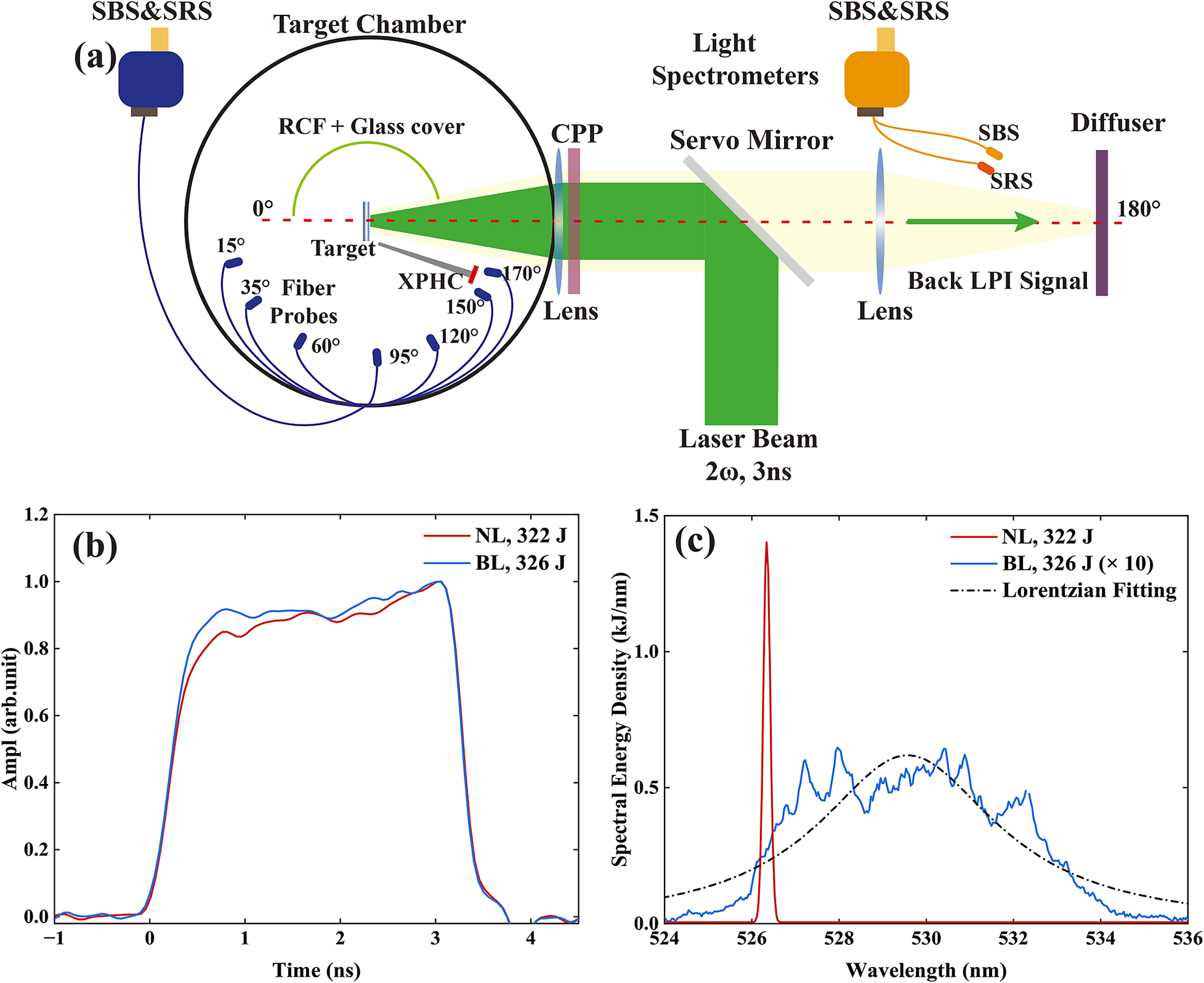
The experiments were conducted at the low-coherence Kunwu laser facility of the Shanghai Institute of Laser Plasma. The Kunwu facility is a high-power broadband laser system designed to deliver kilojoule-level pulses with controlled bandwidth. The configuration is schematically shown in Figure 1(a), while laser waveforms and spectra of narrowband and broadband lasers are illustrated in Figures 1(a) and 1(b), respectively. Hereafter, narrowband and broadband lasers are sequentially abbreviated as ‘NL’ and ‘BL’. A single beam 2ω laser with narrowband or broadband (fractional bandwidth ~0.6%), 300–450 J laser energy (E L) and 3 ns square laser pulses irradiated normally at 50 μm thick planar parylene N (C8H8) targets. A CPP was placed before the main focusing lens to obtain a uniform focal spot. The laser focal spot size is approximately 200 μm, corresponding to laser intensities (I L) of (3–5) × 1014 W cm–2 on average.
Schematic illustration of the experimental setup. Scattering angles θ are labeled, with 0° at laser incidence and 180° backward. (b), (c) Laser waveforms and corresponding laser spectra at energy (E L) of approximately 325 J of the NL and BL. NL, narrowband laser; BL, broadband laser. The black dashed line in (c) is the Lorentzian fitting of the BL. Center wavelengths: NL = 526.3 nm, BL = 529.5 nm. Full width at half maximum (FWHM) bandwidth: NL < 0.01 nm, BL ≈ 3.2 nm, equivalent to Δω/ω 0 values of less than 0.01% and roughly 0.6% (Δω is the bandwidth, ω 0 is the central angular frequency).

Time-integrated SBS and SRS backscattered signals were captured within the full aperture backscatter station (FABS) by fiber-optic probes oriented toward a diffuse-reflecting plate in the backward laser direction, and subsequently analyzed with a multichannel spectrometer equipped with a 150 grooves mm–1 grating. Time-integrated SBS and SRS side scatters at various scattering angles (θ = 15°, 35°, 60°, 95°, 120°, 150°, 170°) were acquired with another multichannel spectrometer equipped with a 150 grooves mm–1 grating. A standard light source located at the target chamber center and aligned with the backward laser direction was used to calibrate the above diagnostics, enabling measurement of the light energy density in absolute units.
An approach based on RCF for side scatter light diagnostic was designed to obtain the continuous spatial distribution of side scatter light. The RCF (Gafchromic HD-V2) is composed of a dye-infused active layer deposited on a polyester substrate with an overall thickness of 100 μm. The RCF was positioned on a near-semicircular arc located 5/8 cm from the center of the target chamber, covering an approximately $\pi$
solid angle and hundreds of square centimeters of space. A 5 mm thick polymethyl methacrylate (PMMA) sheet (exhibiting ~93% transmittance for visible light) was placed in front of the RCF, which eliminated interference from plasma radiation-emitted X-rays, electrons and ions on the RCF color-change response[
Reference Hong, Nguyen and Nghiem
41
]. A new PMMA sheet has been used for each shot. The response curves of RCF on net optical density (OD) versus laser fluence in the red channel were calibrated using a light source with known energy, wavelength and pulse duration. The irradiated RCFs were scanned about 1 hour after exposure with an Epson perfection V850 scanner in RGB full-color mode (24-bit) at a resolution of 1200 dpi. Data processing was performed utilizing the mean background fog subtraction method, which was found to be the most accurate approach compared to pixel-by-pixel background fog subtraction and mean lot background fog subtraction[
Reference Gueli, Cavalli, De Vincolis, Raffaele and Troja
42
]. The net OD can be obtained by the following formula:
$\pi$
solid angle and hundreds of square centimeters of space. A 5 mm thick polymethyl methacrylate (PMMA) sheet (exhibiting ~93% transmittance for visible light) was placed in front of the RCF, which eliminated interference from plasma radiation-emitted X-rays, electrons and ions on the RCF color-change response[
Reference Hong, Nguyen and Nghiem
41
]. A new PMMA sheet has been used for each shot. The response curves of RCF on net optical density (OD) versus laser fluence in the red channel were calibrated using a light source with known energy, wavelength and pulse duration. The irradiated RCFs were scanned about 1 hour after exposure with an Epson perfection V850 scanner in RGB full-color mode (24-bit) at a resolution of 1200 dpi. Data processing was performed utilizing the mean background fog subtraction method, which was found to be the most accurate approach compared to pixel-by-pixel background fog subtraction and mean lot background fog subtraction[
Reference Gueli, Cavalli, De Vincolis, Raffaele and Troja
42
]. The net OD can be obtained by the following formula:
 $$\begin{align}\mathrm{net}\; \mathrm{OD}=\mathrm{OD}_{\mathrm{exposed}}-{\overline{\mathrm{OD}}}_\mathrm{unexposed}=\lg \frac{{\overline{\mathrm{PV}}}_\mathrm{unexposed}-{\overline{\mathrm{PV}}}_{\mathrm{dark}}}{\mathrm{PV}_{\mathrm{exposed}}-{\overline{\mathrm{PV}}}_{\mathrm{dark}}}.\end{align}$$
The X-ray pinhole camera (XPHC) captures the X-ray emission from the laser-irradiated targets, thereby imaging laser focal spots.
3 Results and discussion
3.1 Laser energy absorption in CH planar targets
Substantial energy loss occurs in laser–corona plasma interaction as a consequence of LPI-driven scattering. The laser absorption efficiency is obtained by measuring the energy fraction carried by the backscattered and near-backscattered light relative to the incident laser, with the FABS measuring the former and RCF together with fiber-optic probes measuring the latter. In addition, two independent methods were implemented to assess the laser absorption efficiency of the NL and BL. The first one is based on the conventional fiber-optic probe sampling technique, whereas the second is a diagnostic approach based on RCF, applied here for the first time. Note that the laser absorption efficiency is given under the condition of a negligible forward scattering rate (~10–4) and 3ω/2 reflectivity with similar experimental conditions[ Reference Kang, Zhao, Lei, Liu, Li, Xu, An, Xiong, Wang, Xie, Fang, Wang, Ji, Zhou, Hu, Li, Wang, Gao, Huang and Fu 37 ].
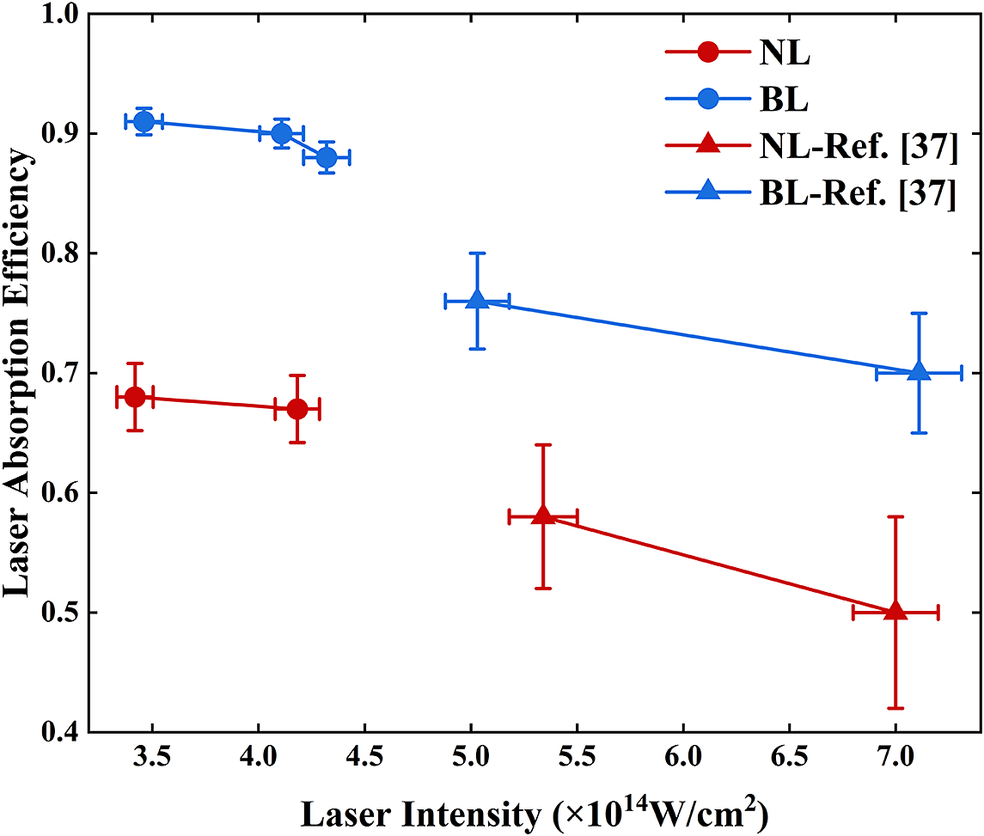
The results of laser absorption efficiency measurements based on fiber-optic probes combined with spectrometers are shown in Figure 2. For comparison, the experimental data from Ref. [Reference Kang, Zhao, Lei, Liu, Li, Xu, An, Xiong, Wang, Xie, Fang, Wang, Ji, Zhou, Hu, Li, Wang, Gao, Huang and Fu37] are also included. According to Ref. [Reference Kang, Zhao, Lei, Liu, Li, Xu, An, Xiong, Wang, Xie, Fang, Wang, Ji, Zhou, Hu, Li, Wang, Gao, Huang and Fu37], the region within the hemispherical domain between θ = 90° and 180° is subdivided into five rings symmetric about the beam axis, with each measurement angle treated as a representative sampling of the corresponding ring under the assumption of axisymmetric scattering. The laser absorption efficiency is improved from 65%–70% to 85%–92% by implementing the BL, which is consistent with earlier studies in similar experimental conditions. The lasers in our experiment are linearly polarized along the axis perpendicular to the equatorial plane. For a linearly polarized beam, the strongest side scatter typically appears in the plane orthogonal to its polarization[ Reference Drake, Turner, Lasinski, Campbell, Kruer, Williams and Kauffman 32 , Reference Xiao, Zhuo, Yin, Liu, Zheng, Zhao and He 33 ]. Thus, the ‘lower bound’ estimates of laser absorption efficiency can be given. Ref. [Reference Kang, Zhao, Lei, Liu, Li, Xu, An, Xiong, Wang, Xie, Fang, Wang, Ji, Zhou, Hu, Li, Wang, Gao, Huang and Fu37] reported laser absorption efficiency measurements conducted at a laser intensity range of (5–7) × 1014 W cm–2, while our work complements data at lower intensities of (3–5) × 1014 W cm–2. In Ref. [Reference Kang, Zhao, Lei, Liu, Li, Xu, An, Xiong, Wang, Xie, Fang, Wang, Ji, Zhou, Hu, Li, Wang, Gao, Huang and Fu37], the reported laser absorption efficiencies for narrowband and broadband cases are roughly 50%–60% and 70%–80%, respectively. Although these values differ from those presented in our work, the overall trend remains consistent: laser absorption efficiency decreases with increasing laser intensity. Therefore, the results can be considered in good agreement when accounting for the dependence on laser intensity.
Laser absorption efficiency of a CH target versus incident laser intensity. Experimental results measured in this work (circle symbols) based on fiber-optic probes are compared with previously published data from Ref. [Reference Kang, Zhao, Lei, Liu, Li, Xu, An, Xiong, Wang, Xie, Fang, Wang, Ji, Zhou, Hu, Li, Wang, Gao, Huang and Fu37] (triangular symbols).

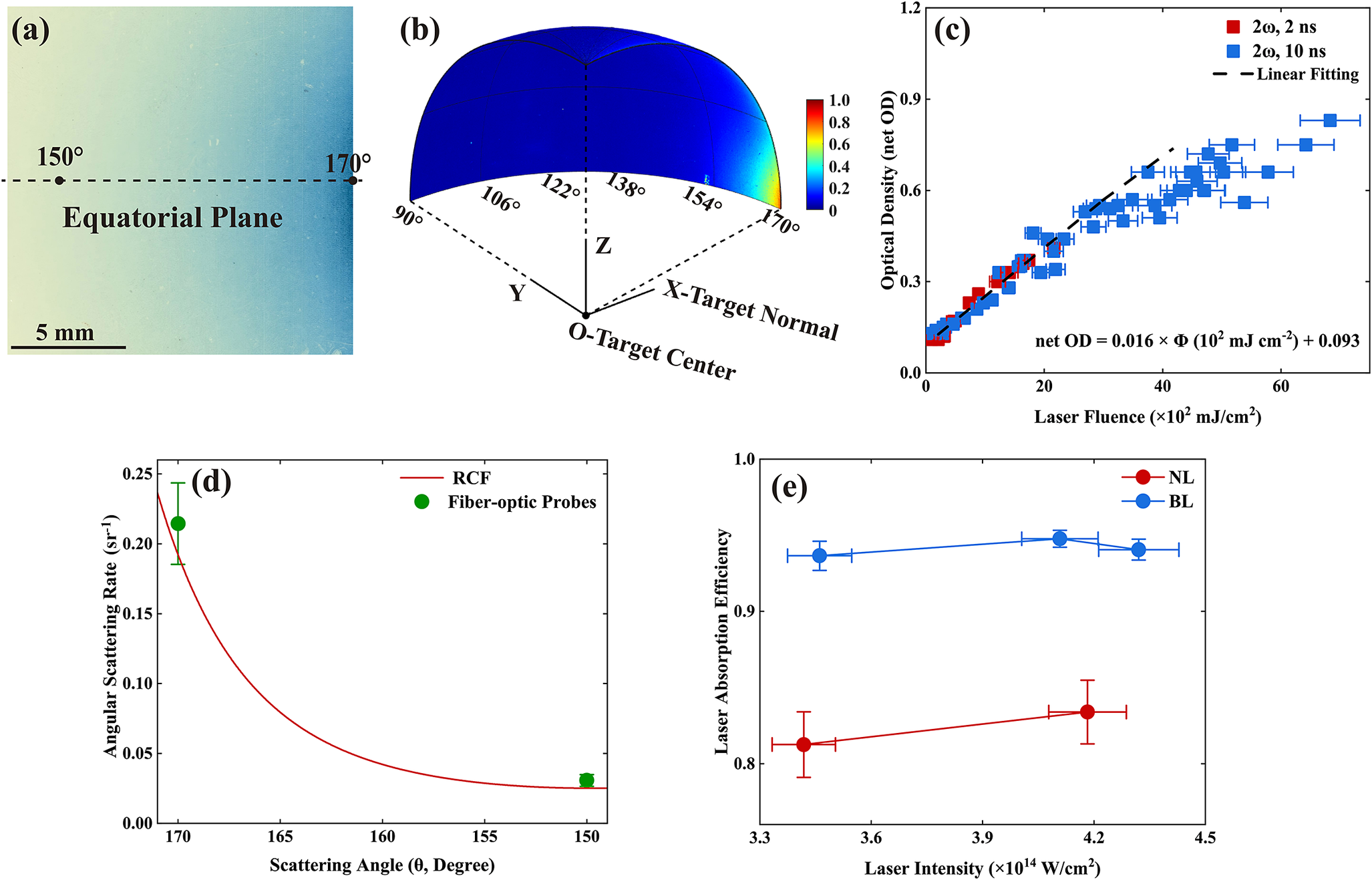
The second estimates of laser absorption efficiency based on RCF are presented in Figure 3. Figure 3(a) shows the response of RCF to scattered light and Figure 3(b) gives the corresponding spatial distribution of scattered light in the solid angle $\varOmega =\int \int \sin\;\theta \mathrm{d}\theta \mathrm{d}\varphi ={\int}_{90^{\circ}}^{170^{\circ }}\sin\;\theta \mathrm{d}\theta {\int}_0^{90^{\circ }} \mathrm{d}\varphi \approx 0.49\pi$
. The color change is most significant at θ = 170°, and diminishes progressively as the detected angle decreases. It has been proved that the net OD of an irradiated RCF is proportional to the fluence of the incident laser pulse (800 nm@22 fs) in a large range[
Reference He, Hong, Hua, Qi, Zhang, Li, Cui, Lu, Deng, He, Su, Zhou, Lu and Gu
40
]. In this work, we found that for different pulse durations (2 and 10 ns) at 532 nm, the correlation between net OD and laser fluence Φ is linear in the range of 500–4000 mJ cm–2, as shown in Figure 3(c). Under experimental conditions, the energy collected by RCF is treated as SBS side scattering, which can be calculated according to the linear fitting formula,
$\varOmega =\int \int \sin\;\theta \mathrm{d}\theta \mathrm{d}\varphi ={\int}_{90^{\circ}}^{170^{\circ }}\sin\;\theta \mathrm{d}\theta {\int}_0^{90^{\circ }} \mathrm{d}\varphi \approx 0.49\pi$
. The color change is most significant at θ = 170°, and diminishes progressively as the detected angle decreases. It has been proved that the net OD of an irradiated RCF is proportional to the fluence of the incident laser pulse (800 nm@22 fs) in a large range[
Reference He, Hong, Hua, Qi, Zhang, Li, Cui, Lu, Deng, He, Su, Zhou, Lu and Gu
40
]. In this work, we found that for different pulse durations (2 and 10 ns) at 532 nm, the correlation between net OD and laser fluence Φ is linear in the range of 500–4000 mJ cm–2, as shown in Figure 3(c). Under experimental conditions, the energy collected by RCF is treated as SBS side scattering, which can be calculated according to the linear fitting formula, $\mathrm{net}\; \mathrm{OD}=0.016\times \varPhi \left(1{0}^2\kern0.33em \mathrm{mJ}\kern0.33em \mathrm{c}{\mathrm{m}}^{-2}\right)+0.093\kern0.33em \left({R}^2=0.95\right)$
. It should be noted that under nanosecond laser irradiation, the color-change response of the RCF is supposed to be driven by photochemical-thermal mechanism rather than by the conventional ionizing-radiation dosimetry process. At low and moderate laser fluence, the response is dominated by photochemical polymerization driven by the absorbed surface energy density, whereas at sufficiently high fluence, strong local heating can lead to thermal melting, decomposition and partial material removal. However, if the laser fluence is too low, the RCF would fail to undergo noticeable color change or it would fall outside its linear response range. The angular scattering rate for RCF is in good agreement with the fiber-optic probe measurements, while additionally extending the diagnostic coverage to spatial regions beyond the fiber-optic probe detection capability, as shown in Figure 3(d). The angular scattering rate reflected by RCF presents nonlinear distribution. Thus, the ‘upper bound’ estimates of laser absorption efficiency for both bandwidths can be defined, which are presented in Figure 3(e). An average increase of 15% in laser absorption was achieved by introducing a 0.6% bandwidth, consistent with the report previously published[
Reference Kang, Zhao, Lei, Liu, Li, Xu, An, Xiong, Wang, Xie, Fang, Wang, Ji, Zhou, Hu, Li, Wang, Gao, Huang and Fu
37
]. The trend of absorption efficiency with laser energy varies slightly from expectation, possibly because 5 cm was too distant for the side-scattered light at small detected angles to induce a detectable color change in the RCF. A more detailed investigation of the RCF response capability is currently underway.
$\mathrm{net}\; \mathrm{OD}=0.016\times \varPhi \left(1{0}^2\kern0.33em \mathrm{mJ}\kern0.33em \mathrm{c}{\mathrm{m}}^{-2}\right)+0.093\kern0.33em \left({R}^2=0.95\right)$
. It should be noted that under nanosecond laser irradiation, the color-change response of the RCF is supposed to be driven by photochemical-thermal mechanism rather than by the conventional ionizing-radiation dosimetry process. At low and moderate laser fluence, the response is dominated by photochemical polymerization driven by the absorbed surface energy density, whereas at sufficiently high fluence, strong local heating can lead to thermal melting, decomposition and partial material removal. However, if the laser fluence is too low, the RCF would fail to undergo noticeable color change or it would fall outside its linear response range. The angular scattering rate for RCF is in good agreement with the fiber-optic probe measurements, while additionally extending the diagnostic coverage to spatial regions beyond the fiber-optic probe detection capability, as shown in Figure 3(d). The angular scattering rate reflected by RCF presents nonlinear distribution. Thus, the ‘upper bound’ estimates of laser absorption efficiency for both bandwidths can be defined, which are presented in Figure 3(e). An average increase of 15% in laser absorption was achieved by introducing a 0.6% bandwidth, consistent with the report previously published[
Reference Kang, Zhao, Lei, Liu, Li, Xu, An, Xiong, Wang, Xie, Fang, Wang, Ji, Zhou, Hu, Li, Wang, Gao, Huang and Fu
37
]. The trend of absorption efficiency with laser energy varies slightly from expectation, possibly because 5 cm was too distant for the side-scattered light at small detected angles to induce a detectable color change in the RCF. A more detailed investigation of the RCF response capability is currently underway.
(a) The response of RCF to scattered light. Color changes from light to dark. The dashed line refers to the equatorial plane of the target chamber. (b) The spatial distribution of scattered light in the approximately π/2 solid angle. (c) The correlation between net OD and laser fluence Φ for different pulse durations (2 and 10 ns) at 532 nm in the red channel, which are close to the experimental conditions. The black dashed line is the linear fitting of the results. (d) Angular scattering rate of RCF and fiber-optic probes, which is defined as the angular energy density (I) in J/sr normalized to the incident laser energy in J. (e) The laser absorption efficiency of the CH target versus incident laser intensity based on RCF.

3.2 Bandwidth effects on stimulated scattering instabilities in laser–plasma interactions
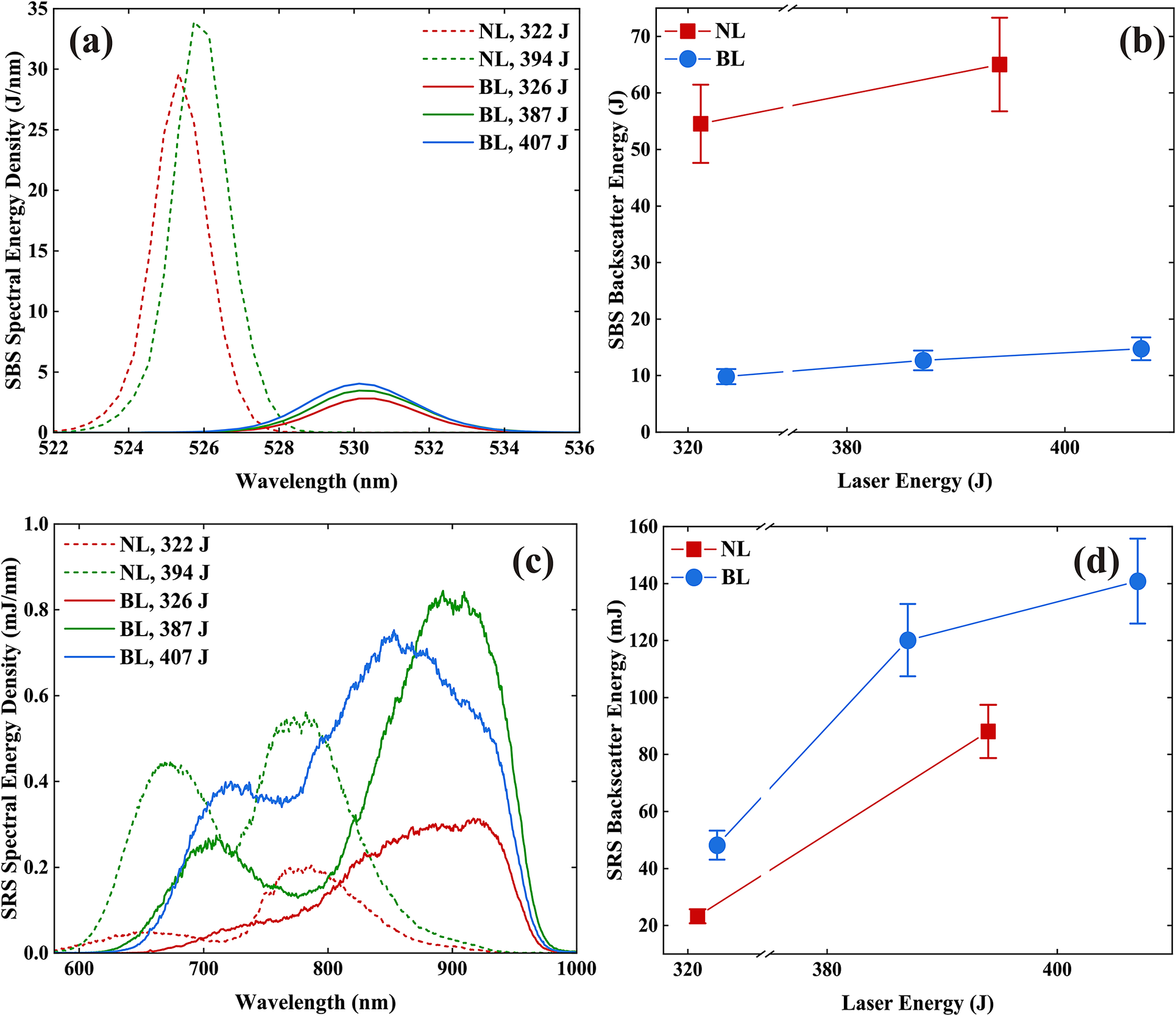
The measured time-integrated SBS backscatter spectra at about 325, 390 and 400 J are presented in Figure 4(a). The limited spectral resolution is responsible for the blurred spectral shape, which means the measured signal near the laser frequency can barely be distinguished between the reflected laser light and the Brillouin scatter. Despite this, the results are still helpful when analyzing the backscatter energy based on the intensity-energy calibration. The comparison of SBS backscatter energy (E b,SBS) between the NL and BL is presented in Figure 4(b). Apparently, E b,SBS of the narrowband is about five times higher than that of the broadband under similar conditions, suggesting that the SBS backscatter rate was reduced by a factor of 5 with the 0.6% bandwidth robustly. Further theoretical analysis reveals that the bandwidth exerts a pronounced suppressive effect on the growth rate of backward SBS. Assuming homogeneous plasmas, the normalized monochromatic growth rate can be estimated by the following[ Reference Kruer 34 ]:
 $$\begin{align}{\gamma}_0/{\omega}_0&=3.4\times {10}^{-2}{\lambda}_{0,\mu \mathrm{m}}{\left({I}_{14}\right)}^{1/2}\left\{\left[Z/\left({ZT}_{\mathrm{e, keV}}+3{T}_{\mathrm{i, keV}}\right)\right]\right.\nonumber\\& \quad \times \left.\left(1-{k}_{\mathrm{s}}^2/{k}_0^2\right)\left({n}_{\mathrm{e}}/{n}_{\mathrm{c}}\right)\left(1-{n}_{\mathrm{e}}/{n}_{\mathrm{c}}\right)\right\}^{1/2},\end{align}$$
Experimental results regarding the SBS and SRS backscatter within the FABS diagnostics. (a) Measured time-integrated SBS spectra at roughly 325, 390 and 400 J. (b) E b,SBS versus incident energy, based on the time-integrated spectra. (c) Measured time-integrated SRS spectra at roughly 325, 390 and 400 J. (d) E b,SRS versus incident energy, based on the time-integrated spectra.

where ${I}_{14}$
is the laser intensity in
${I}_{14}$
is the laser intensity in $1{0}^{14}\;\mathrm{W}\ {\mathrm{cm}}^{-2}$
,
$1{0}^{14}\;\mathrm{W}\ {\mathrm{cm}}^{-2}$
, ${\lambda}_{0,\mu \mathrm{m}}$
is the laser wavelength in micrometers,
${\lambda}_{0,\mu \mathrm{m}}$
is the laser wavelength in micrometers, ${n}_{\mathrm{e}}/{n}_{\mathrm{c}}$
is the electron density normalized to the critical density,
${n}_{\mathrm{e}}/{n}_{\mathrm{c}}$
is the electron density normalized to the critical density, ${T}_{\mathrm{e, keV}}$
and
${T}_{\mathrm{e, keV}}$
and ${T}_{\mathrm{i, keV}}$
are the electron and ion temperatures in keV, respectively, and Z is the effective ionization state. The ratio
${T}_{\mathrm{i, keV}}$
are the electron and ion temperatures in keV, respectively, and Z is the effective ionization state. The ratio ${k}_{\mathrm{s}}/{k}_0$
is determined from the three-wave matching relationship. For the broadband laser with fractional bandwidth
${k}_{\mathrm{s}}/{k}_0$
is determined from the three-wave matching relationship. For the broadband laser with fractional bandwidth $\varDelta \omega /{\omega}_0$
= 0.6%, the effective linear growth rate can be estimated by
$\varDelta \omega /{\omega}_0$
= 0.6%, the effective linear growth rate can be estimated by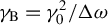 ${\gamma}_{\mathrm{B}}={\gamma}_0^2/\varDelta \omega$
when
${\gamma}_{\mathrm{B}}={\gamma}_0^2/\varDelta \omega$
when $\varDelta \omega /{\gamma}_0\ge 6$
. Thus, the relevant figure of merit is the ratio
$\varDelta \omega /{\gamma}_0\ge 6$
. Thus, the relevant figure of merit is the ratio ${\gamma}_0/{\gamma}_{\mathrm{B}}$
, which measures how efficiently spectral broadening reduces the backscattered SBS. Here we consider laser energy 390 J, corresponding to a laser intensity of
${\gamma}_0/{\gamma}_{\mathrm{B}}$
, which measures how efficiently spectral broadening reduces the backscattered SBS. Here we consider laser energy 390 J, corresponding to a laser intensity of $4.1\times {10}^{14}\;\mathrm{W}\;\mathrm{cm}^{-2}$
, and plasma conditions Z ≈ 3.5,
$4.1\times {10}^{14}\;\mathrm{W}\;\mathrm{cm}^{-2}$
, and plasma conditions Z ≈ 3.5, ${T}_{\mathrm{e, keV}}\sim 2\;\mathrm{keV}$
,
${T}_{\mathrm{e, keV}}\sim 2\;\mathrm{keV}$
, ${T}_{\mathrm{i, keV}}\sim 1\;\mathrm{keV}$
. Across the density range
${T}_{\mathrm{i, keV}}\sim 1\;\mathrm{keV}$
. Across the density range ${n}_{\mathrm{e}}/{n}_{\mathrm{c}}$
= 0.01–0.99, the monochromatic growth rate is found to be bounded by
${n}_{\mathrm{e}}/{n}_{\mathrm{c}}$
= 0.01–0.99, the monochromatic growth rate is found to be bounded by ${\gamma}_0/{\omega}_0\le 9.6\times {10}^{-4}$
. When bandwidth effects are included, the effective growth rate is strongly reduced with an average value
${\gamma}_0/{\omega}_0\le 9.6\times {10}^{-4}$
. When bandwidth effects are included, the effective growth rate is strongly reduced with an average value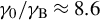 ${\gamma}_0/{\gamma}_{\mathrm{B}}\approx 8.6$
. Note that the bandwidth-induced suppression of SBS is evaluated at the level of an order-of-magnitude estimate.
${\gamma}_0/{\gamma}_{\mathrm{B}}\approx 8.6$
. Note that the bandwidth-induced suppression of SBS is evaluated at the level of an order-of-magnitude estimate.
The backscattered SRS (BSRS) signals of both the NL and BL present a bimodal distribution associated with the laser energy directly, as shown in Figure 4(c). Under narrowband conditions, the corresponding wavelengths of the double peaks are approximately 680 and 760 nm, respectively, while for the broadband, the corresponding wavelengths are approximately 710 and 900 nm, indicating that SRS developed predominantly in distinct regions under the two cases. With the increase of the laser energy, the intensity of SRS backscattering gradually increases and develops another peak for both narrowband and broadband cases; in other words, only long wavelength peaks (see NL-322 J and BL-326 J) appear when the laser energy is low. The broadband laser can shorten the temporal coherence and introduce rapid intensity modulation. These modulations violate the slow envelope assumption and can drive intermittent BSRS bursts when the bandwidth is not large enough for linear suppression[ Reference Liu, Zhang, Meng, Zhang, Zhang, Wang, Gao, Cai and Zhu 43 ]. According to Liu et al. [ Reference Liu, Zhang, Meng, Zhang, Zhang, Wang, Gao, Cai and Zhu 43 ], such bursts strengthen the EPWs and enhance electron trapping, which increases the nonlinear EPW frequency shift and can promote kinetic inflation. In an inhomogeneous plasma, these effects preferentially amplify BSRS in denser regions where Landau damping is weaker and the EPWs can respond more efficiently to the intensity peaks. Figure 4(d) indicates that the backscattered SRS energy (E b,SRS) of the broadband is about two times higher than that of the narrowband under similar conditions. Particle-in-cell simulations performed under similar conditions also indicate 0.6% bandwidth may be insufficient to mitigate SRS, since SRS growth rate can hardly be reduced by the bandwidth[ Reference Lei, Kang, Zhao, Liu, An, Xiong, Wang, Xie, Tu, Xu, Zhou, Fang, Wang, Xia, Feng, Zhao, Ji, Cui, Zhou, Liu, Zheng, Wang, Gao, Huang and Fu 29 , Reference Kang, Zhao, Lei, Liu, Li, Xu, An, Xiong, Wang, Xie, Fang, Wang, Ji, Zhou, Hu, Li, Wang, Gao, Huang and Fu 37 ]. Besides, comparison of backscattered energies shows E b,SRS is two to three orders of magnitude less than E b,SBS, demonstrating the predominance of SBS in energy loss.
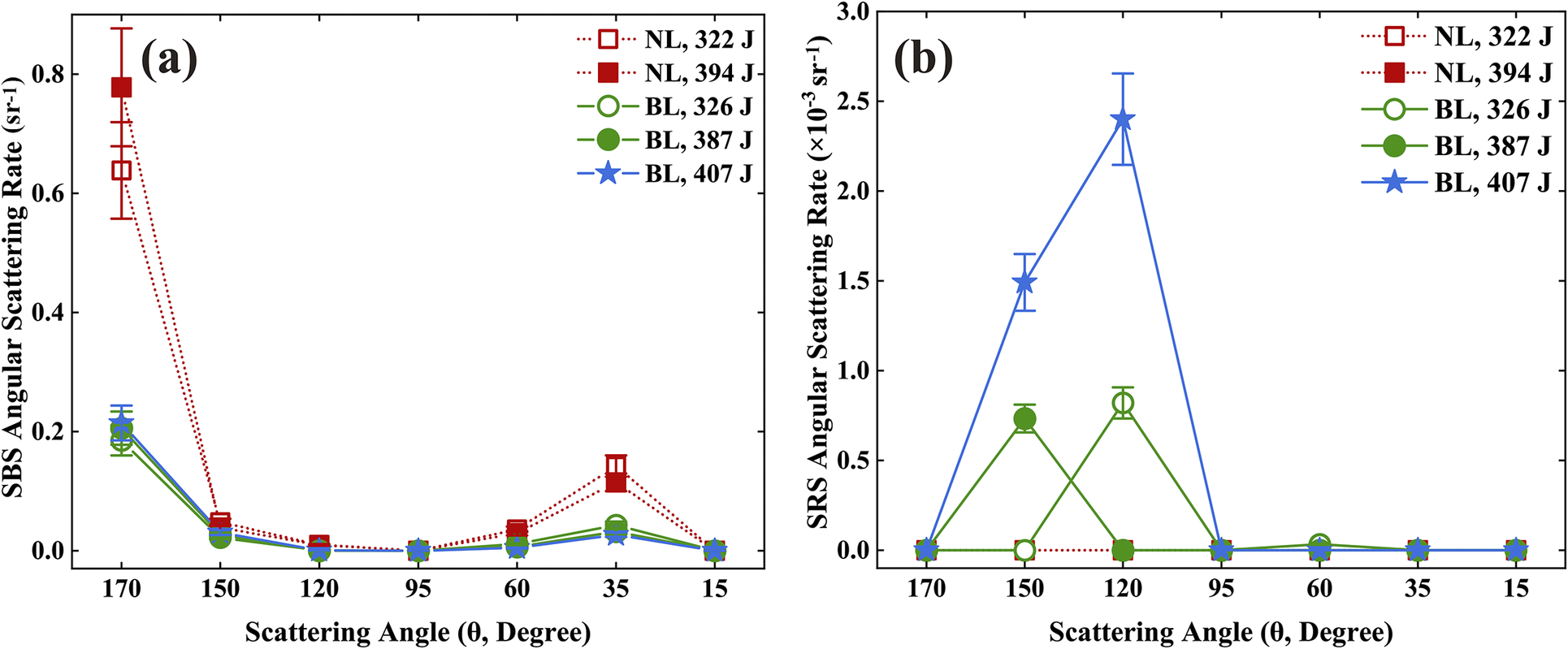
Figures 5(a) and 5(b) present the angular distribution of SBS and SRS side scattering in the target chamber, respectively. Although fluctuations can be observed in the results for all shots, they still exhibit the same trend under both narrowband and broadband cases. It can be seen in Figure 5(a) that the SBS near-backward scattering at θ = 170° was the most intense mode in all the shots, and the SBS decreased rapidly with decreasing measurement angle, which is consistent with expectations. The SBS produced by the NL is significantly higher (3.5 times on average) than that produced by the BL at both θ = 170° and θ = 35°, while the scattering is nearly fair for both bandwidths at other detected angles. It is worth noting that in the experiment, the laser was unable to penetrate the 50 μm thick target and the transverse dimensions of the target were much larger than the central focal spot. In addition, stray light was effectively suppressed by the experimental design. Under these conditions, it is likely that near-forward scattered light could not be collected by the fiber-optic probes. However, a pronounced enhancement of SBS near-forward scattering can be observed at θ = 35°. The physical origin of this feature is not fully understood and may be related to plasma nonuniformities in the near-target region rather than conventional forward-scattering instabilities. The cause and mechanism of SBS forward scattering are currently under investigation.
Experimental results regarding the SBS and SRS side scatter. (a) The SBS angular scattering rate, which is defined as the angular energy density (I) in J/sr normalized to the incident laser energy in J. (b) The angular scattering rate for SRS.

The angular distribution of SRS side scattering is significantly different from that of SBS side scattering, as is presented in Figure 5(b). The lateral scattering at θ = 150°/120° instead of being in the near-backward direction is the most intense with the BL. A similar enhancement of lateral SRS has recently been reported in laser–plasma interaction experiments at the PHELIX facility, where broadband nanosecond laser pulses were found to predominantly amplify SRS at large scattering angles while suppressing backward SBS[ Reference Kanstein, Wasser, Zähter, Atzeni, Benincasa, Cristoforetti, Erdogdu, Fischer, Gizzi, Glize, Grimm, Hornung, Hume, Köster, Kuschel, Meffert, Neufeld, Neumayer, Nguyen, Theobald, Winter, Woolsey, Zarrouk, Zhao, Bagnoud and Roth 44 ]. For the NL, the SRS angular scattering rate at all measured angles is below 10–4. Similar to the case of backscattering, the SRS side scattering is two to three orders of magnitude (or even more) weaker than the SBS side scattering. This behavior is consistent with the PHELIX observations, where the total scattered energy remains dominated by SBS despite the relative enhancement of side-scattered SRS. Therefore, SBS can still be regarded as the dominant energy loss mechanism when considering the scattered energy in the target chamber.
4 Conclusion
In summary, we have expanded the measurement angular space in our research on the impact of broadband lasers on SBS and SRS effects on laser–target coupling efficiency and adopted new experimental methodologies. At the Kunwu facility, we performed laser absorption measurements using a combination of RCF and fiber-optic probe diagnostics, which demonstrated a clear improvement in coupling efficiency when finite spectral bandwidth was introduced. The quantitative analysis supports previous findings that SBS is the dominant mechanism of energy loss, with bandwidth effectively suppressing SBS while tending to increase SRS under moderate intensities. Further exploration of the underlying physical mechanisms and theoretical simulations will be conducted in the future. These results highlight the role of broadband in mitigating parametric instabilities and improving laser–plasma coupling, underscoring the potential of bandwidth control in advancing high-gain direct-drive IFE.
Acknowledgements
The authors gratefully acknowledge the beneficial assistance and help of all the technical staff at the Kunwu laser facility during the experiments. This work was supported by the National Natural Science Foundation of China (Grant No. 12075227).

 Open access

