


Introduction
Neurosurgical career opportunities in Canada have been a subject of significant discussion within the neurosurgical community over the past two decades. Reference Woodrow, O’Kelly, Hamstra and Wallace1,Reference Tso, Findlay, Lownie, Wallace, Toyota and Fleetwood2 A 2019 study analyzing career outcomes in Canadian neurosurgical residents who started residency between 1998 and 2008 reported a 20% underemployment rate at some point within 5 years of residency completion, defined as a locum or clinical associate positions, pursuit of multiple unrelated fellowships and career change to nonsurgical careers. Reference Tso, Findlay, Lownie, Wallace, Toyota and Fleetwood2 Numerous factors are involved. Despite neurosurgery having some of the longest wait times in Canada, Reference Thind, Stewart and Manuel3 opening new neurosurgical positions to alleviate this problem is often a significant financial challenge to provinces and may not be a viable solution if the imbalance between the number of graduates and retirees persists. Reference Woodrow, O’Kelly, Hamstra and Wallace1,Reference Tso, Findlay, Lownie, Wallace, Toyota and Fleetwood2 According to the Canadian Medical Association, between 2016 and 2018, 22 neurosurgeons retired 4 ; meanwhile, the Canadian Resident Match Service (CaRMS) reported 50 newly accepted residents over the same time frame. 5 Historically, up to 50% of Canadian graduates have emigrated to the USA. Reference Kondro6 However, the decision of the American Board of Neurological Surgery (ABNS) to no longer recognize Canadian training programs for board certification has considerably reduced the employability of new Canadian graduates, 7 further contributing to the surplus of underemployed neurosurgeons in Canada.
Suboptimal career prospects in neurosurgery could have serious long-term consequences, including dissuading bright, motivated medical students from pursuing a career in neurosurgery. Reference Woodrow, O’Kelly, Hamstra and Wallace1 Further, there is fairly limited exposure to neurosurgery at most medical schools. In the 2022 CaRMS application cycle, only 19 of the 22 offered neurosurgery positions were filled, making neurosurgery the only surgical specialty with a lower number of first-choice applicants than positions. 5 Along with the needs of an increasingly aging population, Reference Zuccato and Kulkarni8 these issues could potentially lead to a shortage in the neurosurgery workforce in the future. Reference Findlay9 However, publications have also highlighted the limited career opportunities currently available for Canadian graduates in neurosurgery. Reference Woodrow, O’Kelly, Hamstra and Wallace1,Reference Findlay9,Reference Kondro6 A recent manuscript by Tso et al. analyzed the career status of neurosurgical trainees who started residency following ABNS’s decision Reference Tso, Findlay, Lownie, Wallace, Toyota and Fleetwood2 (expected to graduate between 2004 and 2014). Eight years have passed since the expected graduation of the last cohort of that study, and an analysis of a more recent sample is warranted. In this paper, we provide an updated summary of career prospects among Canadian neurosurgery graduates.
Methods
The following study is a cross-sectional analysis as of June 1, 2022, of career outcomes among neurosurgery graduates from accredited Canadian neurosurgery residency programs graduating from 2015 to 2020. Residents who were part of Canadian neurosurgery residency programs but either withdrew or did not complete their training were excluded. Passing the RCPSC final examination was not a requirement for inclusion. The 2021 graduating cohort was excluded because, at the time of the write-up of this manuscript, they would be just finishing their fellowship and likely not yet have settled into their practice. There was no limitation for inclusion based on the initial residency start date; however, all included residents were ineligible to write the ABNS primary certification exam. The length of residency training in Canada is 6 years and can be extended for academic pursuits like obtaining a master’s degree or Ph.D. The current manuscript’s methods and analyses are based on a prior published paper analyzing career trends in neurosurgery graduates in Canada authored by this manuscript’s senior author. Reference Tso, Findlay, Lownie, Wallace, Toyota and Fleetwood2 There was no funding source for this study.
Data collection
Residents who completed their training in an accredited Canadian neurosurgery residency program between 2015 and 2020 were identified through surveillance of public domain websites. These websites included residency training program sites, provincial College of Physicians and Surgeons sites, hospital and university sites, authorship information from scientific databases (i.e., PubMed) and social media platforms like LinkedIn. These data were supplemented and corroborated by personal knowledge from discussions with active residents and staff neurosurgeons in Canada. Several resident characteristics were collected, including residency location, geographic location, year of graduation, sex, employment location (Canada vs. USA vs. Other), employment status at own institution, overall employment status (academic, community, private practice), underemployment status, presence of an advanced research degree (master’s, Ph.D.), first fellowship subspecialty training, first fellowship location and international medical graduate (IMG) status. Underemployment was defined as a locum/clinical associate position, pursuit of multiple unrelated fellowships and career change/nonsurgical career. Unrelated fellowships were defined as fellowships that were not related to the surgeon’s final position (e.g., a spine fellowship for a final position as a skull-base neurosurgeon) or multiple fellowships unrelated to each other (e.g., a spine fellowship followed by a pediatric fellowship). Geographic location was divided into three categories – Quebec/Dalhousie, Ontario and the Western Provinces (Manitoba, Saskatchewan, Alberta and British Columbia). An academic position was defined as one associated with a residency program and university. Community practice was described as a neurosurgery position in Canada that is not associated with a residency program. Private practice was described as a neurosurgery position in the USA that is not affiliated with a university. Full employment status was defined as a fully employed graduate at the time of the analysis.
Statistical analyses
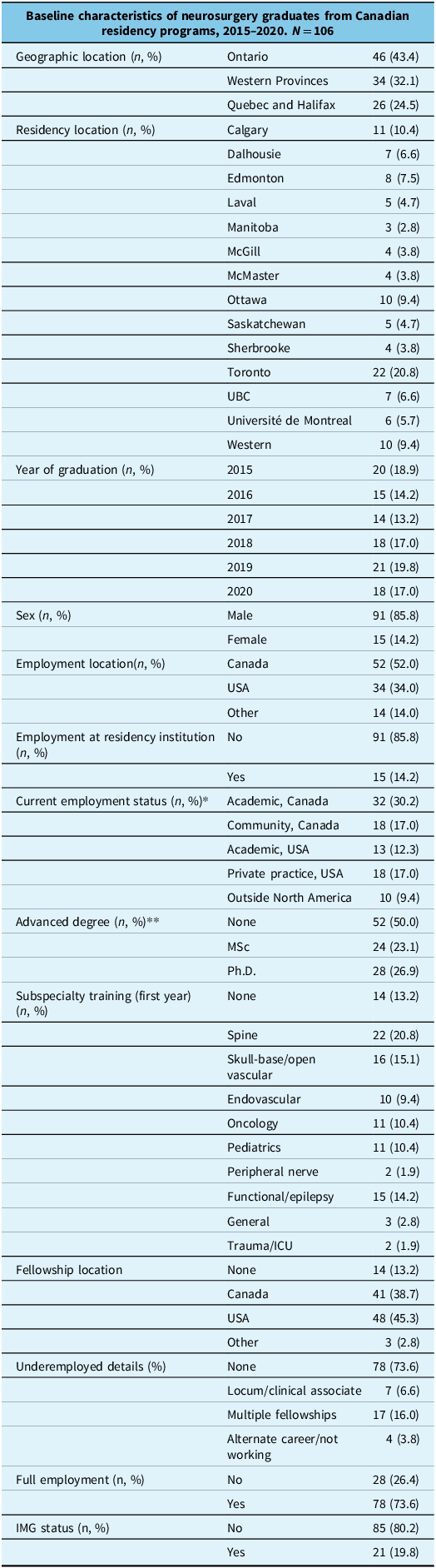
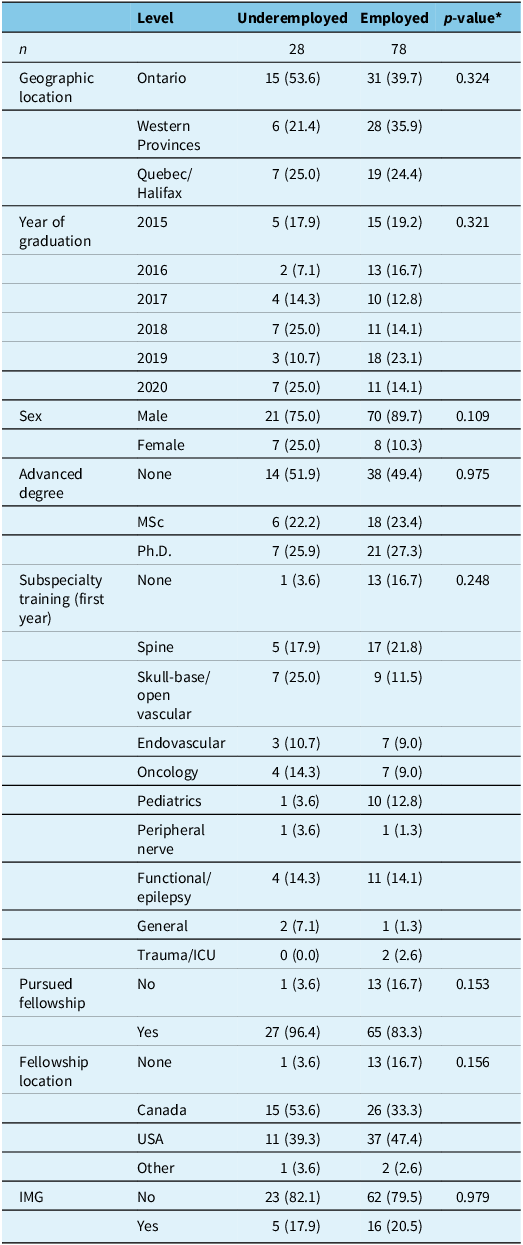
R-4.1.3 statistical software was used for all statistical analyses. Initial analyses involved calculating baseline characteristics for the entire cohort (Table 1). These data were then stratified by employment status to compare baseline characteristics between fully employed and underemployed Canadian neurosurgery graduates (Table 2). The hypothesis test functions used in Table 2 are Fisher’s exact tests for categorical variables with continuity correction.
Table showing the baseline characteristics of the entire cohort of neurosurgery graduates from Canadian residency programs from 2015 to 2020

* These data represent the current employment status of individuals at the time of data collection. Individuals who may have been previously underemployed but are now fully employed are included in the applicable category at the time of data collection. **Data were available for 104 individuals. IMG = international medical graduate.
Characteristics of neurosurgery graduates from Canadian programs from 2015 to 2020, stratified by employment status

IMG = international medical graduate.
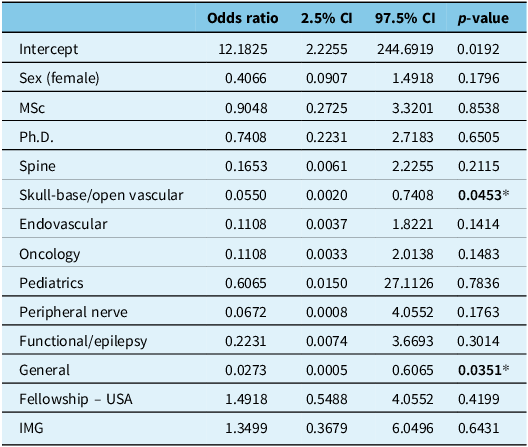
Logistic regressions were used to estimate the probability of employment (full employment) occurring based on the predefined independent variables. These variables were sex, presence of an advanced degree (master’s, Ph.D. or none), first fellowship subspecialty, first fellowship training in the USA and IMG status. The first logistic regression (Table 3) was used to identify predictors of overall employment (academic, community-based and private practice) among all included graduates. Subsequent logistic regression models were used to identify predictors of overall academic appointment, academic appointment in a Canadian institution and any employment (community or academic) in Canada. Given that Quebec had instituted a coordinated province-wide limitation of neurosurgery trainee positions, we also separately compared employment between Quebec graduates and graduates from the rest of Canada.
Logistic regression identifying factors associated with full employment status overall, including academic and nonacademic appointments in Canada, the USA and the world

* Denotes statistical significance. IMG = international medical graduate.
Ethical considerations
All the data utilized and presented in this study are archival, cross-sectional and observational and obtained from publicly accessible sources. The identities of all neurosurgery graduates were anonymized with a numerical coding system. Thus, the present study is exempt from the institutional research board approval as per the Canadian Tri-Council Policy Statement for Research.
Results
Overall, 106 graduates were included in the study. These graduates were from all 14 accredited Canadian neurosurgical residency training programs (Figure 1). Most (43.4%) residents were from Ontario, followed by the Western Provinces (32.1%) and Quebec and Halifax (24.5%). Overall, 91 (85.8%) of graduates were male, while 15 (14.2%) were female; this represents a roughly 6:1 male-to-female ratio of neurosurgery graduates. Overall, 50.0% of graduates did not have an advanced degree, 23.1% had a master’s degree and 26.9% had a Ph.D. A relatively similar number of graduating residents was seen per year from 2015 to 2020 (range 14–21, Figure 2). Most (86.8%) graduates pursued a fellowship, mainly in the USA (45.4%). Finally, 85 (80.2%) of all graduates were Canadian medical graduates, while 21 (19.8%) were IMGs. A full breakdown of the baseline characteristics can be found in Table 1.
Number of neurosurgery graduates in each Canadian neurosurgical residency program from 2015 to 2020.

Number of neurosurgery graduates from Canadian programs per year from 2015 to 2020.

Employment outcomes
Overall, 28 (26.4%) of graduates were previously or currently underemployed. Further, almost half (48%) were working outside Canada (Table 1). Underemployment subcategorization was as follows: 7 (6.6%) were locum or clinical associates, 17 (16.0%) had pursued multiple fellowships and 4 (3.8%) had a change in career or nonsurgical career (e.g., family medicine or clinic-only neurosurgical practice). These were not the current employment status of all individuals, as some who were previously underemployed (e.g., locuming) may have subsequently found full-time employment. It is important to note that this manuscript only considered graduates of neurosurgical training programs and excluded those who withdrew or changed careers before finishing residency.
Academic positions were noted in 42.5% of graduates, with 30.2% in Canada and 12.3% in the USA. Eighteen (17%) graduates found employment in Canadian community hospitals, while 18 (17%) graduates found employment in US private practice. Finally, 10 (9.4%) graduates found full employment outside of North America. Of note, only 14% of graduating residents were employed at their institution of training.
Stratification by employment
Baseline characteristics of the entire cohort, stratified by employment status (employed vs. underemployed), can be seen in Table 2. There were no significant differences between the employed and underemployed groups with respect to having an advanced degree (master’s degree or Ph.D.), geographic location of the residency training program, graduation from a Quebec program, year of graduation, sex, fellowship training, fellowship location or IMG status. Overall, 68.4% of graduates from the Quebec program were fully employed, compared to 74.7% in other provinces (p: 0.782).
Predictors of employment
A logistic regression model was used to identify predictors of overall employment (Table 3). For all employment, skull-base/open vascular (OR: 0.055, 95%CI [0.002, 0.74]) and general neurosurgery (OR: 0.027, 95% CI [<0.01, 0.61]) fellowships were predictive of underemployment when adjusting for sex, advanced degree, fellowship and IMG status. Sex (OR: 0.41, 95% CI [0.09, 1.5]), presence of a master’s degree (OR: 0.90, 95% CI [0.27, 3.3]) or Ph.D. (OR: 0.74, 95%CI [0.22, 2.71]), pursuing a fellowship in the USA (OR: 1.49, 95%CI [0.55, 4.01]) and IMG status (OR:1.35, 95%CI [0.37, 6.0]) were not predictive of employment.
For predictors of academic appointments (in Canada or USA), only IMG status (OR: 0.08, 95% CI [0.01, 0.40]) was a negative predictor of any academic appointment when adjusting for other variables. A similar trend was seen when analyzing predictors of academic appointments specifically in Canada and when analyzing predictors of any appointment (academic and community) in Canada. In both cases, being an IMG was associated with lower odds of employment.
Research
Overall, 50% of graduates did not have an advanced degree, 23.1% had a master’s degree and 26.9% had a Ph.D. Similar proportions were seen among employed and underemployed graduates (Table 2). No significant association was noted between having a master’s degree or a Ph.D. and overall employment, overall academic employment, academic appointment in Canada or working in Canada on logistic regression.
Fellowship training
Most graduates pursued a fellowship (86.8%); 48 (45.3%) did their fellowship in the USA. The most common first fellowship choice was spine (20.8%), followed by skull-base/open vascular (15.1%) and functional/epilepsy (14.2%). Skull-base/open vascular fellowships and general neurosurgery fellowships were predictive of lower overall employment when adjusting for other variables (Table 3). Spine fellowships were not associated with higher employment.
Discussion
This paper describes the career outcomes of all Canadian neurosurgery graduates who completed residency between 2015 and 2020 and provides an updated analysis of underemployment in neurosurgical graduates in Canada. Several important findings are reported, including (1) an underemployment rate of 26.4% among newly graduated neurosurgeons, (2) general neurosurgery and skull-base/open vascular fellowships are associated with lower employment, (3) advanced degrees (master’s or Ph.D.) and the pursuit of fellowships did not increase employment and (4) IMG status is associated with lower chances of employment in Canada and academic appointments in Canada and the USA.
Comparative analysis of results
This manuscript is largely based on a paper by Tso et al., which identified an underemployment rate of 12% among neurosurgery graduates who started training between 1998 and 2008. Reference Tso, Findlay, Lownie, Wallace, Toyota and Fleetwood2 Comparatively, this study’s underemployment rate has more than doubled to 26.4%. Comparing the results of our updated analysis to the initial results obtained by Tso et al., we did not find a significant difference in the number of graduates who pursued a fellowship (87% vs. 93%).
Similarly, neither study found an association between pursuing a fellowship in the USA and full-time employment. No subspecialty was associated with lower or higher employment in the previous manuscript. However, we found that skull-base/open vascular and general neurosurgery fellowships were associated with lower employment overall. The percentage of trainees who pursued an advanced degree did not change significantly between the two studies (50% vs. 51%). Although research training was not associated with employment in either cohort, Tso et al. found a significant correlation between research during residency and employment. A Ph.D. was associated with academic appointment for trainees who started residency between 1998 and 2008. In contrast, we found no association between having an advanced degree (Ph.D. or MSc) and overall employment or academic appointment.
Research and employment
Neurosurgery is a highly innovative field with considerable importance given to research by program directors throughout training. According to the National Resident Matching Program data, neurosurgery applicants who matched in the USA had the second highest number of presentations, abstracts and publications at 25.5 per applicant on average. 10 Moreover, neurosurgeons with a Ph.D. are more likely to get hired by academic institutions in the USA and receive National Institute of Health funding. Reference Choi, DeLong, DeLong, Friedman and Sampson11 Anecdotally, many Canadian residents are encouraged by mentors to pursue advanced degrees, often specifically to increase employability. Our data contrast this assumption. Specifically, we found that a Ph.D. or master’s degree among Canadian graduates was not associated with higher employment, even among those employed at academic institutions. None of the variables included in this analysis were predictive of higher employment in Canada or the USA, and we did not identify any factors (except fellowship choice) that could help young neurosurgeons increase their chances of employment.
Potential solutions
Various solutions have been proposed to address the surplus of neurosurgeons in Canada. One suggestion by Findlay, adopted in the province of Quebec, is limiting the number of neurosurgery residency positions by adjusting to the future need for neurosurgeons. Reference Findlay9 Quebec has reduced the number of positions to two per year for a population of around 8 million, yielding a ratio of 1 position per 4 million. The same ratio applied at a national level would lead to a decrease in residency positions to 10 per year, less than half of that of the 2022 cycle. 5 It must be noted, however, that our findings demonstrated no significant difference in the unemployment rate of Quebec graduates, compared to other provinces. On the other hand, many suggest increased hiring of neurosurgeons instead of limiting entry to the profession, in anticipation of the future needs of an aging population. Despite the apparent surplus, neurosurgery has the longest wait times among all medical fields in Ontario, Reference Thind, Stewart and Manuel3 and many neurosurgeons often advocate for improved working conditions. Reference Tepper, Jaigobin and Wang12 However, this requires the allocation of significant healthcare resources – a difficult task in an already strained healthcare system. Reference Woodrow, O’Kelly, Hamstra and Wallace1
Moreover, determining future societal neurosurgical needs while accounting for external factors such as ABNS’s implemented restriction might be inaccurate. The limitation of such predictions is best demonstrated by Hugenholtz’s prediction of a neurosurgery workforce shortage in the 2000s. Reference Hugenholtz13 Further, training neurosurgeons at the cost of $1.5 million per surgeon, while nearly half are lost to underemployment, emigration to the USA or attrition, contributes to the exhaustion of valuable healthcare resources that could be used to recruit recently graduated trainees. Reference Kondro6,Reference Valberg, Gonyea, Sinclair and Wade14
Employment in the USA
Despite the lack of American Board Certification, 34% of the graduates were hired in the USA. A working visa sponsored by an employer is required for Canadian neurosurgeons to work in the USA. 15 There is a perceived disadvantage to the Canadian neurosurgery graduate looking for employment in the USA compared to our American counterparts. Negotiating with the ABNS to reverse their decision has been discussed, but previous attempts have failed despite significant Canadian lobbying. Reference Tso, Findlay, Lownie, Wallace, Toyota and Fleetwood2,Reference Findlay9 With the introduction of the competency-by-design curriculum in 2019 by the Royal College, more objective data might be available to American employers to facilitate the process of hiring new Canadian graduates. Ultimately, however, Canadian trainees will remain ineligible to become board certified by the ABNS for the foreseeable future. Reference Mansouri16
Strengths and limitations
The current manuscript has several strengths. First, it offers a thorough and comprehensive cross-sectional analysis of the employment outcomes of all Canadian neurosurgery graduates completing residency between 2015 and 2020. We collected data on all graduates; thus, there is less concern about the accuracy and precision of the sample size. Further, regression models were used to test variables commonly thought to increase employment. Finally, we considered several recent years of data and are therefore more confident about the data reflecting the current status of the Canadian neurosurgery job market.
The current manuscript also has limitations. First, this study defined underemployment as clinical associate positions or locum, pursuit of multiple fellowships and career change/nonsurgical career. While unlikely, these may reflect the personal choices of neurosurgery graduates rather than a systemic underemployment crisis. Second, some of the information provided by neurosurgery residents and faculty in Canada may be inaccurate, although great care was taken to corroborate information using publicly available websites and data. Third, we did not consider whether trainees had successfully passed the Royal College exam, as this data is usually kept private.
Conclusion
Underemployment remains a serious issue among contemporary Canadian neurosurgery graduates. The unemployment rate is 26.4%, and only half of graduates work in Canada. Skull-base/open vascular and general neurosurgery fellowships predicted underemployment. Advanced research degrees (master’s or PhD) were not associated with employment, whether academic or community/private practice. IMGs were less likely to obtain academic employment in Canada and the USA and overall employment in Canada. No factors were predictive of employment in Canada. A nationally coordinated effort is required to address the employment issue within neurosurgery.
Acknowledgments
The authors would like to acknowledge the Canadian Neurosurgical Society active and junior members who assisted in gathering data for this manuscript.
Author contributions
MKT conceived the idea of the manuscript and collected the data. LME and FN performed the data analysis and drafted the manuscript. All authors (MKT, LME, FN) critically reviewed and edited the manuscript.
Funding statement
The authors did not receive funding for this study.
Competing interests
The authors have no conflict of interest or disclosures relevant to this study.


 Open access

