





1. Introduction
Let $k \geqslant 2$
be an integer. One of the most celebrated results in additive number theory is Hilbert’s theorem that the
$k \geqslant 2$
be an integer. One of the most celebrated results in additive number theory is Hilbert’s theorem that the $k$
th powers are an asymptotic basis of finite order. That is, there is some
$k$
th powers are an asymptotic basis of finite order. That is, there is some $s$
such that every sufficiently large natural number can be written as a sum of at most
$s$
such that every sufficiently large natural number can be written as a sum of at most $s$
$s$ $k$
th powers of natural numbers.
$k$
th powers of natural numbers.
One may ask whether a similar result holds if one passes to a subset $\{ x^k : x \in \mathcal {S}\}$
of the full set of
$\{ x^k : x \in \mathcal {S}\}$
of the full set of $k$
th powers. This has been established in various cases, for instance, when
$k$
th powers. This has been established in various cases, for instance, when $\mathcal {S}$
is the set of primes (the so-called Waring–Goldbach problem [Reference Kumchev and TolevKT05]), the set of smooth numbers with suitable parameters [Reference Drappeau and ShaoDS16], the set of integers such that the sum of digits in base
$\mathcal {S}$
is the set of primes (the so-called Waring–Goldbach problem [Reference Kumchev and TolevKT05]), the set of smooth numbers with suitable parameters [Reference Drappeau and ShaoDS16], the set of integers such that the sum of digits in base $b$
lies in some fixed residue class modulo
$b$
lies in some fixed residue class modulo $m$
[Reference Thuswaldner and TichyTT05], random sets with
$m$
[Reference Thuswaldner and TichyTT05], random sets with $\mathbf {P}(s \in \mathcal {S}) = s^{c - 1}$
for some
$\mathbf {P}(s \in \mathcal {S}) = s^{c - 1}$
for some $c \gt 0$
[Reference VuVu00, Reference WooleyWoo03a], or all sets with suitably large density [Reference SalmensuuSal21].
$c \gt 0$
[Reference VuVu00, Reference WooleyWoo03a], or all sets with suitably large density [Reference SalmensuuSal21].
Our main result in this paper is that a statement of this type holds when $\mathcal {S}$
is the set of integers whose base
$\mathcal {S}$
is the set of integers whose base $b$
expansion contains just two different (fixed) digits.
$b$
expansion contains just two different (fixed) digits.
Theorem 1.1.
Let $k \geqslant 2$
and
$k \geqslant 2$
and $b \geqslant 3$
be integers, and suppose that
$b \geqslant 3$
be integers, and suppose that $d_1, d_2 \in \{0,1,\dots , b - 1\}$
are distinct and coprime. Let
$d_1, d_2 \in \{0,1,\dots , b - 1\}$
are distinct and coprime. Let $\mathcal {S}$
be the set of non-negative integers, all of whose digits in base
$\mathcal {S}$
be the set of non-negative integers, all of whose digits in base $b$
are either
$b$
are either $d_1$
or
$d_1$
or $d_2$
. Then every sufficiently large integer is a sum of at most
$d_2$
. Then every sufficiently large integer is a sum of at most $b^{160 k^2}$
numbers of the form
$b^{160 k^2}$
numbers of the form $x^k$
,
$x^k$
, $x \in \mathcal {S}$
.
$x \in \mathcal {S}$
.
Remark. While the basic form of the bound is the best the method gives, the constant $160$
could certainly be reduced, especially for large values of
$160$
could certainly be reduced, especially for large values of $b$
; I have not tried to optimise it. The restriction to
$b$
; I have not tried to optimise it. The restriction to $b \geqslant 3$
is helpful at certain points in the argument. Of course, the case
$b \geqslant 3$
is helpful at certain points in the argument. Of course, the case $b = 2$
(in which case we must have
$b = 2$
(in which case we must have $\{d_1, d_2\} = \{0,1\}$
) corresponds to the classical Waring problem, for which much better bounds are known.
$\{d_1, d_2\} = \{0,1\}$
) corresponds to the classical Waring problem, for which much better bounds are known.
Although Theorem1.1 seems to be new, one should certainly mention in this context the interesting work of Biggs [Reference BiggsBig21, Reference BiggsBig23] and Biggs and Brandes [Reference Biggs and BrandesBB23], who showed that, for some $s$
, every sufficiently large integer is a sum of at most
$s$
, every sufficiently large integer is a sum of at most $s$
numbers of the form
$s$
numbers of the form $x^k$
,
$x^k$
, $x \in \mathcal {S}$
, and one further
$x \in \mathcal {S}$
, and one further $k$
th power. (In their work
$k$
th power. (In their work $b$
is taken to be prime and larger than
$b$
is taken to be prime and larger than $k$
.)
$k$
.)
This paper is completely independent of the work of Biggs and Brandes, but it seems plausible that by combining their methods with ours one could significantly reduce the quantity $b^{160k^2}$
in Theorem1.1, at least for prime
$b^{160k^2}$
in Theorem1.1, at least for prime $b$
.
$b$
.
Finally, we note that sets of integers whose digits in some base are restricted to some set are often called ellipsephic, a term coined by Mauduit, as explained in [Reference BiggsBig21, Reference BiggsBig23].
1.1 Notation
If $x \in {\mathbf {R}}$
, we write
$x \in {\mathbf {R}}$
, we write $\Vert x \Vert$
for the distance from
$\Vert x \Vert$
for the distance from $x$
to the nearest integer. The only other time we use the double vertical line symbol is for certain box norms
$x$
to the nearest integer. The only other time we use the double vertical line symbol is for certain box norms $\Vert \cdot \Vert _{\Box }$
, which occur in Appendix A. There seems little danger of confusion so we do not resort to more cumbersome notation such as
$\Vert \cdot \Vert _{\Box }$
, which occur in Appendix A. There seems little danger of confusion so we do not resort to more cumbersome notation such as $\Vert x \Vert _{{\mathbf {R}}/\mathbf {Z}}$
. Write
$\Vert x \Vert _{{\mathbf {R}}/\mathbf {Z}}$
. Write $e(x) = e^{2 \pi i x}$
.
$e(x) = e^{2 \pi i x}$
.
If $X$
is a finite set and
$X$
is a finite set and $f : X \rightarrow \mathbf {C}$
is a function then we write
$f : X \rightarrow \mathbf {C}$
is a function then we write $\mathbf {E}_{x \in X}f(x) = {1}/{|X|} \sum _{x \in X} f(x)$
.
$\mathbf {E}_{x \in X}f(x) = {1}/{|X|} \sum _{x \in X} f(x)$
.
All intervals will be discrete. Thus, $[A,B]$
denotes the set of all integers
$[A,B]$
denotes the set of all integers $x$
with
$x$
with $A \leqslant x \leqslant B$
(and here
$A \leqslant x \leqslant B$
(and here $A,B$
need not be integers). We will frequently encounter the discrete interval
$A,B$
need not be integers). We will frequently encounter the discrete interval $[0, m)$
, for positive integer
$[0, m)$
, for positive integer $m$
, which is the same thing as the set
$m$
, which is the same thing as the set $ \{0,1,\dots , m - 1\}$
. Note carefully that at some points in § 6, the notation
$ \{0,1,\dots , m - 1\}$
. Note carefully that at some points in § 6, the notation $[m_1, m_2]$
will also refer to the lowest common multiple of two integers
$[m_1, m_2]$
will also refer to the lowest common multiple of two integers $m_1, m_2$
.
$m_1, m_2$
.
Throughout the paper we will fix a base $b \geqslant 3$
, an exponent
$b \geqslant 3$
, an exponent $k \geqslant 2$
and distinct coprime digits
$k \geqslant 2$
and distinct coprime digits $d_1,d_2 \in [0, b)$
. Denote by
$d_1,d_2 \in [0, b)$
. Denote by $\mathcal {S}$
the set of all non-negative integers
$\mathcal {S}$
the set of all non-negative integers $x$
, all of whose digits in base
$x$
, all of whose digits in base $b$
are
$b$
are $d_1$
or
$d_1$
or $d_2$
. We include
$d_2$
. We include $0$
in
$0$
in $\mathcal {S}$
. Write
$\mathcal {S}$
. Write $\mathcal {S}^k := \{x^k : x\in \mathcal {S}\}$
. Note that
$\mathcal {S}^k := \{x^k : x\in \mathcal {S}\}$
. Note that $\mathcal {S}^k$
might more usually refer to the
$\mathcal {S}^k$
might more usually refer to the $k$
-fold product set of
$k$
-fold product set of $\mathcal {S}$
with itself, but we have no use for that concept here.
$\mathcal {S}$
with itself, but we have no use for that concept here.
We will reserve the letter $n$
for a variable natural number, which we often assume is sufficiently large, and which it is usually convenient to take to be divisible by
$n$
for a variable natural number, which we often assume is sufficiently large, and which it is usually convenient to take to be divisible by $k$
. We always write
$k$
. We always write $N = b^n$
, so
$N = b^n$
, so $[0, N)$
is precisely the set of non-negative integers with at most
$[0, N)$
is precisely the set of non-negative integers with at most $n$
digits in base
$n$
digits in base $b$
.
$b$
.
If $n$
is a natural number, we define the map
$n$
is a natural number, we define the map $L_b : \{0,1\}^{[0, n)} \rightarrow \mathbf {Z}$
by
$L_b : \{0,1\}^{[0, n)} \rightarrow \mathbf {Z}$
by
 \begin{equation} L_b(\mathbf {x}) := \sum _{i \in [0, n)} x_i b^{i}, \end{equation}
where $\mathbf {x} = (x_i)_{i \in [0,n)}$
. Although this map depends on
$\mathbf {x} = (x_i)_{i \in [0,n)}$
. Although this map depends on $n$
, we will not indicate this explicitly, since the underlying
$n$
, we will not indicate this explicitly, since the underlying $n$
will be clear from context. Then
$n$
will be clear from context. Then
 \begin{equation} \tfrac {d_1(b^n - 1)}{b - 1} + (d_2 - d_1) L_b(\mathbf {x}) \end{equation}
is the number whose base $b$
expansion has a
$b$
expansion has a $b^i$
digit equal to
$b^i$
digit equal to $d_1$
if
$d_1$
if $x_i = 0$
, and
$x_i = 0$
, and $d_2$
if
$d_2$
if $x_i = 1$
.
$x_i = 1$
.
2. An outline of the argument
Unsurprisingly, given its pre-eminence in work on Waring’s problem, the basic mode of attack is the Hardy–Littlewood circle method. Let $n \in \mathbf {N}$
, set
$n \in \mathbf {N}$
, set $N = b^n$
and consider the subset of
$N = b^n$
and consider the subset of $\mathcal {S}$
consisting of integers with precisely
$\mathcal {S}$
consisting of integers with precisely $n$
digits. This is a set of size
$n$
digits. This is a set of size $2^n$
. Denote by
$2^n$
. Denote by $\mu _n$
the normalised probability measure on the set of
$\mu _n$
the normalised probability measure on the set of $k$
th powers of the elements of this set. That is,
$k$
th powers of the elements of this set. That is, $\mu _n(m) = 2^{-n}$
if
$\mu _n(m) = 2^{-n}$
if $m = (\sum _{i \in [0, n)} x_i b^i)^k$
with all
$m = (\sum _{i \in [0, n)} x_i b^i)^k$
with all $x_i \in \{d_1, d_2\}$
for all
$x_i \in \{d_1, d_2\}$
for all $i$
, and
$i$
, and $\mu _n(m) = 0$
otherwise. The Fourier transform
$\mu _n(m) = 0$
otherwise. The Fourier transform $\widehat {\mu _n}(\theta ) := \sum _{m \in \mathbf {Z}} \mu _n(m) e(m \theta )$
is then a normalised version of what is usually called the exponential sum or Weyl-type sum, and as expected for an application of the circle method, it plays a central role in our paper.
$\widehat {\mu _n}(\theta ) := \sum _{m \in \mathbf {Z}} \mu _n(m) e(m \theta )$
is then a normalised version of what is usually called the exponential sum or Weyl-type sum, and as expected for an application of the circle method, it plays a central role in our paper.
Our main technical result is the following, which might be called a log-free Weyl-type estimate for $k$
th powers with restricted digits.
$k$
th powers with restricted digits.
Proposition 2.1.
Suppose that $k \geqslant 2$
and
$k \geqslant 2$
and $b \geqslant 3$
. Set
$b \geqslant 3$
. Set $B := b^{6k^2}$
. Suppose that
$B := b^{6k^2}$
. Suppose that $\delta \in (0,1)$
and that
$\delta \in (0,1)$
and that $k \mid n$
. Suppose that
$k \mid n$
. Suppose that $|\widehat {\mu _n}(\theta )| \geqslant \delta$
and that
$|\widehat {\mu _n}(\theta )| \geqslant \delta$
and that $N \geqslant (2/\delta )^{B}$
, where
$N \geqslant (2/\delta )^{B}$
, where $N := b^n$
. Then there is a positive integer
$N := b^n$
. Then there is a positive integer $q \leqslant (2/\delta )^{B}$
such that
$q \leqslant (2/\delta )^{B}$
such that $\Vert \theta q \Vert \leqslant (2/\delta )^{B}N^{-k}$
.
$\Vert \theta q \Vert \leqslant (2/\delta )^{B}N^{-k}$
.
Remarks. If $\mu _n$
is replaced by the normalised counting measure on
$\mu _n$
is replaced by the normalised counting measure on $k$
th powers less than
$k$
th powers less than $N$
without any digital restriction, a similar estimate is true and is very closely related to Weyl’s inequality. The most standard proof of Weyl’s inequality such as [Reference VaughanVau97, Lemma 2.4], however, results in some extra factors of
$N$
without any digital restriction, a similar estimate is true and is very closely related to Weyl’s inequality. The most standard proof of Weyl’s inequality such as [Reference VaughanVau97, Lemma 2.4], however, results in some extra factors of $N^{o(1)}$
(from the divisor bound). ‘Log-free’ versions may be obtained by combining the standard result with major arc estimates as discussed, for example, in [Reference WooleyWoo03b], or by modifying the standard proof of Weyl’s inequality to focus on this goal rather than on the quality of the exponents, as done in [Reference Green and TaoGT10, § 4]. Our treatment here is most closely related to this latter approach.
$N^{o(1)}$
(from the divisor bound). ‘Log-free’ versions may be obtained by combining the standard result with major arc estimates as discussed, for example, in [Reference WooleyWoo03b], or by modifying the standard proof of Weyl’s inequality to focus on this goal rather than on the quality of the exponents, as done in [Reference Green and TaoGT10, § 4]. Our treatment here is most closely related to this latter approach.
Although we will only give a detailed proof of Proposition 2.1 in the case that $\mu _n$
is the measure on
$\mu _n$
is the measure on $k$
th powers of integers with just two fixed digits, similar arguments ought to give a more general result in which the digits are restricted to an arbitrary subset of
$k$
th powers of integers with just two fixed digits, similar arguments ought to give a more general result in which the digits are restricted to an arbitrary subset of $\{0,1,\dots , b - 1\}$
of size at least
$\{0,1,\dots , b - 1\}$
of size at least $2$
. This would be of interest if one wanted to obtain an asymptotic formula in Theorem1.1, with more general digital restrictions of this type.
$2$
. This would be of interest if one wanted to obtain an asymptotic formula in Theorem1.1, with more general digital restrictions of this type.
Experts will consider it a standard observation that Proposition 2.1 implies that $\mathcal {S}^k$
is an asymptotic basis of some finite order
$\mathcal {S}^k$
is an asymptotic basis of some finite order $s$
. Roughly, this is because one can use it to obtain a moment estimate
$s$
. Roughly, this is because one can use it to obtain a moment estimate $\sum _x \mu _n^{(t)}(x)^2 = \int ^1_0 |\widehat {\mu _n}(\theta )|^{2t} d\theta \ll N^{-k}$
for a suitably large
$\sum _x \mu _n^{(t)}(x)^2 = \int ^1_0 |\widehat {\mu _n}(\theta )|^{2t} d\theta \ll N^{-k}$
for a suitably large $t$
. Here,
$t$
. Here, $\mu _n^{(t)}$
denotes the
$\mu _n^{(t)}$
denotes the $t$
-fold convolution power of
$t$
-fold convolution power of $\mu _n$
; see immediately after (3.1) for full details. The Cauchy–Schwarz inequality then implies that the
$\mu _n$
; see immediately after (3.1) for full details. The Cauchy–Schwarz inequality then implies that the $t$
-fold sumset
$t$
-fold sumset $t \mathcal {S}^k$
has positive density in an interval of length
$t \mathcal {S}^k$
has positive density in an interval of length $\gg N^k$
, whereupon methods of additive combinatorics can be used to conclude.
$\gg N^k$
, whereupon methods of additive combinatorics can be used to conclude.
However, by itself this kind of argument leads to $s$
having a double-exponential dependence on
$s$
having a double-exponential dependence on $k$
. The reason is that Proposition 2.1 is not very effective in the regime
$k$
. The reason is that Proposition 2.1 is not very effective in the regime $\delta \approx 1$
. It is possible that the proof could be adapted so as to be more efficient in this range, but this seems nontrivial. Instead we provide, in § 4, a separate argument that is at first sight crude, but turns out to be more efficient for this task. This gives the following result.
$\delta \approx 1$
. It is possible that the proof could be adapted so as to be more efficient in this range, but this seems nontrivial. Instead we provide, in § 4, a separate argument that is at first sight crude, but turns out to be more efficient for this task. This gives the following result.
Proposition 2.2.
Let $n \in \mathbf {N}$
and let
$n \in \mathbf {N}$
and let $N = b^n$
. Suppose that
$N = b^n$
. Suppose that $n \geqslant k$
. Then the measure of all
$n \geqslant k$
. Then the measure of all $\theta \in {\mathbf {R}}/\mathbf {Z}$
such that
$\theta \in {\mathbf {R}}/\mathbf {Z}$
such that $|\widehat {\mu _n}(\theta )| \geqslant 1 - {1}/{4}b^{-3k^2}$
is bounded above by
$|\widehat {\mu _n}(\theta )| \geqslant 1 - {1}/{4}b^{-3k^2}$
is bounded above by $2b^{k^2} N^{-k}$
.
$2b^{k^2} N^{-k}$
.
In fact, we obtain a characterisation of these values of $\theta$
, much as in Proposition 2.1; see § 4 for the detailed statement and proof.
$\theta$
, much as in Proposition 2.1; see § 4 for the detailed statement and proof.
Details of how to estimate the moment $\int ^1_0 |\widehat {\mu _n}(\theta )|^{2t} d \theta$
using Propositions 2.1 and 2.2, and of the subsequent additive combinatorics arguments leading to the proof of Theorem1.1, may be found in § 3.
$\int ^1_0 |\widehat {\mu _n}(\theta )|^{2t} d \theta$
using Propositions 2.1 and 2.2, and of the subsequent additive combinatorics arguments leading to the proof of Theorem1.1, may be found in § 3.
This leaves the task of proving Proposition 2.1, which forms the bulk of the paper, and is where the less standard ideas are required. For the purposes of this overview, we mostly consider the case $k = 2$
, and for definiteness set
$k = 2$
, and for definiteness set $\{d_1, d_2\} = \{0,1\}$
.
$\{d_1, d_2\} = \{0,1\}$
.
Decoupling. The first step is a kind of decoupling. Recall the definitions of the maps $L_b$
(see (1.1)). The idea is to split the variables
$L_b$
(see (1.1)). The idea is to split the variables $\mathbf {x} = (x_i)_{i \in [0, n)}$
into the even variables
$\mathbf {x} = (x_i)_{i \in [0, n)}$
into the even variables $\mathbf {y} = (x_{2i})_{i \in [0, n/2)}$
and the odd variables
$\mathbf {y} = (x_{2i})_{i \in [0, n/2)}$
and the odd variables $\mathbf {z} = (x_{2i+1})_{i \in [0, n/2)}$
, assuming that
$\mathbf {z} = (x_{2i+1})_{i \in [0, n/2)}$
, assuming that $n$
is even for this discussion. We have
$n$
is even for this discussion. We have $L_b(\mathbf {x}) = L_{b^2}(\mathbf {y}) + b L_{b^2}(\mathbf {z})$
. Here, there is a slight abuse of notation in that
$L_b(\mathbf {x}) = L_{b^2}(\mathbf {y}) + b L_{b^2}(\mathbf {z})$
. Here, there is a slight abuse of notation in that $L_b$
is defined on vectors of length
$L_b$
is defined on vectors of length $n$
, whilst
$n$
, whilst $L_{b^2}$
is defined on vectors of length
$L_{b^2}$
is defined on vectors of length $n/2$
. We then have
$n/2$
. We then have
 \begin{align*} \widehat {\mu _n}(\theta ) = \mathbf {E}_{\mathbf {x} \in \{0,1\}^{[0, n)}} e(\theta L_b(\mathbf {x})^2) & = \mathbf {E}_{\mathbf {y}, \mathbf {z} \in \{0,1\}^{[0, n/2)}} e\big( \theta \big(L_{b^2}(\mathbf {y}) + b L_{b^2}(\mathbf {z})^2\big)\big) \\ & = \mathbf {E}_{\mathbf {y}, \mathbf {z} \in \{0,1\}^{[0, n/2)}} \Psi (\mathbf {y}) \Psi ^{\prime}(\mathbf {z}) e\big( 2b \theta L_{b^2}(\mathbf {y}) L_{b^2}(\mathbf {z})\big),\end{align*}
where $\Psi (\mathbf {y}) = e(\theta L_{b^2}(\mathbf {y})^2)$
and
$\Psi (\mathbf {y}) = e(\theta L_{b^2}(\mathbf {y})^2)$
and $\Psi ^{\prime}(\mathbf {z}) = e(b^2 \theta L_{b^2}(\mathbf {z})^2)$
, but the precise form of these functions is not important in what follows. By two applications of the Cauchy–Schwarz inequality (see Appendix A for a general statement), we may eliminate the
$\Psi ^{\prime}(\mathbf {z}) = e(b^2 \theta L_{b^2}(\mathbf {z})^2)$
, but the precise form of these functions is not important in what follows. By two applications of the Cauchy–Schwarz inequality (see Appendix A for a general statement), we may eliminate the $\Psi$
and
$\Psi$
and $\Psi ^{\prime}$
terms, each of which depends on just one of
$\Psi ^{\prime}$
terms, each of which depends on just one of $\mathbf {y}, \mathbf {z}$
. Assuming, as in the statement of Proposition 2.1, that
$\mathbf {y}, \mathbf {z}$
. Assuming, as in the statement of Proposition 2.1, that $|\widehat {\mu _n}(\theta )| \geqslant \delta$
, we obtain
$|\widehat {\mu _n}(\theta )| \geqslant \delta$
, we obtain
 \begin{align*} \delta ^4 \leqslant \mathbf {E}_{\mathbf {y}, \mathbf {z}, \mathbf {y}^{\prime}, \mathbf {z}^{\prime} \in \{0,1\}^{[0, n/2)}} e(2b \theta ( L_{b^2}(\mathbf {y}) L_{b^2}(\mathbf {z}) - L_{b^2}(\mathbf {y}^{\prime}) L_{b^2}(\mathbf {z}) - L_{b^2}(\mathbf {y}) L_{b^2}(\mathbf {z}^{\prime}) + L_{b^2}(\mathbf {y}^{\prime}) L_{b^2}(\mathbf {z}^{\prime}))). \\[-12pt] \end{align*}
We remove the expectation over the dashed variables, that is to say, there is some choice of $\mathbf {y}^{\prime}, \mathbf {z}^{\prime}$
for which the remaining average over
$\mathbf {y}^{\prime}, \mathbf {z}^{\prime}$
for which the remaining average over $\mathbf {y}, \mathbf {z}$
is at least
$\mathbf {y}, \mathbf {z}$
is at least $\delta ^4$
. For simplicity of discussion, suppose that
$\delta ^4$
. For simplicity of discussion, suppose that $\mathbf {y}^{\prime} = \mathbf {z}^{\prime}= 0$
is such a choice; then
$\mathbf {y}^{\prime} = \mathbf {z}^{\prime}= 0$
is such a choice; then
 \begin{align} \delta ^4 \leqslant \mathbf {E}_{\mathbf {y}, \mathbf {z} \in \{0,1\}^{[0, n/2)}} e( 2b \theta L_{b^2}(\mathbf {y}) L_{b^2}(\mathbf {z})). \\[-12pt] \nonumber \end{align}
At the expense of replacing $\delta$
by
$\delta$
by $\delta ^4$
, we have replaced the quadratic form
$\delta ^4$
, we have replaced the quadratic form $L_b(\mathbf {x})^2$
by a product of two linear forms in disjoint variables, which is a far more flexible object to work with. I remark that I obtained this idea from the proof of [Reference Costello, Tao and VuCTV06, Theorem 4.3], which uses a very similar method.
$L_b(\mathbf {x})^2$
by a product of two linear forms in disjoint variables, which is a far more flexible object to work with. I remark that I obtained this idea from the proof of [Reference Costello, Tao and VuCTV06, Theorem 4.3], which uses a very similar method.
Now, for fixed $\mathbf {z}$
, the average over
$\mathbf {z}$
, the average over $\mathbf {y}$
in (2.1) can be estimated fairly explicitly. The conclusion is that for
$\mathbf {y}$
in (2.1) can be estimated fairly explicitly. The conclusion is that for $\gg \delta ^4 2^{n/2}$
values of
$\gg \delta ^4 2^{n/2}$
values of $\mathbf {z}$
,
$\mathbf {z}$
, $2b \theta L_{b^2}(\mathbf {z})$
has
$2b \theta L_{b^2}(\mathbf {z})$
has $\ll \log (1/\delta )$
nonzero base
$\ll \log (1/\delta )$
nonzero base $b$
digits, among the first
$b$
digits, among the first $n$
digits after the radix point. Here, we use the centred base
$n$
digits after the radix point. Here, we use the centred base $b$
expansion in which digits lie in
$b$
expansion in which digits lie in $(-{b}/{2}, {b}/{2}]$
, discussed in more detail in § 5.
$(-{b}/{2}, {b}/{2}]$
, discussed in more detail in § 5.
Additive expansion. The output of the decoupling step is an assertion to the effect that, for $m$
in a somewhat large set
$m$
in a somewhat large set $\mathscr {M} \subset \{1,\dots , N\}$
,
$\mathscr {M} \subset \{1,\dots , N\}$
, $\theta m$
has very few nonzero digits in base
$\theta m$
has very few nonzero digits in base $b$
among the first
$b$
among the first $n$
after the radix point. The set
$n$
after the radix point. The set $\mathscr {M}$
is the set of
$\mathscr {M}$
is the set of $2b L_{b^2}(\mathbf {z})$
for
$2b L_{b^2}(\mathbf {z})$
for $\gg \delta ^4 2^{n/2}$
values of
$\gg \delta ^4 2^{n/2}$
values of $\mathbf {z} \in \{0,1\}^{[0, n/2)}$
, and so has size
$\mathbf {z} \in \{0,1\}^{[0, n/2)}$
, and so has size $\sim N^{(\log 2)/2\log b}$
that, though ‘somewhat large’, is unfortunately appreciably smaller than
$\sim N^{(\log 2)/2\log b}$
that, though ‘somewhat large’, is unfortunately appreciably smaller than $N$
.
$N$
.
The next step of the argument is to show that the sum of a few copies of $\mathscr {M}$
is a considerably larger set, of size close to
$\mathscr {M}$
is a considerably larger set, of size close to $N$
. In fact, in the case
$N$
. In fact, in the case $k = 2$
under discussion,
$k = 2$
under discussion, $b^2-1$
copies will do. This follows straightforwardly from the following result from the literature.
$b^2-1$
copies will do. This follows straightforwardly from the following result from the literature.
Theorem 2.3.
Let $r, n \in \mathbf {N}$
. Suppose that
$r, n \in \mathbf {N}$
. Suppose that $A_1,\dots , A_r \subseteq \{0,1\}^n$
are sets with densities
$A_1,\dots , A_r \subseteq \{0,1\}^n$
are sets with densities $\alpha _1,\dots , \alpha _r$
. Then
$\alpha _1,\dots , \alpha _r$
. Then $A_1 + \cdots + A_r$
has density at least
$A_1 + \cdots + A_r$
has density at least $(\alpha _1 \cdots \alpha _r)^{\gamma }$
in
$(\alpha _1 \cdots \alpha _r)^{\gamma }$
in $\{0,1,\dots , r\}^n$
, where
$\{0,1,\dots , r\}^n$
, where $\gamma := r^{-1} \log _2(r+1)$
.
$\gamma := r^{-1} \log _2(r+1)$
.
This theorem, which came from the study of Cantor-type sets in the 1970s and 1980s, seems not to be well known in modern-day additive combinatorics. The result has a somewhat complicated history, with contributions by no fewer than 10 authors, and I am unsure exactly how to attribute it. For comments and references pertinent to this, see Appendix B.
We remark that, for $k \gt 2$
, a considerably more elaborate argument is required at this point, and this occupies the bulk of § 6.
$k \gt 2$
, a considerably more elaborate argument is required at this point, and this occupies the bulk of § 6.
The conclusion is that $\theta m$
has
$\theta m$
has $\ll \log (1/\delta )$
nonzero base
$\ll \log (1/\delta )$
nonzero base $b$
digits among the first
$b$
digits among the first $n$
after the radix point, for all
$n$
after the radix point, for all $m$
in a set
$m$
in a set $\mathscr {M}^{\prime} \subset \{1,\dots , N\}$
of size
$\mathscr {M}^{\prime} \subset \{1,\dots , N\}$
of size $\gg \delta ^{C} N$
.
$\gg \delta ^{C} N$
.
From digits to diophantine. In the final step of the argument we extract the required diophantine conclusion (that is, the conclusion of Proposition 2.1) from the digital condition just obtained. The main ingredient is a result on the additive structure of sets with few nonzero digits, which may potentially have other uses. Recall that if $A$
is a set of integers then
$A$
is a set of integers then $E(A)$
, the additive energy of
$E(A)$
, the additive energy of $A$
, is the number of quadruples
$A$
, is the number of quadruples $(a_1, a_2, a_3, a_4) \in A \times A \times A \times A$
with
$(a_1, a_2, a_3, a_4) \in A \times A \times A \times A$
with $a_1 + a_2 = a_3 + a_4$
.
$a_1 + a_2 = a_3 + a_4$
.
Proposition 2.4.
Let $r \in \mathbf {Z}_{\geqslant 0}$
. Suppose that
$r \in \mathbf {Z}_{\geqslant 0}$
. Suppose that $A \subset \mathbf {Z}$
is a finite set, all of whose elements have at most
$A \subset \mathbf {Z}$
is a finite set, all of whose elements have at most $r$
nonzero digits in their centred base
$r$
nonzero digits in their centred base $b$
expansion. Then
$b$
expansion. Then $E(A) \leqslant (2b)^{4r} |A|^{2}$
.
$E(A) \leqslant (2b)^{4r} |A|^{2}$
.
The proof of this involves passing to a quadripartite formulation (that is, with four potentially different sets $A_1 ,A_2, A_3, A_4$
, and also allowing for the possibility of a ‘carry’ in the additive quadruples) and an inductive argument.
$A_1 ,A_2, A_3, A_4$
, and also allowing for the possibility of a ‘carry’ in the additive quadruples) and an inductive argument.
The final deduction of Proposition 2.1 uses this and some fibring arguments. This, and the proof of Proposition 2.4, may be found in § 7.
3. Reduction to a log-free Weyl-type estimate
In this section we show that our main result, Theorem1.1, follows from the log-free Weyl-type estimate, Proposition 2.1. We begin by stating two results about growth under set addition. The first is a theorem of Nathanson and Sárközy [Reference Nathanson and SárközyNS89, Theorem 1].
Theorem 3.1.
Let $X \in \mathbf {N}$
and
$X \in \mathbf {N}$
and $r \in \mathbf {N}$
. Suppose that
$r \in \mathbf {N}$
. Suppose that $A \subset \{1,\dots , X\}$
is a set of size
$A \subset \{1,\dots , X\}$
is a set of size $\geqslant 1 + X/r$
. Then there is an arithmetic progression of common difference
$\geqslant 1 + X/r$
. Then there is an arithmetic progression of common difference $d$
,
$d$
, $1 \leqslant d \leqslant r - 1$
and length at least
$1 \leqslant d \leqslant r - 1$
and length at least $\lfloor X/2r^2\rfloor$
contained in
$\lfloor X/2r^2\rfloor$
contained in $4r A$
.
$4r A$
.
Proof. In [Reference Nathanson and SárközyNS89, Theorem 1], take $h = 2r$
,
$h = 2r$
, $z = \lfloor X/2r^2\rfloor$
; the result is then easily verified.
$z = \lfloor X/2r^2\rfloor$
; the result is then easily verified.
The second result we will need is a simple but slightly fiddly lemma on repeated addition of discrete intervals.
Lemma 3.2.
Let $X \geqslant 1$
be real and suppose that
$X \geqslant 1$
be real and suppose that $I \subset [0, X)$
is a discrete interval of length
$I \subset [0, X)$
is a discrete interval of length $L \geqslant 2$
. Set
$L \geqslant 2$
. Set $\eta := L/X$
. Let
$\eta := L/X$
. Let $K \geqslant 4$
be a parameter. Then
$K \geqslant 4$
be a parameter. Then $\bigcup _{j \leqslant \lceil 2K/\eta ^2\rceil } j I$
contains the discrete interval
$\bigcup _{j \leqslant \lceil 2K/\eta ^2\rceil } j I$
contains the discrete interval $[{4}/{\eta } X, {K}/{\eta } X]$
.
$[{4}/{\eta } X, {K}/{\eta } X]$
.
Proof. Write $I = [x_0, x_0 + L-1]$
, where
$I = [x_0, x_0 + L-1]$
, where $x_0 \in \mathbf {Z}_{\geqslant 0}$
. Then
$x_0 \in \mathbf {Z}_{\geqslant 0}$
. Then $jI = [jx_0, jx_0 + j(L-1)]$
. Note that if
$jI = [jx_0, jx_0 + j(L-1)]$
. Note that if $j \geqslant x_0/(L-1)$
, we have
$j \geqslant x_0/(L-1)$
, we have $jx_0 + j(L-1) \geqslant (j+1) x_0$
, and so the interval
$jx_0 + j(L-1) \geqslant (j+1) x_0$
, and so the interval $(j+1) I$
overlaps the interval
$(j+1) I$
overlaps the interval $jI$
. Therefore, if we set
$jI$
. Therefore, if we set $j_0 := \lceil x_0/(L-1) \rceil$
, for any
$j_0 := \lceil x_0/(L-1) \rceil$
, for any $j_1 \geqslant j_0$
, the union
$j_1 \geqslant j_0$
, the union $I^* := \bigcup _{j_0 \leqslant j \leqslant j_1} jI$
is a discrete interval. Set
$I^* := \bigcup _{j_0 \leqslant j \leqslant j_1} jI$
is a discrete interval. Set $j_1 := \lceil 2K/\eta ^2 \rceil$
. We have
$j_1 := \lceil 2K/\eta ^2 \rceil$
. We have
 \begin{equation*} \min I^* = j_0x_0 \leqslant \big \lceil \tfrac {X}{L-1}\big \rceil X \leqslant \big \lceil \tfrac {2X}{L} \big \rceil X \leqslant \tfrac {4X^2}{L} = \tfrac {4}{\eta } X,\end{equation*}
and
 \begin{equation*} \max I^* \geqslant j_1 (L-1) \geqslant \tfrac {2K}{\eta ^2} \tfrac {L}{2} = \tfrac {K}{\eta } X.\end{equation*}
This concludes the proof.
Proof of Theorem 1.1, assuming Proposition 2.1 Let $n$
be some large multiple of
$n$
be some large multiple of $k$
and consider the measure
$k$
and consider the measure $\mu _n$
as described in § 2. Thus,
$\mu _n$
as described in § 2. Thus, $\mu _n$
is supported on
$\mu _n$
is supported on $\mathcal {S}^k \cap [0, N^k)$
, where
$\mathcal {S}^k \cap [0, N^k)$
, where $N = b^n$
. Set
$N = b^n$
. Set
 \begin{equation} t := 8b^{9k^2}, \end{equation}
and write $\mu _n^{(t)}$
for the
$\mu _n^{(t)}$
for the $t$
-fold convolution power of
$t$
-fold convolution power of $\mu _n$
, that is to say,
$\mu _n$
, that is to say,
 \begin{equation*} \mu _n^{(t)}(x) = \sum _{x_1 + \cdots + x_{t} = x} \mu _n(x_1) \cdots \mu _n(x_t).\end{equation*}
Then $\widehat {\mu _n^{(t)}} = ( \widehat {\mu _n})^t$
and so by Parseval’s identity and the layer-cake representation,
$\widehat {\mu _n^{(t)}} = ( \widehat {\mu _n})^t$
and so by Parseval’s identity and the layer-cake representation,
 \begin{equation} \sum _x \mu _n^{(t)}(x)^2 = \int ^1_0 |\widehat {\mu _n}(\theta )|^{2t} d\theta = 2t \int ^1_0 \delta ^{2t - 1} \operatorname {meas} \{ \theta : |\widehat {\mu _n}(\theta )| \geqslant \delta \} d \delta = 2t (I_1 + I_2 + I_3), \end{equation}
where $I_1, I_2, I_3$
are the integrals over ranges
$I_1, I_2, I_3$
are the integrals over ranges $[0, 2N^{-1/B}]$
,
$[0, 2N^{-1/B}]$
, $[2N^{-1/B}, 1 - c]$
and
$[2N^{-1/B}, 1 - c]$
and $[1 - c, 1]$
, respectively, with
$[1 - c, 1]$
, respectively, with $c := \frac {1}{4} b^{-3k^2}$
,
$c := \frac {1}{4} b^{-3k^2}$
, $B = b^{6k^2}$
(as in Proposition 2.1) and
$B = b^{6k^2}$
(as in Proposition 2.1) and $\operatorname {meas}$
is the Lebesgue measure on the circle
$\operatorname {meas}$
is the Lebesgue measure on the circle ${\mathbf {R}}/\mathbf {Z}$
. We have, for
${\mathbf {R}}/\mathbf {Z}$
. We have, for $N$
large,
$N$
large,
 \begin{equation*} I_1 \leqslant (2N^{-1/B})^{2t - 1} \lt N^{-k}.\end{equation*}
To bound $I_2$
, we use Proposition 2.1, which tells us that the set
$I_2$
, we use Proposition 2.1, which tells us that the set $\{ \theta \in {\mathbf {R}}/\mathbf {Z} : |\widehat {\mu }_n(\theta )| \geqslant \delta \}$
is contained in the set
$\{ \theta \in {\mathbf {R}}/\mathbf {Z} : |\widehat {\mu }_n(\theta )| \geqslant \delta \}$
is contained in the set $\{ \theta \in {\mathbf {R}}/\mathbf {Z} : \Vert \theta q \Vert \leqslant (2/\delta )^B N^{-k} \; \mbox {for some positive} \; q \leqslant (2/\delta )^B\}$
, and so
$\{ \theta \in {\mathbf {R}}/\mathbf {Z} : \Vert \theta q \Vert \leqslant (2/\delta )^B N^{-k} \; \mbox {for some positive} \; q \leqslant (2/\delta )^B\}$
, and so $\operatorname {meas}\{ \theta : |\widehat {\mu _n}(\theta )| \geqslant \delta \} \leqslant 2(2/\delta )^{2B} N^{-k}$
. Since
$\operatorname {meas}\{ \theta : |\widehat {\mu _n}(\theta )| \geqslant \delta \} \leqslant 2(2/\delta )^{2B} N^{-k}$
. Since $2t - 1 - 2B \geqslant t$
, we therefore have
$2t - 1 - 2B \geqslant t$
, we therefore have
 \begin{equation*} I_2 \leqslant 2N^{-k} \int ^{1 - c}_0 \delta ^{2t-1}(2/\delta )^{2B} d\delta \leqslant 2N^{-k} (1 - c)^t 2^{2B} \lt N^{-k}.\end{equation*}
For the last inequality, we used the fact that $t = 2B/c$
and so
$t = 2B/c$
and so $(1 - c)^t \leqslant e^{-2B}$
.
$(1 - c)^t \leqslant e^{-2B}$
.
Finally, to bound $I_3$
, we use Proposition 2.2, which immediately implies that
$I_3$
, we use Proposition 2.2, which immediately implies that
 \begin{equation*} I_3 \leqslant 2b^{k^2} N^{-k} . \end{equation*}
Substituting these bounds for $I_1, I_2$
and
$I_1, I_2$
and $I_3$
into (3.2), we obtain that, for sufficiently large
$I_3$
into (3.2), we obtain that, for sufficiently large $N$
,
$N$
, $\sum _x \mu _n^{(t)}(x)^2 \leqslant 4t b^{k^2} N^{-k} = 32b^{10k^2} N^{-k}$
. On the other hand, it follows by the Cauchy–Schwarz inequality and the fact that
$\sum _x \mu _n^{(t)}(x)^2 \leqslant 4t b^{k^2} N^{-k} = 32b^{10k^2} N^{-k}$
. On the other hand, it follows by the Cauchy–Schwarz inequality and the fact that $\sum _x \mu _n^{(t)}(x) = 1$
that
$\sum _x \mu _n^{(t)}(x) = 1$
that $1 \leqslant |\operatorname {Supp}(\mu _n^{(t)})| \sum _x \mu _n^{(t)}(x)^2$
, and so
$1 \leqslant |\operatorname {Supp}(\mu _n^{(t)})| \sum _x \mu _n^{(t)}(x)^2$
, and so $|\operatorname {Supp}(\mu _n^{(t)})| \geqslant 2^{-5} b^{-10k^2}N^k$
. Thus, since
$|\operatorname {Supp}(\mu _n^{(t)})| \geqslant 2^{-5} b^{-10k^2}N^k$
. Thus, since $\mu _n^{(t)}$
is supported on the
$\mu _n^{(t)}$
is supported on the $t$
-fold sumset of
$t$
-fold sumset of $\mathcal {S}^k \cap [0, N^k)$
, we see that
$\mathcal {S}^k \cap [0, N^k)$
, we see that $|t \mathcal {S}^k \cap [0, tN^k)| \geqslant 2^{-5} b^{-10k^2}N^k$
. Applying Theorem3.1 with
$|t \mathcal {S}^k \cap [0, tN^k)| \geqslant 2^{-5} b^{-10k^2}N^k$
. Applying Theorem3.1 with $X = tN^k$
and
$X = tN^k$
and $r = 2^8 b^{19k^2}$
, we see that
$r = 2^8 b^{19k^2}$
, we see that $4rt \mathcal {S}^k \cap [0, 4rt N^k)$
contains an arithmetic progression
$4rt \mathcal {S}^k \cap [0, 4rt N^k)$
contains an arithmetic progression $P$
of common difference
$P$
of common difference $\lt r$
and length
$\lt r$
and length $|P| \geqslant L := 2^{-15} b^{-29k^2} N^k$
.
$|P| \geqslant L := 2^{-15} b^{-29k^2} N^k$
.
Since $d_1^k$
and
$d_1^k$
and $d_2^k$
are coprime, every number greater than or equal to
$d_2^k$
are coprime, every number greater than or equal to $(d_1^k - 1)(d_2^k - 1) \lt b^{2k} \lt r$
is a non-negative integer combination of these numbers. Therefore, it is certainly the case that
$(d_1^k - 1)(d_2^k - 1) \lt b^{2k} \lt r$
is a non-negative integer combination of these numbers. Therefore, it is certainly the case that $2r \mathcal {S}^k$
contains
$2r \mathcal {S}^k$
contains $[r, 2r)$
. Since the common difference of
$[r, 2r)$
. Since the common difference of $P$
is less than
$P$
is less than $r$
,
$r$
, $P + [r, 2r)$
contains a discrete interval
$P + [r, 2r)$
contains a discrete interval $I$
of length
$I$
of length $\geqslant L$
. This interval is therefore contained in
$\geqslant L$
. This interval is therefore contained in $(4rt + 2r) \mathcal {S}^k \subset 8rt \mathcal {S}^k$
. Note that by construction
$(4rt + 2r) \mathcal {S}^k \subset 8rt \mathcal {S}^k$
. Note that by construction $I \subset [0, 8rt N^k)$
.
$I \subset [0, 8rt N^k)$
.
Apply Lemma 3.2, taking $X = X(n) = 8rt N^k$
,
$X = X(n) = 8rt N^k$
, $\eta = \frac {L}{X} = 2^{-29} b^{-57k^2}$
and
$\eta = \frac {L}{X} = 2^{-29} b^{-57k^2}$
and $K = 4b^{k^2}$
. Since
$K = 4b^{k^2}$
. Since $\mathcal {S}$
contains
$\mathcal {S}$
contains $0$
, we see that
$0$
, we see that $\lfloor 2K/\eta ^2\rfloor 8rt \mathcal {S}^k = 2^{75}b^{142k^2} \mathcal {S}^k$
contains the interval
$\lfloor 2K/\eta ^2\rfloor 8rt \mathcal {S}^k = 2^{75}b^{142k^2} \mathcal {S}^k$
contains the interval $I_n := [\frac {4}{\eta } X(n), \frac {K}{\eta } X(n)]$
. Remember that here
$I_n := [\frac {4}{\eta } X(n), \frac {K}{\eta } X(n)]$
. Remember that here $n$
is any sufficiently large multiple of
$n$
is any sufficiently large multiple of $k$
. By the choice of
$k$
. By the choice of $K$
,
$K$
, $\frac {K}{\eta } X(n) = \frac {4}{\eta } X(n+k)$
, and so these intervals overlap. Thus,
$\frac {K}{\eta } X(n) = \frac {4}{\eta } X(n+k)$
, and so these intervals overlap. Thus, $\bigcup _{n} I_n$
consists of all sufficiently large integers, and hence, so does
$\bigcup _{n} I_n$
consists of all sufficiently large integers, and hence, so does $2^{75}b^{142k^2} \mathcal {S}^k$
. Finally, one may note that
$2^{75}b^{142k^2} \mathcal {S}^k$
. Finally, one may note that $2^{75} \lt b^{12k^2}$
for
$2^{75} \lt b^{12k^2}$
for $b \geqslant 3$
and
$b \geqslant 3$
and $k \geqslant 2$
.
$k \geqslant 2$
.
4. Very large values of the Fourier transform
In this section we establish Proposition 2.2. We will in fact establish the following more precise result.
Proposition 4.1.
Let $n \in \mathbf {N}$
and let
$n \in \mathbf {N}$
and let $N = b^n$
. Suppose that
$N = b^n$
. Suppose that $n \geqslant k$
. Let
$n \geqslant k$
. Let $\theta \in {\mathbf {R}}/\mathbf {Z}$
. Suppose that
$\theta \in {\mathbf {R}}/\mathbf {Z}$
. Suppose that $|\widehat {\mu _n}(\theta )| \geqslant 1 - {1}/{4}b^{-3k^2}$
. Then there is a positive integer
$|\widehat {\mu _n}(\theta )| \geqslant 1 - {1}/{4}b^{-3k^2}$
. Then there is a positive integer $q \leqslant (2k!)b^{{1}/{2}k(k-1) + 1}$
such that
$q \leqslant (2k!)b^{{1}/{2}k(k-1) + 1}$
such that $\Vert \theta q \Vert \leqslant (2k!)^{-1} b^{{1}/{2}k(k+1) - 1} N^{-k}$
.
$\Vert \theta q \Vert \leqslant (2k!)^{-1} b^{{1}/{2}k(k+1) - 1} N^{-k}$
.
Proposition 2.2 is a consequence of this and the observation that the measure of $\theta \in {\mathbf {R}}/\mathbf {Z}$
such that
$\theta \in {\mathbf {R}}/\mathbf {Z}$
such that $\Vert \theta q \Vert \leqslant \varepsilon$
for some positive integer
$\Vert \theta q \Vert \leqslant \varepsilon$
for some positive integer $q \leqslant q_0$
is bounded above by
$q \leqslant q_0$
is bounded above by $2\varepsilon q_0$
.
$2\varepsilon q_0$
.
Proof of Proposition 4.1. Set $Q := 2k! b^{k (k - 1)/2 +1}$
. Note that, since
$Q := 2k! b^{k (k - 1)/2 +1}$
. Note that, since $2k! \leqslant 2^{k^2/2} \leqslant b^{k^2/2}$
for all
$2k! \leqslant 2^{k^2/2} \leqslant b^{k^2/2}$
for all $b,k \geqslant 2$
, we have
$b,k \geqslant 2$
, we have $Q \leqslant b^{k^2}$
. By Dirichlet’s theorem, there is some positive integer
$Q \leqslant b^{k^2}$
. By Dirichlet’s theorem, there is some positive integer $q \leqslant Q$
and an
$q \leqslant Q$
and an $a$
, coprime to
$a$
, coprime to $q$
, such that
$q$
, such that $|\theta - a/q| \leqslant 1/qQ$
. Set
$|\theta - a/q| \leqslant 1/qQ$
. Set $\eta := \theta - a/q$
, thus
$\eta := \theta - a/q$
, thus $|\eta | \leqslant 1/qQ$
. There is a unique integer
$|\eta | \leqslant 1/qQ$
. There is a unique integer $j$
such that
$j$
such that
 \begin{equation} \tfrac {1}{2bq} \lt |(d_2 - d_1) k! b^j \eta | \leqslant \tfrac {1}{2q}. \end{equation}
Now if we had $j \lt k(k-1)/2$
then
$j \lt k(k-1)/2$
then
 \begin{equation*} |(d_2 - d_1) k! b^j \eta | \leqslant (b-1)k! b^{1/2k(k-1) - 1} |\eta | \lt k! b^{1/2k(k-1)}/qQ = 1/2bq,\end{equation*}
contrary to (4.1). If $j \gt kn - k(k+1)/2$
then, using (4.1),
$j \gt kn - k(k+1)/2$
then, using (4.1),
 \begin{equation*} \Vert \theta q\Vert = |\eta q| \leqslant \big |2 (d_2 - d_1) k! b^j \big |^{-1} \leqslant (2k!)^{-1} b^{1/2k(k+1) - 1} N^{-k} ,\end{equation*}
in which case the conclusion of the proposition is satisfied.
Suppose, then, that $k(k-1)/2 \leqslant j \leqslant kn -k(k+1)/2$
. Then there is a set
$k(k-1)/2 \leqslant j \leqslant kn -k(k+1)/2$
. Then there is a set $I \subset [0,n)$
,
$I \subset [0,n)$
, $|I| = k$
, such that
$|I| = k$
, such that $j = \sum _{i \in I} i$
. As usual, write
$j = \sum _{i \in I} i$
. As usual, write $\mathbf {x} = (x_i)_{i \in [0,n)}$
. It is convenient to write
$\mathbf {x} = (x_i)_{i \in [0,n)}$
. It is convenient to write $\mathbf {x}_I$
for the variables
$\mathbf {x}_I$
for the variables $x_i$
,
$x_i$
, $i \in I$
and
$i \in I$
and $\mathbf {x}_{[0,n) \setminus I}$
for the other variables. For any fixed choice of
$\mathbf {x}_{[0,n) \setminus I}$
for the other variables. For any fixed choice of $\mathbf {x}_{[0,n) \setminus I}$
, we can write, setting
$\mathbf {x}_{[0,n) \setminus I}$
, we can write, setting $u := {d_1(b^n - 1)}/{b - 1}$
,
$u := {d_1(b^n - 1)}/{b - 1}$
,
 \begin{align*} \big(u + (d_2 - d_1) L_b(\mathbf {x})\big)^k & = \bigg(u + (d_2 - d_1)\sum _{i \in [0, n)} x_i b^i \bigg)^k \\ & = (d_2 - d_1)k! b^j \prod _{i \in I} x_i + \sum _{i \in I} \psi _i(\mathbf {x}_{[0,n) \setminus I}; \mathbf {x}_I) \end{align*}
for some functions $\psi _i$
, where
$\psi _i$
, where $\psi _i$
does not depend on
$\psi _i$
does not depend on $x_i$
. It follows that
$x_i$
. It follows that
 \begin{align*} |\widehat {\mu }_n(\theta )| & = \big | \mathbf {E}_{\mathbf {x} \in \{0,1\}^{[0,n)}} e \big(\big(u + (d_2 - d_1) L_b(\mathbf {x})\big)^k \big)\big | \\ & \leqslant \mathbf {E}_{\mathbf {x}_{[0,n) \setminus I} \in \{0,1\}^{[0,n) \setminus I}} \bigg | \mathbf {E}_{\mathbf {x}_I \in \{0,1\}^I} \prod _{i \in I} \Psi _i(\mathbf {x}_{[0,n) \setminus I}; \mathbf {x}_I) e \bigg( (d_2 - d_1) k! b^j \theta \prod _{i \in I} x_i\bigg) \bigg |, \end{align*}
where $\Psi _i := e(\psi _i)$
is a 1-bounded function, not depending on
$\Psi _i := e(\psi _i)$
is a 1-bounded function, not depending on $x_i$
. By Proposition A.2 (and the accompanying definition of the Box norm, Definition A.1) it follows that
$x_i$
. By Proposition A.2 (and the accompanying definition of the Box norm, Definition A.1) it follows that
 \begin{equation*} |\widehat {\mu _n}(\theta )|^{2^k} \leqslant \mathbf {E}_{\mathbf {x}_I, \mathbf {x}^{\prime}_I \in \{0,1\}^I} e\bigg((d_2 - d_1) k! b^j \theta \prod _{i \in I} (x_i - x^{\prime}_i)\bigg).\end{equation*}
(The right-hand side here is automatically a non-negative real number). On the right, we now bound all the terms trivially (by $1$
) except for two: the term with
$1$
) except for two: the term with $x_i = x^{\prime}_i = 0$
for all
$x_i = x^{\prime}_i = 0$
for all $i \in I$
, and the term with
$i \in I$
, and the term with $x_i = 1$
and
$x_i = 1$
and $x^{\prime}_i = 0$
for all
$x^{\prime}_i = 0$
for all $i \in I$
. This gives, using the inequality
$i \in I$
. This gives, using the inequality $2 - |1 + e(t)| = 4 \sin ^2 {\pi \Vert t \Vert }/{2} \geqslant 4 \Vert t\Vert ^2$
,
$2 - |1 + e(t)| = 4 \sin ^2 {\pi \Vert t \Vert }/{2} \geqslant 4 \Vert t\Vert ^2$
,
 \begin{align} \nonumber |\widehat {\mu _n}(\theta )|^{2^k} & \leqslant 1 - \tfrac {2}{4^k} + \tfrac {1}{4^k} |1 + e((d_2 - d_1)k! b^j \theta )| \\ & \leqslant 1 - 2^{2 - 2k} \Vert (d_2 - d_1) k! b^j \theta \Vert ^2. \end{align}
There are now two slightly different cases, according to whether or not $q \mid (d_2 - d_1) k! b^j a$
. If this is the case, then by (4.1),
$q \mid (d_2 - d_1) k! b^j a$
. If this is the case, then by (4.1),
 \begin{equation*} \Vert (d_2 - d_1) k! b^j \theta \Vert = | (d_2 - d_1) k! b^j \eta | \geqslant 1/2bq.\end{equation*}
If, on the other hand, $q \nmid (d_2 - d_1) k! b^j a$
then by (4.1) we have
$q \nmid (d_2 - d_1) k! b^j a$
then by (4.1) we have
 \begin{equation*} \Vert (d_2 - d_1) k! b^j \theta \Vert \geqslant \tfrac {1}{q} - | (d_2 - d_1) k! b^j \eta | \geqslant \tfrac {1}{2q}.\end{equation*}
In both cases, $\Vert (d_2 - d_1) k! b^j \theta \Vert \geqslant 1/2bQ = (4k!)^{-1} b^{-2-\frac {1}{2}k(k-1)}$
. It follows from (4.2) that
$\Vert (d_2 - d_1) k! b^j \theta \Vert \geqslant 1/2bQ = (4k!)^{-1} b^{-2-\frac {1}{2}k(k-1)}$
. It follows from (4.2) that
 \begin{equation*} |\widehat {\mu _n}(\theta )| \leqslant \big(1 - 2^{2 - 2k} (4k!)^{-2} b^{-4 - k(k-1)}\big)^{1/2^k} \lt 1 - \tfrac {1}{4}b^{-3k^2}, \end{equation*}
that is to say, the hypothesis of the proposition is not satisfied. Here, the second inequality follows from the Bernoulli inequality $(1 - x)^{1/2^k} \leqslant 1 - x/2^k$
and the crude bounds
$(1 - x)^{1/2^k} \leqslant 1 - x/2^k$
and the crude bounds $k! \leqslant b^{k^2/4}$
,
$k! \leqslant b^{k^2/4}$
, $2^{3k} \leqslant b^{2k}$
, both valid for
$2^{3k} \leqslant b^{2k}$
, both valid for $b \geqslant 3$
and
$b \geqslant 3$
and $k \geqslant 2$
.
$k \geqslant 2$
.
5. Decoupling
We now turn to the somewhat lengthy task of proving Proposition 2.1. In this section we give the details of what we called the decoupling argument in the outline of § 2. The main result of the section is Proposition 5.2 below. We begin with a definition.
Definition 5.1. Let $\alpha \in {\mathbf {R}}/\mathbf {Z}$
. Then we define
$\alpha \in {\mathbf {R}}/\mathbf {Z}$
. Then we define
 \begin{equation} \tilde {\text {w}}_n(\alpha ) := \sum _{i \in [0, n)} \Vert \alpha b^i \Vert ^2. \end{equation}
The reason for the notation is that $\tilde {\text {w}}_n(\alpha )$
is closely related to the more natural quantity
$\tilde {\text {w}}_n(\alpha )$
is closely related to the more natural quantity $\operatorname {w}_n(\alpha )$
, which is the number of nonzero digits among the first
$\operatorname {w}_n(\alpha )$
, which is the number of nonzero digits among the first $n$
digits after the radix point in the (centred) base
$n$
digits after the radix point in the (centred) base $b$
expansion of
$b$
expansion of $\alpha$
. For a careful definition of this, see § 7. However,
$\alpha$
. For a careful definition of this, see § 7. However, $\tilde {\text {w}}_n$
has more convenient analytic properties.
$\tilde {\text {w}}_n$
has more convenient analytic properties.
Now we come to the main result of the section. As we said before, it is a little technical to state. However, it is rather less technical in the case $k = 2$
, in which case the reader may wish to compare it with the outline in § 2.
$k = 2$
, in which case the reader may wish to compare it with the outline in § 2.
Proposition 5.2.
Let $n \in \mathbf {N}$
be divisible by
$n \in \mathbf {N}$
be divisible by $k$
and set
$k$
and set $N := b^n$
. Suppose that
$N := b^n$
. Suppose that $\delta \in (0,1]$
and that
$\delta \in (0,1]$
and that $|\widehat {\mu _n}(\theta )| \geqslant \delta$
. Then there are
$|\widehat {\mu _n}(\theta )| \geqslant \delta$
. Then there are $t_1,\dots , t_{k-1} \in \mathbf {Z}$
with
$t_1,\dots , t_{k-1} \in \mathbf {Z}$
with $|t_j| \leqslant N$
for all
$|t_j| \leqslant N$
for all $j$
and a positive integer
$j$
and a positive integer $q_0 \leqslant b^{k^2}$
such that, for at least
$q_0 \leqslant b^{k^2}$
such that, for at least ${1}/{2} \delta ^{2^k} 2^{(k-1) n/k}$
choices of
${1}/{2} \delta ^{2^k} 2^{(k-1) n/k}$
choices of $\mathbf {x}^{(1)},\dots , \mathbf {x}^{(k-1)} \in \{0,1\}^{[0, n/k)}$
, we have
$\mathbf {x}^{(1)},\dots , \mathbf {x}^{(k-1)} \in \{0,1\}^{[0, n/k)}$
, we have
 \begin{equation*} \tilde {\text {w}}_n \Bigg( \theta q_0 \prod _{i=1}^{k-1}( L_{b^k}(\mathbf {x}^{(i)}) + t_i) \Bigg) \leqslant 2^k b^{2k} \log (2/\delta ). \end{equation*}
Proof. By (1.2) and the definition of the measure $\mu _n$
, we have
$\mu _n$
, we have
 \begin{equation} \widehat {\mu _n}(\theta ) = \mathbf {E}_{\mathbf {x} \in \{0,1\}^n} e \big(\theta \big(u + (d_2 - d_1) L_b(\mathbf {x})\big)^k\big), \end{equation}
where $u := d_1(b^n - 1)/(b - 1)$
. The first stage of the decoupling procedure is to split the variables
$u := d_1(b^n - 1)/(b - 1)$
. The first stage of the decoupling procedure is to split the variables $\mathbf {x}$
into
$\mathbf {x}$
into $k$
disjoint subsets of size
$k$
disjoint subsets of size $n/k$
. If
$n/k$
. If $\mathbf {x} = (x_i)_{i \in [0, n)} \in \{0,1\}^{[0, n)}$
, for each
$\mathbf {x} = (x_i)_{i \in [0, n)} \in \{0,1\}^{[0, n)}$
, for each $j \in [0, k)$
, we write
$j \in [0, k)$
, we write $\mathbf {x}^{(j)} = (x_{ik + j})_{i \in [0, n/k)} \in \{0,1\}^{[0, n/k)}$
. Then
$\mathbf {x}^{(j)} = (x_{ik + j})_{i \in [0, n/k)} \in \{0,1\}^{[0, n/k)}$
. Then
 \begin{equation} L_b(\mathbf {x}) = \sum _{j \in [0, k)} b^j L_{b^k}(\mathbf {x}^{(j)}). \end{equation}
(Note here that $L_b$
is defined on
$L_b$
is defined on $\{0,1\}^{[0, n)}$
, whereas
$\{0,1\}^{[0, n)}$
, whereas $L_{b^k}$
is defined on
$L_{b^k}$
is defined on $\{0,1\}^{[0, n/k)}$
.) By (5.2) we have
$\{0,1\}^{[0, n/k)}$
.) By (5.2) we have
 \begin{equation*} \widehat {\mu _n}(\theta ) = \mathbf {E}_{\mathbf {x}^{(0)},\dots , \mathbf {x}^{(k-1)} \in \{0,1\}^{[0, n/k)}} e\bigg (\theta \bigg( u + (d_2 - d_1)\sum _{i \in [0, k)} b^i L_{b^k}(\mathbf {x}^{(i)})\bigg)^k\bigg ).\end{equation*}
Expanding out the $k$
th power and collecting terms, this can be written as
$k$
th power and collecting terms, this can be written as
 \begin{equation*} \mathbf {E}_{\mathbf {x}^{(0)},\dots , \mathbf {x}^{(k-1)} \in \{0,1\}^{[0, n/k)}} \bigg(\prod _{j \in [0, k)} \Psi _j(\mathbf {x}) \bigg)e \bigg(\theta q_0 \prod _{i \in [0, k)} L_{b^k}(\mathbf {x}^{(i)})\bigg),\end{equation*}
where
 \begin{equation*} q_0 := k!(d_2 - d_1)^k b^{k(k-1)/2}\end{equation*}
and $\Psi _j$
is some
$\Psi _j$
is some $1$
-bounded function of the variables
$1$
-bounded function of the variables $\mathbf {x}^{(i)}$
,
$\mathbf {x}^{(i)}$
, $i \in [0, k) \setminus \{j\}$
, the precise nature of which does not concern us. The inequality
$i \in [0, k) \setminus \{j\}$
, the precise nature of which does not concern us. The inequality $q_0 \leqslant b^{k^2}$
follows using
$q_0 \leqslant b^{k^2}$
follows using $|d_1 - d_1| \leqslant b$
and the estimate
$|d_1 - d_1| \leqslant b$
and the estimate $k! \leqslant 3^{k(k-1)/2}$
, since
$k! \leqslant 3^{k(k-1)/2}$
, since $b \geqslant 3$
.
$b \geqslant 3$
.
One may now apply the Cauchy–Schwarz inequality $k$
times to eliminate the functions
$k$
times to eliminate the functions $\Psi _j$
in turn. This procedure is well known from the theory of hypergraph regularity [Reference GowersGow07] or from the proofs of so-called generalised von Neumann theorems in additive combinatorics [Reference Green and TaoGT10]. For a detailed statement, see Proposition A.2. From this it follows that
$\Psi _j$
in turn. This procedure is well known from the theory of hypergraph regularity [Reference GowersGow07] or from the proofs of so-called generalised von Neumann theorems in additive combinatorics [Reference Green and TaoGT10]. For a detailed statement, see Proposition A.2. From this it follows that
 \begin{equation*} \delta ^{2^k} \leqslant \mathbf {E} e \bigg(\theta q_0 \sum _{\omega \in \{0,1\}^{[0, k)}}(-1)^{|\omega |} \prod _{i \in [0, k)} L_{b^k}(\mathbf {x}_{\omega _i}^{(i)} )\bigg),\end{equation*}
where the average is over $\mathbf {x}^{(0)}_0, \dots, \mathbf {x}_0^{(k-1)}, \mathbf {x}^{(0)}_1, \dots, \mathbf {x}_1^{(k-1)} \in \{0,1\}^{[0, n/k)}$
, and we write
$\mathbf {x}^{(0)}_0, \dots, \mathbf {x}_0^{(k-1)}, \mathbf {x}^{(0)}_1, \dots, \mathbf {x}_1^{(k-1)} \in \{0,1\}^{[0, n/k)}$
, and we write $\omega = (\omega _i)_{i \in [0,k)}$
and
$\omega = (\omega _i)_{i \in [0,k)}$
and $|\omega | = \sum _{i = 1}^k |\omega _i|$
. By pigeonhole there is some choice of
$|\omega | = \sum _{i = 1}^k |\omega _i|$
. By pigeonhole there is some choice of $\mathbf {x}^{(0)}_1,\dots , \mathbf {x}^{(k-1)}_1$
such that the remaining average over
$\mathbf {x}^{(0)}_1,\dots , \mathbf {x}^{(k-1)}_1$
such that the remaining average over $\mathbf {x}^{(0)}_0, \dots, \mathbf {x}_0^{(k-1)}$
is at least
$\mathbf {x}^{(0)}_0, \dots, \mathbf {x}_0^{(k-1)}$
is at least $\delta ^{2^k}$
. This may be written as
$\delta ^{2^k}$
. This may be written as
 \begin{equation*} \delta ^{2^k} \leqslant \big | \mathbf {E}_{\mathbf {x}^{(0)},\dots , \mathbf {x}^{(k-1)} \in \{0,1\}^{[0, n/k)}} e \bigg(\theta q_0 \prod _{i \in [0, k)} (L_{b^k}(\mathbf {x}^{(i)}) + t_i) \bigg)\big |, \end{equation*}
where $t_i := -L_{b^k}(\mathbf {x}_1^{(i)})$
. It follows that, for at least
$t_i := -L_{b^k}(\mathbf {x}_1^{(i)})$
. It follows that, for at least ${1}/{2}\delta ^{2^k} 2^{(k-1)n/k}$
choices of
${1}/{2}\delta ^{2^k} 2^{(k-1)n/k}$
choices of $\mathbf {x}^{(1)},\dots , \mathbf {x}^{(k-1)} \in \{0,1\}^{[0, n/k)}$
, we have
$\mathbf {x}^{(1)},\dots , \mathbf {x}^{(k-1)} \in \{0,1\}^{[0, n/k)}$
, we have
 \begin{equation} \big | \mathbf {E}_{\mathbf {x}^{(0)}\in \{0,1\}^{[0, n/k)}} e \Bigg(\theta q_0 L_{b^k}(\mathbf {x}^{(0)}) \prod _{i = 1}^{k-1} (L_{b^k}(\mathbf {x}^{(i)}) + t_i) \Bigg)\big | \geqslant \delta ^{2^k}/2. \end{equation}
Let $\alpha \in {\mathbf {R}}/\mathbf {Z}$
be arbitrary. Note that
$\alpha \in {\mathbf {R}}/\mathbf {Z}$
be arbitrary. Note that
 \begin{align*} \tilde {\text {w}}_n(\alpha ) & = \sum _{i \in [0, n-1)} \Vert \alpha b^{i} \Vert ^2 = \sum _{j \in [0, k)} \sum _{i \in [0, n/k)} \Vert \alpha b^{j + ik}\Vert ^2 \\ & \leqslant \bigg(\sum _{j \in [0, k)} b^{2j} \bigg) \sum _{i \in [0, n/k)} \Vert \alpha b^{ik}\Vert ^2 \leqslant b^{2k} \sum _{i \in [0, n/k)} \Vert \alpha b^{ik}\Vert ^2. \end{align*}
Therefore, using the inequality $|1 + e(t)| = 2|\cos (\pi t)| \leqslant 2 \exp (-\Vert t \Vert ^2)$
, we have
$|1 + e(t)| = 2|\cos (\pi t)| \leqslant 2 \exp (-\Vert t \Vert ^2)$
, we have
 \begin{align*} \big |\mathbf {E}_{\mathbf {y} \in \{0,1\}^{[0, n/k)}} e(\alpha L_{b^k}(\mathbf {y}))\big | &= \prod _{i \in [0, n/k)} \bigg | \frac {1 + e(\alpha b^{ik}) }{2} \bigg | \\ & \leqslant \exp\! \bigg({-}\sum _{i \in [0, n/k)} \Vert \alpha b^{ik} \Vert ^2 \bigg) \leqslant \exp \!\big({-}b^{-2k} \tilde {\text {w}}_n(\alpha )\big). \end{align*}
6. Sums of products of linear forms
We now turn to the next step of the outline in § 2, which we called additive expansion. The main result of the previous section, Proposition 5.2, is roughly of the form ‘for quite a few $m \sim N^{k-1}$
,
$m \sim N^{k-1}$
, $\tilde {\text {w}}_n(\theta m) \lesssim \log (2/\delta )$
’. (The reader should not attach any precise meaning to the symbols
$\tilde {\text {w}}_n(\theta m) \lesssim \log (2/\delta )$
’. (The reader should not attach any precise meaning to the symbols $\sim , \lesssim$
here.) The shortcoming of the statement as it stands is that the set of
$\sim , \lesssim$
here.) The shortcoming of the statement as it stands is that the set of $m$
is of size
$m$
is of size $\sim 2^{(k-1) n/k}$
, which is substantially smaller than
$\sim 2^{(k-1) n/k}$
, which is substantially smaller than $N^{k-1}$
(recall that
$N^{k-1}$
(recall that $N = b^n$
). The aim of this section is to upgrade the conclusion of Proposition 5.2 to get a much larger set of
$N = b^n$
). The aim of this section is to upgrade the conclusion of Proposition 5.2 to get a much larger set of $m$
. Here is the statement we will prove.
$m$
. Here is the statement we will prove.
Proposition 6.1.
Set $C := b^{7k^2/2}$
. Suppose that
$C := b^{7k^2/2}$
. Suppose that $\delta \in (0, 1]$
and that
$\delta \in (0, 1]$
and that $k \mid n$
. Suppose that
$k \mid n$
. Suppose that $|\widehat {\mu _n}(\theta )| \geqslant \delta$
and that
$|\widehat {\mu _n}(\theta )| \geqslant \delta$
and that $N \geqslant (2/\delta )^{C}$
, where
$N \geqslant (2/\delta )^{C}$
, where $N := b^n$
. Then for at least
$N := b^n$
. Then for at least $(\delta /2)^{C}N^{k-1}$
values of
$(\delta /2)^{C}N^{k-1}$
values of $m$
,
$m$
, $ |m| \leqslant C N^{k-1}$
, we have
$ |m| \leqslant C N^{k-1}$
, we have $\tilde {\text {w}}_n(\theta m) \leqslant C\log (2/\delta )$
.
$\tilde {\text {w}}_n(\theta m) \leqslant C\log (2/\delta )$
.
The basic idea of the proof is to take sums of a few copies of the set of $m$
produced in Proposition 5.2 that (it turns out) expands this set of
$m$
produced in Proposition 5.2 that (it turns out) expands this set of $m$
dramatically, whilst retaining the property of
$m$
dramatically, whilst retaining the property of $\tilde {\text {w}}_n(\theta m)$
being small.
$\tilde {\text {w}}_n(\theta m)$
being small.
We assemble some ingredients. The key input is Theorem2.3 (see, in addition to § 2, Appendix B). We will also require some other lemmas of a miscellaneous type, and we turn to these first.
Lemma 6.2.
Let $\varepsilon , U, V$
be real parameters with
$\varepsilon , U, V$
be real parameters with $0 \lt \varepsilon \leqslant 2^{-44}$
and
$0 \lt \varepsilon \leqslant 2^{-44}$
and $U, V \geqslant 64/\varepsilon$
. Suppose that
$U, V \geqslant 64/\varepsilon$
. Suppose that $\Omega \subset [-U, U] \times [-V, V]$
has size at least
$\Omega \subset [-U, U] \times [-V, V]$
has size at least $\varepsilon UV$
. Then at least
$\varepsilon UV$
. Then at least $\varepsilon ^7 UV$
integers
$\varepsilon ^7 UV$
integers $n \in [-2UV, 2UV]$
may be written as
$n \in [-2UV, 2UV]$
may be written as $u_1 v_1 + u_2v_2$
with
$u_1 v_1 + u_2v_2$
with $(u_1, v_1), (u_2, v_2) \in \Omega$
.
$(u_1, v_1), (u_2, v_2) \in \Omega$
.
Proof. The conclusion is invariant under applying any of the four involutions $(u,v) \mapsto (\pm u, \pm v)$
to
$(u,v) \mapsto (\pm u, \pm v)$
to $\Omega$
, so without loss of generality we may suppose that
$\Omega$
, so without loss of generality we may suppose that $\Omega \cap ([0, U] \times [0, V])$
has size at least
$\Omega \cap ([0, U] \times [0, V])$
has size at least $\varepsilon UV/4$
. It then follows that
$\varepsilon UV/4$
. It then follows that $\Omega \cap ([\varepsilon U/32, U] \times [\varepsilon V/32, V])$
has size at least
$\Omega \cap ([\varepsilon U/32, U] \times [\varepsilon V/32, V])$
has size at least $\varepsilon UV/8$
. Covering this box by disjoint dyadic boxes
$\varepsilon UV/8$
. Covering this box by disjoint dyadic boxes $[2^i, 2^{i+1})\times [2^j, 2^{j+1})$
contained in
$[2^i, 2^{i+1})\times [2^j, 2^{j+1})$
contained in $[\varepsilon U/64, 2U] \times [\varepsilon V/64, 2V]$
, we see that there is some dyadic box
$[\varepsilon U/64, 2U] \times [\varepsilon V/64, 2V]$
, we see that there is some dyadic box $[U^{\prime}, 2U^{\prime}) \times [V^{\prime}, 2V^{\prime})$
,
$[U^{\prime}, 2U^{\prime}) \times [V^{\prime}, 2V^{\prime})$
, $\varepsilon U/64 \leqslant U^{\prime} \leqslant U$
,
$\varepsilon U/64 \leqslant U^{\prime} \leqslant U$
, $\varepsilon V/64 \leqslant V^{\prime} \leqslant V$
, on which the density of
$\varepsilon V/64 \leqslant V^{\prime} \leqslant V$
, on which the density of $\Omega$
is at least
$\Omega$
is at least $\varepsilon /32$
. Without loss of generality, suppose that
$\varepsilon /32$
. Without loss of generality, suppose that $U^{\prime} \leqslant V^{\prime}$
, and set
$U^{\prime} \leqslant V^{\prime}$
, and set $X := U^{\prime} V^{\prime} \geqslant 1$
. Set
$X := U^{\prime} V^{\prime} \geqslant 1$
. Set $\Omega ^{\prime}:= \Omega \cap \big([U^{\prime}, 2U^{\prime}) \times [V^{\prime}, 2V^{\prime})\big)$
.
$\Omega ^{\prime}:= \Omega \cap \big([U^{\prime}, 2U^{\prime}) \times [V^{\prime}, 2V^{\prime})\big)$
.
For $n \in \mathbf {Z}$
, denote by
$n \in \mathbf {Z}$
, denote by $r(n)$
the number of representations of
$r(n)$
the number of representations of $n$
as
$n$
as $u_1 v_1 + u_2 v_2$
with
$u_1 v_1 + u_2 v_2$
with $(u_1, v_1)$
and
$(u_1, v_1)$
and $(u_2, v_2)$
in
$(u_2, v_2)$
in $\Omega ^{\prime}$
, and by
$\Omega ^{\prime}$
, and by $\tilde r(n)$
the number of representations as
$\tilde r(n)$
the number of representations as $u_1 v_1 + u_2 v_2$
with
$u_1 v_1 + u_2 v_2$
with $(u_1, v_1), (u_2, v_2) \in [U^{\prime}, 2U^{\prime}) \times [V^{\prime}, 2V^{\prime})$
. Thus,
$(u_1, v_1), (u_2, v_2) \in [U^{\prime}, 2U^{\prime}) \times [V^{\prime}, 2V^{\prime})$
. Thus, $r(n) \leqslant \tilde r(n)$
. By the Cauchy–Schwarz inequality,
$r(n) \leqslant \tilde r(n)$
. By the Cauchy–Schwarz inequality,
 \begin{equation} (\varepsilon X/32)^4 \leqslant |\Omega ^{\prime}|^4 = \bigg(\sum _n r(n)\bigg)^2 \leqslant |\operatorname {Supp}(r)| \sum _n \tilde r(n)^2. \end{equation}
Now, denoting by $\nu (n)$
the number of divisors of
$\nu (n)$
the number of divisors of $n$
in the range
$n$
in the range $[U^{\prime}, 2U^{\prime})$
,
$[U^{\prime}, 2U^{\prime})$
,
 \begin{equation*} \tilde r(n) \leqslant \sum _{m \leqslant 4X} \nu (m) \nu (n - m) = \sum _{\substack {d, e \in [U^{\prime}, 2U^{\prime}) \\ (d,e) | n}} \sum _{\substack {m \leqslant 4X \\ d \mid m, e \mid n - m}} 1 \leqslant 8X \!\!\!\sum _{\substack {d,e \in [U^{\prime}, 2U^{\prime}) \\ (d,e) | n}} \tfrac {1}{[d,e]} .\end{equation*}
Here, in the last step we used the fact that the set of $m$
satisfying
$m$
satisfying $d \mid m$
and
$d \mid m$
and $e \mid n - m$
is a single residue class modulo
$e \mid n - m$
is a single residue class modulo $[d,e]$
(the lowest common multiple of
$[d,e]$
(the lowest common multiple of $d$
and
$d$
and $e$
), whose intersection with the interval
$e$
), whose intersection with the interval $[1, 4X)$
has size
$[1, 4X)$
has size $\leqslant 1 + 4X /[d, e] \leqslant 8 X/[d,e]$
since
$\leqslant 1 + 4X /[d, e] \leqslant 8 X/[d,e]$
since $[d, e] \leqslant (2U^{\prime})^2 \leqslant 4X$
.
$[d, e] \leqslant (2U^{\prime})^2 \leqslant 4X$
.
Setting $\delta := (d,e)$
and
$\delta := (d,e)$
and $d = \delta d^{\prime}$
,
$d = \delta d^{\prime}$
, $e = \delta e^{\prime}$
, so that
$e = \delta e^{\prime}$
, so that $[d,e] = \delta d^{\prime} e^{\prime}$
, it then follows that
$[d,e] = \delta d^{\prime} e^{\prime}$
, it then follows that
 \begin{equation*} \tilde r(n) \leqslant 8 X \sum _{ \delta \mid n} \tfrac {1}{\delta } \sum _{d^{\prime}, e^{\prime} \in [U^{\prime}/\delta , 2U^{\prime}/\delta )} \tfrac {1}{d^{\prime} e^{\prime}} \leqslant 8 X \sum _{\delta | n} \tfrac {1}{\delta }.\end{equation*}
Since $\tilde r(n)$
is supported where
$\tilde r(n)$
is supported where $n \leqslant 8X$
, we have
$n \leqslant 8X$
, we have
 \begin{align*} \sum _{n} \tilde r(n)^2 & \leqslant (8X)^2 \sum _{n \leqslant 8X} \bigg(\sum _{\delta | n} \frac {1}{\delta }\bigg)^2 = (8X)^2 \sum _{\delta _1, \delta _2 \leqslant 8X} \frac {1}{\delta _1 \delta _2} \sum _{n \leqslant 8X} 1_{[\delta _1, \delta _2] | n} \\ & \leqslant (8X)^2 \sum _{\delta _1, \delta _2 \leqslant 8X} \tfrac {1}{\delta _1 \delta _2} \bigg(\frac {8X}{[\delta _1, \delta _2]} + 1\bigg) . \end{align*}
The contribution from the $+1$
term is
$+1$
term is $\leqslant (8X)^2 (1 + \log 8X)^2 \lt 2^{10} X^3$
, since
$\leqslant (8X)^2 (1 + \log 8X)^2 \lt 2^{10} X^3$
, since $X \geqslant 1$
. Since
$X \geqslant 1$
. Since $[\delta _1, \delta _2] \geqslant \sqrt {\delta _1 \delta _2}$
, the contribution from the main term is
$[\delta _1, \delta _2] \geqslant \sqrt {\delta _1 \delta _2}$
, the contribution from the main term is $\leqslant 2^8 \zeta (\frac {3}{2})^2 X^3 \lt 2^{11}X^3$
. It follows that
$\leqslant 2^8 \zeta (\frac {3}{2})^2 X^3 \lt 2^{11}X^3$
. It follows that $\sum _n \tilde r(n)^2 \leqslant 2^{12} X^3$
. Comparing with (6.1), we obtain
$\sum _n \tilde r(n)^2 \leqslant 2^{12} X^3$
. Comparing with (6.1), we obtain $|\operatorname {Supp}(r)| \geqslant 2^{-32} \varepsilon ^4 X \geqslant 2^{-44} \varepsilon ^6 UV$
. Since we are assuming that
$|\operatorname {Supp}(r)| \geqslant 2^{-32} \varepsilon ^4 X \geqslant 2^{-44} \varepsilon ^6 UV$
. Since we are assuming that $\varepsilon \leqslant 2^{-44}$
, this is at least
$\varepsilon \leqslant 2^{-44}$
, this is at least $\varepsilon ^7 UV$
, and the proof is complete.
$\varepsilon ^7 UV$
, and the proof is complete.
Lemma 6.3.
Let $X \geqslant 1$
be real, and suppose that
$X \geqslant 1$
be real, and suppose that $S_1,\dots , S_t \subseteq [-X, X]$
are sets of integers with
$S_1,\dots , S_t \subseteq [-X, X]$
are sets of integers with $|S_i| \geqslant \eta X$
. Then
$|S_i| \geqslant \eta X$
. Then $\big | \bigcap _{i=1}^t (S_i - S_i) \big |\geqslant (\eta /5)^t X$
.
$\big | \bigcap _{i=1}^t (S_i - S_i) \big |\geqslant (\eta /5)^t X$
.
Proof. We have
 \begin{equation*} \sum _{h_2,\dots , h_t} \bigg( \sum _x 1_{S_1}(x) 1_{S_2} (x+h_2) \cdots 1_{S_t} (x + h_t) \bigg) = \prod _{i = 1}^t |S_i| \geqslant \eta ^t X^t.\end{equation*}
Since the $h_i$
may be restricted to range over
$h_i$
may be restricted to range over $[-2X, 2X]$
, which contains at most
$[-2X, 2X]$
, which contains at most $5X$
integers, there is some choice of
$5X$
integers, there is some choice of $h_2,\dots , h_t$
so that
$h_2,\dots , h_t$
so that $\sum _x 1_{S_1}(x) 1_{S_2} (x+h_2) \cdots 1_{S_t} (x + h_t) \geqslant (\eta /5)^t X$
. That is, there is a set
$\sum _x 1_{S_1}(x) 1_{S_2} (x+h_2) \cdots 1_{S_t} (x + h_t) \geqslant (\eta /5)^t X$
. That is, there is a set $S$
,
$S$
, $|S| \geqslant (\eta /5)^t X$
, such that
$|S| \geqslant (\eta /5)^t X$
, such that $S \subseteq S_1 \cap (S_2 - h_2) \cap \cdots \cap (S_t - h_t)$
. But then
$S \subseteq S_1 \cap (S_2 - h_2) \cap \cdots \cap (S_t - h_t)$
. But then $S - S \subseteq \bigcap _{i=1}^t (S_i - S_i)$
, and the result is proved.
$S - S \subseteq \bigcap _{i=1}^t (S_i - S_i)$
, and the result is proved.
We now turn to the heart of the proof of Proposition 6.1. The key technical ingredient is the following.
Proposition 6.4.
Let $d, r$
be positive integers with
$d, r$
be positive integers with $d \geqslant 2$
. Let
$d \geqslant 2$
. Let $\alpha \in (0,1]$
. Let
$\alpha \in (0,1]$
. Let $m$
be an integer, set
$m$
be an integer, set $N := d^m$
and suppose that
$N := d^m$
and suppose that $N \geqslant (2/\alpha )^{(32d)^r}$
. Suppose that
$N \geqslant (2/\alpha )^{(32d)^r}$
. Suppose that $t_1,\dots , t_r$
are integers with
$t_1,\dots , t_r$
are integers with $|t_j| \leqslant N$
. Define
$|t_j| \leqslant N$
. Define $L_d: \{0,1\}^{[0, m)} \rightarrow [0, N)$
as in (1.1). Suppose that
$L_d: \{0,1\}^{[0, m)} \rightarrow [0, N)$
as in (1.1). Suppose that $A \subset \big( \{0,1\}^{[0, m)} \big)^{r}$
is a set of size at least
$A \subset \big( \{0,1\}^{[0, m)} \big)^{r}$
is a set of size at least $\alpha 2^{mr}$
. Then at least
$\alpha 2^{mr}$
. Then at least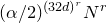 $(\alpha /2)^{(32d)^r}N^r$
integers
$(\alpha /2)^{(32d)^r}N^r$
integers $x$
with
$x$
with $|x| \leqslant (8d N)^r$
may be written as a
$|x| \leqslant (8d N)^r$
may be written as a $\pm$
sum of at most
$\pm$
sum of at most $(4d)^r$
numbers
$(4d)^r$
numbers $\prod _{j=1}^r (L_d(\mathbf {y}_j) + t_j)$
with
$\prod _{j=1}^r (L_d(\mathbf {y}_j) + t_j)$
with $(\mathbf {y}_1,\dots , \mathbf {y}_{r}) \in A$
.
$(\mathbf {y}_1,\dots , \mathbf {y}_{r}) \in A$
.
Proof. It is convenient to write $\phi _j(\mathbf {y}) := L_d(\mathbf {y}) + t_j$
,
$\phi _j(\mathbf {y}) := L_d(\mathbf {y}) + t_j$
, $j = 1,\dots , r$
. Note, for further use, the containment
$j = 1,\dots , r$
. Note, for further use, the containment
 \begin{equation} \phi _j(\{0,1\}^{[0, m)}) \subset [-2N, 2N], \end{equation}
which follows from the fact that $|t_j| \leqslant N$
.
$|t_j| \leqslant N$
.
Turning to the proof, we proceed by induction on $r$
. In the case
$r$
. In the case $r = 1$
, we can apply Theorem2.3. Noting that
$r = 1$
, we can apply Theorem2.3. Noting that $L_d(\{0,1,\dots , d-1\}^m) = \{0,1,\dots , N - 1\}$
, we see that at least
$L_d(\{0,1,\dots , d-1\}^m) = \{0,1,\dots , N - 1\}$
, we see that at least $\alpha ^{\log _2 d} N$
elements of
$\alpha ^{\log _2 d} N$
elements of $\{0,1,\dots , N-1\}$
are the sum of
$\{0,1,\dots , N-1\}$
are the sum of $d-1$
elements
$d-1$
elements $L_d(\mathbf {y}_1)$
,
$L_d(\mathbf {y}_1)$
, $\mathbf {y}_1 \in A$
. Since, for any
$\mathbf {y}_1 \in A$
. Since, for any $\mathbf {y}_1^{(1)},\dots , \mathbf {y}_1^{(d-1)} \in A$
, we have
$\mathbf {y}_1^{(1)},\dots , \mathbf {y}_1^{(d-1)} \in A$
, we have
 \begin{equation*} \sum _{i = 1}^{d-1} \phi _1(\mathbf {y}_1^{(i)}) = \sum _{i = 1}^{d-1} L_d(\mathbf {y}_1^{(i)}) + (d - 1) t_1,\end{equation*}
we see that at least $\alpha ^{\log _2 d} N$
elements of
$\alpha ^{\log _2 d} N$
elements of $[-d N, d N]$
are the sum of
$[-d N, d N]$
are the sum of $d - 1$
elements
$d - 1$
elements $\phi _1(\mathbf {y}_1)$
,
$\phi _1(\mathbf {y}_1)$
, $\mathbf {y}_1 \in A$
, which gives the required result in this case.
$\mathbf {y}_1 \in A$
, which gives the required result in this case.
Now suppose that $r \geqslant 2$
, and that we have proven the result for smaller values of
$r \geqslant 2$
, and that we have proven the result for smaller values of $r$
. For each
$r$
. For each $\mathbf {y}_r \in \{0,1\}^{[0,m)}$
, denote by
$\mathbf {y}_r \in \{0,1\}^{[0,m)}$
, denote by $A(\mathbf {y}_r) \subseteq (\{0,1\}^{[0,m)})^{r-1}$
the maximal set such that
$A(\mathbf {y}_r) \subseteq (\{0,1\}^{[0,m)})^{r-1}$
the maximal set such that $A(\mathbf {y}_r) \times \{\mathbf {y}_r\} \subseteq A$
. By a simple averaging argument there is a set
$A(\mathbf {y}_r) \times \{\mathbf {y}_r\} \subseteq A$
. By a simple averaging argument there is a set $Y$
of at least
$Y$
of at least $(\alpha /2) 2^{m}$
values of
$(\alpha /2) 2^{m}$
values of $\mathbf {y}_r$
such that
$\mathbf {y}_r$
such that $|A(\mathbf {y}_r)| \geqslant (\alpha /2) 2^{m(r-1)}$
. By the inductive hypothesis, for each
$|A(\mathbf {y}_r)| \geqslant (\alpha /2) 2^{m(r-1)}$
. By the inductive hypothesis, for each $\mathbf {y}_r \in Y$
, there is a set
$\mathbf {y}_r \in Y$
, there is a set
 \begin{equation} B(\mathbf {y}_r) \subseteq [- (8d N)^{r-1}, (8d N)^{r-1}], \end{equation}
with
 \begin{equation} |B(\mathbf {y}_r)| \geqslant (\alpha /4)^{(32d)^{r-1}} N^{r-1}, \end{equation}
such that everything in $B(\mathbf {y}_r)$
is a
$B(\mathbf {y}_r)$
is a $\pm$
sum of at most
$\pm$
sum of at most $(4d)^{r-1}$
elements
$(4d)^{r-1}$
elements $\phi _1(\mathbf {y}_1) \cdots \phi _{r-1}(\mathbf {y}_{r-1})$
with
$\phi _1(\mathbf {y}_1) \cdots \phi _{r-1}(\mathbf {y}_{r-1})$
with $(\mathbf {y}_1,\dots , \mathbf {y}_{r-1}) \in A(\mathbf {y}_r)$
. Observe that everything in
$(\mathbf {y}_1,\dots , \mathbf {y}_{r-1}) \in A(\mathbf {y}_r)$
. Observe that everything in $(B(\mathbf {y}_r) - B(\mathbf {y}_r)) \phi _r(\mathbf {y}_r)$
is then a
$(B(\mathbf {y}_r) - B(\mathbf {y}_r)) \phi _r(\mathbf {y}_r)$
is then a $\pm$
combination of at most
$\pm$
combination of at most $2 (4d)^{r-1}$
elements
$2 (4d)^{r-1}$
elements $\phi _1(\mathbf {y}_1) \cdots \phi _{r}(\mathbf {y}_r)$
with
$\phi _1(\mathbf {y}_1) \cdots \phi _{r}(\mathbf {y}_r)$
with $(\mathbf {y}_1,\dots , \mathbf {y}_r) \in A$
.
$(\mathbf {y}_1,\dots , \mathbf {y}_r) \in A$
.
Suppose now that $z \in (d - 1) \phi _r(Y) = \phi _r(Y) + \cdots + \phi _r(Y)$
. Note that, by (6.2),
$z \in (d - 1) \phi _r(Y) = \phi _r(Y) + \cdots + \phi _r(Y)$
. Note that, by (6.2),
 \begin{equation} |z| \lt 2dN. \end{equation}
For each such $z$
, pick a representation
$z$
, pick a representation $z = \phi _r(\mathbf {y}_r^{(1)}) + \cdots + \phi _r(\mathbf {y}_r^{(d-1)})$
with
$z = \phi _r(\mathbf {y}_r^{(1)}) + \cdots + \phi _r(\mathbf {y}_r^{(d-1)})$
with $\mathbf {y}_r^{(i)} \in Y$
for
$\mathbf {y}_r^{(i)} \in Y$
for $i = 1,\dots , d-1$
, and define
$i = 1,\dots , d-1$
, and define $S(z) := \bigcap _{i=1}^{d-1} (B(\mathbf {y}_r^{(i)}) - B(\mathbf {y}_r^{(i)}))$
. By (6.3), (6.4) and Lemma 6.3 (taking
$S(z) := \bigcap _{i=1}^{d-1} (B(\mathbf {y}_r^{(i)}) - B(\mathbf {y}_r^{(i)}))$
. By (6.3), (6.4) and Lemma 6.3 (taking $X := (8dN)^{r-1}$
,
$X := (8dN)^{r-1}$
, $\eta := (8d)^{-(r-1)} (\alpha /4)^{(32d)^{r-1}}$
and
$\eta := (8d)^{-(r-1)} (\alpha /4)^{(32d)^{r-1}}$
and $t := d - 1$
in that lemma), we have
$t := d - 1$
in that lemma), we have
 \begin{align} \nonumber |S(z)| & \geqslant 5^{-(d-1)} (8d)^{-(r-1)(d-2)} (\alpha /4)^{(32 d)^{r-1} (d - 1)} N^{r-1} \\ & \geqslant (\alpha /2)^{4d (32d)^{r-1}} N^{r-1}. \end{align}
Here, the second bound is crude and uses the inequality
 \begin{equation*} (2d+2)(32d)^{r-1} \geqslant (d-1)\log _2 5 + (r-1)(d-2) \log _2(8d),\end{equation*}
valid for $d \geqslant 2$
and
$d \geqslant 2$
and $r \geqslant 1$
(by a large margin if
$r \geqslant 1$
(by a large margin if $r \gt 1$
).
$r \gt 1$
).
Note that everything in $S(z) z$
is a
$S(z) z$
is a $\pm$
combination of at most
$\pm$
combination of at most $2(d-1) (4d)^{r-1}$
elements
$2(d-1) (4d)^{r-1}$
elements $\phi _1(\mathbf {y}_1) \cdots \phi _r( \mathbf {y}_r)$
with
$\phi _1(\mathbf {y}_1) \cdots \phi _r( \mathbf {y}_r)$
with $(\mathbf {y}_1,\dots , \mathbf {y}_r) \in A$
. Set
$(\mathbf {y}_1,\dots , \mathbf {y}_r) \in A$
. Set $\Omega := \bigcup _{z \in (d-1) \phi _r(Y)} (S(z) \times \{z\})$
. Then
$\Omega := \bigcup _{z \in (d-1) \phi _r(Y)} (S(z) \times \{z\})$
. Then $\Omega \subset [-U, U] \times [-V, V]$
where by (6.3) and (6.5) we can take
$\Omega \subset [-U, U] \times [-V, V]$
where by (6.3) and (6.5) we can take $U := 2(8dN)^{r-1}$
and
$U := 2(8dN)^{r-1}$
and $V := 2 dN$
. Now by Theorem2.3, and recalling that
$V := 2 dN$
. Now by Theorem2.3, and recalling that $|Y| \geqslant (\alpha /2) 2^m$
, we have
$|Y| \geqslant (\alpha /2) 2^m$
, we have $| (d - 1) \phi _r(Y) | = |(d - 1) L_d(Y) | \geqslant (\alpha /2)^{\log _2 d} N$
. From this and (6.6), we have
$| (d - 1) \phi _r(Y) | = |(d - 1) L_d(Y) | \geqslant (\alpha /2)^{\log _2 d} N$
. From this and (6.6), we have $|\Omega | \geqslant (\alpha /2)^{4d(32d)^{r-1} + \log _2 d} N^r$
. Thus, noting that
$|\Omega | \geqslant (\alpha /2)^{4d(32d)^{r-1} + \log _2 d} N^r$
. Thus, noting that $UV = 2^{3r -1 + r \log _2 d} N^r$
, it follows that
$UV = 2^{3r -1 + r \log _2 d} N^r$
, it follows that $|\Omega | \geqslant \varepsilon UV$
with
$|\Omega | \geqslant \varepsilon UV$
with
 \begin{equation} \varepsilon := (\alpha /2)^{4d(32d)^{r-1} + 3r + (r+1) \log _2 d}. \end{equation}
Now we aim to apply Lemma 6.2. For such an application to be valid, we require $\varepsilon \lt 2^{-44}$
, which is comfortably a consequence of (6.7). We also need that
$\varepsilon \lt 2^{-44}$
, which is comfortably a consequence of (6.7). We also need that $U,V \geqslant 64/\varepsilon$
, which follows from (6.7) and the lower bound on
$U,V \geqslant 64/\varepsilon$
, which follows from (6.7) and the lower bound on $N$
in the hypotheses of the proposition. Note that if
$N$
in the hypotheses of the proposition. Note that if $(u_1, v_1) = (S(z), z)$
,
$(u_1, v_1) = (S(z), z)$
, $(u_2, v_2) = (S(z^{\prime}), z^{\prime}) \in \Omega$
then
$(u_2, v_2) = (S(z^{\prime}), z^{\prime}) \in \Omega$
then $u_1 v_1 + u_2 v_2 = S(z) z^{\prime} + S(z^{\prime}) z^{\prime}$
is a
$u_1 v_1 + u_2 v_2 = S(z) z^{\prime} + S(z^{\prime}) z^{\prime}$
is a $\pm$
combination of at most
$\pm$
combination of at most $(4d)^r$
elements
$(4d)^r$
elements $\phi _1(\mathbf {y}_1) \cdots \phi _r( \mathbf {y}_r)$
with
$\phi _1(\mathbf {y}_1) \cdots \phi _r( \mathbf {y}_r)$
with $(\mathbf {y}_1,\dots , \mathbf {y}_r) \in A$
, and by Lemma 6.2 there are
$(\mathbf {y}_1,\dots , \mathbf {y}_r) \in A$
, and by Lemma 6.2 there are $\geqslant \varepsilon ^7 UV \gt \varepsilon ^7 N^r$
such elements. To conclude the argument, we need only check that
$\geqslant \varepsilon ^7 UV \gt \varepsilon ^7 N^r$
such elements. To conclude the argument, we need only check that $\varepsilon ^7 \geqslant (\alpha /2)^{(32 d)^r}$
, which, using (6.7), comes down to checking that
$\varepsilon ^7 \geqslant (\alpha /2)^{(32 d)^r}$
, which, using (6.7), comes down to checking that $4d (32 d)^{r-1} \geqslant 7(3r + (r + 1) \log _2 d)$
, which is comfortably true for all
$4d (32 d)^{r-1} \geqslant 7(3r + (r + 1) \log _2 d)$
, which is comfortably true for all $d, r \geqslant 2$
.
$d, r \geqslant 2$
.
Finally, we are ready for the proof of the main result of the section, Proposition 6.1, which results from combining Propositions 5.2 and 6.4.
Proof of Proposition 6.1. In the following proof we suppress a number of short calculations, showing that various constants are bounded by $C = b^{7k^2/2}$
. These calculations are all simple finger exercises using the assumption that
$C = b^{7k^2/2}$
. These calculations are all simple finger exercises using the assumption that $b \geqslant 3$
and
$b \geqslant 3$
and $k \geqslant 2$
.
$k \geqslant 2$
.
First apply Proposition 5.2. As in the statement of that Proposition, we obtain $t_1,\dots , t_{k-1} \in \mathbf {Z}$
,
$t_1,\dots , t_{k-1} \in \mathbf {Z}$
, $|t_j| \leqslant N$
such that, for at least
$|t_j| \leqslant N$
such that, for at least ${1}/{2} \delta ^{2^k} 2^{(k-1) n/k}$
choices of
${1}/{2} \delta ^{2^k} 2^{(k-1) n/k}$
choices of $\mathbf {x}^{(1)},\dots , \mathbf {x}^{(k-1)} \in \{0,1\}^{[0, n/k)}$
, we have
$\mathbf {x}^{(1)},\dots , \mathbf {x}^{(k-1)} \in \{0,1\}^{[0, n/k)}$
, we have
 \begin{equation} \tilde {\text {w}}_n \Bigg( \theta q_0 \prod _{i=1}^{k-1} (L_{b^k}(\mathbf {x}^{(i)}) + t_i) \Bigg) \leqslant 2^k b^{2k} \log (2/\delta ) \end{equation}
for some positive integer $q_0 \leqslant b^{k^2}$
. (For the definition of
$q_0 \leqslant b^{k^2}$
. (For the definition of $\tilde {\text {w}}_n$
, see Definition 5.1.) To this conclusion, we apply Proposition 6.4, taking
$\tilde {\text {w}}_n$
, see Definition 5.1.) To this conclusion, we apply Proposition 6.4, taking $m := n/k$
,
$m := n/k$
, $r := k-1$
and
$r := k-1$
and $d := b^k$
in that proposition, and taking
$d := b^k$
in that proposition, and taking $A$
to be the set of all
$A$
to be the set of all $(\mathbf {x}^{(1)},\dots , \mathbf {x}^{(k-1)})$
as just described; thus, we may take
$(\mathbf {x}^{(1)},\dots , \mathbf {x}^{(k-1)})$
as just described; thus, we may take $\alpha := \delta ^{2^k}/2$
. Note that
$\alpha := \delta ^{2^k}/2$
. Note that $N = d^m = b^n$
is the same quantity. The reader may check that the lower bound on
$N = d^m = b^n$
is the same quantity. The reader may check that the lower bound on $N$
required for this application of Proposition 6.4 is a consequence of the assumption on
$N$
required for this application of Proposition 6.4 is a consequence of the assumption on $N$
in Proposition 6.1.
$N$
in Proposition 6.1.
We conclude that at least $(\delta ^{2^k}/4)^{(32 b^k)^{k-1}} N^{k-1} \gt (\delta /2)^{C} N^{k-1}$
integers
$(\delta ^{2^k}/4)^{(32 b^k)^{k-1}} N^{k-1} \gt (\delta /2)^{C} N^{k-1}$
integers $x$
with
$x$
with $|x| \leqslant (8b^k N)^{k-1}$
may be written as a
$|x| \leqslant (8b^k N)^{k-1}$
may be written as a $\pm$
sum of at most
$\pm$
sum of at most $(4b^k)^{k-1}$
numbers of the form
$(4b^k)^{k-1}$
numbers of the form $\prod _{i=1}^{k-1} (L_{b^k}(\mathbf {x}^{(i)}) + t_i)$
, with
$\prod _{i=1}^{k-1} (L_{b^k}(\mathbf {x}^{(i)}) + t_i)$
, with $(\mathbf {x}^{(1)},\dots , \mathbf {x}^{(k-1)}) \in A$
. By (6.8), the fact that
$(\mathbf {x}^{(1)},\dots , \mathbf {x}^{(k-1)}) \in A$
. By (6.8), the fact that $\tilde {\text {w}}_n(-\alpha ) = \tilde {\text {w}}_n(\alpha )$
, as well as the (easily verified) subadditivity property
$\tilde {\text {w}}_n(-\alpha ) = \tilde {\text {w}}_n(\alpha )$
, as well as the (easily verified) subadditivity property
 \begin{equation*} \tilde {\text {w}}_n(\alpha _1 + \cdots + \alpha _s) \leqslant s (\tilde {\text {w}}_n(\alpha _1) + \dots + \tilde {\text {w}}_n(\alpha _s)),\end{equation*}
we see that, for all such $x$
, we have
$x$
, we have
 \begin{equation*} \tilde {\text {w}}_n(\theta q_0 x) \leqslant (4b^k)^{2(k-1)} 2^k b^{2k} \log (2/\delta ) \lt C \log (2/\delta ).\end{equation*}
Finally, note that for all these $x$
, we have
$x$
, we have $|q_0 x| \leqslant b^{k^2}(8 b^k)^{k-1} N^{k-1}$
, which is less than
$|q_0 x| \leqslant b^{k^2}(8 b^k)^{k-1} N^{k-1}$
, which is less than $C N^{k-1}$
. This concludes the proof.
$C N^{k-1}$
. This concludes the proof.
7. From digital to diophantine
In this section we turn to the final step in the outline of § 2, the aim of which is to convert the ‘digital’ conclusion of Proposition 6.1 to the ‘diophantine’ conclusion of Proposition 2.1. Before turning to detailed statements, we comment on the notion of a centred base $b$
expansion.
$b$
expansion.
Centred base $b$
expansions. Consider
$b$
expansions. Consider $\alpha \in {\mathbf {R}}/\mathbf {Z}$
. Then there are essentially unique choices of integers
$\alpha \in {\mathbf {R}}/\mathbf {Z}$
. Then there are essentially unique choices of integers $\alpha _j \in (-{b}/{2}, b/2]$
such that
$\alpha _j \in (-{b}/{2}, b/2]$
such that
 \begin{equation} \alpha = \alpha _0 + \alpha _1 b^{-1} + \alpha _2 b^{-2} + \cdots {(\operatorname {mod}\, 1)}. \end{equation}
We call this the centred base $b$
expansion of
$b$
expansion of $\alpha {(\operatorname {mod}\, 1)}$
.
$\alpha {(\operatorname {mod}\, 1)}$
.
Let us pause to explain the existence of such expansions. When $b$
is odd, so that
$b$
is odd, so that $(-{b}/{2}, {b}/{2}] = \{-{1}/{2}(b-1),\dots , {1}/{2}(b-1)\}$
, the centred expansion may be obtained from the more usual base
$(-{b}/{2}, {b}/{2}] = \{-{1}/{2}(b-1),\dots , {1}/{2}(b-1)\}$
, the centred expansion may be obtained from the more usual base $b$
expansion of
$b$
expansion of $\alpha + {b}/{2}$
, noting that
$\alpha + {b}/{2}$
, noting that ${b}/{2} = {1}/{2}(b-1) (1 + b^{-1} + b^{-2} + \cdots )$
. As usual, there is some ambiguity when all the digits from some point on are
${b}/{2} = {1}/{2}(b-1) (1 + b^{-1} + b^{-2} + \cdots )$
. As usual, there is some ambiguity when all the digits from some point on are ${1}/{2}(b-1)$
; any such number can also be written with all digits from some point on being
${1}/{2}(b-1)$
; any such number can also be written with all digits from some point on being $-{1}/{2}(b-1)$
. For consistency with the usual base
$-{1}/{2}(b-1)$
. For consistency with the usual base $b$
expansions, we always prefer the latter representation. When
$b$
expansions, we always prefer the latter representation. When $b$
is even, so that
$b$
is even, so that $(-{b}/{2}, {b}/{2}] = \{-{1}/{2}(b-2), \dots , {1}/{2}b\}$
, one instead considers the usual base
$(-{b}/{2}, {b}/{2}] = \{-{1}/{2}(b-2), \dots , {1}/{2}b\}$
, one instead considers the usual base $b$
expansion of
$b$
expansion of $\alpha + {b(b-2)}/{2(b-1)}$
, noting now that
$\alpha + {b(b-2)}/{2(b-1)}$
, noting now that ${b(b-2)}/{2(b-1)} = {1}/{2}(b-2) (1 + b^{-1} + b^{-2} + \cdots )$
.
${b(b-2)}/{2(b-1)} = {1}/{2}(b-2) (1 + b^{-1} + b^{-2} + \cdots )$
.
Definition 7.1.
Given $\alpha \in {\mathbf {R}}/\mathbf {Z}$
, denote by
$\alpha \in {\mathbf {R}}/\mathbf {Z}$
, denote by $\operatorname {w}_n(\alpha )$
the number of nonzero digits among the first
$\operatorname {w}_n(\alpha )$
the number of nonzero digits among the first $n$
digits
$n$
digits $\alpha _0,\alpha _1,\dots , \alpha _{n-1}$
in the centred expansion (7.1).
$\alpha _0,\alpha _1,\dots , \alpha _{n-1}$
in the centred expansion (7.1).
We record the connection between $\operatorname {w}_n$
and the ‘analytic’ proxy
$\operatorname {w}_n$
and the ‘analytic’ proxy $\tilde {\text {w}}_n$
, introduced in Definition 5.1.
$\tilde {\text {w}}_n$
, introduced in Definition 5.1.
Lemma 7.2.
Suppose that $b \geqslant 3$
. Then
$b \geqslant 3$
. Then $\tilde {\text {w}}_n(\alpha ) \leqslant \operatorname {w}_n(\alpha ) \leqslant 16b^2 \tilde {\text {w}}_n(\alpha )$
.
$\tilde {\text {w}}_n(\alpha ) \leqslant \operatorname {w}_n(\alpha ) \leqslant 16b^2 \tilde {\text {w}}_n(\alpha )$
.
Proof. Let the centred expansion of $\alpha {(\operatorname {mod}\, 1)}$
be (7.1), and suppose that
$\alpha {(\operatorname {mod}\, 1)}$
be (7.1), and suppose that $\alpha _i$
is a nonzero digit. We have
$\alpha _i$
is a nonzero digit. We have $\alpha b^{i-1} \equiv \sum _{j \geqslant 0} \alpha _{i +j} b^{-j - 1} {(\operatorname {mod}\, 1)}$
. However,
$\alpha b^{i-1} \equiv \sum _{j \geqslant 0} \alpha _{i +j} b^{-j - 1} {(\operatorname {mod}\, 1)}$
. However,
 \begin{equation*} \bigg|\sum _{j \geqslant 0} \alpha _{i +j} b^{-j - 1} \bigg| \leqslant \tfrac {b}{2} \sum _{j \geqslant 0} b^{-j-1} = \tfrac {b}{2(b-1)} \leqslant \tfrac {3}{4},\end{equation*}
and, since $\alpha _i \neq 0$
,
$\alpha _i \neq 0$
,
 \begin{equation*} \bigg|\sum _{j \geqslant 0} \alpha _{i +j} b^{-j - 1} \bigg| \geqslant \tfrac {1}{b} - \tfrac {b}{2}\sum _{j \geqslant 1} b^{-j-1} = \tfrac {b-2}{2b(b-1)} \geqslant \tfrac {1}{4b}.\end{equation*}
Thus, $\Vert \alpha b^{i-1} \Vert \geqslant 1/4b$
and the upper bound follows.
$\Vert \alpha b^{i-1} \Vert \geqslant 1/4b$
and the upper bound follows.
The lower bound is not needed elsewhere in the paper, but we sketch the proof for completeness. Let $I := \{ i : \alpha _i \neq 0\}$
. Given
$I := \{ i : \alpha _i \neq 0\}$
. Given $j$
, denote by
$j$
, denote by $i(j)$
the distance from
$i(j)$
the distance from $j$
to the smallest element of
$j$
to the smallest element of $I$
that is greater than
$I$
that is greater than $j$
. Then
$j$
. Then
 \begin{equation*} \Vert \alpha b^j \Vert = \bigg \Vert \sum _{i \in I, i \gt j} \alpha _i b^{-i + j} \bigg \Vert \leqslant \tfrac {b}{2} \sum _{m \geqslant i(j)} b^{-m} = \tfrac {b^2}{2(b-1)} b^{-i(j)} .\end{equation*}
Now square this and sum over $j$
, and use the fact that
$j$
, and use the fact that $\# \{ j : i(j) = i\} \leqslant |I| = \operatorname {w}_n(\alpha )$
for all
$\# \{ j : i(j) = i\} \leqslant |I| = \operatorname {w}_n(\alpha )$
for all $i$
.
$i$
.
Remarks. This upper bound breaks down when $b = 2$
, as may be seen by considering
$b = 2$
, as may be seen by considering $\alpha$
of the form
$\alpha$
of the form $1 - 2^{-m}$
. This is the main reason for the restriction to
$1 - 2^{-m}$
. This is the main reason for the restriction to $b \geqslant 3$
in the paper.
$b \geqslant 3$
in the paper.
Here is the main result of the section.
Proposition 7.3.
Let $b \geqslant 3$
be an integer. Let
$b \geqslant 3$
be an integer. Let $r, M, n$
be positive integers, and set
$r, M, n$
be positive integers, and set $N := b^n$
. Let
$N := b^n$
. Let $\eta \in (0,1]$
be real. Suppose that
$\eta \in (0,1]$
be real. Suppose that $M, N \geqslant b^{20r} \eta ^{-2}$
. Suppose that
$M, N \geqslant b^{20r} \eta ^{-2}$
. Suppose that $\theta \in {\mathbf {R}}$
, and that
$\theta \in {\mathbf {R}}$
, and that $\operatorname {w}_n(\theta m) \leqslant r$
for at least
$\operatorname {w}_n(\theta m) \leqslant r$
for at least $\eta M$
values of
$\eta M$
values of $m \in [-M, M]$
. Then there is some positive integer
$m \in [-M, M]$
. Then there is some positive integer $q \leqslant b^{20r} \eta ^{-2}$
such that
$q \leqslant b^{20r} \eta ^{-2}$
such that $\Vert \theta q \Vert \leqslant b^{20r} \eta ^{-2} M^{-1} N^{-1}$
.
$\Vert \theta q \Vert \leqslant b^{20r} \eta ^{-2} M^{-1} N^{-1}$
.
Before giving the proof, we assemble some lemmas. In the first of these, we will again be concerned with centred expansions in base $b$
, but this time of integers. Every integer
$b$
, but this time of integers. Every integer $x$
has a unique finite-length centred base
$x$
has a unique finite-length centred base $b$
expansion
$b$
expansion
 \begin{equation} x = x_0 + x_1 b + x_2 b^2 + \cdots , \end{equation}
with $x_i \in (-{b}/{2}, {b}/{2}]$
. To see uniqueness, note that
$x_i \in (-{b}/{2}, {b}/{2}]$
. To see uniqueness, note that $x_0$
is uniquely determined by
$x_0$
is uniquely determined by $x {(\operatorname {mod}\, b)}$
, then
$x {(\operatorname {mod}\, b)}$
, then $x_1$
is uniquely determined by
$x_1$
is uniquely determined by $ {x - x_0}/{b} {(\operatorname {mod}\, b)}$
, and so on. Strictly speaking, we do not need the existence in this paper but one way to see it is to take the usual base
$ {x - x_0}/{b} {(\operatorname {mod}\, b)}$
, and so on. Strictly speaking, we do not need the existence in this paper but one way to see it is to take the usual base $b$
expansion and modify from the right. For instance, in base 10 we have, denoting the ‘digit’
$b$
expansion and modify from the right. For instance, in base 10 we have, denoting the ‘digit’ $-d$
by
$-d$
by $\overline {d}$
,
$\overline {d}$
, $6277 = 628\overline {3} = 63\overline {2}\overline {3} = 1\overline {4}3\overline {2}\overline {3}$
.
$6277 = 628\overline {3} = 63\overline {2}\overline {3} = 1\overline {4}3\overline {2}\overline {3}$
.
Denote by $\operatorname {d}_b(x)$
the number of nonzero digits in this expansion of
$\operatorname {d}_b(x)$
the number of nonzero digits in this expansion of $x$
. The set of
$x$
. The set of $x$
for which
$x$
for which $\operatorname {d}_b(x) \leqslant r$
is a kind of ‘digital Hamming ball’. As for true Hamming balls [Reference BonamiBon70, Reference Kirshner and SamorodnitskyKS20], subsets of this set have little additive structure. Such a result was stated as Proposition 2.4. We recall the statement now. Recall that, if
$\operatorname {d}_b(x) \leqslant r$
is a kind of ‘digital Hamming ball’. As for true Hamming balls [Reference BonamiBon70, Reference Kirshner and SamorodnitskyKS20], subsets of this set have little additive structure. Such a result was stated as Proposition 2.4. We recall the statement now. Recall that, if $A \subset \mathbf {Z}$
is a finite set, the additive energy
$A \subset \mathbf {Z}$
is a finite set, the additive energy $E(A)$
is the number of quadruples
$E(A)$
is the number of quadruples $(a_1, a_2, a_3, a_4) \in A \times A \times A \times A$
with
$(a_1, a_2, a_3, a_4) \in A \times A \times A \times A$
with $a_1 + a_2 = a_3 + a_4$
.
$a_1 + a_2 = a_3 + a_4$
.
Proposition 2.4
Let $r \in \mathbf {Z}_{\geqslant 0}$
. Suppose that
$r \in \mathbf {Z}_{\geqslant 0}$
. Suppose that $A \subset \mathbf {Z}$
is a finite set, all of whose elements have at most
$A \subset \mathbf {Z}$
is a finite set, all of whose elements have at most $r$
nonzero digits in their centred base
$r$
nonzero digits in their centred base $b$
expansion. Then
$b$
expansion. Then $E(A) \leqslant (2b)^{4r} |A|^{2}$
.
$E(A) \leqslant (2b)^{4r} |A|^{2}$
.
The proof of Proposition 2.4 will proceed by induction. However, to make this work, we need to prove a more general statement, involving four potentially different sets $A_1, A_2, A_3, A_4$
instead of just one, as well as the provision for a ‘carry’ in base
$A_1, A_2, A_3, A_4$
instead of just one, as well as the provision for a ‘carry’ in base $b$
arithmetic. Here is the more general statement, from which Proposition 2.4 follows immediately.
$b$
arithmetic. Here is the more general statement, from which Proposition 2.4 follows immediately.
Lemma 7.4.
Let $r_1,r_2, r_3, r_4 \in \mathbf {Z}_{\geqslant 0}$
. For each
$r_1,r_2, r_3, r_4 \in \mathbf {Z}_{\geqslant 0}$
. For each $i \in \{1,2,3,4\}$
, suppose that
$i \in \{1,2,3,4\}$
, suppose that $A_i \subset \mathbf {Z}$
is a finite set, all of whose elements have at most
$A_i \subset \mathbf {Z}$
is a finite set, all of whose elements have at most $r_i$
nonzero digits in their centred base
$r_i$
nonzero digits in their centred base $b$
expansion. Let
$b$
expansion. Let $e \in \mathbf {Z}$
,
$e \in \mathbf {Z}$
, $|e| \lt b$
. Then the number of quadruples
$|e| \lt b$
. Then the number of quadruples $(a_1, a_2, a_3, a_4) \in A_1 \times A_2 \times A_3 \times A_4$
with
$(a_1, a_2, a_3, a_4) \in A_1 \times A_2 \times A_3 \times A_4$
with $a_1 + a_2 = a_3 + a_4 + e$
is at most
$a_1 + a_2 = a_3 + a_4 + e$
is at most $(2b)^{r_1 + r_2 + r_3 + r_4} |A_1|^{1/2} |A_2|^{1/2} |A_3|^{1/2} |A_4|^{1/2}$
.
$(2b)^{r_1 + r_2 + r_3 + r_4} |A_1|^{1/2} |A_2|^{1/2} |A_3|^{1/2} |A_4|^{1/2}$
.
Proof. We proceed by induction on $\sum _{j = 1}^4 |A_j| + \sum _{j = 1}^4 r_j$
, the result being obvious when this quantity is zero. Suppose now that
$\sum _{j = 1}^4 |A_j| + \sum _{j = 1}^4 r_j$
, the result being obvious when this quantity is zero. Suppose now that $\sum _{j = 1}^4 |A_j| + \sum _{j = 1}^4 r_j = n \gt 0$
and that the result has been proven for all smaller values of
$\sum _{j = 1}^4 |A_j| + \sum _{j = 1}^4 r_j = n \gt 0$
and that the result has been proven for all smaller values of $n$
. If any of the
$n$
. If any of the $A_j$
are empty, or if
$A_j$
are empty, or if $A_1 = A_2 = A_3 = A_4 = \{0\}$
, the result is obvious.
$A_1 = A_2 = A_3 = A_4 = \{0\}$
, the result is obvious.
Suppose this is not the case, but that $b$
divides every element of
$b$
divides every element of $\bigcup _{j = 1}^4 A_j$
. Let
$\bigcup _{j = 1}^4 A_j$
. Let $b^m$
be the largest power of
$b^m$
be the largest power of $b$
that divides every element of
$b$
that divides every element of $\bigcup _{j = 1}^4 A_j$
, this being well defined since this set contains at least one nonzero element. Then, if the number of quadruples in
$\bigcup _{j = 1}^4 A_j$
, this being well defined since this set contains at least one nonzero element. Then, if the number of quadruples in $A_1 \times A_2 \times A_3 \times A_4$
with
$A_1 \times A_2 \times A_3 \times A_4$
with $a_1 + a_2 = a_3 + a_4 + e$
is nonzero, we must have
$a_1 + a_2 = a_3 + a_4 + e$
is nonzero, we must have $e = 0$
, and the number of such quadruples is the same as the number in
$e = 0$
, and the number of such quadruples is the same as the number in ${1}/{b^m}A_1 \times {1}/{b^m} A_2 \times {1}/{b^m} A_3 \times {1}/{b^m} A_4$
. Thus, replacing
${1}/{b^m}A_1 \times {1}/{b^m} A_2 \times {1}/{b^m} A_3 \times {1}/{b^m} A_4$
. Thus, replacing $A_j$
by
$A_j$
by $\frac {1}{b^m} A_j$
, we may assume that not all the elements of
$\frac {1}{b^m} A_j$
, we may assume that not all the elements of $\bigcup _{j=1}^4 A_j$
are divisible by
$\bigcup _{j=1}^4 A_j$
are divisible by $b$
.
$b$
.
For each $j \in \{1,2,3,4\}$
and for each
$j \in \{1,2,3,4\}$
and for each $i \in (-{b}/{2}, {b}/{2}]$
, write
$i \in (-{b}/{2}, {b}/{2}]$
, write $A_j^{(i)}$
for the set of
$A_j^{(i)}$
for the set of $x \in A_j$
whose first digit
$x \in A_j$
whose first digit $x_0$
(in the centred base
$x_0$
(in the centred base $b$
expansion (7.2)) is
$b$
expansion (7.2)) is $i$
. Write
$i$
. Write $\alpha _j(i)$
for the relative density of
$\alpha _j(i)$
for the relative density of $A_j^{(i)}$
in
$A_j^{(i)}$
in $A_j$
, that is to say,
$A_j$
, that is to say, $|A_j^{(i)}| = \alpha _j(i) |A_j|$
. Any quadruple
$|A_j^{(i)}| = \alpha _j(i) |A_j|$
. Any quadruple $(a_1, a_2, a_3, a_4)$
with
$(a_1, a_2, a_3, a_4)$
with $a_1 + a_2 = a_3 + a_4 + e$
must have
$a_1 + a_2 = a_3 + a_4 + e$
must have $a_j \in A_j^{(i_j)}$
, where
$a_j \in A_j^{(i_j)}$
, where $i_1 + i_2 \equiv i_3 + i_4 + e {(\operatorname {mod}\, b)}$
. Let us estimate the number of such quadruples
$i_1 + i_2 \equiv i_3 + i_4 + e {(\operatorname {mod}\, b)}$
. Let us estimate the number of such quadruples $(a_1, a_2, a_3, a_4)$
for each quadruple
$(a_1, a_2, a_3, a_4)$
for each quadruple $(i_1, i_2, i_3, i_4) \in (-{b}/{2}, {b}/{2}]^4$
satisfying this condition.
$(i_1, i_2, i_3, i_4) \in (-{b}/{2}, {b}/{2}]^4$
satisfying this condition.
First note that $i_1 + i_2 = i_3 + i_4 + e + e^{\prime} b$
for some integer
$i_1 + i_2 = i_3 + i_4 + e + e^{\prime} b$
for some integer $e^{\prime}$
, where
$e^{\prime}$
, where
 \begin{equation*} |e^{\prime}| \leqslant \tfrac {1}{b} ( |i_1 + i_2 - i_3 - i_4| + |e|) \leqslant \tfrac {3(b-1)}{b} \lt b,\end{equation*}
where here we noted that $|i_1 - i_3|, |i_2 - i_4|, |e| \leqslant b - 1$
. We then have
$|i_1 - i_3|, |i_2 - i_4|, |e| \leqslant b - 1$
. We then have ${1}/{b}(a_1 - i_1) + {1}/{b}(a_2 - i_2) - {1}/{b}(a_3 - i_3) - {1}/{b}(a_4 - i_4) = - e^{\prime}$
. Now the set
${1}/{b}(a_1 - i_1) + {1}/{b}(a_2 - i_2) - {1}/{b}(a_3 - i_3) - {1}/{b}(a_4 - i_4) = - e^{\prime}$
. Now the set $A^{\prime}_j := \frac {1}{b}(A_j^{(i_j)} - i_j)$
is a finite set of integers, all of whose elements
$A^{\prime}_j := \frac {1}{b}(A_j^{(i_j)} - i_j)$
is a finite set of integers, all of whose elements $x$
have
$x$
have $\operatorname {d}_b(x) \leqslant r^{\prime}_j := r_j - 1_{i_j \neq 0}$
. Note that
$\operatorname {d}_b(x) \leqslant r^{\prime}_j := r_j - 1_{i_j \neq 0}$
. Note that $\sum _{j = 1}^4 |A^{\prime}_j| + \sum _{j = 1}^4 r^{\prime}_j \lt \sum _{j = 1}^4 |A_j| + \sum _{j = 1}^4 r_j$
; if any
$\sum _{j = 1}^4 |A^{\prime}_j| + \sum _{j = 1}^4 r^{\prime}_j \lt \sum _{j = 1}^4 |A_j| + \sum _{j = 1}^4 r_j$
; if any $i_j$
is not zero, this follows from the fact that
$i_j$
is not zero, this follows from the fact that $r^{\prime}_j = r_j - 1$
, whereas if
$r^{\prime}_j = r_j - 1$
, whereas if $i_1 = i_2 = i_3 = i_4 = 0$
we have
$i_1 = i_2 = i_3 = i_4 = 0$
we have $\sum _{j = 1}^4 |A^{\prime}_j| = \sum _{j = 1}^4 |A_j^{(0)}| \lt \sum _{j = 1}^4 |A_j|$
, since not every element of
$\sum _{j = 1}^4 |A^{\prime}_j| = \sum _{j = 1}^4 |A_j^{(0)}| \lt \sum _{j = 1}^4 |A_j|$
, since not every element of $\bigcup _{j = 1}^4 A_j$
is a multiple of
$\bigcup _{j = 1}^4 A_j$
is a multiple of $b$
.
$b$
.
It follows from the inductive hypothesis that the numbers of quadruples $(a_1, a_2, a_3, a_4)$
with
$(a_1, a_2, a_3, a_4)$
with $a_1 + a_2 = a_3 + a_4 + e$
, and with
$a_1 + a_2 = a_3 + a_4 + e$
, and with $a_j \in A_j^{(i_j)}$
,
$a_j \in A_j^{(i_j)}$
, $j = 1,\dots , 4$
, is bounded above by
$j = 1,\dots , 4$
, is bounded above by
 \begin{equation*} (2b)^{r_1 + r_2 + r_3 + r_4 - \#\{j : i_j \neq 0\}} \prod _{j = 1}^4 |A_j^{(i_j)}|^{1/2}.\end{equation*}
To complete the inductive step, it is therefore enough to show that
 \begin{equation} \sum _{i_1 + i_2 \equiv i_3 + i_4 + e {(\operatorname {mod}\, b)}} (2b)^{-\# \{j : i_j \neq 0\}} \prod _{j=1}^4 \alpha _j(i_j)^{1/2} \leqslant 1. \end{equation}
If $e \not \equiv 0 {(\operatorname {mod}\, b)}$
then we have
$e \not \equiv 0 {(\operatorname {mod}\, b)}$
then we have $\# \{j : i_j \neq 0\} \geqslant 1$
for all
$\# \{j : i_j \neq 0\} \geqslant 1$
for all $(i_1, i_2, i_3, i_4)$
in this sum, and moreover (where all congruences are
$(i_1, i_2, i_3, i_4)$
in this sum, and moreover (where all congruences are $(\operatorname {mod}\, b)$
)
$(\operatorname {mod}\, b)$
)
 \begin{align*} & \sum _{i_1 + i_2 \equiv i_3 + i_4 + e} \prod _{j=1}^4 \alpha _j(i_j)^{1/2} \\ & \quad = \sum _{x \in \mathbf {Z}/b\mathbf {Z}} \bigg(\sum _{i_1 + i_2 \equiv x+e } \alpha _1(i_1)^{1/2} \alpha _2(i_2)^{1/2} \bigg) \bigg( \sum _{i_3 + i_4 \equiv x } \alpha _3(i_3)^{1/2} \alpha _4(i_4)^{1/2}\bigg) \\ & \quad \leqslant \sum _{x \in \mathbf {Z}/b\mathbf {Z}} \bigg(\sum _{i_1 + i_2 \equiv x+e } \frac {\alpha _1(i_1) + \alpha _2(i_2)}{2} \bigg) \bigg(\sum _{i_3 + i_4 \equiv x } \frac {\alpha _3(i_3) + \alpha _4(i_4)}{2}\bigg) = b, \end{align*}
since $\sum _i \alpha _j(i) = 1$
for each
$\sum _i \alpha _j(i) = 1$
for each $j$
. Therefore, (7.3) holds in this case.
$j$
. Therefore, (7.3) holds in this case.
Suppose, then, that $e \equiv 0{(\operatorname {mod}\, b)}$
, which means that
$e \equiv 0{(\operatorname {mod}\, b)}$
, which means that $e = 0$
. Then, if
$e = 0$
. Then, if $i_1 + i_2 \equiv i_3 + i_4 {(\operatorname {mod}\, b)}$
we either have
$i_1 + i_2 \equiv i_3 + i_4 {(\operatorname {mod}\, b)}$
we either have $(i_1, i_2, i_3, i_4) = (0,0,0,0)$
, or else
$(i_1, i_2, i_3, i_4) = (0,0,0,0)$
, or else $\# \{j : i_j \neq 0\} \geqslant 2$
, and so to establish (7.3) it suffices to show that
$\# \{j : i_j \neq 0\} \geqslant 2$
, and so to establish (7.3) it suffices to show that
 \begin{equation} \prod _{j = 1}^4 \alpha _j(0)^{1/2} + (2b)^{-2} \sum _{\substack {i_1 + i_2 \equiv i_3 + i_4 {(\operatorname {mod}\, b)} \\ (i_1, i_2, i_3, i_4) \neq (0,0,0,0)}} \prod _{j=1}^4 \alpha _j(i_j)^{1/2} \leqslant 1. \end{equation}
Write $\varepsilon _j := 1 - \alpha _j(0)$
. We first estimate the contribution to the sum where none of
$\varepsilon _j := 1 - \alpha _j(0)$
. We first estimate the contribution to the sum where none of $i_1, i_2, i_3, i_4$
are zero. We have, similarly to the above (and again with congruences being
$i_1, i_2, i_3, i_4$
are zero. We have, similarly to the above (and again with congruences being $(\operatorname {mod}\, b)$
),
$(\operatorname {mod}\, b)$
),
 \begin{align*} &\!\!\!\! \sum _{\substack {i_1 + i_2 \equiv i_3 + i_4 \\ i_1i_2i_3i_4 \neq 0}} \prod _{j=1}^4 \alpha _j(i_j)^{1/2} \\ & \quad = \sum _{x \in \mathbf {Z}/b\mathbf {Z}} \left(\sum _{\substack {i_1 + i_2 \equiv x \\ i_1i_2 \neq 0}} \alpha _1(i_1)^{1/2} \alpha _2(i_2)^{1/2} \right) \left( \sum _{\substack {i_3 + i_4 \equiv x \\ i_3i_4 \neq 0}} \alpha _3(i_3)^{1/2} \alpha _4(i_4)^{1/2}\right) \\ & \quad \leqslant \sum _{x \in \mathbf {Z}/b\mathbf {Z}} \sum _{\substack {i_1 + i_2 \equiv x\\ i_1i_2 \neq 0}} \bigg(\frac {\alpha _1(i_1) + \alpha _2(i_2)}{2} \bigg)\left(\sum _{\substack {i_3 + i_4 \equiv x\\i_3i_4 \neq 0}} \frac {\alpha _3(i_3) + \alpha _4(i_4)}{2}\right) \\ & \quad \leqslant b \bigg(\frac {\varepsilon _1 + \varepsilon _2}{2}\bigg)\bigg(\frac {\varepsilon _3 + \varepsilon _4}{2}\bigg) \lt b\sum _{j = 1}^4 \varepsilon _j. \end{align*}
Next we estimate the contribution to the sum in (7.4) from the terms where at least one, but not all, of $i_1, i_2, i_3, i_4$
are zero. In each such term, at least two
$i_1, i_2, i_3, i_4$
are zero. In each such term, at least two $i_j, i_{j^{\prime}}$
are not zero, say with
$i_j, i_{j^{\prime}}$
are not zero, say with $j \lt j^{\prime}$
. Fix a choice of
$j \lt j^{\prime}$
. Fix a choice of $j,j^{\prime}$
. Then, for each
$j,j^{\prime}$
. Then, for each $i_j, i_{j^{\prime}}$
, there are at most two choices of the other
$i_j, i_{j^{\prime}}$
, there are at most two choices of the other $i_{t}$
,
$i_{t}$
, $t \in \{1,2,3,4\} \setminus \{j,j^{\prime}\}$
, one of which must be zero and the other then being determined by the relation
$t \in \{1,2,3,4\} \setminus \{j,j^{\prime}\}$
, one of which must be zero and the other then being determined by the relation $i_1 + i_2 \equiv i_3 + i_4 {(\operatorname {mod}\, b)}$
. It follows that the contribution to the sum in (7.4) from this choice of
$i_1 + i_2 \equiv i_3 + i_4 {(\operatorname {mod}\, b)}$
. It follows that the contribution to the sum in (7.4) from this choice of $j,j^{\prime}$
is
$j,j^{\prime}$
is
 \begin{equation*} \leqslant 2 \sum _{i_j, i_{j^{\prime}} \neq 0} \alpha _j(i_j)^{1/2} \alpha _{j^{\prime}}(i_{j^{\prime}})^{1/2} = 2 \bigg( \sum _{i \neq 0} \alpha _j(i)^{1/2} \bigg) \bigg ( \sum _{i \neq 0} \alpha _{j^{\prime}}(i)^{1/2}\bigg) \leqslant 2b \varepsilon _j^{1/2}\varepsilon _{j^{\prime}}^{1/2} \leqslant b\big(\varepsilon _j + \varepsilon _{j^{\prime}}\big) ,\end{equation*}
where in the middle step we used the Cauchy–Schwarz inequality and the fact that $\sum _{i \neq 0} \alpha _j(i) = \varepsilon _j$
. Summing over the six choices of
$\sum _{i \neq 0} \alpha _j(i) = \varepsilon _j$
. Summing over the six choices of $j,j^{\prime}$
gives an upper bound of
$j,j^{\prime}$
gives an upper bound of $3b \sum _{j = 1}^4 \varepsilon _j$
. Putting all this together, we see that the left-hand side of (7.4) is bounded above by
$3b \sum _{j = 1}^4 \varepsilon _j$
. Putting all this together, we see that the left-hand side of (7.4) is bounded above by $\prod _{j = 1}^4 (1 - \varepsilon _j)^{1/2} + {1}/{b} \sum _{j = 1}^4 \varepsilon _j$
. Using
$\prod _{j = 1}^4 (1 - \varepsilon _j)^{1/2} + {1}/{b} \sum _{j = 1}^4 \varepsilon _j$
. Using $\prod _{j = 1}^4 (1 - \varepsilon _j)^{1/2} \leqslant 1 - {1}/{2}\sum _{j = 1}^4 \varepsilon _j$
, it follows that this is at most
$\prod _{j = 1}^4 (1 - \varepsilon _j)^{1/2} \leqslant 1 - {1}/{2}\sum _{j = 1}^4 \varepsilon _j$
, it follows that this is at most $1$
. This completes the proof of (7.4), and, hence, of Lemma 7.5.
$1$
. This completes the proof of (7.4), and, hence, of Lemma 7.5.
Now we turn to the proof of Proposition 7.3.
Proof of Proposition 7.3. Consider the map $\psi : {\mathbf {R}} \rightarrow \mathbf {Z}$
defined as follows. If
$\psi : {\mathbf {R}} \rightarrow \mathbf {Z}$
defined as follows. If $\alpha {(\operatorname {mod}\, 1)}$
has centred base
$\alpha {(\operatorname {mod}\, 1)}$
has centred base $b$
expansion as in (7.1), set
$b$
expansion as in (7.1), set $\psi (\alpha ) := \alpha _0 b^{n-1} + \dots + \alpha _{n-2} b + \alpha _{n-1}$
. Observe that
$\psi (\alpha ) := \alpha _0 b^{n-1} + \dots + \alpha _{n-2} b + \alpha _{n-1}$
. Observe that
 \begin{equation} \operatorname {d}_b(\psi (\alpha )) = \operatorname {w}_n(\alpha ). \end{equation}
Note that
 \begin{equation} \Vert \alpha - b^{1-n} \psi (\alpha ) \Vert \leqslant \sum _{i \geqslant n} \tfrac {b}{2} b^{-i} \leqslant \tfrac {3}{4} b^{1-n}. \end{equation}
Thus, if $\alpha _1 + \alpha _2 = \alpha _3 + \alpha _4$
then
$\alpha _1 + \alpha _2 = \alpha _3 + \alpha _4$
then
 \begin{equation*} \Vert b^{1-n} (\psi (\alpha _1) + \psi (\alpha _2) - \psi (\alpha _3) - \psi (\alpha _4)) \Vert \leqslant 3 b^{1-n}.\end{equation*}
Note also that, since $\psi$
takes values in
$\psi$
takes values in $\mathbf {Z} \cap [-\frac {3}{4} b^n, \frac {3}{4} b^n]$
, we have
$\mathbf {Z} \cap [-\frac {3}{4} b^n, \frac {3}{4} b^n]$
, we have
 \begin{equation*} |\psi (\alpha _1) + \psi (\alpha _2) - \psi (\alpha _3) - \psi (\alpha _4)| \leqslant 3 b^n.\end{equation*}
Now if $x \in \mathbf {Z}$
is an integer with
$x \in \mathbf {Z}$
is an integer with $\Vert b^{1-n} x \Vert \leqslant 3 b^{1-n}$
and
$\Vert b^{1-n} x \Vert \leqslant 3 b^{1-n}$
and $|x| \leqslant 3 b^n$
then
$|x| \leqslant 3 b^n$
then $x$
takes (at most) one of the
$x$
takes (at most) one of the $7(6b+1)$
values
$7(6b+1)$
values $\lambda b^{n-1} + \lambda ^{\prime}$
,
$\lambda b^{n-1} + \lambda ^{\prime}$
, $\lambda \in \{-3b, \dots , 3b\}$
,
$\lambda \in \{-3b, \dots , 3b\}$
, $\lambda ^{\prime} \in \{0, \pm 1, \pm 2, \pm 3\}$
. Denoting by
$\lambda ^{\prime} \in \{0, \pm 1, \pm 2, \pm 3\}$
. Denoting by $\Sigma$
the set consisting of these
$\Sigma$
the set consisting of these $7(6b + 1)$
values, we see that
$7(6b + 1)$
values, we see that $\psi$
has the following almost-homomorphism property: if
$\psi$
has the following almost-homomorphism property: if $\alpha _1 + \alpha _2 = \alpha _3 + \alpha _4$
then
$\alpha _1 + \alpha _2 = \alpha _3 + \alpha _4$
then
 \begin{equation*} \psi (\alpha _1) + \psi (\alpha _2) - \psi (\alpha _3) - \psi (\alpha _4) \in \Sigma .\end{equation*}
With parameters as in the statement of Proposition 7.3, consider the map $\pi : [-M, M] \rightarrow \mathbf {Z}$
given by
$\pi : [-M, M] \rightarrow \mathbf {Z}$
given by
 \begin{equation} \pi (m) := \psi (\theta m). \end{equation}
Since the map $m \mapsto \theta m$
is a homomorphism from
$m \mapsto \theta m$
is a homomorphism from $\mathbf {Z}$
to
$\mathbf {Z}$
to $\mathbf {R}$
, we see that
$\mathbf {R}$
, we see that $\pi$
also has an almost-homomorphism property, namely that if
$\pi$
also has an almost-homomorphism property, namely that if $m_1 + m_2 = m_3 + m_4$
then
$m_1 + m_2 = m_3 + m_4$
then
 \begin{equation} \pi (m_1) + \pi (m_2) - \pi (m_3) - \pi (m_4) \in \Sigma . \end{equation}
Denote by $\mathscr {M}$
the set of all
$\mathscr {M}$
the set of all $m \in [-M, M]$
such that
$m \in [-M, M]$
such that $\operatorname {w}_n(\theta m) \leqslant r$
. Thus, by the assumptions of Proposition 7.3,
$\operatorname {w}_n(\theta m) \leqslant r$
. Thus, by the assumptions of Proposition 7.3, $|\mathscr {M}| \geqslant \eta M$
. Denote
$|\mathscr {M}| \geqslant \eta M$
. Denote $A := \pi (\mathscr {M})$
. By the definition (7.7) of
$A := \pi (\mathscr {M})$
. By the definition (7.7) of $\pi$
, (7.5) and the definition of
$\pi$
, (7.5) and the definition of $\mathscr {M}$
, we see that
$\mathscr {M}$
, we see that $\operatorname {d}_b(a) \leqslant r$
for all
$\operatorname {d}_b(a) \leqslant r$
for all $a \in A$
. For
$a \in A$
. For $a \in A$
, denote by
$a \in A$
, denote by $X_a := \pi ^{-1}(a) \cap \mathscr {M}$
the
$X_a := \pi ^{-1}(a) \cap \mathscr {M}$
the $\pi$
-fibre above
$\pi$
-fibre above $a$
. Decompose
$a$
. Decompose $A$
according to the dyadic size of these fibres, thus, for
$A$
according to the dyadic size of these fibres, thus, for $j \in \mathbf {Z}_{\geqslant 0}$
set,
$j \in \mathbf {Z}_{\geqslant 0}$
set,
 \begin{equation} A_j := \{ a \in A : 2^{-j-1} M \lt |X_a| \leqslant 2^{-j} M\}. \end{equation}
Denote by $\mathscr {M}_j \subset \mathscr {M}$
the points of
$\mathscr {M}_j \subset \mathscr {M}$
the points of $\mathscr {M}$
lying above
$\mathscr {M}$
lying above $A_j$
, that is to say,
$A_j$
, that is to say, $\mathscr {M}_j := \bigcup _{a \in A_j} X_{a}$
. Define
$\mathscr {M}_j := \bigcup _{a \in A_j} X_{a}$
. Define $\eta _j$
by
$\eta _j$
by $|\mathscr {M}_j| = \eta _j M$
. Since
$|\mathscr {M}_j| = \eta _j M$
. Since $\mathscr {M}$
is the disjoint union of the
$\mathscr {M}$
is the disjoint union of the $\mathscr {M}_j$
, we have
$\mathscr {M}_j$
, we have
 \begin{equation} \sum _j \eta _j \geqslant \eta . \end{equation}
By (7.9) we have $2^{-j-1} M |A_j| \leqslant |\mathscr {M}_j| \leqslant 2^{-j} M |A_j|$
, and so
$2^{-j-1} M |A_j| \leqslant |\mathscr {M}_j| \leqslant 2^{-j} M |A_j|$
, and so
 \begin{equation} 2^j \eta _j \leqslant |A_j| \leqslant 2^{j+1} \eta _j. \end{equation}
Now by a simple application of the Cauchy–Schwarz inequality any subset of $[-M, M]$
of size at least
$[-M, M]$
of size at least $\varepsilon M$
has at least
$\varepsilon M$
has at least $\varepsilon ^4 M^3/4$
additive quadruples. In particular, for any
$\varepsilon ^4 M^3/4$
additive quadruples. In particular, for any $j \in \mathbf {Z}_{\geqslant 0}$
, there are
$j \in \mathbf {Z}_{\geqslant 0}$
, there are $\geqslant \eta _j^4 M^3/4$
additive quadruples in
$\geqslant \eta _j^4 M^3/4$
additive quadruples in $\mathscr {M}_j$
. By (7.8), there is some
$\mathscr {M}_j$
. By (7.8), there is some $\sigma _j \in \Sigma$
such that, for
$\sigma _j \in \Sigma$
such that, for $\geqslant 2^{-10} b^{-1}\eta _j^4 M^3$
additive quadruples in
$\geqslant 2^{-10} b^{-1}\eta _j^4 M^3$
additive quadruples in $\mathscr {M}_j$
, we have
$\mathscr {M}_j$
, we have
 \begin{equation} \pi (m_1) + \pi (m_2) = \pi (m_3) + \pi (m_4) + \sigma _j. \end{equation}
For each $j$
, fix such a choice of
$j$
, fix such a choice of $\sigma _j$
. Now the number of such quadruples with
$\sigma _j$
. Now the number of such quadruples with $\pi (m_i) = a_i$
for
$\pi (m_i) = a_i$
for $i = 1,2,3,4$
is, for a fixed choice of
$i = 1,2,3,4$
is, for a fixed choice of $a_1,\dots , a_4$
, satisfying
$a_1,\dots , a_4$
, satisfying
 \begin{equation} a_1 + a_2 = a_3 + a_4 + \sigma _j, \end{equation}
the number of additive quadruples in $X_{a_1} \times X_{a_2} \times X_{a_3} \times X_{a_4}$
, which is bounded above by
$X_{a_1} \times X_{a_2} \times X_{a_3} \times X_{a_4}$
, which is bounded above by $|X_{a_1}| |X_{a_2}| |X_{a_3}| \leqslant 2^{-3j} M^3$
since three elements of an additive quadruple determine the fourth. It follows that the number of
$|X_{a_1}| |X_{a_2}| |X_{a_3}| \leqslant 2^{-3j} M^3$
since three elements of an additive quadruple determine the fourth. It follows that the number of $(a_1, a_2, a_3, a_4) \in A_j^4$
satisfying (7.13) is
$(a_1, a_2, a_3, a_4) \in A_j^4$
satisfying (7.13) is $\geqslant 2^{-10} b^{-1} 2^{3j} \eta _j^4$
. By (7.11), this is
$\geqslant 2^{-10} b^{-1} 2^{3j} \eta _j^4$
. By (7.11), this is $\geqslant 2^{-13} b^{-1} \eta _j |A_j|^3$
.
$\geqslant 2^{-13} b^{-1} \eta _j |A_j|^3$
.
Now if $S_1, S_2, S_3, S_4$
are additive sets then
$S_1, S_2, S_3, S_4$
are additive sets then $E(S_1, S_2, S_3, S_4)$
, the number of solutions to
$E(S_1, S_2, S_3, S_4)$
, the number of solutions to $s_1 + s_2 = s_3 + s_4$
with
$s_1 + s_2 = s_3 + s_4$
with $s_i \in S_i$
, is bounded by
$s_i \in S_i$
, is bounded by $\prod _{i = 1}^4 E(S_i)^{1/4}$
, where
$\prod _{i = 1}^4 E(S_i)^{1/4}$
, where $E(S_i)$
is the number of additive quadruples in
$E(S_i)$
is the number of additive quadruples in $S_i$
. This is essentially the Gowers–Cauchy–Schwarz inequality for the
$S_i$
. This is essentially the Gowers–Cauchy–Schwarz inequality for the $U^2$
-norm; it may be proven by two applications of the Cauchy–Schwarz inequality or alternatively from Hölder’s inequality on the Fourier side. Applying this with
$U^2$
-norm; it may be proven by two applications of the Cauchy–Schwarz inequality or alternatively from Hölder’s inequality on the Fourier side. Applying this with $S_1 = S_2 = S_3 = A_j$
and
$S_1 = S_2 = S_3 = A_j$
and $S_4 = A_j + \sigma _j$
, and noting that
$S_4 = A_j + \sigma _j$
, and noting that $E(A_j + \sigma _j) = E(A_j)$
, we see that
$E(A_j + \sigma _j) = E(A_j)$
, we see that $E(A_j) \geqslant 2^{-13} b^{-1}\eta _j |A_j|^3$
.
$E(A_j) \geqslant 2^{-13} b^{-1}\eta _j |A_j|^3$
.
By Proposition 2.4, we have $|A_j| \leqslant 2^{4r + 13} b^{4r+1} \eta _j^{-1}$
. Comparing with (7.11) gives
$|A_j| \leqslant 2^{4r + 13} b^{4r+1} \eta _j^{-1}$
. Comparing with (7.11) gives $\eta _j \leqslant 2^{2r + 7-j/2} b^{2r + 1/2}$
. Take
$\eta _j \leqslant 2^{2r + 7-j/2} b^{2r + 1/2}$
. Take $J$
to be the least integer such that
$J$
to be the least integer such that $2^{J/2} \geqslant 2^{2r + 9} b^{2r+1/2} \eta ^{-1}$
; then
$2^{J/2} \geqslant 2^{2r + 9} b^{2r+1/2} \eta ^{-1}$
; then $\sum _{j \geqslant J} \eta _j \lt \eta$
, and so by (7.10), some
$\sum _{j \geqslant J} \eta _j \lt \eta$
, and so by (7.10), some $\mathscr {M}_j$
,
$\mathscr {M}_j$
, $j \leqslant J-1$
, is nonempty. In particular, by (7.9) there is some value of
$j \leqslant J-1$
, is nonempty. In particular, by (7.9) there is some value of $a$
such that
$a$
such that $|X_a| \geqslant 2^{-J} M \geqslant 2^{-4r - 20} b^{-4r-1} \eta ^2 M$
. Fix this value of
$|X_a| \geqslant 2^{-J} M \geqslant 2^{-4r - 20} b^{-4r-1} \eta ^2 M$
. Fix this value of $a$
and set
$a$
and set $\mathscr {M}^{\prime} := X_a$
. Thus, to summarise,
$\mathscr {M}^{\prime} := X_a$
. Thus, to summarise,
 \begin{equation} |\mathscr {M}^{\prime}| \geqslant 2^{-4r - 20} b^{-4r-1} \eta ^2 M \end{equation}
and if $m \in \mathscr {M}^{\prime}$
then
$m \in \mathscr {M}^{\prime}$
then $\pi (m) = a$
. Note that the condition on
$\pi (m) = a$
. Note that the condition on $M$
in the statement of Proposition 7.3 implies (comfortably) that
$M$
in the statement of Proposition 7.3 implies (comfortably) that $|\mathscr {M}^{\prime}| \geqslant 2$
.
$|\mathscr {M}^{\prime}| \geqslant 2$
.
Note that, by (7.6) and the definition (7.7) of $\pi$
, we have that if
$\pi$
, we have that if $m \in \mathscr {M}^{\prime}$
then
$m \in \mathscr {M}^{\prime}$
then
 \begin{equation} \Vert \theta m - b^{1-n} a \Vert \leqslant \tfrac {3}{4} b^{1-n}. \end{equation}
Pick some $m_0 \in \mathscr {M}^{\prime}$
, and set
$m_0 \in \mathscr {M}^{\prime}$
, and set $\mathscr {M}^{\prime\prime} := \mathscr {M}^{\prime} - m_0 \subset [-2M, 2M]$
. By the triangle inequality and (7.15), we have
$\mathscr {M}^{\prime\prime} := \mathscr {M}^{\prime} - m_0 \subset [-2M, 2M]$
. By the triangle inequality and (7.15), we have
 \begin{equation} \Vert \theta m \Vert \leqslant \tfrac {3}{2} b^{1-n} \lt 2b N^{-1} \end{equation}
for all $m \in \mathscr {M}^{\prime\prime}$
. (Recall that, by definition,
$m \in \mathscr {M}^{\prime\prime}$
. (Recall that, by definition, $N = b^n$
.) Replacing
$N = b^n$
.) Replacing $\mathscr {M}^{\prime\prime}$
by
$\mathscr {M}^{\prime\prime}$
by $-\mathscr {M}^{\prime\prime}$
if necessary (and since
$-\mathscr {M}^{\prime\prime}$
if necessary (and since $|\mathscr {M}^{\prime\prime}| \geqslant 2$
), it follows that there are at least
$|\mathscr {M}^{\prime\prime}| \geqslant 2$
), it follows that there are at least $2^{-4r - 22} b^{-4r-1} \eta ^2 M$
integers
$2^{-4r - 22} b^{-4r-1} \eta ^2 M$
integers $m \in \{1,\dots , 2M\}$
satisfying (7.16).
$m \in \{1,\dots , 2M\}$
satisfying (7.16).
Now we apply Lemma C.1, taking $L = 2M$
,
$L = 2M$
, $\delta _1 = 2b N^{-1}$
and
$\delta _1 = 2b N^{-1}$
and $\delta _2= 2^{-4r - 22} b^{-4r-1} \eta ^2$
in that result. The conditions of the lemma hold under the assumptions that
$\delta _2= 2^{-4r - 22} b^{-4r-1} \eta ^2$
in that result. The conditions of the lemma hold under the assumptions that $M, N \geqslant b^{20r} \eta ^{-2}$
(using here the fact that
$M, N \geqslant b^{20r} \eta ^{-2}$
(using here the fact that $b \geqslant 3$
). The conclusion implies that there is some positive integer
$b \geqslant 3$
). The conclusion implies that there is some positive integer $q \leqslant b^{20r} \eta ^{-2}$
such that
$q \leqslant b^{20r} \eta ^{-2}$
such that $\Vert \theta q \Vert \leqslant b^{20r} \eta ^{-2} N^{-1} M^{-1}$
, which is what we wanted to prove.
$\Vert \theta q \Vert \leqslant b^{20r} \eta ^{-2} N^{-1} M^{-1}$
, which is what we wanted to prove.
Finally, we are in a position to prove Proposition 2.1, whose statement we recall now.
Proposition 2.1
Suppose that $k \geqslant 2$
and
$k \geqslant 2$
and $b \geqslant 3$
. Set
$b \geqslant 3$
. Set $B := b^{6k^2}$
. Suppose that
$B := b^{6k^2}$
. Suppose that $\delta \in (0,1)$
and that
$\delta \in (0,1)$
and that $k \mid n$
. Suppose that
$k \mid n$
. Suppose that $|\widehat {\mu _n}(\theta )| \geqslant \delta$
and that
$|\widehat {\mu _n}(\theta )| \geqslant \delta$
and that $N \geqslant (2/\delta )^{B}$
, where
$N \geqslant (2/\delta )^{B}$
, where $N := b^n$
. Then there is a positive integer
$N := b^n$
. Then there is a positive integer $q \leqslant (2/\delta )^{B}$
such that
$q \leqslant (2/\delta )^{B}$
such that $\Vert \theta q \Vert \leqslant (2/\delta )^{B}N^{-k}$
.
$\Vert \theta q \Vert \leqslant (2/\delta )^{B}N^{-k}$
.
Proof. First apply Proposition 6.1. The conclusion is that, for at least $(\delta /2)^{C}N^{k-1}$
values of
$(\delta /2)^{C}N^{k-1}$
values of $m$
,
$m$
, $ |m| \leqslant C N^{k-1}$
, we have
$ |m| \leqslant C N^{k-1}$
, we have $\tilde {\text {w}}_n(\theta m) \leqslant C\log (2/\delta )$
, where
$\tilde {\text {w}}_n(\theta m) \leqslant C\log (2/\delta )$
, where $C := b^{7k^2/2}$
. By Lemma 7.2, for these values of
$C := b^{7k^2/2}$
. By Lemma 7.2, for these values of $m$
, we have
$m$
, we have $\operatorname {w}_n(\theta m) \leqslant 16b^2 C \log (2/\delta )$
. (For the definitions of
$\operatorname {w}_n(\theta m) \leqslant 16b^2 C \log (2/\delta )$
. (For the definitions of $\tilde {\text {w}}_n$
and
$\tilde {\text {w}}_n$
and $\operatorname {w}_n$
, see Definitions 5.1 and 7.1 respectively.) Now apply Proposition 7.3 with
$\operatorname {w}_n$
, see Definitions 5.1 and 7.1 respectively.) Now apply Proposition 7.3 with $\eta := (\delta /2)^{C}C^{-1}$
,
$\eta := (\delta /2)^{C}C^{-1}$
, $r = \lceil 16 b^2 C\log (2/\delta )\rceil$
,
$r = \lceil 16 b^2 C\log (2/\delta )\rceil$
, $N = b^n$
(as usual) and
$N = b^n$
(as usual) and $M := C N^{k-1}$
.
$M := C N^{k-1}$
.
To process the resulting conclusion, note that $b^{20r} \eta ^{-2} \leqslant (2/\delta )^{C^{\prime}}$
, with
$b^{20r} \eta ^{-2} \leqslant (2/\delta )^{C^{\prime}}$
, with
 \begin{equation*} C^{\prime} := 2C + 320 b^2 C \log b + \log _2(C^2 b^{20}) \lt 321 b^2C \log b \lt b^{8}C \lt B.\end{equation*}
Proposition 2.1 then follows.
Appendix A. Box norm inequalities
In this appendix we prove an inequality, Proposition A.2, which is in a sense well known: indeed, it underpins the theory of hypergraph regularity [Reference GowersGow07] and is also very closely related to generalised von Neumann theorems and the notion of the Cauchy–Schwarz complexity in additive combinatorics. We begin by recalling the basic definition of Gowers box norms as given in [Reference Green and TaoGT10, Appendix B].
Definition A.1. Let $(X_i)_{i \in I}$
be a finite collection of finite nonempty sets, and denote by
$(X_i)_{i \in I}$
be a finite collection of finite nonempty sets, and denote by $X_{I} := \prod _{i \in I} X_i$
the Cartesian product of these sets. Let
$X_{I} := \prod _{i \in I} X_i$
the Cartesian product of these sets. Let $f : X_{I} \rightarrow \mathbf {C}$
be a function. Then we define the (Gowers) box norm
$f : X_{I} \rightarrow \mathbf {C}$
be a function. Then we define the (Gowers) box norm $\Vert f \Vert _{\Box (X_I)}$
to be the unique non-negative real number such that
$\Vert f \Vert _{\Box (X_I)}$
to be the unique non-negative real number such that
 \begin{equation*} \Vert f \Vert _{\Box (X_I)}^{2^{|I|}} = \mathbf {E}_{x_I^{(0)}, x_I^{(1)} \in X_I} \prod _{\omega _I \in \{0,1\}^I} \mathcal {C}^{|\omega _I|} f(x_I^{(\omega _I)}).\end{equation*}
Here, $\mathcal {C}$
denotes the complex conjugation operator and, for any
$\mathcal {C}$
denotes the complex conjugation operator and, for any $x_I^{(0)} = (x_i^{(0)})_{i \in I}$
and
$x_I^{(0)} = (x_i^{(0)})_{i \in I}$
and $x_I^{(1)} = (x_i^{(1)})_{i \in I}$
in
$x_I^{(1)} = (x_i^{(1)})_{i \in I}$
in $X_I$
and
$X_I$
and $\omega _I = (\omega _i)_{i \in I} \in \{0,1\}^I$
, we write
$\omega _I = (\omega _i)_{i \in I} \in \{0,1\}^I$
, we write $x_I^{(\omega _I)} = (x_i^{(\omega _i)})_{i \in I}$
and
$x_I^{(\omega _I)} = (x_i^{(\omega _i)})_{i \in I}$
and $|\omega _I| := \sum _{i \in I} |\omega _i|$
.
$|\omega _I| := \sum _{i \in I} |\omega _i|$
.
It is not obvious that $\Vert f \Vert _{\Box (X_I)}$
is well defined, but this is so; see [Reference Green and TaoGT10, Appendix B] for a proof. Another non-obvious fact, whose proof may also be found in [Reference Green and TaoGT10, Appendix B], is that
$\Vert f \Vert _{\Box (X_I)}$
is well defined, but this is so; see [Reference Green and TaoGT10, Appendix B] for a proof. Another non-obvious fact, whose proof may also be found in [Reference Green and TaoGT10, Appendix B], is that $\Vert f \Vert _{\Box (X_I)}$
is a norm for
$\Vert f \Vert _{\Box (X_I)}$
is a norm for $|I| \geqslant 2$
. When
$|I| \geqslant 2$
. When $|I| = 1$
, say
$|I| = 1$
, say $I = \{1\}$
, we have
$I = \{1\}$
, we have $\Vert f \Vert _{\Box (X_I)} = |\sum _{x_1 \in X_1} f(x_1)|$
, which is only a seminorm.
$\Vert f \Vert _{\Box (X_I)} = |\sum _{x_1 \in X_1} f(x_1)|$
, which is only a seminorm.
To clarify notation, in the case $I = \{1,2\}$
we have
$I = \{1,2\}$
we have
 \begin{equation*} \Vert f \Vert _{\Box (X_{\{1,2\}})}^4 = \mathbf {E}_{\substack { x_1^{(0)}, x_1^{(1)} \in X_1 \\ x_2^{(0)}, x_2^{(1)} \in X_2}} f(x_1^{(0)}, x_2^{(0)}) \overline {f(x_1^{(0)}, x_2^{(1)}) f(x_1^{(1)}, x_2^{(0)})} f(x_1^{(1)}, x_2^{(1)}).\end{equation*}
Here is the inequality we will need. The proof is simply several applications of the Cauchy–Schwarz inequality, the main difficulty being one of notation.
Proposition A.2. Suppose that the notation is as in Definition A.1
. Suppose additionally that, for each $i \in I$
, we have a
$i \in I$
, we have a $1$
-bounded function
$1$
-bounded function $\Psi _i : X_I \rightarrow \mathbf {C}$
that does not depend on the value of
$\Psi _i : X_I \rightarrow \mathbf {C}$
that does not depend on the value of $x_i$
, that is to say,
$x_i$
, that is to say, $\Psi _i(x_I) = \Psi _i(x^{\prime}_I)$
if
$\Psi _i(x_I) = \Psi _i(x^{\prime}_I)$
if $x_j = x^{\prime}_j$
for all
$x_j = x^{\prime}_j$
for all $j \neq i$
. Let
$j \neq i$
. Let $f : X_I \rightarrow \mathbf {C}$
be a function. Then we have
$f : X_I \rightarrow \mathbf {C}$
be a function. Then we have
 \begin{equation*} \big | \mathbf {E}_{x_I \in X_I} \bigg(\prod _{i \in I} \Psi _i(x_I) \bigg) f(x_I) \big | \leqslant \Vert f \Vert _{\Box (X_I)}.\end{equation*}
Proof. We proceed by induction on $|I|$
, the result being a tautology when
$|I|$
, the result being a tautology when $|I| = 1$
. Suppose now that
$|I| = 1$
. Suppose now that $|I| \geqslant 2$
, and that we have already established the result for smaller values of
$|I| \geqslant 2$
, and that we have already established the result for smaller values of $|I|$
. Let
$|I|$
. Let $\alpha$
be some element of
$\alpha$
be some element of $I$
, and write
$I$
, and write $I^{\prime} := I \setminus \{\alpha \}$
. By the Cauchy–Schwarz inequality, the
$I^{\prime} := I \setminus \{\alpha \}$
. By the Cauchy–Schwarz inequality, the $1$
-boundedness of
$1$
-boundedness of $\Psi _\alpha$
, and the fact that
$\Psi _\alpha$
, and the fact that $\Psi _\alpha$
does not depend on
$\Psi _\alpha$
does not depend on $x_\alpha$
, we have
$x_\alpha$
, we have
 \begin{align*} & \bigg | \mathbf {E}_{x_I \in X_I} \bigg (\prod _{i \in I} \Psi _i(x_I) \bigg ) f(x_I) \bigg | ^2 \\ & \quad = \bigg | \mathbf {E}_{x_{I^{\prime}} \in X_{I^{\prime}} }\Psi _\alpha (x_{I}) \mathbf {E}_{x_\alpha \in X_{\alpha }} \bigg (\prod _{i \in I^{\prime}} \Psi _i(x_I) \bigg ) f(x_I) \bigg |^2 \\ & \quad \leqslant \mathbf {E}_{x_{I^{\prime}} \in X_{I^{\prime}}} \bigg | \mathbf {E}_{x_\alpha \in X_{\alpha }}\bigg( \prod _{i \in I^{\prime}} \Psi _i(x_I) \bigg) f(x_I)\bigg |^2 \\ & \quad = \mathbf {E}_{x_\alpha ^{(0)}, x_\alpha ^{(1)} \in X_\alpha } \mathbf {E}_{x_{I^{\prime}} \in X_{I^{\prime}}} \bigg ( \prod _{i \in I^{\prime}} \Psi _i(x_{I ^{\prime}}, x_\alpha ^{(0)}) \overline {\Psi _i(x_{I^{\prime}}, x_\alpha ^{(1)})}\bigg ) f(x_{I^{\prime}}, x_\alpha ^{(0)}) \overline { f(x_{I^{\prime}}, x_\alpha ^{(0)}) }. \end{align*}
For fixed $x_\alpha ^{(0)}, x_\alpha ^{(1)}$
, we may apply the induction hypothesis (with indexing set
$x_\alpha ^{(0)}, x_\alpha ^{(1)}$
, we may apply the induction hypothesis (with indexing set $I^{\prime}$
) with
$I^{\prime}$
) with $1$
-bounded functions, i.e.
$1$
-bounded functions, i.e.
 \begin{equation*} \tilde \Psi _i(x_{I^{\prime}}) := \Psi _i(x_{I^{\prime}}, x_\alpha ^{(0)}) \overline {\Psi _i(x_{I^{\prime}}, x_\alpha ^{(1)})}\end{equation*}
and with
 \begin{equation*} \tilde f(x_{I^{\prime}}) = f(x_{I^{\prime}}, x_\alpha ^{(0)}) \overline { f(x_{I^{\prime}}, x_\alpha ^{(0)}) },\end{equation*}
noting that $\tilde \Psi _i$
does not depend on
$\tilde \Psi _i$
does not depend on $x_i$
.
$x_i$
.
This gives
 \begin{equation*} \bigg | \mathbf {E}_{x_I \in X_I} \bigg(\prod _{i \in I} \Psi _i(x_I) \bigg) f(x_I) \bigg | ^2 \leqslant \mathbf {E}_{x_\alpha ^{(0)}, x_\alpha ^{(1)} \in X_\alpha } \Big \Vert f(\cdot , x_\alpha ^{(0)}) \overline {f (\cdot , x_\alpha ^{(1)})} \Big \Vert _{\Box (X_{I^{\prime}})}.\end{equation*}
By Hölder’s inequality, it follows that
 \begin{equation*} \bigg | \mathbf {E}_{x_I \in X_I} \bigg(\prod _{i \in I} \Psi _i(x_I) \bigg) f(x_I) \bigg | ^{2^{|I|}} \leqslant \mathbf {E}_{x_\alpha ^{(0)}, x_\alpha ^{(1)} \in X_\alpha } \Big \Vert f(\cdot , x_\alpha ^{(0)}) \overline {f (\cdot , x_\alpha ^{(1)})} \Big \Vert _{\Box (X_{I^{\prime}})}^{2^{|I|-1}}.\end{equation*}
However, the right-hand side is precisely $\Vert f \Vert _{\Box (X_I)}^{2^{|I|}}$
, and the inductive step is complete.
$\Vert f \Vert _{\Box (X_I)}^{2^{|I|}}$
, and the inductive step is complete.
Appendix B. Sumsets of subsets of $\{0,1\}^n$

In this appendix we provide some comments on Theorem2.3, which seems to have a very complicated history. In the case $r = 2$
it is due to Woodall [Reference WoodallWoo77], and independently to Hajela and Seymour [Reference Hajela and SeymourHS85].
$r = 2$
it is due to Woodall [Reference WoodallWoo77], and independently to Hajela and Seymour [Reference Hajela and SeymourHS85].
In the general case, Theorem2.3 is a consequence of the following real-variable inequality, which was conjectured in [Reference Hajela and SeymourHS85].
Proposition B.1.
Let $r \geqslant 2$
be an integer. Suppose that
$r \geqslant 2$
be an integer. Suppose that $1 \geqslant x_1 \geqslant x_2 \geqslant \cdots \geqslant x_r \geqslant 0$
. Then
$1 \geqslant x_1 \geqslant x_2 \geqslant \cdots \geqslant x_r \geqslant 0$
. Then
 \begin{equation*} (x_1 \cdots x_r)^{\gamma } + (x_1 \cdots x_{r-1} (1 - x_r))^{\gamma } + \cdots + ((1 - x_1) \cdots (1 - x_r))^{\gamma } \geqslant 1,\end{equation*}
where $\gamma := r^{-1} \log _2(r+1)$
.
$\gamma := r^{-1} \log _2(r+1)$
.
The deduction of Theorem2.3 from Proposition B.1 is a straightforward ‘tensorisation’ argument, but no details are given in either [Reference Brown, Keane, Moran and PierceBKMP88] or [Reference Hajela and SeymourHS85]. For the convenience of the reader, we give the deduction below, claiming no originality whatsoever.
Proposition B.1 (and, hence, Theorem2.3) was established by Landau, Logan and Shepp [Reference Landau, Logan and SheppLLS85], and 3 years later but seemingly independently (and in a more elementary fashion) by Brown, Keane, Moran and Pearce [Reference Brown, Keane, Moran and PierceBKMP88]. A discussion of the history of these and related problems is given by Brown [Reference BrownBro88] but this appears to overlook [Reference Landau, Logan and SheppLLS85].
Finally, we note that a result that is weaker in the exponent than Theorem2.3, but quite sufficient for the purpose of proving the qualitative form of Theorem1.1, follows by an iterated application of a result of Gowers and Karam [Reference Gowers and KaramGK22, Proposition 3.1]. This avoids the need for the delicate analytic inequality in Proposition B.1. Let us also note that the context in which Gowers and Karam use this result is in some ways analogous to ours, albeit in a very different setting.
Proof of Theorem
2.3
, assuming Proposition B.1
. As stated in [Reference Brown, Keane, Moran and PierceBKMP88], one may proceed in a manner ‘parallel’ to arguments in [Reference Brown and MoranBM83], specifically the proof of Lemma 2.6 there. We proceed by induction on $n$
. First we check the base case
$n$
. First we check the base case $n = 1$
. Here, one may assume without loss of generality that
$n = 1$
. Here, one may assume without loss of generality that $A_1 = \cdots = A_s = \{0,1\}$
and
$A_1 = \cdots = A_s = \{0,1\}$
and $A_{s+1} = \cdots = A_r = \{1\}$
for some
$A_{s+1} = \cdots = A_r = \{1\}$
for some $s$
,
$s$
, $0 \leqslant s \leqslant r$
. The density of
$0 \leqslant s \leqslant r$
. The density of $A_1 + \cdots + A_r$
in
$A_1 + \cdots + A_r$
in $\{0,1,\dots , r\}$
is then
$\{0,1,\dots , r\}$
is then $(s+1)/(r+1)$
, whilst
$(s+1)/(r+1)$
, whilst $\alpha _1 = \cdots = \alpha _s = 1$
and
$\alpha _1 = \cdots = \alpha _s = 1$
and $\alpha _{s+1} = \cdots = \alpha _r = 1/2$
. The inequality to be checked is thus
$\alpha _{s+1} = \cdots = \alpha _r = 1/2$
. The inequality to be checked is thus $(s+1)/(r+1) \geqslant 2^{-(r-s)\gamma }$
. However, taking
$(s+1)/(r+1) \geqslant 2^{-(r-s)\gamma }$
. However, taking $x_1 = \cdots = x_s = 1/2$
and
$x_1 = \cdots = x_s = 1/2$
and $x_{s+1} = \cdots = x_r = 0$
in Proposition B.1 yields
$x_{s+1} = \cdots = x_r = 0$
in Proposition B.1 yields $(s+1) 2^{-s\gamma } \geqslant 1$
. Since
$(s+1) 2^{-s\gamma } \geqslant 1$
. Since $2^{r\gamma } = r+1$
, the desired inequality follows.
$2^{r\gamma } = r+1$
, the desired inequality follows.
Now assume the result is true for $n - 1$
. Let
$n - 1$
. Let $A_i^0$
be the elements of
$A_i^0$
be the elements of $A_i$
with first coordinate 0, and
$A_i$
with first coordinate 0, and $A_i^1$
the elements of
$A_i^1$
the elements of $A_i$
with first coordinate 1. Suppose that
$A_i$
with first coordinate 1. Suppose that $|A_i^0| = x_i |A_i|$
, and without loss of generality suppose that
$|A_i^0| = x_i |A_i|$
, and without loss of generality suppose that $x_1 \geqslant x_2 \geqslant \cdots \geqslant x_r$
. Then the sets
$x_1 \geqslant x_2 \geqslant \cdots \geqslant x_r$
. Then the sets $A_1^0 + \dots + A_j^0 + A_{j+1}^1 + \dots + A_r^1$
,
$A_1^0 + \dots + A_j^0 + A_{j+1}^1 + \dots + A_r^1$
, $j = 0,\dots , r$
are disjoint, since the first coordinate of every element of this set is
$j = 0,\dots , r$
are disjoint, since the first coordinate of every element of this set is $j$
.
$j$
.
It follows that
 \begin{equation*} |A_1 + \cdots + A_r| \geqslant \sum _{j = 0}^r |A_1^0 + \dots + A_j^0 + A_{j+1}^1 + \dots + A_r^1| .\end{equation*}
Note that $A_i^0$
is a subset of a copy
$A_i^0$
is a subset of a copy $\{0,1\}^{n-1}$
of density
$\{0,1\}^{n-1}$
of density $2\alpha _i x_i$
, and that
$2\alpha _i x_i$
, and that $A_i^1$
is a subset of (a translate of)
$A_i^1$
is a subset of (a translate of) $\{0,1\}^{n-1}$
of density
$\{0,1\}^{n-1}$
of density $2\alpha _i (1 - x_i)$
.
$2\alpha _i (1 - x_i)$
.
By the inductive hypothesis,
 \begin{align*} |A_1^0 + \dots + A_j^0 + A_{j+1}^1 + \dots + A_r^1| & \geqslant (2^r \alpha _1 \cdots \alpha _r x_1 \cdots x_j (1 - x_{j+1}) \cdots (1 - x_r))^{\gamma } (r+1)^{n-1} \\ & = (r+1)^n (\alpha _1 \cdots \alpha _r)^{\gamma }\big(x_1 \cdots x_j (1 - x_{j+1}) \cdots (1 - x_r)\big)^{\gamma } . \end{align*}
Performing the sum over $j$
and applying Proposition B.1, the result follows.
$j$
and applying Proposition B.1, the result follows.
Appendix C. A diophantine lemma
The following is a fairly standard type of lemma arising in applications of the circle method and is normally attributed to Vinogradov. We make no attempt to optimise the constants, contenting ourselves with a version sufficient for our purposes in the main paper.
Lemma C.1.
Suppose that $\alpha \in {\mathbf {R}}$
and that
$\alpha \in {\mathbf {R}}$
and that $L \geqslant 1$
is an integer. Suppose that
$L \geqslant 1$
is an integer. Suppose that $\delta _1, \delta _2$
are positive real numbers satisfying
$\delta _1, \delta _2$
are positive real numbers satisfying $\delta _2 \geqslant 32 \delta _1$
, and suppose that there are at least
$\delta _2 \geqslant 32 \delta _1$
, and suppose that there are at least $\delta _2 L$
elements
$\delta _2 L$
elements $n \in \{1,\dots , L\}$
for which
$n \in \{1,\dots , L\}$
for which $\Vert \alpha n \Vert \leqslant \delta _1$
. Suppose that
$\Vert \alpha n \Vert \leqslant \delta _1$
. Suppose that $L \geqslant 16/\delta _2$
. Then there is some positive integer
$L \geqslant 16/\delta _2$
. Then there is some positive integer $q \leqslant 16/\delta _2$
such that
$q \leqslant 16/\delta _2$
such that $\Vert \alpha q \Vert \leqslant \delta _1\delta _2^{-1} L^{-1}$
.
$\Vert \alpha q \Vert \leqslant \delta _1\delta _2^{-1} L^{-1}$
.
Proof. Write $S \subseteq \{1,\dots , L\}$
for the set of all
$S \subseteq \{1,\dots , L\}$
for the set of all $n$
such that
$n$
such that $\Vert \alpha n \Vert \leqslant \delta _1$
; thus,
$\Vert \alpha n \Vert \leqslant \delta _1$
; thus, $|S| \geqslant \delta _2 L$
. By Dirichlet’s lemma, there is a positive integer
$|S| \geqslant \delta _2 L$
. By Dirichlet’s lemma, there is a positive integer $q \leqslant 4L$
and an
$q \leqslant 4L$
and an $a$
coprime to
$a$
coprime to $q$
such that
$q$
such that $|\alpha - a/q| \leqslant 1/4Lq$
. Write
$|\alpha - a/q| \leqslant 1/4Lq$
. Write $\theta := \alpha - a/q$
; thus,
$\theta := \alpha - a/q$
; thus,
 \begin{equation} |\theta | \leqslant \frac {1}{4Lq}. \end{equation}
The remainder of the proof consists of ‘bootstrapping’ this simple conclusion. First, we tighten the bound for $q$
, and then the bound for
$q$
, and then the bound for $|\theta |$
.
$|\theta |$
.
Suppose that $n \in S$
. Then, by (C.1), we see that
$n \in S$
. Then, by (C.1), we see that
 \begin{equation} \Big \Vert \frac {an}{q} \Big \Vert \leqslant \delta _1 + \frac {1}{4q}. \end{equation}
Now we bound the number of $n \in \{1,\dots , L\}$
satisfying (C.2) in a different way. Divide
$n \in \{1,\dots , L\}$
satisfying (C.2) in a different way. Divide $\{1,\dots , L\}$
into
$\{1,\dots , L\}$
into $\leqslant 1+ {L}/{q}$
intervals of length
$\leqslant 1+ {L}/{q}$
intervals of length $q$
. In each interval,
$q$
. In each interval, $\frac {an}{q} {(\operatorname {mod}\, 1)}$
ranges over each rational
$\frac {an}{q} {(\operatorname {mod}\, 1)}$
ranges over each rational $(\operatorname {mod}\, 1)$
with denominator
$(\operatorname {mod}\, 1)$
with denominator $q$
precisely once. At most
$q$
precisely once. At most $2 q(\delta _1 + {1}/{4q}) + 1 \lt 2 (\delta _1 q + 2)$
of these rationals
$2 q(\delta _1 + {1}/{4q}) + 1 \lt 2 (\delta _1 q + 2)$
of these rationals $x$
satisfy
$x$
satisfy $\Vert x \Vert \leqslant \delta _1 + \frac {1}{4q}$
. Thus, the total number of
$\Vert x \Vert \leqslant \delta _1 + \frac {1}{4q}$
. Thus, the total number of $n \in \{1,\dots , L\}$
satisfying (C.2) is bounded above by
$n \in \{1,\dots , L\}$
satisfying (C.2) is bounded above by $2 ({L}/{q} + 1) (\delta _1 q + 2) = 2\delta _1 L + 2 \delta _1 q + \frac {4L}{q} + 4$
. It follows that
$2 ({L}/{q} + 1) (\delta _1 q + 2) = 2\delta _1 L + 2 \delta _1 q + \frac {4L}{q} + 4$
. It follows that
 \begin{equation} 2\delta _1 L + 2 \delta _1 q + \frac {4L}{q} + 4 \geqslant \delta _2 L. \end{equation}
Using $\delta _2 \geqslant 32 \delta _1$
,
$\delta _2 \geqslant 32 \delta _1$
, $q \leqslant 4L$
and
$q \leqslant 4L$
and $L \geqslant 16/\delta _2$
, one may check that the first, second and fourth terms on the left are each at most
$L \geqslant 16/\delta _2$
, one may check that the first, second and fourth terms on the left are each at most $\delta _2 L/4$
. Therefore, (C.3) forces us to conclude that
$\delta _2 L/4$
. Therefore, (C.3) forces us to conclude that $4L/q \gt \delta _2 L/4$
, and therefore,
$4L/q \gt \delta _2 L/4$
, and therefore, $q \leqslant 16/\delta _2$
, which is a bound on
$q \leqslant 16/\delta _2$
, which is a bound on $q$
of the required strength.
$q$
of the required strength.
Now we obtain the claimed bound on $\Vert \alpha q \Vert$
. Note that, by the assumptions and the inequality on
$\Vert \alpha q \Vert$
. Note that, by the assumptions and the inequality on $q$
just established, we have
$q$
just established, we have $\delta _1 \leqslant \delta _2/32 \leqslant 1/2q$
, and so if
$\delta _1 \leqslant \delta _2/32 \leqslant 1/2q$
, and so if $n \in S$
then, by (C.2), we have
$n \in S$
then, by (C.2), we have $\Vert an/q \Vert \lt 1/q$
, which implies that
$\Vert an/q \Vert \lt 1/q$
, which implies that $q | n$
. That is, all elements of
$q | n$
. That is, all elements of $S$
are divisible by
$S$
are divisible by $q$
. It follows from this and the definition of
$q$
. It follows from this and the definition of $\theta$
that if
$\theta$
that if $n \in S$
then
$n \in S$
then $\Vert \theta n \Vert = \Vert \alpha n \Vert \leqslant \delta _1$
. However, since (by (C.1)) we have
$\Vert \theta n \Vert = \Vert \alpha n \Vert \leqslant \delta _1$
. However, since (by (C.1)) we have $|\theta | \leqslant 1/4L q$
, for
$|\theta | \leqslant 1/4L q$
, for $n \in \{1,\dots , L\}$
, we have
$n \in \{1,\dots , L\}$
, we have $\Vert \theta n \Vert = | \theta n|$
. Therefore,
$\Vert \theta n \Vert = | \theta n|$
. Therefore,
 \begin{equation} |\theta n| \leqslant \delta _1 \end{equation}
for all $n \in S$
. Finally, recall that
$n \in S$
. Finally, recall that $S$
consists of multiples of
$S$
consists of multiples of $q$
and that
$q$
and that $|S| \geqslant \delta _2 L$
; therefore, there is some
$|S| \geqslant \delta _2 L$
; therefore, there is some $n \in S$
with
$n \in S$
with $|n| \geqslant \delta _2 q L$
. Using this
$|n| \geqslant \delta _2 q L$
. Using this $n$
, (C.4) implies that
$n$
, (C.4) implies that $|\theta | \leqslant \delta _1/q\delta _2 L$
, and so finally
$|\theta | \leqslant \delta _1/q\delta _2 L$
, and so finally $\Vert \alpha q \Vert \leqslant |\theta q| \leqslant \delta _1/\delta _2 L$
. This concludes the proof.
$\Vert \alpha q \Vert \leqslant |\theta q| \leqslant \delta _1/\delta _2 L$
. This concludes the proof.
Acknowledgements
I thank Zach Hunter and Sarah Peluse for comments on the first version of the manuscript, and the two referees for a careful reading of the paper.
Conflicts of interest
None.
Financial support
The author gratefully acknowledges the support of the Simons Foundation (Simons Investigator grant 376201).
Journal information
Compositio Mathematica is owned by the Foundation Compositio Mathematica and published by the London Mathematical Society in partnership with Cambridge University Press. All surplus income from the publication of Compositio Mathematica is returned to mathematics and higher education through the charitable activities of the Foundation, the London Mathematical Society and Cambridge University Press.


 Open access

