


Introduction
Orang-utans (Pongo spp.) are the only great apes found in Asia. During the Pleistocene they occurred throughout South-east Asia, from southern China in the north to Java in the south (von Koeningswald, Reference von Koeningswald and de Boer1982; Bacon & Long, Reference Bacon and Long2001). Today their distribution is restricted to the islands of Sumatra and Borneo (Rijksen & Meijaard, Reference Rijksen and Meijaard1999; Singleton et al., Reference Singleton, Wich, Husson, Stephens, Utami-Atmoko and Leighton2004), with those on each island being generally regarded as unique species (P. abelii on Sumatra and P. pygmaeus on Borneo; Groves, Reference Groves2001; Warren et al., Reference Warren, Verschoor, Langenhuijzen, Heriyanto, Swan, Vigilant and Heeney2001). The Bornean species is generally regarded to comprise three subspecies: P. pygmaeus pygmaeus, P. p. wurmbii and P. p. morio (Groves, Reference Groves2001).
In addition to large-scale habitat conversion, destruction and fragmentation (Holmes, Reference Holmes2000; Jepson et al., Reference Jepson, Jarvie, MacKinnon and Monk2001), and hunting for food and the pet trade (Rijksen & Meijaard, Reference Rijksen and Meijaard1999; Marshall et al., Reference Marshall, Nardiyono, Engström, Pamungkas, Palapa, Meijaard and Stanley2006), their large body size (Harvey et al., Reference Harvey, Martin, Clutton-Brock, Smuts, Cheney, Seyfarth, Wrangham and Struhsaker1987) and long inter-birth interval (6.1–9.3 years, Galdikas & Wood, Reference Galdikas and Wood1990; Wich et al., Reference Wich, Buij and van Schaik2004), make orang-utans particularly vulnerable to extinction (Leighton et al., Reference Leighton, Seal, Soemarna, Adjisasmito, Wijaya, Mitra Setia, Nadler, Galdikas, Sheeran and Rosen1995; Singleton et al., Reference Singleton, Wich, Husson, Stephens, Utami-Atmoko and Leighton2004; Marshall et al., in press). Adding to their vulnerability are the facts that orang-utans live at low densities (ranging from near zero to 7 km-2; van Schaik et al., Reference van Schaik, Priatna, Priatna, Nadler, Galdikas, Sheeran and Rosen1995, Reference van Schaik, Monk and Robertson2001, Reference van Schaik, Wich, Utami and Odom2005; Morrogh-Bernard et al., Reference Morrogh-Bernard, Husson, Page and Rieley2003; Wich et al., Reference Wich, Utami-Atmoko, Setia, Rijksen, Schürmann and van Schaik2004b; Johnson et al., Reference Johnson, Knott, Pamungkas, Pasaribu and Marshall2005), occupy large home ranges (Singleton & van Schaik, Reference Singleton and van Schaik2001), are mainly restricted to lowland rainforest areas (Rijksen & Meijaard, Reference Rijksen and Meijaard1999) and are increasingly restricted to small forest fragments (Wich et al., Reference Wich, Singleton, Utami-Atmoko, Geurts, Rijksen and van Schaik2003; Singleton et al., Reference Singleton, Wich, Husson, Stephens, Utami-Atmoko and Leighton2004). As a result the Sumatran orang-utan is currently categorized as Critically Endangered on the IUCN Red List (IUCN, 2007), and the Bornean orang-utan as Endangered.
Recognizing the fact that ecological extinction of orang-utans could be only decades away (Rijksen & Meijaard, Reference Rijksen and Meijaard1999; Singleton et al., Reference Singleton, Wich, Husson, Stephens, Utami-Atmoko and Leighton2004; Meijaard & Wich, Reference Meijaard and Wich2007), a group of orang-utan conservation scientists and relevant stakeholders met in 2004 to update distribution maps and life history data and to develop a population and habitat viability assessment model. No such update had been made since the mid 1990s (Rijksen & Meijaard, Reference Rijksen and Meijaard1999) but such information is urgently needed to guide conservation planning. We report here the status and trends of orang-utan populations as discussed in the 2004 workshop along with results from more recent surveys. The results of the population and habitat viability modelling exercises are reported elsewhere (Marshall et al., in press). We conclude with recommendations for urgent conservation actions.
Methods
Distribution and habitat assessment
Using LANDSAT images from 2002 of North Sumatra and Aceh we produced a comprehensive and detailed map of vegetation coverage, which we overlaid on an elevational data set. We identified key forests for orang-utans in Sumatra according to inferred geographical boundaries or to known variations in orang-utan density between areas at similar altitudes. Thus we identified five areas of primary dry-land forest, and three swamp forests north and west of Lake Toba. Two additional dry-land forest orang-utan populations are known to the south of Lake Toba and these were examined separately using up-to-date information from surveys.
Density estimates were derived from extensive line-transect surveys (Wich et al., Reference Wich, Singleton, Utami-Atmoko, Geurts, Rijksen and van Schaik2003, Reference Wich, Utami-Atmoko, Setia, Rijksen, Schürmann and van Schaik2004b; Singleton et al., Reference Singleton, Wich, Husson, Stephens, Utami-Atmoko and Leighton2004; Wich et al., unpubl. data). Because Sumatran orang-utans are known to respond negatively to selective logging (Husson et al., in press) and because we knew that areas identified from satellite imagery as degraded were heavily damaged, we ignored such areas in our density estimates. Furthermore, field knowledge indicates that less heavily degraded areas were sometimes included as primary forest during the digitizing process (which has led to overestimates of populations in most areas). Thus, we assumed that the small errors produced by ignoring disturbed forests and by including some disturbed forests into the primary forest class would tend to cancel each other out. Nonetheless, we acknowledge some uncertainty in the estimates derived.
For Kalimantan, Indonesian Borneo, we used an existing presence/absence data set for Bornean orang-utan (P. pygmaeus; Rijksen & Meijaard, Reference Rijksen and Meijaard1999) as a baseline distribution map. We updated this knowledge with new density estimates and presence/absence information obtained in 2003, updated with surveys in 2006 and 2007. We combined this new data set with a 2002 forest/non-forest classification, using imagery from the Moderate Resolution Imaging Spectrometer (MODIS, spatial resolution 500 × 500 m). The classification, based on imagery for 10 February–22 April 2002, created composite reflectance images largely free of cloud and other atmospheric perturbations. These were classified using standard image processing algorithms to derive a forest/non-forest map of Borneo (Fuller et al., Reference Fuller, Jessup and Salim2004). We visually compared the 2002 forest/non-forest cover with the baseline distribution map (Rijksen & Meijaard, Reference Rijksen and Meijaard1999), and used this and recent information from the field to update digitally boundaries for the remaining orang-utan habitat using the geographical information system (GIS) ArcView v 3.2a (ESRI, Redlands, USA). The accuracy of the classification was checked against a number of sources, including 2002 Landsat ETM imagery and the forest/non-forest classification provided by the Indonesian Ministry of Forestry, which is based on 1999–2000 satellite data. This was done by converting classifications to a raster format and assessing the amount of overlap between the different classifications. In comparison with the Ministry of Forestry classification, ours overestimated orang-utan habitat in 4.8% of the grid cells (i.e. our classification suggested that orang-utan habitat existed in certain areas that the Ministry of Forestry classified as non-forest). About 27% of the grid cells classified as non-habitat in our map were classified as forest areas by the Ministry of Forestry classification. Taking into consideration that the latter is based on 1999–2000 data and that the Kalimantan forest area declines by c. 10,000 km2 yr-1 (Barber et al., Reference Barber, Matthews, Brown, Brown, Curran and Plume2002) this justifies a 5% margin of error for our estimates of forest area in Kalimantan.
In Sabah (Malaysian Borneo), orang-utan surveys were conducted in 2002 and 2003 by Ancrenaz et al. (Reference Ancrenaz, Gimenez, Ambu, Ancrenaz, Andau and Goossens2005) using nest count techniques from helicopters and ground surveys. The results of the ground and aerial surveys were processed with a GIS using a combination of administrative maps and satellite images. Based on aerial observation, each block was stratified according to disturbance type (no disturbance; old- or recently exploited forest; on-going exploitation; disturbed swamp forest), and disturbance and site-specific density estimates were multiplied by the size of orang-utan habitat in that area. As opposed to Kalimantan, where only c. 50% of the total orang-utan distribution was surveyed, the Sabah surveys covered the entire distribution range. Presence data and density estimates in Sabah therefore provide a better representation of the actual occurrence of orang-utans than in Kalimantan. For Sarawak we do not have sufficient data for analysis.
Results
Sumatra
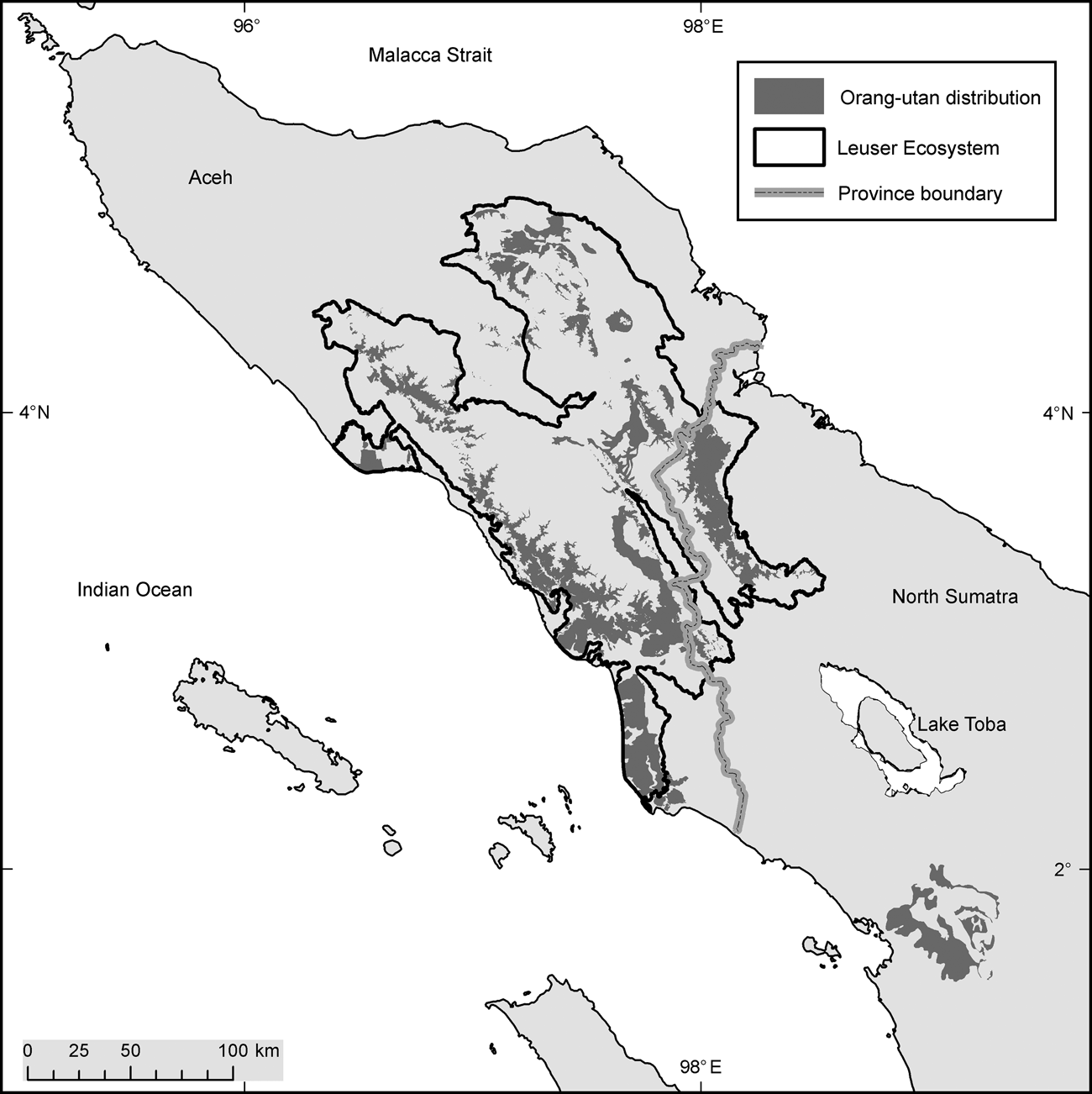
All areas in Sumatra where orang-utans occur are in the northern part of the island (Fig. 1) and we estimate the population is c. 6,624 (Tables 1–2). This is a sharp reduction from the previous estimate of 7,501 orang-utans (Singleton et al., Reference Singleton, Wich, Husson, Stephens, Utami-Atmoko and Leighton2004). This reduction is mainly because an 8-week survey in 2007 in the northern part of Aceh (Ulu Masen and surrounding regions) revealed virtually no orang-utans in an area that had been thought to contain c. 800 (Wich, Reference Wich2007). Subsequently the number of orang-utans that were previously estimated to occur in this area were subtracted from the original total estimate of 7,501 orang-utans (Singleton et al., Reference Singleton, Wich, Husson, Stephens, Utami-Atmoko and Leighton2004). Of the remaining populations on Sumatra only three contain > 1,000 individuals and an additional three contain 1,000 > 250 individuals, which is considered the size of a viable population (Marshall et al., in press). The Leuser Ecosystem (Fig. 1) is clearly the stronghold for the Sumatran orang-utan, with c. 91% of all Sumatran orang-utans occurring within its boundaries. Most of this area consists of high mountains, and orang-utans primarily exist around the periphery where they depend on the remaining lowlands. It is in these lowlands that the three largest (> 1,000 individuals) Sumatran orang-utan populations occur (Table 1). Outside the Leuser Ecosystem the most important orang-utan population occurs in what is referred to as the Batang Toru area south of Lake Toba.
Distribution of the Sumatran orang-utan P. abelii. The original version of this map was produced by the Sumatran Orang-utan Conservation Programme and the Leuser Management Unit and has been updated based on 2007 survey work in Aceh Province by Fauna & Flora International in collaboration with the Great Ape Trust.
Estimated numbers of P. abelii on Sumatra (Fig. 1) and P. p. pygmaeus, P. p. wurmii and P. p. morio on Borneo (Fig. 2) by habitat unit, and the area of suitable remaining orang-utan habitat within each such unit (and also, for Sumatra only, by habitat block within each unit).

1 The subspecific status of this population is unknown, it could be either P. p. pygmaeus or P. p. wurmbii.
2 Confidence intervals from Ancrenaz et al., Reference Ancrenaz, Gimenez, Ambu, Ancrenaz, Andau and Goossens2005
Summary of estimated population sizes of Pongo spp. in 2002 (see detailed data in Table 1), and the main threats to the four taxa.
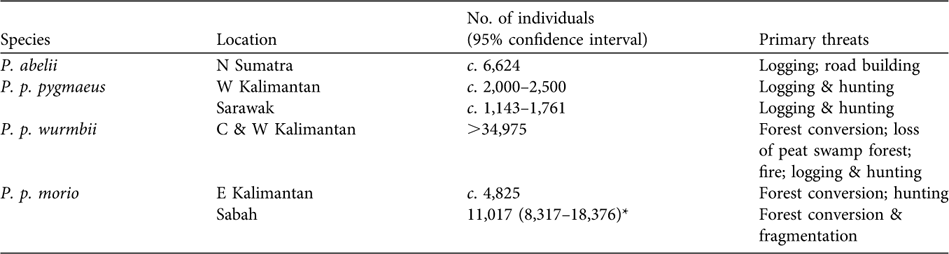
* Confidence interval from Ancrenaz et al., Reference Ancrenaz, Gimenez, Ambu, Ancrenaz, Andau and Goossens2005
Borneo
We identified 306 geographically distinct forest areas (separated from adjacent areas by rivers or cleared land > 1 km wide) on Borneo in which we expect orang-utans to occur. Our data indicate that the total P. pygmaeus population is at least 54,000, in three subspecies, with 44 populations containing > 100 animals (Tables 1–2; data for the East Kalimantan and Sabah populations of P. p. morio are presented separately because these populations may need to be classified as distinct subspecies; Meijaard & Groves, unpubl. data). The actual total, including all the small populations with < 100 individuals will be considerably higher.
P. p. pygmaeus (Fig. 2) is the most severely threatened subspecies, with a total of only 3,000–4,500 individuals in north-west Borneo, including Sarawak (Fig. 2). The Lanjak Entimau and Betung Kerihun protected areas are the most important and contain populations of > 1,000 individuals (Table 1). There are only two other areas that contain > 250 orang-utans (Ancrenaz, Reference Ancrenaz2007).
P. p. wurmbii is the most numerous subspecies, with an estimated total of > 34,975 individuals. Most of these occur in the province of Central Kalimantan, in 10 populations of > 1,000 individuals and seven of > 250 individuals (Table 1). This subspecies is also represented by the largest populations, such as those in Sebangau, Tanjung Puting, and the Arut-Belantikan area (Fig. 2), which all support > 6,000 individuals (Table 1).
Distribution of the three Bornean subspecies of orang-utan (P. pygmaeus pygmaeus, P. p. wurmbii and P. p. morio).

P. p. morio (Fig. 2) survives in several smaller populations in the province of East Kalimantan (c. 4,800), and in larger numbers in the Malaysian state of Sabah (c. 11,000). In addition, preliminary survey work in the heavily degraded forests around the Kutai National Park has revealed that large numbers (≥ 2,500) of orang-utans may survive there but more information is needed before these findings can be included in the density estimate for this subspecies. The East Kalimantan and Sabah populations of P. p. morio may be distinct taxa (Meijaard & Groves, unpubl. data), in which case the former would be severely threatened, with c. 4,800 animals remaining in several geographically distinct populations (Table 1, Fig. 2). In East Kalimantan only the Kelai and adjacent Telen/Wahau watershed areas contain > 1,000 individuals and, in addition, there are only three areas with populations > 250 individuals. In Sabah there are four areas with > 1,000 orang-utans and an additional three with > 250. By far the largest of these is the Segama population, with 4,584 orang-utans.
Population trends
Because estimates of orang-utan density based on a standardized methodology have become available only recently (van Schaik et al., Reference van Schaik, Priatna, Priatna, Nadler, Galdikas, Sheeran and Rosen1995) it is not possible to assess accurately the long-term decline of orang-utans for any of the areas where they occur. Genetic studies, however, indicate that orang-utans in certain areas are in serious decline (Goossens et al., Reference Goossens, Chikhi, Ancrenaz, Lackman-Ancrenaz, Andau and Bruford2006) and this is likely to be similar for many areas where they occur. Nevertheless, forest loss can be used as an indication of orang-utan decline. Assumptions associated with this method are (1) we know whether or not the forests that have been lost contained orang-utans, and (2) non-forest vegetation does not offer habitat for viable orang-utan populations. Such an approach can only be used for areas that have been surveyed since the early 1990s, when systematic surveys were first used to determine the presence and density of orang-utans in forest blocks throughout their range. Before that time orang-utan distribution was not known in sufficient detail and therefore fails to fulfil the first assumption. The second assumption does not always hold as orang-utans have been found in degraded areas (Marshall et al., Reference Marshall, Nardiyono, Engström, Pamungkas, Palapa, Meijaard and Stanley2006). In addition, the degree of forest loss is not known for all areas and our results in this respect should therefore be considered cautiously. In Kalimantan our results indicate that during 1992–2002 the total area of habitat for P. pygmaeus decreased from c. 141,500 to c. 85,835 km2, i.e. a 39% decline. The decrease is not all caused by habitat loss. Several areas, including the upper Melawi watershed in West Kalimantan, and the Mueller and Schwaner Ranges that were partly included by Rijksen & Meijaard (Reference Rijksen and Meijaard1999) in their orang-utan distribution maps, are now thought not to contain breeding populations of orang-utans, although the occasional orang-utan may travel through. The total area thus taken out of the 1999 range is c. 15,000 km2, suggesting that the actual decrease in habitat is c. 40,665 km2, i.e. 28% over 10 years, or 2.8% annually. For Sumatra, annual forest loss over 1985–2001 has been 1–1.5% annually in most orang-utan habitat (Singleton et al., Reference Singleton, Wich, Husson, Stephens, Utami-Atmoko and Leighton2004). We were unable to obtain data on forest loss for Sarawak but it has been estimated that coverage of primary forest in Sabah has decreased from 2.8 million to c. 0.3 million ha (a decrease of 89.3%) over 1975–1995 (Mannan & Awang, Reference Mannan and Awang1997).
Although the rate of forest loss in some areas remains high, in other areas the loss is slowing down. For instance, in recent years forest loss in the Leuser Ecosystem in Sumatra decreased to 0.6% annually (based on SPOT imagery analysis since 1990: M. Griffiths, pers. comm.) and in East Kalimantan it has dropped from 2% (Fuller et al., Reference Fuller, Jessup and Salim2004) to 0.6% annually in areas where several important orang-utan populations occur (Meijaard & Wich, Reference Meijaard and Wich2007).
Discussion
The data presented here highlight several important issues for orang-utan conservation. Firstly, the number of surviving orang-utans is much lower on Sumatra than on Borneo. There are only three populations on Sumatra with > 1,000 orang-utans, whereas on Borneo there are 17. Analyses have indicated that 250 individuals is the minimum number for a viable population (Singleton et al., Reference Singleton, Wich, Husson, Stephens, Utami-Atmoko and Leighton2004; Marshall et al., in press) and there are only six such populations on Sumatra and 32 on Borneo. Secondly, the total estimate for Borneo is considerably higher than previously reported (Rijksen & Meijaard, Reference Rijksen and Meijaard1999). This is mainly because the earlier estimates were based on limited surveys and incomplete information. The data reported here cover several previously unsurveyed areas, such as Arut Belantikan (Fig. 2), and contain more detailed information from surveys for several other areas. It is important to emphasize that the previous estimates should have been higher, and that our data do not indicate that the reduction of Bornean orang-utans has been less severe or that the population has increased. Forest loss was high during the 20th century and consequently the number of orang-utans that lost their habitat and subsequently died must also have been high. It is also important to note that our current orang-utan estimates are mostly based on forest maps from 2002, which are now 6 years old, and thus our estimates are probably too high for some areas. As a result of the political situation in Aceh Province (northern Sumatra) there has been hardly any reduction in forest cover during 2000–2006 (Gaveau et al., Reference Gaveau, Epting, Adnan, Kumara, Suyikno and Sumantri2007; Meijaard & Wich, Reference Meijaard and Wich2007). The areas where orang-utans were previously surveyed are therefore still largely intact and it is likely that the estimate for Sumatra is accurate. A recent Borneo-wide analysis of forest cover change showed that during 2002–2005 annual forest loss was 1.7%. Most of this loss occurs in lowland forest where the majority of orang-utans occur. Based on our own observations this trend has continued during 2005–2007, and it is thus reasonable to assume that orang-utan habitat has been lost during 2002–2008 at an annual rate of c. 1.7%. This suggests that we may have overestimated the Borneo population by c. 10%.
Another fact highlighted by the collation of all available data is that c. 75% of all orang-utans occur outside national parks (Meijaard & Wich, Reference Meijaard and Wich2007), which have been suffering from illegal logging, mining, encroachment by palm oil plantations, and fires and have therefore been severely degraded (Nellemann et al., Reference Nellemann, Miles, Kaltenborn, Virtue and Ahlenius2007). In many cases it appears that the appropriate authorities are either unable or reluctant to implement conservation management effectively. However, despite the general lack of law enforcement, improved protected area management can be attained. Recent examples from several sites in Kalimantan show that illegal logging in protected areas can be effectively reduced, as indicated by large reductions in illegal logging in the Sungai Wain Protection Forest (G. Fredriksson, unpubl. data), Lesan and Wehea protection forests and the Sumalindo Lestari Jaya Unit IV timber concession (EM, unpubl. data), and Gunung Palung and Sebangau National Parks (AJM & SH, pers. obs.). Key reasons for success in Sungai Wain, Gunung Palung and Sebangau were political and financial support, media attention, and efforts by conservationists. Political and financial support mostly came from the Indonesian Government and/or international agencies although, in general, the lack of political will and financial support for conservation management by the Indonesian Government remains a concern (Rijksen & Meijaard, Reference Rijksen and Meijaard1999; Robertson & van Schaik, Reference Robertson and van Schaik2001). Anti-logging measures included eviction of illegal settlers, closure of timber transportation routes, and legally endorsed insertion of metal spikes in all commercial timber trees. In addition, in some cases the operations of community-based forest protection units have been an effective system to protect orang-utan habitat and to combat illegal hunting or trade of the species (authors, pers. obs.).
The case of Sungai Wain may be special because it is a small area that may not be representative of the complexities of conserving much larger areas. Nevertheless, we believe lessons can be learned from such small-scale conservation projects that may be applicable to larger areas. On Sumatra most orang-utans occur in the province of Nanggroe Aceh Darussalam, both in and outside National Parks. The recent temporary moratorium on logging, put in place by the first democratically elected Acehnese Governor, is a sign that forest conservation is now on the political agenda.
In non-protected areas similar threats occur but at least on Borneo there may be opportunities to develop reduced impact logging systems that may enable orang-utans to survive in such areas. Because many orang-utans occur in forests legally exploited for timber (> 75% in Kalimantan; > 60% in Sabah) there is a need to develop forestry management practices that reduce impacts on orang-utan populations. Both orang-utan species suffer temporary density declines following reduced impact logging, P. abelii more so than P. pygmaeus (Rijksen, Reference Rijksen1974; Felton et al., Reference Felton, Engstrom, Felton and Knott2003; Morrogh-Bernard et al., Reference Morrogh-Bernard, Husson, Page and Rieley2003; Johnson et al., Reference Johnson, Knott, Pamungkas, Pasaribu and Marshall2005; van Schaik et al., Reference van Schaik, Wich, Utami and Odom2005; Marshall et al., Reference Marshall, Nardiyono, Engström, Pamungkas, Palapa, Meijaard and Stanley2006) but recover to pre-logging densities if forests are allowed to regenerate (Knop et al., Reference Knop, Ward and Wich2004). Recovery is helped by retaining soft-pulp fruit bearing trees and climbers, and strictly enforcing anti-poaching laws (Rijksen & Meijaard, Reference Rijksen and Meijaard1999; Robertson & van Schaik, Reference Robertson and van Schaik2001). In Sabah the Deramakot Forest Reserve, using sustainable forestry practices, harbours higher orang-utan densities than areas under traditional (i.e. more destructive) forestry practices (Ancrenaz et al., Reference Ancrenaz, Gimenez, Ambu, Ancrenaz, Andau and Goossens2005). Thus, if there is a significant improvement in management, timber concessions elsewhere could make an important contribution to orang-utan conservation. On Sumatra orang-utans seem to cope less well with logging and more research is needed to determine whether any level of extraction is compatible with orang-utan conservation. For orang-utans, as for chimpanzees Pan troglodytes and gorillas Gorilla gorilla in West Africa (Morgan & Sanz, Reference Morgan and Sanz2007), a balance between timber extraction and conservation is being sought as one option to improve conservation.
It is essential that conservation measures are taken to protect orang-utans outside national parks, and these measures will by necessity be specific to each region. In Sumatra, for example, most orang-utans occur within the boundaries of the legally protected Leuser Ecosystem, which was gazetted to protect lowland forests and incorporated the existing, mostly mountainous, Gunung Leuser National Park. Because many orang-utans occurred in the lowland forests surrounding the Gunung Leuser National Park the Leuser Ecosystem has provided formal protection to a much larger number of orang-utans (Singleton et al., Reference Singleton, Wich, Husson, Stephens, Utami-Atmoko and Leighton2004). Creating such alternatives to national parks, where more local management is involved, may create local support for conservation, which is thought to be essential for success (Ancrenaz et al., Reference Ancrenaz, Dabek and O'Neil2007). Similar efforts are now under way in large (> 1.5 million ha) multi-function landscapes in West Kalimantan (Ketapang District) and East Kalimantan (Kelai and Lesan watersheds).
Although timber extraction can in certain situations be compatible with orang-utan conservation, complete conversion of forest to plantations is generally not so. There are reports of orang-utans surviving and, in the short-term, seemingly thriving in or near monocultures of Acacia spp. (Marshall et al., Reference Marshall, Salas, Stephens, Nardiyono, Engström, Meijaard and Stanley2007; EM, pers. obs.) but generally timber and oil palm plantations appear not to provide viable orang-utan habitat. By far the greatest present threat is the impact on the forest from the expanding palm oil industry. Indonesia and Malaysia are the two largest palm oil producers, with a combined 80.5% share of global production (FAOSTAT, 2006). The rapid expansion of this industry is putting great pressure on the forest (Pin Koh & Wilcove, Reference Pin Koh and Wilcove2007). A large number of new plantations are being created in recently logged forest areas, whereas they could be established on already degraded land (Venter et al., Reference Venter, Meijaard and Wilson2007). In cases where this is not possible and plantations are created on forested land, mechanisms are required by which conservationists can advise the oil palm industry and other land developers on where to leave wildlife corridors.
In addition, much forest conversion and degradation stems from poor land-use planning. For example, in Sumatra, the controversial Ladia Galaska road project in the Leuser Ecosystem will, unless halted, fragment two of the three largest remaining orang-utan populations. The effect of this road network can be predicted from that of a similar road project, in 1982, which split the Gunung Leuser National Park. Monitoring showed that the improved access facilitated uncontrolled illegal settlements inside the Park, large-scale illegal encroachment and logging, and poaching of threatened species (Singleton et al., Reference Singleton, Wich, Husson, Stephens, Utami-Atmoko and Leighton2004). The mega rice project in Central Kalimantan, funded primarily by Indonesia's reforestation fund, eliminated c. 10,000 km2 of primary peat swamp forest and killed an estimated 15,000 orang-utans from 1996 to 1999 (EIA, 1998; Rijksen & Meijaard, Reference Rijksen and Meijaard1999). Both are examples of ill-advised projects with few benefits to local economies but major environmental costs. However, as such projects provide substantial revenue for a small group of individuals with considerable political influence, unprecedented political will is needed to prevent similar projects in the future.
Hunting of orang-utans, which is prohibited throughout their range, is potentially a major factor contributing to their decline (Marshall et al., Reference Marshall, Nardiyono, Engström, Pamungkas, Palapa, Meijaard and Stanley2006). Because orang-utan populations have such a slow growth rate they are unable to sustain substantial continued loss of individuals (Singleton et al., Reference Singleton, Wich, Husson, Stephens, Utami-Atmoko and Leighton2004; Marshall et al., in press). A decline in orang-utan populations through hunting is especially likely in areas where agriculture is encroaching into orang-utan habitat and where human-orang-utan conflicts occur, and in areas where orang-utans are hunted for food, such as logging concessions (Bennett et al., Reference Bennett, Nyaoi, Sompud, Robinson and Bennett1999, Reference Bennett, Milner-Gulland, Bakarr, Eves, Robinson and Wilkie2002). Such problems have led to a huge influx of orang-utans into rehabilitation centres, especially on Borneo.
Based on this review and our experience in Sumatra and Borneo, we make seven recommendations to reduce hunting and human-orang-utan conflict in agricultural areas (cf. Yuwono et al., Reference Yuwono, Susanto, Saleh, Andayani, Prasetyo and Utami Atmoko2007) and for orang-utan conservation in general: (1) Effective law enforcement and prosecution is needed to stop hunting of orang-utans for food and trade. (2) Mechanisms need to be developed to mitigate and reduce human-orang-utan conflict in agricultural areas, including large-scale plantations (cf. Yuwono et al., Reference Yuwono, Susanto, Saleh, Andayani, Prasetyo and Utami Atmoko2007). (3) Audits are required to assess the compliance of forestry concessions to their legal obligation to ensure orang-utans are not hunted in concession areas. (4) Increased environmental awareness is needed at a local level (several NGOs, such as the Sumatran Orang-utan Conservation Program and Kinabatangan Orang-utan Conservation Project, are promoting awareness of the conservation of forests and their biodiversity). (5) Mechanisms for monitoring orang-utan populations and forest cover need to be developed (implementation of such monitoring is beginning on both Sumatra and Borneo, and there are initiatives under way to guide such monitoring for great apes in general; A.P.E.S. Database, 2008). (6) Surveys in less-explored regions such as Sarawak need to be continued. (7) Improved survey methodology is required and nest decay rate needs to be determined for more sites as it can vary substantially (Mathewson et al., Reference Mathewson, Spehar, Meijaard, Nardiyono and Sasmirul2008; Husson et al., in press).
All efforts to monitor orang-utans will, however, be to no avail unless the decline in numbers is halted, and this requires a change in political will (Rijksen & Meijaard, Reference Rijksen and Meijaard1999). The Indonesian President recently launched the Indonesian National Orang-utan Conservation Action Plan. This was prepared by the Ministry of Forestry, with contributions from several of the authors of this article, and for which the orang-utan numbers presented here were used (Soehartono et al., Reference Soehartono, Djoko Susilo, Andayani, Utami Atmoko, Sihite, Saleh and Sutrisno2007). Another sign of changing political will and action is the current moratorium on logging in Aceh Province, where by far the largest number of Sumatran orang-utans occur. Here and in other areas new incentives for forest protection could be tested, e.g. payments for environmental services such as water, carbon sequestration and avoided deforestation (Stern, Reference Stern2007; Wunder, Reference Wunder2007). In combination with the above mentioned recommendations these may improve forest and orang-utan protection. However, it is essential that funding for environmental services reaches the local level and that there is strong law enforcement. Developing a mechanism to ensure these occur is the challenge for the conservation of orang-utans.
Acknowledgements
We gratefully acknowledge the co-operation and support of the Indonesian Institute of Science, Jakarta, the Indonesian Nature Conservation Service, Jakarta (and at the various local offices involved). In addition, SAW thanks the Fauna & Flora International Aceh programme for which the recent surveys in Aceh were conducted. We thank the Conservation Breeding Specialist Group for organizing the 2004 workshop, and the Gibbon Foundation for funding it. Thanks to the Unit Management Leuser for providing LANDSAT images, Nick Jewell for digitizing the Sumatran vegetation maps, and Doug Fuller for providing the MODIS images.
Biographical sketches
The 16 authors represent a wide range of disciplines related to the conservation of the various orang-utan taxa, including behavioural ecology, ecology, remote sensing, geographical information systems, conservation science and population modelling. The 2004 orang-utan workshop in Jakarta, from which this article developed, provided the opportunity for us to share information so that we could compile the most up-to-date and accurate data on the distribution and density of both Sumatran and Bornean orang-utans. Such an integrative approach is essential to assess the conservation status of the various taxa, model future scenarios, and develop appropriate and realistic conservation strategies.



