

During climate change negotiations at the Twenty-eighth Conference of Parties (COP), in December 2023, the United Arab Emirates (UAE), then presiding over the negotiations, claimed that there was “no science” behind the prominent demand to phase out fossil fuels as part of a push to keep the rise in global average temperature below 1.5 °C. The UAE was able to claim this, in part, by leaning on the latest report from the Intergovernmental Panel on Climate Change (IPCC), the international body charged with communicating the scientific consensus on climate change. The part of the report that deals with mitigation mentions fossil fuel phase-outs only once, in passing.Footnote 1 As a spokesperson for the COP later said, the UAE was simply “quoting the science.”Footnote 2
It is not an accident that the IPCC report did not emphasize the need to phase out fossil fuels. While prominent climate scientists write the IPCC’s reports, governments review and comment on drafts, and they have the final say on approving the Summary for Policymakers. During the approval process for the IPCC’s Sixth Assessment Report, fossil-fuel-producing countries successfully lobbied to remove references to the need to phase out fossil fuels.Footnote 3
While states often politicize science in the international climate change regime, we know little about the conditions under which they do so. Specifically, when do countries agree or disagree over interpretations of climate science? If scientists signal greater certainty in their findings, are states less likely to argue over the science? And what function do ostensible information providers like the IPCC serve in international cooperation if states can influence the reports they publish?
I argue that the IPCC serves as a venue for states to negotiate a shared understanding of the scientific basis of a collective problem—in this case, climate change. In these negotiations, states’ disagreements will reflect their attempts to alter the understanding of climate change in ways that strengthen their bargaining position in climate change negotiations. Thus the reports that result from this process are summaries of the scientific consensus but also international political agreements.
From this argument, I derive and test two hypotheses. First, the politicization of science reflects two prominent dimensions of disagreement in climate change negotiations. On one dimension, countries that differ in their degree of responsibility for climate change will offer different interpretations of the science. All else equal, countries with greater aggregate greenhouse gas (GHG) emissions will prefer weaker science, since this implies weaker agreements with lower aggregate mitigation burdens. On the other dimension, there will be conflict between large emitters over how to distribute the burden of climate change mitigation. This reflects a broader ideological divide between countries over support for a US-led liberal international order.Footnote 4 This conflict will show up in disagreement over particularistic interpretations of science that single out subgroups of emitters as particularly affected by (or particularly responsible for) climate change.
Second, I hypothesize that which one of these two divides predominates is mediated by scientific uncertainty. Relatively uncertain science will allow room for both weaker and stronger interpretations, increasing conflict between countries based on their degree of responsibility for climate change. But highly certain science leaves little room for such differences in interpretation. On the other hand, highly certain science may increase conflict between countries at different ends of the ideological divide, who will argue over interpretations that have particularistic and distributional consequences.
To test these hypotheses, I collect new data on the approval process for the IPCC’s Fifth and Sixth Assessment Reports. In the final stage of this process, states negotiate with IPCC scientists and each other in plenary sessions to formulate a mutually agreeable summary of the science behind climate change. I quantify inter-state agreement or disagreement over individual statements in the summary reports of the IPCC Assessment Report and use this as my primary dependent variable.
Using these data, I estimate an ideal-point model that scales countries along a common spatial dimension based on their pattern of supporting or opposing the IPCC’s draft interpretations of climate science. I find that the predominant cleavage is distributional, dividing large polluters who sit at opposite ends of a broader ideological spectrum regarding a US-led international order. In other words, conflict among large polluters is more common than conflict between large polluters and vulnerable countries. I interpret this as states being more likely to argue over scientific statements if they have distributional disagreements over how to share the burden of climate mitigation.
Why does this distributional conflict predominate, despite theoretical expectations that both these divides should feature at the IPCC? In line with my second hypothesis, I argue that distributional conflict predominates because climate science has grown highly certain over the past thirty years. This makes it harder to insert doubt into the science and thus leaves little room for conflict between large and small polluters. Testing this more systematically, I find evidence that conflict based on ideology is much less common with respect to statements where there is still scientific uncertainty. While only suggestive, this result is consistent with the hypothesis that uncertainty allows greater room for agreement between large polluters who are ideologically opposed.
These results suggest that climate science gets politicized by activating distributional conflict between states. Moreover, contrary to the literature on epistemic communities, gains in scientific certainty do not necessarily translate into less politicization.Footnote 5 Instead, greater scientific certainty may change the nature of this politicization by sharpening distributional conflict between states.
By shedding light on an under-studied international organization, these findings add to our understanding of the functional role of international institutions in global governance. The IPCC has no enforcement power, and the heavy government involvement in its reports suggests that its role is not purely to provide information; thus its role in global climate governance is not clear. I show that, in part, it serves as a bargaining forum where states attempt to establish a common understanding of science for climate negotiations.
The next section frames the theoretical issues at stake and provides background information on the IPCC.
The Politicization of Science in the Climate Change Regime
Knowledge of the state of the world is central to international cooperation. States often delegate the job of knowledge provision to international organizations, NGOs, and domestic bureaucracies.Footnote 6 These organizations are thought to influence international politics through their privileged access to expertise.Footnote 7
Yet science and expertise are often politicized in international regimes, from monetary relations to regulatory cooperation to global public health.Footnote 8 States, firms, and other political actors expend resources trying to influence interpretations of science in favor of their interests. When and how does science become politicized during political bargaining between states? And what role does scientific uncertainty play in this process?
I consider these questions in the context of the climate change regime. Cooperation on climate change requires coordination not just on policies such as emissions reductions but also on a shared understanding of the complex physical and social phenomena that govern climate change. The attempts by political actors such as states to politicize climate science make it an ideal case to study the politicization of science.
Defining Politicization I define politicization as the process by which competing political actors or groups push competing interpretations of a scientific idea or finding. I assume that scientific findings must be interpreted and translated to be politically relevant. For example, a scientific estimate of equilibrium climate sensitivity—the degree of warming that results from doubling GHG emissions—by itself has no political content. However, greater climate sensitivity implies more significant reductions in emissions to keep the temperature increase below a certain target, and this makes the interpretation of the science politically relevant. This is how science can become politicized.
Two Forms of Political Conflict in the Climate Change Regime
To understand politicization, it helps first to consider two prominent political cleavages in the climate change regime and how they may be instantiated in conflict over interpretations of climate science.Footnote 9
First, climate change negotiations clearly divide countries by their degree of responsibility for climate change. This connects with conflict over the “polluter pays” principle, by which states that bear the most responsibility for anthropogenic climate change should pay most of the cost of mitigation and adaptation. At one end of this divide sit large GHG emitters such as the United States and China; at the other end are countries with little responsibility for, but high vulnerability to, damages from unchecked climate change, such as Bangladesh and Tuvalu.Footnote 10
Since climate change is a problem of global public goods provision,Footnote 11 this divide looms large in climate change politics. Indeed, research on climate change negotiations has found it to be an important determinant of states’ negotiating positions.Footnote 12 On scientific issues, large polluters are most likely to prefer interpretations that de-emphasize the seriousness of climate change, underestimate the scale of costs from unchecked climate change, and highlight the costliness of mitigation measures. On the other hand, countries with relatively small GHG emissions and high ecological vulnerability may invoke the precautionary principle, by which scientific uncertainty should not impede remedial action.
Second, there may be conflict between large polluters over how to distribute the mitigation burden. This distributional divide pits old industrializers, such as the UK and the US, against new industrializers such as China, India, and Brazil. New industrializers often argue that climate mitigation is a burden that should be apportioned according to countries’ historical and cumulative emissions levels rather than their current emissions.Footnote 13 Older industrializers like the US and the UK point to the faster emissions growth of emerging economies and their often larger total emissions. This debate often gets framed in ideological terms related to fairness and equity and tends to sort countries based on their support for a US-led multilateral world order.Footnote 14
When arguing over scientific questions, countries ideologically opposed to a US-led order may lobby for the inclusion of language and findings that point to old industrializers as the originators of the problem of climate change. They may also lobby for more emphasis on research pointing to the disproportionate share of climate change impacts borne by poorer countries. Countries at the US end of the spectrum, on the other hand, may prefer highlighting that emerging economies are responsible for most of the present GHG emissions, singling out countries such as China and India.
Scientific Uncertainty and Politicization
How should we expect uncertainty in science to affect its politicization along these two dimensions? I argue that the effect depends on the nature of the conflict between states. I assume that more uncertainty in science allows a larger set of interpretations that matter for policy. For example, uncertainty as to the exact amount of climate sensitivity creates room for a wide range of implied mitigation burdens.
This has two effects. First, in line with the conventional wisdom, greater uncertainty should create more conflict between countries based on their degree of responsibility for climate change. Climate-vulnerable countries will prefer interpretations that emphasize higher climate sensitivity, hoping this will lead to deep reductions in emissions, in line with the precautionary principle. Large polluters, who prefer lower mitigation burdens, will prefer interpretations that highlight the uncertainty of findings on climate sensitivity.
Indeed, this is the expectation expressed in much of the literature. As Sarewitz has argued, uncertainty in science can amplify political disagreement by providing competing parties with rhetorical ammunition to further their own interests.Footnote 15 Similarly, the epistemic-communities perspective argues that an uncoordinated scientific community rife with disagreement and uncertainty would undermine the influence of science on policy, enabling political conflict between states over interpretations of science.Footnote 16
Scientific uncertainty can also increase conflict by incentivizing large polluters to emphasize that uncertainty to undermine the case for stringent action. As a large literature shows in the case of climate science, emphasizing uncertainty in public and elite science communication can undermine popular support for policy action.Footnote 17 Indeed, this is why firms and other political actors facing stringent regulation have emphasized uncertainty in public campaigns that aim to undermine the scientific basis for policy action in cases as varied as public health regulation and climate change.Footnote 18
However, uncertainty can also foster unexpected alliances by reducing conflict between large polluters. States that share an interest in lower aggregate burdens but disagree on the distribution of that burden can find common ground in weaker interpretations of science, which uncertainty allows. Large polluters such as China and the US, who might sit at opposite ends of a broader ideological divide, have an incentive to work together to weaken the scientific basis for action. This shared incentive to weaken science and emphasize uncertainty may allow these states to put aside disagreements about how to distribute the burden of mitigation, enhancing the potential for greater cooperation.
For example, we might expect less conflict in this group over language that calls out developing countries for their CO
 $${_2}$$
-intensive growth trajectories. Conceptually, uncertainty has a pacifying effect because it creates a new dimension over which states can negotiate. When science is certain, the only dimension along which states can bargain is distributional and particularistic (for example, whether to emphasize historical responsibility versus the emissions intensity of growth trajectories). With uncertainty, states can compromise on distributional interpretations and agree to emphasize uncertainty itself.Footnote
19
$${_2}$$
-intensive growth trajectories. Conceptually, uncertainty has a pacifying effect because it creates a new dimension over which states can negotiate. When science is certain, the only dimension along which states can bargain is distributional and particularistic (for example, whether to emphasize historical responsibility versus the emissions intensity of growth trajectories). With uncertainty, states can compromise on distributional interpretations and agree to emphasize uncertainty itself.Footnote
19
On the other hand, when science is certain, this opportunity for large polluters to compromise on distributional and particularistic issues diminishes—it is much harder to collectively push for inserting doubt. Moreover, since certain science has more public credibility, differing particularistic framings may have greater distributional consequences than relatively uncertain science. We would therefore expect more conflict among large polluters over relatively certain science.
To sum up, uncertainty in science creates room for doubt and competing interpretations. I hypothesize that this creates disagreement between states that are large polluters and those that are not. By the same token, uncertainty should also create greater agreement among large polluters, who now share an interest in undermining the scientific basis for action on climate change.
Setting: The Intergovernmental Panel on Climate Change
I test these hypotheses in the context of the IPCC, which is the international body in charge of communicating the global scientific consensus on climate change.
At first glance, the IPCC is a typical example of states delegating information provision to an international organization. States negotiating climate agreements need to know the latest scientific information regarding the degree and severity of climate change, its human and ecological costs, and the efficacy of various mitigation methods. The IPCC aids states by creating assessment reports that are supposed to provide a comprehensive but approachable overview of the state of climate science.Footnote 20 These reports have consistently been cited as the main source summarizing the global consensus on climate change. In fact, IPCC reports over the years track the formation of a strong scientific consensus on the anthropogenic nature of climate change. Figure 1 shows the evolution of this consensus by tracking comparable statements in assessment reports from 1990 to 2021. These statements all concern a critical scientific question: Is human activity causing a greenhouse effect that is warming the atmosphere? In 1990, the answer was seen as uncertain; but by 2021, it was “unequivocal.”
The IPCC’s increasing certainty about human-caused climate change
Notes: Underlying statements are from the Summaries for Policymakers of the IPCC’s Assessment Reports (Intergovernmental Panel on Climate Change n.d.). Quotes based on Hsiang and Kopp Reference Hsiang and Kopp2018, extended to the Sixth Assessment Report, released in 2021.

The assessment reports are widely cited and often the basis of national and subnational climate change policy.Footnote 21 They are also mentioned widely in news reports and academic papers on climate change.Footnote 22 And they form the basis of political negotiations over international climate change agreements at the UN Framework Convention on Climate Change.
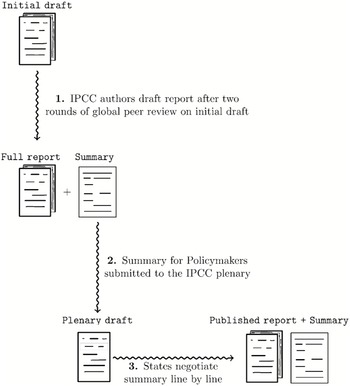
The process of producing the assessment reports belies the IPCC’s image as an information provider because it allows member governments significant involvement. Governments review and comment on drafts of the report and must reach a consensus on its Summary for Policymakers during IPCC plenary negotiations (Figure 2).Footnote 23
The IPCC’s assessment process

The IPCC’s official goal is to “provide governments at all levels with scientific information that they can use to develop climate policies.” But thanks to their involvement in the drafting process, national governments already know the contents of each report before its final version is published.Footnote 24 As Voeten states, institutions like the IPCC “matter not so much because they have expertise that states do not have. After all, many of the panel members are state employees and the knowledge is often in the public domain. However, the organization matters in that it restricts the supply of expert advice by offering a focal understanding of expertise.”Footnote 25
What role does the IPCC play in the international climate regime if it allows states such influence? I argue that the IPCC serves as a forum for states to negotiate a common understanding of the state of the world. As Allan emphasizes, the political priorities of governments have always shaped scientific understandings of climate change.Footnote 26 That is, science is politicized at the IPCC by design, allowing states to coordinate over a common understanding of the state of the world before bargaining over the rules of an international agreement. Other work on the IPCC has highlighted its politicized nature, particularly the role of richer states who bear the greatest responsibility for climate change. As Bayer and Crippa show, domestic economic interests, particularly rents from fossil fuels, drive participation at the IPCC in both the commenting stage and the plenary negotiations.Footnote 27 This concern for both particularistic and shared national interests has been part of the IPCC’s assessment process since its inception.Footnote 28
Observable Implications
What coalitions form to politicize science at the IPCC, and how does scientific uncertainty mediate this process? First, I hypothesize that states’ preferences over interpretations of science will reflect the two political divides that matter in climate change negotiations: overall responsibility for climate change and distributional conflict. Second, uncertainty in science should mediate which coalitions form. Specifically, distributional conflict between ideologically opposed countries will predominate on certain science, while conflict between countries with different levels of emissions will predominate on uncertain science.
H1: Coalitions at the IPCC will reflect two dimensions of conflict: differences in countries’ responsibility for climate change; and disagreement over the distribution of the mitigation burden between large polluters.
H2: Distributional conflict between large polluters will be more likely on relatively certain science, while conflict between countries with different levels of current emissions will be more likely on relatively uncertain science.
We now turn to the data and empirical strategy I use to test these hypotheses.
Data
Dependent Variable: Governments’ Agreement on Climate Science
To measure a government’s preferences over the interpretation of climate science, I use new data from the final negotiation stage of the IPCC’s assessment process. As we saw in Figure 2, the IPCC periodically produces its flagship assessment reports using a two-step “global peer review” process. In the first step, the IPCC produces drafts of the report’s chapters, which get edited as thousands of comments are received from non-IPCC climate experts and member governments. In the second step, the IPCC produces a Summary for Policymakers (SPM), which is then negotiated line by line by member governments in a plenary session.
I focus on the SPMs rather than the underlying report for two reasons. First, the most intense bargaining at the IPCC occurs over the wording of the SPMs. Second, governments’ intense attention to the SPM suggests that it is the most important part of the report for policymaking. While scholarship on the use of the IPCC is sparse, existing work suggests that media coverageFootnote 29 and negotiated climate change agreementsFootnote 30 typically cite language from the SPMs rather than the underlying report.
Sample. I collect data from plenary sessions for six IPCC reports spanning two assessment cycles: the Fifth Assessment Report in 2013–14 and the Sixth Assessment Report in 2021–23. Figure 3 shows the reports included in the analysis and the year of the IPCC negotiation session that approved the report. For each assessment cycle, the sample includes negotiations for the three working group reports dealing with physical science, adaptation, and mitigation, respectively. Each assessment report also includes a synthesis report that ties together findings from the three working group reports. I exclude negotiations over the synthesis reports since they repeat statements from the earlier working groups.
IPCC reports included in the analysis, with year of negotiation

Extracting state–scientist interactions. I link scientific statements in each report’s SPM to plenary negotiations over that statement, found in meeting summaries in the Earth Negotiations Bulletin.Footnote 31 Figure 4 shows an example of a draft scientific statement from the SPM of the IPCC’s Working Group 3 report from the Fifth Assessment Report. India and Saudi Arabia proposed an intervention, which New Zealand, the UK, Canada, and Ireland opposed.Footnote 32 For each such intervention, I record the intervening countries as opposing the current wording and the opposing countries as supporting the status quo wording.
How the Earth Negotiations Bulletin records state–scientist interactions

Using these data, I construct two measures of countries’ preferences over the interpretations of scientific consensus. First, I create a country-statement-level measure that I then use to estimate an ideal-point model. Second, I create a dyadic measure that records agreement between two countries on a given statement.
Ideal-Point Measure
To quantify a country’s preferences over the interpretation of climate science, I estimate an ideal-point model with a three-point ordinal outcome: intervene, oppose, or abstain.
I assume that the draft wording of a statement and a country’s preferences over that wording are in a common latent ideological space. A country will intervene or support an intervention on a statement if its ideal point is far from that statement and oppose an intervention if its ideal point is very close to that statement. As is common in the literature on ideal points in international relations,Footnote 33 I take abstention or nonparticipation to be an intermediate outcome that indicates that a country’s ideal point is an intermediate distance from the statement.Footnote 34 I estimate countries’ ideal points using a Bayesian model in stan, as described further in Section B of the appendix.
The estimated ideal points from the model measure expressed preferences as revealed by participation in the IPCC rather than “true” underlying preferences. Countries with moderate ideal points will be those that do not intervene in plenaries as forcefully on either side. This could be because they have moderate preferences, but is more likely because of a lack of capacity in their delegations. Despite this indeterminacy, we can learn about the revealed or expressed preferences of these countries. This might be more informative if we are interested in actually instantiated politicization of science rather than what politicization would look like if all countries had the capacity to participate.
Dyadic-agreement measure
Second, I create an undirected dyadic-agreement variable to capture the degree to which two countries supported or opposed each other on a given statement. I define the agreement measure between countries
 $$i$$
and
$$i$$
and
 $$j$$
on statement
$$j$$
on statement
 $$k$$
as
$$k$$
as

Since the set of possible dyads is large, any given dyad will not interact on most statements. I therefore scale this measure to lie between –100 and 100 to make downstream regression results more interpretable. I subset to countries with at least two instances of participation in the sample and to dyads with at least one interaction. This leaves me with 86 countries forming 3,655 dyads. In total, I have 574 statements spanning the six summary reports. The agreement measure has a mean of 0.07 and standard deviation of 4.3.Footnote 35
Independent Variables
Differences in responsibility for climate change
I measure a country’s current responsibility for climate change using its total emissions of GHGs in kilotons of CO
 $${_2}$$
equivalent in 2013 from the World Bank. For analyses where the unit of observation is the dyad-statement, I create a dyadic-difference version of this variable defined as the standard deviations (
$${_2}$$
equivalent in 2013 from the World Bank. For analyses where the unit of observation is the dyad-statement, I create a dyadic-difference version of this variable defined as the standard deviations (
 $$\sigma $$
) by which the two countries’ GHG emissions differ:
$$\sigma $$
) by which the two countries’ GHG emissions differ:

Distributional conflict
The second dimension of conflict I measure is over how to distribute the burden of climate change mitigation. This is an ideological divide that captures many factors, such as a country’s current level of development, colonial history, historical responsibility for climate change, and position in the international system (for example, as a rising power or a threatened hegemon).
The multidimensional nature of the divide makes measurement challenging. I use a country’s estimated ideal point at the UN General Assembly, as estimated by Bailey, Strezhnev, and Voeten, as a parsimonious measure of this cleavage.Footnote 36 Widely used by political scientists, it captures in a single dimension a country’s ideological position on the US-led world order. I average a country’s UN ideal point from 2007 to 2013 and use it in country-level regressions as a measure of the distributional divide. In dyadic regressions, as before, I construct a dyadic measure of two countries’ divergence along this divide:

This measures the standard deviations by which two countries’ UN ideal points diverge.
Scientific uncertainty
I measure scientific uncertainty at the statement level using the standardized measure the IPCC uses. The IPCC assigns a level of uncertainty to almost all of its statements, using one of two criteria.Footnote 37 If quantitative statements of likelihood are possible, it uses one of seven levels of confidence, from “virtually certain” (99–100%) to “exceptionally unlikely” (0–1%). If only qualitative statements of uncertainty are possible, it uses one of five levels, from “very high confidence” to “very low confidence.” For each statement, I assign a numerical value to the level of uncertainty, with higher values indicating greater uncertainty. Table 1 shows my mapping from the IPCC’s qualitative levels of confidence to numerical values.
Quantified measure of statement-level uncertainty

If a statement has multiple uncertainty levels, I average them to come up with a statement-level measure. Section A.5 of the appendix shows the distribution of this measure by working group and assessment cycle.
Dyadic controls
Dyadic controls include the logged value of trade between dyad members,Footnote 38 logged inter-capital distance,Footnote 39 and indicators for shared language, shared colonial legacy, common official language, shared land border, and mutual membership in a military alliance.Footnote 40
Results
Distributional Conflict Between Polluters Predominates in Ideal Points
This section presents the country-level ideal points estimated following the methodology outlined earlier. Figure 5 presents the ideal points ordered by value. The color of the points corresponds to their UN ideal points, and their size corresponds to their total GHG emissions.
Estimated IPCC ideal points
Notes: The figure plots the means of the posterior distribution of country ideal points, with 95% credible intervals in gray. Note that the ideal points for Germany and Saudi Arabia are fixed at 1 and –1, respectively.

This figure suggests that the predominant cleavage at the IPCC is not between large polluters and vulnerable countries but between large polluters who differ in their broader ideological position in international politics. At one extreme of the distribution, with high ideal points, are old industrializers such as the US, while at the other end are emerging economies such as India that are also large GHG emitters. Smaller countries that lack capacity to intervene are clustered in the middle with moderate estimated positions. The predominant cleavage, therefore, seems to be a distributional one.
More formally, Table 2 presents the results from regressing the country-level ideal points on predictors representing the two divides outlined in the theory. Both predictors are standardized so that their coefficients are interpretable as the effect of a one-standard-deviation change. Column 1 shows a strong positive relationship between UN ideal points and IPCC ideal points. Column 2 shows a negative association between a country’s total GHG emissions in 2013 and its IPCC ideal point, though the coefficient is noisy and fails to reach conventional levels of significance. Column 3 shows that the two predictors are jointly significant.Footnote 41
UN ideal points and emissions intensity predict IPCC ideal points

Notes: The table shows the result of an OLS regression of the estimated IPCC ideal point on standardized versions of two variables: a country’s UN ideal point (averaged over 2008 to 2013) and its total GHG emissions in 2013. *p < .10; **p < .05; ***p < .01; heteroskedasticity-robust standard errors in parentheses.
While these estimated coefficients provide evidence that the two divides matter at the IPCC, they are difficult to interpret from the coefficients in Table 2. To understand which of these two matters more, I estimate a partial
 $${R^2}$$
that captures the degree of variation in IPCC ideal points explained by the covariates. UN ideal points explain 48 percent, while a country’s emissions intensity explains only 13 percent.
$${R^2}$$
that captures the degree of variation in IPCC ideal points explained by the covariates. UN ideal points explain 48 percent, while a country’s emissions intensity explains only 13 percent.
Why is the predominant cleavage at the IPCC distributional and broadly ideological? The theoretical argument presented previously predicts that such disagreement will be more likely on relatively certain science. This suggests that the IPCC’s Fifth and Sixth Assessment Reports have reached a level of certainty where large polluters find it harder to jointly cast doubt on the reality or severity of climate change. On the other hand, certain science may raise the stakes at climate change negotiations, creating divisions between the group of large polluters on particularistic language and interpretations that reduce their burden of mitigation.
The next section tests whether the residual uncertainty that remains in IPCC reports reduces distributional conflict.
Less Distributional Disagreement over Uncertain Science
This section tests the hypothesis that on relatively uncertain statements, distributional conflict will be less likely, while conflict between vulnerable countries and large emitters will be more likely.
Since this is an explicitly dyadic hypothesis, I use a dyad-statement-level analysis, with a dyad’s agreement on a statement as the outcome.Footnote 42 Specifically, I regress an (undirected) dyad-agreement score on its UN ideal-point difference and its total emissions difference, as described previously. I then interact these measures of dyadic preference divergence with a statement’s uncertainty score.
Table 3 shows the results. Column 1 shows the results of a regression including only a dyad’s divergence in terms of UN ideal points and emissions. The coefficients on both are negative, although only the coefficient on the UN ideal-points difference is statistically significant. This accords with the ideal-points results presented earlier, suggesting that distributional conflict (such as between China and the US) is more prevalent than conflict between polluters and countries with relatively few emissions (such as China and Tuvalu). Substantively, countries whose UN ideal points are one standard deviation apart have an agreement score 0.21 units lower than similar countries that have the same UN ideal point.
Ideologically divergent dyads less likely to conflict over uncertain statements

Notes: The table shows the results of a dyad-statement level regression of the dyadic-agreement measure on the dyad’s divergence in UN ideal points and total emissions, as well as the uncertainty in the statement. *p < .10; **p < .05; ***p < .01; clustered (statement & dyad) standard errors in parentheses.
Columns 2 through 4 progressively add a statement’s uncertainty as a variable and as an interaction term, along with dyadic controls. The estimated coefficient on the interaction term between the UN ideal-point difference and a statement’s uncertainty is negative and statistically significant at the 5 percent level. Substantively, compared to a statement with no uncertainty (“virtually certain” or “very high confidence”), a statement with the greatest uncertainty (“low confidence” or “very low confidence”) reduces the effect of the UN ideal-point difference by 0.09 units. These results suggest that scientific uncertainty has a “pacifying effect” on conflict between large polluters.Footnote 43
How large is this pacifying effect? To make the estimated coefficients more interpretable, Figure 6 plots the predicted values of agreement
 $${{\rm}_{ijk}}$$
for dyads based on both their predicted divergence in UN ideal points and the uncertainty of a statement. Other covariates are held at their average levels.
$${{\rm}_{ijk}}$$
for dyads based on both their predicted divergence in UN ideal points and the uncertainty of a statement. Other covariates are held at their average levels.
Predicted agreement by divergence in UN ideal points and statement uncertainty
Notes: This figure plots predicted values, from the model estimated in Table 3, of the agreement variable as a function of a dyad’s divergence in UN ideal points and a statement’s uncertainty level. Predicted values are computed using the marginaleffects package, keeping the values of other covariates at their mean level (see Arel-Bundock, Greifer, and Heiss Reference Arel-Bundock, Greifer and Heiss2024).

At the highest level of UN ideal-point difference (where two countries’ ideal points differ by five standard deviations), a highly uncertain statement has an agreement score 0.37 units higher than one that is highly certain, though this difference is noisy. While this is small relative to the total scale of agreement
 $${{\rm}_{ijk}}$$
, it is large relative to the agreement level for the average dyad-statement, which is 0.069.
$${{\rm}_{ijk}}$$
, it is large relative to the agreement level for the average dyad-statement, which is 0.069.
To put this into perspective, out of 574 statements, the US and Saudi Arabia agreed on fourteen and disagreed on twenty-two, making their average agreement score –1.4. An agreement score that is 0.37 units higher for this dyad would be consistent with their agreeing on two more statements that they did not interact on, or not interacting on two of the statements that they disagreed on.Footnote 44
At first glance, the US and Saudi Arabia disagreeing on two fewer statements might not seem like a big difference. But it is roughly equivalent to the difference in predicted agreement rate of the US–Saudi Arabia dyad versus the US–Japan dyad. Japan and Saudi Arabia sit very far from each other in terms of their overall IPCC ideal points (Figure 5). To the extent that the difference between Saudi Arabia and Japan in behavior toward the US is significant, the effect of uncertainty is substantively large.
Nevertheless, as mentioned, the effect of uncertainty here is identified from the residual uncertainty that remains as of the Fifth and Sixth Assessment Reports. As hypothesized earlier, this small uncertainty might not have much of an effect on agreement between countries.Footnote 45
Why does uncertainty reduce disagreement between dyads with distributional disagreements but have no detectable effect for dyads with different emissions levels? As the first column of Table 3 shows, a dyad’s difference in total emissions does not, on average, predict its level of disagreement, irrespective of the statement’s uncertainty. This accords with the earlier finding that countries’ emissions levels explain only a small portion of the variation in IPCC ideal points. If this axis of disagreement is not very prevalent in the first place, any effect of uncertainty will be difficult to detect statistically.
In sum, I find mixed evidence for H1 and H2. The theory expected politicization to be split: distributional conflict would predominate on relatively certain science, while conflict between countries with different current GHG emissions would predominate on uncertain science. Empirically, however, distributional conflict by far predominates at the IPCC. I hypothesized that this might be because, as of 2014 (the publication of the Fifth Assessment Report), the science underlying IPCC reports has grown highly certain, making it difficult for large polluters to jointly cast doubt on the severity of climate change. Still, the theory predicts that distributional conflict is less likely on issues where residual uncertainty remains, and this is borne out by the data.Footnote 46 To illustrate this mechanism further, Section C.2 of the appendix presents some examples from the IPCC negotiations that bolster the argument that uncertainty mediates the type of conflict that arises over climate science.
Conclusion
Government involvement in the work of scientists in international organizations raises concerns about the politicization of expertise. At the IPCC, this takes the form of concern that large polluters are weakening science at the expense of climate-vulnerable countries. Here I have provided a theoretical framework that defines politicization as competing political groups championing opposing interpretations of science. Using new data and methods applied to government interventions at the IPCC, I have shown that the vast majority of political contention over science occurs not between large polluters and vulnerable countries but between large polluters at different levels of development. This distributional conflict occurs not over preferences for weaker versus stronger science but over particularistic interpretations of science that reflect an ideological divide common in other areas of international politics.
I also provide evidence that the predominance of ideological and distributional conflict may result from climate science having grown highly certain over the last thirty years. Highly certain science leaves less room for conflict between large polluters and less vulnerable countries. On the other hand, it reorients conflict toward particularistic and distributionally salient features of interpretations of science, creating conflict between countries at opposite ends of the ideological divide. Testing this hypothesis, I find that distributional conflict is indeed less likely over statements where residual scientific uncertainty remains.
While these findings suggest that uncertainty can forge unexpected alliances between countries, this does not imply that greater uncertainty will lead to normatively better cooperative outcomes. A weak IPCC report may serve as the basis for a multilateral agreement with a large set of participants, but such an agreement may be weaker than is needed to prevent catastrophic climate change. The Paris Accord, for example, aspires to temperature goals with questionable scientific bases and yet brings together a large set of countries that typically find cooperation over climate change difficult.Footnote 47 However, the agreement itself is weak, with voluntary commitments and no formal sanctions for noncooperation. While the uncertainty in the science may have aided cooperation, the ultimate outcome is not necessarily better than one that would have been achieved under greater scientific certainty.
Another implication of these results is that greater certainty in science does not necessarily lead to less political disagreement over science but may change the nature of these disagreements. While scientific uncertainty may support disagreement between political actors preferring weaker and stronger versions of science, scientific certainty can shift the focus of political contention to particularistic features of scientific interpretations, such as whether certain framings of scientific consensus single out certain groups of countries. This is a cautionary note regarding optimistic expectations that politics and policy will catch up to science as science approaches certainty.
Overall, these findings point to a need to broaden our understanding of the role of information production in international relations. While much past work has taken information and knowledge to be exogenous parameters that structure cooperation, this paper joins a burgeoning literature on how information may be endogenous to the interests of powerful actors.
Data Availability Statement
Replication files for this research note may be found at <https://doi.org/10.7910/DVN/OYXFOE>.
Supplementary Material
Supplementary material for this research note is available at <https://doi.org/10.1017/S0020818325000062>.
Acknowledgments
I am indebted to Judy Goldstein, Avi Acharya, and Mike Tomz for encouragement and support in pursuing this project. The paper benefited from feedback from Natalya Adam-Rahman, Feyaad Allie, Fiona Bare, Alexander Gazmararian, Zoe Ge, Steven Han, Amanda Kennard, Sung Mi Kim, Soyoung Lee, Rachel Lienesch, Hannah Loeffler, Helen Milner, Rebecca Perlman, Ken Scheve, Theo Serlin, Denis Tchaouchev, Christina Toenshoff, Elisabeth van Lieshout, Grace Zeng, Noah Zucker, and participants at the 2021 International Political Economy Society Conference, the Stanford International Relations Workshop, and the 2024 Princeton Political Economy of Climate Change Conference.



 Open access

