




Introduction
On 13 August 1947, a letter arrived at the headquarters of the Historical Division of the US European Command in Berlin from Heinrich Amersdorffer, a painter who was active during the Nazi regime. It was addressed to former US Army Air Force Captain Gordon Gilkey:
Herr Luitpold Adam [head of the German Combat Artist Division] … informed me that the works of art of the war-painters in the former German Wehrmacht administered by him have been taken over by your office. He pointed out that you were kind enough to declare that you – on a special desire – would return the works to the painters. … I would be very much obliged to you if I could also get these works back. May I draw your attention especially to the fact that I never received any compensation for these works[?]Footnote 1
Amersdorffer’s petition was a reaction to Gilkey’s 1946 confiscation of nearly 9,000 paintings and sketches from government buildings and private artist studios in Germany and Austria deemed “militaristic” or “propagandistic” in nature, known as the “German War Art Collection.” These works of art, which had been produced by Nazi-era artists and Kriegsmaler (combat artists), sent to the front to record the war experience, were then sent to sites in the United States for safekeeping. All but 450 would be returned only in 1953, 1986, and 2005. Amersdorffer’s letter embodies questions plaguing the US army’s collection of Nazi-era artwork following the war. His plea of innocence to the crimes of Nazism complicates the question confronted by US occupying forces in 1945 of which type of art comprised “Nazi and militarist activity or propaganda,” according to the vague definitions laid out in the Yalta and Potsdam agreements.Footnote 2 Importantly, his letter concludes on a legal appeal, arguing that the United States did not in any way partake in art looting following the war: “[I’ve attached] a political certificate regarding … my proprietary rights of the works kept in the former Army Museum.”Footnote 3
Amersdorffer’s story is significant not because it was an outlier but, rather, because it was so common. Dozens of German painters were in contact with the US government following the seizure of their works in hopes of regaining custody of their paintings and sketches. The focus on Kriegsmaler is also intentional. Gilkey and his men were also in charge of excavating and collecting paintings from the private holdings of the Nazi elite; much of that artwork, comprising classicist nudes, still lifes, and landscapes that adorned the walls of Nazi dignitaries and art exhibitions, embodied stereotypical aesthetic ideals of Nazi-era art, including the conservative nineteenth-century figurative paintings favored by Adolf Hitler and the aesthetically regressive ideologue Alfred Rosenberg. The collection’s most recognizable painting – Hubert Lanzinger’s Der Bannerträger (1935) – which features the messianic figure of Hitler in a suit of armor with the Nazi flag swelling behind him, remains in the hands of the US army to this day.
Paintings of the Kriegsmaler, on the other hand, often varied in content and style, as the combat artists were allowed a relative degree of flexibility in both. These paintings and drawings challenge the persistent notion that a specific Nazi aesthetic was prescribed to artists producing works during the Nazi period. Along the lines of Gregory Maertz’s recently published tome on modernist styles on painting and sculpture produced under the patronage of the Third Reich, this article, in examining several specific works of art produced by combat artists, argues that the perceived censorship of modernist artists and artistic tendencies is actually a persistent myth. Instead, the notion of Nazi-era art as monolithic or retrogressive in style has been exaggerated since the 1930s.Footnote 4 Maertz’s understanding of Gilkey, however, frames the American as a man with a “personal appetite for retribution” during his assignment in Germany, determined to rectify the wrongs done to the international art world by the Germans.Footnote 5 However, the interactions that Gilkey had with combat artists during his time in Germany, and his writings from this period and later, reveal a man with a fraught, complicated relationship to both combat artists and their art, often even empathizing with both.
Drawing on letters by several Kriegsmaler, responses from the US military, and the recollections of Gilkey, this article argues that these combat artists – and their commander, Hauptmann Luitpold Adam – understood themselves as separate from other artists working in the Third Reich. It also contends that, because the US army had a large squadron of combat artists of their own during the war, groundwork was laid for a certain degree of ambivalence – even empathy and recognition – toward their works’ purpose and potential historical legacy by not only Gilkey but also other Army officers and even political actors as well. The article begins by tracing the story of these paintings and drawings from their production to their seizure in postwar American-occupied Germany under Gilkey’s German war art program, an offshoot of the Historical Properties Division of the US army. The nebulousness of the orders leading to the seizure of the paintings is highlighted, an imprecision that led to confusion amongst the Kriegsmaler and legal problems that the US army worked for years to subvert. The final section examines the internment of the artworks in Washington, DC, arguing that the postwar US policy toward West Germany and its cultural properties may have initially incorporated art looting. On a broader level, the US army both influenced and mitigated the process of “struggling to cope with the past” through its treatment of the German War Art Collection, suggesting that the historical trajectory of the artworks was a mirror for the United States’s own fears and desires regarding the relationship between West Germany’s past and the United States’s present.Footnote 6
Luitpold Adam and the war art program in Nazi Germany
In 1942, the High Command of the Wehrmacht founded the Squadron of Visual Artists (Staffel der bildenden Künstler Propaganda Abteilung [SdbK]). The tradition of combat art went back to World War I in Germany; in his official war art report, Gilkey noted that German soldiers produced combat art for the Nazi regime prior to the war’s beginning, with artist soldiers using military subjects from World War I and exhibiting or selling their works to Nazi dignitaries.Footnote 7 With the invasion of Poland in 1939, the number of combat artists swelled; though they were not yet officially part of their own unit, artists often tagged along as “war correspondents” with magazines and newspapers. Gilkey even claimed that artists occasionally “cooked up” images from the comfort of their own ateliers to illustrate the war effort, a practice that Adam later hoped to eliminate with the SdbK. According to Gilkey, war art from 1939 to 1941 was “over the top” and meant to galvanize the viewing public and glorify the war effort. Gilkey implied that this situation changed at least marginally under Adam after 1942.Footnote 8 US forces had shared this tradition of combat art (since 1917), though the program during World War II was largest and best developed in Germany.Footnote 9 The army’s familiarity with the program and goals of combat art programs certainly contributed to the high level of interest in – and respect for – the German War Art Collection following its seizure.
The man appointed head of the SdbK, Luitpold Adam, had served as a Kriegsmaler during the previous war.Footnote 10 In June 1941, Adam was assigned to the Propaganda Center in Potsdam, where he oversaw the output of the group of “War Painters and Newspaper Artists.”Footnote 11 This group was the foundation for the SdbK. When Adam took his post in Potsdam, these artists were in dire need of equipment and space. Adam went to work, ordering the construction of an art supply depot and gathering new supplies for the artists in preparation for their deployment.Footnote 12 He also secured a “safe space” in vacated rooms of the Society of Berlin Artists, to be used as an archive and exhibition area for the paintings arriving from the front.Footnote 13 By the spring of 1942, the nascent SdbK comprised 80 combat artists, a number that would reach 300 by the war’s end, with half of them assigned to the Heer (army) and the other half to the navy and Luftwaffe. Footnote 14 Their art was exhibited throughout Germany and occupied Europe for “educational and cultural purposes.”Footnote 15 Quick sketches produced by artists were sent back and used to produce large-scale studio paintings that adorned the walls of army museums and the offices of Nazi dignitaries.Footnote 16 A purchase commission also met with Adam and some of the painters regularly and selected their favorite paintings to hang in the German army headquarters and museums. In the expected event of an Allied defeat, the works were designated to narrate the German victory, commemorative visual reminders of the Wehrmacht’s successful struggles over the Allied forces.Footnote 17
The artists were enticed not only by monetary and equipment compensation but also by the promise that they would be allowed relative freedom in the expression of their ideas.Footnote 18 Adam initially had no control over the artists’ subject matter or output, as this was left up to the leader of each individual so-called Propaganda Company (Propaganda-Kompanie [PK]), though Adam later reviewed each piece of art as it arrived in Potsdam.Footnote 19 This promise both combats the long-held idea that Nazi visual ideology was rigidly defined and controlled by the Reich Chamber of Culture (Reichskulturkammer [RKK]) and confirms newer research that characterizes the RKK as a trade union rather than an organization that inflexibly prescribed a specific aesthetic to artists. It also continues the tradition of relatively newer scholarship that challenges the conception of “Nazi artwork” as thematically and stylistically ill-defined, varied, and malleable.Footnote 20
Each PK employed one “fine artist” and two commercial artists. Because war painters sometimes found themselves in need of new subjects if their company had been stationary for a long period of time, Adam pushed for company leaders to send their war painters to the front while battles were in progress in order to record more stirring narratives.Footnote 21 Adam often fought with PK leaders on this point, as many of them preferred to keep their Kriegsmaler away from the front lines, instead “cook[ing up] pictures” removed from the scene. According to Gilkey’s recollection, Adam was ultimately successful in receiving authorization from higher command (of the Oberkommando der Wehrmacht) for an operational procedure that allowed the artists three months in the combat area to paint or draw and then required a return to Potsdam to register their watercolors or drawings, pick up supplies, and work on finishing their paintings in the studio for another three months. Like Gilkey and the Americans, Adam viewed the role of the Kriegsmaler and their immersion on the front as vital not only to history and future audiences but also to the spirit of the troops on the front lines. In his support of embedding artists on the front, Adam emphasized that the war artists were expected to visualize “not just the horrible side of war, but war’s episodical [sic] and lyrical moments.”Footnote 22 Adam’s understanding of the Kriegsmaler as combatant and artist – as someone who not only took part in and contributed to the action and war effort but also experienced and then visually rendered the war, immortalizing it for generations to come – was echoed by war artists and, ultimately, the US occupying forces.
Combat art: between realism and immortalization
A glance at the paintings and sketches produced reveals a tension felt by the Kriegsmaler between exalting the war and documenting day-to-day horrors and malaise felt by those on the front. Adam’s artists produced art with style and subject matter that both reinforces and challenges expectations often prescribed to Nazi-era art. Stylistically, the works that Gilkey encountered in 1946 ran the gamut from portraits of noble military leaders and triumphant soldiers to melancholic and abstracted images that attempted to convey both the trauma of war and a certain degree of introspection. Importantly, the works also fit into a broader canon of war art produced during the period by other combatants.Footnote 23 Specifically, the combat paintings of the German soldiers shared much with the art of its US counterparts. There is no written evidence that Luitpold Adam explicitly set rules to what the soldier artists could and could not record, and many of the works are typical by the standards of the 1930s and 1940s, as evidenced by analogous works of US combat art.
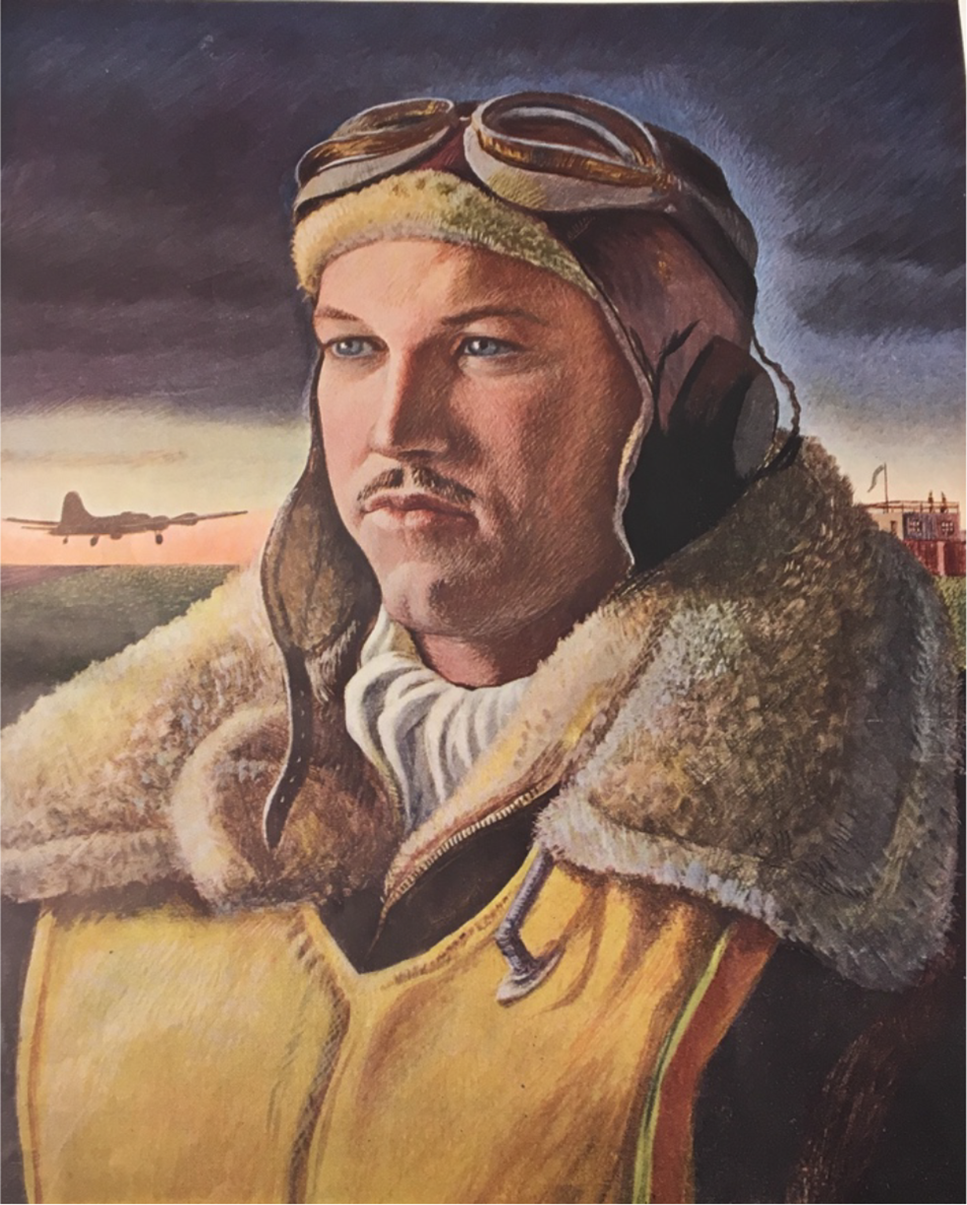
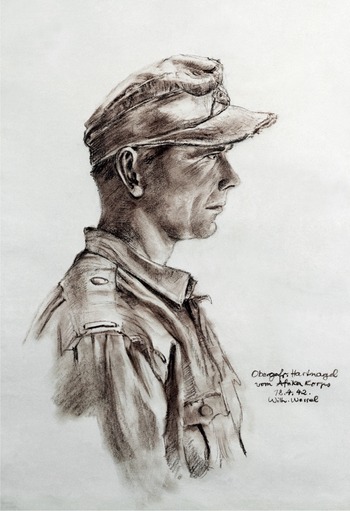
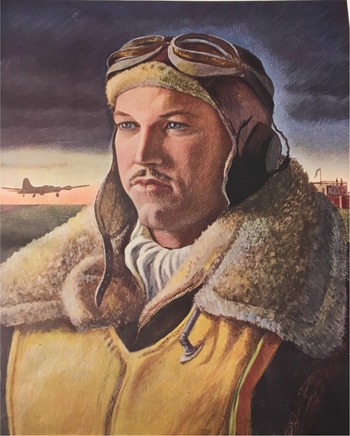
Kriegsmaler Olaf Jordan, for example, specialized in realistic and probing portraits of volunteer Cossack soldiers as well as likenesses of German army leaders, such as his portrait of Generalmajor Helmuth von Pannwitz. Wilhelm Wessel made several heroic charcoal portraits of soldiers from the Afrikakorps (Figure 1). These bear a resemblance to the gallant portraits of American combat artists like Peter Hurd, who painted the famed 8th Air Force Bomber Command (Figure 2). The stylistic similarities challenge the notion of a monolithic “Nazi art,” even among German artists, suggesting instead that the heroic realism of officer portraits was an international trend understood by artists on both sides of the Atlantic.Footnote 24 More broadly, a survey of US war art suggests that, while there may have been a slightly greater degree of variation in terms of style and subject matter within American combat art than in German war art, the variation is not striking enough to separate them into two entirely discrete art historical traditions based simply on the political situations that produced them. The fact that there existed more similarities than differences in paintings produced by a democracy and those produced under a dictatorial regime seemed to both intrigue and trouble American officers like Gilkey.
Wilhelm Wessel, Afrikakorps Trooper, charcoal, 1942 (G.P.1.8235.47, US Army Art Collection, NARA).

Peter Hurd, Portrait of Captain W.W. Foster, Navigator and Operations Officer, oil, 1943 (RG 9C1, Gallery Publications, Temporary Exhibition Catalogues, National Gallery of Art, Gallery Archives).
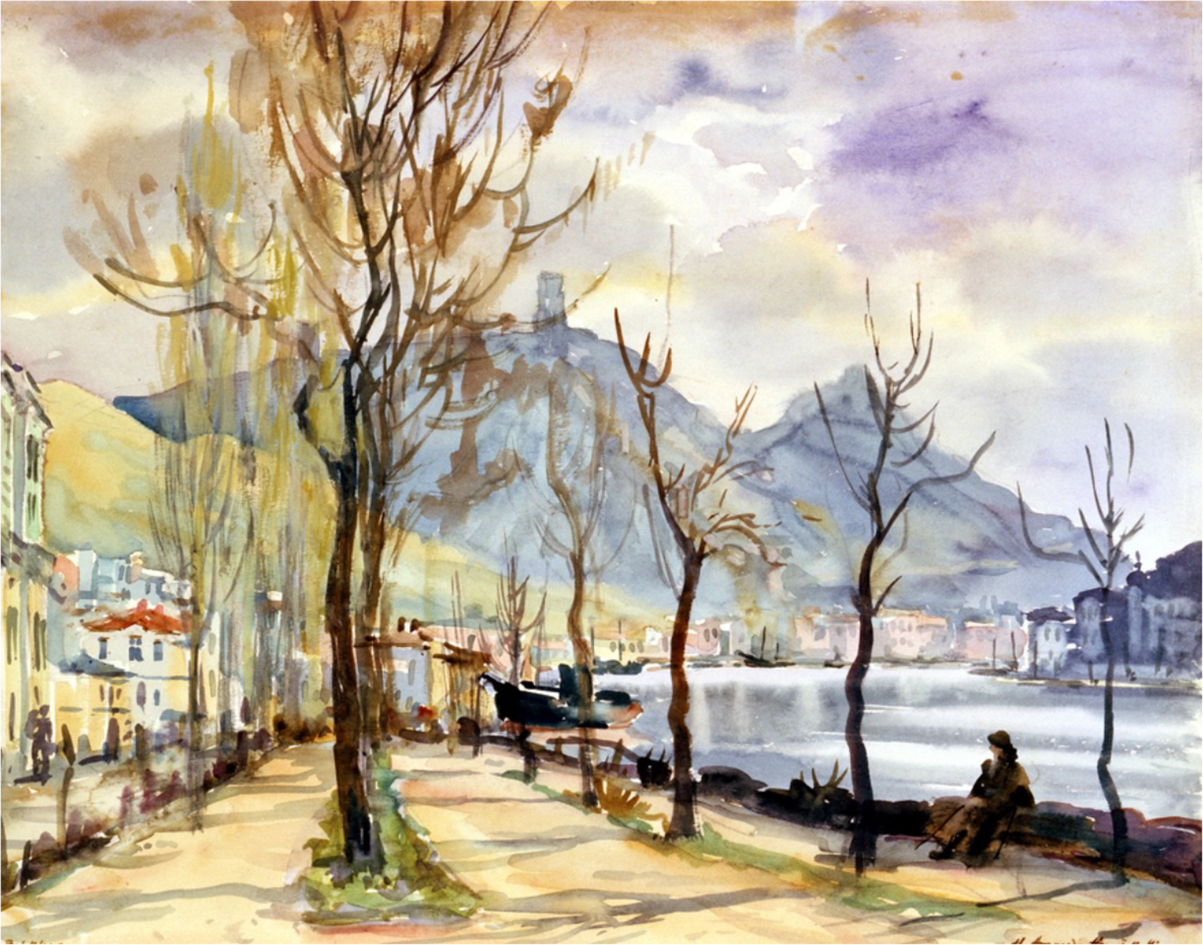
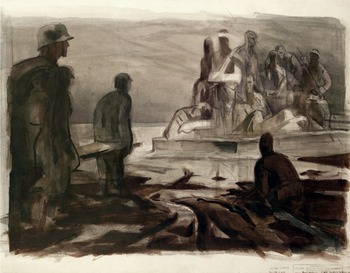
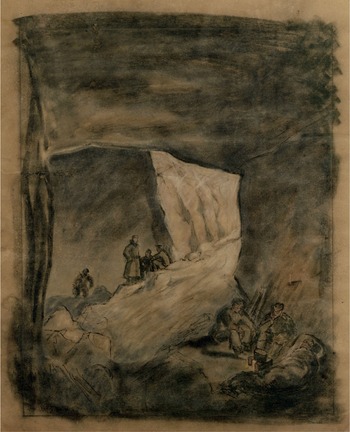
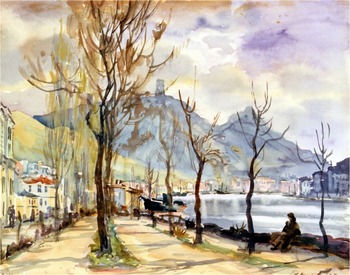
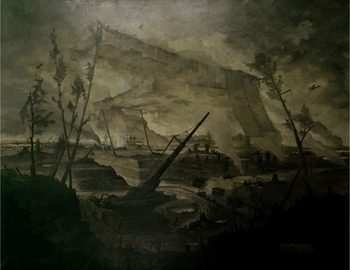
Other works, such as the melancholic watercolors of German combat artist Rudolf Hengstenberg, deviate from the figurative realism of portraiture, approximating more closely impressionistic forms also present in some US combat art (see Figure 3). Several sketches of Herbert Agricola employ near-abstracted forms to convey the smallness of German troops seeking shelter on the face of a mountain (Figure 4). Heinrich Amersdorffer specialized in picturesque landscapes and townscapes, his works unfettered by the horrors of war until one notices small details – for example, a black blot approximating a battleship – that allude quietly to the ongoing violence (Figure 5). Still others, including Bavarian artist Otto Bloß in his eerily apocalyptic Landscape of War (undated), seem to have taken inspiration from the fetid color palette of Otto Dix to render the nightmarish deathscape of war, even if the purpose of their renderings arguable diverged (Figure 6).Footnote 25
Rudolf Hengstenberg, Boatload of Wounded Soldiers, watercolor, undated (G.W.1.2748.47, US Army Art Collection, NARA).

Herbert Agricola, Bivouac Near Cliff, Italy, charcoal, undated (G.P.1.161.47, US Army Art Collection, NARA).

Heinrich Amersdorffer, Waterfront – Balaclava, Crimea, watercolor, 1942 (G.W.1.355.47, US Army Art Collection, NARA).
Otto Bloß, Landscape of War, undated (probably 1942) (G.O.2.221.50, US Army Art Collection, NARA).

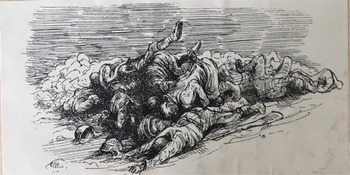
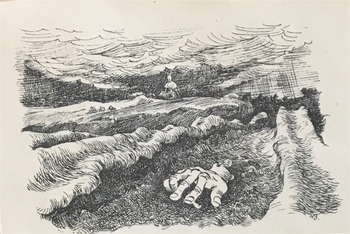
A sketchbook titled Tagebuch eines Kriegsmalers by Helmut Bibow, a combat artist on the Eastern Front in PK 693, presents grotesqueries that would not be out of place in a George Grosz exhibition: a horse, stomach bulging, dying in a trench; the metal corpse of a Panzer; a jumbled pile of Wehrmacht bodies; a disembodied hand, fingers curled unnervingly, laying in a field while storm clouds gather overhead (Figures 7–8). Admittedly, the sketchbook also contains caricatures of drunken Cossacks, sometimes contrasted with the capable bodies of Wehrmacht soldiers. Yet even the German soldiers are rendered anonymous, with interchangeable faces, swathed in darkness, suggesting the “heroic Aryan” victor did not always triumph.
Helmut Bibow, Tagebuch eines Kriegsmalers, ink, late 1941 (N591/179, Bundesarchiv-Militär Archiv).
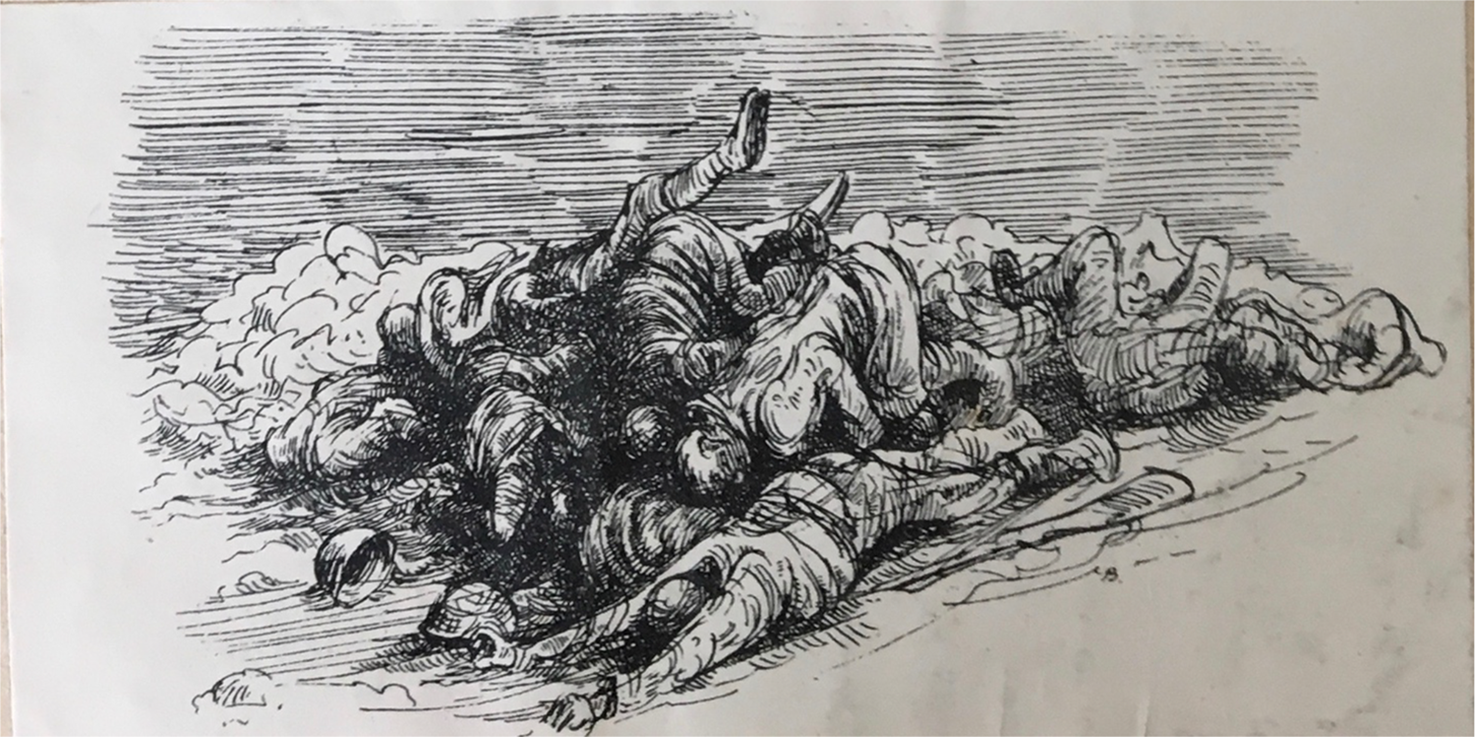
Helmut Bibow, Tagebuch eines Kriegsmalers, ink, late 1941 (N591/179, Bundesarchiv-Militär Archiv).
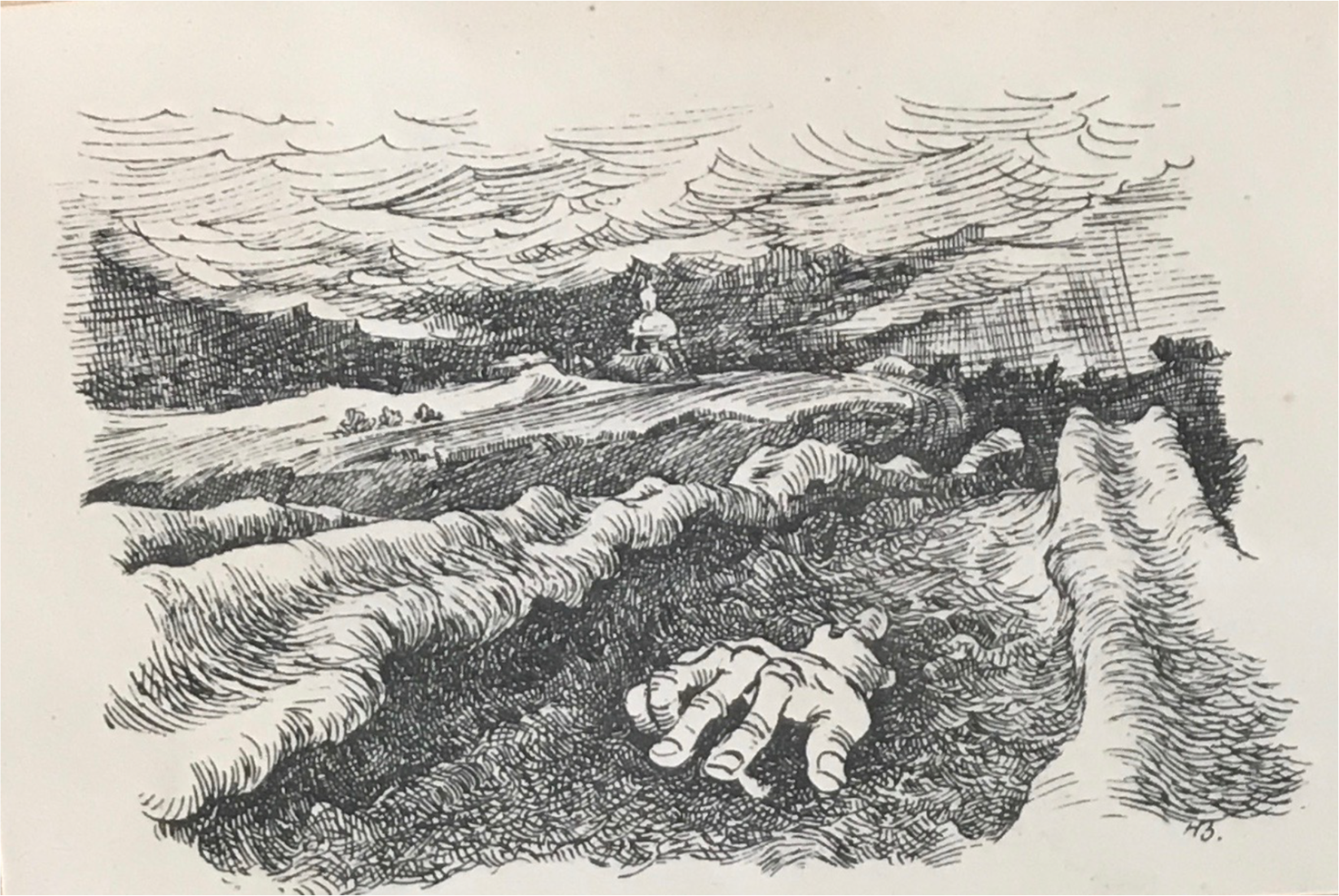
The sketchbook’s introductory dedication, penned by a Kriegsberichter named Hans Huffzky, emphasizes Adam’s idea of the war artist as a mythic figure whose task of visually rendering life in battle for posterity set him apart from war reporters and photographers:
His [the Kriegsmaler’s] studio was a meadow, his roof a tarpaulin, stretched between the trees, or simply the empty sky, his stool, a petrol canister. … We, the other members of the Propaganda Company, wrote our reports, took photographs, shot footage, broadcast – but good God, our work was missing something, which we would not have known, had our “Comrades of the Palette” not been with us. Just as they do not create their work in a fleeting instant, they also do not create their work for a fleeting instant.Footnote 26
Here, the war artist is a humble but great servant of the German war effort, at home in nature and the company of his fellow soldiers. The dedication visualizes a nazified “heroic landscape” in which the landscape – peaceful and bucolic – interacts with emblems of war or technological might.Footnote 27 Yet, again, it would be a mistake to construe this romantic understanding of the combat artist’s role as specifically “German” or of the Nazi era. US combat artists, and institutions that exhibited their work, shared this hyperbolic language lauding the importance of the war artist to the tides of history, noting that the destructive beauty of war must be immortalized.
The foreword to a 1943 show of US war artists commissioned by Life Magazine expressed: “[I]t is inescapable to military men and civilians alike that there is also in war a certain desperate beauty” and that “in these days it is not only the opportunity but the inescapable duty of the war artist to see one in terms of the other.”Footnote 28 Other exhibitions emphasized that the role of the war artist was not simply to “glorify” war but also to portray “the realism of the day.”Footnote 29 Like the Tagebuch, which celebrated the artist as an exceptional figure grounded by the raw experience of war, exhibitions of US combat artists praised “courage, skill, [and] watchfulness” as important attributes of both soldiers and artists.Footnote 30 Ultimately, in the words and images that they produced, the combat artists of the US and German battalions were more alike than different. This is perhaps another reason that Gilkey, as well as subsequent viewers and consumers of German war art, often felt a certain closeness to the art that was seized following the war – it was familiar. And if it seemed familiar, perhaps the enemy was closer than once imagined.
The confiscation of the German War Art Collection
Originally trained as a printmaker, Gordon Gilkey’s interest in the war had always focused on protecting Europe’s artistic legacy. Eventually, with pressure from Harvard art historians and the American Council of Learned Societies, President Franklin Roosevelt sanctioned the formation of the Roberts Commission, comprising officers who worked with the US army to protect specific “cultural treasures of Europe, collect information on cultural property looted by the Axis Powers, and promote its restitution.”Footnote 31 In 1945, Gilkey was deployed to the headquarters of the European theatre in Frankfurt. There exists a certain symmetry to the stories of Hauptmann Adam and this US captain in charge of the German war art program. Both were artists who understood their task – protecting the story of war as captured on canvas – as a calling of the highest importance. Both also understood the role of the combat artist as morally elevated, a calling existing, perhaps, outside of any specific political framework. Following the war, Adam expressed his desire to “[make] the artists’ intellectual and art contributions … available to the German people, who by nature are inclined to meditate on and assimilate the spiritual-cultural values of a nation.”Footnote 32 This sentiment is reflective not only of statements that Gilkey made in the years following the war but also of his interactions with some of the artists whose ateliers he visited and then raided, including Agricola, who remembered Gilkey as interested in both the subject of his war paintings and the high quality of their workmanship. These sympathies were not limited to Gilkey. Indeed, high desirability among members of the US army to “borrow” art from the German War Art Collection to adorn office walls, the army’s willingness to loan out works to military museums, and later, specific political figures’ investment in returning paintings to their original creators in Germany indicate a level of admiration for the artwork that is not inconsequential.
As part of his assignment to lead the German war art program, Gilkey was put into contact with the headquarters’ Allied Restitution Missions and assigned the specific task of finding, collecting, and then transporting objects “dealing with Nazi propaganda.”Footnote 33 Of specific interest to Gilkey were the paintings of the Kriegsmaler, which he believed were “of more historic significance.”Footnote 34 Precisely to whom their work was of higher value, Gilkey never specified; his personal correspondence with several of these artists through the decades suggests that Gilkey regarded them as distinct from court painters like Adolf Ziegler or portraitist Fritz Erler, whose work he denigrated as “a summer re-run of German art of the 19th century.”Footnote 35 This suggests he viewed some of the combat art as somehow less artificial and more truthful, a shared account of universal realities of war.
Gilkey’s orders to collect works of visual art related to “Nazi propaganda” had their roots at Yalta, where Allied leaders called for the removal of all “Nazi and militaristic influences from public office and from the cultural and economic life of the German people,” an order echoed by the Potsdam Agreement later that summer, which was codified in Control Council Directive no. 30 the following year.Footnote 36 Gilkey emphasized that, with the accords, the Allies were “united in declaring German militarism and Nazism would be destroyed and that such references would be removed from the cultural life of the German people.”Footnote 37 While hidden Nazi-looted masterpieces were the priority of the officers of the US Monuments, Fine Arts and Archives (MFA&A),Footnote 38 heaps of art seen as propagandistic or militaristic in nature remained hidden away by Nazi leadership for Gilkey’s crew to find and mine.Footnote 39 By the last weeks of the war, more than 800 art repositories, from Keller to Schlösser, had been reported.Footnote 40 Gilkey’s investigation began with his acquisition of every exhibition catalogue of the Haus der deutschen Kunst’s Great German Art Exhibitions between 1937 and 1944 as well as catalogues of traveling exhibitions of war art and popular art magazines. Importantly, Gilkey also used the last known addresses of artists registered as Kriegsmaler to track down those remaining in the US zone of occupation. It was through these lists that Gilkey met some of the artists in person, including Amersdorffer and Agricola, who were by then living quietly outside of Munich. During these visits, Gilkey both raided private ateliers and established personal contact with some of the war artists. According to the recollection of some artists, he was apparently unable or unwilling to keep the art seizures strictly professional, often complimenting the high quality of the works and promising to return the paintings as soon as possible.Footnote 41
These lists led Gilkey to Luitpold Adam, who had escaped Berlin during the last months of the war, hoping to preserve not only his life but also the legacy of the works created by his squadron of artists. When Gilkey tracked Adam and his wife down in the Bavarian village of Frauenau, the former head of the SdbK guided him to a cache of paintings at Schloss Oberfrauenau as well as a sizable stash in a woodcutter’s mountaintop hut straddling the German-Czech border.Footnote 42 According to Gilkey, Adam willingly helped him pack the artwork, realizing that “my arrival saved the total collection from destruction via the mice or the moisture.”Footnote 43 Though he might have embellished the German captain’s graciousness, it is clear that Gilkey understood their goals as similar: two army men and art lovers who viewed art as a mode of communicating with future generations, trying to save paintings from disintegrating into the dustbin of history.
Gilkey and his team classified 8,722 paintings and drawings as “Nazistic” or “militaristic” in theme. According to his official record, had these works remained in Germany, they would “have been a potential threat to the world through [their] future reinstallation and German misuse,” a claim that corroborated an initial goal of denazifying the area through obliteration of visual remnants of the Third Reich.Footnote 44 Despite his task to collect and confiscate the paintings, or perhaps because of it, Gilkey felt empathy for the Kriegsmaler as soldiers, artists, and keepers of history, not necessarily enemy combatants. His emotional response to the skill and plight of German combat artists is evidenced in both his words and his continued correspondence with many of them in the decades following the war. Yet this empathy was tempered by an ambivalence, at least in the two years after the war, to other characterizations of the artwork by Gilkey as “monument[s] of German baseness.” There is no clear answer for Gilkey’s conflicting narratives about the art that he collected and confiscated, though it might be interpreted as a tension between his human and artistic desire to empathize with “the other” and his role as a military man during and immediately after the war for whom “the other” was prescribed as the enemy.Footnote 45
Gilkey’s fascination with the paintings also manifested in a 1946 exhibition in the basement of Frankfurt’s Städel Museum, open to US military personnel and any “interested Germans.”Footnote 46 Gilkey selected a “representative” group of 103 paintings, toeing the line between celebrating the spoils of war and a genuine respect for the paintings of the Kriegsmaler. “Very few” Germans showed up, but the exhibition did attract 1,500 US military personnel. All of the paintings and prints were sent to Washington, DC, three months later. There, several works ended up adorning the office walls of high-ranking military officers, blurring the line between an understanding of the paintings as war trophies, incendiary tools capable of reigniting the spirit of Nazism, artistic documents, and soldiers’ records of the universal experience of wartime.Footnote 47
Kriegsmaler and confiscations post-1946
Gilkey made a moral demarcation between three categories of artwork: those that “[showed] the Nazi emblem, [and] Nazi military victories attained through inhumanity towards individuals,” the nudes and landscapes in the Haus der deutschen Kunst (which he did not see as politically meaningful), and the visual records left by Kriegsmaler. Yet he did not make the distinction between the former and latter group until after he had completed his confiscations, and his art raids cast a wide net, often ensnaring combat artists who felt that their works were far from propagandistic. And sometimes the law was on their side.
Heinrich Amersdorffer’s case, and the confusion about whether works of art seized by American forces during and following the war were US property or stolen property of the artists, was just one of several that emerged in the years following Gilkey’s raids. Herbert Agricola also took up correspondence with the Office of Military Government, United States (OMGUS) after the war to retrieve his paintings. Agricola was not as well known as Amersdorffer, though his paintings from the front in Russia, Yugoslavia, and Italy were exhibited at several smaller German museums as “Wehrmacht property.”Footnote 48 According to Agricola, his paintings were “an artistic standpoint in contrary [sic] to Goebbels’s Nazi propaganda art” and not intended to invoke “a new German heroism, as these pictures showed our desperate situation as well as destroyed landscapes.”Footnote 49 Furthermore, Amersdorffer pointed out in his letter to Gilkey that Agricola seemed surprised that a “considerable number” of his artworks had not been returned, despite Gilkey’s promise to do just that:
One day I came in touch with Captain Gilkey. … He asked me to give him 5 or 10 paintings. … I [wanted] to do him a favor and offered him all my works for this purpose. He was very friendly to me and promised to return all paintings … as soon as possible. Some day[s] later in my absence from home, CIC [Counterintelligence Corps] personnel checked my rooms for war pictures and confiscated them by order of the Munich Collecting Point. … All my requests not to confiscate them were in vain.Footnote 50
Gilkey never left a list of the exact paintings he and his men seized from Agricola during their art raids with the MFA&A officers working at the Munich Central Collecting Point (CCP), so the exact artworks in US custody were unknown. Furthermore, as Jonathan Petropoulos has pointed out, art was not always treated with care at the CCP and was, indeed, destroyed by some officers of the MFA&A (Gilkey excluded). Lane Faison, a professor of art history at Williams College, who became the director of the CCP in Munich between 1949 and 1951, and Theodore Heinrich, cultural affairs adviser in the office of the High Commissioner on Germany, oversaw the immolation of some art – up to 500 objects – in both Munich and Wiesbaden that was seen as “explicitly” National Socialistic in theme as well as art created by Nazi leaders such as Alfred Rosenberg and Julius Streicher.Footnote 51 The decision by US occupying forces to destroy art by burning it is of note (and one that Faison later regretted, according to Petropoulos) considering the Nazis’ propensity for burning not only books but also modern artwork. However, the choice was never explicitly called into question as violating the 1907 Hague Convention.Footnote 52
Agricola’s complaints made their way to H. Stewart Leonard, chief of the MFA&A in Bavaria. However, after noting that more than 100 watercolors had been returned to Agricola in 1947, that there was no documentation of his remaining artworks at the CCP in Munich, and that Gilkey was never officially part of the MFA&A while carrying out his confiscations, the MFA&A determined that they bore no responsibility.Footnote 53 Agricola appealed the decision in 1949, writing to the head of the OMGUS in Bavaria and again characterizing his paintings as “stolen,” pleading that “the character of all my lost works has nothing to do with militarism nor Nazi-propaganda.”Footnote 54 His initial appeals were denied, though Gilkey struck up correspondence with him in the 1970s and recalled conversations that he and another officer had about several of Agricola’s paintings, claiming to have had the “highest regard for your artistry.”Footnote 55 Gilkey assured Agricola that “it has never been the policy of the U.S. to destroy great or lesser works of art” and that, if any of Agricola’s art had been destroyed, it was merely a consequence of the war.Footnote 56 By 1988, ostensibly with Gilkey’s assistance, Agricola informed Gilkey that his war paintings had been returned after filing a claim at a Bavarian court, and he repeated his claim that his art was not purposefully or inherently political: “I think you know, I was never a militaristic or political fan [sic] … [and] my endeavors, to become [a] war painter were obvious: I did not kill ore [sic] hurt anybody, and I came fairly through [sic]. This is quite a lot!”Footnote 57
Another Kriegsmaler, Olaf Jordan, saw his paintings reproduced in a 1950 issue of Life Magazine and sent an emotional appeal to the Department of the Army, upset by his characterization as a “Nazi” by the periodical:
I wish to point out that the discovery of some of my works in Life Magazine was more painful to me than happy when reading the text below them: “War Through Nazi Eyes,” which I must feel as a bitter injustice to me. I was never a member of the Nazi Party, but the fact that I preferred, during the Nazi war, to paint than to shoot … or to be shot myself cannot be put up as a blame to me.Footnote 58
Like Agricola’s letter, Jordan vehemently distanced himself from ties to Nazism through his role as a combat artist and the art itself, arguing that his art was somehow separate from the crimes committed by the Nazi Party, an understandable position to take, whether consciously or subconsciously, in the postwar period. Gilkey eventually learned of Jordan’s plea and helped arrange an art exhibition at Carnegie-Mellon of his paintings. Jordan’s appeals for his paintings’ return were denied in the following decades by various army personnel, who maintained that the paintings were the property of the Wehrmacht during the war and, thus, “legitimate war booty.”Footnote 59 Jordan died before his exhibition opened, and any of his works were returned. The fate of Amersdorffer’s paintings followed the same path: in the 1970s, the army responded to his pleas with a final decision, stating that his works in US custody displayed “propagandistic” imagery (without clearly defining what it was) and was subject to seizure by the US army.Footnote 60
Spoils of war or looted artwork?
The war art program’s directives and Gilkey’s actions were cause for legal concern not just among the Kriegsmaler but also in Washington. As soon as the art began to arrive in the United States in 1946, military lawyers cautioned that the army could be holding them in violation of Article 56 of the 1907 Hague Convention prohibiting the seizure of cultural property during times of war.Footnote 61 A memorandum from the OMGUS’s Legal Division to the chief of the Restitution Branch retroactively answered the question of whether the works might be considered legal “war booty” as opposed to illegally confiscated cultural property. The response was that the paintings in question could not be considered “trophies of war” and were thus not legally seized.Footnote 62 The memo led to a series of internal debates regarding the legality of the actions of Gilkey’s men; in the end, there was a tenuous agreement that, though the Allied powers may have violated international law, the removal of the property was justified if an authority demonstrated “an overriding public interest” in removing the artwork. This again favored the argument that works believed to stoke “militarism or Nazism” in a German viewing public must be removed.Footnote 63
Gilkey’s attitudes toward the artwork muddied the waters. He alternately referred to the paintings and drawings he collected as “art” or “historical documents,” a notable dichotomy when considering “art” was protected by Article 56 and “historical documents” may not have been. Even when he did not articulate it, Gilkey felt a tension between several competing factors: his background as an artist and art historian, his duty as an army officer working to rebuild Germany and protect the world from the shadow of Nazism, and his very human empathy for the task of both the Kriegsmaler and Luitpold Adam, the German officer who had a similar appreciation for the artworks’ importance to historical collective memory.Footnote 64 Gilkey’s battles with these questions were also indicative of the US army’s – and the US government’s – larger-scale ambivalence toward this artwork. This struggle is reflected by the army’s confiscation of the paintings and drawings as “dangerous,” the widespread use of the paintings to decorate government offices, and the exhibitions of the paintings once they had been safely sequestered back in the United States.
As letters from aggrieved war artists poured into Gilkey’s office and the Historical Division Offices, further debates in 1947 and 1948 enfeebled the army’s decision that there had been an “overriding public interest” for Gilkey to remove these works during his raids. Once again, the question of exactly what might constitute “incendiary” artwork was left open, implying that many in the army were still uncertain. In late 1950, informal talks with the Department of State began with the goal of returning more than 1,600 “non-political” and “non-military” paintings, though the 8,000-plus works in the custody of the Office of Military History were retained as trophies of war.Footnote 65 As John Weber points out, the historians had an ulterior motive: they hoped that if they offered up the return of innocuous works to their rightful owners in West Germany, they might quell the influx of questions from the Kriegsmaler and their heirs and preserve most of the collection with “immense potential historical value,” a phrase used often by both Gilkey and Adam, for an impending National Military Museum.Footnote 66
In 1951, the confusion reached a breaking point, and the entire German War Art Collection was reexamined, though it was maintained that the German Wehrmacht owned any works executed by artists in the Propaganda Division and that their title had passed to the United States at the time of seizure. The collection was divided into three categories: those exhibiting an official stamp denoting their status as property of the Wehrmacht, those with “obvious military of Nazi subject matter” (and, therefore, legally subject to confiscation, as determined three years earlier), and those neither stamped nor confirmed to be of “propagandistic” nature.Footnote 67 The works set aside for repatriation were found to have been “taken in error,” and their owners simply “temporarily deprived of legal possession.”Footnote 68
Gregory Maertz rightly suggests that the reversal of attitude toward the art had less to do with the military’s desire to open a National Military Museum and more with warming diplomatic relations between the United States and West Germany. Both the US government and military officials were increasingly wary of potential comparisons to the Soviet occupiers, who infamously looted their way from East to West during the final weeks of the war, keen to take any objects related to the German armed forces as their own war plunder.Footnote 69 Furthermore, the Soviet military administration’s attitude toward the fine arts immediately after the war was more draconian than the Americans’, even though the Americans also approached cultural production, including fine arts, as inherently political and, therefore, vulnerable to exploitation as propaganda.Footnote 70 In 1951, US army officials were keen to improve their relations with the nascent Federal Republic of Germany (West Germany), especially as the Korean War had hit a bloody impasse. Maertz argues that “placating” West Germany by returning the contentious artwork (rather than focusing on the restitution of Holocaust assets) took precedent in this period, prompting action from the State Department.Footnote 71
Military officials and political figures in the United States favorable to repatriating the German War Art Collection may also have believed that the return of the artwork would be welcomed because of the West German myth of the “clean Wehrmacht,” the idea that the Wehrmacht was an apolitical organization, innocent of the crimes of Nazi Germany.Footnote 72 The notion that German soldiers comported themselves as honorably as the Western Allies was widespread, as illustrated by Gilkey’s emotional connection to the plight of the combat artists and the fact that many combat artists were not forced to testify before courts during denazification. Even President Dwight Eisenhower publicly enforced the notion of a clean Wehrmacht, proclaiming in 1951 that “there was a real difference between the German soldier and Hitler and his criminal group,” an argument that claimed the German people as Cold War allies by clearly drawing a line between the “misled” public and their ill-intentioned leaders.Footnote 73 However, this theory does not quite pass muster when held against the West German government’s response to the partial repatriation of the paintings.
In early 1951, the State Department drew up plans to formally deliver the stash of paintings to West German Chancellor Konrad Adenauer in Bonn. The plans included a ceremony attended by press representation (particularly West German) and the presentation of a single “symbolic” painting to Adenauer. From there, the paintings were to be systematically distributed to their private owners or museums designated by the Bonn government.Footnote 74 Adenauer, however, was not enthused by what the United States thought was a gesture of friendship. In late 1951, Colonel W. S. Nye, chief of the US Army Historical Division, wrote: “We still have the German War Art … Bonn claims that they haven’t facilities for tracking down the individual owners, which probably is true to some extent. And I suspect that for political reasons they are avoiding accepting what is to them a partial restitution.”Footnote 75 The works were loaded onto a freighter bound for Bremerhaven, West Germany, only to be left unclaimed in a warehouse near the harbor for two years. In 1953, Adenauer finally accepted the paintings, sans ceremony, and the repatriated works were sent back to Munich, where they were stored in the same place Gilkey and his men had once assessed and catalogued them – the Munich CPP in the former Nazi Party Verwaltungsbau.Footnote 76
In 1947, Gilkey characterized the artwork he confiscated and send back to Washington, DC, as visualizations of Hitler’s dreams of a “super-race built upon the bones of destruction of all who opposed him.”Footnote 77 In 1946 and 1947, working to collect these paintings and sketches, Gilkey acknowledged that, though “perhaps the combat artists were sincere,” all fell within the confines of “monumental realism” and that all whose views did not coincide with Hitler’s were “forbidden to paint, exhibit, or sell.”Footnote 78 In his 1947 report, Gilkey condemned the arts programs in Nazi Germany in no uncertain terms, writing that “a blindfold was placed on the borders of Germany to keep the German people free from the contamination and influence of contemporary culture and creative movements in other lands.”Footnote 79 Though he had exhibited a degree of empathy toward the Kriegsmaler, reporting back to the OMGUS headquarters, Gilkey was vocal in his condemnation of all Nazi-era art as politically and stylistically undemocratic and, therefore, antithetical to US art and values. Yet several years after his work with the army was finished, Gilkey had complicated his views, perhaps as a result of years of correspondence with the artists whose work he was tasked with confiscating: “There is an inherent separate life in each art object, fully apart from the creator of the art or the circumstances responsible for the object of art. Thus, the war art of that period of time, in both the U.S. … and in Germany, is completely on its own, will sink or survive on the individual artistic merits of each work … and not because of the politics or contemporary occupation (such as soldier-artist) of the creators.”Footnote 80
These tensions, embodied by Gilkey, would persist for the next four decades.Footnote 81 They continue today, as 456 of the artworks remain hidden in a warehouse that is closed to the public. The ambivalences toward the artwork would also be echoed across the Atlantic even more overtly than with Adenauer’s refusal to accept the repatriated paintings. Over the following years, the initial batch of restituted paintings began to stir anxieties in Germans, some dormant since the end of the war, about what this artwork might reveal. These tensions would surface explicitly as a result of the 1968 movements – notably, in the first major show exhibiting Nazi-era artwork in Frankfurt in 1974 called Documents of Oppression, which elicited controversy and protests – but even in the 1980s and early 1990s.Footnote 82 Most recently, as of August of 2019, Berlin’s Deutsches Historisches Museum had many of the works in their possession transferred to a storage facility in the Spandau district of Berlin. Proving that artwork’s ambiguous status is still far from settled, a reporter for Der Spiegel recently wrote: “For quite some time, the ugly side of beautiful art has been covered up. A thorough, scientific investigation of art from the Nazi period would complete our view of the dictatorship.”Footnote 83 Germany’s state minister for culture, Monika Grütters, now has purview over the art; when questioned recently about her stance on the artwork, her office punted responsibility to the Foreign Ministry, seemingly taking their cue from the Kohl administration’s vague position on the same artwork 30 years earlier. At the Foreign Ministry, the commissioner for foreign art, State Minister Michelle Müntefering, stated merely that it would be the “wrong signal” for Germany to call for the return of the rest of the works in US custody on the basis of the Potsdam Agreement.Footnote 84
As Adenauer’s (non-)action attests, nearly a decade after the war, the German government was not yet ready to look back in the mirror, let alone let the public gaze into the mirror as represented by the return of these paintings. The combat art of the German War Art Collection was both exceptional and ordinary – while the artists working under the SdbK painted within the auspices of the RKK, they were also allowed a degree of freedom in style and subject matter that challenges the comfortable assumption of a monolithic “Nazi art.” Due to their respect for the German armed forces and familiarity with combat art from within their own ranks, some in the US army, Gilkey included, were occasionally sympathetic to the visual renderings of their enemy and perhaps even saw themselves in it. This empathy, or, at the least, ambiguity, challenged the standard and accepted notion of art created under the Nazi regime as somehow dangerous or incendiary and continues to challenge this idea into the present.
Gilkey’s reckoning with the art that he confiscated was just the beginning of the story. Legally and ethically, who had the right to artworks produced under the Nazi regime? The US military and government was clearly uncertain about the set of rules and regulations that should apply to works of art that had been confiscated by Gilkey at the end of the war, at one point choosing to legally categorize them not as “looted” art or even spoils of war but, rather, as legally acquired property.Footnote 85 What role did Gilkey’s own empathy toward the combat artists play in legal confusions following the confiscation of the art? How precisely can – or should – future generations decide what art is and is not “dangerous”? Ultimately, the larger moral issue that once plagued the OMGUS and Gilkey would continue to haunt government officials, heads of cultural institutions, and the public into the next decades: what did it mean as an American or postwar German to understand or appreciate artwork created under an oppressive and deadly regime. Perhaps “the other” was not as far away as they wished to imagine.

 Open access

