


Collective crises such as terrorist attacks, natural disasters, and pandemics abruptly disrupt the symbolic and social frameworks that allow individuals to experience everyday life as stable and predictable (Quarantelli Reference Quarantelli1998; Tierney Reference Tierney2019). They strike entire communities – sometimes entire nations or even larger populations – like a shock wave, abruptly exposing large segments of society to uncertainty, loss of control, and disruptions of meaning. The diffuse threats that emerge under such conditions quickly become the focal point around which collective emotional responses take shape. From the very first hours, the affected population becomes the site of a massive and simultaneous emotional activation dominated by anxiety.
Contrary to the widespread assumption that disasters produce panic and social disorganization (Clarke and Chess Reference Clarke and Chess2008), sociological research has consistently shown that large-scale crises more often generate waves of solidarity, collective mobilization, and mutual support (e.g., Dynes Reference Dynes1970; Quarantelli and Dynes Reference Quarantelli and Dynes1977; Tierney Reference Tierney2007). Starting with Carr (Reference Carr1932), many authors in the sociology of disasters and crises have pointed out that these situations often unfold according to a sequence of social processes that gradually restore normal living conditions (e.g., Fritz Reference Fritz, Merton and Nisbet1961; Stoddard Reference Stoddard1968; Drabek Reference Drabek1986). The key stages of such dynamic can be summarized as follows: (1) breaking point, when social routines are disrupted; (2) collective uncertainty, as interpretive frameworks become destabilized; (3) attentional convergence, when society as a whole focuses on the same event; (4) social mobilization, marked by intense communication, demonstrations of solidarity, and collective gatherings; and (5) symbolic reconstruction, through which societies rebuild shared meaning and cohesion.
Approaches of this kind provide a compelling description of the social dynamics that unfold in crisis situations. However, they leave largely unexplored a crucial question: what psychological mechanisms drive these collective dynamics? The proposed social dynamics does not explain why members of a society facing a crisis constantly think about the event, why the situation dominates everyday conversations, why people compulsively consult the media, or why they feel a strong need to gather with others in public spaces. The present article addresses these questions by proposing that emotions play a central role in the development of collective responses to crises. More specifically, we argue that anxiety acts as the psychosocial driver of both individual and collective responses to collective threats. This emotion – closely linked to uncertainty, unpredictability, and the perception of diffuse danger – becomes the driving force behind the cognitive and social manifestations that dominate people’s responses.
To examine this proposition, we draw on a line of research initiated several decades ago (Rimé et al. Reference Rimé, Mesquita, Philippot and Boca1991) that documents the cognitive and social processes triggered by emotions in everyday life (for reviews, Rimé Reference Rimé2009, Reference Rimé2020). We show how findings from this body of research help understand the complex and sometimes puzzling emotional dynamics that unfold during collective crises. We successively consider major components of this framework: emotion induction, cognitive consequences of emotion, social consequences of emotion, functions of the social sharing of emotion, transmission of shared emotions, and collective sharing of emotion. At each step, we contrast what is observed in ordinary life with what unfolds in the context of collective crises, drawing on empirical findings from studies conducted in interpersonal settings, public gatherings, and digital environments.
The core argument of this conceptual and empirically grounded review is that, in times of collective upheaval, anxiety stimulates a need for meaning and social support that find their way into the expression and social sharing of emotion. Through these processes, emotions are progressively transformed into information and social bonds, thereby fostering collective cohesion and supporting social resilience.
Media exposure at the onset of collective crises
From the very onset, collective crises radically depart from ordinary life. Mass media generally constitute the source that triggers the shift. Not only do they bring people the news that will shake them up, but they also set the stage. Their role is particularly critical at the start of a crisis, when information is scarce, uncertainty is high, and individuals are especially attentive to cues that may help them interpret unfolding events. At this early stage, media coverage strongly shapes the initial framing of the situation, influences risk perception, and contributes to the intensity and nature of emotional responses. Through processes of selection, repetition, and visual dramatization, mass media can rapidly amplify events initially experienced by a limited number of individuals, transforming them into large-scale collective phenomena and extending their emotional impact far beyond those directly exposed.
Several widely witnessed events illustrate this amplifying function. Extensive media coverage of the 2004 Indian Ocean tsunami and the 2010 Haiti earthquake elicited strong emotional reactions and widespread empathic responses across the globe. Similarly, the deaths of highly symbolic public figures such as Princess Diana and John Lennon – mediated through intense and prolonged media exposure – triggered powerful emotional reactions in populations far removed from the events themselves. Through media exposure, even vicariously experienced events may elicit traumatic responses. Empirical evidence from natural disasters, terrorist attacks, and health crises shows that early and repeated exposure to crisis-related content – especially graphic or emotionally charged material – is associated with heightened distress, anxiety, and stress-related symptoms, even among individuals who were not directly affected (Ahern et al. Reference Ahern, Galea, Resnick, Kilpatrick, Bucuvalas, Gold and Vlahov2002; Propper et al. Reference Propper, Stickgold, Keeley and Christman2007; Silver et al. Reference Silver, Holman, Andersen, Poulin, McIntosh and Gil-Rivas2013; Holman et al. Reference Holman, Garfin, Lubens and Silver2020).
In contemporary crises, this amplifying function is no longer confined to traditional media but is closely intertwined with social media platforms. Information, images, and emotional expressions circulate almost instantaneously through digital networks, blurring the boundaries between professional journalism and interpersonal communication. Social media not only relays traditional media content but also enables continuous emotional commentary, thereby intensifying emotional contagion and collective sense-making. In this way, traditional and social media jointly participate in the initial emotional propagation of collective crises. They do not merely transmit information; they help create the emotional conditions that characterize the early phase of a crisis and prepare the ground for the emotional, cognitive, interpersonal, and collective processes that follow.
Emotion induction in everyday life and in collective crises
The abrupt mediatic introduction of an extremely disruptive event into public consciousness creates prototypical conditions for triggering negative emotional responses. However, in collective crises, these responses differ from those observed in everyday life in two important respects.
Specific disruptions versus threats to existence
In everyday life, negative emotional states typically occur when a projected plan fails to unfold as expected (e.g., Carver and Scheier Reference Carver and Scheier1990) and/or when expectations, standards, or frameworks of understanding are disrupted (e.g., Mandler Reference Mandler1984; Weick Reference Weick1995). The resulting feeling – fear, anger, sadness, and so forth – depends on the configuration of cognitive and situational elements involved (e.g., Scherer and Moors Reference Scherer and Moors2019). Sadness typically follows the loss of a clearly identifiable object, fear is linked to a well-defined danger, and anger revolves around a specific source of frustration. The key point here is that in everyday life, negative emotions generally arise from disruptions affecting specific aspects of a person’s life – a specific plan or goal, an expectation, or a standard. Individuals are therefore clearly aware of the object of their emotion. For phenomenologists, such awareness of the object is in fact central to the experience of emotion (Sartre Reference Sartre1938).
By contrast, in collective crises people experience a diffuse threat to their safety and well-being – a threat whose nature, scope, and consequences cannot yet be clearly specified. The news abruptly disrupts life continuity and may even threaten existence itself. Ongoing projects are suspended, habitual routines are destabilized, and previously taken-for-granted expectations become blurred. Daily activities unfold in a climate of uncertainty. This condition of uncertain threat to existence, which lies at the heart of most collective crises, triggers anxiety – a state of uneasiness and worry that arises when individuals anticipate harm, lack clear explanations, and feel unable to cope effectively with an ill-defined threat (Oatley and Johnson-Laird Reference Oatley and Johnson-Laird2014). Unlike most emotional states, anxiety provides no clear impulse to act that would guide people in managing the situation (Frijda Reference Frijda1986; Oatley and Johnson-Laird Reference Oatley and Johnson-Laird1987).
Specific challenges versus existential threat
Because negative emotions arise when projected plans fail to unfold as expected, they necessarily signal gaps, failures, or limitations in the assumptions and models of the world that individuals rely on to adapt to reality and pursue their goals. By revealing fissures, negative emotions expose weaknesses in these constructions and pose a potential threat to the person’s symbolic order (Berger and Luckmann Reference Berger and Luckmann1966; Pyszczynski et al. Reference Pyszczynski, Solomon and Greenberg2003). Research on major life events has shown that such threats to the symbolic order may undermine fundamental psychological resources, including meaning, self-confidence, agency, and self-efficacy, and may even lead to the collapse of the assumptive universe (Epstein Reference Epstein1973, Reference Epstein, Barone, Hersen and Van Hasselt1998; Janoff-Bulman Reference Janoff-Bulman1992), thus generating ontological insecurity (Laing Reference Laing1959). In everyday emotions, this effect generally remains subtle because the disruptions concern specific aspects of a person’s assumptions. Nevertheless, the resulting insecurity generates feelings of anxiety and distress that blend with the primary emotional response (Rimé Reference Rimé2009).
In collective crises, by contrast, this effect takes on much greater importance. People are confronted with events that violently threaten human life. Socially shared certainties are abruptly stripped away. The fragility of human bodies, the limits of agency, the inevitability of death, and the arbitrariness of fate suddenly become vividly salient for all (Pyszczynski et al. Reference Pyszczynski, Solomon and Greenberg2003). Previously taken-for-granted assumptions about safety, control, and continuity are rendered temporarily inoperative. Individuals find themselves exposed to heightened vulnerability and an acute awareness of human finitude and existential precariousness (Becker Reference Becker1973). In collective crises, the threat to the symbolic order – and the anxiety it generates – lies at the very core of the emotional response. What appears as a secondary effect in everyday negative emotions becomes central in this context.
Conclusion
In a collective crisis, individuals are exposed to a double threat. First, there is a threat to existence itself, resulting from the sudden disruption of the continuity of life and, in some cases, from direct threats to human survival. Second, there is an existential threat arising from challenges to the symbolic frameworks that sustain meaning, predictability, and ontological security. For these reasons, the following conceptualization of anxiety is especially appropriate in the present context:
Anxiety is not a feeling of worry directed at an external threat, but a frame of mind—an ontological disposition—that hovers over the question of who am I? and what am I capable of?
(Batiashvili et al. Reference Batiashvili, Topçu and Wertsch2025, p. 5)The conceptual analysis developed in this section suggests that collective crises have the potential to trigger particularly high levels of anxiety within exposed populations. This emotional response then acts as a constant reminder of the threats created by the crisis. As we will see, anxiety becomes the driving force behind the cognitive activity and social interactions that follow. Before examining these processes, however, it is necessary to consider whether empirical evidence supports the central role of anxiety in collective crises.
The prevalence of anxiety in collective crises
Until the advent of social media, obtaining data that revealed which types of emotions prevailed at a given moment was difficult. Digital social networks now provide access to large-scale traces of interpersonal exchanges. Moreover, the emotional content of these exchanges can be analysed using well-established linguistic methods (Pennebaker et al. Reference Pennebaker, Boyd, Jordan and Blackburn2015).
Anxiety in the context of a terrorist attack
We examined social media content following the terrorist attacks against the Bataclan and other sites in Paris on November 13, 2015 (Garcia and Rimé Reference Garcia and Rimé2019). Tweets posted by users located in metropolitan France were analysed across an extended time window surrounding the events. The frequency of emotional terms showed a sharp deviation from baseline on the day of the attacks, driven primarily by an increase in negative emotion words. This pattern confirmed the immediate emergence of a powerful wave of social sharing of emotion among French Twitter users. A closer inspection revealed that anxiety-related terms were used more than twice as often as sadness- or anger-related terms on the day of the attacks. Sadness- and anger-related terms appeared at comparable levels. Although emotional expression gradually declined in the following days, anxiety-related terms remained dominant throughout this period. The predominance of anxiety in this collective crisis was replicated in another context.
Anxiety in the context of a pandemic
We conducted a large-scale study of emotional expression at the onset of the COVID-19 outbreak (Metzler et al. Reference Metzler, Rimé, Pellert, Niederkrotenthaler, Di Natale and Garcia2023). Across 18 countries, the emergence of the pandemic was marked by a pronounced surge in anxiety-related terms on Twitter. Compared with baseline levels from the preceding year, expressions of anxiety rose sharply during the first week after the outbreak and remained elevated for several weeks. Although they subsequently declined, anxiety-related terms stayed significantly above baseline throughout the first 5 weeks. None of the other emotional categories showed a comparable immediate impact: sadness increased only later in most countries, while anger did not display a similar surge.
Strikingly similar patterns were reported in an analysis of Reddit comments from eight U.S. cities at the onset of the COVID-19 outbreak (Ashokkumar and Pennebaker Reference Ashokkumar and Pennebaker2021). A surge in anxiety immediately followed the emergence of COVID-19 warnings. Anxiety levels spiked again – reaching twice the baseline levels – when shelter-in-place measures began in the United States. Sadness increased, and positive emotion decreased, but in comparison with anxiety, the rise in sadness was relatively small and gradual. As in the previous study, expressions of anger declined following the outbreak.
Conclusion
Digital traces thus reveal the extent to which anxiety becomes the dominant emotional response when a collective threat emerges. Expressions of anxiety rise sharply in the hours and days following the event and remain elevated for longer than other negative emotions. Anxiety emerges as the prevailing emotional tone because it reflects the defining characteristics of crises: uncertainty, loss of control, diffuse threat, and the inability to predict what will happen.
The predominance of anxiety in crisis situations – and its emergence at levels far exceeding those of sadness, fear, or anger – has essential implications for our argument. Anxiety differs from other negative emotions in that it induces a state of heightened vigilance: individuals’ cognitive activity becomes strongly oriented towards information seeking and risk evaluation. This hypervigilance fosters the development of attentional biases that tend to maintain, and even amplify, the initial anxiety (e.g., Kimble et al. Reference Kimble, Boxwala, Bean, Maletsky, Halper, Spollen and Fleming2014; Richards et al. Reference Richards, Benson, Donnelly and Hadwin2014). In this way, anxiety operates as a particularly powerful motivational force that sustains and amplifies the cognitive and social processes activated by emotions. Triggered by the inconsistencies and perceived threats inherent in such situations, rising anxiety continually drives individuals to seek information, monitor potential dangers, construct meaning around the unfolding events – and to find emotional support. As a result, the cognitive and social processes that normally follow emotional experiences in everyday life – such as rumination, information seeking, and social sharing – develop on at a magnified scale under the influence of the escalating anxiety characteristic of collective crises.
We now examine successively first the cognitive consequences entailed by emotions, and then the social consequences they feed into. In each case, we compare everyday life experiences and collective crises.
Cognitive consequences of emotion
From the outset, research on the social sharing of emotion has emphasized that everyday emotional experiences trigger ruminative thoughts (Rimé et al. Reference Rimé, Mesquita, Philippot and Boca1991, Reference Rimé, Philippot, Boca and Mesquita1992). Although this phenomenon long remained relatively neglected in the study of emotions, it was well documented in research on trauma (Horowitz Reference Horowitz1976) and was beginning to emerge in studies of life events (Tait and Silver Reference Tait, Silver, Ulleman and Bargh1989).
Everyday emotional experience
Negative emotions are most often the result of discrepancies between expectations and incoming information. Unmet expectations and/or disrupted action plans generate cognitive dissonance, which in turn triggers cognitive efforts to restore consistency and meaning (Festinger Reference Festinger1957). This process fuels rumination, an automatically generated mental activity that follows emotional episodes in everyday life in almost all cases (Horowitz Reference Horowitz1975; Rimé et al. Reference Rimé, Mesquita, Philippot and Boca1991, Reference Rimé, Philippot, Boca and Mesquita1992) and involves thoughts about the nature, causes, and consequences of the event (for reviews, Wyer Reference Wyer1996; Borders Reference Borders2020).
Collective crises
When confronted with uncertainty, loss of control, diffuse threat, and the impossibility of predicting what will happen, individuals find their mental landscape overrun by rumination. Profuse rumination at the onset of crises has been documented in collective emotional events in the United States (Pennebaker and Harber Reference Pennebaker and Harber1993) and in Spain (Rimé et al. Reference Rimé, Páez, Basabe and Martínez2010). People hardly detach their minds from alarming news: collective threats seem to exert a fascination (Rimé et al. Reference Rimé, Delfosse and Corsini2005). Cognitive focus on sources of threat is being documented with growing precision. Recently, a study based on examination of event-related brain potentials found that compared to neutral stimuli, threatening ones elicited increased automatic and in-depth neural processing (Kausche et al. Reference Kausche, Härpfer, Carsten, Kathmann and Riesel2022). Because rumination sustains emotional activation, it tends to become perseverative (Borders Reference Borders2020), particularly in the absence of relevant external information.
Obsessive thoughts about the threatening event fuel anxiety and thus stimulate a strong urge to seek external information. To alleviate uncertainty (e.g., Charpentier et al. Reference Charpentier, Cogliati Dezza, Vellani, Globig, Gädeke and Sharot2022), people compulsively seek information through the media (Mileti and Darlington Reference Mileti and Darlington1997; Boyle et al. Reference Boyle, Schmierbach, Armstrong, McLeod, Shah and Pan2004). At the onset of a crisis, newspapers respond to this demand with overwhelming coverage. However, information available at these early stages is generally unlikely to reduce anxiety. Partial, fragmented, and often contradictory, and frequently focused on the most spectacular aspects of the event, early news coverage rarely satisfies the public’s need for reassurance. Traditional media often feed the most threatening mental scenarios and create fertile ground for escalating concerns.
The situation appears even more problematic for social media. These platforms have been shown to amplify negative emotions through the relentless influx of alarming updates, disinformation, and false reports circulating on their networks (e.g., Buchanan Reference Buchanan2020). As anxiety-provoking news invades people’s thoughts, it further fuels their emotional responses (e.g., Modini and Abbott Reference Modini and Abbott2016), which in turn nourishes and exacerbates rumination and thereby anxiety. In a survey conducted across 120 cities in China during the COVID-19 pandemic, individuals with higher levels of media exposure were found to be more susceptible to anxiety (Guo et al. Reference Guo, Gong, Zhang, Ma, Xia, Lu, Liu, Xin, Cao, Yang, Li, Liu and Fan2025). This relationship is likely bidirectional and may therefore generate a circular process. In addition, social media are suspected to intensify negative emotions through emotional contagion (Wheaton et al. Reference Wheaton, Prikhidko and Messner2021; Lu and Hong Reference Lu and Hong2022).
Conclusion
The media response to the public’s strong demand for information thus tends to maintain – or even reinforce – rumination and anxiety. Although rumination is widely recognized for its detrimental effects, it also entails positive consequences. By mobilizing attention, rumination encourages individuals to seek support from others and thereby becomes a driver of social processes (Rimé et al. Reference Rimé, Philippot, Boca and Mesquita1992). It stimulates both the search for meaning and the need for social contact and support, which constitute the two main motives underlying the social sharing of emotion (Duprez et al. Reference Duprez, Christophe, Rimé, Congard and Antoine2015).
Social consequences of emotion
In classic studies, Stanley Schachter (Reference Schachter1959) demonstrated that exposure to a distressing emotional condition triggers a need to be with others. Schachter’s observations were later extended by studies showing that emotional experiences systematically trigger interpersonal communication. Since it was first documented (Rimé et al. Reference Rimé, Mesquita, Philippot and Boca1991), this process has been investigated under the label social sharing of emotion (for reviews, Rimé Reference Rimé2009, Reference Rimé2020).
Everyday emotional experience
After an emotional experience, individuals typically feel the need to talk about it and share both what happened and what they felt. They do so in most cases (around 90%), often repeatedly and with several people. People predominantly share their emotions with close members of their social circle – partners, family members, and friends (Rimé et al. Reference Rimé, Finkenauer, Luminet, Zech and Philippot1998). Strangers or professionals are rarely involved, except in specific contexts: soldiers share with comrades, healthcare workers with colleagues, and patients with other patients or healthcare professionals. In most cases, emotion sharing begins on the same day the event occurs. The intensity of the emotion is the strongest predictor of sharing. The more intense an emotional episode, the greater the likelihood and extent of sharing, both for positive emotions (e.g., joy) and negative ones (e.g., fear, anger, and sadness) (Rimé et al. Reference Rimé, Mesquita, Philippot and Boca1991). This principle, which was experimentally supported for the first time by Luminet et al. (Reference Luminet, Bouts, Delie, Manstead and Rimé2000), was largely confirmed by meta-analytic data (Zhao et al. Reference Zhao, Fu and Xu2026). Highly intense emotional experiences may be shared for weeks, months, or even years. However, emotions such as shame and guilt, which threaten the person’s social image, tend to reduce the propensity to disclose the experience (Finkenauer and Rimé Reference Finkenauer and Rimé1998). Social sharing of emotion appears to be a universal phenomenon, observed across cultures in Europe, Asia, and North America (e.g., Singh-Manoux and Finkenauer Reference Singh-Manoux and Finkenauer2001; Yeo and Tong Reference Yeo and Tong2024).
Collective crises
Recent research confirms the critical role of emotion in shaping social sharing responses during collective crises. In a survey of more than 600 adults affected by Hurricane Florence in 2018, Austin et al. (Reference Austin, Kim and Saffer2023) showed that negative emotions played a central mediating role in driving both information-seeking and information-sharing behaviours during the crisis. Emotional responses significantly predicted how actively individuals searched for and disseminated disaster-related information. Importantly, these effects remained robust beyond cognitive appraisals of threat. These findings indicate that public engagement with disaster-related information depends not only on perceived danger but also – and critically – on the intensity of the emotions elicited by the event. Such observations suggest that the onset of a collective crisis should be associated with a rapid and substantial increase in the social sharing of emotion. What evidence supports this expectation?
Before the advent of the digital age and social media, social sharing triggered by collective crises largely went unnoticed. William James already pointed to this phenomenon when observing the aftermath of the 1910 San Francisco earthquake. In correspondence with Pierre Janet, he reported that in the rescue tents it was impossible to sleep at night because of the endless chatter (Janet Reference Janet1926/1975, p. 326). Early empirical documentation came from survey-based studies. Pennebaker and Harber (Reference Pennebaker and Harber1993) provided the first systematic evidence of the abundant verbalization of emotions following collective upheavals. They surveyed residents of the San Francisco Bay Area after the major earthquake of 1989. On average, respondents reported thinking about the event more than 10 times per day during the following week and talking about it nearly eight times per day. Comparable observations were collected by the same authors among U.S. respondents following the outbreak of the first Gulf War in 1991. In the two studies, high levels of social sharing lasted for a period of 2–3 weeks and then declined sharply.
These findings have been replicated in studies of terrorist attacks in Western Europe during the present century. One of the first attacks took place in March 2004 in Spain, targeting the Atocha train station in Madrid, killing 191 people and injuring more than 2,000. In the days and weeks that followed, residents of major Spanish cities completed questionnaires about their reactions to the event (Rimé et al. Reference Rimé, Páez, Basabe and Martínez2010). Virtually all respondents reported talking about the attack and hearing others talk about it at very high levels during the first week. Sharing declined during the second and third weeks and had largely disappeared 2 months later. Similar findings emerged in a study of Paris residents following the January 7, 2015, terrorist attacks against the magazine Charlie Hebdo (Pelletier and Drozda-Senkowska Reference Pelletier and Drozda-Senkowska2016). In the majority, respondents reported discussing the event within 15 minutes of learning about it and continued to talk about it extensively in the following days.
New communication technologies have made it possible to monitor and quantify the extraordinary volume of exchanges triggered by collective upheavals. After the 2011 earthquake in Japan, the number of tweets sent per second peaked at more than 5,000 (Abdur Reference Abdur2011). After the January 2015 attacks in Paris, the hashtag #JeSuisCharlie was used nearly 6,500 times per minute (Goldman and Pagliery Reference Goldman and Pagliery2015). In their review of social media use in emergency situations, Simon et al. (Reference Simon, Goldberg and Adini2015) summarized the volume of tweets generated by several major crises between 2010 and 2013:
Following the Haiti earthquake, 3.28 million tweets were posted (Sarcevic et al., 2012); 20 million tweets were posted during Hurricane Sandy in 2012 (Olanoff, 2012); 27.8 million tweets were posted following the Boston Marathon bombing in 2013 (Rovell, 2013); and 5.72 million tweets were posted during Typhoon Haiyan in 2013 (Levine, 2013).
(Simon et al. Reference Simon, Goldberg and Adini2015, p. 612)The success of brief communications such as tweets likely reflects an immediate and impulsive need to connect with others as soon as a collectively significant emotional event becomes known. However, such brief initial responses rarely suffice to meet the broader need for social sharing generated by high-intensity emotional situations. Participants in a nationally representative study of U.S. adults reported strong intentions to engage in interpersonal communication after exposure to disaster-related information (Liu et al. Reference Liu, Fraustino and Jin2016). Notably, respondents expressed a clear preference for offline interpersonal modes – phone conversations, face-to-face interactions, text messaging, and email – over most online formats, apart from email. As the authors noted, these preferences likely reflect the desire for richer interpersonal exchanges following collective threats. Richer media (Daft and Lengel Reference Daft and Lengel1984; Trevino et al. Reference Trevino, Daft, Lengel, Fulk and Steinfield1990) provide more abundant visual and social cues, thereby enhancing the subjective experience of social contact.
Conclusion
The previous sections have shown that the cognitive processes (rumination and search for meaning) and social processes (seeking contact and sharing experiences) that follow emotional events in everyday life manifest themselves at high intensity during collective crises. The reviewed evidence confirms the strength of social sharing processes, the speed with which they unfold, and the remarkable amplification they can reach in the context of collective upheavals. These observations raise an important question: what function do these manifestations serve?
Functions of the social sharing of emotion
Sharing positive emotions reactivates positive feelings, which helps explain why people are motivated to share them (Langston Reference Langston1994; Gable and Reis Reference Gable, Reis and Zanna2010; Peters et al. Reference Peters, Reis and Gable2018). In contrast, sharing negative emotions reactivates unpleasant memories, yet people share them just as readily as positive emotions (Rimé et al. Reference Rimé, Mesquita, Philippot and Boca1991). What, then, is the benefit? A widely held belief suggests that verbalizing emotions reduces their intensity. However, this cathartic hypothesis has not been supported by empirical research: sharing tends to reactivate emotions rather than dissipate them (for a review, see Rimé Reference Rimé2009). At the same time, participants who were encouraged to verbalize a negative experience in an interpersonal interaction reported numerous beneficial effects, including cognitive clarification, feelings of comfort and support, social validation, strengthened social ties, and a sense of social inclusion (Zech and Rimé Reference Zech and Rimé2005). These seemingly paradoxical findings were clarified when it became evident that sharing emotions can take two different forms: the socio-affective mode and/or the cognitive mode. We examine them first in everyday emotional experiences and then in the context of collective crises.
The socio-affective mode in everyday emotional experience
The socio-affective mode is fostered by the support and empathy of the listener. It fuels an interpersonal dynamic that profoundly reshapes the relationship between them and the narrator (Collins and Miller Reference Collins and Miller1994; Reis and Patrick Reference Reis, Patrick, Higgins and Kruglanski1996; Christophe and Rimé Reference Christophe and Rimé1997; Peters and Kashima Reference Peters and Kashima2007). The process typically unfolds as follows: (1) the sharing of an emotional story arouses listeners’ interest, which stimulates further disclosure; (2) as narrators provide increasingly detailed accounts, listeners resonate with their emotional responses; (3) the reciprocal stimulation of emotion progressively promotes interconnectedness and increased mutual liking (Collins and Miller Reference Collins and Miller1994). The process also fosters interpersonal synchrony, which strengthens social bonds and stimulates prosociality (Rennung and Göritz Reference Rennung and Göritz2016; Mogan et al. Reference Mogan, Fischer and Bulbulia2017). Neural substrates of this interpersonal dynamic are now being documented (Cheng et al. Reference Cheng, Wang, Guo, Wang, Hu and Pan2024; Yu et al. Reference Yu and Li2026; Yu and Li Reference Yu, Zhao, Liu, Gao and Li2026). Because social contact represents a primary means of alleviating distress (Bowlby Reference Bowlby1969), strengthened social ties in the social sharing of a negative emotion reduce narrators’ distress – hence the beneficial effects they report.
However, in the absence of a changed perspective, the sharing process does not resolve the emotion itselfFootnote 1. In line with cognitive appraisal theories of emotion (e.g., Frijda Reference Frijda1986; Scherer and Moors Reference Scherer and Moors2019), the memory of an emotional episode continues to affect individuals as long as the underlying cognitive elements remain unchanged. In short, when cognitive change does not occur, sharing may relieve emotional distress without restoring the underlying cognitive balance. Thus, if thwarted goals remain active and/or disconfirmed schemas or worldviews remain unrevised, the episode repeatedly returns to mind. The social benefits of sharing without cognitive restructuring are therefore transient: once alone, rumination, search for meaning, and the urge to share typically re-emerge.
The cognitive mode in everyday emotional experience
The cognitive mode serves precisely to change perspectives: detachment from frustrated goals, reappraisal of the emotional episode, restructuring of challenged assumptions, and so forth. Such reorganizations contribute to restoring the cognitive balance. Experimental findings demonstrate that listeners can play a decisive role in this regard (Nils and Rimé Reference Nils and Rimé2012). Thus, listeners instructed to adopt a cognitively oriented sharing mode facilitated belief reconstruction and thus reduced narrators’ subsequent emotional reactivation when re-exposed to the emotional condition. By contrast, listeners instructed to restrict their responses to socio-affective support simply enhanced narrators’ feelings of connectedness and comfort without effect on emotion.
To sum up, emotional resolution depends not on sharing per se, but on the extent to which sharing engages genuine cognitive reorganization. It was observed that shortly after an emotion, the socio-affective mode generally prevails because the person is seeking support and is not open to a change in perspective (Rimé Reference Rimé2009). This suggests that the cognitive mode finds its effectiveness later.
The socio-affective mode in collective crises
The socio-affective mode plays a particularly critical role in collective crises. In ordinary life, emotion, one’s entourage generally remains unaffected. Shared meanings, trust, and social continuity persist all around. Affected people can turn to supportive listeners and find emotional relief, at least temporarily. In a collective crisis, everyone experiences the same anxiety and the same need to be reassured. The social world is transformed into a hall of mirrors in which emotional responses are reflected and amplified in every direction. Everyone is immersed in similar processes: they think about the event, consult the media, share emotions, and listen to others who share emotions. These processes can be conceptualized as a self-amplifying socio-emotional dynamic in which anxiety simultaneously fuels cognitive activity, media exposure, and interpersonal communication (Rimé Reference Rimé2007a). As illustrated in Figure 1, when these mutually reinforcing processes unfold across many individuals at the same time, they progressively synchronize emotional responses throughout the community.
Anxiety-driven amplification of cognitive and social dynamics in collective crises. Collective crises trigger widespread anxiety, which activates mutually reinforcing processes such as rumination, media exposure, emotional sharing, and listening to others’ accounts. These processes form a self-amplifying spiral of emotional activation within each person. Because the same dynamics unfold simultaneously across many individuals (persons A–E), emotional exchanges circulate through the social environment and progressively synchronize emotional responses across the community.
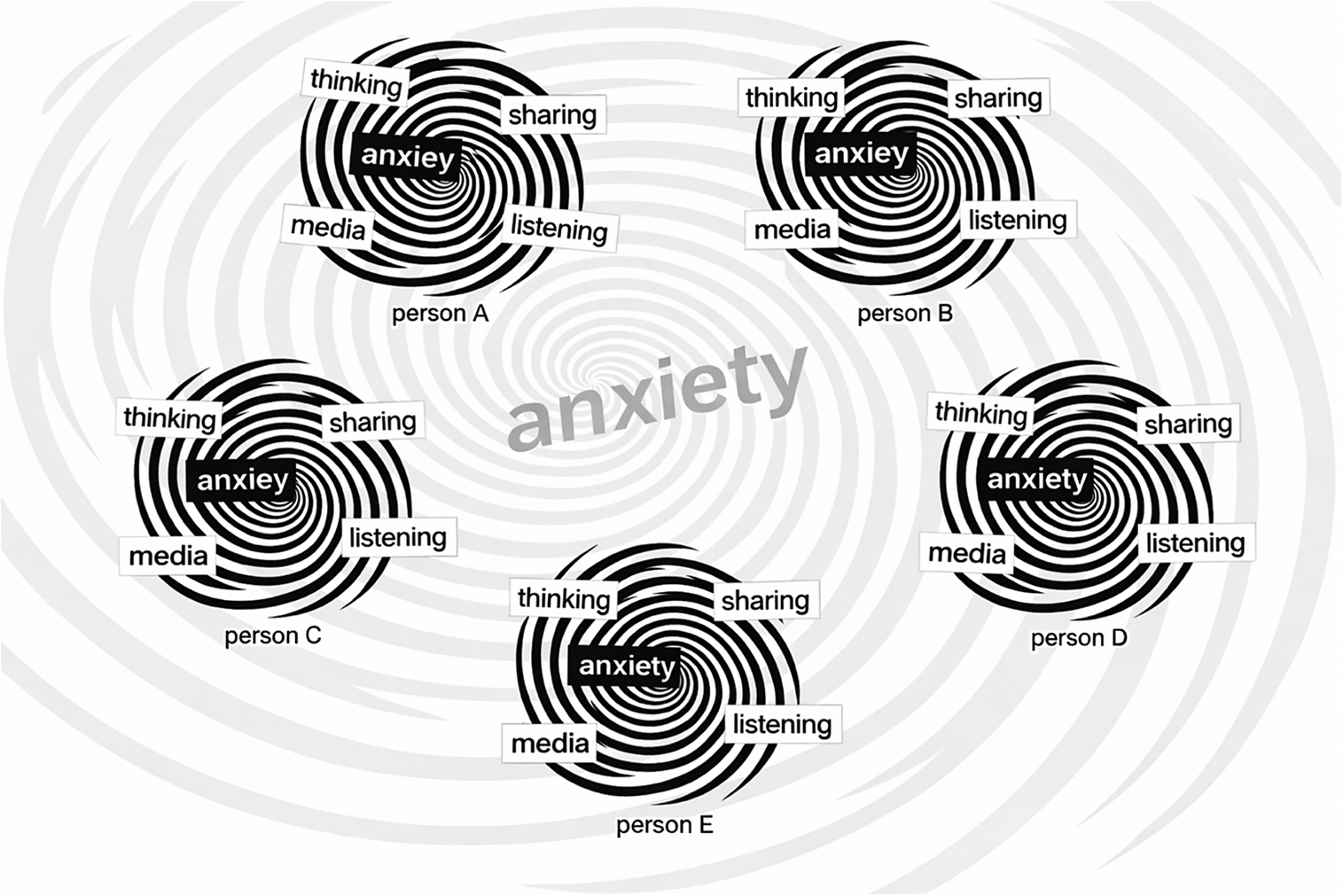
Thus, in collective crises, the interpersonal dynamic of the socio-affective mode permeates the social sphere. But by that fact, thoughts and emotions become increasingly homogeneous and synchronized. Reciprocal emotional activation fosters bonding and interpersonal closeness. Emotional sharing strengthens social ties and promotes a sense of unity. This leads to the expectation that individuals who participate in such a collective movement of heightened social sharing of emotions would derive increased feelings of solidarity and trust from it. Findings consistent with this prediction resulted from longitudinal data collected on the Spanish population’s responses to the March 11, 2004, terrorist attacks in Madrid (Rimé et al. Reference Rimé, Páez, Basabe and Martínez2010). Measures included the frequency of interpersonal sharing during the first week following the attacks. Data collected on the participants weeks later revealed that higher initial sharing predicted greater perceived social support, lower loneliness, increased positive affect, higher levels of posttraumatic growth, and a more hopeful and cohesive emotional climate. Within the limits of correlative data, these results are consistent with the expected effects of the socio-affective mode of social sharing of emotions. It fits the view that though emotional sharing sustains emotional arousal, it simultaneously fosters social cohesion and resilience.
The cognitive mode in collective crises
In individual emotional episodes, as developed above, the cognitive mode can promote resolution by easing the processing of specific cognitive elements involved in the source of emotion. In collective crises, the question of specific factors involved in sparking the crisis recedes into the background. Of course, society members and social institutions will strive to document failures that may have contributed to the crisis. But this is a secondary task that is generally undertaken later, once the crisis is over, because what matters most lies elsewhere.
The crisis has overturned the symbolic framework that enables individuals to live their daily lives with confidence. The entire system of reference through which reality is interpreted is called into question, undermining individuals’ sense of predictability and control – in other words, their sense of empowerment. Yet, life cannot proceed without such a framework which shields individuals from direct exposure to raw reality. Overcoming a collective crisis requires the restoration of the symbolic structures that sustain meaning and social order. How can this be achieved? In the following section, we examine whether the transmission processes generated through the social sharing of emotion in everyday life may offer part of the answer.
Transmission of shared emotions
The social sharing of emotion initially appeared primarily as a mechanism for the interpersonal regulation of individuals’ emotions (Rimé Reference Rimé and Gross2007b). However, findings that shared emotions propagate widely throughout society have broadened this perspective. These findings indicate that the process serves functions that extend far beyond the regulation of individual emotional experiences.
Everyday emotional experience
People exposed to an emotional account generally experience emotional reactions themselves. Because emotion elicits social sharing, listeners frequently pass the story on to others – a process termed secondary social sharing of emotion (Christophe and Rimé Reference Christophe and Rimé1997). Studies indicate that roughly three-quarters of listeners transmit the story to others, typically on the same day and often to several people (Curci and Bellelli Reference Curci and Bellelli2004; Harber & Cohen, Reference Harber and Cohen2005). In addition, new recipients frequently share the account with further listeners in tertiary sharing, generating a rapid and multiplying diffusion process. As in the spread of rumours or urban legends, emotional intensity – rather than informational value – appears to be the primary driver of propagation (Heath et al. Reference Heath, Bell and Sternberg2001; Pröllochs et al. Reference Pröllochs, Bär and Feuerriegel2021).
Through this cascading process, an event that initially affected a single individual may become an object of attention, discussion, and reflection for countless others. Significant emotional experiences reveal to all of them weaknesses or limitations in shared systems of expectations, worldviews, and socially shared knowledge. By communicating these experiences and reflecting upon them, community members may collectively extract lessons that benefit the group (Rimé Reference Rimé2020). Social sharing diffusion can thus contribute to updating shared knowledge, interpretations, and representations, based on countless individual experiences.
Collective crises
Whereas minor events typically reach only a small circle and lead to slight adjustments to existing models, major events – those affecting an entire community, a nation, or even the global population – may generate profound and lasting transformations in collective understanding. The transmission processes generated through social sharing can contribute to these transformations by fostering the progressive development of lessons learned from the crisis and by prompting revisions of the reference frameworks meant to ensure better protection in the future. However, this necessarily constitutes a long-term process. It does not address the major deficit imposed by a collective crisis, namely the disruption of the symbolic framework. This framework must be restored as promptly as possible; otherwise, the already widespread anxiety may intensify disproportionately. How can this be achieved? Systems of meaning and belief exist only insofar as they are collectively shared through social consensus (Berger and Luckmann Reference Berger and Luckmann1966). This leads to the conclusion that individuals must experience renewed social cohesion alongside a strong reaffirmation of shared beliefs. At this point, we turn to the theoretical insights developed in Émile Durkheim’s theory of collective gatherings, which highlight the central role of shared emotions, social cohesion, and common beliefs in overcoming collective crises.
Shared emotions, social cohesion, and shared beliefs
Émile Durkheim (Reference Durkheim1915) argued that individuals cannot cope with human existence on their own. They must draw upon collective beliefs and representations accumulated across generations. Participation in collective life and the sharing of these cognitive frameworks empower individuals and enable them to face life with confidence. Yet because individuals conduct their daily activities largely side-lined from the group, these collective resources tend to erode over time. Periodic revitalization, therefore, becomes necessary. Durkheim viewed collective gatherings – religious or secular – as a response to this need. All groups, whether political, economic, professional, or religious, hold periodic meetings in which members can revitalize their common faith, which exists only insofar as it is collectively shared. Surrounded by symbols of identity (flags and emblems), participants focus on a common object and engage in coordinated expressions – singing, chanting, shared movements, music, or dance. Their words, slogans, and banners reflect their core beliefs and values. Personal self-awareness recedes, giving way to collective identity. Intense emotions are generated, and their expressions echo and reinforce one another. The reciprocal stimulation of emotions engenders a climate of emotional fusion. Participants experience unity and similarity in a state of emotional exaltation that Durkheim termed collective effervescence. For Durkheim, this phenomenon constitutes the driving force behind collective assemblies. In communion with others, participants revive both their sense of belonging to the group and their adherence to shared beliefs. As a consequence, they experience both positive emotions and a renewed sense of empowerment.
Testing the effects of shared emotions in collective gatherings
Long neglected by empirical research, Durkheim’s model of collective gatherings has attracted considerable scientific attention and substantial empirical support in the last decade (for a review, Rimé and Páez Reference Rimé and Páez2023). We first tested this model in the context of the ‘Gacaca’ justice courts established in Rwanda after the 1994 genocide. Inspired by the principles of Truth and Reconciliation Commissions (TRCs), these courts organized the hearing of victims and perpetrators across all communities of the country (Ingelaere Reference Ingelaere2016). The process aimed to encourage both the expression of suffering and the acknowledgement of wrongdoing.
TRCs necessarily involve extensive emotional expression and sharing. This led us to investigate the effects of participation in Gacaca on emotional and social variables. In two studies, victims and prisoners completed questionnaires before and after participating in Gacaca. Their responses were compared with those of control groups surveyed simultaneously in communities where Gacaca sessions had not yet taken place (Kanyangara et al. Reference Kanyangara, Rimé, Philippot and Yzerbyt2007; Rimé et al. Reference Rimé, Kanyangara, Yzerbyt and Páez2011). The results were twofold. Participation intensified emotional responses in both groups, but indicators of social integration improved following participation. Moreover, consistent with Durkheim’s theoretical framework, emotional activation mediated these positive social integration effects.
Durkheim’s model was subsequently tested in greater detail in studies conducted in social contexts closer to ordinary life (Páez et al. Reference Páez, Rimé, Basabe, Wlodarczyk and Zumeta2015). Four studies examined participants in gatherings such as folk marches (eliciting positive emotions) and socio-political protests (eliciting negative emotions), comparing them with non-participants. Across studies, participation in these gatherings strengthened collective identity, empowerment, and positive affect. It also reinforced beliefs shared within the group. In line with Durkheim’s theory, the emotional synchronization perceived by participants (‘we are one’) mediated these effects. These findings have been replicated several times (e.g., Bouchat et al. Reference Bouchat, Rimé, Van Eycken and Nils2020, Reference Bouchat, Pizarro, Zabala, Páez and Rimé2026; Zabala et al. Reference Zabala, Conejero, Pascual, Zumeta, Pizarro and Alonso-Arbiol2023, Reference Zabala, Vázquez, Conejero and Pascual2024), and meta-analytic reviews have confirmed their robustness (Pizarro et al. Reference Pizarro, Zumeta, Bouchat, Wlodarczyk, Rimé, Basabe, Amutio and Páez2022; Bouchat et al. Reference Bouchat, Pizarro, Páez, Zumeta, Basabe, Wlodarczyk, Hatibovic and Rimé2024).
Collective gatherings in collective crises
Following collective emotional events, people frequently gather spontaneously in public spaces, engaging in collective forms of emotional sharing. Such gatherings may reach spectacular proportions. After the terrorist attacks of March 2004 in Madrid, spontaneous protest marches took place across Spain, with approximately one-quarter of the population participating. Similarly, in the weekend following the terrorist attacks against the magazine Charlie Hebdo on January 7, 2015, demonstrations across France gathered between 4 and 5 million participants – an unprecedented mobilization (‘Contre le Terrorisme’ 2015). Collective memory particularly recalls the massive demonstration held in Paris 4 days later, during which approximately 50 heads of state and government marched arm in arm with the French President leading 1 million protesters. These gatherings illustrate that, in the aftermath of collective trauma, segments of the population spontaneously create collective settings capable of restoring social cohesion and consensus.
But do such gatherings indeed produce these effects? Páez et al. (Reference Páez, Basabe, Ubillos and González-Castro2007) investigated the consequences of participation in socio-political mobilizations following the March 11, 2004, attacks in Madrid. They surveyed 661 participants 1, 3, and 8 weeks after the attacks. Respondents were categorized as demonstrators or non-demonstrators to assess the effects of participation on emotional climate and posttraumatic growth. Demonstrators were also classified according to their frequency of participation. The findings supported the positive interpersonal and social effects of participation. Demonstrators reported higher levels of perceived social integration, social support, and positive affect 3 weeks after the attacks. They also expressed stronger beliefs in positive life changes following trauma and reported a more positive emotional climate characterized by hope, solidarity, and trust 8 weeks later. Participation was also associated with higher perceived social support and lower loneliness in subsequent weeks, suggesting strengthened social resources. Moreover, demonstrators reported greater levels of posttraumatic growth, indicating broader cognitive resources. These results align with a social functionalist interpretation of collective gatherings consistent with Durkheim’s framework.
Peer-to-peer sharing of emotion in collective crises
Even when large-scale gatherings occur, they typically involve only a small fraction of the affected population. The participation of one million people in Paris after the Charlie Hebdo attacks was extraordinary, yet the population of metropolitan France exceeds 66 million. Does this mean that most of the population remains outside the processes that contribute to overcoming collective crises? We noted earlier that a collective crisis triggers the sharing of emotions between individuals. Everything indicates that the entire population takes part in this process. In this way, the psychosocial process that develops in collective gatherings would find its equivalent in these peer-to-peer exchanges. As such exchanges develop massively in the digital environment, it was possible to verify this hypothesis of equivalence by analysing their content. We therefore examined whether processses resembling collective effervescence might be observed in these peer-to-peer digitally mediated conditions.
Using Twitter data collected following the terrorist attacks in Paris on November 13, 2015 (Garcia and Rimé Reference Garcia and Rimé2019), we analysed changes in tweet content using three lexical indicators of solidarity: (1) social processes, referring to people, relationships, and social activities; (2) prosocial behaviours, including terms such as ‘attention’ and ‘solidarity’; and (3) value terms, including ‘liberty’, ‘equality’, and ‘fraternity’ – symbolic values targeted by the attacks. All three indicators showed a sharp increase the day after the attacks, reflecting the emergence of widespread expressions of solidarity. These indicators gradually declined in the following days. Social process and value terms returned to baseline levels within approximately 10–12 days, whereas prosocial terms remained elevated for several additional weeks.
To determine whether this pattern reflected participation in collective effervescence, users were categorized according to their emotional involvement. Emotional involvement was assessed by comparing each user’s frequency of emotional words during the 2 weeks following the attacks with their own baseline levels during the same period in the previous year. Users showing a significant increase were classified as high emotional responders, whereas those showing no increase were classified as low emotional responders. Prior to the attacks, both groups used solidarity-related terms at comparable levels. After the attacks, however, highly emotionally involved users displayed significantly greater use of solidarity-related vocabulary across all three categories. Moreover, these differences persisted for several months. These findings support the view that participation in emotionally charged online sharing processes is associated with heightened expressions of solidarity, similar to the effects observed in collective gatherings.
Recent findings point in a similar direction. In an online survey conducted during the COVID-19 pandemic (Kim et al. Reference Kim2025), participants reported how frequently they engaged in COVID-related social sharing behaviours on social media. They also reported emotional responses and evaluated variables such as policy support and prosocial behaviour. Results showed that increased sharing was associated with stronger emotional reactions – particularly anxiety, anger, and sadness. At the same time, social media interactions indirectly increased both policy support and prosocial behaviour through the mediating role of anxiety. Notably, neither anger nor sadness mediated these outcomes. Anxiety thus appeared to play a dual role, functioning both as a psychological stressor and as a motivator for cooperative and prosocial behaviours.
Conclusion
Taken together, these findings converge on a central proposition: shared emotion functions as a powerful engine of social cohesion and collective meaning-making. From Durkheim’s concept of collective effervescence to contemporary experimental, longitudinal, and digital-trace studies, evidence consistently reveals that emotional activation – far from being merely disruptive – becomes socially functional when it is shared. In face-to-face gatherings, emotional synchronization fosters belonging, reinforces shared beliefs, and enhances empowerment. Following collective crises, participation in demonstrations strengthens social integration, perceived support, and posttraumatic growth. Importantly, similar processes extend beyond large-scale assemblies. Peer-to-peer emotional sharing across the broader population produces comparable increases in cohesion and resilience. Even in online environments, emotionally engaged users display heightened solidarity and prosocial orientations.
Across contexts – collective gatherings, public demonstrations, interpersonal exchanges, and social media networks – the same mechanism emerges: emotional arousal fosters synchronization, which in turn consolidates social bonds, shared values, and collective confidence. Thus, although crises initially destabilize societies, the social sharing of emotion provides a spontaneous pathway towards collective reintegration and renewed social strength.
Temporal evolution of social sharing of emotion in times of crisis
From their observations of social responses to collective emotional events, Pennebaker and Harber (Reference Pennebaker and Harber1993) proposed a stage model describing their temporal evolution.
A model of temporal evolution
According to this model, an initial stage – called the emergency period – begins immediately after the event and typically lasts 2–3 weeks. During this period, individuals experience intense emotional reactions accompanied by strong rumination. At the social level, intense forms of communication develop, including extensive media coverage, frequent interpersonal contact, abundant social sharing of emotion, and numerous expressions of generosity and solidarity. The second stage, termed the inhibition phase, extends approximately from the second or third week to the sixth or eighth week after the event. During this period, social sharing and media coverage decline, whereas intrapersonal manifestations of rumination continue. Finally, about 2 months after the event, a third stage – the adaptation phase – emerges. During this period, spontaneous expressions of solidarity diminish, rumination and social sharing progressively disappear, and social life gradually returns to normal.
Inhibition of social sharing of emotion
As individuals share their emotions extensively in times of crisis and as sharing sustains both their own emotions and those of their interlocutors, what could stop the upward spiral from developing in the community? In their investigation of a Californian community struck by an earthquake, Pennebaker and Harber (Reference Pennebaker and Harber1993) reported an observation that might shed light on this issue. During the first days after the disaster, emotional sharing was extremely frequent. Later, however, a reversal in attitude was noted:
“Beginning two to three weeks after the quake, a significant shift occurred, indicating that subjects wanted to talk about the quake but did not want to be audience to other people’s quake-related thoughts and feelings. This sentiment was succinctly expressed by T-shirts, appearing in Palo Alto four weeks after the quake occurred, which read “Thank you for not sharing your earthquake experience.” (p. 133)
Thus, repeated exposure to emotionally charged accounts had gradually eroded these people’s capacity to absorb additional narratives.
Evolution of newspaper coverage
The model proposed by Pennebaker and Harber (Reference Pennebaker and Harber1993) makes specific predictions regarding the evolution of media coverage: intensive media coverage would persist for approximately 2–3 weeks before rapidly declining. These predictions had not been empirically examined. I undertook this in the context of four terrorist attacks carried out by jihadist groups in France and Belgium in 2015 and 2016. The data from this study have not been published; I briefly summarize the method and main observations here.
I examined the content of the principal daily newspapers in the countries affected by these events. For each attack, I analysed successive issues beginning the day after the event. The events and the newspapers analysed were as follows:
-
• January 7–9, 2015 (France). Attacks against the Charlie Hebdo magazine (January 7) and the Hyper Cacher supermarket (January 8–9) caused a total of 17 deaths. Analyses were conducted using the national daily newspapers Le Monde and Le Figaro.
-
• November 13, 2015 (France). Coordinated attacks, including explosions near the Stade de France, the assault on the Bataclan concert hall, and shootings on several café and restaurant terraces in Paris, resulted in 130 deaths and approximately 350 injuries. Analyses were conducted using Le Monde and Le Figaro.
-
• March 22, 2016 (Belgium). Suicide bombings at Brussels National Airport and in the Brussels metro killed 32 people and injured 340. Analyses were conducted using the Belgian national newspapers Le Soir and La Libre.
-
• July 14, 2016 (France). A truck attack along the Promenade des Anglais in Nice targeted a crowd celebrating the national holiday, killing 86 people and injuring 458. Analyses were conducted using Le Monde, Le Figaro, and the regional newspaper Nice-Matin.
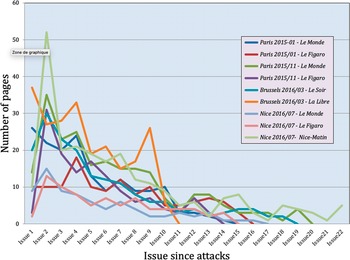
To quantify the evolution of media coverage, I used a simple indicator. For each newspaper issue, I counted the number of pages containing any text or photograph related to the attack. This count served as a unit of measurement of media attention. The results are summarized in Figure 2. Because these newspapers are not published on Sundays, the horizontal axis represents successive issues rather than calendar dates.
Evolution of media coverage following four terrorist attacks. For each newspaper and each of its successive issues, the results of the count of pages containing text or photographs related to the attack.
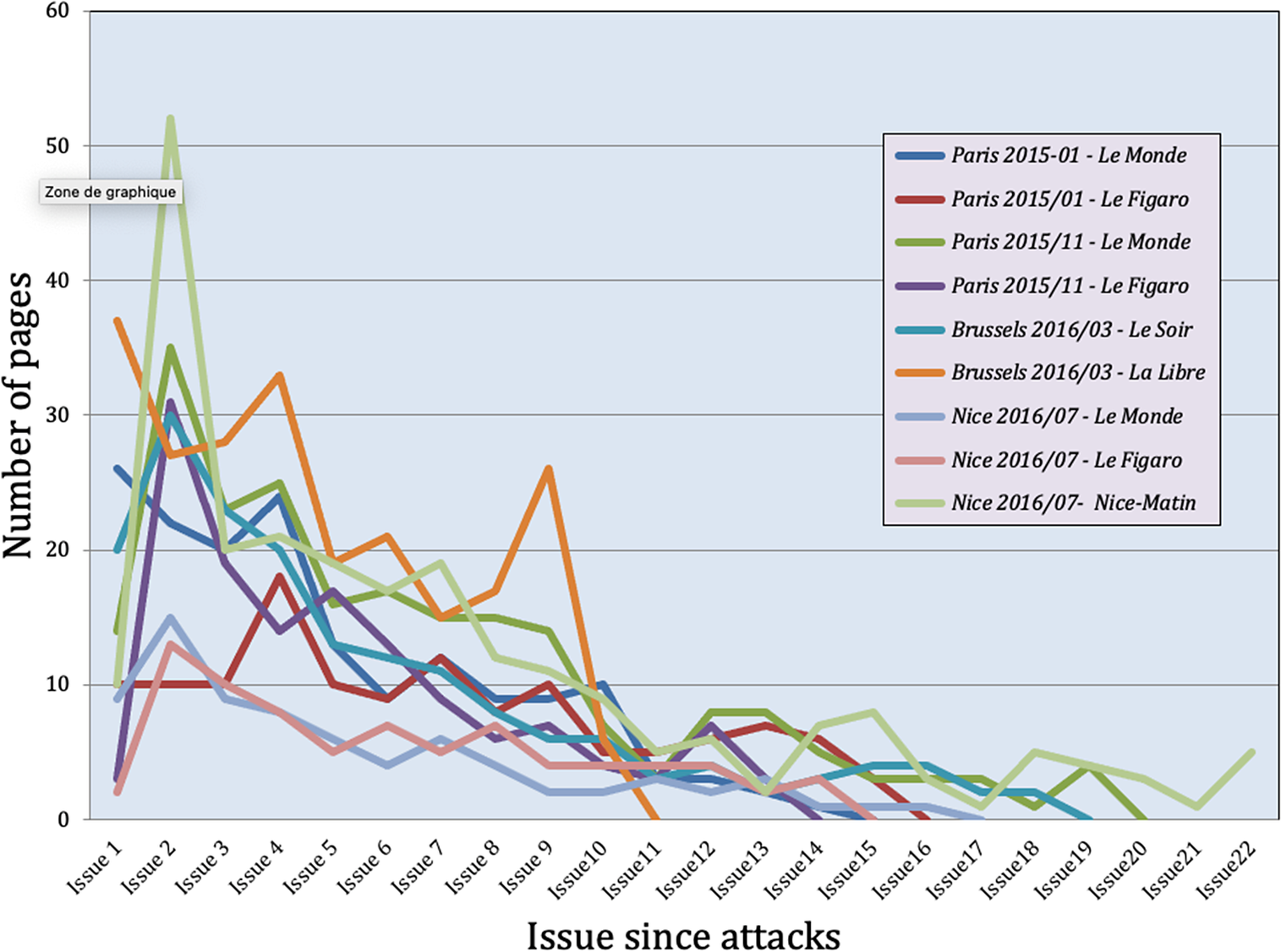
The graph shows that newspapers’ coverage generally peaked in the second issue following the attack. The two peaks observed in the Belgian newspaper La Libre correspond to weekend editions, which typically contain a larger number of pages. Apart from this exception, the number of pages devoted to the attacks decreased almost linearly from issue to issue in all newspapers, reaching a low point around the 11th issue – approximately the end of the second week after the attacks. At this point, one newspaper had already reached zero coverage, indicating the complete absence of any mention of the attacks. The other newspapers gradually reached this level as well. With one exception, all newspapers ceased coverage before the 21st issue, corresponding roughly to the end of the third week after the event (assuming six issues per week). The exception was the regional newspaper Nice-Matin, which continued to publish a small number of items about the attacks in Nice for its local readership directly affected.
Conclusion
These data describing the temporal evolution of media attention to collective events strongly support the model proposed by Pennebaker and Harber (Reference Pennebaker and Harber1993). They confirm its principal predictions: an initial peak in attention, followed by a rapid decline, with a low point reached around the end of the second week and the disappearance of coverage around the third week. This convergence is particularly striking given that (1) the events analysed here differed in nature from those originally used to develop the model, (2) they occurred in different countries, and (3) a similar temporal pattern emerged across all four cases.
Social sharing of emotion and memory
A key implication of the process of social sharing of emotion lies in its contribution to the memory of critical events. When individuals repeatedly think about and talk about an emotional experience, they are engaging rehearsal, a particularly effective mechanism for consolidating information in long-term memory (Ebbinghaus Reference Ebbinghaus1885). Through repetitions, social sharing helps build and consolidate the knowledge that individuals derive from their emotional experiences. Such knowledge contributes to the enrichment of individuals’ worldviews, particularly when the event concerns a situation for which they were previously unprepared.
Moreover, because emotional experiences tend to be shared widely, the information associated with them spreads throughout the social environment. Intense emotional episodes being more frequently shared, they open to a wider dissemination of information. In the case of collective crises, where an entire population participates in discussing and circulating information about the event, this process can contribute to a genuine reconfiguration of collective memory (Pennebaker et al. 1996).
The role of social sharing in consolidating memory for collective emotional events has been demonstrated in research on flashbulb memories, that is, the vivid memories people form of the circumstances in which they first learned about major public events. The assassination of President Kennedy provides the paradigmatic example: people vividly recalled not only the event itself but also where they were and what they were doing when they received the news. According to the original account proposed by Roger Brown and James Kulik (Reference Brown and Kulik1977), flashbulb memories arise from the conjunction of surprise and personal importance. These conditions were thought to trigger a special encoding mechanism operating much like a photographic snapshot, preserving both the event and its contextual details. Subsequent research, however, showed that such memories are far less accurate and stable than suggested by the photographic metaphor.
Important theoretical refinements emerged from the study of an unexpected collective loss in Belgium. In July 1993, Baudouin of Belgium died of a heart attack at the age of 62 in his summer residence in Spain. Because the king had previously appeared in good health, the news came as a shock and had a profound emotional impact on the Belgian population. Having reigned for 42 years, Baudouin was widely regarded as a paternal figure and a unifying presence in a country marked by linguistic and cultural divisions. His death provoked a widespread emotional reaction across the nation. Television and radio stations interrupted their regular programming to broadcast tributes to the royal family, and newspapers devoted a substantial portion of their pages – approximately 60 per cent – to coverage of the event.
Subsequently, Finkenauer et al. (Reference Finkenauer, Luminet, Gisle, El-Ahmadi, Van der Linden and Philippot1998) conducted a large-scale study examining Belgians’ reactions to the king’s death. Participants reported their memory of the event itself, the circumstances in which they had learned about it, the intensity of their emotional reactions, and the extent to which they had discussed the event and followed media coverage. The results showed that emotional intensity did not directly determine the accuracy of factual memory. Instead, emotional intensity exerted a strong indirect effect through the mediating influence of social sharing and social rehearsal. The more intense the individuals’ emotional reactions were, the more frequently they discussed the king’s death and followed media reports. In line with the arguments developed earlier in this article, the social sharing of the event therefore played a decisive role in consolidating memory of the original occurrence.
Comparable findings emerged from the longitudinal study conducted after the terrorist attacks of March 11, 2004, in Madrid. The extent of social sharing reported 1 week after the attacks predicted the accurate recall and recognition of details related to the collective traumatic event 2 months later (Páez et al. Reference Páez, Basabe, Ubillos and González-Castro2007). Taken together, these findings indicate that memory for major collective events is strengthened not by emotion alone, but by the socially mediated processes through which emotion is repeatedly shared, discussed, and rehearsed within the community.
Discussion
Collective crises abruptly disrupt the symbolic frameworks that allow individuals to experience everyday life as stable, predictable, and meaningful. While sociological research has long documented that such disruptions often give rise to solidarity and collective mobilization rather than social disorganization, the psychological processes underlying these dynamics have remained insufficiently specified. The present article proposed an integrative account that places emotions at the core of the psychosocial processes that unfold in individuals and groups under these conditions. The proposed analysis is centred on two interconnected mechanisms: the predominance of anxiety and the large-scale social sharing of emotion. Drawing on empirical evidence from laboratory studies, field surveys, longitudinal investigations of collective crises, and large-scale analyses of media and social media communication, we argued that these processes form the core engine of the cognitive and social dynamics that unfold during collective upheavals.
A first key finding concerns the central role of anxiety. Across different crises and methodological approaches, anxiety consistently emerges as the dominant emotional response. Unlike more specific emotions such as anger, fear, or sadness, anxiety reflects diffuse threat, uncertainty, and the impossibility of anticipating future outcomes. These characteristics make it particularly effective in mobilizing attention and sustaining cognitive activity. Anxiety fuels persistent rumination, stimulates intensive information seeking, and maintains individuals’ focus on the unfolding situation. In this way, anxiety acts not only as a reaction to crisis but also as a motivational force that drives the cognitive and social processes through which individuals attempt to understand and cope with disruptive events.
A second central contribution concerns the social consequences of this emotional activation. The research reviewed here shows that anxiety-driven rumination and information seeking are closely intertwined with a massive expansion of interpersonal communication. Individuals repeatedly share their emotional experiences with others, and these exchanges propagate widely through processes of secondary and tertiary sharing. Through this cascading diffusion, emotional reactions progressively synchronize across members of the community. What begins as individual emotional responses gradually develops into collective emotional dynamics. Importantly, this process does not merely sustain emotional activation. By fostering emotional synchronization and interpersonal resonance, social sharing strengthens social ties, increases perceptions of support, and reinforces shared interpretations of events.
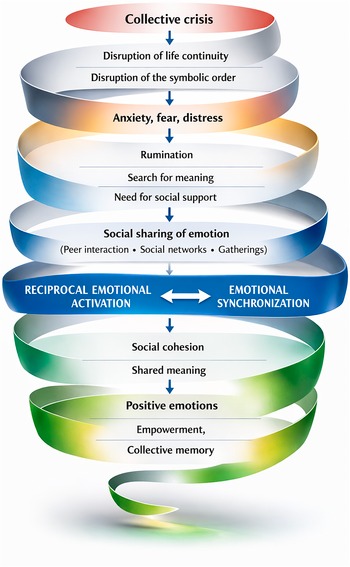
Figure 3 presents a conceptual model of the emotional dynamics unfolding in collective crises. The model describes how disruptions to life continuity and the symbolic order elicit anxiety and hypervigilance, which foster rumination, meaning-making efforts, and a search for social support, ultimately leading to social sharing of emotion and to processes of reciprocal emotional activation and emotional synchronization that promote social cohesion, shared meaning, and positive emotional outcomes.
Conceptual model of emotional dynamics in collective crises. Collective crises disrupt life continuity and the symbolic order, triggering anxiety and hypervigilance. These states foster rumination, meaning-making efforts, and a search for social support, which lead individuals to engage in social sharing of emotion. Through reciprocal emotional activation and emotional synchronization, these processes promote social cohesion and shared meaning, culminating in positive emotions, empowerment, and the formation of collective memory.
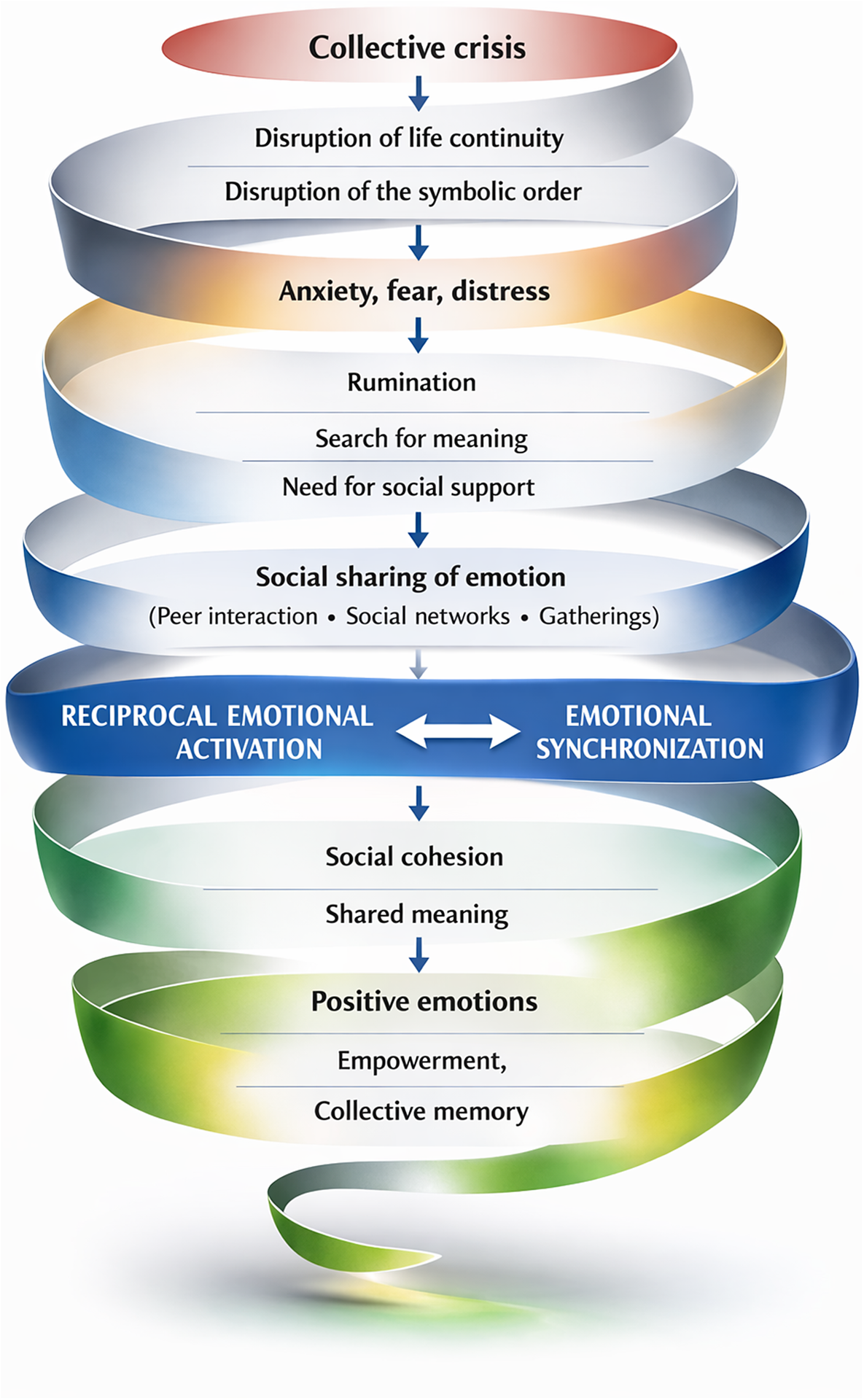
The analysis proposed in this article points to a central paradox of collective crises. The very processes that intensify emotional activation simultaneously contribute to restoring social cohesion. Evidence from collective gatherings, public demonstrations, interpersonal exchanges, and digital communication consistently shows that shared emotional activation promotes solidarity, strengthens collective identity, and enhances perceptions of empowerment. In Durkheimian terms, emotional synchronization generates forms of collective effervescence that reaffirm shared values and rebuild a sense of belonging. Thus, although crises initially destabilize societies, the collective circulation of emotions can become a powerful mechanism of social reintegration.
Beyond their immediate interpersonal effects, these processes also play an important cognitive and cultural role. Repeated discussions of emotionally significant events function as a form of social rehearsal that contributes to the consolidation of collective memory. Research on flashbulb memories and collective crises shows that memory for major public events depends less on emotional intensity alone than on the repeated interpersonal exchanges that follow. Through social sharing, emotional experiences are progressively transformed into shared narratives that contribute to the reconstruction of collective knowledge and meaning.
Finally, the temporal evolution of emotional sharing highlights the adaptive character of these processes. The data we examined show that, following its initial surge at the onset of the crisis, anxiety subsequently declined rapidly and steadily. This suggests that people have a low tolerance for living in conditions dominated by uncertainty and threat. The causal role played in this regard by the cognitive and social processes we have described still needs to be better documented by studies using appropriate methodologies. Furthermore, the informal observations reported by Pennebaker and Harber (Reference Pennebaker and Harber1993) suggest that other processes may contribute to emotional decline. According to these observations, a saturation effect produced by repeated exposure to emotional narratives leads individuals to no longer wish to be exposed to the emotions of others, thereby triggering a phase of active inhibition of emotional expressions. To our knowledge, this important hypothesis has never been examined. Future studies should thus consider the various explanations for the decline in anxiety and assess their respective roles.
Conclusion
Taken together, our observations suggest that the emotional turbulence triggered by collective crises is not merely a by-product of disruption but a fundamental component of the processes through which societies reorganize themselves. Anxiety initiates a cascade of cognitive and social activities that lead individuals to seek information, communicate extensively, and reconnect with others. Through the large-scale social sharing of emotion, these activities transform individual emotional reactions into collective processes that rebuild social bonds, reaffirm shared meanings, and integrate the crisis into collective memory.
In contemporary societies where emotionally charged information circulates rapidly through global media and digital networks, understanding these dynamics becomes particularly important. Crises now generate emotional reactions that spread faster and farther than ever before. Understanding how anxiety, communication, and social sharing interact to shape collective responses, therefore, represents a crucial step towards understanding how societies maintain cohesion and resilience in the face of large-scale disruptions.
Competing interests
The author declares that he has no competing interests.
Bernard Rimé (Ph.D.) is professor emeritus of psychology at the Catholic University of Louvain, Belgium. He is a former president of the International Society for Research on Emotion (ISRE) and is currently pursuing his research on the social sharing of emotions in interpersonal and collective situations.

 Open access

