





Heritage languages are minority or minoritized languages acquired in a language-contact situation. Several situations give rise to minority languages, such as immigration, colonization or territorial annexation. Any language can become a heritage language because its status depends on its sociopolitical situation. There are major languages like Spanish, English, German and Hindi, to name just a few, that are spoken as standard official languages in their homeland (Spain and Latin America, the United States/the UK, Canada, Australia/New Zealand, Germany, India, etc.) but as a heritage language in diasporic contexts (e.g., Spanish in the U.S., English in Israel, German in Argentina). Some heritage languages are minority languages in their own homeland (e.g., Quechua), while other languages on the verge of extinction no longer have a homeland (e.g., Menominee as discussed by Polinsky, Reference Polinsky2018). Heritage speakers are bilingual native speakers with different command of the heritage language, which can range from merely receptive ability (Au et al., Reference Au, Knightly, Jun and Oh2002; Sherkina-Lieber, Reference Sherkina-Lieber2020), to fully fluent in productive ability (Kupisch & Weijer, Reference Kupisch and Weijer2016) depending on life circumstances. Although this article is about heritage languages that arise in the context of immigration, the questions we address and the methodology we use could easily be extended to study other language minority situations (e.g., national minority languages and Indigenous languages).
When compared to monolingual native speakers in the homeland and to native speakers who immigrated in adulthood and became bilingual in the diaspora (the parental generation), heritage speakers exhibit significant grammatical variability at the level of phonetics and phonology (Rao, Reference Rao2024), morphology (Coşkun Kunduz & Montrul, Reference Coşkun Kunduz and Montrul2022; Laleko & Polinsky, Reference Laleko and Polinsky2013), syntax (Polinsky, Reference Polinsky2011; Westergaard & Lohndal, Reference Westergaard, Lohndal, Lightfoot and Havenhill2019), semantics (Cuza & Frank, Reference Cuza and Frank2011) and discourse pragmatics (Ivanova-Sullivan, Reference Ivanova-Sullivan2014; Laleko & Polinsky, Reference Laleko and Polinsky2016). In the past two decades, an important line of research has tried to identify the factors that give rise to the structural changes observed. There is evidence that multiple factors play a role, such as learner-internal cognitive and linguistic processes of reduction, simplification and overgeneralization of morphology that affect syntax and long-distance dependencies (Polinsky & Scontras, Reference Polinsky and Scontras2019), age of onset of bilingualism (Keating, Reference Keating2022), majority language transfer (Montrul & Ionin, Reference Montrul and Ionin2012), and the sociopolitical context with respect to the vitality and status of the heritage language in the diaspora (Rodina et al., Reference Rodina, Kupisch, Meir, Mitrofanova, Urek and Westergaard2020), among many others. At the individual level, the structural differences observed in heritage languages seem to be related to the level of proficiency, because the speakers with the lowest proficiency in the heritage language display extensive structural changes compared to speakers with higher proficiency (Polinsky, Reference Polinsky2006). Level of proficiency is impacted by the age of onset of bilingualism, amount of input and use of the heritage language along the lifespan, but especially in childhood (Montrul, Reference Montrul2008, Reference Montrul2016), and the nature and quality of the input (Pires & Rothman, Reference Pires and Rothman2009; Rothman, Reference Rothman2007), including access to schooling (Montrul & Armstrong, Reference Montrul, Armstrong and Batbasouli2024).
In this study, we consider the sources of heritage language innovations in the context of contact-induced language change and the psycholinguistic mechanism that may be at play. For example, Silva-Corvalán (Reference Silva-Corvalán1994) argued that some of the changes observed in the Mexican Spanish heritage speakers from Los Angeles studied, such as the expansion of the copula estar to contexts where the copula ser is more felicitous, were not due to transfer from the majority language English, but due to ongoing diachronic internal changes in the Spanish language, accelerated by the language contact situation. Carando (Reference Carando2015), Kupisch and Polinsky (Reference Kupisch and Polinsky2022), Montrul (Reference Montrul2022), Martínez Bruera et al. (Reference Martínez Bruera, Weingärtner, Flores, Lago and Rienke2023) and Rinke et al. (Reference Rinke, Flores, Oliveira and Correa2024) are recent studies linking grammatical patterns attested in heritage languages with patterns common in diachronic language change. In following this line of inquiry, our assumption is that even if language change is treated as a broad, societal and historical phenomenon, it starts with individual learners/speakers (Meisel, Reference Meisel2024; Montrul, Reference Montrul2022) and may diffuse to other speakers (Labov, Reference Labov2007). Therefore, the focus of the present study is on how specific changes may start in individuals, which has not been clearly addressed.
As to how change may happen at the individual level, Jäger and Rosenbach (Reference Jäger and Rosenbach2008) have attempted to connect diachronic change observed across centuries with cognitive microprocesses involved in change in present-day speakers, such as structural priming. Structural priming in language production is the phenomenon whereby speakers reuse a structure they have been previously exposed to, and this reuse can lead to the adoption of innovative or variable grammatical structures (Bock, Reference Bock1986). Chang et al. (Reference Chang, Dell and Bock2006) propose that structural priming is a form of implicit learning because exposure to a sentence makes speakers implicitly extract probabilistic information and create structural associations, which lead to the production of similar syntactic structures. The fact that speakers adjust to a specific linguistic environment by producing (or not) certain structures is considered implicit learning (Frensch & Rünger, Reference Frensch and Rünger2003).
Chang (Reference Chang2008) suggested that long-term, persistent structural priming could potentially lead to more stable language change. Priming can be a factor driving change, or an amplifier, enhancing the frequency of forms/constructions. As such, priming may contribute to the automatization or entrenchment of forms/constructions, a point raised by Traugott (Reference Traugott2008). According to Jäger and Rosenbach (Reference Jäger and Rosenbach2008), whether priming is the motivation (the why) or the mechanism (the how) for change is open to empirical investigations. Fernández et al. (Reference Fernández, de Souza and Carando2016) is one such study. They provide experimental evidence form Portuguese (Fernández & Souza, Reference Fernández, Souza, Heredia, Altarriba and Cieslicka2016) and Spanish speakers, some who live in a language contact environment (the U.S.) and others who do not (Carando, Reference Carando2015), that bilingual grammars exhibit bidirectional transfer, and that cross-linguistic structural priming leads to language change at the individual level. In Carando’s study, bilinguals living in a contact environment showed innovations through priming in constructions shared between the languages and in parallel structures elsewhere in the L1. More specifically, the rates of differential object marking (DOM) omission among heritage speakers of Spanish living in the United States increased after being exposed to transitive sentences in English, a language that does not have DOM. Similarly, Torres-Cacoullos and Travis (Reference Torres-Cacoullos and Travis2016) found that exposure to first-person singular overt subject pronouns, either in English (‘I’) or in Spanish (‘yo’), primed speakers to overproduce overt subject pronouns in subsequent sentences (instances of both within-language and cross-linguistic priming). Therefore, cross-linguistic priming has been found to promote change in bilinguals.
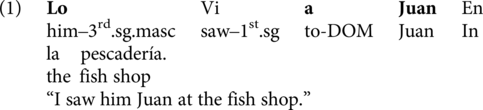
We contribute to this emergent line of research by examining the role of structural priming as a potential mechanism for language change at the individual level among Spanish heritage speakers in the U.S. Unlike Carando (Reference Carando2015), our study examines the flexibility of these bilingual grammars through within-language priming and focuses on structures that are acceptable in some varieties of Spanish but not in others. The structure of interest is accusative clitic doubling, the co-occurrence of an object DP and a referring clitic in the same clause, as in (1), which is present in some Spanish varieties (Andean, Rioplatense Spanish), but largely unacceptable in others (Mexican and Peninsular Spanish), and which only use (2). This structure does not exist in the majority language, English, either. Although heritage speakers who interact in Spanish with speakers from clitic-doubling varieties may have been exposed to these structures, our goal is to understand whether heritage speakers, in general, are influenced by and tend to incorporate unacceptable structures in their repertoire if they are exposed to them.

Putnam (Reference Putnam2019) uses descriptors such as “unstable grammar” or “unconsolidated grammar” to characterize the dynamic nature of heritage grammars in a language contact situation. If heritage speakers have unstable grammars in adulthood, our guiding hypothesis is that they may be more susceptible to what they perceive in the input than baseline speakers, such as first-generation immigrants or native speakers in the homeland. Therefore, our research question is as follows: How flexible are the grammars of heritage speakers compared to baseline speakers? More specifically, to what extent do heritage speakers adopt grammars not present in the majority language but attested in other varieties of their heritage language? During their language development, when grammatical knowledge is not entrenched, both child L1 and adult L2 learners have been found to produce or accept grammatical properties not present in their L1 or L2, but that are nonetheless grammatical in another human language. For example, Thornton (Reference Thornton1990) found that young monolingual English-speaking children produce sentences like What do you think what’s in here?, and Schulz (Reference Schulz2011) documented similar interlanguage patterns in Japanese learners of English. These medial wh-movement structures are possible in German, but not in Japanese or English. Therefore, we assume that entertaining a grammatical feature from other human languages would not be beyond the realm of possibility for heritage speakers either.
We present results from two independent studies. Study 1 tested the acceptability of accusative clitic doubling by heritage speakers of Spanish in the United States, adult immigrants from Mexico and Mexican native speakers in the homeland with an acceptability judgment task. Study 2 used an acceptability judgment task and an elicited production task with priming administered to heritage speakers and adult immigrants in the United States, as well as to a group of native speakers in Spain. The overall results of the two studies confirm that heritage speakers are accepting of innovative structures (i.e., their grammars are flexible) and they are somewhat sensitive to structural priming.
Before discussing the details of the experiments, we describe accusative clitic doubling in Spanish.
1. Accusative clitic doubling
Spanish has object clitic pronouns, which are phonologically weak and must attach to a verb (Cardinaletti & Starke, Reference Cardinaletti, Starke and van Riemsdijk1999). Unlike other Romance languages, Spanish has clitic doubling: the co-existence of the clitic pronoun and the referential DP it refers to, as in (3) and (4). Clitic doubling can be optional or obligatory. It is usually considered obligatory when used emphatically with a strong pronoun as the object (Lipski, Reference Lipski1996; Zagona, Reference Zagona2002):

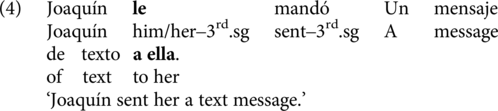
With dative clitics and ditransitive predicates, as in (5), clitic doubling is optional but very frequent in all varieties of Spanish:
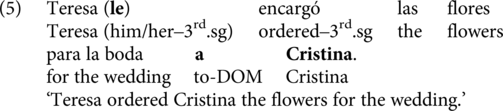
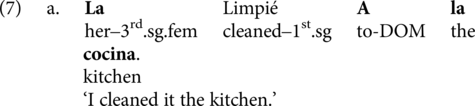
In most varieties of Spanish, except for Rioplatense Spanish (spoken along the River Plate in Buenos Aires and Uruguay) and for some varieties spoken along the Andes in Perú, accusative clitic doubling is considered unacceptable. In Rioplatense Spanish, accusative clitic doubling is often used with postverbal direct objects that are animate and specific. These objects are also obligatorily marked with differential object marking (DOM), the preposition “a,” as in (6) (Belloro, Reference Belloro2007). Sometimes, the doubling is also possible when the direct object is inanimate but specific. In these cases, DOM is still required for doubling to occur (7a), despite the fact that DOM would be ungrammatical if there were no clitic doubling (7b) (Fernández Soriano, Reference Fernández Soriano, Bosque and Demonte1999). This phenomenon has been almost exclusively documented in Buenos Aires (Argentina) (Fernández Soriano, Reference Fernández Soriano, Bosque and Demonte1999; Suñer, Reference Suñer1988; Silva-Corvalán, Reference Silva-Corvalán1980).


Accusative clitic doubling has been reported in the Spanish spoken in Los Angeles, California. In this variety of U.S. Spanish, accusative clitic doubling with direct objects in a postverbal position sometimes takes place together with the omission of DOM and the lack of agreement between the clitic and the object, as in (8) (Luján & Parodi, Reference Luján, Parodi, Gutiérrez-Rexach and Silva-Villar2001).

In summary, in most varieties of Spanish, accusative clitic doubling with full DPs in postverbal position is largely unacceptable, having been only documented in oral speech and informal contexts (e.g., Silva-Corvalán, Reference Silva-Corvalán1980 reported cases in Chile; Alarcón and Orozco, Reference Alarcón, Orozco, Molina, Ma and López2004 in Mexico; and Rinke et al., Reference Rinke, Wieprecht and Elsig2019 in Peninsular Spanish).
Since young adult heritage speakers can be agents of language change (Montrul, Reference Montrul2022), we investigate whether these speakers accept and produce accusative clitic doubling in Spanish, even when these structures may not be part of the variety of Spanish they speak or their linguistic environment.
2. Study 1: Accusative clitic doubling and DOM
Study 1 asked whether heritage speakers of Spanish accepted grammatical structures from other languages or Spanish varieties. As mentioned earlier, accusative clitic doubling with postverbal objects in Spanish is most felicitous with animate, specific direct objects, which must also be obligatorily marked with the preposition “a,” which is an instance of differential object marking (DOM). DOM is the overt morphological marking of semantically and pragmatically prominent direct objects (Bossong, Reference Bossong, Wanner and Kibbee1991), as in (9). Many languages exhibit DOM, such as Romanian, where definite, specific direct objects are preceded by the preposition pe (10).
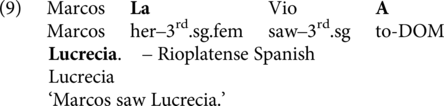
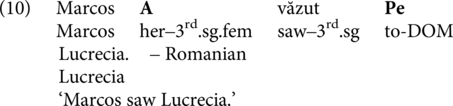
The data for this study comes from a large-scale project conducted by Montrul et al. (Reference Montrul, Bhatt and Girju2015) (see also Montrul, Reference Montrul2022), which tested heritage speakers of Mexican Spanish and heritage speakers of Romanian, among other groups. The results of the heritage speakers of Romanian are discussed in Montrul (Reference Montrul2022). Here, we present new results from the Mexican groups on accusative clitic doubling not published before.
2.1. Participants
A total of 77 first- and second-generation Mexican-origin immigrants in the United States and 41 Spanish native speakers in Northern Mexico (Guanajuato) were recruited. First-generation immigrants are foreign nationals who immigrate as adults; second-generation immigrants are their children, born or very early arrivals in the host country (Silva-Corvalán, Reference Silva-Corvalán1994). The participants were divided into four groups: 32 simultaneous bilingual heritage speakers (those who were exposed to English and Spanish from birth or before age 4), 25 sequential bilingual heritage speakers (those exposed to Spanish since birth but to Spanish and English after age 5), 20 first-generation adult immigrants and 41 adult Mexican native speakers. In this latter group, half the participants were young (N = 20) and matched the heritage speakers in SES, whereas the other half were older (N = 21) and matched the adult Mexican immigrants in SES. This was done to have a representative sample of speakers that was similar to the speakers in the U.S. All the simultaneous bilinguals except for one (who came to the United States at age 5) were born in the United States and were exposed to both Spanish and English since birth. The sequential bilinguals came to the United States between the ages of 7 and 12. Table 1 presents basic information about the participants related to mean age at testing, mean age of acquisition (AoA) of Spanish and English, and length of residence in the United States (LoR U.S.) for the U.S. groups, mean level of education completed (1 = elementary school, 2 = middle school/high school, 3 = college/university, 4 = postgraduate), mean SES scores and proficiency measures. SES scores were the sum of level of education and occupation, which was ranked from 1 (menial job) to 4 (professional). The maximum score possible was 16 since SES scores were calculated per household. In the case of the simultaneous bilinguals, the sequential bilinguals and the younger native speakers, SES scores were calculated using their parents’ level of education and occupation instead of their own.
Information about the Spanish-speaking participants in Study 1
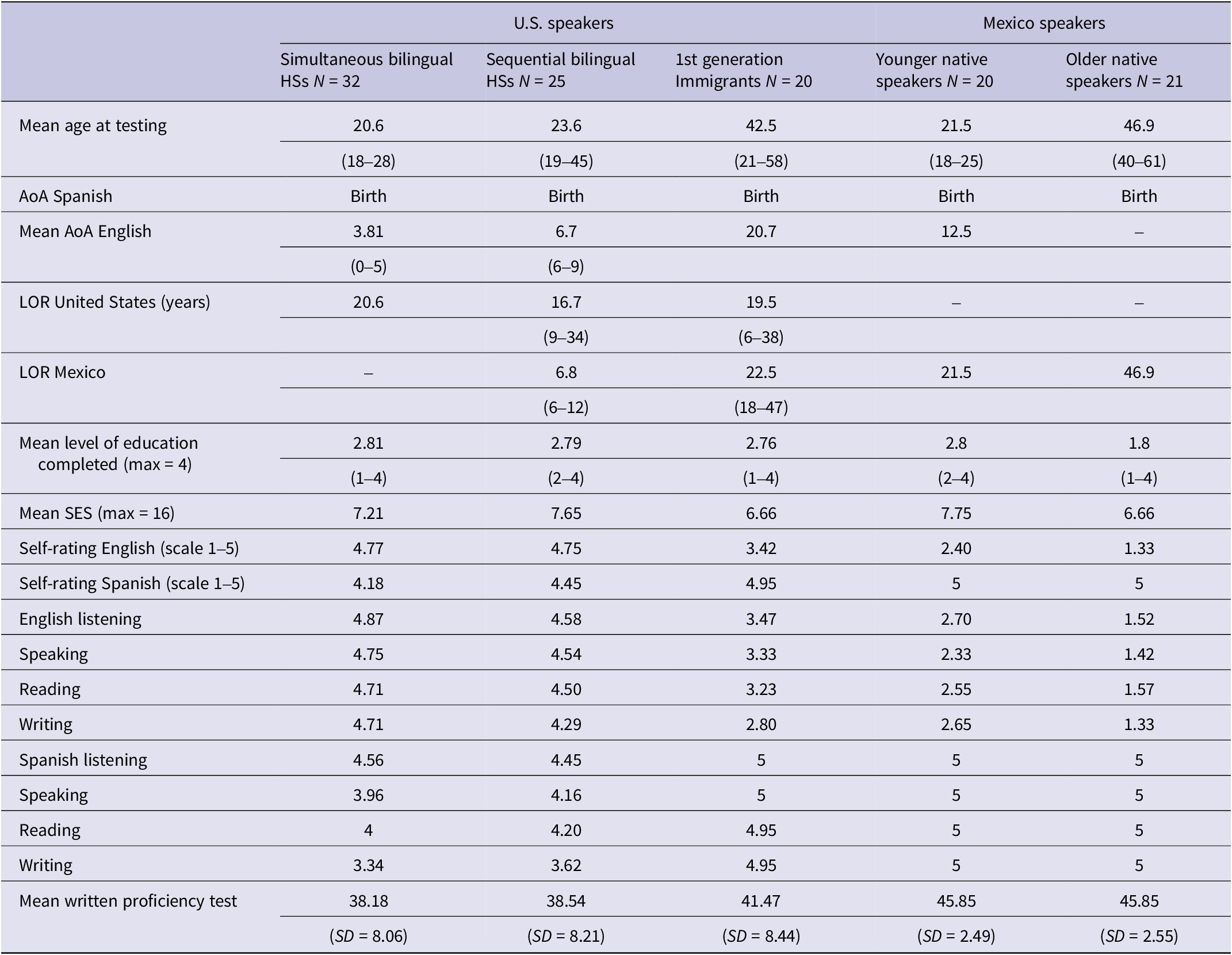
Note 1: level of education: 1 = elementary school, 2 = middle school/high school, 3 = college/university, 4 = postgraduate (Masters, PhD, Professional degree).
Note 2: SES = level of education completed + occupation of parents.
All participants completed an extensive language background questionnaire which, in addition to questions about age, education and occupation, included additional questions about their bilingual language history, patterns of language use along their lifespan and during schooling, self-ratings about their Spanish and English skills, attitudes toward improving Spanish and so forth Table 1 describes the participants’ mean self-ratings in Spanish and English, globally and by skill (speaking, listening, reading and writing) on a scale of 1–5 (5 = fully fluent, native-like). Lastly, to complement self-ratings, which are not usually reliable as stand-alone proficiency measures for heritage speakers (Polinsky, Reference Polinsky2018), all participants completed parts of a standardized written proficiency test (DELE) in Spanish as well, consisting of a cloze passage with 20 blanks and 30 multiple choice questions about vocabulary and collocations. The total maximum points in this task was 50. The validity of this task for heritage speakers is discussed in Montrul (Reference Montrul2016) and Sáez-Fajardo (Reference Saez-Fajardo2022). Montrul (Reference Montrul2016) reported high-reliability statistics (Cronbach alpha above 0.80) and significant high positive correlations (0.78) between these written proficiency scores and other written measures, such as a morphology recognition task. Sáez-Fajardo (Reference Saez-Fajardo2022) found high correlations between the DELE scores and a sentence repetition (elicited imitation) task for a group of 71 Spanish heritage speakers of different proficiency levels.
One-way ANOVAs were conducted to compare the four groups. The heritage speakers were very fluent in English and did not differ from each other on their self-ratings, while the Mexican native speakers had very low proficiency in English (F(4,112 = 108.2, p < .001). The first-generation immigrants, with a self-rating mean of 3.42 for English, ranked themselves in between the heritage speakers and the Mexican speakers. The overall self-ratings in Spanish showed that the Mexican speakers rated themselves as fully fluent native speakers, while there was variability in the three U.S. groups (F(4,113) = 13.9, p < .0001). Still, the first-generation immigrants rated themselves quite high in Spanish (4.5 over 5): higher than the heritage speakers, who tended to rate themselves mostly with scores in the intermediate and advanced levels of fluency in the language (4.18 simultaneous bilinguals and 4.45 sequential bilinguals). The overall ratings for English are similarly reflected in the self-ratings of the four skills in English, while for Spanish we see that the U.S. groups rated their writing skills in Spanish lower than their other skills, with the widest difference in ratings reflected by the heritage speakers. The independent measure of written proficiency showed differences between the groups (F(4,113) = 7.208, p < .0001), but posthoc tests revealed no differences between the simultaneous and sequential bilingual heritage speakers and no differences between the Mexican speakers and the first-generation immigrants.
2.2. Methodology
Acceptance of accusative clitic doubling was tested via a bimodal acceptability judgment task (AJT), which presented written sentences with audio buttons so that participants could read and hear each sentence before providing a rating on a 4-point scale (4 = perfectly acceptable, 1 = completely unacceptable). Participants were instructed to read and hear the sentence before responding. The task consisted of 168 sentences (90 grammatical and 78 ungrammatical) divided into 28 conditions, with 6 token sentences per condition. The 24 unique sentences that are relevant for this study manipulated the presence and omission of DOM with and without accusative clitic doubling and were divided into four conditions, all of them part of the same set of items: no doubling with DOM (“Marina vio a Madonna,” Marina saw Madonna – acceptable in all Spanish varieties), no doubling without DOM (“*Julia vio Shakira,” Julia saw Shakira – unacceptable in all Spanish varieties), doubling with DOM (“%Manuela la vio a Madonna,” Manuela saw her Madonna – acceptable in Rioplatense Spanish) and doubling without DOM (“*Marina la vio Mafalda,” Marina saw her Mafalda – unacceptable in all Spanish varieties). A female native speaker of Mexican Spanish recorded all sentences in a soundproof room.
2.3. Results
Descriptive analyses showed that sentences without accusative clitic doubling but with DOM (“Marina vio a Madonna,” Marina saw Madonna”) received the highest ratings by all groups (Figure 1). This was not surprising, given that this construction represents the canonical structure.
Mean acceptability ratings and standard error for each condition of the bimodal AJT (Study 1). NS = older and younger native speakers from Mexico; ADIM = adult immigrants in the United States; SEQ = sequential bilinguals; SIM = simultaneous bilinguals.
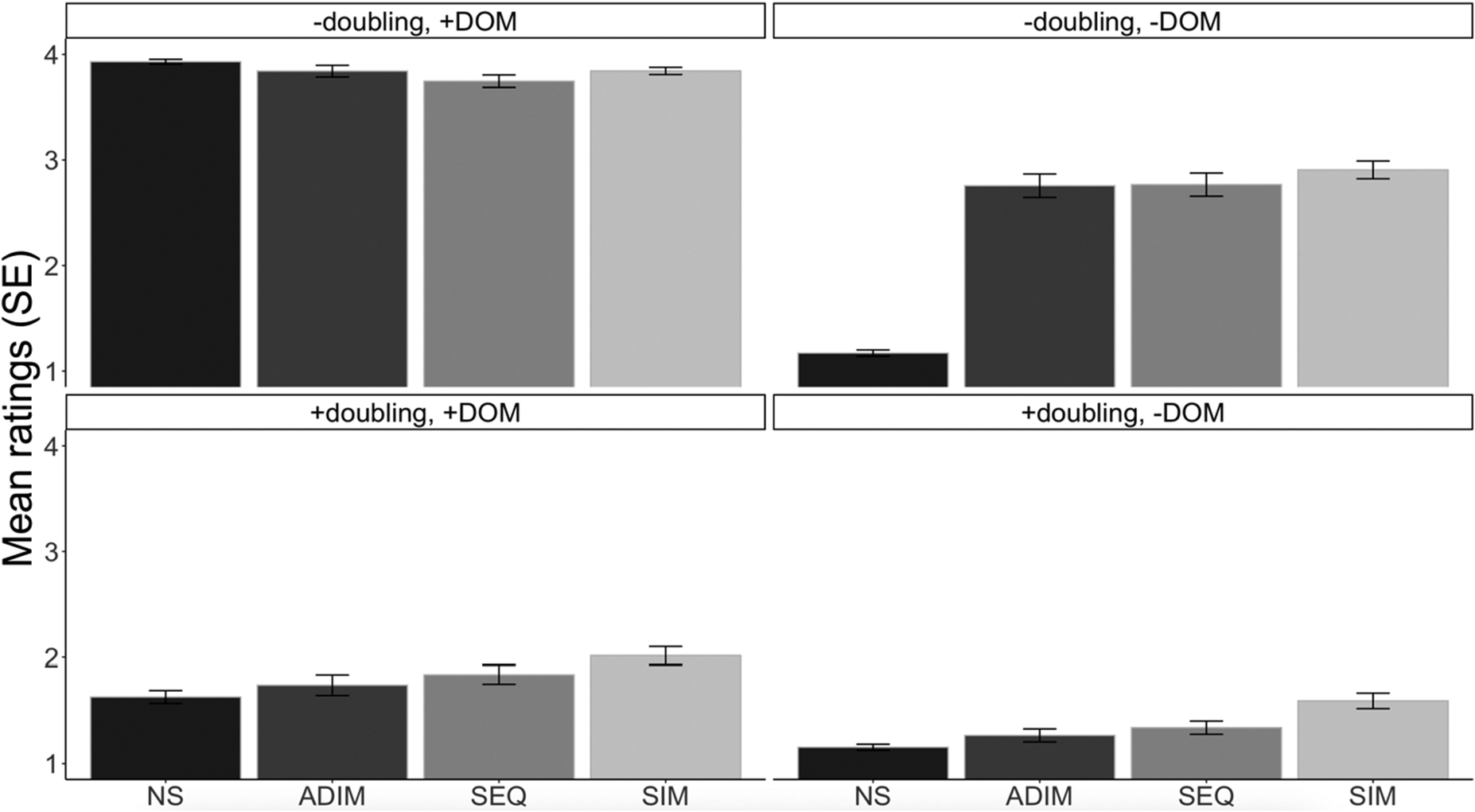
In all other conditions, the ratings were lower, and there was also a continuum observed across groups, with native speakers giving the lowest ratings, followed by the adult first-generation immigrants, the sequential heritage bilinguals and the simultaneous heritage bilinguals. Sentences with accusative clitic doubling but without DOM (“*Marina la vio Mafalda,” Marina saw her Mafalda) received the lowest ratings overall. Interestingly, this construction is the most similar to the one Luján and Parodi (Reference Luján, Parodi, Gutiérrez-Rexach and Silva-Villar2001) attested among Spanish heritage speakers in Los Angeles, California. Another unexpected finding was that adult first-generation immigrants from Mexico gave high ratings to sentences without accusative clitic doubling and without DOM (“*Julia vio Shakira,” Julia saw Shakira), deviating from the native speaker groups in Mexico and pairing more closely with the heritage speakers. Since both the native speakers and the adult immigrants were from Mexico, we attribute this difference to a potential instance of L1 attrition, as discussed by Montrul (Reference Montrul2022, in press). The adult immigrants with longer lengths of residence in the United States were more accepting of these seemingly ungrammatical sentences than those with shorter lengths of residence, based on results from a simple linear regression (R 2 = .12, F(1, 118) = 16.73, p < .001).
In order to explore whether the differences observed were significant, we ran an ordinal mixed-effects model using R version 4.2.2. (R Core Team, 2022) and the ordinal package (Christensen, Reference Christensen2023). We started out with the maximal random-effects structure possible, and simplified it until convergence, following Jaeger (Reference Jaeger2008, Reference Jaeger2009). The final model included ratings as the dependent ordinal variable, and group, condition and an interaction between the two as fixed effects. The random effects structure included random intercepts and a random slope for condition by subject as well as random intercepts and a random slope for group by item. All factors were entered into the model with dummy coding. As reference levels, we chose the native speaker group from Mexico and the sentences with DOM and no clitic doubling, which represented the canonical structure. All remaining levels were automatically set by R in alphabetical order. The output of the model showed that there was a significant difference between the canonical structure and the other three constructions overall. Similarly, most of the interactions were significant (Table 2).
Output of the ordinal mixed-effects model examining the bimodal AJT (Study 1)
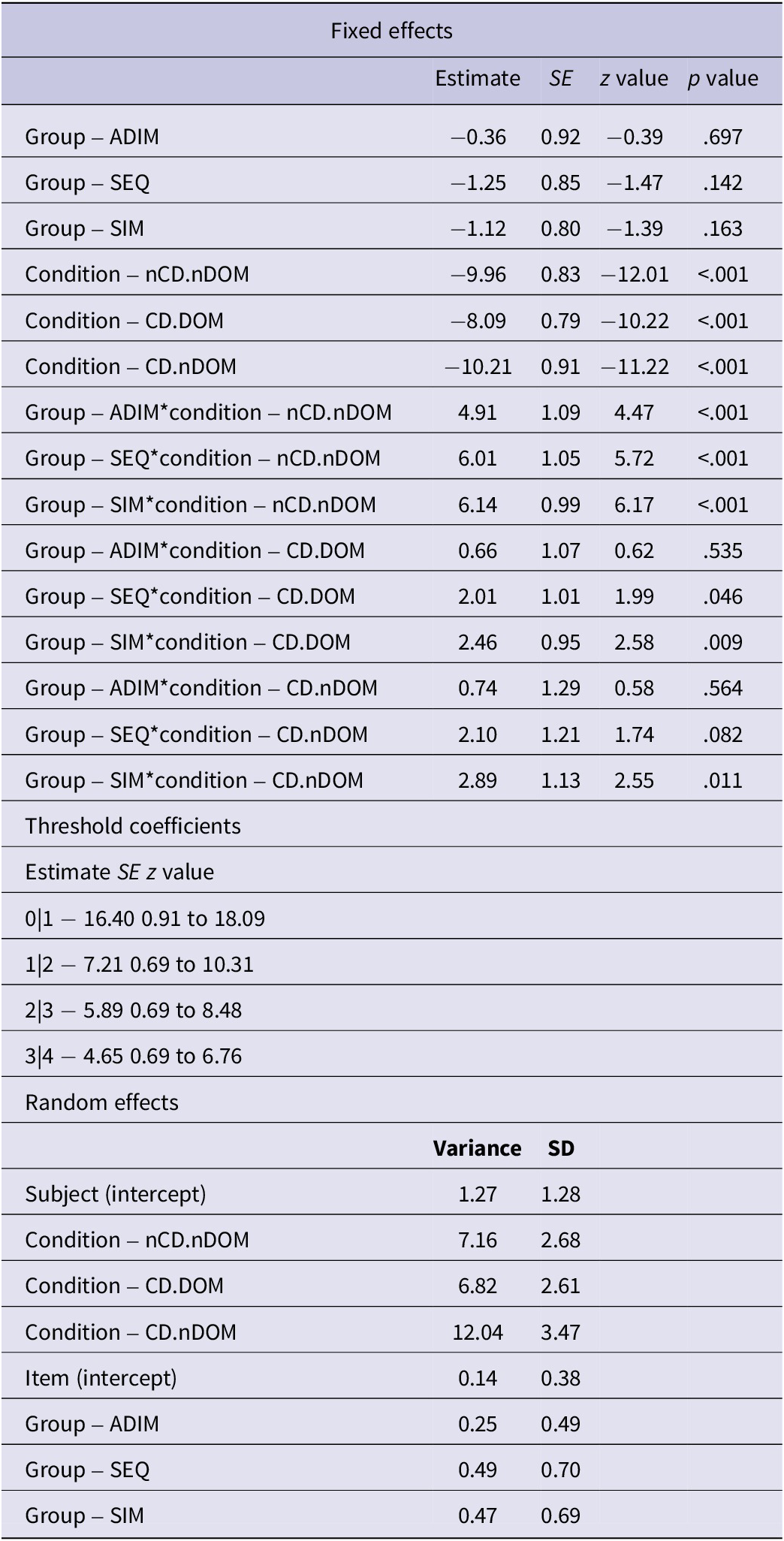
NS = older and younger native speakers from Mexico; ADIM = adult immigrants in the United States; SEQ = sequential bilinguals; SIM = simultaneous bilinguals; nCD.nDOM = no clitic doubling, no DOM; CD.DOM = clitic doubling, DOM; CD.nDOM = clitic doubling, no DOM.
To explore the interactions, we calculated estimated marginal means using the emmeans package in R (Lenth et al., Reference Lenth, Bolker, Buerkner, Giné-Vázquez, Herve, Jung, Love, Miguez, Riebl and Singmann2024) and conducted pairwise comparisons between groups by condition (Table 3).
Estimated marginal means from the mixed-effects ordinal model examining the bimodal AJT (Study 1)
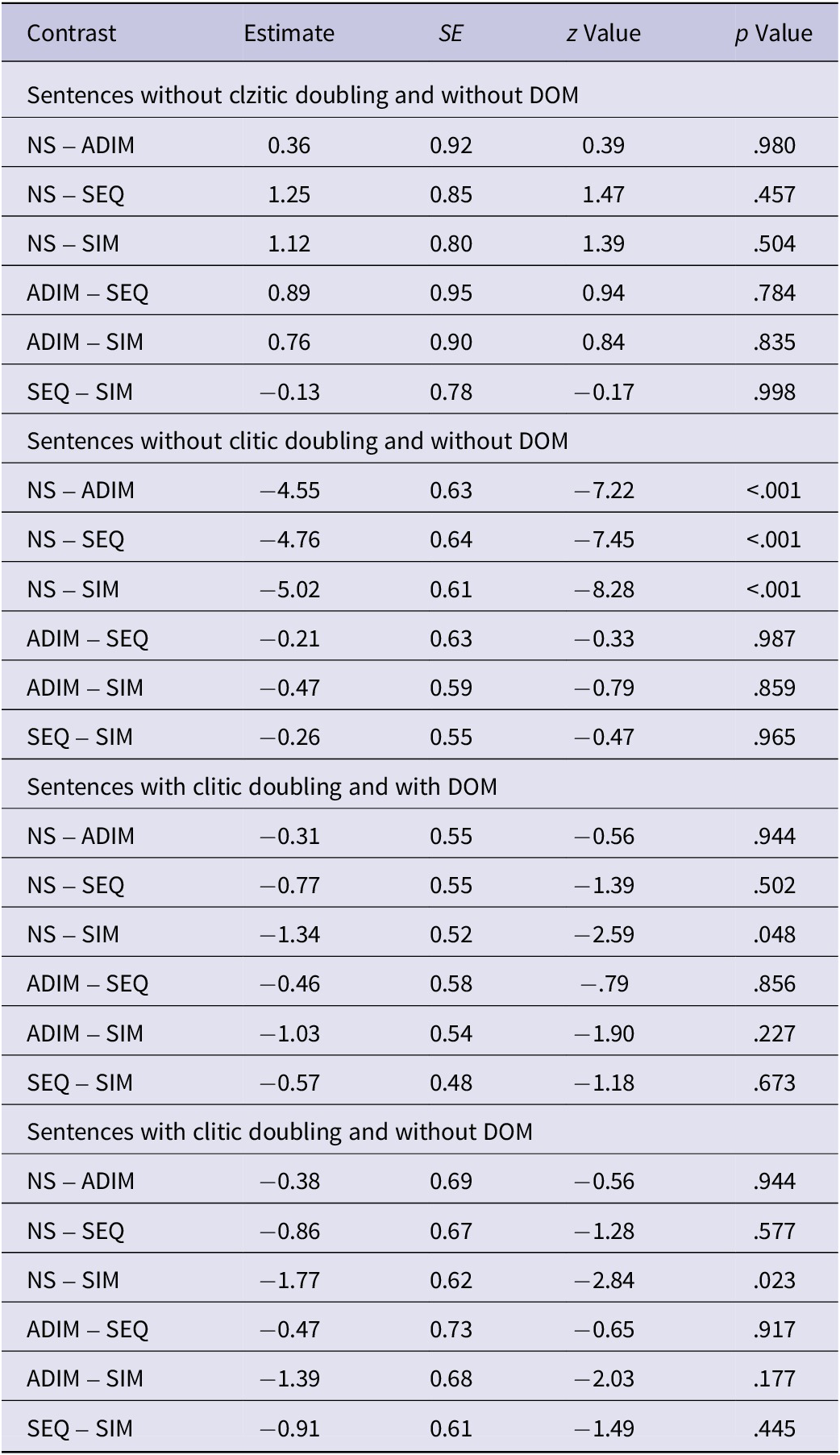
NS = older and younger native speakers from Mexico; ADIM = adult immigrants in the United States; SEQ = sequential bilinguals; SIM = simultaneous bilinguals
According to these results, the heritage bilinguals differed significantly from the native speakers from Mexico in all conditions, although in the sentences with clitic doubling and with DOM (“%Manuela la vio a Madonna,” Manuela saw her Madonna) and sentences with clitic doubling and without DOM (“*Marina la vio Mafalda,” Marina saw her Mafalda), there was only a significant difference between the native speakers and the simultaneous bilingual heritage speakers (no significant difference between the native speakers and the sequential bilingual heritage speakers). However, the comparisons between the simultaneous and sequential bilingual heritage speakers were not significant either in those two conditions.
In sum, Study 1 showed that heritage speakers of Mexican Spanish do not generally accept accusative clitic doubling as much as sentences containing ungrammatical instances of DOM because their acceptability ratings hover well below 2.5 on a scale of 1–4 for grammatical acceptability. Yet, those heritage speakers with the lowest proficiency in the language (simultaneous bilingual heritage speakers) as well as the immigrants with the longest length of residence, were more accepting of accusative clitic doubling than the other groups tested. Since accusative clitic doubling does not exist in English, their dominant language, it is unlikely that the higher acceptability of those constructions comes from contact with English. This suggests that their grammars are more flexible and considers grammatically appropriate structures from other language varieties. To confirm these results, we conducted another study.
3. Study 2: Structural priming and accusative clitic doubling
Study 2 tested whether heritage speakers of Spanish not only accepted but also used instances of accusative clitic doubling in oral production. First, we sought to replicate the findings of Study 1 with other groups of heritage speakers and first-generation immigrants. Second, we wanted to see whether these “unacceptable” structures were produced, by linking these potential changes to structural priming. Previous studies have shown that language changes start at the level of comprehension and only later affect production (Arechabaleta & Montrul, Reference Arechabaleta and Montrul2019; Czypionka & Kupisch, Reference Czypionka and Kupisch2019; Lundquist et al., Reference Lundquist, Rodina, Sekerina and Westergaard2016). If this is true, some heritage speakers may accept sentences with accusative clitic doubling in an acceptability judgment task and produce, to a lesser extent, instances of the same construction in Spanish, even though the structure is not common in their language variety nor are they exposed to it frequently.
We hypothesized that even if heritage speakers of Spanish do not generally produce accusative clitic doubling naturally when producing sentences in a priming task, they may copy the prime structure, if they consider it acceptable to some extent, as Study 1 showed. This is due to priming involving exposure to the target structure (i.e., comprehension), which would facilitate its production when the syntactic representation is activated (Branigan & Pickering, Reference Branigan and Pickering2017). If so, Study 2 would confirm that the acceptability of accusative clitic doubling is likely and that structural priming may be a mechanism that facilitates language change at the individual level.
3.1. Participants
A total of 113 participants took part in Study 2, divided into three groups: a group of 38 sequential bilingual heritage speakers of Spanish living in the United States, a group of 35 first-generation immigrants of Mexican or Peninsular origin also living in the United States, and a group of 40 Spanish native speakers living in Southern Spain (Huelva) who had some knowledge of English as a second language. Speakers from Spain in a monolingual environment were tested because they are the least likely to use accusative clitic doubling. All participants completed a language background questionnaire to gather more information about their age of acquisition (AoA) of Spanish and English, as well as their length of residence (LoR) (U.S. participants only). Table 4 presents basic information extracted from this questionnaire.
Information about the Spanish-speaking participants in Study 2
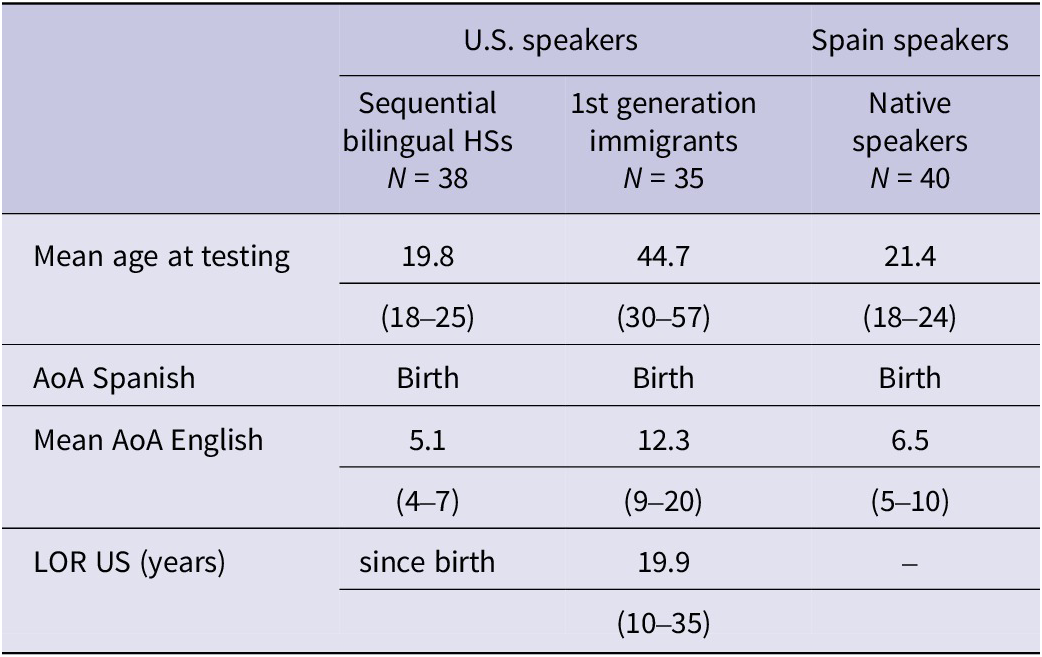
In terms of age, the sequential bilingual heritage speakers matched in age the native speakers from Spain, whereas the first-generation immigrants were older. The main reason for the age difference was that an inclusion criterion for first-generation immigrants was a minimum of 10 years of residence in the United States. An LoR of 10 years is a common cutoff point in L1 attrition studies (Schmid, Reference Schmid2011, Reference Schmid, Schmid and Köpke2019). Furthermore, this group was also the most diverse from a linguistic perspective, since it included speakers from Peninsular Spanish (N = 20) and Mexican Spanish (N = 15). Sequential bilingual heritage speakers were all speakers of Mexican Spanish and the participants tested in Spain were all speakers of Peninsular Spanish. These two varieties follow Standard Spanish with regard to their use of accusative clitic doubling.
Since the two studies reported in this paper were conducted independently of each other, we could not match all participant groups directly. Therefore, there are some minor differences between the groups of participants in Study 1 and the groups of participants in Study 2. More specifically, some heritage bilinguals in Study 1 had an age of acquisition (AoA) of English which would overlap with the AoA of English of some of the first-generation immigrant participants from Study 2. Therefore, we use the term “sequential bilinguals” to refer to speakers who were either born in the United States or who immigrated to the United States at a very young age. Thus, regardless of their AoA of English, they already lived immersed in an English-dominant environment. First-generation immigrants, on the other hand, were born and raised in a Spanish-speaking country and moved to the United States at the age of 18 or older. Those who learned some English in their home countries before moving to the United States had an earlier AoA of English than those who did not. Yet, they grew up in a Spanish-dominant environment where English was restricted to an academic context. Thus, despite the AoA of English overlap between the two studies, the difference between groups is still justified due to the environment each group was raised in and the status of Spanish and English as majority and minority languages in each of those environments. Another point worth clarifying is that Study 2 did not include a group of simultaneous bilingual heritage speakers, whereas Study 1 did. Our original plan was to also include such a group in Study 2. However, in a pilot test we did with simultaneous heritage bilinguals, we found that they had difficulty producing sentences in Spanish containing clitics. Because the priming task involved an oral production component, we excluded this group from Study 2.
In addition to the language background questionnaire, participants completed a fluency task and a frequency of language use questionnaire. For the fluency task, participants had to narrate the story of Little Red Riding Hood naturally, as they looked at pictures taken from a children’s book, which were presented on a computer screen. Each participant narrated the story once in Spanish and once in English. The recordings were transcribed and words per minute were calculated for each participant and language. A fluency score was obtained for each participant by subtracting words per minute in English from words per minute in Spanish. Thus, a negative score would indicate greater fluency in English, whereas a positive score would indicate greater fluency in Spanish. The native speakers from Spain received the highest positive scores (M = 22.85, SD = 11.68), followed by the first-generation immigrants (M = −1.77, SD = 15.13). Heritage speakers’ fluency scores were negative, indicating a higher fluency in English than in Spanish (M = −21.43, SD = 9.89).
Information about the frequency of language use was gathered from one of the sections of the Bilingual Language Profile (Birdsong et al., Reference Birdsong, Gertken and Amengual2012). Participants were presented with five situations (with family, with friends, at school/work, when counting and when self-talking) and they had to estimate what percentage of the time they used Spanish in each situation, from 0% to 100%. This time, native speakers in Spain showed the highest percentage of Spanish use, which was the preferred language in all situations (M = 92.55%, SD = 5.78). First-generation immigrants also showed a preference for Spanish over English overall (M = 56.74%, SD = 15.01), although they had a tendency to use English over Spanish at work and with friends. As is typically the case, the heritage speakers reported using Spanish the least (M = 35.84%, SD = 10.79). English was their preferred language in all situations except for with family, with whom using Spanish was more frequent. This was expected, since Spanish heritage speakers tend to use their heritage language mostly at home, especially with their parents (Montrul, Reference Montrul2016, Reference Montrul2022).
3.2. Methodology
Grammatical acceptability of accusative clitic doubling was measured via an acceptability judgment task (AJT), following Study 1, except that all sentences were presented in written format onlyFootnote 1. There were two types of sentences that participants had to rate on a scale from 1 (= completely unacceptable) to 5 (= completely acceptable): transitive sentences with no clitic doubling (e.g. Juan saludó a la niña “Juan waved at the girl”) and transitive sentences with clitic doubling (e.g., Juan la saludó a la niña ). There were 32 sentences total, 16 without accusative clitic doubling and 16 with accusative clitic doubling. In addition to the target sentences, 64 fillers were included to test the acceptability of other structures in Spanish, unrelated to clitic doubling. All sentences were divided into two counterbalanced lists and were presented in randomized order.
The oral production of accusative clitic doubling was tested via a priming experiment that consisted of three parts: a pre-test, a treatment and a post-test. The purpose of the pre-test task was to determine average production rates of accusative clitic doubling in the absence of priming. Priming was then administered during the treatment task. The post-test task was similar to the pre-test task, and its goal was to measure long-term priming effects. This post-test was included to determine whether accusative clitic doubling could “stick” in participants’ long-term memory for some time after the treatment, a sine qua non condition for implicit learning to occur and concomitant language change at the individual level.
All tasks were designed to elicit transitive sentences and followed a picture description methodology. The tasks were presented on a computer, as for the AJT. For the pre-test and post-test tasks, two lists of 20 target items and 20 filler items each were created. Each item consisted of a picture with a question and a verb in the infinitive (Figure 2). Participants had to answer the question by looking at the picture and producing a sentence with the verb in the infinitive, which they could conjugate in any tense they wanted. There were at least two animate objects (i.e., people or animals) depicted in each target picture since animacy is a requirement for accusative clitic doubling to occur. The two lists were counterbalanced, such that half the participants completed list 1 during the pre-test task and list 2 during the post-test task, and the other half followed the opposite order. Items within each list were randomized.
Sample pictures from the pre-test and post-test tasks (left picture) and from the treatment task (right picture). Eng.: ‘What did Lola do to the girls? Wake up’ (left picture); ‘The patient examined him the doctor’ (right picture). Note: Possible answers for picture on the left: ‘Las despertó’ (She woke them up) or ‘Despertó a las chicas’ (She woke up the girls) without doubling or ‘Las despertó a las chicas’ (She woke them up the girls) with doubling.
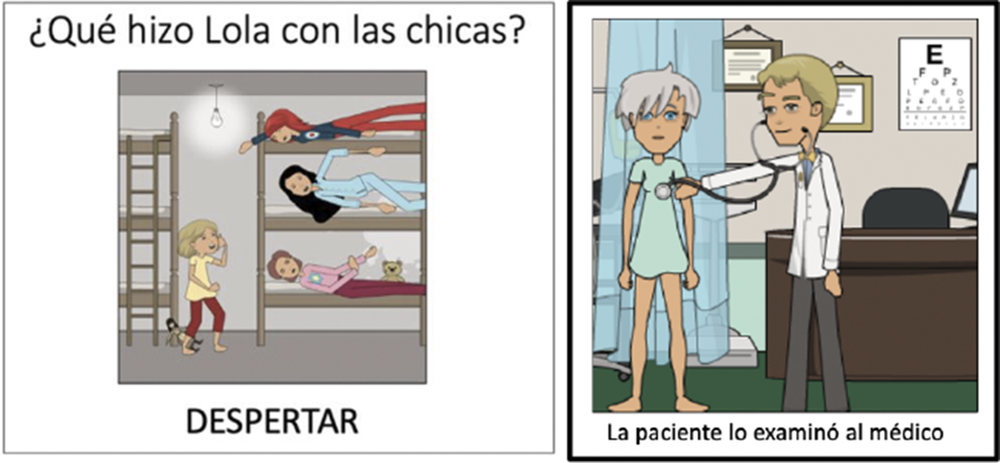
For the treatment task, a third list with 20 target items and 20 fillers was created. Items consisted of a full sentence containing accusative clitic doubling, the unattested construction that was the focus of this task, and a picture (Figure 2). However, the target sentences never matched the pictures, as the characters depicted participants’ computer screen. Participants were asked to read the sentence and to look at the picture. Then, they had to decide whether the sentence accurately described the picture or not by clicking on either “cierto” (true) or “falso” (false). After they clicked on one of the options, they were taken to a new screen where they received feedback and, if the answer was false, they were shown the picture again without its accompanying sentence. Here, they had to produce a new sentence to accurately describe the picture. It was in this new sentence where participants could show a priming effect from the sentence they had read. All items in the treatment task were presented in a randomized order.
Both the AJT and the three priming tasks were completed in the same session. Half the participants completed the AJT first and the priming experiment last, and vice versa. When completing the priming experiment, participants were given a 5 minute break between each task (pre-test, treatment and post-test). Additionally, and in order to space out the AJT and the priming experiment as much as possible, in between those two things participants completed other, unrelated tasks which were part of a different study not reported here. Generally, there was 1 hour and 15 minutes between the first and the last task of the session.
3.3. Results
Participants’ responses to the AJT showed that sentences with accusative clitic doubling received overall lower ratings than sentences without accusative clitic doubling in all three groups (Figure 3). However, descriptive results also showed that heritage speakers gave higher ratings to sentences with accusative clitic doubling than the other two groups tested.
Descriptive results from the AJT testing accusative clitic doubling (Study 2). Note. Bars represent mean ratings computed across all trials. Error bars represent standard error (SE). NS = native speakers; FG = first-generation immigrants; HS = heritage speakers.
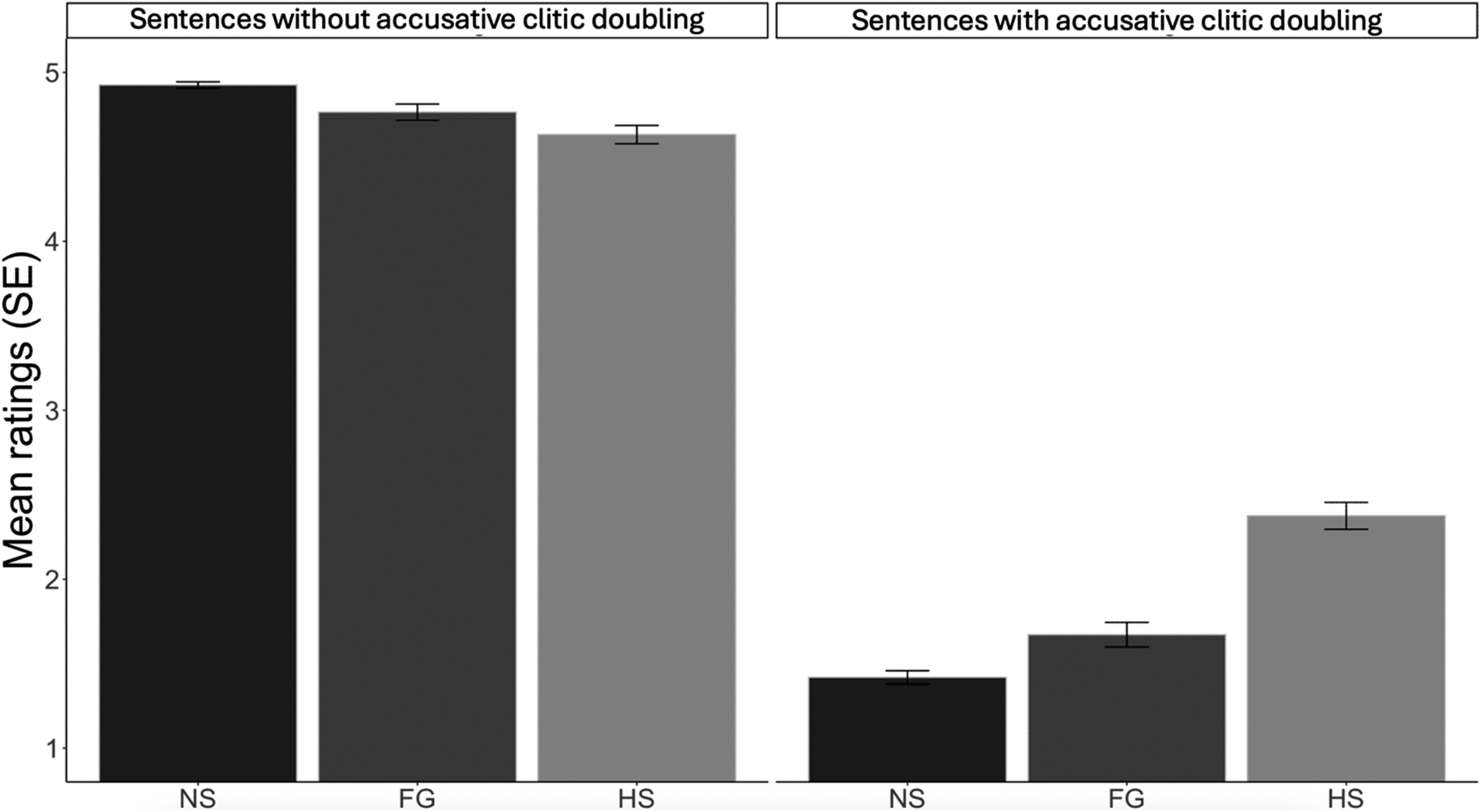
An ordinal mixed-effects regression model similar to the one of Study 1 was run with the ratings as the dependent variable and with group, condition and an interaction between the two as fixed effects. The random effects structure included random intercepts and a random slope for condition by subject, as well as random intercepts and a random slope for group by item. All factors used dummy coding. Native speakers from Spain and sentences without accusative clitic doubling were chosen as reference levels for each of the fixed effects, respectively. Results from this model showed that the differences observed in the descriptive analysis were significant. Native speaker participants rated canonical sentences without accusative clitic doubling higher than sentences with doubling (SE = 0.72, β = − 9.60, p < .001) and heritage speakers’ ratings differed significantly from those of the native speakers from Spain (SE = 0.60, β = − 1.45, p = .016). Likewise, the interaction between condition and group was also significant, with heritage speakers giving higher ratings to sentences with accusative clitic doubling compared to native speakers in Spain and sentences without accusative clitic doubling (SE = 0.84, β = 4.16, p < .001).
The relationship between the individual variables (i.e., fluency and frequency of language use) controlled for and the degree of acceptability of accusative clitic doubling was also explored via a second ordinal mixed-effects regression model. This time, we used a subset of the data coming from sentences with accusative clitic doubling. Ratings were the dependent variable and group, fluency and frequency of language use of Spanish were entered as fixed effects in the model. Lastly, random intercepts by subject and by item were included as random effects. However, neither fluency nor frequency of language use were significant (p > .05).
As for the results of the priming experiment, participants’ responses were recorded and were later transcribed and coded attending to the presence or absence of the target construction. Thus, each sentence was coded as “yes” or as “no,” depending on whether the structure used contained accusative clitic doubling or not. Descriptive analyses showed that participants barely produced the accusative clitic doubling structures (Figure 4). The greatest increase in production was observed in the heritage speaker group during the treatment and post-test tasks, but especially in the treatment.
Mean production of accusative clitic doubling in the oral priming experiment in percentages (Study 2). Note. Error bars represent standard error (SE). NS = native speakers; FG = first-generation immigrants; HS = heritage speakers.
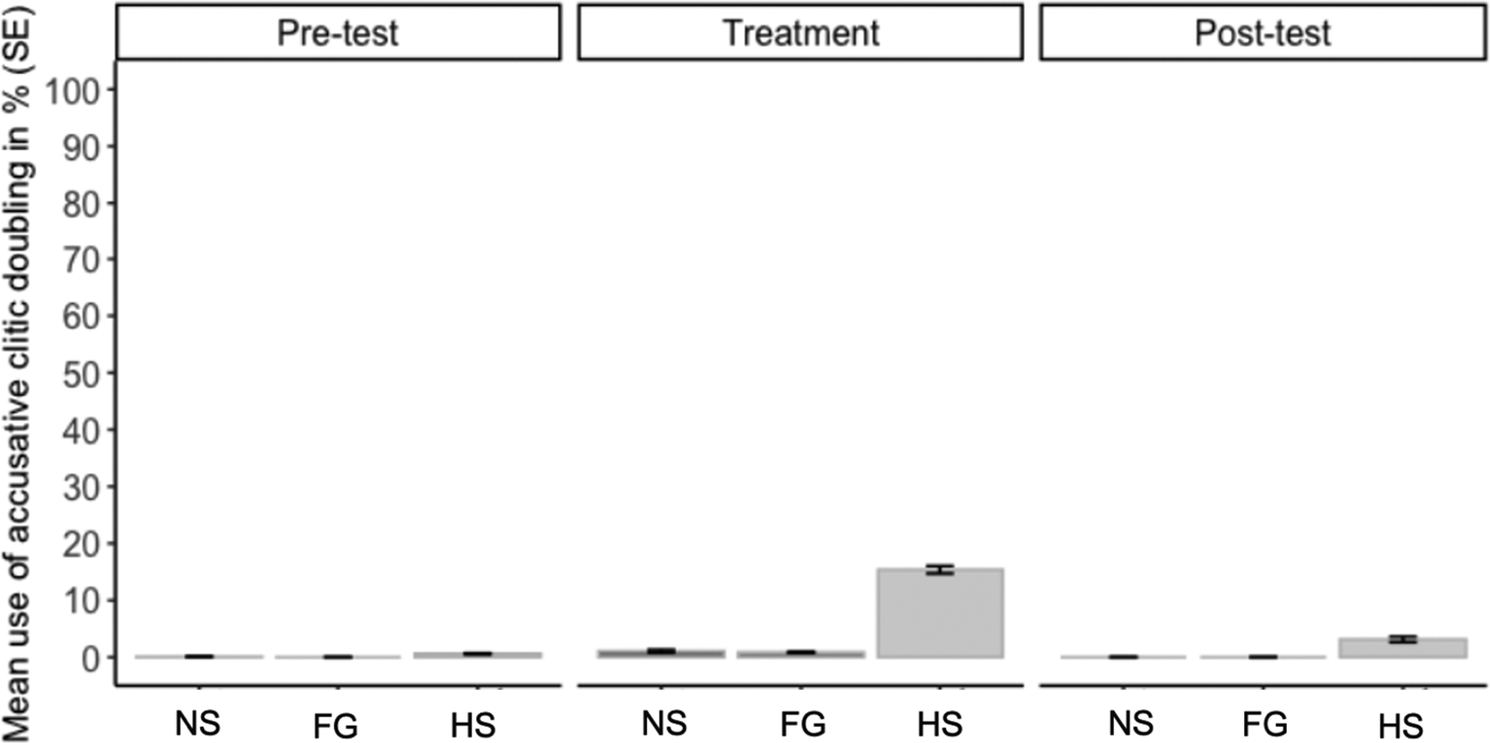
A mixed-effects binomial logistic regression model using the lme4 package in R (Bates et al., Reference Bates, Mächler, Bolker and Walker2015) was conducted to examine whether the differences observed in the descriptive analysis were significant. We started out with the maximal random-effects structure possible and then simplified it until convergence. Target production of accusative clitic doubling was the binomial dependent variable (coded as “yes” or “no,” and where “yes” was coded as 1 and “no” was coded as 0). Task and group were entered as fixed effects in the model, together with an interaction between task and group, and subject and item were entered as random effects, all of them using dummy coding. The pre-test was chosen as the reference level for the task and heritage speakers were chosen as the reference level for the group. Although the original idea was to use one of the baseline groups as the reference level, the low number of target constructions produced by those groups forced us to change this reference level, or else the model would not converge. The output of the model showed that there was a significant effect of both the treatment and the post-test tasks (Table 5), as more clitic doubling constructions were produced in those tasks than in the pre-test. Likewise, heritage speakers also produced significantly more clitic doubling constructions than the native speakers in Spain.
Mixed-effects binomial logistic regression model for the priming experiment
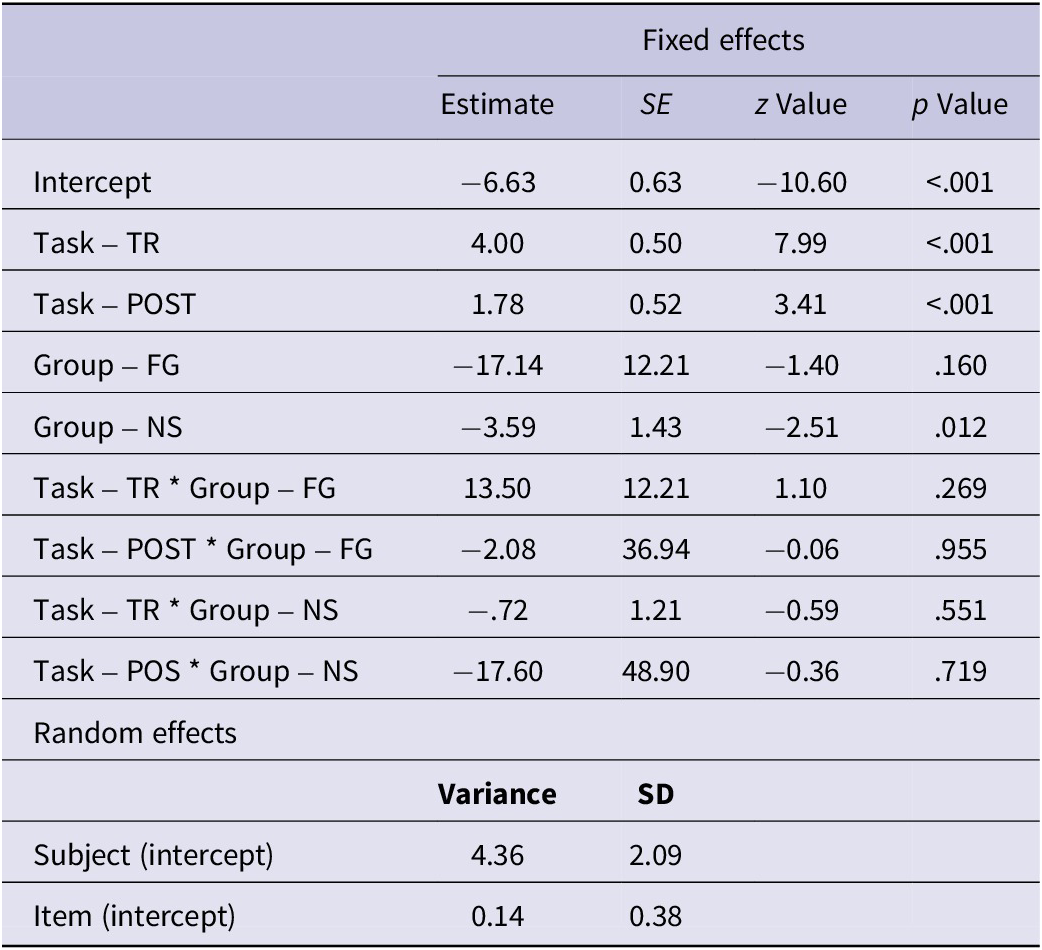
TR = treatment task; POST = post-test task; FG = first-generation immigrants; NS = native speakers
In addition to running this first model, we also explored whether the individual variables fluency and frequency of language use in Spanish could explain part of the results. A second mixed-effects binomial logistic regression model was run using only data from the heritage speakers in the treatment task. This time, we looked at whether the dependent variable, production of accusative clitic doubling (coded as “yes” or “no”), varied depending on either fluency or frequency of language use in Spanish, which were centered and entered as fixed effects in the model. Random intercepts by subject and item were also included as random effects. The output of this second model showed a significant effect on the frequency of language use of Spanish (SE = .03, β = − .07, p = .025), such that the more a speaker used Spanish, the fewer accusative clitic doubling structures they produced. Lastly, we also looked at whether there was a relationship between the degree of acceptability of sentences containing accusative clitic doubling and the amount of these constructions produced by heritage speakers. Here, we ran a simple linear regression to predict the production of accusative clitic doubling constructions among heritage speakers based on acceptability ratings, but it did not reach significance: (F(1, 36) = 0.73, p = .398, R2 = .02).
A closer examination of the sentences produced by heritage speakers showed that, in some cases, these participants produced sentences that did not match exactly the target structure (11a). More specifically, out of the 123 target sentences containing clitic doubling that heritage speakers produced in the treatment task overall, 28 of them diverged from the prime structure (22.7%). The most common deviation was cases of “leísmo” (use of the dative clitic le instead of the accusative clitics lo/la) (11b), which were found in 22 out of the 28 divergent sentences (78.6%). The remaining sentences deviated from the target structure in that they contained gender mismatches. Specifically, participants used the masculine singular clitic lo instead of the feminine singular clitic la (11c). Because these deviations were not attested in the pre-test task, they were considered cases of syntactic priming, as these were all instances of clitic doubling.
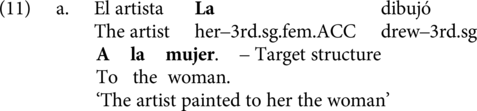
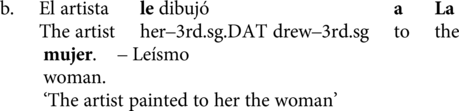
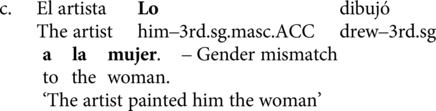
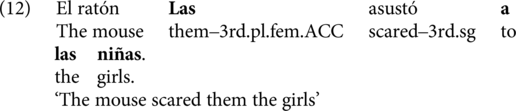
In the post-test task, however, out of the 25 target sentences containing clitic doubling, only 1 of them (4%) diverged from the target (a case of “leísmo”), whereas the remaining sentences constituted cases of standard accusative clitic doubling constructions (12). Overall, cases of “leísmo” appeared with both feminine and masculine direct objects (14 cases of “leísmo” with feminine nouns and 15 cases with masculine nouns), despite the fact that “leísmo” is more common in the masculine form across the Spanish-speaking world (DeMello, Reference DeMello2002; Kany, Reference Kany1970; Fernández-Ordóñez, Reference Fernández Soriano, Bosque and Demonte1999; Uruburu, Reference Uruburu1993).
To summarize, Study 2 found that heritage speakers barely produced any accusative clitic doubling structures in isolation, just like the first-generation immigrants in the United States and the native speakers in Spain. However, a brief priming task that exposed them to the target structure changed their preferences and made them produce several instances of accusative clitic doubling. In fact, this priming effect was strong enough to extend to a post-test task conducted 5 minutes later and which no longer involved exposure to the target structure. This suggests that if experienced frequently in daily life, structural priming may lead to priming in the long-term, the first step for implicit learning to take place, and eventually, language change at the individual level.
4. Discussion
In the last two decades, research on heritage speakers has identified multiple sources of variability in these speakers (e.g., parental input, education and language attitudes). In the present study, we looked at the role of recent input, measured via exposure to an innovative structure in two AJTs (Study 1 and Study 2) and in a structural priming task (Study 2). Our goal was to determine whether heritage speakers, whose grammars may be unstable and less consolidated than those of monolingual speakers due to fluctuations in input and language use along the lifespan, could accept and adopt structures from other varieties of their heritage language.
Since accusative clitic doubling is not a frequent structural pattern beyond the Spanish varieties that actively use this construction, in Study 1 and in Study 2 we used an AJT to assess the acceptability of this structure by speakers who are not generally exposed to it. Although sentences with accusative clitic doubling were rated largely unacceptable in both studies, the heritage speakers in the two studies were significantly more accepting of accusative clitic doubling than Spanish speakers in Mexico and in Spain, and than first-generation immigrants in the U.S. (baseline groups). This effect seemed to be modulated by the degree of language experience since simultaneous bilingual heritage speakers were more accepting of innovative structures than sequential bilingual heritage speakers.
Still, compared to the widely attested omission of DOM by heritage speakers documented in many studies (Montrul & Bowles Reference Montrul and Bowles2009; Cuza et al. Reference Cuza, Miller, Pérez Tattam and Ortiz Vergara2019) and again in Study 1, the acceptance of accusative clitic doubling is considerably lower than the acceptance of unmarked direct objects. As a change in U.S. Spanish, the omission of DOM is far more extended and advanced, because it is produced more often, perhaps, by both heritage speakers, L2 learners of Spanish, and long-term immigrants, than accusative clitic doubling. If the omission of DOM is an established change (see Montrul Reference Montrul2022 and in press for arguments that this may be the case), the production and acceptance of accusative clitic doubling could be considered an incipient change, manifested to a certain extent in a limited number of speakers. The same can be said of the incipient trend observed in several Latin American Spanish varieties that DOM is expanding to inanimate objects (Bautista Maldonado & Montrul, Reference Bautista Maldonado and Montrul2019).
The priming experiment in Study 2 sought to further confirm whether patterns of incipient change observed in an AJT would also be attested in production. The priming task showed that, even though the heritage speakers patterned with the baseline groups in production, they were primed to a certain extent, and the effect extended to a post-test task conducted a few minutes later (i.e., long-term priming effects). We attribute this susceptibility to priming by heritage speakers to the unstable state of their grammars, following Putnam (Reference Putnam2019). In fact, the negative correlation found between the frequency of language use in Spanish and the degree of priming supports this possibility. That is, the more unstable and the less entrenched their grammars are, the more likely it is for heritage speakers to adopt an innovative structure.
Previous research has shown that adult heritage grammars are more susceptible to recent input via structural priming when compared to monolingually raised speakers. For example, Hurtado and Montrul (Reference Hurtado and Montrul2021) tested whether heritage speakers of Spanish could increase their production rates of dative clitic doubling constructions (“Jaime le dio el libro a Carla,” Jaime gave Carla the book) after being exposed to such structures during a priming task. Although in a baseline task heritage speakers had a preference for sentences without dative clitic doubling (“Jaime dio el libro a Carla,” Jaime gave the book to Carla), the priming task significantly increased the production of the target construction. The study also found that the priming effect was significantly stronger among heritage speakers than among monolingual Spanish speakers. Altogether, the study showed that constructions that are frequent in a language can be easily primed among heritage speakers. Here, we extend this finding to cases when the prime structure comes from a different language variety, and it is thus infrequent for heritage speakers. Furthermore, because the prime structure we tested – accusative clitic doubling – also represents an incipient stage of a diachronic language change in Spanish, the speakers’ heritage language, we suggest that structural priming is a likely mechanism to trigger language changes at the individual level, in line with similar proposals (Carando, Reference Carando2015; Fernández et al., Reference Fernández, de Souza and Carando2016).
A limitation of our study is that the language background questionnaire did not include detailed questions about the number, language and ethnicity of the participants’ interlocutors beyond their homes. Therefore, we do not know whether and to what extent the heritage speakers in the two studies may have been exposed to speakers of the Argentine variety. The heritage speakers reported speaking Spanish primarily at home with their parents, who tended to speak the same language variety as them (in this case, Mexican Spanish most of the time). Argentinian speakers are the least common Spanish speakers to find in the United States, based on Census data reporting the number of immigrants by Spanish-speaking countries (Escobar & Potowski, Reference Escobar and Potowski2015), and most of them tend to live in Southern states (e.g., Florida). Although our participants were residents of Chicago and Central Illinois, they might have been exposed to these structures on a regular basis if they interacted with some Argentines, but it is highly unlikely.
If heritage speakers of Mexican origin accept to some extent accusative clitic doubling when it is not acceptable in the Mexican Spanish variety, we wonder whether heritage speakers of the varieties where accusative clitic doubling is commonly used, such as Argentinian Spanish, would be even more accepting of these constructions. Given that there are many varieties of Spanish spoken in the United States and cross-dialectal contact phenomena are frequent (Escobar & Potowski, Reference Escobar and Potowski2015; Otheguy & Zentella, Reference Otheguy and Zentella2011), it is unclear how heritage speakers of Argentinian Spanish, for instance, would respond to the types of tasks we included in our studies. Perhaps they continue using accusative clitic doubling as adults, provided that they were exposed to this construction at home, through their parents. At the same time, it is also possible that exposure to other varieties of Spanish spoken in the local community would lead them to decrease their production rates of such structure. Alternatively, heritage speakers of Argentine origin may also influence the oral production of heritage speakers of other Spanish-speaking backgrounds by priming them with accusative clitic doubling, as Study 2 showed. These are all hypotheses we are currently pursuing in ongoing research since they would help us better understand the role of structural priming in language contact areas.
Our results suggest that the grammars of heritage speakers are more flexible and capable of entertaining grammatical possibilities that are attested in other languages or varieties of the same language. For example, not only did the heritage speakers in our studies accept sentences with accusative clitic doubling but they also used sentences with “leísmo” (replacing accusative clitics with dative clitics), which is common in some areas of Spain but not necessarily in Mexican Spanish. In Study 1 and in several other previous studies (Montrul & Bowles, Reference Montrul and Bowles2009, Montrul& Sánchez-Walker, Reference Montrul and Sánchez-Walker2013), heritage speakers also produced and accepted transitive sentences with animate and specific direct objects without DOM, which is ungrammatical in Spanish but grammatical in many languages of the world, including English. An intriguing question raised by an anonymous reviewer is whether heritage speakers would be equally primed with ungrammatical structures in general, including those that are not attested in other languages. This is an empirical question, that remains to be tested, but our prediction is that heritage speakers may be primed with ungrammatical structures that they themselves produce if these are part of their linguistic representations. We suspect that heritage speakers may be less likely to be primed with ungrammatical sentences that are ungrammatical in their language and other languages.
Since in our study, we linked susceptibility of priming to degree of “grammatical stability” in heritage speakers, we predict that priming is possible whenever we have a prime structure that is unstable in heritage speakers, regardless of whether it exists in other varieties or not. In the case of accusative clitic doubling, because doubling is the required option in some contexts (i.e., with personal pronouns, such as in La vi a ella “I saw her”), an unstable syntactic representation of that structure might favor a priming effect in cases where they are exposed to the innovative structure (i.e., accusative clitic doubling with full DPs, such as in La vi a María “I saw Maria”). Similarly, if heritage speakers were primed with a structure whose syntactic representation is stable, priming would not occur, just like what happened with the baseline speakers. To support the claim that their syntactic representation of accusative clitic doubling is unstable, we have the data from the AJTs showing that heritage speakers had higher ratings for accusative clitic doubling than the other groups, as well as the inverse correlation found between frequency of heritage language use and degree of priming.
Finally, we believe that future studies should further examine individual differences among heritage speakers. Although we controlled for some linguistically related variables (e.g., frequency of language use), little is known about how other cognitive variables might have affected our results, especially in Study 2, where we tested structural priming. Previous research has shown that structural priming is a very variable phenomenon that often affects some speakers more than others (Chia & Kaschak, Reference Chia and Kaschak2022). Unfortunately, structural priming research looking at individual differences is scarce, with only some pedagogically oriented studies conducted with L2 learners (Coumel et al., Reference Coumel, Ushioda and Messenger2022a, Reference Coumel, Ushioda and Messenger2022b, Reference Coumel, Muylle, Messenger and Hartsuiker2023; McDonough & Trofimovich, Reference McDonough and Trofimovich2016; McDonough et al., Reference McDonough, Kielstra, Crowther, Smith, Mackey and Marsden2016). Possible cognitive variables of interest could be short-term memory, awareness or attention. Still, there is a need for more priming studies with heritage speakers testing a variety of constructions, ideally comparing structures that we know are vulnerable for heritage speakers versus structures that we know tend to be more native-like or stable to understand the potential mechanisms of language change at the individual level in this population.
5. Conclusion
In this study, we have examined how language change may happen at the individual level in heritage language speakers. We focused on the low but consistent acceptance by some heritage speakers of Mexican Spanish of accusative clitic doubling constructions, which are unacceptable in their variety of Spanish but acceptable in other varieties of Spanish. Although we assumed that these speakers were unlikely exposed to these structures on a regular basis, some of them accepted them in acceptability judgment tasks significantly more than the baseline groups. We then examined whether language priming might be a mechanism for language change in these speakers. Through a production task with priming, we found that the heritage speakers were sensitive to priming, while the baseline speakers were not. This study shows that heritage speakers’ grammars are more flexible and entertain other grammatical possibilities, probably due to their inherent “instability.”
Data Availability Statement
The data that support the findings of this study are openly available in FigShare (DOI: 10.6084/m9.figshare.26962051).
Competing interest
None declared.


 Open access

