

Introduction
When do relations between a rising state and a hegemonic state deteriorate? Worsening US–China relations across the diplomatic, economic, and military domains have made these questions increasingly pertinent. However, most international relations studies on the topic forgo explaining why and how relations between a rising state and the hegemonic state vary over time. They tend to ignore that there is no linear route or inevitable path to conflict, as relations have also improved again after periods of tension. In this article, we extend the baseline that power transition theory provides by including temporal scope conditions and proposing a causal mechanism from systemic incentives to the rising state’s strategy. A rising state’s challenge to the hegemonic state is contingent on two variables: when, over time, the rising state translates its gross power rise into advanced military capabilities, and to what degree it perceives the hegemonic state to have resolve. This in turn allows developing more granular expectations for conflict deterioration between the rising state and hegemonic state. To demonstrate the utility of our theory we explore three case studies: US–China relations from 1991 to 2024 (low-level deterioration), Spain–Portugal relations from 1469 to 1494 (stabilisation), and Germany–UK relations from 1871 to 1914 (higher-level deterioration).
To investigate relations between hegemons and rising states, scholars conventionally hark back to one of the most widely used approaches in the field: power transition theory. Adherents of power transition theory suggest that when a dissatisfied rising state’s growth rates outpace that of the hegemonic state, the former’s escalation risks and costs decrease. The rising state is then more likely to use its newly attained power to challenge the international order’s status quo; relations between it and the hegemonic state deteriorate.Footnote 1
This literature offers a baseline to explain when relations deteriorate but faces two key theoretical challenges. First, power transition theory suggests under which conditions the relations between the rising state and the hegemonic state deteriorate, but it does not explain when this process occurs. It provides longer-term, probabilistic theorisation,Footnote 2 but these long-term expectations are challenged by empirical observations of non-linear developments, bursts, and jumps.Footnote 3 It cannot explain, for example, why US–China relations changed from relatively stable during the 1990s and 2000s to deteriorating relations since the 2010s. Recent research has therefore highlighted the need to revisit theoretical explanations to better understand the conditions under which conflict between the rising state and hegemonic state may escalate or stabilise.Footnote 4 Second, power transition theory lacks a clear causal mechanism by which international systemic incentives are translated into the rising state’s strategy. Power transition theory conceptualises the expected transition between a rising state and a hegemonic state, but not the transitioning. This transitioning process translates international systemic incentives, like the power transition theory baseline’s growth rate differentials between the rising state and hegemonic state, into the rising state’s strategy.
This article makes three main contributions. First, this article contributes to theory development, extending power transition theory by adding temporal scope conditions and explicitly including strategic choice. This reframes power transition as a contingent, non-linear process. Specifically, we explore the order by and sequence in which variables affect state strategy, and by extension international systemic outcomes. By explaining when, over time, the rising state’s strategy is driven more by international factors and when more by domestic factors, we seek to address a core theoretical challenge in multi-factorial approaches such as neoclassical realism.Footnote 5 A better understanding of when relations deteriorate between a rising state and a hegemonic state also helps explain when power transitions in international affairs turn conflictual. This contributes to key debates around temporality, context, and the role of history.Footnote 6 While conventionally, neoclassical realist approaches adopt baselines rooted in scholarship from Kennth N. Waltz, John J. Mearsheimer, or Robert Gilpin,Footnote 7 we introduce a version rooted in that of A. F. K. Organski. This opens theoretical space to not automatically associate bipolarity with stability, which overlooks the key role of the rising power for potential escalation or de-escalation. This offers also an avenue to contribute to so-called type III approaches in neoclassical realism.Footnote 8
Second, this article contributes to empirical research by offering an analytical lens that opens novel avenues for empirical research about great power politics.Footnote 9 We reveal previously uncovered and critical variation in the power transitions of three emblematic cases of power transitions. Finally, this article contributes to policy debates. By elucidating how the political process in the rising state shapes the power transition process, we offer avenues to considering better strategic choices.
The remainder of this article proceeds in four steps. The first section introduces the power transition theory baseline and opens the theoretical space to extend it. The second section extends the power transition baseline by introducing scope and boundary conditions. The third section explores the cases of US–China, Spain–Portugal, and Germany–UK. The conclusion section discusses broader implications from our research for the study of international relations and the future of US–China relations.
The power transition theory baseline
Power transition theory provides a baseline to examine how relations vary over time between a rising state and a hegemonic state.Footnote 10 Much of the extant power transition literature focuses on the hegemonic state, for example how it may engage in imperial expansion until the costs of overstretch outweigh the benefits.Footnote 11 This offers insights in the hegemonic state’s role in the power transition. However, considerable explanatory value can be gained through a theory that focuses on the rising state.Footnote 12
Power transition theory expands on the conditions under which a rising state challenges a hegemonic state. It proposes that the rising state’s risks and costs of escalation decrease when the rising state meets the criteria of the power transition theory baseline. These criteria include that the rising state (a) is frustrated with the international order’s status quo, (b) enjoys higher growth rates than the hegemonic state, and (c) attains power parity with it. Power parity is defined as a situation where a rising state attains 80 per cent of the power capabilities of the hegemonic state or of the alliance.Footnote 13 This is conventionally measured through indicators like gross domestic product (GDP) and military spending in the Composite Index of National Capability (CINC). It includes for example ratios concerning population size, iron and steel production, energy consumption, military expenditure, and military personnel.Footnote 14 This produces a probability distribution that sets the menu of available strategic choices for the rising state. When the rising state meets the three criteria, it is more likely to use its newly attained power to challenge the international order’s status quo, and relations with the hegemonic state deteriorate.Footnote 15 In other words, the question is not how China operates in a ‘historical vacuum’ devoid of the US’s role and may suddenly choose to escalate. The question is also not if it is either the hegemonic state or the rising state that generates the power transition outcome. Rather, the question is what, theoretically, provides additional explanatory power beyond the role of the hegemonic state; empirically, given the US’s relatively constant military presence in the Asia–Pacific and reliance on partner states in the region for nearly seventy years, under which conditions China can be expected to more likely challenge the United States.Footnote 16
When we focus on the role of the rising state in power transitions, we open theoretical space for two critical insights. First, it enables us to better grasp the rising state’s strategy, including how it may challenge (or not) the hegemonic state across the military, economic, and diplomatic domains. Some scholars categorise rising states as revisionist and hegemonic states as status quo without distinguishing between different domains.Footnote 17 However, a rising state can exhibit revisionist or status quo–oriented behaviour contingent on domain and time (for example in the short versus long term). In turn, the hegemon may promote openness of the international order and cooperation with the rising state by providing public goods like a stable international economy that supports international trade and investment.Footnote 18 This may lead the rising state to postpone its lingering frustration with the current order and tolerate the hegemonic state. The rising state may then seek gratification only when it thinks its growth will end.Footnote 19 This suggests that states may exhibit different types of revisionism, akin to a more fine-grained distinction into revolutionary and revisionist powers.Footnote 20 Even when the rising state has reached the power transition baseline criteria, then, it still has a strategic choice vis-à-vis the hegemon: it may choose to escalate, but also to stand firm or even back down.
Second, focusing on the rising state’s challenge to the hegemonic state can help explain how power transitions and associated conflictual dynamics play out across domains and over time. In particular, if a rising state can exhibit revisionist behaviour that varies per domain and time, dichotomous categories to evaluate the systemic outcomes of power transitions – war either occurred or did not – are insufficient to grasp dynamics of deterioration and stabilisation. War may not occur between the rising state and the hegemonic state even as their relations deteriorate severely in, for example, diplomatic and economic terms. If a rising state can challenge the hegemonic state depending on domain and time, an outcome continuum focusing on only one domain also insufficiently captures their relationship. This means that a multi-domain continuum helps to explore cases of power transition that do not easily fit with extant theoretical explanations (i.e., those cases of power transition that did not result in war).
We investigate how power transitions move on a continuum that spans stabilisation, lower-level deterioration, and higher-level deterioration. Stabilisation refers to a continuous situation where cooperation is high and where antagonism in terms of deteriorating relations across diplomatic, military, and economic domains is mostly absent. This implies an absence of recurring coercive incidents, limited or no disruption of international institutional arrangements, and no use or credible threat of force that alters the status quo. Lower-level deterioration refers to recurrent instances of non-cooperation, which may include disrupting or severing diplomatic, economic, and military relations, including temporarily and spatially constrained crises and near-crises in the absence of war.Footnote 21 This implies the presence of repeated but contained occurrences of non-cooperation and coercion across one or more domains – such as sanctions, military posturing, diplomatic suspensions, or crises – that disrupt relations without escalating to sustained armed conflict or fundamentally overturning the status quo. Higher-level deterioration entails instances of armed conflict up to general war. It implies the escalation from limited coercion to sustained armed conflict, including the deliberate use of force, crossing of established red lines, or military operations that fundamentally alter institutional arrangements. Movement up or down the continuum depends on several aspects, including whether states change diplomatic or economic relations, claim contested territory, escalate or de-escalate international crises, shift strategic focus, conduct military exercises, or deploy military capabilities.Footnote 22
Extending the power transition theory baseline
Extending the power transition theory provides a baseline and explains the rising state’s strategy choices vis-à-vis the hegemonic state and how these choices affect power transitions – rather than deal with them either deterministically or probabilistically as the power transition theory baseline suggests, we must sacrifice some of the parsimony of power transition theory for more specificity by adding variables.Footnote 23 These additional variables influence the shape and timing of the rising state’s strategic choices and, thus, how it navigates challenges and opportunities provided by international systemic incentives.Footnote 24 They operate as unit-level variables that complement and specify the power transition theory baseline.
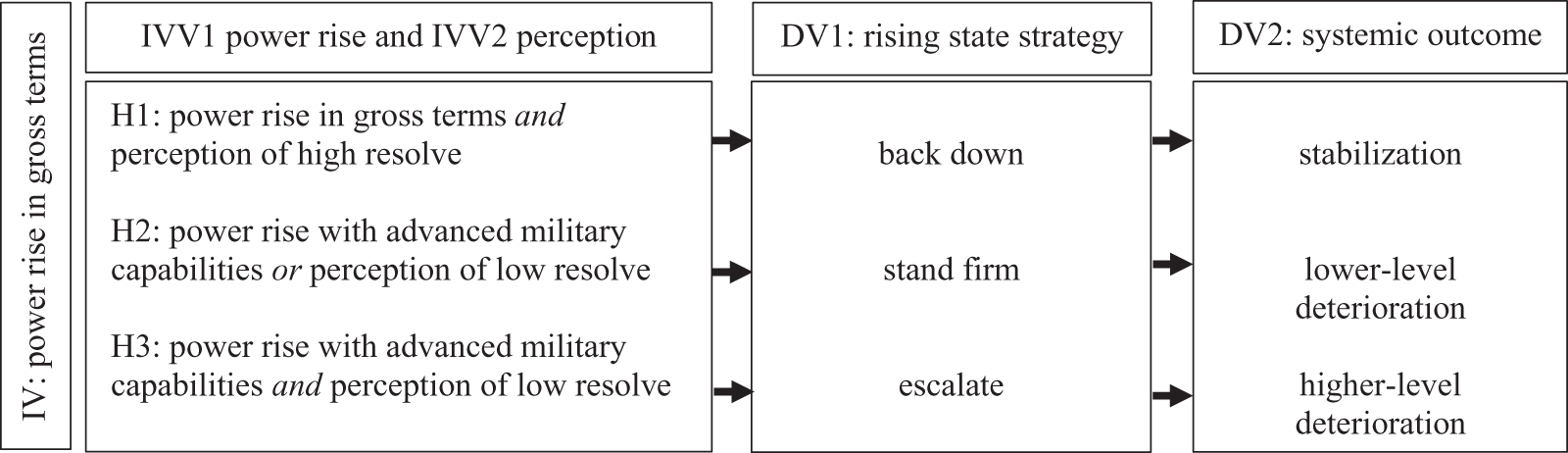
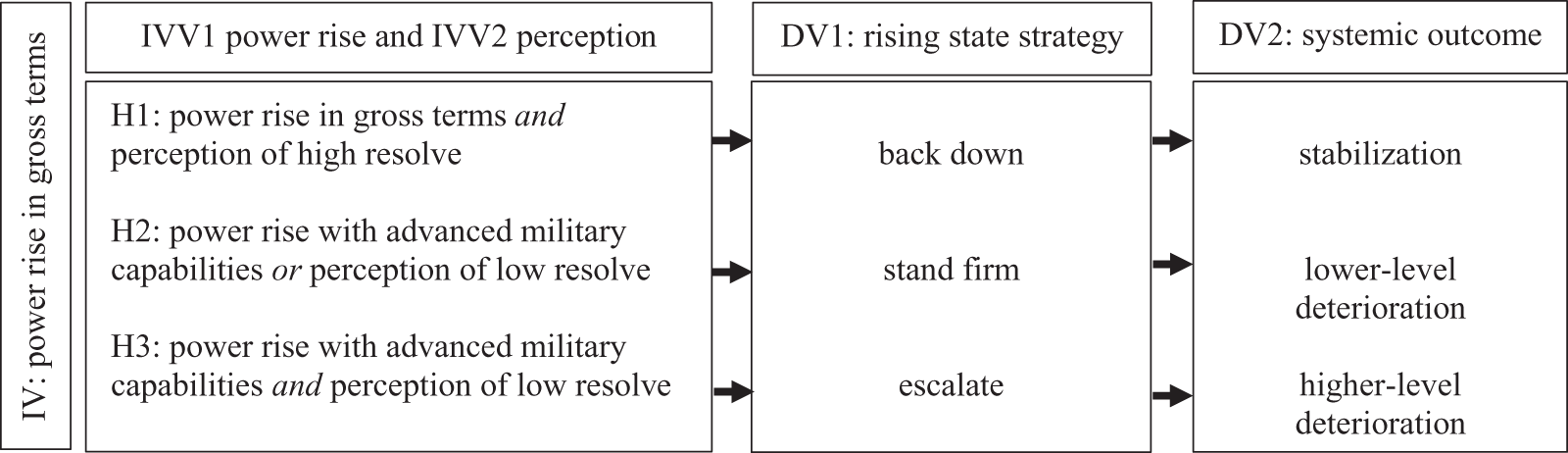
We focus here on two intervening variables to further specify the rising state’s strategy: type of power rise and perception of resolve. Specifically, we suggest that (a) the type of power rise and (b) the perception of hegemonic resolve intervene to produce the rising state’s particular strategic choices and thereby affect the power transition with the hegemonic state. The rising state’s power rise relates to the development of advanced military capabilities and is relative to the hegemonic state’s capabilities. The rising state’s perception of the hegemonic state’s resolve relates to the latter’s behaviour. This means that the relationship between the power transition theory baseline on the one hand and the type of power rise and perception of resolve on the other hand represents a ‘transitive interplay between systemic and non-systemic factors; that is, … the ways in which systemic factors activate a number of non-systemic causal mechanisms, leading to the explained trends and patterns’.Footnote 25 Note that the type of power rise and the perception of hegemonic resolve are temporarily and analytically prior to the rising state’s strategic behaviour. This means that these intervening variables are identified prior to, and independently of, the strategic choices they are meant to explain. This logic is illustrated in Figure 1.
Power transition variables.

Intervening variable 1: Type of power rise
The first intervening variable we consider is the rising state’s rise in power, distinguishing two different yet interlinked types of power rise. The first type of power rise is that the rising state develops power in gross terms. This is captured in the power transition theory baseline and measured through the rising state enjoying higher growth rates than the hegemonic state and nearing power parity with it in terms of indicators like gross domestic product, military spending, and iron and steel production. Because the rising state becomes more powerful, its range of possible strategic choices expands from backing down to standing firm and escalating. The second type of power rise occurs when the rising state translates, over time, its gross power rise into advanced military capabilities. Extant scholarship has long argued that the particular advanced military capabilities the rising state develops help improve explanatory accuracy regarding its behaviour. We extend this line of research by clarifying the time horizon that spans the transformation from gross power into advanced military capabilities. This explains not only when the rising state’s menu of strategic options expands from backing down (when it grows only its gross power) to standing firm but also when it escalates (when it develops advanced military capabilities).
This means that these two types of power – gross power and advanced military capabilities – are different sides of the same coin. Time horizon and time-lag between the moment when a rising state develops more gross power and the moment when it translates its newly attained gross power into advanced military capabilities are key to power transition. This time-lag for the rising state to translate gross power into advanced military capabilities is context specific. On the one hand, over time in history state bureaucracies became more efficient and centralised to extract societal resources and shortened the time-lag.Footnote 26 On the other hand, state bureaucracies can regress when significant reorganisations of the state bureaucracy occur. The time-lag may also grow as, over history, military technologies become increasingly complex. This increasing technological complexity complicates efforts by states, for example, to imitate the hegemonic state’s best military technologies.Footnote 27
Intervening variable 2: Perception of hegemonic resolve
The second intervening variable is the rising state’s perception of the hegemonic state’s resolve. How the rising state responds to the hegemonic state depends on how the former perceives the latter’s resolve to protect its interests, act on its threats, and endure escalation costs.Footnote 28 The rising state’s perceptions of the hegemon’s resolve relate to the latter’s willingness to prevent decline to the extent that the hegemonic state’s behaviour is easy to interpret; otherwise, perceptions depend on cognition.Footnote 29 One state learns, for example, from the past behaviour of the other state something about what to expect about the latter’s future behaviour.Footnote 30 The hegemonic state can signal which action it wants the rising state to refrain from, and which threat the former will execute in case the latter defies it. In doing so, the hegemon may increase the likelihood of successful deterrence. The credibility of the hegemon’s signalling depends on the perceived costs associated with the signal itself or with backing down from it.Footnote 31 The rising state’s leaders update their perceptions of the hegemonic state’s resolve when the latter changes its strategy, for example from standing firm to backing down.Footnote 32 They update their perceptions of the hegemon’s resolve when the latter’s behaviour departs from the former’s existing perceptions.Footnote 33
This perception of resolve variable merits a clarification about evidentiary hierarchy and inferential criteria. Our empirical analysis below privileges contemporaneous accounts where available. Elite statements were treated as evidence of perception when corroborated by other elites (where available) or by secondary sources. We paid careful attention to the difference between contemporaneous perceptions and ex post rationalisations, and to sequencing perceptions and behaviour (that is, whether the inferred perception precedes and plausibly shapes behaviour). We also acknowledge, where relevant, contradictory evidence.
Dependent variables: Rising state’s strategy and power transition outcome
This means that the power transition theory baseline criteria – higher growth rates than the hegemon, power parity, and dissatisfaction with the status quo – are necessary but insufficient conditions for a rising state to stand firm or escalate. We supplement them with the rising state’s type of power rise and its perception of the hegemon’s resolve to explain the rising state’s choice to stand firm or escalate.
The particular combination of these variables – the power transition theory baseline, the type of power rise, and the perception of resolve – generate variation on the dependent variables. Dependent variable 1 is the rising state’s strategy. This is measured by indicators like the rising state’s foreign military and economic policy and diplomacy. For example, a stand firm policy may include military build-up and coercive diplomacy without escalation of a direct military attack. Dependent variable 2 is the international systemic outcome of variation in the relations between the rising state and the hegemonic state. This is measured, as detailed above, along the multi-domain continuum of their relations (stabilisation, low-level deterioration, or high-level deterioration). The intervening variables of type of power rise and perception of resolve are identified before, and independently of, the strategic choices (Dependent variable 1) they are meant to explain.
This generates three hypotheses. The three hypotheses each represent a different stage of the power transition. Each hypothesis relates to different stages of the rising state’s power rise and the perceptions that it holds about the hegemonic state’s resolve. How the power transition likely develops (stabilisation, lower-level deterioration, or higher-level deterioration) is contingent on the rising state’s type of power rise and the perception of resolve over time. Dependent variable 2, the international systemic outcome of the relations between the rising state and the hegemonic state, is contingent also on the strategy of the hegemonic state or hegemonic coalition, since power transition is an interactive process. In order not to overcomplicate our theoretical apparatus, we do not consider in detail the hegemonic state’s strategy in response to the rising state’s strategy. This means that we largely forgo interactive effects at the level of theory. Instead, we focus on the rising state’s strategy’s likely effects on transitioning. We return to this point in the article’s conclusion.
The first hypothesis is: when the rising state forgoes translating gross power into advanced military capabilities and perceives the hegemonic state to have high resolve, it is more likely to back down (DV1); which stabilises its relations with the hegemonic state (DV2). On the one hand, the rising state’s leaders confront a time-lag to transform their newly attained gross power into advanced military capabilities. This increases the rising state’s escalation costs. On the other hand, based on the initial balance of power between the rising state and the much more powerful hegemonic state, the rising state is more likely to view the hegemonic state to be highly resolved.Footnote 34 The rising state’s leaders enjoy limited access to new information and little time to process even the best-designed deterrence signals promptly and accurately.Footnote 35 To make up for these limits to rational decision-making, the rising state’s leaders fall back on their pre-existing perceptions of the hegemonic state’s resolve. They employ these existing heuristics, belief systems, schemas, operational codes, and (pre-existing) perceptions about resolve.
Combining this high resolve and lack of advanced military capabilities, the rising state is incentivised to back down. A rising state’s strategy can be operationalised as backing down when it refrains from using or threatening coercive instruments despite having the capability and opportunity to do so, instead accepting external constraints, relying on third-party legal or diplomatic mechanisms, offering material or diplomatic concessions (for example withdrawing forces, giving up on previous claims), or otherwise exhibiting a level of restraint and accommodation conducive to de-escalating rather than maintaining or strengthening its position against the hegemonic state.Footnote 36 This first hypothesis is visualised in Figure 2 and Figure 3.
Power transition hypotheses.
The rising state’s strategy as a function of development of advanced military capabilities and perceptions of hegemonic resolve.

The second hypothesis is: if the rising state either translates gross power into advanced military capabilities or perceives the hegemonic state to have low resolve (but not the other), it is more likely to stand firm (DV1); this produces low-level deterioration of relations with the hegemonic state (DV2). In other words: if the rising state has developed advanced military capabilities but perceives high resolve, it is more likely to stand firm. If the rising state has not developed advanced military capabilities but perceives low resolve, it is also more likely to stand firm. On the one hand, when the rising state confronts the time-lag to translate gross power into advanced military capabilities, its military escalation costs increase. On the other hand, as the power difference between the rising state and the hegemonic state narrows, the former’s perception of the latter’s resolve can be expected to decrease.Footnote 37 This means that the rising state’s escalation benefits increase. Taken together, this incentivises the rising state to stand firm but refrain from escalating its strategy and risking higher-level deterioration of armed conflict. A rising state’s strategy can be operationalised as standing firm when it resists the pressures from the hegemonic state by maintaining its claims and position via deterrence signals and limited coercive measures or military posturing; without accepting external constraints, without making significant concessions, but also without initiating escalation or moves that might risk it (for example major deployment of capabilities), thereby preserving the status quo while avoiding accommodation as well as open confrontation.
The third hypothesis is: when the rising state translates gross power into advanced military capabilities and perceives the hegemonic state to have low resolve, it is more likely to adopt an escalatory strategy (DV1); this produces higher-level deterioration of relations with the hegemonic state (DV2). The rising state enjoys more time to transform its newly attained gross power into advanced military capabilities. This enables it to act on its threats and endure potential costs of escalation for longer. Concomitantly, the rising state’s leaders believe they have access to information, and the time and knowledge they require, to interpret the hegemonic state’s strategy, and (based on behaviour or expressed intent) assess it to be insufficiently resolved to withstand a challenge. Escalatory strategies can most clearly be identified where the rising state deliberately undertakes actions that risk high-intensity conflict, such as initiating the use of force, deploying advanced military capabilities, or crossing previously observed red lines.
Figure 3 visualises how the rising state’s strategy is a function of the interrelation of the rising state’s development of advanced military capabilities and perceptions of hegemonic resolve.
In other words, our hypotheses, when read in tandem, clarify a crucial distinction between two central features shaping the rising state’s strategic choices: its willingness and its ability to challenge the hegemonic state. Unwillingness is about perception of resolve: when the rising state perceives the hegemonic state to have high resolve, it is more likely to be unwilling to escalate. Conversely, inability pertains to military capacities: when the rising state lacks advanced military capabilities, it is more likely to be materially constrained. In other words, we sacrificed some of power transition theory’s parsimony for our theory’s complexity precisely by complementing it with and distinguishing between inability and unwillingness.
A caveat about hypotheses two and three is necessary at this stage. Specifically, one could criticise that, in fact, the less resolved a hegemonic state is to defend its interest, the fewer reasons the rising state has to antagonise the hegemonic state with the same intensity as it would if the hegemonic state had high resolve. If the hegemonic state is indeed less willing to shoulder the costs of defending its interests, the rising state can more easily assert and defend its own. In other words, the rising state’s intensity of challenge may decrease, and the resulting power transition may be less extreme. However, this can be considered a relevant yet secondary effect, whereas the primary effect studied in this article concerns when the rising state challenges the hegemonic state. Specifically, this line of criticism does not undo the fact that even if the hegemonic state becomes less resolved, the status quo would, unless challenged, remain in the hegemonic state’s advantage. If the rising state is incentivised to challenge, then it is precisely because the hegemonic state has less resolve that the former’s estimated costs of challenging the hegemonic state decrease and its benefits increase.
Based on the three hypotheses, our theory is falsifiable in two main scenarios. (1) The rising state forgoes translating its gross power into advanced military capabilities and perceives the hegemonic state to have high resolve. Nevertheless, we observe higher-level deterioration in its relations with the hegemonic state. (2) The rising state translated its gross power into advanced military capabilities and perceives the hegemonic state to have low resolve. Nevertheless, we observe stabilisation or low-level deterioration in its relations with the hegemonic state. If any of these scenarios occurs in the empirical investigation, our theory is flawed. In the remainder of the article, we detail the methodological rationale for our empirical investigation, and we explore three cases.
Empirical investigation
This section explores three cases from the universe of power transition cases: US–China relations from 1991 to 2024, Spain–Portugal relations from 1469 to 1494, and Germany–UK relations from 1871 to 1914. We selected the three cases purposefully for maximum variation on the outcome of our dependent variables, as well as across time (spanning five hundred years of history) and space (Western and non-Western rising states).Footnote 38 If our theory can help explain widely varying and hard cases, we should be more confident that it can explain cases with more favourable conditions.
Our three cases are similar in that the rising states – China, Spain, and Germany – meet the criteria of the power transition theory baseline: they all enjoyed higher growth rates than the hegemonic state, neared power parity with it, and were frustrated with the status quo. However, our cases exhibit important differences that make them suitable to illustrate and test different aspects of our theory. First, two of the cases are puzzling for conventional power transition theory as the rising state met the criteria of the power transition theory baseline but did not escalate to large-scale war (Spain–Portugal and US-China). Second, the type of power rise and the perception of resolve can moreover be expected to vary significantly across and within the three cases. Two cases concern rising states from the Western hemisphere (Spain and Germany) and the third covers a non-Western rising state (China).Footnote 39 This means that the cases cover potential cultural differences and biases in the rising state’s perceptions of the hegemonic state’s resolve. Third, the Portugal–Spain case concerns neighbouring countries on a peninsular area, the Britain–Germany case concerns an island hegemonic state, and the US–China case concerns two regional subsystems in the international system. This means that the effect of oceans and canals – often argued to reduce the likelihood for escalation and invasionFootnote 40 – varies across the cases.
Fourth, our cases are selected from a period of five hundred years. This means that the cases vary regarding their level of bureaucracies, nationally organised military, and government control over the use of force. Armies and navies came under the direct control of the state bureaucracy only in the nineteenth century.Footnote 41 It means moreover that our cases span different historical eras of military technological complexity. Technological complexity has increased over time, which in turn has negatively affected states’ ability to develop advanced military capabilities quickly.Footnote 42 Third, two of our cases predate the nuclear revolution. Mutually assured destruction is said to make war less likely between two nuclear-armed states on their soil.Footnote 43 Even in that scenario relations between nuclear-armed hegemons and rising powers can deteriorate below that ultimate threshold, which evidently matters to global and regional security and stability.Footnote 44
Our empirical investigation follows a structured, focused comparison across three cases in which each case is used to evaluate the same hypotheses, even if evidentiary density varies. The US–China case is developed with greater analytical and process-oriented depth than the two historical cases of UK–Germany and Spain–Portugal relations. This is due in part to differences in source availability and especially the relative abundance of primary materials and government sources for the contemporary US–China case compared to the more limited archival record for the two historical cases. While such asymmetry may be inevitable to some degree, the density of analysis across the three cases and differences in source depth do not bias inference. The theoretical claims are, even when the level of causal narrative detail differs, explored against observable implications that are present in all cases. We triangulate data from primary and secondary sources to provide evidential support and to thicken the causal narrative. The three cases are different sides of the same theory and should be read in tandem.
China’s challenge to the United States, 1991–2024
This section explores the power transition between the United States and China between 1991 and 2024. US–China relations were during the Cold War built on a mutual interest in containing the Soviet Union. From 1991 on, US–China economic relations became highly intertwined, but the United States and China also faced different incentives from the international system. From the late 2000s onwards, China started to meet the three power transition theory baseline criteria. First, China had since 1991 enjoyed higher economic growth rates than the United States, with the spread between the two peaking at 12 percentage points in 2007.Footnote 45 Second, China neared power parity with the United States. In 1990 China’s economy in purchasing power parity was 20 per cent of the US economy, growing to 80 per cent by 2010.Footnote 46 In the early 2000s, China surpassed the United States on the CINCFootnote 47 and China’s military spending surged sixfold to $149 billion between 1991 and 2011.Footnote 48 Third, Chinese governments were frustrated with the West at least since the 1990s when Chinese state elites, academia, and the general public were increasingly irritated with the US military posture in East Asia.Footnote 49
This trend has prompted numerous scholars and practitioners to warn for decades that China will challenge US military dominance in the East China Sea and the Taiwan Strait, leading US–China relations into a ‘danger zone’.Footnote 50 Nevertheless, while US–China relations deteriorated in diplomatic and trade terms, they did not escalate to higher-level destabilisation of military conflict.
Intervening variable 1: China’s time-lag to translate gross power advanced military capabilities
In the 2000s, China’s foreign policy was still characterised by ‘keeping a low profile’, and China’s menu of strategic choices still spanned the full range of options: back down, stand firm, or escalate. China developed since the 2000s more advanced military capabilities but struggled to imitate the most advanced military technologies from the United States. On the one hand, China became better equipped to impose its nine-dash-line and block American access to areas close to China’s shores. China built Anti-Access Area Denial capabilities like anti-ship missiles in the late 2000s and early 2010s and placed its first aircraft carrier, Liaoning, into service in 2012. China invested significantly in its minimal nuclear deterrent and developed infrastructure like naval platforms and submarine bases in the East China Sea needed for large-scale military operations.Footnote 51 On the other hand, China struggled to emulate the US’s superior military technology concerning chips design, AI algorithm development, and their military applications like modern fighter aircrafts. China enjoyed vast access to foreign technology, know-how, and foreign-direct investment in its effort to imitate US technology. But it struggled in the aviation industry, which is key to challenge the United States in air-to-air battles in the Taiwan Strait and the South and East China Seas. For decades, China’s aircraft industry suffered from low absorptive capacity, which is the ability to assimilate and apply external research and practices.Footnote 52 In 2017, China continued to lag significantly behind the United States in terms of fighter aircraft technology.Footnote 53
Intervening variable 2: Chinese perceptions of decreasing US resolve
In the 1990s, Chinese elites believed that the United States dominated the international system and that the US’s past behaviour demonstrated resolve. At this moment, possible strategic choices by China comprised back down, stand firm, or escalate. The subsequent shift in Chinese elite perception of US resolve can be identified prior to and independently of China’s subsequent strategic choices.
In the 1990s, Chinese elites perceived the United States as leading the international system and believed that the US’s historical behaviour demonstrated resolve. This included US technology transfer restrictions to China in 1989 and the United States sending aircraft carriers in the 1996 Taiwan Strait crisis. It included the US invasion of Iraq and Afghanistan in the early 2000s.Footnote 54 Chinese foreign minister Qian Qichen noted that US hegemony in the 2000s meant that the United States relied on ‘US might, particularly its military might to rule the world’.Footnote 55 Certainly, Chinese elites noticed the US’s economic challenges like worsening federal debt levels. But China viewed the United States as superior in specific domains like science and military technology.Footnote 56
However, by the late 2000s, Chinese perceptions of US resolve changed in the economic and political domains. Chinese elites started to view the US economy, society, and political system with decreasing regard. They believed that US embroilment in the Middle East reduced the US’s ability and resolve to defend its interests in East Asia. The 2008 financial crisis accelerated this trend, leading China to believe that the United States could no longer afford its global hegemonic role.Footnote 57 By 2010–11, Chinese elites started to perceive a decline in US resolve also in the military domain. Chinese elites and intellectuals believed that US military operations indicated a US retreat from its international leadership role. They observed the 2011 Osama bin Laden raid of a rapid attack with instant withdrawal and the 2011 leading-from-behind NATO campaign in Libya. These operations were seen as a decreasing US willingness to bear economic, military, and human costs. Chinese leader Wen Jiabao concluded that the United States was in decline and unable to efficiently decide and organise resources for asserting its dominance in the world.Footnote 58 By the late 2010s, they believed that the United States had become less willing to intervene in a conflict between one of its allies and China. In 2016, President Donald J. Trump’s election came with a surge in anti-globalisation populism and the belief that the United States had become less willing to spend many resources abroad.Footnote 59 In the 2020s, Chinese elites and intellectuals expected moreover little change in the US’s China policy whether Democrats of Republicans won the White House.
Dependent variable 1: China’s strategy of standing firm
Patterns of China’s military capabilities and perceptions of the United States shaped the outcome on dependent variable 1 of China’s strategy. Given China’s perception that US resolve had declined, the former became more willing to escalate. While it developed more advanced military capabilities, it struggled to emulate the most advanced military technologies from the United States and thus remained materially constrained.
At the start of the 2010s, China demonstrated a new behavioural pattern of enhancing China’s position in East Asia and pursuing international political influence in East Asia. It demonstrated that China offered security to other nations and created a regional environment favourable to China. It was ‘a reflection of changes in dominant [Chinese] elite perceptions … [and] the manifestation of “triumphalist” mentality among Chinese elites and intellectuals … [to] support more ambitious policies’.Footnote 60
One the one hand, China demonstrated elements of revisionism. In terms of the distribution of military capabilities, China more forcefully claimed contested territories in the East and South China Seas. China expressed more clearly its readiness to use military force to reunify Taiwan with the mainland. In 2013, for example, China imposed new air traffic restrictions in the Air Defence Identification Zone in the East China Sea. This zone overlaps with the Japanese-administered Senkaku Islands. In terms of international economic institutions, China created and joined international institutions and initiatives that were seen to challenge US-led institutions. Several institutions were in place earlier that included the United States and China. This includes the World Trade Organization (WTO), which China joined in 2001. But new international institutions and multilateral mechanisms were launched or joined by China that challenged US leadership. These include the 2012 Regional Comprehensive Economic Partnership, the 2014 New Development Bank, the 2015 Asian Infrastructure Investment Bank (AIIB), and the China–Pacific Islands Countries Disaster Management Cooperation Mechanism.Footnote 61 Traditional American security allies South Korea and Australia became members of the AIIB, indicating that China started to integrate American allies into its economic orbit.Footnote 62
On the other hand, China forwent adopting an escalatory strategy. Regarding international economic institutions, even though China protested organisations like the IMF and WTO, it remained firmly committed to them. Regarding the distribution of military power, the Chinese leadership expressed that it was willing to use military force to reunite Taiwan with the mainland – but it forwent doing so. Already in 1995, Chinese leader Jiang Zemin had warned President Bill J. Clinton. When Taiwan announces its independence, China ‘will inevitably employ non-peaceful methods’.Footnote 63 In 1996, Foreign Ministry spokesperson Chen Jian doubled down on this position. By the end of the decade, ‘the settlement of the question of Taiwan and the accomplishment of the reunification of the motherland will be on the top of the agenda’.Footnote 64 In 2004, Chinese President Hu Jintao called for a resolution to the Taiwan issue.Footnote 65 This Chinese rhetoric about Taiwan remained firm in subsequent years. But China did not adopt an escalatory strategy with military escalation. A Chinese invasion of Taiwan, for example, would require highly complex military operations that coordinate critical air, land, and sea power. It would require stealth fighter aircrafts that meet the US’s F22/A Raptor performance in order to successfully challenge the United States in air-to-air battles. China lacked these advanced military capabilities.
Dependent variable 2: US–China relations and lower-level deterioration
US–China relations during the 1990s and 2000s endured limited crises like the Taiwan Strait crises, the US bombing of the Chinese embassy in Belgrade, and the Hainan Island incident. But relations remained close and lukewarm in international trade and cooperation on the global war on terror. Thereafter, US–China relations developed to lower-level deterioration below the threshold of higher-level deterioration.
Lower-level deterioration in the economic and institutional domain
Since the 2010s, US–China relations have become more tense over trade issues. In 2015, the United States and East Asian states like Japan signed the Trans-Pacific Partnership (TPP). ‘[I]n terms of our rebalance in the broadest sense’, Defense Secretary Ash Carter said, ‘passing TPP is as important to me as another aircraft carrier. It would deepen our alliances and partnerships abroad and underscore our lasting commitment to the Asia-Pacific.’Footnote 66 But the TPP never went into force. Whereas the United States had previously exercised both security and economic leadership in East Asia, by 2015, China had increasingly assumed an economic leadership role in the form of shared leadership.Footnote 67 China expanded its economic influence while the United States maintained its security umbrella for its allies.Footnote 68 The China-led Regional Comprehensive Economic Partnership, launched in 2012 and effective on 1 January 2022, is a free trade agreement that comprises, in addition to China, US security allies Japan, Australia, and South Korea. But it excludes the United States.
In the mid-2010s the US–China institutional setup started to break down. The US–China Comprehensive Economic Dialogue was established in April 2017 but suspended within the same year. The 2020 US–China Phase One Trade Deal was widely regarded as a failure, as both nations fell short of the trade commitments outlined in the agreement.Footnote 69 The United States and China challenged key institutions of the liberal international order through which to manage their trade disputes. These include the WTO, which the United States challenged for its inefficiency in managing economic relations with China.Footnote 70 Chinese commentators argued that the US leverages the WTO’s dispute settlement mechanism to initiate trade cases against China, often as pre-election rhetoric and political posturing ahead of US elections.Footnote 71
No higher-level deterioration
US–China military relations worsened but remained below the threshold for higher-level deterioration. On 29 January 2010, the Obama administration announced a $6 billion arms sale to Taiwan, prompting China to suspend military exchanges with United States. Chinese General Xu Caihou had previously invited US Secretary of Defense Robert Gates to visit China, but following the arms deal, China cut off the exchange and informed the United States that Gates’s planned visit in June was no longer convenient. In June, at the Shangri-La Asia Security Summit in Singapore, Gates addressed the issue in front of Chinese military leaders, stating that cutting off US–China military ties over arms sales ‘made little sense’.Footnote 72 A retired Chinese general responded by saying that China had tolerated US–Taiwan arms sales ‘because we were weak, but now we are strong’.Footnote 73 In subsequent years further territorial disputes followed over the Spratly Islands, Diaoyu Islands, and China’s nine-dash line claims covering most of the South China Sea. However, this did not lead to higher-level deterioration. In 2022, China conducted military exercises near Taiwan in response to the latter hosting US Speaker of the House Nancy Pelosi. In subsequent years, China continued to conduct military drills near Taiwan and frequently violated Taiwan’s Air Defence Identification zone, but it remained below the threshold for higher-level deterioration.
Unified Spain’s challenge to Portuguese dominance, 1469–1494
Portugal dominated for much of the fifteenth century over its neighbour rival, the Spanish Crown of Castile, through its global hegemony and naval dominance in international exploration and trade. Portugal’s advanced naval technology allowed Prince Henry the Navigator, patron of the Portuguese exploration, to traverse vast oceanic distances more efficiently and gain access to lucrative gold, ivory, and slave markets. By the time explorer Bartolomeu Dias rounded the Cape of Good Hope in 1488, opening the Indian Ocean trade route, Portugal’s naval dominance and economic wealth were unparalleled in Europe.
However, by the start of the 1490s, unified Spain became more powerful. On 19 October 1469, when Aragon was ruled by Ferdinand I of Aragon (the father), Ferdinand II (the son) of Aragon and Isabella I of Castile married and created a dynastic, familial union of the two Spanish kingdoms.Footnote 74 This vastly expanded their territory, economy, and population. It solidified Spain’s great power status in Europe. The Spanish crown was moreover dissatisfied with Portugal’s dominant maritime position. In 1493, when news about Christopher Columbus’s new discoveries reached Europe, Spain and Portugal disagreed over who had exploration rights for the new overseas territories and thus the discoveries in the New World.
This trend has prompted several scholars and practitioners to assert that it explains why Spain–Portugal relations deteriorated.Footnote 75 Nevertheless, war did not occur, the Spain–Portugal power transition progressed without it, and they settled their territorial disputes in 1494 with the Treaty of Tordesillas.
Intervening variable 1: Spain’s lag-time to translate gross power to advanced military capabilities
Although the Spanish monarchs tried to empower their armed forces, they continued to suffer from a weak military. First, in the years prior to settling the conflict in 1494 with the Treaty of Tordesillas, Isabella I and Ferdinand II lacked the financial means to endure a prolonged military conflict. The War of Castilian Succession and the Reconquista had drained Spain’s finances and military.Footnote 76 Second, Spain’s monarchy, still in the early stages of centralising its bureaucracy, lacked the institutional capacity to wage an extended conflict with Portugal. For example, Spain’s tax apparatus was underdeveloped, which eroded their taxation authority and taxation income to support war.Footnote 77 Portugal enjoyed a more efficient and centralised bureaucracy, allowing it to mobilise resources effectively for its military and maritime power. Spanish monarchs’ efforts to strengthen the military were moreover to little avail. Isabella I and Ferdianand II attempted strengthening the military apparatus with initiatives that required no new expenses. It included enacting fiscal measures on supporters of Joanna la Beltraneja (who was an opponent of Isabella I and Ferdianand II during the earlier War of Castilian Succession) by confiscating their rents. But even these measures did not suffice to sustain the military for a prolonged conflict.Footnote 78
Intervening variable 2: Spain’s perceptions of high Portuguese resolve
Not only did the Spanish monarchs suffer from a weak military, but they also viewed Portugal as resolved on defending its interests, and perceived this resolve as credible and formidable. First, Spain believed this resolve due to Portugal’s centralised monarchy and effective bureaucratic apparatus, which allowed Portugal to mobilise resources effectively and maintain its position as a maritime leader. Spanish monarchs had moreover been preoccupied with the reconquest of Islamic kingdoms on the Iberian Peninsula until the recapture of Granada, as well as with the monarchical War of Castilian Succession of 1475–9, during which they exhausted much of their financial and military power.Footnote 79 Second, Spain worried that Portugal might wage war. On 4 March 1493, Columbus returned from the New World. Isabella I and Ferdinand II were concerned that Portugal might either sail to the newly discovered islands or launch an attack.Footnote 80 João II, king of Portugal at the time, challenged Spain’s claims over what he saw as Portuguese lands based on earlier papal bulls, and he prepared a fleet to take possession of the lands. On 10 April 1493, João II menaced Spain with war over the new islands and publicly proclaimed that he was preparing a new fleet.Footnote 81 The Portuguese king also sent an ambassador to Spain demanding that Columbus’s discoveries be prohibited to Spain beyond a line west of the Canary Islands.Footnote 82
Dependent variable 1: Spain’s strategy of backing down
This made military conflict for Spain a less viable option. Spain refrained from threatening Portugal with war, though Portugal had menaced Spain.Footnote 83 Spain had moreover a highly active and experienced military in the Reconquista and in the War of Succession. Why did it suddenly opt for diplomatic, non-military tools to settle the conflict with Portugal? Conventional wisdom maintains that conflict between Spain and Portugal was prevented due to an intervention of the Pope through the Inter Caetera bull. This ‘Demarcation bull’ mapped the vertical line near Cape Verde in the Atlantic to grant all lands west of it to the Spanish monarch and east of it to Portugal.Footnote 84 But this interpretation of why conflict between Spain and Portugal was prevented obscures the fact that the Pope’s actions were a tool of Isabella I’s and Ferdinand II’s foreign policy towards Portugal. Spain’s foreign policy preferred a diplomatic solution, not a military one, to the tensions with Portugal that prevented conflict.Footnote 85 That is, Spain avoided military conflict, aiming to settle the conflict diplomatically, even as several moments occurred when it could have resorted to military tools. Isabella I and Ferdinand II thus sought the ear of Pope Alexander VI. The Pope was born an Aragonese. When the Pope learned that the Spanish monarchs sent Columbus for his westward voyage, he granted them the territories ‘to instruct the aforesaid inhabitants and dwellers therein in the Catholic faith, and train them in good morals’.Footnote 86 But Ferdinand II was frustrated and rejected the Pope’s proposal because it did not delimit Portugal’s territory, and Ferdinand II demanded revisions. On 28 June 1493, ‘the Inter Caetera was revised in accordance with Spanish requirements … signed and sealed as a papal bull’.Footnote 87 The Pope’s intervention through the Inter Caetera bull thus was not an exogenous factor to the Spain–Portugal power transition.Footnote 88 Rather, it was part and parcel of Spain’s foreign policy towards Portugal that preferred diplomatic, rather than military, solution to the conflict.Footnote 89
Dependent variable 2: Spain–Portugal relations and stabilisation
On 10 April 1493, João II threatened Spain with war over the newly discovered islands and publicly announced that he was preparing a new fleet. But while Portugal threatened Spain with military action, Spain chose not to issue threats in return. Spain also invited Portugal to enter into diplomatic negotiations to resolve their competing claims and clarify each nation’s rights in the Atlantic.Footnote 90 On 22 April, Spain sent an envoy to Portugal, urging the Portuguese to hold back from launching their new armada. Spain moreover accepted a revised version of the demarcation line, ‘granting Portugal control over territories it deemed vital’.Footnote 91 This granted Portugal rights over territories in what is now Brazil and safeguarded its trade routes in the Indian Ocean. Namely, this more westward demarcation line cut through eastern Brazil, placing it on the Portuguese side of the divide. It secured Portugal’s access to trade routes in India and Africa. In other words, when Spain acknowledged Portugal’s resolve and minded its own limited economic and military resources, Spain refrained from menacing Portugal with war and agreed to shift the demarcation line in the latter’s favour. On 7 June 1494, the two monarchies signed the Treaty of Tordesillas, which set the revised demarcation line. As historian A. R. Disney writes, Tordesillas ‘became a basic charter of empire, defining their respective spheres of “conquest” and influence well into the eighteenth century’.Footnote 92
Germany’s challenge to Britain, 1871–1914
By the mid-nineteenth century, Britain maintained naval supremacy with a fleet larger than the next two largest navies combined. Britain controlled 23 per cent of global manufacturing output.Footnote 93 However, Germany started its unification in 1866, proclaiming the German Empire in 1871. Germany began its industrial ascent and started to challenge British leadership in key sectors like steel and coal production. Following unification under Bismarck, Germany became the leading military and economic power in continental Europe and began threatening British industrial and naval supremacy. Germany’s share of global manufacturing surged from 4.8 per cent in 1860 to 14.8 per cent in 1913. It surpassed Britain, whose share declined from 19.9 per cent to 13.6 per cent.Footnote 94 Between 1870 and 1910, German coal production increased by 800 per cent compared to Britain’s 200 per cent rise.Footnote 95
This growth in Germany’s power moreover underpinned its dissatisfaction with the status quo on the European continent and its increasingly international ambitions. By the 1880s, Imperial Germany had secured colonial holdings in Africa, China, New Guinea, and the South Pacific. Germany under Otto von Bismarck, who served as first Chancellor of the German empire from 1871 to 1890, demonstrated more satisfaction with the European order’s status quo.Footnote 96 However, Germany became more frustrated with the international order’s status quo in later years. Wilhelm II, who served as German emperor and King of Prussia from 1888 to 1918, dismissed in 1890 Bismarck’s satisfaction with and peaceable approach to the European order. On 6 December, Foreign Secretary Bernhard von Bülow summarised Imperial Germany’s foreign policy: ‘we also demand our own place in the sun’.Footnote 97 In 1897, von Bülow was instructed by Wilhelm II to implement Germany’s new international course of ambitious and assertive empire-building policy.
This trend has prompted several scholars and practitioners to assert that it explains why Germany escalated its foreign policy towards Britain and entered World War I.Footnote 98 Nevertheless, while Germany–UK relations had deteriorated since the 1880s, they did not escalate to higher-level deterioration and military conflict until 1914.
Intervening variable 1: Germany’s translation of gross power into advanced military capabilities
To challenge the UK, Germany required a world-class navy, which it developed only in the early 1910s. As early as 1898, Admiral Alfred Tirpitz spearheaded Germany’s ‘Tirpitz Plan’. This plan aimed to develop a modern naval power to achieve world power status.Footnote 99 By 1902 it had become clear to William Palmer, First Lord of the Admiralty of the UK, ‘that the great new German navy is being carefully built up from the point of view of war with us’.Footnote 100 Germany enjoyed a Prussian bureaucratic military tradition and general staff system. This system facilitated Germany to transform its growing economic and industrial power into advanced military capabilities like modern warships. These were critical military capabilities that Germany needed if it were to challenge Britain in key sea lanes.
By 1914 the ‘Tirpitz Plan’ resulted in Germany having the world’s second largest naval force, one that was sufficiently powerful to challenge Britain’s naval dominance. This included modern dreadnought class battleships, cruisers, and battlecruisers – all critical to challenging British naval supremacy in the North Sea and English Channel.Footnote 101 The battleships of the Kaiser-class, for example, were built only since 1909 and commissioned since 1912. These battleships enjoyed better top speed, steam turbines, and improved armour layout. They were critical for Germany to threaten Britain’s naval dominance, and they aided Germany in later military conflict with the UK like the Battle of Jutland in 1916.Footnote 102 Germany contemplated its Schlieffen plan, which anticipated deploying the German army for war against France, as early as 1905. But the plan came to fruition only in the early 1910s when Germany developed more advanced military capabilities like modern dreadnoughts and battlecruisers.Footnote 103 The Schlieffen plan was moreover an offensive endeavour, as it considered several scenarios including battles beyond French borders.Footnote 104
Intervening variable 2: Germany’s perceptions of low British resolve
Towards the end of the first decade of the twentieth century, Germany started to perceive the UK’s resolve to defend its interests as decreasing. Specifically, Germany viewed Britain’s commitment to European affairs as uncertain at best, based on the UK’s traditional policy of ‘splendid isolation’. This splendid isolation entailed that after Waterloo in 1815, the UK avoided permanent alliances until the start of the twentieth century and relied on naval power rather than a large standing army.Footnote 105 Reduced British resolve was visible also in the British government, which saw Germany as an efficient state with superior industrial organisation and a rapidly expanding bureaucracy. It saw Germany as having a military command structure capable of mobilising vast resources especially on the continent. By 1908 Germany considered British resolve as decreased to such extent that Germany could consider using its expanding naval capabilities to ‘prey on our [i.e. British] fears and extort concessions out of us’.Footnote 106 Germany viewed Britain as in decline and unable or unwilling to defend its power position against Germany’s aim to establish hegemony on the European continent. This change in Germany’s perceptions of the UK’s resolve coincided with a steady decline in the two countries’ relations in the decade prior to 1914.Footnote 107
Dependent variable 1: Germany’s strategy of escalation
This resulted in Germany escalating its strategy by mid-1914. Prior to 1914, Germany had sought to protect its industrial and agricultural sectors with steep import tariffs through the ‘Marriage of Iron and Rye’.Footnote 108 This was a convergence of interests of German industrial and agricultural groups. They supported Germany’s protectionist measures like imposing import duties on grain in 1879 and further adjusting them in the 1880s, 1890s, and 1900s.Footnote 109 However, in the early 1910s, Germany’s leadership increasingly considered escalating its strategy against UK allies. Specifically, it considered preventive war against Russia and fighting beyond French borders, which it considered necessary before the latter could become too powerful.Footnote 110 Germany faced the risk of a two-front war with France and Russia for decades prior to 1914.
On 6 July 1914, days after the assassination of Archduke Franz Ferdinand by a Serbian nationalist, Chancellor of Imperial Germany Bethmann-Hollweg sent a telegram to Austria’s Foreign Minister Leopold von Berchtold. Bethmann-Hollweg’s telegram meant to assure Berchtold that Germany offered a ‘blank check’ of unconditional support to Austria-Hungary. This meant that Germany would support any actions Austria-Hungary deemed necessary in its rivalry with Serbia. This blank check also covered scenarios in which UK allies Russia and France would intervene in the conflict and bring Germany into military conflict with the UK alliance.Footnote 111 In other words, Germany’s blank check support for Austria-Hungary said that the former must support the latter also in war against Russia and France. Germany could materialise its blank check support either by reacting defensively and waiting until Russia aggressed Austria-Hungary, or by aggressing Russia and acting pre-emptively. Germany opted for the offensive option when it pre-emptively declared war on Russia on 1 August 1914 and on France the day after.Footnote 112
Dependent variable 2: German–UK relations and higher-level deterioration
Germany’s strategy of unconditional support to Austria-Hungary deteriorated relations between Germany and allies, on the one side, and the UK and allies, on the other side. Germany’s escalatory strategy played a crucial role concerning its blank check of support to Austria-Hungary when Russia intervened. Days after the assassination of Archduke Franz Ferdinand, Austria-Hungary declared war on Serbia, on 28 July 1914. Germany’s blank check commitment to Austria-Hungary defence meant that the former must also aid the latter in war against Russia and France. But whether this meant a commitment to defend after Russian aggression towards Austria-Hungary or pre-emptive aggression against Russia and France was a different matter. Germany’s escalatory stance, however, meant that because Russia was mobilising its military in the weeks and months prior to August 1914, Germany declared war on Russia on 1 August. And on 3 August Germany declared war against France after the latter mobilised resources to support Russia in war with Germany. This crossed a red line for the UK, an ally of Russia and France, who declared war on Germany on 4 August. ‘So far as the British and German governments were concerned’, writes historian Paul Kennedy, ‘the 1914–18 conflict was essentially entered into because the [British] wished to preserve the existing status quo, whereas [Germany], for a mixture of offensive and defensive motives, was taking steps to alter it’.Footnote 113
Conclusion
This article extends the baseline of power transition theory by adding temporal scope conditions and variables that help explain not just whether but also when relations between a rising state and a hegemonic state deteriorate. The rising state’s ability to translate gross power into advanced military capabilities and its perception of the hegemonic state’s resolve shape the rising state’s strategy and thereby the timing and nature of power transitions. This extension refines power transition theory by accounting for the timing and shape of strategic interaction between great powers. To demonstrate the utility of our theory, we explore three case studies with sufficient variation on the dependent variable, namely Spain–Portugal (stabilisation), China–US (lower-level deterioration), and Germany–UK (higher-level deterioration). These cases illustrate that the power transition baseline criteria are necessary but insufficient for deterioration to occur. Only when they interact with the rising state’s translation of gross power into advanced military capabilities and a perception of low resolve is the rising state more likely to adopt a more assertive strategy, which tends to move relations to the higher end of the deterioration continuum. In this way, we offer a theory that accounts for non-linear, sequential developments that are often overlooked in existing research. The theory we offer is also clearly falsifiable. This is especially important as the US–China case is ongoing, and future developments may thus allow for testing the theory’s plausibility.
Our cases follow a structured and focused comparison in which each case is used to evaluate the same hypotheses. We apply our theoretical hypotheses consistently across the cases of US–China, Spain–Portugal, and the UK–Germany. We explore possible shifts in the rising state’s perceptual assessments of the hegemonic state’s resolve, the rising state’s development of advanced military capabilities, and, ultimately, the rising state’s strategic adjustment. We suggest that strategic choice followed this perceptual shift and development of advanced material capabilities, showcasing a degree of sequencing as expected by our theory. Although, as detailed above, the evidentiary base in the cases of Spain–Portugal and the UK–Germany is thinner than in the contemporary US–China case, the available primary and secondary data consistently link perceived changes in resolve and development of advanced military capabilities to strategic change. While we note minor contradictory observations in our cases, the three cases are mostly consistent with our expectations.
Future research may consider our theory’s applicability against alternative hypotheses and in other cases. Alternative hypotheses could, for example, be derived from economic interdependence literature or domestic politics, or focus on specific elites. Hypotheses centred on variation in economic interdependence between the rising power and hegemonic state would have to account for the counterintuitive observation that, for example in the US–China case, economic interdependence increased at the same time as relations worsened in the military and diplomatic domains. As our theory develops a clearer causal mechanism, this opens pathways to in-depth process tracing within or across cases.
Alternative cases could further explore our theory’s applicability. While one option here would be to study the UK–US power transition in the twentieth century, cases with more analytical value could be selected given that our cases already cover Western rising states and already span the twentieth century. Based on our case selection criteria – variation across the hypotheses and across time and space – a case could be selected for the hypothesis of a rising state that develops advanced military capabilities and perceives the hegemonic state to have low resolve. Other cases could cover variation across time, for example the France–Germany power transition in the nineteenth centuryFootnote 114 and England’s challenge to the Dutch Republic in the mid- to late seventeenth century.Footnote 115 Alternatively, cases like Japan’s rise to challenge China and Russia in the late nineteenth century and the rise of the Ottoman Empire’s challenge against the Hapsburgs in the sixteenth and seventeenth centuries could further widen the geographical scope.Footnote 116
Finally, our contribution centres on the rising state’s strategy and how it likely affects the transitioning process that translates international systemic incentives into the rising state’s strategy, and how this affects international systemic outcomes in terms of power transition dynamics. How the relations between the rising state and hegemonic state develop, as covered extensively by extant literature, depends also on the strategy of the hegemon. That is because power transition is an interactive process. Future research should therefore consider to what extent and how these interactive dynamics play out, for example in how hegemonic responses to a rising state’s challenge may shape future perceptions of resolve. This may necessitate further relinquishing parsimony, measured in terms of the number of variables, for complexity and more explanatory accuracy.
Power transitions are not singular moments dependent predominantly on the hegemon; rather, they are extended and strategic processes whose trajectories hinge on how rising states navigate their power rise. The theory proposed in this article advances power transition theory by incorporating strategic choice and temporal sequencing. This reframes power transition as a contingent, non-linear dynamic rather than driven solely by material convergence. By identifying the conditions under which rising states back down, stand firm, or escalate, the theory proposed in this article helps explain why some transitions stabilise, others linger, and yet others spiral into major confrontation. This carries clear implications for contemporary policy debates: managing power transitions is not solely or even primarily a question of preserving material dominance. It is also about shaping perceptions of resolve and the political incentives facing rising states. This is especially urgent when faced with multiple, overlapping power shifts and challenges across different domains.
Acknowledgements
The authors thank the editors and three anonymous reviewers for detailed suggestions. They are grateful for feedback on earlier versions of this manuscript from participants at the following academic events: the colloquium at University of Antwerp’s Department of Political Science’s research group on International Relations & Diplomacy; the 2024 ISA conference panel on ‘Security, Strategy and Competition in a Changing World: Theoretical Prospects and Challenges’; the 2023 workshop on ‘The Dragon after the Pandemic: Reflections on Recent Political Developments in China’ at ETH Zurich/University of Zurich; and the Third Interdisciplinary Conference on the Belt and Road Initiative at Lancaster University in 2023. We also thank our research assistant, Wiebe de Wit, for his capable support.
Michiel Foulon is a full-time guest professor at the University of Antwerp, where his research centres on European security, US–China relations, cyber resilience, and international relations theory.
Gustav Meibauer is an assistant professor in international relations at Radboud University Nijmegen. His research focuses on the intersections of foreign policy decision-making, political communication, and international relations theory.



 Open access

