

Introduction
Dating back to the 1990s, Canadian political science has been increasingly subject to standardized ethics review. This began in 1998 under the first Tri Council Policy Statement (TCPS 1), which introduced standardized requirements for scholars to submit their work involving human participants to institutional ethics boards. In theory, these boards review researchers’ fieldwork plans to ensure a minimum standard of participant risk-management. Under the critique that TCPS 1 imposed a biomedical or positivist approach to ethics on the social sciences (Porter, Reference Porter2008a; Stephenson et al., Reference Stephenson, Jones, Fick, Bégin-Caouette, Taiyeb and Metcalfe2020), TCPS 2 was introduced in 2010 and subsequently amended in 2014, 2018 and 2022. Here, political science remains under the purview of research ethics boards, albeit with modified language.
Nevertheless, there is a prevailing view that research ethics review has overburdened the social sciences with clinically-oriented and legally risk-averse processes (Hemming, Reference Hemming, Sriram, King, Mertus, Martin-Ortega and Herman2009; Stiegman and Castleden, Reference Stiegman and Castleden2015). This mission creep has developed over time (Haggerty, Reference Haggerty2004) and inconsistently (Stephenson et al., Reference Stephenson, Jones, Fick, Bégin-Caouette, Taiyeb and Metcalfe2020), imposing a burden on research involving human participants. For political scientists, this burden is extended to those in relatively powerful positions who would otherwise not receive such careful consideration in their everyday (i.e., from journalists and media) (Porter, Reference Porter2008a, Reference Porter2008b). In that sense, extensive research ethics reviews may chill research production involving human participants for two reasons. First, the burdensome process undermines short-term or time-sensitive research, which disproportionately hurts graduate students (Amyot, Reference Amyot2002) and pre-tenure faculty (Stiegman and Castleden, Reference Stiegman and Castleden2015). Second, the ethics regime requires heavy protections and care for all human participants, even those in positions that warrant scrutiny (Porter, Reference Porter2008b). This may hurt critical scholarship, especially.
In response to this literature, this article asks the following research question: has Canadian institutional research ethics review under TCPS chilled human participant-driven research production in political science doctoral theses? This focus on doctoral theses is consistent with the anticipation that graduate students are uniquely vulnerable under TCPS (see Amyot, Reference Amyot2002). Thus, it is hypothesized that there has been a decline in human participation within doctoral theses following TCPS. This hypothesis is tested using an original dataset of English and French PhD dissertations across 11 Canadian universities, spanning the period from 1990 to 2019, the year preceding the pandemic. This study finds no concrete evidence of an ethics chill under TCPS.
While this is not the first study to assess ethics chill (see van den Hoonaard, Reference van den Hoonaard2006; van den Hoonaard and Connolly, Reference van den Hoonaard and Connolly2006), it is the first to focus specifically on political science and PhD theses. Political science, as a discipline, frequently engages with people in power, especially government and bureaucracy, in ways that other disciplines may not. In turn, the discipline may play a role in holding “powerful figures accountable” (Porter, Reference Porter2008a: 496). However, per the Canadian Political Science Association, TCPS was insensitive to “the costs of foregone research to the researcher, the university, and the society” (CPSA, 2010). Political science may be uniquely impacted by a research ethics chill.
This research note proceeds as follows. The first section briefly summarizes the history of TCPS and the ethics chill argument. The next section details our data collection and model specification. The section following that presents the results. The last section discusses and concludes.
TCPS and Ethics Chill
Research ethics review is not new to the social sciences. The Social Sciences and Humanities Research Council has had guidelines since the late 1970s. Meanwhile, institutions themselves had their own internal ethics review. Some disciplines, such as the health sciences, were already captured under other existing frameworks and policies (Stephenson et al., Reference Stephenson, Jones, Fick, Bégin-Caouette, Taiyeb and Metcalfe2020). The emergence of standardized institutional ethics review boards, however, is a relatively new phenomenon. Following a set of biomedical research scandals, the United States led the way with its introduction of institutional ethics boards in the early 1980s (Haggerty, Reference Haggerty2004; Tapscott and Rincón Machón, Reference Tapscott and Rincón Machón2025). Canada followed suit in the late 1990s. Many countries still lack centralized national ethics frameworks for the social sciences. Tapscott and Rincón Machón’s (Reference Tapscott and Rincón Machón2025) global survey of national research ethics regulations found that only 25 per cent of countries have national ethics review requirements for the social sciences. Canada is one of 15 countries where this is an explicit requirement.
In Canada, the first push for standardized ethics review came under the Tri Council Policy Statement (TCPS 1) in 1998. To ensure compliance, tri-council funding agencies (Social Sciences and Humanities Research Council, National Sciences and Engineering Research Council and Canadian Institutes of Health Research) made research funding contingent on compliance with TCPS (Stephenson et al., Reference Stephenson, Jones, Fick, Bégin-Caouette, Taiyeb and Metcalfe2020). By 2001, most Canadian universities had created institutional ethics review boards consistent with this framework (van den Hoonaard and Connolly, Reference van den Hoonaard and Connolly2006). These boards were charged with reviewing research involving human participants prior to its execution. TCPS provides the bounds for review, but there remains significant board discretion. Where necessary, institutional ethics boards can (and often do) require amendments to research plans. TCPS has been incrementally updated over the years. TCPS 2 was formalized in 2010, with updated language regarding proportionality and the inclusion of marginalized research participants. Characterized as an incremental but flawed improvement by some (Bull et al., Reference Bull, Beazley, Shea, MacQuarrie, Hudson, Shaw, Brunger, Kavanagh and Gagne2020; Stiegman and Castleden, Reference Stiegman and Castleden2015), TCPS 2 also included a dedicated chapter on Indigenous research. Minor amendments have been made to TCPS 2 in 2014, 2018 and 2022.
Broadly, TCPS 1 and 2 have been criticized by social scientists and political scientists specifically. At its core, most social science critiques frame TCPS and institutional ethics boards as imposing a biomedical or clinical research model (Amyot, Reference Amyot2002; Stephenson et al., Reference Stephenson, Jones, Fick, Bégin-Caouette, Taiyeb and Metcalfe2020; van den Hoonaard, Reference van den Hoonaard2011). Here, boards are thought to favour positivist or neo-positivist approaches that expect participant-focused risk management strategies, often including anonymity, formal consent and data destruction. For political scientists, this treatment of research participants may elide their social location and its ethical implications. As an example, a politician is typically considered an “elite” who has obligations to the public (Amyot, Reference Amyot2002; Naurin and Öhberg, Reference Naurin and Öhberg2021). Under this research ethics regime, however, REBs may be ill-equipped to differentiate this elite status from another type of participant.
In that vein, there is a burgeoning Canadian and American literature raising concerns over this form of standardized ethics review. A survey of this literature reveals the following recurring and interrelated critiques:
-
• Institutional boards are slow, undermining research that is responsive to a particular moment (Amyot, Reference Amyot2002; Zywicki, Reference Zywicki2007);
-
• REBs often fail to weigh the benefits of the research against its risks, particularly as it relates to elites and their accountability (Porter, Reference Porter2008a, Reference Porter2008b);
-
• While TCPS emphasizes participant risks, legal and reputational risk aversion may take precedent (Amyot, Reference Amyot2002; Hemming, Reference Hemming, Sriram, King, Mertus, Martin-Ortega and Herman2009);
-
• Due in part to ambiguities around risk, there is a great deal of inconsistency between REBs (Haggerty, Reference Haggerty2004; Stephenson et al., Reference Stephenson, Jones, Fick, Bégin-Caouette, Taiyeb and Metcalfe2020);
-
• Conventional approaches to obtaining consent assume participants have not already incurred risk up to that moment and that the researcher is in a position to gauge that risk (Fujii, Reference Fujii2012);
-
• In demanding review in the early stages of research, there is limited autonomy for Indigenous partners during the research itself. This could undermine decolonial and ground-up methodologies (Auger et al., Reference Auger, Greene and Nath2023; Bull et al., Reference Bull, Beazley, Shea, MacQuarrie, Hudson, Shaw, Brunger, Kavanagh and Gagne2020; Stiegman and Castleden, Reference Stiegman and Castleden2015); and
-
• REBs’ ambiguous mandate has allowed a mission creep into researchers’ epistemologies and theories. This could pose a threat to academic freedom (Amyot, Reference Amyot2002; Stephenson et al., Reference Stephenson, Jones, Fick, Bégin-Caouette, Taiyeb and Metcalfe2020).
It is this appeal to an ethics mission creep that is most germane to this note. As Haggerty defines it, “ethics creep is a dual process whereby the regulatory structure of the ethics bureaucracy is expanding outward, colonizing new groups, practices, and institutions, while at the same time intensifying the regulation of practices deemed to fall within its official ambit” (Reference Haggerty2004: 394). That is, the ambiguity of research frameworks like TCPS 2 has facilitated the imposition of other disciplinary norms upon Canadian political science.
The consequences of an ethics creep may not be felt evenly. Critical and insurrectionary scholarship—typified by its challenge to existing hierarchies, modes of domination, and oppression, including disciplinary norms (for a discussion, see Nath et al., Reference Nath, Tungohan and Gaucher2018)—may paradoxically be forced to extend protections to the same elites it critiques (Alvesalo-Kuusi and Whyte, Reference Alvesalo-Kuusi and Whyte2018). This may include minimizing risks to elite participants like public officials, which could frustrate attempts to critique those same officials and their work. Likewise, TCPS (2022) expects researchers will allow participant withdrawal of data unless impossible or impractical. Here, situational methods more common to critical research, like confrontational or deliberative interviews, could be rendered impossible (Söderström et al., Reference Söderström, Holdo and Junman2025). For some, particularly those with job security, these consequences can be managed through exchanges with their REB over time.
But not all researchers have the time and authority to manage this dialogue. Writing on the original TCPS, Amyot (Reference Amyot2002) anticipated that the new ethics regime may disproportionately impact graduate students. He argues that graduate students are susceptible to blanketly accepting board recommendations. He further observes that these same students have “no clear lines of appeal” and may not bear the “unacceptable cost” of waiting for REB responses. For these reasons and more, Amyot anticipated that ethics creep “may lead graduate students to opt for theoretical topics, even when empirical research is much more appropriate given their interests and capabilities.” This view is not unique to political science (see AAUP, 2001; van den Hoonaard and Connolly, Reference van den Hoonaard and Connolly2006). Amyot terms this “ethics chill” to characterize the avoidance of human participant research in response to a new ethics regime.
This anticipated ethics chill recognizes the unique vulnerabilities graduate students face. Graduate students have tight timelines with limited funding. This is most evident for one-year MA programs. For PhD programs, students might only seek ethics approval after course work, comprehensive exams, and an accepted internal thesis proposal (for example, see McMaster University, 2024). Ethics boards can take several months to review applications. One estimate suggests ethics review takes three months but potentially longer for complicated research (Queen’s University, 2025; also see UBC, 2021). The vast majority of applications require revisions. For example, Dalhousie (2025: 7) only approved 9 per cent of applications at their first submission while 82 per cent required two or more rounds of review. This excludes the 37 per cent that were “withdrawn for quality control.” In a four-year program, this may leave roughly two years for the field work itself—including recruitment and travel grant applications—thesis writing, revisions and defence. This timeline can be further complicated by participant withdrawal periods, which TCPS (2022) requires unless impossible or impractical. This challenge is joined by pressures to publish, teach, obtain funding, provide research assistance and apply to jobs.
The empirical demonstration of this ethics chill, however, has been limited. Will van den Hoonaard investigated this potential in the mid-2000s through a dataset of MA theses in between 1995 and 2004 across six disciplines (sociology, social work, gerontology, anthropology, women’s studies and linguistics). Writing with a colleague on Anthropology, they found that Master’s theses involving human participation have increased as a proportion of the whole (van den Hoonaard and Connolly, Reference van den Hoonaard and Connolly2006). For Sociology, however, van den Hoonaard (Reference van den Hoonaard2006) observed a discernible drop in theses involving human participants and field work. These contradictory results suggest the social sciences cannot be treated as a monolith. The discipline of political science could be uniquely impacted by an ethics chill, given its direct engagement with people in power. In fact, the Canadian Political Science Association (2010) raised this very possibility.
Writing in 2025, a focus on political science master’s theses would be problematic. Increasingly, Canadian political science departments are opting for Major Research Papers (MRPs) over theses. MRPs are generally shorter documents (i.e., journal article-length) that allow for quicker program progression. It is possible that MRPs are a partial response to the burdensome research ethics regime; however, other factors, such as limited funding, may also be at play. MRP programs are generally one year in length, which aligns with the duration of SSHRC (CGS-M) funding and minimizes demand on internal graduate funds.
With this in mind, this article fixates on the following research question: has Canadian institutional research ethics review chilled human participant-driven research production in political science doctoral theses? Drawing on the preceding review, this article tests three hypotheses. First, in keeping with Amyot’s (Reference Amyot2002) expectations:
H1: Human participant research in political science PhD dissertations declines following the intervention of TCPS.
There is an argument that this chill has waned over time. TCPS 2 was explicitly designed to address the concerns of social scientists. During the process, scholars and social science associations were invited to participate in shaping the new code. In fact, some, like the CPSA (2010), have even characterized the new code as an improvement. Thus, we have hypothesis 2:
H2: Human participant research in political science PhD dissertations drops under TCPS 1 and rebounds under TCPS 2.
Others anticipated that TCPS would introduce a shock that scholars or REBs would manage over time. Haggerty argues that the ambiguity around research ethics “is crystallizing into a more regular and predictable form” (Reference Haggerty2004: 392). They further anticipate “researchers will choose to employ certain types of unproblematic and often predictable research methodologies […] to follow what they perceive to be the path of least institutional resistance” (412). By contrast, Porter sees the ethics regime itself as backing down over time: “it is likely that at a certain point opposition on the part of SSH researchers will increase and the legitimacy of the arrangements will be damaged, as will the ability of the regime to elicit the degree of voluntarism and acceptance that is needed to sustain it” (Reference Porter2008a: 498). If either case holds true, we would anticipate a decline in human participant research following TCPS and then a rebound. This raises hypothesis 3:
H3: Human participant research in political science PhD dissertations drops following the introduction of TCPS and rebounds over time thereafter.
Model Specification and Data Collection
To test these hypotheses, this article offers an original dataset of political science doctoral theses published between 1990 and 2019, the year preceding the pandemic. This dataset covers the online theses of 11 institutions, including across several databases where there were evident coverage gaps (see Appendix for list of databases). The institutions were chosen to ensure geographic and linguistic diversity. Each thesis was reviewed for the following information: topic (international or domestic scope), methodology (human participants and method(s) used), year uploaded, SSHRC acknowledgement, and language (English and French only). Special attention was paid to the abstracts, methodology sections and appendices. In total, this dataset represents a working sample of 1124 PhD theses.
Dependent variables
This study operationalizes human participation in two ways. First, Human is a dummy variable indicating whether the thesis directly included human participants in their research strategy. This can include interviews, surveys, fieldwork and other original participant-based work. The use of existing data, like the Canadian census, generally does not require research ethics approval and is not independently coded as involving human participants.
Second, Participants is a count variable indicating the number of human participants involved in the thesis. In cases where multiple methods were employed, this figure is summed across relevant categories. This figure does not include existing data from other institutions or researchers mobilized within the thesis. Instances where the thesis did not disclose its total participants or otherwise employed vague language (e.g., “over X”) were dropped. The working sample for this variable is 964 theses.
Key independent variables
Each hypothesis is operationalized as follows. TCPS is a dummy variable indicating whether the thesis was published before or after 2001 (H1). 2001 is the first year TCPS was mandatory (van den Hoonaard, Reference van den Hoonaard2006). Furthermore, theses published between 1998 and 2001 likely conducted their fieldwork prior to the implementation of the new ethics regime.Footnote 1
TCPS-Ver is an alternative factor variable indicating the TCPS phase in which the thesis was published (H2). Here, there are three levels: 0 for pre-2001 theses predating TCPS, 1 for TCPS 1.0 ranging from 2001 to 2012, and 2 for TCPS 2.0 representing 2013 onward. TCPS 2.0 was technically released in 2010, but it is delayed it by three years to allow for new PhD cohorts and to be consistent with TCPS’s measurement.
Adoption is a count variable indicating the number of years since full TCPS adoption (H3). Theses published before 2001 are coded as 0, while those published in 2001 are coded as 1 and increasing thereafter. This allows us to test for a curvilinear relationship.
Controls
Institution is a categorical variable indicating the PhD-granting university. PhD programs vary by institution. This includes funding arrangements, expected timelines, comprehensive exams, and linguistic requirements. Moreover, existing literature notes that ethics boards exhibit spatial inconsistencies (Haggerty, Reference Haggerty2004; Stephenson et al., Reference Stephenson, Jones, Fick, Bégin-Caouette, Taiyeb and Metcalfe2020). Some boards may be more permissive than others. This study includes the following universities: Alberta, British Columbia, Calgary, Carleton, Dalhousie, Laval, McGill, McMaster, Montréal, Queen’s and York. York University, which is particularly known for its critical orientation (Murphy and Heffernan, Reference Murphy and Heffernan2021; York University, 2025), is set as the reference category.
International is a dummy variable indicating whether the thesis has an international or comparative focus beyond the geographic boundaries of the Canadian state. International participant research can be treated as medium or high risk depending on the destination. Moreover, as outlined in Chapter 8 of TCPS (2022), international travel can sometimes require multiple ethics board reviews spanning several institutions. International travel can also be expensive, particularly for under-resourced graduate students. For this reason, international research may encounter additional challenges that are not necessarily attributable to TCPS.
Method is a categorical variable indicating the type of original data collection method employed within the thesis. Some methods, such as surveys, often require less of a burden on participants and can quickly reach a large sample size. By contrast, interviews may introduce more risks to participants and require greater effort from the researcher. This is especially true for semi-structured elite interviews, which are a common research method in political science. As such and consistent with others’ observations (see van den Hoonaard, Reference van den Hoonaard2006; van den Hoonaard and Connolly, Reference van den Hoonaard and Connolly2006), an ethics chill may not equally apply to all methods. The following categories are included: baseline, survey and mixed (survey + another human participant method). Relative to the reference category (baseline), human participant research is anticipated to be higher per category.
French is a dummy variable indicating whether a thesis was written in French. In other aspects of the discipline, francophone scholarship has been marginalized in several ways. Rocher (Reference Rocher2007) observes that French scholarship is often undersourced in scholarly production. Rocher and Stockemer (Reference Rocher and Stockemer2017) find that Canadian Francophone political scientists are often pushed to publish in English. Daoust et al. (Reference Daoust, Gagnon and Galipeau2022) find that francophone authors are often marginalized in course syllabi. With this in mind, it is possible that French PhDs must be fluently bilingual to complete their work (i.e., literature reviews, interviewing, surveys). If so, this could foist an additional burden that may not be attributable to a research ethics chill.
SSHRC is a dummy variable indicating whether the thesis acknowledged SSHRC funding. Existing research suggests that greater funding enables graduate student success (Acker and Haque, Reference Acker and Haque2015) and supports effective research designs (Corcelles et al., Reference Corcelles, Ortiz, Liesa, González-Ocampo and Castelló2019). Research funding can help offset travel and research expenses, as well as minimize secondary work. Therefore, PhD candidates may have more time to dedicate to research ethics and data collection. There are other scholarships and fellowships available to PhD students, but the parameters and value of these sources vary considerably.
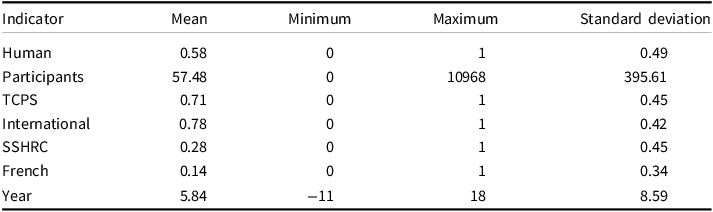
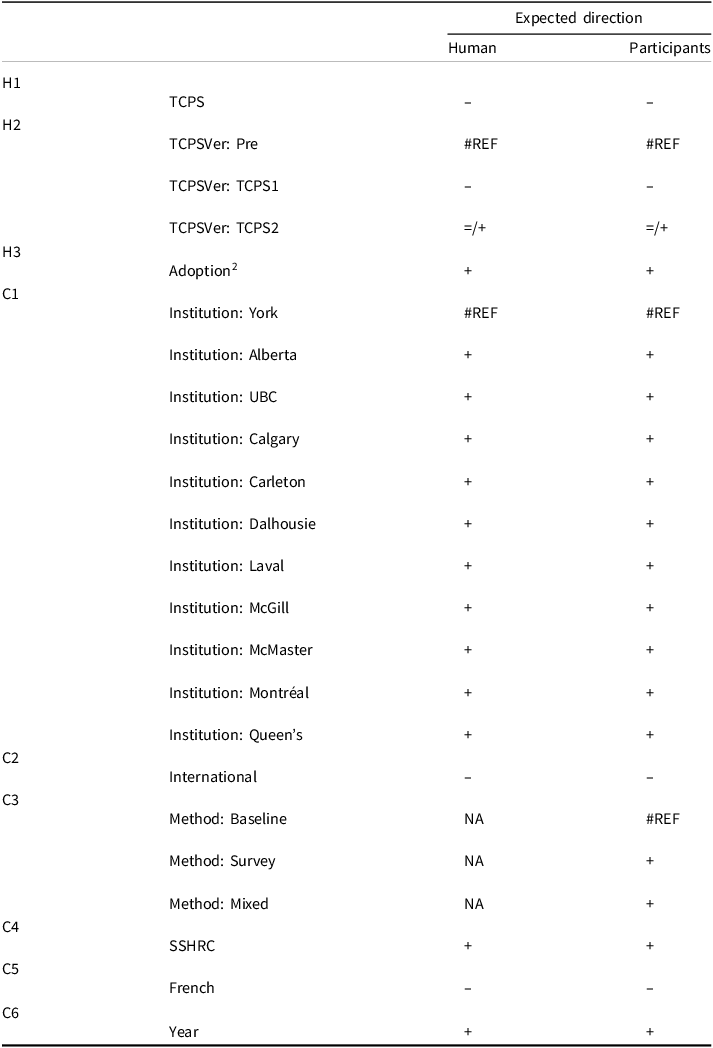
Finally, Year is a numeric variable indicating the thesis year of publication. This is to control for any temporal dimensions non-attributable to TCPS and its alternative measures. For instance, technological innovations like internet accessibility and recruitment can reduce barriers to participation (for example, see Loomis and Paterson, Reference Loomis and Paterson2018). Year is centred at 2001, the year TCPS became mandatory. Table 1 provides the descriptive statistics for numeric variables. Table 2 summarizes each independent variable’s anticipated relationship (direction) to the dependent variables.
Descriptive Statistics

Table 1. Long description
The table presents descriptive statistics for numeric variables, focusing on indicators such as Human, Participants, TCPS, International, SSHRC, French, and Year. It includes columns for Mean, Minimum, Maximum, and Standard Deviation. The Human indicator has a mean of 0.58, a minimum of 0, a maximum of 1, and a standard deviation of 0.49. The Participants indicator shows a mean of 57.48, a minimum of 0, a maximum of 10968, and a standard deviation of 395.61. The TCPS indicator has a mean of 0.71, a minimum of 0, a maximum of 1, and a standard deviation of 0.45. The International indicator presents a mean of 0.78, a minimum of 0, a maximum of 1, and a standard deviation of 0.42. The SSHRC indicator has a mean of 0.28, a minimum of 0, a maximum of 1, and a standard deviation of 0.45. The French indicator shows a mean of 0.14, a minimum of 0, a maximum of 1, and a standard deviation of 0.34. The Year indicator has a mean of 5.84, a minimum of -11, a maximum of 18, and a standard deviation of 8.59. The table provides a comprehensive overview of the central tendencies and variability of each indicator.
Summary of Hypotheses and Controls

Table 2. Long description
The table presents a summary of hypotheses and controls, detailing the expected direction of various human and participant variables. It includes rows labeled with hypotheses and controls, such as TCPS, TCPSVer, Adoption, and Institution, along with their respective expected directions. The table has six columns: one for hypotheses and controls, and two each for human and participant variables. Notable trends include consistent positive expectations for institutions like Calgary, UBC, and McGill, while TCPSVer shows mixed directions. The table also indicates the use of numeric variables to control for temporal dimensions, such as the year of thesis publication, centered at 2001 when TCPS became mandatory.
Results
At first glance, the descriptive statistics suggest little change in the engagement of political science PhD dissertations with human participant research since the introduction of TCPS. In fact, a slightly larger proportion of sampled theses explicitly employed human participant research from 2001 onward, although this is neither statistically nor substantively significant (χ2 = 0.20, φ = 0.01). In terms of the employed methods, there are mixed results (see Table 3). The number of interviews per thesis (when employed as a human participant method) is similar pre- and post-TCPS. We do observe larger differences in both the survey and mixed categories. Due to the sample size of these categories, however, only the survey dummy approaches statistical significance.Footnote 2 For the overall number of participants, the difference just misses statistical significance at conventional alpha levels (p = 0.18, also see Figure 1).
TCPS on the Mean of Human (Binary) and Participants by Method (Count)

Table 3. Long description
The table presents data on the engagement of political science PhD dissertations with human participant research before and after the introduction of TCPS. It includes two main categories: Human and Participants, with subcategories for Interviews, Survey, and Mixed methods. The Human category shows a slight increase from fifty-seven point one percent before TCPS to fifty-eight point eight percent after. The Participants category shows counts for Interviews, Survey, and Mixed methods both before and after TCPS. Interviews increased slightly from thirty-nine point two to forty point one. Surveys saw a significant increase from six hundred ninety-nine to one thousand five hundred thirty-three point seven. Mixed methods also increased from two hundred twenty-two point five to five hundred twelve point one. The table highlights the changes in research methods and participant counts in political science dissertations over time.
Mean Thesis Participants by TCPS (with 95% Confidence Interval).

Figure 1. Long description
The bar graph titled Mean Thesis Participants by TCPS (with 95% Confidence Interval) features two vertical bars representing the mean number of thesis participants before and after the implementation of TCPS. The x-axis is labeled TCPS Group with two categories: 0 (Before) and 1 (After). The y-axis is labeled Mean Thesis Participants, ranging from 0 to 100. The bar for the Before group shows a mean value of approximately 25 participants with a confidence interval extending from around 15 to 35. The bar for the After group shows a mean value of approximately 75 participants with a confidence interval extending from around 35 to 100. The bars are colored in dark gray, and the confidence intervals are depicted with black error bars. The graph indicates a significant increase in the mean number of thesis participants after the implementation of TCPS. All values are approximated.
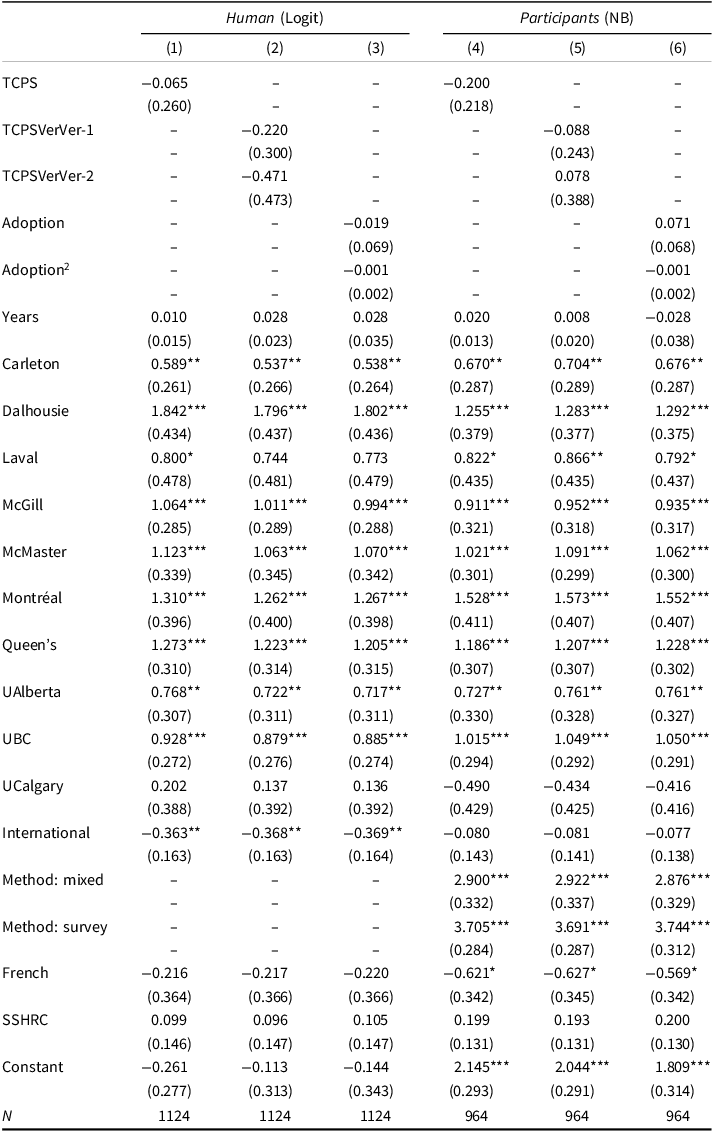
Shifting beyond descriptive and basic inferential statistics, Table 4 offers six regression models. Models 1–3 are logit regressions testing each hypothesis on Human (i.e., whether human participant research is undertaken). Models 4–6 are negative binomial regressions testing each hypothesis on the number of human participants (Participants) within each thesis. These models use MacKinnon and White’s (Reference MacKinnon and White1985) robust standard errors.
Logit (Models 1–3) and Negative Binomial (Models 4–6) Regression Results

Table 4. Long description
The table presents six regression models analyzing human participant research and the number of participants in theses. Models 1 to 3 are logit regressions testing hypotheses on whether human participant research is conducted. Models 4 to 6 are negative binomial regressions testing hypotheses on the number of human participants within each thesis. The table includes coefficients and robust standard errors for various predictors such as TCPS, adoption, years, and university affiliations. Notable trends include significant positive coefficients for universities like Dalhousie, McGill, and Montreal, indicating a higher likelihood of human participant research or a higher number of participants. The table also shows the impact of different research methods and language on the outcomes.
*p < 0.1; **p < 0.05; *** p < 0.01. Robust standard errors in brackets.
Beginning with the first set, we fail to reject the null hypothesis in each case. Consistent with our descriptive statistics, the TCPS intervention in Model 1 is neither statistically nor substantively significant (∼6.3 per cent decrease, p = 0.80). In Model 2, we do not find support for hypothesis 2. Both TCPS version 1 and 2 coefficients are negative, but not statistically significant (p = 0.46, p = 0.32). Model 3 tests whether there was a curvilinear relationship between human participant research and TCPS. Our squared variable coefficient is nearly zero (p = 0.82).
In our second set, we also fail to reject each null hypothesis. In Model 4, the TCPS intervention does not have a statistically significant impact on the number of human participants within political science PhD theses (p = 0.36). The TCPS dummy coefficient translates to an 18 per cent decrease in the expected number of human participants after 2001. Model 5 does not indicate a statistically significant difference between either TCPS version relative to pre-TCPS. In both cases, the expected change in participant count is very minor (Version 1 = 8 per cent decrease, Version 2 = 8 per cent increase). In Model 6, we also fail to reject the null hypothesis. There does not appear to be a curvilinear relationship between TCPS and the count of human participants. In fact, Adoption2 is practically zero.
The interpretation of control variables carries significant assumptions (see Hünermund and Louw, Reference Hünermund and Louw2025). Each model is specified to test the relationship between TCPS and dissertation human participation. As such, the control variables should not be interpreted casually but descriptively. Here, the French-language and institutional controls specifically merit our attention. For human participants count models, the control for French dissertations is statistically significant at the lowest alpha threshold and, as predicted, negative. This is consistent with the theorized relationship.
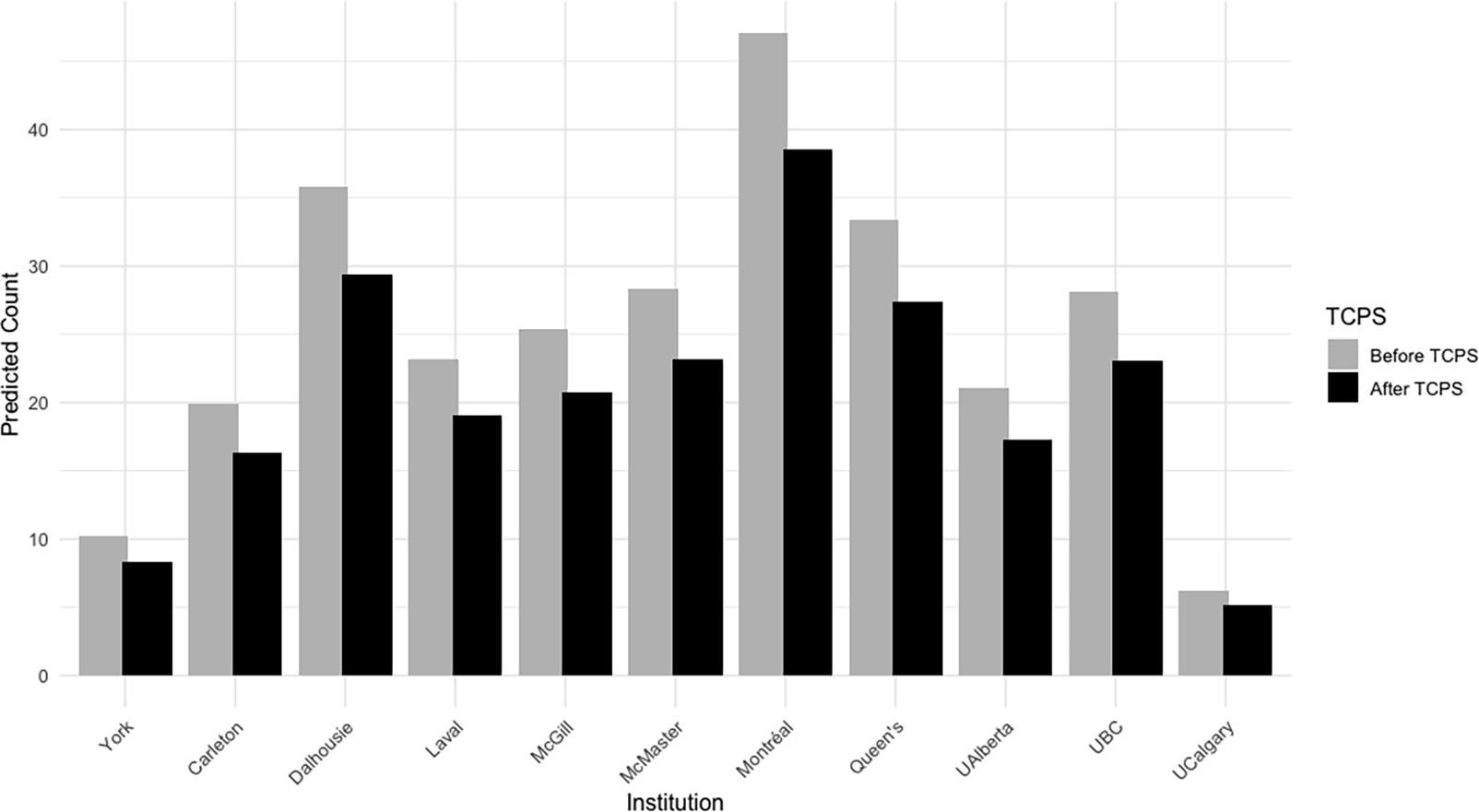
Likewise, the institutional controls mostly perform as expected. Across each model, all institutions except Calgary and Laval have a positive and statistically significant difference relative to York.Footnote 3 This is visualized in Figure 2, with pre- and post-TCPS predicted counts. Here, theses are set to English, domestic, no SSHRC and baseline method (i.e., interviews). 1995 and 2010 are chosen to represent the pre- and post-TCPS periods, respectively. Montréal had the highest predicted count at 47 pre-TCPS and 38 post-TCPS, followed by Dalhousie and Queen’s.
Predicted Counts of Dissertation Human Participants by Institution (1995 vs 2010).

Figure 2. Long description
The bar graph compares predicted counts of dissertation human participants by institution for the years 1995 and 2010. The x-axis lists institutions including York, Carleton, Dalhousie, Laval, McGill, McMaster, Montreal, Queen’s, UAlberta, UBC, and UCalgary. The y-axis represents the predicted count, ranging from 0 to 50. Each institution has two bars: a grey bar for 1995 and a black bar for 2010. The grey bars generally show higher counts compared to the black bars, indicating a decrease in predicted counts from 1995 to 2010. Notable institutions with higher counts in 1995 include Montreal and Dalhousie, while institutions like York and UCalgary show lower counts. All values are approximated.
Discussion and Conclusion
In brief, we fail to reject each null hypothesis. As it stands, this study finds no evidence of a research ethics chill as it applies to political science PhD dissertations. There is a slight decrease in human participant research following TCPS, but neither statistically nor substantively significant in any case. This raises questions about the alarm previously raised by Amyot (Reference Amyot2002) and Porter (Reference Porter2008a). If PhD students are among the most vulnerable to the theorized research ethics chill, then the larger phenomenon may not exist.
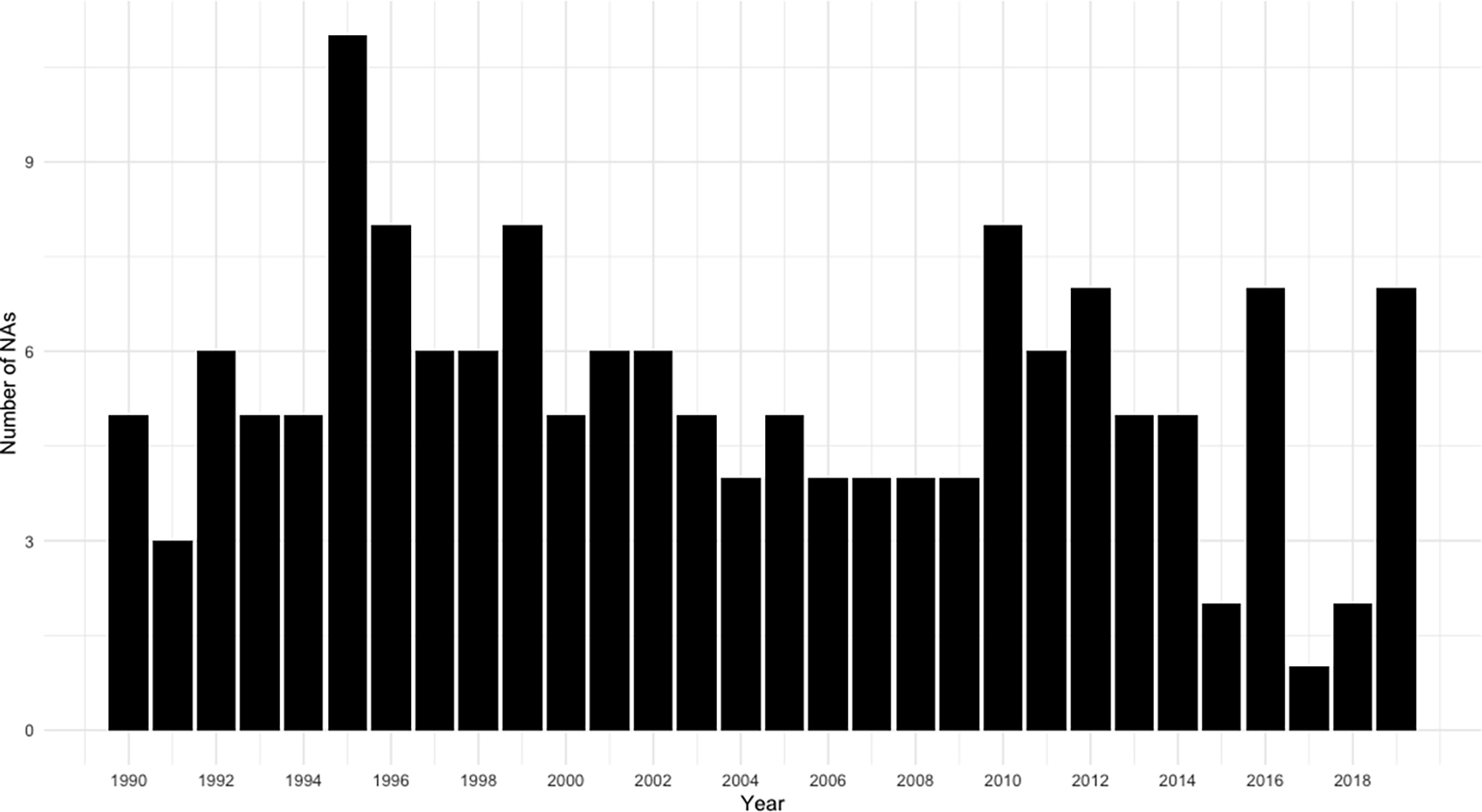
There are, however, limitations to this study. First, this study does not consider whether PhD candidates were compensating for a potential research ethics burden in other ways. For example, it is possible that PhD candidates are taking longer to complete their dissertations, which may allow for more field work. Second, as it relates to the number of participants, some dissertations were too vague to be included. As visualized in Figure 3, older theses were slightly more likely to be vague and dropped. Could it be that the discipline has adopted more formalized language for participant research? Is this an indication of political science acquiescing to a clinical research model?
Number of Not Available (NA) Thesis Participant Counts by Year.

Figure 3. Long description
The bar graph compares the number of not available thesis participant counts by year from 1990 to 2018. The x-axis represents the years, ranging from 1990 to 2018, while the y-axis represents the number of not available participants, ranging from 0 to 10. The bars are vertical and ungrouped. Notable trends include a peak in 1995 with approximately 12 not available participants and a drop around 2004 to 2008 with values around 4. The graph shows fluctuations in the number of not available participants over the years.
Third and related, this study’s sample represents theses available online from one of our consulted databases (see Appendix). If the data gaps are non-random, then this could impact our results. It is worth noting, however, that universities generally require the online publication of theses with a short embargo period if requested. That noted, institutional access to French-language dissertations prior to 2001 was very limited. This was compounded by a tendency for Québec-based theses to still be written in English. The goal was for 20 per cent of the sample to be French dissertations, but this came up short with 14 per cent. This may reinforce larger concerns over the marginalization of Francophone scholars within Canadian political science. This marginalization may spill over to participant recruitment, where we observed a substantial decrease among French theses.
The final study limitation is participants’ social location. While the dataset captures human participant research, it does not capture participant status (e.g., elite or not). This specificity could matter: the post-TCPS ethics regime may reallocate risk unevenly, insulating elites while exposing marginalized individuals to unchecked power. Thus, although the results do not show an ethics chill among PhD dissertations, the dataset may still obscure a research chill involving specific participants.
Beyond these limitations, a few other notable findings are worth mentioning. For this study, sandwich theses—theses that combine several journal-length papers as a thematic collection—were treated the same as “ordinary” theses. In theory, these are meant to be equivalent projects; hence, no control was added. Anecdotally, during the coding of the data, sandwich theses were observed to be increasingly common, especially with survey research. Intuitively, this makes sense, as survey data lends itself to quantitative analysis, which in turn lends itself to shorter and more discrete projects. Whether this suggests a shift in disciplinary norms, let alone norms attributable to TCPS, is unclear. Are PhD students picking sandwich theses because they fit their research interests, or because doing so streamlines journal publications at a crucial moment in one’s career?
The results do suggest that survey research is changing over time. While not quite statistically significant, the mean number of participants jumped from 699 under pre-TCPS to 1534 post-TCPS. In our view, this has less to do with research ethics than the digitization of survey recruitment. Online surveys are inexpensive, relatively unencumbering for participants, and widely accessible (Loomis and Paterson, Reference Loomis and Paterson2018). The gradual global diffusion of internet and alternative means of communication like teleconferencing are also a part of this story, albeit difficult to precisely measure. On this point, the omission of a precise control for technological innovations and accessibility, which may affect other methods like interviews, could cloud our TCPS indicators. This study does, however, specifically control for time and data collection method.Footnote 4
This study’s results do not foreclose the possibility of an ethics chill more broadly. While PhD dissertations do not appear to be quantitatively impacted, the collapse of MA theses in favour of Major Research Projects suggests human participant research is no longer practical for some graduate students. That is, MA students have especially limited funding and restrictive timelines, which raises the cost of ethics review delays. Other vulnerable political scientists, such as postdoctoral fellows and non-tenured faculty, may still face an ethics chill. The interaction between critical scholarship and research ethics boards, in particular, warrants examination. This study’s narrow results do show that critical institutions, namely York, had lower predicted human participants.
On that point, ethics review invariably imposes some cost to researchers. That is, ethics review—however desirable—is always more burdensome than none at all. The question turns to how that cost is managed. For some, it may involve new research sequencing where a project is started early and staggered with others while out for ethics review. For others, it may mean publishing over longer periods. For others yet, it may involve re-designing the project to avoid bottlenecks from the start. This third grouping, the subject of the ethics chill, is theoretically anticipated to be worse for graduate students whose timelines are tight and institutional authority is weak. Yet, this form of compensation is not observed. This does not exclude the potential for alternative tactics. For example, to fast-track their work, PhD students may be channelling their recruitment strategies to relatively accessible and powerful participants. If this is true, then the type of dissertation research and findings being produced under TCPS could favour the status quo and its beneficiaries over marginalized groups.
To that end, this research note does not address every critique of institutional ethics review. Ethics boards invariably slow some research, reducing the potential for scholarly responsiveness. REBs are risk averse in potentially skewed ways that favour legal and reputational costs over complacency. Here, the cost of inaction is rarely weighed. For that matter, the sequencing of ethics review and obtaining consent complicate community-based research and assume risks are not incurred until consent is formally sought. Regardless of an ethics chill, these critiques remain and may warrant greater reflection of TCPS.
As a concluding note, we should also not dismiss the possibility that more participant research is not necessarily better. Human participants not only incur some risk in their participation but also give their time, often for no monetary benefit. As researchers, we must be conscious to ask ourselves whether the marginal benefit of the next participant outweighs the overall cost to that participant. This raises an alternative outcome to a research ethics chill: a research intensification. Today, scholars are publishing more frequently and at a faster pace to keep up with an increasingly competitive and demanding research environment. This culture of rapid research could incentivize extractive work that does more harm than good to marginalized communities. If this is the case, then perhaps a chill would be welcome.
Supplementary material
The supplementary material for this article can be found at https://doi.org/10.1017/S0008423926101206




 Open access

