

Beginning with the rise of engendered archaeologies in the 1980s and 1990s, a growing number of scholars have turned their lenses inward to examine the gendered social realities of our own discipline (Claassen Reference Claassen1994; du Cros and Smith Reference du Cros and Smith1993; Gero Reference Gero1985, Reference Gero, Walde and Willows1991, Reference Gero and Wright1996; Handly Reference Handly1995; Hutson Reference Hutson1998, Reference Hutson2002; Ikawa-Smith Reference Ikawa-Smith, Nelson and Rosen-Ayalon2002; Kramer and Stark Reference Kramer and Stark1988; Nelson et al. Reference Nelson, Nelson and Wylie1994; Stark et al. Reference Stark, Spielmann, Shears and Ohnersorgen1997; Victor and Beaudry Reference Victor, Beaudry and Claassen1992; Walde and Willows Reference Walde and Willows1991; Zeder Reference Zeder1997a, Reference Zeder1997b). As is broadly the case in gendered studies of academia (Chilly Collective 1995), Canadian archaeology was at the forefront of this move: the edited volume for the 1989 gender-themed Chacmool conference (Walde and Willows Reference Walde and Willows1991) featured eight articles on gender equity in North American archaeology. They identified significant gendered disparities in hiring, funding, publication, and citation rates. Because science benefits from the inclusion of previously marginalized perspectives that can help question long-standing assumptions and biases (Wylie Reference Wylie and Grasswick2011, Reference Wylie, Harding and Figueroa2013), these findings are of epistemological concern. Moreover, universities increasingly recognize the importance of having faculties that reflect the diversity of student bodies across many axes of intersecting identities (e.g., gender, race/ethnicity, sexual orientation, class, [dis]ability), because faculty members are role models who can either expand or contract student career aspirations.
Recently, many American scholars have begun to assess progress in recent decades (Bardolph Reference Bardolph2014; Bardolph and VanDerwarker Reference Bardolph and VanDerwarker2016; Fulkerson and Tushingham Reference Fulkerson and Tushingham2019; Goldstein et al. Reference Goldstein, Mills, Herr and Burkholder2018; Heath-Stout Reference Heath-Stout2019; Jalbert Reference Jalbert2019; Rautman Reference Rautman2012; Speakman, Hadden, Colvin, Cramb, Jones, Jones, et al. Reference Speakman, Hadden, Colvin, Cramb, Jones, Jones, Lulewicz, Napora, Reinberger, Ritchison, Edwards and Thompson2018; Speakman, Hadden, Colvin, Cramb, Jones, Kling, et al. Reference Speakman, Hadden, Colvin, Cramb, Jones, Kling, Lulewicz, Napora, Reinberger, Ritchison, Rivera-Araya, Smith and Thompson2018; Tushingham et al. Reference Tushingham, Fulkerson and Hill2017).Footnote * Similarly, we wondered what progress had been made in Canada since the most recent publications in the 1990s (Bernick and Zacharias Reference Bernick and Zacharias1995; Handly Reference Handly1995; Kelley and Hill Reference Kelley, Hill, Nelson, Nelson and Wylie1994). We also wanted to understand whether differences exist between Canada and the United States given the significant movement of scholars in both directions for graduate school and academic positions.
Overholtzer, an example of this movement and a recent arrival to Canada herself, wanted to better understand the milieu in which she was situated, and the academic career pathway through which she was guiding her doctoral students, all of whom had career goals in higher education. She is a white, straight, cisgendered, American scholar-wife-mother on the tenure track at McGill University, and she has personally benefited from Canada's progressive, family-friendly policies. These include paid parental leave and subsidized childcare, McGill University's spousal hiring program, and generous research funding from the liberal federal government. While teaching the seminar on Gender and Sexuality in Archaeology at McGill, she was unable to find any recent publications on diversity and equity issues within the Canadian context that she could assign. Consequently, her part of this study was born. Because her own archaeological experience is limited to academic contexts, so too was her study.
Jalbert, who also identifies as a white, cisgendered woman, chose a CRM career. As a dual citizen, she has had the privilege of pursuing studies and work both in the United States and Canada. She recently completed her dissertation at Memorial University of Newfoundland and currently calls Texas home. Her dissertation addressed some of the very questions pondered by Overholtzer, examining demographics and working conditions in archaeological education and employment through a feminist, intersectional lens. Jalbert came to this research topic through her doctoral comprehensive exams. Because of her situatedness in the discipline, she has always been interested in the production of knowledge, particularly from the perspective of CRM.
Like many women studying archaeology, the authors suffered negative experiences, such as gender-based discrimination and harassment in the field, which influenced their choice of career paths and led to their commitment to promoting more equitable workplaces. Overholtzer was motivated to stay in academia, conduct research and teach on gender in the discipline, and direct field projects that would provide safe spaces for all students—following the example of her advisers, all of whom were women. Jalbert's experiences cemented her decision to remain in CRM. In her work, she aims to support students who are interested in exploring their opportunities outside of an academic career path. These shared experiences and diverse perspectives are brought together in this article to assess the current state of affairs in archaeology in Canada.
Academic Archaeology Turns a Gendered Lens in on Itself
The conclusions reached by the initial generation of scholars in the 1980s and 1990s, using empirical datasets—ranging from grant, publication, and citation rates to representation in tenure-track university positions—are striking. Although most of this research focused on the United States, these data provide a useful point of comparison for Canada because, as this article will show, many academics move across the border in both directions for tenure-track positions. Yellen (Reference Yellen, Nelson, Nelson and Wylie1994) documented the attrition of women archaeologists in the United States, or what can be called a “leaky pipeline,” from a majority of National Science Foundation (NSF) grant applicants at the doctoral level (54%) to only 26% at the senior level. Several studies found that despite greater parity in graduate degree attainment, women were not hired into permanent academic positions at rates proportionate to their presence in PhD cohorts (Hutson Reference Hutson1998; Stark et al. Reference Stark, Spielmann, Shears and Ohnersorgen1997; Zeder Reference Zeder1997a, Reference Zeder1997b). Women were also less successful in funding their research, less productive as measured by publication rates, undercited, and less satisfied in their positions (Beaudry and White Reference Beaudry, White and Claassen1994; Hutson Reference Hutson2002; Zeder Reference Zeder1997a, Reference Zeder1997b).
More recent studies in the United States have confirmed that these problems continue, despite increased awareness and in the face of a growing (albeit minority) sentiment that men in STEM fields now suffer from “reverse discrimination” (Funk and Parker Reference Funk and Parker2018). In the United States, gender disparities remain in tenure-track archaeology hiring (Goldstein et al. Reference Goldstein, Mills, Herr and Burkholder2018; Speakman, Hadden, Colvin, Cramb, Jones, Jones, et al. Reference Speakman, Hadden, Colvin, Cramb, Jones, Jones, Lulewicz, Napora, Reinberger, Ritchison, Edwards and Thompson2018; Speakman, Hadden, Colvin, Cramb, Jones, Kling, et al. Reference Speakman, Hadden, Colvin, Cramb, Jones, Kling, Lulewicz, Napora, Reinberger, Ritchison, Rivera-Araya, Smith and Thompson2018), senior research grant submissions (Goldstein et al. Reference Goldstein, Mills, Herr and Burkholder2018), and participation in conferences and publishing in peer-reviewed journals, especially those with high impact factors (Bardolph Reference Bardolph2014; Bardolph and VanDerwarker Reference Bardolph and VanDerwarker2016; Fulkerson and Tushingham Reference Fulkerson and Tushingham2019; Gamble Reference Gamble2020; Heath-Stout Reference Heath-Stout2019, Reference Heath-Stout2020a, Reference Heath-Stout2020b; Rautman Reference Rautman2012; Tushingham et al. Reference Tushingham, Fulkerson and Hill2017).
Despite women constituting the majority of U.S. PhD recipients in archaeology since 2002 (Tushingham et al. Reference Tushingham, Fulkerson and Hill2017:Figure 1), men still hold 65% of American academic positions, and they are particularly overrepresented at universities with graduate programs (Goldstein et al. Reference Goldstein, Mills, Herr and Burkholder2018:374, Figures 5 and 6). Moreover, analysis of hiring in the United States (2004–2014) revealed that, in comparison to PhD graduation rates, men were disproportionately hired into research-intensive positions, especially those with doctoral programs (Speakman, Hadden, Colvin, Cramb, Jones, Kling, et al. Reference Speakman, Hadden, Colvin, Cramb, Jones, Jones, Lulewicz, Napora, Reinberger, Ritchison, Edwards and Thompson2018:6; see also Speakman, Colvin, Cramb, Jones, Jones, et al. Reference Speakman, Hadden, Colvin, Cramb, Jones, Kling, Lulewicz, Napora, Reinberger, Ritchison, Rivera-Araya, Smith and Thompson2018). Given the underrepresentation of women in research-intensive positions, it is not surprising that the number of submissions by senior archaeology women to the U.S. NSF between 2009 and 2013 was half that of men.
Comparatively little is known about the status and success of women in academic archaeology in Canada today (Jalbert Reference Jalbert2019; for Canadian studies in other disciplines, see Adamo Reference Adamo2013; Tamblyn et al. Reference Tamblyn, Girard, Qian and Hanley2018; Titone et al. Reference Titone, Tiv and Pexman2018). Kelley and Hill (Reference Kelley, Hill, Nelson, Nelson and Wylie1994) provide historical data for archaeology graduate training and career placement in Canada. Their analysis of graduate program statistics from the University of Calgary between 1966 and 1990 revealed that women withdrew at higher rates than men (36% vs. 24%) and that fewer women went into full-time academic positions (17% vs. 36%). Women made up only 20% of the assistant professors of archaeology in Canadian institutions listed in the 1989–1990 AAA AnthroGuide (n = 3), compared to 49% for all of anthropology. They pointed out that women were underrepresented in archaeology faculty positions with respect to their numbers in graduate programs.
Bernick and Zacharias (Reference Bernick and Zacharias1995:84) found lower rates of conference participation, publication and citation rates, and fieldwork permits among women, as well as a “near absence” of senior-level women in British Columbia archaeology. Handly's (Reference Handly1995) review of the Canadian Journal of Archaeology (1969–1993) found a historical increase in articles authored by women—up to 37% in the last five years. He found a positive correlation between editorial staff positions occupied by women and acceptance of women's articles, suggestive of the role of gendered marginalization and academic gatekeeping (Handly Reference Handly1995:72). Furthermore, he found no increase in the proportion of women asked to review archaeology books, which suggests that they were still not assumed to be authorities within their academic specialization (Handly Reference Handly1995:72). Recently, Jalbert (Reference Jalbert2019) conducted a mixed-methods study that included education and employment data, surveys, and interviews with women archaeologists. She concluded that although more women are entering the field at all levels and within all sectors, they are not retained in upper-level positions across academic and CRM workplaces.
These findings are broadly supported within Canadian academia (Drakich and Stewart Reference Drakich and Stewart2007; Ornstein et al. Reference Ornstein, Stewart and Drakich2007; Stewart et al. Reference Stewart, Ornstein and Drakich2009). Despite dramatic increases in the representation of women in Canadian graduate programs from the mid-1980s to 1990s, there have been more modest gains in their appointment to faculty positions, the speed of their promotion to associate professor, their advancement to full professor, and their representation as Canada Research Chairs. The 2018 equity report of the Canadian Association of University Teachers (CAUT) confirms this slow progress: women represented 48.5% of assistant professors in 2016/2017 compared to 42.9% in 2006/2007, and 27.6% of full professors in 2016/2017 compared to 20.3% in 2006/2007.
For this study, we requested data on archaeology PhDs conferred annually to men and women in Canada between 2003 and 2016 from Statistics Canada. We followed the trajectory of these PhDs to the faculty level by surveying tenure-track archaeology faculty across Canadian universities. We also considered movement across North America by tracking Canadian PhDs who were hired in the United States using the AAA AnthroGuide and by considering PhD institutions of Canadian faculty. We also requested data on archaeology grant applications and awards at the doctoral, postdoctoral, and senior research levels from the Social Sciences and Humanities Research Council (SSHRC), the major public research body in Canada. This article presents these findings—most notably, a quantification of the discipline's “leaky pipeline” and an evaluation of gendered differences in success rates historically. Unfortunately, our analysis of these datasets is limited because gender is presented as a binary system and does not allow for third or gender-fluid self-identification—SSHRC and Statistics Canada provide data only for “females” and “males.” No nonbinary gender pronouns (e.g. they, ze), however, were observed within the faculty web pages examined to conduct the survey.
This study has major limitations that are important to acknowledge. Third-wave feminism has rightfully demanded an intersectional approach that takes account of the multiple intersecting axes of oppression that influence the likelihood that an individual will earn a PhD and go on to have a successful career in varied workspaces. Academia continues to struggle in recruiting and retaining a diverse workforce in terms of not only gender composition but also race and ethnicity, sexual orientation, class, parental education, and (dis)ability. In Laura Heath-Stout's (Reference Heath-Stout2019) survey and intersectional analysis of 1,377 archaeologists who had published in major American or British journals, 45% identified as straight, white, cisgender men and 33% as straight, white, cisgender women. Archaeology in the United States is very white, straight, and cisgender.
Two recently completed demographic surveys of Canadian archaeologists suggest that Canadian archaeology is perhaps even less diverse than its American counterpart. Of the 315 responses to Jalbert's survey (Reference Jalbert2019:155), 90% of participants identified as white, with 2% of respondents identifying as a person of color (Black, Asian, or Latin) and 2% identifying as Indigenous (First Nations, Inuit, or Métis). Demographic information was also collected for the MeToo survey recently undertaken by the Canadian Archaeological Association (CAA) Equity and Diversity Working Group led by Lisa Hodgetts (Hodgetts et al. Reference Hodgetts, Supernant, Lyons and Welch2020). Of the 551 respondents, 87.3% self-identified as white—a substantially higher proportion than the 72.8% census figure for the Canadian population as a whole, and a higher percentage than the U.S. survey by the SAA or the California survey conducted by UCSB. Archaeologists of Indigenous and Latin American descent (5.3% and 1.1%, respectively) were present among survey respondents in similar proportions as the general Canadian population, whereas Black and Asian archaeologists (0.0% and 2.7%, respectively) were notably underrepresented. The vast majority of respondents (78.2%) also identified as straight, whereas 10% identified as bisexual and 2.1% identified in each of the categories of gay, lesbian, and asexual.
Gender Representation in Academic Archaeology in Canada
Archaeology Doctorates in Canada
To examine the relative representation of women and men at the doctoral level, we requested data from Statistics Canada on PhD recipients by gender over the past 15 years for the Classification of Instructional Programs code for “Archaeology”—45.0301 (Figure 1). This code likely excludes most classical archaeologists, who should be classified under 30.2202 (“Classical, Ancient Mediterranean, and Near Eastern Studies and Archaeology”) as well as bioarchaeologists, who are likely classified under 45.0202 (“Physical and Biological Anthropology”). These other subfields will only be discussed briefly here.
Archaeology doctoral graduates by gender, 2002–2003 through 2016–2017. Data provided by Statistics Canada, Postsecondary Student Information System. Note that in order to prevent the release of data that might relate to identifiable individuals, Statistics Canada rounds all values to a multiple of 3 (a value of 1 is rounded to 0, whereas a value of 2 is rounded to 3). Totals are summed using true numbers, and the sum is then rounded to the nearest multiple of 3. Because of rounding, totals may not add up to the sum of all categories.

These data reveal that women probably overtook men as the majority of doctorates in the mid-2000s. Across the entire 15-year period studied, women received 58% of archaeology doctorates in Canada, and across the last 10 years, they received a full 64%. By the last five-year period (2012–2016), women represented two-thirds of all newly minted archaeology PhDs. These data coincide with larger documented trends in archaeological education in Canada. Jalbert (Reference Jalbert2019:104–111) demonstrated that between 1992 and 2012, women represented 67% of enrollments and 68% of graduates in archaeology undergraduate programs, and they represented 64% of enrollments and 59% of master's level graduates.
Goldstein and colleagues (Reference Goldstein, Mills, Herr and Burkholder2018:Figure 4) similarly report that women began to earn more than 50% of the PhDs in the United States in the mid-2000s. Our Canadian data are also consistent with trends seen in National Geographic Society (NGS) applications that are correlated with the 2008–2009 economic recession. Goldstein and colleagues (Reference Goldstein, Mills, Herr and Burkholder2018:372) determined that NGS applicants declined overall between 2009 and 2010, but applications by women rebounded rapidly in 2011, whereas men's applications have not returned to pre-economic crisis levels. Consequently, the Statistics Canada data suggest that the recession may have also accelerated the increasing feminization of the archaeological academy in Canada.
There is no parallel in the U.S. data, however, for the dramatic increase we observe in women's representation among Canadian archaeology doctorates in the last five years. This discrepancy might reflect the fact that the U.S. data only go up to 2014, whereas the Canadian data go up to 2017. It is possible, then, that a similar increase will be seen in representation of women in U.S. doctorates in data released in the next few years.
Archaeology Faculty in Canada
Jalbert (Reference Jalbert2019:125) demonstrated a steady increase from 1972 to 2011 in women faculty in both anthropology and archaeology departments. Although a consistent, upward trend was less visible in archaeology, women have made substantial gains at all academic faculty ranks, particularly from 1990 to 2011. Nevertheless, women remained vastly underrepresented at the rank of full professor, representing only 14% between 2000 and 2011 (Jalbert Reference Jalbert2019:Figure 5.16). This figure is far below the national average of 20% across all disciplines/universities in Canada in 2006/2007 and 23% in 2010/2011 (CAUT 2018).
To understand the current situation, three undergraduate research assistants at McGill University conducted an online search to determine the relative representation of women and men in tenure-track positions in Canadian universities in 2019. Because the American Anthropological Association (AAA) AnthroGuide is not used extensively in Canada, we also examined university faculty web pages, using personal pronouns to identify each faculty member's gender. Because there are currently only two dedicated archaeology departments in Canada, this survey included archaeology faculty regardless of their department, which included Anthropology, Archaeology, Art History, Geography, Indigenous Studies, History, Human Sciences, Historical Sciences, Classical Studies, Greek and Roman Studies, and Near and Middle Eastern Civilizations. Our survey documented a total of 222 tenure-stream archaeologists employed at 46 universities.
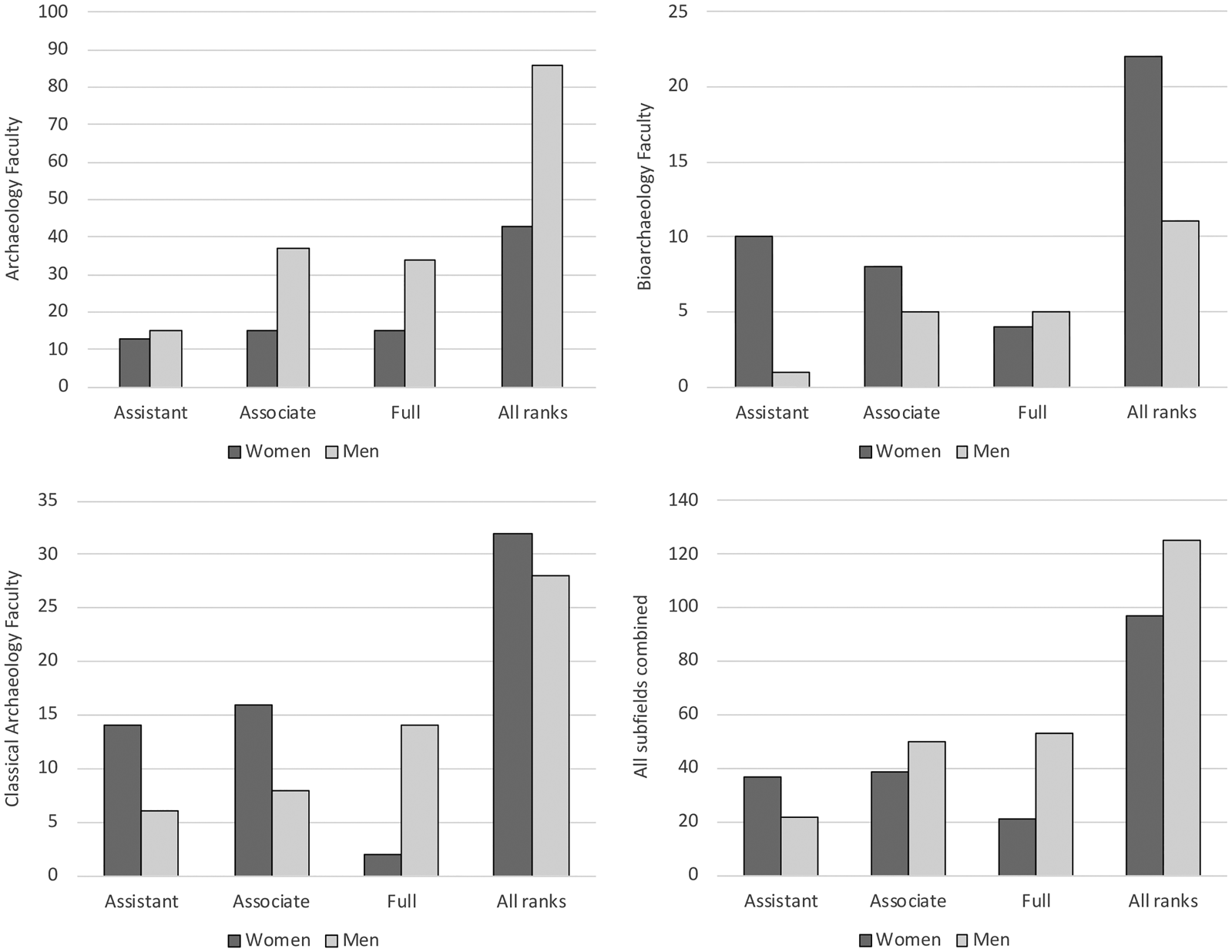
To facilitate comparison of our data, faculties were divided into Bioarchaeology, Classical Archaeology, and Archaeology, the latter excluding the former two subfields (Figure 2). Because bioarchaeology is often classified as a subfield of biological anthropology, and because classical archaeologists are usually not within anthropology departments, these two subfields are typically excluded from these kinds of studies. We felt, however, that there was utility in quantifying them separately in order to examine trends within specializations.
Charts showing the numbers and relative proportions of men and women in tenure-track and tenured faculty positions by rank within archaeology, bioarchaeology, classical archaeology, and all subfields combined.
We included only individuals listed as Assistant Professor / Professeur adjoint, Associate Professor / Professeur associé, or Professor / Professeur titulaire, and we excluded individuals listed as adjunct faculty, lecturers, instructors, associate members, or emeritus. It remains possible that we missed some faculty members not listed on department websites, or that we included faculty members who recently left their positions, but we think this survey is representative of the academic situation in 2019.
Women are well represented within classical archaeology, where they represent 53% of faculty of all ranks, and especially within bioarchaeology, where they represent 69% of faculty. In our faculty survey, a larger proportion of the bioarchaeology faculty were at the assistant professor level, likely reflecting more junior hires in the past five or so years, and women filled 91% of these positions (Figure 2). Rather unsurprisingly, women are better represented at the assistant professor level in each subfield, but the increased representation in assistant and even associate levels is more marked within classical archaeology and bioarchaeology.
Women are least well represented in archaeology—only 33% of all faculty combined. As Smith similarly found 19 years after implementing a faculty equity plan at the University of Alberta, “The percentage of female faculty remains stalled at about one-third, despite the burgeoning number of female graduates” (Reference Rautman2013:2). Women still represent only 46% of assistant professors in archaeology, and only 29% and 31% of associate and full professors, respectively. Moreover, there have been proportionately fewer tenure-track hires in this research area compared to bioarchaeology and classical archaeology. As we will discuss shortly, although a 46% representation of women at the assistant professor level reflects some advances in equity, the gender ratio of assistant professors in archaeology is lower than we would expect given the gender ratios of doctorates over the last 15 years. Given that equity targets are defined by representation proportionate to the broader population or candidate pool, this percentage actually represents a relative underrepresentation of women when we consider gender representation in doctoral degrees granted.
The 33% representation rate of women across Canadian archaeology faculty is comparable to the 35% figure Goldstein cites for U.S. faculty (2018). It is a vast increase from the 1989–1990 Canadian data cited by Kelley and Hill (Reference Kelley, Hill, Nelson, Nelson and Wylie1994), in which women constituted only 20% of junior faculty. Nonetheless, the archaeology professoriate is top-heavy: assistant professors comprise only 22% of faculty members, and tenured men constitute a full 55% of all faculty members (n = 71). This situation is perhaps an unintended consequence of the end of mandatory retirement in Canada. The increasing adjunctification crisis in academia leads us to question whether those tenure-track positions will be replaced. This factor—and the gender ratio of those hired—will affect when and if parity is reached.
Because men are overrepresented in graduate and especially doctorate-granting U.S. institutions within archaeology (Goldstein et al. Reference Goldstein, Mills, Herr and Burkholder2018; Speakman, Hadden, Colvin, Cramb, Jones, Kling, et al. Reference Speakman, Hadden, Colvin, Cramb, Jones, Jones, Lulewicz, Napora, Reinberger, Ritchison, Edwards and Thompson2018), we also subdivided universities by research intensity. Our criteria included membership in the U15 Group of Canadian Research Universities (roughly equivalent to R-1 status in the United States) and the presence of a PhD program. For this and remaining analyses, we examined only archaeologists and excluded classical archaeologists and bioarchaeologists. We found no gendered difference in universities that fit either U15 membership or PhD program criteria: 49% of women (n = 21) and 51% of men (n = 44) faculty members are located in U15 universities, and 67% of both women (n = 29) and men (n = 58) are in PhD-granting departments. Consequently, women are equally represented at research-intensive Canadian institutions.
The Archaeology Pipeline: Doctoral to Faculty
The demographic data presented here provide significant insight into archaeology's “pipeline” today. The pipeline model, originally developed for STEM fields, postulated that increasing the number of women interested in science would eventually (as they traveled inside the pipe) result in greater gender parity in scientific careers. This model was quite quickly debunked because scholars realized that the pipeline was “leaky”: women do not progress through the ranks in the same proportions as men, and instead, they drop or “leak” out of STEM fields at various career stages (Schiebinger Reference Schiebinger1999).
As an analytical tool to guide data collection and interpretation, the pipeline concept encourages us to follow people over their career trajectory and identify the specific moments at which pathway changes occur, particularly for women and other underrepresented groups. It is important to recognize that movements within the pipeline are varied and complex, often constituting more than “leaking.” For example, they can propel you forward, backward, stall you in place, or push you out—a more forceful motion than what leaking implies. Understanding the multitudinous factors that promote different movements within the pipeline is vital. But the pipeline concept alone cannot account for contextual differences in motivations and experiences between individuals, nor does it address the fact that many career decisions are made in early adulthood, simultaneously with many other family and personal decisions (Cannady et al. Reference Cannady, Greenwald and Harris2014:446–447). As an initial critical metaphor, however, the pipeline may help frame research questions for later investigation using survey, interview, and ethnographic methods (for recent examples, see Heath-Stout Reference Heath-Stout2019; Jalbert Reference Jalbert2019).
The discipline of archaeology should be conceptualized as one pipeline that has multiple, intersecting chambers allowing for fluid movement. Although pathways to academia are present, equally present (and more heavily populated) are pathways to private industry, variably called contract archaeology, consulting, heritage management, or cultural resources management (CRM). Due to length restrictions, a closer examination of CRM professionals is outside the scope of this article, but it is treated in Jalbert's dissertation (Reference Jalbert2019). It is worth noting movement between the academic and private sectors for some individuals during their career. Although academia may not be the career goal for many archaeologists trained within the university system, an underrepresentation of women among archaeology faculty may deter women from pursuing archaeological careers in all sectors. Consequently, it is crucial that we understand academic archaeology's demographics.
Comparing doctoral and faculty datasets, it is clear that women archaeologists disproportionately exit academia at this juncture. Women have earned 66% of all doctoral degrees in archaeology in the last five years and 64% over the last 10 years, yet they represent only 46% of assistant professors (n = 13). The mean, median, and mode for degree year of assistant professors are 2010, 2012, and 2013, respectively; five of the 29 assistant professors in Canada received their degrees before 2007, and two after 2016. Consequently, the 2007–2016 doctoral degrees data provide the closest approximation of market availability when those assistant professors were hired. Given their representation in the PhD recipient pool for both the last five and 10 years, we would have expected 18 women to be hired using either period's proportions. A χ2 test of these values revealed a statistically significant p value of 0.049 (χ2 [1] value of 3.889). That is, women are hired in Canada in proportions lower than their presence in the PhD recipient pool. From doctoral degree to assistant professor, there is a nearly 20% drop in the representation of women. By themselves, these data do not address whether this underrepresentation is due to differing career goals, implicit bias in hiring, or other factors altogether.
Canadian-produced PhDs are not the only candidates for those positions. Only 48% (n = 62) of faculty members received their doctorates in Canada, with 36% (n = 47) receiving their training in the United States and 16% (n = 20) in Europe. These numbers might lead to the hypothesis that the majority of men among tenure-track assistant professors in Canada is a reflection of a more male-dominated international candidate pool. We can reject this idea, however, given that men at the assistant professor level were actually more likely to have received their PhD in Canada (11 out of 15 men vs. 4 out of 13 women; χ2 test p value of 0.024). Only 14% of tenure-track positions are currently filled by women who were trained in Canada. Looking at the dataset another way, and examining all professorial ranks, Canadian universities today employ 16 men and 7 women who earned their PhDs in Canada between 2003 and 2017 (Table 1). These individuals represent 36% of men and 12% of women who received their PhDs in Canada during this time period—that is, men who earned their degrees in Canada between 2003 and 2017 are three times more likely to occupy faculty positions in Canada today. Women with Canadian PhDs have been hired into tenure-track positions in Canada at rates statistically lower than men; a χ2 test for all Canadian professors who earned PhDs between 2003 and 2017 produced a highly significant χ2 (1) value of 6.369 (p = 0.012). The very low numbers of women with Canadian PhDs hired at Canadian institutions are even more concerning because Canadian law dictates that universities prioritize the hiring of Canadian citizens over international scholars, given equally qualified candidates.
Gender in PhD Recipients in Canada 2003–2017 and Tenure-Track Faculty in Canada and the United States in 2019.

So, where are these women going? We might suspect that women are choosing to enter museums, CRM, or other industries in a greater proportion. Although tracking and quantifying individuals in these sectors is difficult (see Everill Reference Everill2009; Zeder Reference Zeder1997a; Zorzin Reference Zorzin2010), Jalbert's (Reference Jalbert2019:145) recent analysis of available CRM permit data demonstrated that women are far less likely to be the permit-holder / principal investigator. Although this data point is limited to the senior level and does not provide insight into archaeologists who enter CRM as field/lab technicians or staff, it does suggest that women who earn PhDs are not more likely to enter the private sector as senior archaeologists. Alternatively, they may be leaving archaeology entirely, perhaps a consequence of the “chilly climate” factors that will be discussed in further detail below.
We might also speculate that women are more successful in securing academic positions elsewhere, perhaps in the United States' larger job market. To address this question, we conducted degree institution searches in the AAA Anthro Guide for each of the Canadian PhD-granting universities, limiting our search to archaeology faculty in the United States and to 2003–2017 doctorate recipients. We recorded a total of 12 archaeology faculty members with Canadian PhDs who were hired at U.S. institutions, including five who are currently at the assistant level, six at associate, and one at full. Of these, 10 are women (83%), and two are men (17%)—gender proportions nearly reversed from those of Canadian hires (Table 1). The United States therefore hires women with Canadian PhDs in greater numbers than their proportion among PhD recipients in Canada, although the difference is not statistically significant (χ2 [1] = 3.086, p = 0.079).
Therefore, some women who earned PhDs in Canada did not “leak” out of archaeology entirely. Instead, they found academic positions in the United States, many at R1 institutions. In fact, these women with Canadian PhDs seem to be outperforming the broader pool of women candidates in U.S. tenure-track searches (Speakman, Hadden, Colvin, Cramb, Jones, Kling, et al. Reference Speakman, Hadden, Colvin, Cramb, Jones, Kling, Lulewicz, Napora, Reinberger, Ritchison, Rivera-Araya, Smith and Thompson2018). These statistics may reflect an inability to retain top talent within Canada, although the numbers are small.
Putting the datasets for U.S. and Canadian hiring together, 40% of the men and 30% of the women who earned PhDs between 2003 and 2017 are currently employed in tenure-track or tenured positions somewhere in North America. Although a gender gap remains, these numbers are higher than the recent 20% figure for men and women with U.S.-produced PhDs (Speakman, Hadden, Colvin, Cramb, Jones, Kling, et al. Reference Speakman, Hadden, Colvin, Cramb, Jones, Kling, Lulewicz, Napora, Reinberger, Ritchison, Rivera-Araya, Smith and Thompson2018).
The faculty survey also allowed us to compare the Canadian programs that are producing successful candidates for tenure-track positions, following similar analyses in the United States (Speakman, Hadden, Colvin, Cramb, Jones, Kling, et al. Reference Speakman, Hadden, Colvin, Cramb, Jones, Kling, Lulewicz, Napora, Reinberger, Ritchison, Rivera-Araya, Smith and Thompson2018). Assistant professors in Canada received their PhDs at nine different Canadian universities, with no single institution accounting for more than three graduates, whereas three universities produced PhDs—no more than two each—who were hired as assistant professors in the United States. Although the University of Calgary, Simon Fraser University, and the University of Toronto have the largest market shares, they are also the only departments with archaeology faculty members numbering in the double digits. These data indicate a less hierarchical market share in Canada in comparison to the United States.
We cannot currently assess the presence of potential biases in the selection process because we lack evidence for applicant pools for tenure-track positions in Canada. We also lack evidence for the number of men and women archaeologists employed in museums, although that sector is comparatively small. Finally, data are lacking on the men and women employed in adjunct and lecturer positions within academia and non-permit-holding positions in CRM. However, given that women with Canadian PhDs are more successful than men on the academic job market in the United States, and given that they also appear to be underrepresented at the senior level as CRM permitholders in Canada, it seems unlikely that women who earn their PhDs in Canada are less likely to apply for or accept academic positions in Canada, or that they are less qualified for them.
Scholars in the United States have identified marriage and children under the age of six as accounting for the lower likelihood that women will secure a tenure-track position (Mason et al. Reference Mason, Wolfinger and Goulden2013; Wolfinger et al. Reference Wolfinger, Mason and Goulden2008). Family issues are a broad category, but they include (1) dual-career constraints limiting women's ability to accept or hold faculty positions and (2) parenting demands resulting in mothers opting for less constraining careers. We would suspect that Canada's paid parental leave and other family-friendly policies would help mitigate this, and there is no reason to believe that Canadian institutions are less likely to accommodate spouses in dual-career couples (Careless and Mizzi Reference Careless and Mizzi2015). Moreover, within the pool of archaeologists who earned their PhD in Canada between 2003 and 2017, women were in fact far more likely to move internationally, often for research-intensive positions. Consequently, our current data do not support the hypothesis that academic women are significantly less mobile because of family obligations (Rosenfield and Jones Reference Rosenfield and Jones1987).
We might suspect that implicit—but likely subtle—gender bias or discrimination in hiring is partly responsible for how archaeologists in Canada move through and out of the pipeline at this point, as has been argued for the United States (e.g., Monroe and Chiu Reference Monroe and Chiu2010). The underrepresentation of women in faculty positions in Canada relative to their proportions among doctorates may be due to a lack of mentorship in publishing and job application processes, weaker recommendation letters, or hiring-committee bias against research topics and methods historically dominated by women—for example, lab work–based projects such as paleoethnobotany (Gero Reference Gero1985, Reference Gero, Walde and Willows1991; Gifford-Gonzalez Reference Gifford-Gonzalez, Nelson, Nelson and Wylie1994). Indeed, all seven women with Canadian PhDs from 2003 to 2017 who are currently employed in Canada have active fieldwork programs, whereas five of the 10 women with Canadian PhDs from this period hired within the United States had women-dominated laboratory specializations. Canadian institutions did hire archaeologists with specializations typically dominated by women, but those archaeologists’ degrees were from abroad. Moreover, we would expect similar constraints and biases in hiring on both sides of the border, and our current data do not explain why women would fare less well on the Canadian job market than in the United States.
The data presented here suggest that Canadian tenure-track search committees in upcoming years should expect candidate pools that are overwhelmingly made up of women. For those of us in academic departments, this is a crucial consideration, as a goal of parity (a 50-50 ratio in archaeology faculty) has the potential to result in bias against women and contribute to movement in, or leaking out of, the pipeline at this point. Therefore, it cannot be overstated that target hiring ratios should be representative of candidate pools and not those of the general population.
Unfortunately, we lack historical data on the professoriate that would allow us to assess gendered differences in retention, tenure, and/or promotion. The mean PhD year for women at the associate professor level, however, is 1997, compared to 2000 for men, which suggests that there is not an extremely large difference in how quickly women are promoted and receive tenure. Nonetheless, we do not know when those individuals were hired, nor how many were denied tenure.
SSHRC Grants Data
Given that grant funding is key to academic success, and because archaeology grant submission rates have recently received American scholarly attention (see Goldstein et al. Reference Goldstein, Mills, Herr and Burkholder2018), we requested data on applications and awards submitted and received by men and women for the discipline of archaeology from SSHRC. Doctoral, postdoctoral, and senior research competition data were available for the last 15 years, binned into five-year increments (Table 2).
Major Program Application and Award Data as Provided by SSHRC.

SSHRC combined all doctoral and all postdoctoral competitions to ensure anonymity. Doctoral awards include the SSHRC Doctoral Fellowships, the Joseph-Armand Bombardier Canada Graduate Scholarships (CGS), and the Vanier Canada Graduate Scholarships. Postdoctoral competitions include the SSHRC and the Banting Postdoctoral Fellowships. The SSHRC Doctoral, Vanier Canada, and Banting Postdoctoral datasets include students put forward by their universities after a preliminary selection process. We do not have any way to assess gendered differences in success rates at the internal competition level. SSHRC was unable to send data on the prestigious Canada Research Chairs because of the limited application numbers, but searches of their online awards database revealed five men (63%) and three women (38%) who have held chairs in the last 15 years—figures that are representative of the proportions of men and women in the professoriate overall.
SSHRC Archaeology Application Rates
The “leaks” in archaeology's pipeline in Canada are also visible in the SSHRC application numbers. Between 2003 and 2017, women consistently formed 60%–70% of doctoral applicants, 50%–60% of postdoctoral applicants, and 30%–40% of senior research applicants in archaeology (Figure 3). Women consistently submitted approximately twice as many doctoral applications, whereas men submitted nearly twice as many senior-level applications.
SSHRC applications numbers at doctoral, postdoctoral, and senior research levels by gender (2003–2007, 2008–2012, and 2013–2017).

These numbers are consistent with the doctorate and assistant professor demographic data discussed earlier. Given that SSHRC doctoral applications are generally submitted early in graduate school, some applications in one five-year period likely resulted in doctorates awarded in the next. Consequently, the 12 women (57%) and nine men (43%) who earned their doctorates between academic years 2007–2008 and 2011–2012 likely submitted some of the 79 women's (63%) and 47 men's (37%) applications between 2003 and 2007. Similarly, the 30 women (67%) and 15 men (33%) who earned their PhDs between 2012–2013 and 2016–2017 were likely behind some of the 101 women's applications (71%) and 42 men's applications (29%) between 2008 and 2012. It is possible that there are gendered differences in the number of times individuals applied on average. Goldstein and colleagues (Reference Goldstein, Mills, Herr and Burkholder2018) speculated that men are less likely to be discouraged by negative reviewer feedback and more likely to reapply. Nonetheless, these numbers track comparatively well, with women relatively equally represented among doctoral fellowship applicants and doctoral degree recipients. These data do not support the hypothesis that women drop out of graduate school more often than men, which suggests an improvement in the retention of women in archaeology graduate programs in Canada since Kelley and Hill's publication (Reference Kolev, Fuentes-Medel and Murray2019).
Comparing SSHRC data for doctoral and senior levels reveals a decrease in women's applications from 60%–70% to only 30%–40%—consequently, a significant “leak” following doctoral degree programs and before senior-level projects. Women's representation as senior research grant applicants in archaeology neatly corresponds to their representation among all faculty (33%) in this study's survey. Moreover, cross-referencing faculty with the searchable SSHRC database showed that men and women archaeology faculty members currently employed at Canadian institutions are equally likely to have received funding during the 15-year study period (Table 3). The decrease in proposals by women across the course of their academic career is therefore indicative of women exiting the academic pathway rather than women not requesting funding. It is possible that proportionately more women move into other pathways within archaeology—for example, the private sector—after earning their doctorate degree, although the movement of these groups is currently difficult to track.
SSHRC Funding Rates for Current Archaeology Faculty Members in Canada, Grant Periods 2003–2017.

The same trend of declining grant submissions by women is seen at each stage in each five-year period, indicating no improvements in the last 15 years. In fact, the last five years was the lowest for women's representation as senior research applicants. Women submitted 63% of doctoral applications in archaeology between 2003 and 2007, but still only comprised 32% of senior-level submissions in the 2013–2017 period. We might not have expected women to reach parity by the most recent five-year period given the low post-recession hiring rates that are visible in the lower number of assistant professors compared to associate and full professors (Figure 2). Nonetheless, we would have expected some movement toward parity assuming that women are equally well trained, equally pursue academic jobs, and are not targets of systemic bias in hiring.
Comparing SSHRC grant application data to Goldstein and colleagues’ (Reference Goldstein, Mills, Herr and Burkholder2018) recent analysis of NSF grants (FY2004, 2008, and 2013) suggests that the Canadian archaeology pipeline is even leakier. Whereas at the senior-level Goldstein and colleagues (Reference Goldstein, Mills, Herr and Burkholder2018) similarly report nearly twice as many applications by men, at the doctoral level, U.S. applications reflect relative parity, with the 2013 data reporting the greatest representation of women (59%). Consequently, although the endpoints are similar in the United States and Canada, more women enter as doctoral students in Canada and are affected by processes within the pipeline.
SSHRC Archaeology Success Rates
Success rates in SSHRC archaeology grant competitions were approximately 25%–35% at the senior level, 20%–40% at the postdoctoral level, and 40%–60% at the doctoral level. The doctoral-level rates include only applications that were preselected by universities after departmental and college levels of competition, and for this reason, we cannot compare success rates to those of other countries. The senior-level success rates, however, are comparable to those reported for the United States (Goldstein et al. Reference Goldstein, Mills, Herr and Burkholder2018), although it is worth recalling that much of the period studied here reflects the budgetary constraints on research implemented by Prime Minister Stephen Harper (2006–2015).
Analyzing the success rates for all archaeology grant competitions by gender (Figure 4) reveals a slightly higher rate for applications submitted by men consistently across time and across levels, with the single exception of the most recent period, in which senior women were 2.1% more successful. These differences are slight; men were 3.6%–11.7% more successful than women in all other instances, with an average of 7.3%. The difference appears to be greater in the doctoral and postdoctoral competitions. According to χ2 tests, these trends do not rise to statistical significance. For example, a χ2 test for the doctoral competition statistics from 2003 to 2007 revealed a p value of 0.227. Yet, it would be misleading to discount the practical differences that are consistent across years and researcher levels.
Success rates of men and women in doctoral, postdoctoral, and senior-level SSHRC competitions (2003–2007, 2008–2012, and 2013–2017).

Jalbert (Reference Jalbert2019) further revealed that women were also less successful in other senior-level SSHRC funding programs. These programs include a number of grants aimed at research development and collaboration (Jalbert Reference Jalbert2019; Table 4). Women generally submitted fewer applications than men—only representing an average of 34% of applicants—and no grants were awarded to women in three out of the nine programs.Footnote 1 Jalbert (Reference Jalbert2019:143) concluded that although the number of applications submitted by women is proportionate to their representation in faculty positions, she also considers how the formation of academic networking relationships between men and women might impact both application and success rates to funding programs such as those offered by SSHRC (see Husu Reference Husu2001; Nokkala et al. Reference Nokkala, Culum, Fumasoli and Eggins2016).
Application and Award Data Provided by SSHRC for Other Funding Codes for Archaeology.

Considering grant application and success rates in their totality, it is possible that reviewer bias is at play, given that applicants are not anonymized (although reviewers are), or that other aspects of gendered dynamics might be producing these differences. For example, studies have found that science faculty members are more willing to mentor men (Moss-Racusin et al. Reference Moss-Racusin, Dovidio, Brescoll, Graham and Handelsman2012), and women studying anthropology and archaeology are more likely to suffer from marginalization, discrimination, gender harassment, and microaggressions (Clancy et al. Reference Clancy, Nelson, Rutherford and Hinde2014; Meyers et al. Reference Meyers, Horton, Boudreaux and Barmody2018; Nelson et al. Reference Nelson, Rutherford, Hinde and Clancy2017; see also Jalbert [Reference Jalbert2019] and Hodgetts et al. [Reference Hodgetts, Supernant, Lyons and Welch2020] for Canadian archaeology). Lower success rates of women could reflect training and mentoring deficiencies, specifically in grant writing. Goldstein and colleagues (Reference Goldstein, Mills, Herr and Burkholder2018:369) identified a positive correlation between the gender of the adviser and that of the student, but they did not have the data to assess whether women were more likely to be successful if they had women as advisers—as might be expected given that gender and sexual harassment is far more common when women study with men (Clancy et al. Reference Clancy, Nelson, Rutherford and Hinde2014).
Gendered language and gendered research topics may also contribute to the discrepancy. Business scholars (Kolev et al. Reference Kolev, Fuentes-Medel and Murray2019) have found a gendered disparity in scores in blinded review processes that remains even after controlling for applicant publication history and reviewer demographics. They found, however, that the disparity disappears when controlling for word choice. In particular, men tend to use words that are found across all proposals (such as “drug,” “detection,” “target,” “bacteria,” and “therapy”), whereas women tend to use words that vary significantly in usage across proposals (such as “ children,” “vaccination,” “contraceptive,” and “community”). Although researchers call these “broad” and “narrow” words, respectively, it is clear that these words reflect research topics and subjects that are traditionally gendered. Consequently, we might consider the possibility of bias in grant evaluation against those research topics and methods that are typically feminine coded, as we suggested might be possible for the job market.
We were not given access to individual SSHRC application scoring data, so we were unable to assess the relative strength of applicant pools by gender and evaluate reviewer bias. Similar analyses of CIHR data (Tamblyn et al. Reference Tamblyn, Girard, Qian and Hanley2018) suggest that it would be possible and fruitful for SSHRC-funded archaeology grants.
A Leaky Pipeline and Chilly Climate
The data presented here indicate that a great deal of progress has been made since the 1980s. Women are represented at substantially higher rates since Kelley and Hill's publication (Reference Kolev, Fuentes-Medel and Murray2019). They estimated that between 28% and 33% of Canadian archaeology graduate students were women, and as discussed previously, 20% of assistant professors were women. Today, women earn two-thirds of all archaeology doctorates, and they constitute 46% of junior faculty. There are still, however, twice as many men among archaeology faculty.
Perhaps more importantly, the data presented here demonstrate that a drop of approximately 20% in women's representation exists between the receipt of a doctoral degree and the appointment to a tenure-track position. Whereas most of the men hired to tenure-track positions received their PhDs at domestic institutions, most of the women hired in Canada were trained internationally. Therefore, the underrepresentation of Canadian PhD women is even more marked within Canadian academic positions. Women who earned their PhDs in Canada between 2003 and 2017 were hired in Canada at significantly lower rates (and in the United States, they were hired at higher rates) compared to their proportions within PhD cohorts, which suggests the possibility of systemic, implicit gender bias in the Canadian hiring process. This is of significant concern for those of us training women graduate students in Canada who are interested in pursuing academic careers. We might hypothesize that the gains in women's representation have only occurred because the archaeological pipeline begins with a contingent overwhelmingly dominated by women—that is, the 33% of women's representation in the archaeology professoriate today exists at the cost of the many women who leave after significant personal and professional investment.
Many factors likely contribute to the poor retention of women in archaeology's pipeline in Canada. This study points to (1) slightly lower success rates for women in the past 15 years in grant competitions, perhaps due to differences in mentoring and/or the devaluing of typically women-dominated or feminine-coded research topics and methods; (2) significantly lower success rates for women (especially for Canadian-trained women) in tenure-track job searches in Canada over the past 15 years, possibly due to systemic bias in hiring; and (3) low rates of tenure-track hiring in archaeology in the past decade, when women have constituted roughly two-thirds of the candidate pool, which coincides with the end of mandatory retirement in Canada. The relative importance of those factors and their root causes is unclear, and as Smith suggests,
The gaps in institutional knowledge on the dynamics at play—leaky pipelines or impermeable glass ceilings—suggests the need to ask hard questions about discrimination and barriers, as well as equitable recruitment, retention, gender bias in mentoring and hiring, and the culture and climate of graduate programs [Smith Reference Smith2013:6].
The findings presented in this article are consistent with U.S. statistics reported by Canadian philosopher of archaeology Alison Wylie over 25 years ago. Wylie (Reference Wylie, du Cros and Smith1993) describes this situation as a symptom of the “revolving door” (Wylie Reference Wylie, du Cros and Smith1993:249) syndrome: despite making it through the door into the field of archaeology and earning PhDs, women face differential rates of appointment and advancement that are not explained by their productivity. She attributes women's continued status as “second class citizens . . . disproportionately clustered in the lower and more vulnerable ranks” (Wylie Reference Wylie, du Cros and Smith1993:251) to a discriminatory work environment. Wylie (Reference Wylie, du Cros and Smith1993:67; see also Chilly Collective 1995) drew on the concept of a “chilly climate” in academia, which was formulated by Sandler and Hall (Hall and Sandler Reference Hall and Sandler1982, Reference Hall and Sandler1984; Sandler Reference Sandler and Sandler1986) to refer to subtle, nondiscursive, and informal practices that stereotype, exclude, and devalue women. These practices, Parezo and Bender (Reference Parezo, Bender, Nelson, Nelson and Wylie1994:73) argued, only arise after the representation of women (or any historically excluded group) reaches a level that is considered threatening to the majority—somewhere between 20% and 35%.
Although “chilly climate” is a rather broad concept, Wylie (Reference Wylie, du Cros and Smith1993) identified several specific factors: (1) gender stereotyping, resulting in heavier service and teaching demands; (2) devaluing of research accomplishments, resulting in women being less competitive in job searches, and if hired, lower salaries and allocation of institutional resources; and (3) sexual harassment and assault, resulting in women leaving the discipline. To this list, we might add (4) a work environment that is not family-friendly.
Wylie explains that women are often assigned heavier service loads and other stereotypical “housekeeping” tasks early in their careers, leaving them with less time for research and having negative consequences for advancement. Interviews by Goldstein and colleagues (Reference Goldstein, Mills, Herr and Burkholder2018) confirm that academic women in the United States commonly feel overextended due to service burdens and “hidden labor” (Goldstein et al. Reference Goldstein, Mills, Herr and Burkholder2018:374-475). Women who had not applied for NSF grants cited heavy service burdens twice as often as those who had applied (Goldstein et al. Reference Goldstein, Mills, Herr and Burkholder2018). As discussed earlier, our faculty survey did not find a large difference in how quickly women faculty members are promoted to associate professor, which suggests that if women in Canada do have heavier service and “hidden labor” burdens, it is not affecting the speed with which they are tenured. Nonetheless, we lack data on tenure rates and gender.
Women's research accomplishments are often devalued in academia, and women's actual achievements are often compared with men's potential achievements in hiring decisions (Sandberg Reference Sandberg2013; Wylie Reference Wylie, Harding and Figueroa2013), which possibly causes discrepancy in tenure-track hiring. Wylie (Reference Wylie, Harding and Figueroa2013) mentions gendered discrepancies in pay, but inequities in laboratory size and start-up packages might also represent gendered differences in institutional resource allocation. These factors likely contribute to career dissatisfaction in academia and, thus, institutions’ inability to retain women. We lack data that speak directly to such devaluing, although the lower success rates of women in grants and tenure-track searches in Canada is consistent with it. Statistics Canada data suggest that pay discrepancies in Canadian academia overall are small but persistent, despite salary adjustments made recently at a number of universities (Statistics Canada 2018).
Wylie (Reference Wylie, du Cros and Smith1993) briefly mentions that women are sexualized and subject to significant sexual harassment and assault, which reinforce the notion that women do not belong and lower their workplace satisfaction. This subject has received far more attention in recent years in archaeology and anthropology broadly (Clancy et al. Reference Clancy, Nelson, Rutherford and Hinde2014; Meyers et al. Reference Meyers, Horton, Boudreaux and Barmody2018; Nelson et al. Reference Nelson, Rutherford, Hinde and Clancy2017; Radde Reference Radde2018; VanDerwarker et al. Reference VanDerwarker, Brown, Gonzalez and Radde2018). Using qualitative interview data, Nelson and colleagues (Reference Nelson, Rutherford, Hinde and Clancy2017) link discrimination, sexual harassment, and safety issues with a lack of access to research opportunities and resources, and ultimately to career disruptions, especially for women. The subject was also the focus of the highly visible #MeToo in archaeology session at the 2019 Annual Meeting of the Society for American Archaeology (SAA). The SAA implemented policies on sexual harassment in 2015 and anti-harassment in 2018, and after a public scandal involving the attendance of known sexual predator David Yesner at the 2019 meeting, it established the Task Force on Sexual and Anti-Harassment Policies and Procedures and the Meeting Safety Committee.
The CAA also formed a committee to draft and propose a policy on member safety, sexual harassment and assault, member code of conduct, and qualifications for membership. The 2019 survey of the CAA's Working Group on Equity and Diversity (Hodgetts et al. Reference Hodgetts, Supernant, Lyons and Welch2020) revealed that 80% of women and 75% of men had negative experiences (harassment, physical violence, sexual violence) a few times or many times. Students and young archaeologists reported negative experiences in all categories at higher rates. Women were far more likely to suffer from gender-based discrimination, verbal harassment, sexual touching, and sexual violence, whereas men were more likely to suffer from age-, seniority-, or ethnicity-based discrimination, exploitation, and physical violence. Men in positions of authority were identified as the vast majority of perpetrators in all categories. Verbal harassment, physical violence, and exploitation were more frequently reported for CRM, whereas individuals reporting sexual violence were more than three times as likely to have been in academic roles at the time of the violence (73.7% vs. 21.1%). These findings are alarming and point to the need for additional research to investigate how these negative experiences result in disruptions to career trajectories in Canadian archaeology.
Finally, Kelley and Hill (Reference Kolev, Fuentes-Medel and Murray2019) found that some women (but no men) who withdrew from the University of Calgary's graduate program cited family and childcare reasons. This pattern existed despite the fact that fewer women enrolled were parents (10% vs. 25%). Interestingly, Goldstein and colleagues (Reference Goldstein, Mills, Herr and Burkholder2018) found that although nearly all of the 36 faculty women they interviewed mentioned the challenge of balancing family responsibilities and fieldwork, most indicated that they were able to do so thanks to supportive partners and “creative childcare” (Goldstein et al. Reference Goldstein, Mills, Herr and Burkholder2018:376–377). Perhaps pessimism regarding the feasibility of having both a family and an active research project was one of the factors that influenced whether women exited or shifted career pathways in the pipeline. Surveying anthropologists in all subfields of anthropology, Lynn and colleagues (Reference Lynn, Howells and Stein2018) found that women reported a more negative impact of their career on family planning and ranked their work-life balance more negatively. Women were also less likely have to conducted fieldwork after having children. Similarly, Ceci and Williams (Reference Ceci and Williams2011) argued that women's underrepresentation in math-intensive science disciplines is due not to discrimination or bias, but rather to career/family balance issues and career preferences—both free and constrained. Accordingly, they suggest the implementation of a part-time tenure-track option for parents that could transition to full-time later in careers when family needs are less extreme.
A number of other policy outcome recommendations have been suggested within academia in order to address work/family balance issues that disproportionately affect women (Mason et al. Reference Mason, Wolfinger and Goulden2013). Some of these are already present in Canada, including extended paid parental leave (present at the federal level since 2000) and subsidized childcare (present in some Canadian provinces). Formal spousal accommodation programs, important since women are disproportionately partnered with other academics, are present in some Canadian institutions. For example, among the Mesoamerican archaeologists surveyed by Ford and Hundt (Reference Ford, Hundt, Nelson, Nelson and Wylie1994:150), 60% of women but only 22% of men were in dual-career couples.
There is also current movement across North America to provide fieldwork-specific financial support for archaeologists with families—support that is essential for women, who often take on more childcare responsibilities. National Geographic added a supplement for women and dependent care in 2017 that enables women whose research is already funded by National Geographic to apply to fund additional professional development, training, or conferences or to pay for dependent care assistance for these and fieldwork trips. SSHRC currently allows dependent travel or care as an eligible expense only in the case of breastfeeding children or children with single parents. This does not apply to older children, even when both parents must travel. Given the centrality of fieldwork in archaeology, this limitation may be significant for academic women.
These issues now have the support of many governments, including Canada, in the form of the Athena SWAN (Scientific Women's Academic Network) program, which is designed to promote and recognize work undertaken to address gender inequality (Advance HE Reference Advance2020). First launched with a focus on STEM fields in the United Kingdom more than a decade ago, it has expanded to cover nearly all disciplines and has been adopted in many countries. Canada's version, called Dimensions, was announced in May 2019, and it aims to increase equality, diversity, and inclusion more broadly, addressing gender and obstacles faced by Indigenous peoples, minority groups, LGBTQ2+ communities, and persons with disabilities (NSERC-CRSNG 2020). It is supported by SSHRC and the Canada Research Chairs (CRC) program. The latter has set gender-equity targets since 2006, and in 2019, it added targets for persons with disabilities, Indigenous people, and visible minorities, along with even more ambitious targets for women.
Assessment of the current state of affairs is a necessary first step, and this article makes a contribution by presenting data on archaeology's pipeline and the representation of men and women within Canadian archaeology. Although we see a need for qualitative investigation of the myriad factors that influence career choices and competitiveness for grants and tenure-track positions, we might suggest a few possible ideas for paths forward: (1) additional CRC positions to improve the retention of top Canadian-trained women, (2) improved training on implicit bias for university hiring committees and SSHRC review panels, (3) the reformation of graduate programs to ensure equity in advising and learning environments that are free of abuse and sexual harassment, and (4) the expansion of dependent travel and care eligibility for SSHRC grants to children of all ages.
Coda: COVID-19
These issues may be of increased relevance and urgency given the COVID-19 pandemic, which broke out after the preparation of this article. This pandemic is laying bare the structural inequalities present in our society and will undoubtedly exacerbate current disparities within academic archaeology across North America, especially those based on gender, parenthood, and race. We suggest that attention to proximal causes for increased inequality within the discipline as a result of the pandemic is an important first step to designing solutions. We highlight four such possible causes.
First, given the current “sheltering-in-place” practices and the closure of schools and day cares—and in turn, the highly unbalanced care work between men and women—women archaeologists with children (especially young children) may see a sharp decline in their publication records in the next year or two (Minello Reference Minello2020). In the first few months of the pandemic, several journal editors noticed considerable decreases in women's manuscript submissions (Flaherty Reference Flaherty2020). Subsequent analyses of working papers confirmed many fewer first-authored articles by women in economics (Amano-Patiño et al. Reference Amano-Patiño, Faraglia, Giannitsarou and Hasna2020) and medicine (Andersen et al. Reference Andersen, Nielsen, Simone, Lewiss and Jagsi2020). An intersectional survey of academics in Brazil (Staniscuaski et al. Reference Staniscuaski, Kmetzsch, Zandonà, Reichert, Soletti, Ludwig, Lima, Neumann, Schwartz, Mello-Carpes, Tamajusuku, Werneck, Ricachenevsky, Infanger, Seixas, Staats and de Oliveira2020) found that childless academic men reported being the least affected by the pandemic, whereas Black mothers were the most affected.
Women with and without children shoulder more domestic labor and provide more emotional labor both within the classroom (El-Alayli et al. Reference El-Alayli, Hansen-Brown and Cevner2018) and in the home (Erickson Reference Erickson2005), and many are facing decreased productivity from a sense of instability and increased anxiety caused by an uncertain future. Surveys in April and May 2020 found that women academic scientists were far more likely to (1) report an inability to concentrate on research activities and (2) describe the ways unanticipated childcare obligations have negatively impacted their research (Jung Reference Jung2020; Myers et al. Reference Myers, Tham, Yin, Cohodes, Thursby, Thursby, Schiffer, Walsh, Lakhani and Wang2020).
Second, the pandemic may be particularly difficult for archaeologists given that fieldwork is currently untenable for most field sites. For early-career scholars with active fieldwork programs, delays in fieldwork might push women graduate students out of graduate school or the academic candidate pool and decrease the likelihood that women faculty members are granted tenure. Given that dependent care responsibilities are greater for women on average, a return to fieldwork might be challenging for many women for a longer period of time compared to their male colleagues.
Third, many universities are now offering tenure clock extensions for COVID-related delays, but previous research indicates that such extensions tend to widen the gender gap in tenure. Men who took parental leave used the extra year to publish research, whereas women did not (Antecol et al. Reference Antecol, Bedard and Stearns2018). Like Malisch and colleagues (Reference Malisch, Harris, Sherrer, Lewis, Shepherd, McCarthy, Spott, Karam, Moustaid-Moussa, Calarco, Ramalingam, Talley, Cañas-Carrell, Ardon-Dryer, Weiser, Bernal and Deitloff2020), we are concerned that gender-neutral COVID-19 extensions will similarly widen the gulf in productivity, tenure, and promotion between men and women in academic archaeology.
Fourth, many universities in Canada are now implementing hiring freezes, and the current candidate pool, overwhelmingly composed of women, will face even greater challenges in securing tenure-stream positions. Moreover, as Malisch and colleagues (Reference Malisch, Harris, Sherrer, Lewis, Shepherd, McCarthy, Spott, Karam, Moustaid-Moussa, Calarco, Ramalingam, Talley, Cañas-Carrell, Ardon-Dryer, Weiser, Bernal and Deitloff2020:15379) explain, “In times of stress, such as pandemics, biased decision-making processes are favored, which threaten to deprioritize equity initiatives.” Given that women with Canadian PhDs were being hired into tenure-track positions at lower rates before the pandemic, and given that research productivity will likely be disproportionately negatively impacted for many of these women, we are concerned that much of the progress made in gender equity in hiring in recent decades will be lost. We think that this topic merits increased scholarly attention and institutional concern.
Acknowledgments
The faculty survey was funded by Overholtzer's William Dawson chair from McGill University. She would like to acknowledge the key role of three undergraduate research assistants—Stephanie Frenette, Sophie Manfredi, and Marina Martin—who combed faculty web pages and cross-checked the SSHRC database. She would also like to thank colleagues Nicole Couture and Debra Titone for their helpful comments on a draft of the manuscript. Some of the data in this manuscript were originally presented in Jalbert's dissertation. She would like to thank her supervisors, Meghan Burchell and Lisa Rankin, and her committee members, Sonja Boon and Marica Cassis, for supporting her through the process and helping to see this work to its successful completion. An additional special thanks is due to the reviewers of an earlier version of this manuscript for connecting the authors and for providing detailed feedback that significantly improved the final article. Key datasets were provided by SSHRC Canada and Statistics Canada.
Data Availability Statement
Grants data can be requested from SSHRC Corporate Data at corporatedata@sshrc-crsh.gc.ca. Doctorates awarded can be requested from Statistics Canada at statcan.infostats-infostats.statcan@canada.ca. The faculty survey data produced for this study can be requested from the authors.


 Open access

