

Graham Allison’s (Reference Allison1971) Essence of Decision: Explaining the Cuban Missile Crisis is considered a classic in foreign policy decision making and political science. The book’s core contribution is the application of three explanatory decision-making models to the Cuban Missile Crisis: the Rational Actor Model, the Organizational Process Model, and the Bureaucratic Politics Model.Footnote 1 In the Rational Actor Model, states are unitary, utility-maximizing actors who efficiently weigh the payoffs of all available alternatives and ultimately choose the option for which the benefits most exceed the costs. Through the lens of the Organizational Process Model, government action is fundamentally organizational output: preexisting plans constrain leaders and standard operating procedures limit the execution of directives. The Bureaucratic Politics Model understands state behavior as a product of internal bargaining, persuasion, and debate among government elites with differing incentives and (often parochial) perspectives.
These three seminal models are worth teaching in undergraduate courses on international relations (IR), national security, and foreign policy; however, doing so can be challenging. A single “crash course” lecture could encompass all three models at a basic level. However, this approach avoids the intricacies of each model. It often lacks a nuanced exploration of how each model would explain specific events from the Cuban Missile Crisis (or other cases of decision making). Such a quick treatment of the material also risks missing the drama and intensity of the case study.
Conversely, instructors could conduct a “deep dive” into Allison’s (Reference Allison1971) three models by assigning Essence of Decision in an upper-division undergraduate seminar. However, this assumes that undergraduate students will read a dense text of more than 400 pages. Such a detailed treatment of the material would require a sizable portion of a course to be dedicated solely to this material. Is there an engaging middle ground that avoids glossing over the material or asking undergraduate students to engage is graduate-level assigned readings? This article proposes that there is. Its purpose is to introduce a series of novel simulations and demonstrate their effectiveness.
This article demonstrates how the commercially available board game, 13 Days: The Cuban Missile Crisis, 1962 (hereafter referred to as 13 Days), can teach the three foreign policy decision-making models. The official rules of 13 Days closely approximate the Rational Actor Model (Pedersen and Granerud Reference Pedersen and Granerud2016). This author created two additional rule variants, each corresponding to the Organizational Process Model or Bureaucratic Politics Model. For the simulations proposed in this article, the intention is for students to learn about each decision-making model individually through class readings, lectures, and/or discussions and then play a version of the Cuban Missile Crisis that reflects that specific model.
To evaluate the educational value of using 13 Days to teach Allison’s (Reference Allison1971) three models, the author conducted an experiment comparing a course section that experienced 13 Days with one that did not. Students in both sections were given the opportunity to complete a survey about their experience of the relevant course module and to take a not-for-credit quiz on the module’s material. By comparing survey responses and quiz scores between students who experienced the simulations and those who did not, 13 Days is demonstrated to be an effective instructional tool. Students who learned the material by playing 13 Days reported higher rates of enjoying the course material and being more excited about it. They also scored an average of 8.2% higher on the quiz. However, quiz scores exhibited a high level of variance, and further research is needed to conclude that the simulation improves testing. Finally, an unexpected finding in the data collected for this study is preliminary evidence that classroom simulations may serve as a “knowledge check” for students’ self-assessment of their understanding of the material they have studied. That is, students who were required to engage with the material in a hands-on manner are more likely to accurately judge their understanding of it.
To evaluate the educational value of using 13 Days to teach Allison’s (Reference Allison1971) three models, the author conducted an experiment that compared a course section that experienced 13 Days with one that did not.
The following section discusses how this author’s approach was informed by prior research. The second section discusses the base rules of 13 Days and how they approximate the Rational Actor Model. The third and fourth sections discuss the two novel rule sets developed by the author, representing the Organizational Process Model and the Bureaucratic Politics Model. The fifth section outlines the methodology used to assess the value of 13 Days as a course activity. The sixth section presents the findings from the survey and the quiz. The final section includes brief concluding remarks.
BUILDING ON PRIOR RESEARCH
Previous research argued that the use of games and simulations in political science and IR classrooms constitutes a valuable pedagogical tool (Asal Reference Asal2005; Asal and Blake Reference Asal and Blake2006). Simulations have been shown to enhance students’ self-reported learning (Shellman and Turan Reference Shellman and Turan2006). More broadly, active learning techniques have been shown to have an overwhelmingly positive influence on student excitement, interest, and self-efficacy (Hendrickson Reference Hendrickson2019). Whereas this article proposes and evaluates new simulations for learning models of foreign policy decision making, previous educators already created simulations for teaching a variety of other security-related topics, such as terrorism and counterterrorism (Siegel and Young Reference Siegel and Young2009), the bargaining model of war (Haynes Reference Haynes2015), levels of analysis (Asal, Miller, and Willis Reference Asal, Miller and Willis2020), and state oppression and rebellion (Asal et al. Reference Asal, Willis, Linebarger and Jahanbani2021).
This article is not the first effort to create a simulation of the Cuban Missile Crisis for teaching undergraduates. However, previous efforts emphasized different elements of learning, such as gaining empathy for policy makers (Stover Reference Stover2007). There is no previously published scholarship on the use of the board game 13 Days in the college classroom; however, at least one pair of educators wrote about using the film 13 Days as part of a unit on the Cuban Missile Crisis (Simpson and Kaussler Reference Simpson and Kaussler2009). Unlike these instructional approaches, this author used a commercially available strategy game to teach the material, similar to Asal (Reference Asal2005), who demonstrated that the game Diplomacy can effectively teach neorealism. The unique approach described herein uses a high-complexity, historically structured board game as the basis for the simulation. Historically structured board games, such as 13 Days, are particularly useful in structuring the options and incentives of players in ways that encourage them to act in a historically accurate manner (Ambrosio and Ross Reference Ambrosio and Ross2023). Using a game of this complexity in the classroom has benefits and drawbacks that mirror those of wargames and military simulations. The degree of historical detail enables students to learn history in a way that they would not in a more straightforward, abstract game. The level of mechanical depth allows students to discover incentives and strategies that are not readily apparent but that reflect real-life causal mechanisms at work. However, using these games in academia is challenging due to constraints on instructional time (Sabin Reference Sabin2012). 13 Days is significantly shorter than most games of its type, playable in only 45 minutes. The short length of individual play sessions allows a game session to fit comfortably within a standard instructional time block. Three class sessions are required, one for each model.
In addition to proposing a set of novel simulations, this article evaluates their effectiveness using a survey about the experience and a quiz to assess student learning. This approach builds on the efforts of other scholars who administered similar surveys to assess the value of their instructional techniques (Hendrickson Reference Hendrickson2019; Shellman and Turan Reference Shellman and Turan2006). The use of a quiz to assess learning is similar to the approach used by Levin-Banchik (Reference Levin-Banchik2018), who studied the role of simulations in enhancing long-term knowledge retention.
13 DAYS AS AN APPROXIMATION OF THE RATIONAL ACTOR MODEL
This article does not thoroughly review the standard rules of 13 Days created by Pedersen and Granerud (Reference Pedersen and Granerud2016). The official rules (unlike the author’s rule variants) are not a novel contribution.Footnote 2 The short explanation is that 13 Days is a simulation of the Cuban Missile Crisis in which one player takes the role of the United States and another player takes the role of the Soviet Union. Each player alternates in adding or removing influence from various “battlegrounds” that represent military, political, and world opinion domains over which the superpowers compete for influence.
The two players do not add influence merely as they see fit. Instead, they must play “strategy cards” that allow them to add or remove influence. These cards can be used to place or remove influence or to execute a specific event relevant to the Cuban Missile Crisis. For example, consider the two strategy cards associated with the two responses that President John F. Kennedy most seriously considered in response to the Soviet missiles in Cuba: (1) a naval blockade/quarantine of Cuba, and (2) surgical air strikes to destroy the missile sites. Figure 1 displays the strategy cards associated with each option. The historical context provided by the image and the flavor text (i.e., a description that adds background information but does not affect the game’s rules or mechanics) at the bottom makes events and counterfactuals associated with the Cuban Missile Crisis more concrete for students. Each of these events represents the outcome of taking the given action: a quarantine would increase US presence in the Atlantic, and airstrikes would remove Soviet assets from Cuba. The fundamental strategic depth in 13 Days lies in which strategy cards to play, in what order, and in which way (i.e., for influence or event). Individual players’ thought processes mirror the logic of the Rational Actor Model, which emphasizes choosing between alternatives based on their expected outcomes.
Two Example Strategy Cards

When playing the standard version of 13 Days, the class is evenly divided into two teams (i.e., American and Soviet) with the instructor serving as a moderator. One student from each team is chosen as the team leader, who ultimately is responsible for physically interacting with the game board. As a practical matter, this author found it useful to require students to learn the rules prior to class. Suppose instructors are concerned that students will not take the time to learn the rules before class. In that case, they could incentivize them to come prepared by administering a short quiz on the basic rules on the day of the first simulation. Another practical aspect of executing these simulations is ensuring that the game board is visible to the class. Because most classes are too large for everyone to crowd around a physical game board, projecting it on a screen in the front of the classroom is a convenient solution.Footnote 3 Other than establishing teams, implementing the first simulation is as straightforward as playing a game of 13 Days by the official rules. For the class in which this instructor used and evaluated the game, open-ended discussion was a key feature of the course; therefore, it made sense to allow students on each team to plan and make decisions through unstructured discussion. If these simulations were implemented for a class that has not developed a similar rapport, the instructor may prefer to have a more structured process for team decision making. Although the default mechanics of 13 Days closely approximate the Rational Actor Model, transforming the game to approximate the Organizational Process Model and Bureaucratic Politics Model required innovation.
RULE VARIANT 1: APPROXIMATING THE ORGANIZATIONAL PROCESS MODEL
For the novel Organizational Process Model and Bureaucratic Politics Model variants, students were assigned various roles on Team USA, playing against the instructor representing Team USSR. Team role assignment is beneficial because it encourages collaboration and minimizes the risk of single absences or underperformances derailing the game (Wedig Reference Wedig2010). In these cases, it often is preferable for the instructor to assign roles and groups to ensure a balance of high-performing students across groups and that the most pivotal roles are occupied by capable students who reliably attend class (Shaw and Switky Reference Shaw and Switky2018).
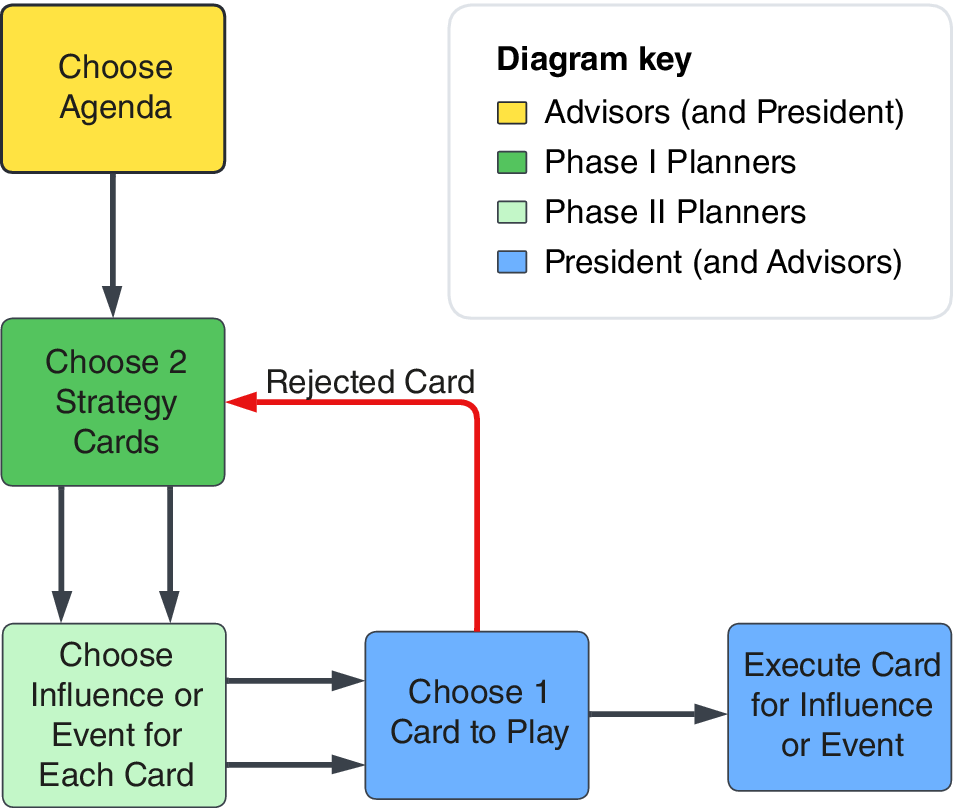
For the Organizational Process Model rule variant developed by this author, the goal is to illustrate how standard operating procedures and prior planning can restrict the decisions afforded to senior decision makers. Therefore, one student is assigned to play President Kennedy and the others are assigned to one of three roles: advisor, phase I planner, or phase II planner. The standard process of selecting one strategy card from a menu of options during each turn is replaced by a multistep process in which (1) the advisors select an agenda for the round; (2) phase I planners choose two strategy cards from a menu; (3) phase II planners choose whether those cards should be played for influence or event; and (4) the President selects which card to play, sends the rejected card back to the phase I planner, and makes any implementation decisions resulting from that choice. This process is illustrated in figure 2, which is derived from the single-page document distributed to students to explain the author’s additional rules added to 13 Days for the Organizational Process Model variant.Footnote 4 The advisors and the President are allowed to consult with one another; however, direct conversations between individuals in any other pairing of groups are prohibited. Handwritten notes were allowed to be passed up or down the chain of command.
Organizational Process Model Gameplay Diagram
This version of the game successfully captured the tension and frustration of policy as organizational output. The President and senior advisors often are unhappy and confused about the policy options presented to them by their planners; planners, in turn, often are frustrated with the President, who implements policies in ways that they did not intend. The first time this rule variant was offered, students proposed sending minimal, handwritten instructions alongside card selections, which improved the experience. The notes were minimal, direct, and concise because the students made their decisions under intense time constraints (i.e., to limit each game to a single 50-minute class session).
RULE VARIANT 2: APPROXIMATING THE BUREAUCRATIC POLITICS MODEL
For the Bureaucratic Politics Model variant of 13 Days developed by this author, the class is again divided into groups with assigned roles on the American side of the crisis. One student is assigned to play the role of President Kennedy and six students are assigned to play the roles of specific senior policy makers (i.e., Secretary of State Rusk, Attorney General Kennedy, Director of Central Intelligence McCone, Army Chief of Staff Wheeler, Navy Chief of Operations Anderson, and Air Force Chief of Staff LeMay). The remaining students are assigned as staff to one of the senior policy makers.
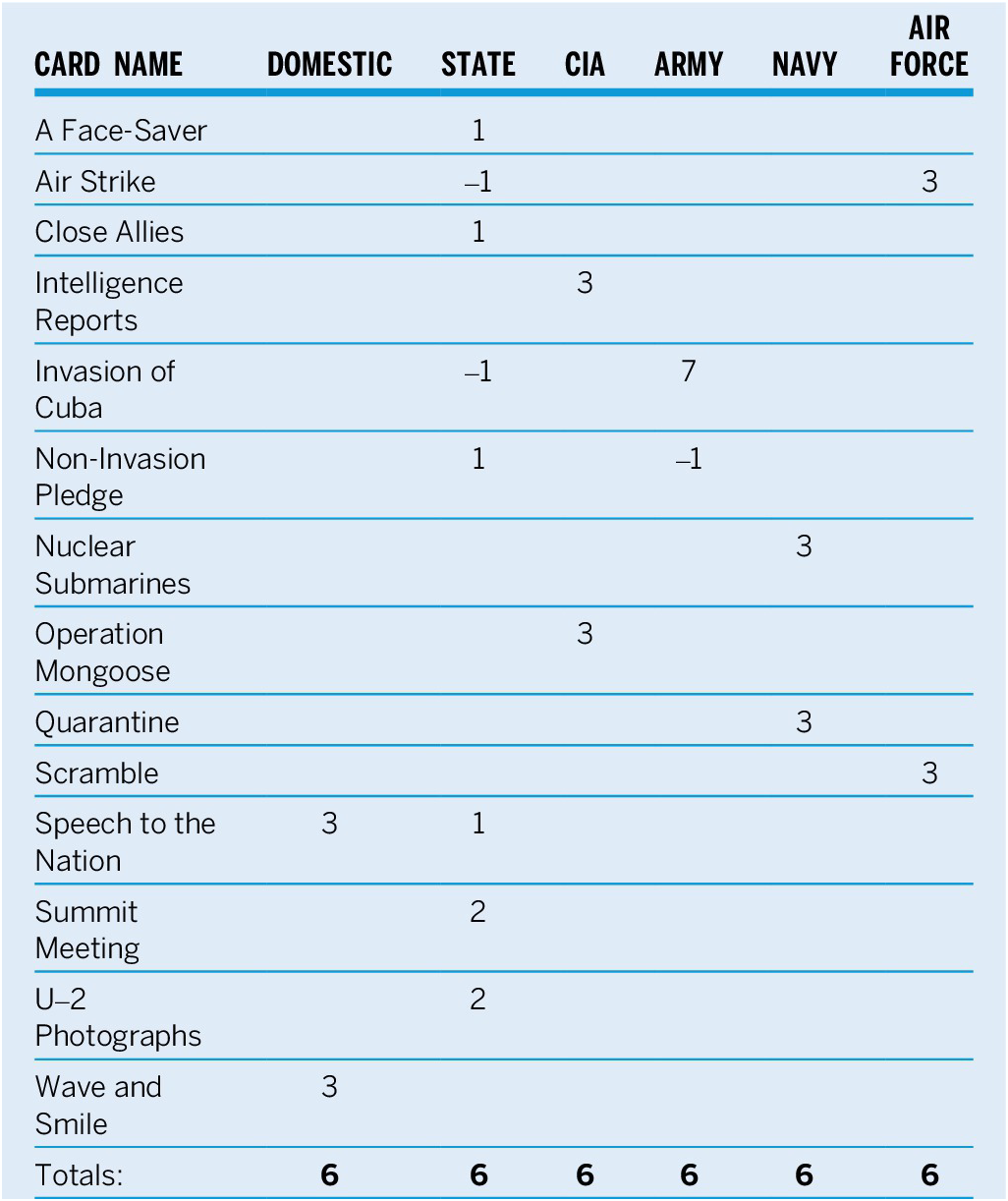
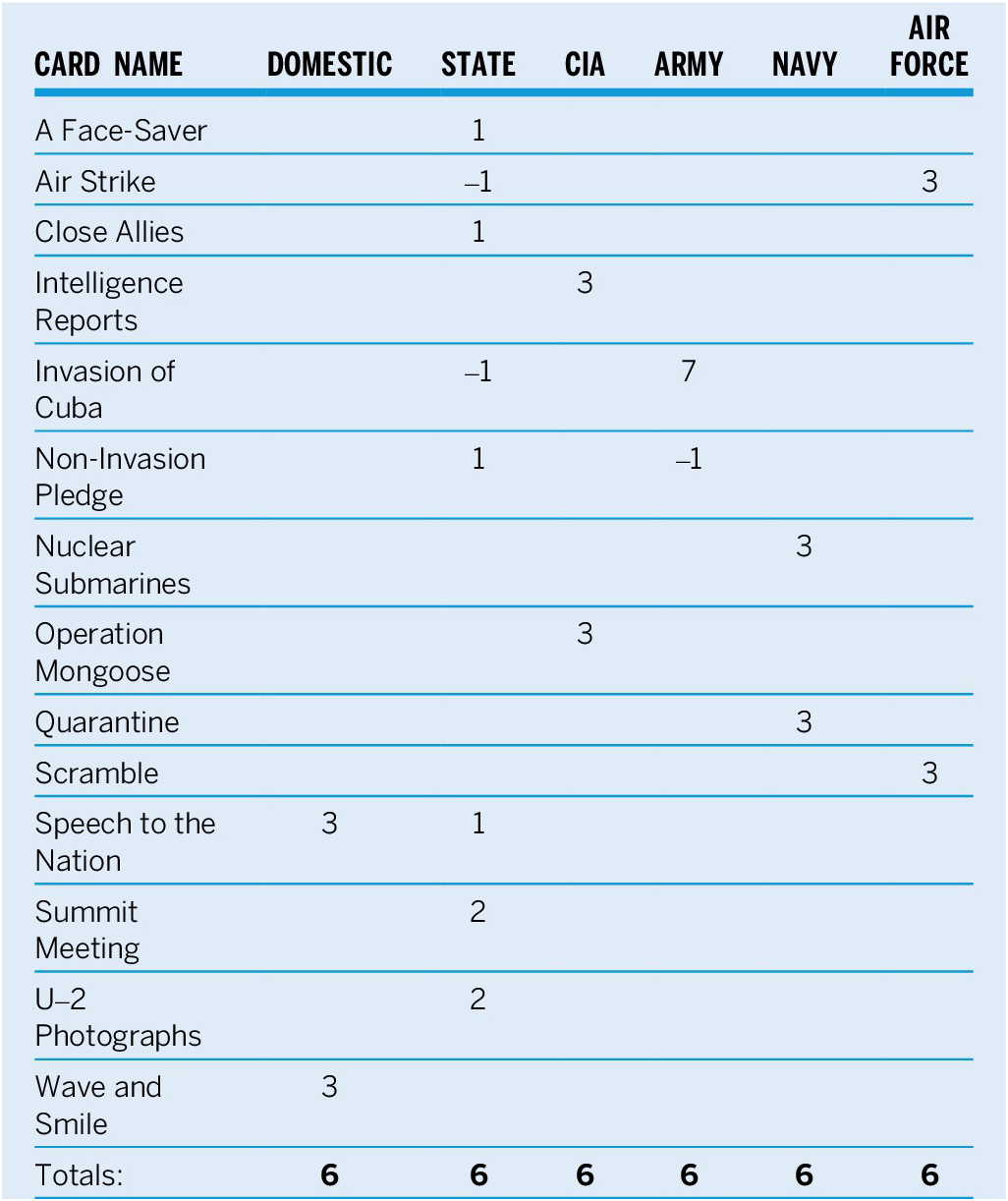
The rule variant representing the Bureaucratic Politics Model does not fundamentally alter the decision-making process like the previous variant. Instead, it captures the competing, parochial priorities of various government actors by giving them organizational-level incentives. Specifically, each senior policy maker receives a list of cards, each of which would produce either a positive or a negative payout if played for the event (there is no impact if played for influence). These payouts create strong incentives to see certain cards played for the event based on the assigned role (i.e., “where you sit”). For example, students assigned to roles in the Navy receive NAVY Points if the card “Nuclear Submarines” or “Quarantine” is played for the event. In another example, students assigned to roles in the Air Force receive AIR Points if the “Air Strike” or “Scramble” card is played for the event. Table 1 is a complete list of cards selected by this author to produce a payout for a specific organization when played for the event. In the interest of fairness, each group has incentive cards that total six possible points. Groups do not always have the same number of scoring opportunities, but this has not been a problem for students in the past. The deck of cards used for this game variant is stacked so that each card in table 1 is guaranteed as an option in one of the three rounds of the game.
Organizational Incentives for Bureaucratic Politics Model
The list of incentivized events is private knowledge. The principal decision maker for each organization is given a letter at the beginning of the simulation that outlines their incentives. This letter clarifies that students could lobby the President or negotiate among themselves as they deemed appropriate before any decision. It also provides students with real, tangible stakes. If the American team (students) could defeat the Soviet team (instructor), the entire class will receive extra credit. If the American team wins and the student’s assigned group (e.g., State or CIA) has the most points, then that student receives an additional award: an automatic 100% on the simulation reaction paper.
These letters are provided in sealed envelopes to create a sense of importance and immersion as the students unseal them and privately read the letter.Footnote 5 Based on prior experience, students should be given a brief time in class to read their letter, discuss it with other students assigned to their team, and fully understand their incentive structure. Some students have misread or misunderstood aspects of their incentives, which can reduce the utility of the simulation. If there is sufficient time, the instructor may want to visit each group to ensure that no one misunderstood the instructions.
This combination of incentives (i.e., one for the entire class and one limited to a student’s assigned organization) creates a tense environment of simultaneously cooperative and competitive interactions among students—a hallmark of the Bureaucratic Politics Model and good simulation design (Shaw and Switky Reference Shaw and Switky2018). This tension is clearly on display during the simulation. As some students lobby the President, they will attempt to implement their agenda by whatever means are at their disposal. Students attempt persuasion and negotiation, but they also resort to cruder means, such as falsely accusing another student of misunderstanding the rules or physically standing between a student who is lobbying the President to interrupt or derail a conversation. Other students are less assertive, which may be a more or less successful strategy depending on the disposition of the student assigned to the President role. As in the Bureaucratic Politics Model, personalities can play a significant role in this game variant. Personalities also are significant in role assignments. For example, the student assigned to be the President in this version of the game must be capable of managing disagreements among the other policy makers and be socially comfortable making difficult decisions that may upset some of their classmates. Additionally, the State Department has the most complex set of incentives. For this reason, the role of Secretary of State Rusk is recommended for a highly engaged and competent student.
The three simulations are summarized and compared in table 2. Each simulation represents one of Allison’s (Reference Allison1971) three models. The base rules of 13 Days approximate the assumptions of the Rational Actor Model, emphasizing cost-benefit analysis and utility maximization. For the simulation portraying the Organizational Process Model, the rules are modified to utilize the sequential decision-making flowchart in figure 2, which is designed to treat decisions as organizational output and to approximate the constraining effect of standard operating procedures. The Bureaucratic Politics Model simulation alters the rules by introducing private incentives in table 1 for each team of students, highlighting the role of such incentives (i.e., “where you stand depends on where you sit”) and the effect that persuasion and internal bargaining can have on decision-making outcomes.
Comparison of the Three Simulations

METHODOLOGY
To assess the value of the 13 Days activity, the author conducted an experiment during the Spring 2024 semester. During this semester, he taught two sections of an upper-division course titled “National Security,” which included a module on Allison’s (Reference Allison1971) three models. In the designated control section, the author taught the models using lectures and discussions. In the treatment section, he used the three versions of 13 Days (with a reduced schedule of lectures and discussions). Each section had the same number of class sessions on the relevant material. After completing the course module, students had the opportunity to complete a survey about their experience and to take a not-for-credit quiz.
When selecting questions for the survey, the author sought to maximize knowledge accumulation and comparability with prior research. As such, he followed the examples of questions and wording used in previous studies of simulations and other active learning techniques (Hendrickson Reference Hendrickson2019; Shellman and Turan Reference Shellman and Turan2006).Footnote 6 To summarize, students were asked to self-evaluate their enjoyment of, excitement about, understanding of, and interest in the material, as well as how they felt about their ability to do well in the course (i.e., self-efficacy) on a five-point Likert scale (1=strong decrease; 5=strong increase).
Evaluating the learning outcomes from an experiential pedagogical technique using a standardized test offered immediately after learning the material constitutes a hard case for showing the effectiveness of alternative instruction. Simulations excel most at improving long-term recall and knowledge retention, whereas traditional lectures have been shown to excel at short-term recall (Levin-Banchik Reference Levin-Banchik2018; Wunische Reference Wunische2019). The quiz consisted of a 15-question multiple-choice instrument.Footnote 7
FINDINGS
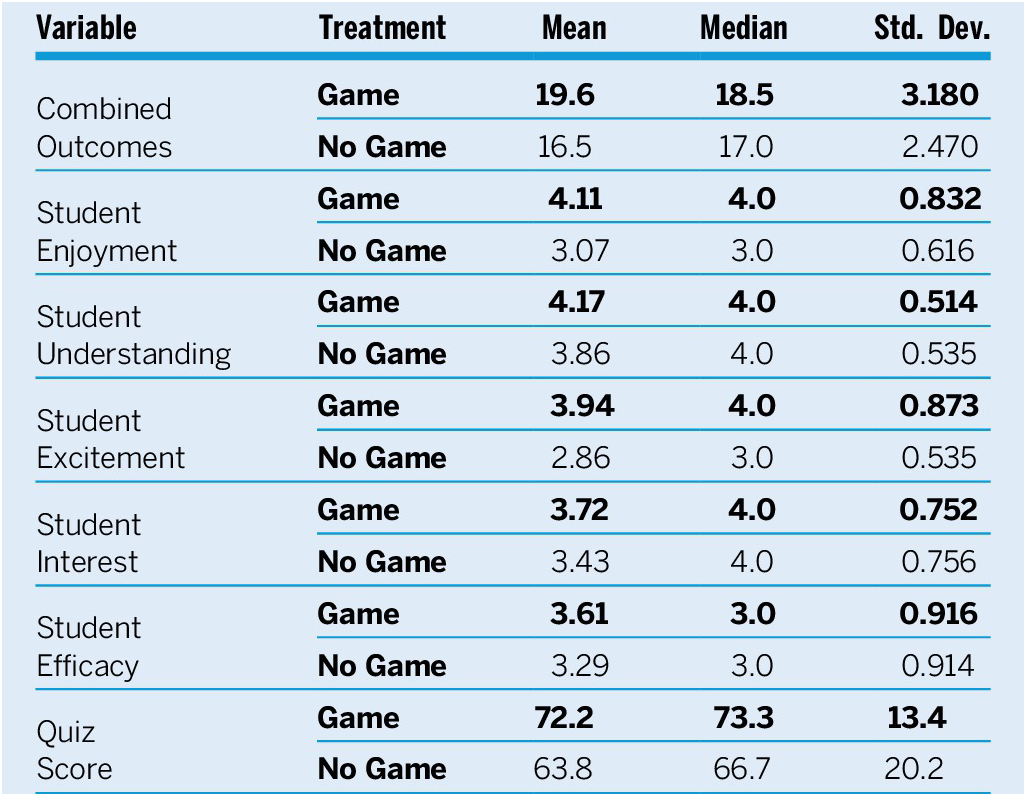
Table 3 presents the mean, median, and standard deviation across the treatment and control groups for each of the five survey questions related to 13 Days; the sum of those five questions; and the quiz grade. As shown in the table, the mean values are consistently higher for the class that participated in the 13 Days activity. In the control section, 14 students volunteered to participate in the survey and quiz and 18 students volunteered in the treatment section (Roberts Reference Roberts2025). Given this small sample size, conducting tests of statistical significance can be misleading.
Descriptive Statistics from Survey and Quiz

Figure 3 further explores the survey results by plotting histograms that show the distribution of responses for each question across both the treatment and control sections. The plots for the aggregate across all metrics, student enjoyment, and student excitement illustrate the most evident differences between the treatment and control groups. Intuitively, the effects would be most apparent in terms of student enjoyment and excitement because previous studies on using simulations in the classroom have reported—at least anecdotally—that students generally enjoy simulations and appear more engaged than during standard lectures.
Distribution of Student Survey Results
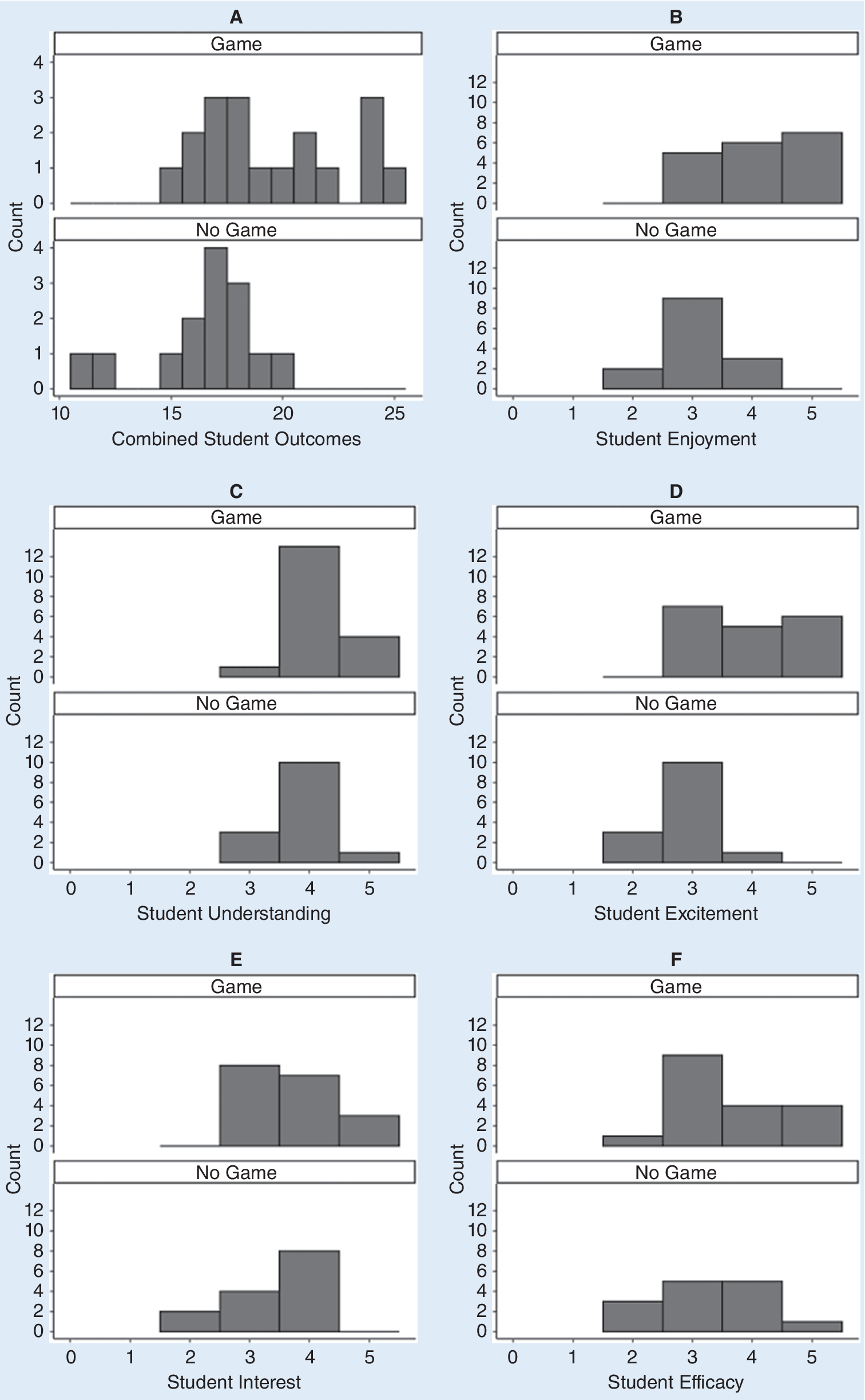
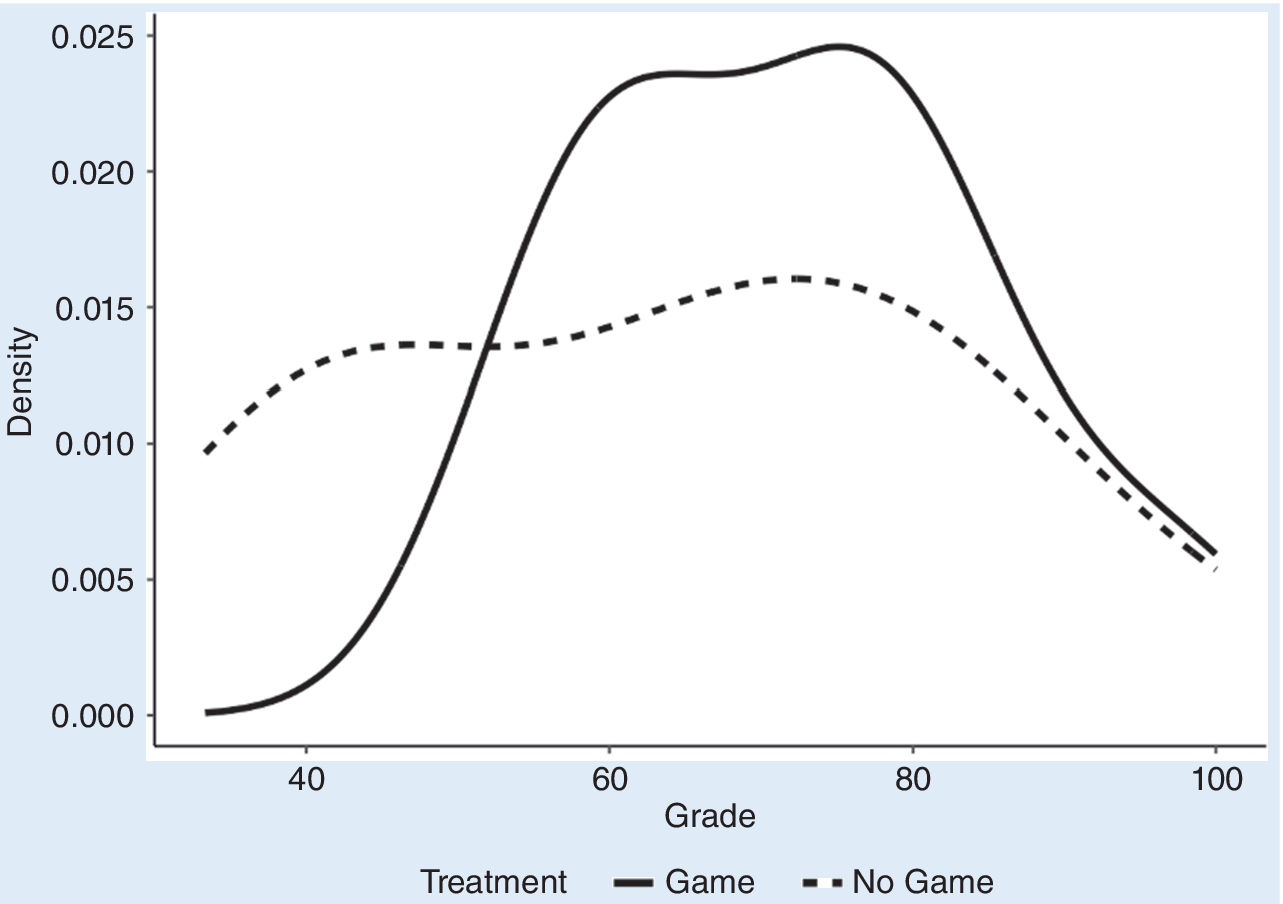
Figure 4 displays the distribution of quiz scores between the treatment and control groups. Quiz scores for this optional, not-for-credit quiz were significantly lower than what students typically receive on graded quizzes that impact their final course grade, which implies that some volunteers did not put their typical level of effort into maximizing their scores. Despite this limitation, there was an average 8.2% gap between the students who played the 13 Days game and those who did not. Although there was a similar number of high performers in each section, the simulation section had many fewer students fail the quiz than in the control section. Whereas the distribution for the simulation section approximates a normal distribution centered around the low-C range, for the section without the simulations it appears much flatter and more uniform across the B to F range. Despite these initial findings, further research with a larger sample is needed before concluding that the 13 Days simulations increase test scores.
Distribution of Student Quiz Results
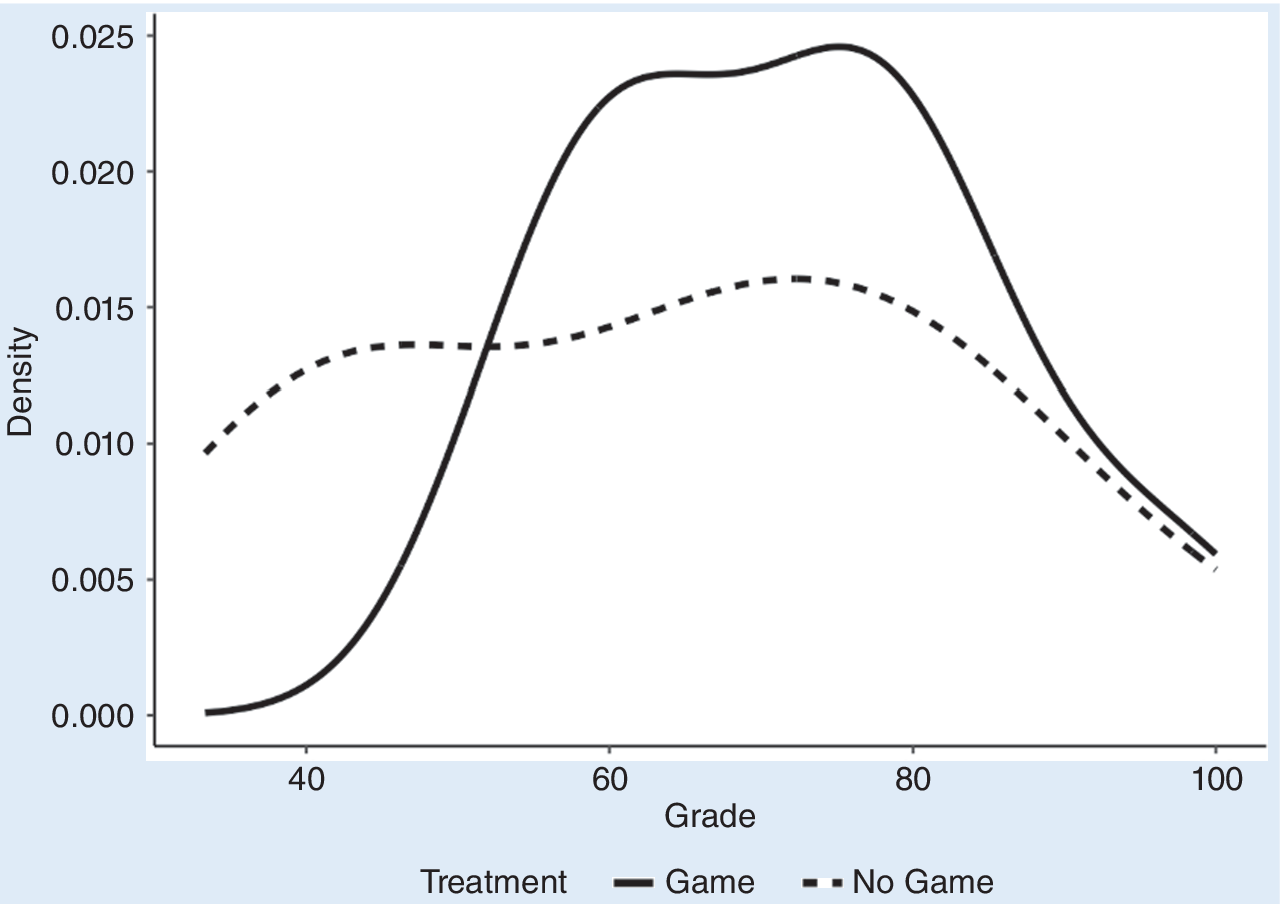
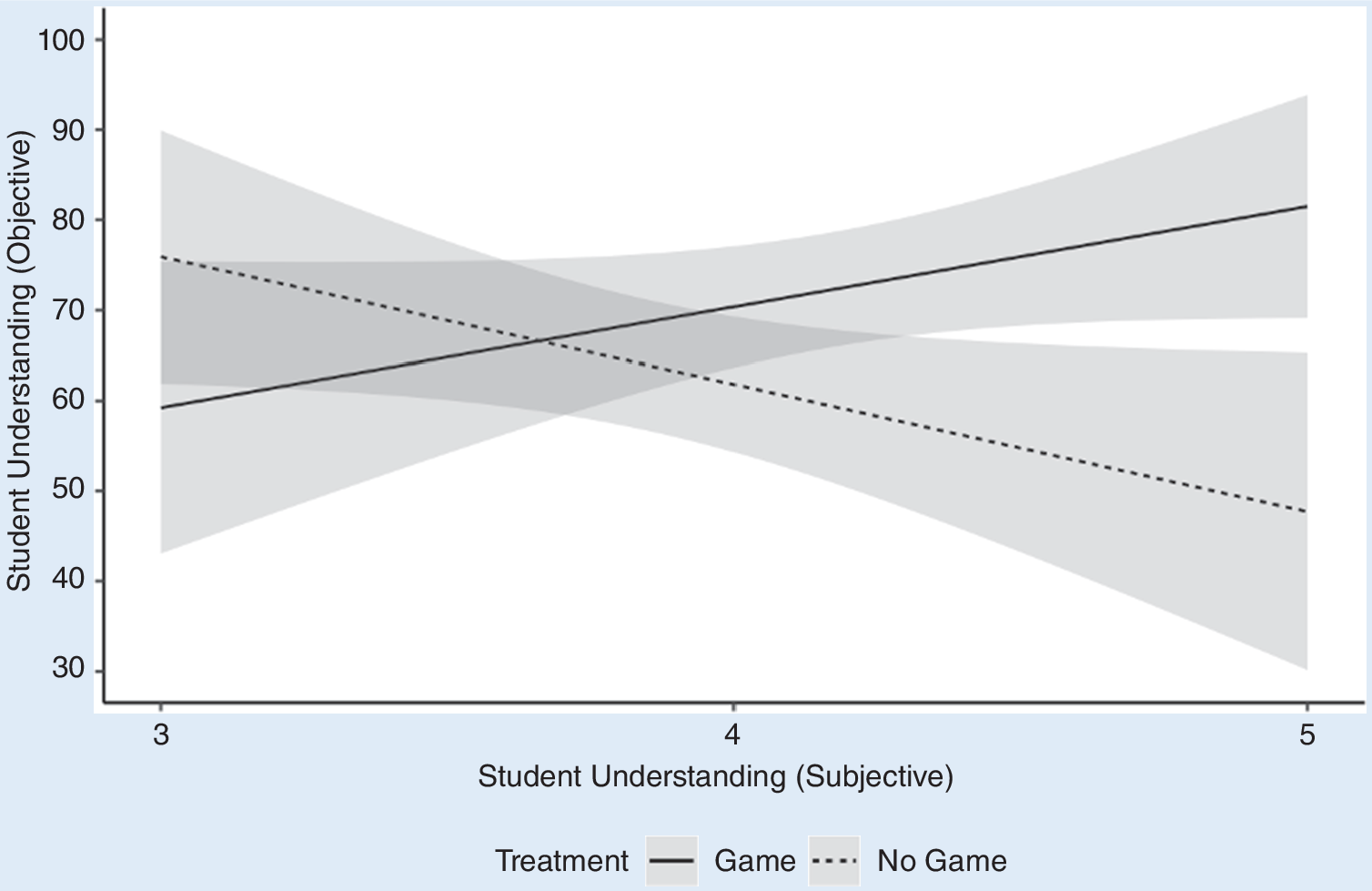
Figure 5 represents a preliminary exploration of a question that remains for future research: Do active learning techniques, such as the 13 Days simulations, increase students’ awareness of their level of knowledge? This question was explored by fitting a linear regression model with the dependent variable as the quiz score (i.e., an objective measure of student understanding) and independent variables of the treatment (i.e., exposure to the 13 Days simulations); the Likert scale student self-assessment of understanding (i.e., a subjective measure of student understanding); and an interaction between the treatment and the self-assessed understanding. The marginal effects presented in figure 5 reveal a surprising result. For students who participated in the 13 Days simulations, their self-assessment of their understanding was positively correlated with the assessment of their understanding obtained by the quiz. However, for students who did not experience the simulations, their self-assessed understanding was negatively correlated with the quiz-assessed understanding. Because students completed the survey before taking the quiz, this self-assessment measures how well they thought they understood the subject matter before being confronted with an exam that tested their understanding of the material.
Marginal Effects of Subjective and Objective Student Understanding

These results could be preliminary evidence indicating that students who are directed to engage in active learning activities become more self-aware of their competence or shortcomings in understanding the material because they are required to apply it in practice. Whether or not the students have developed a solid understanding of Allison’s (Reference Allison1971) three models, they experience their level of understanding when confronted with a simulation that requires knowledge of the material. Students who have not been instructed to participate in an activity that reveals their knowledge of the material—or lack thereof—may be subject to a phenomenon similar to the Dunning–Kruger effect (Kruger and Dunning Reference Kruger and Dunning1999). The Dunning–Kruger effect is a cognitive bias in which those who have low knowledge in a domain lack the metacognitive capacity to accurately assess their understanding and typically overestimate their level of knowledge. In contrast, those with higher levels of knowledge are more likely either to accurately assess or to underestimate their level of knowledge.
As a hypothetical example, consider two students who have attended the lecture and discussions about a topic but fundamentally misunderstood the material such that they overestimate their knowledge of it due to ignorance of what they do not know. Suppose the first student is in a course section that requires an active learning activity such as a competitive game or simulation. In that case, that student will be forced to reckon with their lack of knowledge as they struggle to act effectively in the simulation. Suppose the second student is in a section that engages with the material only during the class lecture. In that case, the student may continue believing that they have mastered the material until an exam or another assessment of mastery presents contradictory data. These examples highlight the potentially unique value of classroom games and other hands-on pedagogical techniques. These activities could serve as knowledge checks for students by clarifying how well they understand the material before higher-stakes assessments are administered, such as a final exam that represents a significant portion of their final grade.
The combination of the survey and the quiz used in this study was not ideal for evaluating the potential of games to communicate to students how well they understand the material. Instead of comparing the results of a Likert scale from a survey and quiz scores, any future attempt to more fully explore this idea should compare more similar measures. That is, before the quiz, students should be asked to predict their quiz score, their score percentile, or both. This prediction then should be compared to the actual result. Suppose in-class games truly communicate to students how well they have understood the material. In that case, students who have encountered a simulation should be better predictors of their performance on an assessment of their understanding. Furthermore, the low sample size in this study is insufficient to confidently evaluate the existence of this effect. Testing this hypothesis remains for future research.
CONCLUSION
This article demonstrates how the 13 Days game can be adapted into a three-part simulation that vividly captures Allison’s (Reference Allison1971) Rational Actor Model, Organizational Process Model, and Bureaucratic Politics Model. It affirms the thesis that such simulations can be developed and are effective. This approach provides a practical and engaging way for instructors to move beyond lectures and immerse their students in the competing logics of foreign policy decision making.
The findings suggest that simulations based on 13 Days enhance students’ enjoyment and excitement, their ability to recognize and apply complex theoretical models, and their ability to accurately assess their own learning. By forcing students to grapple with strategic tradeoffs, organizational constraints, and bureaucratic bargaining, the activity reinforces that state behavior cannot be reduced to a single explanatory lens. This result highlights the significance of this experiment: the simulations discussed herein operationalize Allison’s (Reference Allison1971) classic insight for a new generation of students.
The findings suggest that simulations based on 13 Days enhance students’ enjoyment and excitement, their ability to recognize and apply complex theoretical models, and their ability to accurately assess their own learning.
Furthermore, this study underscores the need for additional research. Small sample sizes limit the ability to make definitive claims about learning outcomes. Future studies should investigate whether these simulations improve long-term retention and enhance metacognitive awareness of understanding. However, even in preliminary form, the results are encouraging: students not only enjoyed the activity but also performed better on an assessment and demonstrated more accurate self-evaluation of their knowledge. Future research exploring this latter effect could improve on the approach used here by having students directly predict their performance (i.e., quiz score) on the assessment. This improvement of the empirical approach would allow a more precise comparison of self-assessed learning and assessment performance.
This article contributes both a replicable classroom tool and evidence that such a tool can enrich the teaching of foreign policy. Incorporating simulations such as 13 Days can bridge the gap between theory and practice, helping students to grasp the drama, uncertainty, and institutional complexity of real-world decision making. For instructors of IR, national security, and foreign policy, these simulations provide a compelling way to enliven the classroom and deepen student learning.
SUPPLEMENTARY MATERIAL
To view supplementary material for this article, please visit http://doi.org/10.1017/S1049096525101650.
ACKNOWLEDGMENTS
The author thanks the PS editorial team and anonymous reviewers for their valuable suggestions, his colleagues at Coastal Carolina University for suggestions on previous iterations of this article, and Constance Burt for her meticulous copyediting.
DATA AVAILABILITY STATEMENT
Research documentation and data that support the findings of this study are openly available at the PS: Political Science & Politics Harvard Dataverse at https://doi.org/10.7910/DVN/9TUD7T.
CONFLICTS OF INTEREST
The author declares that there are no ethical issues or conflicts of interest in this research.






 Open access

