


INTRODUCTION
The prevalence of clientelistic, or more broadly nonprogrammatic, political competition constrains economic and political development (Hicken Reference Hicken2011; Kitschelt and Wilkinson Reference Kitschelt and Wilkinson2007). Such political equilibria, in which politicians provide private, or highly targeted, benefits to voters in exchange for their votes, affect the selection of politicians, voters’ ability to hold them to account, and distort the allocation of public resources (Keefer Reference Keefer2007; Khemani Reference Khemani2015; Robinson and Verdier Reference Robinson and Verdier2013). Augmenting its structural roots in voters’ poverty and the state’s limited capacity (Bobonis et al. Reference Bobonis, Gertler, Gonzalez-Navarro and Nichter2022; Gottlieb Reference Gottlieb2024; Weitz-Shapiro Reference Weitz-Shapiro2012), one potential reason for the persistence of nonprogrammatic competition is that election candidates face high costs to supply broad-based policy information while voters face high costs of access (Cruz et al. Reference Cruz, Keefer, Labonne and Trebbi2024; Fujiwara and Wantchekon Reference Fujiwara and Wantchekon2013; Hicken and Nathan Reference Hicken and Nathan2020).
Initiatives that promote the flow of policy information from candidates to voters might then induce electoral turnover and the selection of candidates better equipped for programmatic politics. A large literature, in turn, has studied the effects of easing voters’ access to policy information on their support for their incumbents, who were elected under the preexisting clientelistic equilibrium (Bidwell, Casey, and Glennerster Reference Bidwell, Casey and Glennerster2020; Dunning et al. Reference Dunning, Guy, Macartan, Hyde, Craig, Gareth and Adida2019; Ferraz and Finan Reference Ferraz and Finan2008; Fujiwara and Wantchekon Reference Fujiwara and Wantchekon2013). This work has typically found reductions in voters’ support for incumbents, though the effects are importantly conditioned by the mode of dissemination, candidates’ campaigning responses, and voters’ prior beliefs (Arias et al. Reference Arias, Larreguy, Marshall and Querubin2022; Cruz, Keefer, and Labonne Reference Cruz, Keefer and Labonne2021; Enríquez et al. Reference Enríquez, Larreguy, Marshall and Simpser2024). Overall, voters’ demand does not seemingly hinder the transition to more programmatic political equilibria (Bowles and Marx Reference Bowles and Marx2023; Weghorst and Lindberg Reference Weghorst and Lindberg2013).
If the challenge is not evidently voters’ demand, we instead consider candidates’ supply of policy information. Even when the costs of reaching broad swathes of the electorate are low, the effects of initiatives intended to promote the flow of policy information are likely to be conditioned by candidates’ incentives to use them. Especially given that participation might imply electoral costs, candidates’ participation in such initiatives then cannot be assumed. We focus on election debates, which have spread rapidly across developing democracies, with 24 sub-Saharan African countries holding one in recent years (Debates International 2023). Aiming to foster more programmatic competition, these initiatives primarily act to elicit and disseminate policy information from a range of candidates, with the debate format potentially enhancing voters’ attention to, and updating about, participating candidates (Bidwell, Casey, and Glennerster Reference Bidwell, Casey and Glennerster2020). But, as one leading debate organizer notes, “the greatest universal challenge that [debate] sponsors face, regardless of country or culture, is convincing candidates to take part” (National Democratic Institute 2014, 42). Illustratively, incumbent candidates in sub-Saharan Africa have refused to participate in nearly half of all presidential debates, with similar challenges observed in developed democracies (Juárez-Gámiz, Holtz-Bacha, and Schroeder Reference Juárez-Gámiz, Holtz-Bacha and Schroeder2020).Footnote 1
We study a legislative debates initiative held during Liberia’s 2017 election, a highly clientelistic setting, and which held debates in every electoral district for the first time. These standardized debates focused on soliciting policy promises from participating candidates which were then rebroadcast multiple times, shortly prior to the election, by reputable community radio stations with signals covering 90% of the electorate. By restricting the extent of interaction between candidates, with small in-person audiences, and by disseminating the debate information mostly through radio broadcasting, the initiative aimed to showcase policy information more than candidates’ personalities and charisma. In partnership with the organizers, we study a nationwide field experiment that randomly encouraged the debate participation of candidates across electoral districts, which the organizers were concerned would be low. The intensive invitation intervention, which sought to inform and persuade candidates to participate, increased the participation of incumbents from 35% to 50%; that of their most prominent challengers from 50% to 65%; and had no effect on more marginal candidates who participated at high rates absent the encouragement intervention.
When candidates’ participation cannot be enforced, we suggest that incumbents face consequentially distinct trade-offs, compared to their challengers, in electing to participate. First, incumbents’ participation, by acting as a focal point in a debate, determines the amount of attention voters pay to such an initiative and the extent to which they update in response. Second, strong performance in a debate is likely to induce potentially valuable mass media campaigning complementarities—especially when such debates are disseminated at scale—of particular value to more resource-constrained challenger candidates. While incumbents, concerned about the downside risk of their (highly salient) poor performance, then refrain from participation unless they are confident of its direct electoral returns, challenger candidates are relatively more likely to gamble on participation in an effort to amplify their campaigns.
Consistent with the relevance of these twin channels, our experimental results point to uneven electoral consequences of debate initiatives at scale. Using an original panel survey of 4,060 voters across every electoral district before and after the election, as well as administrative polling station data, we find that incumbents benefited at the expense of their challengers: voters in treated districts became around 5 percentage points more likely to vote for them. These changes in electoral outcomes occurred particularly in districts where we predicted incumbents to perform well in the debates, or where incumbents had policy priorities well-aligned with their voters’. Remarkably, 50% of incumbents in treated districts won reelection compared to 43% in control.
Three sets of analyses, grounded in a formal model of debate participation, help parse these results. First, we find important differences in compliance: those incumbents induced to participate by the intervention had policy priorities much better aligned with their voters relative to their challengers. Second, as a result of increased candidate participation, voters in treated districts paid more attention to the debates. Voters in treated districts then updated positively, albeit weakly, about incumbents’ competence and policy priorities, becoming much more certain in the process. However, they updated relatively negatively about their challengers and experienced weaker gains in certainty about their competence and policy alignment. Third, aided by an increase in demand, incumbents increased their radio campaigning in treated districts while challengers, seemingly deterred by their relatively poorer debate performance, reduced their on-the-ground campaigning.
Variation in candidates’ selection into participation then critically determined the electoral consequences of the debate initiative. This selection issue is likely to condition the effects of many programmatic interventions when scaled. For example, prior field experimental studies on debates (Bidwell, Casey, and Glennerster Reference Bidwell, Casey and Glennerster2020; Brierley, Kramon, and Ofosu Reference Brierley, Kramon and Ofosu2020; Platas and Raffler Reference Platas and Raffler2021) and deliberative town hall initiatives (Fujiwara and Wantchekon Reference Fujiwara and Wantchekon2013; Wantchekon and Guardado Reference Wantchekon and Guardado2024), in which candidates’ uniform participation was ensured, have found that less well-known candidates tend to benefit. We find that most nonparticipating incumbents had priorities poorly aligned with voters’. Had they participated, our results could well have matched prior studies. But absent such enforcement—which becomes implausible as the potential electoral impact of programmatic initiatives increase—incumbents can take greater advantage of the opportunity to supply policy information compared to a fragmented field of challengers. In turn, the refusal of lower quality incumbents to select into participation inhibits voters’ ability to hold them to account.
Beyond Liberia, we suggest that these stratified electoral consequences are likely to extend to other settings where clientelism is prevalent. This is especially the case where parties’ weak institutionalization implies broad variation in candidates’ abilities for policy-based campaigning; majoritarian systems where voters face difficult informational challenges in selecting among candidates rather than parties; and where meaningful levels of electoral contestation render the decision to supply policy information electorally consequential.
In so doing, our work contributes to two literatures. First, we contribute to the large literature on the electoral consequences of voters’ exposure to policy information. This literature shows that electoral accountability is enhanced through revelations of past incumbent performance via broadcast and social media, but not necessarily via localized information campaigns (Dunning et al. Reference Dunning, Guy, Macartan, Hyde, Craig, Gareth and Adida2019; Enríquez et al. Reference Enríquez, Larreguy, Marshall and Simpser2024; Ferraz and Finan Reference Ferraz and Finan2008; Larreguy, Marshall, and Snyder Reference Larreguy, Marshall and Snyder2020). Experimental studies on debates, in which all candidates participated, find broad effects on informing and persuading voters (Bidwell, Casey, and Glennerster Reference Bidwell, Casey and Glennerster2020; Brierley, Kramon, and Ofosu Reference Brierley, Kramon and Ofosu2020; Platas and Raffler Reference Platas and Raffler2021). Our findings suggest that the effects of nominally similar interventions vary as they are scaled—due not just to differences in the mode of dissemination (as in studies of incumbent malfeasance), but also due to candidates’ incentives to engage. Such incentives are not necessarily well-aligned, especially when candidates often benefit from the preexisting clientelistic equilibrium. Understanding candidates’ compliance decisions then becomes an important factor in understanding the impact of informational interventions administered at scale.
Second, we add to the literature on the development of programmatic competition. A substantial literature suggests that interventions undercutting the roots of clientelist politics disadvantage incumbent candidates on average. These include the promotion of policy promises, which have been found to either disadvantage locally dominant candidates through persuasive deliberative interventions (Fujiwara and Wantchekon Reference Fujiwara and Wantchekon2013; Wantchekon and Guardado Reference Wantchekon and Guardado2024) or be prohibitively expensive (Cruz et al. Reference Cruz, Keefer, Labonne and Trebbi2024); interventions to reduce voters’ vulnerability (Bobonis et al. Reference Bobonis, Gertler, Gonzalez-Navarro and Nichter2022); or anti-vote buying campaigns (Blattman et al. Reference Blattman, Larreguy, Marx and Reid2024; Schechter and Vasudevan Reference Schechter and Vasudevan2023). Our results highlight important variation in candidates’ decisions to select into opportunities for programmatic competition. Identifying high-quality challengers suitable for policy-based competition, and ensuring parties select them effectively, could then be an important lever in shifting toward more programmatic political equilibria.
CANDIDATES’ SUPPLY OF POLICY INFORMATION
The supply of policy information represents a strategic decision by candidates to compete on more programmatic grounds. Focusing on the example of debate participation, we provide a simple framework to understand how candidates’ supply-side decisions are then likely to condition the effects of initiatives intended to promote programmatic competition. In Section A.1 of the Supplementary Material, we formalize key aspects of our framework using a probabilistic voting model where an incumbent candidate I and an opposition candidate O decide whether to engage in costly debating and different forms of campaigning. While we omit the full exposition of the model here, we use it to microfound our empirical implications and, later, to interpret our observed results.
Debate Participation, Policy Information, and Campaigning Responses
Candidates consider the benefits and costs of debate participation. Considering the direct returns first, candidates stand to electorally benefit if their participation leads voters to update positively about them—either by performing well or by revealing their policy priorities to be well aligned with those of their electorate,Footnote 2 which we model as a signal of candidate $ c\in \{I,O\} $
,
$ c\in \{I,O\} $
, $ {s}_c $
, being greater than voters’ prior belief,
$ {s}_c $
, being greater than voters’ prior belief, $ {\mu}_0 $
. Beyond the risk of poor performance, debating incurs direct costs of participation during a busy campaign season.
$ {\mu}_0 $
. Beyond the risk of poor performance, debating incurs direct costs of participation during a busy campaign season.
The indirect returns to participation hinge on its consequences for candidates’ campaigning. This depends on how the debates are disseminated and how the candidate performs in them. While small-scale dissemination might induce candidates to concentrate their campaigning in localities exposed to policy information, this substitution becomes infeasible when debates are broadcast at scale (Bidwell, Casey, and Glennerster Reference Bidwell, Casey and Glennerster2020; Casey and Glennerster Reference Casey and Glennerster2023). Candidates’ endogenous responses should then vary across campaigning strategies. Intuitively, mass media dissemination is likely to have campaign complementarities (Casey and Glennerster Reference Casey and Glennerster2023). Participating and performing relatively well in a debate broadcast on radio or television, for example, is likely to induce follow-up demand from stations offering a cheap route to reach broad swathes of the electorate, while heightening voters’ attention to subsequent campaigning on those outlets.
The implications of debate participation for clientelistic modes of campaigning—such as local rallies and vote buying—are more complex. First, clientelistic strategies become more costly as the broad dissemination of policy information limits candidates’ ability to deviate and narrowly target voters with transfers during the campaign (Fujiwara and Wantchekon Reference Fujiwara and Wantchekon2013; Opalo Reference Opalo2022; Wantchekon Reference Wantchekon2003; Weghorst and Lindberg Reference Weghorst and Lindberg2013). Second, on-the-ground responses are likely to depend on debate performance. As in the broader literature on electoral competition on the basis of policy versus valence, it is ex ante ambiguous whether these are complements or substitutes (Carter and Patty Reference Carter and Patty2015). Consistent with complementarity (Blattman et al. Reference Blattman, Larreguy, Marx and Reid2024; Denter Reference Denter2021; Groseclose Reference Groseclose2001), strong (weak) performance should raise (lower) candidates’ salience and thereby incentivize (deter) their campaigning investments. Or, consistent with substitutability (Ashworth and Bueno de Mesquita Reference Ashworth and Bueno de Mesquita2009; Kendall, Nannicini, and Trebbi Reference Kendall, Nannicini and Trebbi2015), strong performance could induce candidates to leverage mass media campaign complementarities and reduce their costly on-the-ground activities, whereas weak performance might induce investment in more intensive clientelistic campaigning—even if more costly—to limit the resulting electoral damage (Cruz et al. Reference Cruz, Keefer, Labonne and Trebbi2024).Footnote 3
Candidates’ Varied Returns to Participation
These returns vary by the status of the candidate. When elections work well, incumbents should generally perform better in a policy-focused debate than their challengers. First, reflecting a prior selection channel, the fact that incumbents were previously elected can imply both that their policy positions are well-aligned and that strong challengers may have been deterred from competing again (Ashworth and Bueno de Mesquita Reference Ashworth and Bueno de Mesquita2008). Second, reflecting an experience channel, incumbents’ office-holding experience in government increases their ability to understand and discuss key policy issues (Fowler Reference Fowler2016).
When elections are instead typically contested on nonprogrammatic grounds, whether incumbents benefit from the broad supply of policy information becomes ambiguous. The experience channel is still likely to hold. Compared to less experienced challengers liable to make implausible policy promises (Opalo Reference Opalo2022), incumbents are likely to better understand and articulate policy issues. The prior selection channel, however, is less clear. Locally dominant incumbents instead risk revealing their priorities to be disconnected from their constituents’, especially when clientelistic modes of campaigning have proven fruitful in the past (Cruz et al. Reference Cruz, Keefer, Labonne and Trebbi2024; Fujiwara and Wantchekon Reference Fujiwara and Wantchekon2013). Their actual capacity for programmatic competition, then, could well be lower than that of their challengers.
Two additional sources of variation, highlighted by our formal model, critically affect the returns to participation for incumbents relative to challengers. First, by changing its salience and benchmarking (Adida et al. Reference Adida, Gottlieb, Kramon and McClendon2020; Bhandari, Larreguy, and Marshall Reference Bhandari, Larreguy and Marshall2023), how voters internalize the supply of policy information is conditioned by the composition of candidates who take part. Debates, relative to many other informational interventions, are particularly useful in judging multiple candidates simultaneously, with a reference point naturally provided by the incumbent (Bidwell, Casey, and Glennerster Reference Bidwell, Casey and Glennerster2020; Martel Reference Martel1983). Absent this reference point, the effects of such initiatives on voters’ attention, context-dependent updating, and discussions with others are likely to be muted (Cho and Ha Reference Cho and Ha2012).Footnote 4 Voters’ heightened attention to incumbents in a debate, augmented by their office-holding experience, means that their participation is likely to provide a more precise signal about their policy priorities. We model this as incumbents’ debate signal, $ {s}_I $
, having a lower variance than that of their opposition,
$ {s}_I $
, having a lower variance than that of their opposition, $ {s}_O $
,
$ {s}_O $
, $ {\sigma}_I^2<{\sigma}_O^2 $
.
$ {\sigma}_I^2<{\sigma}_O^2 $
.
Second, the nature of campaign responses should vary by candidate type. Any complementarity between debate performance and mass media campaigning is especially attractive for challengers, who have fewer resources for on-the-ground campaigning and less awareness among voters (Cruz, Keefer, and Labonne Reference Cruz, Keefer and Labonne2021). Augmented by the higher variance of their debate signal, $ {\sigma}_O^2 $
, which reduces voters’ updating on average, challengers become more willing to gamble on their performance for the chance of both cheap publicity and its subsequent media campaigning complementarities. Incumbents, facing heightened attention, risk poor performance, thus sending a negative signal to voters and requiring costly on-the-ground campaigning investments to try and mitigate the electoral damage.
$ {\sigma}_O^2 $
, which reduces voters’ updating on average, challengers become more willing to gamble on their performance for the chance of both cheap publicity and its subsequent media campaigning complementarities. Incumbents, facing heightened attention, risk poor performance, thus sending a negative signal to voters and requiring costly on-the-ground campaigning investments to try and mitigate the electoral damage.
Implications of Participation Decisions in Clientelistic Settings
When candidates’ participation can be enforced, initiatives that lower the costs of disseminating policy information lead incumbents—previously selected according to their comparative advantage in clientelism—to suffer electoral losses if the prior selection channel outweighs the experience channel from incumbency. These electoral returns for incumbents being negative on average is consistent with prior evidence on localized debates (Bidwell, Casey, and Glennerster Reference Bidwell, Casey and Glennerster2020; Platas and Raffler Reference Platas and Raffler2021) and deliberative initiatives (Fujiwara and Wantchekon Reference Fujiwara and Wantchekon2013), all of which ensured the full participation of candidates, as well as work on the revelation of incumbents’ performance in office (Ferraz and Finan Reference Ferraz and Finan2008; Larreguy, Marshall, and Snyder Reference Larreguy, Marshall and Snyder2020).
But, when candidates’ participation cannot be enforced, which becomes a more pressing issue as the scale of such initiatives increases, we should then expect quite different electoral consequences. Among incumbents, because their participation induces heightened attention from voters, their downside risk from weak performance or revealing their priorities to be poorly aligned is high. Among less salient challengers, these risks are attenuated both by voters’ more limited attention to their performance and by the potentially valuable campaign complementarities their participation induces. While incumbents and the challengers whose policies are closest to those of their constituents are likely to select into participation, because they confidently anticipate doing well, more marginal challengers’ decisions to participate are therefore likely to be a relatively noisier function of their expected debate performance.
Lowering the costs of supplying policy information then only facilitates transitioning to more programmatic equilibria to the extent that key candidates’ incentives are aligned. Absent this alignment, which is unlikely when many leading candidates benefit from the existing clientelistic equilibrium, such initiatives might act to entrench, rather than threaten, incumbency on average. While entrenching incumbency is not necessarily bad for voters’ welfare—since higher quality incumbents are those most likely to benefit—the refusal of lower quality incumbents to select into the supply of policy information inhibits voters’ ability to hold them to account and then undermines the impact of such programmatic initiatives. This is compounded by voters’ lack of attention when such key candidates fail to participate, which potentially dampens the extent to which their nonparticipation induces electoral sanctioning.
Scope Conditions
A set of scope conditions—beyond settings typically defined by clientelistic competition—affect whether these stratified electoral consequences are likely to occur. Three key conditions, we suggest, relate to weakly institutionalized parties; majoritarian party systems; and the presence of meaningfully contested and reasonably clean elections. We discuss each in turn.
Weak party institutionalization implies that parties are unlikely to consistently select candidates on the basis of their capacity for programmatic competition, nor provide them with substantial resources or impose their policy priorities. As a result, candidates are likely to be quite varied in their programmatic capabilities and policy priorities, while viewing initiatives like debates as a useful but costly way to augment their campaigns. To the extent that ruling party affiliation enhances the flow of campaigning resources and candidates’ prominence, this reduces the incentives for its candidates, likely incumbents, to participate unless they are extremely confident of good performance. While multiple strong parties, by strengthening candidate selection and providing more balanced campaigning resources, might then reduce the uneven electoral consequences we posit, the presence of only one especially strong party would limit the overall impact of such an initiative due to ruling party candidates’ limited incentives to engage. Further, parties’ relative weakness enables candidates to easily defect and either start their own parties or run as independents. By rendering voters’ updating especially hard, a profusion of candidates exacerbates the informational and salience advantages enjoyed by incumbents when they elect to participate.
Majoritarian political systems amplify these informational challenges of voting compared to settings where citizens vote primarily across parties rather than between candidates (Adida et al. Reference Adida, Gottlieb, Kramon and McClendon2020). In majoritarian systems (or non-majoritarian systems with low district magnitude), learning about candidates’ own policy priorities is likely to be more important for citizens’ voting decisions and hence debate participation should become more consequential for individual candidates. Further, while we focus on contexts defined by nonprogrammatic competition, reasonably clean elections are required for shocks to the supply of policy information to be electorally consequential. In semi-authoritarian settings where incumbents face little risk of losing office due to fraud or manipulation, candidates’ decisions to participate in a debate, which are relatively unlikely in those settings, would surely reflect a different set of considerations than those we consider.
LIBERIAN ELECTORAL CONTEXT
We study Liberia’s 2017 House of Representatives elections in which each of 73 electoral districts elected a single representative for a 6-year term. Graphically assessing our scope conditions in Figure A1 in the Supplementary Material using cross-national data, Liberia represents a setting defined by high levels of clientelistic competition, a weakly institutionalized party environment, but with relatively competitive and cleanly administered elections. We draw out these points, and their implications, next.
House members are responsible for shaping legislation and control access to development funds used for the allocation and implementation of local public goods. Representatives are rewarded with an annual salary of over $200,000 USD in a country with an annual per capita income of around $900 (IREDD 2016). Once in office, their performance is highly varied. Dissatisfaction with incumbent performance is widespread, with two-thirds of citizens mistrusting their representative (Afrobarometer 2015), and more than half report seeing their representatives only at election time (USAID 2018). This dissatisfaction is not the result of citizens being unaware of their legislator—92% of our voter survey correctly named their legislator—but often owes to their perceived failure to improve the availability and quality of local public goods. While incumbents sought reelection in nearly 90% of districts, less than half were reelected in an election considered free and fair by international observers (Carter Center 2017).
Who Runs for Office?
Low barriers to candidacy combined with a fragmented and weakly institutionalized party environment mean that many candidates run for office. A total of 984 candidates from 26 different political parties ran, with as many as 28 candidates in a district. Out of this total, there exists a long tail of more marginal candidates who run primarily to enhance their profiles and secure post-electoral favors. Candidate selection processes for even the most prominent parties, the Unity Party and Congress for Democratic Change, are relatively informal and tend to rely on the prominence or connections of an individual seeking candidacy.
We draw on an original survey of 612 candidates to provide descriptive evidence regarding candidacy. Throughout, we distinguish between three predicted leading candidates per district and other candidates, and further divide predicted leading candidates into incumbents and predicted challengers (see more on this categorization in Section A.2 of the Supplementary Material). Our aim was to facilitate measurement and analysis by identifying three candidates per district who had genuine chances of success. Moreover, the definition of actual leading candidates, those whose vote share ranked in the top three of their district, might be endogenous to our intervention.
Table 1 provides descriptive statistics. Candidates generally come from Liberia’s elite, with far more education than an average citizen, and are overwhelmingly male. Incumbents are older and marginally better educated than challengers, with more prior experience in a nonelected government job, likely reinforcing their understanding of policy issues. Almost a third of all candidates have previously run for office, and most report experience in local advocacy campaigns. Candidates report spending substantial amounts—on average above $30,000—on their campaigns. Consistent with their resource advantages, incumbents report spending 50% more than predicted challengers and 100% more than other candidates.
Table 1. Candidate Characteristics

Note: Mean of responses among incumbents, challengers, and other candidates to our candidate survey. Age: age in years; University educated: completed university; Ran before: ran for office at least once before; Govt. job before: previously held nonelected government job; NGO job before: worked for an NGO before; Advocacy experience: worked on an advocacy campaign before; Campaign expenditure: self-reported campaign spending in USD; Radio station: either owns or manages a radio station.
Campaigning and Policy Promises
Candidates primarily organize their own campaigns, with relatively little coordination or resources provided even by the most prominent national parties. Campaigns center on local rallies where candidates interact directly with voters to distribute gifts in cash or kind to generate support. Nearly, 80% of surveyed candidates reported visiting most or all communities in their district, while nearly half reported distributing gifts in most or all communities. During campaign season, incumbents in particular organize the trucking of voters to polling stations, with as many as 35% of voters receiving money in exchange for their vote (USAID 2018), and with substantial variation in their effective monitoring of political brokers (Bowles, Larreguy, and Liu Reference Bowles, Larreguy and Liu2020).
In this clientelistic context, candidates face few incentives to widely disseminate policy promises or their specific priorities for public expenditures. Candidates are well aware of differences in the types and credibility of policy promises delivered at local rallies versus over the radio, as Table 2 reports. Candidates believe that promises made on the radio are more credible than those made at rallies, but they acknowledge the low likelihood of any campaign promise being kept. Incumbents, suggestively, appear to be more sophisticated in this regard than their less experienced challengers.
Table 2. Candidate Attitudes toward Policy Promises

Note: Mean of responses among incumbents, challengers, and other candidates to our candidate survey. Different promises: believes that candidates make different promises on radio versus on-the-ground campaigning; Rally credibility: believes that promises made by candidates at rallies are very likely to be fulfilled; Radio credibility: believes that promises made by candidates on radio are very likely to be fulfilled.
Because candidates lack incentives to publicize policy promises, the wide dissemination of policy priorities is extremely rare. For example, one of the country’s leading newspapers, the Daily Observer, built a “promises tracker” ahead of the election where candidates could outline their policy platforms, with no incumbents electing to do this. Candidate campaigns then generally lack policy platforms, or any broad dissemination of their priorities for public expenditure, and instead target particularistic transfers through on-the-ground campaigning. The absence of policy information is facilitated by a fractured media landscape. Radio stations are a potentially important source of access to political information: radio ownership is high at 83%, and 62% of Liberian respondents report listening to news on the radio every day (Afrobarometer 2015). However, because the radio industry lacks regulation, the market is fragmented, access to electricity is sporadic, and sources of commercial revenue are scarce, radio stations frequently become the mouthpieces of the most prominent political figures and local firms. Indeed, as Table 1 reports, many incumbents actually own their own radio stations, compared to their challengers who had fewer such opportunities for mass disseminated publicity.
CANDIDATE DEBATES
During the campaign season, the international NGO Internews coordinated a nationwide debate initiative to encourage candidates to supply policy information and hence compete on more programmatic grounds. In each district, one of three local journalist associations was responsible for conducting research about the issues relevant to constituents and moderating the debate. In total, 129 debates were held across all 73 districts between August and September 2017.Footnote 5
Debate venues were mostly town halls and schools in front of in-person audiences kept relatively small to minimize any risk of election-related violence. Every debate followed a uniform structure which, by allocating time relatively evenly across candidates and limiting attacks between them, aimed to highlight policy information over candidates’ personality and charisma. First, candidates were asked to outline their campaign policy promises. The moderator then posed the same policy-centered questions to each candidate in turn. These were about the management of the County Social Development Fund (CSDF), which is poorly managed, with little oversight or input from citizens, and about how they would spend their Legislative Support Project (LSP) discretionary funds on local public goods.Footnote 6 After these standardized questions, candidates were asked about local issues based on the moderator’s research.Footnote 7
The debates were then disseminated by at least one prominent community radio station per district that would broadcast the debate in full on average six times, with most contracted rebroadcasting concentrated shortly prior to the election. Forty-three radio stations were selected, on the basis of their reach and political neutrality, to rebroadcast the debates.Footnote 8 Around 90% of the electorate was covered by a signal from the station broadcasting that district’s debate.
Intensive Invitation Intervention
Many candidates expressed hesitation regarding debate participation. Candidates, who had typically emerged under the preexisting highly clientelistic system, were often untested in terms of their ability to compete on more programmatic grounds. The returns to participation—both through debate performance and its implications for subsequent campaigning—were then quite varied, and perhaps negative, for many candidates.
These risks of debate participation were particularly acute for the leading candidates, especially incumbents. Such candidates expressed fears that participation would entail being the focus of attacks by challenger candidates and biased moderators rather than an opportunity to articulate policy priorities. Participation also involved nontrivial direct costs given the difficulties of travel in Liberia’s rainy season. Leading candidates, possessing more resources for on-the-ground campaigning, then faced greater risk of participation. For marginal candidates, debate participation offered a much clearer positive expected return: often lacking the resources to buy votes or hold rallies, debate participation would provide them with free publicity and potentially complement subsequent radio campaigning, as we discuss below.
To evaluate the impact of candidates’ selection into the supply of policy information, we analyze the randomized level of effort associated with informing candidates about the debates and persuading them to participate. Since candidate-level experimental variation raised ethical concerns, the intensity of debate invitation efforts administered to all candidates was randomly varied at the district-level. Section A.3 of the Supplementary Material provides a discussion of relevant ethical considerations.
Candidates in control districts were contacted, generally once, by the relevant organizing Liberian journalist association who invited them to the debate. In treatment districts, this was augmented in three ways by the implementing partner. First, candidates were sent more detailed logistical information about the debates through multiple forms of communication, to ensure that every candidate was reliably informed about their debate. Second, candidates were persistently followed up with via SMS messaging to remind them of the debate during the busy campaign period. Third, phone calls were made by a high-profile Liberian radio journalist widely known and respected by politicians to all candidates around 2 days before each debate to persuade them to attend. These calls were designed to address any concerns candidates had about the debates and to clarify the objectives, structure, and unbiasedness of the debates.Footnote 9
While the intervention was administered to all candidates in treated districts, our preregistered expectation was that this would particularly induce the participation of incumbents and their most credible challengers who, ex ante, faced a more serious strategic decision in electing whether to participate. For one, the logistical reminders served to remind these candidates, who had greater opportunity costs of participation, about the debates during a busy campaign. For another, the detailed information and persuasive phone calls reduced candidates’ uncertainty about the returns to debate participation by mitigating fears that they would be the focus of attacks from other participants, while emphasizing the opportunity to articulate policy priorities.
The intensity of debate rebroadcasting was also cross-randomized. However, this ultimately had little effect because voters were likely to hear their district’s debate even in districts without intensive rebroadcasting. Because candidates were unaware of any differences in future rebroadcasting efforts, we present results where we pool over rebroadcasting intensity for clarity of exposition (see Section A.5.1 of the Supplementary Material for additional information).
Descriptive Evidence on the Debates
Overall, 59% of candidates participated, comprising 48% of incumbents and 60% of challengers and other candidates. As shown in Table 3, candidates’ cited reasons for participation varied.Footnote 10 Consistent with variation in their political sophistication, perhaps owing to their office-holding experience, nonincumbent candidates mostly cited their democratic duty, whereas incumbents cited the opportunity to showcase their policy platforms to voters.
Table 3. Reasons Cited for Debate Participation

Note: Mean of responses among incumbents, challengers, and other candidates to our candidate survey. Candidates were allowed to cite more than one reason for participation. Duty: cited democratic duty; Policies: cited opportunity to present policy platform; Competence: cited opportunity to demonstrate competence; Publicity: cited opportunity for free campaign publicity; Radio: cited the benefits of radio broadcasting reaching a large audience; Attack: cited opportunity to attack other candidates.
We also asked candidates why they did not participate, although candidates perhaps predictably cited logistical issues rather than any electoral concerns. Particularly in districts assigned to control, over 50% of nonparticipating candidates cited late or inadequate notice, whereas 30% claimed that they did not receive any invitation. Consistent with the nontrivial direct costs of participation, nearly 20% mentioned road conditions.
Leveraging transcripts of every debate, we find that the unbiased rules of debate moderation were kept and candidates were given equal time to outline their policy priorities (see Table 4). During these introductions, incumbents focused on their experience while challengers and other candidates highlighted their educational achievements. The most commonly cited policy priorities related to district primary schools, health facilities, and the quality and extent of roads. However, consistent with their greater experience and knowledge, incumbents spoke more about their priorities for the CSDF and the LSP funds. Finally, consistent with the greater attention directed toward them we discuss in our theoretical framework, incumbents were much more likely to both be attacked by other candidates and attack others, as their attendance seemed to act as a focal point for the debate.
Table 4. Transcript Descriptive Statistics

Note: Mean values of variables among incumbents, challengers, and other candidates based on our debate transcriptions. Intro words: number of words spoken in debate introduction; Education emphasis: candidate highlighted their education in introduction; Experience emphasis: candidate highlighted their experience in introduction; CSDF words: number of words spoken about ways to improve management of County Social Development Funds; LSP words: number of words spoken about priorities for spending Legislative Support Projects funds; Attacked: candidate was verbally attacked by another candidate; Attacker: candidate verbally attacked another candidate.
Focus group evidence underscores the novelty of the debates’ policy focus. As one participant said, “Before the debate, the word ‘platform’ was a strange word to me” (Vai Town, September 26, 2017). Many commented that the debates increased information available about candidates, noting that “in the past, there was no opportunity created for voters to engage candidates in understanding their platforms” (Foya, September 20, 2017). As a result, it is not surprising that voters took note of participation decisions, highlighting that “we wanted to see all the six candidates at this debate but only two appeared, which is not good because we are not hearing from [the] other four candidates” (Massabolahun, September 21, 2017). Some even wanted debate participation to be mandatory: “There should be a law binding all candidates to attend the debate […] You can’t be somebody who wants to represent me if you don’t turn up” (Vai Town, September 26, 2017).
Our qualitative evidence also suggests that the debates caused voters to change their voting intentions. One participant stated, “The debate changed my attitude toward candidates and helped me discover the hidden secret of some candidates” (Kolahun, September 18, 2017). Several focus groups pointed to the varied quality of policy platforms: “some of the candidates were not detailed in their explanation on how they going to tackle these sectors” (Voinjama, September 12, 2017). Notably, some respondents suggested that challengers’ promises were often weak: “I did not hear anything new from candidates contesting against the incumbent because the incumbent was already doing most of these things” (Kolahun, September 18, 2017).
DATA
Our primary data source is a panel survey of 4,060 registered voters conducted in all 73 electoral districts.Footnote 11 These cell phone-based interviews were sampled from the universe of active phone numbers on the country’s largest network. The distribution of observations per district naturally reflects phone penetration and rurality, with the sample being older, more male, and better educated than the average Liberian (see Table A1 in the Supplementary Material).
Figure 1 provides a timeline of the debates and our voter survey data collection. Our baseline survey began prior to the first debates. Most data collection was completed by early September but concluding the baseline survey in more rural districts took several more weeks. This timing of the baseline survey is not a significant concern. First, we control for any potential baseline debate exposure using the date of survey enumeration. Second, for variables that were collected only for the endline survey, baseline enumeration timing is irrelevant. Third, the intensive rebroadcasting of debates began in October, when essentially all baseline data had been collected.

Figure 1. Timeline of Debates Initiative and Data Collection
Note: A maximum of nine debates were held on a given day in the run-up to the election. See Section A.5.1 of the Supplementary Material for additional details relating to the intensive rebroadcasting period.
Outcome Variables
To assess whether the invitation intervention, the debates themselves, and their rebroadcasting were properly implemented, we use multiple sources. For candidate debate participation, we use administrative debate reports as well as debate transcripts. For radio rebroadcasting, we use data from the rebroadcast schedules contracted with each of the radio stations and monitoring data from an organization contracted to tune into each scheduled debate broadcast and ensure it was played unedited and on schedule. We complement this with an original survey of radio stations to understand whether contracted (and non-contracted) stations rebroadcast the debates or related content at other times.
To evaluate the ultimate electoral consequences of the intervention, we use respondents’ self-reported vote choices and validate these results using administrative polling station-level electoral data. To measure debate exposure and information acquisition, we asked respondents about the debates, policy issues discussed within the debates, and discussions they held with others. To assess beliefs about the policy priorities and competence of candidates, we asked respondents about both such perceptions and their associated uncertainty, but only about three predicted leading candidates in their district, as described above (also see Section A.2 of the Supplementary Material).Footnote 12 Last, we asked respondents about their exposure to the campaign efforts of each of these candidates.
For all respondent–candidate dyads, we split the analysis into the incumbent and a pooling of their predicted challengers. We provide descriptive statistics for all respondent-level outcome variables in Table A2 in the Supplementary Material and for all respondent–candidate-level outcomes in Table A3 in the Supplementary Material. We provide general descriptions of outcome variables in our results section, whereas details on their construction are in Section A.6.2 of the Supplementary Material. Whenever relevant, we aggregate related outcome variables using standardized z-scores.
Interaction Variables
Our preregistered expectation was that voting outcomes would be affected by (1) candidates’ overall performance in their debate; (2) the extent of alignment between voters’ and candidates’ policy priorities. Section A.6.3 of the Supplementary Material provides full details on our measures, which we summarize here.
In our survey, we asked respondents who they thought won their district debate. Since this is naturally correlated with our treatment—which, as we discuss below, shaped both the share and composition of candidates participating—we construct a predicted measure of performance. We do this by estimating a random forest model of candidates’ performance among participating candidates in control districts, using a vector of predetermined candidate and district characteristics, and then predicting performance out-of-sample for other candidates (whether nonparticipating candidates in control or all candidates in treated races).Footnote 13
We measure the extent of policy alignment between respondents and candidates using data from our baseline survey, in which we asked respondents to name their top three local policy priorities as well as their beliefs about each predicted leading candidate’s priorities. We aggregate this latter measure across respondents for our baseline measure of each candidate’s policy priorities. While imperfect, this measure is superior to our alternatives: priorities discussed in a debate are not observed among nonparticipating candidates, whereas our candidate survey suffers from its postelection enumeration and from only being observed for the self-selected subset of candidates who responded.
We then calculate the share of a given respondent’s top issues that are shared with each candidate to create a measure of policy alignment. We also create a version where we calculate the average of this variable at the district-level, which we use both for our polling station-level estimation and for our analysis of candidates’ self-selection into debate participation. Lastly, we consider voters’ certainty about candidates’ policy priorities, also aggregated to the district-level.
ESTIMATION
Out of all 73 electoral districts, 35 were randomly assigned to receive low invitation effort (control) and 38 to receive high invitation effort (treatment). We stratified our randomization based on which of the journalist association partners was running that district’s debate, which generates regional strata due to the spatial allocation of debates across partners, and then within these strata used district-level covariates to generate blocks of three or four districts to maximize statistical power (as described in Panel A of Table A1 in the Supplementary Material). Consistent with both the effective randomization of treatment and an absence of compositional changes due to attrition in our voter survey, we find that pretreatment variables using district-level data, polling station-level data, the characteristics of respondents in our panel voter survey, and the characteristics of candidates, are all uncorrelated with treatment assignment. Section A.4 of the Supplementary Material provides additional detail and statistical tests.
Taking the case where the respondent–candidate is the unit of observation,Footnote 14 we estimate
 $$ \begin{array}{r}{y}_{icdeb}=\beta {T}_{db}+{\mathrm{X}}_{icdb}+{\mathrm{Z}}_{db}+{\theta}_e+{\eta}_b+{\epsilon}_{icdeb},\end{array} $$
where $ {y}_{icdeb} $
is the outcome for respondent i regarding candidate c in district d interviewed by enumerator e in block b.
$ {y}_{icdeb} $
is the outcome for respondent i regarding candidate c in district d interviewed by enumerator e in block b. $ {T}_{db} $
is an indicator for districts assigned to the intensive invitation treatment.
$ {T}_{db} $
is an indicator for districts assigned to the intensive invitation treatment. $ {\eta}_b $
are randomization block fixed effects and
$ {\eta}_b $
are randomization block fixed effects and $ {\theta}_e $
are survey enumerator fixed effects. Throughout, we include both district-level covariates
$ {\theta}_e $
are survey enumerator fixed effects. Throughout, we include both district-level covariates $ {\mathrm{Z}}_{db} $
and individual-level covariates
$ {\mathrm{Z}}_{db} $
and individual-level covariates $ {\mathrm{X}}_{icdb} $
to improve precision (see Panels A and B of Table A1 in the Supplementary Material for descriptive statistics). Standard errors are clustered at the district-level.
$ {\mathrm{X}}_{icdb} $
to improve precision (see Panels A and B of Table A1 in the Supplementary Material for descriptive statistics). Standard errors are clustered at the district-level.
Our coefficient of interest in Equation 1 is $ \beta $
, which recovers the intent-to-treat effect of the intensive invitation intervention. Drawing on our theoretical framework, this parameter combines both the direct effects of debate participation through increasing the supply of policy information, as well as the indirect effects depending on how the debates endogenously affect candidates’ subsequent campaigning. While the treatment effect of debate participation itself is of significant theoretical interest, our treatment assignment implies that the exclusion restriction is unlikely to hold due to these endogenous responses: for example, if intensive calls shifted candidates’ preferences toward programmatic competition aside from by inducing their participation, or if their updated beliefs about other candidates’ participation changed their strategies. While these channels are unlikely to be substantively large, they are hard to fully rule out and so we estimate the more conservative intent-to-treat effect of the intervention.
$ \beta $
, which recovers the intent-to-treat effect of the intensive invitation intervention. Drawing on our theoretical framework, this parameter combines both the direct effects of debate participation through increasing the supply of policy information, as well as the indirect effects depending on how the debates endogenously affect candidates’ subsequent campaigning. While the treatment effect of debate participation itself is of significant theoretical interest, our treatment assignment implies that the exclusion restriction is unlikely to hold due to these endogenous responses: for example, if intensive calls shifted candidates’ preferences toward programmatic competition aside from by inducing their participation, or if their updated beliefs about other candidates’ participation changed their strategies. While these channels are unlikely to be substantively large, they are hard to fully rule out and so we estimate the more conservative intent-to-treat effect of the intervention.
At the individual-level, we report preregistered specifications varying the weighting of observations to account for variation in the number of respondents by district. We report unweighted specifications; specifications weighted by the inverse of the number of respondents in that district (1/Obs, implying that each district overall is equally weighted in the estimation); and specifications weighted by the number of registered voters in that district divided by the number of respondents in that district (Reg/Obs, implying that districts are weighted in proportion to their share of the electorate). In the Supplementary Material, we provide additional results where we instead weight observations to be representative of district-level demography (Tables A13–A17 in the Supplementary Material).
We consider an analogous specification for polling station-level electoral outcomes, instead controlling for polling station-level variables (see Panel C of Table A1 in the Supplementary Material). We report unweighted specifications; specifications weighted by the inverse of the number of polling stations in that district (1/PS); and specifications weighted by the number of registered voters at that polling station (Reg).
Whenever we have a panel for a given question where the outcome is continuous, we consider the continuous change in that variable between baseline and endline as an outcome $ \Delta {y}_{icdeb} $
. When the outcome is binary, we construct an indicator for whether the coded response changed between waves.Footnote 15 Lastly, we also make use of specifications where we interact treatment assignment with candidate-level covariates
$ \Delta {y}_{icdeb} $
. When the outcome is binary, we construct an indicator for whether the coded response changed between waves.Footnote 15 Lastly, we also make use of specifications where we interact treatment assignment with candidate-level covariates $ {X}_{cdb} $
, which applies to the interaction variables discussed above.
$ {X}_{cdb} $
, which applies to the interaction variables discussed above.
Our analysis is well-aligned with our pre-analysis plan. Section A.5 of the Supplementary Material details and justifies divergences, including that our descriptive analysis of candidates’ compliance with the intervention, which we use to parse our electoral results, was not preregistered.
EFFECTS ON ELECTORAL OUTCOMES
In this section, we establish our two main results. First, we show that the intensive invitation treatment increased the likelihood that leading candidates, whether incumbents or key challengers, attended their debates. Second, we show that incumbents, especially those with well-aligned policy priorities or predicted to perform well in their debates, electorally benefited in treated districts at the expense of their challengers.
Effects on Debate Participation
Table 5 reports treatment effects on candidates’ debate participation. The intensive invitation treatment led to a 7.7 percentage points (pp) (14% relative to the control mean) increase in the share of total candidates attending the debates in treated districts (Panel A). Incumbents were 21.1 pp (75%) more likely to attend in treated districts (Panel B), and predicted challenger candidates were 21.3 pp (43%) more likely to attend (Panel D). There are no treatment effects on other candidates (Panel D), reinforcing our theoretical expectation that the intervention would mainly affect the participation of more prominent candidates. Similar results hold if we consider actual election winners and challengers, which is potentially endogenous to the treatment (Table A20 in the Supplementary Material), or aggregate to the district-level (Table A21 in the Supplementary Material). Using our monitoring data and radio station surveys, we also rule out that the treatment affected how frequently the debates were rebroadcast (Table A22 in the Supplementary Material).
Table 5. Effects on Candidate Debate Participation

Note: Outcomes: share of candidate types (all, incumbent, challenger, other candidate) who attended a debate out of all candidates in that district. Panel D has fewer observations due to only three candidates running in two districts (and hence no “other candidates” defined). See Table A26 in the Supplementary Material for all predetermined covariate coefficients. Specifications estimated using OLS including randomization block fixed effects, enumerator fixed effects, and predetermined covariates defined at the electoral district and individual respondent levels. Weights: Obs: observations in electoral district; Reg: registered voters in electoral district. Standard errors clustered by electoral district in parentheses. $ *p<0.1,**p<0.05,***p<0.01. $
Effects on Electoral Outcomes
Table 6 establishes that the intensive invitation treatment ultimately affected voting outcomes, as measured either using either our voter survey (Panel 1) or polling station data (Panel 2). Panel 1 tests for effects on vote choice, defined as whether the respondent reported voting for a given candidate at endline.Footnote 16 Columns 1–3 present the main effects of treatment assignment. In columns 4–9, we interact treatment assignment with standardized measures of either candidates’ predicted debate performance (4–6) or respondents’ policy alignment with a given candidate (7–9), both described above.
Table 6. Effects on Voting Outcomes

Note: Outcomes: Panel 1: respondent reported voting for incumbent (Panel 1.A.) or a challenger (Panel 1.B.) at endline; Panel 2: share of votes received by incumbent (Panel 2.A.) or challengers (Panel 2.B.) using polling station-level data. Interactions: Panel 1: Columns 4–6: standardized candidate-level measures of predicted debate performance; 7–9: standardized respondent–candidate-level measures of policy alignment (measured at baseline); Panel 2 uses district-level analogs of interaction terms (see Data section). See Tables A27–A30 in the Supplementary Material for all predetermined covariate coefficients. All specifications estimated using OLS including randomization block fixed effects. Panel 1 adds enumerator fixed effects and predetermined covariates defined at the electoral district, individual respondent, and candidate levels. Weights: Obs: observations in electoral district; Reg: registered voters in electoral district. Panel 2 adds predetermined covariates defined at the electoral district, polling station, and candidate levels. Weights: PS: polling stations in electoral district; Reg: registered voters at polling station. Standard errors clustered by electoral district in parentheses. $ *p<0.1,**p<0.05,***p<0.01. $
In Panel 1.A, focusing on the incumbent, we find that incumbents were, in the baseline specification, 4.1 pp more likely to receive the votes of our respondents in treated districts compared to control. Moreover, this effect is greater among incumbents who were predicted to perform well in the debates or whose policy priorities aligned with respondents’.Footnote 17 In contrast, focusing on challengers in Panel 1.B, there are broadly negative main effects and little evidence of interactive effects. Challengers experienced a significant 3.6 pp drop among respondents’ vote choice in treated districts (which is not mechanically implied by the positive effects for incumbents, since our categorization of predicted challengers excludes more marginal other candidates).
Using polling station data in Panel 2 reinforces these results. In Panel 2.A, we find that incumbents’ vote share in treated districts was 4.8 pp higher than in control districts. Incumbent vote share was also higher in districts where their predicted performance was higher, although it was not conditioned by the district-level measure of policy alignment (perhaps since our sample is not representative at the district level, and hence this measure might poorly capture the overall alignment of candidates with all voters). In Panel 2.B, we find that challengers’ vote share in treated districts was 3.0 pp lower than in control districts, again with no evidence of interactive effects.
EXPLAINING THE RESULTS
These results suggest that electoral gains accrued to incumbents in treated districts. This is backed up by actual election outcomes: 50% of incumbents in treated districts won reelection compared to 43% in control.Footnote 18 In a context where approval of incumbent performance is generally low, and given the results of prior experimental interventions, these results might seem surprising. Our theoretical framework and model helps us to explain these electoral effects by considering candidates’ selection into debate participation, voters’ attention to the debates and participating candidates, and how candidates’ campaigns responded.
Differential Selection into Debate Participation
Few incumbents attended in control districts—just 35%—and many failed to attend even with additional invitation effort. Our theoretical framework suggests that incumbents’ downside risk of poor performance, relative to their challengers, deters their participation unless they are confident of its direct benefits. Based on our model, this stems from two forces: first, the higher variance of voters’ updating in response to challengers’ performance (Corollary 1); second, valuable complementarities with radio campaigning induce the participation of more marginal challenger candidates (Corollary 2). An analysis of which candidates participated suggests that incumbents selected into participation on the basis of their policy alignment with voters relatively more positively than challengers did.
We consider standardized candidate-level measures of (1) policy alignment with local voters, and (2) voters’ certainty about candidates’ policy priorities. We follow Abadie (Reference Abadie2003) to compute the $ \kappa $
-weighted means of these continuous variables for the different compliance strata: always-takers (candidates who would have participated absent the intervention), compliers (candidates induced to participate due to the intervention), and never-takers (who would not have participated even with the intervention). The comparison between always-takers and never-takers sheds light on general patterns of selection, while compliers’ characteristics account for how our intervention shifted the composition of participating candidates. Such compliance analysis helps to interpret the effects of interventions even in settings where the exclusion restriction is unlikely to hold (Marbach and Hangartner Reference Marbach and Hangartner2020), although this prevents us from estimating LATE-reweighted results (as in, e.g., Angrist and Fernandez-Val Reference Angrist, Fernandez-Val, Acemoglu, Arellano and Dekel2013).
$ \kappa $
-weighted means of these continuous variables for the different compliance strata: always-takers (candidates who would have participated absent the intervention), compliers (candidates induced to participate due to the intervention), and never-takers (who would not have participated even with the intervention). The comparison between always-takers and never-takers sheds light on general patterns of selection, while compliers’ characteristics account for how our intervention shifted the composition of participating candidates. Such compliance analysis helps to interpret the effects of interventions even in settings where the exclusion restriction is unlikely to hold (Marbach and Hangartner Reference Marbach and Hangartner2020), although this prevents us from estimating LATE-reweighted results (as in, e.g., Angrist and Fernandez-Val Reference Angrist, Fernandez-Val, Acemoglu, Arellano and Dekel2013).
Table 7 presents these estimates when employing the baseline voter survey to construct the policy alignment measure in Panel A, and when employing the candidate survey in Panel B. We focus on the voter survey estimates because our candidate survey is somewhat noisier given it omits a substantial share of candidates, differentially across candidate types, and was conducted after the election.Footnote 19
Table 7. Characterizing Compliers

Note: Each variable is standardized. Panel A uses voter survey to construct policy alignment; Panel B uses candidate survey (see Section A.6.3 of the Supplementary Material). Mean of each variable computed for all candidates (All); compliers (C); always-takers (AT); never-takers (NT) following Abadie (Reference Abadie2003) and Angrist and Fernandez-Val (Reference Angrist, Fernandez-Val, Acemoglu, Arellano and Dekel2013). Columns 5 and 6 provide block bootstrapped p-values comparing C to AT and NT.
On average, incumbents are statistically indistinguishable from their challengers in terms of their policy alignment (column 1), as we also assume in our model. However, we find a more strongly positive pattern of self-selection into debate participation among incumbents. Using the voter survey measure, we find that complier incumbents were substantially better aligned than complier challengers (column 2). Among incumbents, compliers’ characteristics fell somewhere between those of always-takers and never-takers while, among challengers, compliers were poorly selected compared to either of the other strata. While always-taker incumbents were better aligned than always-taker challengers, the reverse is true among never-takers. Similar patterns also hold, albeit attenuate, when using the candidate survey measure in Panel B. Considering certainty about policy priorities, on average, respondents were much more certain about incumbents’ priorities than challengers’. Consistent with the idea that the intervention allayed concerns about the risk of debate attendance, there was less certainty about the policy priorities of complier candidates than other compliance groups.
To shed more light on the composition of compliers, in Figure 2, we nonparametrically estimate the probability of a given candidate being an always-taker or complier for a given value of these variables.Footnote 20 The top panels corroborate a more strongly positive self-selection among incumbents. Out of the incumbents with policy alignment 1 standard deviation (sd) above the mean, 75% are always-takers who would have participated absent the intervention. Among those with policy alignment 1 sd below mean, 70% are never-takers. Consistent with Table 7, the plots suggest that the intervention induced the participation of incumbents at intermediate levels of policy alignment, with few compliers at very high or very low levels of alignment. The plots in the bottom panel, in turn, confirm a positive but substantially weaker self-selection among challengers, with mostly always-takers at the highest levels of policy alignment but compliers drawn from the lower end of the distribution. From those challengers with policy alignment 1 sd above average, 55% are always-takers, while among those with policy alignment 1 sd below mean, 30% are never-takers and 25% are compliers. As with complier incumbents, voters were substantially less certain about the policy priorities of complier challengers.

Figure 2. Distribution of Compliance Strata by Baseline Candidate Characteristics
Note: Nonparametric estimation of compliance status across standardized values of baseline characteristics for incumbents (top) and challengers (bottom). At a given value of each baseline characteristic, the fitted value indicates the probability of a candidate type being an always-taker or complier. Optimal bandwidths computed following Calonico, Cattaneo, and Farrell (Reference Calonico, Cattaneo and Farrell2018).
Voters Paid More Attention to Debates and Learned about Candidates
Our theoretical framework suggests that voters’ attention to, and learning from, policy information disseminated through a debate is likely to be conditioned by the composition of the attending candidates. Based on our model, this owes to the fact that voters are likely to pay more attention to the performance of participating incumbents and increase the precision of their beliefs about their quality to a greater extent than for challengers (Corollary 3). First, we assess how voters’ debate exposure was affected by treatment assignment. In Panel A of Table 8, we use an index of measures of direct exposure to the debates, including whether respondents heard the debate and how often they heard them. Respondents in treated districts had exposure 0.29 sd higher than those in control districts.
Table 8. Effects on Debate Exposure and Information Acquisition

Note: Outcomes are standardized. Panel A: index of (1) indicator for respondent heard debate between baselind and endline; (2) how often respondent heard debate by endline; Panel B: index of (1) indicator for respondent’s stated debate winner attended debate; (2) share of candidates respondent claims participated; (3) share of predicted leading candidates respondent claims participated; Panel C: change in how many questions about CSDF management respondents answered correctly. Panel D: index of (1) change in how much respondents listened to radio; (2) change in how much they discussed politics with friends; (3) how much they accessed other sources of political information. See Table A18 in the Supplementary Material for disaggregated indicator-level results and Tables A31 and A32 in the Supplementary Material for predetermined covariate coefficients. Specifications estimated using OLS including randomization block fixed effects, enumerator fixed effects, and predetermined covariates defined at the electoral district and individual respondent levels. Weights: Obs: observations in electoral district; Reg: registered voters in electoral district. Standard errors clustered by electoral district in parentheses. $ *p<0.1,**p<0.05,***p<0.01. $
In Panel B, we find treatment effects of 0.12 sd on an index of factual questions about the debates themselves. Given that our endline survey began around a month after the election, this persistence suggests meaningful differences in debate exposure. In Panel C, we use an index reflecting factual knowledge about a policy issue, the management of CSDF, which was asked about in every debate. We find treatment effects of 0.17 sd on correctly learning about these poorly understood funds. In Panel D, we find treatment effects of 0.24 sd on an index reflecting broader political information acquisition relating to discussion about the debates and listening to the radio.
These results underscore that the debates meaningfully conveyed policy information and that variation in the most prominent candidates’ participation decisions shaped voters’ exposure to, and learning about, such information.Footnote 21 Given incumbents’ increased emphasis on policy issues in the debates, the results are suggestively consistent with particular attention being paid to their participation.
We probe this further by assessing voters’ updating about candidates. In Table 9, we show that the intervention led voters to update about candidates’ competence and policy priorities. We first assess treatment effects on the standardized change in respondents’ certainty about the competence (columns 1–3) and priorities (columns 4–6) of incumbents, shown in Panel 1.A. Respondents in treated districts became more certain about incumbents’ competence (0.18 sd) and their priority issues (0.18 sd). In Panel 1.B, there is little evidence that respondents became more certain about the competence of challengers, and some evidence that those respondents became more certain about their priority issues. This result, as implied by our model, is consistent with the signal sent by debate participation having a greater variance among challengers. Further, augmented by their weaker self-selection into participation, this potentially rationalizes why we find no evidence of heterogeneous electoral effects among challengers in Table 6 (also see Corollary 4).
Table 9. Effects on Updating about Candidates

Note: Outcomes are standardized. Panel 1: Columns 1–3: change in certainty about candidates’ competence; 4–6: change in certainty about candidates’ policy priorities; Panel 2: Columns 1–3: change in perceptions of candidates’ competence; 4–6: change in correctly learning candidates’ policy priorities. See Tables A33 and A34 in the Supplementary Material for predetermined covariate coefficients. Specifications estimated using OLS including randomization block fixed effects, enumerator fixed effects, and predetermined covariates defined at the electoral district, individual respondent, and candidate levels. Weights: Obs: observations in electoral district; Reg: registered voters in electoral district. Standard errors clustered by electoral district in parentheses. $ *p<0.1,**p<0.05,***p<0.01. $
We then assess treatment effects on voters’ beliefs about the competence (columns 1–3) and priority issues (columns 4–6) of predicted leading candidates, shown in Panel 2. These estimates provide some evidence of positive updating regarding incumbents and negative updating for their challengers, but the estimates are imprecise. Panel 2.A reports sizable, but statistically insignificant, treatment effects on respondents’ perceptions of their incumbent’s competence (0.12 sd) and weakly significant effects on learning about their policy priorities (0.14 sd). In contrast, Panel 2.B suggests that respondents updated negatively about challengers’ competence and did not learn about their policy priorities, though again these estimates are imprecise. These results reinforce the weaker selection of challenger candidates into participation relative to incumbents (see again Corollary 3 in our model).
Campaigning Response by Candidates
Finally, we consider effects on candidates’ campaigning. As our theoretical framework highlights, endogenous campaigning responses along both more clientelistic and programmatic dimensions are likely to importantly condition the electoral returns to participation. Based on our model, valuable campaign complementarities due to the radio-based mode of dissemination potentially induce the debate participation of more marginal candidates (Corollary 2). In Table 10, we report results on standardized indices of survey responses regarding “on-the-ground” campaigning by candidates in respondents’ towns (columns 1–3), comprising candidates’ visits, distribution of leaflets, and vote-buying; and “radio” campaigning (4–6), capturing their presence on the radio. In Panel A, there is a significant increase in respondents’ exposure to their incumbent on the radio in treated districts (0.09 sd) and no effects on exposure to their on-the-ground campaigning. Drawing on our model, the stronger increase in radio campaigning likely owes to complementarities based on the mode of dissemination combined with the positive selection of, and updating about, incumbents we observe (see Figure A5 in the Supplementary Material).Footnote 22
Table 10. Effects on Campaigning

Note: Outcomes are standardized. Columns 1–3: index of how often candidates (1) visited; (2) distributed leaflets; (3) bought votes in respondents’ communities; 4–6: index of how often respondents heard candidates on radio in two weeks before election. See Table A19 in the Supplementary Material for disaggregated indicator-level results, and Table A35 in the Supplementary Material for predetermined covariate coefficients. Specifications estimated using OLS including randomization block fixed effects, enumerator fixed effects, and predetermined covariates defined at the electoral district, individual respondent, and candidate levels. Weights: Obs: observations in electoral district; Reg: registered voters in electoral district. Standard errors clustered by electoral district in parentheses. $ *p<0.1,**p<0.05,***p<0.01. $
In contrast, Panel B reports evidence of negative treatment effects on challengers’ on-the-ground campaigning (0.07 sd) but no treatment effect on radio exposure. Augmented by challengers’ weaker self-selection into participation, the reductions in on-the-ground campaigning highlight its potential complementarities with debate performance. Our model implies that the null results on candidates’ radio campaigning potentially conflate two effects: while poor performance inhibits campaigning, more marginal participating candidates are induced to invest in more mass media campaigning due to its higher returns relative to on-the-ground campaigning.
DISCUSSION
The results are consistent with incumbents, correctly anticipating that their presence would act as a focal point in the debates, only participating when they were confident of its positive direct returns. In turn, their challengers, expecting their presence to be less salient and hence facing less acute downside risks from poor performance, were more likely to gamble on participation in exchange for publicity and its subsequent campaigning complementarities.
While we cannot fully separate the prior selection from experience channels discussed in our theoretical framework, incumbents’ experience in office and anticipated attention informed their decision to strategically participate and aided their performance when they did. While our intervention nudged marginal, but still relatively high quality, incumbents to participate, it induced the participation of challengers facing noisier expected returns. Since nonparticipating incumbents had less aligned priorities, enforcing their universal participation might instead have led to their worsened electoral performance.
When leading candidates were induced to participate, consistent with prior work on deliberative initiatives (López-Moctezuma et al. Reference López-Moctezuma, Wantchekon, Rubenson, Fujiwara and Lero2022), voters paid more attention. Voters then became more certain about their incumbent, who spoke much more on policy-related questions and acted as a focal point when they participated, rather than learning about, or being persuaded by, exposure to new candidates (Brierley, Kramon, and Ofosu Reference Brierley, Kramon and Ofosu2020; Platas and Raffler Reference Platas and Raffler2021). Participating incumbents then benefited in terms of increased voter information about their (relatively well-aligned) priorities compared to voters’ weaker updating about their challengers. Meanwhile, in control districts, the reduced salience and relevance of the debate likely mitigated the extent to which nonparticipation was sanctioned by voters (Adida et al. Reference Adida, Gottlieb, Kramon and McClendon2020; Bhandari, Larreguy, and Marshall Reference Bhandari, Larreguy and Marshall2023).
Amplifying this, while mass media complementarities potentially incentivized the participation of challenger candidates, incumbents’ superior performance led them to campaign more on the radio following the debates ex post. Pointing to the presence of these complementarities and the relevance of candidates’ campaigning responses, in our candidate survey, 77% (63%) of incumbents (challengers) believed that the debates led radio stations to issue invitations for interviews more frequently, whereas 68% (52%) of incumbents (challengers) reported that the debate led them to change their campaigning strategy. In line with incumbents particularly benefiting from increased radio campaigning, among those who changed their strategy, 60% (40%) of them said it affected their radio (on-the-ground) campaigning. By contrast, with their frequently weaker performance particularly inhibiting their on-the-ground campaigning, 73% (27%) of challengers said the debates affected their on-the-ground (radio) campaigning.
CONCLUSION
In Liberia’s weakly institutionalized democracy, a nationwide legislative debates initiative substantially reduced candidates’ perceived costs of supplying and broadly disseminating policy information. Encouraging the debate participation of primarily key candidates ultimately led to uneven electoral consequences, with incumbents benefiting electorally at the expense of their leading challengers, due to differential selection into the debates and subsequent campaigning responses across these different types of candidates. Precisely because such initiatives have electoral consequences when scaled, ensuring candidates’ participation is impossible to assume and hard to enforce. Our results suggest that incumbency potentially confers important benefits—both through their office-holding experience, as well as their participation shaping voters’ attention to programmatic initiatives.
The initiative was then only partially successful in inducing a shift toward more programmatic competition. On the one hand, well-aligned incumbents were induced to participate and electorally benefited when they did, while shifting their campaigning toward less clientelistic modes in the process. On the other hand, poorly aligned incumbents were not induced to participate, and the reduced salience of the debate in districts where fewer leading candidates participated implies that nonparticipating incumbents were likely not particularly electorally punished.
These stratified implications are likely to extend beyond Liberia and, somewhat more speculatively, to other forms of programmatic initiative. Liberia is of course a specific case, representing a highly clientelistic setting with weak parties but cleanly administered elections, but is far from an outlier along any of these dimensions within sub-Saharan Africa. In other weakly institutionalized, but meaningfully democratic, settings we might expect initiatives to enhance candidates’ supply of policy information to face similar constraints relating to participation. These naturally apply to candidate debates but, when scaled, might also condition the impact of a broader set of deliberative interventions, such as town hall discussions, which have been found to especially enhance voters’ internalization of information. Future work could usefully disaggregate how the particular form of initiative, by shaping the sort of information conveyed to voters, conditions their electoral implications at scale.
These implications point to the challenges of transitioning away from the clientelistic equilibrium characterizing many developing democracies. If such democratic initiatives are to more durably enhance programmatic competition, they must then tackle at least three key constraints. First, the experiential deficit between incumbents and their challengers, which is likely to be especially large where parties fail to select their candidates on programmatic grounds or where the barriers to candidacy are low. Second, often substantial resource imbalances that shape the strength of candidates’ incentives to participate in such initiatives to pursue subsequent campaigning benefits. Third, the alignment of candidates’ incentives with consistent participation—most naturally, through the imposition of electoral sanctions for nonparticipation. Either shifting voters’ beliefs about the signal sent by candidates’ nonparticipation, or enhancing the ability of the media to punish candidates for failing to engage, might offer promising avenues for future research.
SUPPLEMENTARY MATERIAL
To view supplementary material for this article, please visit https://doi.org/10.1017/S0003055424001254.
DATA AVAILABILITY STATEMENT
Research documentation and data that support the findings of this study are openly available at the American Political Science Review Dataverse: https://doi.org/10.7910/DVN/KTMVT9.
ACKNOWLEDGMENTS
We are grateful to the J-PAL Governance Initiative and USAID for funding the data collection. H.L. gratefully acknowledges funding from the French Agence Nationale de la Recherche under the Investissement d’Avenir program ANR-17-EURE-0010. With thanks to GeoPoll, Internews Liberia, the National Elections Commission of Liberia, NORC at the University of Chicago, the USAID Democracy, Human Rights and Governance Office and USAID Liberia for their cooperation. We thank Kate Casey, Cesi Cruz, Patrick Francois, Thomas Fujiwara, Miriam Golden, Torben Iversen, Eric Kramon, Julien Labonne, Evan Lieberman, John Marshall, Vincent Pons, Pablo Querubin, Pia Raffler, Franceso Trebbi, and Ariel White for useful discussions, and audiences at APSA, the Harvard Experiments Conference, the Harvard Political Economy of Development Working Group, Internews, Liberia Strategic Analysis, the NYU Center for Experimental Social Science, Toulouse School of Economics, Twaweza, USAID Liberia, University of British Columbia, Universitat Autonoma de Barcelona, Universitat Pompeu Fabra, the Wallis Institute Annual Conference, and WGAPE at NYU-Abu Dhabi for their feedback. With special thanks to Morgan Holmes and Jan McArthur for their enduring support, to Anthony Chan, Michael Haines, Anna Langer, Tawedzegwa Musitini and April O’Neill for their cooperation and to Luis da Silva, Theo Harris, Alpha Senkpeni, Kate Thomas, and Jesús Ynfusino for research assistance. Study was preregistered with EGAP (ID: 20171024AA) and AEA (ID: AEARCTR-0002553).
FUNDING STATEMENT
This research was funded by the J-PAL Governance Initiative and USAID.
CONFLICT OF INTEREST
The authors declare no ethical issues or conflicts of interest in this research.
ETHICAL STANDARDS
The authors declare the human subjects research in this article was reviewed and approved by the Harvard Committee on the Use of Human Subjects (ID: IRB17-1178) and NORC at the University of Chicago (ID: 7554.072.01). The authors affirm that this article adheres to the principles concerning research with human participants laid out in APSA’s Principles and Guidance on Human Subject Research (2020).






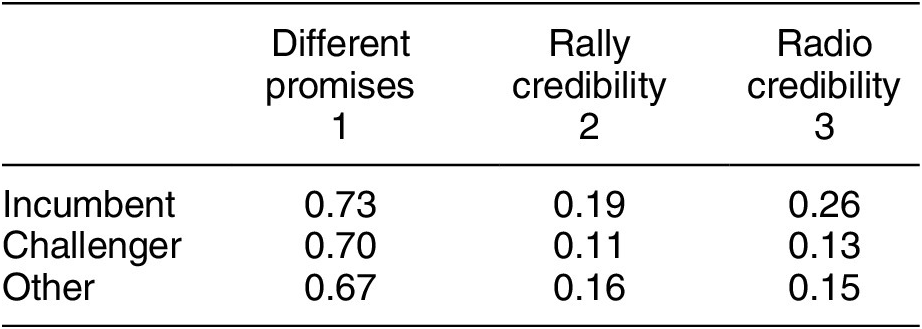


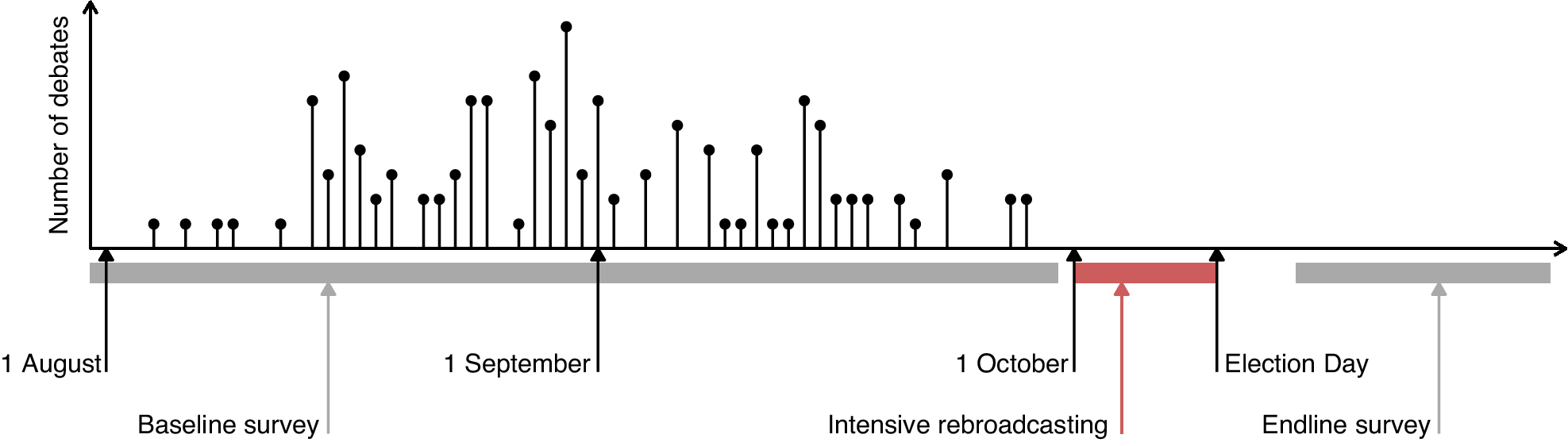
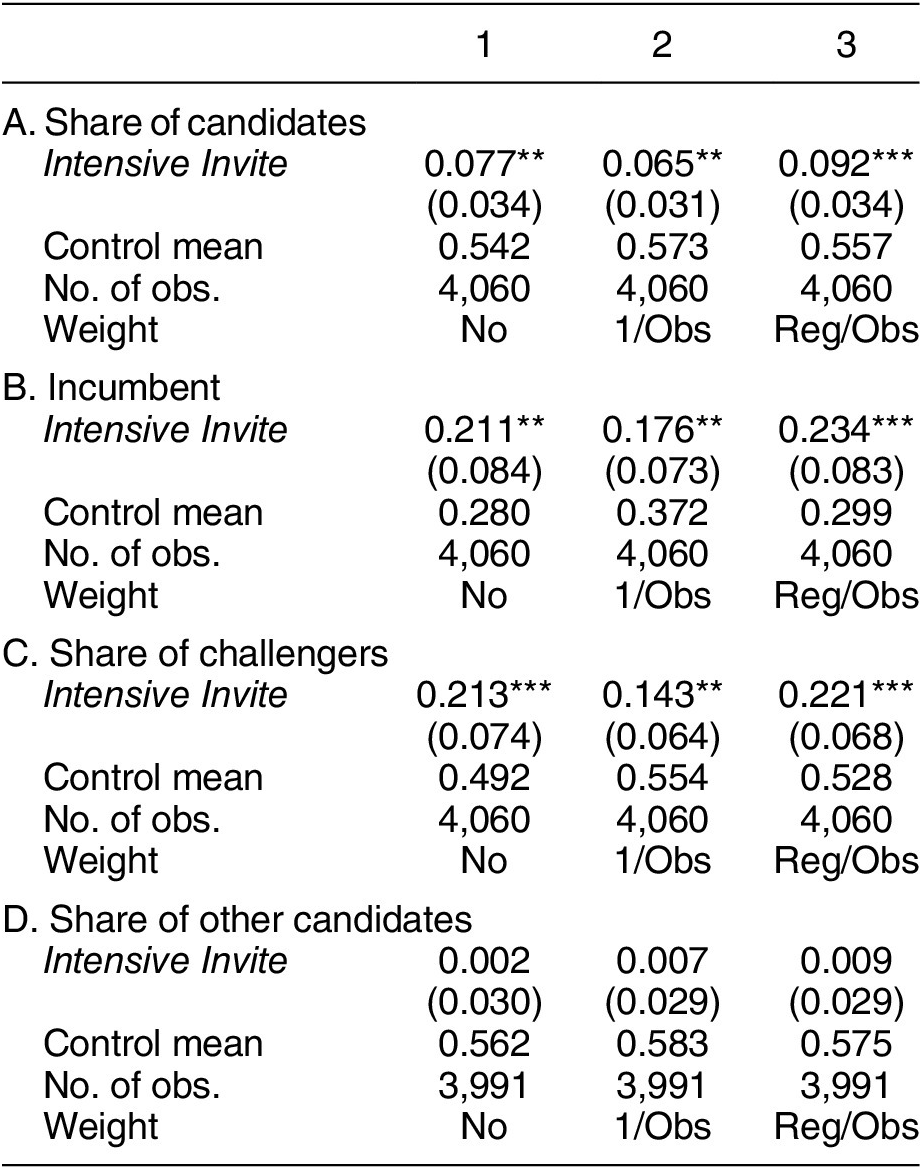
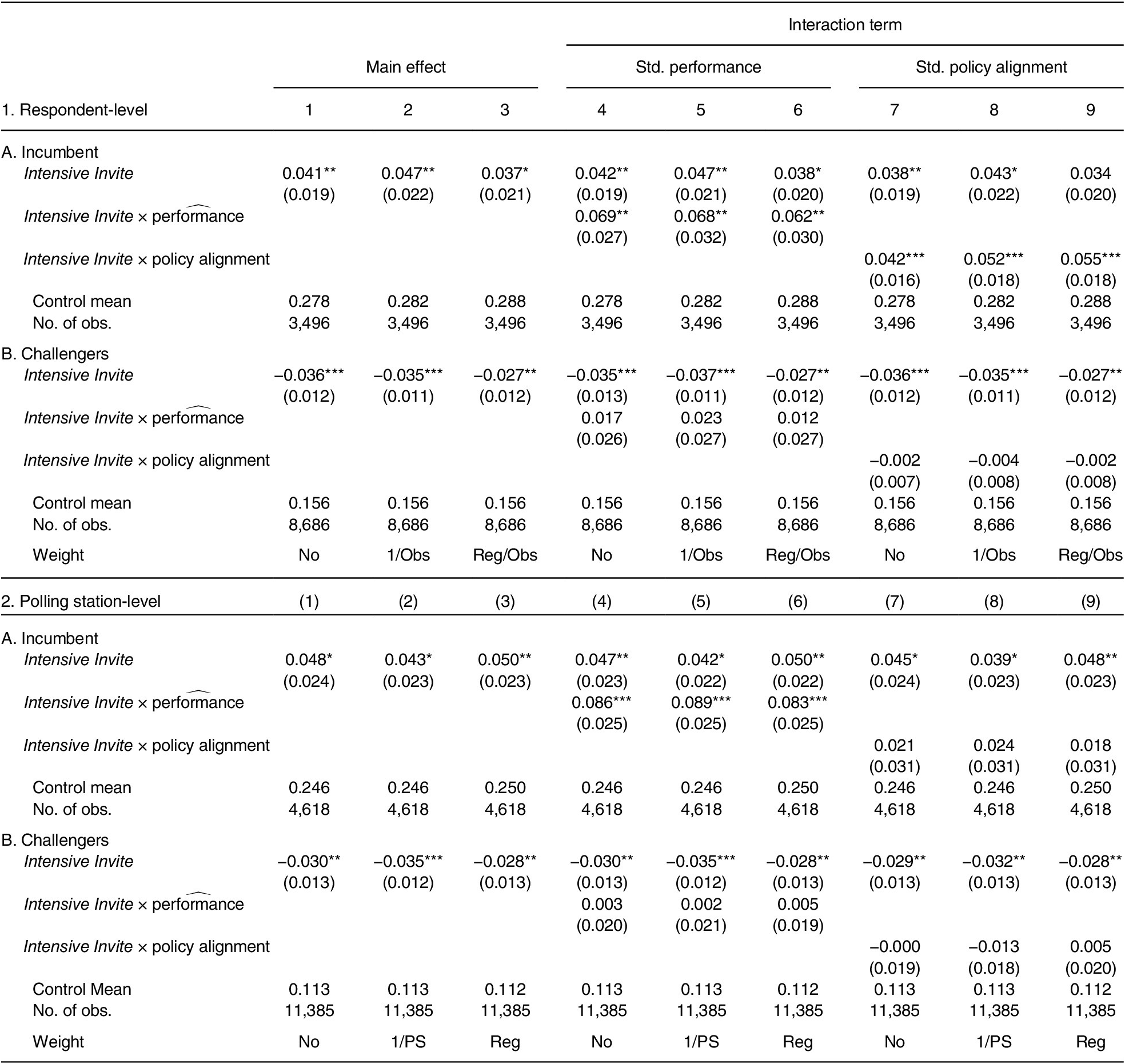
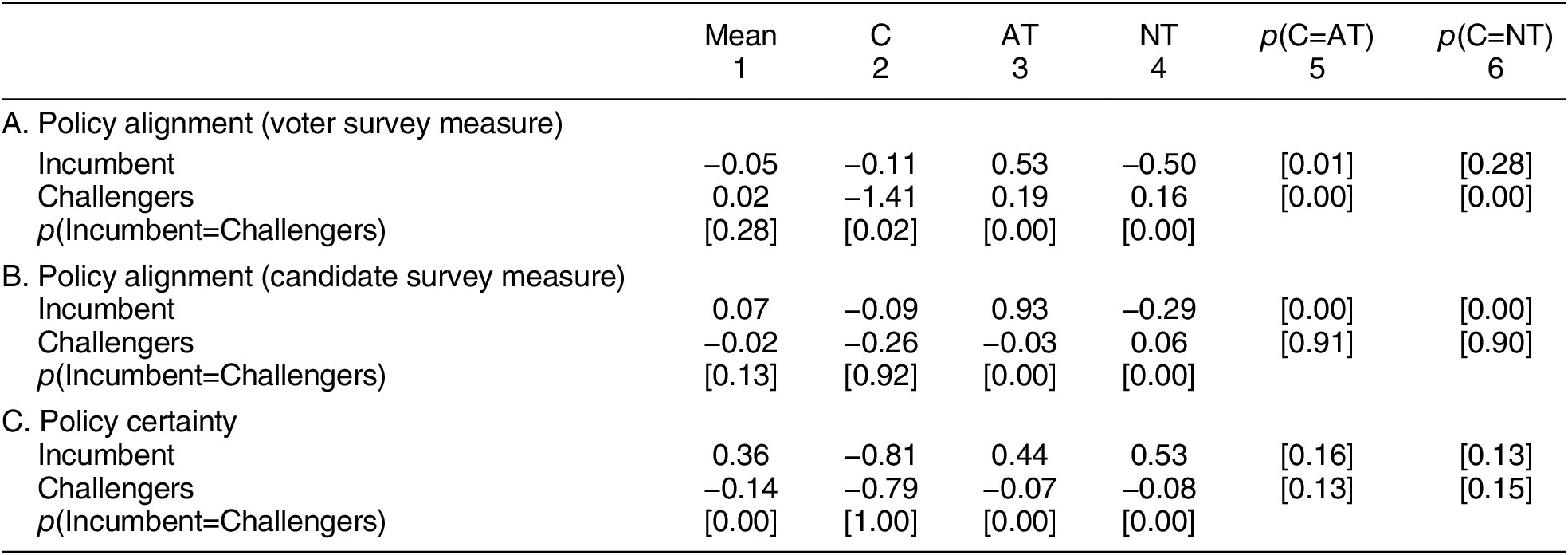
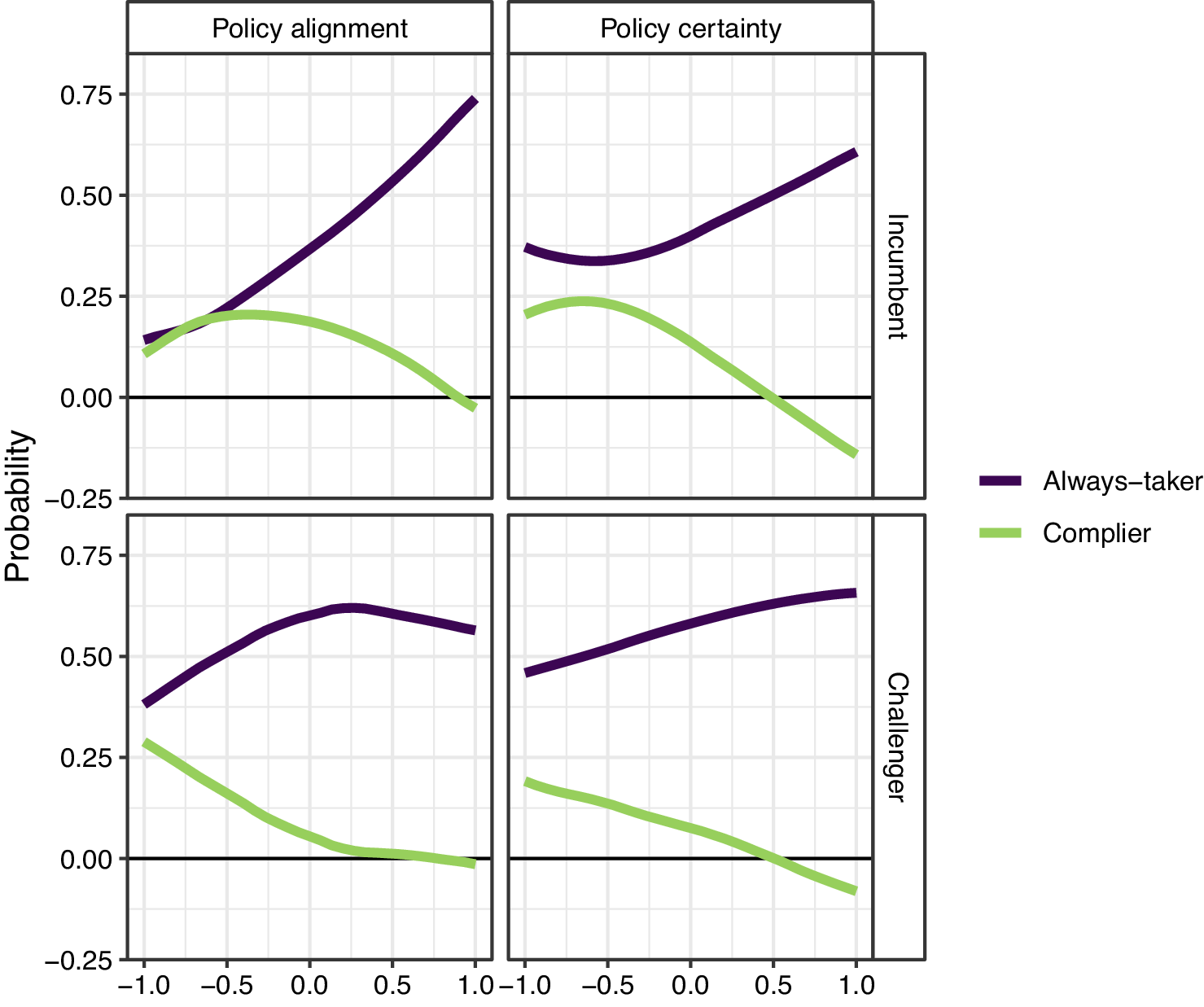
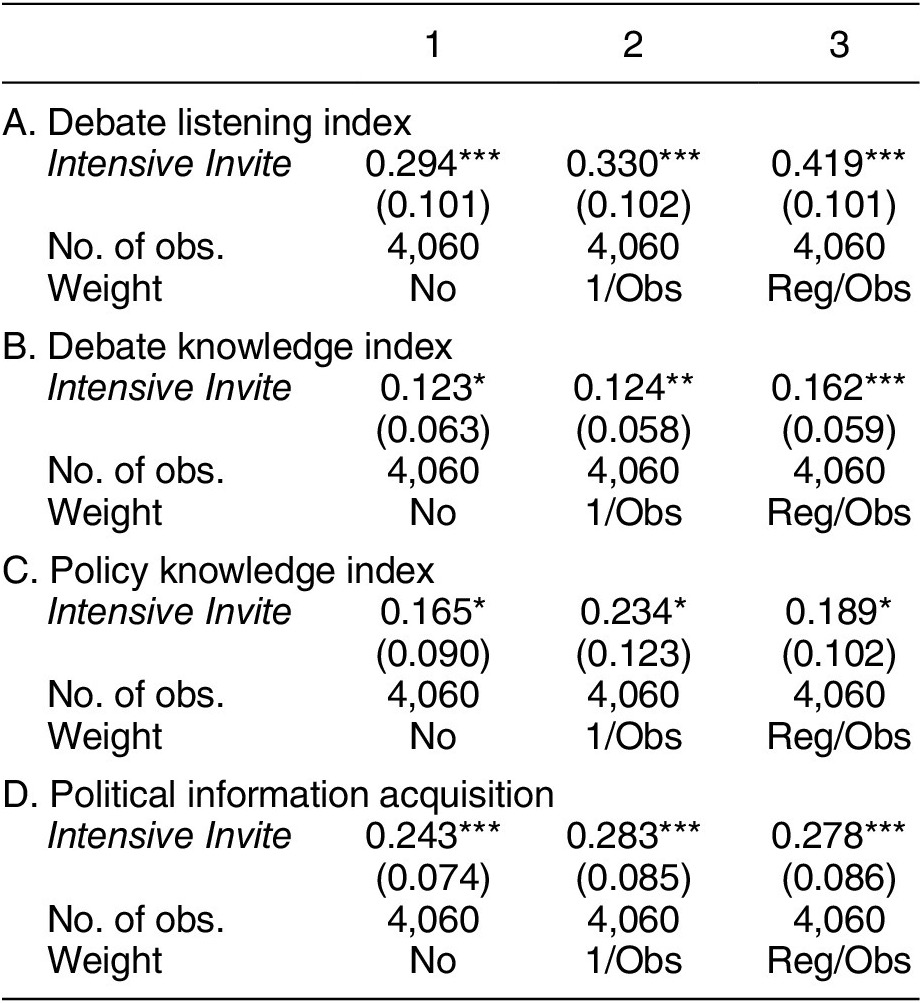
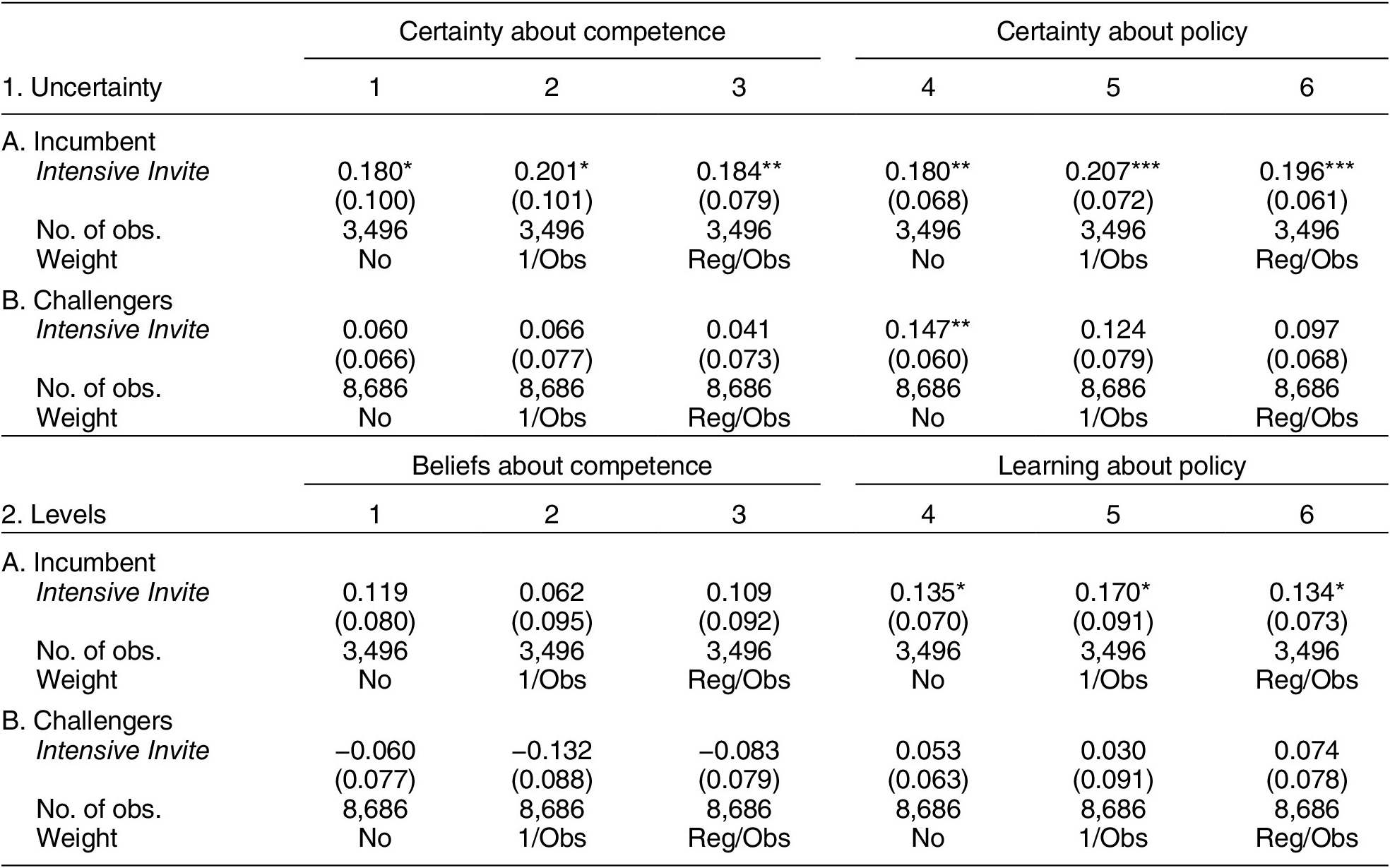
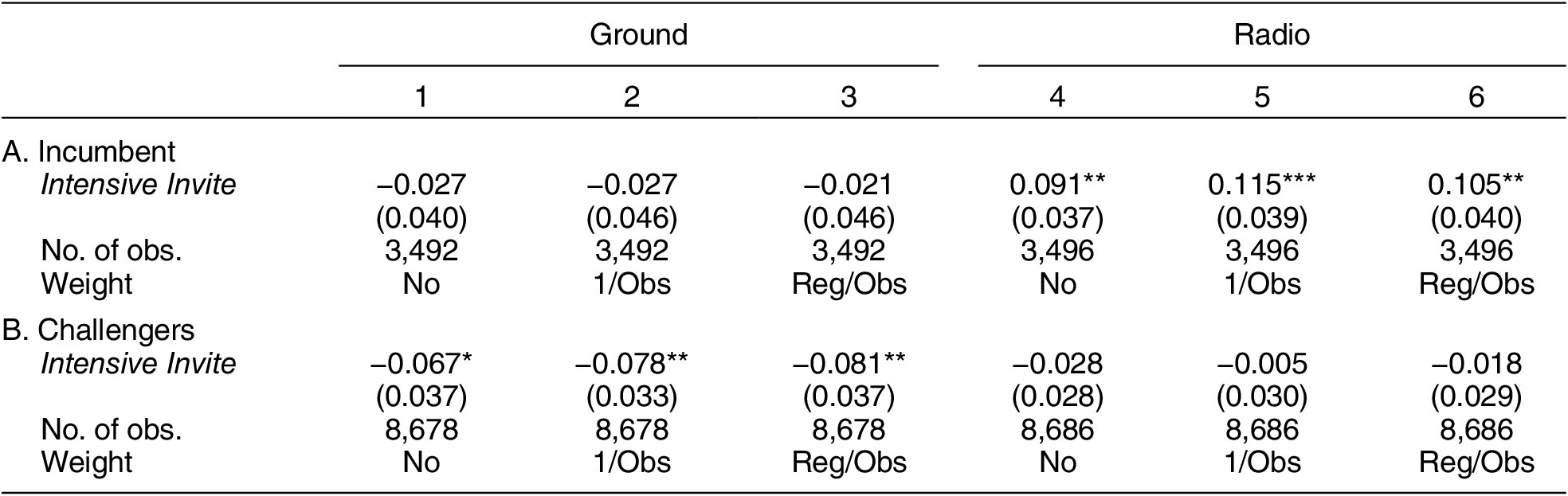


 Open access


Comments
No Comments have been published for this article.