





1. Introduction
Multirotor unmanned aerial vehicles (UAVs) are increasingly employed in diverse applications, including air quality monitoring, remote inspection, disease control and delivery services, owing to their mechanical simplicity, cost effectiveness and capability for hovering and vertical takeoff and landing (VTOL). In flight modes such as low-altitude hovering and VTOL, the proximity to the ground alters the flow patterns around multirotor UAVs, thereby affecting aerodynamic performance. These aerodynamic modifications induced by ground proximity are collectively referred to as ground effect (Knight & Hefner Reference Knight and Hefner1941; Zbrozek Reference Zbrozek1947; Cheeseman & Bennett Reference Cheeseman and Bennett1955; Hayden Reference Hayden1976; Prouty Reference Prouty1984; Griffiths, Ananthan & Leishman Reference Griffiths, Ananthan and Leishman2005). Given that multirotor UAVs frequently conduct a substantial portion of their missions near the ground (Wenzel, Masselli & Zell Reference Wenzel, Masselli and Zell2012; Valavanis & Vachtsevanos Reference Valavanis and Vachtsevanos2015), it is crucial to examine how ground effect influences their aerodynamic performance to ensure efficiency, effectiveness and operational safety (He & Leang Reference He and Leang2020; Dekker et al. Reference Dekker, Ragni, Baars, Scarano and Tuinstra2022).
Although ground effect has been extensively studied for conventional helicopters, relatively little attention has been devoted to multirotor systems. Sanchez-Cuevas, Heredia & Ollero (Reference Sanchez-Cuevas, Heredia and Ollero2017) experimentally investigated quadrotor and octorotor configurations in both in-ground-effect (IGE) and out-of-ground-effect (OGE) conditions, and reported that the thrust produced under IGE was greater than that under OGE. The thrust enhancement was shown to be more pronounced as the multirotor approached the ground. Based on these observations, they proposed a semi-empirical model to predict thrust variations induced by ground effect, which was derived from potential flow theory with the method of images (Cheeseman & Bennett Reference Cheeseman and Bennett1955). Extending this line of research, Conyers, Rutherford & Valavanis (Reference Conyers, Rutherford and Valavanis2018) demonstrated that the thrust augmentation due to ground effect differs between single-rotor and multirotor systems. For a single rotor, the ratio of thrust in IGE to that in OGE increased monotonically as the rotor approached the ground. In contrast, for a quadrotor, this ratio initially increased, then decreased within a certain range of rotor height and subsequently increased again. Based on these findings, they suggested that the classical Cheeseman–Bennett model of ground effect (Cheeseman & Bennett Reference Cheeseman and Bennett1955), widely used for conventional helicopters, is not directly applicable to multirotors. More recently, He & Leang (Reference He and Leang2020) proposed an empirical model designed to predict thrust generation of multirotors under IGE with greater generality. Their model accounted for various rotor configurations (dual, tri and quadrotor) as well as blade geometry parameters (pitch angle, solidity and diameter). They further identified conditions under which ground effect can lead to thrust loss, particularly within certain ranges of rotor separation distance and ground standoff distance of the rotor. Collectively, these studies have advanced the understanding of thrust variations in multirotor systems under IGE conditions by providing predictive models and identifying thrust behaviours that are distinct from those observed in single-rotor systems. Despite these advances, notable limitations remain. Most prior studies lacked flow-field measurements, leaving the underlying aerodynamic mechanisms of ground effect largely unexplored. Moreover, the predominant emphasis on ground effect overlooks the complex aerodynamic interactions that arise when ground proximity couples with rotor–rotor interaction in multirotor systems, such as thrust loss observed when rotors with a certain inter-rotor spacing operate near the ground.
Dekker et al. (Reference Dekker, Ragni, Baars, Scarano and Tuinstra2022) substantially addressed the limitations of the aforementioned studies. In their work, the primary focus was on the gross flow structures that develop around twin rotors in ground proximity. Using Lagrangian particle tracking velocimetry, they demonstrated that a vertical upwash, referred to as a fountain flow, develops in the inter-rotor region. The height of the fountain flow was shown to depend on the combined effects of rotor separation distance and ground standoff distance. Furthermore, when the fountain height approached the ground standoff distance, the upwash was actively re-ingested into the rotors, leading to unsteady blade loading. This study provided valuable insights into the qualitative flow features surrounding multirotors under IGE conditions. However, its scope was limited in that the identified flow patterns were not quantitatively correlated with the detailed variations in aerodynamic performance caused by rotor–rotor interaction.
To bridge the gaps identified in the aforementioned studies and to develop a more comprehensive understanding of the thrust and flow characteristics of multirotors operating under IGE conditions, it is essential to investigate how rotor–rotor interaction modifies thrust generation and to identify the underlying flow mechanisms responsible for these changes through both quantitative and qualitative analyses. Therefore, in this study, direct force measurements were performed to capture the detailed thrust variations, and particle image velocimetry (PIV) was employed to characterise the three-dimensional flow field around twin rotors. These measurements were systematically conducted while varying the rotor separation distance across a range of ground standoff distances, thereby enabling comprehensive analysis of the coupled effects of rotor spacing and ground proximity. To disentangle the contributions of rotor–rotor interaction from those of ground proximity, thrust and flow fields of a single rotor were also measured under both OGE and IGE conditions, enabling direct comparison with the twin-rotor case.
The remainder of this paper is organised as follows. Section 2 describes the twin-rotor model and the experimental set-up for thrust and wake measurements. Section 3 discusses the influence of ground effect on a single rotor, while § 4 examines the impact of rotor–rotor interaction in a twin-rotor system operating in ground effect. Finally, § 5 presents the concluding remarks.
2. Experimental set-up
To investigate rotor–rotor interaction under IGE conditions, we compare the aerodynamic behaviour of a single rotor and that of a pair of rotors placed side by side near the ground. Throughout this study, we refer to the case with one rotor as the single-rotor model and the case with two rotors as the twin-rotor model. All experiments were conducted in a closed chamber with dimensions of 1.2 m $\times$
1.2 m
$\times$
1.2 m $\times$
1.2 m, as illustrated in figure 1(a). Thrust and flow velocity were measured for each model to examine the influence of ground proximity and rotor–rotor interaction. Details of the rotor models, thrust measurements and velocity measurements are described in the following subsections.
$\times$
1.2 m, as illustrated in figure 1(a). Thrust and flow velocity were measured for each model to examine the influence of ground proximity and rotor–rotor interaction. Details of the rotor models, thrust measurements and velocity measurements are described in the following subsections.
(a) Schematic (not to scale) of the experimental set-up for thrust and velocity measurements. (b) Close-up photo of the rotor. (c) Schematic of the experimental configurations. The single-rotor model consists of rotor 1 only, while the twin-rotor model includes both rotor 1 and rotor 2 above a ground plane.

2.1. Single- and twin-rotor models
Figure 1(b) shows a close-up view of the rotor assembly used in both the single- and twin-rotor models. Each rotor, suspended from a rigid supporter, consists of a two-bladed propeller and a brushless DC (BLDC) motor (Race Pro 2207, 2650 KV). The propeller was fabricated from an acrylonitrile butadiene styrene-like resin using a high-precision stereolithography apparatus. The blades are rectangular and untwisted, with a radius $ R = 50.8\,{\textrm{mm}}$
and chord length
$ R = 50.8\,{\textrm{mm}}$
and chord length $ c = 20\,{\textrm{mm}}$
, resulting in a rotor solidity
$ c = 20\,{\textrm{mm}}$
, resulting in a rotor solidity $ \sigma = N_b R c / \pi R^2 = 0.251$
, where
$ \sigma = N_b R c / \pi R^2 = 0.251$
, where $ N_b = 2$
is the number of blades. The blade cross-section is a NACA 0012 airfoil with a fixed pitch angle of
$ N_b = 2$
is the number of blades. The blade cross-section is a NACA 0012 airfoil with a fixed pitch angle of $20^\circ$
. Such simple airfoil geometries, including NACA 0012, have been widely adopted in previous studies on small-scale rotors to facilitate aerodynamic modelling and analysis (Milluzzo et al. Reference Milluzzo, Sydney, Rauleder and Leishman2010; Benedict et al. Reference Benedict, Winslow, Hasnain and Chopra2015; Robinson, Chung & Ryan Reference Robinson, Chung and Ryan2016; Shukla, Hiremath & Komerath Reference Shukla, Hiremath and Komerath2018; Fattah et al. Reference Fattah, Chen, Wu, Wu and Zhang2019; He & Leang Reference He and Leang2020; Chae et al. Reference Chae, Lee and Kim2022, Reference Chae, Lee, Hwang, Jeong and Kim2024). The rotor was operated at a rotational speed of
$20^\circ$
. Such simple airfoil geometries, including NACA 0012, have been widely adopted in previous studies on small-scale rotors to facilitate aerodynamic modelling and analysis (Milluzzo et al. Reference Milluzzo, Sydney, Rauleder and Leishman2010; Benedict et al. Reference Benedict, Winslow, Hasnain and Chopra2015; Robinson, Chung & Ryan Reference Robinson, Chung and Ryan2016; Shukla, Hiremath & Komerath Reference Shukla, Hiremath and Komerath2018; Fattah et al. Reference Fattah, Chen, Wu, Wu and Zhang2019; He & Leang Reference He and Leang2020; Chae et al. Reference Chae, Lee and Kim2022, Reference Chae, Lee, Hwang, Jeong and Kim2024). The rotor was operated at a rotational speed of $14\,200\,{\textrm{rpm}}$
, which lies within the typical range for small UAVs (Fattah et al. Reference Fattah, Chen, Wu, Wu and Zhang2019). The rotational speed was regulated using an electric speed controller (PolyTronics MR-X3) via a feedback loop based on pulse-width modulation, and monitored by a tachometer (Monarch PLT 200), as shown in figure 1(a). The rotor speed was maintained within
$14\,200\,{\textrm{rpm}}$
, which lies within the typical range for small UAVs (Fattah et al. Reference Fattah, Chen, Wu, Wu and Zhang2019). The rotational speed was regulated using an electric speed controller (PolyTronics MR-X3) via a feedback loop based on pulse-width modulation, and monitored by a tachometer (Monarch PLT 200), as shown in figure 1(a). The rotor speed was maintained within $\pm 0.7\,\%$
deviation from the target value during each experiment. The rotor-tip velocity was
$\pm 0.7\,\%$
deviation from the target value during each experiment. The rotor-tip velocity was $ V_{\textit{tip}} = \varOmega R = 75.54\,{\textrm{m s}}^{-1}$
, corresponding to a chord-based Reynolds number of
$ V_{\textit{tip}} = \varOmega R = 75.54\,{\textrm{m s}}^{-1}$
, corresponding to a chord-based Reynolds number of $ {Re}_{\textit{tip}} = V_{\textit{tip}} c / \nu \approx 10^5$
, where
$ {Re}_{\textit{tip}} = V_{\textit{tip}} c / \nu \approx 10^5$
, where $ \varOmega$
is the rotor angular velocity and
$ \varOmega$
is the rotor angular velocity and $ \nu$
is the kinematic viscosity of air. The tip Mach number was
$ \nu$
is the kinematic viscosity of air. The tip Mach number was $M_{\textit{tip}} = V_{\textit{tip}}/c_s = 0.22$
, with
$M_{\textit{tip}} = V_{\textit{tip}}/c_s = 0.22$
, with $c_s$
denoting the speed of sound in air. To verify the structural stability of the blades, high-speed video recordings were taken at a sampling rate of 85 000 Hz using a Phantom VEO 710 camera. The recordings showed that blade deformation during rotation was minimal: the blade twist remained below
$c_s$
denoting the speed of sound in air. To verify the structural stability of the blades, high-speed video recordings were taken at a sampling rate of 85 000 Hz using a Phantom VEO 710 camera. The recordings showed that blade deformation during rotation was minimal: the blade twist remained below $0.5^{\circ }$
, the tip deflection was approximately 0.3 mm (less than 1.6 % of the chord length) and the vibration amplitude at the rotor tip was approximately 0.1 mm (less than 0.6 % of the chord length). These recordings confirmed that blade twist, bending and vibrations during rotation were all negligible.
$0.5^{\circ }$
, the tip deflection was approximately 0.3 mm (less than 1.6 % of the chord length) and the vibration amplitude at the rotor tip was approximately 0.1 mm (less than 0.6 % of the chord length). These recordings confirmed that blade twist, bending and vibrations during rotation were all negligible.
Figure 1(c) illustrates the experimental configurations for both the single- and twin-rotor models used in this study. The single-rotor model consists solely of rotor 1, whereas the twin-rotor model includes an additional rotor (rotor 2) placed laterally across from rotor 1. Rotor 1 rotates clockwise and rotor 2 counter-clockwise, forming a counter-rotating pair. Since the two rotors are driven independently without synchronisation, the phase difference between them remains random throughout the experiments. A transparent tempered glass plate, 5 mm in thickness, was used as the ground plane. The vertical distance from the ground to the rotor tip-path plane (TPP) is defined as the ground standoff distance, $ h$
. This distance was adjusted by raising or lowering the ground using two lifters, as shown in figure 1(a). During each adjustment, an electronic level meter was used to ensure that the ground surface remained horizontal. Previous studies (Lee, Leishman & Ramasamy Reference Lee, Leishman and Ramasamy2010; Tanner et al. Reference Tanner, Overmeyer, Jenkins, Yao and Bartram2015; Cai et al. Reference Cai, Gunasekaran, Ahmed and Ol2019) have reported that ground effect becomes negligible when the normalised standoff distance
$ h$
. This distance was adjusted by raising or lowering the ground using two lifters, as shown in figure 1(a). During each adjustment, an electronic level meter was used to ensure that the ground surface remained horizontal. Previous studies (Lee, Leishman & Ramasamy Reference Lee, Leishman and Ramasamy2010; Tanner et al. Reference Tanner, Overmeyer, Jenkins, Yao and Bartram2015; Cai et al. Reference Cai, Gunasekaran, Ahmed and Ol2019) have reported that ground effect becomes negligible when the normalised standoff distance $ h/R$
exceeds approximately 2. Based on this, we varied
$ h/R$
exceeds approximately 2. Based on this, we varied $ h/R$
from 0.5 to 2.0 in the present study to explore a broad range of ground proximity effects. In the twin-rotor configuration, the strength of rotor–rotor interaction was controlled by varying the tip-to-tip distance
$ h/R$
from 0.5 to 2.0 in the present study to explore a broad range of ground proximity effects. In the twin-rotor configuration, the strength of rotor–rotor interaction was controlled by varying the tip-to-tip distance $ s$
between rotor 1 and rotor 2, hereafter referred to as the rotor separation distance. This distance was precisely adjusted using two linear actuators, as illustrated in figure 1(a), which allowed the rotors to move toward or away from each other. While previous studies (Zhou et al. Reference Zhou, Ning, Li and Hu2017; Lee et al. Reference Lee, Chae, Woo, Jang and Kim2021) found that rotor interaction is negligible for
$ s$
between rotor 1 and rotor 2, hereafter referred to as the rotor separation distance. This distance was precisely adjusted using two linear actuators, as illustrated in figure 1(a), which allowed the rotors to move toward or away from each other. While previous studies (Zhou et al. Reference Zhou, Ning, Li and Hu2017; Lee et al. Reference Lee, Chae, Woo, Jang and Kim2021) found that rotor interaction is negligible for $ s/R \gt 2$
in the absence of ground effect, recent findings by Dekker et al. (Reference Dekker, Ragni, Baars, Scarano and Tuinstra2022) demonstrated that ground proximity can amplify rotor–rotor interaction. Accordingly, we varied
$ s/R \gt 2$
in the absence of ground effect, recent findings by Dekker et al. (Reference Dekker, Ragni, Baars, Scarano and Tuinstra2022) demonstrated that ground proximity can amplify rotor–rotor interaction. Accordingly, we varied $ s/R$
over the range 0.20–3.45, extending the parameter space beyond the conventional interaction threshold.
$ s/R$
over the range 0.20–3.45, extending the parameter space beyond the conventional interaction threshold.
To minimise ceiling- and wall-induced interference on the rotor thrust and wake development, the twin-rotor model was positioned with sufficient clearance from the chamber boundaries. Regarding the ceiling effect, previous studies (Robinson et al. Reference Robinson, Chung and Ryan2016; Han et al. Reference Han, Xiang, Xu and Yu2019; Liu et al. Reference Liu, Kan, Li, Gao, Li and Zhao2024) have shown that, for a single rotor, ceiling-induced thrust variation becomes negligible when the distance between the rotor disk and the ceiling exceeds approximately twice the rotor radius. In the present study, however, the configuration involved two interacting rotors, and the resulting fountain flow can extend well above the TPP. To prevent any upward flow structures from interacting with the ceiling, the rotor disk was located $10.4R$
below the chamber ceiling, which is more than five times the threshold distance reported for single-rotor configurations. Sidewall effects were also considered. Jardin, Prothin & Maga (Reference Jardin, Prothin and Magana2017) reported that vertical wall proximity has little influence on aerodynamic performance, and Sanchez-Cuevas, Heredia & Ollero (Reference Sanchez-Cuevas, Heredia and Ollero2019) showed that sidewall effects on thrust are substantially smaller than ceiling effects. Tanabe et al. (Reference Tanabe, Sugiura, Aoyama, Sugawara, Sunada, Yonezawa and Tokutake2018) further observed that sidewall influence becomes perceptible when the rotor tip is within one rotor radius from the wall. In the present experiments, as the rotor separation distance varied, the rotor tips remained at distances between
$10.4R$
below the chamber ceiling, which is more than five times the threshold distance reported for single-rotor configurations. Sidewall effects were also considered. Jardin, Prothin & Maga (Reference Jardin, Prothin and Magana2017) reported that vertical wall proximity has little influence on aerodynamic performance, and Sanchez-Cuevas, Heredia & Ollero (Reference Sanchez-Cuevas, Heredia and Ollero2019) showed that sidewall effects on thrust are substantially smaller than ceiling effects. Tanabe et al. (Reference Tanabe, Sugiura, Aoyama, Sugawara, Sunada, Yonezawa and Tokutake2018) further observed that sidewall influence becomes perceptible when the rotor tip is within one rotor radius from the wall. In the present experiments, as the rotor separation distance varied, the rotor tips remained at distances between $8.1R$
and
$8.1R$
and $9.7R$
from the chamber sidewalls. These distances are well above the threshold distance for sidewall effects. Therefore, both ceiling and sidewall effects on rotor thrust were considered negligible in this study.
$9.7R$
from the chamber sidewalls. These distances are well above the threshold distance for sidewall effects. Therefore, both ceiling and sidewall effects on rotor thrust were considered negligible in this study.
Regarding potential recirculation effects within the test chamber, we refer to the study by Hwang (Reference Hwang2024), who investigated recirculation-induced influences using a rotor identical in size to that employed in the present work inside an anechoic chamber of comparable dimensions (1.2 m $\times$
1.0 m
$\times$
1.0 m $\times$
1.0 m). By analysing noise spectrograms, Hwang (Reference Hwang2024) distinguished pre-recirculation and post-recirculation regimes and reported that recirculation caused a mean thrust reduction of approximately 1.2 % and increased thrust fluctuations by approximately 0.6 %. Given the similarity in rotor size and chamber dimensions, recirculation effects of comparable magnitude are expected in the present experiments. However, these effects are smaller than the overall measurement uncertainty of the thrust data (
$\times$
1.0 m). By analysing noise spectrograms, Hwang (Reference Hwang2024) distinguished pre-recirculation and post-recirculation regimes and reported that recirculation caused a mean thrust reduction of approximately 1.2 % and increased thrust fluctuations by approximately 0.6 %. Given the similarity in rotor size and chamber dimensions, recirculation effects of comparable magnitude are expected in the present experiments. However, these effects are smaller than the overall measurement uncertainty of the thrust data ( $\pm 1.9\,\%$
; see § 2.2) and are therefore not expected to affect the principal conclusions of this study.
$\pm 1.9\,\%$
; see § 2.2) and are therefore not expected to affect the principal conclusions of this study.
2.2. Thrust measurement
For both the single- and twin-rotor models, the thrust produced by rotor 1 was measured using a load cell (CAS BCL-1L) mounted on its supporter, as illustrated in figure 1(a). The load cell output was amplified by a signal conditioner (VISHAY 2310B), digitised via an A/D converter (NI PCIe-6351), and transmitted to a PC for data acquisition. To obtain statistically converged mean values, each thrust measurement was averaged over a duration exceeding 70 s and repeated three times. To evaluate any possible temporal evolution during acquisition, the cumulative mean thrust was examined and found to converge well: after approximately 40 s, the cumulative mean differed from the final mean at the end of the acquisition period by less than 0.1 %. In addition, the standard deviation of thrust fluctuations, computed using a 10 s moving window, remained nearly constant throughout the measurement interval and stayed within 2.5 % of the overall mean thrust. These results confirm that both the mean thrust and its fluctuations remained statistically stable over the entire acquisition period. The measurement uncertainty was evaluated following standard procedures that distinguish between type A (statistical) and type B (systematic) components. The repeatability of the thrust measurement, assessed from three independent runs, yielded a type A uncertainty of $\pm 1.9\,\%$
of the mean. Based on the manufacturer’s specifications for the CAS BCL-1L load cell (combined error, repeatability, creep and temperature effects), the type B uncertainty was estimated to be approximately
$\pm 1.9\,\%$
of the mean. Based on the manufacturer’s specifications for the CAS BCL-1L load cell (combined error, repeatability, creep and temperature effects), the type B uncertainty was estimated to be approximately $0.27\,\%$
of the reading under the experimental conditions (ambient temperature of approximately
$0.27\,\%$
of the reading under the experimental conditions (ambient temperature of approximately $25\,^{\circ }{\textrm{C}}$
with variations within
$25\,^{\circ }{\textrm{C}}$
with variations within $2\,^{\circ }{\textrm{C}}$
during the 70 s sampling duration). The overall uncertainty, obtained as the root-sum-square of both components, was approximately
$2\,^{\circ }{\textrm{C}}$
during the 70 s sampling duration). The overall uncertainty, obtained as the root-sum-square of both components, was approximately $\pm 1.9\,\%$
, dominated by measurement repeatability. To examine possible thermal-drift effects on the 70 s measurement window, a linear fit was applied to the thrust time series. The fitted trend was negligible, with a net change below 0.5 % of the mean thrust over the entire duration. According to the manufacturer’s specifications, the temperature effects on zero and span are within 0.028 % and 0.014 % of the rated output per 10
$\pm 1.9\,\%$
, dominated by measurement repeatability. To examine possible thermal-drift effects on the 70 s measurement window, a linear fit was applied to the thrust time series. The fitted trend was negligible, with a net change below 0.5 % of the mean thrust over the entire duration. According to the manufacturer’s specifications, the temperature effects on zero and span are within 0.028 % and 0.014 % of the rated output per 10 $^{\circ }$
C, respectively. Given the small ambient temperature variation (within 2
$^{\circ }$
C, respectively. Given the small ambient temperature variation (within 2 $^{\circ }$
C) and the thermal isolation between the motor and the load cell, any thermal drift is significantly smaller than both the observed fluctuations and the overall measurement uncertainty. Therefore, temperature drift is not expected to affect the reported thrust values.
$^{\circ }$
C) and the thermal isolation between the motor and the load cell, any thermal drift is significantly smaller than both the observed fluctuations and the overall measurement uncertainty. Therefore, temperature drift is not expected to affect the reported thrust values.
2.3. Velocity measurement
Velocity measurements were performed using PIV, as illustrated in figure 1(a). The PIV system comprised a charge-coupled device (CCD) camera with a resolution of 2048 $\times$
2048 pixels (Vieworks VH-4MC), a 60 mm prime lens (Nikon AF-S Micro NIKKOR), a Nd:YAG pulsed laser (SpitLight PIV Compact 400) operating at a laser-light intensity of 3.40 W cm−
$\times$
2048 pixels (Vieworks VH-4MC), a 60 mm prime lens (Nikon AF-S Micro NIKKOR), a Nd:YAG pulsed laser (SpitLight PIV Compact 400) operating at a laser-light intensity of 3.40 W cm− $^2$
, a time-delay generator (Integrated Design Tools XS-TH) and a fog generator (SAFEX Fog Generator 2010). Liquid droplets with a diameter of 1
$^2$
, a time-delay generator (Integrated Design Tools XS-TH) and a fog generator (SAFEX Fog Generator 2010). Liquid droplets with a diameter of 1 $\mu$
m, generated by the fog generator, were used as tracer particles. These droplets were illuminated by a 3 mm-thick laser sheet formed by passing the laser beam through a cylindrical lens. The test chamber, constructed from transparent acrylic resin, allowed laser illumination from outside and enabled prolonged retention of tracer particles within the measurement region. To minimise laser reflection from the rotor surface, the rotor model was painted matte black (see figure 1
b) using Musou Black paint, which absorbs up to 99.4 % of visible light. The PIV set-up used in this study is consistent with those employed in our earlier investigations (Chae et al. Reference Chae, Lee, Kim and Lee2019; Lee et al. Reference Lee, Chae, Woo, Jang and Kim2021; Chae et al. Reference Chae, Lee and Kim2022, Reference Chae, Lee, Hwang, Jeong and Kim2024; Oh et al. Reference Oh, Lee, Son, Kim and Ki2022).
$\mu$
m, generated by the fog generator, were used as tracer particles. These droplets were illuminated by a 3 mm-thick laser sheet formed by passing the laser beam through a cylindrical lens. The test chamber, constructed from transparent acrylic resin, allowed laser illumination from outside and enabled prolonged retention of tracer particles within the measurement region. To minimise laser reflection from the rotor surface, the rotor model was painted matte black (see figure 1
b) using Musou Black paint, which absorbs up to 99.4 % of visible light. The PIV set-up used in this study is consistent with those employed in our earlier investigations (Chae et al. Reference Chae, Lee, Kim and Lee2019; Lee et al. Reference Lee, Chae, Woo, Jang and Kim2021; Chae et al. Reference Chae, Lee and Kim2022, Reference Chae, Lee, Hwang, Jeong and Kim2024; Oh et al. Reference Oh, Lee, Son, Kim and Ki2022).
Figure 2 illustrates the locations of the fields of view (FoVs) used for the PIV measurements. The origin of the $x$
and
$x$
and $y$
coordinates was defined at the centre of the rotor disk of rotor 1, with the TPP designated as
$y$
coordinates was defined at the centre of the rotor disk of rotor 1, with the TPP designated as $z = 0$
. To investigate the quasi-three-dimensional flow structures in the rotor wake, velocity fields were measured using planar PIV at 21 parallel planes arranged along the
$z = 0$
. To investigate the quasi-three-dimensional flow structures in the rotor wake, velocity fields were measured using planar PIV at 21 parallel planes arranged along the $y$
-axis over a range of
$y$
-axis over a range of $y/R = -1$
to
$y/R = -1$
to $1$
(see figure 2
a). These 21 planes are collectively referred to as FoV set A. The out-of-plane velocity component was not captured in this measurement. A quasi-three-dimensional flow field was reconstructed using linear interpolation of the velocity fields obtained from these 21 FoVs. For detailed planar flow analysis, PIV measurements were also conducted in three additional planes located in the
$1$
(see figure 2
a). These 21 planes are collectively referred to as FoV set A. The out-of-plane velocity component was not captured in this measurement. A quasi-three-dimensional flow field was reconstructed using linear interpolation of the velocity fields obtained from these 21 FoVs. For detailed planar flow analysis, PIV measurements were also conducted in three additional planes located in the $x{-}z$
plane, as shown in figure 2(b). To further examine the transverse flow characteristics, two more planes were measured, as shown in figure 2(c). Field of view E was positioned at the central plane between the two rotors, while FoV F was placed at the mid-plane between the TPP and the ground (
$x{-}z$
plane, as shown in figure 2(b). To further examine the transverse flow characteristics, two more planes were measured, as shown in figure 2(c). Field of view E was positioned at the central plane between the two rotors, while FoV F was placed at the mid-plane between the TPP and the ground ( $z/R = -0.5h/R$
). The FoV size was 208 mm
$z/R = -0.5h/R$
). The FoV size was 208 mm $\times$
208 mm (
$\times$
208 mm ( $\approx 4.1R\times 4.1R$
) for FoV set A and FoVs B, C and D, and 200 mm
$\approx 4.1R\times 4.1R$
) for FoV set A and FoVs B, C and D, and 200 mm $\times$
200 mm (
$\times$
200 mm ( $\approx 3.9R\times 3.9R$
) for FoVs E and F.
$\approx 3.9R\times 3.9R$
) for FoVs E and F.
Measurement regions (fields of view, FoVs) used in the PIV experiments: (a) twenty-one planes (collectively denoted as FoV set A) perpendicular to the $y$
-axis, arranged along the
$y$
-axis, arranged along the $y$
-axis, for three-dimensional flow reconstruction; (b) three planes (FoVs B, C and D) located in the
$y$
-axis, for three-dimensional flow reconstruction; (b) three planes (FoVs B, C and D) located in the $x$
–
$x$
– $z$
plane; (c) two planes (FoVs E and F), both aligned with the transverse (
$z$
plane; (c) two planes (FoVs E and F), both aligned with the transverse ( $y$
) direction. Field of view E was positioned at the central plane between the two rotors, while FoV F was positioned midway between the TPP and the ground (
$y$
) direction. Field of view E was positioned at the central plane between the two rotors, while FoV F was positioned midway between the TPP and the ground ( $z/R = -0.5h/R$
).
$z/R = -0.5h/R$
).

To enhance image quality prior to analysis, pixel-wise image sharpening was applied during preprocessing. The velocity field was subsequently determined using a cross-correlation algorithm based on fast Fourier transform (Keane & Adrian Reference Keane and Adrian1992). An iterative analysis was conducted, starting with an initial interrogation window of $64 \times 64$
pixels and refining to
$64 \times 64$
pixels and refining to $32 \times 32$
pixels, with an overlap of either 50 % or 75 %. Polynomial subpixel interpolation was employed during the correlation analysis to refine the displacement peaks to subpixel accuracy. This procedure provided a spatial resolution ranging from 0.4 % to 0.6 % of the rotor diameter. Spurious vectors were identified using a local median filter with a
$32 \times 32$
pixels, with an overlap of either 50 % or 75 %. Polynomial subpixel interpolation was employed during the correlation analysis to refine the displacement peaks to subpixel accuracy. This procedure provided a spatial resolution ranging from 0.4 % to 0.6 % of the rotor diameter. Spurious vectors were identified using a local median filter with a $3 \times 3$
window, which removed vectors exceeding three times the root mean square (r.m.s.) value. These outliers were then replaced by linearly interpolated values from neighbouring vectors. A total of 2000 image pairs were acquired at 9 Hz with a 10
$3 \times 3$
window, which removed vectors exceeding three times the root mean square (r.m.s.) value. These outliers were then replaced by linearly interpolated values from neighbouring vectors. A total of 2000 image pairs were acquired at 9 Hz with a 10 $\mu$
s inter-frame time. These images were averaged to obtain time-averaged velocity fields. The instantaneous velocity fields used in this averaging process covered more than 100 000 rotor blade passages. To avoid bias due to blade passage synchronisation, the image acquisition rate was chosen to be asynchronous with the blade passing frequency, thereby ensuring uniform phase sampling. Flow-field statistics, such as r.m.s. velocity fluctuations, were evaluated at various locations, including the point of peak r.m.s. fluctuations. When these statistics were plotted as a function of the number of image pairs, the fluctuations diminished well before reaching the total number of image pairs used for time averaging.
$\mu$
s inter-frame time. These images were averaged to obtain time-averaged velocity fields. The instantaneous velocity fields used in this averaging process covered more than 100 000 rotor blade passages. To avoid bias due to blade passage synchronisation, the image acquisition rate was chosen to be asynchronous with the blade passing frequency, thereby ensuring uniform phase sampling. Flow-field statistics, such as r.m.s. velocity fluctuations, were evaluated at various locations, including the point of peak r.m.s. fluctuations. When these statistics were plotted as a function of the number of image pairs, the fluctuations diminished well before reaching the total number of image pairs used for time averaging.
The measurement uncertainty of the PIV data was estimated based on the peak-to-peak ratio (PPR), defined as the ratio of the primary to the secondary correlation peaks within each interrogation window, following the approach of Charonko & Vlachos (Reference Charonko and Vlachos2013). For a representative flow field at $ h/R = 1.0$
and
$ h/R = 1.0$
and $ s/R = 0.45$
, the mean PPR was approximately 5.1, indicating reliable measurements (Keane & Adrian Reference Keane and Adrian1990; Hain & Kähler Reference Hain and Kähler2007). The corresponding 68.5 %-coverage velocity uncertainty for instantaneous fields was approximately
$ s/R = 0.45$
, the mean PPR was approximately 5.1, indicating reliable measurements (Keane & Adrian Reference Keane and Adrian1990; Hain & Kähler Reference Hain and Kähler2007). The corresponding 68.5 %-coverage velocity uncertainty for instantaneous fields was approximately $1.02\,{\textrm{m s}}^{-1}$
, which corresponds to about
$1.02\,{\textrm{m s}}^{-1}$
, which corresponds to about $0.101$
pixel, consistent with typical PIV uncertainties of 0.05–0.1 pixel reported in the literature (Westerweel Reference Westerweel1997; Sciacchitano et al. Reference Sciacchitano, Neal, Smith, Warner, Vlachos, Wieneke and Scarano2015; Wieneke Reference Wieneke2015). For the time-averaged velocity fields, ensemble averaging over
$0.101$
pixel, consistent with typical PIV uncertainties of 0.05–0.1 pixel reported in the literature (Westerweel Reference Westerweel1997; Sciacchitano et al. Reference Sciacchitano, Neal, Smith, Warner, Vlachos, Wieneke and Scarano2015; Wieneke Reference Wieneke2015). For the time-averaged velocity fields, ensemble averaging over $ N_i = 2000$
image pairs reduced the random uncertainty to approximately
$ N_i = 2000$
image pairs reduced the random uncertainty to approximately $0.023\,{\textrm{m s}}^{-1}$
, following the
$0.023\,{\textrm{m s}}^{-1}$
, following the $ 1/\sqrt {N_i}$
relationship (Charonko & Vlachos Reference Charonko and Vlachos2013; Xue, Charonko & Vlachos Reference Xue, Charonko and Vlachos2014). Statistical convergence was verified by monitoring cumulative averages, which stabilised within
$ 1/\sqrt {N_i}$
relationship (Charonko & Vlachos Reference Charonko and Vlachos2013; Xue, Charonko & Vlachos Reference Xue, Charonko and Vlachos2014). Statistical convergence was verified by monitoring cumulative averages, which stabilised within $\pm 2\,\%$
of the final mean value after approximately 900 image pairs.
$\pm 2\,\%$
of the final mean value after approximately 900 image pairs.
3. Single-rotor results
3.1. Thrust characteristics of the single rotor
Figure 3 shows the variation in the IGE-to-OGE thrust coefficient ratio of the single-rotor model, $C_T\!\mid _{\textit{sg}\text{,}\textit{IGE}} / C_T\!\mid _{\textit{sg}\text{,}\textit{OGE}}$
, as a function of
$C_T\!\mid _{\textit{sg}\text{,}\textit{IGE}} / C_T\!\mid _{\textit{sg}\text{,}\textit{OGE}}$
, as a function of $h/R$
. Here, the thrust coefficient is defined as
$h/R$
. Here, the thrust coefficient is defined as $C_T = T / (\rho A V_{\textit{tip}}^2)$
, where
$C_T = T / (\rho A V_{\textit{tip}}^2)$
, where $T$
is the thrust force,
$T$
is the thrust force, $\rho$
is the density of air, and
$\rho$
is the density of air, and $A$
is the rotor-disk area. The notation
$A$
is the rotor-disk area. The notation $C_T\!\mid _{\textit{sg}\text{,}\textit{IGE}}$
denotes the thrust coefficient measured for the single-rotor model in ground effect (IGE), while
$C_T\!\mid _{\textit{sg}\text{,}\textit{IGE}}$
denotes the thrust coefficient measured for the single-rotor model in ground effect (IGE), while $C_T\!\mid _{\textit{sg}\text{,}\textit{OGE}}$
refers to that measured out of ground effect (OGE). For
$C_T\!\mid _{\textit{sg}\text{,}\textit{OGE}}$
refers to that measured out of ground effect (OGE). For $h/R \geq 2$
, the thrust coefficient ratio remained close to unity, indicating that the ground effect becomes negligible when the rotor is positioned more than one diameter above the ground. As
$h/R \geq 2$
, the thrust coefficient ratio remained close to unity, indicating that the ground effect becomes negligible when the rotor is positioned more than one diameter above the ground. As $h/R$
decreased below 2, the thrust coefficient ratio increased rapidly, reaching approximately 1.33 at
$h/R$
decreased below 2, the thrust coefficient ratio increased rapidly, reaching approximately 1.33 at $h/R = 0.5$
, corresponding to a 33 % enhancement in thrust due to ground effect. The present results are consistent with the findings of He & Leang (Reference He and Leang2020), who investigated a rotor with an identical airfoil profile (NACA 0012) and pitch angle (
$h/R = 0.5$
, corresponding to a 33 % enhancement in thrust due to ground effect. The present results are consistent with the findings of He & Leang (Reference He and Leang2020), who investigated a rotor with an identical airfoil profile (NACA 0012) and pitch angle ( $\theta = 20^\circ$
). Their study demonstrated a more pronounced ground effect at higher rotor solidity. In the present experiment, the rotor solidity (
$\theta = 20^\circ$
). Their study demonstrated a more pronounced ground effect at higher rotor solidity. In the present experiment, the rotor solidity ( $\sigma = 0.251$
) was slightly greater than that in the study by He & Leang (Reference He and Leang2020) (
$\sigma = 0.251$
) was slightly greater than that in the study by He & Leang (Reference He and Leang2020) ( $\sigma = 0.218$
), which may account for the slightly faster increase in the IGE-to-OGE thrust coefficient ratio with decreasing
$\sigma = 0.218$
), which may account for the slightly faster increase in the IGE-to-OGE thrust coefficient ratio with decreasing $h/R$
.
$h/R$
.
The IGE-to-OGE thrust coefficient ratio of the single-rotor model, $C_T\!\mid _{\textit{sg}\text{,}\textit{IGE}} / C_T\!\mid _{\textit{sg}\text{,}\textit{OGE}}$
, as a function of the normalised ground standoff distance. Error bars represent the maximum and minimum values from three repeated measurements. The black dashed line indicates a curve fit to the present results.
$C_T\!\mid _{\textit{sg}\text{,}\textit{IGE}} / C_T\!\mid _{\textit{sg}\text{,}\textit{OGE}}$
, as a function of the normalised ground standoff distance. Error bars represent the maximum and minimum values from three repeated measurements. The black dashed line indicates a curve fit to the present results.

3.2. Flow structure in the single-rotor wake
The wake structures of the single-rotor model at varying ground standoff distances are shown in figure 4 to illustrate the influence of ground effect on flow development. In this figure, all relevant quantities are non-dimensionalised using the hovering-induced velocity $v_h$
, which is defined as
$v_h$
, which is defined as $v_h = \sqrt {T_{\textit{sg}\text{,}\textit{OGE}}/(2\rho \pi R^2)}$
based on the standard momentum theory (Leishman Reference Leishman2006). Here,
$v_h = \sqrt {T_{\textit{sg}\text{,}\textit{OGE}}/(2\rho \pi R^2)}$
based on the standard momentum theory (Leishman Reference Leishman2006). Here, $T_{\textit{sg}\text{,}\textit{OGE}}$
denotes the thrust force of the single-rotor model in OGE conditions. The measured thrust was
$T_{\textit{sg}\text{,}\textit{OGE}}$
denotes the thrust force of the single-rotor model in OGE conditions. The measured thrust was $T_{\textit{sg}\text{,}\textit{OGE}} = 1.14\,\textrm{N}$
, yielding
$T_{\textit{sg}\text{,}\textit{OGE}} = 1.14\,\textrm{N}$
, yielding $v_h = 7.65\,{\textrm{m s}}^{-1}$
. Figure 4(a) shows the flow field for the single rotor in OGE conditions. In the normalised axial velocity contour (left half of figure 4
a), a region of near-zero velocity appears directly beneath the rotor centre, attributed to hub loss. This deficit is also evident in the axial velocity profile at
$v_h = 7.65\,{\textrm{m s}}^{-1}$
. Figure 4(a) shows the flow field for the single rotor in OGE conditions. In the normalised axial velocity contour (left half of figure 4
a), a region of near-zero velocity appears directly beneath the rotor centre, attributed to hub loss. This deficit is also evident in the axial velocity profile at $z/R = -0.08$
(solid black line in the inset), the closest measurable plane to the rotor disk. The profile shows that axial induced velocity is nearly zero at the hub (
$z/R = -0.08$
(solid black line in the inset), the closest measurable plane to the rotor disk. The profile shows that axial induced velocity is nearly zero at the hub ( $x/R = 0$
), increases in the spanwise direction and decreases sharply near the tip due to tip-vortex formation. The average axial induced velocity obtained from the profile was 7.32 m s−1, slightly lower than
$x/R = 0$
), increases in the spanwise direction and decreases sharply near the tip due to tip-vortex formation. The average axial induced velocity obtained from the profile was 7.32 m s−1, slightly lower than $v_h$
, likely due to losses at the rotor hub and tip. This result is physically consistent when considering that both values are based on the full disk area
$v_h$
, likely due to losses at the rotor hub and tip. This result is physically consistent when considering that both values are based on the full disk area $A = \pi R^2$
. While tip and hub losses require higher induced velocities in the working regions of the blade to maintain the measured thrust, these loss regions exhibit significantly reduced or near-zero velocities (as evident in the velocity profile). When spatially averaged over the entire disk area including these loss regions, the overall average induced velocity may become lower than the idealised value
$A = \pi R^2$
. While tip and hub losses require higher induced velocities in the working regions of the blade to maintain the measured thrust, these loss regions exhibit significantly reduced or near-zero velocities (as evident in the velocity profile). When spatially averaged over the entire disk area including these loss regions, the overall average induced velocity may become lower than the idealised value $v_h$
predicted by momentum theory. In the near wake around
$v_h$
predicted by momentum theory. In the near wake around $z/R = 0$
, the mean streamlines exhibit inward bending toward the rotor axis, indicating wake contraction. This is further supported by a region of negative lateral velocity, indicated by the arrow in the right half of figure 4(a). The accelerated flow near the rotor, due to energy transferred from rotation, causes the wake to contract (Glauert Reference Glauert1935). Consequently, the peak axial velocity shifts inward with decreasing
$z/R = 0$
, the mean streamlines exhibit inward bending toward the rotor axis, indicating wake contraction. This is further supported by a region of negative lateral velocity, indicated by the arrow in the right half of figure 4(a). The accelerated flow near the rotor, due to energy transferred from rotation, causes the wake to contract (Glauert Reference Glauert1935). Consequently, the peak axial velocity shifts inward with decreasing $z/R$
(see profiles at
$z/R$
(see profiles at $z/R = -0.08$
and
$z/R = -0.08$
and $-1.0$
). Note that the measurement plane was slightly offset by approximately 2 mm from the
$-1.0$
). Note that the measurement plane was slightly offset by approximately 2 mm from the $x-z$
plane in the positive
$x-z$
plane in the positive $y$
direction to avoid laser reflections. As a result, a weak flow in the direction of rotor rotation (i.e. positive
$y$
direction to avoid laser reflections. As a result, a weak flow in the direction of rotor rotation (i.e. positive $x$
direction) was detected below the blade root (see region of
$x$
direction) was detected below the blade root (see region of $\bar {u}/v_h \gt 0$
near
$\bar {u}/v_h \gt 0$
near $x/R = 0$
in the right half of figure 4
a), which appears to be induced by the root vortex and became observable due to this offset. Figure 4(f) presents the normalised instantaneous vorticity and turbulence kinetic energy (TKE) distributions, where TKE is defined as
$x/R = 0$
in the right half of figure 4
a), which appears to be induced by the root vortex and became observable due to this offset. Figure 4(f) presents the normalised instantaneous vorticity and turbulence kinetic energy (TKE) distributions, where TKE is defined as $ \textrm{TKE} = 0.5(\overline {u'^2} + \overline {w'^2})$
, with
$ \textrm{TKE} = 0.5(\overline {u'^2} + \overline {w'^2})$
, with $ u'$
and
$ u'$
and $ w'$
denoting the lateral and axial velocity fluctuations, respectively. The tip vortices dominate the vorticity field, consistent with previous studies on low-aspect-ratio rotors (Taira & Colonius Reference Taira and Colonius2009; Zhang et al. Reference Zhang, Hayostek, Amitay, He, Theofilis and Taira2020). The tip vortex generated near the blade tip convects radially inward in the near wake, as clearly seen in the pink inset of figure 4(f), while downstream vortices at
$ w'$
denoting the lateral and axial velocity fluctuations, respectively. The tip vortices dominate the vorticity field, consistent with previous studies on low-aspect-ratio rotors (Taira & Colonius Reference Taira and Colonius2009; Zhang et al. Reference Zhang, Hayostek, Amitay, He, Theofilis and Taira2020). The tip vortex generated near the blade tip convects radially inward in the near wake, as clearly seen in the pink inset of figure 4(f), while downstream vortices at $z/R \lt -0.5$
primarily convect axially with minimal radial displacement. This inward movement of the tip vortex in the near wake is consistent with the wake contraction described above. The green inset of figure 4(f) shows the corresponding TKE distribution, where the dashed blue curve denotes the trajectory of the tip vortex (TV). Elevated TKE levels along this TV trajectory indicate that strong velocity fluctuations are generated as the vortex develops repeatedly along a similar path with each rotor revolution.
$z/R \lt -0.5$
primarily convect axially with minimal radial displacement. This inward movement of the tip vortex in the near wake is consistent with the wake contraction described above. The green inset of figure 4(f) shows the corresponding TKE distribution, where the dashed blue curve denotes the trajectory of the tip vortex (TV). Elevated TKE levels along this TV trajectory indicate that strong velocity fluctuations are generated as the vortex develops repeatedly along a similar path with each rotor revolution.
Wake structures of the single-rotor model at various ground standoff distances: OGE, and $h/R = 2.0$
,
$h/R = 2.0$
, $1.5$
,
$1.5$
, $1.0$
and
$1.0$
and $0.5$
(from top to bottom). (a–e) Contours of normalised mean axial velocity (
$0.5$
(from top to bottom). (a–e) Contours of normalised mean axial velocity ( $\bar {w}/v_h$
, left half) and mean lateral velocity (
$\bar {w}/v_h$
, left half) and mean lateral velocity ( $\bar {u}/v_h$
, right half), with mean streamlines superimposed. (f–j) Contours of normalised instantaneous vorticity (
$\bar {u}/v_h$
, right half), with mean streamlines superimposed. (f–j) Contours of normalised instantaneous vorticity ( $\omega R/v_h$
, left half) and normalised turbulence kinetic energy (TKE
$\omega R/v_h$
, left half) and normalised turbulence kinetic energy (TKE $/v_h^2$
, right half). Instantaneous velocity vectors are overlaid on the left half, and mean velocity vectors on the right half. An inset in (a) shows the profiles of normalised mean axial velocity at
$/v_h^2$
, right half). Instantaneous velocity vectors are overlaid on the left half, and mean velocity vectors on the right half. An inset in (a) shows the profiles of normalised mean axial velocity at $z/R = -0.08$
(top) and
$z/R = -0.08$
(top) and $z/R = -1.0$
(bottom), comparing the cases of OGE (solid black),
$z/R = -1.0$
(bottom), comparing the cases of OGE (solid black), $h/R = 0.5$
(red dashed) and
$h/R = 0.5$
(red dashed) and $h/R = 2.0$
(blue dashed). Tip vortices referenced in the main text are labelled as A in (g) and B and C in (j), and their normalised peak vorticity values evaluated along the corresponding downstream trajectories are summarised in table 2.
$h/R = 2.0$
(blue dashed). Tip vortices referenced in the main text are labelled as A in (g) and B and C in (j), and their normalised peak vorticity values evaluated along the corresponding downstream trajectories are summarised in table 2.

In the presence of the ground at $h/R = 2.0$
(see the left half of figure 4
b), the axial wake velocity decreased rapidly as the flow approached the ground. It is noteworthy that the wake flow closer to the rotor centre stagnated earlier at a given
$h/R = 2.0$
(see the left half of figure 4
b), the axial wake velocity decreased rapidly as the flow approached the ground. It is noteworthy that the wake flow closer to the rotor centre stagnated earlier at a given $z/R$
, as evidenced by the dashed blue line in the axial velocity profile at
$z/R$
, as evidenced by the dashed blue line in the axial velocity profile at $z/R = -1.0$
(see inset of figure 4
a), due to its lower axial momentum. As the wake developed downstream, the stagnated flow region at the centre expanded laterally, forming a delta-shaped (or cone-shaped in three dimensions) stagnation region within the rotor wake, which is indicated by the green dashed outlines in figure 4(b). The streamlines show that a weak upward flow was induced near the centre of this region. Such a stagnation region accompanied by upward flow has also been observed in previous studies (Fradenburgh Reference Fradenburgh1960; Nathan & Green Reference Nathan and Green2008), and is often referred to as a dead-air region. As the high-pressure stagnation zone pushed the surrounding flow outward, the mean streamlines were deflected laterally, and the axial velocity peak shifted toward the rotor tip. This is evident in the comparison between the normalised axial velocity profiles (
$z/R = -1.0$
(see inset of figure 4
a), due to its lower axial momentum. As the wake developed downstream, the stagnated flow region at the centre expanded laterally, forming a delta-shaped (or cone-shaped in three dimensions) stagnation region within the rotor wake, which is indicated by the green dashed outlines in figure 4(b). The streamlines show that a weak upward flow was induced near the centre of this region. Such a stagnation region accompanied by upward flow has also been observed in previous studies (Fradenburgh Reference Fradenburgh1960; Nathan & Green Reference Nathan and Green2008), and is often referred to as a dead-air region. As the high-pressure stagnation zone pushed the surrounding flow outward, the mean streamlines were deflected laterally, and the axial velocity peak shifted toward the rotor tip. This is evident in the comparison between the normalised axial velocity profiles ( $\bar {w}/v_h$
) for
$\bar {w}/v_h$
) for $h/R = 2.0$
and for the OGE case at
$h/R = 2.0$
and for the OGE case at $z/R = -1.0$
(inset). In addition, the axial momentum in the near wake (blue contours in the left half of figure 4
b) was redirected radially outward due to the presence of the ground, forming a wall jet (red contours in the right half of figure 4
b). We clarify here the terminology used throughout this study. The term ‘axial wake’ denotes the flow region in which rotor-induced momentum remains predominantly axial. Following ground-induced momentum redirection, the flow becomes dominated by radial momentum and is referred to as the ‘wall jet’. The term ‘wake’ is used in a broader sense to encompass both the axial wake and its downstream continuation as a wall jet. When discussing twin-rotor configurations in the following sections, ‘wake interaction’ refers to the convergence and mutual influence of wakes (in the broader sense) from the two rotors, which may occur either while momentum remains predominantly axial or after wall-jet formation along the ground surface. At
$z/R = -1.0$
(inset). In addition, the axial momentum in the near wake (blue contours in the left half of figure 4
b) was redirected radially outward due to the presence of the ground, forming a wall jet (red contours in the right half of figure 4
b). We clarify here the terminology used throughout this study. The term ‘axial wake’ denotes the flow region in which rotor-induced momentum remains predominantly axial. Following ground-induced momentum redirection, the flow becomes dominated by radial momentum and is referred to as the ‘wall jet’. The term ‘wake’ is used in a broader sense to encompass both the axial wake and its downstream continuation as a wall jet. When discussing twin-rotor configurations in the following sections, ‘wake interaction’ refers to the convergence and mutual influence of wakes (in the broader sense) from the two rotors, which may occur either while momentum remains predominantly axial or after wall-jet formation along the ground surface. At $z/R = -0.08$
, the axial velocity profile for
$z/R = -0.08$
, the axial velocity profile for $h/R = 2.0$
showed little difference from the OGE case, indicating that the stagnation region had negligible influence on the axial induced velocity at the rotor-disk plane. This observation is consistent with the thrust measurement shown in figure 3, where the thrust generated at
$h/R = 2.0$
showed little difference from the OGE case, indicating that the stagnation region had negligible influence on the axial induced velocity at the rotor-disk plane. This observation is consistent with the thrust measurement shown in figure 3, where the thrust generated at $h/R = 2.0$
was nearly identical to that in the OGE condition. As shown in the pink inset of figure 4(g), the TV convected slightly inward due to wake contraction, but was then pushed outward by the stagnation region. The inset also reveals that this stagnation region caused an abrupt change in wake velocity between the stagnation zone and the surrounding flow, generating a large velocity gradient along their boundary. This sharp gradient induced a vortex sheet whose vorticity is opposite to that of the TV. Comparing the pink and green insets of figure 4(g), it is evident that high levels of TKE formed along this vortex sheet. Furthermore, the green inset of figure 4(g) shows that, in the presence of ground, TKE was concentrated along two distinct branches: the TV trajectory and the vortex sheet. This dual-branch TKE structure represents a fundamental difference in wake topology induced by ground effect. In contrast, the green inset of figure 4(f) demonstrates that, in the absence of ground, TKE was primarily concentrated along a single branch following the TV path.
$h/R = 2.0$
was nearly identical to that in the OGE condition. As shown in the pink inset of figure 4(g), the TV convected slightly inward due to wake contraction, but was then pushed outward by the stagnation region. The inset also reveals that this stagnation region caused an abrupt change in wake velocity between the stagnation zone and the surrounding flow, generating a large velocity gradient along their boundary. This sharp gradient induced a vortex sheet whose vorticity is opposite to that of the TV. Comparing the pink and green insets of figure 4(g), it is evident that high levels of TKE formed along this vortex sheet. Furthermore, the green inset of figure 4(g) shows that, in the presence of ground, TKE was concentrated along two distinct branches: the TV trajectory and the vortex sheet. This dual-branch TKE structure represents a fundamental difference in wake topology induced by ground effect. In contrast, the green inset of figure 4(f) demonstrates that, in the absence of ground, TKE was primarily concentrated along a single branch following the TV path.
Normalised maximum wall-jet velocity $\bar {u}_{\textit{wj,max}}/v_h$
for different ground standoff distances
$\bar {u}_{\textit{wj,max}}/v_h$
for different ground standoff distances $h/R$
.
$h/R$
.

As the normalised ground standoff distance decreased from 2.0 (figure 4
b) to 0.5 (figure 4
e), the rotor and the delta-shaped stagnation region became increasingly close. Consequently, the rotor axial wake transitioned into a wall jet more rapidly (i.e. from a location closer to the rotor), resulting in a stronger wall jet. This trend is also evident quantitatively in table 1: the normalised maximum wall-jet velocity $\bar {u}_{\textit{wj,max}}/v_h$
increases from 1.46 at
$\bar {u}_{\textit{wj,max}}/v_h$
increases from 1.46 at $h/R = 2.0$
to 2.12 at
$h/R = 2.0$
to 2.12 at $h/R = 0.5$
, representing an enhancement of approximately 45 %. These results confirm that decreasing
$h/R = 0.5$
, representing an enhancement of approximately 45 %. These results confirm that decreasing $h/R$
not only accelerates the onset of the wall-jet transition but also significantly intensifies the resulting wall-jet strength. This trend has important implications for twin-rotor configurations, where wall jets from both rotors converge at the midplane to generate an upward fountain flow: the strengthening of wall jets at lower
$h/R$
not only accelerates the onset of the wall-jet transition but also significantly intensifies the resulting wall-jet strength. This trend has important implications for twin-rotor configurations, where wall jets from both rotors converge at the midplane to generate an upward fountain flow: the strengthening of wall jets at lower $h/R$
suggests that fountain-flow intensity in twin-rotor systems would similarly increase with decreasing
$h/R$
suggests that fountain-flow intensity in twin-rotor systems would similarly increase with decreasing $h/R$
, provided the rotors are sufficiently separated. The detailed interaction mechanism at various rotor separation distances will be examined in § 4.2. The proximity of the stagnation region also affected the axial velocity distribution near the rotor disk. For example, comparison of the axial velocity profiles at
$h/R$
, provided the rotors are sufficiently separated. The detailed interaction mechanism at various rotor separation distances will be examined in § 4.2. The proximity of the stagnation region also affected the axial velocity distribution near the rotor disk. For example, comparison of the axial velocity profiles at $z/R = -0.08$
between the IGE and OGE conditions reveals a noticeable difference (see inset): at
$z/R = -0.08$
between the IGE and OGE conditions reveals a noticeable difference (see inset): at $h/R = 0.5$
, the near-zero axial velocity region near the rotor centre expanded laterally, and the peak velocity shifted toward the rotor tip. This shift appears to be caused by the stagnation region pushing the axial wake outward. The axial induced velocity at
$h/R = 0.5$
, the near-zero axial velocity region near the rotor centre expanded laterally, and the peak velocity shifted toward the rotor tip. This shift appears to be caused by the stagnation region pushing the axial wake outward. The axial induced velocity at $h/R = 0.5$
is generally lower than that in the OGE case, except near the rotor tip (
$h/R = 0.5$
is generally lower than that in the OGE case, except near the rotor tip ( $x/R = -1$
), indicating a reduction in overall axial inflow. This reduction in axial induced velocity suggests an increase in the effective angle of attack of the rotor blade. Consequently, as shown in figure 3, the single-rotor thrust at
$x/R = -1$
), indicating a reduction in overall axial inflow. This reduction in axial induced velocity suggests an increase in the effective angle of attack of the rotor blade. Consequently, as shown in figure 3, the single-rotor thrust at $h/R = 0.5$
increased by approximately 33 % compared with the OGE condition. Another significant change observed at lower
$h/R = 0.5$
increased by approximately 33 % compared with the OGE condition. Another significant change observed at lower $h/R$
values is the weakening of the inward flow near the TPP, as evidenced by the diminished negative lateral velocity region (indicated by arrows in figure 4
b–e). This reduction in inward flow appears to result from the stagnation region near the TPP pushing the rotor axial wake radially outward. Within this delta-shaped stagnation zone, a pair of counter-rotating recirculation zones emerged (see, for example, figure 4
c), suggesting the formation of a toroidal recirculation structure around the rotor axis. Due to the weakening of the inward lateral flow near the TPP mentioned above, the inward motion of the TV in the very near wake gradually weakened (compare the left halves of figure 4
g–j). In contrast, the accelerated wall-jet formation displaced the TV radially outward from a location closer to the rotor, enabling it to persist over a larger radial extent with reduced vorticity decay. The downstream trajectory of the TV is visualised by the high-TKE region extending from the rotor tip toward the ground in the right halves of figure 4(g–j), since TVs generate strong velocity fluctuations along their paths. To quantify vortex persistence along these trajectories, we tracked the peak vorticity of each TV and normalised it by the peak value of the vortex generated immediately below the TPP. The resulting normalised peak vorticity values at representative downstream locations are summarised in table 2. At
$h/R$
values is the weakening of the inward flow near the TPP, as evidenced by the diminished negative lateral velocity region (indicated by arrows in figure 4
b–e). This reduction in inward flow appears to result from the stagnation region near the TPP pushing the rotor axial wake radially outward. Within this delta-shaped stagnation zone, a pair of counter-rotating recirculation zones emerged (see, for example, figure 4
c), suggesting the formation of a toroidal recirculation structure around the rotor axis. Due to the weakening of the inward lateral flow near the TPP mentioned above, the inward motion of the TV in the very near wake gradually weakened (compare the left halves of figure 4
g–j). In contrast, the accelerated wall-jet formation displaced the TV radially outward from a location closer to the rotor, enabling it to persist over a larger radial extent with reduced vorticity decay. The downstream trajectory of the TV is visualised by the high-TKE region extending from the rotor tip toward the ground in the right halves of figure 4(g–j), since TVs generate strong velocity fluctuations along their paths. To quantify vortex persistence along these trajectories, we tracked the peak vorticity of each TV and normalised it by the peak value of the vortex generated immediately below the TPP. The resulting normalised peak vorticity values at representative downstream locations are summarised in table 2. At $h/R = 2.0$
, TVs located at
$h/R = 2.0$
, TVs located at $x/R \gt -2.0$
retained more than 50 % of their initial peak vorticity; for example, TV A in figure 4(g), positioned along the high-TKE trajectory at
$x/R \gt -2.0$
retained more than 50 % of their initial peak vorticity; for example, TV A in figure 4(g), positioned along the high-TKE trajectory at $x/R \approx -1.8$
, preserved approximately 56 % of its initial strength (table 2). At
$x/R \approx -1.8$
, preserved approximately 56 % of its initial strength (table 2). At $h/R = 0.5$
, vortices maintained this threshold even farther downstream. For instance, figure 4(j) and table 2 show that TV B, located at
$h/R = 0.5$
, vortices maintained this threshold even farther downstream. For instance, figure 4(j) and table 2 show that TV B, located at $x/R \approx -2.4$
, retained approximately 81 % of its initial peak vorticity, while TV C at
$x/R \approx -2.4$
, retained approximately 81 % of its initial peak vorticity, while TV C at $x/R \approx -3.2$
preserved approximately 47 %. At the lowest ground clearance of
$x/R \approx -3.2$
preserved approximately 47 %. At the lowest ground clearance of $h/R = 0.5$
(left half of figure 4
j), the TVs moved radially outward along the ground immediately after formation, generating counter-rotating vortices between the TVs and the ground. Additionally, as
$h/R = 0.5$
(left half of figure 4
j), the TVs moved radially outward along the ground immediately after formation, generating counter-rotating vortices between the TVs and the ground. Additionally, as $h/R$
decreased, TKE along the TV trajectory increased (see the right halves of figure 4
g–j). This increase in TKE appears to result from the accumulation of TVs near the ground.
$h/R$
decreased, TKE along the TV trajectory increased (see the right halves of figure 4
g–j). This increase in TKE appears to result from the accumulation of TVs near the ground.
Normalised peak TV vorticity at selected downstream locations. Tip vortex A corresponds to the trajectory at $h/R = 2.0$
, while TVs B and C are measured along the same downstream trajectory at
$h/R = 2.0$
, while TVs B and C are measured along the same downstream trajectory at $h/R = 0.5$
(see figure 4). The peak vorticity
$h/R = 0.5$
(see figure 4). The peak vorticity $\omega _{\textit{peak}}$
is normalised by its value measured immediately below the TPP,
$\omega _{\textit{peak}}$
is normalised by its value measured immediately below the TPP, $\omega _{\textit{peak,TPP}}$
.
$\omega _{\textit{peak,TPP}}$
.

4. Twin-rotor results
4.1. Thrust characteristics of the twin rotors
Figure 5(a) shows the twin-to-single rotor thrust coefficient ratio in IGE, $C_T\!\mid _{\textit{tw}\text{,}\textit{IGE}} /{} C_T\!\mid _{\textit{sg}\text{,}\textit{IGE}}$
, as a function of
$C_T\!\mid _{\textit{tw}\text{,}\textit{IGE}} /{} C_T\!\mid _{\textit{sg}\text{,}\textit{IGE}}$
, as a function of $s/R$
at different normalised ground standoff distances. Here,
$s/R$
at different normalised ground standoff distances. Here, $C_T\!\mid _{\textit{tw}\text{,}\textit{IGE}}$
denotes the thrust coefficient based on the thrust of rotor 1 in the twin-rotor configuration, and
$C_T\!\mid _{\textit{tw}\text{,}\textit{IGE}}$
denotes the thrust coefficient based on the thrust of rotor 1 in the twin-rotor configuration, and $C_T\!\mid _{\textit{sg}\text{,}\textit{IGE}}$
represents that of the single-rotor model measured at the same
$C_T\!\mid _{\textit{sg}\text{,}\textit{IGE}}$
represents that of the single-rotor model measured at the same $h/R$
as the twin-rotor case. When the rotor and the ground were furthest apart (
$h/R$
as the twin-rotor case. When the rotor and the ground were furthest apart ( $h/R = 2.0$
), the thrust coefficient ratio remained nearly constant at unity for
$h/R = 2.0$
), the thrust coefficient ratio remained nearly constant at unity for $s/R \lt 1.3$
, indicating negligible rotor–rotor interaction in this range. However, as
$s/R \lt 1.3$
, indicating negligible rotor–rotor interaction in this range. However, as $s/R$
increased beyond this range, the thrust coefficient ratio decreased to a minimum value of 0.927 at
$s/R$
increased beyond this range, the thrust coefficient ratio decreased to a minimum value of 0.927 at $s/R = 2.2$
, and then recovered gradually, approaching unity at
$s/R = 2.2$
, and then recovered gradually, approaching unity at $s/R \approx 3.5$
. This recovery confirms that rotor–rotor interaction diminishes at large rotor separations, and the twin-rotor system asymptotically behaves as two isolated rotors. The results show that, at
$s/R \approx 3.5$
. This recovery confirms that rotor–rotor interaction diminishes at large rotor separations, and the twin-rotor system asymptotically behaves as two isolated rotors. The results show that, at $h/R = 2.0$
, the rotor–rotor interaction reduces the IGE thrust of the twin-rotor system by up to 7.3 % compared with the single-rotor thrust in IGE. It is worth noting that the variation in thrust loss with rotor separation distance under IGE is significantly different from that under OGE conditions. Lee et al. (Reference Lee, Chae, Woo, Jang and Kim2021) reported that, under OGE conditions, the thrust loss in a twin-rotor model compared with a single-rotor model is inversely proportional to
$h/R = 2.0$
, the rotor–rotor interaction reduces the IGE thrust of the twin-rotor system by up to 7.3 % compared with the single-rotor thrust in IGE. It is worth noting that the variation in thrust loss with rotor separation distance under IGE is significantly different from that under OGE conditions. Lee et al. (Reference Lee, Chae, Woo, Jang and Kim2021) reported that, under OGE conditions, the thrust loss in a twin-rotor model compared with a single-rotor model is inversely proportional to $s/R$
. However, in the presence of ground effect, the relationship between rotor separation and thrust loss becomes more complex: the maximum thrust loss occurred at
$s/R$
. However, in the presence of ground effect, the relationship between rotor separation and thrust loss becomes more complex: the maximum thrust loss occurred at $s/R = 2.2$
when
$s/R = 2.2$
when $h/R = 2.0$
, and decreased as
$h/R = 2.0$
, and decreased as $s/R$
was reduced. This indicates that ground effect significantly alters the nature of rotor–rotor interaction.
$s/R$
was reduced. This indicates that ground effect significantly alters the nature of rotor–rotor interaction.
(a) Twin-to-single thrust coefficient ratio in IGE, $C_T\!\mid _{\textit{tw}\text{,}\textit{IGE}} / C_T\!\mid _{\textit{sg}\text{,}\textit{IGE}}$
, as a function of the normalised rotor separation distance for different values of
$C_T\!\mid _{\textit{tw}\text{,}\textit{IGE}} / C_T\!\mid _{\textit{sg}\text{,}\textit{IGE}}$
, as a function of the normalised rotor separation distance for different values of $h/R$
. Error bars are omitted for clarity. (b) Contour plot obtained by linearly interpolating the measurements in (a). Symbols indicate the measurement locations in the
$h/R$
. Error bars are omitted for clarity. (b) Contour plot obtained by linearly interpolating the measurements in (a). Symbols indicate the measurement locations in the $s/R$
–
$s/R$
– $h/R$
plane and correspond to those used in (a). The dotted region represents areas outside the measurement range where interpolation was not performed.
$h/R$
plane and correspond to those used in (a). The dotted region represents areas outside the measurement range where interpolation was not performed.

As the ground approached the rotor from $h/R = 2.0$
to
$h/R = 2.0$
to $1.0$
, the thrust coefficient ratio began to decrease at progressively lower
$1.0$
, the thrust coefficient ratio began to decrease at progressively lower $s/R$
values, and the
$s/R$
values, and the $s/R$
at which the thrust loss peaked also shifted to smaller values. For instance, the maximum thrust loss occurred at
$s/R$
at which the thrust loss peaked also shifted to smaller values. For instance, the maximum thrust loss occurred at $s/R \approx 1.8$
and
$s/R \approx 1.8$
and $1.1$
for
$1.1$
for $h/R = 1.5$
and
$h/R = 1.5$
and $1.0$
, respectively. In contrast, the magnitude of the maximum thrust loss increased as
$1.0$
, respectively. In contrast, the magnitude of the maximum thrust loss increased as $h/R$
decreased. Specifically, the thrust of the twin-rotor model under IGE was approximately
$h/R$
decreased. Specifically, the thrust of the twin-rotor model under IGE was approximately $9.3\,\%$
and
$9.3\,\%$
and $13.3\,\%$
lower than that of the single-rotor model at
$13.3\,\%$
lower than that of the single-rotor model at $h/R = 1.5$
and
$h/R = 1.5$
and $1.0$
, respectively. These results indicate that proximity to the ground amplifies the rotor–rotor interaction effect on thrust generation. For a given
$1.0$
, respectively. These results indicate that proximity to the ground amplifies the rotor–rotor interaction effect on thrust generation. For a given $h/R$
, the thrust coefficient ratio
$h/R$
, the thrust coefficient ratio $C_T\!\mid _{\textit{tw}\text{,}\textit{IGE}}{/}C_T\!\mid _{\textit{sg}\text{,}\textit{IGE}}$
gradually recovered after reaching its minimum, as the rotor separation increased. For
$C_T\!\mid _{\textit{tw}\text{,}\textit{IGE}}{/}C_T\!\mid _{\textit{sg}\text{,}\textit{IGE}}$
gradually recovered after reaching its minimum, as the rotor separation increased. For $h/R = 0.5$
, the trend observed at higher
$h/R = 0.5$
, the trend observed at higher $h/R$
values persists: the rotor–rotor interaction becomes strongest at smaller rotor separation distances. Specifically, the thrust coefficient ratio reached its minimum at
$h/R$
values persists: the rotor–rotor interaction becomes strongest at smaller rotor separation distances. Specifically, the thrust coefficient ratio reached its minimum at $s/R \approx 0.7$
, indicating a continued shift of the interaction peak toward lower
$s/R \approx 0.7$
, indicating a continued shift of the interaction peak toward lower $s/R$
as
$s/R$
as $h/R$
decreases from 1.0 to 0.5. However, unlike the previous cases, the magnitude of the maximum thrust loss also decreased. The maximum thrust loss at
$h/R$
decreases from 1.0 to 0.5. However, unlike the previous cases, the magnitude of the maximum thrust loss also decreased. The maximum thrust loss at $h/R = 0.5$
was approximately
$h/R = 0.5$
was approximately $4.6\,\%$
relative to the single-rotor thrust at the same
$4.6\,\%$
relative to the single-rotor thrust at the same $h/R$
, which is substantially lower than the
$h/R$
, which is substantially lower than the $13.3\,\%$
loss observed at
$13.3\,\%$
loss observed at $h/R = 1.0$
. This suggests that, although closer ground proximity continues to shift the strongest interaction to smaller
$h/R = 1.0$
. This suggests that, although closer ground proximity continues to shift the strongest interaction to smaller $s/R$
, the ground also alleviates the severity of rotor–rotor interference at very small
$s/R$
, the ground also alleviates the severity of rotor–rotor interference at very small $h/R$
.
$h/R$
.
To gain a clearer understanding of the aforementioned thrust variations, contours of the thrust coefficient ratio are presented in figure 5(b), obtained by linearly interpolating the measured values. The measurement points shown in figure 5(a) are indicated using symbols. The white regions in the contour plot represent areas where the twin-rotor model experienced less than 1.5 % thrust loss relative to the single-rotor model. In this figure, three distinct regions can be identified: (i) a region of high $h/R$
and low
$h/R$
and low $s/R$
with minor thrust loss; (ii) a diagonal region of dominant thrust loss extending from low
$s/R$
with minor thrust loss; (ii) a diagonal region of dominant thrust loss extending from low $h/R$
and
$h/R$
and $s/R$
to high
$s/R$
to high $h/R$
and
$h/R$
and $s/R$
; and (iii) a region of low
$s/R$
; and (iii) a region of low $h/R$
and high
$h/R$
and high $s/R$
with little thrust loss. Notably, the region of peak thrust loss forms a diagonal band in the
$s/R$
with little thrust loss. Notably, the region of peak thrust loss forms a diagonal band in the $s/R$
–
$s/R$
– $h/R$
plane, where the loss initially increases as
$h/R$
plane, where the loss initially increases as $h/R$
decreases, then diminishes again for
$h/R$
decreases, then diminishes again for $h/R \lt 1.0$
. A counter-intuitive trend emerges when examining thrust variations at a fixed
$h/R \lt 1.0$
. A counter-intuitive trend emerges when examining thrust variations at a fixed $h/R$
. For example, at
$h/R$
. For example, at $h/R = 1.0$
, as
$h/R = 1.0$
, as $s/R$
decreases from approximately
$s/R$
decreases from approximately $2$
to
$2$
to $1$
, the thrust loss progressively increases. Intuitively, one might expect that reducing
$1$
, the thrust loss progressively increases. Intuitively, one might expect that reducing $s/R$
below
$s/R$
below $1$
, and thereby bringing the rotors even closer together, would lead to greater thrust loss due to intensified rotor–rotor interaction. However, the results show the opposite behaviour: when
$1$
, and thereby bringing the rotors even closer together, would lead to greater thrust loss due to intensified rotor–rotor interaction. However, the results show the opposite behaviour: when $s/R$
decreases below
$s/R$
decreases below $1$
, the thrust loss diminishes, and at
$1$
, the thrust loss diminishes, and at $s/R \approx 0.5$
, the thrust coefficient recovers to within
$s/R \approx 0.5$
, the thrust coefficient recovers to within $5\,\%$
of the single-rotor value. This non-monotonic dependence of thrust loss on rotor separation, in which smaller spacing does not necessarily correspond to greater performance degradation, indicates a complex underlying mechanism that cannot be attributed to rotor proximity alone. The value of
$5\,\%$
of the single-rotor value. This non-monotonic dependence of thrust loss on rotor separation, in which smaller spacing does not necessarily correspond to greater performance degradation, indicates a complex underlying mechanism that cannot be attributed to rotor proximity alone. The value of $s/R$
at which maximum thrust loss occurs also shifts systematically as
$s/R$
at which maximum thrust loss occurs also shifts systematically as $h/R$
varies. For instance, the maximum thrust loss occurs at
$h/R$
varies. For instance, the maximum thrust loss occurs at $s/R \approx 2.2$
for
$s/R \approx 2.2$
for $h/R = 2.0$
, whereas it shifts to
$h/R = 2.0$
, whereas it shifts to $s/R \approx 1.1$
for
$s/R \approx 1.1$
for $h/R = 1.0$
. The flow mechanisms responsible for these counter-intuitive behaviours will be clarified through wake-structure analysis in the following sections, and a comprehensive physical explanation will be presented in § 4.5.
$h/R = 1.0$
. The flow mechanisms responsible for these counter-intuitive behaviours will be clarified through wake-structure analysis in the following sections, and a comprehensive physical explanation will be presented in § 4.5.
In the following sections, we focus on wake variations at $h/R = 1.0$
, which exhibited the most significant thrust loss and recovery trends across the full range of
$h/R = 1.0$
, which exhibited the most significant thrust loss and recovery trends across the full range of $s/R$
. This condition therefore provides an ideal basis for examining the complex aerodynamic interactions underlying the observations in figure 5(b).
$s/R$
. This condition therefore provides an ideal basis for examining the complex aerodynamic interactions underlying the observations in figure 5(b).
4.2. Flow structure in the twin-rotor wake
To elucidate the flow features underlying the thrust variations discussed in § 4.1, we examine the wake structures of the twin-rotor model at $ h/R = 1.0$
. As the rotor gap decreases, three representative rotor separation distances,
$ h/R = 1.0$
. As the rotor gap decreases, three representative rotor separation distances, $ s/R = 2.20$
, 0.95 and 0.45, are selected based on the thrust variation trends shown in figure 5(a), to capture the flow characteristics during thrust reduction and recovery phases. Figure 6 presents iso-surfaces of the normalised mean axial (
$ s/R = 2.20$
, 0.95 and 0.45, are selected based on the thrust variation trends shown in figure 5(a), to capture the flow characteristics during thrust reduction and recovery phases. Figure 6 presents iso-surfaces of the normalised mean axial ( $ \bar {w}/v_h$
) and lateral (
$ \bar {w}/v_h$
) and lateral ( $ \bar{u}/v_h$
) velocity components, while figure 7 shows the corresponding contours in the
$ \bar{u}/v_h$
) velocity components, while figure 7 shows the corresponding contours in the $ x{-}z$
plane with superimposed streamlines. The results for the single-rotor model are included in the top row of each figure for comparison. In the single-rotor model, the rotor axis is located at
$ x{-}z$
plane with superimposed streamlines. The results for the single-rotor model are included in the top row of each figure for comparison. In the single-rotor model, the rotor axis is located at $ x/R = 0$
and
$ x/R = 0$
and $ y/R = 0$
. For the twin-rotor model, although the rotor separation distance was physically adjusted by moving both rotor 1 and rotor 2 using linear actuators (as described in § 2.1), all flow fields presented in this study are shown in a reference frame where the axis of rotor 1 is fixed at
$ y/R = 0$
. For the twin-rotor model, although the rotor separation distance was physically adjusted by moving both rotor 1 and rotor 2 using linear actuators (as described in § 2.1), all flow fields presented in this study are shown in a reference frame where the axis of rotor 1 is fixed at $ x/R = y/R = 0$
. Within this coordinate system, the axis of rotor 2 is located at
$ x/R = y/R = 0$
. Within this coordinate system, the axis of rotor 2 is located at $ x/R = -4.20, -2.95$
and
$ x/R = -4.20, -2.95$
and $ -2.45$
for
$ -2.45$
for $ s/R = 2.20, 0.95$
and
$ s/R = 2.20, 0.95$
and $ 0.45$
, respectively, while its
$ 0.45$
, respectively, while its $ y$
-coordinate is held constant at
$ y$
-coordinate is held constant at $ y/R = 0$
. This consistent coordinate system, centred on rotor 1, facilitates a clearer interpretation of the flow evolution and rotor–rotor interactions across different separation distances. In the following analysis, we use the terminology established in § 3.2: ‘axial wake’ for the flow region where momentum remains predominantly axial, ‘wall jet’ for the radially dominant flow along the ground, and ‘wake’ to encompass both. ‘Wake interaction’ refers to the convergence of wakes from the two rotors.
$ y/R = 0$
. This consistent coordinate system, centred on rotor 1, facilitates a clearer interpretation of the flow evolution and rotor–rotor interactions across different separation distances. In the following analysis, we use the terminology established in § 3.2: ‘axial wake’ for the flow region where momentum remains predominantly axial, ‘wall jet’ for the radially dominant flow along the ground, and ‘wake’ to encompass both. ‘Wake interaction’ refers to the convergence of wakes from the two rotors.
Iso-surfaces of normalised mean axial velocity (left half) and normalised mean lateral velocity (right half) at $h/R = 1.0$
under IGE conditions. The top row shows the single-rotor model for comparison, while the remaining rows represent the twin-rotor model at normalised rotor separation distances of
$h/R = 1.0$
under IGE conditions. The top row shows the single-rotor model for comparison, while the remaining rows represent the twin-rotor model at normalised rotor separation distances of $s/R = 2.20$
, 0.95 and 0.45 (from top to bottom). The iso-surfaces were generated for velocity levels ranging from
$s/R = 2.20$
, 0.95 and 0.45 (from top to bottom). The iso-surfaces were generated for velocity levels ranging from $-2.35$
to
$-2.35$
to $2.35$
(in increments of
$2.35$
(in increments of $\approx 0.16$
) of
$\approx 0.16$
) of $\bar {w}/v_{h}$
and
$\bar {w}/v_{h}$
and $\bar {u}/v_{h}$
.
$\bar {u}/v_{h}$
.

Contours of normalised mean axial velocity (left half) and normalised mean lateral velocity (right half) at $h/R = 1.0$
. The top row shows the single-rotor model for comparison, while the remaining rows represent the twin-rotor model at normalised rotor separation distances of
$h/R = 1.0$
. The top row shows the single-rotor model for comparison, while the remaining rows represent the twin-rotor model at normalised rotor separation distances of $s/R = 2.20$
, 0.95 and 0.45 (from top to bottom). All contour plots are taken on the
$s/R = 2.20$
, 0.95 and 0.45 (from top to bottom). All contour plots are taken on the $x$
–
$x$
– $z$
plane (
$z$
plane ( $y = 0$
), with mean streamlines superimposed to illustrate the overall flow patterns. Insets in (d) and (h) provide enlarged views of the inter-rotor region, where the green
$y = 0$
), with mean streamlines superimposed to illustrate the overall flow patterns. Insets in (d) and (h) provide enlarged views of the inter-rotor region, where the green $\times$
denotes a saddle point.
$\times$
denotes a saddle point.

In the single-rotor model, the axial wake spreads radially near the ground (figure 6
a) and subsequently develops into a laterally expanding wall jet along the surface (figure 6
e). A similar trend is observed in the twin-rotor model at $ s/R = 2.20$
; however, comparisons of figures 6(a) and 6(b) (for the axial velocity field) and figures 6(e) and 6(f) (for the lateral velocity field) reveal a pronounced asymmetry induced by the interaction with the neighbouring rotor, with both the axial wake spreading and wall-jet development skewed toward one side. To analyse this asymmetry in more detail, the flow field is divided into two regions with respect to the centre of rotor 1: the inter-rotor region (
$ s/R = 2.20$
; however, comparisons of figures 6(a) and 6(b) (for the axial velocity field) and figures 6(e) and 6(f) (for the lateral velocity field) reveal a pronounced asymmetry induced by the interaction with the neighbouring rotor, with both the axial wake spreading and wall-jet development skewed toward one side. To analyse this asymmetry in more detail, the flow field is divided into two regions with respect to the centre of rotor 1: the inter-rotor region ( $ x/R \lt 0$
), facing rotor 2, and the outboard region (
$ x/R \lt 0$
), facing rotor 2, and the outboard region ( $ x/R \gt 0$
), oriented away from it. As shown in figure 6(b), rotor–rotor interaction enhances the radial spreading of the axial wake in the inter-rotor region while suppressing it in the outboard region, in contrast to the symmetric structure observed in the single-rotor case (figure 6
a). This asymmetric axial wake development leads to a corresponding asymmetry in the wall-jet structure. Specifically, figure 6(f) demonstrates that the wall jet is thicker and stronger in the inter-rotor region than in the outboard region. Additionally, figure 6(b) shows a strong upward flow near the left edge of the measurement domain, which is absent in the single-rotor case. The formation process of this upward motion can be elucidated using the flow fields shown in figures 7(b) and 7(f). The wall jets, developed from the wakes of rotor 1 and rotor 2, extend toward each other within the inter-rotor region and impinge at
$ x/R \gt 0$
), oriented away from it. As shown in figure 6(b), rotor–rotor interaction enhances the radial spreading of the axial wake in the inter-rotor region while suppressing it in the outboard region, in contrast to the symmetric structure observed in the single-rotor case (figure 6
a). This asymmetric axial wake development leads to a corresponding asymmetry in the wall-jet structure. Specifically, figure 6(f) demonstrates that the wall jet is thicker and stronger in the inter-rotor region than in the outboard region. Additionally, figure 6(b) shows a strong upward flow near the left edge of the measurement domain, which is absent in the single-rotor case. The formation process of this upward motion can be elucidated using the flow fields shown in figures 7(b) and 7(f). The wall jets, developed from the wakes of rotor 1 and rotor 2, extend toward each other within the inter-rotor region and impinge at $x/R \approx -2.1$
, the midpoint between the two rotors (figure 7
f). This impingement establishes a stagnation region from which the flow is redirected upward, forming a strong vertical motion (figure 7
b). Notably, this upward flow extends well above the TPP, with positive values of the mean vertical velocity
$x/R \approx -2.1$
, the midpoint between the two rotors (figure 7
f). This impingement establishes a stagnation region from which the flow is redirected upward, forming a strong vertical motion (figure 7
b). Notably, this upward flow extends well above the TPP, with positive values of the mean vertical velocity $\bar {w}$
reaching and exceeding
$\bar {w}$
reaching and exceeding $z/R = 2.0$
at the centre between the two rotors. This upward motion has been reported in previous studies (Ramasamy, Potsdam & Yamauchi Reference Ramasamy, Potsdam and Yamauchi2018; Tan, Sun & Barakos Reference Tan, Sun and Barakos2018; Dekker et al. Reference Dekker, Ragni, Baars, Scarano and Tuinstra2022) and is commonly referred to as a fountain flow. Due to its high velocity, the fountain flow is expected to induce a region of relatively low pressure in the inter-rotor region, causing the axial wake of rotor 1 to tilt toward the neighbouring rotor, as observed in figure 6(b). Lee et al. (Reference Lee, Chae, Woo, Jang and Kim2021) reported that, when the wake tilts due to rotor–rotor interaction, the resulting loss of axial momentum transfer and the reduction in the local effective angle of attack lead to a decrease in rotor thrust. Based on this, the tilt of the rotor 1 wake is expected to reduce the thrust compared with that of the single-rotor model without wake tilt, and this thrust reduction is also evident in figure 5(a). As a result of the tilted axial wake, not only the axial wake originating from the inter-rotor region but also a portion of the axial wake originating from the outboard region of rotor 1 is redirected toward the fountain flow, as shown in figure 7(f). Consequently, the wall jet with negative
$z/R = 2.0$
at the centre between the two rotors. This upward motion has been reported in previous studies (Ramasamy, Potsdam & Yamauchi Reference Ramasamy, Potsdam and Yamauchi2018; Tan, Sun & Barakos Reference Tan, Sun and Barakos2018; Dekker et al. Reference Dekker, Ragni, Baars, Scarano and Tuinstra2022) and is commonly referred to as a fountain flow. Due to its high velocity, the fountain flow is expected to induce a region of relatively low pressure in the inter-rotor region, causing the axial wake of rotor 1 to tilt toward the neighbouring rotor, as observed in figure 6(b). Lee et al. (Reference Lee, Chae, Woo, Jang and Kim2021) reported that, when the wake tilts due to rotor–rotor interaction, the resulting loss of axial momentum transfer and the reduction in the local effective angle of attack lead to a decrease in rotor thrust. Based on this, the tilt of the rotor 1 wake is expected to reduce the thrust compared with that of the single-rotor model without wake tilt, and this thrust reduction is also evident in figure 5(a). As a result of the tilted axial wake, not only the axial wake originating from the inter-rotor region but also a portion of the axial wake originating from the outboard region of rotor 1 is redirected toward the fountain flow, as shown in figure 7(f). Consequently, the wall jet with negative $\bar {u}$
extends beyond the inter-rotor region and is also observed in the outboard region up to
$\bar {u}$
extends beyond the inter-rotor region and is also observed in the outboard region up to $x/R \approx 0.5$
.
$x/R \approx 0.5$
.
As the rotor separation distance $ s/R$
decreases from 2.20 to 0.95, the two rotors move closer to each other, causing the fountain flow formed between them to shift toward rotor 1 (compare figures 6
b and 6
c). Accordingly, the asymmetry in the wall-jet development between the inter-rotor and outboard regions becomes more pronounced (compare figures 6
f and 6
g). In figure 6(g), the wall jets originating from rotor 1 and rotor 2 extend toward each other within the inter-rotor region and impinge at the centre, establishing a lateral stagnation line aligned with the
$ s/R$
decreases from 2.20 to 0.95, the two rotors move closer to each other, causing the fountain flow formed between them to shift toward rotor 1 (compare figures 6
b and 6
c). Accordingly, the asymmetry in the wall-jet development between the inter-rotor and outboard regions becomes more pronounced (compare figures 6
f and 6
g). In figure 6(g), the wall jets originating from rotor 1 and rotor 2 extend toward each other within the inter-rotor region and impinge at the centre, establishing a lateral stagnation line aligned with the $ y$
-axis on the ground surface. More detailed changes in the flow field associated with the reduction in
$ y$
-axis on the ground surface. More detailed changes in the flow field associated with the reduction in $ s/R$
are shown in figures 7(c) and 7(g). At
$ s/R$
are shown in figures 7(c) and 7(g). At $ s/R = 0.95$
, the two rotor disks are sufficiently close that, in the inter-rotor region, the axial wakes from both rotors transition into an upward flow before reaching the ground (figure 7
c). Due to the blockage effect caused by the close rotor spacing, the fountain flow becomes spatially confined (compare figures 7
b and 7
c), with the upward motion reaching only up to approximately
$ s/R = 0.95$
, the two rotor disks are sufficiently close that, in the inter-rotor region, the axial wakes from both rotors transition into an upward flow before reaching the ground (figure 7
c). Due to the blockage effect caused by the close rotor spacing, the fountain flow becomes spatially confined (compare figures 7
b and 7
c), with the upward motion reaching only up to approximately $ 1R$
above the TPP. The flow ascending along the fountain flow diverges laterally above the TPP, as can be seen from the contours in figure 7(g). This diverging flow then turns downward above the rotor disks, as evidenced by the contours in figure 7(c). This overall flow pattern results in symmetric, counter-rotating swirling motions centred around each rotor tip (see streamlines around the fountain flow). This recirculating motion, driven by the fountain flow, increases the inflow velocity into rotor 1 in the inter-rotor region (compare figures 7
b and 7
c). Consequently, the effective angle of attack for the rotor blade is reduced, leading to a significant decrease in thrust compared with the single-rotor model in IGE at the same
$ 1R$
above the TPP. The flow ascending along the fountain flow diverges laterally above the TPP, as can be seen from the contours in figure 7(g). This diverging flow then turns downward above the rotor disks, as evidenced by the contours in figure 7(c). This overall flow pattern results in symmetric, counter-rotating swirling motions centred around each rotor tip (see streamlines around the fountain flow). This recirculating motion, driven by the fountain flow, increases the inflow velocity into rotor 1 in the inter-rotor region (compare figures 7
b and 7
c). Consequently, the effective angle of attack for the rotor blade is reduced, leading to a significant decrease in thrust compared with the single-rotor model in IGE at the same $ h/R$
(see figure 5
a).
$ h/R$
(see figure 5
a).
As the rotor spacing decreases from $ s/R = 0.95$
to
$ s/R = 0.95$
to $ s/R = 0.45$
, the fountain flow formed between the two rotors becomes weaker and more spatially confined (compare figures 6
c and 6
d). The position of the lateral stagnation line, produced by the interaction of the two wakes, shifts closer to rotor 1, from
$ s/R = 0.45$
, the fountain flow formed between the two rotors becomes weaker and more spatially confined (compare figures 6
c and 6
d). The position of the lateral stagnation line, produced by the interaction of the two wakes, shifts closer to rotor 1, from $ x/R \approx -1.5$
at
$ x/R \approx -1.5$
at $ s/R = 0.95$
(figure 6
g) to
$ s/R = 0.95$
(figure 6
g) to $ x/R \approx -1.2$
at
$ x/R \approx -1.2$
at $ s/R = 0.45$
(figure 6
h). Insets in figures 7(d) and 7(h) show the axial and lateral velocity contours with streamlines at
$ s/R = 0.45$
(figure 6
h). Insets in figures 7(d) and 7(h) show the axial and lateral velocity contours with streamlines at $ s/R = 0.45$
, highlighting flow features following this wake interaction. As in the larger spacing cases, the wakes from rotor 1 and rotor 2 interact to generate a fountain flow (see inset of figure 7
d). However, at
$ s/R = 0.45$
, highlighting flow features following this wake interaction. As in the larger spacing cases, the wakes from rotor 1 and rotor 2 interact to generate a fountain flow (see inset of figure 7
d). However, at $ s/R = 0.45$
, the severely restricted inter-rotor gap causes the wake interaction to occur near the rotor disks. As a result, a portion of the flow within
$ s/R = 0.45$
, the severely restricted inter-rotor gap causes the wake interaction to occur near the rotor disks. As a result, a portion of the flow within $ -1.0 \lt z/R \lt -0.8$
is redirected downward and subsequently split laterally toward each rotor (inset of figure 7
h). This gives rise to a weak reverse wall jet with positive
$ -1.0 \lt z/R \lt -0.8$
is redirected downward and subsequently split laterally toward each rotor (inset of figure 7
h). This gives rise to a weak reverse wall jet with positive $ \bar{u}$
directed toward rotor 1 on the ground surface in the range
$ \bar{u}$
directed toward rotor 1 on the ground surface in the range $ -1.0 \lt x/R \lt 0$
, as shown in figure 7(h). The vertical splitting of the flow following the wake interaction gives rise to a saddle point in the inter-rotor region (see the green cross in the insets of figures 7
d and 7
h), where the flow converges laterally (inset of figure 7
h) and diverges vertically (inset of figure 7
d). This saddle point is a unique feature that only arises when the rotor spacing is extremely small under IGE conditions. As the flow diverges vertically around the saddle point, part of the momentum of the merging flows is diverted toward the ground, thereby weakening the fountain flow. Furthermore, the strong blockage caused by the close rotor spacing confines the fountain flow below the TPP (figure 7
d), limiting its extent and strength. Accordingly, the associated recirculating motion is weakened and confined below the TPP. This limited fountain-driven recirculation in the inter-rotor region results in little acceleration of the inflow into rotor 1, as seen in the comparison between figures 7(c) and 7(d). Consequently, the thrust recovers significantly at
$ -1.0 \lt x/R \lt 0$
, as shown in figure 7(h). The vertical splitting of the flow following the wake interaction gives rise to a saddle point in the inter-rotor region (see the green cross in the insets of figures 7
d and 7
h), where the flow converges laterally (inset of figure 7
h) and diverges vertically (inset of figure 7
d). This saddle point is a unique feature that only arises when the rotor spacing is extremely small under IGE conditions. As the flow diverges vertically around the saddle point, part of the momentum of the merging flows is diverted toward the ground, thereby weakening the fountain flow. Furthermore, the strong blockage caused by the close rotor spacing confines the fountain flow below the TPP (figure 7
d), limiting its extent and strength. Accordingly, the associated recirculating motion is weakened and confined below the TPP. This limited fountain-driven recirculation in the inter-rotor region results in little acceleration of the inflow into rotor 1, as seen in the comparison between figures 7(c) and 7(d). Consequently, the thrust recovers significantly at $ s/R = 0.45$
, approaching the level observed for the single-rotor model in IGE at the same
$ s/R = 0.45$
, approaching the level observed for the single-rotor model in IGE at the same $ h/R$
(figure 5
a).
$ h/R$
(figure 5
a).
Figure 8 presents the variation of instantaneous vorticity and TKE with $ s/R$
for the twin-rotor model at
$ s/R$
for the twin-rotor model at $ h/R = 1.0$
. For
$ h/R = 1.0$
. For $ s/R = 2.20$
, the TVs generated by rotor 1 and rotor 2 are convected downstream in the axial direction while being displaced radially outward from each rotor centre by the wall jet (see left panel of figure 8
a). The outward-displaced vortices encounter those from the neighbouring rotor in the inter-rotor region, forming a counter-rotating vortex pair. These vortices ascend along the fountain flow, gradually weakening and dissipating after passing over the TPP (see right panel of figure 8
a). As shown in figure 8(d), regions of high TKE are observed near the rotor tips, where the vortices are generated, and in the inter-rotor region on the ground, where the two TVs undergo interaction. Mutual interactions among TVs are known to accelerate their destabilisation and breakdown into turbulence, greatly enhancing wake mixing and Reynolds stresses (Posa, Broglia & Balaras Reference Posa, Broglia and Balaras2021); this mechanism likely drives the elevated TKE observed in this region. Elevated TKE extends vertically along the fountain flow up to
$ s/R = 2.20$
, the TVs generated by rotor 1 and rotor 2 are convected downstream in the axial direction while being displaced radially outward from each rotor centre by the wall jet (see left panel of figure 8
a). The outward-displaced vortices encounter those from the neighbouring rotor in the inter-rotor region, forming a counter-rotating vortex pair. These vortices ascend along the fountain flow, gradually weakening and dissipating after passing over the TPP (see right panel of figure 8
a). As shown in figure 8(d), regions of high TKE are observed near the rotor tips, where the vortices are generated, and in the inter-rotor region on the ground, where the two TVs undergo interaction. Mutual interactions among TVs are known to accelerate their destabilisation and breakdown into turbulence, greatly enhancing wake mixing and Reynolds stresses (Posa, Broglia & Balaras Reference Posa, Broglia and Balaras2021); this mechanism likely drives the elevated TKE observed in this region. Elevated TKE extends vertically along the fountain flow up to $ z/R \approx 2.0$
and gradually decreases with increasing distance from the TPP due to the dissipation of the TVs.
$ z/R \approx 2.0$
and gradually decreases with increasing distance from the TPP due to the dissipation of the TVs.
( $a$
–
$a$
– $c$
) Contours of normalised instantaneous vorticity and (
$c$
) Contours of normalised instantaneous vorticity and ( $d$
–
$d$
– $f$
) contours of normalised TKE at
$f$
) contours of normalised TKE at $ h/R = 1.0$
for three normalised rotor separation distances:
$ h/R = 1.0$
for three normalised rotor separation distances: $ s/R = 2.20$
,
$ s/R = 2.20$
, $ 0.95$
and
$ 0.95$
and $ 0.45$
(from top to bottom). For each
$ 0.45$
(from top to bottom). For each $ s/R$
, the instantaneous vorticity fields are presented for two different FoVs and overlaid with instantaneous velocity vectors, while the TKE fields are overlaid with mean velocity vectors. The two instantaneous fields shown in (
$ s/R$
, the instantaneous vorticity fields are presented for two different FoVs and overlaid with instantaneous velocity vectors, while the TKE fields are overlaid with mean velocity vectors. The two instantaneous fields shown in ( $a$
–
$a$
– $c$
) for each rotor spacing were captured at different time instants and are therefore not phase synchronised. They were selected as representative snapshots that illustrate similar instantaneous flow structures observed repeatedly during the measurement sequence.
$c$
) for each rotor spacing were captured at different time instants and are therefore not phase synchronised. They were selected as representative snapshots that illustrate similar instantaneous flow structures observed repeatedly during the measurement sequence.

For $s/R = 0.95$
, the reduced spacing between the rotors causes the TVs generated by rotor 1 and rotor 2 to interact at a location closer to the TPP compared with the
$s/R = 0.95$
, the reduced spacing between the rotors causes the TVs generated by rotor 1 and rotor 2 to interact at a location closer to the TPP compared with the $s/R = 2.20$
case (see left panel of figure 8
b), after which the vortices ascend along the fountain flow (see right panel of figure 8
b). Consequently, the peak TKE location in the inter-rotor region, where the TVs strongly interact, also shifts closer to the TPP (compare figures 8
d and 8
e). The onset of a TV pairing instability has been shown to markedly increase turbulent mixing and kinetic energy transport in a rotor wake (Lignarolo et al. Reference Lignarolo, Ragni, Scarano, Ferreira and Van Bussel2015), which is consistent with the elevated TKE observed when the twin-rotor TVs interact in ground effect. The TVs ascending above the TPP are intermittently re-ingested into either the rotor 1 or rotor 2 disk by following the fountain-driven recirculating flow (shown in figures 7
c and 7
g) in the inter-rotor region (see right panel of figure 8
b). The vortex age of the TVs passing over the TPP is considerably lower for
$s/R = 2.20$
case (see left panel of figure 8
b), after which the vortices ascend along the fountain flow (see right panel of figure 8
b). Consequently, the peak TKE location in the inter-rotor region, where the TVs strongly interact, also shifts closer to the TPP (compare figures 8
d and 8
e). The onset of a TV pairing instability has been shown to markedly increase turbulent mixing and kinetic energy transport in a rotor wake (Lignarolo et al. Reference Lignarolo, Ragni, Scarano, Ferreira and Van Bussel2015), which is consistent with the elevated TKE observed when the twin-rotor TVs interact in ground effect. The TVs ascending above the TPP are intermittently re-ingested into either the rotor 1 or rotor 2 disk by following the fountain-driven recirculating flow (shown in figures 7
c and 7
g) in the inter-rotor region (see right panel of figure 8
b). The vortex age of the TVs passing over the TPP is considerably lower for $s/R = 0.95$
than for
$s/R = 0.95$
than for $s/R = 2.20$
(compare left panels of figures 8
a and 8
b), enabling them to maintain coherence until re-ingested into the rotor disks (see right panel of figure 8
b). As a result, higher-intensity TKE is formed around the rotor blades and along the recirculating flow in the inter-rotor region for
$s/R = 2.20$
(compare left panels of figures 8
a and 8
b), enabling them to maintain coherence until re-ingested into the rotor disks (see right panel of figure 8
b). As a result, higher-intensity TKE is formed around the rotor blades and along the recirculating flow in the inter-rotor region for $s/R = 0.95$
compared with
$s/R = 0.95$
compared with $s/R = 2.20$
(figure 8
e). Beyond the thrust degradation observed here, the fountain-driven reingestion of turbulent flow, including TVs, also has implications for rotor operation. Prior studies have shown that turbulence ingestion can induce unsteady blade loading and broadband acoustic emissions (Wang, Wang & Wang Reference Wang, Wang and Wang2021; Raposo & Azarpeyvand Reference Raposo and Azarpeyvand2024; Zhou, Wang & Wang Reference Zhou, Wang and Wang2024).
$s/R = 2.20$
(figure 8
e). Beyond the thrust degradation observed here, the fountain-driven reingestion of turbulent flow, including TVs, also has implications for rotor operation. Prior studies have shown that turbulence ingestion can induce unsteady blade loading and broadband acoustic emissions (Wang, Wang & Wang Reference Wang, Wang and Wang2021; Raposo & Azarpeyvand Reference Raposo and Azarpeyvand2024; Zhou, Wang & Wang Reference Zhou, Wang and Wang2024).
For $ s/R = 0.45$
, the substantially reduced rotor spacing confines the recirculating flow induced by the fountain flow to a narrow region below the TPP in the inter-rotor region, as was shown in figures 7(d) and 7(h). Consequently, the TVs remain within this limited region between the two rotor tips and below the TPP, maintaining a high degree of coherence after their generation at the rotor tips (figure 8
c). As a result, very high TKE levels are concentrated within this limited inter-rotor region where the TVs persist (figure 8
f), whereas the surrounding regions exhibit relatively low turbulence levels.
$ s/R = 0.45$
, the substantially reduced rotor spacing confines the recirculating flow induced by the fountain flow to a narrow region below the TPP in the inter-rotor region, as was shown in figures 7(d) and 7(h). Consequently, the TVs remain within this limited region between the two rotor tips and below the TPP, maintaining a high degree of coherence after their generation at the rotor tips (figure 8
c). As a result, very high TKE levels are concentrated within this limited inter-rotor region where the TVs persist (figure 8
f), whereas the surrounding regions exhibit relatively low turbulence levels.
4.3. Characteristics of fountain flow and fountain-driven recirculation
In this section, we examine in detail the characteristics of the fountain flow and the recirculating flow it drives as the spacing between the two rotor decreases. While § 4.2 identified the fountain flow as the primary flow structure influencing the thrust of the twin-rotor model, the present analysis focuses on how its properties change with $s/R$
. In particular, we investigate how the momentum flux of the fountain flow varies with rotor spacing, how the centre location of the fountain-driven recirculation shifts and how these changes correlate with variations in the twin-rotor thrust.
$s/R$
. In particular, we investigate how the momentum flux of the fountain flow varies with rotor spacing, how the centre location of the fountain-driven recirculation shifts and how these changes correlate with variations in the twin-rotor thrust.
Figure 9(a) presents the mean axial velocity profiles of the fountain flow (hereafter referred to as fountain profiles) near the TPP ( $z/R = -0.08$
) at
$z/R = -0.08$
) at $h/R = 1.0$
, plotted against
$h/R = 1.0$
, plotted against $x_c/R$
. Here,
$x_c/R$
. Here, $x_c$
denotes the lateral coordinate measured from the centreline between the two rotors (see schematic in the bottom-left inset). As
$x_c$
denotes the lateral coordinate measured from the centreline between the two rotors (see schematic in the bottom-left inset). As $s/R$
decreases from 2.20 to 0.95, the inter-rotor region narrows, resulting in a corresponding reduction in the fountain profile width. For instance, the profile width, measured as the lateral extent where the axial velocity is positive, decreases from approximately
$s/R$
decreases from 2.20 to 0.95, the inter-rotor region narrows, resulting in a corresponding reduction in the fountain profile width. For instance, the profile width, measured as the lateral extent where the axial velocity is positive, decreases from approximately $1.8R$
at
$1.8R$
at $s/R = 2.20$
to approximately
$s/R = 2.20$
to approximately $0.7R$
at
$0.7R$
at $s/R = 0.95$
. Simultaneously, the fountain profile height, defined as the maximum axial velocity, increases from approximately
$s/R = 0.95$
. Simultaneously, the fountain profile height, defined as the maximum axial velocity, increases from approximately $1.2v_h$
to
$1.2v_h$
to $1.4v_h$
. This increase reflects the blockage effect induced by closer rotor spacing, which confines and accelerates the upward flow. However, when
$1.4v_h$
. This increase reflects the blockage effect induced by closer rotor spacing, which confines and accelerates the upward flow. However, when $s/R$
decreases further to 0.45, both the fountain profile width and height diminish significantly: the width reduces to approximately
$s/R$
decreases further to 0.45, both the fountain profile width and height diminish significantly: the width reduces to approximately $0.4R$
, and the height drops to approximately
$0.4R$
, and the height drops to approximately $0.8v_h$
. This simultaneous reduction in both dimensions indicates a fundamental weakening of the fountain flow, attributed to saddle point formation that diverts momentum away from the upward direction (see figures 7
d and 7
h).
$0.8v_h$
. This simultaneous reduction in both dimensions indicates a fundamental weakening of the fountain flow, attributed to saddle point formation that diverts momentum away from the upward direction (see figures 7
d and 7
h).
(a,b) Mean axial velocity profiles of the fountain flow near the TPP ( $z/R = -0.08$
) for the twin-rotor model at
$z/R = -0.08$
) for the twin-rotor model at $h/R = 1$
, plotted as functions of (a)
$h/R = 1$
, plotted as functions of (a) $x_c/R$
and (b)
$x_c/R$
and (b) $x_c/s$
for four normalised rotor separation distances. Here,
$x_c/s$
for four normalised rotor separation distances. Here, $x_c$
is the lateral coordinate measured from the centreline between the rotors (see schematic in the bottom-left inset). (c,d) Variation of the momentum flux coefficients with
$x_c$
is the lateral coordinate measured from the centreline between the rotors (see schematic in the bottom-left inset). (c,d) Variation of the momentum flux coefficients with $s/R$
: panel (c) shows the
$s/R$
: panel (c) shows the $R$
-normalised coefficient
$R$
-normalised coefficient $C_{\textit{mf}\text{,}R}$
and panel (d) shows the
$C_{\textit{mf}\text{,}R}$
and panel (d) shows the $s$
-normalised coefficient
$s$
-normalised coefficient $C_{\textit{mf}\text{,}s}$
. Open arrows in (c) and filled arrows in (d) indicate the rotor spacing at which each coefficient reaches its peak for the corresponding
$C_{\textit{mf}\text{,}s}$
. Open arrows in (c) and filled arrows in (d) indicate the rotor spacing at which each coefficient reaches its peak for the corresponding $h/R$
. (e) Variation of thrust loss, defined as
$h/R$
. (e) Variation of thrust loss, defined as $1 - C_T\!\mid _{\textit{tw}\text{,}\textit{IGE}} / C_T\!\mid _{\textit{sg}\text{,}\textit{IGE}}$
, with
$1 - C_T\!\mid _{\textit{tw}\text{,}\textit{IGE}} / C_T\!\mid _{\textit{sg}\text{,}\textit{IGE}}$
, with $s/R$
. The open and filled arrows reproduce the peak locations of
$s/R$
. The open and filled arrows reproduce the peak locations of $C_{\textit{mf}\text{,}R}$
and
$C_{\textit{mf}\text{,}R}$
and $C_{\textit{mf}\text{,}s}$
from panels (c) and (d), enabling direct comparison.
$C_{\textit{mf}\text{,}s}$
from panels (c) and (d), enabling direct comparison.

The variation in $s/R$
affects not only the size (width and height) of the fountain profile but also its shape. To consistently compare the shape evolution of fountain profiles across different rotor spacings, figure 9(b) presents the same velocity profiles replotted against
$s/R$
affects not only the size (width and height) of the fountain profile but also its shape. To consistently compare the shape evolution of fountain profiles across different rotor spacings, figure 9(b) presents the same velocity profiles replotted against $x_c/s$
. In this representation, the inter-rotor region, which physically extends from one rotor tip to the other, is consistently mapped to the normalised domain
$x_c/s$
. In this representation, the inter-rotor region, which physically extends from one rotor tip to the other, is consistently mapped to the normalised domain $-0.5 \lt x_c/s \lt 0.5$
regardless of the absolute value of
$-0.5 \lt x_c/s \lt 0.5$
regardless of the absolute value of $s/R$
. At
$s/R$
. At $s/R = 2.20$
(black curve), the fountain profile exhibits a sharp, Gaussian-like distribution concentrated near the centreline (
$s/R = 2.20$
(black curve), the fountain profile exhibits a sharp, Gaussian-like distribution concentrated near the centreline ( $x_c/s = 0$
). Curve-fitting analysis (not shown) confirms that this measured profile is well represented by a Gaussian distribution symmetric about the centreline. Reducing
$x_c/s = 0$
). Curve-fitting analysis (not shown) confirms that this measured profile is well represented by a Gaussian distribution symmetric about the centreline. Reducing $s/R$
to 1.70 (blue curve) increases the peak axial velocity while maintaining the Gaussian shape. A distinct transition in the velocity distribution occurs as
$s/R$
to 1.70 (blue curve) increases the peak axial velocity while maintaining the Gaussian shape. A distinct transition in the velocity distribution occurs as $s/R$
decreases further to 0.95 (red curve), where the profile evolves into a fuller, parabolic shape that maintains significant upward velocity across a much larger fraction of the inter-rotor region. At this spacing, parabolic fitting provides a closer representation of the profile than a Gaussian fit. When the spacing is further reduced to
$s/R$
decreases further to 0.95 (red curve), where the profile evolves into a fuller, parabolic shape that maintains significant upward velocity across a much larger fraction of the inter-rotor region. At this spacing, parabolic fitting provides a closer representation of the profile than a Gaussian fit. When the spacing is further reduced to $s/R = 0.45$
, the peak velocity decreases, but the parabolic profile shape persists. This Gaussian-to-parabolic transition is primarily associated with the unsteady behaviour of the fountain-driven recirculation. As reported by Dekker et al. (Reference Dekker, Baars, Scarano, Tuinstra and Ragni2023), the fountain-driven recirculation can intermittently switch its dominant direction between rotor 1 and rotor 2 at moderate rotor spacings. Evidence of such unsteady switching is visible in figure 8(b), where the instantaneous fountain flow exhibits a clear bias toward rotor 1, and in figure 8(e), where elevated TKE levels appear in the inter-rotor region around the rotor blades compared with the
$s/R = 0.45$
, the peak velocity decreases, but the parabolic profile shape persists. This Gaussian-to-parabolic transition is primarily associated with the unsteady behaviour of the fountain-driven recirculation. As reported by Dekker et al. (Reference Dekker, Baars, Scarano, Tuinstra and Ragni2023), the fountain-driven recirculation can intermittently switch its dominant direction between rotor 1 and rotor 2 at moderate rotor spacings. Evidence of such unsteady switching is visible in figure 8(b), where the instantaneous fountain flow exhibits a clear bias toward rotor 1, and in figure 8(e), where elevated TKE levels appear in the inter-rotor region around the rotor blades compared with the $s/R=2.20$
case (figure 8
d). The time averaging of such intermittently biased flow fields appears to produce the symmetric, parabolic velocity distribution observed in figure 9(b). In contrast, at larger rotor spacings (e.g.
$s/R=2.20$
case (figure 8
d). The time averaging of such intermittently biased flow fields appears to produce the symmetric, parabolic velocity distribution observed in figure 9(b). In contrast, at larger rotor spacings (e.g. $s/R = 2.20$
), the fountain flow tends to exhibit greater temporal stability with less directional switching, which is consistent with the more Gaussian velocity profile and lower TKE levels in the inter-rotor region (figure 8
d).
$s/R = 2.20$
), the fountain flow tends to exhibit greater temporal stability with less directional switching, which is consistent with the more Gaussian velocity profile and lower TKE levels in the inter-rotor region (figure 8
d).
To characterise the fountain strength quantitatively, we define the momentum flux coefficient based on the axial momentum flux across the inter-rotor region
 \begin{equation} \int _{-s/2}^{s/2} \rho \bar {w}^2 \, {\textrm{d}}x_c. \end{equation}
This quantity is non-dimensionalised using a characteristic length and the reference momentum flux $\rho v_h^2$
. The choice of characteristic length determines the physical interpretation of the resulting coefficient. Two physically relevant choices are the rotor radius
$\rho v_h^2$
. The choice of characteristic length determines the physical interpretation of the resulting coefficient. Two physically relevant choices are the rotor radius $R$
and the rotor separation distance
$R$
and the rotor separation distance $s$
, which characterises the size of the inter-rotor region.
$s$
, which characterises the size of the inter-rotor region.
We first consider the $R$
-normalised momentum flux coefficient,
$R$
-normalised momentum flux coefficient, $C_{\textit{mf}\text{,}R}$
. Introducing the coordinate transformation
$C_{\textit{mf}\text{,}R}$
. Introducing the coordinate transformation ${\textrm{d}}x_c = R \, d(x_c/R)$
, the
${\textrm{d}}x_c = R \, d(x_c/R)$
, the $R$
-normalised momentum flux coefficient can be expressed as
$R$
-normalised momentum flux coefficient can be expressed as
 \begin{equation} C_{\textit{mf}\text{,}R} = \frac {\displaystyle \int _{-s/2}^{s/2} \bar {w}^2 \, {\textrm{d}}x_c}{R v_h^2} = \int _{-s/2R}^{s/2R} \left ( \bar {w}/v_h \right )^2 \, d(x_c/R). \end{equation}
The $R$
-normalised momentum flux coefficient defined in (4.2) is obtained by integrating the fountain velocity distributions in figure 9(a), plotted in terms of
$R$
-normalised momentum flux coefficient defined in (4.2) is obtained by integrating the fountain velocity distributions in figure 9(a), plotted in terms of $x_c/R$
and
$x_c/R$
and $\bar {w}/v_h$
, across the inter-rotor region. Figure 9(c) presents the variation of
$\bar {w}/v_h$
, across the inter-rotor region. Figure 9(c) presents the variation of $C_{\textit{mf}\text{,}R}$
with
$C_{\textit{mf}\text{,}R}$
with $s/R$
. For a given
$s/R$
. For a given $h/R$
,
$h/R$
, $C_{\textit{mf}\text{,}R}$
generally increases as
$C_{\textit{mf}\text{,}R}$
generally increases as $s/R$
decreases, reaches a maximum, and subsequently decreases. The rotor spacing at which
$s/R$
decreases, reaches a maximum, and subsequently decreases. The rotor spacing at which $C_{\textit{mf}\text{,}R}$
attains its peak for each
$C_{\textit{mf}\text{,}R}$
attains its peak for each $h/R$
is indicated by the open arrows in figure 9(c). This trend resembles the variation in thrust loss caused by rotor–rotor interaction discussed earlier in figure 5(a). To examine the relationship between
$h/R$
is indicated by the open arrows in figure 9(c). This trend resembles the variation in thrust loss caused by rotor–rotor interaction discussed earlier in figure 5(a). To examine the relationship between $C_{\textit{mf}\text{,}R}$
and thrust loss, figure 9(e) plots the quantity
$C_{\textit{mf}\text{,}R}$
and thrust loss, figure 9(e) plots the quantity $1 - C_T\!\mid _{\textit{tw}\text{,}\textit{IGE}} / C_T\!\mid _{\textit{sg}\text{,}\textit{IGE}}$
, which represents the thrust loss due to rotor–rotor interaction normalised by the single-rotor thrust IGE. In figure 9(e), the open arrows again mark the rotor spacing at which
$1 - C_T\!\mid _{\textit{tw}\text{,}\textit{IGE}} / C_T\!\mid _{\textit{sg}\text{,}\textit{IGE}}$
, which represents the thrust loss due to rotor–rotor interaction normalised by the single-rotor thrust IGE. In figure 9(e), the open arrows again mark the rotor spacing at which $C_{\textit{mf}\text{,}R}$
peaks. A comparison between figures 9(c) and 9(e) reveals that the spacing at which
$C_{\textit{mf}\text{,}R}$
peaks. A comparison between figures 9(c) and 9(e) reveals that the spacing at which $C_{\textit{mf}\text{,}R}$
peaks does not necessarily coincide with the spacing corresponding to the largest thrust loss. For example, at
$C_{\textit{mf}\text{,}R}$
peaks does not necessarily coincide with the spacing corresponding to the largest thrust loss. For example, at $h/R = 0.5$
(green circles), the two peak locations differ by approximately one rotor radius. This discrepancy arises because thrust loss due to rotor–rotor interaction depends not only on the absolute strength of the fountain flow but also on its proximity to the rotor disks. As discussed in § 4.2, the fountain flow induces wake deflection and drives recirculating flow that can be re-ingested into the rotors. The effectiveness of these mechanisms depends on the fountain–rotor distance, which scales with
$h/R = 0.5$
(green circles), the two peak locations differ by approximately one rotor radius. This discrepancy arises because thrust loss due to rotor–rotor interaction depends not only on the absolute strength of the fountain flow but also on its proximity to the rotor disks. As discussed in § 4.2, the fountain flow induces wake deflection and drives recirculating flow that can be re-ingested into the rotors. The effectiveness of these mechanisms depends on the fountain–rotor distance, which scales with $s$
. When the rotors are far apart (large
$s$
. When the rotors are far apart (large $s/R$
), even a strong fountain may have limited influence on rotor performance because the induced velocities decay with distance. Conversely, when rotors are close (small
$s/R$
), even a strong fountain may have limited influence on rotor performance because the induced velocities decay with distance. Conversely, when rotors are close (small $s/R$
), a weaker fountain can still significantly affect thrust if it develops in close proximity to the rotor disks.
$s/R$
), a weaker fountain can still significantly affect thrust if it develops in close proximity to the rotor disks.
To account for the proximity effect, we introduce the $s$
-normalised momentum flux coefficient
$s$
-normalised momentum flux coefficient $C_{\textit{mf}\text{,}s}$
, which incorporates the rotor separation distance as the characteristic length. Using the coordinate transformation
$C_{\textit{mf}\text{,}s}$
, which incorporates the rotor separation distance as the characteristic length. Using the coordinate transformation ${\textrm{d}}x_c = s\, d(x_c/s)$
, the
${\textrm{d}}x_c = s\, d(x_c/s)$
, the $s$
-normalised momentum flux coefficient can be expressed as
$s$
-normalised momentum flux coefficient can be expressed as
 \begin{equation} C_{\textit{mf}\text{,}s} = \frac {\displaystyle \int _{-s/2}^{s/2} \bar {w}^2 \, {\textrm{d}}x_c}{s v_h^2} = \int _{-0.5}^{0.5} \left ( \bar {w}/v_h \right )^2 \, d(x_c/s). \end{equation}
The $s$
-normalised momentum flux coefficient defined in (4.3) is obtained by integrating the fountain velocity distributions in figure 9(b), plotted in terms of
$s$
-normalised momentum flux coefficient defined in (4.3) is obtained by integrating the fountain velocity distributions in figure 9(b), plotted in terms of $x_c/s$
and
$x_c/s$
and $\bar {w}/v_h$
. Since the integration is performed in the normalised coordinate
$\bar {w}/v_h$
. Since the integration is performed in the normalised coordinate $x_c/s$
, the limits of integration remain fixed at
$x_c/s$
, the limits of integration remain fixed at $-0.5 \le x_c/s \le 0.5$
regardless of the value of
$-0.5 \le x_c/s \le 0.5$
regardless of the value of $s/R$
, providing a consistent basis for comparing momentum flux across different rotor spacings. From (4.2) and (4.3), the momentum flux coefficients
$s/R$
, providing a consistent basis for comparing momentum flux across different rotor spacings. From (4.2) and (4.3), the momentum flux coefficients $C_{\textit{mf}\text{,}s}$
and
$C_{\textit{mf}\text{,}s}$
and $C_{\textit{mf}\text{,}R}$
are related by
$C_{\textit{mf}\text{,}R}$
are related by
 \begin{equation} C_{\textit{mf}\text{,}s} = \frac {C_{\textit{mf}\text{,}R}}{\,s/R\,}. \end{equation}
This formulation indicates that $C_{\textit{mf}\text{,}s}$
functions as a proximity-weighted momentum flux coefficient. While both coefficients quantify the same physical momentum flux (4.1), the choice of normalisation length determines their physical interpretation:
$C_{\textit{mf}\text{,}s}$
functions as a proximity-weighted momentum flux coefficient. While both coefficients quantify the same physical momentum flux (4.1), the choice of normalisation length determines their physical interpretation: $C_{\textit{mf}\text{,}R}$
represents the absolute fountain strength relative to rotor size, whereas
$C_{\textit{mf}\text{,}R}$
represents the absolute fountain strength relative to rotor size, whereas $C_{\textit{mf}\text{,}s}$
represents the fountain strength per unit rotor separation. The factor
$C_{\textit{mf}\text{,}s}$
represents the fountain strength per unit rotor separation. The factor $1/(s/R)$
naturally accounts for the stronger influence of the fountain flow when the rotors are placed closer together, thereby emphasising the relative contribution of momentum flux within a progressively confined inter-rotor region.
$1/(s/R)$
naturally accounts for the stronger influence of the fountain flow when the rotors are placed closer together, thereby emphasising the relative contribution of momentum flux within a progressively confined inter-rotor region.
Figure 9(d) presents the variation of $C_{\textit{mf}\text{,}s}$
with
$C_{\textit{mf}\text{,}s}$
with $s/R$
. A comparison between figures 9(d) and 9(c) shows that, for a given
$s/R$
. A comparison between figures 9(d) and 9(c) shows that, for a given $h/R$
,
$h/R$
, $C_{\textit{mf}\text{,}s}$
becomes smaller than
$C_{\textit{mf}\text{,}s}$
becomes smaller than $C_{\textit{mf}\text{,}R}$
in the low-proximity regime (
$C_{\textit{mf}\text{,}R}$
in the low-proximity regime ( $s/R \gt 1$
) and larger than
$s/R \gt 1$
) and larger than $C_{\textit{mf}\text{,}R}$
in the high-proximity regime (
$C_{\textit{mf}\text{,}R}$
in the high-proximity regime ( $s/R \lt 1$
). As a result, the rotor spacing at which
$s/R \lt 1$
). As a result, the rotor spacing at which $C_{\textit{mf}\text{,}s}$
reaches its maximum value (filled arrows) differs from that of
$C_{\textit{mf}\text{,}s}$
reaches its maximum value (filled arrows) differs from that of $C_{\textit{mf}\text{,}R}$
(open arrows). For example, at
$C_{\textit{mf}\text{,}R}$
(open arrows). For example, at $h/R = 0.5$
,
$h/R = 0.5$
, $C_{\textit{mf}\text{,}R}$
peaks at
$C_{\textit{mf}\text{,}R}$
peaks at $s/R = 1.7$
, whereas
$s/R = 1.7$
, whereas $C_{\textit{mf}\text{,}s}$
attains its maximum at
$C_{\textit{mf}\text{,}s}$
attains its maximum at $s/R = 0.7$
. Importantly, these shifted peak locations of
$s/R = 0.7$
. Importantly, these shifted peak locations of $C_{\textit{mf}\text{,}s}$
(filled arrows in figure 9
e) align closely with the rotor spacing corresponding to the maximum thrust loss. For
$C_{\textit{mf}\text{,}s}$
(filled arrows in figure 9
e) align closely with the rotor spacing corresponding to the maximum thrust loss. For $0.5 \le h/R \le 1.5$
, the
$0.5 \le h/R \le 1.5$
, the $s/R$
value at which
$s/R$
value at which $C_{\textit{mf}\text{,}s}$
attains its maximum coincides with the corresponding
$C_{\textit{mf}\text{,}s}$
attains its maximum coincides with the corresponding $s/R$
for the maximum thrust loss, and even at
$s/R$
for the maximum thrust loss, and even at $h/R = 2.0$
, the two values remain in close agreement. This correspondence indicates that
$h/R = 2.0$
, the two values remain in close agreement. This correspondence indicates that $C_{\textit{mf}\text{,}s}$
provides a more reliable predictor of thrust variations induced by rotor–rotor interaction than the conventional coefficient
$C_{\textit{mf}\text{,}s}$
provides a more reliable predictor of thrust variations induced by rotor–rotor interaction than the conventional coefficient $C_{\textit{mf}\text{,}R}$
.
$C_{\textit{mf}\text{,}R}$
.
Furthermore, $C_{\textit{mf}\text{,}s}$
can also be used to assess the magnitude of the thrust loss. For instance, for
$C_{\textit{mf}\text{,}s}$
can also be used to assess the magnitude of the thrust loss. For instance, for $1.0 \le h/R \le 2.0$
, a larger peak
$1.0 \le h/R \le 2.0$
, a larger peak $C_{\textit{mf}\text{,}s}$
corresponds to a greater thrust loss (compare figures 9
d and 9
e). This is because a larger
$C_{\textit{mf}\text{,}s}$
corresponds to a greater thrust loss (compare figures 9
d and 9
e). This is because a larger $C_{\textit{mf}\text{,}s}$
indicates greater upward momentum transfer above the TPP by the fountain flow, which is recirculated into the rotor disks, thereby reducing rotor thrust, as discussed in § 4.2. However, this trend does not hold at
$C_{\textit{mf}\text{,}s}$
indicates greater upward momentum transfer above the TPP by the fountain flow, which is recirculated into the rotor disks, thereby reducing rotor thrust, as discussed in § 4.2. However, this trend does not hold at $h/R = 0.5$
: Despite the peak
$h/R = 0.5$
: Despite the peak $C_{\textit{mf}\text{,}s}$
at
$C_{\textit{mf}\text{,}s}$
at $h/R = 0.5$
being substantially larger than that at
$h/R = 0.5$
being substantially larger than that at $h/R = 1.5$
, the associated thrust loss is much smaller. This suggests that, when the twin rotors are very close to the ground and extreme ground effect dominates, the thrust loss is governed by a different mechanism from that at moderate ground clearances, warranting further investigation. Although the overall trend for a fixed
$h/R = 1.5$
, the associated thrust loss is much smaller. This suggests that, when the twin rotors are very close to the ground and extreme ground effect dominates, the thrust loss is governed by a different mechanism from that at moderate ground clearances, warranting further investigation. Although the overall trend for a fixed $h/R$
is that
$h/R$
is that $C_{\textit{mf}\text{,}s}$
varies approximately proportionally with the thrust loss as
$C_{\textit{mf}\text{,}s}$
varies approximately proportionally with the thrust loss as $s/R$
decreases, closer inspection reveals deviations. For example, at
$s/R$
decreases, closer inspection reveals deviations. For example, at $h/R = 1.0$
, reducing
$h/R = 1.0$
, reducing $s/R$
from
$s/R$
from $0.95$
to
$0.95$
to $0.70$
causes
$0.70$
causes $C_{\textit{mf}\text{,}s}$
to decrease slightly, whereas
$C_{\textit{mf}\text{,}s}$
to decrease slightly, whereas $1 - C_T\!\mid _{\textit{tw}\text{,}\textit{IGE}} / C_T\!\mid _{\textit{sg}\text{,}\textit{IGE}}$
decreases noticeably from approximately
$1 - C_T\!\mid _{\textit{tw}\text{,}\textit{IGE}} / C_T\!\mid _{\textit{sg}\text{,}\textit{IGE}}$
decreases noticeably from approximately $0.12$
to
$0.12$
to $0.07$
(figure 9
e). This implies that thrust variation due to rotor–rotor interaction under IGE cannot be fully explained by
$0.07$
(figure 9
e). This implies that thrust variation due to rotor–rotor interaction under IGE cannot be fully explained by $C_{\textit{mf}\text{,}s}$
alone.
$C_{\textit{mf}\text{,}s}$
alone.
As discussed in § 4.2, the aerodynamic performance of the twin-rotor model in ground effect is governed by the fountain flow and the recirculating flow driven by it. To more comprehensively understand the thrust variation of the twin-rotor model, figure 10 presents the variations in the fountain-driven recirculation with $s/R$
at
$s/R$
at $h/R = 1.0$
. At
$h/R = 1.0$
. At $s/R = 2.20$
, a weak recirculation is observed around rotor 1, extending from its wake through the fountain flow and back into the rotor inflow (figure 10
a). The centre of the recirculating flow is located between the fountain flow and the near wake of rotor 1 (see the circle with a central dot in figure 10
a). When
$s/R = 2.20$
, a weak recirculation is observed around rotor 1, extending from its wake through the fountain flow and back into the rotor inflow (figure 10
a). The centre of the recirculating flow is located between the fountain flow and the near wake of rotor 1 (see the circle with a central dot in figure 10
a). When $s/R$
decreases to 0.95, the recirculating-flow centre shifts laterally toward rotor 1 as the fountain flow approaches it (see the diamond in figure 10
b). The increased momentum of the fountain flow (figure 9
a) also drives the centre upward in the axial direction. This trend, in which the centre moves toward the rotor tip in both lateral and axial directions with decreasing
$s/R$
decreases to 0.95, the recirculating-flow centre shifts laterally toward rotor 1 as the fountain flow approaches it (see the diamond in figure 10
b). The increased momentum of the fountain flow (figure 9
a) also drives the centre upward in the axial direction. This trend, in which the centre moves toward the rotor tip in both lateral and axial directions with decreasing $s/R$
to 0.95, is clearly illustrated in figure 10(d). Notably, the lateral displacement of the centre for
$s/R$
to 0.95, is clearly illustrated in figure 10(d). Notably, the lateral displacement of the centre for $s/R \lt 1.95$
is much smaller than for
$s/R \lt 1.95$
is much smaller than for $s/R \gt 1.95$
. At
$s/R \gt 1.95$
. At $s/R = 0.95$
, the centre is located very close to the rotor tip, where the downward flow through rotor 1 and the fountain flow balance to form a compact recirculating region (figure 10
b). A further reduction of
$s/R = 0.95$
, the centre is located very close to the rotor tip, where the downward flow through rotor 1 and the fountain flow balance to form a compact recirculating region (figure 10
b). A further reduction of $s/R$
from 0.95 to 0.45 results in a slight additional lateral shift toward rotor 1; however, the weakened fountain flow causes a rapid downward axial displacement (compare the diamond and triangle in figure 10
d) while reducing the spatial extent of the recirculating flow. As the recirculating-flow centre moves farther vertically below the rotor tip, the contracted recirculating region becomes positioned between the fountain flow and the near wake of rotor 1, thereby inhibiting their interaction (figure 10
c). Consequently, the wake of rotor 1 is less deflected toward the fountain flow and becomes more aligned with the axial direction compared with that at
$s/R$
from 0.95 to 0.45 results in a slight additional lateral shift toward rotor 1; however, the weakened fountain flow causes a rapid downward axial displacement (compare the diamond and triangle in figure 10
d) while reducing the spatial extent of the recirculating flow. As the recirculating-flow centre moves farther vertically below the rotor tip, the contracted recirculating region becomes positioned between the fountain flow and the near wake of rotor 1, thereby inhibiting their interaction (figure 10
c). Consequently, the wake of rotor 1 is less deflected toward the fountain flow and becomes more aligned with the axial direction compared with that at $s/R = 0.95$
(compare figures 10
b and 10
c). Since wake tilt induced by rotor–rotor interaction can reduce rotor thrust (Lee et al. Reference Lee, Chae, Woo, Jang and Kim2021), the reduced deflection of the rotor 1 wake at small
$s/R = 0.95$
(compare figures 10
b and 10
c). Since wake tilt induced by rotor–rotor interaction can reduce rotor thrust (Lee et al. Reference Lee, Chae, Woo, Jang and Kim2021), the reduced deflection of the rotor 1 wake at small $s/R$
is expected to mitigate such thrust losses, yielding higher thrust than in cases with greater wake tilt. In other words, at small
$s/R$
is expected to mitigate such thrust losses, yielding higher thrust than in cases with greater wake tilt. In other words, at small $s/R$
, the thrust loss is mitigated partly by the blockage-induced contraction of the fountain flow and partly by the downward shift of the recirculation, which decreases wake deflection. This combined effect results in a substantial recovery of thrust to a level slightly lower than that of the single-rotor model at
$s/R$
, the thrust loss is mitigated partly by the blockage-induced contraction of the fountain flow and partly by the downward shift of the recirculation, which decreases wake deflection. This combined effect results in a substantial recovery of thrust to a level slightly lower than that of the single-rotor model at $s/R = 0.45$
(see figure 5
a). When the influence of the recirculating flow is considered alongside that of the fountain flow, the substantial decrease in thrust loss from
$s/R = 0.45$
(see figure 5
a). When the influence of the recirculating flow is considered alongside that of the fountain flow, the substantial decrease in thrust loss from $s/R = 0.95$
to 0.70 at
$s/R = 0.95$
to 0.70 at $h/R = 1.0$
(shown in figure 9
e) can be attributed to the combined effect of the slight decrease in
$h/R = 1.0$
(shown in figure 9
e) can be attributed to the combined effect of the slight decrease in $C_{\textit{mf}\text{,}s}$
(figure 9
d) and the downward shift of the recirculating-flow centre (figure 10
d).
$C_{\textit{mf}\text{,}s}$
(figure 9
d) and the downward shift of the recirculating-flow centre (figure 10
d).
(a–c) Mean streamlines overlaid with contours of normalised mean axial velocity near the tip of rotor 1 for the twin-rotor model at $h/R = 1.0$
and (a)
$h/R = 1.0$
and (a) $s/R = 2.20$
, (b)
$s/R = 2.20$
, (b) $0.95$
and (c)
$0.95$
and (c) $0.45$
. The red dashed rectangles indicate example interrogation regions used for the circulation calculation. The circle with a central dot in (a), the diamond in (b) and the triangle in (c) mark the centre of the fountain-driven recirculating flow. (d) Variation of the centre position of the fountain-driven recirculating flow with
$0.45$
. The red dashed rectangles indicate example interrogation regions used for the circulation calculation. The circle with a central dot in (a), the diamond in (b) and the triangle in (c) mark the centre of the fountain-driven recirculating flow. (d) Variation of the centre position of the fountain-driven recirculating flow with $s/R$
, using the same symbols as in (a–c). (e) Variation of the dimensionless circulation with
$s/R$
, using the same symbols as in (a–c). (e) Variation of the dimensionless circulation with $s/R$
for different values of
$s/R$
for different values of $h/R$
. For each
$h/R$
. For each $(h/R,\, s/R)$
combination, circulation was evaluated by repositioning the interrogation region while keeping its relative location to the tip of rotor 1 unchanged. The interrogation regions shown in (a–c) correspond to representative examples within the full set of calculations.
$(h/R,\, s/R)$
combination, circulation was evaluated by repositioning the interrogation region while keeping its relative location to the tip of rotor 1 unchanged. The interrogation regions shown in (a–c) correspond to representative examples within the full set of calculations.

To examine the relationship between the strength of the recirculating flow and thrust loss, we first revisit the qualitative observations discussed above. When a strong recirculating flow forms around the rotor tip, the associated thrust loss increases substantially (e.g. figure 10
b). In contrast, the recirculating flow that develops beneath the TPP does not contribute to thrust loss (e.g. figure 10
c). Motivated by these observations, the strength of the recirculating flow was quantified by evaluating the circulation $\varGamma$
within a compact interrogation region of size
$\varGamma$
within a compact interrogation region of size $0.5R \times 0.5R$
located above the TPP. The interrogation region spanned
$0.5R \times 0.5R$
located above the TPP. The interrogation region spanned $0.05 \lt z/R \lt 0.55$
and
$0.05 \lt z/R \lt 0.55$
and $-1.225 \lt x/R \lt -0.725$
, and its relative position with respect to the tip of rotor 1 was kept constant for all cases (see the red dashed squares in figure 10
a–c). Figure 10(e) shows the variation of the dimensionless circulation, defined as
$-1.225 \lt x/R \lt -0.725$
, and its relative position with respect to the tip of rotor 1 was kept constant for all cases (see the red dashed squares in figure 10
a–c). Figure 10(e) shows the variation of the dimensionless circulation, defined as $\varGamma _{\textit{circ}} = -\varGamma /(v_h R)$
, as a function of
$\varGamma _{\textit{circ}} = -\varGamma /(v_h R)$
, as a function of $s/R$
. For a given
$s/R$
. For a given $h/R$
,
$h/R$
, $\varGamma _{\textit{circ}}$
increases as
$\varGamma _{\textit{circ}}$
increases as $s/R$
decreases, reaches a maximum, and then decreases. Notably, the value of
$s/R$
decreases, reaches a maximum, and then decreases. Notably, the value of $s/R$
at which
$s/R$
at which $\varGamma _{\textit{circ}}$
peaks closely matches the value where thrust loss attains its maximum for the same
$\varGamma _{\textit{circ}}$
peaks closely matches the value where thrust loss attains its maximum for the same $h/R$
(compare figures 10
e and 9
e). This correspondence indicates that the strength of the recirculating flow is an effective parameter for predicting the peak in thrust loss.
$h/R$
(compare figures 10
e and 9
e). This correspondence indicates that the strength of the recirculating flow is an effective parameter for predicting the peak in thrust loss.
The predictive performance of $\varGamma _{\textit{circ}}$
, however, is not as strong as that of
$\varGamma _{\textit{circ}}$
, however, is not as strong as that of $C_{\textit{mf}\text{,}s}$
. For example, at
$C_{\textit{mf}\text{,}s}$
. For example, at $h/R = 0.5$
and
$h/R = 0.5$
and $1.5$
, the value of
$1.5$
, the value of $s/R$
at which
$s/R$
at which $C_{\textit{mf}\text{,}s}$
reaches its maximum coincides exactly with the spacing that yields the maximum thrust loss. In contrast, the peak in
$C_{\textit{mf}\text{,}s}$
reaches its maximum coincides exactly with the spacing that yields the maximum thrust loss. In contrast, the peak in $\varGamma _{\textit{circ}}$
occurs at a rotor spacing that differs by approximately
$\varGamma _{\textit{circ}}$
occurs at a rotor spacing that differs by approximately $0.25R$
from the spacing corresponding to the maximum thrust loss. Despite this limitation,
$0.25R$
from the spacing corresponding to the maximum thrust loss. Despite this limitation, $\varGamma _{\textit{circ}}$
remains a useful indicator because it requires substantially less flow-field information. Whereas the evaluation of
$\varGamma _{\textit{circ}}$
remains a useful indicator because it requires substantially less flow-field information. Whereas the evaluation of $C_{\textit{mf}\text{,}s}$
demands detailed measurements across the entire inter-rotor region along the TPP,
$C_{\textit{mf}\text{,}s}$
demands detailed measurements across the entire inter-rotor region along the TPP, $\varGamma _{\textit{circ}}$
can be obtained using only the local flow field near the rotor tip above the TPP. Consequently,
$\varGamma _{\textit{circ}}$
can be obtained using only the local flow field near the rotor tip above the TPP. Consequently, $\varGamma _{\textit{circ}}$
provides an efficient means of assessing the onset and severity of thrust loss based on comparatively sparse velocity-field data.
$\varGamma _{\textit{circ}}$
provides an efficient means of assessing the onset and severity of thrust loss based on comparatively sparse velocity-field data.
It is worth noting that the present experiments were conducted at a chord-based Reynolds number of $Re_{\textit{tip}} \approx 10^{5}$
, where boundary-layer processes such as laminar separation bubbles, bubble bursting and laminar-to-turbulent transition can influence aerodynamic performance. In this Reynolds-number regime, variations in inflow turbulence intensity, including those induced by fountain-driven recirculation and TV re-ingestion (see, for example, figure 8
e), may alter the boundary-layer state and the associated separation characteristics on the blade surface. If elevated turbulence levels in the incoming flow promote earlier transition and suppress flow separation, a corresponding increase in lift could partially mitigate the thrust loss caused by rotor–rotor interaction in ground effect. The extent of such effects is, however, likely to be limited. Breuer (Reference Breuer2018) examined low-Reynolds-number airfoils featuring laminar separation bubbles and found that increasing the free-stream turbulence intensity up to 11 % changed the lift coefficient by no more than approximately 4 % relative to the zero-turbulence condition. It is worth noting that a fully separated laminar flow without reattachment would be expected to induce substantially larger changes in aerodynamic performance than the modest variations reported in such cases. This suggests that, provided no large-scale laminar separation without reattachment occurs, the influence of inflow turbulence on thrust variation through transition-related modification of separation behaviour is likely to remain modest compared with the primary mechanisms considered in this study, namely wake deflection, momentum transfer by the fountain flow and fountain-driven recirculation. Nevertheless, further studies incorporating surface-flow visualisation or high-resolution boundary-layer measurements would be valuable to more clearly quantify transition-related effects at low Reynolds numbers.
$Re_{\textit{tip}} \approx 10^{5}$
, where boundary-layer processes such as laminar separation bubbles, bubble bursting and laminar-to-turbulent transition can influence aerodynamic performance. In this Reynolds-number regime, variations in inflow turbulence intensity, including those induced by fountain-driven recirculation and TV re-ingestion (see, for example, figure 8
e), may alter the boundary-layer state and the associated separation characteristics on the blade surface. If elevated turbulence levels in the incoming flow promote earlier transition and suppress flow separation, a corresponding increase in lift could partially mitigate the thrust loss caused by rotor–rotor interaction in ground effect. The extent of such effects is, however, likely to be limited. Breuer (Reference Breuer2018) examined low-Reynolds-number airfoils featuring laminar separation bubbles and found that increasing the free-stream turbulence intensity up to 11 % changed the lift coefficient by no more than approximately 4 % relative to the zero-turbulence condition. It is worth noting that a fully separated laminar flow without reattachment would be expected to induce substantially larger changes in aerodynamic performance than the modest variations reported in such cases. This suggests that, provided no large-scale laminar separation without reattachment occurs, the influence of inflow turbulence on thrust variation through transition-related modification of separation behaviour is likely to remain modest compared with the primary mechanisms considered in this study, namely wake deflection, momentum transfer by the fountain flow and fountain-driven recirculation. Nevertheless, further studies incorporating surface-flow visualisation or high-resolution boundary-layer measurements would be valuable to more clearly quantify transition-related effects at low Reynolds numbers.
4.4. Transverse flow characteristics
In the preceding §§ 4.2 and 4.3, the effects of rotor–rotor interaction under IGE conditions were discussed primarily in terms of axial and lateral flow characteristics. However, the transverse direction (along the $y$
-axis in figure 11
a) also plays a critical role in the overall wake development and momentum exchange between the rotors. To examine these transverse flow features, figure 11 presents normalised transverse velocity contours for the twin-rotor model at
$y$
-axis in figure 11
a) also plays a critical role in the overall wake development and momentum exchange between the rotors. To examine these transverse flow features, figure 11 presents normalised transverse velocity contours for the twin-rotor model at $h/R = 1.0$
in two representative planes: the central plane between the rotors (
$h/R = 1.0$
in two representative planes: the central plane between the rotors ( $x_c/R = 0$
; green plane in figure 11
a) and the horizontal plane located midway between the rotor disk and the ground (
$x_c/R = 0$
; green plane in figure 11
a) and the horizontal plane located midway between the rotor disk and the ground ( $z/R = -0.5$
; cyan plane in figure 11
a).
$z/R = -0.5$
; cyan plane in figure 11
a).
(a) Schematic showing the locations of the measurement planes for (b–g) in the twin-rotor model at $h/R = 1.0$
. (b–d) Contours of normalised transverse velocity with superimposed mean streamlines in the central plane between the two rotors (
$h/R = 1.0$
. (b–d) Contours of normalised transverse velocity with superimposed mean streamlines in the central plane between the two rotors ( $x_c/R = 0$
; green plane in (a)). (e–g) Contours of normalised transverse velocity with superimposed mean velocity vectors in the horizontal plane between the TPP and the ground (
$x_c/R = 0$
; green plane in (a)). (e–g) Contours of normalised transverse velocity with superimposed mean velocity vectors in the horizontal plane between the TPP and the ground ( $z/R = -0.5$
; cyan plane in (a)). Dashed lines with arrowheads indicate the rotor-tip paths and rotation directions. In (b–g), cases are arranged from top to bottom as
$z/R = -0.5$
; cyan plane in (a)). Dashed lines with arrowheads indicate the rotor-tip paths and rotation directions. In (b–g), cases are arranged from top to bottom as $s/R = 2.20$
,
$s/R = 2.20$
, $0.95$
and
$0.95$
and $0.45$
.
$0.45$
.

Figure 11(b) shows the transverse velocity field in the central plane for $s/R = 2.20$
. The transverse velocity is nearly zero at
$s/R = 2.20$
. The transverse velocity is nearly zero at $y/R = 0$
, where the wall jets from the two rotors impinge and establish a lateral stagnation region (see figure 7
f at
$y/R = 0$
, where the wall jets from the two rotors impinge and establish a lateral stagnation region (see figure 7
f at $x/R \approx -2.1$
). This stagnation region induces an upward redirection of the flow, giving rise to a fountain flow with elevated axial velocity except in the immediate vicinity of the ground (see figure 7
b at
$x/R \approx -2.1$
). This stagnation region induces an upward redirection of the flow, giving rise to a fountain flow with elevated axial velocity except in the immediate vicinity of the ground (see figure 7
b at $x/R \approx -2.1$
). Consequently, a stagnation point, where transverse, lateral and axial velocities all approach zero, forms just above the ground in the central plane. The position of this stagnation point corresponds to the convergence point of streamlines near the ground in figure 11(b). The high pressure associated with stagnation drives a radially outward flow, producing a region of positive transverse velocity for
$x/R \approx -2.1$
). Consequently, a stagnation point, where transverse, lateral and axial velocities all approach zero, forms just above the ground in the central plane. The position of this stagnation point corresponds to the convergence point of streamlines near the ground in figure 11(b). The high pressure associated with stagnation drives a radially outward flow, producing a region of positive transverse velocity for $y/R \gt 0$
and negative transverse velocity for
$y/R \gt 0$
and negative transverse velocity for $y/R \lt 0$
. Hereafter, this outward flow from
$y/R \lt 0$
. Hereafter, this outward flow from $y/R = 0$
in the transverse direction is referred to as the transverse outflow. Figure 11(e) presents the transverse velocity field in the horizontal plane at
$y/R = 0$
in the transverse direction is referred to as the transverse outflow. Figure 11(e) presents the transverse velocity field in the horizontal plane at $z/R = -0.5$
(cyan plane in figure 11
a). It can be seen that the transverse outflow is concentrated and develops primarily near the central plane between the two rotors (
$z/R = -0.5$
(cyan plane in figure 11
a). It can be seen that the transverse outflow is concentrated and develops primarily near the central plane between the two rotors ( $x_c/R = 0$
).
$x_c/R = 0$
).
As $s/R$
decreases, the stagnation point in the central plane shifts vertically upward toward the rotor disks (see figures 11
c and 11
d). At
$s/R$
decreases, the stagnation point in the central plane shifts vertically upward toward the rotor disks (see figures 11
c and 11
d). At $s/R = 0.45$
, the stagnation point coincides with the saddle point shown in the insets of figures 7(d) and 7(h), indicating that the lateral interaction of the wakes not only bifurcates the flow in the axial direction (figure 7
d inset) but also produces transverse outflow in the transverse direction. As
$s/R = 0.45$
, the stagnation point coincides with the saddle point shown in the insets of figures 7(d) and 7(h), indicating that the lateral interaction of the wakes not only bifurcates the flow in the axial direction (figure 7
d inset) but also produces transverse outflow in the transverse direction. As $s/R$
decreases from 2.20 to 0.45, the divergence of the flow about the stagnation point becomes increasingly aligned with the transverse direction (compare figure 11
b–d). This trend is likely due to the increased blockage of the rotor disks at smaller
$s/R$
decreases from 2.20 to 0.45, the divergence of the flow about the stagnation point becomes increasingly aligned with the transverse direction (compare figure 11
b–d). This trend is likely due to the increased blockage of the rotor disks at smaller $s/R$
, which suppresses the axial component of the flow and redirects the momentum of the flow diverging from the stagnation point into the transverse direction. Consequently, the increased rotor-disk blockage at smaller
$s/R$
, which suppresses the axial component of the flow and redirects the momentum of the flow diverging from the stagnation point into the transverse direction. Consequently, the increased rotor-disk blockage at smaller $s/R$
intensifies the transverse outflow, as shown in figure 11(e–g). For
$s/R$
intensifies the transverse outflow, as shown in figure 11(e–g). For $s/R \leq 0.95$
, the transverse outflow for
$s/R \leq 0.95$
, the transverse outflow for $y/R \gt 0$
develops slightly thicker than that for
$y/R \gt 0$
develops slightly thicker than that for $y/R \lt 0$
(figures 11
f and 11
g), which may be attributed to the flow induced by rotor rotation biasing in the positive
$y/R \lt 0$
(figures 11
f and 11
g), which may be attributed to the flow induced by rotor rotation biasing in the positive $y$
-direction near the central plane.
$y$
-direction near the central plane.
4.5. Summary of flow features for a twin-rotor model in ground effect
Figure 12 summarises the flow features of the twin-rotor model at $h/R = 1.0$
for three representative normalised rotor separation distances. For
$h/R = 1.0$
for three representative normalised rotor separation distances. For $s/R = 2.20$
(figure 12
a), the axial wakes originating from the two rotor disks expand radially outward as they approach the ground, forming wall jets along the ground surface. The wall jets impinge in the inter-rotor region, establishing a stagnation point immediately above the ground. Flow diverging transversely from this stagnation point forms a transverse outflow, while flow diverging axially produces a fountain flow with a Gaussian velocity profile. The high-speed, low-pressure fountain flow located between the rotors induces an inward deflection of the rotor wakes, thereby reducing the thrust coefficient of the twin-rotor model compared with that of the single-rotor model at the same
$s/R = 2.20$
(figure 12
a), the axial wakes originating from the two rotor disks expand radially outward as they approach the ground, forming wall jets along the ground surface. The wall jets impinge in the inter-rotor region, establishing a stagnation point immediately above the ground. Flow diverging transversely from this stagnation point forms a transverse outflow, while flow diverging axially produces a fountain flow with a Gaussian velocity profile. The high-speed, low-pressure fountain flow located between the rotors induces an inward deflection of the rotor wakes, thereby reducing the thrust coefficient of the twin-rotor model compared with that of the single-rotor model at the same $h/R$
.
$h/R$
.
Schematic illustration of the wake structures for the twin-rotor model at $h/R = 1.0$
under different normalised rotor separation distances: (a)
$h/R = 1.0$
under different normalised rotor separation distances: (a) $s/R = 2.20$
, (b)
$s/R = 2.20$
, (b) $s/R = 0.95$
and (c)
$s/R = 0.95$
and (c) $s/R = 0.45$
.
$s/R = 0.45$
.

When $s/R = 0.95$
(figure 12
b), the inter-rotor spacing is insufficient for the axial wakes to fully develop into wall jets within the inter-rotor region. As a result, the axial wakes interact earlier, causing the stagnation point to shift upward toward the rotor disks. The increased blockage from the rotor disks compresses the axially upward-diverging flow from the stagnation point, reducing its vertical extent while enhancing transverse outflow. The fountain flow, confined between the rotor disks, changes from a Gaussian to a parabolic profile, increasing the upward momentum near the rotor tips. Interaction between the upward flow in the tip region and the downward flow inside the rotor disks generates a compact fountain-driven recirculation. This recirculating flow enhances momentum re-ingestion into the rotor disks, exacerbating the thrust loss caused by wake deflection. Consequently, the thrust coefficient decreases by nearly 13 % compared with that of the single-rotor model. At the
$s/R = 0.95$
(figure 12
b), the inter-rotor spacing is insufficient for the axial wakes to fully develop into wall jets within the inter-rotor region. As a result, the axial wakes interact earlier, causing the stagnation point to shift upward toward the rotor disks. The increased blockage from the rotor disks compresses the axially upward-diverging flow from the stagnation point, reducing its vertical extent while enhancing transverse outflow. The fountain flow, confined between the rotor disks, changes from a Gaussian to a parabolic profile, increasing the upward momentum near the rotor tips. Interaction between the upward flow in the tip region and the downward flow inside the rotor disks generates a compact fountain-driven recirculation. This recirculating flow enhances momentum re-ingestion into the rotor disks, exacerbating the thrust loss caused by wake deflection. Consequently, the thrust coefficient decreases by nearly 13 % compared with that of the single-rotor model. At the $s/R$
where thrust loss peaks, the combined influence of the fountain flow and the fountain-driven recirculating flow becomes most pronounced, and the momentum flux coefficient of the fountain flow across the rotor TPP reaches its maximum.
$s/R$
where thrust loss peaks, the combined influence of the fountain flow and the fountain-driven recirculating flow becomes most pronounced, and the momentum flux coefficient of the fountain flow across the rotor TPP reaches its maximum.
At $s/R = 0.45$
(figure 12
c), the inter-rotor region becomes highly confined, causing the axial wakes to interact even closer to the rotor disks. Consequently, the stagnation point shifts further upward, approaching the rotor TPP. Flow divergence from the stagnation point occurs both axially (upward and downward) and transversely (forward and aft). Increased rotor-disk blockage strengthens the transverse outflow, while the downward-diverging flow splits along the ground toward both rotors, forming a weak reverse wall jet. Due to the high blockage, the fountain flow is substantially weakened and spatially restricted, resulting in a limited fountain-driven recirculation between the fountain flow and the rotor near wakes. This recirculating flow prevents the axial wakes from tilting inward, mitigating thrust losses caused by wake deflection. Furthermore, the reduced fountain flow decreases the upward momentum transfer beyond the TPP, alleviating re-ingestion losses and yielding a thrust coefficient slightly lower than that of the single-rotor model.
$s/R = 0.45$
(figure 12
c), the inter-rotor region becomes highly confined, causing the axial wakes to interact even closer to the rotor disks. Consequently, the stagnation point shifts further upward, approaching the rotor TPP. Flow divergence from the stagnation point occurs both axially (upward and downward) and transversely (forward and aft). Increased rotor-disk blockage strengthens the transverse outflow, while the downward-diverging flow splits along the ground toward both rotors, forming a weak reverse wall jet. Due to the high blockage, the fountain flow is substantially weakened and spatially restricted, resulting in a limited fountain-driven recirculation between the fountain flow and the rotor near wakes. This recirculating flow prevents the axial wakes from tilting inward, mitigating thrust losses caused by wake deflection. Furthermore, the reduced fountain flow decreases the upward momentum transfer beyond the TPP, alleviating re-ingestion losses and yielding a thrust coefficient slightly lower than that of the single-rotor model.
The flow characteristics described above provide the fluid-mechanical basis for understanding the thrust behaviour of the twin-rotor model discussed in § 4.1, particularly the trends highlighted in figure 5(b). At a fixed ground standoff distance such as $h/R = 1.0$
, reducing the rotor separation from
$h/R = 1.0$
, reducing the rotor separation from $s/R \approx 2$
to
$s/R \approx 2$
to $s/R \approx 1$
progressively increases thrust loss. Intuitively, further reducing
$s/R \approx 1$
progressively increases thrust loss. Intuitively, further reducing $s/R$
would be expected to intensify rotor–rotor interaction and produce even greater thrust loss. However, the opposite behaviour is observed: when
$s/R$
would be expected to intensify rotor–rotor interaction and produce even greater thrust loss. However, the opposite behaviour is observed: when $s/R$
decreases below 1, the thrust loss diminishes. This non-monotonic dependence of thrust on rotor separation, together with the systematic shift of the peak-loss location toward smaller
$s/R$
decreases below 1, the thrust loss diminishes. This non-monotonic dependence of thrust on rotor separation, together with the systematic shift of the peak-loss location toward smaller $s/R$
as
$s/R$
as $h/R$
decreases, can be explained through the interplay of wall-jet strength, fountain-flow formation and rotor-disk blockage.
$h/R$
decreases, can be explained through the interplay of wall-jet strength, fountain-flow formation and rotor-disk blockage.
The key to understanding these trends lies in recognising that maximum thrust loss occurs when a compact, fountain-driven recirculation zone forms around the rotor tips, as illustrated in figure 12(b) for $s/R = 0.95$
at
$s/R = 0.95$
at $h/R = 1.0$
. This recirculation effectively re-ingests the upward momentum from the fountain flow back into the rotor disks, substantially increasing the inflow velocity and reducing the effective angle of attack of the rotor blades. The formation of such a compact recirculation requires a delicate balance between the upward fountain flow and the downward flow through the rotor disks. The strength of the fountain flow is governed primarily by the wall-jet momentum, which increases as
$h/R = 1.0$
. This recirculation effectively re-ingests the upward momentum from the fountain flow back into the rotor disks, substantially increasing the inflow velocity and reducing the effective angle of attack of the rotor blades. The formation of such a compact recirculation requires a delicate balance between the upward fountain flow and the downward flow through the rotor disks. The strength of the fountain flow is governed primarily by the wall-jet momentum, which increases as $h/R$
decreases due to enhanced ground effect, as demonstrated in § 3.2 for the single-rotor case. In the twin-rotor configuration, when
$h/R$
decreases due to enhanced ground effect, as demonstrated in § 3.2 for the single-rotor case. In the twin-rotor configuration, when $s/R$
is sufficiently large, the wall jets from each rotor impinge in the central plane and establish a stagnation region, from which the flow is redirected upward to form a fountain flow. At smaller
$s/R$
is sufficiently large, the wall jets from each rotor impinge in the central plane and establish a stagnation region, from which the flow is redirected upward to form a fountain flow. At smaller $h/R$
, the stronger wall jets generate a more energetic fountain flow. To achieve the balance necessary for compact recirculation formation, the fountain flow must be sufficiently confined such that its upward momentum can be effectively counteracted by the downward flow through the rotor disks. This confinement is provided by rotor-disk blockage, which increases as
$h/R$
, the stronger wall jets generate a more energetic fountain flow. To achieve the balance necessary for compact recirculation formation, the fountain flow must be sufficiently confined such that its upward momentum can be effectively counteracted by the downward flow through the rotor disks. This confinement is provided by rotor-disk blockage, which increases as $s/R$
decreases. The blockage effect spatially restricts the fountain flow between the two rotor disks. However, excessive blockage not only confines the fountain flow but also weakens it by limiting the space required for wall jets to develop and merge. Consequently, when
$s/R$
decreases. The blockage effect spatially restricts the fountain flow between the two rotor disks. However, excessive blockage not only confines the fountain flow but also weakens it by limiting the space required for wall jets to develop and merge. Consequently, when $h/R$
is smaller and the wall jets are stronger, a smaller
$h/R$
is smaller and the wall jets are stronger, a smaller $s/R$
(i.e. greater blockage) is required to achieve the balance needed for compact recirculation. This explains why the
$s/R$
(i.e. greater blockage) is required to achieve the balance needed for compact recirculation. This explains why the $s/R$
value corresponding to maximum thrust loss shifts from approximately 2.2 at
$s/R$
value corresponding to maximum thrust loss shifts from approximately 2.2 at $h/R = 2.0$
to approximately 1.1 at
$h/R = 2.0$
to approximately 1.1 at $h/R = 1.0$
, forming the diagonal band of peak thrust loss observed in figure 5(b).
$h/R = 1.0$
, forming the diagonal band of peak thrust loss observed in figure 5(b).
The non-monotonic thrust variation at $h/R = 1.0$
can now be interpreted as follows. At large
$h/R = 1.0$
can now be interpreted as follows. At large $s/R$
(e.g.
$s/R$
(e.g. $s/R \approx 2$
), rotor-disk blockage is minimal and the fountain flow, although present, remains weakly confined. The resulting recirculation induces only moderate wake deflection and thrust loss (figure 12
a). As
$s/R \approx 2$
), rotor-disk blockage is minimal and the fountain flow, although present, remains weakly confined. The resulting recirculation induces only moderate wake deflection and thrust loss (figure 12
a). As $s/R$
decreases toward
$s/R$
decreases toward $\approx 1$
, the increasing blockage confines the fountain flow, creating the optimal conditions for compact recirculation (figure 12
b). At this critical
$\approx 1$
, the increasing blockage confines the fountain flow, creating the optimal conditions for compact recirculation (figure 12
b). At this critical $s/R$
, the fountain flow is sufficiently energetic to drive vigorous recirculation, while the blockage is not yet large enough to suppress it, resulting in the maximum thrust loss of approximately 13 %. When
$s/R$
, the fountain flow is sufficiently energetic to drive vigorous recirculation, while the blockage is not yet large enough to suppress it, resulting in the maximum thrust loss of approximately 13 %. When $s/R$
decreases below 1, however, blockage becomes excessive; the fountain flow is weakened and restricted below the TPP (figure 12
c), preventing the formation of vigorous recirculation. The recirculation centre shifts downward into the region between the weakened fountain flow and the rotor near wake (figure 10
c), reducing wake deflection and mitigating thrust loss. As a result, at
$s/R$
decreases below 1, however, blockage becomes excessive; the fountain flow is weakened and restricted below the TPP (figure 12
c), preventing the formation of vigorous recirculation. The recirculation centre shifts downward into the region between the weakened fountain flow and the rotor near wake (figure 10
c), reducing wake deflection and mitigating thrust loss. As a result, at $s/R \approx 0.5$
the thrust coefficient recovers to within 5 % of the single-rotor value despite the reduced separation.
$s/R \approx 0.5$
the thrust coefficient recovers to within 5 % of the single-rotor value despite the reduced separation.
In summary, the complex behaviour illustrated in figure 5(b) arises from the competing influences of wall-jet strength (enhanced by decreasing $h/R$
) and rotor-disk blockage (enhanced by decreasing
$h/R$
) and rotor-disk blockage (enhanced by decreasing $s/R$
). Blockage plays a dual role: moderate blockage confines the fountain flow and enables compact recirculation, whereas excessive blockage suppresses the fountain flow. Maximum thrust loss occurs along the diagonal band in which wall-jet momentum and blockage combine to generate confined but unsuppressed fountain flow. This mechanistic framework explains why closer rotor spacing does not always lead to greater thrust reduction and provides a comprehensive physical interpretation of the aerodynamic interactions governing multirotor performance in ground effect.
$s/R$
). Blockage plays a dual role: moderate blockage confines the fountain flow and enables compact recirculation, whereas excessive blockage suppresses the fountain flow. Maximum thrust loss occurs along the diagonal band in which wall-jet momentum and blockage combine to generate confined but unsuppressed fountain flow. This mechanistic framework explains why closer rotor spacing does not always lead to greater thrust reduction and provides a comprehensive physical interpretation of the aerodynamic interactions governing multirotor performance in ground effect.
4.6. Mapping of thrust changes: ground effect and rotor interaction contributions
The preceding sections established the physical mechanisms governing thrust variation in the twin-rotor system IGE. To provide a systematic framework for predicting performance across the $(s/R,\,h/R)$
parameter space, the total thrust coefficient is now decomposed into quantifiable contributions associated with ground effect and rotor–rotor interaction. Using the single-rotor OGE condition as a reference (
$(s/R,\,h/R)$
parameter space, the total thrust coefficient is now decomposed into quantifiable contributions associated with ground effect and rotor–rotor interaction. Using the single-rotor OGE condition as a reference ( $C_T\!\mid _{\textit{sg}\text{,}\textit{OGE}}$
), the thrust coefficient of the twin-rotor model IGE can be expressed as
$C_T\!\mid _{\textit{sg}\text{,}\textit{OGE}}$
), the thrust coefficient of the twin-rotor model IGE can be expressed as
 \begin{equation} C_T\!\mid _{\textit{tw}\text{,}\textit{IGE}} = C_T\!\mid _{\textit{sg}\text{,}\textit{OGE}} + \Delta C_{T\text{,}\textit{GE}} + \Delta C_{T,{\textit{RR}|\textit{GE}}}, \end{equation}
where $\Delta C_{T\text{,}\textit{GE}} = C_{T}\!\!\mid _{\textit{sg}\text{,}\textit{IGE}} - C_{T}\!\!\mid _{\textit{sg}\text{,}\textit{OGE}}$
represents the thrust enhancement produced solely by ground effect, and
$\Delta C_{T\text{,}\textit{GE}} = C_{T}\!\!\mid _{\textit{sg}\text{,}\textit{IGE}} - C_{T}\!\!\mid _{\textit{sg}\text{,}\textit{OGE}}$
represents the thrust enhancement produced solely by ground effect, and $\Delta C_{T,{\textit{RR}\mid\textit{GE}}} = C_{T}\!\!\mid _{\textit{tw}\text{,}\textit{IGE}} - C_{T}\!\!\mid _{\textit{sg}\text{,}\textit{IGE}}$
quantifies the modification of the thrust coefficient that arises solely from rotor–rotor interaction (RR) when ground effect is already present. It represents the additional change produced by introducing a second rotor at a given
$\Delta C_{T,{\textit{RR}\mid\textit{GE}}} = C_{T}\!\!\mid _{\textit{tw}\text{,}\textit{IGE}} - C_{T}\!\!\mid _{\textit{sg}\text{,}\textit{IGE}}$
quantifies the modification of the thrust coefficient that arises solely from rotor–rotor interaction (RR) when ground effect is already present. It represents the additional change produced by introducing a second rotor at a given $(s/R, h/R)$
under IGE conditions.
$(s/R, h/R)$
under IGE conditions.
Figure 13(a) maps $\Delta C_{T\text{,}\textit{GE}}/C_{T}\!\!\mid _{\textit{sg}\text{,}\textit{OGE}}$
across the measurement space. Ground effect produces a monotonic increase in thrust as
$\Delta C_{T\text{,}\textit{GE}}/C_{T}\!\!\mid _{\textit{sg}\text{,}\textit{OGE}}$
across the measurement space. Ground effect produces a monotonic increase in thrust as $h/R$
decreases, consistent with the single-rotor behaviour described in § 3.1. In this panel, the horizontal axis (
$h/R$
decreases, consistent with the single-rotor behaviour described in § 3.1. In this panel, the horizontal axis ( $s/R$
) has no physical meaning because rotor spacing is undefined for the single-rotor configuration. It is nevertheless retained to enable direct comparison with the interaction contribution shown in figures 13(b) and 13(c).
$s/R$
) has no physical meaning because rotor spacing is undefined for the single-rotor configuration. It is nevertheless retained to enable direct comparison with the interaction contribution shown in figures 13(b) and 13(c).
Decomposition of the thrust coefficient for the twin-rotor model operating in ground effect (see (4.5)). All contours are normalised by the reference thrust coefficient of the single-rotor model out of ground effect, $C_T\!\mid _{\textit{sg}\text{,}\textit{OGE}}$
. (a) Thrust coefficient change due to ground effect alone,
$C_T\!\mid _{\textit{sg}\text{,}\textit{OGE}}$
. (a) Thrust coefficient change due to ground effect alone, $\Delta C_{T\text{,}\textit{GE}} / C_T\!\mid _{\textit{sg}\text{,}\textit{OGE}}$
. (b) Thrust coefficient change due to rotor–rotor interaction in the presence of ground effect,
$\Delta C_{T\text{,}\textit{GE}} / C_T\!\mid _{\textit{sg}\text{,}\textit{OGE}}$
. (b) Thrust coefficient change due to rotor–rotor interaction in the presence of ground effect, $\Delta C_{T,{\textit{RR}|\textit{GE}}} / C_T\!\mid _{\textit{sg}\text{,}\textit{OGE}}$
. (c) Net thrust coefficient change,
$\Delta C_{T,{\textit{RR}|\textit{GE}}} / C_T\!\mid _{\textit{sg}\text{,}\textit{OGE}}$
. (c) Net thrust coefficient change, $( \Delta C_{T\text{,}\textit{GE}} + \Delta C_{T,{\textit{RR}|\textit{GE}}} ) / C_T\!\mid _{\textit{sg}\text{,}\textit{OGE}}$
. The black curve denotes the zero thrust change line
$( \Delta C_{T\text{,}\textit{GE}} + \Delta C_{T,{\textit{RR}|\textit{GE}}} ) / C_T\!\mid _{\textit{sg}\text{,}\textit{OGE}}$
. The black curve denotes the zero thrust change line $( \Delta C_{T\text{,}\textit{GE}} + \Delta C_{T,{\textit{RR}|\textit{GE}}} = 0 )$
, which separates the positive and negative thrust-gain regions. Annotations in panel (b) indicate representative fountain-flow regimes, namely an open fountain, a confined fountain and a blocked fountain, corresponding to the characteristic flow structures illustrated in figure 12(a–c), respectively.
$( \Delta C_{T\text{,}\textit{GE}} + \Delta C_{T,{\textit{RR}|\textit{GE}}} = 0 )$
, which separates the positive and negative thrust-gain regions. Annotations in panel (b) indicate representative fountain-flow regimes, namely an open fountain, a confined fountain and a blocked fountain, corresponding to the characteristic flow structures illustrated in figure 12(a–c), respectively.

Figure 13(b) presents $\Delta C_{T,{\textit{RR}\mid\textit{GE}}}/C_{T}\!\!\mid _{\textit{sg}\text{,}\textit{OGE}}$
, revealing the influence of RR in the presence of ground effect. Unlike the monotonic increase in thrust loss with decreasing
$\Delta C_{T,{\textit{RR}\mid\textit{GE}}}/C_{T}\!\!\mid _{\textit{sg}\text{,}\textit{OGE}}$
, revealing the influence of RR in the presence of ground effect. Unlike the monotonic increase in thrust loss with decreasing $s/R$
reported for RR without ground effect (Lee et al. Reference Lee, Chae, Woo, Jang and Kim2021), the RR-induced change under IGE conditions exhibits a pronounced diagonal band (dashed line in figure 13
b) that can be approximated by the linear relationship
$s/R$
reported for RR without ground effect (Lee et al. Reference Lee, Chae, Woo, Jang and Kim2021), the RR-induced change under IGE conditions exhibits a pronounced diagonal band (dashed line in figure 13
b) that can be approximated by the linear relationship $ h/R = 0.95(s/R) - 0.13$
. This diagonal trend indicates that maximum thrust loss occurs when the rotor separation is approximately proportional to the ground standoff distance, with
$ h/R = 0.95(s/R) - 0.13$
. This diagonal trend indicates that maximum thrust loss occurs when the rotor separation is approximately proportional to the ground standoff distance, with $ s/R \approx h/R$
across most of the parameter space. Physically, this condition represents a regime in which the wall jets from the two rotors travel a radial distance comparable to
$ s/R \approx h/R$
across most of the parameter space. Physically, this condition represents a regime in which the wall jets from the two rotors travel a radial distance comparable to $ h/R$
before impinging in the central plane. This distance is sufficient for the wall jets to develop appreciable momentum, while the remaining confinement produced by the rotor-disk blockage is strong enough to form compact fountain-driven recirculation. The diagonal trend therefore reflects the balance between wall-jet momentum, which increases as
$ h/R$
before impinging in the central plane. This distance is sufficient for the wall jets to develop appreciable momentum, while the remaining confinement produced by the rotor-disk blockage is strong enough to form compact fountain-driven recirculation. The diagonal trend therefore reflects the balance between wall-jet momentum, which increases as $ h/R$
decreases, and rotor-disk blockage, which strengthens as
$ h/R$
decreases, and rotor-disk blockage, which strengthens as $ s/R$
decreases. This interplay governs the formation and intensity of the fountain-driven recirculation, as discussed in § 4.3.
$ s/R$
decreases. This interplay governs the formation and intensity of the fountain-driven recirculation, as discussed in § 4.3.
For clarity, the map in figure 13(b) may be interpreted in terms of three representative fountain-flow configurations. Below the diagonal band, the flow corresponds to an open fountain configuration, characterised by relatively unconfined fountain development, as illustrated in figure 12(a). Near the diagonal band, a confined fountain configuration emerges, in which a balance is established between fountain momentum and rotor-disk blockage, leading to compact fountain-driven recirculation (figure 12 b). Above the diagonal band, the flow transitions to a blocked fountain configuration, where strong rotor-disk blockage suppresses fountain development, consistent with the flow structure shown in figure 12(c).
The near-unity slope of the diagonal band $(0.95)$
in the relationship
$(0.95)$
in the relationship $ h/R = 0.95(s/R) - 0.13$
reflects a geometric scaling that is expected to be robust across a range of rotor configurations. Because this trend arises mainly from momentum redirection imposed by geometric constraints, the qualitative behaviour, characterised by a diagonal region of maximum thrust loss with a slope close to unity, should remain valid for rotors with different blade geometries. The exact slope and offset, however, may vary with design parameters such as disk loading, Reynolds number, and blade geometry (twist, camber and solidity). For example, rotors with higher disk loading may generate stronger wall jets for a given
$ h/R = 0.95(s/R) - 0.13$
reflects a geometric scaling that is expected to be robust across a range of rotor configurations. Because this trend arises mainly from momentum redirection imposed by geometric constraints, the qualitative behaviour, characterised by a diagonal region of maximum thrust loss with a slope close to unity, should remain valid for rotors with different blade geometries. The exact slope and offset, however, may vary with design parameters such as disk loading, Reynolds number, and blade geometry (twist, camber and solidity). For example, rotors with higher disk loading may generate stronger wall jets for a given $ h/R$
, shifting the diagonal band toward smaller
$ h/R$
, shifting the diagonal band toward smaller $ s/R$
values or modifying the slope. Despite these quantitative variations, the underlying mechanism remains the same: maximum thrust loss occurs when the balance between wall-jet momentum and rotor-disk blockage is achieved. Further parametric studies would help establish the generality of this scaling and support predictive correlations for broader multirotor configurations.
$ s/R$
values or modifying the slope. Despite these quantitative variations, the underlying mechanism remains the same: maximum thrust loss occurs when the balance between wall-jet momentum and rotor-disk blockage is achieved. Further parametric studies would help establish the generality of this scaling and support predictive correlations for broader multirotor configurations.
Figure 13(c) shows the net thrust coefficient change, $\Delta C_{T,\textit{net}} = \Delta C_{T\text{,}\textit{GE}} + \Delta C_{T,{\textit{RR}\mid\textit{GE}}}$
, normalised by
$\Delta C_{T,\textit{net}} = \Delta C_{T\text{,}\textit{GE}} + \Delta C_{T,{\textit{RR}\mid\textit{GE}}}$
, normalised by $C_{T}\!\!\mid _{\textit{sg}\text{,}\textit{OGE}}$
. The zero thrust change curve (
$C_{T}\!\!\mid _{\textit{sg}\text{,}\textit{OGE}}$
. The zero thrust change curve ( $\Delta C_{T,\textit{net}} = 0$
, black curve) separates regions where the twin-rotor system IGE produces more thrust (positive thrust-gain region) or less thrust (negative thrust-gain region) than the baseline single-rotor OGE condition. The negative thrust-gain region occupies a relatively confined domain of approximately
$\Delta C_{T,\textit{net}} = 0$
, black curve) separates regions where the twin-rotor system IGE produces more thrust (positive thrust-gain region) or less thrust (negative thrust-gain region) than the baseline single-rotor OGE condition. The negative thrust-gain region occupies a relatively confined domain of approximately $1.5 \lesssim s/R \lesssim 2.5$
and
$1.5 \lesssim s/R \lesssim 2.5$
and $1.5 \lesssim h/R \lesssim 2.0$
. This region corresponds to conditions where: (i) ground proximity is sufficiently close to generate strong wall jets (§ 3.2) but not so close as to produce extreme ground-effect enhancement that would dominate over interaction losses; (ii) rotor spacing provides adequate clearance for wall-jet impingement and fountain formation (§ 4.2); (iii) the ratio of
$1.5 \lesssim h/R \lesssim 2.0$
. This region corresponds to conditions where: (i) ground proximity is sufficiently close to generate strong wall jets (§ 3.2) but not so close as to produce extreme ground-effect enhancement that would dominate over interaction losses; (ii) rotor spacing provides adequate clearance for wall-jet impingement and fountain formation (§ 4.2); (iii) the ratio of $s/R$
to
$s/R$
to $h/R$
is approximately balanced (near the diagonal band with slope
$h/R$
is approximately balanced (near the diagonal band with slope $\approx 0.95$
in figure 13
b), which promotes an effective coupling between the fountain momentum and the geometric confinement; and (iv) the resulting compact fountain-driven recirculation promotes strong momentum re-ingestion near the rotor tips (§ 4.3). Under these combined conditions, the RR-induced thrust loss outweighs the ground-effect enhancement, producing
$\approx 0.95$
in figure 13
b), which promotes an effective coupling between the fountain momentum and the geometric confinement; and (iv) the resulting compact fountain-driven recirculation promotes strong momentum re-ingestion near the rotor tips (§ 4.3). Under these combined conditions, the RR-induced thrust loss outweighs the ground-effect enhancement, producing $\Delta C_{T,\textit{net}} \lt 0$
.
$\Delta C_{T,\textit{net}} \lt 0$
.
Outside this negative thrust-gain region, the twin-rotor system experiences net thrust augmentation relative to the baseline single-rotor OGE condition ( $\Delta C_{T,\textit{net}} \gt 0$
). Along the diagonal at small
$\Delta C_{T,\textit{net}} \gt 0$
). Along the diagonal at small $s/R$
and small
$s/R$
and small $h/R$
(lower-left region of the parameter space), the positive thrust-gain region persists despite the proximity to conditions associated with strong RR-induced losses. Close ground proximity generates substantial thrust enhancement (orange–red contours in figure 13
a), while the RR under IGE produces significant thrust reduction (dark blue in figure 13
b). For instance, at
$h/R$
(lower-left region of the parameter space), the positive thrust-gain region persists despite the proximity to conditions associated with strong RR-induced losses. Close ground proximity generates substantial thrust enhancement (orange–red contours in figure 13
a), while the RR under IGE produces significant thrust reduction (dark blue in figure 13
b). For instance, at $s/R \approx h/R \approx 1$
, the RR-induced loss amounts to nearly
$s/R \approx h/R \approx 1$
, the RR-induced loss amounts to nearly $87\,\%$
of the ground-effect enhancement (
$87\,\%$
of the ground-effect enhancement ( $\Delta C_{T,{\textit{RR}\mid\textit{GE}}}/\Delta C_{T\text{,}\textit{GE}} \approx -0.87$
). Despite the strong RR-induced loss, the residual ground-effect enhancement is still sufficient to yield a net positive thrust change (yellow–orange region in figure 13
c), indicating that extremely small ground clearances can preserve a performance advantage even under intense fountain-induced interaction. Away from the diagonal, two additional regions exhibit distinct behaviour. Region A (above the diagonal, upper left in figure 13
c) corresponds to small
$\Delta C_{T,{\textit{RR}\mid\textit{GE}}}/\Delta C_{T\text{,}\textit{GE}} \approx -0.87$
). Despite the strong RR-induced loss, the residual ground-effect enhancement is still sufficient to yield a net positive thrust change (yellow–orange region in figure 13
c), indicating that extremely small ground clearances can preserve a performance advantage even under intense fountain-induced interaction. Away from the diagonal, two additional regions exhibit distinct behaviour. Region A (above the diagonal, upper left in figure 13
c) corresponds to small $s/R$
and large
$s/R$
and large $h/R$
. In this regime, strong blockage associated with small rotor spacing suppresses the development of the fountain flow (figure 12
c), which leads to a relatively small interaction-induced loss (light blue in figure 13
b). However, the large ground clearance provides only a modest ground-effect enhancement (light yellow in figure 13
a), resulting in weak to moderate net thrust gain (light yellow in figure 13
c). Region B (below the diagonal, lower right in figure 13
c) corresponds to large
$h/R$
. In this regime, strong blockage associated with small rotor spacing suppresses the development of the fountain flow (figure 12
c), which leads to a relatively small interaction-induced loss (light blue in figure 13
b). However, the large ground clearance provides only a modest ground-effect enhancement (light yellow in figure 13
a), resulting in weak to moderate net thrust gain (light yellow in figure 13
c). Region B (below the diagonal, lower right in figure 13
c) corresponds to large $s/R$
combined with small
$s/R$
combined with small $h/R$
. In this regime, close ground proximity produces substantial thrust enhancement (orange to red in figure 13
a), while the large rotor spacing weakens the influence of fountain-driven interaction (light to medium blue in figure 13
b). Although a fountain flow still forms in the inter-rotor region, the increased separation distance reduces its ability to induce wake deflection and momentum re-ingestion. As a result, the net thrust change is moderate to strongly positive (yellow to orange in figure 13
c), indicating an operating regime in which ground-effect benefits dominate over the attenuated interaction losses.
$h/R$
. In this regime, close ground proximity produces substantial thrust enhancement (orange to red in figure 13
a), while the large rotor spacing weakens the influence of fountain-driven interaction (light to medium blue in figure 13
b). Although a fountain flow still forms in the inter-rotor region, the increased separation distance reduces its ability to induce wake deflection and momentum re-ingestion. As a result, the net thrust change is moderate to strongly positive (yellow to orange in figure 13
c), indicating an operating regime in which ground-effect benefits dominate over the attenuated interaction losses.
5. Concluding remarks
In this study, the aerodynamic effects of RR on a twin-rotor model operating IGE were experimentally investigated. The intensity of ground effect was varied by adjusting the normalised ground standoff distance ( $h/R$
), while the strength of rotor interaction was controlled through the normalised rotor separation distance (
$h/R$
), while the strength of rotor interaction was controlled through the normalised rotor separation distance ( $s/R$
). Direct force measurements and PIV were employed to systematically compare and analyse the thrust and flow characteristics of single- and twin-rotor models over a range of
$s/R$
). Direct force measurements and PIV were employed to systematically compare and analyse the thrust and flow characteristics of single- and twin-rotor models over a range of $h/R$
and
$h/R$
and $s/R$
.
$s/R$
.
In the single-rotor model, the ground proximity caused the wake to form a stagnation region, where the axial momentum was redirected radially outward to produce a wall jet. As $h/R$
decreased, this stagnation region moved closer to the rotor disk, reducing the axial induced velocity. The reduction in induced velocity increased the effective angle of attack of rotor blade, leading to higher thrust coefficients.
$h/R$
decreased, this stagnation region moved closer to the rotor disk, reducing the axial induced velocity. The reduction in induced velocity increased the effective angle of attack of rotor blade, leading to higher thrust coefficients.
At a given $h/R$
under IGE conditions, the thrust coefficient of the twin-rotor model was reduced compared with that of the single-rotor model due to RR. In particular, reducing
$h/R$
under IGE conditions, the thrust coefficient of the twin-rotor model was reduced compared with that of the single-rotor model due to RR. In particular, reducing $s/R$
at a fixed
$s/R$
at a fixed $h/R$
initially increased, but subsequently decreased thrust loss caused by this interaction. At large
$h/R$
initially increased, but subsequently decreased thrust loss caused by this interaction. At large $s/R$
, the wall jets from the two rotors impinged on the ground, establishing a stagnation point from which the flow diverged to form both a fountain flow and a transverse outflow. The rotor wakes inclined toward the fountain flow, leading to a reduced thrust coefficient compared with the single-rotor case at the same
$s/R$
, the wall jets from the two rotors impinged on the ground, establishing a stagnation point from which the flow diverged to form both a fountain flow and a transverse outflow. The rotor wakes inclined toward the fountain flow, leading to a reduced thrust coefficient compared with the single-rotor case at the same $h/R$
. As
$h/R$
. As $s/R$
decreased, increased blockage of the rotor disks suppressed the fountain flow and strengthened the transverse flow. When this suppressed fountain flow balanced the downward flow passing through the rotor disks, a compact recirculating flow developed around the rotor tips. The fountain-driven recirculation re-ingested momentum from below the TPP into the rotor disks, thereby maximising thrust loss. At the
$s/R$
decreased, increased blockage of the rotor disks suppressed the fountain flow and strengthened the transverse flow. When this suppressed fountain flow balanced the downward flow passing through the rotor disks, a compact recirculating flow developed around the rotor tips. The fountain-driven recirculation re-ingested momentum from below the TPP into the rotor disks, thereby maximising thrust loss. At the $s/R$
where the combined influence of the fountain flow and the fountain-driven recirculation produced the peak thrust loss, the momentum flux coefficient of the fountain flow across the rotor TPP also reached its maximum. Further reduction in
$s/R$
where the combined influence of the fountain flow and the fountain-driven recirculation produced the peak thrust loss, the momentum flux coefficient of the fountain flow across the rotor TPP also reached its maximum. Further reduction in $s/R$
substantially weakened the fountain flow and alleviated recirculation, thereby mitigating re-ingestion losses. The contracted recirculating flow was positioned between the fountain flow and the rotor near wake, preventing the rotor wake from inclining toward the fountain flow. Consequently, thrust loss was mitigated further, and the thrust coefficient of the twin-rotor model approached that of the single-rotor case. The
$s/R$
substantially weakened the fountain flow and alleviated recirculation, thereby mitigating re-ingestion losses. The contracted recirculating flow was positioned between the fountain flow and the rotor near wake, preventing the rotor wake from inclining toward the fountain flow. Consequently, thrust loss was mitigated further, and the thrust coefficient of the twin-rotor model approached that of the single-rotor case. The $s/R$
at which the peak thrust loss occurred shifted to smaller values as
$s/R$
at which the peak thrust loss occurred shifted to smaller values as $h/R$
decreased. This was attributed to the stronger wall-jet development at lower
$h/R$
decreased. This was attributed to the stronger wall-jet development at lower $h/R$
, which intensified the fountain flow and allowed fountain-driven recirculation to form at higher rotor-disk blockage.
$h/R$
, which intensified the fountain flow and allowed fountain-driven recirculation to form at higher rotor-disk blockage.
Importantly, the present study employed a rotor with a symmetric airfoil (NACA 0012), a uniform blade pitch and a relatively high fixed pitch angle of $20^\circ$
. This simplified rotor geometry was intentionally selected to isolate the fundamental mechanisms of ground effect and RR without additional complexities arising from blade twist or cambered airfoils. While this design choice provides a clean baseline for identifying the governing flow physics, it also implies that the quantitative levels of thrust augmentation in ground effect or thrust loss due to RR may differ for rotors with more complex geometries, such as highly cambered or strongly twisted blades. The qualitative interaction mechanisms identified here, including fountain-flow formation through wake interaction, blockage-induced suppression of the fountain flow and fountain-driven recirculation near the rotor tips, are nevertheless expected to persist across a broad range of rotor geometries because these mechanisms arise primarily from momentum redirection and flow confinement rather than from airfoil-specific aerodynamic characteristics. Accordingly, the present results provide a foundational framework that can be extended to more advanced rotor designs in future studies. More broadly, the present study uses a twin-rotor system in ground effect as a controlled physical setting to elucidate how vortex interaction and flow confinement govern instability, turbulence generation and momentum redistribution, phenomena that are central to a wide range of vortex-dominated flows. From a fluid-mechanics perspective, these results emphasise the role of proximity-induced vortex interaction and confinement in shaping wake instability and turbulence, largely independent of specific rotor design details.
$20^\circ$
. This simplified rotor geometry was intentionally selected to isolate the fundamental mechanisms of ground effect and RR without additional complexities arising from blade twist or cambered airfoils. While this design choice provides a clean baseline for identifying the governing flow physics, it also implies that the quantitative levels of thrust augmentation in ground effect or thrust loss due to RR may differ for rotors with more complex geometries, such as highly cambered or strongly twisted blades. The qualitative interaction mechanisms identified here, including fountain-flow formation through wake interaction, blockage-induced suppression of the fountain flow and fountain-driven recirculation near the rotor tips, are nevertheless expected to persist across a broad range of rotor geometries because these mechanisms arise primarily from momentum redirection and flow confinement rather than from airfoil-specific aerodynamic characteristics. Accordingly, the present results provide a foundational framework that can be extended to more advanced rotor designs in future studies. More broadly, the present study uses a twin-rotor system in ground effect as a controlled physical setting to elucidate how vortex interaction and flow confinement govern instability, turbulence generation and momentum redistribution, phenomena that are central to a wide range of vortex-dominated flows. From a fluid-mechanics perspective, these results emphasise the role of proximity-induced vortex interaction and confinement in shaping wake instability and turbulence, largely independent of specific rotor design details.
The present findings provide not only fundamental insights into RRs and ground-effect aerodynamics but also carry significant implications for real engineering applications. In particular, the demonstrated mechanisms of thrust variation, wake deflection and fountain-driven recirculation are directly relevant to the design and operation of multi-rotor systems, such as UAVs, VTOL platforms and emerging urban air mobility vehicles. A deeper understanding of how inter-rotor spacing and ground proximity influence aerodynamic performance can guide the optimisation of rotor configurations to enhance lift efficiency, reduce energy consumption and ensure safer operation in ground-effect environments. It is also worth noting that the fountain flow identified in this study, which induces different flow characteristics in the inter-rotor and outboard regions around each rotor, may generate tilting moments (pitch or roll rotation) and lateral drifting forces under actual untethered flight conditions. These effects could significantly impact flight stability during takeoff, landing and low-altitude hovering operations near the ground. A comprehensive investigation of these stability-related effects, including the coupling between aerodynamic forces, moments and vehicle dynamics, represents an important direction for future research. By bridging experimental observations with practical design considerations, this study highlights pathways for improving the aerodynamic reliability and performance of next-generation rotorcraft in complex operational settings.
Funding
This work was supported by the National Research Foundation of Korea (NRF) Grant (No. 2023R1A2C1005420) funded by the Korea government (MSIT).
Declaration of interests
The authors report no conflicts of interest.


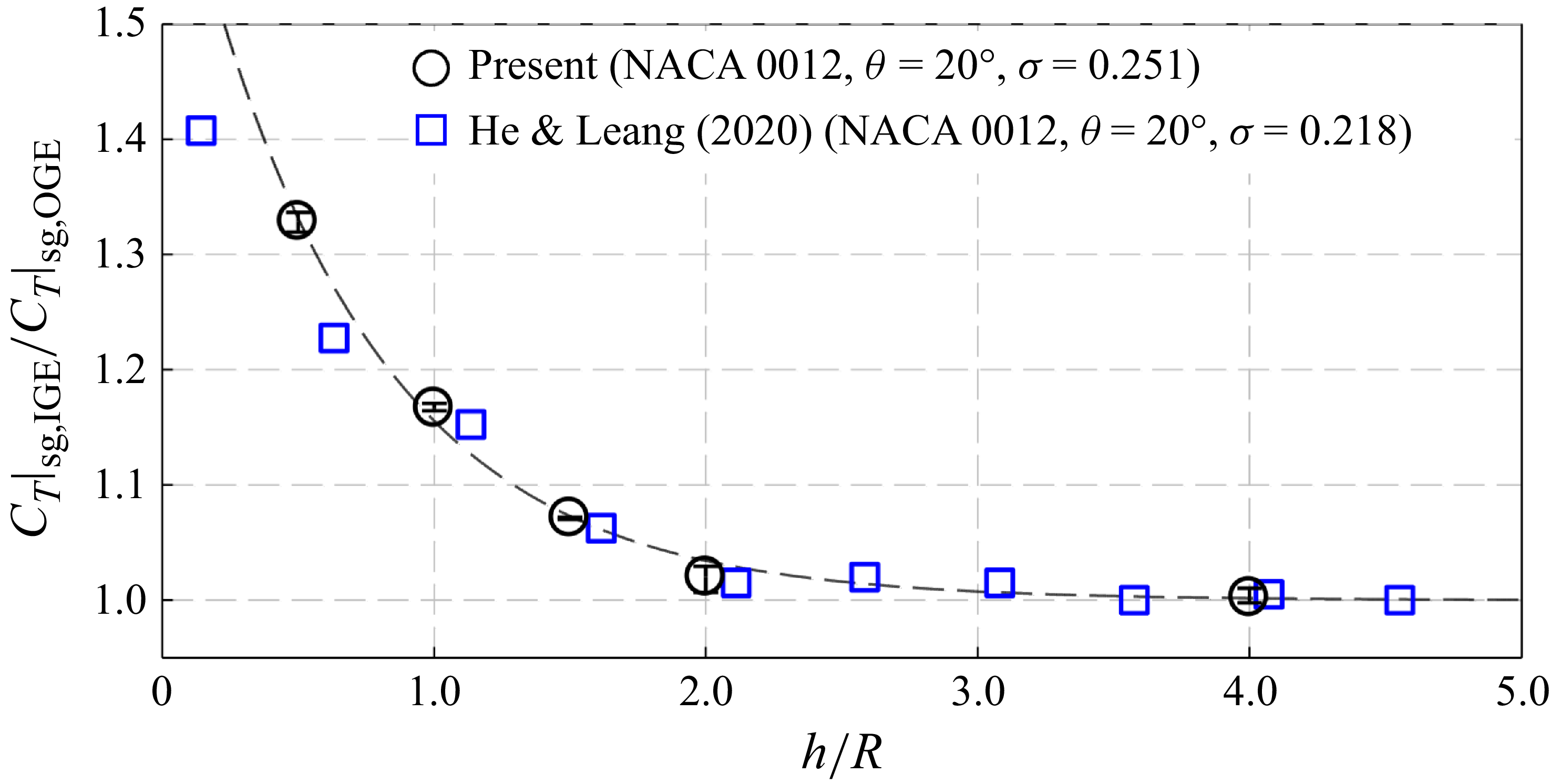





 Open access

