

Scholarship on Greek poetry of the second and third centuries CE has boomed in recent years.Footnote 1 The old assumption (as old as Plutarch, at least in one form)Footnote 2 that the era was definitively prosaic is no longer tenable: that poetry retained both its centrality in civic life and its prestige within literary culture is now undeniable. By and large, however, attention has focused on elite poetics.Footnote 3 In this article I consider an anonymous popular text – a poem, I believe, but that identification presumes the discussion below – that was widely circulated across the Empire. My aim is twofold: to collate and publish it; and to reflect on what it can tell us about Greek metrics, poetics and literary value in the Roman period. This brief text, I argue, shines important new light on the emergence of stress-based (as distinct from quantitative) poetry. It has much to tell us about the ingenuity of ‘subliterary literature’, the interaction between material form and poetic content possible in such texts, and the complex psychology of popular literary production and circulation in the eastern Roman Empire.
The text
In Appendix 1 I collect twenty recorded versions of our text, some fragmentary and some abbreviated by design.Footnote 4 The majority survive in the form of inscriptions on gemstones (mostly cameos); one is a graffito from Cartagena, Spain. I begin with an edition:
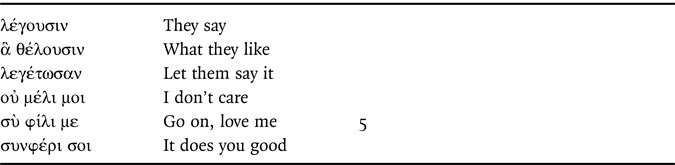
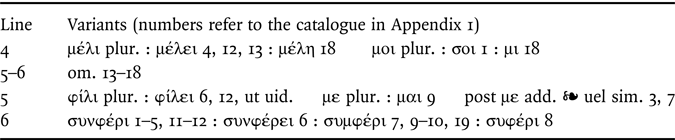
Apart from the fragmentary item 20, all gemstone versions give the colometry reproduced above. The graffito version seems systematically to amalgamate two lines into one, producing a three-line text (see Appendix 2).
In those cases where the artefacts (including the graffito) on which the text is recorded have been dated by modern specialists, estimates have all ranged between the second and third centuries CE. The transmitted spelling is also compatible with that era, although the evidence is not decisive. There are two noteworthy features:
(i) An imperial date is suggested by the general substitution of -ι for -ει endings in the third person singular of the present tense (μέλι, συνφέρι), and in the second-person singular imperative of the ε contract verb (φίλι). On inscriptions this substitution is attested as early as the third century BCE, but becomes commoner after 100 CE.Footnote 5 The confusion of -ι and -ει (which is in fact commoner in the inverse form) is indicative of a gradual phonetic convergence that seems to have left pronunciation of the two largely indistinguishable by the second century CE.Footnote 6
(ii) Less indicative for the purposes of dating are the spellings συνφέρι and συφέρι. In inscriptions συνφ- is ‘comparatively well attested in the last three centuries before Christ’, although συμφ- is approximately twice as common.Footnote 7 συφέρι is more unusual, but the loss of nasals before stops can be paralleled in inscriptions already from the classical period.Footnote 8
Of course, there is no guarantee that the text itself is not older, and the very variability of the spelling should caution us against any prima facie assumption that what we have is anything like the ‘original’ text. But given that the material artefacts indicate a consistently Roman date-range, and no comparable Hellenistic-era inscriptions have been located to date, it seems safe to conclude that our text probably originates in the Roman period, i.e. in the first or second century CE.
The diction is unambitious. The verbs belong to the beginner's Greek lexicon; there are no nouns, adjectives or adverbs. There is no sign of Atticism: in particular, the third-person imperative -έτωσαν ending, which is regular for the koine of the era, is censured by Atticist authorities, who prefer -όντων.Footnote 9 -όντων is the more recherché, literary option in prose at any rate (-έτωσαν, however, is found high poetry).Footnote 10 The spelling συφέρι (in no. 8) also reflects a feature that is ‘not normally found in decrees and documents in which the writing is of a high standard’.Footnote 11 In terms of language, then, our text and its inscribers do not lay claim to literary elevation. This is perhaps what one would expect, given the relatively modest value of the gems themselves: agate, onyx and sardonyx, the material on which the majority of texts are inscribed, are all varieties of chalcedony, an abundant mineral in the Mediterranean region.
Metre
In spite of this apparent want of literary ambition, Carlo Gallavotti has claimed that our text is metrical. Combining the six lines into three pairs appears to yield one hemiamb (∪ — ∪ — ∪ — ∪) and two anacreontics (∪ ∪ — ∪ — ∪ — —):Footnote 12
To scan the first line, however, Gallavotti was forced to interpret its alpha not as the relative ἅ (a short vowel, producing a light syllable) but as (long) ᾇ, explaining this as a Doric form of the adverbial ᾗ (‘in which way’). Given the resolutely unpretentious diction in the rest of the text, however, it is implausible to imagine that readers would avoid the obvious and supply instead a recondite form in a different dialect. While the final two anacreontics are secure, the first verse is not metrical, at least in the form in which we have it.Footnote 13 There are three explanations for the anomalous metrical assemblage:
(i) The anacreontics are intended, and the first line represents an attempt at metre (whether hemiambic or otherwise) that is ‘flawed’ by classical standards.
(ii) The two lines of anacreontics are intended, but the first is deliberately extrametrical.Footnote 14
(iii) The ‘anacreontics’ are unintended.
Before we assess these possibilities we should consider another striking metrical feature. Our text appears to make use of the stress accent to govern rhythm, in the manner of post-antique Greek poetry: the accents appear on the first of every four syllables (ἅ and σύ are treated as unstressed for these purposes, as they would be in Byzantine stress-based poetry).Footnote 15
It is, to be sure, far from self-evident that the option of adopting a stress-based rhythm would have been open to a poet of the second century CE or thereabouts. As is well known, the shift from pitch to stress accent, accompanying the loss of vowel quantity, seems to have begun in the Hellenistic period.Footnote 16 Greek metre was, however, by that stage already congealed in its classical, quantitative forms. Since Wilhelm Meyer's study of 1885 it has been dogma that the earliest unequivocal examples of poetry based around stress rather than quantity come in the form of two fourth-century texts by the experimental poet Gregory of Nazianzus, the De uirginitate Footnote 17 and the Hymnus uespertinus,Footnote 18 composed in bipartite lines of 14–16 syllables none of which has any quantitative metre and almost all of which show accented stress on the penultimate syllable. This feature, paroxytonesis, can be detected in some quantitative poetry from the High Empire: the chief examples are the choliambics of Babrius and the so-called meiouric (‘mouse-tailed’) hexameters found in Lucian and various papyri. Some have interpreted the incorporation of paroxytonesis into ‘classical’ metres as a precursor of the later shift to stress-based metre, but this is not universally accepted.Footnote 19 Either way, the stress-based rhythm found in our text is of a significantly more elaborate and thoroughgoing variety than mere paroxytonesis, and unparalleled (so far) in poetry of the High Empire.Footnote 20
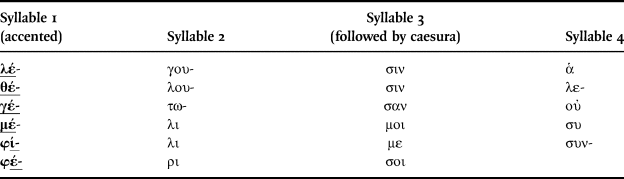
The twenty-three (or, in the shorter version, fifteen) syllables can be understood as trochaic verses consisting of four syllables, with a caesura following the word-break in the third syllable (in the first three verses the caesura follows a free-standing word; in the final three it follows an enclitic attached to the previous word).Footnote 21 The final verse is catalectic, ending at the caesura (see Table 1).
Trochaic scansion by stress rhythm
Alternatively, of course, in order to respect the word-breaks and the colometry in which the text has been transmitted one might understand the rhythm as iambic with a missing first syllable (the ‘caesura’ would then simply become the verse-end). At one level nothing rests on the trochaic/iambic distinction: our text is surely a sui generis experiment with an attractive, memorable rhythm, rather than an attempt to adhere to a formally regulated poetic scheme. But if we consider it from the wider perspective of the history of Greco-Roman metrics then the trochaic/iambic issue becomes significant. At first sight the ‘missing’ syllable is a curiosity, but two related phenomena provide some important context:
(i) The Latin comedies of Plautus make use of iambic and trochaic septenarii in sung sections; this metre appears to have been in common use in oral culture too. The septenarius is in fact a misnomer:Footnote 22 it is rather a catalectic octonarius, consisting of seven full feet plus a half-foot (i.e. fifteen syllables in all). According to Roman conventions, the short version of our text would be considered a trochaic septenarius (the longer version might be considered an extension of the same scheme over twenty-three syllables). Traditional Latin verse patterns are, like Greek, quantitative rather than stress-based, but as has often been noted accentual patterns can track quantitative ones closely in Latin (unlike in Greek).Footnote 23 The uersus quadratus – a trochaic septenarius that often displayed strong correlation between word accent and heavy quantity – was commonly used in acclamations, for example the one that accompanied the return of Germanicus in 19 CE: Salua Roma, salua patria, saluus est Germanicus.Footnote 24 It is notable too that many such septenarii are (like this one, and like our Greek text) characterised by phonetic repetition.
(ii) Our text can also be analysed as seven syllables of stress-based trochaics (λέγουσιν ἁ θέλουσιν) + eight syllables of iambics (λεγέτωσαν οὐ μέλι μοι: short version) + a further eight syllables of iambics (συ φίλι με συνφέρι σοι: longer version).Footnote 25 The fifteen-syllable Byzantine politikos stikhos (‘political verse’), which gained popularity from the tenth century onwards (but the origins of which have been traced back at least to the sixth century),Footnote 26 was similarly based around the combination of octasyllabic and heptasyllabic iambic or trochaic cola.Footnote 27 It has been clearly shown that the late-antique roots of the politikos lie in various different, fluid combinations of eight- and seven-syllable cola,Footnote 28 and that ‘oral accentual verse based on paired cola of 8 and 7 syllables with mixed trochaic/iambic rhythms was already in use from at least late antiquity’.Footnote 29
These two parallels offer some evidence, then, that (a) in both Latin and Greek iambics and trochaics were considered congenial to stressed rhythm, and that (b) such rhythms might be delivered in stikhoi of fifteen syllables, which could in Greek (according to a process that began at least as early as late antiquity) be split into hemistichs of eight and seven syllables. If, as Michael Jeffreys once argued, the politikos stikhos was the end result of a slow evolution of the acclamatory Latin trochaic septenarius, then our text might even be seen as evidence for a ‘missing link’ between Latin and Greek stressed poetry.Footnote 30 Alternatively, if Eduard Fraenkel was right to see the classical Greek (quantitative) trochaic tetrameter catalectic as originally underlying the Latin septenarius,Footnote 31 our text might better be understood as the result of an independent conversion of the Greek quantitative form into a stress-based equivalent. Such questions, however, fall well outside our present remit.
Where does this leave our text, metrically? It seems unlikely that the rhythms might be accidental: can we really believe that a six-fold repetition of a rhythm is the result of chance – particularly when the metrical form is so historically credible? What is more, both the short and the long versions display the same rhythmic pattern (i.e. a combination of seven-syllable and eight-syllable cola), suggesting that the scheme is intrinsic. At the same time, however, the anacreontics seem equally unlikely to be accidental (the non- or sub-metrical first line notwithstanding). What to conclude? One possibility is that an original poem in quantitative verse has been rewritten as a rhythmic poem. Given the frequency of metrical errors in inscribed poetry elsewhere, however, it seems more likely that what we have is the original poem, representing a genuine attempt at (at least capturing some flavours of) quantitative verse, perhaps intended to appeal simultaneously to classically educated readers alongside appreciators of popular verse.Footnote 32 What seems clear, however, is that in the poem's present state the rhythmic metre is more systematic, and likely to have been experienced as dominant.
Other ‘poetic’ features
Other striking features suggest a design that we might call ‘poetic’. One is the use of half-rhymes. As we have seen, the longer version is best understood aurally as six lines of (stress-based) trochaic tetrasyllables, the last of which is catalectic. These six lines divide naturally into 2 × 3-verse phonetic groups. The first is dominated by the initial sequence λέγουσιν/θέλουσιν/-γέτωσαν, the assonance of which is disguised in visual form, and revealed only once the poem is verbalised with the stress rhythm. In the second group of three verses the half-rhymes are even more pronounced: οὐ μέλι μοι/σὺ φίλι με/συνφέρι σοι. In the first group the half-rhymes occupy the first three positions in the trochaic tetrasyllable; in the second half, they run from caesura to caesura. This transition helps to emphasise the closural nature of the (catalectic) final verse's caesura.
Our text is visually as well as aurally poetic. The creators of the gemstone versions were clearly aiming for symmetry and elegant ‘diagrammatic’ patterns.Footnote 33 The Budapest version (no. 5) offers the most stunning example (Fig. 1).
The Budapest version (no. 5). Photograph: Aquincum Museum, reproduced with permission

The six lines are made of nine or eight letters. The first line, which has eight, is slightly distended; the fifth, which also has eight letters, has been elongated by the addition of what is apparently a leaf symbol (the same feature appears in catalogue entries nos. 3 and 7; one of the Paris cameos, no. 9, has μαι (phonetic) instead of με, presumably to fill out the line). The effect is to produce a square, with columnar diagrammatic patterns down either side. On the left, the ΛΕ of lines 1 and 3 and the ΑΘ of line 2 have been deliberately assimilated to create the impression of patterning; similarly in the last three lines the Ϲ has been almost closed, so as to assimilate it to Ο (note how much rounder it is than other sigmas), and so that the repetition of the second Υ is brought out. At the end of lines 1–3 we have ϹΙΝ/ϹΙΝ/ϹΑΝ, and then ΛΙΜΟΙ/ΛΙΜΕ and ΟΙ/ΟΙ. Other patterns include the diagonal run of epsilons going down from the first line. The letters start breaking apart from their positions in the words, and taking on independent lives as visual indices. The cameo takes on a mesmerising quality, as if the letters had a significance that went beyond their immediate function. We have not yet arrived in the fourth-century world of Optatian and the carmina cancellata, where the visual patterning of letters is so intense that the poems ‘vacillate between words and pictures’;Footnote 34 but we are, it seems, well en route.Footnote 35
Interpretation
Our text is, therefore, certainly poem-like, then, even if it differs markedly from a classical poem in its use of stress rhythm, its colloquialism, its inconsistent use of quantitative metre, its deployment of rhyme and its play with visual layout. I turn now from form to content. The text appears in two primary forms (leaving aside minor variations in spelling). The commoner version (nos. 2–12 in the catalogue) has six lines; no doubt no. 19 originally was of this kind too. Versions 13–18, however, lack the last two lines. In Appendix 2 I argue that no. 1, a graffito from Cartagena, originally consisted of the short version, and that the longer version was subsequently superimposed by a second hand.
This short version of the text means ‘they say what they like; let them say it; I don't care’. This reads as a popular-philosophical proverb: the speaker's view is set in defiant opposition to that of an unspecified majority. As a sentiment, this is almost infinitely adaptable, to suit practically any countercultural context. In a Greek context, however, the claim will have resonated as a claim to philosophical independence. The validation of an individual perspective in contrast to popular belief (δόξα) is of course a definitively philosophical stance, from at least Heraclitus and Parmenides onwards.Footnote 36 In the Roman era the opposition between δόξα and various modalities of reality (φύσις, τὰ πράγματα, ἡ ἀλήθɛια etc.) is a cornerstone of practical ethics.Footnote 37 But the shorter version does not specify exactly how or in what field this independent-mindedness manifests itself. Presumably that is the point: what is expressed here is primarily an attitude, adaptable to numerous different real-life scenarios.Footnote 38
The culminating οὐ μέλι μοι adds a more forceful note of self-assertion. It recalls the programmatic declarations of independence that characteristically mark philosophers as critically independent individuals. τί ἡμῖν … τῆς τῶν πολλῶν δόξης μέλει; asks Socrates in Plato's Crito.Footnote 39 Such strident assertions of ‘not caring’ are almost a badge of philosophical identity, particularly when it comes to death, about which Socrates and the Epicureans did not care.Footnote 40 Another popular inscription of the Roman Empire carries a prominent assertion of uncaring with philosophical overtones: the epitaph οὔκ ἤμην, ἐγενόμην, oὐκ εἴμι, οὐ μέλει μοι.Footnote 41 Both οὐ μέλει μοι inscriptions elevate the individual above the masses by borrowing from a philosophical trope (thus exemplifying the traffic between high philosophy and popular morality that has been well discussed by Teresa Morgan).Footnote 42
οὐ μέλει μοι, indeed, may even carry a countercultural charge. μέλει μοι means ‘I acknowledge my responsibility’: it is a marker of submission to social expectations. Homer's Hector famously says πόλεμος δ᾽ ἄνδρεσσι μελήσει | πᾶσι, μάλιστα δ᾽ ἐμοί (Il. 6.492–3), a form of words that also reappears with several different subjects in the Odyssey. For all the multiple ironies compressed into this sentence, for all the subtle prompting for the listener/reader to imagine Andromache's unspoken response, πόλεμος … μελήσει … ἐμοί remains a powerful articulation of the demands of the male citizen-warrior superego. To reject ‘care’ is therefore a defiant rejection of responsibility. We might think of Herodotus’ equally famous story of Hippoclides dancing away his marriage, with its epigrammatic conclusion: ‘that's of no concern to Hippoclides!’ (οὐ φροντὶς Ἱπποκλείδῃ, Hdt. 6.129). To reject ‘care’ in this way is to assert individualism within a social context that demands submission and recognition of obligation.Footnote 43
Most transmitted versions of the text, however, carry an extra two lines, which change its meaning. We shift suddenly from speaking abstractly about what ‘they’ say to a more dramatic relationship between ‘you’ (σύ, σοι) and the ‘me’ (μοι) introduced at the end of line 4. The aggressive imperative φίλι με and the presumptuous συνφέρι σοι create a new urgency. Gone is the vague proverbialising: readers are now summoned, qua addressees, into a metaleptic ‘drama of position’.Footnote 44 We are now in an apparently erotic scenario, where the words that ‘they say’ ask to be reread retrospectively as an expression of wider society's disapproval of an unconventional relationship. Catullus 5 provides an obvious parallel:
In Catullus, as has often been noted, the idiom is mercantile: rejecting the rumores … senum seueriorum is couched in terms of revaluing, as if to subvert conventional society's preoccupation with finance and quantification.Footnote 45 In the Greek text, by contrast, we are given no indication of the subjects of the first three lines’ third-person verbs. The emphasis is less upon the social distinction between ‘we’ and ‘they’, and more on that between words (λέγουσιν, λεγέτωσαν) and the ἔργον of ‘love’ (if we take φίλι euphemistically).Footnote 46
The Hellenistic Anacreontea provide further parallels. Gallavotti noted that poem 7 W2 begins λέγουσιν αἱ γυναῖκες; the women, we are told, mock him for enjoying sensory pleasure while old, but the poet's contrary view is that the closer we get to death the more appropriate it is τὸ τερπνὰ παίζειν. Gallavotti concluded that in our text too the subject of λέγουσιν must be ‘the women’, and that the speaker is therefore an Anacreontic old man asserting that his virility is unimpaired. The Anacreontea certainly provide rich parallels for the rejection of δόξα in favour of sympotic delights (including sex) – indeed, richer still than Gallavotti saw. In particular, ‘not caring’ is a repeated theme. In poem 8 W2 the speaker asserts that the wealth of Gyges οὔ μοι μέλει; what, rather, ἐμοὶ μέλει (the phrase appears three times) is anointing his moustache with perfumes, wreathing his head with roses and living for today. Poem 45 asks τί μοι πόνων, τί μοι γόων, | τί μοι μέλει μεριμνῶν; (4–5). Fr. 4.3 asks τί Πλειάδων μέλει μοι, | τί γὰρ καλοῦ Βοώτου; (10–11).
‘Not caring’ for mainstream tastes is, therefore, not just a philosophical but also a distinctively Anacreontic twist on the lyric persona's idiosyncratic self-definition in defiance of popular tastes (most famously instantiated in Sappho fr. 16 V).Footnote 47 But Gallavotti goes too far in identifying the speaker and the scenario precisely.Footnote 48 As we shall see in the next section, the ‘users’ of this inscription were diverse and widely distributed. The text in fact avoids determining any specific scenario, allowing individuals instead to superimpose a scenario of their choice. Certainly the last lines strongly suggest erotic aggression, and even recall (albeit distantly) magical agōgai that seek to induce passion in the victim, and to lead them forcibly to the spellweaver.Footnote 49 One magical gemstone (now in the British Museum) carries the imperative inscription φίλει με in a context that suggests that the female owner was seeking to secure the ongoing affection of a partner.Footnote 50 But the range of relationships potentially covered by φιλεῖν is broad; this couplet need mean nothing more than ‘show me affection and you'll benefit from it’. Since we all spend much of our time wishing we were loved by one person or another, the sentiment is malleable enough to suit practically any wearer.
Contexts
The few scholars who have considered our text have focused on trying to establish the demography of its wearers and the contexts of its use.Footnote 51 Gallavotti, as we have seen, believed it to be a poem in the Anacreontic tradition. Angelos Chaniotis, relatedly, has claimed that such inscriptions may have been read out at night (perhaps at symposia).Footnote 52 Gabriella Bevilacqua, by contrast, places it in a category of intimate formulae that appealed primarily to ‘un pubblico femminile’.Footnote 53 Given the plasticity of meaning established in the previous section, however, trying to identify one particular class of wearer or user seems the wrong approach. We can track the diversity of the inscription's uses along the axes of both geography and gender. In terms of geography, it was distributed across an extraordinarily wide geographical range: from Spain (no. 1) to Mesopotamia (no. 8). In terms of gender, item no. 5 was discovered around the neck of a young woman buried in what is now Hungary; while the shorter version of item no. 1 was scribbled on a wall in Spain by a man apparently called Eurypylus (see Appendix 2). The inscription's appeal was therefore not limited to one place or to one sex. Perhaps the Anacreontic parallels prompted men to read it as a piece of ironic sexual braggadocio, while parallels with female magical spells encouraged women to see it as an expression of desire to bind someone's affection. But it seems plausible that the text's crucial evolutionary adaptation in the literary contest of survival of the fittest was its very malleability, its openness to multiple renarrativisation in multiple different contexts.
Classicists are trained to locate cultural production with precise authors, individuals, frames; and to consider the reverse-engineering of those elements to be the scholar's primary duty. Who wrote it? In what polis? For what audience? To play what role? With what agenda? These are legitimate questions to ask of classical poetry, but our text is a different kind of animal. Whereas classical poetry achieves fixity and canonicity via its author function,Footnote 54 our text is anonymous;Footnote 55 it is the property not of its creator but of the network that sustains its circulation, and which authorises expansion, compression and variation at the level of detail.Footnote 56 Its real ‘author’ is its consumer, wearer and reader. In a mobile, internationalised economy, accessories that give cultural prestige are those that tie the wearer not to a particular point of origin but to a larger, pan-imperial, elite.
Our text, therefore, appealed not because it identified its wearer as a certain kind of person, but for precisely the opposite reason: because it allowed individuals to escape local pigeon-holing, and claim participation in an indeterminate network of translocal sophisticates who ‘get’ this kind of playful, elliptical discourse freighted with covert sexual aggression. Indeed, the text's content might be held to express precisely this rejection of the epichoric. ‘I don't care what they say’ articulates, as we have seen, a defiant individualism that differentiates those who imagine themselves in the subject position from the trivialities of gossip, and assimilates them instead to archetypes drawn from the literary tradition, whether morally obdurate philosophers or charismatically indulgent lyric personae. The text tells its readers that the logos of the unidentified ‘they’ is to be discounted; what matters is instead the reality of the intimacy shared between ‘you’ and ‘me’. At the same time, of course, the individuality proclaimed by the text is undermined by that text's broad dissemination. The individual who ventriloquises this text asserts autonomy, embodiment and intimacy, but – paradoxically – finds this in a pre-fabricated text. Let us consider briefly the one case where we can see our text ‘in action’, namely the Spanish graffito (no. 1 in the catalogue in Appendix 1):
According to my hypothesis (see Appendix 2), the two horizontal lines enclose the original text (the nonsensical ending of which has been ‘emended’), while a different hand has added the final two lines. What is significant for our purposes is the emphasis upon individual identification. Eurypylus’ autobiographical claim to ‘say’ or ‘speak’ (λέγι) these words drags him into the narrative drama, which centres precisely upon the correct use of words (λέγουσιν, λεγέτωσαν). This shared vocabulary, together with the insertion of his own name within the horizontal lines, folds his own assertion of selfhood into the textual scenario (albeit unmetrically). The individual, Eurypylus, has found his own place within the text's capacious narrative space. But such a widely disseminated text cannot be decisively claimed by one individual. If my hypothesis is right, a second author, identifying him- or herself as ΣΓ, has added the eight syllables of the longer version, thus ‘capping’ Eurypylus not only by correcting his text but also by undermining his individualising claim to be the ‘speaker’ of a poem that is in fact common coin.
We are, perhaps, not far (in essence, if admittedly not in terms of scale) from the paradox of ‘mass individualism’ that has been identified as a characteristic of late-capitalist consumer cultureFootnote 57 (and which Monty Python's Life of Brian famously satirised).Footnote 58 The ‘I’ performed by our text is always pre-scripted, and whatever claims to anti-conformist individuality it allows one to perform are pre-rehearsed. This individualist paradox becomes prima facie even more marked if we consider the material form of the inscriptions. Some of these gems may have been worked in the same workshops (nos. 13 and 15 in the catalogue in Appendix 1). The glass-paste medallion (no. 5), for all its elegance, is probably a cheap replica created from a mould. No. 14 is an intaglio, which may have been used to seal documents. As Verity Platt notes, seals themselves create secondary images: they ‘combine the beauty and expense of precious stones and metals with a specific practical function, for the seal matrix – the carved image – can be replicated ad infinitum in a variety of pliable materials which are not precious at all’.Footnote 59 Even as the text insists on the embodied, erotic/affective individuality of the bearer, setting the singular μοι against the amorphous third-person plurality of λέγουσιν, the intaglio's material form exists as a material reminder of the text's multiple reproducibility.Footnote 60
Conclusions
Given the two lines of anacreontics identified by Gallavotti, and indeed the Anacreontic flavour of the ‘careless’ rejection of the words of others, it is possible that our text started out life as a quantitatively metical poem; in the canonical form in which it circulated, however, across the Roman Empire in the second and third centuries CE, its metre was tied to stressed rhythm. This makes it the earliest example of a Greek stress-based poem identified to date. But there is no great surprise in this: it is highly likely that stressed poetry was circulating in oral form long before it manifested itself in high literature. Indeed, its adoption for late-antique Christian hymns, designed as they were to appeal to a broad audience, is strong evidence that stressed poetry was at that stage deeply rooted in oral contexts. If we knew more about the oral culture of the High Empire we would no doubt have many more parallels.
The simple, alluring beat, coupled with its half-rhymes, must have been one reason for the text's popularity. Another was its adaptability into an elegant, patterned colometry that appealed aesthetically to the eye. But form is not the only explanation for its success. Our text allowed its bearer to stake a claim to individuality by rejecting social orthodoxy (what ‘they say’), and asserting instead a strong bond between ‘you’ and ‘me’. Such claims to individuality were, however, pre-scripted, in a double sense. First, the ‘careless’ rhetoric is borrowed from high literature and philosophy. The owner who says ‘I do not care what they say’ does in fact care what the classical litterati say. Second, the materiality of the gemstones themselves – the fact that they are churned out by workshops and exported over the Empire, and that intaglios at least might have been used to create new copies in wax or clay – expose the iterability of these claims to individuality. I have stressed that we need not see this as a failure or an undermining of the text's individualist message; rather, it is a reminder that the identity of the anti-social individualist is itself necessarily a social one. A gem, intimately embraced by the body, can be imagined as a prosthetic extension of one's own truest self; but it is also, and simultaneously, an alien object superimposed on the body, a reminder of our subjection to society's irresistible demands to purchase goods, to display them, to perform our identities through fashion.
The agency that shaped these texts and the artefacts that bore them is thus multiply distributed.Footnote 61 The individuals who created the gems were many: the poet, the miners, importers and crafters of the gem and its setting, the new owner who commissioned (or simply bought) it. At a more abstract level, the need for a text like this was created by new social pressures that were the result of the emergence of a pan-imperial, translocal Hellenism.Footnote 62 The paradox of large-scale societies is that while they homogenise cultural expression in terms of language, dress-codes and accessorisation, they also increase the pressure on individuals to seek out new ways of seceding from such normative pressures. These two Newtonian cultural forces are equipollent, leaving the individual suspended in an immobile state, neither fully individualised nor wholly part of the imagined community of the like-minded.
Let us turn in conclusion to our text's relationship to literate culture. The role of paideia (civilised education) as a marker of social distinction in the High Empire is now well established.Footnote 63 This cultural ‘superego’ can be detected in our text in the traces of quantitative verse and the distant allusions to philosophical and lyric personae; and, indeed, more generally in the lyric mise en scène that is presumed. Wearers of our text will be staking a claim, however indirect, to membership of the educated elite. At the same time, the text displays a number of markers of independence from the strict demands of classicism: subliterary diction and morphology, and most prominently the superimposed stress rhythm (borrowed from the popular uersus quadratus – whether in the well-attested Latin variety or in a Greek form that is otherwise unknown to us). Our text shows that it is aware of the poetic rules established by the canon; it simply does not care to abide by them (let the high theorists of quantitative metre say what they will). This text exemplifies both the pull of and the push against the normative classicism enshrined by the Second Sophistic. This tension was the stimulus for the creation of an experimental poem – let us finally give it that title – that was, apparently, unprecedented in the Greek world, and in formal terms at any rate astonishingly sophisticated.
Appendix 1: Catalogue
Our text is found widely, and almost exclusively, on gemstones (see however no. 1 for an important exception). Given the popularity of the inscription, and the difficulty of tracing gemstones, the following catalogue cannot claim to be complete. It does offer, however, a representative sample of the various possible variants (and it is unlikely that new publications would change the overall picture). All of the items are, to the very best of my knowledge, owned legitimately according to the 1972 UNESCO Antiquities and Art Treasures Act.
1. Graffito, Cartagena (Spain), 2nd–3rd cent. CE. From an upper-storey room. Lines 1–3 are written between two incised horizontal strokes.
_________________________
Ευρ]ύπυλος λέγι ὃς κὲ Ἀ[…
λέγουσιν ἃ θέλο[υσιν
λεγέτωσαν⋅ οὐ †μελ{ισ}ο{υ̣α̣}
______________________
(σὺ) φίλι μ]ε, συνφέρι σοι⋅ ταῦ[τα
(προσ)έγ]ρ̣αψα ΣΓ 5
SEG 62.768 (A. Chaniotis, T. Corsten, N. Papazarkadas and R. A. Tybout) = Hispania Epigraphica 18 (2009) 133–4 no. 246 (J. Curbera) = IGEP 292 (M. P. de Hoz) = Stylow (Reference Stylow, Noguera and Madrid2009). On the text see Appendix 2 below.
2. Inscription on sardonyx gem. From the collection of Fulvio Orsini.
λέγουσιν ἃ θέλουσιν⋅ | λεγέτωσαν, | οὐ μέλι μοι ⋅ | σὺ φίλι με, | συνφέρι σοι
SEG 44.1704 = Pannuti (Reference Pannuti1994) 337–9 n. 299.
3. Inscription on agate gem. Possibly from the Orsini Collection. Provenance unknown.
λέγουσιν | ἃ θέλουσιν⋅ | λεγέτωσαν, | οὐ μέλι μοι ⋅ | σὺ φίλι με ❧, | συνφέρι σοι
SEG 44.1704 = Pannuti (Reference Pannuti1994) 340 n. 301.
4. Inscription on sardonyx gem. Acquired in Egypt by Wilhelm Froehner (Bakhoum and Hellmann (Reference Bakhoum and Hellmann1992) 172).
λέγουσιν | ἃ θέλουσιν⋅ | λεγέτωσαν, | οὐ μέλει μοι⋅ ‖ σὺ φίλι με, | συνφέρι σοι
Bibliothèque Nationale de France. SEG 42.1620.
5. Cameo on a medallion of glass paste. Found in a sarcophagus around the neck of a deceased young woman, Aquincum (Hungary). 2nd–3rd cent. CE.
λέγουσιν | ἃ θέλουσιν⋅ | λεγέτωσαν, | οὐ μἐλι μοι⋅ | σὺ φίλι με, | συνφέρι σοι
Budapest History Museum. SEG 29.1047 n. 15 = IGPannonia 96.
6. Medallion inscription.
λέγουσιν | ἃ θέλουσιν⋅ | λεγέτωσαν, | οὐ μέλι μοι⋅ | σὺ φίλει με, | συνφέρει σοι
Athens, Νομισματικό Μουσείο, Συλλογή Καραπάνου, αρ. ευρ. 734 (reported at Cabanis (Reference Cabanis2012) 312 n. 136).
7. Inscription on agate cameo.
λέγουσιν | ἃ θέλουσιν⋅ | λεγέτωσαν, | οὐ μέλι μοι⋅ ‖ σὺ φίλι με ❧, | συμφέρι σοι
British Museum. SEG 42.933.1a = Walters Reference Walters1926 no. 3707.
8. Inscribed cameo. ‘Aus der Sammlung von M. Peretie in Beirut: “La pierre a ete trouvée aux environs de Bagdad, sans doute dans les ruines de l'antique Seleucie”’ (Merkelbach and Stauber).
λέγ[ουσιν] | ἅ θέλ[ουσιν]⋅ | λεγέτ[ωσαν], | οὐ μέλι μοι⋅ | σὺ φίλι με, συφέρι σοι
IK Estremo oriente (Babylonia) 87 = Merkelbach and Stauber (Reference Merkelbach and Stauber2005) 508.
9. Inscribed sardonyx cameo. ‘Trouvé à Lutz, près d'Oroza (Hongrie)’ (Babelon).
λέγουσιν | ἃ θέλουσιν⋅ | λεγέτωσαν, | οὐ μέλι μοι⋅ | σὺ φίλι μαι, | συμφέρι σοι
Bibliothèque Nationale de France. Babelon (Reference Babelon1897) 347 = Le Blant (Reference Le Blant1896) no. 150.
10. Inscribed sardonyx cameo.
λέγουσιν | ἃ θέλουσιν⋅ | λεγέτωσαν, | οὐ μέλι μοι⋅ | σὺ φίλι με, | συμφέρι σοι
Bibliothèque Nationale de France. Babelon (Reference Babelon1897) 348.
11. Agate. ‘Ex collect. Calveti medici’ (Boeckh ap. CIG).
λέγουσιν | ἃ θέλουσιν⋅ | λεγέτωσαν, | οὐ μέλι μοι ⋅ | σὺ φίλει με, | συνφέρι σοι
CIG 7293.
12. ‘Fragment de camée copié à Rome, en 1885, au Musée de la Propagande’ (Le Blant)
λέγ[…] | ἃ θέλ[…] | λεγέτ[…] | οὐ μέλε[…] | σὺ φίλει μ[.] | […]νφέρι[…]
Le Blant (Reference Le Blant1896) no. 147.
13. Inscribed sardonyx cameo.
λέγουσιν | ἃ θέλουσιν⋅ | λεγέτωσαν, | οὐ μέλει μοι
Bibliothèque Nationale de France. Babelon (Reference Babelon1897) 349. Probably = CIG 7295, ‘gemma collectionis de Portici … ex Herculan.’ Same workshop as no. 15?
14. Gold pendant with black and white onyx intaglio with inscription, ca 3rd cent. CE. Unknown provenance.
λέγουσιν | ἃ θέλουσιν⋅ | λεγέτωσαν, | οὐ μέλι μοι
SEG 37.1750 = ‘Objects with Greek inscriptions on record’, in Sales Catalogue Sotheby's Monaco, 5th December 1987: Antiquités et Objets d'Art. Collection de Martine, Comtesse de Béhague provenant de la Succession du Marquis de Ganay (non vidi).
15. Inscription on onyx/sardonyx gem. Possibly from the Orsini Collection. Same workshop as no. 13?
λέγουσιν | ἃ θέλουσιν⋅ | λεγέτωσαν, | οὐ μέλι μοι
SEG 44.1704 = Pannuti (Reference Pannuti1994) 339–40 no. 300.
16. Inscription on agate cameo.
λέγουσιν | ἃ θέλουσιν⋅ | λεγέτωσαν, | οὐ μέλι μοι
British Museum. Walters (Reference Walters1926) 3706.
17. Onyx inscription, dated to the Roman imperial period. In the possession of ‘Dr Piperidis’ (Paribeni and Romanelli).
λέγουσιν ἃ θέλουσιν⋅ | λεγέτωσαν, | οὐ μέλι μοι
Paribeni and Romanelli (Reference Paribeni and Romanelli1914) col. 25 no. 14.
18. ‘Camée vu en 1884 dans la collection de M. Auguste Castellani’ (Le Blant).
λέγουσιν ἃ θέλουσιν⋅ | λεγέτωσαν, | οὐ μέλη μι
Le Blant (Reference Le Blant1896) no. 148.
19. Agate/onyx. In the Pourtalès-Gorgier collection in Boeckh's time (the collection was sold in 1865).
– – – | φίλι με | συμφέρι σοι
CIG 7294 = Le Blant (Reference Le Blant1896) no. 146.
20. ‘Fragment communiqué par M. Auguste Castellani’ (Le Blant).
λέγουσιν ἃ θέλου [ | ν […..] εγ […]| [vac. 3 lines]
Le Blant (Reference Le Blant1896) no. 149.
Appendix 2
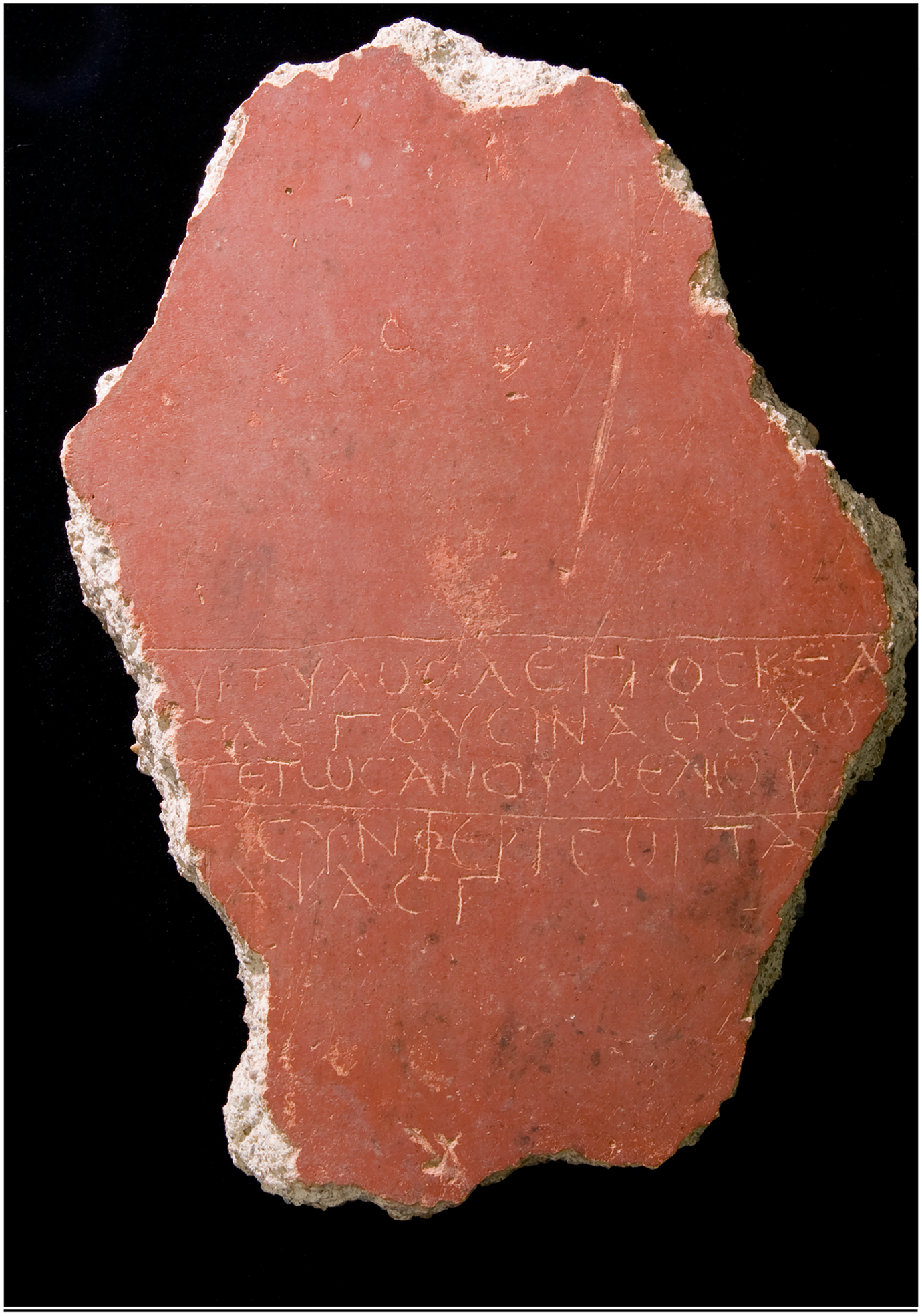
The graffito from Cartagena (Fig. 2) invites separate discussion. I am grateful to Professor Noguera Celdrán for supplying a high-resolution photograph, which has helped to clarify a number of issues. I begin with a conventional transcription:
________________
]ΥΠΥΛΟϹΛΕΓΙΟϹΚΕΑ[
]ΛΕΓΟΥϹΙΝΑΘΕΛΟ[
]ΓΕΤΩϹΑΝΟΥΜΕΛΙ̣Ϲ̣Ο̣Ι̣[
_________________
]Ε̣ϹΥΝΦΕΡΙϹΟΙ ΤΑΥ̣[
]ΑΨΑϹΓ 5
I.e.:
________________
]ύπυλοϲ λέγι ὃϲ κὲ Ἀ[…
]λέγουσιν ἃ θέλο[
]γέτωϲαν, οὐ μέλι̣ ϲ̣οι̣[
________________
]ε ϲυνφέρι ϲοι⋅ ταυ̣[
]αψαϲγ 5
The obvious explanation for the horizontal lines is that they enclose the text. This would imply that the original inscription consisted of the first three lines.
• Line 1. Clearly someone speaks (λέγι) the following words. As editors have seen, the most likely name to end in -ypylos is Eurypylos, but other options are possible.Footnote 64 Αt the end of the line, κὲ (thus accented) should be taken as a variant spelling of καὶ (so de Hoz):Footnote 65 the alternative, epic/dialectic κε (= ἄν),Footnote 66 is surely implausible. We are presumably to imagine ellipsis of a verb such as καλεῖται or προσαγορεύεται (cf. D. L. 1.79: Πιττακὸς … ὃς καὶ Μικρὸς προσηγορεύθη). The crossbar of the Α seems secure, but it is just about conceivable that it is a scratch disguising a Λ, in which case a phrase such as ὁ ϲκελλόϲ (‘the bandy-legged’) could be supplemented.
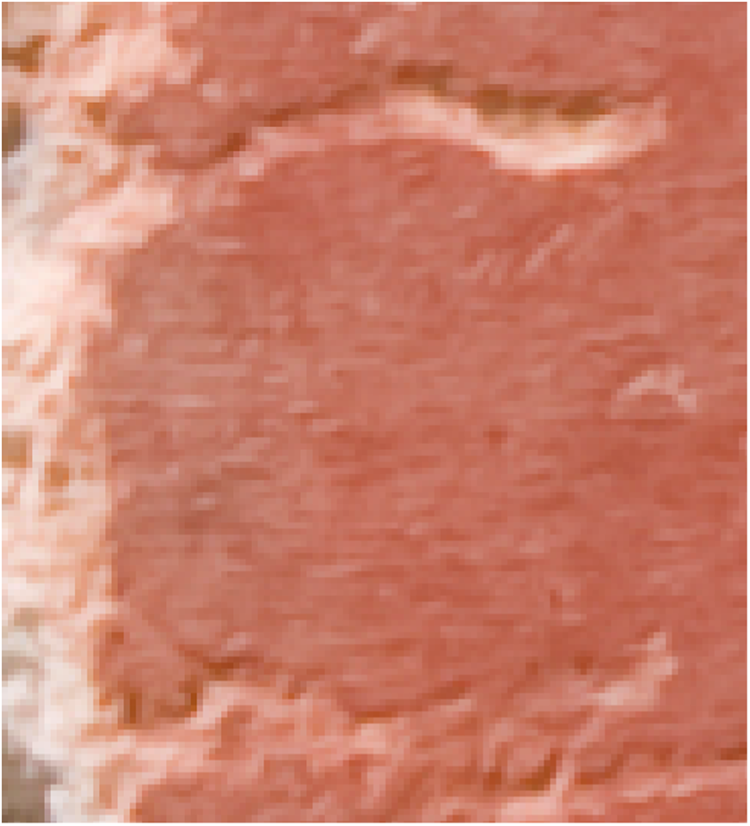
• Line 2. Two horizontal strokes appear to be visible at the left-hand edge (see the detail in Fig. 3). Previous editors have identified a Ϲ, but this seems unlikely, given the unevenness of the marks (elsewhere sigmata are written in neat, compact loops). Expansion of the digital photograph reveals that these marks are continuation of the cracking of the plaster, and thus may be the result of damage caused by the building's collapse rather than design. Certainly the lower of the two looks unlikely to be intentional. The upper could be deliberate, but may not be part of a letter. Could it be a diacritical mark indicating the start of the quoted poem? It is worth noting that if we disregard this ‘letter’ then it would appear from the substantial gap before its start that line 2 is indented relative to line 1 (perhaps indicating the start of the quotation of the poem).
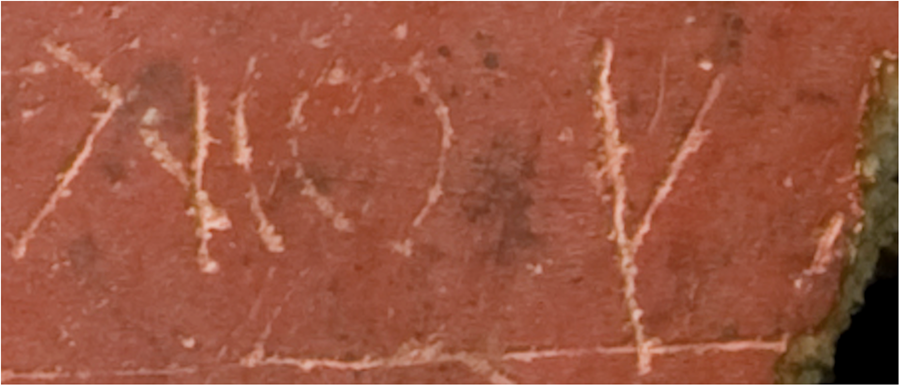
• Line 3. The problems lie at the end, and they are severe (see the detail in Fig. 4). Should we read μέλι ϲοι, with other editors? (The gemstone versions of our text have μέλι μοι.) If the letter following the Λ is indeed an Ι then it cuts across the Λ; and if the next letter is indeed a Ϲ, it is unusually flat and narrow. Both letters are eccentric compared to the rest of the text. The Ο, however, is secure: the author characteristically writes this letter with two semi-circular strokes, as here. I believe that the original inscription read ΜΕΛΟ, and that the two strokes between Λ and Ο have been inserted later (note that the gap between Λ and Ο is consistent with spacing elsewhere). The letter following the Ο has been read as I, but this seems wrong: it shows a slanted stem and a second stroke, firm and deliberate, issuing diagonally up to the right from the centre of the stem; what letter might have been intended here is uncertain (an erratic Υ?). This is another oddity: whereas the rest of the writing is relatively neat, this stroke is longer than usual, slants and breaks down through the horizontal line below. We can also perhaps detect another diagonal stroke where the plaster is broken to the right: an Α or a Λ? (But there is no trace of the second diagonal that one would expect in both cases.) The text thus seems chaotic here. It seems that an original text containing the meaningless μελο has been ‘emended’ by at least one scrawling hand. μελο might be explained as a failed attempt at an first-person present-tense verb meaning ‘I care’ (perhaps an error for μέλω, or an unfinished μέλομαι; or the author may have been distracted by the example of θέλουσιν in the line above).Footnote 67
• Line 4. We are now below the second horizontal line. The writing appears to be that of a different hand: the letters are larger, cruder and more uneven; we can also detect interverbal spacing. This hand may or may not be the one that made the additions to line 3. If Ε is to be read at the start of the line, we should no doubt fill in ϲὺ φίλι με. Expansion of the digital image (see Figs. 5 and 6) shows that ε could indeed be read: although neither of the two horizontal strokes is connected to the rest of a letter on the left, line 1 contains a close parallel for an ε written in this way. The letter seems to have been written by creating an upward loop beginning at the bottom, with the pressure released at the top (causing some jittering). A crossbar was then added, not necessarily connected to the loop. The gap following this letter is compatible with the interverbal spacing employed in the final two lines. Since this and the following line appear to be the work of a second, more haphazard, hand, perhaps the entirety of ϲὺ φίλι με was written on this line, even though this would have jutted out further to the left than previous lines. Alternatively, part of the phrase may have been added to the end of line 3 (although this would have encroached into Eurypylus’ inscription, which was contained between the horizontal lines). The left-hand margin of this line will have been further to the left than the line above, so perhaps just φίλι με (without ϲύ) was written: this would align with the start of Ευρ]ύπυλοϲ. But since the other left-hand margins seem to have been unequal, there is no need to presume the alignment of this one. ταῦτα seems inevitable at the end of the line.
• Line 5 (including the end of line 4). ]ΑΨΑϹΓ is all that is clearly legible. Stylow and Curbera read ]ΛΑΨΑϹΓ, which leads them to the supplement ταῦ[τα β]λάψαϲ. (Curbera also wonders about κολάψαϲ, from κολάπτειν = ‘chisel’). There are indeed further marks to the left of ΑΨΑϹΓ (see the detail in Fig. 7): a vertical stem, and a connected thin, diagonal mark rising from the middle of the stem towards the right. This, however, is incompatible with Λ. I believe it could be a Ρ. The Ρ in line four is comparable (see the detail in Fig. 8): it has a strong vertical stem, and a sail-shaped loop consisting of a strong lower part and a weaker upper part (which would have to be completely invisible in an Ρ at the start of line five). This would be compatible with the suggestion of De Hoz and Chaniotis et al., viz. ταῦτα γράψαϲ γ, a plausible option in terms of sense. Suggestions for the final gamma include the numeral 3 (de Hoz: ‘habiendo escrito esto 3 veces’), an abbreviation for γράμματα (also de Hoz, translating as ‘habiendo escrito estas letras’), and an abbreviation for a name (Chaniotis et al.). The last is the most plausible. I propose in fact ταῦτα ἔγραψα ϹΓ, the last two referring to the name of the second author (no doubt a Roman-style double name or a name + patronymic). The left-hand margin will have been indented considerably relative to the one above, perhaps in imitation of the marginal variation of the text enclosed within the lines. Alternatively, προσέγρ]αψα ϹΓ would begin at roughly the same point as σὺ φίλι με in line 4.
My proposal, therefore, is that the original inscription, prior to correction, read:
____________________
Ευρ]ύπυλοϲ λέγι ὃϲ κὲ Ἀ[…
λέγουσιν ἃ θέλο[υϲιν
λεγέτωϲαν⋅ οὐ †μέλο [
____________________
Here is a complete edition of the original and the overlain inscriptions, together with an apparatus criticus:
______________________
Ευρ]ύπυλος λέγι ὃς κὲ Ἀ[…
λέγουσιν ἃ θέλο[υσιν
λεγέτωσαν⋅ οὐ †μελ{ισ}ο{υ̣α̣}
______________________
(σὺ) φίλι μ]ε, συνφέρι σοι⋅ ταῦ[τα
(προσ)έγ]ρ̣αψα ΣΓ 5
1 Ευρ]ύπυλος uel Ἀνθρούπυλος, Δρουπύλος ὃς κὲ Ἀ[ Chaniotis et al. : ὅς κε Ἀ de Hoz : ΟΣΚΕΑ Stylow, Curbera
3 †μέλο manus prima : {ισ} et {υ̣α̣} add. alius uel alii
4 –5 (σὺ?) φίλι … ΣΓ add. alius
5 προσέγρ]αψα (uel ἔγρ]αψα) ΣΓ scripsi : γράψας Γ (Chaniotis et al.) : γράψας γ’ (uel γ[ράμματα]) de Hoz : βλάψας Γ Stylow, Curbera (uel κολάψαϲ Γ)
The first inscription, between the lines, is therefore the ‘short’ version of the text, apparently inscribed on the wall by Eurypylus. The second hand, identified as belonging to ΣΓ, ‘completed’ the text.
Graffito, Cartagena (Spain), 2nd–3rd cent. CE. From an upper-storey room. Photograph: José Miguel Noguera Celdrán, reproduced with permission
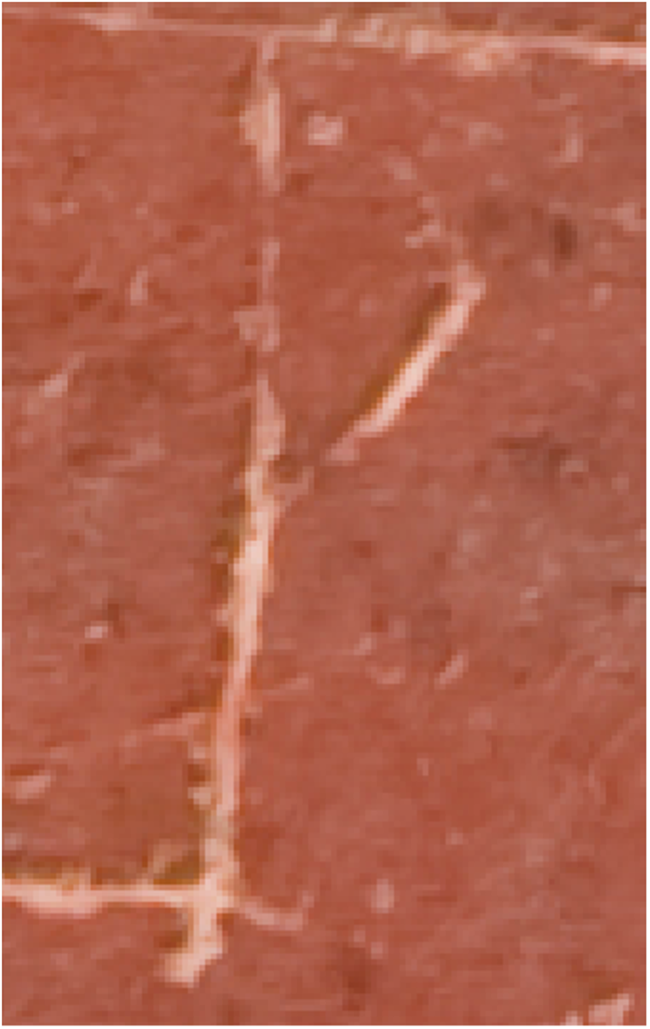
Detail of start of line 2: Ϲ or cracked/gouged plaster?
Detail of end of line 3: -Λ{ΙϹ}Ο{ΥΑ}?
Detail of the start of line 4: Ε?

A parallel from line 1? Ε, showing jittering at the top and floating crossbar

Detail of line 5: ΡΑ?
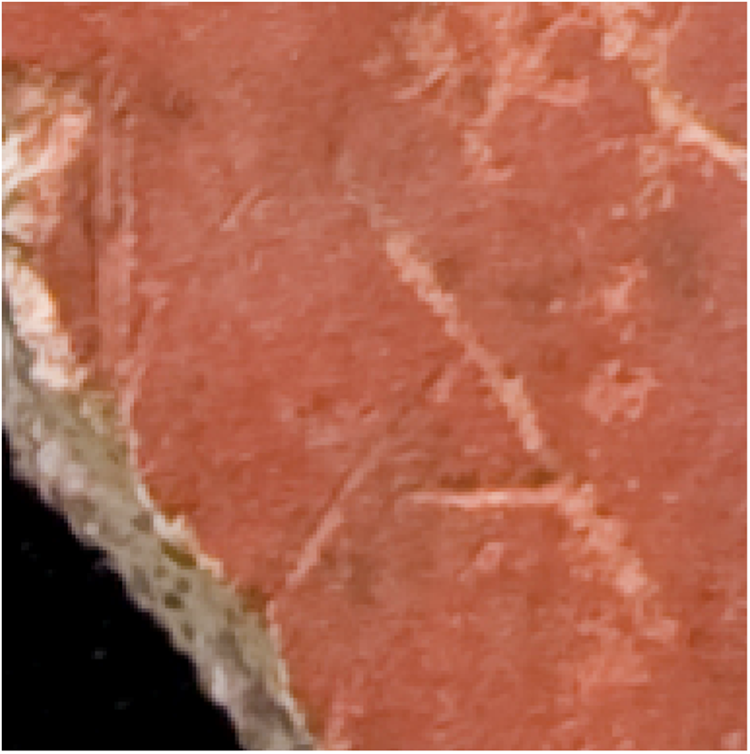
Detail of line 4: Ρ


 Open access

