

Introduction
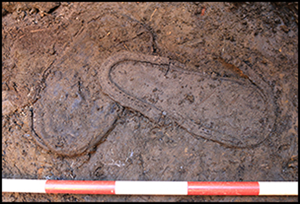
Developer-led urban rescue excavations generate more material culture than can be effectively stored, conserved and analysed. Next Generation Lab accommodates a small part of this material to use as an educational and scientific resource. The collection comprises mostly leather and bone, excavated from Danish medieval urban stratigraphies (Figure 1). The outcomes of the project are twofold: the origin and species of animals are identified; and high school students are trained in the scientific process and cutting-edge methods in the laboratory. The experience relates directly to the school curriculum, and presents a research-led, relevant and current scientific experience to the students. This is based on a citizen-science strategy in which high school students are invited to the Natural History Museum of Denmark for a one-day visit. During the visit, they undertake several analyses, from protein-based and morphological species identification, to interpreting mass spectrometry data and discussing their implications for medieval Denmark. The students apply peptide mass fingerprinting (also known as ZooMS—Zooarchaeology by Mass Spectrometry; Buckley et al. Reference Buckley, Collins, Thomas-Oates and Wilson2009) to large numbers of morphologically non-diagnostic bone and leather fragments. In so doing, they expand our archaeological knowledge of animal exploitation to include materials that are rarely prioritised in medieval assemblages, but which could provide further evidence of a city's use of animal resources.
Leather shoes excavated from the centre of Copenhagen, Denmark (photograph courtesy of the Museum of Copenhagen).

Background
In the past decade, several large-scale Danish rescue excavations have uncovered sizeable assemblages of organic materials, including leather and bone (Figure 2). These have been preserved by cool, damp, anoxic environments, but for practical and economic reasons, organic remains are difficult to store and conserve. Consequently, only a small quantity of these materials is studied in detail at local museums. Organic artefacts are more commonly analysed, whereas the waste products are usually discarded. Such products, however, potentially hold new and important information about production processes, choices of raw materials, exploitation of species, fashion and trade. Being able to identify the species of animal skin or bone is often key to exploring such themes. Morphological methods are often challenged by the nature of archaeological materials, such as degradation or the loss of diagnostic traits. The protein-based species identification method ZooMS, however, identifies species based on small differences in the structural protein collagen, which is abundant in both skin and bone. These analyses have already revealed new information on the earliest Danish cities, such as evidence of long-distance trade in walrus tusk in medieval Odense and preferences for skins from specific animal species for making Danish Viking and early medieval shoes (Brandt et al. Reference Brandt, Haase and Collins2018, Reference Brandt, Ebsen and Haase2020).
Excavation at Krøyers Plads in the centre of Copenhagen, Denmark (photograph courtesy of the Museum of Copenhagen).

ZooMS has several advantages over the analysis of ancient DNA: the superiority of protein-based analysis on older and more degraded samples (Welker et al. Reference Welker2015), the minimal sample material needed, and its relatively low cost (van Doorn Reference van Doorn and Smith2014). Nevertheless, ZooMS has not yet been applied to larger assemblages of bones or leather from Danish excavations, despite the fact that studies of rarely prioritised items have been shown to provide novel information on species range (e.g. Blusiewicz Reference Blusiewicz and Starski2017: 345). Such studies have been hindered by the lack of funding and personnel to carry out analyses.
Our citizen-science approach offers an opportunity to analyse a large number of samples by enabling high school students to increase their understanding of the production of knowledge in archaeology—and the natural sciences more generally—by analysing original archaeological material. Research has shown that involving students in research projects benefits their knowledge and practical skills (Berg et al. Reference Berg2021). The Next Generation Lab also provides an opportunity to meet specialists from the heritage and academic sectors, who can share their vocational choices and career paths and perhaps inspire future colleagues (Figures 3 & 4).
High school students examine the grain pattern of an archaeological leather artefact from Copenhagen, Denmark (photograph courtesy of the Natural History Museum of Denmark).

High school students work in the teaching laboratory (photograph courtesy of the Natural History Museum of Denmark).

Materials
Three Danish museums provide archaeological material for the project: the Museum of Copenhagen, Odense City Museums and the Museum of Southwest Jutland. All museums have recently undertaken excavations of medieval or Renaissance stratigraphy in their respective city centres, which were also the centres of some of Denmark's earliest cities. Amongst the assemblages are materials retrieved from excavations in the underground railway system of Copenhagen, in advance of the building of a new metro line. The materials include leather artefacts, such as shoes, belts and pouches, as well as material offcuts, which all have very different physical properties, suggesting that they derived from different animal species (Figure 5).
Leather artefacts and off-cuts from the excavation at Krøyers Plads, Copenhagen, Demark (photograph courtesy of the Natural History Museum of Denmark).

Zooarchaeology by Mass Spectrometry (ZooMS)
ZooMS is a peptide mass fingerprinting technique that identifies species based on small differences in the protein collagen that is abundant in tissues such as bone, antler and skin. The procedure involves using trypsin to cleave collagen into shorter amino acid chains (peptides) at specific positions. Peptides that are known to differ between species are called markers, and it is the combination of these that is known as the species ‘fingerprints’ (Buckley et al. Reference Buckley, Collins, Thomas-Oates and Wilson2009) (Figure 6).
Flow chart of a ZooMS analysis (figure by S. Frisch).

Peptides are analysed by spectrometric analyses using a matrix-assisted laser desorption/ionisation time-of-flight mass spectrometry (MALDI ToF-MS), which produces spectra that can be compared with spectra of known animal species. Only a few milligrams of leather or bone is required for an analysis.
Future outlook
The project continues over the next three years, during which time 3000 high school students will analyse several hundred organic samples from Danish city centres. The research will add to a new and extensive body of knowledge to define regional and diachronic differences in species exploitation, material preferences, trade and the development of taste and fashion in medieval and Renaissance Denmark. Next Generation Lab demonstrates the advantages of citizen science and encourages the next generation of archaeologists by putting Denmark's past in the hands of its future.
Acknowledgements
The project is a collaboration between the GLOBE Institute and the Natural History Museum of Denmark, University of Copenhagen. We thank the Museum of Copenhagen, Odense City Museums and the Museum of Southwest Jutland for the collaboration and donation of archaeological materials.
Funding statement
Next Generation Lab is funded by the Novo Nordisk Foundation (grant NNF20OC0062346) and the Danish National Research Foundation (DNRF128).



