


Introduction
Winter-annual cover crops have become more readily used as a soil conservation practice across the United States. This conservation technique has been proven to improve soil quality, increase soil organic matter, conserve soil moisture, reduce soil erosion, and provide early-season weed suppression when implemented in an agronomic cropping system (Reddy Reference Reddy2001b; White and Worsham Reference White and Worsham1990). Winter-annual grasses and legumes have been planted as cover crops in soybean, cotton (Gossypium hirsutum L.), and corn (Zea mays L.) (Reddy Reference Reddy2001b; White and Worsham Reference White and Worsham1990). Cover crops have been documented to provide early-season weed suppression by both physical and chemical interference (Barnes and Putnam Reference Barnes and Putnam1986; Reddy Reference Reddy2001b; Teasdale and Mohler Reference Teasdale and Mohler2000). According to a recent United States Department of Agriculture survey, two-thirds of growers who planted a cereal rye cover crop have noticed improved control of multiple herbicide–resistant weeds across the United States (SARE 2017). Research has shown that cover-crop residues are allelopathic, that is, they release phytotoxins that inhibit germination and early growth of some weed species (Blackshaw et al. Reference Blackshaw, Moyer, Doram and Boswell2001; Davis and Liebman Reference Davis and Liebman2003; Yenish et al. Reference Yenish, Worsham and York1996). In light of the uncertainty about the commercialization of new herbicide sites of action, the need for biological, cultural, and mechanical weed control measures is paramount (Heap Reference Heap2018; Norsworthy et al. Reference Norsworthy, Ward, Shaw, Llewellyn, Nichols, Webster, Bradley, Frisvold, Powles, Burgos and Witt2012). The integration of these cover crops with new herbicide-resistant crops can be effective alternatives for managing multiple herbicide–resistant Amaranthus spp. and other problematic weeds (Cahoon et al. Reference Cahoon, York, Jordan, Everman, Seagroves, Culpepper and Eure2015; Culpepper et al. Reference Culpepper, York, Batts and Jennings2000; DeVore et al. Reference DeVore, Norsworthy and Brye2013; Montgomery et al. Reference Montgomery, McClure, Hayes, Walker, Senseman and Steckel2017; Ryan et al. Reference Ryan, Mirsky, Mortensen, Teasdale and Curran2011; Wiggins et al. Reference Wiggins, McClure, Hayes and Steckel2015, Reference Wiggins, Hayes and Steckel2016).
Palmer amaranth is the most troublesome and economically damaging summer-annual weed across the mid-South (Beckie Reference Beckie2011; Van Wychen Reference Van Wychen2016). Palhano et al. (Reference Palhano, Norsworthy and Barber2017) reported that cereal rye cover-crop plots had 83% less Palmer amaranth emergence compared with plots with no cover crop. Wiggins et al. (Reference Wiggins, Hayes and Steckel2016) reported 20% greater control of Palmer amaranth when integrating multiple cover-crop species with glufosinate and glyphosate in cotton. Palmer amaranth biotypes have evolved resistance to six different herbicide sites of action in agronomic crops in the United States (Heap Reference Heap2018). Therefore, successful herbicide programs must focus on use of multiple, effective herbicide sites of action and sequential applications of residual herbicides for season-long control of Amaranthus spp. (Cahoon et al. Reference Cahoon, York, Jordan, Everman, Seagroves, Culpepper and Eure2015; Riar et al. Reference Riar, Norsworthy, Steckel, Stephenson and Bond2013).
Waterhemp is another annual Amaranthus species that demonstrates a very rapid growth rate and can be very competitive with crops––specifically, soybean (Horak and Loughin Reference Horak and Loughin2000). When Palmer amaranth and waterhemp emerged at a density of 8 weeds m−2, soybean yield was reduced 78% and 56%, respectively (Bensch et al. Reference Bensch, Horak and Peterson2003). Waterhemp at a density of 42 plants m−2 reduced soybean yield by 10% when they emerged as late as the V4 soybean growth stage (Steckel and Sprague Reference Steckel and Sprague2004a).
Cover crops have been adopted for use as a conservation practice, because cover crops have been documented to increase soil quality, increase soil organic matter, increase soil moisture retention, reduce erosion, and provide supplemental weed control (Hartwig and Hoffman Reference Hartwig and Hoffman1975). Cereal rye and winter wheat (Triticum aestivum L.) are commonly used winter-annual grass cover crops that reduce pressure of several weed species (Moore et al. Reference Moore, Gillespie and Swanton1994). Two legume cover crops, hairy vetch and crimson clover (Trifolium incarnatum L.), have been investigated for weed suppression as well as their ability to biologically fix atmospheric nitrogen that becomes available for the subsequent crop (Duck and Tyler Reference Duck and Tyler1996; Fisk et al. Reference Fisk, Hersterman, Shrestha, Kells, Harwood, Squire and Sheaffer2001; Norsworthy et al. Reference Norsworthy, Griffith, Griffin, Bagavathiannan and Gbur2014). Winter-annual grasses and legumes have been implemented in several crops, such as corn, cotton, and soybean (Reddy Reference Reddy2001b; White and Worsham Reference White and Worsham1990). Although cover crops suppress many winter-annual weed during the early spring, cover-crop residues typically do not provide adequate in-season weed control for agronomic crops (Teasdale and Mohler Reference Teasdale and Mohler2000. Thus, herbicides are commonly needed alongside cover-crop residues to achieve adequate weed control.
Previous research has shown that the use of residual herbicides in cover crops prolong in-season weed control (Cornelius and Bradley Reference Cornelius and Bradley2017; Wiggins et al. Reference Wiggins, Hayes and Steckel2016). Herbicides that are applied PRE can reduce early-season weed interference and often improve season-long control of Amaranthus spp. (Culpepper and York Reference Culpepper and York1998; Keeling et al. Reference Keeling, Dotray and Everitt2006; Reddy Reference Reddy2001a; Toler et al. Reference Toler, Murdock and Keeton2002; Whitaker et al. Reference Whitaker, York and Culpepper2008). Residual herbicides applied PRE are actively promoted to aid management of glyphosate-resistant Amaranthus spp. and to delay further evolution of resistance (Steckel Reference Steckel2020; Stephenson et al. Reference Stephenson, Stewart and Vidrine2008; York and Culpepper Reference York and Culpepper2009). The research reported here was conducted to determine the potential efficacy of different soil-residual herbicides on Palmer amaranth and waterhemp in the presence of cover-crop residue and develop recommendations for the best residual herbicides for use in cover-crop systems where soybean is the crop.
Materials and Methods
This experiment was conducted in 10 environments total across the mid-South. The environments were located in Fayetteville, AR, Jackson, TN, Farmland, IN, and Carbondale, IL in 2018 and 2019; in Champaign, IL in 2018; and in Columbia, MO in 2019. Palmer amaranth was the recorded species in Tennessee and Arkansas. Waterhemp was the recorded species in Missouri, Illinois, and Indiana. The coordinates for each location can be referenced in Table 1.
Details of field experiments conducted in multiple states to evaluate efficacy of residual herbicides influenced by cover-crop residue for control of Amaranthus spp. in soybean.

The experimental design was a randomized complete block with nine treatments replicated four times in plots 3 m wide and 9.1 m long. Cover crops were planted in the previous fall in 18-cm row spacings and consisted of cereal rye at a rate of 67 kg ha−1 plus hairy vetch at a rate of 8 kg ha−1. Cover-crop species and planting rates were selected as suggested by Wiggins et al. (Reference Wiggins, Hayes and Steckel2016, Reference Wiggins, Hayes, Nichols and Steckel2017). Cover-crop planting dates, soybean planting dates, and soil characteristics for each site can be found in Table 1. Cover crops were terminated 3 wk pre-plant with an application of glyphosate at 1,260 g ae ha−1 + dicamba at 560 g ae ha−1. Soybeans were planted in 75-cm-wide rows to varieties that were Liberty Link (glufosinate resistant). Treatments consisted of a nontreated or no-residual plot, acetochlor, dimethenamid-P, flumioxazin, metribuzin, pendimethalin, pyroxasulfone, pyroxasulfone + flumioxazin, and S-metolachlor. Application rates were based on label specification for those herbicides. Active ingredient, trade names, and rates can be found in Table 2. Treatments were applied at planting with a CO2-pressurized backpack sprayer calibrated to deliver 140 L ha−1 at 220 kPa using AIXR 11003 or a XR 11003 nozzles spaced 50 cm apart (AIXR; TeeJet Technologies, Wheaton, IL).
Herbicide active ingredient and application rates based on soil texture and organic matter content applied in field experiments conducted in multiple states to evaluate efficacy of residual herbicides influenced by cover-crop residue for control of Amaranthus spp. in soybean.

The number of days until Amaranthus spp. reached 10 cm height was recorded to estimate the residual capability from each herbicide treatment and corresponds with the plant height limit for POST control with most herbicides available for soybean (Anonymous 2020a, 2020b, 2020c). Density of Amaranthus spp. was estimated by counting the number of Palmer amaranth and waterhemp plants from two 1-m2 quadrants recorded at each of the following evaluation timings: 14, 21, 28, 35 d. Amaranthus spp. plant heights were recorded at the 35-d evaluation timing. Soybean yield was taken by harvesting with a plot combine, and grain moisture was adjusted to 13% moisture.
Data were subjected to ANOVA using the PROC GLIMMIX procedure in SAS (version 9.4; SAS Institute, Cary, NC). Palmer amaranth and waterhemp data were analyzed separately for this analysis. Each year−location combination was considered an environment sampled at random from a population as described by Blouin et al. (Reference Blouin, Webster and Bond2011) and Carmer et al. (Reference Carmer, Nyquist and Walker1989). Designating environments random broadens the possible inference space to which the experimental results are applicable. Environments, replications (nested within environments), and interactions containing these effects were declared random effects in the model; herbicide treatments were designated fixed effects. Type III statistics were used to test the fixed effects, and least square means were separated using Fisher’s protected LSD at α = 0.05.
Results and Discussion
Days to Palmer Amaranth 10-cm Height
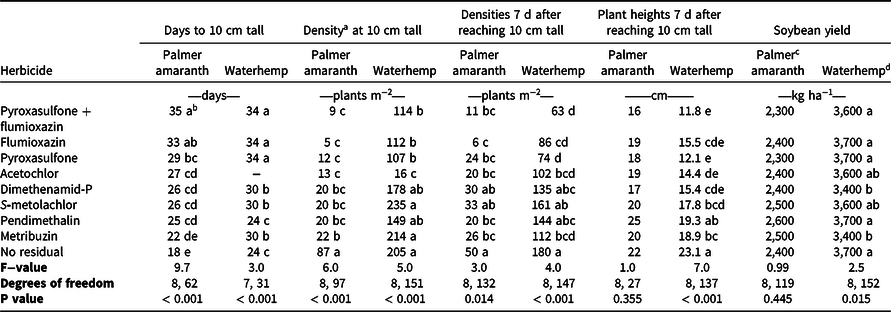
Palmer amaranth took 18 d in the cover crop–alone (nontreated) treatment to reach a height of 10 cm (data not shown). The number of days for Palmer amaranth to reach a height of 10 cm varied from 0 to 37 d in Arkansas and 12 to 27 d in Tennessee. This result supports Wiggins et al. (Reference Wiggins, Hayes, Nichols and Steckel2017), who found that Palmer amaranth took 16.5 d to reach a height of 10 cm in cover-crop residues. The range of days to Palmer amaranth reaching 10-cm height on the herbicide treatments was much narrower (24 to 38 d). Compared with this treatment, all herbicides except metribuzin increased the number of days until 10-cm tall Palmer amaranth plants were present (Table 3), and the increase ranged from 7 to 17 d. Among the herbicide treatments evaluated, pyroxasulfone + flumioxazin and flumioxazin were best at delaying Palmer amaranth growing to a height of 10 cm by 35 and 33 d, respectively.
The effect of cover crop (cereal rye + hairy vetch) with and without soil-residual herbicide on number of days required for Amaranthus spp. to reach 10-cm height, density, and soybean yield during field experiments conducted in multiple states to evaluate efficacy of residual herbicides influenced by cover-crop residue for control of Amaranthus spp. in soybean.
a Plant densities measured in a 1-m2 quadrant.
b Means not followed by a common letter within a column are significantly different (P < 0.05).
c Soybean yield at locations with waterhemp.
d Soybean yield at locations with Palmer amaranth.
Days to Waterhemp 10-cm Height
Waterhemp took 34 d to grow to a height of 10 cm when treated with pyroxasulfone + flumioxazin, flumioxazin, and pyroxasulfone, and 30 d to grow to a height of 10 cm when treated with S-metolachlor and dimethenamid-P (Table 3). Cover crop alone or treatment with pendimethalin was able to suppress waterhemp emergence by 24 d.
Density of Palmer Amaranth
The herbicides that resulted in the lowest Palmer amaranth density were pyroxasulfone + flumioxazin, flumioxazin, pyroxasulfone, and acetochlor (Table 3). Those four herbicide treatments provided 1.5 to 4 times less Palmer amaranth density than other herbicides tested. Herbicides evaluated resulted in lower Palmer amaranth density than the nontreated. Palmer amaranth density in plots with soil-residual herbicides ranged from 5 to 22 plants m−2, which was 94% to 75% compared with the cover crop without herbicide (87 plants m−2). These data are consistent with Wiggins et al. (Reference Wiggins, Hayes and Steckel2016), where a cereal rye and hairy vetch cover crop in cotton reduced Palmer amaranth density by 62%, and fluometuron or acetochlor applied PRE increased control to 89% and 95%, respectively.
Density of Waterhemp
Unlike the results with Palmer amaranth, only four of the herbicides––pyroxasulfone + flumioxazin, flumioxazin, pyroxasulfone, and acetochlor––had fewer waterhemp plants than the nontreated. Those herbicides reduced waterhemp density 20% to 65% compared with the cover crop–alone treatment. Of those top four treatments, acetochlor provided the best control, with just 16 plants m−2 or 7 to 14 times fewer waterhemp plants than all the other herbicides. These data are consistent with Strom et al. (Reference Strom, Gonzini, Mitsdarfer, Davis, Riechers and Hager2019), who found that acetochlor provided better control of multiple herbicide–resistant waterhemp. Densities of waterhemp in treatments that contained dimethenamid-P, S-metolachlor, pendimethalin, and metribuzin were similar to the nontreated.
Amaranthus spp. density counts 7 d after achieving 10 cm in height were different among herbicide treatments for control of both species. Palmer amaranth density with flumioxazin remained the same after 7 d. All the other herbicide treatments resulted in increased Palmer amaranth density. However, pyroxasulfone + flumioxazin, flumioxazin, pyroxasulfone, pendimethalin, metribuzin, and acetochlor all brought about lower densities of Palmer amaranth than the nontreated. Treatments with S-metolachlor and dimethenamid-P had Palmer amaranth densities similar to the nontreated.
Flumioxazin, pyroxasulfone, pyroxasulfone + flumioxazin, acetochlor, and metribuzin provided 65% to 42% greater control of waterhemp compared with the nontreated 7 d after that weed reached 10 cm tall. Interestingly, at this later evaluation timing, densities of both Amaranthus spp. in the nontreated plots declined. We speculate that this decline could be due to the natural variation of the nontreated plots.
Height of Palmer Amaranth and Waterhemp
There were no differences in Palmer amaranth plant height. In contrast to the results with Palmer amaranth, all herbicides except pendimethalin reduced waterhemp plant heights compared with the nontreated. Palmer amaranth plants in pyroxasulfone- and pyroxasulfone + flumioxazin−treated plots were shorter than those in plots treated with pendimethalin, metribuzin, S-metolachlor, or not treated.
Soybean Grain Yield
Despite the substantially reduced control of Palmer amaranth and waterhemp with the cover crop–alone treatment, soybean yield was no less than yield where a cover crop was used with an herbicide. We suggest that one reason for the lack of substantial yield loss may be that the cover crop delayed weed emergence. This suggestion is consistent with numerous studies that suggest delaying emergence of Amaranthus spp. in relation to soybean emergence can greatly mitigate yield loss from competition (Bensch et al. Reference Bensch, Horak and Peterson2003; Culpepper and York Reference Culpepper and York1998; Culpepper et al. Reference Culpepper, York, Batts and Jennings2000; Steckel and Sprague Reference Steckel and Sprague2004b). Notably, there were no yield differences for treatment environments infested with Palmer amaranth. In fact, yields among treatments were separated by only 260 kg ha−1. Yield differences were observed for locations with waterhemp. Soybeans treated with dimethenamid-P and metribuzin yielded less than with other herbicides, except S-metolachlor and acetochlor. Similar to Palmer amaranth sites, yield among treatments only differed by 360 kg ha−1
These findings agree with and add to the literature that adding a soil-residual herbicide improves the consistency of Palmer amaranth and waterhemp control in soybean planted into a cereal rye + hairy vetch cover crop. This research adds to the published literature on integration of cover crops with herbicides by suggesting that pyroxasulfone + flumioxazin, flumioxazin, pyroxasulfone, and acetochlor were the most effective among the herbicides tested in this study for control of Palmer amaranth when used with a cover crop. In addition, acetochlor was the most effective herbicide evaluated providing residual control of waterhemp. Cover crop alone did provide similar soybean yield compared to treatments when a cover crop was integrated with an herbicide despite providing much less Amaranth spp. control. We suggest that this result could be due to the cover crop delaying and reducing the Amaranth spp. enough to mitigate the yield-limiting interference that both these weed species have been well documented to offer. Though soybean yield was not negatively affected when no PRE herbicide was used, numbers of Amaranth spp. present were greatly increased, which would result in more selection pressure for any POST herbicide.
Acknowledgments
The United Soybean Board provided funding for this research. No conflicts of interest have been declared.


 Open access

