

1. Introduction
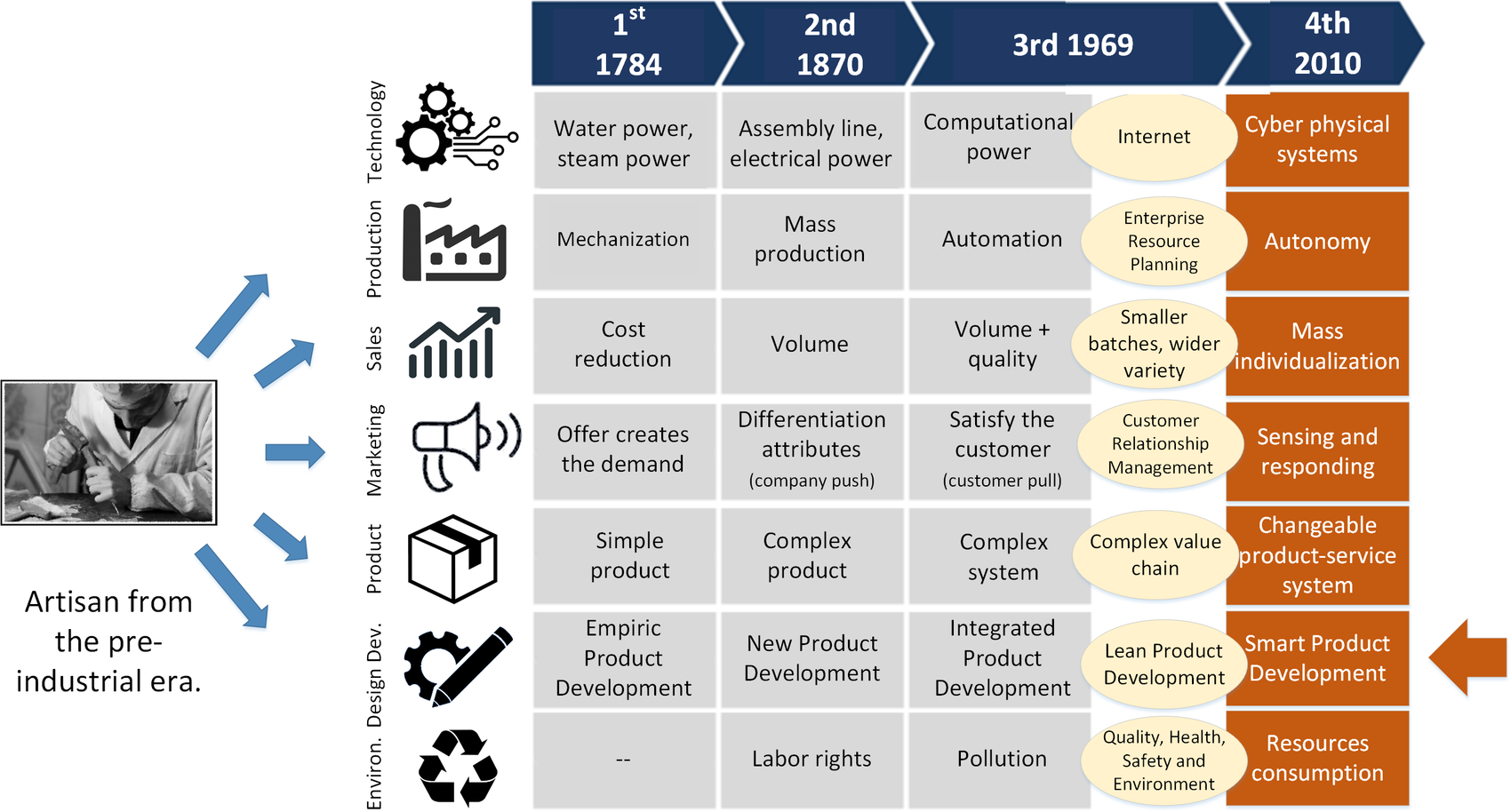
Although the industrial revolutions (IR) impact first on the shop-floor, they affect all the processes through the companies’ value chains. To illustrate these changes Pessoa & Jauregui-Becker (Reference Pessoa and Jauregui-Becker2020) consider seven business and market perspectives, where: (i) the technology increase of the production performance; (ii) the production performance leads to cost reduction and/or allow the developing of new products; (iii) the newer/more affordable products better fit the market needs and increase sales; (iv) the production and the product’s environmental impact raise society awareness; finally (v) a compatible product design and development process (PDDP) is required to deliver products capable of exploiting the previously mentioned benefits. Figure 1 summarizes the perspectives evolution; the ellipses highlight some bridging elements from the 3rd to the 4th IR.
Changes driven by the industrial revolutions – adapted from (Pessoa & Jauregui-Becker Reference Pessoa and Jauregui-Becker2020).
Consequently, taking full benefit from the changes pulled by the 4th IR requires new products and business models adjusted to the rapidly changing market conditions (Reeves et al. Reference Reeves, Bergman, Gourévitch and Ortiz2016). In fact, even though smart factories can better support the manufacturing of individualized products and avoid the sub-optimum use of their resources (Verzijl et al. Reference Verzijl, Dervojeda, Jorn, Nagtegaal, Probst and Frideres2014; Wang et al. Reference Wang, Wan, Zhang, Li and Zhang2015), and smart products have the potential of better serving the needs of its customers through information exchange and adaptiveness (Wolfgang Maass Reference Wolfgang Maass2007; Porter & Heppelmann Reference Porter and Heppelmann2014), these benefits are only achieved if the products are designed accordingly (Rüßmann et al. Reference Rüßmann, Lorenz, Gerbert, Waldner, Justus, Engel and Harnisch2015).
Smart design engineering is here defined as a methodology used during the analysis and design of a product or a system, which can be composed by hardware, software and/or services (therefore not limited to designing smart products), and that explicitly considers exploiting the technologies and opportunities from the 4th IR. Therefore, Smart design engineering leads to process improvement by including 4th IR features, while design of smart products leads to incorporating 4th IR technologies into the products themselves. This work aims at contributing to both design theory and practice by: (i) deepening the understanding about the necessary smart design engineering features; (ii) mapping the features’ impact on PDDP’s phases, thus practitioners can benefit from the presented results to improve their PDDP process.
In this work the term “Industry 4.0” was used rather than Industrie 4.0, which is the original German for the 4th IR. While Industry 4.0 focuses on the communication among cyber-physical systems (CPS) and its impact on the shop floor, the 4th IR expands the core concepts from Industry 4.0 by including changes outside of the shop floor (i.e., products, customer attitude, business models, etc.).
1.1. Smart design engineering: the road so far and the strategy for going beyond
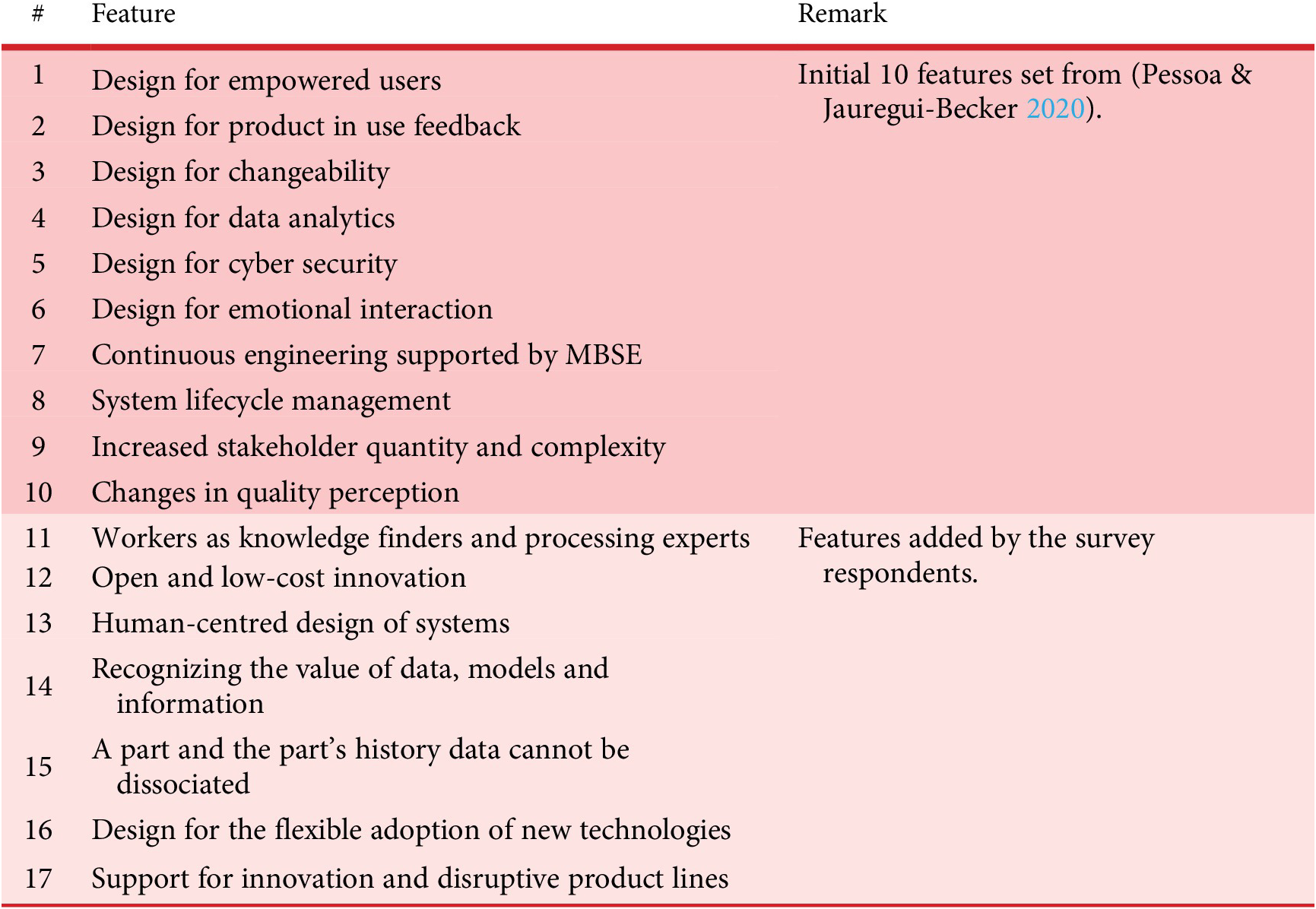
Previous work on analyzing design principles for Industry 4.0 either fail on discussing specific issues related to 4th IR impact on the PDDP. Hermann, Pentek & Otto (Reference Hermann, Pentek and Otto2016) performed a literature review on principles that affect the design of Industry 4.0 scenarios but did not address the PDP itself. Similarly, Wang et al. (Reference Wang, Wan, Li and Zhang2016) compare the Industry 4.0 production system and traditional production line without discussing possible issues related to product development. Lu (Reference Lu2017) conducts a comprehensive review on the topic but presents no findings about its impact on the engineering design process. Pessoa & Jauregui-Becker (Reference Pessoa and Jauregui-Becker2020) performed a literature review and identified 10 initial findings, which would shape smart design engineering (Table 1). The initial findings require further investigation about its completeness. Additionally, no clear reflection on their practical impact through the product life cycle is presented, which in an obstacle to their implementation into the PDDP.
Preliminary features list.
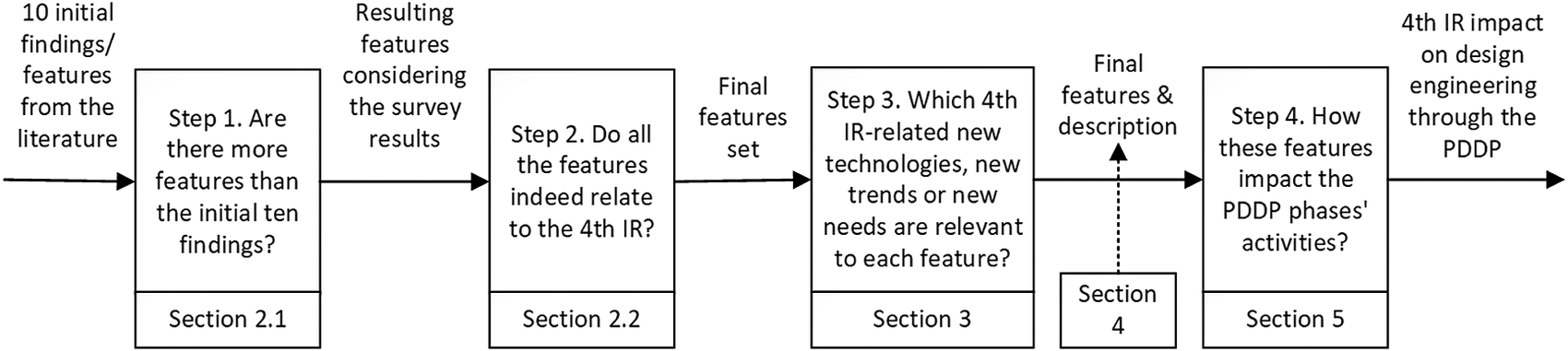
This paper aims at filling this gap by and further describes the 4th IR impact on design engineering and through the PDDP. In order to achieve this objective, this work starts from the smart design engineering features first identified by Pessoa & Jauregui-Becker (Reference Pessoa and Jauregui-Becker2020) and conduces a four-step research, each step aiming at answering a specific research question. Figure 2 shows how the paper was structured for following these steps and achieving the main objective.
-
Step 1. Are there more smart design engineering features than the initial 10 findings? To answer this question, specialists and researchers were asked if they would add any other feature to the initial findings. The respondents were the same 11 specialists contacted by Pessoa & Jauregui-Becker (Reference Pessoa and Jauregui-Becker2020) and 14 attendees from the smart design engineering and PSS workshop at the CIRP IPSS 2019 Conference. The choice of the CIRP IPSS Conference was due to its alignment to the product evolution perspective, as presented in Figure 1.
-
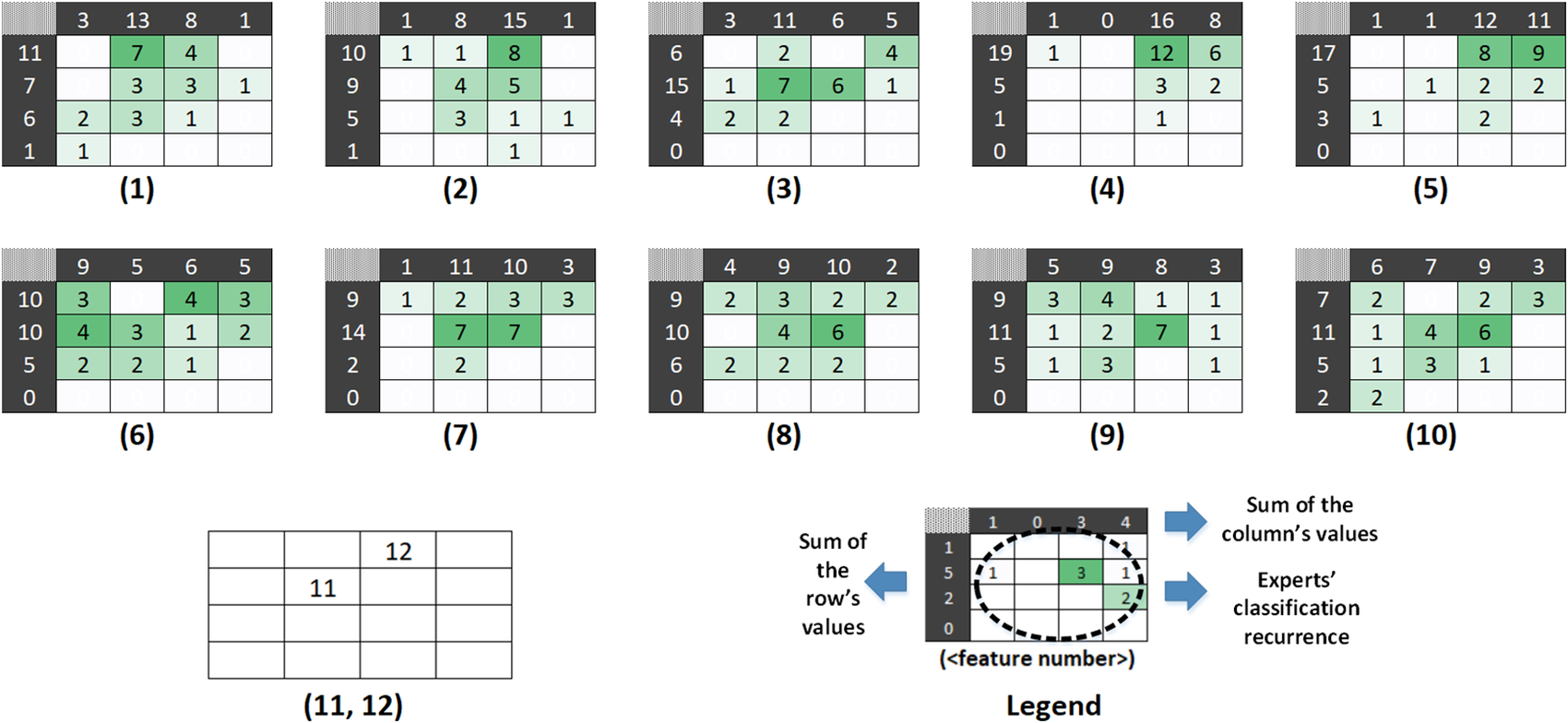
Step 2. Do all the features indeed relate to the 4th IR? As part of the previously mentioned questionnaire, the interviewees classified the features against its relation to the 4th IR and its impact on the PDDP. The respondents received a blank chart as in Figure 4 and were asked to plot the features according to their best knowledge.
-
Step 3. Which 4th IR-related new technologies, new trends or new needs are relevant to each feature? A cross-relation analysis is made among the features, the industry perspectives (Figure 1) and the nine 4th IR core technologies (Rüßmann et al. Reference Rüßmann, Lorenz, Gerbert, Waldner, Justus, Engel and Harnisch2015).
-
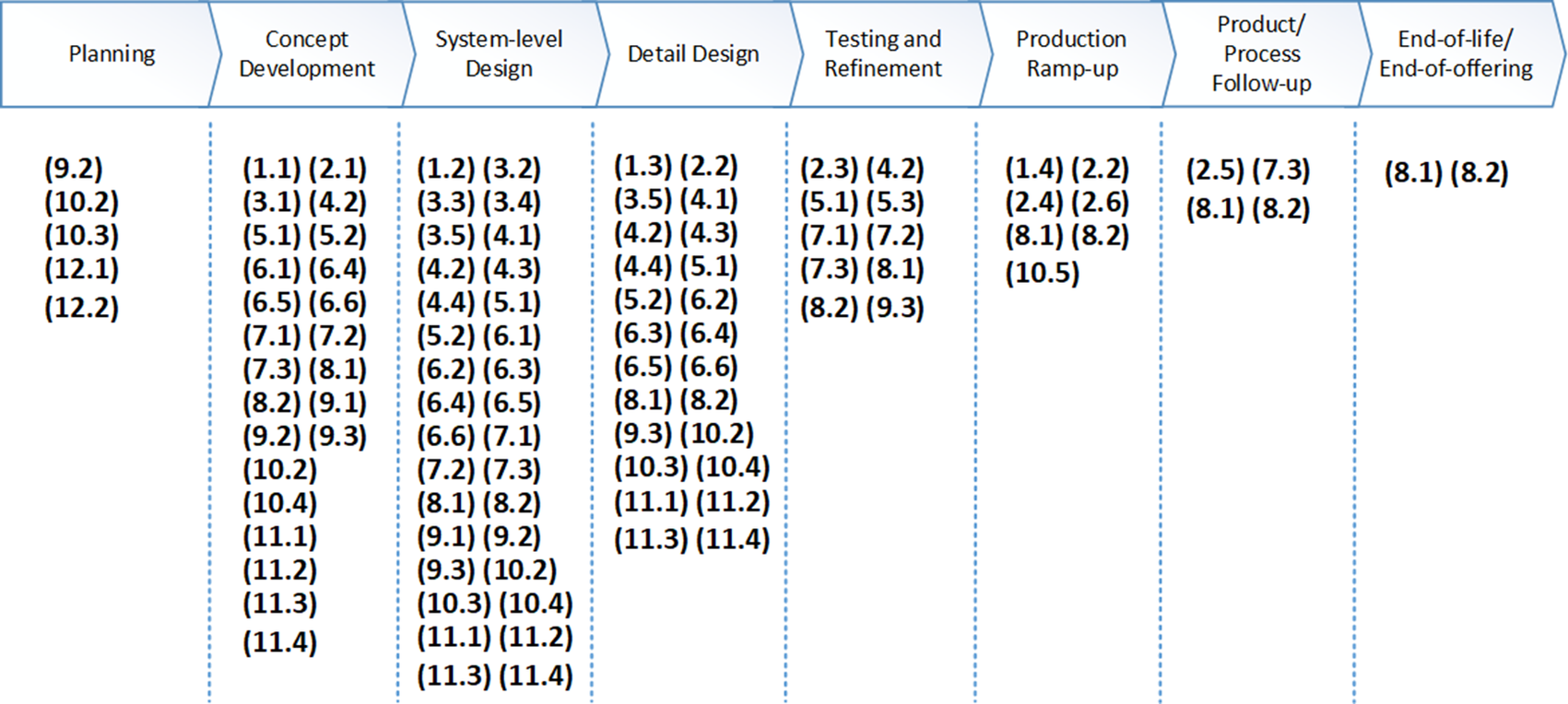
Step 4. How these features impact the PDDP phases’ activities? The impact on the process, people and tools elements is analyzed and plotted into each PDDP phase.
The paper’s structure and the research steps.
2. Resulting features considering the survey results
Considering the topic’s novelty and the scarcity of specific literature, a survey was performed to gather the opinion from specialists and researchers. The objective here was to further validate the completeness and relevance from the 10 initial features that served as the base for this work.
2.1. Features’ completeness
The survey participants were asked to identify additional features to the initial set, which resulted in the preliminary features listed on Table 1. There were no two respondents proposing the same additional feature and some of the propositions could be traced back to the initial set (Section 2.2). Here is the preliminary features list including both the original set as proposed by Pessoa & Jauregui-Becker (Reference Pessoa and Jauregui-Becker2020) and the ones coming from the survey:
-
1. Design for empowered users/customers: Customers can be empowered to become active parties in product creation activities, both at the design process’s front and rear-ends.
-
2. Design for product in use feedback: Products can be outfitted with sensors that enables knowing the product’s actual performance and condition, which might give insight for updating or upgrading the product and helps determining a better and tailored maintenance strategy.
-
3. Design for changeability: Products are changeable by having built-in robustness against small use variations, adaptability to different use experiences and new technologies, and flexibility to updating and upgrading. Set-Based Concurrent Engineering is an example of approach where solution alternatives coexist through flexible modular design (Ward et al. Reference Ward, Liker, Cristiano and Sobek1995).
-
4. Design for data analytics: Design engineering can benefit from the sheer amount of available product data, external data, and enterprise data, where big data analysis can be then performed through the various activities during the product design, manufacturing, and service.
-
5. Design for cyber security: The communication among the systems and the use of internet bring the challenges and threats from the cyber world to the physical world, which means security must be embedded as a first principle in product design and across the value chain.
-
6. Design for (emotional) interaction: By adding communication capabilities, the new products might interface and collaborate with other smart products and with the people in the environment. The product should be designed not only to providing functionality, but to creating the right emotional response and emotional bounds between user and product, while avoiding the possible failure modes that might arise from these interactions.
-
7. Continuous engineering supported by model-based systems engineering (MBSE): Continuous engineering builds on simultaneously considering all engineering disciplines and on the foundation of systems engineering practices by persistently applying engineering tools, methods, and techniques to address change and close gaps between design models and requirements. In this scenario, model-based systems engineering (MBSE) supports new product design processes that integrate design methods.
-
8. System lifecycle management: The product lifecycle-related information availability, quantity and change rate requires models and tools that effectively support decision making. Product Lifecycle Management (PLM) solutions should be dynamically adaptable reflecting the ongoing changes of data models (including hardware, software and services perspectives) and capable of determining the cross-impact of changes among these perspectives.
-
9. Increased stakeholder quantity and complexity: Modelling smart products requires taking into account the complete product lifecycle and an interdisciplinary and transdisciplinary collaboration with several intermediary stakeholders, such as the ones that can give insight on market, technology, legal, sociological, psychological (emotional interaction) and environmental.
-
10. Changes in quality perception: Quality perception is becoming rather dependent of personalized goals and experiences than on generally accepted aspects by the target market, where design, safety, quick availability, and personalized service quality are gaining higher importance. Another aspect to be considered is the concern about privacy and data security.
-
11. Workers as knowledge finders and processing experts: Considering the fast pace of knowledge creation, is very unlikely that someone masters the whole set, even if it is related to a specific topic. Designers must develop a skillset that includes good understanding on how to find, select, combine, and use the knowledge available.
-
12. Open and low-cost innovation: Design processes should take advantage from the knowledgeable and creative individuals outside the company, which can also contribute to achieving strategic goals, reducing innovation costs, and which sharing intellectual property both ways is useful.
-
13. Human centred design of systems: Solutions to problems should be developed by involving the human perspective in all steps of the problem-solving process and thus addressing the core needs and well-being of those who experience the problem.
-
14. Recognizing the value of data, models, and information: Data, its aggregation into information, and its modelling to facilitate the retrieval and processing become central.
-
15. A component and its history data cannot be dissociated: A component (physical product) will always be accompanied by data about its origin and history. This feature implies the need of defining and guaranteeing the keeping track of each component’s history information through its life cycle.
-
16. Design for the flexible adoption of new technologies: The exploding availability of new technologies requires PDDP and product platforms capable of incorporating them in a fast and cost-effective way.
-
17. Support for innovation and disruptive product lines: New product development is often seen as an improvement of their actual products and/or actual way of doing business. The exploding development of new technologies is always a threat to the establishment, so companies should foster (disruptive) innovation to be ahead of the competition.
2.2. From the preliminary to the final features set used during the analysis
By analysing the 10 (initial) + 7 (survey result) features, the set was reduced to 12 features by considering the following rationale:
-
1. Feature 13 (human centred design of systems) is a technique that supports better addressing the stakeholder needs and therefore was merged to feature 10.
-
2. Feature 14 (recognizing the value of data, models, and information) is already included in features 4 and 7. The former deals with data and information choices and data modelling, while the latter deals with information modelling.
-
3. Feature 15 (a component and its history data cannot be dissociated) implies the need of defining and guaranteeing the keeping track of each component’s history information through its life cycle, therefore it was merged to feature 8.
-
4. Feature 16 (design for the flexible adoption of new technologies) was merged to feature 3.
-
5. Feature 17 (Support for innovation and disruptive product lines) is related to set-based concurrent engineering (SBCE) and can be considered part of feature 3.
2.3. Features’ relevance
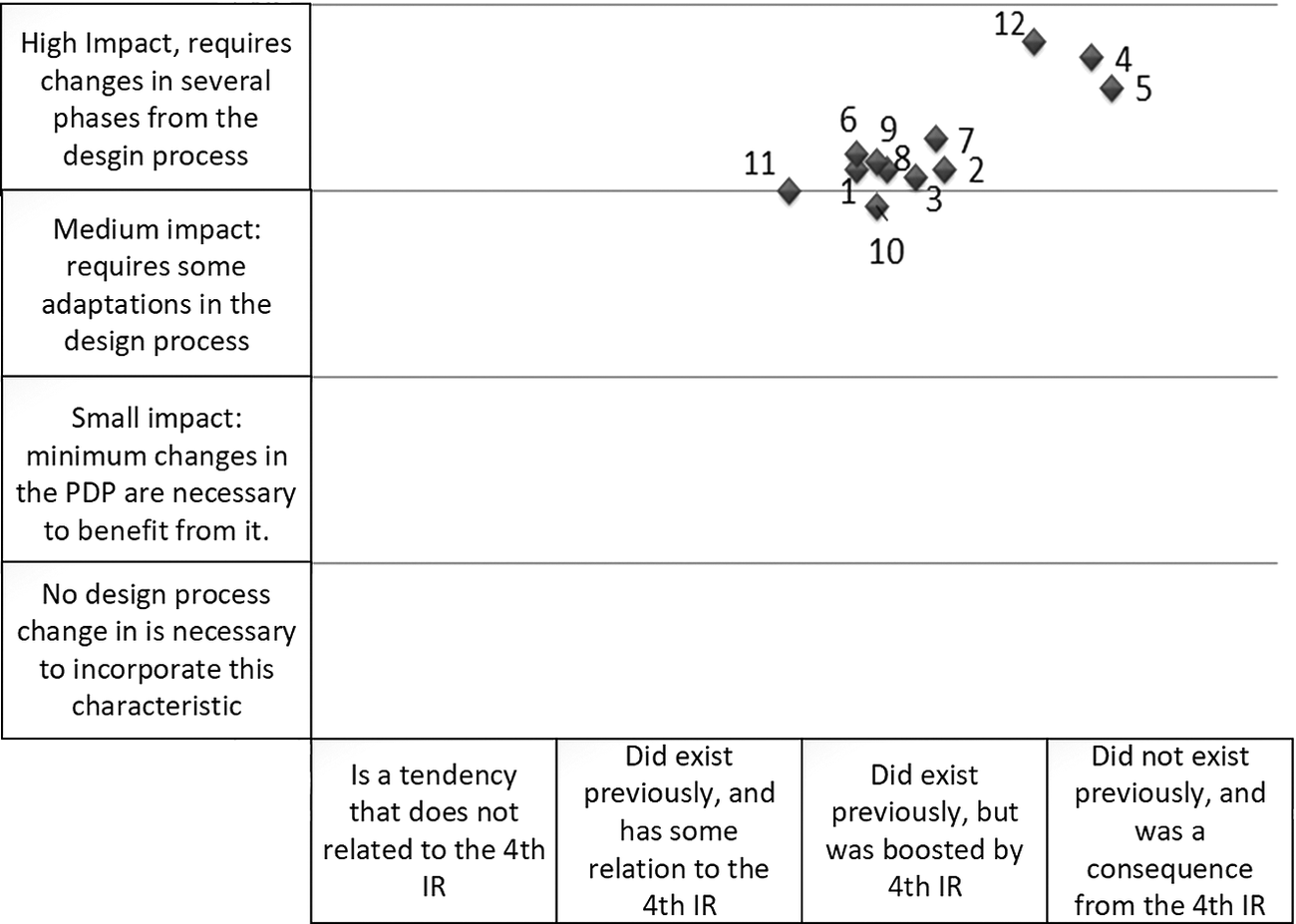
The respondents also determined the features’ relevance according to their link to the 4th IR and to the extent their implementation require changes in the PDDP. Figure 3 shows the results the accumulated results, where each feature from 1 to 10 is presented individually. Since they were cited only once by specific respondents, features 11 and 12 are presented in separate. The lines’ and columns’ meaning are shown in Figure 4; the x-axis links the feature to the 4th IR, and the impact on the design process is represented in the y-axis.
How the experts rated each feature.
Features’ final positioning.
Features impact and the PDDP.
The features final positions (Figure 4) were determined by calculating the mean of the histograms (row’s and columns’ sums) from Figure 3. All features are closely related to the 4th IR and have relevant impact into the PDDP. Features 4 and 5 were rated as the most characteristic from the 4th IR.
3. Features analysis against 4th IR trends and technologies
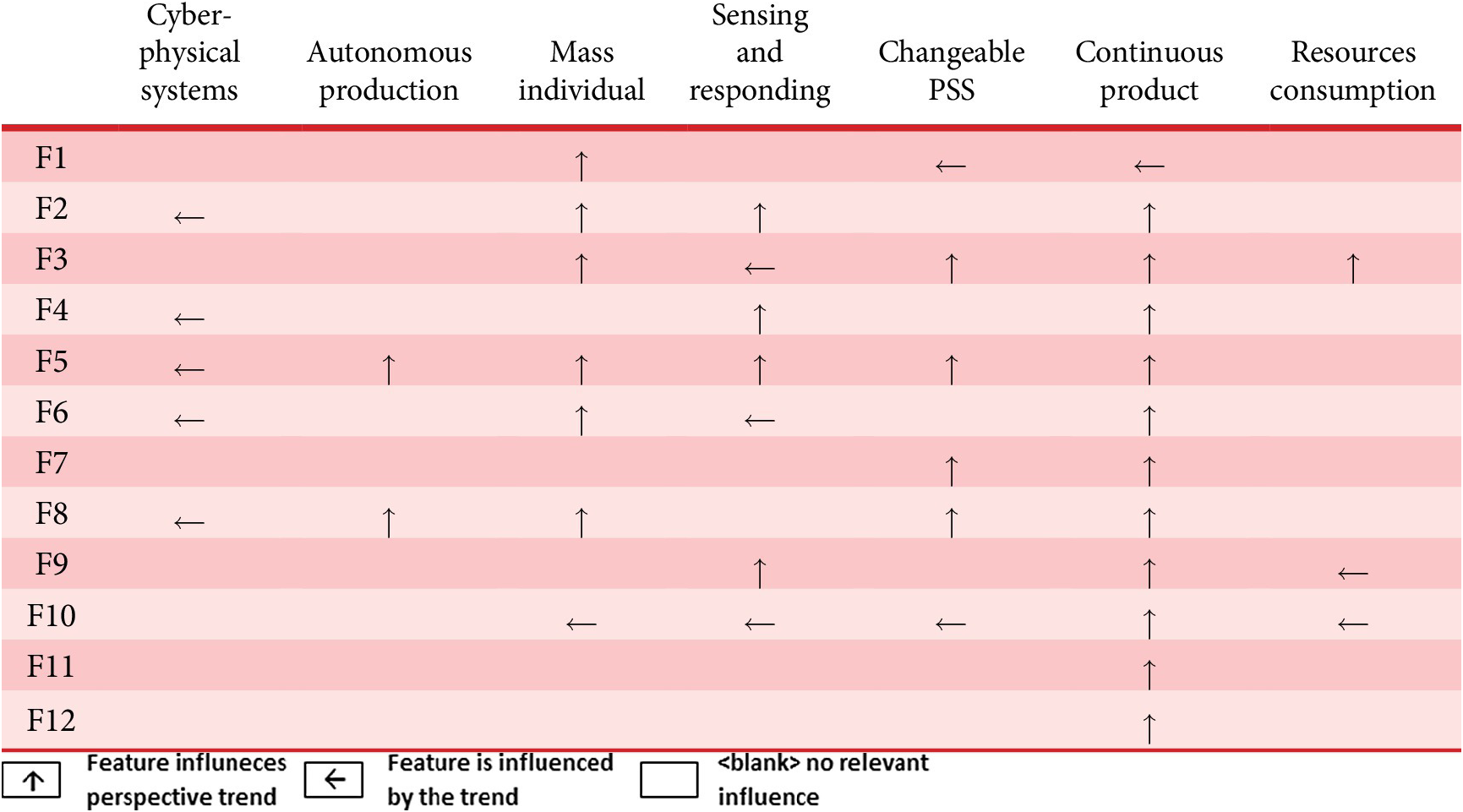
The cross impact among the perspective affected by the IR as presented in Figure 1 shows that no single perspective can be analyzed individually. In this sense, the identified features can both influence (↑) and be influenced by (←) the general context’s trends (Table 2):
-
1. Cyber physical systems are not only transforming the shop-floor; its use in the most diverse applications is a supporting/triggering factor to many features that need exchanging data through secure communication channels (Lee & Lee Reference Lee and Lee2015; Monostori et al. Reference Monostori, Kádár, Bauernhansl, Kondoh, Kumara, Reinhart, Sauer, Schuh, Sihn and Ueda2016; Dawid et al. Reference Dawid, Decker, Hermann, Jahnke, Klat, König and Stummer2017).
-
2. Autonomous production means that the machines can collaborate and solve production problems without human intervention (Porter & Heppelmann Reference Porter and Heppelmann2014; Park et al. Reference Hyun Park, Seon Shin, Hyun Park and Lee2017). The integration through the supply chain and the resulting better data accuracy and traceability is a powerful support to that (Eigner et al. Reference Eigner, Dickopf, Apostolov, Schaefer, Faißt, Keßler, Fukuda, Bernard, Gurumoorthy and Bouras2014; Gerhard Reference Gerhard2017).
-
3. Mass individualization becomes possible if the customer is placed at the centre of the design process (Luchs, Swan & Creusen Reference Luchs, Swan and Creusen2016), so the designed building blocks support the expected configuration possibilities. Also, in use feedback support the product’s adaptation to the user using profile (Rodríguez-Mazahua et al. Reference Rodríguez-Mazahua, Rodríguez-Enríquez, Sánchez-Cervantes, Cervantes, García-Alcaraz and Alor-Hernández2016; Dawid et al. Reference Dawid, Decker, Hermann, Jahnke, Klat, König and Stummer2017). In this way, mass individualization can fulfil the diverse customers quality expectations.
-
4. Marketing trend of sensing and responding requires that diverse stakeholders are taking into consideration and that the products give in use feedback (Broy, Cengarle & Geisberger Reference Broy, Cengarle and Geisberger2012; Luchs, Swan & Creusen Reference Luchs, Swan and Creusen2016); in this way the right emotional interaction can be developed towards users with diverse expectations (Dawid et al. Reference Dawid, Decker, Hermann, Jahnke, Klat, König and Stummer2017).
-
5. Changeable products and product service systems (PSS), and which can deliver the expected quality, should be designed accordingly (Mehrsai et al. Reference Mehrsai, Henriksen, Røstad, Hribernik and Thoben2014). While their flexibility can support higher configurability, they can benefit from models and systems that integrate the data and make easier the reusing and the dealing with variants in the case of changes (Xue et al. Reference Xue, Hua, Mehrad and Gu2012).
-
6. Product development should be supported by a whole set of new design principles to support a quicker response to the market’s need, through continuous product development (MacDougall Reference MacDougall2014; Porter & Heppelmann Reference Porter and Heppelmann2014). At some extent, all the identified features have impact in the PDDP and contribute to continuous product development. Each specific feature is further described in Section 4.
-
7. There is a consensus on the direction of reducing the consumption of resources; changeable products and PSS brings the possibility of updating and upgrading only parts or modules, instead of changing the whole product and having unnecessary wasting (van Rhijn & Bosch Reference van Rhijn, Bosch and Grösser2017).
Features and 4th IR trends.

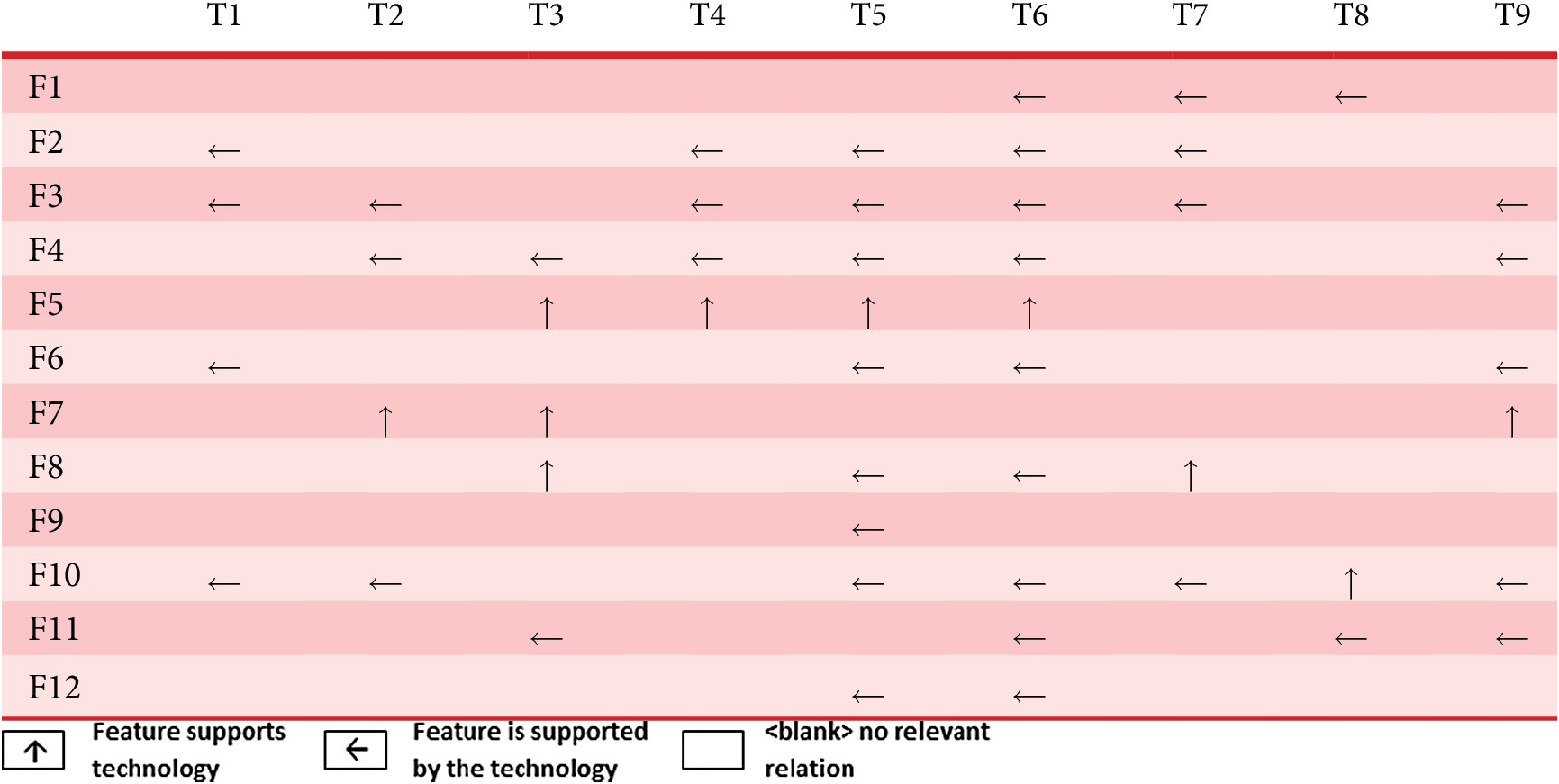
Besides the 4th IR trends, the features were also checked against the 4th IR nine core technologies according to the Boston Consulting Group (Rüßmann et al. Reference Rüßmann, Lorenz, Gerbert, Waldner, Justus, Engel and Harnisch2015). Table 3 presents which features can both influence (↑) and be influenced by (←) the technologies:
-
T1. Autonomy: autonomous, flexible and cooperative systems.
-
T2. Simulation: leverage real-time data to mirror the physical world in a virtual model.
-
T3. Horizontal and vertical system integration: companies, departments, functions and capabilities use universal data-integration networks to enable truly automated value chains.
-
T4. Internet of Things (IoT): field devices and even unfinished products can use IoT to communicate and interact both with one another and with centralized controllers as necessary. It also decentralizes analytics and decision making, enabling real-time responses.
-
T5. Cybersecurity: the need to protect critical systems from cybersecurity threats.
-
T6. The cloud: the cloud can be used for increased data sharing and for offering data-driven services.
-
T7. Additive manufacturing: produce small batches (or individual) customized products, reduce/eliminate transport distances and lower raw material consumption.
-
T8. Augmented reality: provide workers and users real-time information for improving decision making and learning/training.
-
T9. Big data and related analytics: the collection and comprehensive evaluation of data from many different sources.
Features and 4th IR core technologies.

4. Smart design engineering features
A description of the identified features is then proposed, after analyzing their relation to the 4th IR’s environment and technologies.
4.1. Design for empowered users/customers
Customer empowerment can happen either during the final product configuration definition or during the production process (Pessoa & Jauregui-Becker Reference Pessoa and Jauregui-Becker2020). The former requires the designing of building blocks instead of finalized products and the latter means exploring the possibility that the customers produce themselves the final products.
The design of building blocks, which can be a mix of physical, software and service components require a deep understanding of the problem space in which solutions will be configured. In this sense the design of product configurators, which allow the selection of the desired product options, also plays an important role, since it should be easy to use by the target users. Companies like TylkoFootnote 1 have business models completely based on that. Meta products (Rubino et al. Reference Rubino, Hazenberg and Huisman2012) consisting of physical and web elements also can deliver this empowerment. While this feature can benefit from changeable products and continuous product development, it supports mass individualization. In terms of technologies, it requires the cloud and can be boosted by configurators that use augmented reality, Philips professional monitors is one example of that.Footnote 2
Empowering the user and make them capable of product production themselves requires both the cloud and additive manufacturing. By using 3D printers or Distributed Manufacturing Systems (DMS) (Srai et al. Reference Srai, Kumar, Graham, Phillips, Tooze, Ford, Beecher, Raj, Gregory, Tiwari, Ravi, Neely, Shankar, Charnley and Tiwari2016), the customer can own the manufacturing process. This empowerment though requires customer informing and educating, the availability of user-friendly process and/or tools, and a flexible and viable producing capacity.
4.2. Design for product in use feedback
The functions for in use product feedback must be defined since the beginning of the design process (Pessoa & Jauregui-Becker Reference Pessoa and Jauregui-Becker2020). These functions relate to knowing the product’s actual performance and condition, which might give insight for updating or upgrading the product/service to continuously better serve each individual user and for determining a tailored maintenance strategy (Dawid et al. Reference Dawid, Decker, Hermann, Jahnke, Klat, König and Stummer2017). Another application is for better verification and validation, which is the case of living labs (Mulder et al. Reference Mulder, Van Doorn and Stappers2015).
Sensing and communicating capabilities should not be something added on, but the solution should be already designed with integrated sensors (Lehmhus et al. Reference Lehmhus, Aumund-Kopp, Petzoldt, Godlinski, Haberkorn, Zöllmer and Busse2016). This feature is boosted by products with higher autonomy, which can give more insightful feedback, and require the cloud and IoT availability. Additive manufacturing allows components being printed with embedded sensors. While use information exchange is performed without user awareness, it requires user consent and data privacy guarantee (cybersecurity). The development team must therefore be aware and concerned about ethical, privacy and user data confidentiality issues.
4.3. Design for changeability
Changeable products are those which its modules have built-in robustness against small use variations, adaptability to different use experiences and new technologies, and flexibility to updating and upgrading (Richter et al. Reference Richter, Sadek and Steven2010; Xue et al. Reference Xue, Hua, Mehrad and Gu2012). In this sense, the designers need understanding what might drive future changes in the product, and then deciding on changeable solution architectures. It requires educating the designers about options design and on (i) defining which options to include in the product; (ii) deciding whether and when exercising the options; (iii) managing the added variants. Once the modularization strategy can segregate the more likely changes into specific modules and thus allowing the maintaining of the remaining system, it might also contribute to reducing resources consumption (Pessôa & Becker Reference Pessôa and Becker2017).
While changeable products can facilitate mass individualization, they can also benefit from sensing and responding capabilities, which might lead to better robustness gains changes. Several 4th IR technologies can increase changeability. On the one hand, designers can make use autonomy, IoT and the cloud support more adaptable and robust solution. On the other hand, big data and analytics and additive manufacturing allow identifying the options to offer and the quick production of replacing/upgrading parts, respectively. Regardless the case, the concerns with cybersecurity are also present.
4.4. Design for data analytics
Design can take benefit from the sheer amount of available data: (i) physical and virtual product (i.e., digital twins) data; (ii) external data, including information made available for free on the Internet, and which can be accessed using search engines, recommender systems and e-commerce; and (iii) enterprise data from customer relationship management systems and other platforms (Porter & Heppelmann Reference Porter and Heppelmann2014; Dawid et al. Reference Dawid, Decker, Hermann, Jahnke, Klat, König and Stummer2017). The cloud, IoT enabled cyber physical systems, simulation, and horizontal and vertical systems integration are some technologies that support accessing the necessary and available data.
It is necessary to design the functions for this big data analysis and include all the necessary cyber security measures. Defining the data provision project becomes central to the design process, also including the opportunity of getting additional information in form a digital twin (Abramovici et al. Reference Abramovici, Göbel and Savarino2016; Thoben & Lewandowski Reference Thoben and Lewandowski2016). This brings the need of a design team educated on data modelling and data analytics, including artificial intelligence approaches.
4.5. Design for cyber security
The 4th IR use of cyber physical systems and the central role of data, vertical and horizontal data integration and exchange, and data analytics bring the cyber world challenges, such as viruses and hackers, to the physical world. The design engineering should, therefore, guarantee data security, by ensuring safety, security, privacy and knowledge protection (Reiner Reference Reiner2014).It means security must be embedded as a first principle in product design and across the value chain (Borgia Reference Borgia2014; Porter & Heppelmann Reference Porter and Heppelmann2015). It requires that the design team has members educated on IT related topics, which understand the advantages and vulnerabilities (cyber threats) of adding software and IoT to the designed solutions, and the possible countermeasures to be designed-in (Pessoa & Jauregui-Becker Reference Pessoa and Jauregui-Becker2020). At the extent of data exchange is used, systems designed for cyber security can better perform functions related to sensing and responding, autonomy and configuration to individual needs.
4.6. Design for (emotional) interaction
When first describing this feature, Pessoa & Becker (Reference Pessoa and Jauregui-Becker2020) included two points:
-
1. By adding communication capabilities, smart products might interface and collaborate with other smart products in an environment and exploit synergies; and
-
2. By bridging the interface gap between the technology and the user, the product could be designed not only to providing functionality, but to trigger the right emotional response and create emotional bounds between user and product, which is potentially stronger the more interactive, adaptive and “intelligent” the device is.
Regardless the case, cybersecurity is a critical concern, particularly in terms of preventing interfering with the data characteristicsFootnote 3: accuracy and precision; legitimacy and validity; reliability and consistency; timeliness and relevance; completeness and comprehensiveness; availability and accessibility; and granularity and uniqueness.
For designing the right interaction, the design team should master not only the technical sciences, but also the social sciences. Ethics and privacy aspects and regulations should also be taken into consideration. New failure modes could arise from this interaction and must be analyzed during the design. Especial attention should be given to machine learning, where products can learn from specific usage patterns and deliver better use experience while avoid undesired user feedback, regardless the situation that arises (Pessoa & Jauregui-Becker Reference Pessoa and Jauregui-Becker2020).
Design for smart collaboration
It requires that smart products are designed to autonomously become aware of the other smart products the co-exist in the vicinity and set collaboration protocols. In this case, common language that establishes standards for interacting is needed (Dawid et al. Reference Dawid, Decker, Hermann, Jahnke, Klat, König and Stummer2017).
Design for emotional interaction
Creating emotional interaction imply new engineering strategies, which calls for participatory analysis and design of systems and services that are: (i) manageable, tailorable, trustworthy, fault tolerant, accountable; (ii) capable of learning from user’s behavior; (iii) self-determined usable and controllable by the users; and (iv) compatible with non-networked systems and services (as well as dropouts) (Broy et al. Reference Broy, Cengarle and Geisberger2012).
4.7. Continuous engineering supported by MBSE
Continuous engineering builds on simultaneously considering all engineering disciplines and on the foundation of systems engineering practices by persistently applying engineering tools, methods, and techniques to address change and close gaps between design models and requirements (Iordache Reference Iordache2017). In this scenario, MBSE supports new product design processes that integrate design methods in which the designers, hindering mutual understanding in communication through documented interactions and interfaces between the various disciplines, along with operational issues such as privacy (Hehenberger et al. Reference Hehenberger, Vogel-Heuser, Bradley, Eynard, Tomiyama and Achiche2016). Tools that support MBSE modelling languages such as the Systems Modelling Language (SysML) allow the traceability and simulation (verification) of system’s models. The integration with other tools like PLM systems facilitated the creation of digital twins.Footnote 4
4.8. System lifecycle management
System lifecycle Management (SysLM) concept extends the notion form PLM to all disciplines involved in an engineering solution through its complete lifecycle. Being a concept rather than a tool, SysLM require the vertical and horizontal integration/information exchange among the tools used by the diverse engineering disciplines (Eigner et al. Reference Eigner, Dickopf, Apostolov, Schaefer, Faißt, Keßler, Fukuda, Bernard, Gurumoorthy and Bouras2014). The integrated tools solution should be dynamically adaptable reflecting the ongoing changes of data models (including hardware, software and services perspectives) and capable of determining the cross-impact of changes among these perspectives (Morris et al. Reference Morris, Setchi and Prickett2016; Gerhard Reference Gerhard2017). PLM and CAD/CAM tools, which must ensure that information from different domains and lifecycle phases is logically and dynamically linked according to both technical and business relations (i.e., artificial intelligence in PLM). Consequently, SysLM integrated data supports better autonomous production, and guarantees the performance from the possible variations of individualized and/or changeable products (Pessoa & Jauregui-Becker Reference Pessoa and Jauregui-Becker2020).
4.9. Increased stakeholder quantity and complexity
Product’s and PSS’ smartness features, such as autonomy, human-like interaction, ability to cooperate, reactivity, adaptability, or multi-functionality may play a role, requires reshaping the product concept with all participating and involved processes, and taking into account the lifecycle view (Eigner et al. Reference Eigner, Schäfer, Apostolov, Abramovic and Stark2013; Dawid et al. Reference Dawid, Decker, Hermann, Jahnke, Klat, König and Stummer2017).
The complete lifecycle must be considered while designing and developing smart products and PSS. This requires collaboration with several stakeholders, such as the ones that can give insight on market, technology, legal, sociological, psychological (emotional interaction) and environmental aspects. These stakeholders must be identified, and scenarios created in order to estimate how their needs might evolve through the time. It allows the development of flexible, resilient, lasting, and sustainable solution (Pessoa & Jauregui-Becker Reference Pessoa and Jauregui-Becker2020).
4.10. Changes in quality perception
Quality perception is becoming rather dependent of personalized goals and experiences than on features generally accepted by the target market. Unique design, safety, quick availability and personalized services are gaining higher importance, once intelligent manufacturing, robotization, and 3D printing are commoditizing manufacturing quality (Hyun Park et al. Reference Hyun Park, Seon Shin, Hyun Park and Lee2017). Human centered design and design for well-being are candidates for involving the human perspective in all steps of the problem-solving process and thus addressing the core needs of those who experience the problem.
Personalized solutions offered might require individualized approaches for lifecycle-long quality control and assurance, thus expanding quality modelling and engineering standards with: (i) models for quality in use, quality of service, compliance, technical and organizational models and methods for quality assurance; (ii) elicitation and negotiation of acceptance requirements and corresponding system concepts (e.g., governance and fairness) (Broy et al. Reference Broy, Cengarle and Geisberger2012).
Another aspect to be taken into account is the concern about privacy and data security (Borgia Reference Borgia2014; Porter & Heppelmann Reference Porter and Heppelmann2015). In a broader scope, introducing the concept of smart products throughout the manufacturing value chain, and (Hyun Park et al. Reference Hyun Park, Seon Shin, Hyun Park and Lee2017) getting the related benefits, will improve the product quality by integrating intelligent specifications and just-in-time information handling throughout the value chain (Duffy et al. Reference Duffy, Whitfield, Ion and Vuletic2016). Finally, sampling inspection, which has been widely used in the past, is being steadily replaced by total inspection.
4.11. Workers as knowledge finders and processing experts
Design engineers are knowledge workers and their job mainly involve handling and using information. The fast pace of knowledge creation, which is more and more readily available and easy to access is changing the design engineers’ skillset. Instead of knowledge accumulators, they must be good at knowledge finding, selecting, combining and using (Rozkwitalska & Slavik Reference Rozkwitalska and Slavik2017). Creative design techniques such as TRIZ and axiomatic design can play an important role, since they provide approaches for better using the available knowledge to define new solutions (Cavallucci & Eltzer Reference Cavallucci and Eltzer2011).
Horizontal and vertical systems integration, the cloud, and big data and related analytics are also technologies that allow reaching and combining the data available. In this context, augmented reality can be used to provide the resulting information in a just-in-time fashion (Ras et al. Reference Ras, Wild, Stahl and Baudet2017; Caldarola et al. Reference Caldarola, Modoni and Sacco2018).
4.12. Open and social low-cost innovation
Open innovation is considered a fundamental concept from Industry 4.0. (Lasi et al. Reference Lasi, Fettke, Kemper, Feld and Hoffmann2014) In this way, the design processes should take advantage from the knowledgeable and creative individuals outside the company, which can also contribute to achieving strategic goals and reducing innovation costs, and that sharing intellectual property both ways is useful for different parties in different ways. Together with crowdsourcing, cloud-based design and manufacture, and mass collaboration, open Innovation compose what is called Social Product Development, which enable innovation through collaborating communities (Bertoni et al. Reference Bertoni, Larsson, Ericson, Chirumalla, Larsson, Isaksson and Randall2012; Forbes & Schaefer Reference Forbes and Schaefer2017). Social Product Development relies on the cloud and requires secure information channels.
5. Discussion on the features
When designing a development process, the three key dimensions are the choice of methods and procedures, the required knowledge and skills from the people that will perform the process, and the availability of the right infrastructure and tools for supporting the process execution (SEI 2010). The before mentioned features were therefore analyzed according their specific impact on the procedures, people and tools (Table 4).
Features impact on the PDD process, people and tools.
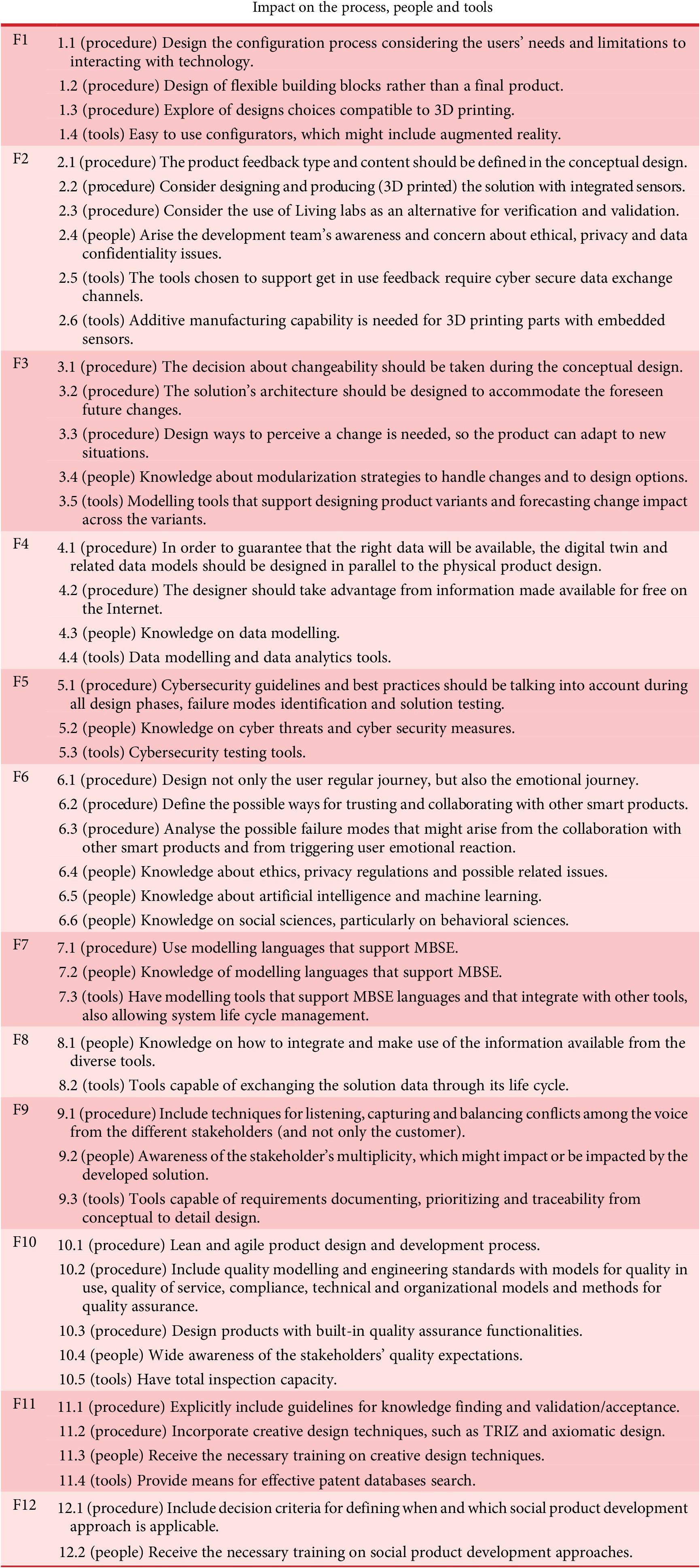
Figure 5 shows how the smart design engineering features impact the can leverage the product design and development to exploiting the benefits from the 4th IR. Therefore, process improvement projects could use it as guidelines.
6. Summary and conclusion
Leveraging the PDDP to better exploiting the 4th IR benefits calls for evolutions in design engineering. In this context, smart design engineering was here defined as a methodology used during the analysis and design of a product or a system, which can be composed by hardware, software and/or services (therefore not limited to designing smart products), and that explicitly considers exploiting the technologies and opportunities from the 4th IR.
A set of smart design engineering features was identified based on the literature and on the feedback from 25 researchers/practitioners. Further analysis was conducted to understand the relation among the features, the 4th IR’s core technologies and the several business and market changes resulting from the 4th IR. This analysis led to a set composed by 12 features, which impact on the PDDP’ key dimensions (procedures, people and tools) was identified. Assuming a generic PDDP and covering the solution’s complete life cycle, the identified features’ impact was mapped to the PDDP’s phases. Therefore, this work’s objective was achieved.
This work contributes to both design theory and practice: (i) it deepens the understanding about the necessary smart design engineering features and show these features impact on the design and development process’s (PDDP) key dimensions (procedures, people and tools); (ii) it maps the features’ impact on PDDP’s phases, thus providing practical direction for process improvement, which lead to better benefiting from the 4th IR opportunities.
Despite its contributions, this study has some limitations, particularly because the topic is recent and still under development. Although the features identification was based on the literature and expert opinion, no reference was found, which showed the combined use of all or even most of the features. Future research on applying the combined features and documenting the resulting PDDP actual benefits and challenges is still needed. Further research opportunities also include the need of further education and new tools and techniques that tackle the features impact in each PDDP phase.


 Open access

