


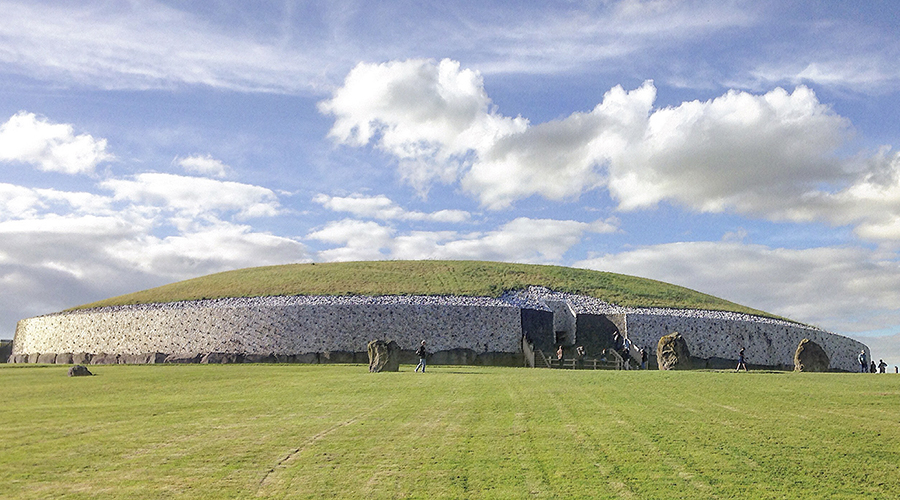


Introduction: Newgrange and its king
Neolithic Ireland is widely recognised for the extent and scale of its megalithic monuments, in particular passage tombs with their eponymous, orthostatic passage that connects to a terminal chamber covered by a circular mound, often with an enclosing kerb. Large and imposing passage tombs have garnered attention since early antiquarian incursions. Among these, the ‘mega’ passage tombs of Newgrange, Knowth and Dowth at Brú na Bóinne in eastern Ireland enjoy the highest international profile, reflected by their 1993 inscription on the UNESCO World Heritage List (UNESCO Reference Wilde2024).
While Newgrange was long considered to be a Bronze Age monument (e.g. Ó Ríordáin & Daniel Reference Ó Ríordáin and Daniel1964), radiocarbon dates from excavations in the 1960s demonstrated its construction and primary use in the later Neolithic, c. 3200–3000 cal BC (O’Kelly Reference O’Kelly1982; Lynch et al. Reference Lynch2014). Interpretation of its function has been more enduring; since rediscovery in 1699, the monument has principally been viewed as either a temple or a sepulchre for a person or persons of high social standing (e.g. Molyneux Reference Molyneux1726: 204; Wilde Reference Wylie1849: 187; Ó Ríordáin & Daniel Reference Ó Ríordáin and Daniel1964: 147, 153). Thus, it is not surprising that a ‘king’ and ‘dynastic elite’ have recently surfaced for Newgrange, represented by an unburnt petrous portion of a temporal bone recovered from inside the tomb chamber and analysed for ancient DNA (aDNA) (Cassidy et al. Reference Cassidy2020). Dated to 3340–3020 cal BC, this bone sample (NG10) came from an adult male who was the offspring of a first-order incestuous union, either between full siblings or parent and child. The bone seems to have come from the right-hand-side recess (O’Kelly Reference O’Kelly1982: 106), an area asserted to be a particularly “prestigious burial place” (Cassidy Reference Cassidy2020: 40). Analysis of aDNA from this and other individuals from passage tomb contexts also found that many were part of a shared genetic cluster; on this basis a dynastic elite was suggested for later Neolithic Ireland (Cassidy et al. Reference Cassidy2020: 384–85; Cassidy Reference Cassidy2020: 40; Reference Cassidy, Whittle, Pollard and Greaney2023), while press reports (from several UK and US newspapers, from June 2020 onwards; contact authors for details) hailed NG10 as a ‘god-king’. Here, we cast serious doubt on this interpretation. At each step, from the archaeological context of sample NG10 to the use of ethnographic analogy concerning incest and the contextualisation of the aDNA evidence within the Irish Neolithic, we reveal uncertainty, ambiguity and misunderstandings. We conclude by exploring the current archaeological evidence for late-fourth-millennium BC society in Ireland and suggest how this individual and their final journey can be investigated further. In this, we recognise the enormous potential and contribution of aDNA for our understanding of Neolithic societies, but stress that rigorous science must also rely on rigorously interpreted archaeological evidence to provide valid narratives of the past (e.g. Carlin et al. Reference Carlin2025).
Deconstructing the narrative
The taphonomy of NG10
While the rediscovery of Newgrange in 1699 and the modern excavations conducted in the 1960s are well known, few people are aware that the interior of Newgrange was visited by approximately 30 antiquarians during the eighteenth and nineteenth centuries, their activities ranged from low-impact survey work to digging through the rear recess in search of treasure (see online supplementary material (OSM)). This consistent disturbance has far-reaching implications for interpreting the presence of sample NG10. Initially described as disarticulated cranial remains (Cassidy et al. Reference Cassidy2020: 385), NG10 has more recently been described as “a man interred in the right-hand-side recess of Newgrange” (Cassidy Reference Cassidy, Whittle, Pollard and Greaney2023: 161), tacitly suggesting an original, intact burial. The idea that the Newgrange chamber originally contained articulated burials (O’Kelly Reference O’Kelly1982: 27) relies upon accounts of the rediscovery of the tomb given to antiquarian Thomas Molyneux, to whom two articulated skeletons (“a husband and his wife”) were reported (Molyneux Reference Molyneux1726: 204; see OSM). This seemed to be borne out by the human bone and dental reports compiled after O’Kelly’s excavations (Fraher Reference Fraher1982: 198, 200; O’Sullivan Reference O’Sullivan1982), which provide a minimum number of individuals (MNI) of two for the unburnt remains. O’Kelly (Reference O’Kelly1982: 107 [emphasis added]) thus suggested that these remains “may have been derived from a pair of skeletons”. However, Molyneux is alone among early visitors to Newgrange in describing articulated human remains, and the veracity of his supposed ‘eye witness’ account has been challenged (see OSM).
But is, at least, the claimed association of NG10 with the ‘auspicious’ right-hand-side recess of Newgrange secure? Five new radiocarbon measurements on animal bone from the chamber range from 3300–2700 cal BC (Smyth et al. Reference Smyth, Geber, Carlin, O’Sullivan, Griffiths, Cummings, Hofmann, Iversen and Bjørnevad-Ahlqvist2025), indicating that the tomb interior was not disturbed between being sealed off by cairn collapse before approximately 2500 BC and antiquarian activity in 1699 (confirming O’Kelly Reference O’Kelly1982: 105, 192). However, there is no certainty regarding the original position of NG10, as the “old soil surface” within the chamber was “much disturbed by animal burrows” (O’Kelly Reference O’Kelly1982: 105). The looser brown earth above this surface contained small broken stones, burnt and unburnt bone and 18 concentrations (or ‘lots’) of commingled human and animal bone (Figure 1). Lot 10 included the human left petrous portion, labelled 10D during excavation and as NG10 during aDNA analysis (Cassidy et al. Reference Cassidy2020: S1, 19–20). Overall, the human remains from this looser brown earth layer represented at least five individuals—unburnt bones from at least two adults and burnt remains from three or more skeletons—and discussion of their precise context is contradictory. Most of the bone lots were adjacent either to the right or left recess and thus “associated with these recesses” (O’Kelly Reference O’Kelly1982: 106–107), but bone fragments had also been widely scattered and intermingled, by both human and animal activity (O’Kelly Reference O’Kelly1982: 104, 107; see OSM). The context of excavation within Newgrange therefore cannot be assumed to be the context of deposition, and there is no evidence that fully articulated bodies were interred; indeed, it is extremely unlikely given prevailing Irish Neolithic mortuary practices.
Location of burnt and unburnt bone lots (1–11 & 13–19) recovered from the Newgrange chamber (after O’Kelly Reference O’Kelly1982: fig. 21).

A substantial amount of modern osteological (re)analysis and archaeological (re)interpretation of Irish megalithic tombs now indicates that multistage activities (excarnation, dismemberment, disarticulation and cremation) were conducted at many locations (e.g. Beckett Reference Beckett2011; Kador et al. Reference Kador, Cassidy, Geber, Hensey, Meehan and Moore2018; Cooney Reference Cooney2023). Whole and fragmented bones of some individuals were eventually deposited within and around tombs. Articulated bodies have been recorded in (or inferred from) only a few instances—for example, at Parknabinnia court tomb and perhaps Poulnabrone portal tomb, as well as the cave burials at Annagh (Figure 2)—and within a few Linkardstown-type tombs (e.g. Beckett Reference Beckett2011; Ó Floinn Reference Ó Floinn, Cahill and Sikora2011). Passage tombs, with their generally large and commingled burial deposits, have seen much recent work (e.g. O’Sullivan Reference O’Sullivan2005; Eogan & Cleary Reference Eogan and Cleary2017; Geber et al. Reference Geber, Hensey, Meehan, Moore and Kador2017; Smyth et al. Reference Smyth, Geber, Carlin, O’Sullivan, Griffiths, Cummings, Hofmann, Iversen and Bjørnevad-Ahlqvist2025) and clear patterns are emerging. Cremation—a key feature of the Irish Neolithic—was the dominant mortuary practice but cremated deposits occur alongside the unburnt disarticulated bones of adults and children, particularly skulls and long bones, and programmes of radiocarbon dating show that deposits were added to over time. Crucially, no articulated human remains have yet been reported from passage tomb contexts. Indeed, the frequency of fragmentation and rearrangement of human remains in passage tombs suggests that maintaining and remembering specific individuals after death was not socially valued within this particular context (Figure 3). The claim that “given the nature of the interment, his [NG10] parentage was very likely to have been socially sanctioned” (Cassidy et al. Reference Cassidy2020: 385) is thus an interpretative leap. We cannot assume that the ‘final’ resting place of fragment NG10 was decided by anyone aware of the biological parentage or personal identity of the deceased. But could it at least be argued that individuals buried in passage tombs formed a coherent (high-status) social stratum?
Map of Ireland with sites mentioned in the text.

Typical fragmented human skeletal assemblages from Irish passage tombs: A) cremated and unburnt human bone from the eastern chamber at Knowth, top image showing bone in situ; B) unburnt human bone from Newgrange; C) unburnt skulls and cremated bone spilling from tomb interior through gap in orthostats, Mound of the Hostages, Tara (figure by authors; A: Eogan & Cleary Reference Eogan and Cleary2017, pls. 2.28b, 4.1 & 4.2; B: O’Kelly Reference O’Kelly1982, pl. 83; C: O’Sullivan Reference O’Sullivan2005, fig. 71).

Newgrange as princely tomb
The interpretation of NG10 as an elite ruler is tightly tied to the bone’s ‘auspicious’ provenance (Cassidy et al. Reference Cassidy2020: 385). This quality of ‘auspiciousness’ appears to rest on the view that passage tombs were scenes of selective deposition based on contemporary socioeconomic categories of status—that is, by so-called elites. Yet access to or deposition within monumental tombs need not imply a dynastic hierarchy.
Two points can be made here. First, several tomb types were built and/or used concurrently in Neolithic Ireland. Deposition at the Poulnabrone portal tomb, County Clare, stretches from 3880–3700 cal BC to the mid-second millennium BC (Lynch Reference Lynch2014; Cassidy et al. Reference Cassidy2020: supp. inf. 1), overlapping with Linkardstown-type mounds and early passage tombs, among others (Cooney et al. Reference Cooney, Whittle, Healy and Bayliss2011; Schulting et al. Reference Schulting, McClatchie, Sheridan, McLaughlin, Barratt and Whitehouse2017). While the construction and primary use of developed passage tombs are now well-established at c. 3300–3000 cal BC (e.g. Schulting et al. Reference Schulting, McClatchie, Sheridan, McLaughlin, Barratt and Whitehouse2017), we cannot confidently pronounce on selection criteria for inclusion into any category of tomb without substantially larger samples from other tomb types. Second, the exceptionally large and technically accomplished passage tombs at Newgrange, Knowth and Dowth appear late in the sequence (e.g. Sheridan Reference Sheridan1986). Their size and architectural complexity, which required high labour inputs, have been read as proxies for political hierarchy, with an implicit expectation of neat evolutionary sequences from simple/egalitarian to complex/hierarchical. The assumption is that only a stratified society could marshal this labour (e.g. Renfrew Reference Renfrew and Renfrew1973). Yet, simple labour estimates for monument construction are not informative without chronological constraints (Adams Reference Adams, Müller, Hinz and Wunderlich2019) and may frequently be overestimated (e.g. Haack Reference Haack2016). The potential impact of cattle traction, deployed by at least the mid-fourth millennium BC in Ireland (Pigière & Smyth Reference Pigière and Smyth2023), must also be considered.
While passage tombs have occasionally been likened to architecture such as the Egyptian pyramids (e.g. Wilde Reference Wylie1849: 179; Cassidy et al. Reference Cassidy2020: 385), these were not static, single-phase monuments built to a centralised design, despite their commonalities (e.g. Robin Reference Robin2010). Instead, these monuments emerged through repeated, habitual actions that selectively reproduced aspects of other passage tombs (e.g. Jones Reference Jones2012: 44–54). Late-twentieth-century excavations at Newgrange and Knowth have demonstrated that these sites were constructed in multiple episodes, over many generations, with sporadic peaks of high input (e.g. Eogan & Cleary Reference Eogan and Cleary2017; Figure 4). Any social structures or organisation required may hence have been transient or conditional and need not have extended beyond the sphere of the monument or specific episodes of its construction or use (Thomas 1996: 178–82).
Newgrange before, during and after excavation (top: April 1950 © Photographic Archive, National Monuments Service, Government of Ireland; middle: March 1968, Howard Goldbaum (voicesfromthedawn.com); bottom: Tjp Finn, CC BY-SA 4.0).

The chambers within tombs such as Newgrange have been interpreted as spaces of controlled access, aiding a privileged few to maintain their position through possession of restricted knowledge, for instance about solar alignments (e.g. Kirk Reference Kirk and Tilley1993). Whether or how restrictions of this sort were enacted is unknowable. Doubtless there were specialist roles and different abilities during activities at the monument, but we should not assume a static division between active ‘elites’ and passive onlookers. Instead, power relations may well have been under constant negotiation (Brück Reference Brück2001: 651). The architecture and construction of passage tombs such as Newgrange need not necessitate a stable elite, let alone a dynastic one based on biological relatedness. That these linkages are so forcefully and consistently made rather rests on a very selective use of ethnographic analogies.
Linking big mounds and incest with an elite social stratum
Archaeologists have only recently engaged in detail with just who was selected for deposition in megalithic monuments (e.g. Cummings & Fowler Reference Cummings and Fowler2023; Elliott et al. Reference Elliott, Saupe, Thompson, Robb and Scheib2023). Bearing in mind the caveats about the representativeness of archaeologically analysable populations (e.g. Frieman Reference Frieman2023: 59–60), there is a consensus that some process of selection took place. However, this does not seem to align with sex, age or physical ability. The proportion of the living community represented in megalithic monuments remains unresolved (e.g. Quinn Reference Quinn2015; Smyth et al. Reference Smyth, Geber, Carlin, O’Sullivan, Griffiths, Cummings, Hofmann, Iversen and Bjørnevad-Ahlqvist2025).
Regardless, the identification of ‘special’ treatment for some people is often automatically equated with ‘high status’. This is a product of long-standing evolutionary thought within archaeology, which attempts to identify material correlates for inequality, cast as dominance created through controlled access to resources (e.g. Kohler & Smith Reference Kohler and Smith2018; for a critique see Politopoulos et al. Reference Politopoulos, Frieman, Flexner and Borck2024). Underlying this is a notion of successive social ‘types’ (after Service Reference Service1962); a ‘complex chiefdom’ would thus be characterised by the redistribution of surplus, increasing population, territoriality, associations between the ‘chief’s’ body and exotic or prestige goods, and elite residences as part of a hierarchical settlement system (e.g. Renfrew Reference Renfrew and Renfrew1973: 543).
In recent years, some archaeologists have questioned this evolutionary model, if such stereotypical ‘chiefdoms’ even existed in any place or time (e.g. Pauketat Reference Pauketat2007), as well as the understanding of ‘high status’ as necessarily implying power over others based on control over surplus (e.g. Lund et al. Reference Lund, Furholt and Austvoll2022). In addition, numerous ethnographic and archaeological studies show that monumental construction is compatible with various forms of social structure and not unique to hierarchical societies, let alone stable and hereditary ones (e.g. Bedford Reference Bedford, Leclerc and Flexner2019; Riris Reference Riris2020; Sanger Reference Sanger2022). Crumley’s (Reference Crumley, Enhrenreich, Crumley and Levy1995) concept of heterarchy recognises that power can be held in separate institutions and multiple spheres of life. Individuals, households, communities and kin groups may be involved in simultaneous vertical (hierarchical) and lateral (heterarchical) relationships. Power structures and hierarchies may emerge from the process of constructing monuments but were not required at the outset (Barrett Reference Barrett1994); even then, it is far from clear how stable such social positions were in other areas of social life, and over time (e.g. Angelbeck & Grier Reference Angelbeck and Grier2012; Borck & Clark Reference Borck, Clark, Thurston and Fernández-Götz2021). Monumentalisation and ritual could act as a sort of release valve preventing centralised power. In line with Indigenous North American practices, Sanger (Reference Sanger2022) sees the elaborate earthworks at Poverty Point (a World Heritage Site in Louisiana) as emerging from localised, temporally restricted hierarchies expressed almost entirely in the ritual sphere. Following Donev (Reference Donev2024), the so-called princely burials from the mid-first millennium BC in the central Balkans need not have been built to commemorate established elites, but to destroy wealth that would otherwise unbalance social relations among the living. Similarly, Sæbø (Reference Sæbø2024) suggests that first-millennium AD funerary mounds in south-east Norway emerged from collective action that reinforced local identities, increased social cohesion and framed resistance to the adoption of Viking religious and social norms, including fixed hierarchical relations. Which form social relations took, and how this changed over time, remains the subject of ongoing archaeological study, in Ireland and elsewhere.
The specific claim of socially sanctioned incest being an indicator of high status for NG10 is based on a very limited and out-of-date comparison with other societies where incest was limited to ruling families—for example, in Egypt, Hawai’i and other “complex chiefdoms and early states” (Cassidy et al. Reference Cassidy2020: 385)—while examples where incest was accepted in non-hierarchical societies or among non-elites are ignored (see comment by Flechner Reference Flechner2020). These are cross-cultural analogies based on problematic expectations of predictable, evolutionary ‘stages’ of social formation, rather than relational analogies where historical links and/or multiple, structurally connected similarities between source and subject have been demonstrated (see Wylie Reference Wylie2002; Pope Reference Pope, Haselgrove and Pope2007). No other incestuous unions have been identified in Neolithic Ireland or Britain (n = 166) and it seems the populations of both islands generally tried to avoid any inbreeding (Brace & Booth Reference Brace, Booth, Whittle, Pollard and Greaney2023: 140). Genetic analysis of living populations has shown that incest also occurs where it is strongly taboo or outlawed (e.g. Yengo et al. Reference Yengo, Wray and Visscher2019). In the case of NG10, the evidence of just one individual is insufficient to determine whether incest was routinely practised within a community or a sub-set thereof, whether it was deemed socially acceptable, or if it was even disclosed. Biological parentage is not universally the most important factor when identifying kin (see references in Carlin et al. Reference Carlin2025), so we cannot be certain this biological classification of ‘incest’ corresponds to a past, social classification.
The interpretation of NG10 as elite is also partially based on this individual forming part of a genetic cluster with six other individuals sampled from passage tomb contexts widely dispersed across space and time. In this cluster, individuals were consistently distantly related to the fifth or sixth degree or further, while closer biological relations were consistently absent. While acknowledging the low number of sampled individuals relative to osteological MNI (≤20%; Table 1), we argue elsewhere (Carlin et al. Reference Carlin2025) that this pattern is best interpreted not as a dynasty—a line of hereditary rulers—but as a post-3600 cal BC reconfiguring of social relations. As a single datapoint, a one-off example of incest is a shaky foundation on which to assign an elite identity, let alone reconstruct a specific social formation. For this interpretation to stand, much more contextual information is needed; yet, so far, there is little evidence of social inequality in Neolithic Ireland.
Osteologically determined MNI from passage tombs comprising the genetic haplotypic cluster identified in Cassidy et al. (Reference Cassidy2020).

The leader we deserve?
Who was NG10 and what was their world?
Evidence for hierarchy occurring in other aspects of life—such as economic strategies, patterns of mobility and territoriality or settlement organisation—is only just beginning to emerge. So, what can we say about the world NG10 inhabited, somewhere between 3340 and 3020 cal BC? A review of settlement evidence suggests that this individual probably lived in architecturally insubstantial domestic spaces that seemingly lacked the symbolism of earlier thirty-eighth- and thirty-seventh-century BC oak-post and plank buildings with foundation deposits and deliberate decommissioning (Figure 5; Smyth 2014). With very few exceptions, later Neolithic settlements did not fulfil this symbolic role (Smyth Reference Smyth, Hofmann and Smyth2013). This symbolism may instead have been increasingly imbued in megalithic monuments, some of which had reached enormous proportions and may have taken over from settlements and enclosures as sites of aggregation. In the wider landscape of the Brú na Bóinne passage tombs, surface-collection surveys and excavations indicate some activity dispersed along the river valley (Brady Reference Brady2018), but evidence for imposing residential architecture or defended sites is absent.
Examples of Middle Neolithic settlement evidence in Ireland (figure by authors).

Similarly, sites with indicators of centralised storage or redistribution are exceptionally rare (Cleary & Kelleher Reference Cleary and Kelleher2011: 166), and archaeobotanical and palaeoecological data point to a marked reduction in arable activity from 3400–2500 cal BC (e.g. McClatchie et al. Reference McClatchie, Bogaard, Colledge, Whitehouse, Schulting, Barratt and McLaughlin2016). Elsewhere (Carlin et al. Reference Carlin2025), we have argued that after 3600 cal BC, social networks shifted to a more expansive system of relatedness that spanned ever greater parts of the island. Several partially excavated Neolithic enclosures could have functioned as places of aggregation and feasting in such a context, rather than as places to store and control access to an economic surplus (e.g. Pigière et al. Reference Pigière, McCormick, Olet, Moore, O’Carroll and Smyth2022). While published strontium isotope datasets for the period are still relatively small (Kador et al. Reference Kador, Fibiger, Cooney and Fullagar2014, Reference Kador, Cassidy, Geber, Hensey, Meehan and Moore2018; Snoeck et al. Reference Snoeck2016, Reference Thomas2020), the mortuary contexts so far investigated comprise both locals and non-locals and support a scenario of routine mobility.
Similarly, there is no evidence that access to specific foods was in some way restricted. Stable carbon and nitrogen isotope values for NG10 (Cassidy et al. Reference Cassidy2020: fig. 1b) suggest a mostly terrestrial-based diet, while lipid analysis of contemporary ceramics suggests this likely included milk products (Smyth & Evershed Reference Smyth and Evershed2015). This is in line with bulk bone collagen samples from other sites, which show no clear dietary trends for Neolithic Ireland (McClatchie et al. Reference McClatchie, Schulting, McLaughlin, Colledge, Bogaard, Barratt and Whitehouse2019), contradicting the assertion that individuals in passage tombs consumed more protein (Cassidy et al. Reference Cassidy2020: 386). In terms of individual burials with lavish grave goods, the only examples that even remotely resemble this are the so-called Linkardstown-type tombs, with their characteristic grave gifts including highly decorated pottery and bone and shell objects (Cooney Reference Cooney2023). Other items, such as the Knowth macehead, are now impossible to associate to a specific individual and may not have been personal belongings.
…and does it matter?
In many ways, attempting to prove or disprove the presence of elites using complexity ‘checklists’ is a distraction. Evolutionary social models limit interpretation to an argument for increasing complexity (Graeber & Wengrow Reference Graeber and Wengrow2021), while taking shortcuts with terms such as ‘elite’ severely constrains our narratives about prehistory (Johnston Reference Johnston2021: 11). Historically, Irish megalithic monuments, and passage tombs in particular, have been considered separately from the structures and forms of social organisation and the other activities of the communities that built and used them (for exceptions, see Smyth 2014; Brady Reference Brady2018; Cooney Reference Cooney2023). This isolation from such concerns has hindered our ability to identify who, if anyone, was preferentially chosen for deposition there. Given the renown of Newgrange, there has been surprisingly little focus on the people who used the passage tomb or the traces that they left inside it, illustrated by how little attention has been given to the human remains from any of the Newgrange tombs. By reversing this trend, aDNA makes its greatest contribution.
While deposition in passage tombs was rare, and thus in some way ‘special’, this term is seldom interrogated and usually simply assumed to mean ‘high status’. This is despite widespread recognition that funerary practices are complex and primarily reflect concerns of the living population, that megalithic monuments were important community spaces in their own right, and that the interment of remains within these monuments was merely the final stage in an extended process of ceremony and circulation that may have lasted years or decades. The funerary record is a composed set of relationships, rather than a direct correlation of the living society; as archaeologists we must therefore resist mapping the individuals deposited within passage tombs directly onto roles and relations in the living world.
There is thus much to critique in the assumption that the selection of specific bodies for burial within passage tombs in Neolithic Ireland was directly related to their status or biological relatedness. At every step of the way, uncertainty reigns—from how securely NG10 can be associated with a particular recess in Newgrange to whether their identity in life was likely to be remembered, and from the choice of appropriate ethnographic comparisons to the identification of hierarchical relations in Neolithic Ireland. It is inappropriate to continue to focus so exclusively on forms of stable, individual rule, in Neolithic Ireland and elsewhere, when the evidence is insufficient to support such claims. Doing so perpetuates the myth that only important individuals (usually male) were socially active, and downplays the contribution made by collective action in the prehistoric past. As Carlin and Cooney (Reference Carlin, Cooney, Card, Edmonds and Mitchell2020) have highlighted, there is substantial evidence that social identity in the Irish (and British) Neolithic was highly fluid and relational, continually emerging through ongoing interactions with kin and non-kin and the environment. Simply put, a social model postulating rigid systems of social stratification in Neolithic Ireland is not a good fit with the evidence. Nor, we contend, is the alternative, in which societies are viewed as uniformly and unproblematically egalitarian. Neither structure is likely to capture the complex sets of relations and exchanges we see in the archaeological evidence for this period. It is perhaps fitting to end with the words of O’Kelly (Reference O’Kelly1982: 126) himself: “We have no way of knowing in what way the people who were put inside Newgrange were special; it does not necessarily follow that they were royal or priestly, they may have been special in some quite different way.”
Acknowledgements
We thank Gabriel Cooney for commenting on an earlier draft and the helpful input of two anonymous reviewers.
Funding statement
Jessica Smyth’s contribution was supported by an Irish Research Council Consolidator Laureate Award IRCLA/2017/206 ‘Passage Tomb People’; Catherine J. Frieman’s contribution was supported by an Australian Research Council Future Fellowship FT220100024 ‘Kin and connection: ancient DNA between the science and the social’.
Online supplementary material (OSM)
To view supplementary material for this article, please visit https://doi.org/10.15184/aqy.2025.63 and select the supplementary materials tab.


 Open access

