





1 Introduction
In 2008, Andrews introduced a weighted count on partitions given by counting in a partition the number of times the smallest part appears. This function, denoted by
$\operatorname {spt}(n)$
 and defined as the number of smallest parts among all the partitions of n, is known to possess an intriguing modular structure and to satisfy the Ramanujan-type congruences

among other beautiful combinatorial and arithmetic properties. The origin of these arithmetic properties is attributed to the connection between its generating function and harmonic Maass forms.
Let
$N,m,n$
 be nonnegative integers. Throughout, we use the following standard notation:

The basic hypergeometric series
${}_{r+1}\phi _r$
 is defined by

When we do not specify the base as in
$(a)_n$
 , the base is q.
By standard combinatorial arguments, the generating function of the smallest parts function (spt-function) due to Andrews is given by

Starting from this, Andrews’ identity for the spt-function, which relates the spt-function to the partition function and the second Atkin–Garvan rank moment, is obtained using Watson’s q-analogue of Whipple’s theorem (
${}_{8}\phi _{7}$
 -transformation):

The spt-function identity of Andrews [Reference Andrews3, Theorem 4] is

The first sum on the right-hand side is the generating function for
$np(n)$
 , where
$p(n)$
, where
$p(n)$
 denotes the number of partitions of n and the second is the generating function for
$\tfrac 12N_2(n)$
denotes the number of partitions of n and the second is the generating function for
$\tfrac 12N_2(n)$
 , where

is the second Atkin–Garvan rank moment. Here,
$N(m,n)$
 denotes the number of partitions of n with rank m. The rank of a partition is defined to be the largest part minus the number of parts. For instance, the rank of the partition
$5+3+3+1$
denotes the number of partitions of n with rank m. The rank of a partition is defined to be the largest part minus the number of parts. For instance, the rank of the partition
$5+3+3+1$
 is
$5-4=1$
is
$5-4=1$
 . See [Reference Atkin and Swinnerton-Dyer9, Reference Dyson11] for more on the rank and [Reference Atkin and Garvan8] for more on rank moments.
In 2015, Andrews et al. [Reference Andrews, Dixit and Yee6] obtained new partition theoretic interpretations for
$q\omega (q)$
 and
$\nu (-q)$
and
$\nu (-q)$
 , where
$\omega (q)$
, where
$\omega (q)$
 and
$\nu (q)$
and
$\nu (q)$
 are the third-order mock theta functions

among a wide range of other results. Perhaps the most striking of these are the congruences

where
$\operatorname {spt}_{\omega }(n)$
 is the total number of smallest parts in all of the partitions of n in which each odd part is less than twice the smallest part. These three divisibility properties are a consequence of a q-series identity obtained using the following limiting case of a
${}_{10}\phi _9$
is the total number of smallest parts in all of the partitions of n in which each odd part is less than twice the smallest part. These three divisibility properties are a consequence of a q-series identity obtained using the following limiting case of a
${}_{10}\phi _9$
 -transformation due to Bailey (limiting case due to Andrews [Reference Andrews2, (2.10)]):

The q-series identity due to Andrews et al. [Reference Andrews, Dixit and Yee6, Lemma 6.1] is an analogue of the Andrews spt-function identity (1.1):

In a recent paper, Andrews and Bachraoui [Reference Andrews and Bachraoui4] established new partition theoretic interpretations, showing that
$q\omega (q)$
 and
$\nu (-q)$
and
$\nu (-q)$
 are generating functions for two-colour partitions in which the even or the odd parts may occur only in one colour, without appeal to such analogues. Additionally, even more recently, a newly discovered analogue of Andrews spt-function identity by Andrews and Kumar [Reference Andrews and Kumar7, Theorem 1.3] has led them to discover a new partition theoretic interpretation of the other third-order mock theta function

which in turn relates partitions with positive odd rank and two-colour partitions [Reference Andrews and Kumar7, Theorems 1.1 and 1.2]. This new analogue is obtained using the limiting case of another
${}_{10}\phi _9$
 -transformation due to Bailey (limiting case due to Andrews [Reference Andrews2, (2.9)]),

and is given by

So far, these analogues have been produced using
${}_{10}\phi _9$
 -transformations. We derive more such analogues using higher parameter basic hypergeometric transformations.
First, we consider the following
${}_{12}\phi _{11}$
 -transformation due to Verma and Jain [Reference Verma and Jain14, (1.5)], [Reference Sills13, (3.5)] and use it to arrive at another analogue of Andrews’ spt-function identity. The identity is

This identity is one of several such identities between basic hypergeometric functions on different bases developed by the authors in [Reference Verma and Jain14] leading to a number of new identities of the Rogers–Ramanujan type.
Remark 1.1. There is a minor error in this identity in Sills’ paper [Reference Sills13, (3.5)] where a minus sign seems to appear before the last parameter
${a^4q^{4+3N}}/{x^3y^3}$
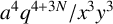 on the left-hand side.
Theorem 1.2 (First analogue of Andrews’ spt-function identity)
We have

Next, we consider the other
${}_{12}\phi _{11}$
 -transformation due to Verma and Jain [Reference Verma and Jain14, (1.6)], [Reference Sills13, (3.6)], to arrive at yet another analogue of Andrews’ spt-function identity. This identity is

Theorem 1.3 (Second analogue of Andrews’ spt-function identity)
We have

The paper contains two more sections. Section 2 is devoted to proofs of the two theorems stated above. In the final section, we discuss possible questions arising from our work.
2 Proof of the theorems
Proof of Theorem 1.2
By [Reference Andrews and Kumar7, page 7], for
$n \geq 1$
 ,
,

Letting
$a \rightarrow 1$
 ,
$x=z$
,
$x=z$
 ,
$y=z^{-1}$
,
$y=z^{-1}$
 in (1.5), we have

Now,

Letting
${N\to \infty }$
 in the identity above and simplifying yields

Thus,

Replacing
$z^3$
 by z and rearranging,

Next, we use the identity [Reference Andrews3, (2.1)]

to compute second derivatives. First, we consider
$f(z)=(zq^3,q^3)_{n-1}(z^{-1}q^3,q^3)_{n-1}$
 , resulting in

Again, taking
$f(z)={(zq^3,q^3)_{\infty }(z^{-1}q^3,q^3)_{\infty }}/{(1-zq^{3n})(1-z^{-1}q^{3n})}$
 results in

Finally, replacing
$q \rightarrow q^3$
 in [Reference Andrews3, (2.4)],

Differentiating both sides of (2.1) twice with respect to z and using these three results,

The theorem follows by dividing throughout by
$(q;q)_{\infty }$
 and rewriting the left-hand side.
Proof of Theorem 1.3
As in the proof of Theorem 1.2, for
$n \geq 1$
 ,
,

In addition, for
$n \geq 1$
 ,
,

Then, letting
$a \rightarrow 1$
 ,
$x=z$
,
$x=z$
 ,
$y=z^{-1}$
,
$y=z^{-1}$
 in (1.6), we have

Now,

Letting
${N\to \infty }$
 in the above identity and simplifying,

Thus,

Rearranging,

Next, as in the proof of the previous theorem, we again use the identity

to differentiate twice with respect to z. Considering
$f(z)=(zq,q)_{n-1}(z^{-1}q,q)_{n-1}$
 results in a double derivative also found in Andrews’ original work [Reference Andrews3, Proof of Theorem 3],

Again, considering
$f(z)={(zq,q)_{\infty }(z^{-1}q,q)_{\infty }}/{(1-zq^{3n})(1-z^{-1}q^{3n})}$
 results in

Finally, [Reference Andrews3, (2.4)] in Andrews’ original work states

Differentiating both sides of (2.2) twice with respect to z and using these three results,

The theorem follows by dividing throughout by
$(q^3;q^3)_{\infty }$
 and rewriting the left-hand side.
3 Concluding observations
Several possible avenues for further investigation arise from our work.
(1) In [Reference Andrews, Dixit and Yee6] and [Reference Andrews and Kumar7], the spt-function identities led to the connections with third-order mock theta functions discussed earlier in Section 1. In both cases, this connection is established using a nonweighted version of the sum on the left-hand side of the identities in (1.3) and (1.4), and working on this closely related series after initial use of the deep four-parameter identity due to [Reference Andrews1, Theorem 1]:

For instance, it is shown in [Reference Andrews, Dixit and Yee6, Theorem 3.1] that

It is possible that such mock theta connections or relations with other partition theoretic objects also exist for our spt-function identities. One attempt at this by removing the quadratic factor in the denominator of the identity in Theorem 1.2 leads to the simplification

Andrews’ identity (3.1) does not seem useful here due to the presence of more parameters in these series. We believe this can be dealt with by considering a higher parameter identity analogous to Andrews’ identity. Some instances of such identities are [Reference Andrews, Dixit, Schultz and Yee5, Theorem 1.1] and [Reference Banerjee, Dixit, Andrews and Garvan10, Theorem 1.3]. Our investigation here is preliminary and a different approach to simplifying and transforming the series is worth considering.
(2) There are more such analogues to be discovered. Some identities that could possibly yield such analogues are [Reference Verma and Jain14, (1.7) and (1.8)], a
${}_{14}\phi _{13}$
 -identity [Reference Verma and Jain14, (2.29)] and a similar higher parameter identity [Reference Verma and Jain14, (2.30)], all due to Verma and Jain, and several similar identities found by McLaughlin and Zimmer [Reference Mc Laughlin and Zimmer12]. However, appropriate choices of the substitutions are necessary. For instance, making the substitutions
$a=q$
-identity [Reference Verma and Jain14, (2.29)] and a similar higher parameter identity [Reference Verma and Jain14, (2.30)], all due to Verma and Jain, and several similar identities found by McLaughlin and Zimmer [Reference Mc Laughlin and Zimmer12]. However, appropriate choices of the substitutions are necessary. For instance, making the substitutions
$a=q$
 ,
$x=z$
,
$x=z$
 ,
$y=z^{-1}$
,
$y=z^{-1}$
 in [Reference Verma and Jain14, (1.7)], letting
$N\rightarrow \infty $
in [Reference Verma and Jain14, (1.7)], letting
$N\rightarrow \infty $
 and differentiating twice with respect to z as in the earlier proofs leads us to the series

on the right-hand side which is new. However, we have observed that making the substitutions
$a \rightarrow 1$
 ,
$c=q$
,
$c=q$
 ,
$d=q^2$
,
$d=q^2$
 ,
$x=z$
,
$x=z$
 ,
$y=z^{-1}$
,
$y=z^{-1}$
 in [Reference Verma and Jain14, (2.29)] leads us again to the identity in Theorem 1.2. Further multi-series generalisations of the
${}_{10}\phi _{9}$
in [Reference Verma and Jain14, (2.29)] leads us again to the identity in Theorem 1.2. Further multi-series generalisations of the
${}_{10}\phi _{9}$
 -identities and the
${}_{14}\phi _{13}$
-identities and the
${}_{14}\phi _{13}$
 -identities due to Verma and Jain [Reference Verma and Jain14, (4.1), (4.3), (4.4), (4.5)] could lead to generalised spt-function identities.
(3) There is resemblance and symmetry between our newfound spt-identities in Theorems 1.2 and 1.3, and those by the previous authors. For instance, upon bringing the lone product
$(q;q)_{\infty }$
 in our identity in Theorem 1.3 to the left-hand side, the first sum on the right-hand side of our identity and that of Andrews, Dixit and Yee in (1.3) are the same, namely the generating function for
$np(n)$
in our identity in Theorem 1.3 to the left-hand side, the first sum on the right-hand side of our identity and that of Andrews, Dixit and Yee in (1.3) are the same, namely the generating function for
$np(n)$
 . The second sum in our identity can be obtained by substituting
$q \rightarrow q^{{3}/{2}}$
. The second sum in our identity can be obtained by substituting
$q \rightarrow q^{{3}/{2}}$
 in the second sum in their identity. This calls for an examination of the underlying theory behind this resemblance more closely.
Acknowledgement
We express our gratitude to Frank Garvan and George Andrews for their kind interest during the course of this project.


 Open access

