

Introduction
In the past few decades, Hong Kong has experienced drastic changes in its population structure: from one of the youngest immigrant cities with a median population age of 21.4 years old in 1965 to one of the fastest ageing regions with a median age of 43.2 in 2015 (Census and Statistics Department of Hong Kong SAR, 2016). Low birth rates, population ageing, and a shrinking work force are among the daunting challenges that the city is facing. In order to facilitate sustainable family care to young children and the elderly while encouraging family caregivers to actively participate in the paid labor market, building family-friendly workplaces and work-family balance has been emphasised and prioritised in Hong Kong’s policy discourses in recent years (Research Office of Legislative Council Secretariat of Hong Kong SAR, 2014).
Maternity leave for mothers before and/or after childbirth or child adoption, paternity leave for fathers to care for new-born or newly adopted children and partners, and family leave for employees to take care of all family members have been discussed and debated in the Hong Kong society. While the previous research on family-friendly workplace in Hong Kong often focused on the struggles of employees (e.g. Chou and Cheung, Reference Chou and Cheung2013), the views of employers, an important stakeholder in the issues, received insufficient academic attention. This study aims to bridge the gap in literature by investigating the factors associated with employers’ support to the policy of paid family leave in the social contexts of Hong Kong, with particular interest in structural constraints in business operation and the subjective and cognitive world of individual employers.
The contexts of Hong Kong
When it was first introduced in the Employment Ordinance of Hong Kong in 1970, maternity leave was given without pay. This was changed in 1981 to provide a working mother two-thirds of her daily wage, and in 1995, four-fifths. The current law in Hong Kong legislates a period of ten weeks’ maternity leave with 80 per cent of average wage covered for women employed under a continuous contract for forty weeks, working a minimum of eighteen hours per week. The cost of maternity leave, at the moment, is covered by the employers. In 2019, the Hong Kong Government extended the statutory maternity leave to fourteen weeks, which finally put Hong Kong on par with the minimum standards laid down by the International Labor Organisation. The cost incurred by the four extra weeks of leave is also subsidised by the Government of Hong Kong in policy implementation.
Although being discussed for years, paternity leave was eventually introduced to Hong Kong in 2015. The current statutory paternity leave in Hong Kong is three days, under similar employment conditions as for maternity leave. The Chief Executive also proposed to increase the leave to five days in Policy Address, but did not offer governmental subsidies.
Meanwhile, the Equal Opportunities Commission (EOC) of Hong Kong has also been exploring the possibility to implement paid family leave in Hong Kong in their sponsored studies (Dai et al., Reference Dai, Song, Tong, Wu and Jin2018). The Family Status Discrimination Ordinance (FSDO) was passed in Hong Kong in 1997. Under the Ordinance, family status is legally defined as the responsibility of a person for the care of an immediate family member, related by blood, marriage, adoption, or affinity. Although the law has existed in Hong Kong for more than two decades, the general public still holds a fairly low degree of awareness and knowledge of family status discrimination (Equal Opportunities Commission, Hong Kong SAR, 2015). Paid family leave, as practiced in many western countries, is regarded as an important policy to tackle family status discrimination and promote equality and integration in the workplace. It assists not only parents, but also caregivers of other family members (especially the growing ageing population) to balance family care responsibilities and career development in needed times.
In spite of the emerging efforts to promote family-friendly workplaces, these policy initiatives often encounter strong objections during consultation, approval, and implementation processes, particularly from the side of employers in Hong Kong (Research Office of Legislative Council Secretariat of Hong Kong SAR, 2014). Reputed as one of the world’s most free economies, Hong Kong has followed and maintained a model of the facilitative and productivist regime in governance (Holliday, Reference Holliday2000). The laissez-faire government has long withdrawn from active intervention in the market, and leaves the organisation of social welfare benefits largely to the private sector. At the same time, the general society well embraces the neo-liberalist values and holds a strong preference for market rationality, free competition, efficiency, and social stratification in social opinions (Wong et al., Reference Wong, Chau and Wong2002). In this context, family care duties are largely treated as responsibilities of individuals and families, instead of general benefits of employment or elements of a more protective welfare system. State intervention in such issues could be regarded by employers as unwise violation of free market rules and unnecessary intrusion into the employment market, and hence would impede the healthy competition among enterprises (Holliday, Reference Holliday2000).
Amidst the conflicts between growing social needs and opposing employers, it is important to explore how employers develop their opinions in their views of family-friendly workplace policies in Hong Kong. Who tends to show more support to these policy directions, what are some important factors associated with their views, and what can be implied for education and advocacy programs for social justice – these questions are at the core of inquiries of this research. It is also important to understand how Hong Kong’s policy experiences, deeply embedded in its productivist governance regime and neo-liberalist social order, are comparable to other regions in the world, and how that comparison sheds light on our understanding of employment benefits and inequality in the workplace.
Literature review
In the policy discussion and debate around parental and family leave in Hong Kong, employers’ objection and reluctance is often attributed to their rational calculation of cost and profit in the neo-liberalist market and their resistance to state intervention in market competition (Wong et al., Reference Wong, Chau and Wong2002). While taking into account the structural constraints that family-friendly workplace policies may exert on their business operations in the market economy, we also need to pay attention to the agency of individual employers (especially their stereotypes and knowledge) in formulating their support to these policies. Built on previous studies, the more balanced theoretical approach of structure and agency (Sewell, Reference Sewell1992) can generate a more complete and comprehensive understanding of the views of employers in Hong Kong.
The controversies around maternity and paternity leave in Hong Kong
Compared with other industrialised nations and regions, Hong Kong, despite its economic prosperity and affluence, is far behind in legislating and implementing maternity and paternity leave policies in the workplace. In her 2018 Policy Address, the Chief Executive admitted that the current policy in Hong Kong does not meet the standards promoted by the International Labor Organisation and needs to be changed. Different political parties and forces have been debating about maternity and paternity leave policies in Hong Kong for decades, but it is still difficult to achieve policy consensus.
The more progressive Labor Party, Democratic Party, Labor Unions, and Trade Unions have advocated on behalf of employees, and argued that maternity and paternity leave policies protect basic human rights of reproduction and need to be prioritised in policymaking and budgeting (Legislative Council Panel on Manpwer of Hong Kong SAR, 2018). On the other hand, employers, particularly those of small-and-medium-sized enterprises (SMEs), demonstrated strong objection and resistance in policy discussion. Through business associations such as Federation of Hong Kong Industries and Hong Kong Catering Industry Association, as well as some members of the Legislative Council, the employers expressed concerns of costs and manpower constraints in adopting and implementing maternity and paternity leave in Hong Kong (Research Office of Legislative Council Secretariat of Hong Kong SAR, 2014).
SMEs count for over 98 per cent of the business establishments in Hong Kong and many of them operate in labor-intensive industries such as catering, accommodation, and retail sales (Census and Statistics Department of Hong Kong SAR, 2018). Employers claimed that mandatory maternity and paternity leave policies would put extra financial burdens on SMEs, undermine their survival chance and cut job positions in Hong Kong. At the same time, they would reinforce the stereotypes of working parents in the workplace as burdensome and inefficient, and reduce their opportunity of employment. From the perspective of the employers, mandatory maternity and paternity leave policies not only harm the best interests of parent employees, but also Hong Kong’s economy in general (Legislative Council Panel on Manpwer of Hong Kong SAR, 2018).
Scholars viewed the objection of employers as deeply embedded in Hong Kong’s laissez-faire capitalist order, and the ‘minimalist market-based employer approach’ in labor relationships, in which employers intend to keep a wide degree of freedom to determine voluntarily the manner and extent to which they will choose to financially support their workers’ family needs (Block et al., Reference Block, Berg, Belman, Coyle-Shapiro and Shore2004). In a social culture that endorses market efficiency and competition, employers in Hong Kong often regard family care duties as individual and family responsibilities (Holliday, Reference Holliday2000). It is believed that incompetent employees who let childcare affect their work performance need to settle the issues in families, instead of relying on enterprises for resources; employers therefore strongly resist mandatory regulations from the government, which would legislate maternity and paternity leave as general employment benefits for all employees (Vyas et al., Reference Vyas, Lee and Chou2017).
Employers would rather, through a case-by-case approach, negotiate individually with employees on their maternity or paternity leave. They tend to calculate the productivity and the contribution to the enterprise of the employees, and grant employment benefits to the deserving ones (Dai et al., Reference Dai, Song, Tong, Wu and Jin2018). Employers mobilise the discourse of cost-benefit efficiency to justify this approach of allocating parental leave (Chou and Cheung, Reference Chou and Cheung2013), which lowers their operational costs yet reinforces the popular market ideologies of efficiency and competence in Hong Kong.
The reluctant attitudes of employers towards the implementation of maternity and paternity leave in Hong Kong hinder the building of a more family-friendly work environment in the changing demographic structures and the promotion of gender equality in the workplace. In the local contexts, what are the factors that are associated with employers’ reluctance? In this study, we aimed to advance the understanding of this question by examining both the structural constraints on business in the free market and the agency of individual employers in their subjective and cognitive world.
Support to family-friendly policies: stereotypes of family caregivers and knowledge of discrimination
In the previous literature, building parental and family leave in a society often involves complicated political, economic, and cultural debates (Moss et al., Reference Moss, Duvander and Koslowski2019). For our study, which focuses on employers’ attitudes towards family-friendly workplace policies, the sociological duality framework of structure and agency (Sewell, Reference Sewell1992) can be mobilised to produce a balanced understanding. In the neo-liberalist market economy of Hong Kong, employers often perceive such policies as extra structural burdens on labor cost and rationally calculate the incurred constraints on their business operation. Meanwhile, their agency (more specifically, their subjective attitudes towards family caregivers and their legal knowledge) would also contribute to their formulation of opinions.
From the side of structural constraints, scholars previously argued that employers would consider company size, industry, staff composition, and history and work culture of enterprises when they decide whether to support family-friendly policies (Casper et al., Reference Casper, Fox, Sitzmann, Landy and Barling2004). Through an analysis of cross-sectional data, researchers discovered that public-sector employers are more likely to support and offer job benefits related to family care duties because they are more susceptible to normative pressures regarding fair employment practices (Ingram and Simons, Reference Ingram and Simons1995). A series of studies found that business establishments with larger numbers of women workers are more likely to support preferential treatment to workers who need to take care of family members (Goodstein, Reference Goodstein1994; Osterman, Reference Osterman1995; Guthrie and Roth, Reference Guthrie and Roth1999). Meanwhile, an earlier study in Hong Kong (Dai et al., Reference Dai, Song, Tong, Wu and Jin2018) suggested that employers of SMEs in labor-intensive industries (such as retail, catering, or accommodation) are more reluctant to support family-friendly policies in employment.
While employment structure and business nature of enterprises could shape the attitudes of employers towards family-friendly policies, researchers have also pointed out that the subjective and cognitive world of employers as human beings should not be neglected in the discussion (Wayne and Cordeiro, Reference Wayne and Cordeiro2003).
Employers’ perception and evaluation of employees, who are family caregivers, often plays an important role in building their acceptance of family-friendly measures in business operation (Kaufman and Uhlenberg, Reference Kaufman and Uhlenberg2000). When employers embrace cultural stereotypes of parents, they tend to deny their equal rights in the workplace (Moss et al., Reference Moss, Duvander and Koslowski2019). Employers who believe that workers with family care duties are incompetent, unreliable, and troublesome for their colleagues, and companies are much less likely to offer job opportunities to women or support family-friendly initiatives in the workplace (Correll et al., Reference Correll, Benard and Paik2007).
At the same time, earlier research suggested that employers’ awareness and knowledge of regulations and laws against discrimination based on family care responsibilities could compel them to accept and adopt family-friendly policies in the workplace. A research report revealed that in the US, although some employers may perceive requests for family and medical leave from some employees as illegitimate (e.g. ‘intermittent leave timing’ or ‘validity of documentation or medical certification’), they would nonetheless grant the leave and adopt generous family leave policies in their establishments, so as to avoid possible complaints about discriminative practices that violate the Family and Medical Leave Act (FMLA) of 1993 (Society for Human Resource Management, 2007).
In the subjective world of employers, stereotypes of employees with family care duties and knowledge and awareness of relevant laws and regulations can therefore be viewed as two mental forces that shape their attitudes towards family-friendly employment policies into opposite directions. While the former hinders their acceptance and adoption of family-friendly measures in the workplace, the latter compels them to follow the rules and implement such measures in their enterprises. There is little exploration to date on how these two opposing mental forces of employers would work together to produce support or objection to family-friendly workplace policies in different social and cultural contexts.
As a starting point, in this article, we used empirical data to investigate in the neoliberalist market and governance of Hong Kong, where family-friendly workplace policies have become heated political issues (Research Office of Legislative Council Secretariat of Hong Kong SAR, 2014), which may affect employers’ support to family-friendly measures in employment policies. Our specific research question is: in Hong Kong, how employers’ perceptions of employees who are family caregivers and their awareness of existing anti-discrimination laws, together with structural characteristics of their business establishments, are associated with their attitudes towards the policy of paid family leave? We formulated the following four hypotheses based on the existing literature:
Hypothesis 1: Employers’ stereotypes of employees with family care duties are negatively associated with their support to family paid leave in the workplace of Hong Kong.
Hypothesis 2: Employers’ awareness and knowledge of laws and regulations are positively associated with their support to family paid leave in the workplace of Hong Kong.
Hypothesis 3: Employers’ stereotypes of employees with family care duties and their awareness and knowledge of laws and regulations have interactive effects on their support to paid family leave in the workplace of Hong Kong.
Hypothesis 4: Structural characteristics of their business establishments (i.e. industry category, employment size and years of establishment) are associated with employers’ support to paid family leave in the workplace of Hong Kong.
Methods
Data
In 2017, commissioned by the EOC of Hong Kong, the research team, in collaboration with a market research company, conducted a telephone survey with employers in Hong Kong. A random sample of business telephone numbers was drawn from the latest business telephone directory of Hong Kong. According to the Support and Consultation Centre for Enterprises in Hong Kong, small-and-medium-sized enterprises (SMEs) count for over 98 per cent of the business establishments in the city. It is thus difficult to capture the views of larger-sized employers for comparative analysis in a fully randomized sample. We therefore oversampled the number of big companies in our sample, aiming at 15 per cent of all respondents. We reached out to 1,404 establishments for survey interviews, and asked to be directed to the person in charge of hiring and employment benefits in the enterprises. In total, bosses, CEOs, general managers, and Human Resource managers in 407 establishments (350 SMEs and fifty-seven large organizations) were successfully interviewed, constituting an overall response rate of 29 per cent. We particularly asked the respondents to reply from the experiences, views, and interest of the enterprises, instead of personal opinions and feelings.
Participants
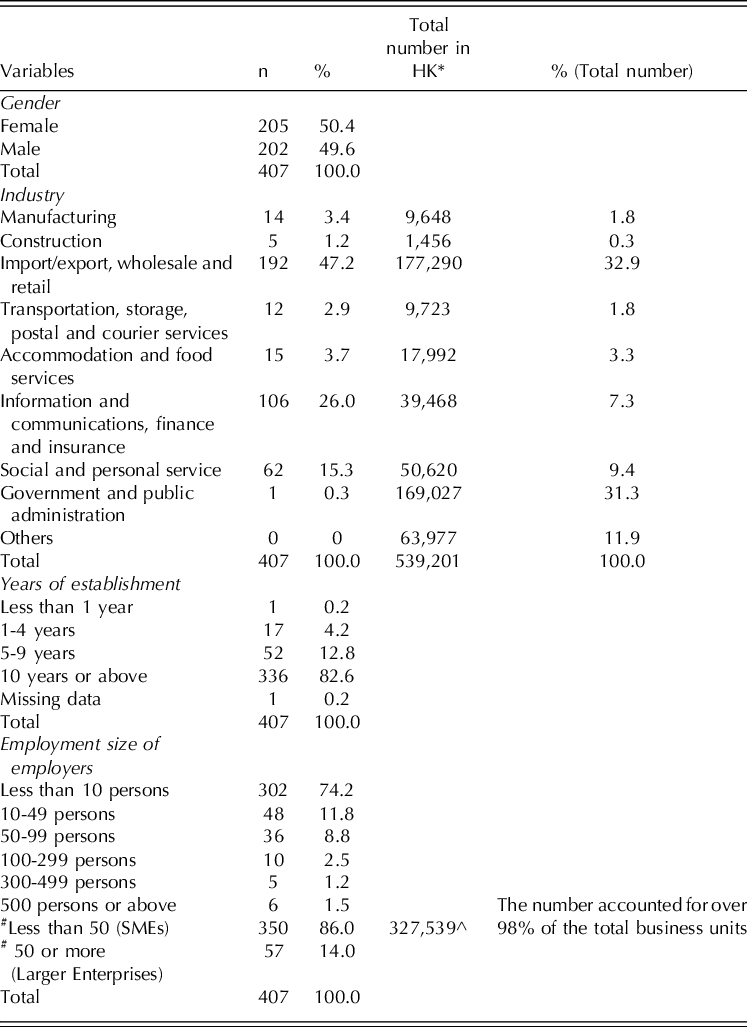
Table 1 shows the distribution of the employer respondents along gender, industry categories, years of establishment, and employment size. Half of the respondents were female (50.4 per cent, n=205). Among the 407 employers sampled, almost half of the employers (47.2 per cent, n=192) were engaged in the Import/Export, Wholesale and Retail Trades, about a quarter (26.0 per cent, n=106) in Information and Communications/Financing and Insurance, 15.3 per cent (n=62) in Education, Human Health and Social Work activities, 3.7 per cent (n=15) in Accommodation and Food Services, 3.4 per cent (n=14) in Manufacturing, 2.9 per cent (n=12) in Transportation, Storage, Postal and Courier Services, 1.2 per cent (n=5) in Construction industry sectors, and 0.3 per cent (n=1) in Government and Public Administration.
Distribution of the sample (N=407)
Notes.
* 1. The last two columns present the number of enterprises by industries and employment size in Hong Kong by the end of Sep. 2017, which are drawn from the “Quarterly Report of Employment and Vacancies Statistics” of HKSAR.
# 2. In this study, companies with less than 50 employees are categorized as small and medium size enterprises (SME), while companies with at least 50 employees are categorized as larger enterprises
^ 3. According to the Support and Consultation Centre for SMEs in Hong Kong, it defines that Manufacturing enterprises with fewer than 100 employees and non-manufacturing enterprises with fewer than 50 employees are regarded as small and medium enterprises (SMEs) in Hong Kong. And the latest number by the end of Sep 2017 was 327,539.
The sample distribution based on industry categories was largely consistent with the overall distribution of employers in Hong Kong, except for the industry category of Government and Public Administration (Census and Statistics Department of Hong Kong SAR, 2018). As government agencies generally declined to be interviewed, the representation of Government and Public Administration was very low in the sample. In data analysis, we combined it with the category of Social and Personal Service, and named the category as Public and Social Service.
The majority of the sampled establishments had a history of more than ten years (82.6 per cent, n=336). And as planned, the SMEs constituted about 86 per cent (n=350) of the total sample.
Measures
Support to paid family leave
In the questionnaire, we asked the respondents how their companies would support paid family leave if the policy is to be implemented in Hong Kong, on a scale from 1 (strongly disagree) to 4 (strongly agree). In order to capture the general attitudes of employers towards family-friendly workplace policies, we used family leave, instead of maternity or paternity leave, in the question. In addition, since family leave has not been legislated in Hong Kong, this hypothetical question could direct the respondents to express their attitudes towards the policy concept, rather than focusing on the specific details of the current maternity and paternity leave policies in Hong Kong. In the questionnaire, we first gave a brief introduction of the policy of family leave and how it was designed and implemented in some western countries, and then asked for the opinions of the respondents.
Stereotypes of employees with family care duties (FCD)
In order to measure employers’ stereotypes of employees with family care duties, we asked, under question number BQ1 in the questionnaire, five related questions about their opinions of such employees. On a scale from 1 (strongly disagree) to 4 (strongly agree), we asked whether they perceived employees with family care duties as bringing considerable burdens to the operation of the company (BQ1a), bringing considerable troubles to their co-workers (BQ1b), unable to concentrate on their work (BQ1c), taking leave too often (BQ1d), and quitting their jobs too often (BQ1e). The five variables were used to construct the measurement of employers’ stereotypes, with larger numbers indicating higher levels of stereotypes. The reliability of the scale was tested and the value of cronbach’s alpha was 0.822.
Employers’ awareness of family status discrimination (FSD)
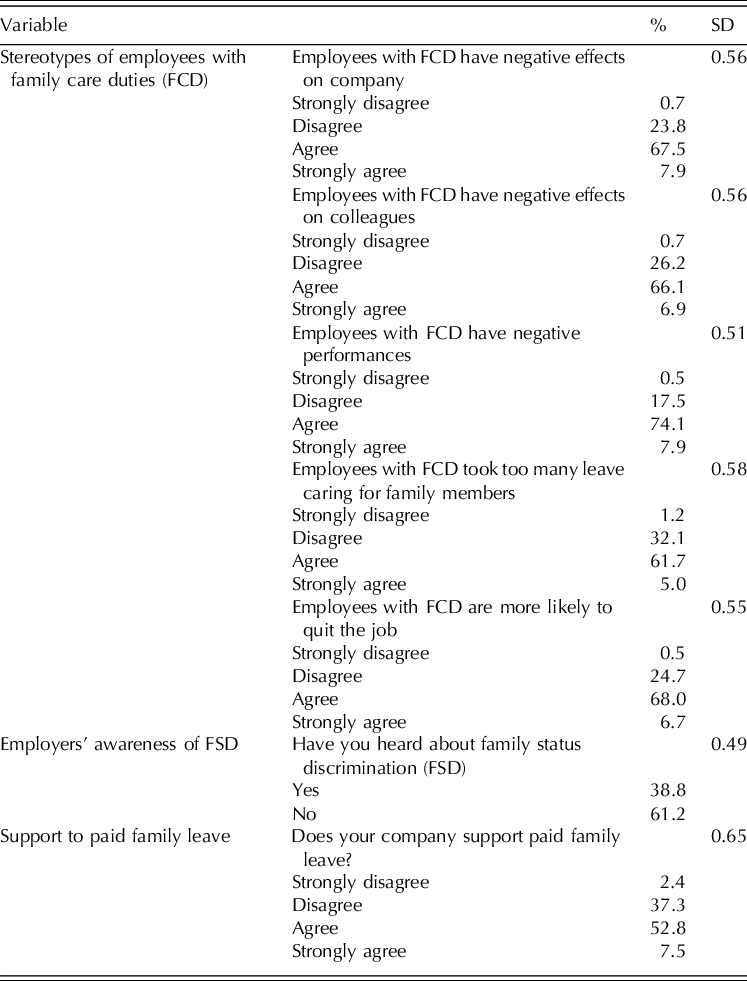
For employers’ awareness and knowledge of laws, regulation, and penalties, we used the question (question number AQ1) – ‘have you ever heard about family status discrimination in Hong Kong before?’ In our sample, only 38.8 per cent of the employers (n=158) claimed that they had heard about family status discrimination before, which echoed the earlier finding that the general public in Hong Kong held a low degree of awareness and knowledge of family status discrimination (Equal Opportunities Commission, Hong Kong SAR, 2015).
The distribution of the key variables is presented in Table 2. The control variables in our analysis included gender of the respondent, years of establishment of the enterprise, employment size of the enterprise, and the industry category of the enterprise. We used the cutting point of ten years and fifty employees for years of establishment and employment size respectively; and female and the industry of import/export, wholesale and retail (the largest industry in Hong Kong) as the reference groups for gender and industry category.
Descriptive of key variables (N=407)
Results of SEM models (N=407)

† p < 0.1, * p < 0.05, ** p < 0.01, ***p < 0.001
Empirical strategy
Using Mplus 7, structural equation modeling (SEM) analyses were conducted to examine whether and how employers’ stereotypes of employees with family care duties and their awareness and knowledge of laws and regulations are associated with their support to paid family leave in Hong Kong. We chose SEM because it can flexibly incorporate factor analysis frameworks and offers a convenient way to differentiate between observed and latent variables (e.g. ‘level of stereotypes’) (MacKinnon et al., Reference MacKinnon, Lockwood and Williams2004).
The statistical significance of the product was evaluated, using bias-corrected bootstrapping approaches (Shrout and Bolger, Reference Shrout and Bolger2002; Selig and Preacher, Reference Selig and Preacher2009), and this study drew 10,000 bootstrap samples to help to estimate the confidence interval of the interaction term (Hypothesis 3).
Results
The results are presented in Table 3. In Model I, we tested the main effects of employers’ stereotypes and awareness of FSD on their support to paid family leave, controlling their gender, industry, and employment size and history of the business establishments. We found that neither employers’ stereotypes of employees with family care duties nor their knowledge and awareness of laws and regulations, as two independent factors, could significantly associate with their support to paid family leave.
But gender and industry category of employers were significantly associated with their support to paid family leave. Compared with female employers, male employers were less likely to support paid family leave (b= −0.17, p<0.05). And employers in construction industry were more supportive, compared to those in import/export, wholesale and retail industry (b=0.35, p<0.001).
As two separate key independent variables, employers’ stereotypes of employees with family care duties and their awareness of relevant laws did not have significant main effects on their support to paid family leave. These two variables indicated two opposite mental forces in the subjective world of employers to formulate opinions regarding family-friendly workplace policies. So as to understand how the two mental forces interacted with one another when employers viewed paid family leave, we added the interaction of these two variables in Model II to test the hypothetical moderating effects. In this model of moderation analysis, the interaction term of employers’ stereotypes of employees with family care duties and their knowledge of family status discrimination was significant (b= 0.35, p<0.05), while employers’ stereotypes became marginally significant (b= −0.17, p=0.07) as well. Among employers who had no knowledge of family status discrimination and related laws, their higher level of personal stereotypes of employees with family care duties was associated with their lower level of support to paid family leave, although the effect was marginally significant. But when the employers acquired the knowledge of family status discrimination, the negative association of their stereotypes of employees with family care duties with their support to paid family leave faded out and became insignificant (b= 0.18, p= 0.14).
Results from our SEM analyses failed to confirm Hypothesis 1 and Hypothesis 2 regarding the independent main effects of employers’ stereotypes and their awareness of laws on their support to paid family leave, in the local contexts of Hong Kong. But the significant moderating effect of the two supported Hypothesis 3 and suggested that employers with knowledge of legal terms and awareness of regulations were less likely to develop opinions towards family-friendly workplace policies based on their own stereotypes of employees who are family caregivers. At the same time, as stated in Hypothesis 4, gender and industry of employers were also significantly associated with their support to family-friendly measures.
Discussion
Our SEM analyses examined how employers’ support or objection to paid family leave could be understood in Hong Kong’s local contexts, with particular attention to structural constraints in business and the agency of employers – more specifically, their stereotypes of employees with family care duties and their awareness and knowledge of relevant laws. Although previous studies in western societies suggested that employers’ stereotypes of family caregivers in the labor market would decrease their support to family-friendly measures in the workplace (Coltrane et al., Reference Coltrane, Miller, DeHaan and Stewart2013), while employers’ awareness and knowledge of laws and regulations against discrimination would compel them to be more supportive to such measures (Ingram and Simons, Reference Ingram and Simons1995), our findings from the main effect model (Model I) failed to validate similar associations in Hong Kong’s workplace.
Earlier studies argued that in Hong Kong’s business world governed by market rationality, rational and profit-based modes of decision-making free from personal emotions are highly appreciated (Vyas et al., Reference Vyas, Lee and Chou2017). This could explain the insignificant main effect of stereotypes of family caregivers on support to paid family leave – employers probably did not heavily involve their personal stereotypes in their attitudes towards policies on employment benefits in their companies. On the other hand, although Family Status Discrimination Ordinance has existed in Hong Kong for more than two decades, complaints related to the law were of very low percentage, according to a survey in 2015 (Equal Opportunities Commission, Hong Kong SAR, 2015). In other words, violation of the law may not have produced very serious consequences for employers. For the rational and legally savvy employers in Hong Kong, knowledge of discrimination might not be significant enough to influence their attitudes towards paid family leave.
The results from our interaction-effect analysis (Model II), however, discovered some patterns through which the subjective and cognitive world of individual employers, or the agency side of employers, is associated with their different levels of support to family-friendly employment policies. When employers had no knowledge of legislation and regulation against family status discrimination, they were more likely to mobilise personal stereotypes of employees with family care duties to decide their support to paid family leave. But when they acquired good knowledge and were aware that certain practices were legally defined as discrimination, they tended to restrain their own stereotypes in the decision-making. Awareness and knowledge of laws may not directly compel employers in Hong Kong to be more supportive to family-friendly measures in the workplace, but it might lower the likelihood of employers to make their decisions of support based on their own stereotypes of employees who are family caregivers.
On the side of structural constraints, it is worth noting that in both our main-effect model (Model I) and interactive-effect model (Model II), gender of employers and industry categories were significantly associated with employers’ support to paid family leave, while history and employment size of enterprises were not. In Hong Kong’s public policy consultation and debates, it is often believed that SMEs, due to their limited human resources and operational capability, are more likely to oppose the legislations of family-friendly employment polices (Legislative Council Panel on Manpwer of Hong Kong SAR, 2018). But results from our statistical analyses, with larger enterprises oversampled, surprisingly pointed out that the employment size did not make a difference in employers’ support to paid family leave. SMEs constitute the predominant majority (over 98 per cent) of Hong Kong’s business establishments, and that could be a better explanation for why we have heard objections from employers of SMEs more frequently than those from larger enterprises.
While sympathy from female employers to family-friendly measures was also observed in other places (Correll et al., Reference Correll, Benard and Paik2007), more support from the male dominant construction industry made Hong Kong sharply different from other regions (Guthrie and Roth, Reference Guthrie and Roth1999). According to the Hong Kong census, female employees constituted only 9.6 per cent of the total workforce in the industry of construction in 2017, while 49.7 per cent of the general workforce in Hong Kong were females (Census and Statistics Department of Hong Kong SAR, 2018). Previous studies discovered that companies with a higher percentage of female staff were more likely to adopt family-friendly measures in the workplace (Guthrie and Roth, Reference Guthrie and Roth1999), because the critical mass of female employees in those enterprises would enable them to negotiate with employers and persuade employers to take family care needs into consideration in enterprise management. But in Hong Kong, our data did not show that effect. On the contrary, employers of establishments with fewer female employees, whose operational costs would not increase drastically even if paid family leave should be implemented, were more likely to support the policy.
These findings echoed previous research on the prevalence of market rationality and neo-liberalist logics in Hong Kong’s governance and social attitudes (Holliday, Reference Holliday2000). When welfare benefits are largely decided and provided in the private market with little intervention from the state, market rationality of labor cost, profit margins and budgetary balance is often a prioritised consideration of employers in their attitudes towards family-friendly policies (Holliday, Reference Holliday2000). Structural constraints, such as the size of female labor force and the resulting labor cost from paid family leave, were strongly associated with the attitudes of employers. Meanwhile, personal stereotypes and awareness of law, or the agency of individual employers, did not have strong direct effects. The interactive effect of the two opposite mental forces suggested an indirect and complex role of employers’ agency in their support to family-friendly workplace policies.
Limitations
Telephone survey as the method of data collection, the low response rate, the small sample size (N=407), the over-representation of the trade and retail industry, and the under-representation of government agencies all affected the quality of our data and the generalisability of the findings. By interviewing one important member of the management team, especially in larger companies, we might not be able to get the complete and accurate view of the establishments, which would affect the validity of the data. Due to the limited time of telephone survey, we did not include many important variables at the company level, such as international vs. local in company nature, number of female labor force, number of employees that may need family leave, etc. The missing of these variables affected the validity and the depth of our data analyses.
In addition, in our data analyses, due to the limited sample size, we had to use 0.1 as the cutting p-value in some of our models, which also undermined the validity and reliability of the results. The cross-sectional data we used did not allow us to identify causal relationships among the variables and all the conclusions were based on associations, which limited their implications for policy and practice.
Conclusion and implication
Findings of this study echoed the prevalence of market rationality of cost-benefit efficiency in the neo-liberalist order in Hong Kong’s business world and governance. In this structural context, it can be a feasible and effective approach to promote family-friendly employment policies through the discourses of cost reduction, profit returns to good investment, and long-term economic benefits. Increasing or full governmental subsidies for employees’ family leave can be effective to persuade employers to welcome the policy by compensating for their labor costs. However, some business establishments in Hong Kong still complained that the subsidies, even if fully implemented, could not cover their administration costs for finding short-term supplement staff and re-assigning job duties among colleagues when employees take longer family leave (Karacs, Reference Karacs2016).
Some local scholars (Chou and Cheung, Reference Chou and Cheung2013) suggested that, in order to increase social acceptance of a family-friendly work environment, more studies need to investigate how family-friendly policies could reduce turnover rates and improve work loyalty and productivity in various job settings. This approach would be in line with the neo-liberalist logics of investment and returns. Although some studies in western contexts (Berdahl and Moon, Reference Berdahl and Moon2013) revealed the financial benefits of family-friendly employment policies to employers in the long term, it is still hard to conduct such research in Hong Kong. These issues have appeared in public discussion only recently, and there are very few truly family-friendly employers in Hong Kong that could be systematically compared with the other establishments in the business sector. But if we can keep accumulating data and conduct such research in the future, the findings might help to generate more support from the employers’ side in the discussion of a family-friendly workplace.
At the same time, the subjective and cognitive world of individual employers, or the agency of employers, is also an important field to explore for policy advocacy. Although neither educational programs debunking stereotypes against family caregivers nor policy advocacy of anti-discrimination laws might increase employers’ support to family-friendly measures in the workplace alone, combining the two could possibly have some positive effects. While promoting the rule of law in Hong Kong, the combined approach could persuade employers from using their judgmental stereotypes to formulate policy preferences. When personal stereotypes and biases are restrained, more reasonable and productive discussion might be facilitated and conducted with employers regarding family friendly measures in the workplace.


 Open access

