


Introduction
It is known that cold-based and wet-based ice can exist beneath ice sheets and that this thermal differentiation may result in either preservation or modification of the underlying landscape (Reference Sugden and WattsSugden and Watts, 1977; Kleman, 1994; Kleman and Borgström, 1994). Such selective erosion/protection is suggested for Øksfjordjokelen, a plateau-top icefield in north Norway.
Øksfjordjokelen is situated approximately 150 km northeast of Tromsø at a latitude of 70°10′N (Fig. 1), and covers approximately 40 km2 (Reference Gellatly, Whalley, Gordon, Hansom and TwiggGellatly and others, 1989). Bedrock is composed of mainly Silurian banded gabbros (Reference KrauskopfKrauskopf, 1954) and thus is “mechanically’ resistant. Camp Glacier (Fig. 1) is the bext example of the few localities where the glacier margin terminates as a small lobe on top of the plateau (average bedrock slope < 10°). A large inner moraine encloses the now deglaciated foreland, with a number of fragmented older moraines outside. The present snout position is approximately 350 m from the inner (Little Ice Age, LIA) moraine. The foreland covers approximately 0.1 km2 and provides evidence of extensive subglacial quarrying. Beneath the snout a cavity stretches some 70 m across- and 100 m up-glacier, providing access beneath ice ≤50 m thick (Reference Rea and WhalleyRea and Whalley, 1994). The present thermal regime is apparently complex. In some areas the ice is actively sliding, e.g. Camp Glacier (Reference Rea and WhalleyRea and Whalley, 1994), while in others there is retreat of protective ice. In these localities of protective ice, blockfield covers with patterned ground are being exposed.
(a) Location of Øksfjordjøkelen. (b) The snout (s) of Camp Glacier is just exposed. The Little Ice Age inner moraine (m) is clearly visible but the foreland (f) is still covered by snow.

At present, four nunataks are located towards the margins, and represent very small sources of supraglacial/englacial material (in the ablation areas no supraglacial material is seen). Thus, everything found in the plateau-top moraines can be assumed to have a subglacial origin.
Observations in the cavity at the snout indicate that subglacial water is at atmospheric pressure. The “roughness” of the foreland suggests that during the summer months when sliding velocities are greatest, cavities would have formed. No water-pressure information is available for the localities further up-glacier. For the following analyses, basal water pressures are taken as Zero. Such an assumption is probably valid for the snout and localities where basal water pressures are reduced, e.g. during periods of northerly weather in summer when melting is reduced and the subglacial meltwater system is well developed.
This field site provides an excellent opportunity to combine subglacial with proglacial erosion evidence to evaluate how this small outlet has produced substantial amounts of subglacial erosion during the LIA. It should be noted that the erosion is not the removal of blockfield (which covers some areas of the plateau) but the quarrying and plucking of material from coherent bedrock.
Subglacial Erosion
Bedrock fracture occurs when the imposed stress exceeds the strength of the bedrock. Plucking is the removal of material produced from fracture processes, or the removal of pre-existing loosened or jointed material. Fracture is most often associated with the lee side of bedrock obstacles where the flow-induced stresses are highest (Reference Morland and BoultonMorland and Boulton, 1975), shown by the plucked lee-side faces of roches moutonnées. The existence of cavities reduces the effective strength of the bedrock, increasing the potential for failure.
Reference Rea, Robinson and WilliamsRea (1994a, Reference Reab) investigated the potential for cavity formation beneath Camp Glacier. The results of these investigations showed that cavities could exist in the lee sides of small (<8 m wavelength) bedrock obstacles (wavelength/amplitude ratio 4:1). Using the safety-factor equations from Reference Boulton and CoatesBoulton (1974), Reference Rea, Robinson and WilliamsRea (1994a, Reference Reab) found that there was no likelihood of bed failure from flow-induced stresses alone. However, removal of material is known to have occurred, so other factors such as structure and squeezing of ice must be considered.
Effect of Structure
Although often modelled as an isotropic material, rock has a number of discontinuities through a large range of scales: faults, joints, bedding, foliation, cleavage. At the scales to be dealt with in this paper, joints are the most important. They affect the response of the rock mass especially at pressures below 500 M Pa (Reference MorlandMorland, 1974), i.e. for pressures generated beneath all known terrestrial ice masses. On the plateau, three major joint sets are identifiable. Two of these are sub-vertical and the third sub-horizontal; the three sets intersect to produce joint-bounded blocks which fit together to make up the bed (Reference Rea, Robinson and WilliamsRea, 1994a). The shear strength of the jointed bedrock can be taken to lie between one half and one third the value of the intact rock (Reference JaegerJaeger, 1959, Reference Jaeger1971). Using the largest possible reduction in strength, Reference Rea, Robinson and WilliamsRea (1994a, Reference Reab) found that, for the reconstructed LIA ice dynamics, no quarrying would have taken place beneath Camp Glacier. The fact that the joints break the bed into blocks is, however, significant. If the blocks can be plucked, subglacial erosion can still proceed without active fracturing of intact bedrock.
Subglacial Plucking/Shear Removal
Figure 2 shows that the block at the crest of a step can be removed by shear displacement. Once this has been removed, the block behind is exposed to the same shear displacement and removal. This is shows how a headward retreat of the lee-side face could occur. From Figure 2 the total resultant shear stress (τRH) and total normal stress (σN) acting on the bottom face of the block is given by:


where Σ is the cryostatic load, T is flow-induced drag. B W is the weight of the block and θ is the angle of up-glacier dip of the rock step. Figure 2 is simplified and extra shear resistance from the sides of the block will provide added resistance to that produced along the bottom face.
Cryostatic load, flow of ice over the bed and lateral forces from adjoining blocks provide forces which can be resolved to give shear (removal) and resistive stresses (Σ = cryostatic load, T = flow-induced drag, and σL = lateral force).

The Coulomb–Navier law can be used to give the limiting resistance to shear (τ r) along a joint plane (Reference MorlandMorland, 1974):
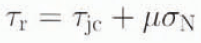
where μ is the coefficient of static friction, and τ jc is the joint cohesion. The “cohesive” shear strength of the joint (τ jc) is a function of its roughness such that a joint can still support a shear stress even at zero normal load. Equation (3) describes the situation where joint-bounded blocks can be removed from the bed, provided that the glacier can exert a shear stress at the ice/rock interface which exceeds τ r.
The removal of blocks along the crest of a rock step for horizontal and vertical joint-controlled surfaces has been modelled by Reference IversonIverson (1989). The conditions modelled were for situations of steady or slowly changing basal water pressures so that water pressures in cracks remained equivalent to cavity water pressures. However, in this analysis basal water pressures are assumed to be atmospheric and the stoss sides of rock steps have a shallow up-glacier dip. Following Reference IversonIverson (1989), Reference ReaRea (1994b) resolved the forces acting on a block at the crest of a subglacial rock step for an up-glacier dipping stoss surface with basal water pressures taken as atmospheric. The upward frictional support from adjoining blocks must first be calculated in order to determine the total shear resistance. When

where A is the contact area in the x, y, z directions, the block is pressed onto its bottom face and bottom frictional resistance is registered.
Two inequalities allow evaluation of the removal potential of specific block sizes for any ice dynamics, bed configuration and joint characteristics. When the upward frictional support from the sides is exceeded (i.e., Inequality (4) >1) and frictional force is mobilised along the bottom block face,

When the upward frictional support from the sides is not exceeded

Using Inequalities (4), (5) and (6) an evaluation of the plucking potential beneath sliding ice is possible.
Evaluation of Shear Removal Beneath Camp Glacier
Determination of Variables
Initially, values for τ jc and μ are taken as 3.79 × 10⁵ N m−2 and 0.66, respectively (Reference Jaeger and Cook.Jaeger and Cook, 1979). Values of θ will be variable but can be measured in the field subglacially, or on forelands as is the case for this research. A reasonable average from measurements taken on the foreland of Camp Glacier is 13°. The size of the block in question controls the value of Ax, Ay, Az . Over 100 boulders were measured on the inner moraine, and average values for the three major orthogonal axes of a particle (a, b, c axes) were calculated. The average values are 1.38, 1.00, 0.74 m = 1.02 m3. For simplicity, this is initially taken as a cubic block with length of side 1 m, which equates to a block of about 3000 kg.
The value of Σ is taken simply from the cryostatic load (ρigh), and T is the drag imparted on the block by ice flow over it. The solution for a cuboid is complex (Reference LliboutryLliboutry, 1979). However, as a first approximation the drag imparted on the block face is inferred from that for a sphere. From Reference LliboutryLliboutry (1979, Reference Lliboutry1987) the drag (T) imparted on a hemisphere with cavitation is:

σ * is for the condition where velocity from plastic deformation and regelation melting–refreezing are equal, i.e. at the transition wavelength (Reference NyeNye, 1969) or controlling obstacle size (Reference WeertmanWeertman, 1957). A cubic block with length of side 1 m lies within this range.
Horizontal laminar flow is assumed, such that the ice flow is directed perpendicular to the cryostatic load as shown in Figure 2. In Equation (7) the cross-sectional area is given by the term πR 2/2. This will be replaced by the effective cross-sectional area (Eesa) of the block which faces vertically up-glacier, i.e. E esa = (x sin θ)(y). Thus Equation (7) can be rewritten

where

(Reference LliboutryLliboutry, 1979).
A reasonable minimum for the lateral stress (σ L) can be taken as Σν/(1 − ν) where ν is Poisson’s ratio (≈0.25 for strong rock; Reference IversonIverson, 1989), which gives σ L = 1/3Σ and a reasonable maximum value of σ L = Σ (Reference Rea, Robinson and WilliamsRea, 1994a).
Reference ReaRea (1994b) undertook reconstructions for Camp Glacier from its snout position on the inner LIA moraine to the ice divide using an iterative model first used by Reference Schilling, Hollin, Denton and HughesSchilling and Hollin (1981). An interpolated subglacial bedrock topography was produced from ice-marginal bedrock and nunatak heights. Using this bedrock profile the basal ice parameters were fine-tuned initially to fit the 1976 ice surface. Once a satisfactory fit had been achieved, similar bed conditions were assumed for the LIA and reconstructions completed. The maximum ice thickness was 190 m and the maximum sliding velocity approximately 15 m a−1 (Reference ReaRea, 1994b).
Results
Using the values given above, an evaluation of the upward frictional support on a block from the adjacent blocks is required. From Inequality (4), if σ L = Σ the upward frictional support is never > 1 and friction along the bottom face is not mobilised, but if σ L = 1/3Σ it is > 1 beneath ice thickness > 105 m.
Both Inequalities (5) and (6) are required to evaluate the removal potential for blocks. In neither situation is sufficient drag produced by ice movement around the blocks to facilitate shear removal from the bed. These calculations are at best rough approximations, but they do show that there is little chance of the removal of bedrock material beneath Camp Glacier. However, extensive LIA erosion is known to have taken place. Proglacial and subglacial observations showed that many of the joints were iron-stained and had thus been affected by some form of preglacial weathering.
Effect of Weathering
The value of τ jc taken initially of 3.79 × 10⁵ Nm−2 from Reference Jaeger and Cook.Jaeger and Cook (1979) is for “moderately rough surfaces”. There is no information on how weathering will affect this value. It is likely that it will increase the joint-roughness coefficient, i.e., from the preferential action of weathering some minerals will be removed. Normally a higher joint-roughness coefficient would increase the strength of the joint. However, with weathering and removal of crystals, the surface may lose shear strength because exposed crystals on the surface will have little support around them and so are likely to fracture and rotate more easily. Thus, in the absence of any published data, τ jc is halved, to 1.895 × 10⁵ N m−2, taking account of the weathering. It should be noted that in places on the foreland and in areas of “immature” blockfield, blocks can be removed from in situ positions by hand. In such situations weathering has reduced τ jc to zero.
Results
From Inequality (4) the lateral stresses will be overcome for ice thicknesses > 37 m. Thus, both Inequalities (5) and (6) are required to evaluate the removal potential for blocks. Figure 3 shows that beneath ice of approximately < 50 m thickness, blocks may be removed from the bed. It is interesting to note that the potential for removal increases as the ice thins (the snout represents a region of high potential erosion). This effect is a result of the decrease in normal force on the bottom face of the block, and of the form drag still remaining high. Figure 3 shows that, in certain circumstances, shear removal of blocks is possible. However, there are other bed parameters which can alter the removal potential.
Blocks can be removed from the bed beneath ice just less than 50 m thick. (Basal sliding velocity = 15 m a−1; σL = 1/3; weathering has reduced τjc by half.)

Bedrock Parameters
Changes in block geometry and up-glacier dip of the stoss side of rock steps will also affect the potential for shear removal of blocks. The following introduces these factors and shows how they may affect the block removal.
Block Geometry
The modelling above was for a 1 m3 rock cube. If blocks are not cubes but cuboid, certain orientations will favour removal while others will reduce removal. On the inner moraine the average a, b, c axes of large blocks were found to be 1.38, 1.00, 0.74 m. Adopting these values such that the x, y, z axes are now 1.00, 1.38, 0.74 m, respectively, provides the lowest possible lateral stress and the largest possible shear removal stress. Assuming pre-weathering along joints, then lateral stresses are overcome beneath all thicknesses of ice. Thus Inequality (5) is used to evaluate the shear removal stress. Figure 4a shows that blocks can now be removed beneath ice <80 m thick.
(a) Modification of the block geometry allows removal beneath ice up to 80 m thick. (Basal sliding velocity = 15 m a−1; σL = 1/3; weathering has reduced τjc by half; θ = 13°; x, y, z axes = 1.00, 1.38, 0.74 m, respectively.) (b) Using the values above but increasing θ from 13° to 20° enhances the removal potential further.

Dip of Stoss Faces
Increasing up-glacier dip (θ) of the stoss faces allows the lateral stresses to be exceeded under lower ice thicknesses. The greater θ the lower the normal stress σ N, but the form drag increases because E esa increases. If the bed dip is taken as 20° and a cuboid block is used, then the potential for block removal is further enhanced (Fig. 4b). It should be noted, however, that the maximum dip up-glacier which could feasibly be considered would be ≈30°. Above this, the dip of the down glacier face of the block will gradually decrease, resulting in cavity suppression.
Processes of Removal Enhancement
A number of other processes are known to exist in the subglacial environment which could potentially aid the process of block removal.
Squeezing of glacier ice along lateral joints was first described by Reference Anderson, Hallet, Walder and AubreyAnderson and others (1982). Beneath Camp Glacier the same process has been observed, and indeed it has gone a stage further with ice being squeezed along the bottom face, suggesting that the block is totally encased in ice (Reference Rea, Robinson and WilliamsRea, 1994a; Reference Rea and WhalleyRea and Whalley, 1994). The sides provide no fractional resistance to movement, and the presence of ice along the bottom face is likely to reduce τ jc effectively to zero. Only the friction along the bottom and sides of the block in contact with ice provide any resistance. In this situation blocks may be easily removed.
Reference IversonIverson (1991) has shown that, as a result of the reduction in normal stresses for a horizontal rock step, the potential for shear removal of blocks is greater for higher basal water pressures. The hydraulic-jack effect of Reference Röthlisberger and IkenRöthlisberger and Iken (1981) provides a further mechanism for the removal of joint-controlled blocks from the bed. The reduction of the normal stress on blocks at the cavity origin favours removal (cryostatic load is reduced by the water pressure).
The Robin heat-pump effect (Reference RobinRobin, 1976) relates to the production of cold patches beneath a glacier at the ice/bed interface. From the work of Reference JellinekJellinek (1959), Reference IversonIverson (1989) gave the shear strength of these adhesion bonds as about 0.2 MPa. This could effectively increase τ RS by about 25%.
If it occurs, stick–slip motion provides very short periods of rapid movement. High velocities, and thus increased form drag, results in increasing erosion potential.
Regions of Protection
Beneath pans of Øksfjordjøkelen, intact blockfields with sorted stone circles are being exposed by ice retreat. These blockfields are at least pre-LIA in age and probably much older (Reference Rea, Whalley, Rainey and GordonRea and others, in press; Reference Whalley, Rea, Rainey, MeAlister and WiddowsonWhalley and others, in press). Thus, past and present ice coverage must have been cold-based. It is likely that only during warm interglacial periods do the outlets slide over their beds and erode. Such problems remain to be fully investigated for this area.
Conclusions
Evidence has been presented above to show that this relatively thin, slow-moving plateau-top maritime ice field can produce substantial erosion of a mechanically hard bed. The erosion is controlled by the favourable rock structure such that joints intersect to produce blocks which can be removed from the crest of an up-glacier dipping rock step. Preglacial weathering is also important as it has reduced the “joint cohesion”, allowing blocks to be removed more easily. Once entrained these blocks provide ideal abrasion tools. Reference LliboutryLliboutry (1994) suggested that little erosion occurs when the preglacially weathered and frost-shattered debris has been removed from the bed. This paper supports his findings to some extent. However, the evidence above also points to the snout being a zone of potentially high erosion, while up-glacier there may be much less occurring, even under faster sliding ice.
Acknowledgements
Thanks go to S. McCarron, J. Hosea and the 1992 Earthwatch Øksfjordjøkelen Expedition, B.R. Rea was in receipt of a Department of Education for Northern Ireland Postgraduate Studentship during the field investigations for this paper.



