


Introduction
International Relations (IR) and Historical IR scholarship have devoted significantly more attention to the 1648 treaties of Westphalia than to the 1848 revolutions and their nationalist demands. This choice of disciplinary benchmarks reflects the fact that, compared to nation-building, state-building has been heavily debated, including with regards to the historical significance of the Westphalian episode. The study of nationalism and nations in IR is not only scarce but also misleading. While IR historians have contested the myth of an international system characterised by anarchy and pointed to various forms of hierarchy among states, notably the ‘standard of civilisations’, they have often treated nationalism as a horizontal division of the world into nations, seemingly deprived of hierarchies. In contrast, this contribution extends the hierarchical turn to nation-building.
Nations are imagined communities, but how do we imagine the nation-based order? While Benedict Anderson’s work centres on determining national boundaries (who belongs, who does not, and on what grounds), he devotes little attention to analysing hierarchies within and between nations (who is where in domestic and international hierarchies), an essential part of what I call the nation-based order. Turning to the Springtime of Nations, often presented as a golden age of nationalism,Footnote 1 this article argues that the 1848 revolutionaries who, on behalf of the brotherhood of nations, demanded the creation of nation-states in Europe imagined hierarchies within and among nations, forming the nation-based order.
Building critically on Anderson’s perspective, I examine how images and imaginaries shape political orders, and in particular the nation-based order and its specific domestic and international hierarchies. Despite the success of Anderson’s notion of ‘imagined community’, imagination, imaginaries, and images have seldom been conceptualised in Historical IR or in IR at large. Images serve to render communities, such as ‘nations’, representable, and thus emotionally resonant. While images have countless significations, their meaning is determined in relation to other images and within the context of a particular imaginary. Conversely, imaginaries are enriched and translated into political orders and hierarchies through images. Investigating the use of fraternal images within nationalist discourses offers a complementary perspective on nation-building.
The Springtime of Nations is an under-examined episode in the trajectory of European nationalism. Following the cancellation of a banquet in Paris, rioters erected barricades, overthrowing the July Monarchy on 24 February.Footnote 2 The revolutionary enthusiasm swiftly spread throughout Europe, challenging the established dynastic order. Nationalism ignited fervent debates in Italian and German states and gained sudden attention within the Austrian Empire. The usual narrative about the 1848 Revolutions usually goes as such: first, the 1848 revolutionaries claimed universal brotherhood and equality, both within and between nations; second, despite the collapse of the Springtime of Nations, resulting in incarceration, exile, and death for many revolutionaries, the nationalist imaginary they promoted would be taken over by dynastic regimes and, through them, would soon become predominant.Footnote 3 Through a comprehensive examination of a diverse array of sources, including memoires, manifestos, revolutionary songs, and engravings, this article addresses both points across four sections.
The first section defines the notions of imagination, imaginaries, and images. Subsequently, the article examines how the 1848 nationalists imagined domestic and international hierarchies through the fraternal images that Anderson thought were horizontal. The second section concentrates on domestic hierarchies, illustrating that while national brotherhoods were almost all-encompassing, they relegated women and formerly enslaved people to lower ranks. Shifting to international dynamics, the third section explores how the concept of the ‘brotherhood of nations’ influenced hierarchies among nation-states, stateless nations, and nationless populations. To a certain extent, this nationalist imaginary was specific to 1848. The collapse of these revolutions precipitated various changes, as showed in the fourth section. The nationalist and revolutionary use of fraternal images was appropriated under an alienated version by some dynastic regimes and opposed by socialists advocating for an international brotherhood of workers.
Conceptualising nationalist imagination, imaginaries, and images
An investigation into nation-building rather than state-building demands an alternative set of theoretical tools and empirical sources. Drawing on Anderson’s insights, I explore the concepts of imagination, imaginaries, and images in relation to nationalism and nations and subsequently outline the methods and archival documents employed.
Imagined nationalism and Historical International Relations
Within IR, nation-states are crucial, but they are predominantly seen as states, sidelining the nation componentFootnote 4 – hence the stress on 1648 rather than 1848.Footnote 5 Despite having discussed the Westphalian myth, IR historians have maintained more emphasis on state-building than on nation-building.Footnote 6
The recent focus on the great transformation of the 19th century is an opportunity to further explore the role of nationalism, which emergedalongside liberalism and socialism.Footnote 7 The reflections on nationalism and nations in the Historical IR scholarship are still significantly influenced by the founding fathers of nationalism studies, namely Ernest Gellner, Terence Ranger, Eric Hobsbawm, and, above all, Benedict Anderson.Footnote 8 However, Anderson’s heritage is paradoxical: despite the influence of his book, most references are limited to its evocative title or to a restrained set of arguments.Footnote 9
Anderson defines the nation as ‘an imagined political community – and imagined as both inherently limited and sovereign’.Footnote 10 The nation is imagined since all its members cannot know each other and must resort to an ‘image of their communion’,Footnote 11 through which ‘the nation is always conceived as a deep, horizontal comradeship’.Footnote 12 This horizontal community has limits imposed by the existence of other nations, and, in comparison with other approaches, Anderson’s project precisely revolves around the determination of these national boundaries. He identifies two historical trajectories. While European nations emerged based on print languages, colonial nations were also imagined through administrative and academic pilgrimages within colonial units. National boundaries are historically produced by the material processes of capitalism and colonisation.
Anderson’s emphasis on boundaries has left many questions unanswered. For instance, the distinction between popular nationalism, which surged in the 1820s and culminated with the Springtime of Nations, and official nationalism, sponsored by dynastic powers in response to revolutionary unrest, appears as a mere shift of actors. Anderson does not analyse the content of national imaginaries, such as the images they use. As a result, he does not study whether different ‘styles of nationalism’ translate into different images. The articulation between the (supposed) horizontality of popular nationalism and the dynastic verticality behind official nationalism is not addressed either. His perspective is more concerned with national limits than with the nation-based order.
Unlike Anderson, IR historians have been increasingly sensitive to hierarchies and have importantly contributed to the ongoing shift from anarchy to hierarchy within IR.Footnote 13 For instance, studies on the ‘standard of civilisation’ have underscored the existing hierarchy between civilised and uncivilised states in the establishment of sovereignty and international law.Footnote 14 However, most IR historians disconnect nationalism from hierarchies and keep defining it as a mere horizontal division of the world into homogeneous blocs,Footnote 15 rather than an order featuring hierarchies within and among nations. In contrast, this article aims to extend the hierarchy turn to nationalism. By focusing on national imaginaries and images, it traces the formation of hierarchies in various archival sources, including revolutionary songs, memoires, and engravings.
A history of national images
This article investigates the nation-based order and its hierarchies through the study of nationalist images. Despite the success of Anderson’s notion of ‘imagined community’, which has been applied to a diverse array of subnational, transnational, and supranational groups,Footnote 16 his approach to imagination, imaginaries, and images has been little explored.Footnote 17 In nationalism studies, Anderson’s ‘imagination’ is usually contrasted with the term ‘invention’ privileged by Gellner, Hobsbawm, and Ranger. While both perspectives point to the artificiality of nations, invention suggests ‘an elite project’, whereas imagination results from ‘a societal process’, placing less emphasis on actors.Footnote 18 Although significant, this distinction does not fully encapsulate the originality of Anderson’s perspective.
Imagination is never properly defined in Imagined Communities, but Anderson’s usage of the notion aligns with its classical definition as the cognitive faculty that reproduces or produces mental images.Footnote 19 Since nations cannot be directly represented, an image is required for the nation to mirror itself – the nation is, for instance, depicted as a band of brothers. Images offer a sensible content to abstract notions. These inadequate images (strictly speaking, the nation is not a band of brothers) are traditionally termed metaphors.Footnote 20 Although inadequate, these images are not arbitrary, as they reveal an analogy between two things, which informs our perceptionFootnote 21 – the nation is something like a band of brothers.
Images are distinct from concepts. Unlike concepts, images ‘do not admit of verification’, as Hans Blumenberg remarks, so that ‘the alternative already decided in them one way or the other is theoretically undecidable’.Footnote 22 While the depiction of the nation as a band of brothers cannot be refuted, it shapes the way the nation is imagined. Fraternal images, are thus ‘more carnal than intellectual … more spontaneous than contemplative’,Footnote 23 providing them with ‘powerful emotional charge’.Footnote 24 Images make the nation imaginable, and thus emotionally resonant. In that sense, images, imaginaries, and affects are intricately interconnected.Footnote 25 The diffusion of the nationalist imaginary through nationalist images produces and reproduces the ‘affective atmospheres’ of nationalism.Footnote 26
While nationalism is poor in concepts and systems, it is rich in images. Distinguishing between images and concepts provides a solution to the paradox pointed out by Anderson: ‘unlike most other isms, nationalism has never produced its own grand thinkers’.Footnote 27 This assertion might hold true if we are looking for concepts but is more disputable concerning images. Nationalists have indeed crafted images with powerful effects. ‘It is this fraternity’, Anderson notes, ‘that makes it possible, over the past two centuries, for so many millions of peoples, not so much to kill, as willingly to die for such limited imaginings.’Footnote 28
Images should not be studied as concepts. When examined purely as concepts, the distinction between ‘brotherhood’ and ‘friendship’ is minimal since both denote a close relationship.Footnote 29 However, when approached as images, brotherhood and friendship reveal distinct constellations of images. The nation as a brotherhood is related to other images, such as ‘fatherhood’, ‘motherhood’, ‘lineage’, ‘family’, or ‘blood’ – all images you would not find in relation to ‘friendship’. While ‘brotherhood’ and ‘friendship’ may be equivalent on a conceptual plane, they are distinct images.
Much like concepts though, images are a concentration of ‘multiple meanings’Footnote 30 with semantic continuities and discontinuities across time, space, and ideologies. The meaning of an image cannot be interpreted solely at the word level; rather, it demands discourse-level analysis to examine in what imaginary this image is inserted.Footnote 31 An imaginary, which is never hegemonic or homogeneous,Footnote 32 is the broader social context which determines the meaning of an image through its definition (what does it mean to be a brother?), uses (who refers to fraternity and why?), extension (who is a brother and who is not?), and articulation with other images. Conversely, an image enriches an imaginary and, through its uses, translates this imaginary into a political order. While an image may be transhistorical (the fraternal image can be found in Greek, Roman, or early Christian discourses), an imaginary is a historical and social product (the nation as a brotherhood originates in Europe in the late 18th century).
Opposite imaginaries can revolve around the same image, as exemplified by the revolutionary ‘nationalist fraternity’ and the reactionary ‘dynastic fraternity’. Both these imaginaries draw on the fabric of early modern European society, wherein fraternal images occupied a central position within dynastic diplomacy, religious and artisanal associations, and masonic groups.Footnote 33 Inheriting from masonic thought and Enlightenment principles, the revolutionaries of 1789 invoked fraternity to put an end to feudal hierarchies.Footnote 34 After the fall of the crown, the nationalist fraternity only recognised vertical relationships with allegorical entities like the Motherland. By contrast, the treaty forged by the reactionary forces of the Holy Alliance (Prussia, the Austrian Empire, and the Russian Empire) after defeating Napoleon lent renew vigour to ‘dynastic fraternity’:
ART. I. Conformably to the words of the Holy Scriptures, which command all men to consider each other as brethren, the Three contracting Monarchs will remain united by the bonds of a true and indissoluble fraternity, and considering each other as fellow countrymen, they will, on all occasions and in all places, lend each other aid and assistance; and, regarding themselves towards their subjects and armies as fathers of families, they will lead them, in the same spirit of fraternity with which they are animated, to protect Religion, Peace, and Justice.Footnote 35
Dynastic fraternity articulates two kinship images – the horizontal fraternity between monarchs (not states or peoples) and their vertical relationships as paternal figures to their subjects. This treaty, meticulously crafted by Klemens von Metternich, interweaves fraternity with Christianity and reactivates an erstwhile diplomatic motif.
Even though they both use fraternal images and associated images (the Motherland versus the royal father), nationalist and dynastic fraternities imagine polarised political orders. The nationalist fraternity established the legitimacy of popular Sovereignty in the third article of the Constitution des droits de l’Homme et du citoyen, making the nation the exclusive wellspring of political authority. On the contrary, dynastic fraternity reaffirmed the dynastic sovereignty emblematic of the Old Regime. The victory of the Holy Alliance over Napoleon’s forces in 1815 appeared to signal the wane of the nation-based order. However, during the eruption of the Springtime of Nations, the nationalist fraternity demonstrated resilience, even extending its reach across Europe.
While almost ignored by the IR scholarship, revolutions are exceptionally fecund episodes.Footnote 36 The 1848 Revolutions developed, enriched, and diffused political imaginaries. Even though ‘most of these rebellions failed, they were not without effect … For both absolutist regimes and their bourgeois challengers, nationalism proved to be a powerful vehicle of mobilization.’Footnote 37 The nationalist imaginary found echoes across Europe. Investigating the uses of fraternal images in this period provides us with valuable insights into the nascent nation-based order and its domestic and international hierarchies.
A methodological approach to images and imaginaries
Images and imaginaries are studied through discourse analysis.Footnote 38 This first requires identifying relevant terms through which the image is conveyed – ‘brother’, ‘brotherhood’, ‘fraternity’, etc. In continuity with Anderson’s practice, there is no limit to the range of sources. Shifting from states to nations introduces IR historians to a great variety of voices and materials, beyond the legal and diplomatic sources they usually deal with.Footnote 39
Discourse analysis is enriched by including as many variations of an image as possible.Footnote 40 While archival studies, especially from the late modern period, are inherently incomplete, the selection of materials aims to reflect the semantic diversity of fraternal images across various social groups and genres. This article consequently engages with diverse sources, ranging from newspapers to songs and engravings. Although some of these documents are written by distinguished authors, like Karl Marx, I aimed to listen to more popular voices whenever possible. For instance, the newspaper, Le Républicain lyrique, published from June 1848 to July 1849, had a significant impact, with no fewer than 10,000 copies printed.Footnote 41 These songs, some of which were well known at the time, are thus stimulating sources to explore popular imaginaries. The broadening of archival sources is not intended to exclude official actors or canonical materials, but rather to complement and juxtapose them with alternative discourses.
Like all methods, the historical study of images and imaginaries suffers from limits, among which I will name two. First, as historians know all too well, archival sources provide us with an easier access to the imaginaries of the powerful. Much less is known about other parts of the population. In 1848, rural revolts responded to urban riots.Footnote 42 While regimes addressed both insurrections as part of the same revolutionary wave,Footnote 43 historians debate on the extent to which nationalism had spread to rural areas.Footnote 44 Did the peasants who were still the majority of European populations imagine urban revolutionaries as their brothers? Given the difficulties of access to testimonies written by these populations and the wide diversity of local situations, one must humbly admit the inherent difficulty in responding.
Secondly, ensuring that a visual representation depicts the nation as a band of brothers – and not, say, as a band of friends – most often supposes a cross-reference with a legend or a text codifying what is represented as fraternal.Footnote 45 Textual sources also present us with diverse practices perceived ‘fraternal’ by contemporaries, such as public oaths or banquets. Rather paradoxically, the analysis of images and imaginaries is dependent on textual sources.Footnote 46
Nations as brotherhoods
National brotherhoods were imagined encompassing everyone, except for dynastic leaders. However, not everyone was included at the same rank. Fraternal images, which for Anderson were inherently horizontal, were employed to establish hierarchies within nations, disadvantaging, for example, women and formerly enslaved people.
The diffusion of the nationalist imaginary through fraternal images
The Springtime of Nations was a turning point in the history of European nationalism. The situation was variable: nationalism was already firmly established and official in France, well-known but rebellious for ‘Italian’ and ‘German’ populations, and barely nascent in Eastern Europe. For the last, nationalism before 1848 was little more than, in Jonathan Sperber’s words, ‘the experience of marching behind the tricolor flag, of large-scale collective singing (national anthems, naturally), of joining in a large public meeting or a small conspiratorial circle’.Footnote 47 The revolutionary events would precisely furnish opportunities for the masses to do so, leading to the formation of imagined communities.Footnote 48
While acknowledging the existence of clandestine societies prior to the revolutions, the revolutionary process favoured political involvement that resulted in the creations of clubs (70,000 in Paris and between 1 and 1.5 million in the German states, equivalent to 10–15 per cent of the male population),Footnote 49 cooperatives (15,000 members in the German workers’ Fraternisation),Footnote 50 and newspapers (from 19 to 306 newspapers in 1848 in the Austrian Empire).Footnote 51 While nationalism did not reach everyone in 1848, an unprecedented multitude imagined themselves as members of national communities.
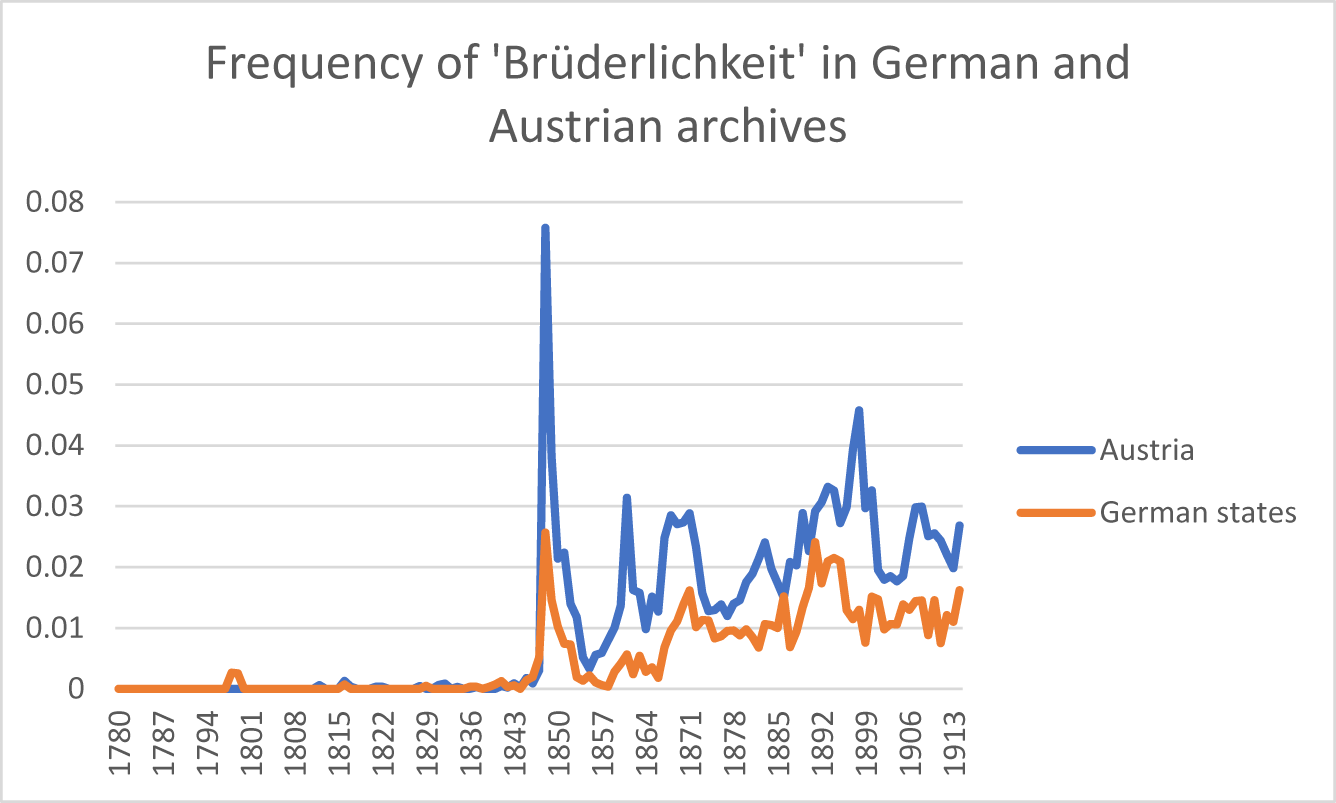
The 1789 Revolution served as both a model and a counterpoint for the 1848 revolutionaries. Amid concerns of replicating the Terror, they embraced the nationalist imaginary forged by the 1789 revolutionaries. The fraternal images at the core of the French discourses in 1789 resonated internationally half a century later (Figure 1). Across Europe, nationalist rhetoric spoke the language of fraternity, making the 1848 Revolutions a ‘springtime of fraternity’.Footnote 52 While this notion was barely used outside of France prior to 1848, fraternity became a central political tenet afterwards.
Charts on the use of Brüderlichkeit (fraternity) in German and Austrian historical archives.a

A dissident nationalist fraternity
Nations encompassed all, except for dynasts. The 1848 revolutionaries’ nationalist imaginary was inseparable from the experience of the barricades. While nationalist circles had hitherto been restricted to an elite in most European countries, the rioters were socially diverseFootnote 53 and served as a metonym for the nation. Despite all their differences, when the revolutionaries first gathered, ‘the euphoria of unanimity was intoxicating’.Footnote 54 Contemporary witnesses and iconography highlighted the collaboration among petit bourgeois, shop-owners, and workers (Figure 2),Footnote 55 a phenomenon later confirmed by historians.Footnote 56
Defenders of the barricade.a

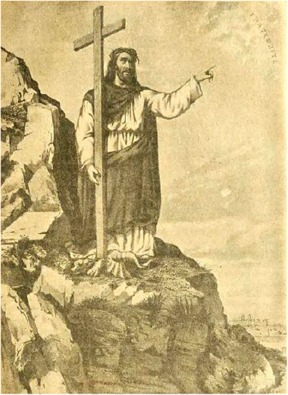
Whenever the uprisings succeeded, revolutionaries employed fraternal images to describe their relationship to each other.Footnote 57 For instance, Marie d’Agoult described the festivities during the night of 23 February: ‘In the effusion of this common celebration, bourgeois and proletarians were holding hands, frock coats and overalls were familiarly getting closer. A feeling of joyful fraternity was pouring out of all the hearts.’Footnote 58 Fraternal banquets, a common practice in the French liberal repertoire by 1848, celebrated the national brotherhood, as illustrated by the French city of Meaux in June 1848.Footnote 59 In various German states, Protestants, Catholics, and Jews praised the united front they presented against their respective regimes.Footnote 60 In France, French priests, once ferocious opponents of the French Revolution and its legacy, offered their blessings for the planting of liberty trees, formerly deemed heretical.Footnote 61 Fraternal images, present in both Christian and revolutionary imaginaries, were amalgamated in the ‘Christ of the Barricades’Footnote 62 (see the right-hand corner of Figure 3).
The Christ of the Barricades calling for fraternity.a

The boundaries of national communities did not always align with linguistic and ethnic divisions. In the Austrian Empire, the term ‘nation’ could still diversely refer to the nobility, the ethnic components of the empire, or all its subjects.Footnote 63 In Prague, Friedrich Sacher’s verses exemplify the multiethnic and multilingual brotherhood:
Beyond ethnic and ideological divides, everyone could be included in national brotherhoods.
The nationalist fraternity was not, in Karl Marx’s phrasing, an ‘imaginary abolition of class relations’Footnote 65 but rather an abolition of class conflicts. The diverse social, ideological, and ethnic identities were not dissolved in the national community, as the emphasis in visual and textual representations on social markers shows, but integrated into it. Despite the perceived differences among community members, they were all considered part of the nation, with few exceptions.
Dynasts were excluded from the nation. Whereas the insurgents lauded allegorical verticality, as in the German song proclaiming ‘Germany, great fatherland, fraternity embraces you’,Footnote 66 they refused dynastic authority. Nationalism was more than just ‘popular’, as Anderson termed it; it was distinctively dissident. Nationalist symbols were subversive. This was particularly evident for nations under foreign domination, like the Irish, Polish, and Italians, but even the black–red–gold flag symbolising a unified Germany carried rebellious connotations in many German states.Footnote 67 In countries like France, in which nationalism was institutionalised, the insurgents employed alternative national symbols. Bringing back the spirit of the French Revolution, the 1848 revolutionaries sang ‘La Marseillaise’, the official national anthem since 1830, albeit informally replaced by ‘La Parisienne’. The tricolours, first embraced by France during the 1789 Revolution and subsequently by its ‘sister republics’ in the 1790s, proliferated throughout Europe in 1848, embodied in flags or cockades.Footnote 68
Dynasts were accused of having damaged the national brotherhood. Ludwig Pfau’s song, ‘Zum 18. März’, laments this fratricide orchestrated by the crowns:
However, when victorious the insurgents extended their brotherhood to the agents of repression.Footnote 70 Prussian workers sent a petition to ask for forgiveness on behalf of yesterday’s opponents: ‘The grave which has closed above our beloved heroes has for ever buried all hatred and fraternal strife. We demand that a brotherly hand of forgiveness should also be extended to our army.’Footnote 71 While this fraternal appeal was dryly refused by the soldiers in Prussia, a similar demand in France led to common funerals and ceremonies for both revolutionaries and troops.Footnote 72 Yesterday’s enemies were forgiven and embraced in the national brotherhoods.
National communities are imagined as limited. While linguistic boundaries were already structuring in 1848, national limits were mostly delineated by the barricades. On one side, a national brotherhood encompassing a great diversity of people; on the other, dynasts.
A female rioter in Prague (left);a nuns taking care of German revolutionaries (right).b

Hierarchies within brotherhoods
Pace Anderson, national brotherhoods, although largely encompassing, were not horizontal. Nationalist violence is usually conceived through the exclusion of individuals and groups from the nation.Footnote 73 However, nationalism is not mere othering; it is also ordering. Fraternal images established hierarchies within the nation This is particularly evident for women and formerly enslaved people.
First, fraternity suggests a masculine community.Footnote 74 Were women brothers too? Although women were forbidden from participating in clubs before 1848, except in France, they played an active role in revolutionary endeavours (Figure 4).Footnote 75 Some invoked fraternity to advance women’s social and political status.Footnote 76 Addressing the French provisional government, the Comité des femmes stated: ‘Women … ask, on behalf of fraternity, to make liberty and equality a truth for them as well as for their brothers.’Footnote 77 The revolutionary representations were divided about the involvement of women in revolutions. In consonance with the Madonna–whore complex, women were either exalted as heroines and icons of the allegorical Motherland or ostracised and mocked as Furies if they diverged from gender norms, including by participating in battles (see Figure 5).
‘Toast raised to the emancipation of women by women already furiously emancipated’, in The Prospective Divorcees by Honoré Daumier.a

Moreover, the memory of female revolutionaries was frequently erased from historical accounts,Footnote 78 and successful revolutions scarcely ameliorated their situations. For instance, the so-called universal suffrage in France was confined to male voters. The nationalist fraternity, which ignored women, contributed to their exclusion, not from the nation but from the civic community.Footnote 79 Women were imagined community members but as mothers, not as equal sisters.
Secondly, in spite of sporadic episodes of antisemitism in France and German states during the Springtime of Nations,Footnote 80 ethnic minorities generally found inclusion within national brotherhoods. Additionally, the principle of fraternity was employed in the calls for abolition. Although abolished in 1794 under the banner of ‘universal fraternity’,Footnote 81 slavery had indeed been reinstated by the Napoleonic regime in 1802. Already before 1848, about a thousand Parisian workers sent a petition to Parliament in 1844: ‘Obeying to the great principle of Human fraternity, we come here to advocate for our unfortunate brothers, the slaves…’.Footnote 82 This appeal was succeeded by a second one from Lyon in 1847. The February revolution ignited renewed ardour for the matter, culminating in abolition on 2 April. Formerly enslaved people were granted citizenship and tasked with their national service, emblematic of their ‘fraternal assimilation to the motherland’.Footnote 83 Black slaves were brothers too.
However, fraternal images were dual, as they contributed to the construction of racial hierarchy in colonial spaces. In March 1848, Victor Schoelcher was entrusted with a delicate task: to ‘wait and prepare [the abolition of slavery in colonies] in an attitude of calm and fraternal concord’.Footnote 84 Indeed, the announcement of the abolition of slavery posed a risk of igniting violence in colonial spaces where the social climate was already tense. Enslavers were not only worried about losing their economical labour force but also dreaded insurrections. Sarda Garriga was thus sent by the Republic to La Réunion to handle this situation. Following the instructions he had been given, he consented to compensate enslavers for their financial losses and to delay the proclamation of abolition until after the sugar-cane harvest in December.Footnote 85 After these negotiations, Garriga claimed:
Yes, an appeal to all of you, Colonists already free and Colonists who will soon be, for God has created you as brothers and I merge you in my affection … If those whom a sad classification had made masters must bring a spirit of fraternity and benevolence into their dealings with their former servants … do not forget, you brothers who are about to be the new chosen of the city, that you have a great debt to pay to this society into which you are about to enter … [I]f you remain at work having become free, I will love you; France will protect you. If you desert it, I will withdraw my affection; France will abandon you like disobedient children.
By contrast to the events in Martinique,Footnote 86 the fears of Reunionese enslavers were unfounded, as Garriga’s speech caused minimal unrest. On 20 December, Garriga claimed the abolition of slavery and affirmed that enslavers and enslaved people were ‘all equal before the law, [and] only [had] brothers around [them]’. Promptly, Garriga reiterated his counsel: ‘you call me your father; and I love you like my children; you will listen to my advice: be eternally grateful to the French Republic that freed you’.Footnote 87 However, many enslaved people, apparently not so grateful towards their former enslavers, left the fields. Garriga issued a stern admonition on 17 February 1849: ‘I am not pleased with you … Children of the Motherland, I have come to grant you freedom in her name … in her name, I will punish those disturb the order by abandoning work.’Footnote 88 In parallel, landowners had already turned to indentured labour (engagisme) and favoured immigration from Madagascar and India to replace their lost workforce.
Throughout his speeches, Garriga extensively employed fraternal images, evoking the national brotherhood. However, the specific use of fraternal images in colonial spaces reveals the racial organisation of the nation. The Motherland, nurturing and affectionate in Europe, proved to be a wicked mother to her racialised children. Furthermore, the representatives of the Republic, like Garriga, presented themselves as fatherly figures of authority. Fraternal images included the new citizens within the nation but portrayed them as perpetual minors, maintaining domestic hierarchies. All brothers were equal, but some more than others.
Fraternal images did not exclude women and formerly enslaved people from the nation and, on the contrary, integrated them within the community – at a lower rank. Beyond exclusion, nationalism resulted in domestic hierarchies.
The brotherhood of nations
The 1848 revolutionaries had an acute awareness of the international dimension of their struggle. While some aspired to a borderless world, many championed a brotherhood of nations representing a nationalist interpretation of internationalism. However, this brotherhood of nations established a hierarchy between nation-states, stateless nations, and nationless populations.
Socialist imaginaries: Brothers without borders
To begin with a caveat: even though the nationalist imaginary had an extraordinary impact, the nation-based order was not the only approach to the international. During the 1848 Revolutions, some radical republicans and socialists regarded nationalism sceptically.
The so-called utopian socialists employed fraternal images to depict their internationalist world. In the first half of the century, Henri de Saint-Simon, a prominent French socialist, believed that a fraternal and peaceful unification of all peoples and nations would progressively arise from the process of civilisation.Footnote 89 The nationalist fraternity was transitory and would soon be overcome by international fraternity. Other socialists, including Étienne Cabet, who sought to establish a Christian variant of communism, maintained that fraternity was a fundamental principle of socialism.Footnote 90
Socialists, who gained popularity in 1848, remained a minority. However, some popular songs, called goguettes, echoed their perspectives. Victor Rabineau, from an anti-militarist stance, critiqued in ‘La gloire militaire’ (‘Military glory’) the excess of the nationalist fraternity:
Certain singers transformed this pacifism into an anti-nationalist version of internationalism. Jules Chalory presented a new Marseillaise titled ‘La Marseillaise européenne et universelle’ (‘The European and universal Marseillaise’), which tempered the martial tone of the original song:
While using the melody of the ‘Marseillaise’ was common, employing this renowned war anthem to endorse the complete eradication of war, borders, and states carried a hint of audacity. Blood, once a nationalist rallying cry for warfare, turned into the binding force for international harmony. Via fraternal images, these radical revolutionaries imagined a new international order transcending nations and states.
The nationalist brotherhood of nations
In 1848, socialist imaginaries had less influence than their nationalist counterparts. Nationalists employed fraternal images to refer to foreign revolutionaries too. As word of the Parisian riots disseminated, impassioned clubs and circles, some pre-dating the revolution and others emerging in its aftermath, sent fraternal letters to the provisional government:
Brothers! Coimbra students could not stay silent while witnessing your achievements … your love for freedom and your devotion to the cause of the peoples. You have unchained France, you have prepared for the Italian and German unities, emancipated Austria, helped the Polish revolution, accelerated the fall of absolutism in Europe … and we, from afar, we wish for the triumph of the holy cause that you defended, which is ours too, the cause of the Peninsula, of the nations, of the whole of humanity … The Holy Alliance is dead and in our hearts the love for freedom grows stronger everyday … Viva the Peninsula! Viva the freedom of all peoples! Viva our brothers in Paris, Italy, Berlin, and Vienna!Footnote 93
Immigrants in Paris formed impromptu delegations to felicitate the provisional government. Hungarians marched proudly alongside Parisians, singing both the ‘Szozat’ and the ‘Marseillaise’.Footnote 94
Many 1848 revolutionaries imagined the nation-based order via Giuseppe Mazzini’s image of ‘brotherhood of nations’.Footnote 95 In La santa alleanza dei popoli, published in 1849, Mazzini asserted that ‘nations are the individuals of humanity in the same way citizens are the individuals of the nation’, so that the nation is ‘an intermediary term between humanity and the individual’.Footnote 96 Nations were thus established as essential and natural units. This nationalist view translated into action through the Mazzinian Young Europe (Giovine Europa) groups, which collaborated but were structured around national foundations.Footnote 97 While nationalism and internationalism are often perceived as opposing forces, the brotherhood of nations embodied a nationalist form of internationalism.
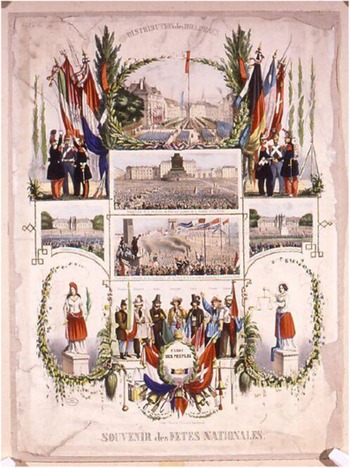
Nations arose through international emulation, and nationalist repertoires traversed borders.Footnote 98 European nationalists imitated each other to achieve a widely recognised ideal and gain acknowledgement from other nations. Foreign revolutionaries embraced certain symbols linked to French nationalism, like Phrygian capsFootnote 99 and ‘the Marseillaise’, particularly in German states,Footnote 100 while others were tailored to local circumstances. Tricolour flags were prevalent among European nationalists, fostering aesthetic cohesion (Figure 6). These paralleled nationalist symbols illustrated the brotherhood of nations. In Vienna, Austrian French, Hungarian, Polish, Croat, Slovene, and Serb students fraternised by exchanging flags.Footnote 101
Union of the peoples.a

The hierarchy of the brotherhood of nations
The brotherhood of nations implied aiding stateless nations. Nationalists endorsed foreign national aspirations prior to 1848, as seen during the Greek War of Independence (1821–9). This international empathy grew through the multitude of exiles traversing Europe in the 19th century, known as the ‘century of exiles’.Footnote 102 After the failure of the November uprisings in 1830, thousands of Poles, especially from political and cultural elites, were compelled to emigrate. Polish immigrants held sway in the French capital, forging a distinctive cultural bond between both nations. Poets such as Alfred de Vigny and Victor Hugo, alongside popular singers, invoked the Polish tragedy and called for a French expedition.Footnote 103 Across Europe, exiles championed the cause of nations.
The Springtime of Nations ignited fresh aspirations among these exiles. Songs glorifying fraternal sentiments towards ‘Sister Poland’, as it was termed, proliferated, including Louvet’s ‘Le Citoyen Mayeux en 1848; (‘The Citizen Mayeux in 1848’):
In March, an anonymous poster warned: ‘Don’t forget Poland! It is not just a nationality, it is a principle, the principle of fraternity, of national independence, that you just proclaimed and that you have to defend now.’Footnote 105
Outside France, numerous Italians, also under Austrian Empire occupation, resonated with the shared destiny of the Polish, evident in ‘Fratelli d’Italia’ (‘Brothers of Italy’), written in 1847 and gaining popularity amid the protests:
Remarkably, sympathy for Poland was also found in the countries that annexed it. The Polish delegation, received by the Austrian emperor for a dialogue, garnered fervent welcome from the Viennese populace.Footnote 106 In Berlin, Polish nationalist Ludwik Mieroslawski’s release from prison prompted a crowd to jubilantly hail Poland.Footnote 107 In the name of fraternity, the 1848 revolutionaries fought to establish their own nation-states and to support foreign efforts in forming theirs.
Nevertheless, the brotherhood of nations between nation-states and stateless nations led to a nuanced hierarchy. Charles Colmance’s song, ‘Appel à tous les peuples’ (‘Call to All the Peoples’), extolled the defence of martyred nations:
While all nations marched together towards a shared purpose, the French, after 1789, 1830, and February 1848, asserted their primogeniture. All nations held equal legitimacy for statehood but did not share an equivalent standing within this brotherhood – at least for now.
The French provisional government heightened the hierarchy within the brotherhood of nations as a measure to prevent exporting the revolution. As Fred Halliday observes, revolutionary regimes often adopt conservative foreign policies to avert adding international conflict to domestic upheaval.Footnote 109 In his March 1848 Manifesto to Europe, Alphonse de Lamartine, a prominent provisional government figure, aimed to restore confidence in France’s commitment to pacifism. Unlike the national disunity that led to war in 1792, the ‘fraternity, that we proclaimed and that the national assembly [would] organise, [was] going to unify everyone’ in 1848. This domestic fraternity would evolve into an international ‘fraternity and peace’.Footnote 110
While Lamartine employed the fraternal rhetoric, invoking ‘over the peoples’ borders … the constitution of international fraternity on the globe’,Footnote 111 his manifesto left uncertain to whom this international fraternity was directed: nations or crowns. On behalf of popular sovereignty, Lamartine asserted nations’ entitlement to overthrow regimes, akin to the French. However, ‘nations, like individuals, have different ages’Footnote 112 and ‘a people would lose itself by forestalling the hour of its maturity as it would dishonour itself by letting this hour pass without seizing it’.Footnote 113 Implicitly, French primogeniture validated the revolution in France while urging other nations to exhibit patience. The brotherhood of nations was indeed subordinated to France’s desire to ‘enter the family of institutionalised governments’.Footnote 114 To appease European crowns, Lamartine relegated the younger brothers to beneath the French elder, and the brotherhood of nations to that of states.
French diplomatic moderation garnered varied reactions from foreign revolutionaries. While denying foreign backing, it averted an invasion à la Napoléon. French revolutionaries were possibly the most discontented. A popular movement urged the newly elected parliament to deliberate on the Polish issue by 15 May. On that day, a sizable crowd infiltrated the assembly, storming the building and demanding a Polish expedition and new elections – with limited success. Around a month later, the shift of the Second Republic towards conservatism would quash these aspirations. The popular brotherhood of nations was deceived by the fraternity of states proclaimed by the regime.
The brotherhood of nations omitted rather than explicitly excluded nationless populations. The conquest of Algeria, launched by French forces in 1830, was largely accomplished following Abdelkader’s surrender in December 1847. The Algerian question was thus vivid for French revolutionaries. Here too, goguettes offer an interesting mirror to the nationalist imaginary. In ‘Ne désespérons de rien’ (‘Let’s Not Despair of Anything’), the same Rabineau who lamented the consequences of the love for the fatherland in Europe praised French conquest elsewhere:
Another singer, Victor Drappier, paid homage to the defeated emir (‘Son of the desert, your name shall not die’), while celebrating French victory:
Via integration into France, Algerians were offered the opportunity to partake in national progress. Nevertheless, singers were not oblivious to the suffering arising from Algerian colonisation – at least from the perspective of the settlers, as depicted in Gustave Leroy’s song: ‘To finally live, we’re expatriating ourselves / Farewell to France, farewell, Motherland.’Footnote 117 The possibility of an Algerian Motherland or nation was, of course, never raised.
The nation-based order was imagined as segmented into bands of brothers. A hierarchy prevailed among these brotherhoods, distinguishing elder nation-states from young stateless nations. However, the nation-based order excluded most populations, those lacking nations and consequently popular sovereignty. Fraternal images thus contributed to shaping what Edward Said called the European ‘imaginative geography’.Footnote 118 Nationalism aligned with the ‘standard of civilisation’: the brotherhood of nations was implicitly a brotherhood of civilised nations.Footnote 119
The collapse of the Springtime of Nations and imaginaries in crisis
European reactionary forces put an end to the Springtime of Nations. The previous divides resurged in various places. After the pope’s initially ambiguous stance, he eventually excommunicated the Roman constituent assembly in December 1848, causing many Catholics to leave the revolutionary fronts.Footnote 120 The peasantry, once fervently involved in uprisings against Austrian forces in Lombardy, had by July become predominantly against a war they believed favoured the landlords, with some even cheering ‘Viva Radetzky!’.Footnote 121
The collapse of the Springtime of Nations turned into a crisis of the nationalist imaginary, visible in the uses of fraternal images. The revolutionary fraternity was appropriated under an alienated version by dynastic regimes and opposed by socialists advocating for the international brotherhood of workers. The demise of the 1848 Revolutions did not mark the end of fraternal images but rather led to the dominance of specific fraternal images over others.
Tu quoque, frater mi?
The June massacre in Paris was notably brutal. The closure of national workshops by the new parliament on 21 June prompted the Parisian proletariat to take once again to the streets. Cavaignac, who led the repression, portrayed the conflict as a fratricide, asking ‘the brothers who are only misled’ to surrender.Footnote 122 However, the conflict was fierce, resulting in the death of 4,000 insurgents over four days, with an additional 4,000 deported to Algeria. Brothers slaughtered their brothers.
Nationalists, including the singer Loynel, were hopeful that the collective mourning after the massacre, would renew the ‘holy union of the noble fraternity’:
Pierre Dupont, perhaps the most distinguished singer in Paris, conveys a similar sentiment in his song ‘Les journées de juin’ (‘June Days’):
Both songs focus on mourning, deliberately sidestepping the episode of the massacre itself. Portraying France as a grieving mother underscored the fraternal connection between insurgents and repressive forces, while discreetly omitting details of who inflicted harm on whom and to what extent. The fratricide became a foundational sacrifice, perhaps reminiscent of the myth of Remus and Romulus.
This mythical standpoint, shaped by destiny rather than political decisions, is present in multiple goguettes. Dupont vividly depicted the battle: ‘Guns and the brutal cannon / Abundantly vomited on the city / A furnace of metal / Ignited by civil war.’Footnote 125 Festeau, another singer, employed comparable phrases: ‘Fire, iron, while riddling the walls / Break the fraternal network in our hearts.’Footnote 126 From these portrayals, the blame for the massacres was attributed to the weaponry rather than to those wielding it. Admittedly tragic, the fratricide should nevertheless not impede the establishment of the national brotherhood.
By contrast, socialists denied the nationalist imaginary after the massacre. Prior to the 1848 Revolutions, many were sceptical towards nationalism and its fraternal images. In a London speech in November 1847, Karl Marx and Friedrich Engels ironised about the ‘brotherhood of nations’, that is ‘the brotherhood of the oppressors’.Footnote 127 Engels asserted that ‘because the condition of the workers of all countries is the same, because their interests are the same, their enemies the same, they must also fight together, they must oppose the brotherhood of the bourgeoisie of all nations with a brotherhood of the workers of all nations’.Footnote 128 International worker fraternity would emerge to counter dual threats: domestic fraternity potentially pacifying social conflicts and the influence of the international bourgeoisie. However, other socialists were undeniably more sensitive to nationalism, like Mikhail Bakunin, who, incarcerated in the Austrian Empire, urged Slavic ‘brothers’ to offer ‘a fraternal alliance to the Magyars’ to achieve a ‘Fraternity of Nations’ through Slavic republics in Central and Eastern Europe.Footnote 129
The collapse of the Springtime of Nations confirmed the traitorous nature of the bourgeoisie. Marx accused the nationalist fraternity and the brotherhood of nations of being empty words. While Lamartine had prioritised France’s internal development over Italy and Poland,Footnote 130 the June massacre exposed the class struggles within the nation:
Fraternité, the brotherhood of antagonistic classes, one of which exploits the other, this fraternité which in February was proclaimed and inscribed in large letters on the façades of Paris, on every prison and every barracks – this fraternité found its true, unadulterated, and prosaic expression in civil war, civil war in its most terrible aspect, the war of labour against capital … This brotherhood lasted only as long as there was a fraternity of interests between the bourgeoisie and the proletariat.Footnote 131
Marx’s bitterness was echoed by socialist singers who, like Rabineau, rejected the false national brotherhood:
Gustave Leroy reminded to the victors of June that, unlike those who shot the insurgents down, the February rioters ‘Forgave their brothers [the troops] / Who followed their oath and their duties. / That’s because they thought about their mothers.’Footnote 133
Fraternal images would serve a new imaginary based on classes rather than nations. The mistake was not to believe in fraternity, but to think that the latter could be extended beyond workers. The singer Charles Gilles, for instance, reserved the notion for the defeated of the June barricades:
After the 1848 Revolutions, the nationalist imaginary had lost for many its suggestive power, but fraternal images remained evocative. Even someone as sceptical of ‘brotherhood’ as Marx resorted to it in the construction of the First International – possibly driven by strategical motives. In the report of the General Council, he affirmed, perhaps as a response to the 1848 Revolutions, that ‘one of the main aims of the [International Workers’] Association [was] to develop amongst workers from diverse countries not only the feeling of fraternity but its fact’.Footnote 135 The international brotherhood of the workers would slowly emerge from the ruins of the Springtime of Nations and enrich the socialist imaginary of the second half of the 19th century.
Institutionalising the national fraternity
No less than revolutionaries, regimes were divided regarding nationalist imaginary and its fraternal images. While some rejected it completely, other European dynasties acknowledged the nascent nation-based order – and used it for their own purposes.
In France, perhaps because the nationalist imaginary was relatively stronger than in most parts of Europe, the president Louis-Napoléon, soon to be Napoléon III, avoided fraternal images, too clearly associated with the republican lexicon.Footnote 136 After the coup, the French motto ‘Liberty, Equality, Fraternity’ was taken down from façades. Napoléon III himself seldom employed fraternal images in his speeches, reserving them for military contexts.Footnote 137 Fraternité, which peaked during the 1848 Revolutions, disappeared from discourses shortly after (see Figure 7). When Napoléon III staged his coup in December 1851, the term was no more in use than it had been prior to the Springtime of Nations. A subsequent revolution, the Paris Commune in 1871, would provide it with a renewed impetus, before it was reinstated into the French motto by the Third Republic.
Use of ‘fraternité’ in French newspapers from 1847 to 1852.

Elsewhere in Europe, where the nation-states were still a project, fraternal images offered significant advantages. During the Italian Risorgimento, ‘the notion of fraternity was clearly associated to the revolutionary nationalist side’.Footnote 138 While the nationalist fraternity was abundantly used in the republican states of Rome and Tuscany in 1848–9, it was intentionally omitted from the Statuto Alberto, a constitution granted ‘with regal loyalty and fatherly’ by Carlo-Alberto, king of Sardinia. The latter, blessed by God, established indeed a fatherly vertical fraternityFootnote 139 with his subjects, affecting to be ‘more a father than a king’ (‘più Padre che Re’).Footnote 140
However, the kingdom of Sardinia relied on a syncretism of imaginaries between dynastic fatherhood and national brotherhood. Already in 1847, Giuseppe Bertoldi had affirmed in his ‘Inno nazionale’ (‘National Hymn’):
While drawing on the nationalist fraternity and its struggle for freedom against tyrants, the song conveys a benevolent version of paternalism. While the paternal figure acknowledged the national brotherhood, the latter embraced a vertical relationship to the throne. The nationalist fraternity was institutionalised in a novel guise,Footnote 142 supporting an altered form of the nation-based order. Contrary to what Anderson seemingly assumes, official nationalism reshaped the nationalist imaginary, as evident in its utilisation of fraternal images. This combination of fraternal nationalism and dynastic fatherhood served the nation-based order, while transforming it – and vice versa. If we want everything to remain as it is, everything must change.Footnote 143
Amid the downfall of the Springtime of Nations, the political visions of the latter half of the 19th century, particularly socialist and official nationalism, are already apparent. Through these reinterpretations of fraternal images, the nascent nation-based order underwent transformations, gained legitimacy, and faced new challenges.
Conclusion
The Springtime of Nations gave an unprecedented platform to nationalism across Europe. Revolutionaries proclaimed fraternity within and between nations, but this very fraternity produced domestic and international hierarchies. Women and formerly enslaved people, although included in nations, were not equal community members. Stateless nations, although legitimate in their aspirations, were not equal to their elder brothers and were asked to show patience. Nationless populations were not even part of the brotherhood unless they integrated into one of the existing European nations. The 1848 revolutionaries imagined the nation-based order as one with domestic and international hierarchies.
After the collapse of the Springtime of Nations, the nationalist imaginary dreamed by the 1848 revolutionaries entered into crisis. While some insurgents endeavoured to renew the nationalist fraternity after fratricides, socialists and regimes transformed in various ways fraternal images to establish new communities. Following 1848, fraternal images were used across the political spectrum to support, discuss, and refuse the nation-based order.
Exploring fraternal images introduces us to political imaginaries and the domestic and international hierarchies they produce, extending the hierarchy turn in IR to nationalism and nations. While historians have long studied sensibilities and imaginaries, Historical IR scholarship has so far mostly focused on states, and thus, on legal and diplomatic documents. Approaching nation-states as nations, and thus, as products of our imagination, broadens this perspective by including another range of sources and voices that have shaped political imaginaries. Incorporating nationalist imaginaries and images into our historical analysis broadens the scope of Historical IR scholarship and enhances its connection with Cultural History.
The historical investigation initiated in this articleis far from exhausted. Studying how other images were used during the Springtime of Nations would complete and, perhaps, nuance the perspective developed here. Furthermore, after the 1848 Revolutions, nationalists and internationalists of all stripes would support or resist through fraternal images the nation-based order to which the world was gradually shifting. As late as during the 1960s decolonisation, fraternal images served anti-colonial movements in imagining national, pan-African, pan-Islamic, and pan-Arab communities. Accounting for these images traces how the nation-based order in which we live has been diversely imagined, limited, hierarchised, legitimised – and challenged.
Video Abstract
To view the online video abstract, please visit: https://doi.org/10.1017/S0260210524000561.
Acknowledgements
I want to express my deepest gratitude to Edward Keene, who suggested I should ‘have a look’ at the Springtime of Nations. I also thank the three anonymous reviewers for their helpful suggestions, as well as Quentin Bruneau, Julia Costa López, John de Bhal, Mathieu Delaveau, Karim El Taki, Clémence Fourton, Johanna Gautier-Morin, Kaoutar Ghilani, Ross J. Gildea, Eric Haney, Guillaume Lancereau, Paul Robin, Héctor Ruiz Soto, Paola Solimena, Claire Vergerio, Tomas Wallenius, and, last but not least, Sonia Gavory, for their comments and kind support.





 Open access

