




Introduction
Tell el-Retaba is in north-eastern Egypt, in the middle of Wadi Tumilat. The site is best known for its fortresses that were built during the New Kingdom (1550–1070 BC). Since 2007, a Polish-Slovak archaeological mission has been working at Tell el-Retaba, exploring the remains of the settlement built on the ruins of the fortresses during the Third Intermediate Period (TIP; 1070–664 BC). Archaeological investigations at the site show how the new geopolitical and ethnic realities of this period (i.e. the collapse of the New Kingdom empire, invasions by Libyans and Sea Peoples, political defragmentation of Egypt under the Libyan rule) affected daily life in a provincial Egyptian town.
The TIP settlement covers the entire area of the New Kingdom fortresses (Figure 1) and the strata are relatively thick, up to 5m in the western part of the site: six main phases have been distinguished (Jarmużek et al. Reference Jarmużek, Rzepka and Ryś2020). Space organisation within the settlement indicates organic development throughout all phases.
General plan of excavated structures at Tell el-Retaba. Structures dated to the Third Intermediate Period are marked in red (figure supplied by University of Warsaw).

Structures
Most structures were houses but stables, workshops and magazines have also been found. Most of the houses were 40–80m2 and comprised 2–5 rooms each. The biggest building—house 3111—covered 116m2 with a courtyard of at least 35m2 (Figure 2). The houses vary significantly in layout: some are L-shaped, while others have a rectangular or irregular plan. Many houses included a mudbrick bench, a fireplace and several pottery vessels cut into the floor; a suite of features indicative of ‘living rooms’. Occasionally other types of domestic installations, such as small mudbrick bins or ovens, were found. The size and furnishing of the houses indicate that they were mostly owned by members of the lower social classes.
Plan of structures belonging to phase C3a (tenth–eighth centuries BC) (figure supplied by University of Warsaw).

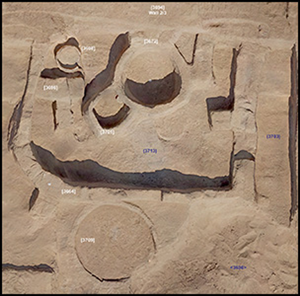
Two large buildings were identified as stables. Stable 518 was at least 148m2. It consisted of two long rooms with large tethering stones. The structure was suitable for keeping large animals such as cows or horses (Figure 3). Stable 3413 was smaller and irregular in layout. Magazines and workshops were mainly found in Area 10 (Jarmużek et al. Reference Jarmużek, Ryś, Wodzińska, Sójka and Rzepka2022). Many round grain silos were found in this area as well (Figure 4).
Excavation of stable 518 (phases C1–C3, tenth–eighth centuries BC) (figure supplied by University of Warsaw).

Silos in Area 10 (phases C1–C2, tenth–eighth centuries BC) (figure supplied by University of Warsaw).

Small finds
The assemblage of small finds (Figure 5) covers different categories of objects that reflect everyday activities in the past: mainly fishing, animal husbandry and agriculture. Daily life focused on food preparation—attested by large numbers of ground stone tools and limestone vessels—and craft activities, including weaving and spinning, metalworking, leatherworking, pottery making, net making and basketry. The assemblage also includes objects connected with private religious practices, such as faience amulets or clay cobra figurines.
Examples of objects found inside the houses at Tell el-Retaba: A) grinder; B) scraper made of a potsherd; C) cuboidal grinder; D) bronze needle; E) bronze strainer; F) bone needle; G) faience scarab; H) faience pendant depicting Pataikos; I) faience pendant depicting one of the Egyptian goddesses Bastet or Sakhmet (figure supplied by University of Warsaw).

Pottery
The assemblage of ceramic vessels from TIP domestic contexts includes closed forms—mostly large storage jars with two vertical handles (Figure 6A & B) and cooking pots (Figure 6C)—and open forms—mostly used during the preparation and consumption of food (e.g. Figure 6D & E), including bread baking (Figure 6F). The majority of vessels were found fragmented in secondary deposits. Storage jars (most probably for water) were positioned in cuts in the floors of some rooms (Wodzińska Reference Wodzińska2019: 95). The remains of about a dozen small conical cups (Figure 6D), probably used for drinking, were found loose on the floors or in small cuts in the floors (Wodzińska Reference Wodzińska2019: 95, fig. 9). The pottery appears to have been made locally, though a few imported amphorae (e.g. Figure 6G) show small-scale international trade.
A selection of pottery types from the TIP Tell el-Retaba (phases C1–C2, tenth–eighth centuries BC) (figure supplied by University of Warsaw).

The TIP ceramic forms from Tell el-Retaba can be more precisely dated to two general time frames: the eleventh–tenth and ninth–eighth centuries BC (especially the conical cups that are also found at Memphis; Aston Reference Aston, Aston and Jeffreys2007: fig. 29, nos. 167–176 and fig. 31, nos. 207–214), which cover the Twenty-first Dynasty. However, most of the material comes from the Twenty-second Dynasty (phases C1–C3). So far, no pottery characteristic of the Twenty-fifth Dynasty has been recovered at Tell el-Retaba.
Zooarchaeology
The local population exploited resources available in the local wetlands and lakes and raised several species of livestock (Gręzak Reference Gręzak2020). Locally caught fish, including catfish, tilapia, Nile perch, globe fish and mullets, were regularly consumed. The local landscape also created opportunities for the hunting of gazelle, antelope, water birds and, occasionally, ostriches. Livestock—cattle, sheep, goats and pigs—formed the basis of the meat diet. Although raised primarily for secondary products and draught, marks on some equid bones indicate sporadic consumption of their meat.
Archaeobotany
Archaeobotanical research has focused on identifying local utilisation of plants, and the ways in which the environment of the Wadi Tumilat shaped the local (agricultural) plant ecology and economy (Malleson Reference Malleson2015, Reference Malleson2020, Reference Malleson2021). Through analysis of the dung-rich assemblage, we can infer that flocks of sheep and goats were left to graze alongside watercourses around the village, or perhaps they were fed with gathered reeds/sedges. Cattle were provided with cereal processing by-products during the ‘wet’ season when grazing was not possible; as is the case for other areas in Egypt, there is no evidence for the cultivation of fodder crops for cattle (Malleson Reference Malleson2020). Analysis of the weed ecology suggests that the hydrology of the Wadi Tumilat was constantly fluctuating (Malleson Reference Malleson2021), with data being comparable at the neighbouring site of Tell el Maskhuta (Crawford Reference Crawford1994, Reference Crawford, Neumann, Butler and Kahlheber2003). Additionally, we have been able to address a major research question in Egyptian archaeobotany regarding crop choices (Murray Reference Murray, Nicholson and Shaw2000: 528–29) and our current interpretation is that there was a shift towards more emmer wheat and less barley cultivation in wetter periods (Malleson Reference Malleson2021).
Acknowledgements
The works are supported by the Polish Centre of Mediterranean Archaeology and Faculty of Archaeology, University of Warsaw.
Funding statement
Funded by the Polish National Science Centre (OPUS 2021/41/B/HS3/01032).


 Open access

