- GHG
-
greenhouse gas
Food is essential to our survival, yet its production is undermining the environment upon which this survival is based. Clean air and water, healthy soils, the presence of a diverse range of other living species and a climate to which we are adapted, collectively constitute our life-support system. They are essential to our survival as a species. However, numerous studies have shown that the food supply chain is jeopardising their functioning: it is a major cause of greenhouse gas emissions (GHG), unsustainable water extraction and pollution, deforestation and biodiversity loss. All these effects have major, and negative, consequences for human well-being( 1 ).
At the same time the food system appears not to be especially successful at performing its primary function: feeding people effectively. Some eat too much and suffer the health consequences thereof, while others go hungry. Many more suffer from the hidden hunger of micronutrient deficiencies. Compounding the problems of unsustainability and nutritional imbalance are population growth, meaning more mouths to feed, and changing climatic and environmental conditions which will make food production increasingly difficult and unpredictable in coming years.
The challenge is clear, if monumental. On the one hand, we are faced with the urgent need to address the major environmental consequences of our current systems of food production, while adapting to those same consequences. On the other, and in the context of these environmental constraints, policy makers are tasked with developing food provisioning systems that ensure that world's growing population has access to enough of the right kind of food to meet their nutritional needs. The challenge in short, is as follows: how to make food production more environmentally sustainable and resilient while feeding more people more effectively?
A problem as multifaceted as this elicits a very broad range of suggestions as to the way forward. It is argued here that broadly three ‘frames’ or perspectives on the issues are emerging, through which the options are considered and solutions proposed. The purpose here is to describe these perspectives, examine how each engages with the nutritional aspect of the food sustainability challenge and consider how things would look, nutritionally speaking, under each perspective, were it to dominate the policy agenda and future activity. It is shown that much hinges on stakeholders’ different approaches to livestock and to meat and dairy consumption. Finally, the strengths and weaknesses found within these perspectives are assessed and an argument made for a reorientation of policy thinking which uses the insights provided by all three perspectives, rather than, as is the situation today, privileging one over the other.
First, however, to provide context and a few numbers, a brief summary of the food sustainability problem is provided as follows.
The food sustainability challenge
Food and its environmental impacts
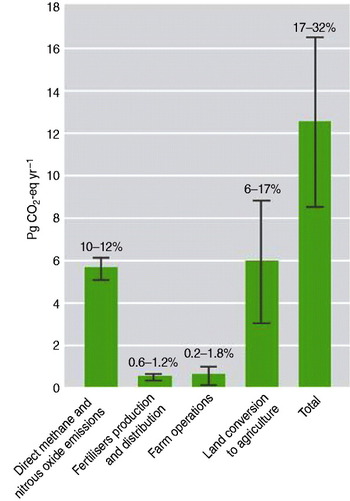
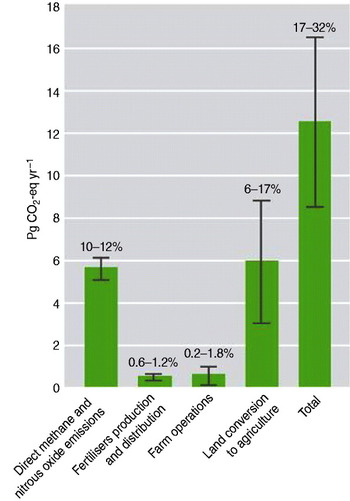
For many policy makers, climate change is the major environmental problem we face, and here the food system's contribution is considerable. Estimates find that the food system as a whole contributes between 15 and 28 % to overall GHG emissions in developed countries, with all stages in the supply chain, from agricultural production through processing, distribution, retailing, home food preparation and waste, playing a part( Reference Garnett 2 ). Agricultural production makes the single largest contribution to overall impacts, accounting for nearly half of food-related GHG emissions in developed countries and more (in relative terms) in developing regions where post-harvest supply chains are less developed. While the direct impacts of farming (from CH4 and N2O emissions) contribute around 10–12 % of global emissions( Reference Smith, Martino, Cai, Metz, Davidson, Bosch, Dave and Meyer 3 ), there are also indirect impacts to consider. Agriculturally induced deforestation causes the release of CO2 into the atmosphere, and taking this into account adds a further 6–17 % to agriculture's share of the burden. Once all direct and indirect impacts are summed, agriculture's contribution to the global emissions total has been estimated to account for as much as 30 %( Reference Bellarby, Foereid and Hastings 4 ) (Fig. 1).
(colour online) Source: Bellarby et al. ( Reference Bellarby, Foereid and Hastings 4 ).
In addition to CO2 release, agriculturally induced deforestation is the main cause of biodiversity loss worldwide. It is also responsible for 70–80 % of all human water withdrawals (water scarcity is becoming more widespread in many parts of the world) and is a significant cause of water pollution( Reference Jägerskog and Jønch Clausen 5 ). The use of fertilisers, manure and N-fixing legumes have disrupted global N and P cycles, with negative impacts on water quality, aquatic ecosystems and marine fisheries( Reference Foley, Ramankutty and Brauman 6 ).
Not all foods make an equal contribution to these linked problems of climate, biodiversity loss, resource depletion and pollution. Numerous assessments of individual food products find that meat and dairy products carry a disproportionately high environmental burden, with GHG emissions a particular concern( Reference Williams, Audsley and Sandars 7 – Reference Westhoek, Rood and van den Berg 10 ). Global estimates suggest that livestock production accounts for about 12–18 % of global GHG emissions( 11 , 12 ) and about half of the food system's total impacts, more when land use change impacts are included( Reference Audsley, Brander and Chatterton 13 ). Since consumption of these foods is high in developed nations, growing rapidly in industrialising, and starting to increase among urban consumers in low income countries, their contribution is set to rise.
Livestock farming is responsible for other environmental impacts too. The sector uses 70 % of agricultural land overall and a third of arable land, and as such plays a leading role in CO2 release and biodiversity loss from deforestation. For example, cattle ranching and soya production (grown for animal feed) are the key drivers of deforestation in the fragile Amazon region( Reference McAlpine, Etter and Fearnside 14 , Reference Nepstad, Soares-Filho and Merry 15 ). Livestock are also the largest source of water pollution in the agricultural sector and a major user of finite irrigation water; much of the anticipated increase in irrigation water in coming years will be attributable to increasing production of animal feed to meet rising demand for livestock products( 12 , 16 ).
The impacts of livestock farming, and agriculture in general, are a consequence of the way farming is practised both in the developed and the developing worlds. They reflect both the problems associated with wealth and excess; and of poverty and insufficiency. Thus the high-input–high output industrial agriculture found in the wealthier countries has enabled and fostered excessive use of environmentally damaging non-renewable inputs and has made possible diets high in resource- and GHG-intensive foods such as meat and dairy products. At the same time, the farming practices of the world's poorest peoples are characterised by insufficiency: by a lack of agricultural inputs, irrigation water and land. This ‘malnourishment’ of the land gives rise to soil degradation, while attempts to compensate for low yields may trigger further land clearance; or, where additional land is not available, population pressures on existing land.
The nutrition food security challenge
The environmental problems caused both by excess and insufficiency are played out in the nutritional arena too. Globally about 35 % of adults are overweight, with half a billion of them obese( 17 ). Obesity is affecting people at ever younger ages: today 43 million preschool children or nearly 7 % of all under fives, are overweight( 18 ). Obesity and its attendant health consequences are, moreover, no longer only rich world problems. The majority of overweight and obese people today are citizens of low and middle income countries, largely living in urban areas, and many of them are poor. Thus while a quarter of deaths in developed countries are attributable to diet and physical inactivity-related risks, they are linked to 18 % of deaths low- and middle-income countries; many more people in absolute terms( 19 ).
The causes of obesity are multifaceted( 20 ), but energy rich diets combined with sedentary lifestyles are major risk factors. Today's agricultural system has increased access for many to energy- and fat-dense foods; these include not just high sugar processed foods and vegetable oils but also, critically, GHG-intensive meat and dairy products( Reference Popkin and Gordon-Larsen 21 – Reference Zhai, Wang and Du 23 ). It is worth noting the link between vegetable oils and livestock farming: oilseeds are grown both for their oil fraction and for the oilseed cake that is used as animal feed. The synergistic relationship between these two production patterns may help increase availability of both, so ratcheting up consumption.
Coexistent with ill health caused by excess consumption, about 850 million people are undernourished; their diets lack sufficient energy( Reference Swinburn, Sacks and Hall 24 , 25 ). A total of 3·5 million children under five die each year from under nutrition( Reference Black, Allen and Bhutta 26 ). An even greater proportion of people worldwide, including many who are overweight, have diets that are imbalanced, and lack the right mix of essential nutrients for healthy development, such as vitamin A, folate, Fe and Ca. For example, approximately one-third of the world's preschool-age population is estimated to be vitamin A deficient; up to 50 % in Africa and South-East Asia. Ca deficiency is the main cause of rickets in many parts of the world. An estimated 35–80 % of children in countries such as Turkey, India, Egypt, China, Libya and Lebanon are vitamin D deficient. Anaemia, much of it Fe-deficiency related, affects about 25 % of the global population, including 47 % of preschool children and one in two pregnant women, with the prevalence much higher in Africa( 18 , 26 – 28 ).
It should be noted that the food system (agriculture in particular) affects not only people's nutritional status but also other aspects of their health too. Millions of people worldwide suffer from environmental health problems arising from agrochemicals (pesticides and fertilisers) and other pollutants in ground water (such as manure); from livestock-related zoonoses and food-borne pathogens; from water-borne diseases such as malaria that are linked to agricultural water use; and exposed to a wide range of agricultural occupational health hazards, from respiratory diseases to accidents, UV radiation and mental health problems. Poor health status due to other factors in turn undermines people's ability to absorb the nutrients available in food, which further increases their vulnerability to disease. Poor people, particularly those who are most marginalised, are most likely to be affected by the negative health effects of food production( Reference Hawkes and Ruel 29 ).
Addressing the food sustainability challenge: three perspectives
What can be done to address the problem of food system sustainability? The solutions proposed very much depend upon how the problem is conceptualised, and broadly speaking three main ‘takes’ or perspectives, on the issues and their interactions, appear to be emerging. One perspective places emphasis on the negative consequences of food production; through this framing, there is a need to address these impacts by developing farming and post-harvest supply chain approaches that cause less damage. A second highlights the consumption patterns that drive production of high-impact foods, such as meat and dairy products; the way forward is therefore to seek to try and alter these. And a third picks out the problem of inequality, the coexistence of excess with insufficiency, that characterises both the environmental damage caused by production and the health problems linked to consumption, arguing for a more equitable food system.
To summarise, depending on one's view point, the problem can be conceptualised as a production challenge, in which case there is a need to change how food is produced by improving the unit efficiency of food production, termed here the ‘production efficiency’ perspective; a consumption challenge, which requires changes to the dietary drivers that determine food production (and may also include a focus on population growth) and ‘demand restraint’; or a socio-economic challenge, which requires changes in how the food system is governed i.e. ‘food system transformation.’
Many observers recognise that the problem requires a multifaceted approach and it would be simplistic to divide them into separate camps. However, there are certainly differences of emphasis: stakeholders tend to feel more comfortable with one framing of the problem over the other, and argue for action accordingly. These different emphases in turn reflect divergent beliefs about the role of technology and the potential it holds to address the problems we face; the extent to which it is possible to alter human behaviours; and the malleability of global institutions and the global economy. More fundamentally, however, which frame stakeholders choose to privilege will reflect their different visions of what sustainability actually ‘looks’ like, based on deeper ethical and aesthetic convictions in relation to our role in the natural world, the nature of human progress, definitions of freedom and ultimately what constitutes the ‘good life’.
The section that follows describes these different perspectives, investigates the implications for nutrition and explores some of the underpinning values driving these three approaches.
The production challenge: improve efficiency
The challenge is conceptualised as follows: the human population is growing and urbanising; we are increasingly becoming net consumers and a dwindling proportion of the world's people will be engaged in farming in coming years, at least as their main activity. As incomes rise, people's food preferences are changing, with demand for meat and dairy foods on the rise. To meet this demand, food production may need to rise by as much as 60–110 % by 2050 overall( Reference Conforti 30 – 32 ). At the same time, environmental damage caused by food production (both direct impacts and those related to deforestation) needs to be reduced.
More food must therefore be produced to feed urban consumers on existing farmland in ways that do not incur excessive environmental costs. Technological innovations and managerial changes are seen as key to reducing environmental impacts and increasing supply. For agriculture, the main strategies include: measures to improve efficiency such as the precise matching of inputs (fertilisers, water and pesticides) to outputs (plant or livestock requirements); technologies to recover energy from agricultural ‘waste’ (such as anaerobic digestion); and farming practices that sequester carbon in soils( 33 , Reference Shafer, Walthall and Franzluebbers 34 ). Post harvest, emissions can be reduced through the development of refrigeration, manufacturing and transport technologies that are more energy efficient or based on renewable energy sources. Waste is minimised through better inventory management, by modifying packaging and portion sizes and through other approaches that either prolong the shelf life of foods or help consumers reduce food waste in other ways( 35 ).
This perspective currently dominates the discourse on food sustainability. Its ‘more for less’ agenda constitutes the main, albeit not the only, focus of concern for governments( 36 ) and for food industry actors such as agricultural input businesses, farming unions, manufacturers and retailers( 37 , 38 ). Demand projections are based on assumptions about income growth and its relationship with demand for certain foods, particularly meat( 32 ) and there is little expectation that such demand could be significantly influenced or moderated. For some, moves towards moderation may pose a threat, given the economic importance of livestock and their nutritional value( 39 , 40 ).
While the other dimensions of food security (access, utilisation and stability over time)( 41 ) and the quality of food are also recognised as important, in practice relatively less attention is paid to these other concerns.
As regards the nutritional quality of what is being produced: the task of agriculture is to supply the commodities that the market demands, based on the laws of supply and demand that in turn reflect individual consumer choices. Nutritional objectives can be met through other means, retrospectively as it were. For example, just as environmental efficiencies can be achieved through more optimised farming practices, so ‘health efficiencies’ can be secured through product reformulations that deliver foods similar in taste to the originals but lower in fat, sugar or salt, or with enhanced nutrition (prebiotics, n-3 fatty acids). Portion resizing can also reduce energy intakes per unit. Supported by appropriate information such as labelling, the consumer is then free to choose the healthier option without fundamentally needing to change their diet( 42 – 44 ). Physical activity is also promoted as a way to address the demand side of the energy balance, while pharmaceutical approaches may also be considered( Reference Caveny, Caveney and Somaratne 45 , Reference Halpern, Oliveira and Faria 46 ).
The high GHG intensity of meat and dairy products, and their association through complex health pathways with various negative health outcomes are recognised (although importantly the health benefits of animal products are also emphasised). However, both environmental and health concerns, from this perspective, can be addressed through technological means. Breeding, feeding and housing strategies, together with research into ways of inhibiting methane emissions from ruminant livestock, can reduce the per unit environmental footprint of meat and dairy production( Reference Shafer, Walthall and Franzluebbers 34 , 47 ). The corollary, nutritional approach is to provide consumers with meat that is leaner and dairy products that are lower in fat (through animal breeding and feeding strategies, or by removing the fat after production) and to encourage people to choose these foods over higher fat options. Such an approach offers the promise of providing consumers with essential micronutrients (Fe, Ca, Zn and so forth) without the ‘downsides’ of fat and energy( 48 – Reference Wyness, Weichselbaum and O'Connor 50 ).
In low income contexts, increased production of all foods can help address the problem of hunger caused by energy deficiencies and the need to produce ‘more food’ is sometimes considered as a moral imperative by farming interests. The importance of meat and dairy foods to consumers in low income countries, where diets are often grain based and lacking in diversity, is underlined. In addition to increased livestock production, post harvest food fortification and supplementation as well as biofortification (breeding crops higher in target nutrients) offer routes to addressing micronutrient deficiencies, with the food industry playing a key role( 51 , 52 ). Biofortification is considered particularly promising: while initial research investment costs are high, ex ante assessments suggest their cost effectiveness in addressing deficiencies is even greater( Reference Meenakshi, Johnson and Manyong 53 ).
To summarise: this is a globalised, ‘macro’ vision of a food system, and, of all the three perspectives, is the one most in keeping with current economic and political trends. It addresses the food security–environmental challenge primarily as an urban-oriented supply side problem. Market signals suggest that people want Western-style food that is convenient to prepare, often processed and reliant on sophisticated supply chains, and that includes substantial quantities of animal products. Since this is the ‘problem’, the solution is to deliver what people apparently want in ways that have lower negative impacts.
Globalised systems of production and distribution and larger food industry players, from agri-business to multinational manufacturers and retailers, can meet demand for food at lower environmental cost since they offer not just economies but also ecologies of scale( Reference Schlich and Fleissner 54 ). Efficient production of economically important commodities can also reduce the unit cost of food, making it more affordable, thus helping combat the problem of absolute hunger.
This perspective also sees a key role for the food industry in providing foods that meet current preferences at less ‘cost’ to health or that even positively enhance health, both in the developed and developing world. Fortification, biofortification, supplementation and an increase in low cost livestock production will improve the nutrient density of the foods available, while obesity can be addressed through product reformulations, information, and medical interventions where appropriate. Less attention is paid to the concept of dietary diversity, except in so far as increases in meat production will, for some, increase the range of foods consumed.
Consumers are rational beings who can make decisions based on the weighting of different preferences. Their choices should not be proscribed; consumption patterns should not be influenced by ‘nanny statist’ regulations and such like. While efforts are made to improve the environmental and health profile of foods through the approaches outlined earlier, consumer choice in relation to these foods i.e. how much of them they eat, is not a subject for consideration.
There a strong strand of optimism underlying this approach: it presents a positive vision of human ingenuity and of our ability to develop technological solutions to our problems. There is also a strong belief in freedom and individual agency, defined as the primacy of consumer choice, manifested through the workings of the market. Freedom is the freedom to consume, to attain a better life defined in terms of increased material possessions and more of the foods currently consumed in the developed world.
However, the efficiency vision may also be upheld by those with a less democratic orientation. Powerful interest groups may support this perspective because it reinforces existing power structures. Others may support the efficiency approach because they are essentially pessimistic about human nature: human subjects are incapable of restraining their desires and current socio-political inequities are entrenched and immutable. All that can be done is to shave away at the problem through technological improvements.
The consumption challenge: demand restraint
In a second framing of the food sustainability challenge, the end point in the supply chain, the consumer, becomes the focus of concern. Central to this perspective lies the conviction that excessive consumption, particularly of high-impact foods such as meat and dairy products, is a leading cause of the environmental crisis we face. Technological improvements alone will not be able to address the problem.
This view is shared by many within the animal welfare and environmental movements( 55 – 57 ). These stakeholders base their arguments on academic studies that argue, to varying degrees, for demand restraint( Reference Foley, Ramankutty and Brauman 6 , Reference Williams, Audsley and Sandars 7 , Reference Audsley, Brander and Chatterton 13 , Reference Goodland 58 – Reference Garnett 61 ).
For example, one study concludes that if consumption is not curbed globally, then given current dietary trends in demand, agricultural emissions are set to rise even when a broad range of production-side mitigation measures are deployed( Reference Popp, Lotze-Campen and Bodirsky 62 ). Another argues that by 2050, livestock sector growth could push the planet to the point where humanity's biological existence is threatened. It concludes that per capita meat consumption in 2050 may therefore need to be between 20 and 40 % of what it is today( Reference Pelletier and Tyedmers 63 ).
While demand may need to be restrained for environmental reasons, this perspective also highlights research finding that reduced consumption of livestock products would actually benefit health( Reference Friel, Dangour and Garnett 64 ). Unlike the production efficiency framing, the demand restraint perspective very explicitly links the health and environmental agendas, often viewing the relationship as synergistic. Thus, the GHG intensity of livestock farming is presented in tandem with arguments that excessive meat and dairy consumption undermines health. Support for this position is found from studies (generally undertaken in developed countries and in urban areas) finding an association between diets rich in animal products (specifically red and processed meat) and various negative health outcomes( 65 – Reference Pan, Sun and Bernstein 67 ).
Demand restraint stakeholders argue that largely plant-based diets are healthier, citing studies showing that people who eat fewer animal products, and vegetarians, are often healthier across a range of indicators, although the reasons for this may be complex; for example, they tend to be more health conscious in general( Reference Millward and Garnett 68 ). They also cite studies showing that plant-based diets can supply an adequate balance of key nutrients at lower GHG ‘cost’ than meat-dominated diets( 69 – Reference Edwards and Roberts 72 ). It has also been argued that how much as well as what kind of food people eat also has environmental relevance; obesity carries an environmental cost. For example, studies conclude that a reduction in obesity could yield environmental benefits through the following main pathways: less consumption means that less food (especially livestock) production is needed; reduced passenger weight reduces the amount of energy required to fuel vehicles; and finally, less food is wasted since less food is produced overall (wasted food represents a waste of embedded emissions)( Reference Edwards and Roberts 72 , Reference Michaelowa and Dransfeld 73 ). Measures to address the problem could yield both environmental and health dividends.
Notably, while this perspective strongly emphasises the diet-related chronic diseases that are associated with animal products and widespread in many parts of the world (particularly cities),( Reference Popkin 74 ) it focuses less on the ongoing problem of hunger and micronutrient deficiencies that still affect millions of poor people worldwide, especially in rural communities. Importantly, the context for studies comparing vegetarians or low-meat eaters with their high meat-eating counterparts, is one where citizens typically have access to a diverse range of plant-based foods including vegetables, fruits, legumes and meals specifically formulated for vegetarians. The situation is very different in low income developing countries: diets are often monotonous and lack diversity. The positive nutrients found in animal products such as Ca, Fe and Zn, are often of critical importance, particularly to children( Reference Dror and Allen 75 ) while livestock can support livelihoods in other ways, with beneficial consequences for health (discussed later). Hence the health–environment synergies obtainable from reduced animal product consumption are highly context dependent. Much depends on what else is, or is not, being eaten and advocates of the demand restraint perspective do not, as yet, have a coherent vision of what a ‘healthy sustainable’ diet looks like in very low income settings.
Finally, much is made, by restraint advocates, of the point that there is enough food in the world to feed everyone, in contrast to the ‘more food’ emphasis in the efficiency perspective. The challenge is therefore to address inequitable and resource-intensive consumption patterns( 76 ), a view developed further in the third perspective, later, but a sophisticated analysis of how structural inequalities might be addressed is lacking. Nor is it clear as to what mechanisms are needed to alter behaviour, apart from some preliminary advocacy of health- or livestock-related taxes( Reference Mytton, Clarke and Rayner 77 , Reference Wirsenius, Hedenus and Mohlin 78 ). Both these gaps reflect the lack of attention that this perspective has received from within the mainstream research and policy community. There are signs, however, that this may change. Increasingly, generally cautious international observers, including the United Nations Development Programme( 79 ), the United Nations Environment Programme( Reference Hertwich, van der Voet and Suh 80 ) the Convention on Biodiversity( 81 ) and the UK Government's Foresight Programme( 82 ) some of whom are more traditionally ‘productionist’ in their views( 83 ), are starting to recognise that consumption issues merit further consideration.
Thus, for the demand restraint perspective, the ‘problem’ reframed is a demand-side one. The efficiency perspective's use of technology to, on the one hand, provide people with the food they want at lower environmental cost and then, on the other, to remove the nutrients from those foods that are causing them harm, is seen as overly complex. A simpler, holistic solution would be to reduce production and associated consumption of the animal products that are causing damage both to health and the environment. A world dominated by this perspective would therefore see a much reduced role for livestock production in agricultural systems and a greater emphasis on producing a diverse range of plant based foods. Land previously used to grow livestock feed would be set to producing grains and other plant foods for human subjects, while grazing land could be left to rewild or afforested( Reference Goodland and Anhang 84 ). Production could be dominated either by larger industry players or by smallholders (the perspective lacks specificity here, reflecting its overwhelming consumption focus). Dietary patterns would be re-oriented through fiscal and regulatory measures such as taxes and subsidies on certain foods, and perhaps even bans on some, or on certain farming practices such as intensive livestock production.
The values underpinning this demand restraint perspective are varied. For some, the conclusion that demand needs to be moderated is simply the inescapable conclusion to be drawn from the data: without reductions in livestock consumption and associated consumption, the mitigation figures simply do not add up. However, others may have a more overtly moral agenda: greed, the perceived insatiability of human desire itself, is the core issue. Freedom is, by this framing, defined as freedom from the ills of consumption. Thus, for many demand restraint advocates their vision of a good life is one that explicitly challenges the status quo, with its emphasis on consumption and growth.
For some too, technological approaches to reducing environmental impact may themselves be problematic: technologies such as genetic modification are ‘part of the problem’ rather than, as for the efficiency perspective, a solution. Technology is being used to broach ‘natural’ limits, whereas the priority should be to respect these limits by shrinking the space which human subjects take up within it. Concerns around animal rights and animal welfare are often added to the mix; stakeholders may reject the industrialised farming that is being advocated as a way of improving the environmental unit efficiency of production or, more fundamentally, even the idea of killing animals for food.
The socio-economic challenge: improve governance
The production efficiency focuses on changing patterns of production; the demand restraint perspective on excessive consumption. The food system transformation perspective considers both production and consumption in terms of the relationships among actors in the food system, interpreting the problem as one of ‘imbalance.’ The concern lies not just with production, and not just with consumption: it is the outcome of unequal relationships between and among producers and consumers, across and within countries and communities. This inequality gives rise to the twin problems of excess and insufficiency that are played out both in the environment (over- as well as under-application of agricultural inputs) and in health (obesity and hunger). The problems we face are thus socio-economic rather than simply technical or a consequence of individual decisions: they are the outcome of the dynamic interactions among natural, technological, behavioural and economic systems.
Within this perspective can be found a broad spectrum of opinions, some more radical than others in their analysis of the problems and vision of the solutions. Some adopt a macro perspective, focusing on trading relations between nations, while others are concerned with local contexts. For all, though, the central argument here is that food system sustainability can only be achieved by changing the socio-economic governance of the food system. A full spectrum of interventions will be needed, including ‘hard’ measures such as regulations and fiscal instruments, as well as ‘soft’ approaches such as voluntary agreements, awareness raising and education( 82 , 85 – Reference Lang 87 ).
Since food sustainability problems are rooted in imbalances and inequities, a focus on increasing production on its own is unlikely to improve food security. Hunger today is not a consequence of insufficient supply but of in sufficient access; poor people cannot afford to eat adequately( Reference Sen 88 ). While some increase in production may be needed, the requirement depends on context: it is necessary to increase production in particular regions, in relation to particular consumers and particular producers, but not everywhere.
This framing of these issues is markedly more rural-centric than the other two perspectives which are essentially concerned with the supply-side needs and consumption patterns of urban populations. The system transformation perspective is focused to a far greater extent on low income rural populations in developing countries, the poorest of the poor.
It also places strong emphasis on all four key dimensions of food security( 41 ). Unlike the efficiency perspective it privileges not just the ‘technical’ supply of nutrients but also the requirements of accessibility (incorporating affordability), utilisation (local environmental conditions and pre-existing health status) and the stability of these factors over time. Differing from the demand perspective too, it emphasises that nutritional outcomes are not just the consequence of what foods are or are not consumed, but also of who produces them, where and for whom. Thus, an argument is often made for altering the terms of trade between nations, and particularly for ending subsidies paid out to food producers in developed countries. For low-income countries, the focus is on production to improve self-sufficiency and on fostering intra-regional trading.
Many within this perspective advocate a central role for smallholders (particularly women) in farming a diverse range of indigenous crops and livestock breeds for local markets( 86 , 89 ). More localised, diverse systems are seen as better able to deliver the full range of micronutrients needed for good health than global supply chains which produce and distribute a simplified range of processed, energy- and fat-dense commodities( Reference Toledo and Burlingame 90 , 91 ) however fortified. Moreover, these systems of provisioning (encompassing all food chain stages and actors rather than just the technical act of production) generate income for smallholders, who can then spend their earnings on food or on other essentials, including health care and education, fostering a positive cycle of health and development( Reference De Schutter 92 ).
The development of institutional and social capacity through the creation of local food provisioning systems is seen as critical; it is the key to good nutrition and human well-being. Fortification and biofortification strategies are supply-side approaches that may have a role, but the larger challenge is to address the inequality inherent in the food system which gives rise to these fundamental problems of dietary simplification and inadequacy( Reference Johns and Eyzaguirre 93 ). Similarly, the activities of ‘big food’ to address micronutrient deficiencies through public–private partnerships are often treated with suspicion for this perspective because they are seen as perpetuating power imbalances: destroying local production, undermining local relationships and provisioning systems, eroding local food cultures and selling processed foods, whose processing is cynically designed to increase the profits of the companies themselves( Reference Nestle 94 , 95 ).
As to the nutritional role of meat and dairy products: the framing here differs from the other perspectives in that it looks beyond nutrition to consider the role that livestock plays in the livelihoods of poor people, and the effect that this in turn has upon health. The nutritional contribution that livestock provide for people in low-income countries is not necessarily a simple relationship along the lines of ‘more production equals better nutrition.’ Health outcomes are mediated through impacts of livestock production on household incomes and the knock-on effects of income generation on health generally, for example on people's ability to pay for health care or education, both of which have independent positive effects on health. In other words, the system transformation approach urges a more complex understanding of agri-health linkages( Reference Hawkes and Ruel 29 ).
As regards the environment, many within this perspective argue for organic or ‘agro-ecological’ approaches as these generally incorporate social objectives around principles of fairness and are assumed to be more environmentally benign( Reference Toledo and Burlingame 90 , Reference Fischer, Batáry and Bawa 96 ). The latter assumption has, however, been challenged since yields from these systems tend to be lower, meaning that more land is needed for a given volume of food production. This in turn has implications for CO2 release and biodiversity loss( Reference Phalan, Onial and Balmford 97 , Reference Burney, Davis and Lobell 98 ). Moreover, the environmental implications of a scaling up of smallholder production are not given much consideration: while an increase in small-scale livestock production may benefit local communities, it will nevertheless generate GHG emissions and other environmental impacts. Similarly, while greater production and access to local indigenous foods may offer benefits for smallholder livelihoods and people's health, consumers may nevertheless choose to reject these foods in favour of mass marketed, processed products.
In conclusion, the priority for this perspective is to alter the terms of trade between nations, between producers, and between producers and consumers. There is a stronger emphasis on fair trade between nations, greater self-sufficiency, and on the development of local food systems and markets producing a diverse range of nutritious foods. More support is advocated for rural development, with agriculture a central plank in this agenda. Food consumption is more closely linked to what regions are able to produce and there is greater diversity, across the world, in local food cultures. Greater regulation of multinational corporations is needed, together with a greater role for publicly supported research and development, agricultural extension and other initiatives. Freedom, for this perspective, is freedom from injustice.
This perspective shares the redistributive morality of the demand restraint perspective but perhaps goes further in its assumption that the ‘underdog’ is somehow inherently more likely to farm and consume within environmental limits; an assumption that is certainly open to challenge. It can romanticise the small scale and local, failing to subject these systems to the same critical scrutiny as it does to commercial systems. Thus, while emphasis on improving rural livelihoods at one level reflects pragmatic recognition of how millions of people live today, for many within this perspective, agrarianism is perhaps synonymous with the good life. Both well-being and sustainability are achieved through the harmonious integration of human subjects with nature through rural living and yet people are flocking in their millions to the cities in the hope of a better life.
Conclusion
Each of these three frames on the food sustainability problem has insights to offer, as well as weaknesses and inconsistencies. These may sometimes go unrecognised by stakeholders, who are too immersed in a particular frame to recognise its shortfalls or the merits of an alternative approach. Entrenched positions, ongoing disagreements, and inaction are the result.
A key strength of the efficiency perspective is its pragmatism. It focuses attention on what can be done now, through better technologies and good management, to address immediate nutritional and environmental problems. It injects a much needed optimism into the discussion on food. However, its equation of more food with greater food security is too simplistic, as is its assumption that increases in the unit efficiency of production will compensate for the environmental impacts of increased demand. The effects of product reformulations and so forth on obesity are unclear; such approaches may simply entrench patterns of over-consumption that drive further environmental damage. While in some ways, the efficiency approach suggests a highly democratic vision, a better material life for more people, its implementation may have the effect of strengthening existing power relations in the supply chain that perpetuate inequalities.
The value of the demand restraint approach lies in its emphasis on the need for absolute rather than just relative reductions in emissions; on highlighting the role of consumption patterns on environmental impacts, and on the need to address environmental and nutritional problems together. These together represent important challenges to the production efficiency approach. However, it can lack nuance in its approach to livestock, while the problem of undernutrition in low-income countries requires far more attention. If environmental sustainability is only possible in a situation of severely reduced livestock production, then we need to consider carefully what systems of food production are needed to deliver such low impact, healthy diets and what policies are needed to effect the necessary changes.
The food system transformation offers a necessary critique both of the efficiency and demand restraint perspectives. It focuses on the structures, systems and relationships that underpin food production and consumption, highlighting the way that unequal power relations influence both environmental and health outcomes. However, it can at time romanticise smallholder production and while this perspective is good at identifying the complex nature of food system interactions, this very complexity makes it difficult to identify specific ways forward.
Policy makers are starting to recognise that the ‘reality’ is a composite of perspectives( 82 ) and, as emphasised earlier, these framings do not represent ideological positions (at least for most people) but rather inclinations or tendencies that stakeholders manifest when discussing the food problem. Most institutions or individuals will not adopt one perspective alone, to the exclusion of the others.
This said, within most mainstream circles the production efficiency approach still tends to overwhelm the others. Far too little attention is paid to the nutritional quality of what people consume, to the potential that dietary changes can play in addressing health and environmental problems together, or the inequities in the food system.
This imbalance needs to be addressed. The priority for the future is a nutrition-driven food system that sits within environmental limits. This will certainly require efforts to increase the environmental efficiency of food production. However, this approach on its own will not deliver a sustainable food system. Equal attention needs to be paid to issues raised by the other framings. How can demand for foods with high environmental impact be moderated and the supply and consumption of more diverse plant-based foods increased? How can we develop systems of governance that deliver on production and consumption objectives while promoting fairness and justice? These are politically far more challenging. To address them demands a broad interdisciplinary research effort, drawing upon the skills of nutritionists, social scientists, the international development community and economists. It is essential, too, to pay more attention to the values that different stakeholders bring to the debate on food sustainability. These are the source of much disagreement and miscommunication; but by identifying values that are common among apparently very different stakeholders it may be possible to resolve some differences and make progress.
Acknowledgements
The author declares no conflicts of interest. T. Garnett's work at the Food Climate Research Network is supported by a grant from the Climate Change Agriculture and Food Programme of the CGIAR and the Oxford Martin Programme for the Future of Food.