



Body dissatisfaction, weight concerns, attempts to lose weight and dieting behaviour are commonly seen among adolescents across modern societies, including among individuals of normal weight( Reference Ojala, Vereecken and Valimaa 1 , Reference Neumark-Sztainer, Story and Hannan 2 ), and particularly among girls( Reference Neumark-Sztainer, Story and Hannan 2 – Reference Halvarsson, Lunner and Westerberg 7 ). Data from Norwegian studies support these findings, as a large proportion of Norwegian adolescents, and especially girls, are unsatisfied with their body and appearance( Reference Storvoll, Strandbu and Wichstrøm 8 – Reference Holsen, Jones and Birkeland 10 ), perceive themselves as overweight( Reference Cuypers, Kvaløy and Bratberg 11 , Reference Børresen and Rosenvinge 12 ) and report slimming attempts( Reference Meland, Haugland and Breidablik 13 ) and frequent dieting( Reference von Soest and Wichstrom 9 , Reference Børresen and Rosenvinge 12 ).
Perception of overweight, rather than actual overweight, appears to be an important and often underrated promoter of body dissatisfaction( Reference Holmqvist, Lunde and Frisen 14 ), unhealthy weight-reduction behaviours( Reference O’Dea and Caputi 15 ), attempts to lose weight( Reference Ojala, Vereecken and Valimaa 1 , Reference Holmqvist, Lunde and Frisen 14 , Reference Strauss 16 ), reduced well-being( Reference Jansen, van de Looij-Jansen and de Wilde 17 ), unhealthy food behaviours( Reference Mikkila, Lahti-Koski and Pietinen 18 ) and weight gain over time( Reference Cuypers, Kvaløy and Bratberg 11 ). Uniform gender differences in weight perception and body satisfaction are found in studies of young people across Western countries( Reference Ojala, Tynjälä and Välimaa 3 , Reference Cuypers, Kvaløy and Bratberg 11 , Reference Mikolajczyk, Maxwell and El Ansari 19 – Reference Currie, Zanotti and Morgan 22 ). While girls perceive themselves as overweight or ‘too fat’ and want to be thinner more often than boys, boys describe themselves as ‘too thin’ or ‘too fat’ equally often and equally often want to be heavier or thinner. In addition, gender differences in adolescents’ eating habits are well documented( Reference Currie, Zanotti and Morgan 22 ). Overall, girls are more likely to skip breakfast, eat more fruit and consume fewer soft drinks than boys. These differences may partly be related to differing views on health and body weight among girls and boys, with girls being more dissatisfied with their body and more weight-conscious than boys( Reference Currie, Zanotti and Morgan 22 , Reference Neumark-Sztainer, Paxton and Hannan 23 ). Currently, there is a lack of Norwegian studies examining associations between adolescents’ subjective experiences of appearance and weight and their dietary habits. Available studies have focused on adverse eating attitudes( Reference von Soest and Wichstrom 9 ) and dieting engagement( Reference Børresen and Rosenvinge 12 ), rather than the potential consequences of dietary choices.
A number of studies from other Western countries have linked young people’s body perception with dietary habits( Reference Mikkila, Lahti-Koski and Pietinen 18 , Reference Videon and Manning 20 , Reference Neumark-Sztainer, Paxton and Hannan 23 – Reference Bibiloni, Pich and Pons 28 ). Cross-sectional studies from the USA have shown a relationship between body dissatisfaction and an increased risk for both genders of inadequate consumption of fruits, vegetables and dairy foods, as well as breakfast skipping( Reference Videon and Manning 20 , Reference Nystrom, Schmitz and Perry 24 – Reference Neumark-Sztainer, Story and Dixon 26 ). Moreover, longitudinal relationships have been observed between high body satisfaction in junior high school and healthier dietary habits in later adolescence and young adulthood( Reference Neumark-Sztainer, Paxton and Hannan 23 ). As regards weight perception, girls who perceived themselves as overweight and boys who perceived themselves as underweight or overweight were likely to consume inadequate amounts of fruits and vegetables( Reference Nystrom, Schmitz and Perry 24 ). In a Finnish study of adolescents aged 14–16 years, overweight perception was strongly associated with skipping school lunch and evening meal among both genders( Reference Mikkila, Lahti-Koski and Pietinen 18 ). In an Australian cross-sectional study of 9th and 10th graders, students who perceived themselves as overweight were found to be more likely to eat unhealthy breakfasts and lunches, although gender differences were not analysed( Reference Young and Fors 27 ). In contrast to the above studies, no associations between weight dissatisfaction and food reports were observed in 12- to 16-year-old boys and girls in the US National Health and Nutrition Examination Survey (NHANES III)( Reference Kant 29 ).
Studies of food combinations may reveal associations and differences between population groups that are not observed when single foods are analysed( Reference Hu 30 ). As far as we know, only two cross-sectional studies, conducted in Finland and Spain, have linked weight dissatisfaction with multiple food groups( Reference Mikkila, Lahti-Koski and Pietinen 18 , Reference Bibiloni, Pich and Pons 28 ). Both studies indicated that adolescents who desired a thinner body reduced their consumption of typical energy-rich Western-diet foods( Reference Bibiloni, Pich and Pons 28 ). In the present study, we have further enhanced the dietary-pattern approach through factor analysis, a technique by which the overall variation in dietary data is used to assess dietary patterns( Reference Oellingrath, Svendsen and Brantsaeter 31 ).
Given the lack of Norwegian adolescent studies linking body perceptions with diet, and the general lack of studies focusing on dietary patterns, supplementary studies would be useful to improve knowledge of this subject.
Previous Norwegian studies have investigated adolescent body satisfaction, weight perception and dieting practices, mainly among adolescents in the first year of lower secondary school and upwards( Reference Storvoll, Strandbu and Wichstrøm 8 – Reference Børresen and Rosenvinge 12 ). However, some studies have included primary-school children (11-year-olds)( Reference Børresen and Rosenvinge 12 , Reference Meland, Haugland and Breidablik 13 ) and indicated gender differences in weight dissatisfaction at this young age. As the age of girls making slimming attempts has fallen in recent years( Reference Strandbu, Storvoll and Kvalem 32 ), further studies of younger age groups appear highly relevant. Moreover, conducting additional studies of younger subjects has been recommended as a means of exploring the role of appearance dissatisfaction in gender dieting differences( Reference von Soest and Wichstrom 9 ).
Body dissatisfaction may be defined as a person’s negative thoughts and feelings about his or her own body, and encompasses multiple aspects( Reference Grogan 33 ). The available studies have employed different, individual scales to assess body concerns. Applying more than one aspect of body satisfaction may yield additional information about the study population and reveal gender differences( Reference Presnell, Bearman and Stice 4 ). Appearance satisfaction and self-perceived weight represent different body-concern aspects( Reference Grogan 33 ). Studies in which these two variables are related to slimming attempts, eating patterns and gender may add new information to the field.
We have previously identified four distinct eating patterns in a sample of young Norwegian adolescents in the last year of primary school (12- to 13-year-olds)( Reference Oellingrath, Svendsen and Brantsaeter 31 ). Self-reported information about appearance satisfaction, weight perception and slimming attempts was collected simultaneously.
The main purpose of the present study was to examine the gender-specific association of weight perception and appearance satisfaction with slimming attempts and eating patterns among young Norwegian adolescents.
Methods
Participants and study design
The present data were obtained from a lifestyle study of primary-school children in Telemark County, Norway. The present data were collected in the spring of 2010, from children in the last year of primary school, grade 7 (mean age 12·7 (sd 0·3) years). The detailed data collection methods have been described previously( Reference Oellingrath, Svendsen and Brantsaeter 31 , Reference Oellingrath, Svendsen and Brantsater 34 ). In brief, all 104 primary schools in Telemark County were invited to participate in the study and fifty-three agreed. Written parental consent to inclusion in the study was given for 1095 children (73 % of the 1503 children invited), representing about half of the county’s grade 7 pupils. Complete data on weight perception, slimming attempts, appearance satisfaction and dietary habits were obtained for 469 participants (43 % of 1095).
Two questionnaires were used in data collection. The parental form, completed at home, contained questions about the adolescent’s dietary habits and physical activity, and background information on both parents. The adolescents’ form, completed at school, contained questions on appearance satisfaction, perceived weight and slimming attempts. Parents were free to complete the questionnaire either together or individually (one parent on behalf of both parents). If the parents lived separately, the questionnaire was completed by the parent with whom the adolescent stayed the week the data were collected.
The study was conducted in accordance with the guidelines laid down in the Declaration of Helsinki and the research protocol was approved by the Regional Committee for Ethics in Medical Research and the Norwegian Data Inspectorate.
Perceived weight and slimming attempts
The questions concerning children’s perceived weight were based on a questionnaire used in the Norwegian part of the WHO Health Behaviour in School-Aged Children (HBSC) Study( Reference Samdal, Leversen and Torsheim 35 ). Perceived weight was assessed by asking the children if they considered their body ‘much too thin’, ‘a bit too thin’, ‘just the right weight’, ‘a bit too fat’ or ‘much too fat’. The two categories ‘much too thin’ and ‘a bit too thin’ were combined into one category and denoted ‘perceived underweight’. The ‘just right’ category was denoted ‘perceived right weight’. Finally, the two categories ‘a bit too fat’ and ‘much too fat’ were combined into one category and denoted ‘perceived overweight’. Slimming attempts were measured by asking the question ‘Are you trying to slim?’ and providing a dichotomous response option.
Appearance satisfaction
The children’s appearance satisfaction was measured using the ‘Physical Appearance’ subscale of a revised version of Harter’s Self-Perception Profile for Adolescents with different features of appearance( Reference Harter 36 , Reference Wichstrom 37 ). The subscale had previously been translated into Norwegian using a back-translation procedure and validated for Norwegian adolescents aged 13–20 years( Reference Wichstrom 37 ). The instrument contained five statements referring to feelings about body appearance: (i) ‘I am not happy with the way I look’; (ii) ‘I wish my body was different’; (iii) ‘I wish my physical appearance was different’; (iv) ‘I think I am good looking’; and (v) ‘I really like my looks’. The response options were: ‘describes me very poorly’, ‘describes me quite poorly’, ‘describes me quite well’ and ‘describes me very well’. The responses were used to compute a mean index with values ranging from 0 to 3 for girls (Cronbach’s α=0·87) and boys (Cronbach’s α=0·85), respectively. The mean score index (denoted ‘appearance satisfaction’) was further divided into two categories: the 50 % with the lowest appearance satisfaction (values ≤2·0) and the 50 % with the highest appearance satisfaction (values>2·0).
Eating patterns
The children’s food and drink intakes and meal frequencies were reported by their parents using a retrospective FFQ, which asked about habitual daily consumption of forty food items, thirteen types of snacks (between meals), eleven types of drinks and five main meals (breakfast, lunch, afternoon meal, dinner, supper) in the last 6 months. The questionnaire was based on a short validated FFQ developed for use with children in grades 4 and 8 in Norway( Reference Lillegaard, Øverby and Andersen 38 ), but was modified to include more dietary questions. The modified FFQ was pre-tested on a sample of parents and followed up by means of qualitative interviews( Reference Schelling and Streitlien 39 ). Response options and other details have been reported previously( Reference Oellingrath, Svendsen and Brantsaeter 31 , Reference Oellingrath, Svendsen and Brantsater 34 ).
Four distinct eating patterns have previously been identified using principal component analysis of the reported dietary responses( Reference Oellingrath, Svendsen and Brantsaeter 31 ). The eating patterns were named after the ingredients of each eating pattern, as follows: (i) ‘junk/convenience’, characterised by high-energy processed fast foods, refined grains, cakes and sweets; (ii) ‘varied Norwegian’, characterised by food items typical of a traditional Norwegian diet, including fruits and vegetables, brown bread, fish, water and regular breakfast and lunch, close to official nutritional advice; (iii) ‘snacking’, characterised by sugar-rich snack items and drinks, low intakes of vegetables and brown bread, low frequency of breakfast and dinner and high frequency of eating between meals; and finally (iv) ‘dieting’, characterised by foods and drinks often associated with weight control, like artificially sweetened drinks and other ‘light’ products. Individuals were given factor scores for each of the eating patterns. Positive factor scores indicate a high intake of foods, drinks and meals within the respective pattern, while negative factor scores indicate a low intake. The factor scores for each eating pattern were grouped into categorical variables (tertiles)( Reference Oellingrath, Svendsen and Brantsaeter 31 ).
Adjustment variables
BMI category
The weights and heights of the children were measured by public health nurses at each school. The children were weighed wearing light clothing (i.e. trousers, T-shirt, socks) using calibrated, electronic scales measuring in 100 g increments. The BMI (kg/m2) of each child was calculated using these measurements. Child BMI categories were calculated using the International Obesity Task Force cut-off points (underweight, normal weight, overweight, obese), based on growth curves and BMI of 17·0, 25·0 and 30·0 kg/m2 at age 18 years( Reference Cole, Flegal and Nicholls 40 , Reference Cole, Bellizzi and Flegal 41 ). The respective cut-off points for 12·5-year-old boys and girls were used. In total, the weight and height of 425 children were measured. Due to the small number of cases, we included four underweight children (<1 %) in the normal-weight group and eighteen obese children (<4 %) in the overweight group.
Physical activity
Physical activity was measured by asking the children ‘For how long are you physically active (sweaty or breathless) on a normal day?’ The possible answers were ‘one hour or more’ and ‘less than one hour’. The categories reflect the officially recommended amount of daily physical activity for children and adolescents (≥1 h/d).
Parental variables
In addition to dietary reports, parents reported their educational level, family income and own height and weight.
Paternal and maternal educational level was divided into three categories: (i) ‘primary and lower secondary education’ (basic: 10 years or less); (ii) ‘upper secondary education’ (an additional 3–4 years); and (iii) ‘university or university college’.
Family income was divided into three categories: (i) ‘both parents<Norwegian kroner (NOK) 300 000’; (ii) ‘one parent≥NOK 300 000’; and (iii) ‘both parents≥NOK 300 000’ (NOK 300 000=€ 40 849 as at 12 December 2012).
Parental BMI was calculated on the basis of self-reported height and weight and the International Obesity Task Force cut-off points for adults (overweight at BMI ≥25·0 kg/m2)( 42 ).
Statistical analysis
Data describing gender differences in weight perception, appearance satisfaction and slimming attempts were analysed using cross-tabulation and Pearson’s χ 2 test (Fisher’s test).
We used multiple logistic regression analysis to associate weight perception and appearance satisfaction (independent variables) with slimming attempts and eating patterns (dependent variables). Odds ratios (OR1–3) with 95 % confidence intervals were calculated for the respective dependent variables. The tertiles considered to be the least desirable from a health perspective (the lowest tertile of the varied Norwegian eating pattern, highest tertile of the junk/convenience eating pattern and highest tertile of the snacking eating pattern), were compared with the rest. For the dieting eating pattern, the highest tertile, indicating high dieting behaviour, was compared with the rest. In model 1, weight perception and appearance satisfaction were adjusted for each other. In models 2 and 3, the associations were further adjusted for BMI categories and background variables, respectively. The available background variables were maternal and paternal education, family income, maternal and paternal BMI and child physical activity. The analyses were stratified by gender and we applied forward conditional selection which included variables significantly associated with the respective dependent variables in each model. Only participants for whom complete data on weight perception, slimming attempts, appearance satisfaction and dietary habits were available (n 469) were used in the present analyses. Informants with missing values for a given adjustment variable were assigned to a separate category.
For all tests, P<0·05 was considered significant. The questionnaires were scanned by Eyes and Hands (Readsoft Forms, Helsingborg, Sweden) and all statistical analyses were carried out using the statistical software package IBM SPSS version 19.
Results
Complete data on weight perception, appearance satisfaction, slimming attempts and eating patterns were obtained from 469 adolescents and their parents (43 % of the children with written parental consent (n 1095)). The characteristics of the sample are specified in Table 1.
Family and child characteristics of study participants (n 469), Telemark, Norway, 2010

* International Obesity Task Force cut-off points for 12·5-year-old boys and girls( Reference Cole, Flegal and Nicholls 40 , Reference Cole, Bellizzi and Flegal 41 ).
† International Obesity Task Force cut-off points for adults( 42 ).
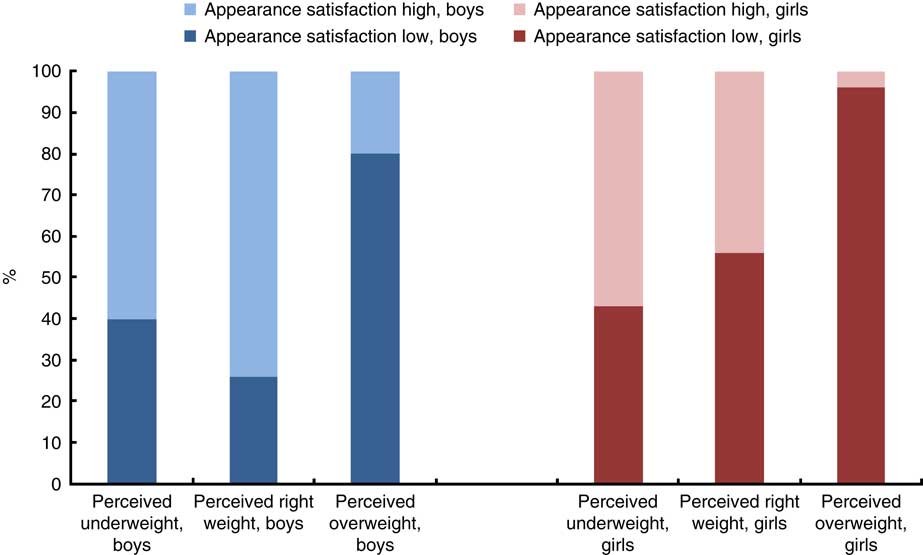
A higher proportion of girls than boys reported low appearance satisfaction (Table 2). No gender differences were found in reported slimming attempts (Table 2). The proportion of girls reporting low appearance satisfaction increased as perceived weight increased (Fig. 1). For boys, the proportion reporting low appearance satisfaction was higher among those who perceived themselves as overweight or underweight than among those who perceived their weight to be just right (Fig. 1).
(colour online) Proportion of girls and boys (n 469), mean age 12·7 (sd 0·3) years, with high and low appearance satisfaction in categories of self-perceived weight, Telemark, Norway, 2010
Gender differences in self-perceived weight, appearance satisfaction and slimming attempts among girls and boys (n 469), mean age 12·7 (sd 0·3) years, Telemark, Norway, 2010

* Pearson’s χ 2 test (Fisher’s exact test).
The multiple logistic regression analysis showed a strong association between perceived overweight and slimming attempts for both girls and boys. The association was observable independently of appearance satisfaction, BMI category and significantly associated background variables (Table 3, models 1–3). Adolescents who perceived themselves as overweight were more likely to report slimming attempts than those who perceived their weight to be right, the association being slightly stronger for boys than girls. Low appearance satisfaction was associated with slimming attempts among both genders, the association being slightly stronger for girls (model 1–3). The association was weaker than that observed between perceived overweight and slimming attempts. In the case of the boys, the association became insignificant following adjustment for significantly associated background variables.
Multiple logistic regression (ORFootnote * and 95 % CI) for the associations between perceived weight, appearance satisfaction and slimming attempts of girls and boys (n 469), mean age 12·7 (sd 0·3) years, Telemark, Norway, 2010

Ref., reference category.
Significant associations are shown in bold font.
* OR1, adjusted for perceived weight and appearance satisfaction; OR2, adjusted for BMI category; OR3, adjusted physical activity and significantly associated background variables.
Appearance satisfaction was associated with girls’ eating patterns (Table 4). Low appearance satisfaction was associated with a high score on the dieting eating pattern (models 1 and 2) and a low score on the varied Norwegian pattern (model 1). The latter association lost significance when adjusted for BMI category (model 2). In addition, low appearance satisfaction among girls was associated with a low score on the snacking pattern (model 2), but this was not significant in any of the other models. For boys, perceived underweight was associated with a high score on the junk/convenience eating pattern independently of BMI category and statistically significantly associated background variables (models 1–3).
Multiple logistic regression (ORFootnote * and 95 % CI) for the associations between perceived weight, appearance satisfaction and eating patterns of girls and boys (n 469), mean age 12·7 (sd 0·3) years, Telemark, Norway, 2010

Ref., reference category.
Significant associations are shown in bold font.
* OR1, adjusted for perceived weight and appearance satisfaction; OR2, adjusted for BMI category; OR3, adjusted physical activity and significantly associated background variables.
Discussion
The main findings of the present study were that girls perceived themselves as overweight more often than boys and reported low appearance satisfaction more frequently. Further, higher reported appearance satisfaction among girls correlated with self-perceived thinness. Boys perceived themselves as underweight more often than girls and their appearance satisfaction decreased when they felt themselves to be both above and below the right weight. No gender differences were observed in slimming attempts. Self-perceived overweight appeared to be a strong predictor of slimming attempts for both genders, but was not reflected in eating patterns. Boys feeling underweight were likely to eat more junk food than other boys. Girls reporting low appearance satisfaction were more likely to report slimming attempts and to consume more low-energy products than girls who were satisfied with their appearance.
A direct comparison with other studies is difficult due to differing measures of body/appearance satisfaction, weight perception/satisfaction and different methods of dietary data collection. However, some similarities and differences can be noted.
Our findings are in line with previous studies of adolescents in which gender discrepancies were observed with regard to self-perceived weight and body/appearance satisfaction. Gender patterns in relation to body satisfaction and weight perception appear to be consistent across Western countries( Reference Ojala, Tynjälä and Välimaa 3 , Reference Cuypers, Kvaløy and Bratberg 11 , Reference Mikolajczyk, Maxwell and El Ansari 19 – Reference Currie, Zanotti and Morgan 22 ). Girls perceive themselves as overweight and report body and appearance dissatisfaction more often than boys, whereas boys are more likely to perceive themselves as underweight. Our results indicate that both boys and girls adopt an ideal body image for their gender by the age of 12–13 years. Our findings highlight the importance of preventive programmes to improve young adolescents’ self-perception and the relevance of gender-specific approaches.
Our results indicate that slimming attempts are equally common among girls and boys. The proportion reporting slimming attempts (20 %) was higher than previously reported for 11-year-old Norwegian children (8 %)( Reference Meland, Haugland and Breidablik 13 ), but lower for girls and higher for boys than reported at age 13–14 years (30 % and 15 %, respectively)( Reference Grogan 33 ). The relatively high proportion of boys reporting slimming attempts may reflect increased pressure on boys to achieve a lean and muscular body. Recent research indicates a growing number of adolescent boys reporting concerns about weight( Reference McCabe and Ricciardelli 43 ).
The nature of the association between appearance satisfaction and weight perception seems to differ according to gender. Girls’ satisfaction decreased in line with perceived overweight, while boys were less satisfied when they felt too thin or too overweight. The results are consistent with previous research reporting gender-specific differences in the association between body dissatisfaction and weight perception( Reference Ojala, Tynjälä and Välimaa 3 , Reference Cuypers, Kvaløy and Bratberg 11 , Reference Mikolajczyk, Maxwell and El Ansari 19 – Reference Furnham, Badmin and Sneade 21 ) and indicate differing subjective body standards among girls and boys. The differences may be explained by the culturally determined, muscular, male ideal( Reference Cohane and Pope 44 ) and the thin body ideal and pressure to be slim experienced by females( Reference Stice and Whitenton 6 ). Our findings further underline the need for health professionals to consider gender-specific approaches when seeking to improve the physical self-image of adolescents.
Self-perceived overweight appeared to be the strongest independent predictor of slimming attempts for both genders. The results are consistent with previous studies on older adolescents( Reference Ojala, Vereecken and Valimaa 1 , Reference Ojala, Tynjälä and Välimaa 3 , Reference Holmqvist, Lunde and Frisen 14 – Reference Mikkila, Lahti-Koski and Pietinen 18 ) and adults( Reference Lemon, Rosal and Zapka 45 ), in which perceived overweight has been closely associated with dieting behaviour. Low appearance satisfaction was also related to slimming attempts among girls, independently of BMI category, physical activity and background variables. It is reasonable to assume that informants who report slimming attempts desire a change in behaviour and may be receptive to advice on leading a healthier lifestyle. However, as long as body dissatisfaction is a driving force, adolescents will be at risk of engaging in unhealthy weight-reduction behaviours rather than healthy lifestyle changes( Reference Neumark-Sztainer, Paxton and Hannan 23 , Reference Hjelkrem, Lien and Wandel 46 ).
In addition to reported slimming attempts, girls who were dissatisfied with their appearance were generally more likely to adhere to a low-fat, low-sugar eating pattern, a pattern often associated with dieting and weight control. The findings are in line with previous studies in which low body satisfaction has been related to dieting, food restrictions and skipping of meals( Reference Videon and Manning 20 , Reference Nystrom, Schmitz and Perry 24 , Reference Austin, Haines and Veugelers 47 ). Unlike in other studies( Reference Mikkila, Lahti-Koski and Pietinen 18 , Reference Videon and Manning 20 , Reference Nystrom, Schmitz and Perry 24 , Reference Austin, Haines and Veugelers 47 ), self-perceived overweight was not reflected in particular dietary patterns in our cohort. Rather, our results indicate uniform dietary behaviour among girls with low appearance satisfaction. One possible explanation is a shared ambition among these girls to achieve the female beauty ideal through weight control. Previous research indicates that many girls believe that being thinner would have a positive impact on their lives( Reference Paxton, Wertheim and Gibbons 48 ). Sociocultural influences such as daily exposure to social networking sites( Reference Tiggemann and Slater 49 ), peer appearance criticism and, particularly, mothers’ preoccupation with their own and their children’s appearance and diet have previously been associated with low body satisfaction and dieting among adolescent girls, and may be important factors contributing to the observed association( Reference Lowes and Tiggemann 50 – Reference Lawler and Nixon 54 ).
Boys feeling too thin were more likely to eat high-energy processed fast foods, refined grains, cakes and sweets than other boys. Previous research has shown that young adolescent boys often describe themselves as too light compared with the male body ideal( Reference Furnham, Badmin and Sneade 21 , Reference Cohane and Pope 44 ). One possibility is that boys who consider themselves too thin consume more energy-rich foods in an attempt to gain weight. Sociocultural factors may partly explain both perceptions and adaptions. Messages from parents, particularly from fathers, have previously been related to muscle gain attempts among boys( Reference Lemon, Rosal and Zapka 43 ). A further explanation may be that boys who feel thin, and their parents, have a less concerned attitude towards energy-rich foods and weight gain.
A challenge to health professionals working with adolescents is the potential conflict between obesity prevention and the risk of undesirable weight-reduction behaviours( Reference Neumark-Sztainer 55 ). Several studies have concluded that in order to prevent both overweight and unhealthy weight-reduction behaviour, the focus should be on improving body satisfaction and altering behaviour – for example by introducing healthier eating patterns and promoting physical activity – rather than on weight loss( Reference Sanchez-Carracedo, Neumark-Sztainer and Lopez-Guimera 56 , Reference Haines and Neumark-Sztainer 57 ). Our findings suggest that gender-specific strategies may also be useful, as body concerns and the association with eating patterns differed for the two genders.
The present study has strengths, but also limitations that should be recognised. Previous studies have employed various instruments for assessing attitudinal body aspects. For the present study, the physical appearance subscale of Harter’s Self-Perception Profile for Adolescents and the HBSC scale of weight perception were chosen. Both represent instruments previously used in Norwegian adolescent population studies( Reference von Soest and Wichstrom 9 , Reference Meland, Haugland and Breidablik 13 ). Harter’s physical appearance subscale includes several complementary statements of appearance( Reference von Soest and Wichstrom 36 , Reference Meland, Haugland and Breidablik 37 ). The complete instrument has given good construct and factorial validity when investigated in a representative sample of Norwegian adolescents aged 13–20 years( Reference Wichstrom 37 ). To illuminate different aspects of body satisfaction and to reveal possible gender-specific associations, we decided to include appearance satisfaction and weight perception as separate independent variables in the multivariate regression. All analyses were stratified by gender.
An important strength of the study is the use of eating patterns derived from principal component analysis as a measure of the children’s overall dietary and meal habits( Reference Hu 30 ). The FFQ included a wide range of commonly used food items, snack products, drinks and meals, resulting in robust factors (eating patterns) covering multiple items.
Clear associations have previously been reported between BMI and body satisfaction, weight perception and dieting among adolescents( Reference Presnell, Bearman and Stice 4 , Reference Neumark-Sztainer, Wall and Eisenberg 5 , Reference Storvoll, Strandbu and Wichstrøm 8 , Reference Holsen, Jones and Birkeland 10 , Reference Austin, Haines and Veugelers 47 , Reference Makinen, Puukko-Viertomies and Lindberg 58 ). We have previously related overweight to a low intake of the varied Norwegian eating pattern( Reference Oellingrath, Svendsen and Brantsaeter 31 ). To investigate independent relationships, BMI was considered an important confounder and adjusted for in the present analyses. Not surprisingly, this adjustment resulted in changes to some estimates. For example, the observed association between low body satisfaction and low intake of the varied Norwegian eating pattern among girls appears highly dependent on real overweight, as the association changed and lost significance when adjusted for actual BMI.
Misperception of weight is common among adolescents( Reference Mikolajczyk, Maxwell and El Ansari 19 ). Although we have not distinguished between informants with accurate and inaccurate weight perceptions in the present study, we have adjusted for BMI category to determine the independent relationships between subjective perceptions and behaviours. While we recognise the importance of weight misperception, we consider further characterisation of this factor to be beyond the scope of the present study. We intend to devote greater attention to the issue in a future paper.
We also adjusted for several other background variables we considered important with regard to weight perception, appearance satisfaction and food intake variability. However, adjusting did not change the estimates substantially. Nevertheless, we cannot exclude the possibility that other sociocultural and environmental factors not taken into account here may have attenuated the associations investigated.
Children’s self-reported appearance satisfaction, perceived weight and slimming attempts may have caused bias due to misreporting. The possibility that the observed gender differences reflect deviations in pubertal status between boys and girls cannot be excluded, as measures of pubertal stage were not included in the study.
We cannot exclude the possibility that parental dietary reports may have influenced the associations, for example by under-reporting of unhealthy items and/or over-reporting of healthy products( Reference Livingstone and Robson 59 ). However, the FFQ data were used to derive patterns reflecting dietary behaviour( Reference Newby 60 ) and are less likely to be distorted by misreporting than estimated intakes of energy, nutrients and food amounts. Nevertheless, biases caused by errors in memory and parental insight into eating outside the home cannot be excluded( Reference Drewnowski 61 ). It is likely that the dietary data reflect the parents’ ‘dietary image’ rather than the true habitual diet of the adolescents( Reference Livingstone and Robson 59 ). However, the inclusion of parental reports via the FFQ may have reduced possible bias resulting from adolescents’ self-reporting of dietary data( Reference Livingstone and Robson 59 ). The reproducibility and validity of principal component analysis-derived dietary patterns assessed using FFQ have previously been found to be comparable to those of patterns obtained using weighted dietary records( Reference Togo, Heitmann and Sorensen 62 – Reference Jacka, Ystrom and Brantsaeter 65 ).
Only one question about slimming attempts, ‘Are you trying to slim?’, was asked in addition to questions about habitual food intake. Additional questions would be necessary to assess possible harmful eating behaviours and weight-reduction practices. However, more detailed questions about adverse behaviours were not asked in our study due to parental reservations. It is likely that the reported slimming attempts do not necessarily reflect real engagement in unhealthy weight-reduction behaviours( Reference Neumark-Sztainer and Story 66 ), but simply an intention and motivation to slim or attempts to reduce the intake of high-energy foods and beverages.
One possible limitation on the results is bias due to non-responders. The participating parents had a somewhat higher educational level and total family income than the Norwegian population in general. Further, we only analysed participants with complete data on diet and body-related perception variables. Because those with missing data on these variables did not differ substantially from the remaining informants with regard to background variables, we consider this problem to be limited. Data collection was limited to one Norwegian county and therefore the results are not necessarily representative of the national population. Finally, the study’s cross-sectional design makes it impossible to identify causal relationships.
Conclusion
Our findings indicate that current Western male and female body ideals are well established among young adolescents, and that dissatisfaction with appearance and weight is clearly associated with slimming attempts and unhealthy eating patterns. Although girls were generally most dissatisfied with their appearance and perceived themselves to be overweight more often than boys, many boys also reported a poor physical self-image and were at similar risk of slimming attempts as girls.
Perceived overweight appears to be a primary driver of slimming attempts by both genders. However, different aspects of body dissatisfaction were related to different food behaviour in boys and girls. While boys who felt too thin seemed to compensate with energy-rich, unhealthy foods, girls were likely to choose low-energy, unbalanced diets when they were unhappy with their appearance, regardless of weight perception. These results suggest that measures aiming to improve the diet of boys should include advice on healthy foods that help build a strong and healthy body, while measures targeting girls should primarily encourage positive appearance perception in order to achieve healthy changes in eating patterns.
Adolescents and their families should be encouraged to shift their focus from unattainable gender-specific body standards and commercial weight ideals onto positive self-esteem, appearance satisfaction and a healthy lifestyle. The observed gender differences should be taken into account when planning health promoting programmes targeting young adolescents.
Acknowledgements
Acknowledgements: The authors would like to thank the children and parents, staff of the primary and lower secondary schools in Telemark County and the public health nurses who participated in this study. Financial support: This research was supported by Telemark University College, Telemark Hospital, the Research Council of Norway and the Public Health Programme for Telemark. The funders had no role in the design, analysis or writing of this article. Authorship: I.M.O. and M.V.S. were responsible for the study design. All authors contributed to data collection. M.V.S. was responsible for the statistical analyses. All authors contributed to the interpretation of the results. I.M.O. drafted the manuscript and the other authors revised it critically. All authors read and approved the final version of the manuscript. Ethics of human subject participation: The study was conducted in accordance with the guidelines laid down in the Declaration of Helsinki and the research protocol was approved by the Regional Committee for Ethics in Medical Research and the Norwegian Data Inspectorate.



