




1. Introduction
In face of uncertain times, several aspects are causing disruption in the academic environment. To nurture the attempts dealing with academic disruptions, this research examines how disciplinary insights from organisational change and design thinking can be integrated withing a framework to support change initiatives. The increasing digital presence and interconnectedness have spurred extensive research into the transferability and diffusion of technology, as well as pedagogical practices, both at the systemic level and within educational institutions (Hwang et al. Reference Hwang, Xie, Wah and Gašević2020; Rof, Bikfalvi & Marques Reference Rof, Bikfalvi and Marques2022). This transformation process is also externally influenced by escalating skills demands stemming from an industrial transition, known as the fourth industrial revolution (Matthews, McLinden and Greenway Reference Matthews, McLinden and Greenway2021).
In an era that requires new skills for cross-disciplinary, complex, and contextual understanding (Sheppard, Pellegrino & Old Reference Sheppard, Pellegrino and Olds2008), the process of reengineering becomes imperative at multiple levels to promote efficient knowledge acquisition (Nair, Patil & Mertova Reference Nair, Patil and Mertova2009). The constraints on engineering problem-solving extend to the societal and human aspects of engineering practice (Grimson Reference Grimson2002). With increasing connectivity, modern design practices place increasing emphasis on skills development, critical thinking, and the pursuit of enhanced efficiency. Forming and organising skills are essential for orchestrating a network of actionable elements, which in turn enhances ideation fluency and innovation novelty (Dym et al. Reference Dym, Agogino, Eris, Frey and Leifer2005). These skills are crucial for navigating future pathways by improving design confidence (Rao, Puranam & Singh Reference Rao, Puranam and Singh2022).
Previous research suggests that changes in complex systems require an appropriate level of abstraction (Maier, Eckert & Clarkson Reference Maier, Eckert and Clarkson2017). Several educational frameworks approach this from a systems level, clarifying relational processes and supporting elements (e.g., Henderson, Beach & Finkelstein Reference Henderson, Beach and Finkelstein2011; Borrego & Henderson Reference Borrego and Henderson2014; Berglund & Leifer Reference Berglund and Leifer2016). Rather than debating the relevance, similarity, or applicability of existing educational frameworks in promoting the integration of new emerging and interdisciplinary efforts (van Dijk et al. Reference van Dijk, Geertsema, van der Schaaf, van Tartwijk and Kluijtmans2023), this research builds upon experiences from teacher activities, student learning, and pedagogical change initiatives. Drawing on examples from four distinct contexts, it contributes to the descriptive foundations needed to contextualise co-creative cases. By combining design thinking with educational change research, this study aims to extend existing frameworks by presenting an educational ecosystem that demonstrates how change processes within academia can support the development of design education.
This article is structured as follows. It begins with a brief literature review on change, design thinking, and the emergence of a process-oriented ecosystem, followed by the aim and research questions. Next, the research design is outlined, including the study’s four cases. The theoretical framework is then presented to establish the necessary connections and understandings for concurrent change actions in higher education and relevance for design education. This is followed by the empirical findings and an extensive discussion. Finally, the conclusions are presented, examining the educational ecosystem and outlining the theoretical contributions.
1.1. Emergence of a process-oriented ecosystem
The concept of ecosystems has gained prominence across various disciplines, impacting diverse areas such as business and innovation. With the shift towards an Industry 4.0 perspective, there is a growing focus on holistic learning systems. Koul and Nayar (Reference Koul and Nayar2021) emphasise the necessity of a seamless design, expressing the idea of an ‘educational ecosystem.’ This term refers to a complex network of elements, including individuals, contexts, and components, all integral to the teaching and learning process. In this article, a more robust framework is advocated, emphasising that learning occurs through relational processes within these system elements, whereas Koul and Nayar (Reference Koul and Nayar2021) aim to establish a foundation for a Classroom 4.0 concept, there remain reasons to further deepen our understanding of how a systems perspective can outline design-driven change processes within academia. The educational ecosystem comprises elements that correspond to a set of relational processes, such as student-teacher relationships, peer interactions, curriculum design, technology integration, contextual factors, and feedback loops. Recognising these dynamic interactions can enhance our understanding of how educational outcomes are influenced and improved. While an educational ecosystem aims to nurture effective and flexible learning, research explores the process of developing a sustainable way between vertical ownership, by appointed leaders, and lateral emerging team coalitions (Andrade & Alden-Rivers Reference Andrade and Alden-Rivers2019).
This evolution extends towards the application of design-based practices and organisational transformation (Dorst Reference Dorst2011), serving as a knowledge catalyst that enhances design cognition and team progression (Beckman & Barry Reference Beckman and Barry2007). Furthermore, design thinking is recognised for its transformative capacity as an educational change maker (Dunne & Martin Reference Dunne and Martin2006). Consequently, design thinking embodies the practices of creating and sustaining an innovation-driven and people-centred approach, enabling ecosystems and organisations to address societal and environmental challenges (Auernhammer & Roth Reference Auernhammer and Roth2021). While design thinking has demonstrated its value for firms and societies in terms of innovation and change (Liedtka Reference Liedtka2018), its adoption in higher education lags behind other sectors. The use of design thinking has predominantly been represented in educational research for the purpose of short-term, transactional benefits. These, often project-based courses (Dym et al. Reference Dym, Agogino, Eris, Frey and Leifer2005; Wodehouse et al. Reference Wodehouse, Grierson, Breslin, Eris, Ion, Leifer and Mabogunje2010) are intentionally designed to support students’ learning experience by broadening perspectives and improving the value provided to those targeted by design activities. It is with growing concern that uncertainties have gained attention, prompting a significant reconfiguration and restructuring of how teaching and learning are manifested, with the potential to extend short-term gains towards a sustainable ‘systematic’ output.
For organisations, emerging complexities present a new trajectory where problems are addressed through the internal change mechanisms they activate (Dorst Reference Dorst2011). To establish sustained impact, it is crucial to cultivate an internal drive within organisations to realise the potential benefits of change, fostering educators’ innovative mindsets (Berglund et al. Reference Berglund, Klasén, Hansson and Grimheden2011). This tacit capacity is related to the design mindset (Daalhuizen & Cash Reference Daalhuizen and Cash2021), which emphasises a systematic approach to problem-solving based on ‘embeddedness’ and context, offering various pathways for progression. This underscores the importance of concise and efficient design delivery in establishing intentional change. Triggered by specific action points such as purpose, scope, coverage, benefits, and contextual conditions, the activation of harboured design capabilities becomes more effective (Gericke, Eckert & Stacey Reference Gericke, Eckert and Stacey2022). This balance between utilising and developing competencies is characterised by a long-term value-based approach, evident in various learning environments where design thinking has been a fundamental change maker (Wodehouse et al. Reference Wodehouse, Grierson, Breslin, Eris, Ion, Leifer and Mabogunje2010; Berglund & Leifer Reference Berglund and Leifer2013; Auernhammer & Roth Reference Auernhammer and Roth2021). Drawing inspiration from co-evolution design theory (Gero, Kannengiesser & Crilly Reference Gero, Kannengiesser and Crilly2022), this article views context variables, such as function, behaviour, and structure as crucial factors influencing a systems perspective on design education. It proposes a theoretical framework that emphasises transformative actions applicable to higher education in general, and design education in particular. Building on recent practices, this article pursues a practice-oriented approach for educators, where design thinking is intended to inspire sustainable initiatives (Calavia et al. Reference Calavia, Blanco, Casas and Dieste2023) and broaden organisational perspectives (Kwon, Choi & Hwang Reference Kwon, Choi and Hwang2021). Creating an effective educational ecosystem depends on the ability to drive change through diverse approaches. This article provides a comprehensive understanding of the mechanisms within an educational ecosystem, linking change theories with design thinking, and offering new insights for design educators and management.
1.2. Aim and research questions
This article aims to explore the relationship between organisational change and design thinking, with a particular focus on vertical and lateral structures that affect processes. To achieve this aim, the study is guided by two research questions.
-
1. How does the application of design thinking contribute to change processes in an educational ecosystem across different levels of authority?
-
2. How can design thinking systematically be linked to and contribute to theory-building in the context of educational ecosystem literature and transformational change?
The study is delimited to four cases, each with a unique impact on their home academic environment, where design thinking has functioned as an implicit change catalyst driven by actions and unfolding events rather than by any guiding formula.
2. Research design
The overall purpose of this research is to explore how design-driven approaches can be characterised in the educational ecosystem through different scopes and transformative cases. Notably, the concept of an educational ecosystem is relatively unfamiliar to many universities, despite being a fundamental practice connecting new research and learning. By utilising a holistic case study approach (Yin Reference Yin2009), the exploration of multiple cases has supported the analysis of influences affecting change processes within the framework of an educational ecosystem. The challenge of pursuing change in large, complex organisations is well-situated to a more systematic comprehensive, application of design thinking. Rooted in the problem and solution spaces (Dorst Reference Dorst2011), design thinking provides basis for analysing and framing the educational ecosystem, as well as understanding how actions of change influences different levels of authority. Four illustrative cases were selected to examine each research question. The selection criteria focused on ensuring contextual richness and accessibility, aiming to outline procedures and key case characteristics. The potential richness and depth provided by cases with personal experience were highly valued. These cases served as a basis for observing changes and unfolding events over time. Given the accessibility of the cases and their innovative nature within the home environment, a qualitative insider perspective was adopted (Dwyer & Buckle Reference Dwyer and Buckle2009). However, acknowledging an insider’s perspective posed several challenges. Nevertheless, potential biases did not cause any apparent impact on the study, which could have risked skewing parts of the cases. Each case was examined individually to explore its characteristics, context, and the underlying dynamics that influenced their evolvement. The case descriptions unfold to identify key characteristics of each of the four cases, including the resources they utilise, the results and effects of their implementation, and any deficiencies or output footprint they may exhibit.
The cases used in this study are presented based on their design, intent, and actions. This opens up the possibility to reveal how four different modes of co-creation may be initiated and approached to redesign engineering education. The modes of co-creation are as follows:
-
(i) student co-creation and knowledge conversion,
-
(ii) faculty co-creation and skills development,
-
(iii) organisational co-creation and digitalisation,
-
(iv) professional co-creation and life-long learning.
However, the comparability and cumulative effect of past research on co-creation and co-production remain relative weak, as systematic links between findings and contributions to theory-building are still underdeveloped (Brandsen & Honingh Reference Brandsen, Honingh, Brandsen, Steen and Verschuere2018).
3. Literature review
The Industry 4.0 revolution highlights the fundamental shift towards digitalisation needed today by educators, organisations, and systems (Matthews, McLinden & Greenway Reference Matthews, McLinden and Greenway2021). The urgency for designers to assist and facilitate systems change involves addressing circularity concerns and shaping resilience to confront Anthropocene challenges (Boehnert Reference Boehnert2018). Graham (Reference Graham2012) highlights a problem in higher education: successful change is rarely driven by pedagogical evidence, and good practices often have limited diffusion and long-term impact. Harsaae et al. (Reference Harsaae, Østergaard and Bang2022) emphasise the importance of systematically mapping domain content and needs beyond individual stakeholder concerns, urging decision-makers to educate graduates with competencies that complement those offered by current programmes. Research generally falls into two domains: prerequisites and outcomes of change, and the change process itself (Kezar & Eckel Reference Kezar and Eckel2002). However, there has been limited focus on the process perspective of educational change. Existing educational change strategies prioritise innovation and the key elements for successful educational reformation, focusing on unleashing innovative activities during transformative processes. Beckman and Barry (Reference Beckman and Barry2007) present a comprehensive approach to innovation and its role in nurturing and supporting the learning process in project-based engineering design courses. Drawing on the engaging principles of Design Thinking as a means to ‘imply a reorientation from the instrumental aims of conventional design education’ (Cross Reference Cross1982: p. 221), this research underscores the importance of actively incorporating design skills within the discipline of engineering education. By unlocking what Cross (Reference Cross1982) declares as ‘intrinsic value,’ this process-oriented perspective can be served through educational change efforts. This article strongly asserts that adopting perspectives from domains beyond engineering design education, particularly through the use of design thinking, can yield valuable insights. It emphasises that education reforms transcend disciplinary boundaries and significantly influence perspectives on organisational change.
3.1 Foundations for change in engineering design education
Engineering design students show reduced ability to apply concept from mathematics, natural, and engineering sciences to solve engineering problems (Carberry & McKenna Reference Carberry and McKenna2014), leading to diminished authentic design capabilities (Owen Reference Owen2007). According to Mayer and Norman (Reference Meyer and Norman2020), engineering design education emphasises the developing performance-related skills in graduates. However, connecting these skills to systemic and contextual challenges remains challenging, with only a few exceptions effectively addressing global issues.
This leads to the existence of a ‘design-science gap’ that needs to be bridged (Vattam & Kolodner Reference Vattam and Kolodner2008). Building on the Aristotelian ideas of knowledge and wisdom conversion, Martin (Reference Martin2015) suggests a need in engineering education to put a stronger emphasis on téchne (knowledge of practice), phrónesis (the wisdom of practice, meaning the capability to make good judgements based on a person’s own experience), sóphia (the wisdom of making good judgements using science and intelligence), and nous (intelligence and the ability to make holistic judgements) from Aristotle’s classical concepts of knowledge. This underlines that mere epistéme (the knowledge of science based on general rules and structures) is insufficient. Reich (Reference Reich2023) employs Archimedes’ reasoning to comprehend the generation of applicable knowledge, which is either produced and organised or further used to leverage comprehension and reach new knowledge. Therefore, an engineer should be able to use all kinds of knowledge. However, conventional academic engineering education often concentrates almost exclusively on epistéme.
This is problematic because an engineer should be able to make good judgements in new and unknown situations (Martin Reference Martin2015) and be proactive to enable new processes and innovative solutions (Berglund Reference Berglund2013). Drawing from ancient wisdom shared by Aristotele and Archimedes, as well as more modern cyclic learning styles proposed by Kolb (Reference Kolb2014), the perceived link between change in form and perspective emerges as an internalisation process. By immersing oneself to understanding a particular context, valuable insights deeply rooted in a specific point of view can be captured and developed over time. Once a cohesive statement is established, the process of generating ideas that encapsulate the core need for change can begin. With the possibility to suggest a game changer suggested solutions are iterated forward to capture as much valuable user experiences as possible. This, in the end, could ensure that the end solution is more robust than it would be otherwise.
3.2 Design thinking as a catalyst for change
Design thinking ensures that solutions are realistic and feasible, acknowledging constraints and challenges inherent in human rationality, such as incomplete information and resource limitations (Simon Reference Simon1972). It has evolved into a human-centred design approach that targets intrinsic values (Cross Reference Cross1982), emphasising empathy, knowledge pragmatism, and addressing wicked problems (Buchanan Reference Buchanan1992). Design thinking has been framed for designerly purposes several times by applying ontologies and outlining the core transformative processes involved (Gero & Kannengiesser Reference Gero and Kannengiesser2004). While design thinking evolves, so is also the interaction patterns between people and systems. Conway et al. (Reference Conway, Masters and Thorold2017) address the limitations to a two-dimensional design thinking perspective, where users and designers are not always able to gain a proper foothold necessary for realisation, partly due to the inability to navigate system structures. Buchanan (Reference Buchanan2019) highlights the growing uncertainty surrounding systems and principles of systems where designers need to recognise the need for creative inquiry. Cross (Reference Cross2023) echoes this sentiment, suggesting the emergence of a new version of design thinking. This new approach is potentially more effective when dealing with complex issues and embodies professional design practice as a core competency. It promotes a broader scope of strategic, adaptive, and cooperative intelligence, which is essential for engaging with the complexities of design education. Adopting systematic thinking and encouraging boldness in design education can significantly enhance students’ ability to tackle complex challenges, compelling educators to adopt these approaches with greater decisiveness and innovativeness.
Additionally, design thinking intersects with cognitive science, where intuitive ‘gut-feeling’ decisions and analytic thinking form a dual ‘internal operative system,’ driving our behaviours towards solution-oriented actions. Grinding decision-making is, therefore, a balancing act between two modes of operation (Kannengiesser & Gero Reference Kannengiesser and Gero2019); on the one hand, to make swift ‘automatic’ decisions, and on the other hand, to establish a well balanced and ‘analytical’ slower decision. From a design and change perspective, human cognition can act as a catalyst, prompting gut-feeling personas and action orientation before a more risk-aversive, slower processing, and decision embodiment.
Design thinking serves an approach to change people’s minds by shifting perspectives and opening up new, foreseen solutions (Liedtka Reference Liedtka2018), providing them with a transformative mindset to approach educational change. The learning modes of Kolb (Reference Kolb2014) in this figure are depicted along axis that relate to captured forms of learning (concrete vs. abstract and analysis vs. synthesis). Along these axes, Beckman and Barry (Reference Beckman and Barry2007) identify four different compartments in which a design process proceeds (see Figure 1).
The design process based on Beckman and Barry (Reference Beckman and Barry2007).
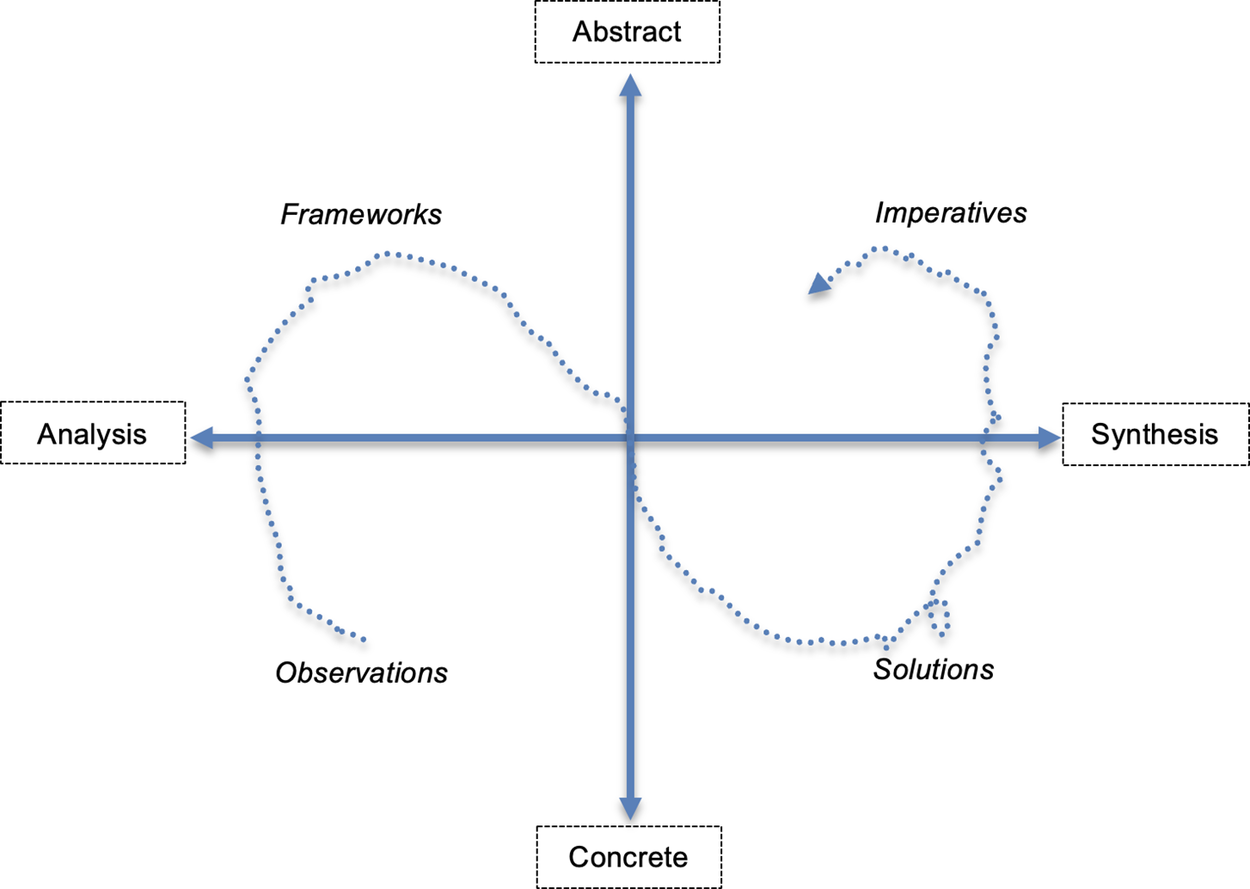
Before setting goals or ambitions, it’s crucial to understand the current situation and engage with users. Observation is key to gathering insights that inform your perspective. By establishing a clear point of view, you create a focused direction for identifying necessary actions. This process guides the generation of ideas, initially framing the challenge or problem and ultimately leading to a solution. As prototypes undergo testing and iterations, there is a growing imperative to persistently reshape existing practices or modify previously tested concepts. With each iteration, the evolving prototype enables instant reshaping, advancing momentum towards novel approaches and forms. While iteration is a natural phenomenon to this process, rethinking and redoing, simply ‘change’, enables people to reconsider boundaries and reshape possibilities.
3.3 Enabling a systematic practice of sustainable change
In engineering design, education ‘change’ offers opportunities to break established patterns and pursue an ambiguous, yet potentially more original path (Dym et al. Reference Dym, Agogino, Eris, Frey and Leifer2005; Beckman & Barry Reference Beckman and Barry2007). From a design-oriented perspective, engineering innovation is perceived as an integral part of the learning process (Berglund Reference Berglund2013; Berglund & Leifer Reference Berglund and Leifer2016). However, it is still crucial to recognise the evolving forms and stages of design thinking conversations. Past research mentions these stages as especially critical, due to urgency for champions that can purse and significantly enhancing the likelihood for reaching implementation and change impact (Liedtka Reference Liedtka2018). Perceiving change as something with minimal involvement prior to implementation can be characterised as an unknown variable. Under the circumstances that change involves a learning process for adopting new practices, it is reasonable to assert that learning serves as a mechanism for driving the establishment change.
Following the reasoning of Fullan (Reference Fullan2007), it is argued that an efficient change is achieved if the solutions attain a certain quality with individuals both accepting the change and understanding the reason for its implementation. Understanding is needed to ensure that changes are appropriately prioritised, and acceptance is crucial for making them sustainable. Being able to manifest local change has been pointed out by Finelli et al. (Reference Finelli, Daly and Richardson2014) as a key driver for accelarating the adoption process towards new teaching practices. Among the factors contributing to the backlash against changes are proposals that have been too narrow, required extensive work to implement, or were difficult to pursue due to a lack of anchorage in educational and institutional realities. In this sense, understanding becomes a critical starting point not for assessing and solving a problem, but for formulating the proper one that could really make a difference. Regarding the extent of change, it is important to distinguish whether efforts are being made are for the purpose of renewal or improvement (Fullan Reference Fullan2007). Kezar and Eckel (Reference Kezar and Eckel2002) argue that internal decisions to innovate and motivate change play a crucial role in deepening our understanding of the change process. Högfeldt et al. (Reference Högfeldt, Malmi, Kinnunen, Jerbrant, Strömberg, Berglund and Villadsen2018), exemplify how academic change depends on internal dynamics, and authority levels. Institutions often struggle to adapt to a rapidly changing world. But what if we could shift the focus from external pressures to the internal dynamics that truly drive transformation. By focusing on internal dynamics, institutions can better navigate the complexities of change and foster an environment conducive to meaningful transformation. This implies that institutions must proactively cultivate a culture of sustainable innovation and establish mechanisms to support and facilitate both disruptive and incremental change efforts.
4. Empirical findings: four illustrative cases
This section presents unique characteristics of scope, change process, and context affecting each outcome. Building on an emphatic ethos, this article gathers insights from different change approaches that hold great relevance for many universities today. Starting with student-centred change efforts, ‘student co-creation’ and knowledge conversion are examined, followed by ‘faculty co-creation’ and skills development, ‘organisational co-creation’ and digitalisation, and finally, ‘professional co-creation’ and life-long learning. This section concludes with a table summarising the key characteristics of the four cases.
4.1 Student co-creation
The first approach described was used in the development of a new advanced course on Advanced Product Development at Mälardalen University, Sweden. The course, founded over two decades ago, incorporate input from industry experts and various stakeholders to adopt a practical approach in providing and challenge students’ engineering design competency. The course is a key component of the product and production development programme, known for its strong collaboration with the local community and manufacturing industry. Typically, 15–30 students are enrolled in the fifth-year programme course. The close collaboration with industrial partners offers project challenges that closely align with the objective of preparing students with authentic, real-world cases (Shawcross & Ridgman Reference Shawcross and Ridgman2012). The course includes a ‘design-build-test’ project (Berggren et al. Reference Berggren, Brodeur, Crawley, Ingemarsson, Litant, Malmqvist and Östlund2003; Crawley et al. Reference Crawley, Malmqvist, Ostlund and Brodeur2014), conducted over 3 months, and recently extended to a full semester half-time. The course allows students to practice practical engineering, develop design competencies, including organisational skills, critical thinking, and reflect. Each project involves student pairs, and more recently, smaller teams, designed to maintain low team complexity while emphasising process and leveraging the smoothness of iterative progression. This project-based course collaborates with an industrial partner who selects a specific problem area for students to address. Projects coordinate and systematise parallel development processes for creating a functional prototype, and design validation steps (user feedback and calculations). The syllabus characteristics align with similar encompassing design-build-test project courses (e.g., Berglund Reference Berglund2012; Berglund & Leifer Reference Berglund and Leifer2013). Individual learning is central, supported by checkpoint debriefs, feedback sessions, prototyping log, and dedicated sections in written project reports. The validation and justification of key features in the final prototype are of central concern. Past research underlines the development of skills in team-based interaction as a primary learning objective (e.g., Wodehouse et al. Reference Wodehouse, Grierson, Breslin, Eris, Ion, Leifer and Mabogunje2010; Berglund Reference Berglund2012, Reference Berglund2013), with outcome-derived factors playing a crucial role.
The exploration of methods to operationalise knowledge is a prominent goal, driven by the need to develop engineers’ skills in effectively organising product development. A key objective in developing the course, both then and now, is to situate specific learning content within a highly authentic, making full use of student input. To facilitate transparency and input, various channels for input support is used including a learning management system (i.e., Canvas), active listening, Q&A sessions, and supervision feedback. The continuous course development made the learning environment to evolve to become a product for product development by itself, encouraging reflective learning (Felder & Silverman Reference Felder and Silverman1988), and promoting self-directedness among students (Berglund Reference Berglund2013). The adoption of a project-based learning format inspired by ‘best practices’ highlights a strong emphasis on pragmatic skills and hands-on experiences that are vital in product development. To increase the level of authenticity and global competence, international collaboration in distributed formats has become increasingly important. The latest course version captures an extended timeline, doubling the project duration, and creating opportunities for global partnerships across academic structures, disciplinary traditions, and industrial partners. Team formation in this context faces increased pressure, not primarily in performance evaluation, but in managing the complexities of diverse cultures, time zones, and asynchronous collaboration. Empathy, team commitment, shared momentum, and a positive team atmosphere are crucial for effective functionality across these diverse teams. Two distinct team compositions, labelled Project Local and Project Global, are tackling parallel project challenges. For the eight-week global team, it is critical to provide support that facilitates their research and interaction, allowing them to move projects into the ideation phase earlier with more relevant and sophisticated ideas, to allow more time for prototyping. This has led to the exploration and integration of an AI teacher (Berglund Reference Berglund2024a), a concept currently being tested in the latest course offerings. This integration aim to leverage research on the topic, provide 24/7 content-based feedback, and overall design process insights to foster engagement and ensure timely updates.
4.2 Faculty co-creation
The second approach is fundamentally different in its foundation. As presented by Berglund et al. (Reference Berglund, Havtun, Johansson, Jerbrant, Andersson, Hedin, Soulard and Kjellgren2015), the Pedagogical Developers’ Initiative (PDI) was an educational change initiative that ran between 2015 and 2018, reaching more than 800 participants, and the impact of the efforts made is still being researched. The project was designed to increase and sharpen the pedagogical skills of faculty at the local university, the KTH Royal Institute of Technology. The PDI was grounded in the vision of enhancing teaching and learning practices among faculty and students. It aimed to achieve this by cultivating change agents, who serves as both educators and facilitators, thereby contributing to the overall advancement of educational programmes. The initiative was launched following the recruiting a cohort of 24 pedagogical developers, each representing one of the university’s 10 engineering schools at that time. Several of the pedagogical developers also hold positions as programme directors or directors of studies, bringing with them extensive experience in the development of courses and programmes development throughout their careers. To initiate change actions, thematical targets were drawn from open-ended need finding exercises. These were conducted school specific meetings, programme revision, and filtered through discussions with course and programme responsibles.
Despite the unclear targets and loose guidance during the project formation, it allowed for a focus on key areas of interest. Additionally, the vague leadership provided extra room to address unforeseen actions as part of a systematic approach to sustainable improvement. To influence and potentially impact both each local school and the university as a whole, each recruited pedagogical developer was allocated approximately 30–50% of their working time to pursue need-based pedagogical development. To support this commitment financially, the time spent was supported both centrally by the university and, in some cases, individually by separate schools to fund school-specific projects. From a university perspective, the PDI has operated on the premise that curriculum change should be broadly integrated (Viberg et al. Reference Viberg, Bälter, Hedin, Riese and Mavroudi2019), reflecting and introducing second-order change. Thus, instead of seeking to change a single programme in its entirety, the aim was to encourage the integration of new pedagogical methods and practices into many courses simultaneously. The PDI explored critical thematic areas, and ways to facilitate teachers’ professional development. This connects well with the internal struggles that many universities face, rooted in the urgent need to provide teachers with a purposeful path for enhancing their disciplinary knowledge and practical expertise (van Dijk et al., Reference van Dijk, Geertsema, van der Schaaf, van Tartwijk and Kluijtmans2023). This initiative has garnered both national and international attention from peers, as it provides an array of different functional ways to enable inspiring learning environments. The project also provides an unfiltered source of inspiration of how a systematic pedagogical change process can be realised (Berglund, et al. Reference Berglund, Havtun, Jerbrant, Wingård, Andersson, Hedin and Kjellgren2017). Successful implementation of workshops and seminars has become activities that engage invited and participating faculty to impact areas such as ‘formative feedback,’ ‘motivation,’ and ‘flipped classroom’ (Kjellgren, et al. Reference Kjellgren, Havtun, Wingård, Andersson, Hedin, Hjelm and Berglund2018).
4.3 Organisational co-creation
The third approach is a bottom-up ‘multifaceted’ case with the purpose of embedding extended realities (XR) as an integrated part of design education programmes. Connecting interested peers, internally and externally it was originally designed to function as a hub for educational projects, research, and to advance pedagogical reasoning. The establishment of an XR Lab at Mälardalen University necessitated investment in equipment, requiring institutional support and the active participation of multiple teachers. As a result, the initial development of the XR Lab became a significant endeavour, strategically integrating innovative practices into existing curricula. The early setup formation took inspiration from innovative game developers utilising and showcasing virtual reality (VR) and from the formation of the Social VR Lab at Stanford University (Mabogunje et al. Reference Mabogunje, Sonalkar, Miller and Bailenson2021). Networking and building partnerships have always been important and have served as a means to explore both software and hardware. However, a critical aspect of the XR Lab’s evolution and its current activities is the risk of self-implosion due to resource depletion. Drawing insights from previous professional roll-out efforts, the expansion possibilities of the XR Lab also depend on the ability to generate traction and secure commitment from a substantial number of individuals, including decision-makers.
Berglund (Reference Berglund2023a) suggests that integration thresholds must be surpassed to effectively deliver and ensure that emerging technologies live up to their perceived benefits. The XR Lab was launched in 2018 with the aim of developing students’ conceptual understanding, practical skills, and their ability to learn how to function in a more digitally enabled design environment. The initiative has sparked local exploration and dedicated research to in aspects such as; learning assessment of XR (Berglund, Zhou & Martinsen Reference Berglund, Zhou and Martinsen2021), case-based learning scenarios of XR (Berglund Reference Berglund2024b), delving into what constitutes XR design (Berglund Reference Berglund2023c), and exploring disciplinary hybrid course setups utilising XR (Berglund Reference Berglund2023b). In the design courses where XR was integrated, overwhelmingly positive results were achieved in course analysis. Although it was initially considered as an extra course-related activity, this needed to be balanced by approaching a more voluntary approach. Additionally, the potential benefits of step-by-step usage and the accompanying pedagogy should be reconsidered. This shift soon impacted curriculum updates, incorporating experiences such as converting CAD drawings into VR simulations and presenting conceptual prototypes using augmented reality (AR). The XR Lab has become an emerging hub for cultivating design skills withing the engineering programme, attracting interest both internally and externally. This interest led to the allocation of funds and the development of combined Augmented Reality and Cybersecurity (ARC) course offerings, specifically designed to provide professional distance education during the pandemic (Berglund Reference Berglund2023b). The initiative facilitated test-bed activities and led to the foundation of a new educational programme in Cybersecurity, which was released soon after. To establish a learning nexus and intentionally address more than the explicitly expressed needs, the internal pedagogical centre was approached. While scaling is ongoing, technology skills are predominantly concentrated in certain individuals. There is also a noticeable gap between the development of skills and their practical application and integration. The XtRa Learning project, launched in spring 2024, is another example of organisational co-creation efforts at Mälardalen University. It specifically targets the evolution of design competencies, with a special focus on utilising XR within the local engineering design programme. By integrating emerging technologies like XR into educational contexts, use cases and specific modular assignments have emerged as enriching elements of the overall learning experience for students.
4.4 Professional co-creation
The fourth approach is the PREMIUM project, an innovative educational initiative aimed at providing local and regional industries with new skills rooted in Industry 4.0. Hosted by Mälardalen University, the project was initiated as a pilot in 2017 and, after scaling up fully in 2019, concluded by the end of 2023. It developed a catalogue of more than 21 courses, including ‘Industrialization and Time-to-volume’, ‘Industry 4.0 – Introduction’, ‘Industry 4.0 – Realisation’, and ‘Visualisation of Industrial Applications’. By transforming and catalysing change in existing programme courses, the ambition to reach high participation was done by reducing the initial credit requirement from 5 credits (i.e., ECTS) to 2.5 credits.
A rigorous needs assessment of professionals within the production industry has underscored the critical importance of continuous learning in this rapidly evolving technological landscape. The preliminary assessment clearly demonstrated that the manufacturing industry requires innovative and comprehensive strategic approaches to human resource management, ensuring that its workforce can adapt and thrive in the face of rapid change. As manufacturing processes become increasingly automated and digitised, this project stands out as one of the largest funded Swedish educational Industry 4.0 ‘professional education’ initiatives. The project’s objective is to enhance the Industry 4.0 skill sets of working professionals, aiming to make a significant impact on innovation within the production landscape. Research highlights the importance of manufacturing companies investing in the education and training of their employees to ensure they acquire the necessary expertise to excel in the evolving Industry 4.0 landscape (Hecklau et al. Reference Hecklau, Galeitzke, Flachs and Kohl2016). Offering courses tailored for professionals has not only attracted industry participants but also sparked the interest of university students. This approach serves to enhance skill diversity through a reflective discourse at course meetings with working professionals.
The initiative became a benchmark in systematically introducing new learning formats and updating content, while transforming several key areas, such as gaining a new perspective on the recruitment and admission of professionals. To increase the chances of successful change, the project builds on the concept proposed by Hoidn and Kärkkäinen (Reference Hoidn and Kärkkäinen2014) to establish robust, functional teacher teams. This approach supports collaboration between disciplinary domains and revitalises various parts of the engineering programme. However, conventional academic processes often exhibit resistance to change, despite the unavoidable necessity of reinventing courses and programmes. Consequently, changes in learning processes are not only a concern for students, the explicit needs for change typically emerge after a course cycle, during course analysis. This project, however, tried to initiate internal revision and scrutinise feedback teams early on. To leverage potential sustained change impact, faculty in formal power positions, such as decision-makers at various levels (heads, deans, and vice chancellor), were approached.
4.5 Summary of case findings
In Table 1, the four separate case approaches are summarised and divided into the following sections: approach, aim, procedure, key characteristics, and output.
Summary of case characteristics

By aligning a research-driven tech-push, many co-creative efforts are capable to generate short engagement wins. In all cases, leadership is crucial at various harmonising stages to sustain integrated efforts. Design thinking, as a strategic approach, enriches early framing, positioning, and information gathering, facilitating the formation of clear objectives, procedures, and adept resource management. It also champions empathetic approaches, bridging existing gaps and fostering deeper understanding within the process. Supporting champion-led initiatives necessitates robust operational governance. This means facilitating active decision-making and fostering cross-disciplinary collaboration, both horizontally and vertically. By breaking down silos, the cases provide insights about how diverse perspectives can converge and drive innovation forward.
5. Discussion
Two insightful observations about engineering design – Bucciarelli’s (Reference Bucciarelli1994) assertion that ‘designing is not law-like or deterministic’ and Schön’s (Reference Schön1987) statement that ‘although some design products may be superior to others, there are no unique right answers’ – are equally applicable to educational change actions. To transform education, it might be necessary to embrace a diverse set of approaches, given the complexity of organisations and their unique requirements. Dorst (Reference Dorst2008) addresses evolving design challenges by focusing on the actor and context, enabling anticipation of specific situations or a series of situations. This research draws attention to the interplay where the environment in which a proposed change action will unfold also plays a significant role in shaping the requirements, constraints, and possibilities. Still, initiatives that, in hindsight, would be labelled transformative change actions require, at present, to be broken down into several factors of influence.
Mobilising a cognitive approach to change using design thinking places increased empathy and potential accountability on factors such as user needs, cultural considerations, environmental influences, and social dynamics. The importance of practical relevance makes this research a concern for institutions aiming to bridge the gap between strategic ambitions and operational needs, often found as direct or indirect needs at the course level. This approach enables a more comprehensive understanding of how change occurs in educational settings, empowering institutions to make informed decisions that lead to meaningful and sustainable transformations. Achieving change impact requires the practical implementation of measures to follow up on intended outcomes, aligning strategic goals with operational needs at the course level. Promoting sustainable educational change necessitates the incorporation of diverse perspectives to effectively transform courses, programmes and universities at various levels.
Design thinking provides an element of transformation where people-centred change is materialised through the efforts of change agents embedding beliefs and practices into culture. All cases show, perhaps, an overall predominance to address unstructured and partly emerging change strategies similar to notions by Borrego and Henderson (Reference Borrego and Henderson2014). However, the links to what Kezar and Eckel (Reference Kezar and Eckel2002) address as change strategies are less apparent, and there are difficulties in establishing sufficient and timely supporting structures.
Fullan (Reference Fullan2007) highlights that effective educational change necessities alignment between managerial strategies and operational implementation. Upon closer examination of the four cases, a notable divergence became apparent in terms of support and alignment. From a managerial perspective, the transformation of learning needs to go hand in hand with rigour and assurance; consequently, change tends to be more risk-aversive compared to a champion or bottom-up perspective. In the latter approach, decision-making processes are characterised by exploration and a higher level of uncertainty, particularly in the presented project-related approaches. However, these exploratory efforts are counterbalanced by entrenched routines and practices within the academic system, which tend to be slower and more risk-aversive (Kannengiesser & Gero Reference Kannengiesser and Gero2019). This contrast in approaches emphasises the inherent tension between the need for innovation and the preservation of established practices within the academic context.
Notably, more extensive initiatives such as faculty co-creation, exemplified by the PDI case, engage multiple schools and faculty members. They strive to showcase their relevance and applicability at the local level by providing various examples (Berglund et al. (Reference Berglund, Havtun, Johansson, Jerbrant, Andersson, Hedin, Soulard and Kjellgren2015). Meanwhile, initiatives at the co-creation level, such as the XRLab, required institutional support deliberately investing time and resources to broaden application use and explore potential practices with several teachers. In this way, changes involving organisational co-creation were not merely diffusion processes (Borrego and Henderson Reference Borrego and Henderson2014) but rather encompassed reflective teachers, organisational development, and a shared vision, as conceptualised by Borrego and Henderson (Reference Borrego and Henderson2014).
5.1 Impact of change agents and distinctions among cases
The first research question is approached by examining how design-driven change, change agents and context function as the basis for perceiving further change reasoning: ‘How does the application of design thinking contribute to change processes in an educational ecosystem across different levels of authority?’
Showcasing approaches to fundamentally shift the design of change initiatives, it is important to highlight the change agents and understand how the relative scope of context can be facilitated. Navigating the steps of change agents, it becomes apparent that Kezar and Eckel (Reference Kezar and Eckel2002) adopt a top-down perspective, emphasising the establishment of a culture shift through a visionary orientation and a supporting structure that incentivises progress. Despite concerns about potential overlaps, each change orientation in the investigated cases is driven by a distinct character and an emerging need for change.
Changes can be categorised according to their governance and support, differentiating between narrow course-level changes and wide, programme- or system-level changes (see Figure 2). All of the studied cases have common elements, reflecting the fact that in each case, the testing and implementation were done in isolated settings, and the results were therefore captured in a narrow context. This could also be interpreted as changes being made and presented in a local setting, such as a course, with no capacity or ambition for extension in other directions. That is to say, these changes have a straightforward purpose or are less complex compared to their counterparts. This comparison presents guidelines and requirements for establishing systems level change. Although the contexts of the changes investigated might appear narrow based on snapshot case descriptions, their high-level focus on sustained and encompassing change indicates that teaching and learning change imperatives, such as design-build projects (in the case of student co-creation), best fit in the top-left quadrant. The change agent facilitates and enables various scenarios, thereby ‘nudging’ receptors that can anchor change initiatives. The actions of the change agent span across all the quadrants and levels, demonstrating their diverse nature. However, the process of educational change can take two distinct forms. First, it may emerge as a response to unknown or insufficiently convincing factors for change. Second, it can assume a prescriptive nature when actionable factors are present and properly formalised for action.
Scope and governance for the positioning of change agents.

Nevertheless, in the latter case, the starting point may appear contradictory due to its prescriptive nature. Therefore, the point of departure at local level is not simply based on student feedback received for operationalising change but rather how the system (i.e., quality assurance and course analysis processes) is functioning to facilitate systematic improvements. Change over time occurs in a way that is reminiscent of the shift towards advanced skills acquisition embedded in the student co-creation approach. Champions’ persistence to overcome obstacles and setbacks is characterised by their dedication and grit. Understanding the role of champions is important to help mitigate uncertainties about strategic and operational actions and enhance successful educational implementation.
5.2 Design thinking as a catalyst for evolutionary change
This section serves as the starting point for the second research question, mitigating diverse perspectives and developing a pattern that connects experiences with theory by answering: ‘How can design thinking systematically be linked and contribute to theory-building in the context of educational ecosystem literature and transformational change?’ In the context of educational change efforts, it seems almost normal to have a degree of in-built tension. This tension lies between hierarchical levels as well as disciplinary domains, especially at overlaps. The open-ended, design-centric approach and the traditional, rigorous, yet potentially path-dependent practice, both seem to function within the existing educational ecosystem. On the one hand, design thinking encourages exploration, user-centredness, and iterative prototyping, challenging established norms. On the other hand, existing practices may resist changes due to familiarity and efficiency. Navigating this tension necessitates a critical reflection on how design-centric thinking disrupts established routines and fosters transformative change through this dynamic interplay. Building upon the frameworks by Henderson, Beach and Finkelstein (Reference Henderson, Beach and Finkelstein2011) and Borrego and Henderson (Reference Borrego and Henderson2014), the process for change, direction of actions, and the level of change are all connected to embedded elements of policy and culture, yet with the potential to be influenced by leadership efforts.
This research suggests that educational changes differ from those captured in previous models, highlighting the importance of examining authority levels. It explores the navigation through bureaucratic structures, the operative nature of decision-making roles, organic contextual functionality, and transparency in operations, and their impact on change outcomes. This research considers the distinction between changes targeting ‘environments and structures’ and those targeting ‘individuals’ as a valuable foundation for analysis. However, since the ‘change agent’ is responsible for both types of change, the argument for this perspective addresses two sides of a coin while only presenting a one-sided solution. From a process perspective, it becomes important to consider the temporal relationship between ‘what’ and ‘when’, and to inquire whether the sought ‘what’ (i.e., strategies) can be linked to any operational ‘when’ activities. This suggests that it might be both possible and useful to construct a flowchart of activities describing the sequence of steps following the first, corresponding to a prescriptive policy act. Based on policy or policy changes, the system must adjust and learn in ways that support the construction of a shared vision. This encourages individuals to adopt better practices by supporting each other informally and through formal scholarly teaching. The crucial factor in driving this process is the dissemination of ‘best’ practices, or rather, a benchmark of successful cases and leading examples of implementations to support faculty.
Borrego and Henderson (Reference Borrego and Henderson2014) connect this aspect of change to the implementation and diffusion of educational ‘innovations’, extending its relevance beyond restricted and potentially local contexts. There is a preference to shift the perspective from local ‘innovation’ to a value-chain approach to educational change at both strategic and operational levels. This aligns more closely with the dynamic shifts and adoption rates necessary for achieving sustained change at an individual level, rather than at an environmental and structural level. To highlight the importance of faculty independence, self-management, and quick adaptation to new needs, it is crucial that decision-making and authority in the change process are clear and open. Considering the rationale provided, it is suggested that utilising design thinking as a catalyst can produce impactful change, balancing as a midpoint between two extremes. On the one hand, there is a ‘top-down’ management approach that relies on effective extrinsic motivators to drive change. On the other end, there is a ‘bottom-up’ approach driven by the intrinsic motivation of enthusiastic individuals. Taking these factors into account, a redesigned conceptual model can emerge, forming the basis of an educational ecosystem.
5.3 Design of an educational ecosystem
This section further develops the necessity for innovation and effective, sustainable change within educational ecosystems by bridging the gap between practical experiences and academic theory. While the educational ecosystem values progression as vital for stakeholder interaction, leadership is crucial for its progression. Kwon, Choi, and Hwang (Reference Kwon, Choi and Hwang2021) outline a three-step change and adoption phase defining roles and responsibilities for creatively prototyping and testing proposals. However, without integrating strategy and operations into design thinking, these efforts remain inadequate for practical implementation. The design of an educational ecosystem refers to the interconnected network of different individuals, contexts, and components involved in developing teaching and learning. As problems and solutions establish a cyclic event, the co-evolution notion by Gero, Kannengiesser, and Crilly (Reference Gero, Kannengiesser and Crilly2022) is used to build upon how context variables of function, behaviour, and structure portray new changes, capable of influencing a co-evolutionary process and even ecosystems. To establish an efficient educational ecosystem, it is crucial to have multiple ways of incentivising change. Recognising the value of both bottom-up and top-down change approaches becomes critical. Providing the necessary support, resources, and structures is needed to facilitate collaboration and synergy between these approaches.
This involves creating channels for meaningful dialogue, empowering individuals, such as systematic support for change agents and champions, strengthening structures and participation, and ensuring transparency in decision-making processes. This holistic view can foster symbiosis within institutions’ various contexts, encouraging innovation, experimentation, and cyclic improvements, as outlined in Figure 3.
Refined design model of an educational ecosystem (based on Berglund Reference Berglund2024c).

Building on the model of Borrego and Henderson (Reference Borrego and Henderson2014), this research postulates that ambitions for change must be anchored to support momentum on an organisational level. However, solely focusing on disseminating good practices presents a risk of inducing a ‘not invented here’ attitude among peers. The proposed model introduces new paths where well-established building blocks of the design process are interlinked both with an internal learning loop. This implies a dynamic interaction and feedback loop within the model, enhancing its adaptability and learning capabilities. Strategic guidance should be provided from a systems perspective (Matthews, McLinden & Greenway Reference Matthews, McLinden and Greenway2021), creating spin-off activities and reasons for refinement. Consequently, operational shifts towards change momentum can expand existing acceptance levels, aligning with Fullan’s (Reference Fullan2007) foundational requirement for successful, sustainable change. To achieve sustained and effective educational change, change agents must iteratively navigate towards equilibrium between strategic concerns and operational commitment. Design thinking can uncover unforeseen needs, establishing a functional, iterative progression towards change. This allows for a cyclic reformulation of agreements between strategic and operational considerations to evolve.
To capitalise on every attempt to change, it should be essential to strike a balance between top-down governance and bottom-up freedom to act. This article suggests that the most sustainable change efforts are positioned at some point along this equilibrium. The dimensions of change influence one another, such that saturation with respect to one dimension causes changes to occur on either a lateral or a hierarchical level, manifesting in either a lateral (narrow or wide context) or a hierarchical level (top-down or bottom-up).
6. Conclusions
This article examines how design thinking, alongside educational change theories, can support transformative learning challenges within universities. Drawing upon four case studies and subsequent discussion, the contribution underscores the relevance of how actions are formulated and how sustained effort is maintained. Highlighting the imperative for design education to evolve, such actions must gain traction, present a compelling rationale for collective endeavour, and establish future pathways in conjunction with existing programmes and courses. Alternatively, if freedom of action permits, current practices can be transformed by seeking opportunities for change. Determine transformative actions needed and chart efforts made, not in isolation but as part of an ecosystem of actors and influencers. To design a sustainable educational ecosystem, it is essential to pursue disciplinary overlaps and transparency by aligning challenges with shared goals and integrating vertical and lateral structures. Thematic hotspots may ignite new ideas, collaborations, and future projects. The importance of empathy and exploration in educational change, and recognising the integration of champions or change agents as essential elements within the university’s change systems, cannot be overstated. The freedom of action residing in change agents, including their ability to manoeuvre and challenge established boundaries, is critical.
By proposing the educational ecosystem as a systematic change framework driven by design thinking practices, this research provides novel insights into the synergy between relational processes, change agents, and key decision-makers. It contributes to educational change theory by demonstrating how harmonious interactions and combined effects can be attained by those responsible for implementing change initiatives at both operational and strategic levels. Decision-makers must balance the delicate equilibrium between top-down authority and bottom-up self-directedness. Further testing of the model is encouraged to enhance its contextual relevance for design education by identifying specific triggers and actuators. Through such continued refinement, the model can empower educators to confidently implement transformative learning experiences, challenge established practices, and innovate a more dynamic learning environment across universities.


 Open access

