


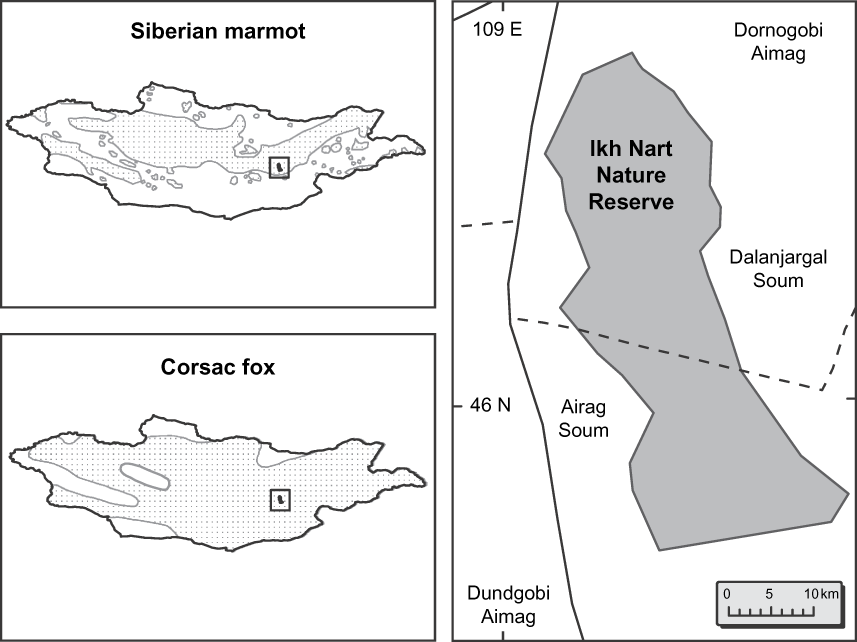
The Siberian marmot Marmota sibirica is a large (c. 6–8 kg), colonial-living rodent that ranges across the grassland, semi-desert, and forest steppes of northern Asia (Fig. 1; Bannikov, Reference Bannikov1954; Mallon, Reference Mallon1985; Clark et al., Reference Clark, Munkhbat, Dulamtseren, Baillie, Batsaikhan and King2006a). In Mongolia herders hunt marmots for food and body parts, used in traditional medicines, and also for fur used locally and sold for income (Reading et al., Reference Reading, Mix, Lhagvasuren and Tseveenmyadag1998; Pratt et al., Reference Pratt, Macmillan and Gordon2004; Wingard & Zahler, Reference Wingard and Zahler2006). Millions of furs are harvested annually and many enter illegally into burgeoning markets in China and Russia (Wingard & Zahler, Reference Wingard and Zahler2006). The impact of overharvesting has been substantial and populations have declined throughout Mongolia (Townsend & Zahler, Reference Townsend and Zahler2006; Wingard & Zahler, Reference Wingard and Zahler2006), from c. 40 million in 1940 (Eregdendagva, Reference Eregdendagva1972) to 20 million in 1990 (Wingard & Zahler, Reference Wingard and Zahler2006) and 5 million in 2001 (Batbold, Reference Batbold, Armitage and Rumiantsev2002). This decline of > 85% prompted the government to enact temporary hunting bans and conservationists to categorize the species as Endangered (Clark et al., Reference Clark, Munkhbat, Dulamtseren, Baillie, Batsaikhan and King2006a; IUCN, 2008).
Siberian marmot Marmota sibirica and corsac fox Vulpes corsac distribution in Mongolia and the location of the study site (rectangle on distribution figures) in Ikh Nart Nature Reserve relative to soum (i.e. county: dashed line) and aimag (i.e. province: solid line) boundaries. Distributions adapted from Clark et al. (Reference Clark, Munkhbat, Dulamtseren, Baillie, Batsaikhan, Samiya and Stubbe2006b).
The decline of the Siberian marmot is of importance because it is often considered a keystone species (Zahler et al., Reference Zahler, Lkhagvasuren, Reading, Wingard, Amgalanbaatar and Gombobaatar2004), i.e. one that exerts effects on its ecosystem that are unique and disproportionately large relative to its abundance (Power et al., Reference Power, Tilman, Estes, Menge, Bond and Mills1996; Kotliar, Reference Kotliar2000). There is therefore concern about the possible impact of the decline on other species. Marmots are important prey for some carnivores and raptors (Heptner & Naumov, Reference Heptner and Naumov1992; Ellis et al., Reference Ellis, Tsengeg, Whitlock and Ellis1999; Gombobaatar et al., Reference Gombobaatar, Sumiya, Shagdarsuren, Potapov, Fox, Potapov, Banzragch, Fox and Barton2001) and are thought to serve key ecosystem functions through their extensive colonial burrow systems, some of which have > 90 entrances (Townsend, Reference Townsend2006). Burrow systems may assist soil renewal (Zahler et al., Reference Zahler, Lkhagvasuren, Reading, Wingard, Amgalanbaatar and Gombobaatar2004), influence plant community dynamics (Van Staalduinen & Werger, Reference Van Staalduinen and Werger2007), and provide shelter and habitat for small mammals, reptiles and insects (Adiya, Reference Adiya2000). The burrows may also be important habitat resources for some carnivores (Adiya, Reference Adiya2000). However, accounts of burrow use by carnivores remain few, unquantified, and based largely on casual sightings and reports.
The small (c. 2.5 kg), nocturnal corsac fox Vulpes corsac reportedly uses marmot burrows (Heptner & Naumov, Reference Heptner and Naumov1992). Corsacs live in the grassland and semi-desert steppes of Mongolia (Murdoch et al., in press), occupying a range that overlaps with that of the Siberian marmot (Fig. 1; Clark et al., Reference Clark, Munkhbat, Dulamtseren, Baillie, Batsaikhan, Samiya and Stubbe2006b). Although details of corsac ecology are few (Poyarkov & Ovsyanikov, Reference Poyarkov, Ovsyanikov, Sillero-Zubiri and Macdonald2004), historical accounts suggest they rely on burrows, resting in them during daytime (Ognev, Reference Ognev1962; Heptner & Naumov, Reference Heptner and Naumov1992). Most accounts, however, have been based on incidental observations. Like marmots, corsac populations have declined in Mongolia and there is also a similar need to identify the biological requirements of the species to inform conservation actions (Clark et al., Reference Clark, Munkhbat, Dulamtseren, Baillie, Batsaikhan, Samiya and Stubbe2006b; Wingard & Zahler, Reference Wingard and Zahler2006).
In 2004 we began a study of the spatial ecology of corsacs in central Mongolia, during which we documented them using marmot dens on several occasions. Here, we present data on the frequency of marmot burrow use by radio-collared corsacs and evaluate the importance of burrows as a resource for the species. We also discuss the implications of burrow use and suggest a practical and cost-effective solution for protecting both species.
We studied corsacs in the Ikh Nart Nature Reserve of Dornogobi Aimag, Mongolia (Fig. 1), established in 1996 to protect argali Ovis ammon and the unique landscape of the region (Reading et al., Reference Reading, Kenny, Wingard, Mandakh and Steinhauer-Burkart2006). Ikh Nart lies at the junction of steppe and semi-desert ecotones (Murzaev, Reference Murzaev1948) and includes grasslands, shrublands, open plains, rocky habitats and ephemeral drainages. Siberian marmots and corsacs are sympatric there, occupying mainly grassland and shrubland areas (Murdoch et al., Reference Murdoch, Munkhzul, Amgalanbaatar and Reading2006).
Our study involved capturing, radio-collaring, and tracking the movements of 10 adult (> 1 year old) foxes. Foxes were live-captured and handled following appropriate guidelines (Gannon et al., 2007) and protocols approved by the Denver Zoological Foundation. We fitted each fox with a VHF radio-collar (c. 1.5% body weight; model-1930, ATS, Isanti, USA) and tracked them using directional antennas.
During May–November 2006 we tracked each fox weekly to its daytime resting location, and recorded whether it was inside a burrow or resting above ground, and whether the burrow used was a marmot burrow. Marmot burrows were identified based on Townsend's (Reference Townsend2006) criteria as having an entrance diameter of 10–30 cm, including fresh scats (< 1 month old), diggings of vegetation, and tracks near (< 3 m) an entrance, and occurring in a known colony (identified from observations of marmots and knowledge of local herders).
Of 207 daytime locations, corsacs used a subterranean burrow as a resting place on 173 (84%) occasions, greater than expected by chance (χ2 = 93.34, df = 1, P < 0.001). On other occasions corsacs rested under a shrub, in a shallow depression, ravine or the shadow of a rock. Often these above-ground resting locations were in close proximity (< 3 m) to a burrow entrance (68%; n = 23). Corsacs rested in marmot burrows on 53% of observations (n = 110), or 64% of those observations when foxes used a burrow of any kind, resulting in marmot burrows being used significantly more frequently than non-marmot burrows (χ2 = 12.77, df = 1, P < 0.001). Each fox used a mean of 6.7 ± SE 1.1 burrows (either marmot or otherwise; range 3–17) and 4.3 ± SE 1.5 marmot burrows (range 2–12).
On one occasion we observed a marmot and a corsac emerge within 2 minutes of each other from the same burrow entrance, indicating they both occupied the same burrow system. We also observed a large marmot colony (n = 56 burrows) go extinct, most likely due to overhunting. Corsacs regularly used burrows in this colony prior to the marmot hunting season in August–September. However, after the hunting season all of the burrows filled with sand by the end of the next winter and we did not subsequently observe corsacs using burrows or hunting in the area.
Early accounts of corsac foxes reported their regular use of marmot burrows. Heptner & Naumov (Reference Heptner and Naumov1992), summarizing studies from the Transbaikal region of Russia and Mongolia, even suggested that corsacs live almost exclusively in abandoned marmot burrows. Most of these studies, however, were based on incidental observations and reports. In comparison, a more recent study in eastern Mongolia noted that corsacs used marmot areas but that locations of fox sightings did not associate with colonies; the lack of association was probably due to small sample sizes that reflected substantially reduced corsac populations in the region (Townsend & Zahler, Reference Townsend and Zahler2006).
Our observations in Ikh Nart demonstrate that burrows constitute an important resource for corsacs. Corsacs appear capable of excavating their own dens but using marmot burrows probably represents an energetically-efficient behavioural adaptation to living in arid steppe environments, where food resources fluctuate considerably. Marmot burrows probably help corsacs by providing shelter and refuges from other carnivores known to kill corsacs, such as wolves Canis lupus, red foxes Vulpes vulpes and domestic dogs (Heptner & Naumov, Reference Heptner and Naumov1992). Our findings also suggest that the removal of marmots from an area may disrupt the ranging patterns of corsacs, which in turn may make them more vulnerable to predation.
Another implication is that the regular use of marmot burrows by corsacs may affect the transmission of plague caused by the bacterium Yersinia pestis (Biggins & Kosoy, Reference Biggins and Kosoy2001). Outbreaks of plague commonly occur in marmot populations in Mongolia, resulting in quarantines of affected areas and marmot eradication programmes (Batbold, Reference Batbold, Armitage and Rumiantsev2002). Details of the transmission of plague between colonies are few but our observations suggest that it may be partly influenced by the movements of corsacs between burrows and colonies. Several fleas parasitize corsacs, including Oropsylla silantiewi, considered one of the main plague vectors in the Transbaikal region of Mongolia (Gratz, Reference Gratz1999), and corsacs may act as a vector of infected fleas by spreading them between colonies (Heptner & Naumov, Reference Heptner and Naumov1992).
Although Siberian marmots are generally considered a keystone species, in the same way that plateau pika Ochotona curzoniae acts as a keystone species on the Tibetan plateau (Smith & Foggin, Reference Smith and Foggin1999), few studies have quantified their roles in steppe ecosystems. Similarly, we are unaware of studies quantifying the frequency of burrow use by other species, particularly carnivores. Our results support the notion that marmots act as a keystone species, as the loss of marmots from an area and the concomitant loss of their burrows would probably exert a significant effect on corsac populations. However, more detailed studies are required to assess the relationship between the population dynamics of marmots, corsacs and other burrow users.
Conservation measures are required for the protection of marmots and corsacs in Mongolia (Wingard & Zahler, Reference Wingard and Zahler2006). Marmots have declined greatly in some areas. A 3,148 km survey in historically good marmot habitat in the eastern steppe only detected the species 68 times (130 individuals; Townsend & Zahler, Reference Townsend and Zahler2006). Similarly, corsac declines due to hunting, and to a lesser extent poisoning, disease and habitat loss, resulted in this once common species being listed as Near Threatened on the Mongolian Red List (Clark et al., Reference Clark, Munkhbat, Dulamtseren, Baillie, Batsaikhan, Samiya and Stubbe2006b). Both species receive little protection under the Mongolian Law on Fauna (Wingard & Odgerel, Reference Wingard and Odgerel2001) but hunting quotas exist and in the past the government enacted temporary hunting bans for both species to stem declines (Clark et al., Reference Clark, Munkhbat, Dulamtseren, Baillie, Batsaikhan and King2006a). However, enforcement of wildlife laws and regulations is weak and few large-scale strategies exist to protect these species adequately.
In Ikh Nart marmots and corsacs are hunted, even though all forms of hunting are illegal (Wingard & Odgerel, Reference Wingard and Odgerel2001) and, like many other protected areas in Mongolia, funds for conservation activities are limited. A cost-effective solution to conserving both species in Ikh Nart would be to target protection at colonies in August–September and December–January, when marmots and corsacs, respectively, are hunted. Herders mainly hunt marmots and corsacs with leghold traps set at burrow entrances, and daily checks for traps in larger colonies would probably result in a substantial reduction of poaching. Increased protection of colonies during these periods would also reduce captures of non-target species, which during our study included four corsacs, two Pallas's cats Otocolobus manul and a cinereous vulture Aegypius monachus.
Acknowledgements
We thank the Denver Zoo, Rufford Foundation, and Trust for Mutual Understanding for supporting the project. We also thank G. Otgonbayar, S. Dandarbaatar and D. Jargalsaikhan for help with radio-tracking. The project was conducted in collaboration with the Mongolian Academy of Sciences–Institute of Biology.
Biographical sketches
James Murdoch studies the competitive interactions between corsac and red foxes in Mongolia, and has studied other canids including kit foxes and African wild dogs. T. Munkhzul focuses on the population dynamics of small mammals and carnivore conservation issues. S. Buyandelger studies the diet of foxes and other steppe carnivores. Richard Reading studies argali, ibex, and raptors and has been working on conservation issues in Mongolia since 1994. Claudio Sillero-Zubiri is Chair of the IUCN/SSC Canid Specialist Group and his interests include the conservation of threatened species, protected area management and the behavioural ecology of wild canids.



