


Introduction
Energy drinks gained popularity after the launch of Red Bull in 1997; afterwards, more than 500 different types of energy drinks were introduced until 2006.(Reference Boyle1,Reference Malinauskas, Aeby and Overton2) As the international market for energy drinks reached $15 trillion, its intake has risen accordingly, especially among university students and young people.(Reference Aljaloud3)
Energy drinks are beverages that consist of a high level of caffeine, sugars, and other additives. Consequently, they become stimulants that can raise breathing rate, heart rate, and blood pressure.(4) Along with the caffeine, energy drinks provide several ‘energy boosters’ including herbal extract (e.g. ginseng), amino acids and their derivatives (e.g. taurine and carnitine), and sugar derivatives such as ribose and glucuronolactone.(Reference Boyle1) Energy drink manufacturers implement marketing approaches claiming increased attention, alertness, concentration, and energy, targeting mainly young adults and teens.(Reference Schneider, Benjamin and Nutrition5)
When consumed, energy drinks have an energising effect on adults between the ages of 18 and 55; this effect peaks 30–60 min after consumption and may last for no less than 90 min.(Reference Smit, Cotton and Hughes6) One energy drink is approximately equivalent to 4–6 cups of coffee.(Reference Doherty and Smith7) Young adults and youths under the age of 35 make up more than half of the consumer market worldwide.(Reference McLellan and Lieberman8)
For many reasons, university students take various types of energy drinks, unaware of the potential risks associated with them and have no idea where to turn for trustworthy information.(Reference Aljaloud3) However, in the quest to be at the top, educationally successful, the fastest, or the strongest, various students consume possibly damaging energy drinks.(Reference Aljaloud3) Students usually believe that energy drinks can improve attention during a long cognitive mental demand.(Reference Aljaloud3)
Energy drinks campaigns across Jordan are well-known, and many universities participate and host such events. For example, the energy drink Boom Boom organised ‘All around Jordan City's Social Media Campaign’ in July 2021, where a giant can be pictured in several tourism sites in Jordan.(Reference Kiswani9) Additionally, Red Bull organises several regular advertising and sports campaigns, such as Red Bull car park drift(10) and Red Bull HATTRICK;(11) both were also organised in 2022, in which many university students compete to participate increasing the widespread of these energy drinks consumptions among the youth population.
Limited research is done to estimate the prevalence, knowledge, attitude, and perception of young adults in Jordan regarding energy drinks. A study published in 2021 revealed that over half of the participating university students had poor knowledge about energy drinks and the prevalence of energy drinks consumption among them was 40⋅1 %.(Reference Elsahoury, Alhaj and McGrattan12) In another study, the prevalence of sugar-sweetened beverage consumption was found to be 60 %.(Reference Bawadi, Khataybeh and Obeidat13) This paper contributes to the literature by determining the proportion of university students who consume energy drinks, evaluating their knowledge, and assessing their perception while the energy drink advertising campaigns are increasing across Jordan.
Experimental methods
Study design and sample size
A cross-sectional online survey was carried out in Jordan from September to November 2022.
The required number of students to be recruited in this study was calculated according to the sample size equation for a cross-sectional survey(Reference Kasiulevičius, Šapoka and Filipavičiūtė14,Reference Pourhoseingholi, Vahedi and Rahimzadeh15) based on the total number of students registered for the academic year 2020/2021 in Jordan, equating to 332 413 students.(16) According to the equation used for calculating the sample size, the minimum sample size needed is 384 students to meet a 95 % confidence level (CI) and a 5 % margin of error.
The formula used to calculate the sample size is n = Z 2⋅p⋅(1 − p)/E 2, where n is the required sample size and Z is the Z-score corresponding to the desired CI. For a 95 % CI, Z is approximately 1⋅96; p is the population proportion; and E is the desired margin of error.
Ethical approval
The study was approved by the Institutional/Local Research Ethics Committee, Amman, Jordan (Approval number: 2022-PHA-22).
Survey development, validation, and data collection
Data collection was carried out using a self-administered online survey, which was developed using Google Forms and validated after extracting suitable questions from previous similar studies(Reference Malinauskas, Aeby and Overton2,Reference Elsahoury, Alhaj and McGrattan12,Reference Itany, Diab and Rachidi17–Reference Trapp, Allen and O'Sullivan19) to obtain anonymous responses, which were treated confidentially. A brief description of the study and a consent statement was given at the beginning of the survey. Participation was voluntary, with no incentives offered. Eligible participants were any interested students enrolled in any university in Jordan. The participants were recruited through social media platforms: Facebook, WhatsApp, LinkedIn, and Twitter.
The survey was constructed in English but was delivered to the participants in Arabic. A panel of experts evaluated content and face validities. The first draft of the survey was evaluated by ten independent academics who have previous experience in this type of study and a statistician to assess the survey for appropriateness, complexity, attractiveness, and relevance of the items. The comments provided by the experts were taken into consideration and were incorporated as appropriate to the final version of the survey. The survey was then translated from English into Arabic and back by two bilingual senior academic staff members. The survey was then piloted on a sample of twenty-five academics and twenty-five non-academic people to enhance clarity, readability, and understandability and confirm its applicability to our targeted population.
The final version of the survey consisted of four sections that could be completed within 15 min (provided in the Supplementary material). The first section was designed to collect the participants’ demographic characteristics, while the second section was designed to assess the participants’ knowledge and source of information about energy drinks. Knowledge was assessed by giving 1 to the correct answer and 0 to the wrong answer. The scale measured knowledge from a maximum of 12 to a minimum of Zero. The score <2⋅4 were considered very unconfident, 2⋅4–4⋅8 as fairly unconfident, 4⋅9–7⋅2 as neutral, 7⋅3–9⋅6 as fairly confident, and 9⋅7–12 as very confident about the knowledge regarding energy drinks.(Reference Fang, Liu and Gao20) The third section was designed to assess energy drinks consumption and experience among participants and the fourth and final sections were designed to assess the participants’ perception and attitude towards energy drinks. The attitude score was assessed using a Likert scale (strongly agree = 5, agree = 4, neutral = 3, disagree = 2, strongly agree = 1). The scale measured attitude from a maximum of 5 to a minimum of 1. Scores were categorised using Bloom's cut-off points, <3 (<59⋅0%) were considered a negative attitude, 3–3⋅9 (60⋅0–79⋅0 %) as neutral, and 4–5 (80⋅0–100⋅0 %) as a positive attitude towards energy drinks.(Reference Khaled, Siddiqua and Makki21)
Statistical analyses
Data were extracted from Google Forms into an Excel spreadsheet and were then exported and statistically analysed using Statistical Package for Social Sciences version 24.0 (SPSS Inc., Chicago, IL, USA). Descriptive statistical analysis was used to analyse the socio-demographic data: mean and standard deviation (sd) for continuous variables. Categorical variables were demonstrated as frequencies and percentages. The Shapiro–Wilk test was used to assess the normality. Cronbach's α was used to evaluate the reliability of the questionnaire (=0⋅79), i.e. that the scales constructed are fit for their purpose, with values ≥0⋅7 indicating acceptable internal consistency. A point-biserial correlation was used to figure out whether there is an association between the score of knowledge and the dichotomous variables presenting the Pearson correlation and P-values. A P-value of <0⋅05 represents a significant difference.
Results
Demographic characteristics
A total of 749 surveys were completed and included in the final study analysis. The socio-demographic characteristics of the participants are demonstrated in Table 1. There was a predominance of male participants (n 495, representing 66⋅1 % of the sample) compared with females. The mean age of the respondents was 22⋅2 ± 3⋅9 years old and 695 were single. Most of the study sample expected to obtain a bachelor's degree (n 639, 85⋅3 %) and live in the middle of Jordan (n 585, 78⋅1 %), where the capital Amman is located. Around half of the respondent students were studying a major in the medical field (n 382, 51 %) and 66⋅2 % were studying in governmental universities (n 496). Around half of the participants’ family income was <750 Jordanian dinars; more than one-third were not medically insured (n 28, 137⋅5 %). Most of the participants (n 538, 71⋅8 %) were non-smokers of tobacco and (n 712, 95⋅1 %) did not have any chronic diseases.
Socio-demographic characteristics of the study participants (n 749)

Participants’ knowledge about energy drinks
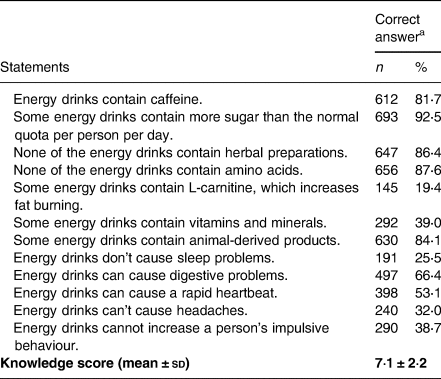
The participants demonstrated a neutral level of knowledge about energy drinks, as the mean knowledge score = 7⋅1 ± 2⋅2 (out of 12). As shown in Table 2, the majority of the students knew that energy drinks contain caffeine (n 612, 81⋅7 %), and some may also contain herbal supplements and amino acids (86⋅4 and 87⋅6 %, respectively). Less than half of the participants knew that energy drinks contain L-carnitine, which increases fat burning (n 145, 19⋅4 %) and contains vitamins and minerals (n 292, 39⋅0 %). To a lesser extent, a minority of the participants knew that energy drinks could cause medical problems such as sleep problems (n 191, 25⋅5 %), headache (n 240, 32⋅0 %), and increase a person's impulsive behaviour (n 290, 38⋅7 %).
Participants’ knowledge about energy drinks (n 749)

a Knowledge was assessed by giving 1 to the correct answer and 0 to the wrong answer. The scale measured knowledge from a maximum of 12 to a minimum of Zero. The score <2⋅4 were considered very unconfident, 2⋅4–4⋅8 as fairly unconfident, 4⋅9–7⋅2 as neutral, 7⋅3–9⋅6 as fairly confident, and 9⋅7–12 as very confident knowledge about energy drinks.
Fig. 1 demonstrates the main sources of information about energy drinks reported by the participants. The most common sources are family and friends (n 543, 72⋅5 %), followed by social media (n 516, 68⋅9 %) and television/radio (n 316, 42⋅2 %). While the role of healthcare providers was only 32⋅0 % (n 240), followed by nutritionists (n 172, 23⋅0 %) and sports coaches (n 96, 12⋅8 %).
Sources of information about energy drinks among the study participants (n 749).

Energy drinks consumption and experience
Among the total sample size of the study, 66 % (n 498) of them have consumed energy drinks and experienced their effects, as shown in Fig. 2a. The majority of the participants of this category (energy drinks consumers) stated, in Fig. 2a, the most common products: Red Bull®, Boom Boom®, and BM®, 70⋅1, 66⋅1, and 50⋅8 %, respectively. Upon asking them about their weekly consumption of energy drinks, more than half of the users (n 275, 55⋅2 %) only drink one can per week. While around 15 % (n 78) were consuming more than five cans per week. Regarding the reasons for drinking energy products, as shown in Table 3, most of them declared that energy drinks help them to stay awake for a longer time (n 312, 62⋅7 %), help them to study for a longer time and accomplish tasks such as homework (n 309, 62⋅7 %), and to feel strong and energetic in general (n 269, 54⋅0 %). On the other hand, more than 90 % of them do not drink these energy products concomitantly with medications (n 475, 95⋅4 %), vitamins (n 487, 97⋅8 %), other herbs or natural products (n 474, 95⋅2 %), or alcohol (n 476, 95⋅6 %).
Participants reported usage of energy drinks. (a) Participants answers upon asking them if they drink these energy products. (b) Among the energy drinks users (n 498), this graph demonstrates the most common types of the used energy drinks.

Participants’ experience and causes for the use of energy drinks (n 498)

Perception and attitude towards energy drinks
In general, the study's participants demonstrated a neutral attitude towards energy drinks, as shown in Fig. 3. The majority of the students acknowledged (strongly agreed/agreed) that energy drinks increase activity (n 528, 70⋅5 %), and improve athletic or functional performance (n 329, 43⋅9 %), and stamina (n 311, 41⋅5 %). On the other hand, more than 70 % of the participants strongly disagree/disagree that energy drinks are good for health (n 580, 77⋅4 %) and have no side effects (n 591, 78⋅9 %).
Participants’ perception towards energy drinks (n 749). Attitude score (mean ± sd) 3⋅9 ± 1⋅0. The attitude score was assessed using a Likert scale from a maximum of 5 to a minimum of 1.

Regarding the correlation between the knowledge score and the study variables, Table 4 shows a significant (P-value <0⋅5) positive correlation between knowledge score and female gender, education in medical subjects, academic years, and monthly income.
Point-biserial correlation between score of knowledge about energy drinks and the dichotomous demographic variables

* Significance measure at P-value <0⋅05 is presented in bold using point-biserial correlation.
Discussion
This study is one of two studies conducted in Jordan to assess the prevalence, knowledge, and perception of the use of energy drinks among university students.(Reference Elsahoury, Alhaj and McGrattan12) This study is the only one conducted after many structured campaigns organised by several energy drink manufacturers in which the use of energy drinks was linked with sports activities such as football and drifting.(10,11) These activities are attractive to university students, particularly males. This can also explain why more male students are interested in filling out this survey than female students. Similar behaviour was also observed in studies conducted in different countries, including Zambia,(Reference Mwape and Mulenga22) Taiwan,(Reference Chang, Peng and Lan23) Poland,(Reference Cencek, Wawryk-Gawda and Samborski24) Saudi Arabia,(Reference Alabbad, AlMussalam and AlMusalmi25) the United Arab Emirates,(Reference Faris, Jahrami and Al-Hilali26) and Lebanonv(Reference Itany, Diab and Rachidi17) as well as in the only study conducted in Jordan in 2020,(Reference Elsahoury, Alhaj and McGrattan12) where it was noted that males are more daring and willing to try new things when compared to females.
Regarding the participating students’ knowledge about energy drinks, the majority knew that these drinks contain caffeine and sugars and may also contain amino acids and herbal extracts. However, many were unaware that these drinks might also contain L-carnitine, vitamins, and minerals, indicating that students do not generally check the constituents of the products they consume. Additionally, only around one-third of the participants knew that energy drinks may cause sleep problems and headaches. Many of the energy drinks side effects are due to the fact that they contain a considerable amount of caffeine. Eight ounces of energy drinks typically have 80–141 mg of caffeine.(Reference Malinauskas, Aeby and Overton2) The biological mechanism of caffeine is not fully realised yet; it positively impacts performance by reducing feelings of exhaustion, enhancing physical endurance, and increasing central drive.(Reference Magkos and Kavouras27) Although caffeine has some positive effects on mood and cognition at low doses (12⋅5–100 mg),(Reference Smit and Rogers28) it also has some harmful negative effects on health, including the promotion of diuresis,(Reference Riesenhuber, Boehm and Posch29) reduction of insulin sensitivity,(Reference Lee, Hudson and Kilpatrick30) disturbance of regular sleep patterns,(Reference Aljaloud3) increase in mean arterial blood pressure,(Reference Bichler, Swenson and Harris31) and chronic daily headache.(Reference Scher, Stewart and Lipton32) Studies conducted in Zambia and the United Arab Emirates among university students found that there was a statistically significant association between energy drink consumption and poor sleep quality.(Reference Mwape and Mulenga22,Reference Faris, Jahrami and Al-Hilali26)
In the study conducted in 2020 by Elsahoury et al. in Jordan, it was found that more than 60 % of the participating students had poor knowledge regarding energy drinks. In this study, the participants had a neutral knowledge, which could be attributed to the fact that more organised energy drinks campaigns were organised in 2021 and 2022, which may have influenced them to get more information about these drinks. The poor knowledge about energy drinks’ ingredients and detrimental health effects was also reported in a similar study conducted in Saudi Arabia.(Reference Aljaloud3) On the other hand, in a study conducted in Poland, students had high knowledge about energy drinks and their side effects, yet, their knowledge was not reflected in their consumption of such drinks.(Reference Cencek, Wawryk-Gawda and Samborski24) A better understanding of energy drinks constituents and side effects was also observed among medical students in a study conducted in Türkiye.(Reference Kuş, Keten and Güvenç33)
Friends and advertisements on various platforms were an important source of information regarding energy drinks for the Jordan students, as observed in this study and the one conducted in 2020.(Reference Elsahoury, Alhaj and McGrattan12) Energy drinks advertisements usually have persuasive cues like sports and celebrities, which can influence young adults and persuade them to consume these drinks.(Reference Bleakley, Ellithorpe and Jordan34) The strong influence of advertisement was also observed in a study conducted in the United Arab Emirates.(Reference Jacob, Tambawel and Trooshi18)
Regarding the prevalence of energy drinks consumptions among the participating students, it was found that 66 % of the participants consumed energy drinks. This percentage is higher than what was found in a similar previous study that was conducted in 2020 in Jordan, where 40⋅1 % of the students who participated in that study reported the consumption of energy drinks.(Reference Elsahoury, Alhaj and McGrattan12) This obtained result of a high prevalence of energy drinks consumption among students in Jordan is consistent with similar studies conducted worldwide, as it has been reported that energy drinks consumption prevalence was around 50 % among students in Australia,(Reference Trapp, Allen and O'Sullivan19) Italy,(Reference Gallimberti, Buja and Chindamo35) the United States,(Reference Malinauskas, Aeby and Overton2) and Canada(Reference Azagba, Langille and Asbridge36) (48, 56⋅2, and 63 %, respectively). Similar research conducted in the Middle East and North Africa (MENA) region showed that energy drinks are consumed by 42⋅7 % of Iraqis, particularly young adults,(Reference Asaad37) 52⋅6 % of Saudi Arabian medical students,(Reference Ibrahim, Iftikhar and Murad38) and 63⋅6 % of Lebanese students.(Reference Itany, Diab and Rachidi17) A higher percentage was reported in the United Arab Emirates, as more than 90 % of the students reported using energy drinks.(Reference Jacob, Tambawel and Trooshi18)
Red Bull® and Boom Boom® were the most common brands of energy drinks used by the students who participated in this study. These two brands were also very popular among students in Lebanon.(Reference Itany, Diab and Rachidi17) Red Bull was also reported to be the most favourite energy drink among young adults and students in Saudi Arabia(Reference Aljaloud3,Reference Alabbad, AlMussalam and AlMusalmi25) and the United Arab Emirates.(Reference Jacob, Tambawel and Trooshi18) The students’ tastes in Zambia differed as their preferred energy drinks were Dragon® and Wild Cat®.(Reference Mwape and Mulenga22)
Most of this study's participants declared that they consume energy drinks to help them stay awake, study, and feel energetic. These mentioned reasons for using energy drinks were also mentioned by young adults who participated in similar studies that were conducted in Saudi Arabia,(Reference Aljaloud3,Reference Alabbad, AlMussalam and AlMusalmi25,Reference Ibrahim, Iftikhar and Murad38) Lebanon,(Reference Itany, Diab and Rachidi17) the United States,(Reference Malinauskas, Aeby and Overton2) Poland,(Reference Cencek, Wawryk-Gawda and Samborski24) Zambia,(Reference Mwape and Mulenga22) and Taiwan.(Reference Chang, Peng and Lan23)
Interestingly, less than 5 % of the students who participated in this study reported mixing energy drinks with drugs or alcohol. However, in other similar studies conducted in Lebanon(Reference Itany, Diab and Rachidi17) and the United States,(Reference Malinauskas, Aeby and Overton2) around 50 % of the participants reported using alcoholic energy drinks. Mixing energy drinks with alcohol was also reported in Taiwan(Reference Chang, Peng and Lan23) and Türkiye.(Reference Kuş, Keten and Güvenç33) In Poland, energy drinks were found to be commonly mixed with coffee or alcohol.(Reference Cencek, Wawryk-Gawda and Samborski24) A study conducted in 2009 and 2010 among university students in an urban setting found that energy drinks consumption was significantly related to drinking alcohol.(Reference Spierer, Blanding and Santella39) In addition, energy drinks were associated with people committing more risky behaviours.(Reference Miller40,Reference Terry-McElrath, O'Malley and Johnston41)
More than two-thirds of this study's participants believed that energy drinks are harmful to health and have side effects but agreed that they increase physical activity. It was found in various studies that young people knew energy drinks have side effects and experienced some of them, yet they still consumed them for various reasons.(Reference Malinauskas, Aeby and Overton2,Reference Itany, Diab and Rachidi17,Reference Cencek, Wawryk-Gawda and Samborski24–Reference Faris, Jahrami and Al-Hilali26,Reference Kuş, Keten and Güvenç33,Reference Ibrahim, Iftikhar and Murad38)
This study is the first in Jordan to find a correlation between the knowledge of student participants regarding energy drinks and their demographics. In this study, female gender, medical education, and monthly income had a positive effect on the knowledge. In a study conducted to see gender differences in health information behaviour, men were found to be often unwilling and unmotivated to engage with health-related information.(Reference Ek42) This can explain why women are often more knowledgeable about health-related information than men, as shown in other studies assessing the public knowledge about various health information.(Reference Barakat, Elnaem and Al-Rawashdeh43–Reference Thiab, Barakat and Al-Qudah45)
With the increased competition between different brands and manufacturers of energy drinks, which is reflected by various means of advertising these products targeting mainly young people, there is a need to have awareness campaigns to counteract the peer pressure and advertisements’ influence young people to decrease their consumption of energy drinks. Hence, these drinks are known for their high caffeine and sugar content, especially with the increasing number of reported caffeine toxicity cases associated with the consumption of energy drinks.(Reference Rath46)
One of the limitations of the current study is that it was based on an online self-administered questionnaire, which can cause errors of over-reporting or underreporting which affects the results to some extent. Another limitation is the sample representativeness, as most of the participants were from the middle of Jordan, where the Capital is located and most universities are, but this provides an opportunity for future similar studies to be conducted in the north and south of Jordan to see if the university students there have similar or different behaviours and perception towards energy drinks.
Conclusion
This study is one of two cross-sectional studies conducted in Jordan to assess the knowledge, attitude, and perception of energy drinks consumption among university students in Jordan and the first to try to find a correlation between demographic characteristics and student knowledge regarding these drinks.
The prevalence of consuming energy drinks was high, and the students had neutral knowledge regarding the constituents and side effects of energy drinks. Additionally, females and those studying a major in the medical field had better knowledge. The students reported that the main reasons for consuming these drinks are helping them stay awake, study, and be more energetic.
There is a need for more structured awareness campaigns to warn students about the possible side effects of these products in an effort to reduce the consumption and popularity of energy drinks between young adults and students.
Supplementary material
The supplementary material for this article can be found at https://doi.org/10.1017/jns.2023.90.
Acknowledgements
S. T.: Conceptualisation, Methodology, Validation, Writing – Original draft, Writing – Review and Editing, Project administration. M. B.: Conceptualisation, Methodology, Validation, Formal analysis, Data curation, Writing – Original draft, Writing – Review and Editing. R. N.: Methodology, Data curation, Writing – Original draft. R. A.: Data curation, Writing – Review and Editing. A. S.: Methodology, Data curation, Writing – Original draft. R. T.: Data curation. F. O.: Data curation. W. A. D.: Data curation, Writing – Review and Editing.
There are no conflict of interest.
This study was conducted according to the guidelines laid down in the Declaration of Helsinki and all procedures involving research study participants were approved by the ethics committee at Applied Science Private University. Electronic informed consent was obtained from all subjects/patients.



 Open access

