





1. Introduction
Producing language is generally less efficient for bilinguals than for monolinguals; their responses in any of their languages are generally slower and more error-prone. Even highly proficient bilinguals take longer to name pictures in either of their languages compared to monolinguals (Gollan et al., Reference Gollan, Montoya and Bonanni2005a, Reference Gollan, Montoya, Fennema-Notestine and Morris2005b, Reference Gollan, Montoya, Cera and Sandoval2008; Ivanova & Costa, Reference Ivanova and Costa2008; Kohnert et al., Reference Kohnert, Hernandez and Bates1998; Roberts et al., Reference Roberts, Garcia, Desrochers and Hernandez2002). They produce fewer words than monolinguals in timed verbal fluency measures (Rosselli et al., Reference Rosselli, Ardila, Araujo, Weekes, Caracciolo, Padilla and Ostrosky-Solí2000) and have significantly more tip-of-the-tongue (TOT) experiences, or failures to retrieve a known word compared to monolinguals (Gollan et al., Reference Gollan, Montoya and Bonanni2005a, Reference Gollan, Montoya, Fennema-Notestine and Morris2005b; Gollan & Brown, Reference Gollan and Brown2006; Gollan & Silverberg, Reference Gollan and Silverberg2001; Pyers et al., Reference Pyers, Gollan and Emmorey2009), even in their dominant language (Gollan & Acenas, Reference Gollan and Acenas2004). Despite group differences between monolinguals and bilinguals, there are considerable individual differences in language processing within bilinguals (Fricke et al., Reference Fricke, Zirnstein, Navarro-Torres and Kroll2019; Higby et al., Reference Higby, Gámez and Holguín Mendoza2023; Kroll et al., Reference Kroll, Takahesu-Tabori and Navarro-Torres2021; López et al., Reference López, Luque and Piña-Watson2023; Takahesu Tabori et al., Reference Takahesu Tabori, Mech and Atagi2018). Here, we explored how individual differences influence bilingual lexical retrieval.
Two theoretical accounts have tried to explain the difference between monolinguals and bilinguals in language production. The first, the frequency lag hypothesis (Gollan et al., Reference Gollan, Montoya, Cera and Sandoval2008, Reference Gollan, Slattery, Goldenberg, van Assche, Duyck and Rayner2011) begins with the premise that frequency shapes language use regardless of how many languages you speak; the more you encounter and use a word or structure the more accessible those forms are, making them easier to process (Ferreira et al., Reference Ferreira, Henderson, Anes, Weeks and McFarlane1996; Inhoff & Rayner, Reference Inhoff and Rayner1986) and to produce (Bates et al., Reference Bates, D'Amico, Jacobsen, Székely, Andonova, Devescovi, Herron, Lu, Pechmann, Pléh, Wicha, Federmeier, Gerdjikova, Gutierrez, Hung, Hsu, Iyer, Kohnert, Mehotcheva and Tzeng2003; Runnqvist et al., Reference Runnqvist, Gollan, Costa and Ferreira2013). In the case of bilinguals, who divide their language use across multiple languages, words and structures in their languages are less frequently encountered and produced than those of monolingual speakers. Thus, less efficient language production in bilinguals is theorized to result from their relatively lower cumulative frequency of use of each language compared to monolinguals. Bilinguals are therefore predicted to have reduced fluency relative to monolinguals, especially in their nondominant language. Bilinguals are indeed slower and more error-prone than monolinguals when producing lower frequency words in their nondominant language (Duyck et al., Reference Duyck, Vanderelst, Desmet and Hartsuiker2008; Emmorey et al., Reference Emmorey, Petrich and Gollan2012; Gollan et al., Reference Gollan, Montoya, Cera and Sandoval2008, Reference Gollan, Slattery, Goldenberg, van Assche, Duyck and Rayner2011). Another prediction that follows from the frequency lag hypothesis is that bilinguals should have smaller vocabularies due to lower frequency of use over time. Indeed, bilinguals have been found to have smaller vocabularies than monolinguals in each of their languages (Bialystok et al., Reference Bialystok, Craik and Luk2008, Reference Bialystok, Luk, Peets and Yang2010).
One limitation of the frequency lag hypothesis is that it does not address how translation knowledge influences language production. Unlike monolinguals, bilinguals have lexical knowledge in both of their languages. Critically, one language cannot be accessed without involving the other language; bilinguals activate the translation equivalents in the nontarget language while planning speech (for a review, see Kroll et al., Reference Kroll, Bobb and Wodniecka2006). Although the frequency lag hypothesis has explored the overall role of frequency of target language use in language production, how implicit coactivation of translations over time impacts lexical access has received limited attention (but see Gollan & Acenas, Reference Gollan and Acenas2004).
The competition for selection account attributes bilinguals' relatively weaker performance on language production tasks to competition that arises from coactivating the nontarget language (for a review, see Kroll & Gollan, Reference Kroll, Gollan, Goldrick, Ferreira and Miozzo2014). Bilingual lexical access is universally accepted to be language nonselective (de Groot et al., Reference de Groot, Delmaar and Lupker2000), meaning that bilinguals activate both target and nontarget languages when planning speech (Costa et al., Reference Costa, Caramazza and Sebastian-Galles2000; Schwartz et al., Reference Schwartz, Kroll and Diaz2007). For example, when asked to name a picture of a dog in English, a Spanish–English bilingual activates the target word dog as well as the translation perro (Green, Reference Green1998; Hermans et al., Reference Hermans, Bongaerts, De Bot and Schreuder1998). Overcoming nontarget language competition has been theorized to involve inhibitory control to suppress the nontarget language (Green, Reference Green1998; Van Heuven et al., Reference Van Heuven, Dijkstra and Grainger1998; but see Finkbeiner et al., Reference Finkbeiner, Almeida, Janssen and Caramazza2006).
The primary source of support for the competition for selection account comes from cued language switching paradigms. Cued language switching studies ask bilinguals to name pictures or numbers as they switch between languages across trials based on an experimentally prompted cue. These studies measure the reaction time difference between repeated language trials compared to trials involving a language switch to compute the “switch cost.” Regardless of language dominance, bilinguals are slower when required to switch languages, but for unbalanced bilinguals, shifting from the nondominant to the dominant language incurs a greater switch cost than is observed in the other direction. This switch cost asymmetry is interpreted as evidence that re-engaging the dominant language after speaking the nondominant language is harder because the dominant language must be so strongly suppressed in order to produce the nondominant language (Costa & Santesteban, Reference Costa and Santesteban2004, experiment 1; Jackson et al., Reference Jackson, Swainson, Cunnington and Jackson2001; Macizo et al., Reference Macizo, Bajo and Paolieri2012, experiment 1; Meuter & Allport, Reference Meuter and Allport1999; Peeters & Dijkstra, Reference Peeters and Dijkstra2018; Slevc et al., Reference Slevc, Davey and Linck2016).
More recently some researchers have challenged the ecological validity and generalizability of forced language-switching paradigms (Blanco-Elorrieta & Pylkkänen, Reference Blanco-Elorrieta and Pylkkänen2018). Language switching yields reduced or no costs when it is voluntary (de Bruin et al., Reference de Bruin, Samuel and Duñabeitia2018; Gollan & Ferreira, Reference Gollan and Ferreira2009; Jiao et al., Reference Jiao, Gao, Schwieter, Li, Zhu and Liu2022; Sánchez et al., Reference Sánchez, Struys and Declerck2022) and when it occurs in more naturalistic contexts (Blanco-Elorrieta & Pylkkänen, Reference Blanco-Elorrieta and Pylkkänen2017). Thus, language switching may not accurately reflect the typical language competition demands in bilingual language production, especially the implicit activation of the nontarget language in a unilingual language production context.
Examining the role that translation equivalents play in a unilingual production context is critical given that the competition for selection account is thought to explain bilingual language production dynamics when two languages are explicitly involved in the task as well as when only one is. One challenge for the competition for selection account is that the effect of translation equivalents across a range of language production tasks is mixed (for a review, see Bailey et al., Reference Bailey, Lockary and Higby2023). Language switching tasks generally reveal costs (for a review, see Declerck & Philipp, Reference Declerck and Philipp2015), while picture word interference (Costa et al., Reference Costa, Miozzo and Caramazza1999) and some picture-naming tasks reveal facilitatory effects (Gollan & Acenas, Reference Gollan and Acenas2004). Critically, some findings contradict the assumption of the competition for selection model that translations interfere with production; the bilingual disadvantage in lexical retrieval disappears for words that are highly translatable (Gollan & Acenas, Reference Gollan and Acenas2004), and translation equivalents seem to facilitate rather than inhibit word retrieval in bilinguals (Costa et al., Reference Costa, Miozzo and Caramazza1999; Gollan & Silverberg, Reference Gollan and Silverberg2001; Higby et al., Reference Higby, Donnelly, Yoon and Obler2020; Poulin-Dubois et al., Reference Poulin-Dubois, Bialystok, Blaye, Polonia and Yott2013).
Although the competition for selection account does not explain translation facilitation effects, an alternative account has been proposed. According to the activation boosting account, shared semantic representations for words and their translations not only lead to coactivation of translation equivalents but also to boosting of resting activation levels for both target and nontarget words (Higby et al., Reference Higby, Donnelly, Yoon and Obler2020). For example, when a Spanish–English bilingual produces the word dog, the target second-language (L2) lexical representation receives a direct boost in activation from retrieving that word and the first-language (L1) translation equivalent (perro) also receives an indirect activation boost when it is coactivated. Without a known translation equivalent, the additional indirect activation boost would be absent, leading to words without known translations being less accessible than those with known translation equivalents (Gollan & Acenas, Reference Gollan and Acenas2004; Higby et al., Reference Higby, Donnelly, Yoon and Obler2020). Alternatively, such translation facilitation effects could arise because translation knowledge and frequency are confounded. Words that are known in both languages may be higher in frequency compared to words only known in one language because higher frequency words are more likely to be acquired earlier than low-frequency words are (Brysbaert & Ghyselinck, Reference Brysbaert and Ghyselinck2006). To tease apart explanations for translation facilitation, both the roles of word frequency and translation knowledge need to be considered.
One possible explanation for discrepant findings regarding the role of translation knowledge in bilingual language production is that bilinguals may differ in how much translation facilitation/interference they will show based on their ability to resolve nontarget language competition, which may be shaped by their L2 proficiency. Neither the frequency lag nor the competition for selection accounts directly consider the role of individual differences in L2 proficiency. Previous research suggests that group differences in L2 proficiency are associated with different degrees of dual-language activation, such as cognate effects (Bice & Kroll, Reference Bice and Kroll2015; Van Hell & Tanner, Reference Van Hell and Tanner2012). Proficiency also affects phonetic convergence or how much the pronunciation of one language is influenced by the language-not-in-use during speech production. When speaking in the L2, bilinguals with lower L2 proficiency who are less immersed in their L2 are more strongly influenced in their pronunciation by their L1 than bilinguals with higher levels of L2 proficiency are (Jacobs et al., Reference Jacobs, Fricke and Kroll2016). Similarly, when speaking in their L1, bilinguals with lower L2 proficiency appear to produce sounds in their L1 in a way that is influenced by the phonetic properties of their L2 (Chang, Reference Chang2012), while more proficient bilinguals appear to be able to articulate their L1 with less influence from the L2 (Chang, Reference Chang2013). Taken together these results illustrate that the language-not-in-use, whether it be L1 or L2, influences the quality of bilingual speech, and that L2 proficiency shapes cross-language influence, such that more proficient bilinguals are seemingly able to control the influence of the nontarget language during language production.
Why might higher L2 proficiency be associated with an improvement in the ability to manage nontarget language competition during speech production? L2 proficiency may come to affect how spontaneous dual-language activation is resolved in at least two ways. The first is by improving bilinguals' ability to efficiently suppress the nontarget language using cognitive control resources. Better cognitive control is associated with better resolution of nontarget language competition (Bartolotti et al., Reference Bartolotti, Marian, Schroeder and Shook2011; Blumenfeld & Marian, Reference Blumenfeld and Marian2007; Linck et al., Reference Linck, Schwieter and Sunderman2012). During speech production, language selection has already occurred (e.g., the target word has been selected for production), but the nontarget language could become reactivated due to its semantic association with the target word (Kroll et al., Reference Kroll, Bobb and Wodniecka2006). Less proficient bilinguals may be able to suppress nontarget language activation during speech planning but not readily suppress feedback reactivation of the nontarget language during speech execution. On the contrary, as indicated by studies that examined acoustic properties of bilingual speech (Chang, Reference Chang2012, Reference Chang2013; Jacobs et al., Reference Jacobs, Fricke and Kroll2016), long-term experience with the L2 that is associated with higher proficiency may enable highly proficient bilinguals to effectively suppress feedback reactivation of the nontarget language. The difference in switch cost symmetry observed between balanced and unbalanced bilinguals is also consistent with higher L2 proficiency being associated with more efficient resolution of nontarget language competition (Costa & Santesteban, Reference Costa and Santesteban2004; Costa et al., Reference Costa, Santesteban and Ivanova2006; Meuter & Allport, Reference Meuter and Allport1999). Thus, increased L2 proficiency either eliminates or reduces L1 interference during L2 production, possibly indicating that highly proficient bilinguals resolve dual-language competition more efficiently.
The other reason why more proficient bilinguals may be better able to manage nontarget language competition is that L2 proficiency influences lexical production by increasing the number of words that receive activation boosts (Gollan & Acenas, Reference Gollan and Acenas2004; Higby et al., Reference Higby, Donnelly, Yoon and Obler2020). The resting level of activation of words in either language is hypothesized to be boosted directly by retrieving words in that language and indirectly by coactivating translation equivalents. Less proficient bilinguals may more frequently use their L1 and know fewer translation equivalents than highly proficient bilinguals; fewer translation equivalents would lead to fewer words receiving activation boosts via the L2. However, more proficient bilinguals may use their two languages more evenly and consequently, know more words in the L2; knowing more translation equivalents would increase the number of words that receive activation boosts.Footnote 1 Critically, if L2 proficiency reaches a certain threshold, translation facilitation (via activation boosting) could equal the magnitude of translation interference and effectively eliminate it from being observed in behavior. If L2 experience is maximized and language competition demands are minimized, only translation facilitation may be observed during an experimental task. Although there is evidence consistent with activation boosting (Costa et al., Reference Costa, Miozzo and Caramazza1999; Gollan & Acenas, Reference Gollan and Acenas2004; Higby et al., Reference Higby, Donnelly, Yoon and Obler2020; Poulin-Dubois et al., Reference Poulin-Dubois, Bialystok, Blaye, Polonia and Yott2013), the extent to which activation boosting is associated with higher L2 proficiency merits further investigation.
While both proficiency effects and translation knowledge have been found to independently influence language production in bilinguals, the combined influence of these two factors on language production has not been widely investigated. The one study, to our knowledge, that investigated the effects of translation knowledge and L2 proficiency on language production found that, among late L2 learners, L2 translation knowledge facilitated L1-naming latencies, but L2 proficiency played no role (Higby et al., Reference Higby, Donnelly, Yoon and Obler2020). The present study tests the hypothesis that L2 proficiency modulates translation effects on lexical retrieval in a very different bilingual population. We asked early Spanish–English bilinguals, who had acquired their two languages early in life but under very different circumstances, to name pictures of low-frequency nouns in English. For these bilinguals, Spanish was acquired as a home language (L1) and English as the majority language of their environment (L2). Although the terms L1 and L2 are most commonly used to reflect order of acquisition in sequential bilinguals, for this sample of early bilinguals we use the term L1 to refer to the home language (Spanish) and L2 to refer to the majority language of the broader environment (English).
We also separately measured: Spanish (L1) translation knowledge, English (L2) proficiency and nonverbal intelligence. In the picture-naming task, the outcome of interest was the TOT experience, a temporary word retrieval failure. We examined the incidence of TOTs as a function of L1 (Spanish) translation knowledge and L2 proficiency. In the picture-naming task, translation interference would be indicated by more TOTs for words that the bilinguals translated into Spanish compared to words that they could not translate, while translation facilitation would be indicated by fewer TOTs for words that they translated compared to words they could not translate. Below we outline the possible patterns we could observe in the data and how such patterns would align with the frequency lag, competition for selection and activation boosting accounts.
1.1. Predictions
(1) If all bilinguals show translation interference regardless of proficiency, this pattern would be consistent with the competition for selection account.
(2) If bilinguals show an effect of L2 proficiency, but not of translation knowledge, this pattern would be consistent with the frequency lag hypothesis.
(3) If all bilinguals show translation facilitation regardless of L2 proficiency, this would be consistent with the activation boosting account.
(4) If less proficient bilinguals show translation interference and more proficient bilinguals show reduced or no translation interference, this pattern would be consistent with two possible explanations: that bilinguals experience competition for selection but become more efficient at resolving it as they become more proficient in their L2, and/or activation boosting increases with L2 experience, reducing observed translation interference.
(5) If less proficient bilinguals show translation interference and more proficient bilinguals show translation facilitation, this would be consistent with combined predictions of the competition for selection and the activation boosting hypothesis.
Because Spanish translation knowledge was assessed individually from participants rather than manipulated, it was possible that words with known Spanish translations might have differed from words with unknown Spanish translations in lexical and/or visual properties. To confirm that any translation effects from experiment 1 were not due to other properties of the stimuli, we conducted a second control experiment where we examined English monolinguals' TOT rates with the same items as a function of item translatability.
2. Experiment 1
2.1 Method
2.1.1. Participants
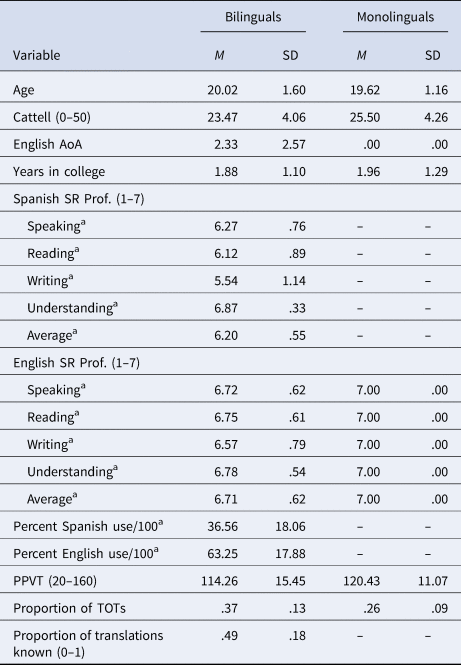
Fifty-five Spanish–English bilinguals living in the United States participated in this experiment. All recruited bilinguals learned Spanish as a L1 and acquired English either simultaneously with or later than Spanish. To qualify for participation bilinguals had to have minimal knowledge of a third language (average self-rated proficiency of 3 or less on a scale from 1 to 7). All bilinguals in the study learned English relatively early in life (M = 2.38 years; SD = 2.62; range = 0–9) and as a group had above-average vocabulary size for their age (standard scores above 100 in the Peabody Picture Vocabulary Test [PPVT], a standardized English vocabulary measure; Table 1). At the time of the study, most of the bilinguals were attending college in a primarily English-speaking environment out of their home state. Consequently, the sample of participants was geographically diverse in terms of their home language communities.
Descriptive statistics comparing bilinguals and monolinguals on study measures

Cattell, Cattell Culture Fair Test pattern completion subtests total score; AoA, age of acquisition; Spanish SR Prof., Spanish self-rated proficiency; English SR Prof., English self-rated proficiency; PPVT, Peabody Picture Vocabulary Test; TOT, tip-of-the-tongue.
This table includes data for participants included in the analyses.
The following participants were excluded: Spanish-dominant bilinguals (n = 6), participants missing Cattell and PPVT scores (n = 2) and a participant without translation data (n = 1).
a Due to a data storage error, we had data available for only 33/47 monolinguals and 10/29 bilinguals for these variables.
Forty-three (76%) of the bilinguals reported being English-dominant, six (11%) reported being Spanish-dominant and seven (13%) reported being balanced in both languages (based on the question “Which is your strongest spoken language?”). Even though English (L2) was the dominant language of the environment for all bilinguals, we excluded participants who reported Spanish dominance (n = 6) from analyses because, unlike the rest of the sample, they differed significantly in their language experience; they were not heritage speakers or bilinguals who had lived in the United States most of their lives, but international students from Spanish-speaking countries, who were more recently immersed in English.Footnote 2 The language and background characteristics for each of the groups are summarized in Table 1. Two participants were excluded from the analysis due to missing PPVT and Cattell scores and one participant due to missing translation data. Thus, 47 Spanish–English bilinguals were included in the final data analysis.
2.1.2. Materials
The stimuli for the picture-naming task consisted of 60 black and white line drawings of low-frequency images primarily drawn from Snodgrass and Vanderwart (Reference Snodgrass and Vanderwart1980) and from searches of fair use images on the internet (Supplementary materials). The average word frequency of the target words was 2.02 words per million (CELEX, Baayen et al., Reference Baayen, Piepenbrock and Gulikers1995). Only noncognates were included in the materials.Footnote 3 All test items were selected from a larger set of pictures, which were normed to ensure high name agreement in English. All items had a one-word translation equivalent in both languages.
2.1.3. Procedure
Participants were tested individually for approximately 1 h in a quiet room. All participants completed three tasks in the following order: (1) English picture-naming task, (2) Cattell Culture Fair Test, (3) Peabody Picture Vocabulary Test III (PPVT-III), (4) language history questionnaire and (5) Spanish translation task.
The procedure for the picture-naming task was based on the protocol of Gollan and Brown (Reference Gollan and Brown2006). The pictures were presented in a fixed random order on a computer monitor. Each picture was presented individually for 15 s at the center of the screen with a white background before disappearing from the screen. All participants completed the picture-naming task in English. At the beginning of the task, participants were told what a TOT was, given instructions to name the pictures in English and asked to let the experimenter know if they were experiencing a TOT.
When participants successfully retrieved the target word, the experimenter manually advanced to the next item. The experimenter encouraged the participant to try to remember the target word until the 15-s time limit passed, and the picture disappeared from the screen. When the participant had difficulty retrieving the target word, the experimenter asked the participant, “If I tell you the word, do you think you might know it?” After the participant responded with yes or no, the experimenter gave the participant the name of the target word and asked whether the word provided was the one the participant was trying to retrieve (“Is anvil the word you might have been looking for?”). Participants were videotaped during the picture-naming task for offline-coding.
2.1.4. Coding
Participants' responses were coded according to the criteria outlined in Gollan and Brown (Reference Gollan and Brown2006). A response was coded as a TOT in two circumstances. First, if the participant said he/she was having a TOT and ultimately retrieved the target word within the time limit. Second, if the participant did not retrieve the target word, the experimenter provided the target after the time limit and asked the participant if that was the word they had been looking for. If the participant said that was exactly the word he/she was looking for, the response was coded as a TOT. Other response types were not counted as TOTs but as other response types specified in Gollan and Brown (Reference Gollan and Brown2006).
2.1.5. Measures
To measure proficiency of the L2 (English), we administered the PPVT-III (Dunn & Dunn, Reference Dunn and Dunn1997) which assesses participants' receptive English vocabulary. In the Language Background Questionnaire (available at https://osf.io/wj4fq/), we asked participants to provide information regarding language use, proficiency and general background information. We administered the four timed pattern completion subtests from the Cattell Culture Fair Test (Cattell & Cattell, Reference Cattell and Cattell1973), a culturally neutral measure of nonverbal intelligence administered on pen and paper. This measure was administered to control for any effects of nonverbal intelligence on lexical retrieval. The Spanish translation task was intended to assess whether participants knew the Spanish translations of words they had previously named in English in the picture-naming task. A word was counted as known in Spanish if it was either produced by the participant or if when given the word, the participant recognized it or knew it well. Data from this task were not coded for TOTs and were only intended to determine which words from the picture-naming task were also known in Spanish. Participants were given the English word verbally by the experimenter and asked to provide the Spanish translation equivalent verbally (“What is the Spanish word for anvil?”). If participants struggled to retrieve a Spanish word, they were told the Spanish translation and asked if that was the word they had been looking for. While participants were not timed in the Spanish translation task, they were asked to report if they did not know the Spanish word immediately. Spanish translations were written by the experimenter and a Spanish speaker later resolved whether any dialectal variation in Spanish translations counted as correct translations.
2.1.6. Analysis
We conducted statistical analyses predicting the binary TOT outcomes (yes, no) at the trial level. TOTs were the primary outcome of interest, occurring on 19% of the trials (see Supplementary materials for descriptive statistics on all response types). All TOTs were coded as 1 and non-TOT responses were coded as 0. We were primarily interested in the roles of L2 (English) proficiency, Spanish translation knowledge and their potential interaction. Thus, models included these two variables as well as word frequency as interacting terms. Word frequency was included as an interacting term due to the possibility that translation effects might be restricted to lower or higher frequency items. Cattell score was additionally included as a noninteracting fixed effect to control for effects of nonverbal intelligence on TOT outcomes. Analyses were conducted using the R programming environment (R version 4.2.2; R Core Team, 2021) package lme4 (Bates et al., Reference Bates, Maechler, Bolker, Walker, Christensen, Singmann, Dai, Scheipl, Grothendieck, Green, Fox, Bauer, Krivitsky, Tanaka and Jagan2015). The continuous predictors (vocabulary size, word frequency) were z-scored. The categorical predictor, translation knowledge (known L1 translation, unknown L1 translation), had two levels and was contrast coded (−.5, .5). All models included random intercepts for participants and items. Maximal models (Barr, Reference Barr2013) were fitted which included random slopes by items.
2.2. Results and discussion
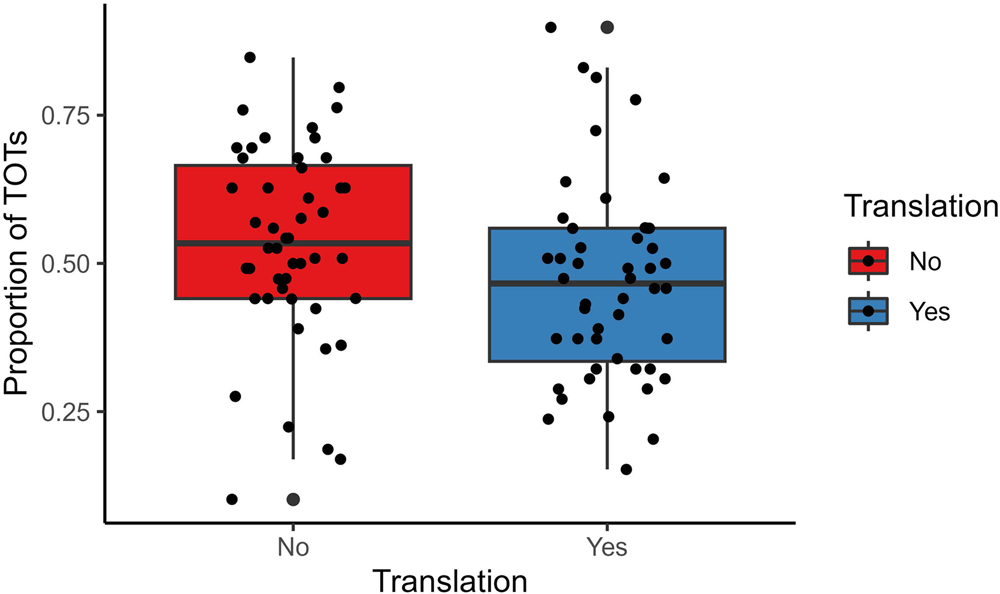
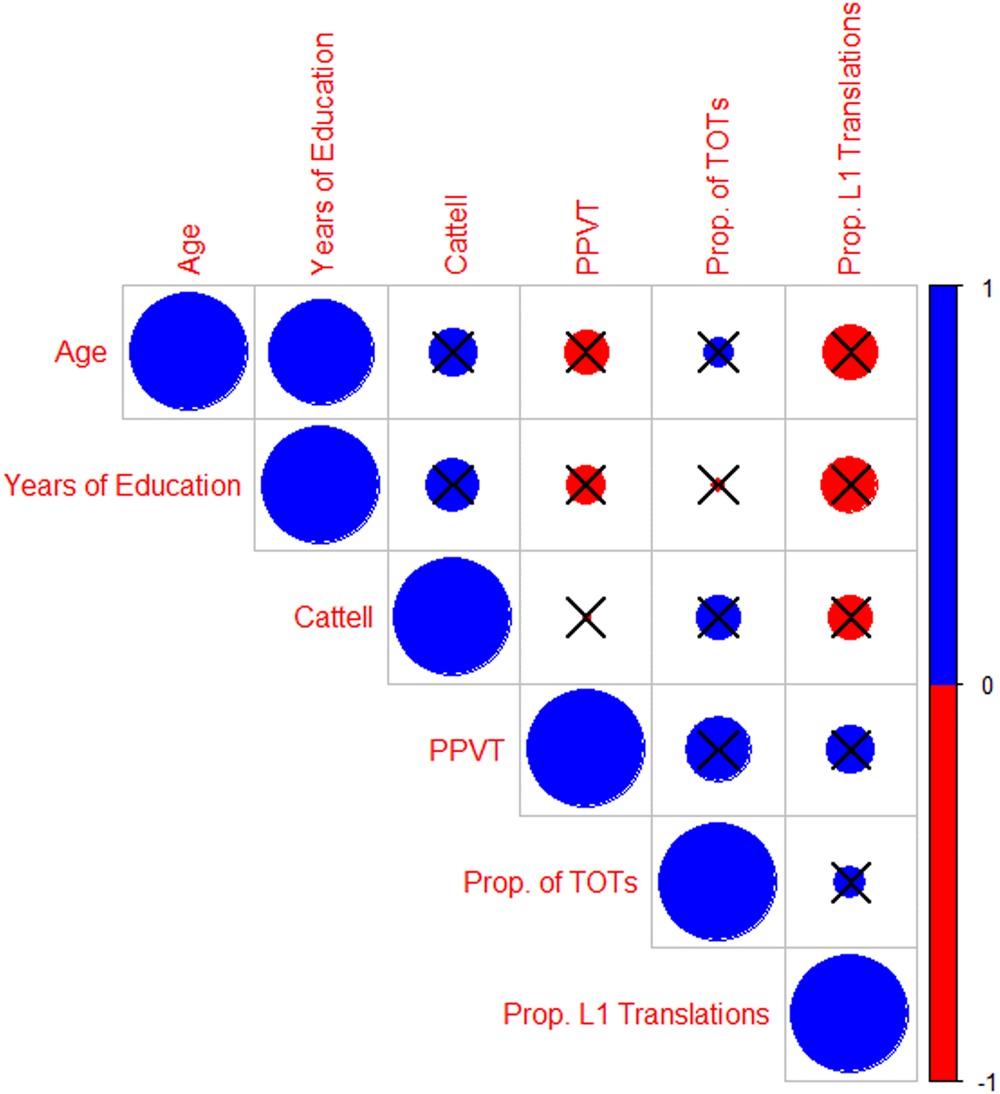
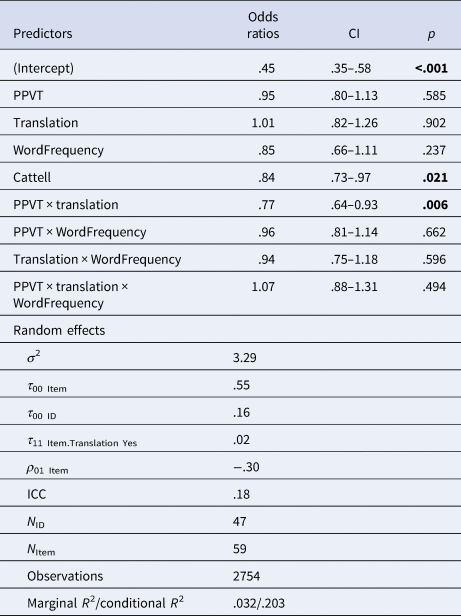
Descriptive statistics for TOTs are shown in Figure 1 and correlations among predictors in the model are summarized in Figure 2. The results of this model are summarized in Table 2.
TOT rates by Spanish translation knowledge for bilinguals.
Notes: Plot generated using the function geom_boxplot from R package ggplot2 (Wickham, Reference Wickham2016). The line represents the median and the whiskers represent the first and third quartiles. Dots represent the proportion of TOTs for each bilingual participant. The proportion of TOTs = total number of TOTs (for items with or without a translation)/the number of words (with or without a translation).

Correlations among variables of interest.
Notes: Plot generated using the function corrplot from R package corrPlot (Wei & Simko, Reference Wei and Simko2021). The size of the circles indicates the magnitude of the correlation. The color (blue/red) indicates whether the correlation is positive/negative. Nonsignificant correlations (α = .05) are crossed out. Prop. TOTs, proportion of TOTs (out of all items known in the L2); Prop. L1 Translations, proportion of L1 translations known out of all items.

Bilingual model predicting TOT outcomes

PPVT, Peabody Picture Vocabulary Test; Cattell, Cattell Culture Fair Test pattern completion subtests. Bold numbers indicate p-value is less than .05.
Model formula: TOT ~ PPVT × translation × WordFrequency + Cattell + (1|ID) + (Translation|Item).
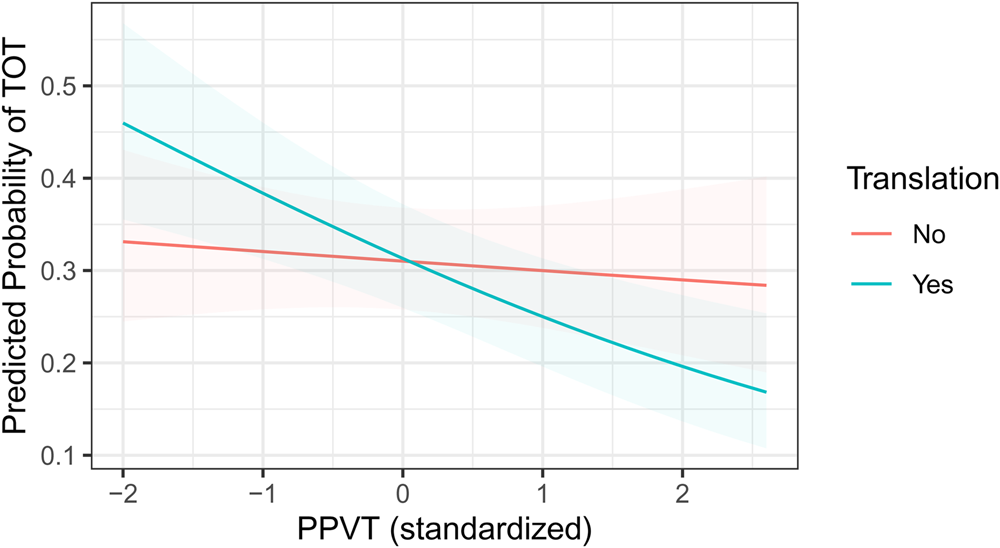
We observed no significant effects of PPVT, Spanish translation knowledge or word frequency on TOT outcomes. There was a main effect of Cattell score, with higher Cattell scores predicting a lower probability of experiencing a TOT. There was a significant interaction between PPVT score (L2 proficiency) and Spanish translation knowledge (Figure 3). To probe this interaction, we conducted simple effects tests. The effect of translation knowledge was evaluated at high (1 SD above mean or 15 points above the group average of 114) and low (1 SD above mean below the group average of 114) values of vocabulary size. Simple effects tests indicated that at low levels of L2 proficiency, the probability of having a TOT was higher when a Spanish translation for the target was known compared to when the translation was unknown in Spanish, β = .25, z = 1.84, confidence interval (CI) = [−.01, .53], p = .03. At high levels of English vocabulary, the probability of having a TOT was marginally lower when a Spanish translation for the target was known compared to when the translation was unknown in Spanish, β = −.30, z = −2.05, CI = [−.22, .14], p = .05.
Interaction between Spanish translation knowledge and PPVT score for bilinguals.
Note: Plot generated using the function geom_line from R package ggplot2 (Wickham, Reference Wickham2016).

The finding that less proficient bilinguals experienced translation interference and more proficient bilinguals experienced translation facilitation is consistent with both the competition for selection and activation boosting hypotheses. These results suggest that less proficient bilinguals are also less efficient in managing the coactivation of Spanish while speaking in English. Importantly, at higher levels of proficiency, the effect of translation was facilitative. Bilinguals with higher L2 proficiency had fewer TOTs when they knew a Spanish translation compared to when they did not. This facilitative effect of translation knowledge can only be explained by the activation boosting hypothesis. The finding that translation interference occurred at low levels of L2 proficiency and facilitation at high levels of L2 proficiency is consistent with the proposal that translation facilitation effects are cumulative and that translation interference effects are short term (Higby et al., Reference Higby, Donnelly, Yoon and Obler2020). As L2 proficiency increases, translation facilitation increases to the extent that it can obscure more transient translation interference effects.
Notably, the interactive effect of translation knowledge and L2 proficiency was significant when controlling for word frequency and is therefore unlikely to be due to differences in the word frequency for words known in one language versus the two languages. However, one possibility is that words known in one language (L2) are different along some other dimension that was not accounted for in the analysis. If so, the translation effects observed may not truly be due to the effect of translation knowledge. An examination of the proportion of participants who correctly translated each item (Supplemental materials) suggests that less translatable words may have been exotic animals (platypus, hedgehog) and old-fashioned tools/artifacts (bellows, sickle, scythe). Other than the relatively low frequency of the less translatable objects that were named, no clear pattern emerges from the semantics of these words. In order to ascertain that the interaction between translation knowledge and vocabulary size was driven by translation knowledge and L2 proficiency and not by some extraneous properties of words or pictures, we conducted a control experiment with English monolinguals (experiment 2).
3. Experiment 2
By investigating the TOT rates of English monolinguals as a function of how translatable these items were for bilinguals, we can better interpret the effects of translation knowledge observed in experiment 1. If greater translatability predicts TOT rates among monolinguals, then confounding item properties rather than bilingual translation knowledge systematically influenced the results of experiment 1. If we replicate the interaction between translation knowledge and PPVT score with monolinguals (in the form of a translatability and PPVT interaction), that would suggest that the interaction in experiment 1 was due not to translation effects being moderated by L2 proficiency, but to some other unidentified property of the words interacting with vocabulary size. Finally, if we observe no effects of translatability on the TOT rates of monolinguals, we can confirm that the effect of translation knowledge observed in experiment 1 was truly due to bilingual translation knowledge.
3.1. Method
3.1.1. Participants
We recruited 30 English monolinguals from the same undergraduate college as the bilingual participants. To qualify for participation, the monolinguals had to rate themselves no higher than a 3 out of 7 on self-rated proficiency in a language other than English in any domain (speaking, reading, writing, comprehension). Two of the participants were excluded from analyses because they had missing PPVT scores. Thus, the final sample of monolinguals in the analyses was 28.
3.1.2. Procedure
We asked English monolinguals to complete the same tasks as the bilinguals in experiment 1 except for the Spanish translation task. Experimental and coding procedures were identical to those of experiment 1.
3.1.3. Analysis
The goal of the analysis was to uncover whether differences in item translatability (based on translation data from the bilinguals in experiment 1) would be predictive of TOT outcomes in monolinguals in the absence of Spanish knowledge. We conducted a parallel analysis to that of experiment 1 using the same data analysis software and modeling approach. We conducted a mixed logistic regression predicting TOT outcomes (0, 1) including PPVT score, Translatability, Word Frequency and Cattell score as predictors. Translatability was operationalized as the proportion of bilingual participants who correctly translated each item. The model included random intercepts for participants and items. Unlike the bilingual data, in which each item could be either translated or not translated, in the monolingual data translatability was constant for each item. Thus, in the monolingual data, there were no random slopes by-item.
3.2. Results and discussion
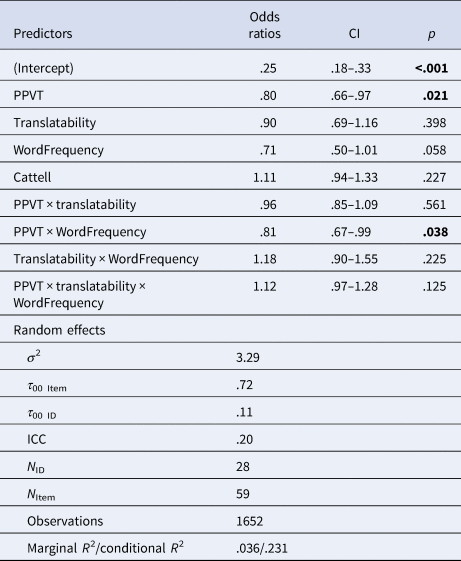
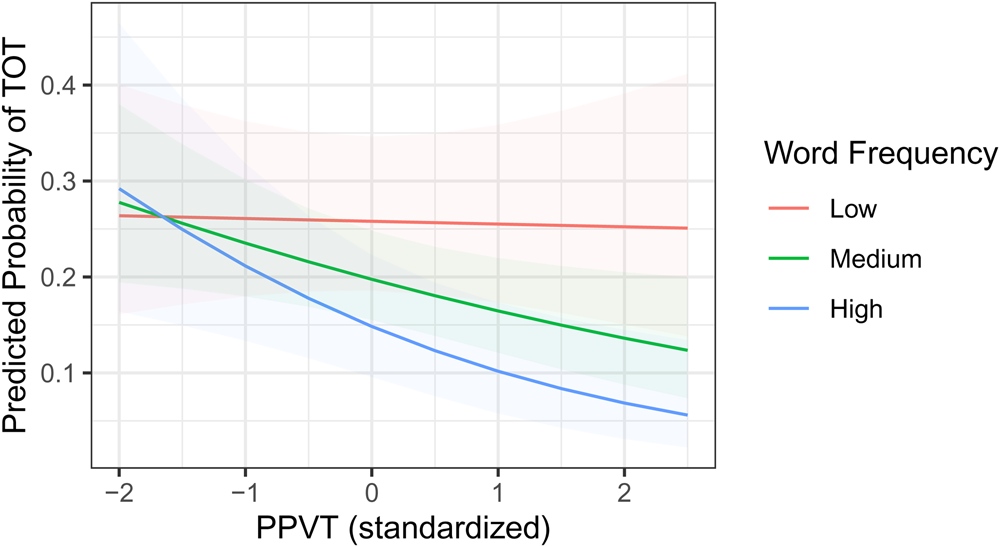
The model is summarized in Table 3. The only significant predictor of TOT outcomes was PPVT score, with a higher PPVT score predicting a lower probability of having a TOT. There was a marginal effect of word frequency on TOT outcomes, with higher word frequency predicting a lower probability of having a TOT. A significant interaction between PPVT score and word frequency (Figure 4) reflected that for low-frequency words, PPVT score did not predict TOT outcomes, while for high-frequency words, higher PPVT scores predicted a lower probability of having a TOT.
Monolingual model predicting TOT outcomes

PPVT, Peabody Picture Vocabulary Test; Cattell, Cattell Culture Fair Test pattern completion subtests. Bold numbers indicate p-value is less than .05.
Model formula: TOT ~ PPVT × translatability × WordFrequency + Cattell + (1|ID) + (1|Item).
Interaction between PPVT score and Word frequency for monolinguals.
Note: Plot generated using the function geom_line from R package ggplot2 (Wickham, Reference Wickham2016).

The finding that only PPVT score and word frequency predicted TOT outcomes is in line with frequency effects being the primary driver of lexical access in monolinguals. Word frequency and vocabulary size are both indices of cumulative language experience and higher values are therefore generally expected to predict fewer TOTs. The interaction between PPVT score and word frequency may reflect that although both vocabulary size and word frequency contribute to lexical access, vocabulary knowledge affects lexical retrieval to different degrees depending on the frequency of the word being retrieved.
We observed no effect of translatability or interaction between translatability and PPVT on monolinguals' TOT rates. This pattern of results suggests that no systematic item-specific confounds led to the findings of experiment 1 and supports the conclusion that the effect of L1 translation knowledge is modulated by L2 proficiency.
4. General discussion
The present study tested the predictions of different accounts of bilingual language production: the competition for selection (Green, Reference Green1998; Hanulová et al., Reference Hanulová, Davidson and Indefrey2011; Kroll et al., Reference Kroll, Bobb and Wodniecka2006), frequency lag (Gollan et al., Reference Gollan, Montoya, Cera and Sandoval2008, Reference Gollan, Slattery, Goldenberg, van Assche, Duyck and Rayner2011) and activation boosting (Higby et al., Reference Higby, Donnelly, Yoon and Obler2020) accounts. We did so by examining the role of individual differences in L2 proficiency and L1 translation knowledge on L2 lexical retrieval within a group of early Spanish–English bilinguals. Although some of these accounts have been previously argued not to be mutually exclusive (Kroll & Gollan, Reference Kroll, Gollan, Goldrick, Ferreira and Miozzo2014), they have generally been tested separately in studies (but see Sullivan et al., Reference Sullivan, Poarch and Bialystok2018). Our approach was to consider not only the individual effects of cross-language competition, frequency and activation boosting mechanisms, but also their combined effects on lexical production. We examined how the likelihood of having a TOT when naming pictures in the L2 was influenced by bilinguals' knowledge of an L1 translation and their level of L2 proficiency. Our results showed that after controlling for nonverbal intelligence and word frequency, there was an interaction between L2 proficiency and translation knowledge: bilinguals with lower L2 proficiency experienced translation interference (more TOTs when they knew a Spanish translation equivalent compared to when they did not), while bilinguals with higher L2 proficiency experienced translation facilitation (fewer TOTs when they knew a Spanish translation equivalent compared to when they did not).
Because translation knowledge was not manipulated, but assessed individually for each bilingual, differences in the properties of items that were known in both languages versus only in the L2 could have driven the differences between TOT rates for items with and without translation equivalents. Moreover, differences in the properties of the words that bilinguals with different levels of proficiency knew in one versus the two languages could have driven the interaction between L2 proficiency and L1 translation knowledge. We ruled out these possibilities by showing that neither the translatability norms from the bilinguals in experiment 1 nor an interaction between translatability and vocabulary size predicted TOT outcomes in monolinguals. The effect of translation knowledge and L2 proficiency in experiment 1 was not due to spurious item effects.
The L2 proficiency and translation knowledge interaction was consistent with the combined predictions of the competition for selection and activation boosting accounts. If competition for selection was the only mechanism contributing to lexical retrieval in bilinguals, then translation interference should have occurred across the L2 proficiency spectrum. Likewise, if activation boosting was the only mechanism contributing to lexical retrieval in bilinguals, then we would have expected to see translation facilitation across the L2 proficiency spectrum. The finding that bilinguals experienced translation interference at lower levels of L2 proficiency and translation facilitation at higher levels of L2 proficiency seems to indicate that both competition for selection and activation boosting mechanisms contribute to lexical retrieval in bilinguals, with a different weighting for the mechanisms as L2 experience increases.
Bilinguals who have lower levels of L2 experience may be less efficient in suppressing the nontarget language, opening them up to interference from translation equivalents (Costa et al., Reference Costa, Santesteban and Ivanova2006). Although our bilingual sample was highly proficient in both languages and had life-long experience resolving coactivation from the L1 during L2 production, individual differences in L2 proficiency may reflect more subtle variation in the degree of nontarget language interference. L2 proficiency reflects not only accumulated L2 knowledge (e.g., vocabulary size), but also the automaticity of L2 access (e.g., naming speed). Previous research indicates that L2 proficiency may modulate L1 translation coactivation as a function of its effect on the time course of production. For example, research using temporally sensitive methods such as event-related potentials suggests that translation coactivation is fleeting in nature and can occur at different loci (Guo et al., Reference Guo, Misra, Tam and Kroll2012). Proficiency has been argued to be one of the factors that shapes the timing of translation coactivation (Kroll et al., Reference Kroll, Bobb and Wodniecka2006). Behavioral tasks may be sensitive to coactivation only at some points in lexical production and thus, may be less likely to reveal the coactivation of the nontarget language, especially when target language access is fast and efficient. In summary, we suggest that translation interference at only low levels of L2 proficiency likely arises from the less proficient speaker more slowly accessing the L2 which in turn extends the time window for the coactivation of the L1.
We attribute the facilitative effect of L1 translation knowledge for highly L2 proficient bilinguals to long-term activation boosting benefits for concepts known in the two languages. L1 translation facilitation may be more likely to be detected at high levels of L2 proficiency because having a larger vocabulary in the L2 increases the opportunities for bilinguals to coactivate L1 translation equivalents during L2 production, boosting the accessibility of a greater number of concepts known in the two languages. Importantly, although we did not measure L1 proficiency, the same would be expected for this sample of bilinguals as a function of increasing L1 proficiency; the more words known in the L1, the more opportunities for L2 translations to be coactivated, facilitating access to concepts known in the two languages.Footnote 4
Although the lack of word frequency and L2 proficiency effects on lexical retrieval for bilinguals may seem to contradict a traditional version of the frequency lag hypothesis (Gollan et al., Reference Gollan, Montoya, Cera and Sandoval2008, Reference Gollan, Slattery, Goldenberg, van Assche, Duyck and Rayner2011), we suggest that these noneffects point to a more nuanced role of frequency in lexical retrieval. A close examination of the interaction between L2 proficiency and L1 translation knowledge reveals different contributions of L2 proficiency for words known in one versus two languages. For words only known in the L2, L2 proficiency does not predict TOT outcomes. However, for words known in both languages, L2 proficiency predicts TOT outcomes. Words known in only one language may be less likely to show a proficiency effect because the use of these words is not divided across the two languages. However, words known in both languages are divided in their frequency of use across languages, making it easier to detect the effect of frequency, because, as is the premise of the frequency lag hypothesis, infrequently used words show stronger frequency effects than more frequently used words.
If L2 proficiency reflects frequency of use, why doesn't word frequency itself interact with translation knowledge? In principle, word frequency may have been the measure that would most accurately predict TOT rates, with more frequent words being accessed more easily than more infrequent words. One possibility could be that the items in our study were all relatively low frequency limiting our chances of detecting frequency effects at the word level. We consider this an unlikely explanation because monolinguals showed the frequency effect with the same set of items. Alternatively, because bilingual lexical knowledge is distributed across languages and varies across bilinguals, lexical frequency norms may not accurately reflect how frequently an individual bilingual encounters specific words. Thus, word frequency norms may be less likely to map onto lexical retrieval outcomes for individual bilinguals than for monolinguals. Because L2 vocabulary size is a more holistic measure of L2 experience, it may wash out the item-specific variation among words to capture overall levels of L2 experience.
Although L2 proficiency generally reflects cumulative experience with the L2, many factors contribute to L2 proficiency. Our measure of L2 proficiency – vocabulary size – may reflect overall linguistic aptitude. For learners, L2 vocabulary size positively relates to reading, writing and listening abilities in the L2 (Stæhr, Reference Stæhr2008). Additionally, the bilingual language environment of our participants prior to attending college may be related to their L2 vocabulary size. Language communities of Spanish–English bilinguals vary in how widespread each language is used; and this variability in language use may affect L2 proficiency and frequency effects in language production (Beatty-Martinez et al., Reference Beatty-Martínez, Navarro-Torres, Dussias, Bajo, Guzzardo Tamargo and Kroll2020). One limitation of our study is that we did not assess L1 (Spanish) proficiency using an objective measure, which would have provided us with more insight into the individual differences in cumulative L1 experience among the bilinguals. Nonetheless, by examining individual differences in L2 proficiency, we were able to holistically capture the interplay between cumulative L2 experience and L1 translation knowledge.
The moderating role of L2 proficiency is striking for three reasons. The first is that our sample of Spanish–English bilinguals appeared to be relatively homogenous in that they had all learned Spanish as a native language, had acquired English early in life (before age nine), had lived in the United States for most of their lives and were attending the same undergraduate institution. Despite this apparent homogeneity in language experience and of their language environment at the time of the study, there were substantial individual differences in L2 proficiency. These individual differences in L2 proficiency within bilinguals enabled us to detect the complex interaction between L1 translation knowledge and proficiency that was not apparent at the group level. Critically, the individual differences analysis we conducted revealed two opposite results that have previously been found in separate studies: translation interference (Costa & Santesteban, Reference Costa and Santesteban2004, experiment 1; Jackson et al., Reference Jackson, Swainson, Cunnington and Jackson2001; Macizo et al., Reference Macizo, Bajo and Paolieri2012, experiment 1; Meuter & Allport, Reference Meuter and Allport1999; Peeters & Dijkstra, Reference Peeters and Dijkstra2018; Slevc et al., Reference Slevc, Davey and Linck2016) and translation facilitation (Costa et al., Reference Costa, Miozzo and Caramazza1999; Gollan & Acenas, Reference Gollan and Acenas2004; Higby et al., Reference Higby, Donnelly, Yoon and Obler2020; Poulin-Dubois et al., Reference Poulin-Dubois, Bialystok, Blaye, Polonia and Yott2013).
Different subsets of bilinguals within our sample experienced different translation effects on L2 lexical retrieval, revealing that a single mechanism insufficiently accounts for the differences between monolinguals and bilinguals in lexical retrieval. The aggregation of data across bilinguals without examining individual variability would have obscured these patterns, distorting conclusions. By examining variability in bilingual language experience continuously, we were able to localize points in the L2 proficiency spectrum where nontarget language competition and activation boosting mechanisms play a larger role in lexical retrieval. Many researchers in the field have advocated for such continuous analyses of the bilingual language experience (DeLuca et al., Reference DeLuca, Rothman, Bialystok and Pliatsikas2019; Gullifer & Titone, Reference Gullifer and Titone2019; Luk & Bialystok, Reference Luk and Bialystok2013; Pot et al., Reference Pot, Keijzer and De Bot2018) and in many cases, such analyses have provided new insights not previously revealed by group-level analyses (Navarro-Torres et al., Reference Navarro-Torres, Dussias and Kroll2022; Sulpizio et al., Reference Sulpizio, Del Maschio, Del Mauro, Fedeli and Abutalebi2020; Tanner & Van Hell, Reference Tanner and Van Hell2014; Zirnstein et al., Reference Zirnstein, van Hell and Kroll2018).
While translation effects in our study of lexical retrieval were shaped by proficiency, translation effects may also be affected by task demands. Translation interference is most likely to be observed in language-switching studies and translation facilitation in other paradigms; this difference merits a closer examination of experimental task demands that shape these results.Footnote 5 Some task demands worth exploring are whether two languages are explicitly involved and how much time is allowed for production. The mechanisms involved in single- and dual-language production are not identical (Declerck et al., Reference Declerck, Ivanova, Grainger and Duñabeitia2020), and may in turn shape how translation knowledge affects language production. Moreover, both interference and facilitation can occur but at different loci of processing (Chen & Mirman, Reference Chen and Mirman2012; Muscalu & Smiley, Reference Muscalu and Smiley2019) and a longer interval before lexical production could provide bilinguals with more time to resolve nontarget language competition (Guo et al., Reference Guo, Misra, Tam and Kroll2012; Ma et al., Reference Ma, Chen, Guo and Kroll2017). A more careful examination of the time course of bilingual language production may illuminate the way in which nontarget language competition affects language production.
5. Conclusions
The results of the present study underscore that individual differences approaches can have great utility for testing theoretical models of bilingual language processing (Chen et al., Reference Chen, Ma, Wu, Li, Zhang, Fu, LU and Guo2020; Kroll et al., Reference Kroll, Takahesu-Tabori and Navarro-Torres2021; Takahesu Tabori et al., Reference Takahesu Tabori, Mech and Atagi2018). Our results suggest that variation in language processing rather than being random may be conditioned by aspects of language experience (Beatty-Martinez et al., Reference Beatty-Martínez, Navarro-Torres, Dussias, Bajo, Guzzardo Tamargo and Kroll2020; Beatty-Martinez & Dussias, Reference Beatty-Martínez and Dussias2017; Green & Abutalebi, Reference Green and Abutalebi2013). By characterizing and harnessing variation in language experience, researchers may come to a better understanding of which aspects of bilingual language experience are critical for shaping language processing.
Supplementary material
The supplementary material for this article can be found at https://doi.org/10.1017/S1366728924000385.
Data availability statement
The data that support the findings of this study are openly available through OSF at https://osf.io/wj4fq/, DOI 10.17605/OSF.IO/WJ4FQ.
Acknowledgments
This research was supported by a Wellesley College Dean's Office fellowship to A. A. T. and a James S. McDonnell Foundation Scholar Award to J. E. P. We thank members of the Laboratory for Language and Cognitive Development who assisted in data collection and coding: Sara Mejia, Rebecca Hosey and Adrienne Lage.
Competing interests
None.
Ethical standards
The authors assert that all procedures contributing to this work comply with the ethical standards of the relevant national and institutional committees on human experimentation and with the Helsinki Declaration of 1975, as revised in 2008.


 Open access

