



Iodine is an essential trace element required for the normal functioning of thyroid hormones, including thyroxine and triiodothyronine. Clinical and subclinical manifestations of iodine deficiency are termed iodine-deficiency disorders (IDD). Iodine deficiencies were prevalent in China until the introduction of universal salt iodisation (USI) in 1995. In the early 1980s, surveys identified 831 000 individuals with IDD manifesting as goitre, and an additional 134 with typical cretinism in Zhejiang Province. Salt iodisation has been recognised as the most effective and cost-efficient strategy to prevent IDD because salt is consumed daily by everybody and by all age groups( 1 – Reference Wang, Zhang and Ge 3 ). A provincial survey conducted in 2000 found the virtual elimination of IDD, but the prevention and control of iodine deficiency is a continuous process because the concentration of iodine in the nature cannot change. It requires monitoring to be sustainable.
The iodine status of a population is defined by calculating urinary iodine concentrations (UIC) from spot urine samples collected in a representative sample and comparing the median UIC against reference ranges( 4 ). The daily urinary excretion of iodine closely reflects the iodine intake of populations, so the UIC of a group is considered to be a valid biomarker of the iodine nutrition status of that population( Reference Ristic-Medic, Piskackova and Hooper 5 , Reference Zimmermann, Jooste and Pandav 6 ).
Since excess iodine intake also could have adverse health effects, in recent years, a different standpoint on whether it is scientific and necessary to keep launching the USI programme throughout China has been adopted( Reference Wang, Zhang and Ge 3 , Reference Yan, Chen and Yang 7 – Reference Chen, Xu and Huang 11 ). The uniform iodised salt criterion might not work across China because of its vast territory with different natural environmental status. Each province should adjust the iodine level in salt according to their actual situation. Therefore, it is extremely important to calculate the reasonable range of salt iodine concentration. The aim of the present study was to explore the influencing factors of UIC, and suggest the reasonable range of salt iodine concentration in order to give suggestions for the surveillance of iodine nutrition status.
Subjects and methods
Subjects
In the present cross-sectional study, a multi-stage cluster sampling technique was employed. A total of eleven cities come under the direct jurisdiction of the Zhejiang provincial government. First, a rural-area sampling unit (county-level cities) and an urban-area sampling unit (counties) were selected from each city, respectively. Then, three investigation sites were selected from each sampling unit according to their location in the county-level cities or counties. Only one community was selected randomly from each sampled investigation site. So, a total of thirty-three rural communities and thirty-three urban communities were selected where the investigation was conducted. From each sampled community, 100 households were selected by the random sampling method according to the household registration information. Then, all members of the sampled household were interviewed and their urine samples were collected. Since the iodine requirement for pregnant women and breast-feeding women is more than that of the general population, and their urinary iodine standard is different from that of the general population, pregnant women and breast-feeding women were excluded from the present study.
Methods
A questionnaire was designed to obtain general personal information about the participant's sex, age, residence and dietary habits. The questionnaire was administered face to face by trained staff through a door-to-door interview. Participants were asked to provide a salt sample from their kitchen for the determination of salt iodine concentration and urine samples for the determination of UIC. Research protocols were approved by Zhejiang Provincial Center for Disease Control and Prevention (CDC). All subjects gave written informed consent after the research protocols were carefully explained to them.
Measures
Spot urine samples and salt samples were collected and delivered to local CDC laboratory for measuring UIC. UIC was determined by the modified acid-digestion method( Reference Yan, Zhang and Liu 12 ). Salt iodine concentration was determined by the direct titration method.
Statistical analysis
As continuous variables were not normally distributed, they were described as medians and 25th–75th percentiles. Spearmen's correlation analysis was used to evaluate the correlations between UIC and salt iodine concentration. To explore the risk factors of having a lower UIC, the population was divided into two groups (group 1: UIC < 100 μg/l; group 2: UIC ≥ 100 μg/l). The differences in qualitative data between the two groups were evaluated by the χ2 test. Risk factors of having a lower UIC were identified by logistic regression analysis, and the equations of UIC and salt iodine concentration were fitted by curve regression analysis. Data processing and statistical analyses were performed using SAS 9.2 software (SAS Institute). All tests were two-sided, and the level of significance was set at P< 0·05.
Results
Urinary iodine concentrations of individuals living in Zhejiang Province
A total of 26 773 participants took part in the provincial survey conducted in 2011; of these participants, 23 361 provided the samples, with the response rate being 87·2 %. The median UIC of the participants was found to be 162·0 (25th–75th percentile 98·2–248·6) μg/l. Their median salt iodine concentration was found to be 29·4 (25th–75th percentile 25·8–32·9) μg/l. UIC was found to have a significant association with salt iodine concentration (Spearman's ρ = 0·144, P= 0·000).
Comparison of characteristics according to urinary iodine concentration level
A total of 16 590 adults participated in the interview. The population was divided into two groups (group 1: UIC < 100 μg/l; group 2: UIC ≥ 100 μg/l). The differences between the two groups are presented in Table 1. Age, sex, education level, status of occupation, occupation, marine products, pickled food, dining out, smoking, thyroid disease, height and salt iodine concentration were found to be significant using the single-factor analysis (P< 0·05).
Distribution of the characteristics of individuals living in Zhejiang Province, stratified by urinary iodine concentration (UIC) level (Mean values and standard deviations; number of residents and percentages; medians and interquartile ranges)

Multiple logistic regression analysis
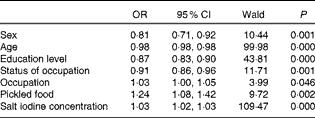
The regression model was found to be significant (χ2= 302·281, P= 0·000). Age (OR 0·98, 95 % CI 0·98, 0·98), sex (OR 0·81, 95 % CI 0·71, 0·92), education level (OR 0·87, 95 % CI 0·83, 0·90), status of occupation (OR 0·91, 95 % CI 0·86, 0·96), occupation (OR 1·03, 95 % CI 1·00, 1·05), pickled food (OR 1·24, 95 % CI 1·08, 1·42) and salt iodine concentration (OR 1·03, 95 % CI 1·02, 1·03) were found to be the influencing factors for having < 100 μg/l of UIC using the multiple linear regression analysis (P< 0·05) (Table 2).
Risk factors of having urinary iodine concentration <100 μg/d in Zhejiang Province in 2011 (Odds ratios and 95 % confidence intervals)
Curve regression analysis
The curve regression analysis found that UIC (y) and salt iodine concentration (x) could be expressed by the equation y= 1·5772x 1·4845 (Fig. 1). From this equation, UIC could be estimated according to salt iodine concentration. In the 2011 survey, the salt concentration was estimated to be 28.1 mg/kg, so the predicted value of UIC was 223 μg/l (actual UIC: 237 μg/l( 13 )), and in the 2013 survey, the salt concentration was estimated to be 24.1 mg/kg, so the predicted value of UIC was 178 μg/l (actual UIC: 178 μg/l( 14 )).
Curve regression of urinary iodine concentration (y) and salt iodine concentration (x) (y= 1·5772x 1·4845).

Application of the equation
According to the guidelines for the assessment of IDD and monitoring of their elimination, the median UIC are used to assess iodine nutrition status, such as iodine deficiency (UIC < 100 μg/l; low), adequate iodine nutrition (100 ≤ UIC < 200 μg/l; normal), above the required iodine nutrition (200 ≤ UIC < 300 μg/l; sufficient) and excess iodine (UIC ≥ 300 μg/l; excess)( 4 ). Therefore, the equation of UIC (y) and salt iodine concentration (x) was used to explore the reasonable range of salt iodine concentration. Salt iodine concentration was calculated to be in the range of 16·4 to 34·3 mg/kg for the range of 100 to 300 μg UIC/l.
Discussion
UIC is a good marker of the recent dietary intake of iodine. In the present study, the median UIC of the population living in Zhejiang Province was found to be 162·0 μg/l, indicating optimal iodine intake. Since October 2000, the salt iodisation level was set at 35 mg/kg, and the survey was conducted in 2011, the findings of which suggested that iodine nutrition status was in the normal level according to the guidelines of the WHO/UNICEF/International Council for Control of IDD( 4 ) under the USI period, with the salt iodisation level being set at 35 mg/kg. Meanwhile, since the 75th percentile of UIC was found to be 248·6 μg/l, the iodisation level set could be suggested to be adjusted down. In fact, after the survey, since 2013, China has adopted a new iodised salt standard of 25 or 30 mg/kg according to the actual situation in each province (autonomous region, municipality)( 15 ).
In China, iodised salt is the main vehicle for iodine supplementation. Salt contributed 63·5 % of food iodine( Reference Chen, Xu and Huang 11 ). A study in Shanghai has reported that iodised salt contributed 63·5 % of the total dietary iodine, while aquatic products contributed 5·03 %, with 14·9 % by the laver and kelp, which were markedly lower than the contribution of iodised salt. Iodised salt intake is the main factor that influence iodine intake( Reference Zou, Wu and Guo 16 ). Our previous study conducted in part of the cities of Zhejiang Province has shown that the proportions of iodine intake through water, salt and other foods (other foods refer to all the foods containing iodine in addition to water and salt) were 1·70, 76·41 and 21·89 %, respectively( Reference Mo, Lou and Zhu 17 ). Consistent with previous studies in China, the present study showed that salt iodine concentration was 29·4 mg/kg, which was within the range of China's current iodised salt standard, and UIC was closely correlated with salt iodine concentration. The present results indicate that iodised salt is the main dietary source of iodine among the population living in Zhejiang Province. Consequently, it provides support that the USI programme is necessary for the individuals residing in Zhejiang Province.
Since the introduction of iodised salt, we have been monitoring the iodine nutrition status based on UIC only in children aged 8–10 years, and this survey of the entire population provides baseline data for further studies in the general population. From the present study, it appears that individuals who ate marine products more than two times per week (Table 1) were more likely to have a UIC of < 100 μg/l. Although marine products might be expected to contain significant iodine levels and increase UIC, the population who ate marine products were those living in the island areas with a low coverage rate of iodised salt. Moreover, the multiple logistic regression analysis found age, sex, education level, status of occupation, occupation, pickled food and salt iodine concentration to be the influencing factors for having a lower UIC. Individuals with a different age, education level and occupation may have different attitudes and behaviours towards using iodised salt. Some individuals have the point of view that they have more access and opportunity to consume seafood with sufficient iodine levels as part of their daily diet, especially those living in the islands, because of which they prefer to use non-iodised salt. In addition, individuals living in rural areas may be especially prone to higher salt consumption resulting from eating habit that included more coarse and pickled foods( Reference Zou, Lou and Ding 18 ). Therefore, iodised salt may be the most important factor influencing the UIC.
Since UIC could be adjusted by salt iodine concentration, an equation was fitted by curve regression analysis, which found that UIC (y) and salt iodine concentration (x) could be expressed by the equation y= 1·5772x 1·4845. With this equation, the suggested range of salt iodine concentration could be estimated for optimal UIC. Based on this equation, salt iodine concentration was calculated to be in the range of 16·4 to 34·3 mg/kg for the range of 100–300 μg UIC/l. This equation was used to estimate UIC when the information obtained was limited and the surveillance frequency increased, and can be used as a reference for future studies. Due to the high variation in the UIC of an individual, the WHO recommends the use of the median UIC of a given population to assess the iodine status of that population. In fact, community data are obtained from individual data. In the present study, the equation was set up using individual data rather than community data in order to ensure the validity and authenticity of the data, and to improve the efficiency of the statistics; otherwise, using the median of community data may reduce the differences between the individuals. In addition, the aforementioned curve regression equation was the actual situation of the correlation between iodised salt intake and UIC for individuals living in Zhejiang Province. The USI programme was launched in 1995 in China. Our previous study conducted in part of the cities of Zhejiang Province has shown that table salt was the major source of iodine intake of individuals living in Zhejiang Province( Reference Mo, Lou and Zhu 17 ). The percentage of households using adequately iodised salt will affect the median UIC. In 2011, the coverage rate of iodised salt was 95·06 %( 13 ), suggesting that the USI policy achieved significant results. For the individuals living in this area, the equation was useful for estimating the suggested range of salt iodine concentration for optimal UIC. For individuals, there may be special circumstances, for example greater consumption of marine products that have high levels of iodine, but this situation was based on the individual level rather than on the population level.
The present study has several limitations. UIC are highly variable and represent the recent dietary intake of iodine rather than the usual intake. Due to this variation, a sample of 100 spot urine test samples is needed to produce the estimates of UIC with a precision range of ± 10 %, and a sample of 500 is needed for a precision range of ± 5 %( Reference Andersen, Karmisholt and Pedersen 19 ).
In conclusion, in the present cross-sectional survey, the median UIC of individuals living in Zhejiang Province falls within the range of optimal iodine status as recommended by the WHO/UNICEF/International Council for Control of IDD. Age, sex, education level, status of occupation, occupation, pickled food and salt iodine concentration were found to be the influencing factors for having a lower UIC. The suggested salt iodine concentration was 16·4 to 34·3 mg/kg. The present study provides important information and reference for the monitoring of iodine nutrition status during the annual surveillance.
Acknowledgements
The authors thank the staff of city-level and county-level CDC in Zhejiang Province, who collected the epidemiological data and urine samples. The authors particularly thank all the participants for their contribution and support.
The present study was supported by Zhejiang Province Science and Technology Fund (grant no. 2009C03010-1). The funder had no role in the design and analysis of the study or in the writing of this article.
The authors’ contributions are as follows G. D., X. L. and Y. Z. were responsible for the study design; Y. Z. was involved in the data collection and analysis, and writing and revision of the manuscript; Z. M. took part in the field investigation and data collection; W. Z. was in charge of laboratory detection; J. Z. and G. M. took part in the field investigation.
None of the authors has any conflicts of interest to declare.



