Recent research suggests that humans first occupied high mountain regions during the Final Pleistocene and Early Holocene. Some of the earliest high-altitude sites (4000m asl and above) found in the Andes date to around 10kya, and to approximately 13kya in Tibet and the Himalayas (Meyer et al. Reference Meyer, Aldenderfer, Wang, Hoffmann, Dahl, Degering, Haas and Schlütz2017). Bracketed by the Himalayas and the Tibetan Plateau, western Central Asia was a probable migration route for early peoples moving into North and East Asia (Bae et al. Reference Bae, Douka and Petraglia2017). The area also channelled cultural and technological influence, and facilitated exchange between adjoining regions in later prehistory, most famously as part of the Silk Roads (Christian Reference Christian2000). As many culturally and economically significant areas of this region lie above 2000m asl, it is essential to characterise the timing and nature of human exploitation of the high-altitude continental interior, in order to understand the human history in Eurasia.
Western Central Asia has several high mountain regions, including the Tian Shan (2000–5000m asl), the Pamir Mountains (3000–4500m asl) and the Alay Range (2300–3500m asl). Previous archaeological research in the Central Asian high mountains discovered several Epipalaeolithic sites in the Pamir region, including the Oshhona open-air site (4000m asl) and Istikskaya Cave (4000m asl), and the Markansu River Valley in Tajikistan (Ranov Reference Ranov1988).
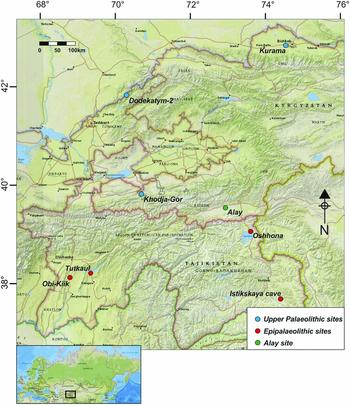
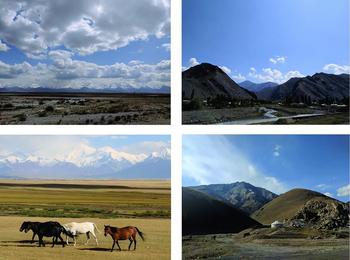
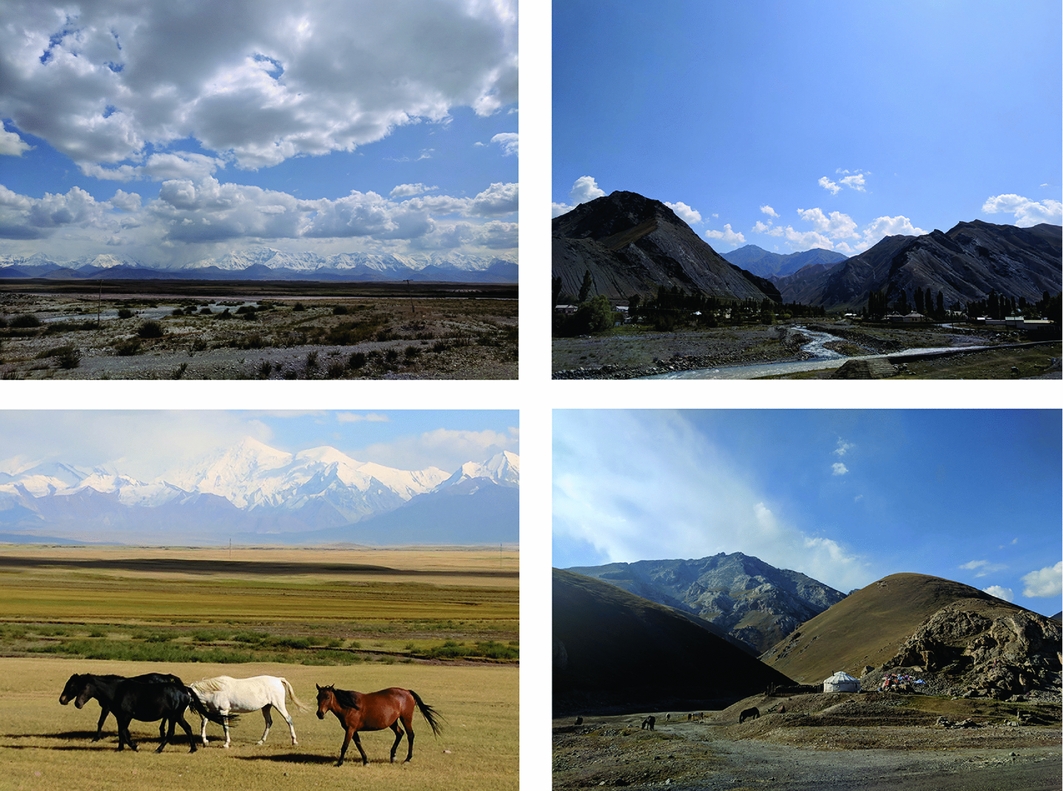
Only one Palaeolithic site has been documented in the Alay Valley. Known as the Alay site, it is located in the western part of the Alay Valley, on the banks of the Kyzyl-Suu River, at an elevation of 2800m (Figures 1 & 2). It was discovered in 1975 by A.A. Nikonov, who conducted several seasons of field survey. More than 1740 lithic artefacts were recovered, analysis of which revealed prismatic and narrow-faced blades and bladelets, end-scrapers, notched pieces, awls and backed points on blades. The lithic industry was typologically dated to the Early Holocene, and is hypothesised to be synchronous with other materials from Pamir (the Oshhona site and Istikskaya Cave) (Ranov et al. Reference Ranov, Filimonova, Nikonov, Derevianko and Shun'kov2015). As the only evidence for early human occupation at high altitude in this key region of southern Kyrgyzstan, this site is of immense significance to our understanding of human lifeways in Central Asian prehistory.
The location of archaeological sites mentioned in the article. Map produced using National Geographic Basemap using ArcGIS Online.

Alay Valley, Kyrgyzstan. Photographs by W. Taylor.
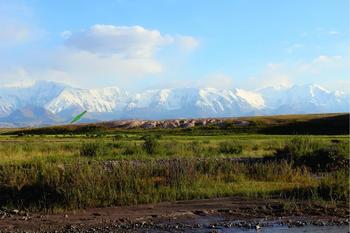
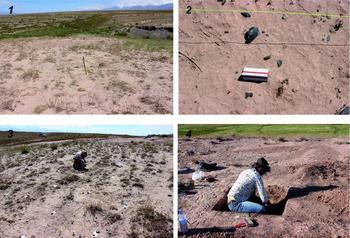
Our international expedition returned to the Alay site (Figure 3) in 2017. Three test pits were dug in different areas of the site in order to clarify its stratigraphy and lateral extent (Figures 4 & 5: 4). These confirmed that much of the cultural layer of the site is currently exposed, with material including charcoal, bones and lithics visible on the surface. We collected all materials from an artefact-dense 25m2 area (Figure 5: 1–3). The stone artefact assemblage from this area comprises 244 specimens, the majority of which is debitage (n = 156; 64 per cent). We identified two morphologically distinct core types: semi-cylindrical with one striking platform (Figure 6: 9), and semi-pyramidal with two striking platforms for bladelets (Figure 6: 7). Core-preparation blanks included semi-tablets, a corner spall, front core-trimming spalls and one lateral spall, while in the blank category we identified 47 flakes, 14 blades (Figure 6: 6) and 13 bladelets (Figure 6: 2).
View of the Alay site from the east (indicated by green arrow). Photograph by W. Taylor.

Map of the Alay site (by W. Taylor).

Excavations at the Alay site, 2017: 1) area of artefact collection; 2) example showing artefact distribution; 3) artefact collection; 4): test pit at the Alay site. Photographs by A. Abdykanova.

Lithic artefacts from the Alay site.

Blank production at the Alay site appears to have been focused on the manufacture of blades and bladelets that are morphologically similar and result from a specialised blank-production system. The blanks that we recovered were extremely fragmented. The length of whole blades varies from 30–50mm, and the width from 12–23mm, with most falling between 13 and 16mm. Only four whole bladelets were identified, ranging in length from 15–21mm, with a width for most bladelets between 6 and 9mm. Blades and bladelets show predominantly unidirectional parallel dorsal scar patterns, with parallel lateral edges, trapezoidal to triangular midpoint cross sections, and straight longitudinal profiles. Most blades have a reduced, flat striking platform, while a few bladelets have a linear platform. These characteristics are indicative of a recurrent unidirectional production system. All blades and bladelets with a proximal edge show lips and small percussion damage, indicative of soft-hammer flaking. These characteristics suggest that Alay occupants used the same strategy to produce both blades and bladelets. The tool assemblage totals 17 specimens, most of which are end-scrapers (Figure 6: 4 & 8) and notched pieces, although the collection also includes awls, backed bladelets (Figure 6: 1), flakes (Figure 6: 5) and blades (Figure 6: 3) with utilisation retouch. Blades appear to have served as blanks for most of the tool types recovered from the Alay site.
This analysis challenges the analogy drawn between the Alay site and other materials recovered from high-altitude sites in Pamir. Our recent reanalysis of the stone artefact collections from the Oshhona and Istikskaya cave sites demonstrates that these assemblages were produced through the microblade knapping; microblades with ventral retouch and ‘thumbnail’ end-scrapers dominated the assemblages. This industry dates to between 13–7 kya BP (Shnaider et al. Reference Shnaider, Krajcarz, Viola, Abdykanova, Kolobova, Fedorchenko, Alisher-Kyzy and Krivoshapkin2017). Major technological and typological differences with the Alay assemblage suggest that the Oshhona and Istikskaya materials may represent a different cultural or technological tradition. In contrast, the Alay stone tool assemblage shows many similarities with the late stage of the ‘Kulbulakian’ (represented by Dodekatym-2) and early and middle ‘Tutkaulian’ (represented by Tutkaul, l.3, Obi-Kiik) cultures found in post-Late Glacial Maximum assemblages from the Tian-Shan and Hissaro-Alay regions (Kolobova et al. Reference Kolobova, Shnaider and Krivoshapkin2016), as well as with Upper Palaeolithic industries, such as Khodja-Gor and Kurama. As with the Alay lithic assemblage, these industries are also characterised by blade/bladelet knapping with soft-hammer flaking, along with similar types of tools, such as end-scrapers, notched pieces and backed bladelets.
A more detailed cultural and chronological characterisation of the Alay site will only be possible through new excavations aimed at obtaining a larger archaeological assemblage and material for absolute dating. These efforts will illuminate the economy of Central Asia's first high-altitude foragers and their role in the movements, exchanges and cultural developments that shaped the prehistory of the continental interior. Nevertheless, key technological differences with assemblages from the nearby Pamir Mountains hint at an affiliation with the Final Palaeolithic complexes of western Central Asia. They may also confirm that the Alay site represents the earliest episode of high-altitude occupation in the region.
Acknowledgements
The research was supported by a project of the Institute of Archaeology and Ethnography (SB RAS 0329-2016-0002).