





Introduction
Perennial crops can improve agricultural sustainability compared to annual crops because their extensive root systems can sequester carbon, reduce soil erosion and nutrient leaching, and minimize pesticide usage while increasing farmer incomes due to decreased annual inputs and costs (Glover et al. Reference Glover, Reganold, Bell, Borevitz, Brummer, Buckler, Cox, Cox, Crews, Culman, DeHaan, Erikkson, Gill, Holland, Hu, Hulke, Ibrahim, Jackson, Jones, Murray, Paterson, Ploschuk, Sacks, Snapp, Tao, Van Tassel, Wade, Wyse and Xu2010). Intermediate wheatgrass (IWG), a perennial cool-season forage grass, has been bred for its large seed size and grain yield and is the first commercially available perennial grain crop in the United States (DeHaan et al. Reference DeHaan2010). This species has great potential as a human food and livestock feedstock while providing environmental benefits. It has an extensive root system that limits nitrate leaching into groundwater, reduces soil erosion with year-round ground cover, and improves soil health (Culman et al. Reference Culman, Snapp, Ollenburger, Basso and DeHaan2013; Jungers et al. Reference Jungers, DeHaan, Mulla, Sheaffer and Wyse2019; Ryan et al. Reference Ryan, Crews, Culman, DeHaan, Hayes, Jungers and Bakker2018; de Oliveira et al. Reference de Oliveira, Brunsell, Crews, DeHaan and Vico2020).
Commercial interest in IWG grain, marketed as Kernza®, has expanded recently (DeLage Reference DeLage2015). To minimize risk solely from grain production, farmers can use IWG as a dual-purpose crop and harvest the forage as another revenue stream (Favre et al. Reference Favre, Castiblanco, Combs, Wittiaux and Picasso2019; Hunter et al. Reference Hunter, Sheaffer, Culman and Jungers2020). Intermediate wheatgrass yields relatively high-quality forage, is palatable to many types of livestock, and is competitive with weeds (Asay Reference Asay, Jensen, Moser, Buxton and Casler1996; Favre et al. Reference Favre, Castiblanco, Combs, Wittiaux and Picasso2019; Hybner Reference Hybner and Jacobs2012; Nelson et al. Reference Nelson, Finley, Scarnecchia and Paris1989; Zimbric et al. Reference Zimbric, Stoltenberg and Picasso2020). The forage can be harvested in early spring before elongation and/or in the fall after the summer grain harvest. Having various potential uses improves the chances of increasing farmers’ income and adoption of IWG (Law et al. Reference Law, Wayman, Pelzer, Culman, Gómez, DiTommaso and Ryan2022; Pinto et al. Reference Pinto, Cartoni-Casamitjana, Colin, Stevens, Stoltenberg, Zimbric and Picasso2022).
Although many farmers are interested in growing this perennial grain for its ecological and economic benefits, weed management has been recognized as a considerable need and information gap in cultivating IWG for forage and grain (Lanker et al. Reference Lanker, Bell and Picasso2020). Specifically, farmers are interested in herbicide options that can reduce weed impacts during critical stand establishment and during early production years when needed.
Weed community dynamics in IWG are variable. Some studies have shown that weed biomass is highest in the establishment year and decreases substantially as the IWG stand ages (Dick et al. Reference Dick, Cattani and Entz2019; Olugbenle et al. Reference Olugbenle, Pinto and Picasso2021; Zimbric et al. Reference Zimbric, Stoltenberg and Picasso2020). A recent study showed that over 4 yr, weed biomass declined in the fall of all years but remained constant in the spring (Duchene et al. Reference Duchene, Bathellier, Dumont, David and Celette2023). Other studies have noted that weed biomass in IWG is generally low (Law et al. Reference Law, Pelzer, Wayman, DiTommaso and Ryan2020; Sakiroglu et al. Reference Sakiroglu, Dong, Hall, Jungers and Picasso2020; Pinto et al. Reference Pinto, Cartoni-Casamitjana, Colin, Stevens, Stoltenberg, Zimbric and Picasso2022). Furthermore, weed community composition tends to transition from broadleaf annual species, particularly winter annual, to perennial broadleaf and grass species after establishment (Duchene et al. Reference Duchene, Bathellier, Dumont, David and Celette2023; Law et al. Reference Law, Wayman, Pelzer, DiTommaso and Ryan2021; Zimbric et al. Reference Zimbric, Stoltenberg and Picasso2020).
Weed management in IWG systems is typically based on integrating cultural and mechanical methods. Recommendations are to plant in fields with low weed pressure, especially low pressure from perennial and highly competitive weed species that can become problematic throughout the life of the stand (DeHaan et al. Reference DeHaan, Favre, Forcella, Jungers, Picasso and Reser2019). In locations with high winter annual weed density, timely mowing before stem elongation in the spring is recommended for weed management (Zimbric et al. Reference Zimbric, Stoltenberg and Picasso2020). Otherwise, interrow cultivation might be used to reduce weeds between rows if the row spacing is wide enough. However, common IWG seeding practices use narrow row spacing (15 to 30 cm) to reduce weed pressure. If interrow cultivation is to be used to manage weeds, it is recommended that IWG be established in a wide-row spacing (61 to 91cm) to reduce the risk of damaging stands (DeHaan et al. Reference DeHaan, Favre, Forcella, Jungers, Picasso and Reser2019).
Herbicide efficacy on problematic weeds commonly found in IWG cropping systems is well understood, but herbicide effects on IWG for grain production have not been studied. Registration of herbicides for use in IWG can reduce weed competition in systems that do not allow mechanical weed management. Specifically, this study assesses three synthetic growth regulator herbicides (synthetic auxins, Group 4) registered for use in wheat cropping systems: 2,4-D amine, clopyralid, and MCPA. Synthetic auxin herbicides are commonly used for broadleaf weed control, where they mimic a plant hormone, disrupting cell formation and growth, and leading to plant death (Todd et al. Reference Todd, Figueiredo, Morran, Soni, Preston, Kubes, Napier and Gaines2020). These herbicides have good to excellent crop tolerance in small grains and varying degrees of efficacy on winter annual, summer annual, and perennial broadleaf weed species (Dewerff et al. Reference Dewerff, Jensen, Liesch, Nice, Renz, Smith and Werle2019). Specifically, 2,4-D amine has good to excellent efficacy on several winter and summer annual broadleaf weed species, fair to good efficacy on dandelion (Taraxacum officinale F. H. Wigg.), but only fair efficacy on Canada thistle (Cirsium arvense L.) and other perennial broadleaf species often found in small grain production systems. Conversely, clopyralid has good to excellent efficacy on Canada thistle, good efficacy on dandelion and red clover (Trifolium pratense L.), fair efficacy on the winter annuals shepherd’s purse (Capsella bursa-pastoris L.) and field pennycress (Thlaspi arvense L.), and poor to no efficacy on pigweeds (Amaranthus spp.) and common lambsquarters (Chenopodium album L.). MCPA has excellent efficacy on shepherd’s purse and pennycress, good efficacy on pigweeds and common lambsquarters, and only fair efficacy on Canada thistle. However, the spectrum of MCPA is limited and is not typically recommended for use alone. Thus, a premix of clopyralid + MCPA is commonly used to address individual herbicide deficiencies in broadleaf weed efficacy.
The objective of this study was to determine the effects of 2,4-D, clopyralid, MCPA, and clopyralid + MCPA on injury and grain yield of newly seeded and established IWG stands under field conditions when applied during the tillering stage or before the boot growth stage as recommended for small grain crops. We hypothesized that IWG would tolerate these herbicides with little or no effect on injury or grain yield. The results will address a critical information gap for herbicide use in IWG systems, generating information needed for labeling and assessing potential tradeoffs associated with herbicide use in IWG production systems.
Material and Methods
Site Characterization and Experimental Design
The experiment was conducted at four sites: 1) the University of Wisconsin-Madison Arlington Agricultural Research Station near Arlington, WI, on Plano silt loam (fine-silty, mixed, superactive, mesic, Typic Argiudoll); 2) the University of Minnesota-Twin Cities Rosemount Research and Outreach Center near Rosemount, MN, on Urban Land-Waukegan complex (fine-silty over sandy or sandy-skeletal, mixed, superactive, mesic Typic Hapludolls) and eroded Timula-Bold silt loam (coarse-silty, mixed, superactive, mesic Typic Eutrudepts); 3) the Cornell University Tailby Research farm near Varna, NY, on Braceville gravelly silt loam (coarse-loamy, mixed, active, mesic Typic Fragiudepts); and 4) the North Dakota State University Williston Research Extension Center near Williston, ND, on Williams-Bowbells loam (fine-loamy, mixed, superactive, frigid Pachic Argiustolls). Research site coordinates and intermediate wheatgrass varieties, planting dates, seeding rates, row spacing, and nitrogen fertilization are shown in Table 1.
Study site coordinates, soil type, intermediate wheatgrass description, and nitrogen fertilization. a

a Abbreviations: MN, Minnesota; N, Nitrogen; ND, North Dakota; NY, New York; TLI, The Land Institute; WI, Wisconsin.
b Nitrogen was applied as urea in April, except in New York, where it was applied as ammonium sulfate.
c Nitrogen was not applied.
d Broadcast seeding.
Treatments were arranged in a three-factor randomized complete block design replicated three times with herbicide (2,4-D amine, clopyralid, MCPA, clopyralid + MCPA, and a nontreated check) as the first factor, herbicide rate (1× within the range of labeled rates for use in wheat and 2×) nested in herbicide as the second factor, and herbicide application timing (fall or spring) as the third factor (Table 2). The experiment was initiated in fall 2019, conducted during the 2020 growing season, and continued at some sites until the summer 2021 after grain harvest (Tables 3 and 4). Intermediate wheatgrass stand age at the time of herbicide application varied across sites from newly planted stands to established stands (Tables 3 and 4). Herbicide treatments were applied in the fall during IWG tillering or jointing stages (Table 3) or in the spring during the jointing stage (Table 4).
Description of synthetic auxin herbicides, application rates, and times in intermediate wheatgrass experiments.

a Herbicide was not applied.
Fall herbicide application information. a
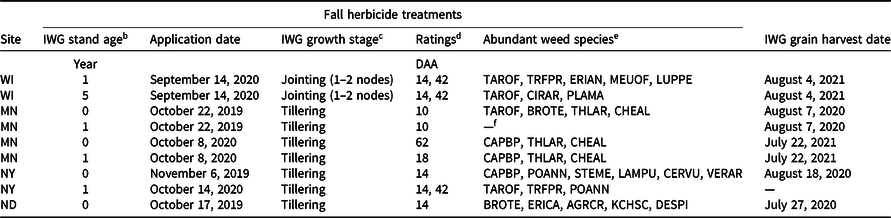
a Abbreviations: DAA, days after application; IWG, intermediate wheatgrass; MN, Minnesota; ND, North Dakota; NY, New York; WI, Wisconsin; AGRCR, crested wheatgrass [Agropyron cristatum (L.) Gaertn.]; BROTE, downy brome (Bromus tectorum L.); CAPBP, shepherd’s purse (Capsella bursa-pastoris L.); CERVU, mouseear chickweed [Cerastium vulgatum (Hartmann) Greuter & Burdet]; CHEAL, common lambsquarters (Chenopodium album L.); CIRAR, Canada thistle (Cirsium arvense L.); DESPI, pinnate tansymustard [Descurainia pinnata (Walter) Britton]; ERIAN, annual fleabane [Erigeron annuus (L.) Pers.]; ERICA, horseweed (Erigeron canadensis L.); KCHSC, kochia [Bassia scoparia (L.) A.J. Scott]; LAMPU, purple deadnettle (Lamium purpureum L.); LUPPE, perennial lupine (Lupinus perennis L.); MEUOF, yellow sweetclover [Melilotus officinalis (L.) Lam.]; PLAMA, broadleaf plantain (Plantago major L.); POANN, annual bluegrass (Poa annua L.); STEME, common chickweed [Stellaria media (L.) Vill.]; TAROF, dandelion (Taraxacum officinale F. H. Wigg.); THLAR, field pennycress (Thlaspi arvense L.); TRFPR, red clover (Trifolium pratense L.); VERAR, corn speedwell (Veronica arvensis L.).
b IWG stand age: 0 = establishment (seeding) year; 1 and 5 = first and fifth grain production year, respectively.
c IWG stage of growth at time of herbicide application: tillering (Feekes scale 3–5) and jointing 1–2 nodes (Feekes scale 6–7).
d Days after application for IWG injury ratings, and weed control and cover ratings.
e Shown in order of abundance at the time of ratings.
f Data not collected.
Spring herbicide application information. a
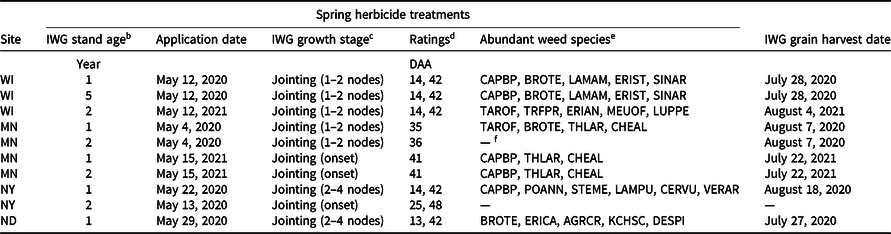
a Abbreviations: DAA, days after application; IWG, intermediate wheatgrass; MN, Minnesota; ND, North Dakota; NY, New York; WI, Wisconsin; AGRCR, crested wheatgrass [Agropyron cristatum (L.) Gaertn.]; BROTE, downy brome (Bromus tectorum L.); CAPBP, shepherd’s purse (Capsella bursa-pastoris L.); CERVU, mouseear chickweed [Cerastium vulgatum (Hartmann) Greuter & Burdet]; CHEAL, common lambsquarters (Chenopodium album L.); DESPI, pinnate tansymustard [Descurainia pinnata (Walter) Britton]; ERIAN, annual fleabane [Erigeron annuus (L.) Pers.]; ERICA, horseweed (Erigeron canadensis L.); ERIST, rough fleabane (Erigeron strigosus Muhl. ex Willd.); KCHSC, kochia [Bassia scoparia (L.) A.J. Scott]; LAMAM, henbit (Lamium amplexicaule L.); LAMPU, purple deadnettle (Lamium purpureum L.); LUPPE, perennial lupine (Lupinus perennis L.); MEUOF, yellow sweetclover [Melilotus officinalis (L.) Lam.]; POANN, annual bluegrass (Poa annua L.); SINAR, wild mustard (Sinapis arvensis L.); STEME, common chickweed [Stellaria media (L.) Vill.]; TAROF, dandelion (Taraxacum officinale F. H. Wigg.); THLAR, field pennycress (Thlaspi arvense L.); TRFPR, red clover (Trifolium pratense L.); VERAR, corn speedwell (Veronica arvensis L.).
b IWG stand age: 0 = establishment (seeding) year; 1, 2, and 5 = first, second, and fifth grain production year, respectively.
c IWG stage of growth at time of herbicide application: jointing, 1–2 nodes (Feekes scale 6–7); jointing, 2–4 nodes (Feekes scale 7–8).
d Days after application for IWG injury ratings and weed control and cover ratings.
e Shown in order of abundance at the time of ratings.
f Data not collected.
Field Procedures
In Wisconsin, the experiment was conducted in an established IWG stand (planted in September 2015) and a new stand planted in September 2019 (Table 1). Field history for the established stand was conventionally managed orchardgrass (Dactylis glomerata L.) in 2012 to 2014 and fallow during spring and summer 2015. Before IWG planting in September 2015, the site was tilled with a field cultivator followed by one pass with a cultipacker to improve soil-seed contact. The site was managed for a dual-use (forage and grain) experiment with at least one forage harvest and one grain harvest yearly over 4 yr (Zimbric et al. Reference Zimbric, Stoltenberg and Picasso2020). Field history for the new stand was IWG intercropped with legumes [red clover and perennial lupine (Lupinus perennis L.)]. The site was planted using a 3-m-wide grain drill with a single-disc opener (Model 750; John Deere, Moline, IL). Herbicide treatments included 1) 2,4-D amine (Shredder Amine 4; 448 g ae L−1, Dow AgroSciences LLC, Indianapolis, IN), 2) clopyralid (Stinger; 360 g ae L−1, Dow AgroSciences LLC), 3) MCPA (MCPA LV4 Ester; 443 g ae L−1, Nufarm Americas Inc., Burr Ridge, IL), and 4) clopyralid + MCPA (Curtail M; 50 g ae L−1 clopyralid + 282 g ae L−1 MCPA-EHE; Dow AgroSciences LLC) (Table 2). Herbicides were applied using a CO2-pressurized backpack sprayer and a 3-m-wide boom with TeeJet AIXR 110015 nozzles (Spraying Systems Co., Glendale Heights IL) with a spray volume of 140 L ha−1. Plot size was 3 m by 6 m in the established stand and 3 m by 9 m in the new stand.
In Minnesota, IWG was planted using a grain drill with a double-disc opener (Model 8300; John Deere, Waterloo, IA) in early September of 2018, 2019, and 2020 (Table 1). Seedbeds were prepared with multiple passes of a disk harrow that tilled to a depth of 10 to 15 cm followed by field cultivation. Previous crops in stands established in fall 2018, 2019, and 2020 were conventionally managed soybean [Glycine max (L.) Merr.], alfalfa (Medicago sativa L.), and spring wheat, respectively. Herbicide treatments included 1) 2,4-D amine (Shredder Amine 4), 2) clopyralid (Stinger), 3) MCPA (MCPA amine; 443 g ae L−1, WinField Solutions LLC, St. Paul, MN), and 4) clopyralid + MCPA (Curtail M) (Table 2). Herbicides were applied using a CO2-pressurized sprayer with a 4-m-wide boom with TurboTeeJet 11002 nozzles (Spraying Systems Co.). Plot size was 4 m by 5 m.
In New York, the research site was previously used to grow orchardgrass and red clover for forage and hay production over several years with minimal use of synthetic herbicides and fertilizers. Prior to IWG planting, glyphosate (Roundup PowerMax; 540 g ae L−1, Monsanto Company, St. Louis, MO) was applied at 1.7 kg ae ha−1 across the site as a burndown treatment followed by chisel plowing, disking, and cultipacking. Intermediate wheatgrass seed was broadcast and rolled into the prepared seedbed using a Brillion grass seeder in September 2019 (Table 1). Herbicide treatments included 1) 2,4-D amine (Amine 400 2,4-D Weed Killer; 443 g ae L−1, Gordon’s, Shawnee, KS), 2) clopyralid (Stinger), 3) MCPA (Rhomene; 479 g ae L−1, Nufarm, Morrisville, NC), and 3) clopyralid + MCPA (tank mix of Stinger and Rhomene MCPA) (Table 2). Herbicides were applied using a CO2-pressurized backpack sprayer with a 1.5-m wide boom and Teejet XR11002 nozzles. Plot size was 3 m by 9 m.
In North Dakota, IWG was planted in August 2019 using a 4.6-m-wide no-till drill with a single-disc opener (Model 750; John Deere). The previous crop was conventionally managed durum wheat (Triticum durum Desf.). Glyphosate (RT3; 540 g ae L−1, Monsanto Company) and 2,4-D ester (Defy® LV-6; 659 g ae L−1, ADAMA Group, Raleigh, NC) were applied at 1,263 and 385 g ae ha−1, respectively, across the site 1 d prior to planting as a burndown treatment. Herbicide treatments included 1) 2,4-D amine (Amine 4, 2,4-D Weed Killer; 1158 g ae L−1, Loveland Products, Loveland, CO) and 2) clopyralid (Stinger) (Table 2). Herbicides were applied using a CO2-pressurized backpack sprayer and a 3-m-wide boom with TeeJet AIXR 110015 nozzles. Plot size was 3 m by 9 m.
Temperature and Precipitation
Temperature and precipitation data were obtained from the online database maintained by the National Weather Service (National Weather Service 2021). Daily temperatures (C) were used in Equation 1 (McMaster and Wilhelm Reference McMaster and Wilhelm1997) to calculate growing degree days (GDD):
 $$GDD = [\left( {{T_{max}} + {T_{min}})/{\rm{2}}} \right] - {T_{base}}$$
where T max and T min are daily maximum and minimum air temperature, respectively, and T base is the base temperature (0 C) (Frank Reference Frank1996). Growing degree day accumulation initiated at the time of IWG planting and ended when average daily temperatures remained below the base temperature for a consecutive 5 d (Favre et al. Reference Favre, Castiblanco, Combs, Wittiaux and Picasso2019; Jungers et al. Reference Jungers, Frahm, Tautges, Ehlke, Wells, Wyse and Sheaffer2018).
Data Collection
In Wisconsin and Minnesota, weed control was visually assessed 14 and 42 d after application (DAA) of herbicides on a scale of 0% to 100% where 0% = no control and 100% = complete control relative to the nontreated check. Weed cover was visually assessed 13 and 42 DAA in North Dakota and 25 and 48 DAA in New York on a scale of 0% to 100% where 0% = no weed cover and 100% = complete weed cover. Intermediate wheatgrass injury was visually assessed at the same time as weed control ratings (Wisconsin and Minnesota) and weed cover ratings (North Dakota and New York). Injury ratings were based on a scale of 0 to 10 (0 = no crop injury, 10 = crop mortality) relative to the nontreated check. Grain yield was harvested with a 1.5-m-wide combine (Model 150; ZÜRN Harvesting GmbH & Co. KG, Waldenburg, Germany) from the center 14.4-m2 of each plot in Wisconsin and by hand from two 0.5-m2 quadrats per plot at other sites. Seed heads (spikes) were cut from all tillers within the quadrats, dried at 60 C until constant mass, threshed with a mechanical seed thresher, and weighed.
Statistical Analysis
All data were subjected to ANOVA in R, version 2022.07.1 (R Core Team 2022). Grain yield data in Wisconsin were square root–transformed to meet normality and constant variance assumptions (data from other sites met assumptions for ANOVA). Data were back-transformed for presentation. Assumptions were assessed by evaluation of residual plots. The lmer function from the lme4 package was used to analyze a linear mixed model. Site, stand age at harvest, herbicide application time, herbicide, herbicide rate, and all interactions were considered fixed effects and block as a random effect. Interactions with all fixed effects were evaluated for significance and analyzed separately if significant at α = 0.05. Post hoc mean comparisons were conducted using Tukey’s honestly significant difference test (HSD) at α = 0.05. The linear regression model used for grain yield analysis was:
 $$Y = {\rm \mu} + \left( {S \times A \times T \times H \times R} \right) + B + E$$
where Y = grain yield, µ = the overall mean, S = site effect, A = stand age effect at grain harvest, T = herbicide application time effect, H = herbicide effect, R=herbicide rate effect, with S × A × T × H × R = effect of all interactions, B = block nested within site, and E = random residual.
The number and timing of IWG injury ratings (Tables 3 and 4) varied across sites; therefore, the average rating was used for initial comparison across sites. If any variables significantly affected IWG injury ratings, each site and timing were analyzed separately. Average IWG injury ratings were analyzed using logistic regression where 0 = no injury, 1 = injury present using the glmer function from the lme4 package using the logit link function. The Minnesota data were removed from the IWG injury analysis because multiple frosts had occurred before the ratings and caused damage that was indistinguishable from herbicide injury. For IWG injury analysis, the model for logistic regression was as follows:
 $$Y = {\rm{1}}/\left[ {{\rm{1}} + {e^{-(I + S \times A \times T \times H \times R)}}} \right] + B + E$$
where Y = IWG injury, I = intercept, and other parameters are as described above.
Average weed control and cover data at each site were analyzed separately. Weed cover data from the New York site were square root–transformed to meet normality and constant variance assumptions and back transformed for presentation. The New York weed data were analyzed without the fixed effect of herbicide application time because there were no data for nontreated plots during fall application. Weed control and weed cover data were analyzed using the linear regression model:
 $$Y = {\rm\mu} + \left( {T \times H \times R} \right) + B + E$$
where Y = weed control or weed cover, and other parameters are as described above.
Results and Discussion
Temperature and Precipitation
Accumulated GDD did not differ among sites (P = 0.51) or study years (P = 0.73). Accumulated GDD for Minnesota, North Dakota, New York, and Wisconsin were 1,427, 1,084, 1,449, and 1,372, respectively (Figure 1). Spring GDD accumulation did not begin until May at the North Dakota site, whereas GDD accumulation began at the other three sites in March or April.
Accumulated growing degree days (GDD, base temperature = 0 C) from September 2019 to August 2020 and from September 2020 to August 2021 at 1) University of Minnesota-Twin Cities Rosemount Research and Outreach Center near Rosemount, MN; 2) North Dakota State University Williston Research Extension Center near Willison, ND; 3) Cornell University Tailby Research farm near Varna, NY; and 4) University of Wisconsin-Madison Arlington Agricultural Research Station near Arlington, WI.

Average precipitation did not differ (P = 0.8) across study years or compared to the 30-yr average (data not shown). However, average monthly precipitation differed (P < 0.01) among sites (Figure 2). Average precipitation in North Dakota was lower than all other sites with an average monthly accumulation of 25 mm. Average monthly precipitation did not differ among Minnesota, New York, and Wisconsin sites with 69, 82, and 79 mm, respectively.
Average monthly precipitation (mm) at 1) University of Minnesota-Twin Cities Rosemount Research and Outreach Center near Rosemount, MN; 2) North Dakota State University Williston Research Extension Center near Willison, ND; 3) Cornell University Tailby Research farm near Varna, NY; and 4) University of Wisconsin-Madison Arlington Agricultural Research Station near Arlington WI, during 2019, 2020, and 2021. The 30-yr monthly precipitation average is shown for 1991 to 2020.

Intermediate Wheatgrass Grain Yield and Herbicide Injury
Grain yield was not affected by herbicide (P = 0.38; Figure 3) or rate (P = 0.57) with an average grain yield of 562 kg ha−1 across all treatments. Grain yield did not differ between fall- and spring-applied herbicide treatments (P = 0.76). Site (P < 0.01), stand age (P < 0.01), and their interaction (P < 0.01) were the only factors that explained grain yield differences. The highest average yield was at the Minnesota site, followed by Wisconsin, North Dakota, and New York sites. Although grain yields varied among sites, they were consistent with the range of previously reported IWG grain yields, from 225 to 1,200 kg ha−1, varying with specific management practices (nitrogen fertilization, planting date, harvest date), varieties, soil type, and climate (Culman et al. Reference Culman, Pinto, Pugliese, Crews, DeHaan, Jungers, Larsen, Ryan, Schipanski, Sulc, Wayman, Wiedenhoeft, Stoltenberg and Picasso2023; Franco et al. Reference Franco, Berti, Grabber, Hendrickson, Nieman, Pinto, Van Tassel and Picasso2021; Pinto et al. Reference Pinto, Cartoni-Casamitjana, Colin, Stevens, Stoltenberg, Zimbric and Picasso2022). Low grain yields at the North Dakota site may have been due to a lack of nitrogen fertilizer applied during IWG planting. The previous durum wheat crop at this site may have depleted available soil nitrogen, thus limiting subsequent IWG yields. Although nitrogen fertilizer was applied to IWG stands in Wisconsin and Minnesota, different IWG varieties may have been one factor contributing to grain yield variability between these sites. In Wisconsin, two IWG varieties were used, TLI-C4 and Minnesota-Clearwater, whereas Minnesota-Clearwater was the only variety used at the Minnesota site. The Minnesota-Clearwater variety was recently introduced for its high grain yield, reduced seed shattering, high free grain threshing, reduced lodging, and uniform maturity, traits that would lead to higher grain yield than the older TLI-C4 variety (Bajgain et al. Reference Bajgain, Zhang, Jungers, DeHaan, Heim, Sheaffer, Wyse and Anderson2020).
Intermediate wheatgrass grain yield per herbicide applied averaged over site, and harvest year. Herbicide had no effect on grain yield (P = 0.33). The top and bottom of the box represent the third quartile and the first quartile, respectively. The median, or the second quartile, is the solid line through the box. The whiskers are vertical lines extending to the last data point within 1.5 times the interquartile range (the distance between the first and third quartiles) of the top or bottom of the box. Points above or below whisker lines represent outlier data points.

In Wisconsin and Minnesota, grain yield declined with stand age (data not shown). In Minnesota, grain yield declined from the first to second production year from 1,150 to 650 kg ha−1, whereas in Wisconsin it declined from the first to third production year from 679 to 256 kg ha−1. Stand age effects were not determined for the North Dakota or New York sites because grain was harvested only in the first year. Grain yield decline over time in IWG stands has been well documented in many studies showing that yield is typically greatest in the first year of grain production and declines in subsequent years (Culman et al. Reference Culman, Pinto, Pugliese, Crews, DeHaan, Jungers, Larsen, Ryan, Schipanski, Sulc, Wayman, Wiedenhoeft, Stoltenberg and Picasso2023; Hunter et al. Reference Hunter, Sheaffer, Culman and Jungers2020; Jungers et al. Reference Jungers, DeHaan, Betts, Sheaffer and Wyse2017; Law et al. Reference Law, Pelzer, Wayman, DiTommaso and Ryan2020; Pinto et al. Reference Pinto, De Haan and Picasso2021; Zimbric et al. Reference Zimbric, Stoltenberg and Picasso2020). Despite grain yield decline, our recent research found that the profitability of dual-use IWG systems remained high over 3 yr primarily due to the economic value of the forage that was produced (Pinto et al. Reference Pinto, Cartoni-Casamitjana, Colin, Stevens, Stoltenberg, Zimbric and Picasso2022). Similarly, other recent research found that sustainability of dual-use IWG production systems is highly dependent on how the hay or straw co-product is used and the extent to which external inputs can be substituted with locally available renewable resources (Law et al. Reference Law, Wayman, Pelzer, Culman, Gómez, DiTommaso and Ryan2022).
Herbicide treatments did not injure IWG, nor did any other factors affect IWG injury (data not shown). The probability of IWG injury was zero for site, IWG stand age, application timing (fall or spring), herbicide, and herbicide rate.
These results show that the synthetic auxin herbicides 2,4-D amine, clopyralid, MCPA, and a mix of clopyralid + MCPA did not affect IWG grain yield, nor did they elicit crop injury, suggesting a high level of IWG tolerance to these herbicides applied during tillering or jointing in the fall or during jointing in the spring. The lack of herbicide effect on IWG grain yield or crop injury associated with use of these herbicides is consistent with their use on small grains.
Weed Control and Cover
In Wisconsin, herbicide (P < 0.01) and herbicide rate (P < 0.01) explained the level of weed control observed, with a significant interaction between these factors (P = 0.03). In New York, only herbicide (P < 0.01) affected weed cover. In North Dakota, weed cover was not affected by any of the treatment factors (P = 0.20 to 0.89).
In Wisconsin, weed control differed among herbicide and herbicide rate with 2,4-D amine 2×, clopyralid 2×, and clopyralid + MCPA 2× showing greater weed control than other treatments (Table 5). Weed control did not differ between 2,4-D amine 1× and clopyralid 1×, clopyralid + MCPA 1×, MCPA 1×, or MCPA 2×. However, weed control by clopyralid + MCPA 1× was greater than by clopyralid 1× or MCPA 1×, but it did not differ from that provided by 2,4-D amine 1×. Winter annual weeds present in Wisconsin IWG stands at the time of herbicide application included shepherd’s purse, henbit (Lamium amplexicaule L.), and wild mustard (Sinapis arvensis L.). Summer annuals present were annual fleabane [Erigeron annuus (L.) Pers.] and rough fleabane (Erigeron strigosus Muhl. ex Willd.). The biennial, yellow sweetclover [Melilotus officinalis (L.) Lam.] was found along with the perennials dandelion, red clover, Canada thistle, perennial lupine, and broadleaf plantain (Plantago major L.). The only grass weed found was downy brome (Bromus tectorum L.).
Weed control at the Wisconsin site and weed cover at the New York site as affected by herbicide and rate of application. a

a Means followed by the same lower-case letter within a site do not differ according to Tukey’s HSD α = 0.05.
b Weed control was visually assessed relative to the nontreated check in Wisconsin on a scale of 0–100 (0 = no control, 100 = total control).
c Weed cover was visually assessed in North Dakota and New York on a scale of 0–100 (0 = no cover, 100 = total cover).
d Herbicide was not applied.
In New York, all herbicides reduced weed cover relative to the nontreated check (Table 5) where the most abundant weeds were the perennials dandelion, red clover, and mouseear chickweed [Cerastium vulgatum (Hartmann) Greuter & Burdet], the winter annuals shepherd’s purse, common chickweed [Stellaria media (L.) Vill.], and corn speedwell (Veronica arvensis L.), and annual bluegrass (Poa annua L.).
In North Dakota, weed cover was not affected by herbicides as noted above. The lack of herbicide effect may have been due to the abundance of grass weeds that were not affected by the synthetic auxin herbicides. The most abundant weed species were downy brome, horseweed (Erigeron canadensis L.), crested wheatgrass [Agropyron cristatum (L.) Gaertn.], kochia [Bassia scoparia (L.) A. J. Scott], and pinnate tansymustard [Descurainia pinna (Walter) Britton]. Both Law et al. (Reference Law, Wayman, Pelzer, DiTommaso and Ryan2021) and Duchene et al. (Reference Duchene, Bathellier, Dumont, David and Celette2023) noted that grass weeds were more prominent than annual broadleaf weeds as IWG stands aged, suggesting that a prevention strategy for grass weeds before IWG should be a management priority. Their results also highlight the need for evaluation of grass herbicide use in IWG grain production systems.
Weed control was variable over time at the Minnesota site (data not shown). This was due in part to little or no weed pressure. Although the weed community consisted of dandelion, downy brome, field pennycress, and common lambsquarters, the IWG stand may have outcompeted these weeds, minimizing herbicide treatment effects.
In conclusion, IWG showed a high level of tolerance to the synthetic auxin herbicides 2-4-D amine, clopyralid, MCPA, and the mixture of clopyralid + MCPA when they were applied during tillering or jointing in the fall or during jointing in the spring, with no impact on grain yield in the first production year or later years. Using these synthetic auxin herbicides represents an important potential option for broadleaf weed control and protection of crop yield potential in Kernza® IWG production systems. Partially due to the results of this study, 2,4-D amine was labeled in 2021 for use on IWG for Kernza grain production (Weedar® 64 Broadleaf Herbicide; Nufarm Inc., Alsip, IL). Although newly planted acres for Kernza production in 2021 were predominantly certified organic (60.1%), with nonorganic acres and transitional acres accounting for 21.7% and 18.2%, respectively, the majority of active production acres in 2021 were nonorganic (45%) with certified organic and transitional at 38% and 17% of acres, respectively (Skelly Reference Skelly2021). Consequently, IWG grain producers currently can use 2,4-D amine for improved broadleaf weed control for IWG establishment and production. Our results also provide a database for labeling other synthetic auxin herbicides for use in IWG systems. Future research should address additional herbicides for broadleaf and grass weed control in IWG systems.
Practical Implications
Our research found that IWG was highly tolerant to several growth regulators (synthetic auxin) Group 4 herbicides (2-4-D amine, clopyralid, and MCPA) when applied during tillering or jointing in the fall or during jointing in the spring, with no impact on grain yield. These synthetic auxin herbicides represent a promising option for broadleaf weed control and protection of grain yield potential in IWG production systems. In part because of this study, 2,4-D amine was labeled in 2021 for use on IWG for grain production. Consequently, IWG grain producers currently have the option of using 2,4-D amine for improved broadleaf weed control for IWG establishment and production. Our results also provide a database for the possible labeling of other synthetic auxin herbicides for use in IWG systems.
Acknowledgments
This report is based on work supported in part by the U.S. Department of Agriculture–National Institute of Food and Agriculture Hatch project 1023365 (D.E. Stoltenberg, principal investigator) to the University of Wisconsin-Madison. The University of Wisconsin-Madison authors thank Richard Proost for technical assistance and data collection at the Wisconsin site. The Cornell University authors thank Scott Morris, Sandra Wayman, and Matt Ryan for technical assistance and data collection at the New York site.
Competing interests
No conflicts of interest have been declared.


 Open access

