





Young children who have been adopted internationally have often experienced institutional care, disruptions in early caregiving relationships, or other circumstances that are incompatible with their need to form close relationships with a small number of caregivers early in life (Gunnar & Reid, Reference Gunnar and Reid2019; Gunnar, Bruce, & Grotevant, Reference Gunnar, Bruce and Grotevant2000; van IJzendoorn et al., Reference van IJzendoorn, Palacios, Sonuga-Barke, Gunnar and Vorria2011). These early adversities can undermine children's capacities for behavioral and biological regulation. Specifically, the hypothalamic–pituitary–adrenal (HPA) axis appears to be susceptible to the effects of early adversity (Gunnar & Donzella, Reference Gunnar and Donzella2002; Lupien, McEwen, Gunnar, & Heim, Reference Lupien, McEwen, Gunnar and Heim2009). Typically, the HPA axis produces a diurnal pattern characterized by high levels of the glucocorticoid cortisol shortly after wakening in the morning followed by a steep decline in cortisol production throughout the day (Gunnar, Doom, & Esposito, Reference Gunnar, Doom, Esposito and Lerner2015). In contrast, young children living in institutional environments often exhibit lower wake-up cortisol levels and flatter diurnal declines than children being raised by their birth parents (Carlson & Earls, Reference Carlson and Earls1997; Chernego et al., Reference Chernego, Martin, Bernard, Muhamedrahimov, Kathleen Gordon and Dozier2019). These atypical patterns of HPA axis regulation can persist after children are adopted and placed into highly enriched family contexts (Flannery et al., Reference Flannery, Gabard-Durnam, Shapiro, Goff, Caldera, Louie and Tottenham2017; Koss, Hostinar, Donzella, & Gunnar, Reference Koss, Hostinar, Donzella and Gunnar2014), and they can increase the risk for behavioral problems among children adopted internationally (Koss et al., Reference Koss, Hostinar, Donzella and Gunnar2014).
Attachment and Biobehavioral Catch-Up (ABC) is a parenting-focused intervention that was designed to promote healthy regulatory outcomes of children who have experienced early adversity (Dozier & Bernard, Reference Dozier and Bernard2019). A prior randomized controlled trial demonstrated that ABC normalized the diurnal HPA axis patterns among children whose parents had been referred to Child Protective Services (CPS) due to concerns regarding child maltreatment (Bernard, Dozier, Bick, & Gordon, Reference Bernard, Dozier, Bick and Gordon2015a; Bernard, Hostinar, & Dozier, Reference Bernard, Hostinar and Dozier2015b). The purpose of the current study was to assess the efficacy of ABC among families who adopted a young child internationally. Specifically, we used a randomized controlled trial to evaluate whether children adopted internationally whose parents received the ABC intervention showed more normative diurnal production of cortisol than children whose parents received a control intervention.
The functioning of the HPA axis
The HPA axis play a major role in neuroendocrine regulation. Neurons within the paraventricular nucleus of the hypothalamus synthesize and release corticotrophin-releasing hormone, which binds to the anterior pituitary and leads to the secretion of adrenocorticotropic hormone (ACTH) into the bloodstream. ACTH then binds to receptors in the adrenal glands, and this in turn triggers the release of the glucocorticoid cortisol in the bloodstream. Circulating cortisol binds to receptors located throughout the brain and body and has pervasive regulatory effects throughout the body and brain, including aiding in metabolism, mobilizing energy resources such as glucose, and promoting memory and other cognitive functions (Gunnar et al., Reference Gunnar, Doom, Esposito and Lerner2015). The HPA axis also includes a negative feedback cycle in which cortisol binds with receptors in the pituitary gland and the hypothalamus in order to inhibit the continued activation of the HPA axis.
The HPA axis has a well-recognized role in mounting a stress response. The HPA axis also assists with maintaining a diurnal rhythm of arousal, wakefulness, and sleep (Gunnar et al., Reference Gunnar, Doom, Esposito and Lerner2015). A diurnal pattern of HPA activity emerges within the first few months of life and is apparent across the lifespan (Gunnar & Donzella, Reference Gunnar and Donzella2002; Ivars et al., Reference Ivars, Nelson, Theodorsson, Theodorsson, Ström and Mörelius2017). The typical diurnal pattern of cortisol production involves an increase in cortisol levels prior to wake-up in the morning, followed by a dramatic rise in cortisol levels shortly after awakening (Fries, Dettenborn, & Kirschbaum, Reference Fries, Dettenborn and Kirschbaum2009). Cortisol levels typically peak between 30 and 45 min after awakening and then quickly decrease. Cortisol levels slowly decrease throughout the rest of the day and typically reach a nadir shortly after the onset of nighttime sleep.
The HPA axis is one pathway by which central circadian rhythms are signaled to peripheral systems (Adam et al., Reference Adam, Quinn, Tavernier, McQuillan, Dahlke and Gilbert2017; Gunnar & Vazquez, Reference Gunnar and Vazquez2001; Lupien et al., Reference Lupien, McEwen, Gunnar and Heim2009). As a result, alterations in the diurnal cortisol patterns may both reflect and contribute to poor physical and mental health outcomes. Individuals with blunted diurnal cortisol patterns are at increased risk for a variety of negative health outcomes, including cancer, problematic immune system functioning, obesity, fatigue, depression, and externalizing behavior problems (Adam et al., Reference Adam, Quinn, Tavernier, McQuillan, Dahlke and Gilbert2017). Blunted diurnal HPA axis patterns have also been associated with increased risk for behavior problems among children who were adopted internationally (Koss et al., Reference Koss, Hostinar, Donzella and Gunnar2014; see also Koss, Mliner, Donzella, & Gunnar, Reference Koss, Mliner, Donzella and Gunnar2016; Pitula, DePasquale, Mliner, & Gunnar, Reference Pitula, DePasquale, Mliner and Gunnar2019).
Diurnal HPA axis activity among children adopted internationally
Infants and young children have a basic need to form close relationships with a small number of adult caregivers who regularly care for them (Bowlby, Reference Bowlby1969/1982). These early attachment relationships not only promote children's survival; they also shape children's capacities for biological and behavioral regulation (Hofer, Reference Hofer2006; Sroufe, Reference Sroufe1995). In particular, the development of the neural regions involved in regulating the HPA axis are thought to be sensitive to experiences early in life, especially experiences of stress within early attachment relationships (Gunnar & Donzella, Reference Gunnar and Donzella2002). For this reason, alterations to the functioning of the HPA axis may be one mechanism by which early stress exposures confer risk for poor developmental outcomes across the lifespan (Gunnar & Vazquez, Reference Gunnar and Vazquez2001; Lupien et al., Reference Lupien, McEwen, Gunnar and Heim2009).
Children who have been adopted internationally into the United States often have experienced chronic early life stress prior to adoption. Many internationally adopted children have experienced institutional care. These group-based, residential settings are ill-equipped to meet young children's needs for a small number of attachment relationships (Dozier, Zeanah, Wallin, & Shauffer, Reference Dozier, Zeanah, Wallin and Shauffer2012; Gunnar et al., Reference Gunnar, Bruce and Grotevant2000). For example, institutional caregiving settings typically have high child-to-caregiver ratios, a relatively large number of caregivers who work in rotating shifts, as well as a lack of stability of caregivers (van IJzendoorn et al., Reference van IJzendoorn, Palacios, Sonuga-Barke, Gunnar and Vorria2011). Some countries rely on foster care rather than institutional care when children cannot be cared for by their parents. Although foster care is generally a preferable environment to institutional care (Dozier et al., Reference Zeanah, Humphreys, Fox and Nelson2014; Goldman et al., Reference Goldman, Bakermans-Kranenburg, Bradford, Christopoulos, Lim Ah Ken, Cuthbert and Songua-Barke2020), foster caregivers vary in their commitment to children (Dozier & Lindhiem, Reference Dozier and Lindhiem2006) and in their responses to children's cues (Bernard & Dozier, Reference Bernard and Dozier2011). In addition, children adopted from foster care often have experienced repeated disruptions in their early attachment relationships (Almas et al., Reference Almas, Papp, Woodbury, Nelson, Zeanah and Fox2020), with more placement changes associated with greater problems regulating behavior (Lewis, Dozier, Ackerman, & Sepulveda-Kozakowski, Reference Lewis, Dozier, Ackerman and Sepulveda-Kozakowski2007; Oosterman, Schuengel, Slot, Bullens, & Doreleijers, Reference Oosterman, Schuengel, Slot, Bullens and Doreleijers2007). Thus, both institutional environments and foster care present obstacles for meeting young children's attachment-related needs.
These early adverse experiences have the potential to alter the development of the HPA axis. For example, Carlson and Earls (Reference Carlson and Earls1997) reported that children in a Romanian institution had lower morning cortisol levels than family-reared Romanian children. More recently, Chernego et al. (Reference Chernego, Martin, Bernard, Muhamedrahimov, Kathleen Gordon and Dozier2019) reported that institutionally reared children in Russia had blunter wake-up to bedtime declines in cortisol levels than family-reared children. These two sets of findings suggest that exposure to institutional care early in life results in the reduced diurnal activity of the HPA axis (but see Dobrova-Krol, van IJzendoorn, Bakermans-Kranenburg, & Juffer, Reference Dobrova-Krol, van IJzendoorn, Bakermans-Kranenburg and Juffer2010; Kohrt et al., Reference Kohrt, Hruschka, Kohrt, Carrion, Waldman and Worthman2015). This pattern of hypocortisolism has been observed in other groups of maltreated children and is thought be an adaptive response to prolonged HPA axis activity associated with chronic stress early in life (Bernard, Frost, Bennett, & Lindhiem, Reference Bernard, Frost, Bennett and Lindhiem2017a; Fries, Hesse, Hellhammer, & Hellhammer, Reference Fries, Hesse, Hellhammer and Hellhammer2005; Gunnar & Vazquez, Reference Gunnar and Vazquez2001).
Adoption represents a profound change in children's caregiving environments because children are placed into stable and often highly supportive families, and is associated with corresponding improvements in the behavioral outcomes of children who had been in foster or institutional care (van IJzendoorn & Juffer, Reference van IJzendoorn and Juffer2006). That said, differences between adopted and nonadopted children often remain. A growing number of studies indicate that children or adolescents who have been adopted internationally exhibit atypically low cortisol levels upon wake-up and/or blunted declines in cortisol levels throughout the day (Flannery et al., Reference Flannery, Gabard-Durnam, Shapiro, Goff, Caldera, Louie and Tottenham2017; Johnson, Bruce, Tarullo, & Gunnar, Reference Johnson, Bruce, Tarullo and Gunnar2011; Koss et al., Reference Koss, Hostinar, Donzella and Gunnar2014; Leneman, Donzella, Desjardins, Miller, & Gunnar, Reference Leneman, Donzella, Desjardins, Miller and Gunnar2018; Quevedo, Johnson, Loman, LaFavor, & Gunnar, Reference Quevedo, Johnson, Loman, LaFavor and Gunnar2012; for a review, see Gunnar & Reid, Reference Gunnar and Reid2019). For at least some individuals adopted internationally, the consequences of the early experiences of adversity for diurnal HPA axis activity persist into adulthood (Kumsta et al., Reference Kumsta, Schlotz, Golm, Moser, Kennedy, Knights and Sonuga-Barke2017; van der Vegt, van der Ende, Kirschbaum, Verhulst, & Tiemeier, Reference van der Vegt, van der Ende, Kirschbaum, Verhulst and Tiemeier2009). For example, Kumsta et al. (Reference Kumsta, Schlotz, Golm, Moser, Kennedy, Knights and Sonuga-Barke2017) reported that young adults who experienced more than 6 months of severely depriving institutional care in Romania before being adopted by families living in the United Kingdom exhibited a lack of a cortisol awakening response 20 years after being adopted. Altogether, these findings suggest that early experiences of adversity may have long-term consequences on HPA axis functioning even after individuals are adopted and placed into highly enriched caregiving environments.
Parenting and children's HPA axis regulation
Although adverse early experiences may result in atypical diurnal cortisol production, parents’ prompt and contingent responses to children's cues may promote healthy regulatory processes in children (Hofer, Reference Hofer2006; Sroufe, Reference Sroufe1995). Dozens of correlational studies have examined the associations between parental sensitivity and children's HPA axis outcomes (for a meta-analytic review, see Hackman, O'Brien, & Zalewski, Reference Hackman, O'Brien and Zalewski2018). Parenting-focused interventions in which families are randomly assigned to different experimental conditions offer another approach for testing whether parental behavior has causal effects on the activity of children's HPA axes (Rutter, Reference Rutter2012; Slopen, McLaughlin, & Shonkoff, Reference Slopen, McLaughlin and Shonkoff2014). A growing number of studies indicate that interventions that target promoting warm, sensitive parenting are effective at increasing morning cortisol levels among young children who had been maltreated (Bernard et al., Reference Bernard, Hostinar and Dozier2015b; Hackman et al., Reference Hackman, O'Brien and Zalewski2018). To our knowledge, no studies have tested whether internationally adopted children's diurnal patterns of HPA activity can be rescued with an early intervention. Research evaluating the efficacy of interventions that target internationally adopted children's attachment relationships with their adoptive parents have the potential to both identify strategies for improving the health and well-being of vulnerable children and contribute to our basic understanding of the plasticity of the HPA axis following chronic stress early in life.
Attachment and biobehavioral catch-up
The ABC intervention was designed to promote the development of healthy self-regulation among young children who had experienced early adversity (Dozier & Bernard, Reference Dozier and Bernard2019). ABC is a parenting-focused intervention. Specifically, ABC encourages parents to respond to children's distress in a nurturing manner, follow children's lead when children are not distressed, and avoid behaving in ways that are intrusive or frightening to children. ABC is a relatively brief intervention, consisting of 10 one-hour sessions that are carried out in parents’ homes. ABC's efficacy has been evaluated via several randomized controlled trials with children in foster care and children who were living with birth parents that had been referred to CPS due to concerns of child maltreatment. These trials have consistently demonstrated that ABC promotes sensitive parental behavior (Bick & Dozier, Reference Bick and Dozier2013; Raby, Freedman, Yarger, Lind, & Dozier, Reference Raby, Freedman, Yarger, Lind and Dozier2019; Yarger, Bronfman, Carlson, & Dozier, Reference Yarger, Bronfman, Carlson and Dozier2019b; Yarger, Hoye, & Dozier, Reference Yarger, Hoye and Dozier2016). ABC also has positive effects on children's behavioral outcomes. Children who parents received ABC exhibit increased attachment security (Bernard et al., Reference Bernard, Dozier, Bick, Lewis-Morrarty, Lindhiem and Carlson2012; Zajac, Raby, & Dozier, Reference Zajac, Raby and Dozier2020), less negative affect (Labella, Lind, Sellers, Roben, & Dozier, Reference Labella, Lind, Sellers, Roben and Dozier2020; Lind, Bernard, Ross, & Dozier, Reference Lind, Bernard, Ross and Dozier2014), greater compliance (Lind, Bernard, Yarger, & Dozier, Reference Lind, Bernard, Yarger and Dozier2019), stronger executive functioning abilities (Lewis-Morrarty, Dozier, Bernard, Moore, & Terraciano, Reference Lewis-Morrarty, Dozier, Bernard, Moore and Terraciano2012; Lind, Raby, Caron, Roben, & Dozier, Reference Lind, Raby, Caron, Roben and Dozier2017), and more advanced receptive language skills (Bernard, Lee, & Dozier, Reference Bernard, Lee and Dozier2017b; Raby et al., Reference Raby, Freedman, Yarger, Lind and Dozier2019) than children whose parents received a control intervention.
ABC has also been shown to promote normal diurnal patterns of HPA axis activity among children whose parents had been referred to CPS (Bernard et al., Reference Bernard, Dozier, Bick and Gordon2015a). Children whose parents received ABC had higher wake-up cortisol values and a steeper diurnal slope shortly after the intervention than children whose parents received the control intervention. When this same group of children was assessed three years after completing the ABC intervention, the children whose parents had received the ABC intervention continued to exhibit higher morning cortisol levels and a steeper decline in cortisol levels across the day than the children whose parents had received the control intervention (Bernard et al., Reference Bernard, Hostinar and Dozier2015b).
Up to this point, the effects of the ABC intervention on children's outcomes have been examined among children experiencing ongoing caregiving adversity. In particular, we have studied children who continued to live with CPS-involved parents and children in foster care. Children living with CPS-involved parents tend to experience care that leads to biological dysregulation (Bernard et al., Reference Bernard, Frost, Bennett and Lindhiem2017a). Although foster care is more regulating in general than living with high-risk birth parents (e.g., Bernard, Butzin-Dozier, Rittenhouse, & Dozier, Reference Bernard, Butzin-Dozier, Rittenhouse and Dozier2010), it is variable in terms of foster parent commitment to the child (Dozier & Lindhiem, Reference Dozier and Lindhiem2006) and sensitivity (Bernard & Dozier, Reference Bernard and Dozier2011). In addition, changes in placement are inherent to the foster care system, and these changes can undermine children's self-regulation (Lewis et al., Reference Lewis, Dozier, Ackerman and Sepulveda-Kozakowski2007).
Children adopted internationally represent a very different population than children living with CPS-involved parents or children in foster care because they experienced early, but not ongoing, adversity. Parents who adopt internationally are an unusually dedicated, committed group of caregivers. They have gone to great lengths to adopt, often spending much time and money in the process (Raby & Dozier, Reference Zeanah, Humphreys, Fox and Nelson2019). As a result, these placements are quite stable. Adoptive families have few demographic risks, as most parents are married, are highly educated, and have high family incomes (Hellerstedt et al., Reference Hellerstedt, Madsen, Gunnar, Grotevant, Lee and Johnson2008). These parents also have high rates of autonomous states of mind (Raby et al., Reference Raby, Yarger, Lind, Fraley, Leerkes and Dozier2017), which are predictive of birth children having secure attachments (Verhage et al., Reference Verhage, Schuengel, Madigan, Fearon, Oosterman, Cassibba and van IJzendoorn2016). In addition, parents who have adopted internationally tend to interact with their adopted children in highly sensitive ways and with much warmth (Yarger, Bernard, Caron, Wallin, & Dozier, Reference Yarger, Bernard, Caron, Wallin and Dozier2019a). Children who are adopted internationally generally show better outcomes than children living with high-risk birth parents or with foster parents (e.g., van IJzendoorn & Juffer, Reference van IJzendoorn and Juffer2006). This raises the question of whether intervening to further enhance parenting among this rather extraordinary group of parents can improve children's self-regulatory capabilities.
The present study
The present study used a randomized controlled trial to test whether ABC promotes healthy patterns of biological regulation among young children who have been adopted internationally. Families were randomly assigned to either ABC or a control condition. Parents in the ABC condition received the 10-session ABC home visiting intervention, whereas parents in the control condition received the 10-session home visiting intervention focusing on cognitive development. Measures of children's diurnal HPA axis activity were collected immediately before receiving the intervention and again within a few months after receiving the intervention. Our hypothesis was that ABC would normalize the diurnal functioning of the HPA axis. Because children adopted internationally tend to exhibit low morning cortisol levels and flat diurnal patterns, we expected that internationally adopted children whose parents received ABC would have higher morning levels of cortisol and steeper diurnal declines in cortisol production than children whose parents received the control intervention.
Method
Participants
The current study included 85 children (48% female) who had been adopted internationally by families living in the United States. Children had been adopted between the ages of 4.7 and 33.0 months (M = 16.1, SD = 6.3) from 11 countries, including China (38%), South Korea (19%), Russia (18%), Ethiopia (12%), Kazakhstan (4%), Guatemala (2%), India (2%), Vietnam (2%), Armenia (1%), Marshall Islands (1%), and Ukraine (1%). Children had spent an average of 59.2% of their preadoptive lives in institutional care (SD = 40.8) and an average of 30.1% of their preadoptive lives in foster care (SD = 41.5). The majority of the internationally adoptive parents were married and had a family income of $100,000 or more. In addition, the majority of parents serving as primary caregivers had a college degree. Table 1 contains demographic information for children and parents who were assigned to receive the ABC intervention (n = 46) or the control intervention (n = 39).
Demographic characteristics of parents and children.

Note. ABC = Attachment and Biobehavioral Catch-up. DEF = Developmental Education for Families
Procedure
Internationally adoptive families were recruited from adoption clinics, agencies, and support groups in the mid-Atlantic area as well as from announcements placed on public radio, adoption newsletters, and social media. Adoptive families were eligible for the study if their child was younger than 48 months old and they were living within a two-hour drive of the University of Delaware. Home visits were scheduled with interested families to provide them with more information, complete informed consent, and enroll them in the study. Parents were also provided with instructions for how to collect the daily saliva samples. The children included in these analyses were between 6 and 48 months old when these preintervention data were collected (M = 21.0, SD = 8.4).
After completing the preintervention assessment, families were randomly assigned to receive either the ABC intervention or a control intervention. Randomization was completed by research staff using a random number generator. The intended schedule for postintervention follow-up visits included an assessment approximately one month after completion of the intervention as well as annual assessments around the time of the child's birthday until the child reached 60 months of age. Diurnal saliva samples collected as part of the first follow-up assessment were used for the present study. These samples were collected between 1 and 8 months after the last intervention session (M = 2.1, SD = 1.1). At the time the postintervention saliva samples were collected, the children included in these analyses were between 12.6 and 54.8 months old (M = 27.1, SD = 8.3).
See Figure 1 for a diagram of participant flow through the randomized controlled trial. Recruitment stopped when 150 internationally adoptive families were randomized to an intervention condition. Four additional families were consented and randomized after that point. Families were included in the present study if they completed the assigned intervention and collected valid diurnal saliva samples from the children at the first follow-up assessment. The 85 families who were included in the analyses did not differ significantly from the families who consented to the study but who were not included in the study with respect to demographic characteristics of the adoptive parents (family income, marital status, parent educational attainment, parent biological sex, parent race/ethnicity) or the demographic characteristics of adopted child (biological sex, region of adoption, age at adoption, percentage of preadoptive life in institutional care, or the percentage of preadoptive life in foster care). The trial was registered at www.clinicaltrials.gov (registration identification number: NCT00816621). The University of Delaware Institutional Review Board approved this research.
Diagram of participant flow through the randomized controlled trial. ABC = Attachment and Biobehavioral Catch-up. DEF = Developmental Education for Families.

Interventions
The ABC intervention and the control intervention were similar in structure, frequency, and duration. Both interventions consisted of 10 one-hour training sessions conducted in the families’ homes on a weekly basis and were based on structured manuals.
Attachment and biobehavioral catch-up
The ABC intervention targets three parenting behaviors: (a) providing nurturing care in response to children's distress, (b) following children's lead, and (c) avoiding intrusive or frightening behavior. In addition, strategies for reducing children's indiscriminately sociable behaviors were discussed with internationally adoptive parents when observed. During the intervention sessions, parents were coached on the importance of these parenting behaviors and presented with video examples that illustrated the behaviors. In addition, parents received live feedback about how their parenting behaviors fit with intervention targets while they were interacting with their children during the intervention sessions. These “in the moment” comments are a key component of the ABC intervention because they aid in parents’ understanding of the target behaviors and execution of these behaviors (Caron, Bernard, & Dozier, Reference Caron, Bernard and Dozier2018).
Control intervention: developmental education for families (DEF)
The DEF intervention was adapted from an evidence-based, home-visiting program designed to improve children's cognitive and language development (Ramey, Yeates, & Short, Reference Ramey, Yeates and Short1984). The DEF intervention was modified to address the particular needs of internationally adopted children with the help of occupational and physical therapists. Parent coaches focused on methods to help children reach developmental milestones through play activities and provided opportunities for practice. Specific activities were chosen based on the child's developmental level. Video feedback was also used to review parents’ skills. Components related to parental sensitivity were excluded in order to differentiate it from ABC. In this way, the DEF intervention served as an active control for nonspecific effects of a home-visiting program.
Measures
Diurnal cortisol data
Parents were given data collection materials, instructions and illustrative pictures detailing how to collect and store children's saliva samples in their homes. Specifically, parents were instructed to place the end of a dental cotton swab in the child's mouth until the swab was soaking wet, place the saturated swab in a prelabeled vial, and store the vial in the freezer until it was collected by a research assistant. Parents were also asked to record the time each sample was collected, the time the child woke up in the morning, and any medication use on the days the saliva samples were collected. Parents were asked to collect one saliva sample when the child woke up and one sample at bedtime on each of three consecutive days. Parents were instructed to wait at least 30 min after eating before collecting the bedtime sample and to collect samples on days when the children were healthy.
After saliva samples were brought to the lab, they were stored in a freezer at −20 degrees Celsius until they were assayed using a high sensitivity salivary cortisol enzyme immunoassay kit (Salimetrics, LLC, State College, Pennsylvania). All samples from a child were assayed in duplicate on the same plate to minimize variability. The average intraassay coefficients of variation were between 2.3% and 4.2%. Samples that had cortisol levels below the detectable limit of the assay were replaced with a value of .004 mg/dl (n = 6 at preintervention and n = 8 at postintervention). Consistent with established procedures (e.g., Bernard et al., Reference Bernard, Dozier, Bick and Gordon2015a), cortisol values were excluded from analyses if they were unreliable (i.e., had an intraassay coefficient of variation greater than 15%) or were outliers (i.e., greater than 3 SD above the mean). In addition, wake-up cortisol samples were excluded from the analyses if they were collected more than 45 min after the recorded wake-up time.
Postintervention cortisol data were available for 85 families. Of the 510 possible samples (i.e., three wake-up and three bedtime samples for the 85 children), 451 were included in analyses, with 25 missing due to an inadequate volume of saliva or because no sample was collected, 5 missing due to concerns about reliability, 11 missing because the wake-up sample was collected late, and 18 missing due to being biologically implausible or being outliers. The amount of missing data at the postintervention assessment was similar for children whose parents received ABC and children whose parents received the control intervention (t = 1.43, p = .16). See Table 2 for descriptive statistics regarding cortisol values, sampling times, and the amount of time between wake-up and sample collection for the postintervention cortisol data.
Descriptive statistics of cortisol samples collected postintervention.
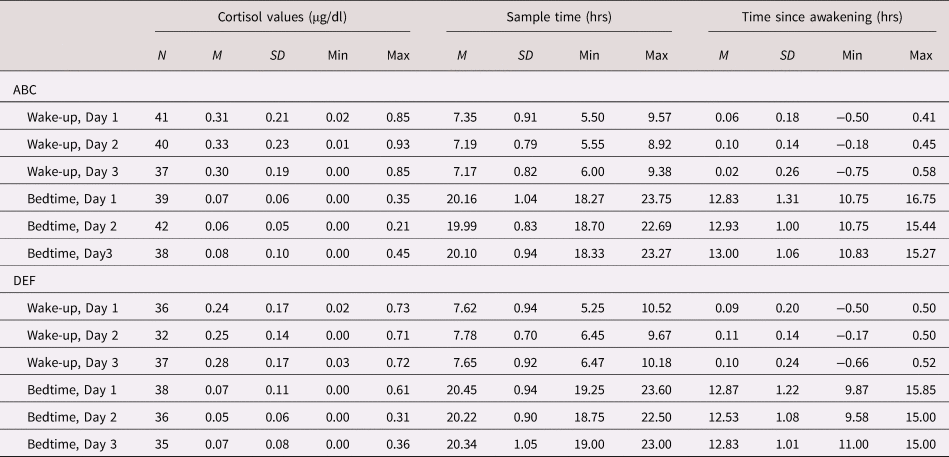
Note. ABC = Attachment and Biobehavioral Catch-up. DEF = Developmental Education for Families
Preintervention cortisol data were available for all of the children who had postintervention cortisol data except four (three children assigned to ABC and one child assigned to DEF). Thus, there were 486 possible preintervention samples (i.e., three wake-up and three bedtime samples for 81 children). Of these, 425 samples were included in analyses, with 35 missing due to an inadequate volume of saliva or because no sample was collected, 5 missing due to concerns about reliability, 13 missing because the wake-up sample was collected late, and 8 missing due to being biologically implausible or being outliers. See Table 3 for descriptive statistics regarding cortisol values, sampling times, and the amount of time between wake-up and sample collection for the preintervention cortisol data.
Descriptive statistics of cortisol samples collected prior to intervention.

Note. ABC = Attachment and Biobehavioral Catch-up. DEF = Developmental Education for Families
Data analytic strategy
Diurnal changes in cortisol levels were modeled using latent change analyses in Mplus version 8 (Muthén & Muthén, Reference Muthén and Muthén1998–2017). The observed cortisol values from the three days were included as indicators of the latent wake-up and latent bedtime cortisol variables. Each observed cortisol value was also regressed onto two time-varying covariates: sample time and time since wake-up. In addition, medication use was included as a time-invariant covariate. Granger, Hibel, Fortunato, and Kapelewski's (Reference Granger, Hibel, Fortunato and Kapelewski2009) guidelines were used to code whether the child was taking medication that may have affected cortisol levels. Diurnal changes in cortisol values were modeled as a latent change score. Factor loadings for the latent slope variable were constrained to 0 for the wake-up sample and 1 for the bedtime sample. In this way, the cortisol intercept represented the average wake-up cortisol level, and the cortisol slope (i.e., latent change score) represented the changes in cortisol levels across the day. Missing data were estimated using full information maximum likelihood estimation with robust standard error. Because this method is appropriate for nonnormal data, raw cortisol values were used in the analyses.
Results
Preliminary analyses
Children and parents assigned to the ABC intervention did not differ significantly from children and parents assigned to the DEF intervention with regard to the demographic characteristics summarized in Table 1 with the exception of parents’ race. Parents who were assigned to receive ABC were more likely to be White, non-Hispanic than parents assigned to receive the control intervention. For this reason, parental race was included as a covariate in the analyses predicting children's diurnal cortisol levels.
Cortisol values prior to the intervention were examined to ensure there were no preexisting differences between children assigned to the ABC intervention and children assigned to the control intervention. Specifically, the latent intercept and slope variables for the preintervention cortisol data were regressed onto intervention condition (ABC = 1; control intervention = 0). Results indicated that the two groups of children did not differ significantly from one another with regard to their wake-up cortisol levels (B = −.04, SE = .03, β = −.16, p = .32) or their diurnal cortisol patterns (B = .03, SE = .04, β = .12, p = .47) prior to receiving the interventions.
Intervention effects on internationally adopted children's diurnal cortisol levels
In order to test intervention effects on the diurnal pattern of cortisol production, we examined whether intervention condition predicted latent intercept and slope variables for the postintervention cortisol data (see Table 4). Effect sizes were represented by standardized regression coefficients. Children whose parents received the ABC intervention showed marginally higher wake-up levels of cortisol than children whose parents received the control intervention (β = 0.22, p = .053). There also was a significant effect of the ABC intervention on the steepness of the cortisol slope across the day. Children in the ABC group showed a steeper decline in cortisol levels from wake-up to bedtime (i.e., more negative slope) than children in the control intervention group (β = −0.30, p = .016). In other words, children whose parents received the control intervention showed a more blunted diurnal cortisol pattern than children whose parents received the ABC intervention. Intervention effects on bedtime cortisol levels were examined by rerunning the model with the bedtime sample as the intercept. Bedtime cortisol levels did not differ significantly between the intervention groups (β = −0.01, p = .962). Figure 2 presents the average postintervention wakeup and bedtime cortisol levels for children in the two intervention conditions.
Average wake-up and bedtime cortisol levels for internationally adopted children whose parents received the Attachment and Biobehavioral Catch-up (ABC) intervention and children whose parents received the control intervention. Error bars represent standard errors.

Intervention effects on diurnal cortisol production among children adopted internationally.

Note. N = 85. For intervention, 0 = control intervention and 1 = Attachment and Biobehavioral Catch-up intervention. For parent race/ethnicity, White/non-Hispanic = 1, other = 0.
Discussion
The current study examined whether the ABC intervention enhanced the diurnal functioning of the HPA axis among children who had been adopted internationally. Prior to the intervention, there were no differences between children who had been randomly assigned to the two intervention conditions with regard to their diurnal cortisol production. However, after families completed the intervention, children whose parents had received ABC exhibited steeper declines in their cortisol levels from wake-up to bedtime than children whose parents had received the control intervention. These findings indicate that the ABC intervention is effective at promoting a healthy regulation of the HPA axis among young children who have been adopted internationally.
The findings from this study have implications for our understanding of the development of the HPA axis and its capacity to recover after experiences of early adversity. Experiences of deprivation prior to adoption can result in disturbances in children's diurnal HPA axis activity that persist after children are adopted (for a review, see Gunnar & Reid, Reference Gunnar and Reid2019). In fact, studies of adults who had been adopted as children have suggested early neglect may have long-term programing effects on the HPA axis (Kumsta et al., Reference Kumsta, Schlotz, Golm, Moser, Kennedy, Knights and Sonuga-Barke2017; van der Vegt et al., Reference van der Vegt, van der Ende, Kirschbaum, Verhulst and Tiemeier2009). The results of the current study suggest that the HPA axis is also capable of adapting to new caregiving contexts after children are adopted. In other words, the HPA axis appears to be relatively plastic, at least for children who are adopted internationally during the first few years of life.
The results of the current study also contribute to the growing body of evidence regarding the effectiveness of early interventions for children who are at-risk for poor developmental outcomes. Parenting-focused interventions have been shown to enhance HPA axis regulation among young children who have been maltreated (Bernard et al., Reference Bernard, Hostinar and Dozier2015b; Hackman et al., Reference Hackman, O'Brien and Zalewski2018). To our knowledge, this is the first study demonstrating the efficacy of an early intervention for promoting healthy HPA axis regulation among children who have been adopted internationally from institutional or foster care. The effects of the ABC intervention on these children's diurnal cortisol outcomes are remarkably consistent with the results of a separate randomized controlled trial involving children whose parents were referred to CPS (Bernard et al., Reference Bernard, Dozier, Bick and Gordon2015a; Bernard et al., Reference Bernard, Hostinar and Dozier2015b). For both the internationally adopted and CPS-referred families, the children whose parents received the ABC intervention exhibited steeper declines in cortisol levels throughout the day. Thus, although CPS-referred and internationally adoptive families differ from one another in several respects, the ABC intervention appears to be effective at creating an environment that normalizes the diurnal activity of the HPA axis for both groups of children with histories of early adversity.
Randomized controlled trials are considered a gold standard for evaluating the efficacy of an intervention as well as for testing whether an environmental factor has causal effects on children's development (Rutter, Reference Rutter2012). Thus, the current study's use of a randomized controlled research design as well as the lack of baseline differences between children assigned to the two intervention conditions increases the confidence in the efficacy of the ABC intervention for altering the diurnal HPA axis activity of internationally adopted children. The current study focused on measures of diurnal HPA axis activity that were collected within a few months after families completed the intervention. An important question for future research is whether the effects of the ABC intervention on HPA axis regulation are sustained over time for internationally adopted children. ABC has been shown to have fairly long-term effects on the biological outcomes of children from CPS-referred families (Bernard et al., Reference Bernard, Hostinar and Dozier2015b; Bick, Palmwood, Zajac, Simons, & Dozier, Reference Bick, Palmwood, Zajac, Simons and Dozier2019; Tabachnick, Raby, Goldstein, Zajac, & Dozier, Reference Tabachnick, Raby, Goldstein, Zajac and Dozier2019; see also Zajac et al., Reference Zajac, Raby and Dozier2020). In addition, ABC's effects on parenting have been observed to persist for at least 2 years for parents who adopted internationally (Yarger et al., Reference Yarger, Bernard, Caron, Wallin and Dozier2019a). Therefore, a potentially fruitful future research direction is investigating whether these changes in parents’ caregiving behaviors promote long-term alterations in internationally adopted children's diurnal cortisol patterns.
Children who have been adopted internationally are at higher risk than nonadopted children for difficulties with behavioral regulation, including externalizing behavior problems and delays in executive functioning (Bos, Fox, Zeanah, & Nelson, Reference Bos, Fox, Zeanah and Nelson2009; Hostinar, Stellern, Schaefer, Carlson, & Gunnar, Reference Hostinar, Stellern, Schaefer, Carlson and Gunnar2012; Juffer & van IJzendoorn, Reference Juffer and van IJzendoorn2005). Moreover, HPA axis activity is associated with these problematic behavioral outcomes among nonadopted and adopted children (Alink et al., Reference Alink, van IJzendoorn, Bakermans-Kranenburg, Mesman, Juffer and Koot2008; Koss et al., Reference Koss, Mliner, Donzella and Gunnar2016). Therefore, another valuable direction for future research is to test whether the intervention-induced changes in the diurnal functioning of children's HPA axes lead to improvements in behavioral regulation among children whose parents received ABC.
The children included in this study had varying experiences prior to adoption, both in terms of children's ages at the time of adoption and the proportion of their preadoptive lives that were spent in institutional or foster care. The current study did not have sufficient statistical power to examine whether ABC's effects were conditional on children's preadoptive experiences. However, evidence from the Bucharest Early Intervention Project suggests that receiving an enhanced caregiving intervention may be most effective at promoting healthy developmental outcomes for children who were placed early in life (i.e., those that have a relatively short duration of institutional care; Zeanah, Humphreys, Fox, & Nelson, Reference Zeanah, Humphreys, Fox and Nelson2017). Thus, it will be important to evaluate whether the effectiveness of parenting-based interventions varies based on the children's age of placement in their adoptive families as well as the severity of their preadoptive adversity.
The rates of international adoptions have declined precipitously in recent decades (Selman, Reference Selman2012). Within the United States, the rates of international adoptions have declined from a peak of nearly 23,000 adoptions in 2003 to approximately 3,000 in 2019 (U.S. Department of State, 2020). One reason for this reduction is that many countries have invested more in their own child welfare programs than they had in the past (Neville & Rotabi, Reference Neville and Rotabi2020). This includes allocating resources to transitioning children living in institutional environments into domestic foster care or adoptive families in children's countries of origin. Although the process of deinstitutionalization and moving children into more stable and potentially permanent family situations will have beneficial effects for children's development, previously institutionalized children likely will have ongoing challenges related to biological and behavioral regulation due to their experiences of early deprivation (van IJzendoorn et al., Reference van IJzendoorn, Palacios, Sonuga-Barke, Gunnar and Vorria2011). Thus, there will be a need for evidence-based, parenting-focused programs, such as the ABC intervention, that can help support the foster parents and adoptive parents within these countries. It will be important to assess the implementation of these services to ensure fidelity and to evaluate the effectiveness of the parenting programs when they are delivered in these diverse cultural contexts.
In conclusion, the current study demonstrates that the parenting-focused ABC intervention enhances diurnal HPA axis regulation for children adopted internationally. These findings support the efficacy of ABC for promoting healthy development among this unique group of vulnerable children. In addition, this study also highlights that the HPA axis is capable of recovering from early adversity when the caregiving environments meet young children's needs for nurturing, responsive, and stable care.
Acknowledgment
The content is solely the responsibility of the authors and does not necessarily represent the official views of the National Institute of Mental Health.
Funding Statement
This work was supported by National Institutes of Mental Health grants to the fourth author (R01MH074374 and R01MH084135) and the second author (R01MH0119310).
Conflicts of Interest
None.


 Open access

