


Formal bone tools and personal ornaments are considered elements of cultural identity, as well as chronological markers of the first Upper Palaeolithic societies in Northern and Central Asia. The oldest collections of formal bone tools from these regions have been documented in the Initial and Early Upper Palaeolithic assemblages of Altai, almost exclusively from karst caves, whose microclimate contributes to the excellent preservation of organic remains (Figure 1a). Most of these objects come from Denisova Cave and have been recently subjected to direct and indirect dating (Douka et al. Reference Douka2019). Outside the cave, a much smaller number of such items has been identified. In this article, we present the results of analysis of the first antler projectile point with a direct radiocarbon date from an Early Upper Palaeolithic assemblage at the Kara-Bom open-air site.
Study area: a) location of Initial and Early Upper Palaeolithic sites with bone points in the Altai region (map produced using the National Geographic Basemap and ArcGIS Online); b) excavation at the Kara-Bom site in 1991, the red arrow indicates the location of the 2016 stratigraphic profile (photograph from the personal archive of V.T. Petrin, figure by N. Belousova).

Kara-Bom is located in an intermontane basin of the Central Altai of Russia (50°43′23″ north, 85°34′27″ east) (Figure 1b). Kara-Bom is an excellent source of information on the technological, adaptation and cultural processes that occurred in the region during the Initial Upper Palaeolithic (Derevianko et al. Reference Derevianko, Petrin, Rybin and Chevalkov1998). The Upper Palaeolithic cultural-stratigraphic sequence at the site (excavation unit 4) includes two archaeological assemblages attributed to the same Kara-Bomian tradition (~48.0–34.0 ka cal BP; all dates were modelled in OxCal v.4.3, using the IntCal13 calibration curve (Reimer et al. Reference Reimer2013)), but associated with different stages of its development.
This article concerns the analysis of a point that was identified through reanalysis of a faunal assemblage carried out in 2017. The artefact was recovered from square M–8 during the 1991 excavations (Figure 2a). It was found at a depth of 0.30m below datum in deposits associated with the upper part of section 2016 (layer 1–2) (Figure 2b), which correlates with the archaeological complex of cultural horizon Upper Palaeolithic 1 (38.5–34.0 ka cal BP) (Belousova et al. Reference Belousova, Rybin, Yu. Fedorchenko and Anoykin2018). The Upper Palaeolithic 1 stone industry is characterised by blade and bladelet production from bidirectional prismatic and narrow-faced cores. The toolkit includes retouched blades, points and end-scrapers on blades, as well as convergent scrapers.
Spatial analysis: a) bone-point location on the plan; b) stratigraphic profile produced in 2016 on the line ‘N’ (figure by N. Belousova).

We performed a use-wear analysis with an Altami CM0745-T stereomicroscope equipped with a Canon EOS 5D Mark IV digital camera and an Olympus ВНМ microscope. A 3D-Scanner RangeVision Pro 5m was used to build a 3D model of the artefact. The identification of use-wear and manufacture traces is based on published data (Bradfield & Brand Reference Bradfield and Brand2015; Pétillon et al. Reference Pétillon, Plisson, Cattelain, Iovita and Sano2016). The results of analysis indicate that evidence associated with the artefact's manufacture is disguised over much of its surface by drying, root etching and other post-depositional effects (Figure 3b–d). This observation accords with the information we have about its stratigraphic context—the enclosing sediments of layers 1–2 were subjected to gravitational drift and root impact.
Manufacture traces on the bone point from the Kara-Bom site (figure by A. Fedorchenko).

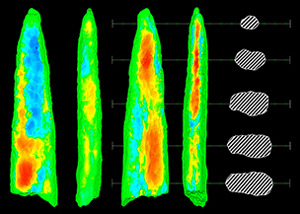
The bone tool is a distal-medial fragment (Figure 4a). It is 75.83mm long, 6.00–17.83mm wide and 3.90–8.64mm thick, the artefact volume is 6.94cm3. Zooarchaeological analysis shows that red deer antler (Cervus elaphus) was the raw material used as a blank for manufacturing this point. These data were independently verified by peptide mass fingerprinting (ZooMS) analysis, which showed that the point belongs to a non-species-specific group—Cervidae/Gazella/Saiga. The specimen has a narrow, elongated, symmetrical shape. The cross-section of the artefact varies from rounded in the proximal part to sub-rectangular in the middle, to oval in the distal portion (Figure 4b).
3D model of the bone point: a) height map; b) cross-sections (figure by M. Seletskiy).

Despite the problems with surface preservation generally, the most well-preserved manufacture traces can be observed on the lateral sides of the tool on its proximal and medial parts (Figures 4–5). Elongated irregular grooves extending parallel and diagonal to the tool axis provide evidence of a planing technique used in the manufacture of the tool (Figure 4c–e). The tool base is fragmented due to a transverse fracture that appears to have resulted from utilisation (Figure 6b). Functionally, we interpreted the artefact as an element of composite hunting weapons. No deer remains were previously identified in the Early Upper Palaeolithic faunal complex from Kara-Bom, which indicates that Palaeolithic inhabitants could have manufactured the tool away from the site. A step-terminating fracture recognised in the artefact (Figure 6a) (Bradfield & Brand Reference Bradfield and Brand2015) suggests that the artefact was brought to the site along with an animal carcass, and was then discarded after butchering. To place the point in its correct chronological context, we directly dated it using AMS. The result we obtained is 29 110±320 BP (OxA-36907) (34 000–32 450 cal BP).
3D model of the bone point: a–c) treated surfaces (figure by M. Seletskiy).

Use-wear traces on the tool: a) step-terminating fracture; b) evidence of a transverse fracture (figure by A. Fedorchenko).

The osseous technology was an essential part of the cultural assemblage of the Kara-Bomian tradition. The antler point from Kara-Bom has counterparts in other Upper Palaeolithic assemblages from the Altai region (Figure 1a). The Early Upper Palaeolithic assemblages recovered from Denisova Cave (>50.0–34.0 ka cal BP) include the most extensive set of points made from bones, antler and ivory using the planing technique (Derevianko et al. Reference Derevianko, Shunkov, Agadjanian, Baryshnikov, Malaeva, Ulianov, Kulik, Postnov and Anoikin2003). Two bone points from Denisova Cave were directly AMS dated to 48.1–42.6 ka cal BP (Douka et al. Reference Douka2019). Three fragmented points were found at Strashnaya Cave (49.1–45.6 and 23.2–22.9 ka cal BP) (Krivoshapkin et al. Reference Krivoshapkin, Bauman, Shnaider and Kolobova2018). The Early Upper Palaeolithic layer 8 at Ushlep-6 site (45.7–42.0 ka cal BP) has yielded another industry with ivory points. The much younger group of points with a pointed base and slotted tools were found at archaeological sites and among surface scatter in the northern foothills of the Altai, dated 21.7–14.5 ka cal BP (Kungurov Reference Kungurov2005). Outside the Altai region, the closest analogies with a similar age are the Malaya Syia site at Kuznetsk Alatau, southern Siberia (38.2–30.0 ka cal BP; Barkov & Lbova Reference Barkov and Lbova2017), Ma'anshan Cave in south China (35.4–33.0 ka cal BP; Zhang et al. Reference Zhang, D'Errico, Backwell, Zhang, Chen and Gao2016) and the Yana site in the Siberian Arctic (33.4–30.8 ka cal BP; Pitulko et al. Reference Pitulko, Pavlova, Nikolskiy and Ivanova2012).
The chronometric data on the Palaeolithic bone points from the Altai have rendered them the oldest formal bone tools in Eurasia discovered thus far. The formal antler tool from the Kara-Bom Early Upper Palaeolithic layer is one of the earliest directly dated Palaeolithic bone points in the Altai, and it conforms with other dates for the site. Cultural horizon Upper Palaeolithic 1, which is the direct successor of the southern Siberian and Central Asian Initial Upper Palaeolithic cultural unit, appears as the upper chronological boundary of the Kara-Bomian tradition in the Altai region.
Acknowledgements
We are grateful to the Russian Science Foundation (project 19-18-00198) for supporting our spatial analysis. Support for use-wear research was provided by IAET SB RAS project 0264-2019-0009. The radiocarbon dating and ZooMS were supported through the European Research Council-funded ‘PalaeoChron’ project (ERC: grant 324139).



