Introduction
Dow AgroSciences commercially launched Enlist™ cotton (Gossypium hirsutum L.) in 2018, which allowed 2,4-D, glufosinate, and glyphosate to be used as postemergence options for control of troublesome weeds. Current label regulations allow for 2,4-D choline to be added in mixture or sequence with glufosinate over the top of Enlist™ crops, providing two effective sites of action (SOAs) for control of herbicide-resistant Amaranthus spp. (Anonymous 2019a; Merchant et al. Reference Merchant, Culpepper, Eure, Richburg and Braxton2014). Adding two effective SOAs in mixture reduces selection for target-site herbicide resistance in weeds; however, this practice is not always utilized (Norsworthy et al. Reference Norsworthy, Ward, Shaw, Llewellyn, Nichols, Webster, Bradley, Frisvold, Powles, Burgos, Witt and Barrett2012). Enlist One® (2,4-D choline) and Enlist Duo® (2,4-D choline plus glyphosate) labels also allow for application of both products with spray nozzles that provide better coverage than the Turbo TeeJet® nozzles (Ultra Coarse spray classification) that are required by the Xtend® system (Anonymous 2018a, 2018b, 2019a, 2019b; Meyer et al. Reference Meyer, Norsworthy, Kruger and Barber2016; Ramsdale and Messersmith Reference Ramsdale and Messersmith2001).
XtendFlex™ cotton was commercially launched by Monsanto, which allowed postemergence applications of dicamba, glufosinate, and glyphosate. XtendiMax® plus VaporGrip® (Monsanto, St. Louis, MO 63167) and Engenia® (BASF, Research Triangle Park, NC 27709) labels currently do not allow for mixture with glufosinate (Anonymous 2018a, 2018b). These label restrictions force producers to apply dicamba and glufosinate sequentially. However, limited work has been conducted to optimize sequential applications of dicamba and glufosinate. Understanding what sequence and duration between sequential applications of the two herbicides best optimizes efficacy on troublesome weeds will likely mitigate the perpetuating evolution of herbicide resistance (Norsworthy et al. Reference Norsworthy, Ward, Shaw, Llewellyn, Nichols, Webster, Bradley, Frisvold, Powles, Burgos, Witt and Barrett2012).
From past literature, applying a contact herbicide like glufosinate will decrease absorption and translocation of sequential systemic herbicide applications (Burke et al. Reference Burke, Askew, Corbett and Wilcut2005). Reductions in herbicide absorption and translocation were attributed to the rapid necrosis caused by the prior glufosinate application. Furthermore, Meyer et al. (Reference Meyer, Peter, Norsworthy and Beffa2020) observed a 46% reduction in dicamba translocation in Palmer amaranth when dicamba plus glufosinate was applied in mixture compared with dicamba alone. Following a glufosinate application, the reduction of absorption and translocation of the sequentially applied herbicide may suggest that applying glufosinate before dicamba will not optimize the postemergence options in the XtendFlex® system.
In contrast, little work has evaluated the effects of applying auxin herbicides before contact herbicides. Dicamba and 2,4-D are synthetic auxin herbicides that cause leaf and stem epinasty in sensitive vegetation shortly after application (Al-Khatib and Peterson Reference Al-Khatib and Peterson1999; Andersen et al. Reference Andersen, Clay, Wrage and Matthees2004; Auch and Arnold Reference Auch and Arnold1978; Kelley et al. Reference Kelley, Wax, Hager and Riechers2005; Wax et al. Reference Wax, Knuth and Slife1969). The resulting symptomology from an auxin herbicide application may be a concern if weeds are not effectively controlled and a sequential application of a contact herbicide is needed.
Synthetic auxins affect dicot weeds in three phases: the stimulation phase, the inhibition phase, and the decay phase (Cobb Reference Cobb1992; Fedtke and Duke Reference Fedtke, Duke, Hock and Elster2005; Grossman Reference Grossman2007; Sterling and Hall Reference Sterling, Hall, Roe, Burton and Kuhr1997). The stimulation phase is associated with the activation of ethylene biosynthesis through the induction of 1-amioncyclopropane-1-carboxylic acid in shoot tissues (1 to 2 h after application), resulting in subsequent leaf epinasty, tissue swelling, and stem curling that occurs 3 to 4 h after an application. The resulting epinasty, tissue swelling, and stem curling likely affects the spray retention of sequential herbicide applications (Butler Ellis et al. Reference Butler Ellis, Webb and Western2004; Knoche Reference Knoche1994). Spray droplet adhesion decreases with an increase in leaf angle, droplet impact velocity, diameter, and leaf roughness factor (Forster et al. Reference Forster, Kimberley and Zabkiewicz2005; Nairn et al. Reference Nairn, Forster and van Leeuwen2013). The resulting symptomology that follows an auxin herbicide application changes the leaf/stem angles and exposes shoot tissue of sensitive species that would not typically be contacted by a pesticide application.
When using the XtendFlex® technology, glufosinate can only be applied in sequence with dicamba. In terms of glufosinate, several factors play contributing roles in optimizing efficacy. These include but are not limited to light intensity (Ahrens Reference Ahrens1994), growing vigor of targeted species (Anderson et al. Reference Anderson, Roeth and Martin1996), humidity (Coetzer et al. Reference Coetzer, Al-Khatib and Loughin2000), and coverage of spray solution (Etheridge et al. Reference Etheridge, Hart, Hayes and Mueller2001; Meyer et al. Reference Meyer, Norsworthy, Kruger and Barber2015). The coverage of spray solution of glufosinate and other contact herbicides will likely be impacted by a prior auxin herbicide application due to the subsequent auxin herbicide symptomology observed. The adoption of Enlist™ and XtendFlex® crops increases the likelihood of sequential applications that include auxin and contact herbicides, that is, glufosinate. Currently, the effects of auxin symptomology on subsequent coverage of contact herbicides is unknown. Therefore, quantification of groundcover of weed species following an auxin herbicide application is needed to understand whether reduced-rate selection of subsequently applied herbicides is occurring in the XtendFlex® and Enlist™ technologies. The objective of this research was to quantify the extent of changes in groundcover of Palmer amaranth following dicamba and 2,4-D applications in several environments across an assortment of nozzle types.
Materials and Methods
Greenhouse Experiment
A greenhouse experiment was conducted in April of 2020 and repeated in May of 2020 at the University of Arkansas Milo J. Shult Agricultural Research and Extension Center in Fayetteville, AR. Each experimental run was conducted as a two-treatment, completely randomized design with six replications. Fifteen 50-cell trays (25 cm by 50 cm) (Greenhouse Megastore, Danville, IL 61834) were planted with Palmer amaranth seed collected from a population collected from a production field in Crittenden County, AR, with confirmed resistance to acetolactate synthase inhibitors, 4-hydroxyphenylpyruvate dioxygenase inhibitors, an 5-enolpyruvyl shikimate-3-phosphate synthase inhibitor, microtubule assembly inhibitors (dinitroanilines), protoporphyrinogen oxidase inhibitors, and very-long-chain fatty-acid elongase–inhibiting herbicides (data not shown) at a population of 50 plants per tray. The Palmer amaranth accession chosen for the experiment was not screened for dicamba or 2,4-D resistance. Each tray represented an experimental unit.
Palmer amaranth plants were grown in mediated potting soil (Sun Gro® Horticulture, Agawam, MA, USA 01001) until the 1-leaf stage and then were transplanted into mediated potting soil at 1 plant cell−1 in 50 cell trays. Moist potting mix was maintained throughout the experiment through daily irrigation. Greenhouse conditions throughout the experiment are displayed in Table 1. When Palmer amaranth reached heights of 7.6 and 10.6 cm in experimental runs 1 and 2, respectively, dicamba (XtendiMax® plus VaporGrip®, Monsanto) and 2,4-D (Enlist One®, Dow AgroSciences, Indianapolis, IN 46268) were applied at 560 and 1,065 g ae ha−1, respectively. Applications were made using a two-nozzle track sprayer equipped with TeeJet® 1100067 nozzles (TeeJet® Technologies, Spraying Systems, Glendale Heights, IL, USA 60139). The stationary spray chamber equipped with a track sprayer was calibrated to deliver 190 L ha−1 at 1.61 km h−1. Environmental conditions during application and after application are displayed in Table 1. Photos of each flat were taken 64 cm above the center of the flat using a Canon PowerShot SX10IS (1 Canon Park, Melville, NY 11747) mounted to a stationary tripod. The camera was positioned horizontally directly above the flat to avoid angled photos. Black felt was placed under the flats to avoid background interference in the picture analysis. Images of each flat were repeatedly taken at time intervals of 0, 30, 60, 90, 120, 180, 210, 240, 270, 300, 360, 420, 480, 540, 600, 660, 720, 1,440, 2,880, 4,320, 5,760, 7,200, 8,640, 10,080, 14,400, 20,160 (14 d), and 30,240 (21 d) min after application to assess reductions in Palmer amaranth groundcover.
Environmental condition at the time of application and averages calculated for the 21 d following application by experiment and site-year.

Images were analyzed using the Turf Analyzer 1.0.4 (TurfAnalyzer, Fayetteville, AR 72704) software to determine the proportion of green pixels in each photograph, which represents the groundcover achieved by Palmer amaranth. The proportion of green pixels in each image was considered the groundcover of Palmer amaranth and was reported relative to the tray/plot image taken immediately before application (t = 0 min). Butts et al. (Reference Butts, Norsworthy, Kruger, Sandell, Young, Steckel, Loux, Bradley, Conley, Stoltenberg, Arriaga and Davis2016), Purcell (Reference Purcell2000), and Priess et al. (Reference Priess, Norsworthy, Roberts and Spurlock2020a, Reference Priess, Norsworthy, Roberts, Spurlock and Gbur2020b) have used similar image analysis techniques to estimate the groundcover of crop canopies. These image analysis techniques have proven more accurate than visual estimates or manual height and width measurements (i.e., soybean [Glycine max (L.) Merr.] volume calculations). Therefore, visual estimates were not taken to verify the image analysis.
Field Experiment
Field experiments were initiated at the Arkansas Agricultural Research and Extension Center (AAREC; 36.09917°N, 94.17859°W) in Fayetteville, AR, on May 18, 2020, and the experiment was repeated on August 21, 2020. The experimental design was a randomized complete block with a two-factor factorial treatment structure. The two factors were herbicide: dicamba (XtendiMax® plus VaporGrip®) and 2,4-D (Enlist One®) at 560 and 1065 g ae ha−1, respectively, and nozzle selection: Extended Range (XR) 110015, Air Induction Extended Range (AIXR) 110015, and Turbo TeeJet Induction (TTI) 110015 (TeeJet Technologies, Spraying Systems, Glendale Heights, IL, USA).
The soil in Fayetteville was composed of a Leaf silt loam (fine, mixed, active, thermic Typic, Albaquults) with 34% sand, 53% silt, 13% clay, 1.5% organic matter, and a pH of 6.8. The field where the experiment was conducted was over-seeded with the same Palmer amaranth biotype that was used in the greenhouse experiment. The plot size was 1 m2, with a distance of 2.1 m between plots. The area outside of each 1-m2 plot was rototilled to remove any green vegetation. The entire experiment was over-sprayed after rototilling with S-metolachlor at 1,605 g ai ha−1. Herbicide treatments were applied to Palmer amaranth with a CO2-pressurized backpack sprayer calibrated to deliver 140 L ha−1 at 4.8 km h−1.
In sites 1 and 2, Palmer amaranth at application was an average of 12.7 cm (0.5- to 14.5-cm range) and 7.6 cm (0.5- to 10-cm range) tall and had an average density of 420,000 and 482,000 plants ha−1, respectively (Table 1). The variability in size was likely influenced by rainfall events that promoted differing germination. Photos were taken at 0, 30, 60, 90, 120, 180, 210, 240, 270, 300, 420, 480, 540, 600, 660, 720, 1,440, 2,880, 4,320, 5,760, 7,200, 8,640, 10,080, 14,400, 20,160 (14 d), and 30,240 (21 d) min after application to assess changes in groundcover. Image analyses were performed similarly to the previous greenhouse experiment.
Droplet Size and Velocity Experiment
An experiment was conducted at the Lonoke Extension Center in Lonoke, AR, on October 14, 2020. Droplet size and velocity for each treatment were measured using the VisiSize Portable P15 Oxford image particle analyzer (Oxford Lasers, Imaging Division, Oxford, UK). Images were analyzed in real time with the VisiSize Particle Sizing Software that linked to the VisiSize Portable P15 Oxford image particle analyzer. The system analyzed the droplet spectrum by utilizing a technique called particle/droplet image analysis (Carvalho et al. Reference Carvalho, Antuniassi, Chechetto, Mota, Jesus and Carvalho2017). The system measures droplets with a diameter greater than 5 µm. In addition to the droplet diameter measurement, the system calculates velocity of droplets in real time through sequential images taken at a set time interval, similar to other particle/droplet image analysis equipment and research (Butts et al. Reference Butts, Hoffmann, Luck and Kruger2018a). The system was programmed to measure diameter and velocity of 2,500 droplets per repetition. Treatments were repeated three times to allow diameter and velocity measurement of a total of 7,500 droplets per treatment.
Treatments included applications of 2,4-D and dicamba with XR (1100067, 110015, 11004), AIXR (110015, 11004), and TTI (110015, 11004) nozzles. A Generation 4 Research Track Sprayer (Devries Manufacturing, Hollandale, MN) was calibrated to deliver 147 L ha−1 of spray solution at 1.46 m s−1 and 276 kPa. Applications were made with the spray pattern oriented perpendicular in between the two image housings of the VisiSize Portable P15 Oxford image particle analyzer to allow for droplet measurements to be taken from the entire spray plume. The distance from nozzle to image frame was 50 cm to allow droplet measurements to be taken as the droplet would be contacting the target. The treatments in this study were compared using the Dv0.1, Dv0.5, and Dv0.9 size measurements and velocity. Droplet diameters of Dv0.1, Dv0.5, and Dv0.9 represent 10%, 50%, and 90% of the spray volume being composed of droplets of a smaller diameter, respectively.
Spray Coverage
A spray coverage experiment was conducted at the AAREC in Fayetteville, AR, on November 6, 2020. The spray coverage experiment conducted utilized water-sensitive spray cards to assess the coverage of the aforementioned treatments in the droplet size and velocity experiment. Three different application methods were utilized due to the change in nozzle orifice size and a desired constant 147 L ha−1 spray volume. XR 1100067 nozzles were applied in a two-nozzle track sprayer at 1.61 km h−1. Nozzles with orifice sizes of 110015 were applied with CO2-pressurized backpack sprayers at 4.8 km h−1. Nozzles with orifice sizes of 11004 were applied with a Bowman Mudmaster Multi-Purpose Sprayer (Bowman Manufacturing, Newport, AR) at 11.2 km h−1. All application methods were calibrated to deliver 147 L ha−1 at 276 kPa.
Before application, SpotOn water-sensitive spray cards (51 by 76 mm) (Innoquest, Woodstock, IL) were placed horizontal to the spray pattern, 50 cm below the nozzle orifice. This process was repeated for four applications per nozzle and size, providing four replications per treatment. The yellow water-sensitive spray cards turned blue where spray solution contacted the card. After application, the sprayed water-sensitive cards were allowed to dry before handling. Spray cards were scanned and imported into DepositScan software (USDA-ARS; https://www.ars.usda.gov/midwest-area/wooster-oh/application-technology-research/docs/depositscan/). A coverage analysis was conducted in the Deposit Scan Software to provide a percentage of card that was covered by the spray solution. This methodology and software has been proven useful for calculating percentage spray coverage by Hoffmann and Hewitt (Reference Hoffmann and Hewitt2005).
Data Analysis
Percent groundcover of Palmer amaranth after application is reported relative to initial percent groundcover before application in the greenhouse and field experiments. Relative groundcover estimates were analyzed in the Fit Curve Platform of JMP Pro 15.2 (SAS Institute, Cary, NC). A biexponential 4P curve $y = a * {\rm exp}(-b \ast {\rm minutes \;after \;application})$ $\hskip 20pt+\, c \ast {\rm exp(-d \ast minutes \;after \;application}) $
where a = scale 1, b = decay rate 1, c = scale 2, and d = decay rate 2, was found to be the best fit when Akaike’s Information Criteria (AICc), Bayesian Information Criterion (BIC), error sum of squares (SSE), mean square error (MSE), and R2 values were used to model the percent groundcover of Palmer amaranth. Similarly, Dornai et al. (Reference Dornai, Gerstl, Chen and Mingelgrin1991) used biexponential models to assess changes in cotton growth following trifluralin applications. Individual nonlinear biexponential 4P curves were fit by site-year (due to differences in weed size), herbicide, and nozzle in the greenhouse and field experiments, respectively. Parameter estimates and R2 values for the nonlinear lines fit are displayed in Table 2. Predictions of Palmer amaranth groundcover and associated standard errors (α = 0.05) were made at 0, 180, 360, 4,320, 10,080, 20,160, and 30,240 min after an auxin herbicide application. Differences between the predicted Palmer amaranth groundcover between herbicide or among nozzles within site-year were determined by comparison of the predicted values + or − the associated standard error. If the predicted values + or − the associated standard error did not overlap with the compared predicted value + or − the associated standard error, the two predictions were considered different.
Biexponential 4P curve (y = a * exp(−b * minutes after application) + c * exp(−d * minutes after application), where a = scale 1, b = decay rate 1, c = scale 2, d = decay rate 2), fit to site-year, herbicide in the greenhouse experiment by site-year, herbicide, and nozzle in the field experiment.

a XR, Extended Range nozzle; AIXR, Air Induction Extended Range nozzle; TTI, Turbo TeeJet® Induction nozzle.
b R2 values represent the amount of variability explained by the fit of the line.
The droplet size distribution and coverage experiments were designed as a completely randomized experiment with a 2 by 3 by 2 three-factor factorial treatment structure, with the three factors being herbicide (dicamba and 2,4-D), nozzle (XR, AIXR, and TTI), and nozzle size (110015 and 11004). The XR 1100067 treatments were not included in the analysis, and means of the treatments will be presented. Droplet size, velocity, and percent coverage data were subjected to an ANOVA in the Generalized Linear Mixed Model Platform of JMP 15.2 (SAS Institute, Cary, NC). Droplet size and velocity data were assumed to have a gamma distribution, while coverage data were assumed to have a normal distribution. Means were separated using Fisher’s LSD at an alpha value of 0.05.
Results and Discussion
Greenhouse Experiment
From the data collected, the effect of site-year was evident through comparison of trend lines. Therefore, biexponential 4P lines were fit by experimental run and herbicide. Several factors can influence the efficacy of a herbicide, including weed size and environmental conditions (Ehleringer Reference Ehleringer1981; Wright et al. Reference Wright, Coble, Raper and Rufty1999). The method of transplanting Palmer amaranth at the 1-leaf stage increased the variability of plant size in each tray. Flats were treated when 50% of the plants in the tray were 7.6 to 10.1 cm in height or at the 5-leaf stage (Table 1). In experimental run 2, a delay in treatments occurred, allowing for the range in plant height to increase. The authors suggest the difference in experimental runs was caused by plants that exceeded 15 cm at the time of application in site-year 2. A higher survival rate of the Palmer amaranth plants that exceeded 15 cm at the time of application in site-year 2 likely contributed to differences in groundcover between the 2 site-years.
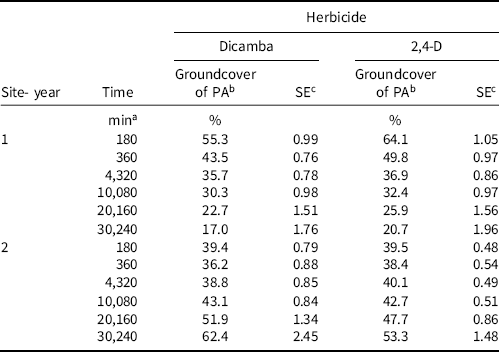
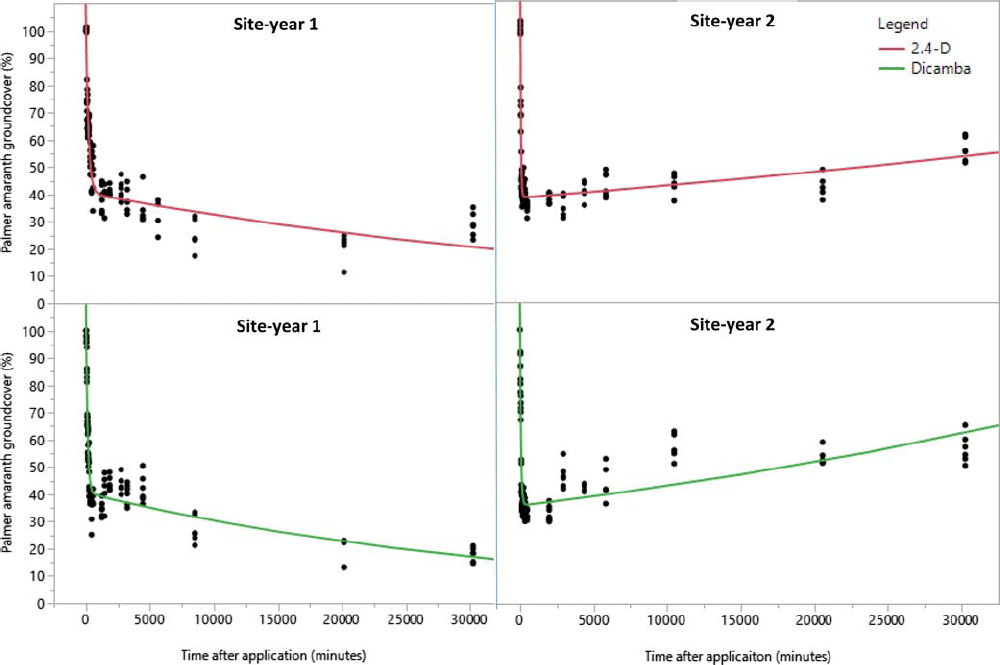
Generally, across experimental runs, rapid reductions in groundcover were observed in the first 180 min (Table 3). Dicamba and 2,4-D reduced groundcover of Palmer amaranth in the first 180 min from 100% at time zero to 69.8% to 84.6% and 60.0% to 85.8%, regardless of experimental run, respectively. From 180 to 360 min after application, reductions in groundcover were 11.8 to 14.3 percentage points in site-year 1 and only 1.1 to 3.2 percentage points in site-year 2. General differences in trends in groundcover response between experimental runs 1 and 2 were observed at 360 min after application. In experimental run 1, where Palmer amaranth weed size was shorter at the time of application, a general decrease in Palmer amaranth groundcover from 180 to 30,240 min after application, regardless of herbicide, was observed. In experimental run 2, reductions in Palmer amaranth groundcover ceased after 4,320 min regardless of herbicides. From 10,080 to 30,240 min after an application of 2,4-D or dicamba, an increase of 10.6 and 19.3 percentage points in Palmer amaranth groundcover was observed, respectively (Table 3; Figure 1).
Predicted groundcover of Palmer amaranth (PA) and the associated standard error for the biexponential (y = a * exp(−b * minutes after application) + c * exp(−d * minutes after application), where a = scale 1, b = decay rate 1, c = scale 2, d = decay rate 2) nonlinear curves that were fit to data in site-years 1 and 2 of the greenhouse experiment following an application of dicamba and 2,4-D.

a min represents minutes after application of the auxin herbicide.
b The predicated values of PA groundcover relative to time before application.
c Associated standard error of the predicted value of PA groundcover.
Biexponential 4P curves fit the greenhouse data by site-year and herbicide. Palmer amaranth groundcover was made relative to groundcover before the application.

Based on the images captured and data collected, it was observed that neither treatment provided 100% control of Palmer amaranth, meaning that there were escapes for both treatments. For both herbicides, the most rapid reduction occurred within the first 180 min following application while also reaching a maximum or near-maximum reduction of groundcover 1 wk following application. Coupled with the lack of complete control of Palmer amaranth by either herbicide, the reduction of groundcover may be detrimental to future efforts to control the weed within fields. At 20,160 min (14 d) after application, the amount of plant material for sequential herbicide applications to contact on Palmer amaranth increased in one of the two experimental runs, regardless of herbicide. This increase in plant material would likewise increase the amount of herbicide intercepted by actively growing plant tissue. Further research should be conducted to investigate the efficacy of applications at different time intervals following 2,4-D and dicamba applications to determine the optimum timing between sequential herbicide applications for Palmer amaranth control.
Field Experiment
In general, rapid reductions in groundcover of Palmer amaranth were observed after application regardless of nozzle selection or herbicide (Figures 2 and 3). In site 1, where larger plants were treated, changes in Palmer amaranth groundcover were significantly less than changes observed in site 2 (Tables 4 and 5; Figures 2 and 3). The variability in Palmer amaranth groundcover changes between sites 1 and 2 is likely attributable to the differences in Palmer amaranth size and density and, to a lesser extent, environmental factors at the initial application (Table 1). Observations from previous research concluded that weed size, weed density, and environmental factors can influence the rate of growth and ability of Palmer amaranth to survive a herbicide application (Ehleringer Reference Ehleringer1981; Forseth et al. Reference Forseth, Ehleringer, Werk and Cook1984; Guo and Al-Khatib Reference Guo and Al-Khatib2003; Meyer and Norsworthy Reference Meyer and Norsworthy2019; Shell and Lang Reference Shell and Lang1976; Stewart et al. Reference Stewart, Nurse, Hamill and Sikkema2010; Wright et al. Reference Wright, Coble, Raper and Rufty1999). While differences in the factors mentioned above contributed to variability between sites, the primary focus of the experiment was to quantify the extent to which an auxin herbicide application influences Palmer amaranth groundcover.
Biexponential 4P (y = a * exp(−b * minutes after application) + c * exp(−d * minutes after application), where a = scale 1, b = decay rate 1, c = scale 2, d = decay rate 2) curve to estimate percent reduction in Palmer amaranth groundcover by nozzle following a dicamba application relative to Palmer amaranth groundcover before the application.

Biexponential 4P (y = a * exp(−b * minutes after application) + c * exp(−d * minutes after application), where a = scale 1, b = decay rate 1, c = scale 2, d = decay rate 2) curve to estimate percent reduction in Palmer amaranth groundcover by nozzle following a 2,4-D application relative to Palmer amaranth groundcover before the application.

Predicted groundcover of Palmer amaranth and the associated standard error for the biexponential 4P (y = a * exp(−b * minutes after application) + c * exp(−d * minutes after application), where a = scale 1, b = decay rate 1, c = scale 2, d = decay rate 2) nonlinear curves that were fit to the data in site-year 1 of the field experiment following an application of dicamba and 2,4-D.

a min represents minutes after application of the auxin herbicide.
b XR, Extended Range nozzle; AIXR, Air Induction Extended Range nozzle; TTI, Turbo TeeJet® Induction nozzle.
c The predicated values of Palmer amaranth groundcover relative to time before application.
d Associated standard error of the predicted value of Palmer amaranth groundcover.
Predicted groundcover of Palmer amaranth and the associated standard error for the biexponential 4P (y = a * exp(−b * minutes after application) + c * exp(−d * minutes after application), a = scale 1, b = decay rate 1, c = scale 2, d = decay rate 2) nonlinear curves that were fit to the data in site-year 2 of the field experiment following an application of dicamba and 2,4-D.

a min represents minutes after application of the auxin herbicide.
b XR, Extended Range nozzle; AIXR, Air Induction Extended Range nozzle; TTI, Turbo TeeJet® Induction nozzle.
c The predicated values of Palmer amaranth groundcover relative to time 0 before application.
d Associated standard error of the predicted value of Palmer amaranth groundcover.
In general, reductions in groundcover of Palmer amaranth were observed up to 4,320 min after application in site-year 1, regardless of herbicide or nozzle. A 3.2- to 28.2-percentage point increase in Palmer amaranth groundcover was observed from 4,320 min (3 d)to 30,240 min (21 d) regardless of herbicide or nozzle (Table 4). While an increase in groundcover of Palmer amaranth represents regrowth at 30,240 min, the extent of regrowth did not achieve groundcover equivalent to or exceeding what was observed before herbicide application (Table 4). Additionally, Palmer amaranth in site 2 was at a labeled size at application for both herbicides (Anonymous 2018a, 2018b, 2019b); however, complete control in both sites was not achieved with a single application of either herbicide based on observed regrowth at 14 d after application or failure to remove all living (green) biomass. Thus, surviving plants with reduced groundcover will need to be controlled with a sequential herbicide application.
When treating labeled-size plants (<10.2-cm height), a general decline in Palmer amaranth groundcover following application occurred through the final assessment at 30,240 min, regardless of nozzle and herbicide. The continued decline in groundcover through all time intervals indicates the performance of the herbicides regardless of nozzle selection. However, at 30,240 min, Palmer amaranth still maintained between 8.6% and 24.2% groundcover. Even though applications were made to Palmer amaranth that was 7.6-cm tall, Palmer amaranth with green tissue was still present at 30,240 min. Unlike at site 1, regrowth of Palmer amaranth after 4,320 min was not observed, therefore determining an optimal timing recommendation for sequential applications of a contact herbicide is unlikely from the data collected on auxin herbicide applications made to 7.6-cm Palmer amaranth.
Droplet Size and Velocity Experiment
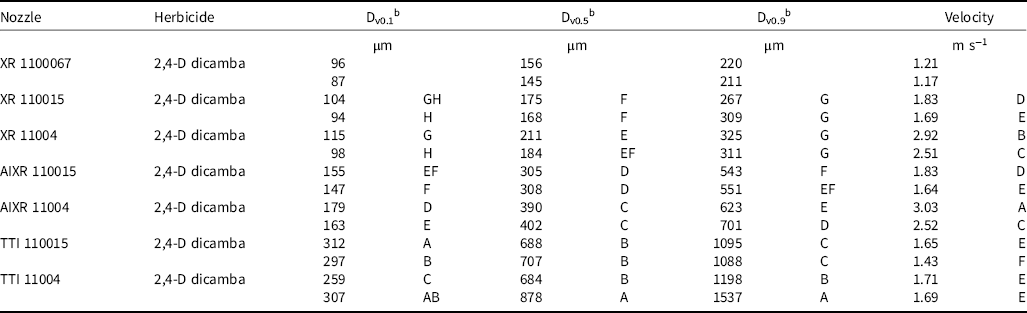
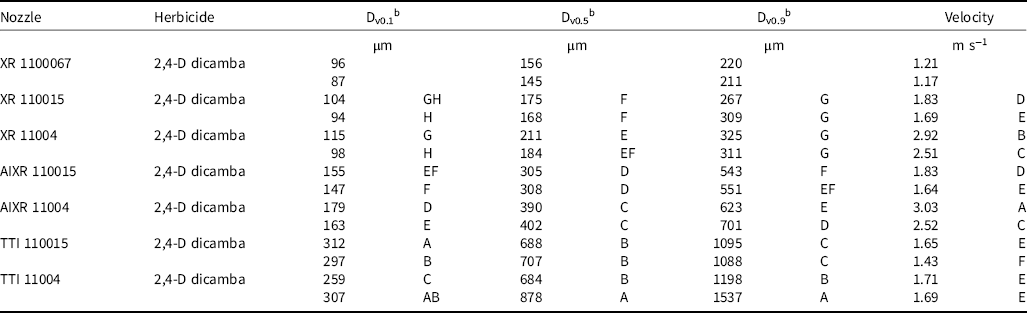
The three-factor interaction of herbicide by nozzle by nozzle size was significant when droplet diameters Dv0.1, Dv0.5, and Dv0.9 and velocity were analyzed (P-values = <0.0001). Overall trends showed that as the velocity of spray droplets increased increased as orifice size increased, nozzle selection changed in order of XR > AIXR > TTI, and when 2,4-D was used, an increase in droplet diameter was observed when compared with dicamba (Table 6). For spray droplet velocity, the general trend was that nozzle selection changed in order of TTI > XR = AIXR, and the velocity of spray droplets increased increased as orifice size increased from the 110015 to 11004 for 2,4-D compared with dicamba (Table 6).
Droplet diameter and velocity of dicamba and 2,4-D when applied through XR, AIXR, and TTI nozzles at orifices sizes of 1100067, 110015, and 11004.a
a XR, Extended Range nozzle; AIXR, Air Induction Extended Range nozzle; TTI, Turbo TeeJet® Induction nozzle.
b Dv0.1, Dv0.5, and Dv0.9 represent the diameter at which 10%, 50%, and 90% of spray solution is atomized into smaller droplets, respectively. Means not represented with the same letters are statistically different within columns based on Fisher’s protected LSD (α = 0.05).
In the analysis of the spray solution coverage data, a significant interaction of herbicide by nozzle (P-value = 0.0173) and a main effect of nozzle size (P-value = <0.0001) was observed. In general, the percent coverage of 2,4-D treatments was reduced, when averaged over nozzle size, by 8.8 and 14.3 percentage points when the XR nozzle was compared with the AIXR nozzle and the AIXR nozzle was compared with the TTI nozzle, respectively (Table 7). Spray coverage (%) of dicamba was reduced, when averaged over nozzle size, by 14.8 percentage points when the XR nozzle was compared with the AIXR nozzle. No change in spray coverage was observed between AIXR and TTI nozzles when dicamba was applied (Table 7). This observation may be confusing, as Dv0.5 nearly doubled from the AIXR to the TTI nozzle; however, the number of spray depositions are likely a contributing factor. The number of spray depositions on the water-sensitive cards calculated by the DepositScan software did not accurately represent the true number of depositions due to the spray solution volume used and the overlapping of spray depositions (Salyani et al. Reference Salyani, Zhu, Sweeb and Pai2013). In Figure 4, a number of spray deposits can be observed to increase from XR to AIXR to TTI nozzles. However, spreading of large droplets on the water-sensitive spray cards likely compensated for the reduction in spray deposits (Figure 4). Further spray coverage averaged over herbicide and nozzle was 44.7% for the 110015 orifice size and 34.7% for the 11004 orifice size. In the field experiment conducted in this study, applications were applied through nozzles with 110015 orifice sizes. Commercial application equipment is often equipped with orifice sizes larger than 11004; therefore, the effect of nozzle selection may be more apparent because as orifice size increases, a likewise decrease in spray solution coverage occurs.
Spray solution coverage of dicamba and 2,4-D when applied through XR, AIXR, and TTI nozzles on water-sensitive spray cards, averaged over orifice size.a

a XR, Extended Range nozzle; AIXR, Air Induction Extended Range nozzle; TTI, Turbo TeeJet® Induction nozzle.
b Means not represented with the same letters are statistically different within columns based on Fisher’s protected LSD (α = 0.05).
Water-sensitive spray cards that received dicamba at 560 g ae ha−1 at 147 L.

Dicamba Nozzle Selection
Different nozzle types impact droplet size and efficacy of herbicide applications (Butts et al. Reference Butts, Hoffmann, Luck and Kruger2018a, Reference Butts, Samples, Franca, Dodds, Reynolds, Adams, Zollinger, Howatt, Fritz, Hoffmann and Kruger2018b; Meyer et al. Reference Meyer, Norsworthy, Kruger and Barber2015, Reference Meyer, Norsworthy, Kruger and Barber2016). Palmer amaranth control was indirectly captured through the quantitative assessment of the amount of green plant tissue at the time of the photographs. In sites 1 and 2, nozzle selection did not affect the groundcover of Palmer amaranth differently in the first 360 min. Less than a 10-percentage point difference in Palmer amaranth groundcover was observed following dicamba applications with regard to nozzle selection from 4,320 to 10,080 min after application; however, these differences were not believed to be impactful to real-world scenarios. No relationship between nozzle selection and Palmer amaranth groundcover at 30,240 min was observed when dicamba was applied. Nozzle selection for dicamba applications did not impact the groundcover of Palmer amaranth sufficiently to form different sequential herbicide application recommendations. As mentioned previously, no change in dicamba spray coverage was observed between the AIXR and TTI nozzles (Table 7); therefore, changes in Palmer amaranth groundcover with regard to nozzle selection would not be expected to be apparent. Additionally, only the TTI nozzle is labeled for postemergence applications of XtendiMax® plus VaporGrip® and Engenia® (Anonymous 2018a, 2018b); therefore, it is unlikely that postemergence applications of dicamba would be made with AIXR or XR nozzles.
This observation coincides with previous literature reporting that nozzle selection did not impact the efficacy of dicamba at 140 to 187 L ha−1 spray solution (Legleiter et al. Reference Legleiter, Young and Johnson2018; Meyer et al. Reference Meyer, Norsworthy, Kruger and Barber2016; Nuyttens et al. Reference Nuyttens, Dhoop, Blauwer and Hermann2009). If lower volumes of spray solutions are used, a nozzle effect should be anticipated (Meyer et al. Reference Meyer, Norsworthy, Kruger and Barber2016; Nuyttens et al. Reference Nuyttens, Dhoop, Blauwer and Hermann2009). While the research in the present study did not evaluate the effect of spray solution volume on changes in Palmer amaranth groundcover, previous research observed a reduction in dicamba efficacy when a Coarse through Ultra Coarse spray is used in combination with low spray volumes (94 L ha−1) (Butts et al. Reference Butts, Samples, Franca, Dodds, Reynolds, Adams, Zollinger, Howatt, Fritz, Hoffmann and Kruger2018b; Meyer et al. Reference Meyer, Norsworthy, Kruger and Barber2016). The reduction in dicamba efficacy with Coarse through Ultra Coarse spray–producing nozzles at lower spray volumes would likely lead to a decrease in the reduction of Palmer amaranth groundcover and hasten regrowth of escapes.
2,4-D Nozzle Selection
In general, decreases in Palmer amaranth groundcover were similar across nozzle type up to 4,320 min after application when 2,4-D was applied in both site-years (Figures 2 and 3). After 4,320 min, the effect of the nozzle used during application became apparent. At 10,080, 20,160, and 30,240 min after a 2,4-D application, the greatest reduction of Palmer amaranth groundcover in both site-years occurred in this order: XR > AIXR > TTI. These data coincide with the spray coverage and droplet diameter data collected as spray coverage increases and droplet size decreases in the following order: XR > AIXR > TTI. The XR (Fine spray classification) nozzle reduced Palmer amaranth groundcover at 30,240 min after application 10.9 and 19.2 percentage points more than the TTI (Ultra Coarse spray classification) nozzle, in sites 1 and 2, respectively. Previous research has observed that as droplet size decreased, weed control of multiple species increased (Ennis and Williamson Reference Ennis and Williamson1963; Lake Reference Lake1977; Knoche Reference Knoche1994; McKinlay et al. Reference McKinlay, Brandt, Morse and Ashford1972, Reference McKinlay, Ashford and Ford1974). These data contradict the general observations made by Butts et al. (Reference Butts, Samples, Franca, Dodds, Reynolds, Adams, Zollinger, Howatt, Fritz, Hoffmann, Luck and Kruger2019), who observed that a Very Coarse to an Ultra Coarse spray optimized the efficacy of 2,4-D plus glyphosate on several weed species. However, in some site-years where high humidity and low wind speeds were present, a Fine to Coarse spray optimized the efficacy of the 2,4-D plus glyphosate mixture (Butts et al. Reference Butts, Samples, Franca, Dodds, Reynolds, Adams, Zollinger, Howatt, Fritz, Hoffmann, Luck and Kruger2019). In the present study, humidity levels were between 67% to 84% and wind speeds were negligible, below 0.89 m s−1, thus allowing for smaller spray droplets produced by the XR and AIXR nozzles to reach the intended target without off-target movement or substantial in-air evaporation (De Cock et al. Reference De Cock, Massinon, Salah and Lebeau2017). Under low humidity and higher wind speeds, the efficacy of a Coarse to Ultra Coarse spray may outperform a Fine spray and impact the reductions in groundcover observed.
Practical Applications and Conclusions
In current and next-generation technologies, the use of sequential applications of contact and systemic herbicides are needed to control escapes from the first application and reduce the risk for herbicide resistance. A rapid reduction in Palmer amaranth groundcover from 100% at time zero to 39.4% to 64.1% and 60.0% to 85.8% following an auxin herbicide application was observed at 180 min after application in greenhouse and field experiments, respectively. The reductions in groundcover of targeted weed species could be troublesome in sequential applications. Reductions in groundcover reduce the surface area available for sequentially applied herbicides to contact, thus reducing the rate of the sequentially applied herbicide that individual plants are exposed to. In site 1 of the field experiment and site 2 of the greenhouse experiment, regrowth of Palmer amaranth was observed at 20,160 (14 d) after the initial application. If Palmer amaranth regrowth occurs following an auxin herbicide application, sequential herbicide efficacy may be optimized if applied at 20,160 min after the initial application. In addition, further work is needed to optimize coverage, rate, and timing of sequentially applied herbicide to overcome the reduction in groundcover of Palmer amaranth following an auxin herbicide application. If coverage, rate, or timing of sequentially applied herbicides cannot be adjusted to combat reductions in Palmer amaranth groundcover, an increase in selection pressure on sequentially applied herbicides should be expected due to selection of reduced rate exposure.
Acknowledgments
Funding for this research was provided by Bayer Crop Science. No conflicts of interest have been declared.