


Introduction
While polarization has been long understood as the policy-based or ideological distances between political parties along the political spectrum (Dalton, Reference Dalton2008; Sartori, Reference Sartori2016), recent research has shifted to a new type of polarization grounded on affect stemming from partisan or group identities (Iyengar et al., Reference Iyengar, Sood and Lelkes2012; Reference Iyengar2019). The divisive potential of affective polarization—the idea that people harbor simultaneously a deep sense of animosity for the other side and a strong affinity for their own side (Krupnikov & Ryan, Reference Krupnikov and Ryan2022)—and its profound social and political implications, have brought it to the forefront of academic, public and political debate in many contemporary democracies.
Affective polarization is argued to have harmful consequences for democracy, and therefore, current efforts focus on developing interventions to reduce it (Voelkel et al., Reference Voelkel2023). Some of these depolarizing interventions have focused on highlighting elements common to all parties and voters, such as values, practices or identities shared by opposed partisan groups. For example, primed with appeals to a common national identity, individuals tend to put aside their political differences and perceive the out-group more favorably (Levendusky Reference Levendusky2018a; Reference Levendusky2023). Similarly, highlighting shared democratic values (Voelkel et al., Reference Voelkel2023), or common political strategies (Zoizner et al., Reference Zoizner2021) also reduces cross-partisan animosity. In other words, emphasizing commonalities between otherwise opposed political camps tends to decrease mutual negative affection.
These interventions have been tested in the US context with encouraging results, but so far, no evidence exists for European multi-party systems. In this study, we extend the depolarization logic that reducing perceived distance through highlighting commonalities may attenuate intergroup animosity and apply it to the European context. More particularly, we investigate the potential of (i) a shared European project and (ii) shared democratic values and principles as mechanisms to reduce affective polarization in European countries. We focus on general democratic principles and the European Union because they apply across different national contexts, and therefore possess favorable properties for scalability, such as portability and comparability.
Specifically, we design and test four novel interventions aimed at reducing affective polarization in the context of the European Parliament (EP) elections. Our interventions focus on features that parties or voters share regarding the European project (parties’ collaboration in the European institutions and voters’ view of being better off in the EU) and democracy (parties’ adherence to democratic principles and voters’ overwhelming support for democracy). This strategy has the advantage of the abovementioned scalability, but also an important shortcoming: since these elections are perceived as less important “second order national elections” (Reif and Schmitt, Reference Reif and Schmitt1980), interventions in this type of election may be less effective because there is less awareness of the democratic mechanisms at the EU level. Nevertheless, we expect our study to provide valuable insights into the potential effectiveness of similar interventions also in national political contexts, where political engagement and perceived stakes may be higher.
We test these interventions with a preregistered survey experimentFootnote 1 simultaneously fielded in 16 EU countries before the 2024 EP elections. With approximately 32,000 respondents, our four-arm vignette experiment is well equipped to detect even small effects similar to those previously found in US-based interventions. Our results lead to three key findings. First, we use a series of subjective manipulation checks (Kane and Barabas, Reference Kane and Barabas2019) to validate our interventions and show that all of them, regardless of their focus (democracy or the EU) and level (party or voter), are effective in increasing respondents’ perceptions that national political parties collaborate within European institutions and share respect for democratic principles and values. However, respondents do not extend these evaluations to their respective voters. Second, we find that the effectiveness of our interventions is limited to a subset of our respondents. Far-right supporters, and respondents with eurosceptic or authoritarian-oriented attitudes are unaffected by our treatment. This heterogeneity makes sense given the contested nature of the European Union and even democracy. Those respondents who do not share the values we prime them with remain impassive to our interventions. Therefore, respondents with these characteristics report similar perceptions of parties’ commonalities across the treatment and control groups. Finally, despite the effectiveness of our treatments in shifting party perceptions among a majority of respondents, none of our interventions reduce affective polarization. This null result is robust across different operationalizations of affective polarization and across subgroups, not being significantly affected by pre-existing attitudes toward the European Union or democratic views.
This paper makes three contributions. First, our manipulation check analysis shows that depolarizing interventions focusing on shared European and democratic values can effectively increase voters’ perceptions of shared values and principles across parties. Thus, to the best of our knowledge, we are the first to adapt and test in a comparative European multi-party setting interventions that increase perceptions of cross-party commonalities inspired by prior US-based research.
Second, we advance on previous findings and show that these interventions may not always be equally effective among all voters. Since our treatments focus on contested common ground, particularly the European project, far-right supporters and those with more eurosceptic and authoritarian-leaning attitudes are not affected. This finding highlights limitations previously overlooked in research on depolarizing interventions, which has often ignored the heterogeneity of these interventions’ effects and the need to explicitly define the scope conditions for their success. This qualification is particularly important in multi-party systems where, unlike in the US context, depolarization interventions may not reach all partisan groups equally. In such settings, interventions may need to specify clear scope conditions and target particular parties, especially those where the need for depolarization is most acute, in order to be effective.
Finally, our main null findings suggest that the link between highlighting shared values and principles and decreasing affective polarization is not straightforward. These findings add to an increasing set of failed depolarizing interventions (e.g., Levendusky, Reference Levendusky2018b) and contribute to the growing consensus that depolarization is hard to achieve (Holliday et al., Reference Holliday, Lelkes and Westwood2025). Most notably, our results qualify previous US evidence suggesting that short, one-shot interventions highlighting commonalities may be sufficient to reduce partisan animosity. Our study shows that the difficulty of reducing affective polarization through such interventions extends to the European context. More importantly, it emphasizes the importance of understanding the context-dependent conditions required to reduce affective polarization and calls for further research into the mechanisms that make such interventions effective.
Theory and hypotheses
The rapid surge in affective polarization that has occurred in the United States over the last few decades has urged scholars to develop and test potential ways to mitigate mutual hostility between political camps. As a result, a myriad of depolarization interventions has emerged. An important subset of these interventions focuses on reducing the perceived distance between opposed partisan groups in voters’ minds, a strategy that has shown promising results (Hartman et al., Reference Hartman2022).
These types of interventions can be concreted into three subtypes, which build on different assumptions. A first subtype has built on the widely documented finding that partisans hold inaccurate beliefs about their opponents; thus, correcting misperceptions can reduce animosity (Druckman et al., Reference Druckman2022). A second cognition-altering approach focuses on priming a superordinate common identity. Rooted in social identity theory (Tajfel & Turner, Reference Tajfel, Turner, Austin and Worchel1979; Turner et al., Reference Turner1987), the common ingroup identity model posits that intergroup hostility can be reduced when former out-group members are recategorized as part of a broader superordinate in-group (Gaertner & Dovidio, Reference Gaertner and Dovidio2000). Building on research that identifies the strengthening and alignment of partisan identities as a central driver of affective polarization (Iyengar et al., Reference Iyengar, Sood and Lelkes2012; Reference Iyengar2019; Mason, Reference Mason2015; Reference Mason2022), several studies in the US context have established that priming common identities that cut across party lines, such as a common American identity, represents a promising avenue for reducing animosity (Levendusky, Reference Levendusky2018a, Reference Levendusky2023; Voelkel et al., Reference Voelkel2023).
A third, related type of intervention, less explicitly theorized but increasingly studied, focuses on highlighting cross-cutting commonalities across partisan groups. These interventions do not necessarily presuppose inaccurate beliefs, nor do they require activating a superordinate social identity. Instead, they emphasize overlapping values, goals, or political practices. Examples include highlighting shared democratic commitments (Voelkel et al., Reference Voelkel2023) or similarities in parties’ campaign strategies (Zoizner et al., Reference Zoizner2021). Such interventions may reduce affective polarization by narrowing perceived intergroup distance through two related mechanisms. First, like identity recategorization strategies, they may function as salience-based primes, increasing the cognitive accessibility of shared considerations when respondents are already aware of such commonalities. Second, like misperception-correction strategies, they may induce belief updating if individuals were previously unaware of the extent of cross-partisan agreement or cooperation. In this sense, commonalities-based interventions partially overlap with both approaches while remaining distinct in that they rely on less stringent assumptions about partisans’ identities and prior knowledge and may operate through a combination of these two cognitive mechanisms.
In this paper, we focus on this third category of interventions and examine whether highlighting shared political commonalities can reduce affective polarization in European democracies. Several studies have demonstrated that voters who identify more strongly with their party, and whose partisan affiliation is aligned with other salient social features, are affectively more polarized in European countries as well (Huddy et al., Reference Huddy, Bankert and Davies2018; Viciana et al., Reference Viciana, Hannikainen and Gaitan Torres2019; Harteveld, Reference Harteveld2021; Reiljan & Ryan, Reference Reiljan and Ryan2021). Thus, it is plausible that emphasizing some shared elements that cut across party lines could reduce hostility toward political opponents. At the same time, the European context differs from the American one in several ways. Levels of partisanship have been consistently decreasing in Western European democracies over the last half a century (Garzia et al., Reference Garzia, Da Silva and De Angelis2021), and there is no uniform pan-European upswing in the levels of affective polarization, with the trends significantly varying country-by-country (Garzia et al., Reference Garzia, da Silva and Maye2023; Reiljan et al., Reference Reiljan2024). Moreover, partisan identities might play a lesser role in driving partisan feelings in multi-party systems as compared to the US two-party system. Therefore, while there are reasons to assume that a similar depolarization logic based on highlighting shared commonalities could also apply in Europe, we must be cautious when applying US findings to a multi-party context. Currently, we lack any empirical evidence to either support or refute such hypotheses. Here we provide such an initial test.
We focus on the European Union and democratic principles as common cross-partisan ground. These aspects are particularly relevant because they apply uniformly and synchronously across European countries. If effective in reducing affective polarization, they would offer a portable solution—capable of working across different national contexts—and a scalable one—implementable simultaneously across multiple countries—thereby reducing the costs associated with country-specific interventions in national elections. Focusing on EP elections rather than national ones has important implications, both positive and negative. On the positive side, as discussed above, they allow for greater scalability. On the negative, they still today (Ehin & Talving, Reference Ehin and Talving2021) tend to be perceived as less important “second-order national elections” (Reif & Schmitt, Reference Reif and Schmitt1980) where no government formation is at stake, therefore interventions in this type of election may be less effective than in a national counterpart. In other words, if there is widespread perception that the EU is flawed by a “democratic deficit” (Bellamy & Castiglione, Reference Bellamy and Castiglione2002; Follesdal & Hix, Reference Follesdal and Hix2006; Marquand, Reference Marquand1979), the effect of interventions anchored on the democratic principles at the EU level may be weaker.
In any case, European and democratic institutions represent shared principles for most voters and parties both within and across countries. However, both remain contested, especially the European ones. While political parties frequently collaborate in the EU, co-drafting legislation and forming coalitions (Lindeberg et al., Reference Lindberg, Rasmussen and Warntjen2008), voters may be more attuned to their differences, often amplified by media coverage and political discourse. In general, after a phase of “permissive consensus” that lasted until the 1990s, European integration has become a contested issue in the public debate (Eichenberg & Dalton, Reference Eichenberg and Dalton2007; Hooghe & Marks, Reference Hooghe and Marks2009; Hutter & Grande, Reference Hutter and Grande2014), politicized mostly from the eurosceptic rather than the europhile side (Leconte, Reference Leconte2015; Hobolt & de Vries, Reference Hobolt and De Vries2016). Moreover, negative rhetoric in the European Parliament and media portrayals tend to highlight conflicts rather than cooperation. Similarly, high-profile events such as Brexit and eurosceptic protests often receive more media attention than the widespread public support for the European project (De Wilde & Trenz, Reference De Wilde and Trenz2012; Usherwood & Startin, Reference Usherwood and Startin2013; De Vreese & Boomgaarden, Reference De Vreese and Boomgaarden2006). Still, a majority of Europeans believe in being better off in the European Union because it brings a number of pragmatic benefits. Similarly, democratic principles remain majoritarily supported.
Based on these observations, we hypothesize that exposing citizens to factual information about the extent to which voters and parties share commitment to the European project may help reduce affective polarization. By highlighting shared foundations that transcend party divides,Footnote 2 these interventions could encourage a broader perception of common political ground. We acknowledge that holding a clear pro-European view is not as ubiquitous among European electorates as is national identity—both in the EU and, especially, in the United States. In fact, previous studies have rather perceived the division over attitudes toward European integration as a driver of affective polarization, as those with pro-and anti-EU positions have shown to exhibit significant levels of hostility and discrimination against the other side (Hobolt et al., Reference Hobolt, Leeper and Tilley2021; Hahm et al., Reference Hahm, Hilpert and König2023). Yet, again, more than half of EU citizens do identify with being EuropeanFootnote 3 and more than 70% think that their country has benefitted from EU membership.Footnote 4 Also, a clear majority of political parties in European countries are generally positive toward European integration (Reiljan et al., Reference Reiljan2020). Thus, we assume that highlighting shared European values and partisan collaboration in the context of the European Union could, on average, reduce affective polarization between different partisan camps.
Turning to our testable hypotheses, first, we hypothesize that increasing voters’ awareness about parties’ cooperation practices in the European Union political context would reduce perceptions of party (or elite) polarization. Parties’ collaboration in the European context is ubiquitous, as most parties frequently collaborate to co-draft and pass legislation. Priming these facts to voters should highlight parties’ common adherence to the political rules governing the EU. In turn, this could lead to more favorable views of the out-group parties, now framed as collaborators, and, consequently, to lower levels of affective polarization. This leads to our first hypothesis (H1a)Footnote 5 :
Hypothesis 1a: Priming European citizens with political parties’ common cooperation in the European Union framework reduces affective polarization toward parties.
Shifting the lens from parties to voters, we highlight respondents’ shared views about the European Union in the form of perceptions about the pragmatic benefits of being part of the EU. While only around half of Europeans shared a (self-reported) European identity, around 70% of them agree with being better off in the European Union. As in previous studies demonstrating the potential of highlighting commonalities in reducing affective polarization, here we test the extent to which support for a common supra-national project can act similarly in the European context.
Hypothesis 1b: Priming European citizens with their co-citizens’ common perceptions about the pragmatic benefits of being in the EU reduces affective polarization toward voters.Footnote 6
Our second set of hypotheses shifts from the European project to democratic values as the common ground holding parties and voters across the ideological spectrum together.Footnote 7 Hypothesis 2a (H2a) and Hypothesis 2b (H2b) target the same actors, that is, parties and voters, respectively, but instead of priming their collaboration in or support for the European project, they focus on their common adherence to democratic rules and principles.
This idea largely engages with previous depolarizing interventions tested in the United States, which indicate that correcting misperceptions about anti-democratic views of the opposing party and priming pro-democratic attitudes via elite cues reduces affective polarization (Voelkel et al., Reference Voelkel2023). In addition, the European Union is frequently described as a community of values: previous research shows that democratic identity is highly consolidated among EU member states and that it increases largely as a function of years of EU membership (Oshri et al., Reference Oshri, Sheafer and Shenhav2016). Citizens in all EU member states also overwhelmingly support the specific tenets of democracy, such as free and fair elections, freedom of expression, and the rule of law (Ferrin & Kriesi, Reference Ferrín and Kriesi2016).Footnote 8 Considering that most parties in the EU member states also abide by these general principles, we hypothesize that priming their common adherence to democracy should reduce affective polarization between parties and voters.Footnote 9 H2a and H2b follow this logic:
Hypothesis 2a: Priming European citizens with political parties’ common adherence to democratic rules reduces affective polarization toward parties.
Hypothesis 2b: Priming European citizens with their co-citizens’ common support for democratic principles reduces affective polarization toward voters.
Research design
We designed an original five-arm experiment consisting of four treatment interventions and a pure control group. Each intervention targets one of our four hypothesized depolarization mechanisms. The interventions consist of a newly-developed short informational vignette with factual information highlighting elements that either parties and voters have in common regarding the European Union or democracy, followed by an evaluative statement emphasizing these commonalities based on the previous description. This reinforcement was designed to strengthen the treatment’s effect.
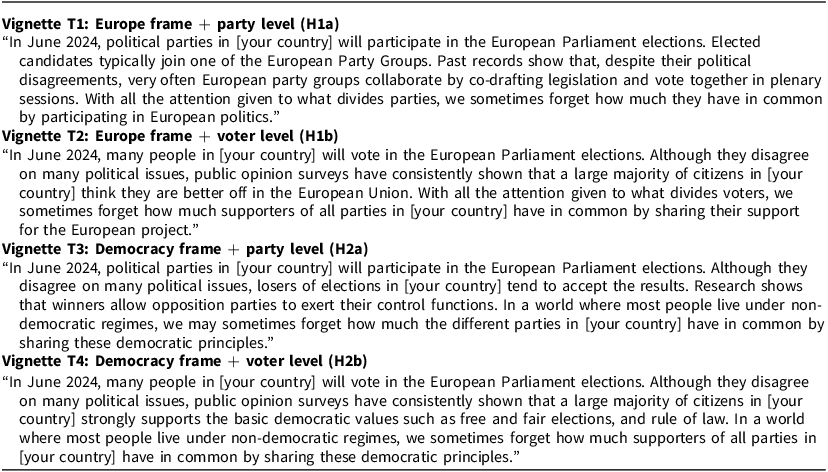
Specifically, the vignettes include factual information about the collaboration of political parties in the European Union (EU × Party), voters’ support for the European Union (EU × Voter), national parties’ adherence to democratic rules (DEM × Party), or voters’ overwhelming support for democratic values (DEM × Voter). The text of each vignette is displayed in Table 1.
Vignettes of the survey experiment

The experiment was embedded in a mass survey run by YouGov simultaneously in 16 EU countries two weeks before the 2024 EP elections.Footnote 10 We implemented the experiment in the context of the European Parliament elections to maximize the likelihood of our depolarizing interventions succeeding. The European Parliament (EP) elections encompass both the democratic and European dimensions captured by our interventions. Therefore, we expected that, in a context of heightened salience, citizens’ perceptions would be more susceptible to influence. Since these are exploratory interventions, we aimed to test whether they could be effective in a most-likely scenario before applying them to more challenging settings.
The EP elections provide a unique setting in which national politics—where affective polarization is deeply rooted—can be more easily connected to the European context. Political parties compete at the national level while simultaneously being part of European party groups and vying for European-level positions. This dual structure allows us to examine how depolarizing interventions can function across national boundaries. More broadly, the advantage of developing pan-European interventions is that they facilitate comparability, portability, and, in summary, scalability across different political contexts; the disadvantage, already discussed in the theory section, is that the EU’s “democratic deficit” could negatively impact these interventions, making them weaker to an analog design at the domestic level.
Our vignettes were placed at the end of a general survey covering various political issues at both the national and European levels. Respondents were randomly assigned to either a pure control group, which was exposed to no vignette, or one of our four vignettes, with a 20% probability. Then, we compared respondents exposed to each of the vignettes with respondents in the control group to test the effectiveness of our interventions.
To measure our outcomes, we first included four manipulation checks placed right after the vignettes. These subjective manipulation checks (Kane & Barabas, Reference Kane and Barabas2019) are particularly important when testing novel depolarizing strategies because, rather than measuring factual recall of the vignette content, they assess whether the interventions shift the specific perceptions they are designed to affect and thus operate as intended. Each manipulation check corresponds to one of the vignettes and captures respondents’ perceptions of how much voters or parties share regarding the European Union and democracy. We randomized the order of appearance of the manipulation checks and randomly exposed respondents to only two of them to avoid contamination. The manipulation checks are measured as follows:
-
• Manipulation Check for T1 (MC1) – Europe frame + party-level: A continuous variable ranging from 0 to 10 where 0 means complete disagreement and 10 means complete agreement with the statement “Despite their many differences, political parties in [your country] collaborate in European politics.”
-
• Manipulation Check for T2 (MC2) – Europe frame + voter-level: A continuous variable ranging from 0 to 10 where 0 means complete disagreement and 10 means complete agreement to the statement “Despite disagreement in many issues, most voters in [your country] think that we are better off in the European Union.”
-
• Manipulation Check for T3 (MC3) – Democracy frame + party-level: A continuous variable ranging from 0 to 10 where 0 means complete disagreement and 10 means complete agreement to the statement “Despite their many differences, parties in [your country] tend to respect a common set of democratic rules.”
-
• Manipulation Check for T4 (MC4) – Democracy frame + voter-level: A continuous variable ranging from 0 to 10 where 0 means complete disagreement and 10 means complete agreement to the statement “Despite disagreement on many issues, most voters in [your country] strongly support basic democratic values.”
Finally, we asked a battery of feeling thermometers for the main national parties and their supporters, measured from 0 (Really dislike) to 100 (Really like). The order of the batteries was randomized, so that some respondents received the battery of items asking for the parties first and their supporters after, or vice versa. With these items, we follow Wagner (Reference Wagner2021) and calculate two distinct measures of affective polarization in multi-party systems, capturing either the spread of like-dislike measures or the average distance from the most liked party. We also calculate weighted measures using the normalized vote shares in the EP elections.
We employ these two measures of affective polarization because they capture distinct manifestations of the phenomenon in multiparty systems. Unlike the United States, where two dominant parties structure political competition, most EU countries feature multiple parties that cluster into ideological blocks. Wagner’s average distance from the most liked party effectively captures scenarios in which an individual strongly favors a single party while disliking the others, mirroring the US context, where partisanship revolves around a binary divide. In contrast, Wagner’s spread measure accounts for perceptions of politics as organized into two broad camps, each encompassing one or more parties (Wagner, Reference Wagner2021).
Irrespective of the measures used, we find meaningful variation in mean levels of affective polarization across countries. As Figure 1 displays, weighted mean distance measures yield consistently higher values of affective polarization than spread measures, as originally reported by Wagner (Reference Wagner2021). Within each type of measure, values also tend to be higher whenever the target of affective considerations is political parties rather than voters.
Average affective polarization levels across countries and by measure.

In addition to our main variables, the questionnaire also includes traditional socio-demographic variables that allow us to check for balance across treatment groups (i.e., age, gender, and education). Political variables, such as partisan identification, support for European integration, and authoritarian attitudes, among others, were also added to explore the possibility of heterogeneous treatment effects.
The survey also recorded the time respondents took to complete the interview. Following our pre-analysis plan in the preregistration, we excluded respondents who completed the survey in nine minutes or less (speeders), which is half the estimated interview length (18 minutes). This threshold also coincides with the median completion time, reassuring us that we are only removing speeders—respondents less likely to have engaged with the vignettes meaningfully and, therefore, not properly treated.
In addition, we excluded respondents who provided the same response to all like-dislike questions (straightliners). After removing speeders and straightliners, the distribution of affective polarization measures more closely approximates a normal distribution,Footnote 11 further confirming that we are filtering out only low-quality responses. The total number of respondents in the survey was 31,695, while the final sample used for analysis, after applying these quality checks, consists of 26,963 observations.
To ensure the validity of our findings, we also checked for balance across treatment and control groups on a range of socio-demographic characteristics. The results indicate no systematic differences,Footnote 12 allowing us to proceed with the analysis without concerns of bias.
To test our hypotheses, we estimate the effect of our individual treatments with an ordinary least squares regression (OLS) model. Our quantity of interest is the Average Treatment Effect for the Treated (ATT) for each treatment category. To identify this quantity, the main specification includes the treatment status (t) as an independent variable and the measure of affective polarization corresponding to each hypothesis as the dependent variable (y). This specification is given by the following equation: ${y_i}\; = \;\alpha \; + \;\beta {t_i}\; + \;{\varepsilon _i}$
Based on our hypotheses, we expect that respondents exposed to the vignettes will rate lower on affective polarization compared to the control group. Specifically, we expect that respondents assigned to the voter-level vignettes display lower voter-level AP while respondents assigned to one of the party-level vignettes report lower party-level AP.
We use regular standard errors to calculate the p-values in the main specifications using 95% and 90% confidence intervals and reject the null hypotheses when the beta coefficients associated with the treatment corresponding to each hypothesis are not positive and significant at a 90% confidence level.
Analysis of manipulation checks
We begin our empirical analysis with the manipulation checks. When introducing novel depolarizing interventions, the first task is to establish whether they operate in their intended way. In our case, this is by shifting the specific perceptual dimensions they are designed to affect. To assess this, we estimate the Average Treatment Effect on the Treated (ATT) for each of our treatments on the four manipulation checks.Footnote 13
Ideally, each treatment (T1, T2, etc.) would exclusively influence its corresponding manipulation check (MC1, MC2, etc.). However, given the conceptual proximity between European cooperation and democratic commitments, as well as between parties and voters, we anticipate the possibility of spillover effects across dimensions and targets. For instance, increasing the perception that parties collaborate within the EU may also influence respondents’ perceptions of parties’ commitment to democratic principles, and vice versa. Likewise, shifting perceptions of political parties could also affect perceptions of voters, and the reverse may also hold true.
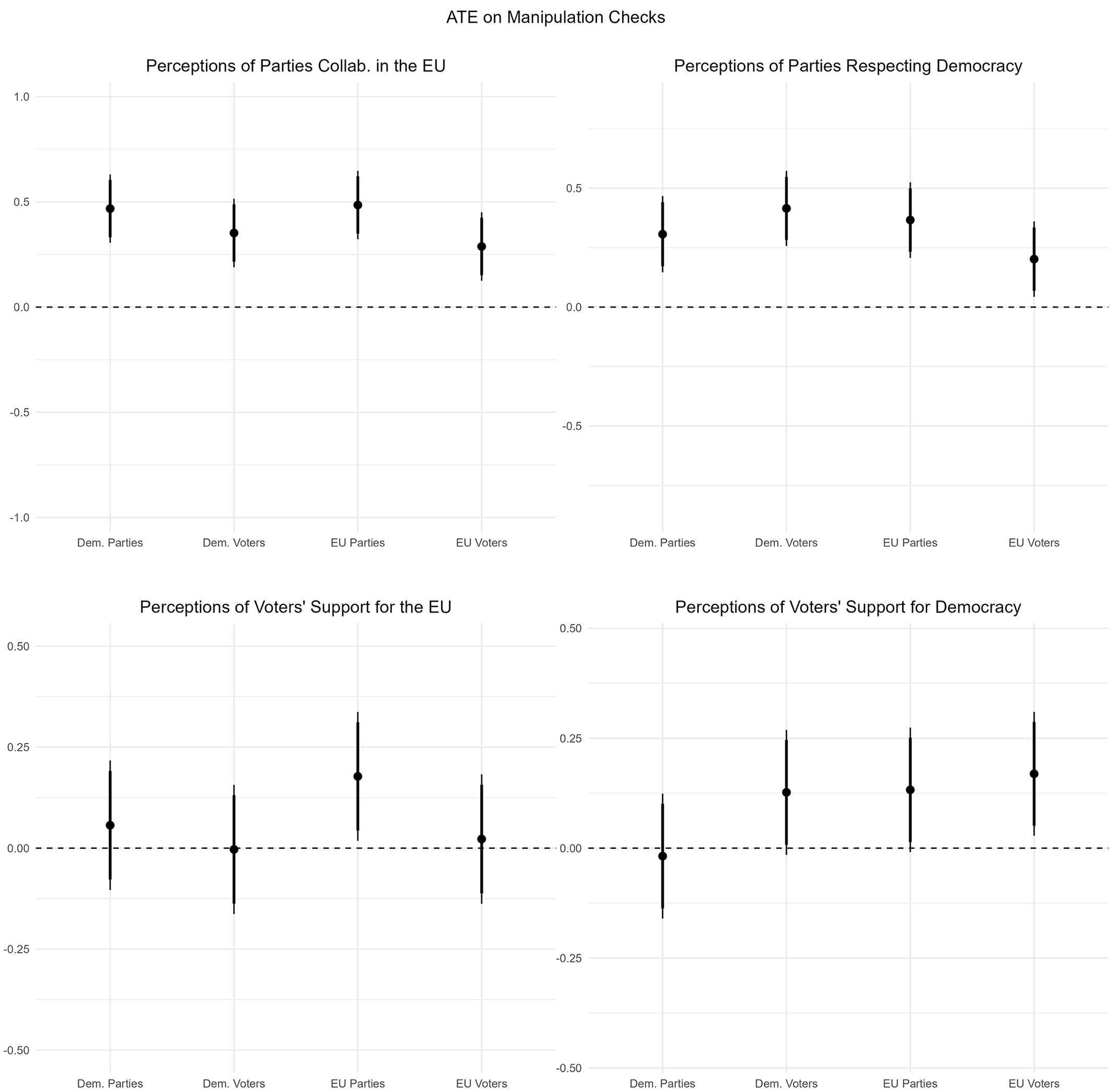
We report our regression estimates in Figure 2. The results indicate that all treatments significantly increased respondents’ perceptions that parties collaborate in the EU (top-left panel) and respect democratic principles (top-right panel). These effects are consistently positive across all treatment conditions, including those focusing on voters, with similar magnitudes and overlapping confidence intervals. Importantly, this pattern implies that even the interventions originally designed to shift voter-level perceptions nevertheless increased perceptions of commonalities at the party level.
Estimated ATT on the manipulation checks.
Note: The horizontal line at 0 is the standardized control group baseline.

In contrast, the bottom panels show that the treatments had a much weaker impact on respondents’ perceptions of voters’ support for the EU (bottom-left) and voters’ support for democracy (bottom-right). The estimated effects are close to zero, with confidence intervals that include the null value, indicating no statistically significant changes in voter-level perceptions across treatment conditions. Thus, the two interventions targeting voters’ commonalities therefore do not shift the specific voter-level dimension they were designed to affect, even if, as shown above, these same interventions nevertheless increase perceptions of party-level commonalities.
These findings confirm that our treatments successfully increased perceptions of party-level commonalities across conditions. However, it remains unclear why respondents adjusted their perceptions of parties even when the information was framed in terms of voters. One plausible interpretation is that respondents processed the vignettes through a party-centered lens, particularly in the context of European Parliament elections, which are commonly characterized as second-order contests in which party–voter linkages are less salient and political competition is primarily understood in elite terms. Moreover, affective polarization in Europe is much weaker when measuring attitudes toward partisans compared to parties, with elites concentrating the most extreme affects. This pattern of stronger vertical affective polarization (Areal and Harteveld, Reference Areal and Harteveld2024) may help explain why our respondents interpreted our vignettes in terms of parties rather than their supporters, regardless of the text they received.
In addition, while we designed each treatment to target a specific dimension—either party collaboration, democratic principles, voter support for the EU, or voter support for democracy—the observed effects indicate considerable overlap in how respondents process information. Regardless of whether the treatment emphasized European cooperation or democratic values, respondents consistently reported increased perceptions of party-level commonality across both dimensions. This pattern may be linked to the European context in which the experiment was fielded. In the 2024 electoral campaign, discussions of the European project were closely intertwined with debates about democratic principles, with both often framed as strongly aligned ideas (Hobolt et al., Reference Hobolt, Popa and van der Brug2026). Given this context, respondents may have implicitly connected Europe and democracy when processing the vignettes. As a result, spillover effects occurred at the level of parties and across substantive dimensions, but not at the level of voters.
Taken together, the evidence from the manipulation checks indicates that our interventions successfully shifted perceptions of commonalities at the party level, even if not always along the originally intended voter-level dimension. We theorized that increasing perceptions of shared ground across political groups should reduce perceived distance between camps and, in turn, decrease inter-partisan animosity. Hence, given these perceptual shifts, we would expect our interventions to exert a negative effect on affective polarization.
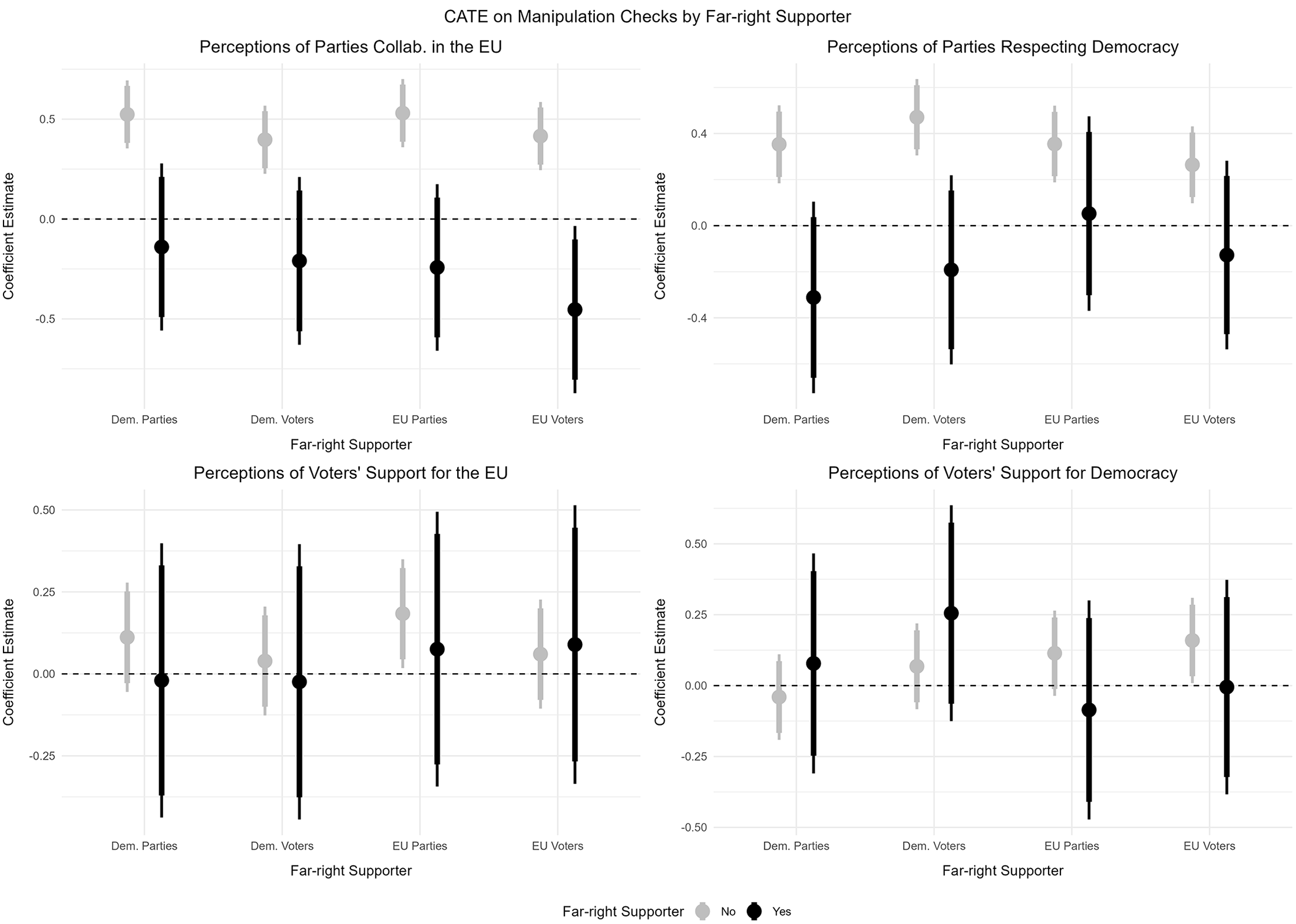
However, before turning to the analysis of affective polarization, we briefly explore whether the effectiveness of our interventions varies across political groups.Footnote 14 In contrast to the two-party US context, European multi-party systems are characterized by heterogeneous patterns of affect within and between ideological blocs. Because support for the European Union and for democratic principles is contested in Europe, particularly among far-right voters, the effectiveness of commonality-based messages may depend on respondents’ prior attitudes. We therefore test whether treatment effects on the manipulation checks differ between far-right and non-far-right supporters. Using respondents’ reported party identification and the PopuList classification (Rooduijn et al., Reference Rooduijn2024), we interact our treatment indicators with a dichotomous measure of far-right support.Footnote 15 The results, displayed in Figure 3, show that our interventions significantly increase perceptions of party-level commonalities among non-far-right respondents, but have no meaningful effect among far-right supporters. Similar patterns emerge when examining perceptions of voters. This suggests that far-right supporters are largely unresponsive to messages emphasizing party and voter commonalities in the EU and democracy.
Interaction with far-right party supporters on the manipulation checks.
Note: The horizontal line at 0 is the standardized control group baseline. All the specifications control for gender, age, education, income, employment status and country fixed-effects.

To further assess the scope conditions of our interventions, we also explore heterogeneity by interacting the treatments with continuous measures of support for European integration and authoritarian attitudes.Footnote 16 These analyses, reported in Figure A4 in the online Appendix, confirm that the treatments are effective primarily among respondents who are supportive of European integration and who reject authoritarian views. Across specifications, perceptual shifts occur at the party level but not at the voter level, and more strongly among respondents with positive democratic and European views.
Altogether, these findings confirm that our interventions function as expected, modifying perceptions among those whose prior attitudes make them more receptive. At the same time, they highlight a clear and previously unexplored limitation of depolarizing interventions of this type. The effectiveness of these messages depends on whether the commonalities they emphasize are rooted in pre-existing shared values and beliefs. When this is not the case, the interventions fail to produce meaningful effects among the targeted groups.
Results on affective polarization
Now that we have validated that our interventions effectively increased perceptions of parties’ common ground, we turn to the analysis of affective polarization. Based on similar interventions conducted in the United States, we would expect that increasing respondents’ perceptions of party commonalities would reduce affective polarization. To test this expectation, we estimate the ATT of each treatment on two key measures: the weighted mean distance to the most liked party (voter) and the spread of like-dislike scales, both at the party and voter levels.
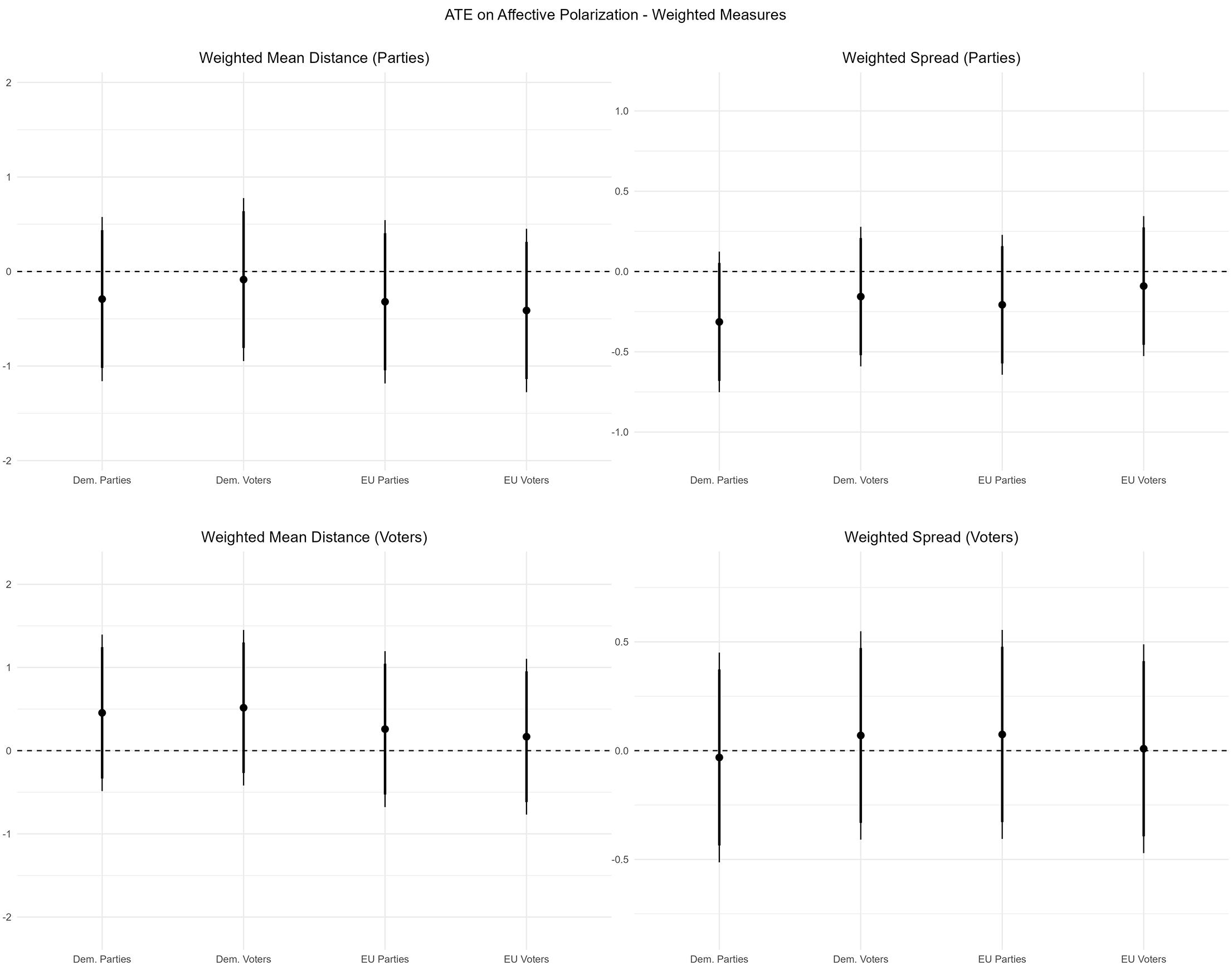
Our main results are displayed in Figure 4. The two plots at the top show the estimated ATT for party-level affective polarization. The first measure is the weighted mean distance from the most liked party. The second measure captures the average weighted spread in like-dislike ratings, reflecting the overall dispersion of partisan evaluations. The two plots at the bottom present the same measures applied to voters rather than parties.
Estimated ATT on affective polarization measures.
Note: The horizontal line at 0 is the standardized control group baseline.

Across all measures and treatment conditions, the results remain consistent. The estimated ATT is never significantly different from zero at the 95% and 90% confidence levels. While the coefficients for party-level measures are generally negative, suggesting a potential—but tiny—decline in affective polarization, the coefficients for voter-level measures are slightly positive, indicating that, if anything, the interventions may have increased affective polarization in terms of voter perceptions. This difference is consistent with our previous finding that our treatments shifted perceptions of parties but not of voters. However, none of the coefficients reach statistical significance at even a 90% confidence level. Therefore, these findings provide no support for any of our hypotheses. Despite successfully increasing perceptions of party commonalities, our interventions did not lead to measurable reductions in affective polarization in the European context.
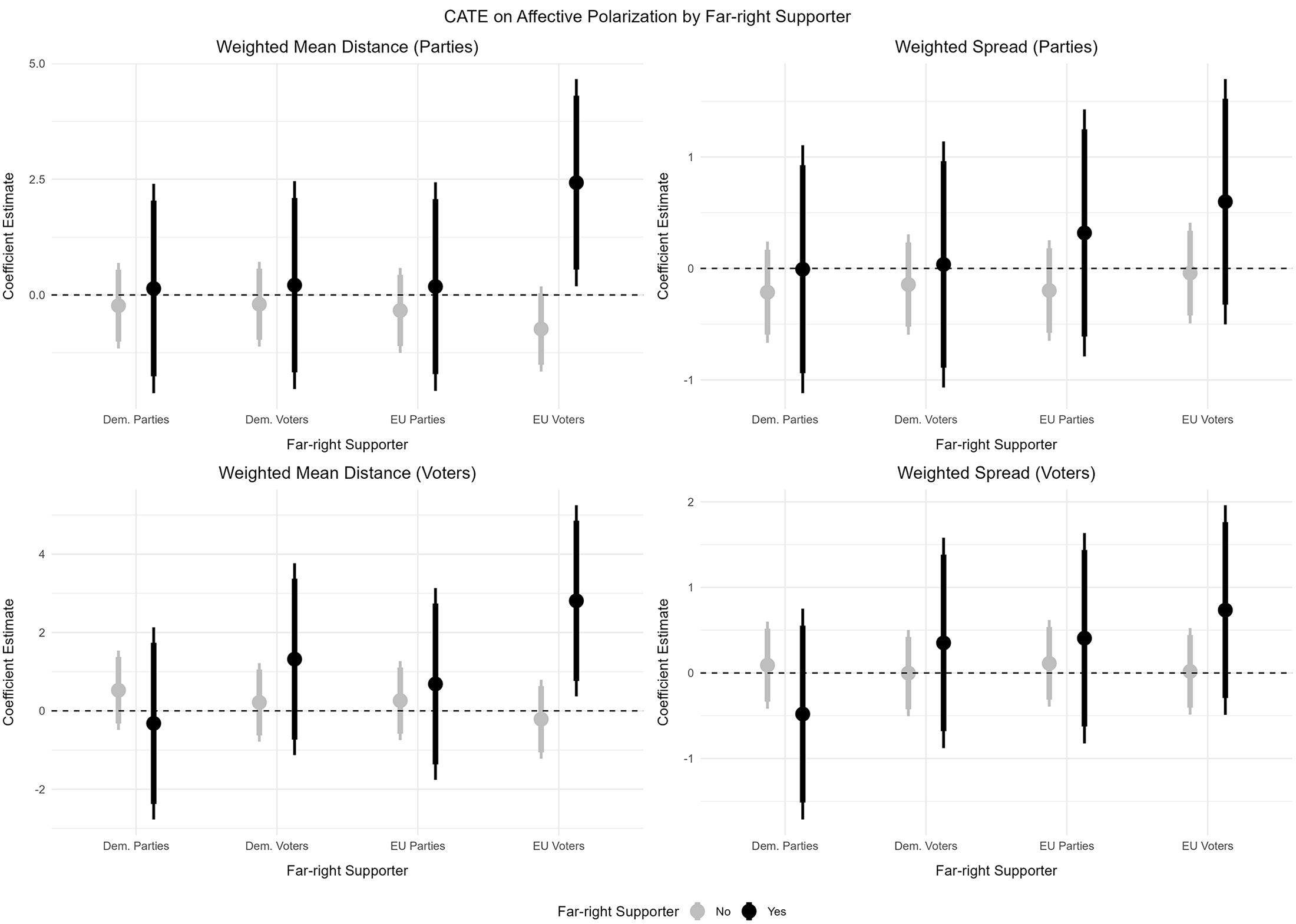
To ensure that our null results do not mask subgroup heterogeneity, similar to what we observed in the manipulation checks, we conducted additional exploratory analyses by regressing affective polarization on the interaction between our treatment variables and far-right support.Footnote 17 The results, displayed in Figure 5, confirm that the null effects hold consistently across subgroups.
Interaction with far-right party supporters (vs. others) on AP measures.
Note: The horizontal line at 0 is the standardized control group baseline. All the specifications control for gender, age, education, income, employment status and country fixed-effects.

In the top panels of Figure 5, which examine party-level affective polarization, the estimates for both the weighted mean distance and the weighted spread remain close to zero for non-far-right supporters (gray dots) and far-right supporters (black dots). While some estimates for far-right supporters exhibit larger confidence intervals, reflecting greater variability, and despite the coefficients for non-far-right supporters at the party level being consistently negative, none of the effects reach statistical significance.
A similar pattern emerges in the bottom panels, which assess voter-level affective polarization. Neither the weighted mean distance nor the weighted spread measures show meaningful treatment effects for either subgroup. The estimates for non-far-right supporters remain centered around zero, while the coefficients for far-right supporters display wider confidence intervals but remain statistically indistinguishable from zero.
Additional analyses of heterogeneous treatment effects by pre-treatment support for European integration and authoritarian attitudes reveal a similar pattern (Figure A5 in the online Appendix). Although respondents with stronger support for European integration tend to report slightly lower levels of affective polarization in the treatment group, these differences are small and do not reach conventional levels of statistical significance. Analyses by European identity,Footnote 18 reported separately in Figure A6 in the Appendix, show a comparable pattern: while respondents who identify as Europeans seem to exhibit lower levels of affective polarization in the treatment conditions, the difference with those in the control group remains statistically indistinguishable from zero across treatment conditions and for each measure of affective polarization.
All in all, these findings confirm that the absence of significant effects is not driven by differential treatment responsiveness across supporters. The null effects persist across all subgroups, reinforcing the conclusion that our interventions did not influence affective polarization, regardless of respondents’ partisan affinities, European attitudes, and democratic views. If anything, any potential depolarizing effect of our interventions is too small to be detected even with large samples and among the most likely affected groups. Therefore, while effective in increasing perceptions of parties’ commonalities, our interventions failed to reduce affective polarization.
Robustness
We conducted a series of robustness checks to confirm the validity of our results. First, we replicated our main specifications using unweighted affective polarization measures as dependent variables to ensure that our findings are not driven by minor parties. The results, presented in Appendix A3, consistently show non-significant coefficients, closely aligning with the null effects observed in our main analysis.
Second, we examined whether concurrent effects on in-group and out-group evaluations cancel each other out, potentially masking a true effect. To do so, we regressed average in-party/in-voter and out-party/out-voter like-dislike ratings on our treatment variables. The results, again in Appendix A3, indicate that this is not the case. The estimated ATT remains statistically indistinguishable from zero across all specifications.
Third, we systematically explored sources of heterogeneity by applying a causal forest algorithm with a range of potential covariates.Footnote 19 The causal forest approach allows us to identify variables associated with heterogeneous treatment effects without imposing parametric assumptions. The results, presented in Appendix A5, highlight several key variables contributing to heterogeneity. The most relevant predictors include a populist attitudes index, satisfaction with democracy in one’s own country, left-right ideological orientation (all of which are correlated with far-right support), and the respondent’s country. They also include authoritarian attitudes and attitudes toward the EU, which we already explored.
Yet, a key limitation of the causal forest method is that it detects heterogeneity in treatment effects but does not determine whether this heterogeneity is systematically related to the direction or magnitude of the effects. To address this limitation, we estimate a series of interaction models using the variables identified as most relevant by the causal forest analysis. The results in Appendix A6 indicate no statistically significant heterogeneous treatment effects.
To refine this analysis, we conducted a principal component analysis (PCA) using all variables included in the causal forest. The PCA identifies two principal components that capture most of the variance (Factor 1 explains 27% of the variance, and Factor 2 explains 12%). We then rerun our interaction models using these principal components, but once again, none of the interactions yield statistically significant results.Footnote 20
Finally, we re-estimated our main specifications separately for respondents in each of the 16 countries included in our study. The results, presented in Appendix A8, confirm that our interventions do not produce meaningful variation across national contexts, with null effects observed in nearly every case. The robustness of this finding is further supported by a more systematic analysis using the 4,000 regression trees generated by our causal forests, which combine different covariate structures to identify potential nonlinear sources of heterogeneity. The mean Conditional Average Treatment Effects (CATEs) consistently remain close to zero and are not statistically significant at conventional levels. Detailed results are provided in Appendix A9.
In summary, our interventions successfully increased perceptions of party commonalities, particularly regarding their collaboration within the EU framework and their adherence to democratic principles. However, these effects did not extend to affective polarization, which remained unchanged despite our interventions. These findings have concrete implications for future efforts aimed at reducing affective polarization in Europe. In the next section, we discuss these implications and potential avenues for future research.
Discussion
This study examined whether four novel short textual interventions highlighting shared political commonalities—namely democratic values and practices, and the shared European Union project—can reduce affective polarization in European multi-party systems. Our analyses yield two main findings. First, our interventions successfully shifted voters’ perceptions of shared political ground among parties, but only among respondents with baseline support for these core values and practices. Second, despite successfully modifying perceptions, our interventions failed to reduce affective polarization. In our view, these findings have three main implications for the study of depolarization interventions and affective polarization more broadly.
First, to the best of our knowledge, our results provide the first evidence that short informational interventions highlighting commonalities across partisan groups can successfully increase perceptions of shared political ground outside the US context. Across all treatments, respondents exposed to vignettes emphasizing collaboration within European institutions or adherence to European and democratic values reported significantly higher perceptions that political parties share common commitments. This finding contributes to a growing set of cognition-altering depolarization interventions that move beyond correcting misperceptions or priming superordinate identities (e.g., Mullinix & Lythgoe, Reference Mullinix and Lythgoe2023). Most importantly, our interventions are explicitly designed for the European context and to operate across national boundaries. While our democracy-based interventions build on prior work conducted in the United States (Voelkel et al., Reference Voelkel2023), our use of the European Union as both a shared political project and an institutional framework for inter-party cooperation, represents a novel attempt to design a transnational intervention capable of increasing perceptions of commonality. Although this intervention ultimately failed to reduce affective polarization, it demonstrates that the European political framework can serve as a meaningful reference point for shaping political perceptions. More broadly, this approach opens new avenues for designing depolarization interventions beyond the US context.
Second, the effectiveness of these interventions in shifting perceptions was not uniform across respondents. In particular, our interventions were largely ineffective among respondents holding eurosceptic or authoritarian attitudes, especially supporters of far-right parties. This finding highlights an important scope condition that has received limited attention in prior research. Most depolarization interventions have been developed and tested in the United States, a two-party system in which interventions are designed to operate across two clearly defined political groups. By contrast, multi-party systems are characterized by more complex partisan alignments, cross-cutting cleavages, and variation in political affinities. As a result, identifying shared political elements that resonate broadly across supporters of multiple parties is inherently more challenging.
Our results illustrate this constraint directly. While the interventions successfully shifted perceptions among respondents already predisposed to view European integration and democratic institutions positively, they failed to influence respondents holding more sceptical attitudes. This pattern points to a “preaching to the converted” dynamic, in which interventions primarily affect individuals who already share the values being emphasized. More broadly, this suggests that commonality-based interventions may face structural limitations when the highlighted commonalities are themselves contested. While this challenge is particularly evident in multi-party systems, where the diversity of political beliefs makes it more difficult to identify shared elements capable of resonating across the entire electorate, it may also extend beyond Europe and the specific commonalities examined in this study. For example, appeals to national identity may be divisive, particularly in multi-ethnic states or where expressions of national pride are associated with exclusionary ideologies (Dinas et al., Reference Dinas, Martínez and Valentim2024). Similarly, interventions emphasizing democratic values rely on the assumption that these values are broadly shared. While this assumption generally holds in Western democracies, important variation exists in how citizens interpret and support democratic principles (Ferrín & Kriesi, Reference Ferrín and Kriesi2025). More broadly, our findings suggest that depolarization interventions must carefully consider the attitudinal landscape of the target population. To paraphrase Yves Mény’s observation regarding institutional mimicry, where institutional grafting can lead to rejection (Mény, Reference Mény1993), transplanting depolarization interventions across political contexts may prove ineffective if scope conditions are not properly specified.
Third, and finally, despite successfully shifting perceptions of shared political ground, our interventions failed to reduce affective polarization. This null result is substantively important. Failed interventions provide critical insights into the limits of depolarization strategies and help mitigate the file-drawer problem in experimental research (Franco et al., Reference Franco, Malhotra and Simonovits2015). Our findings add to a growing body of evidence documenting the difficulty of reducing affective polarization through short informational interventions (Levendusky, Reference Levendusky2018a; Holliday et al., Reference Holliday, Lelkes and Westwood2025) and extend this conclusion to the European context.
Importantly, this limitation cannot be attributed to a failure of the interventions to influence perceptions. Our manipulation checks clearly demonstrate that respondents updated their perceptions of political commonalities, indicating that the treatments were processed and accepted as credible by a majority of respondents. Even when focusing exclusively on respondents whose perceptions shifted, we observe no corresponding reduction in affective polarization. This suggests that modifying perceptions of shared political ground may be insufficient, on its own, to alter affective evaluations of political opponents. This highlights a key distinction between perceptual and affective dimensions of polarization and suggests that reducing partisan animosity may require more intensive, sustained, or structurally different interventions.
Overall, our findings point to several directions for future research. While brief informational interventions can successfully shift perceptions, more intensive or repeated interventions may be necessary to produce meaningful reductions in affective polarization. For example, long-term interventions embedded in educational settings have been shown to improve citizens’ ability to identify misinformation and engage in fact-checking (Amar et al., Reference Amar2026). Similar approaches may prove more effective in reducing affective polarization, particularly if they involve repeated exposure or more immersive engagement.
In conclusion, our study contributes to the growing consensus that depolarization is difficult to achieve and underscore the importance of defining the scope conditions under which interventions can effectively reduce polarization, especially in complex multi-party systems, like those in Europe.
Supplementary material
The supplementary material for this article can be found at https://doi.org/10.1017/S1755773926100496
Data availability statement
The data and replication materials for this study are publicly available on Harvard Dataverse and can be accessed at https://doi.org/10.7910/DVN/PMMQRU.
Acknowledgments
We would like to thank Tina Freyburg and Oana Ioana-Elena for their helpful comments on previous versions of the manuscript. We also acknowledge the co-editors of the EPSR special issue “The 2024 European Elections: Crises, Contestation, and Voter-Party Linkages in EU Politics” for their valuable assistance, and members of the ERC SOLID team for their collaboration and support. Earlier versions of this paper benefited from feedback received at EUI 2024 International Workshop on Depolarization and at the EPSR Special Issue on the 2024 European Elections pre-publication workshop. All remaining errors are our own.
Funding statement
This study was supported by the SOLID research project (“Policy Crisis and Crisis Politics, Sovereignty, Solidarity and Identity in the EU Post-2008”) financed by the ERC Synergy Grant Agreement 810356 (ERC-2018-SYG).
Competing interests
The author(s) declare no competing interests.
Ethical standards
This study received Human Subjects Review Clearance by the Human Subjects Committee at the University of Lucerne (IRB # 2024-006).



 Open access

