


Clovis is the earliest recognizable techno-complex in northwestern Mexico and the southwestern United States (Hamilton et al. Reference Hamilton, Buchanan, Huckell, Holliday, Steven Shackley and Hill2013). Clovis lithic technology has been characterized as containing complex biface and blade technologies, multiple flake and blade tools such as end scrapers and spokeshaves, and distinctive patterns of raw material selection (Bradley et al. Reference Bradley, Collins and Hemmings2010; Collins Reference Collins1999; Ellis Reference Ellis2013; Goodyear Reference Goodyear1979; Huckell Reference Huckell, Vance Haynes and Bruce2007; Huckell and Kilby Reference Huckell and Kilby2014; Kelly Reference Kelly1988). However, most of what we know about Clovis stone tool technology comes from surface finds, including isolated Clovis points, and from buried contexts, most of which represent megafauna kill sites (Grayson and Meltzer Reference Grayson and Meltzer2002; Haynes and Huckell Reference Haynes and Huckell2007; Surovell and Waguespack Reference Surovell and Waguespack2008; Waguespack and Surovell Reference Waguespack and Surovell2003). Information about domestic tasks unrelated to megafauna hunting practices, such as exploitation of other organic and inorganic resources, lithic raw material quarrying activities, and ritual behavior, is limited because the archaeological record of these activities is very rare. These kinds of contexts include burial sites, caches, toolstone quarries, and campsites. Campsites in particular have the potential to reveal information about both Clovis technology and subsistence strategies, because a wide array of domestic activities are usually performed at these locations (Binford Reference Binford1980). Sites including Murray Springs in Arizona (Agenbroad and Huckell Reference Agenbroad, Huckell, Haynes and Huckell2007), Aubrey in Texas (Ferring Reference Ferring2001), Mockingbird Gap in New Mexico (Hamilton et al. Reference Hamilton, Buchanan, Huckell, Holliday, Steven Shackley and Hill2013; Holliday et al. Reference Holliday, Huckell, Weber, Hamilton, Reitze and Mayer2009), and Dietz in Oregon (Pinson Reference Pinson2011) are extensive and contain large collections of Clovis stone tools indicative of Clovis campsites; some provide evidence of discrete activity areas related to animal resource processing and stone tool manufacture and repair.
El Fin del Mundo is an archaeological site in the Sonoran Desert of northwest Mexico that contains a Clovis megafauna kill locality associated with scatters of Clovis and later lithic materials on the deflated surface of the surrounding uplands. The technological, typological, and qualitative features of the lithics in the uplands suggest that a large Clovis stone tool assemblage indicative of a campsite is present at the site. El Fin del Mundo offers a unique and significant contribution to our understanding of Clovis lithic technology in the region encompassing Sonora and the neighboring state of Arizona, given its proximity to the extensively studied Clovis sites of the San Pedro River Valley, about 250 km to the northeast, in southeastern Arizona (Antevs Reference Antevs1953; Haury Reference Haury1953; Haury et al. Reference Haury, Sayles and Wasley1959; Haynes and Huckell Reference Haynes and Huckell2007; Hemmings and Haynes Reference Hemmings and Vance Haynes1969; Mead et al. Reference Mead, Haynes and Huckell1979; Mehringer and Haynes Reference Mehringer and Haynes1965). Unlike most of the Sonoran Clovis record, the site is relatively pristine and has not been collected by amateur archaeologists.
Here we present a comprehensive and detailed description of the Clovis lithic assemblage from the site, expanding on previously published descriptions (Sánchez-Morales Reference Sánchez-Morales2018) with the addition of materials recovered in 2018 and 2020. We expand our interpretations on site use and the relationships between the localities that form the site, including the gomphothere kill, upland camp, and a local lithic raw material quarry.
Site Location and Description
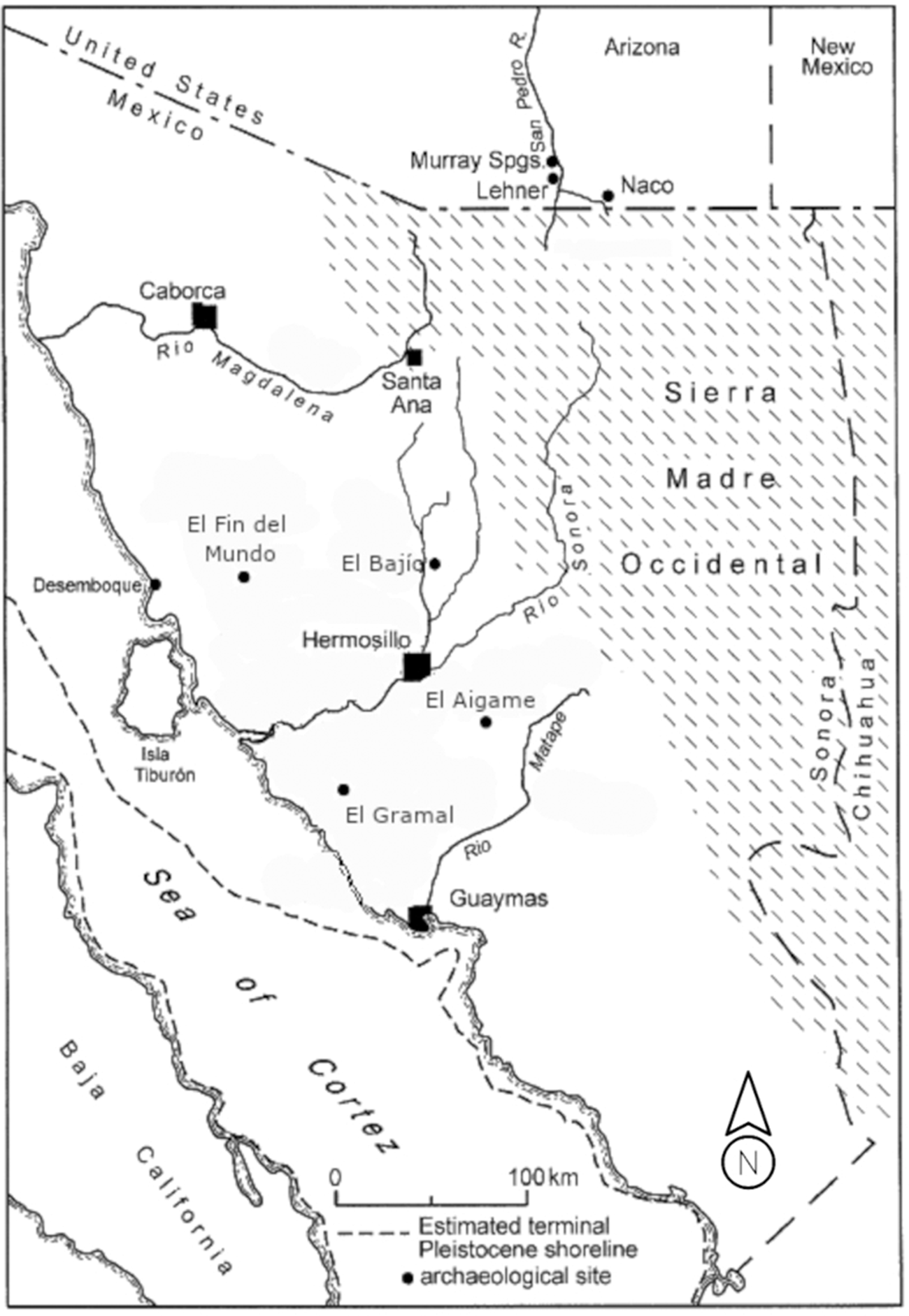
El Fin del Mundo is located in the northern portion of the state of Sonora, northwest Mexico (Figure 1). The site lies in a small intermontane basin within the Sonoran Desert, at an elevation of 650 m asl and about 80 km east from the coast of the Gulf of California. It is situated on the toe of an alluvial fan within the drainage of the Rio Bacoachi. The site contains 25 localities exposed across the eroded fan surface. These localities were identified by surface concentrations of archaeological materials, exposed geological profiles, and buried contexts of either archaeological or paleontological significance. Investigations at the site started in 2007, with seven field seasons conducted until 2020. The main focus has been the systematic excavation of Locality 1, a kill feature that preserves the skeletal remains of at least two gomphotheres (Cuvieronius sp.) in direct association with diagnostic Clovis lithic artifacts (Sanchez Reference Sanchez2016; Sanchez et al. Reference Sanchez, Holliday, Gaines, Arroyo-Cabrales, Martínez-Tagüeña, Kowler, Lange, Hodgins, Mentzer and Sánchez-Morales2014). Additional field research has focused on the excavation of test pits and systematic surveys conducted on the surrounding uplands, the slightly more elevated terrain of the alluvial fan where undifferentiated scatters of lithic materials have been identified on the surface (Sánchez-Morales Reference Sánchez-Morales2012, Reference Sánchez-Morales2018).
Location of selected Clovis sites in north-central Sonora and the San Pedro River Valley of southeastern Arizona (modified from Gaines et al. Reference Gaines, Sánchez and Holliday2009:Figure 1).
Locality 1
This locality consists of an exposed “island” remnant of sediment that filled a channel incised into the distal margin of the alluvial fan. The island extends over an area about 100 m2 isolated by subsequent arroyo dissection, which exposed the Clovis kill feature preserved in the channel fill. Three strata exposed in the landform (2, 3, and 4 from bottom to top) rest on top of the bedrock (Sánchez et al. Reference Sanchez, Holliday, Gaines, Arroyo-Cabrales, Martínez-Tagüeña, Kowler, Lange, Hodgins, Mentzer and Sánchez-Morales2014). Two concentrations of Pleistocene faunal remains—the upper and lower bonebeds—are preserved in these deposits. The upper bonebed is contained in the upper ~15 cm of stratum 3 (3B), a sandy clay alluvium, and is sealed by a stratum of pure white lacustrine diatomite (lower stratum 4) up to 10 cm thick (Sanchez Reference Sanchez2016; Sanchez et al. Reference Sanchez, Holliday, Gaines, Arroyo-Cabrales, Martínez-Tagüeña, Kowler, Lange, Hodgins, Mentzer and Sánchez-Morales2014).
Strata 3 and 4 filled a channel less than 100 m wide based on the minimum distances to fan exposures along the modern arroyo. The extent and course of the channel are unknown, but the absence of other channel exposures indicates that Locality 1 was near the headwaters. Water feeding the alluvial and lacustrine systems was probably derived from seeps, remnants of which are locally preserved along nearby arroyo exposures (Sanchez et al. Reference Sanchez, Holliday, Gaines, Arroyo-Cabrales, Martínez-Tagüeña, Kowler, Lange, Hodgins, Mentzer and Sánchez-Morales2014). The stratigraphic position of the Clovis bonebed in upper stratum 3 and the absence of weathering of the surface of the alluvium suggest that the transition from alluvial to freshwater lacustrine conditions was rapid and occurred shortly after the kill. The palynological record of Locality 1 indicates a change in plant communities in the landscape from pines, junipers, oaks, and grasses in lower stratum 3 (3A) to a grass-dominated landscape during Clovis times (3B), with an associated decline in arboreal vegetation.
The upper bonebed contained the semi-articulated skeletal elements of at least two gomphotheres (Cuvieronius sp.), extinct proboscideans distinct from mammoths and mastodons and characterized by their smaller size and straighter tusks. The gomphothere bones were directly associated with four Clovis points and several small (≤1 cm) stone tool resharpening flakes (Sanchez Reference Sanchez2016; Sanchez et al. Reference Sanchez, Holliday, Gaines, Arroyo-Cabrales, Martínez-Tagüeña, Kowler, Lange, Hodgins, Mentzer and Sánchez-Morales2014). Another three Clovis points were found in Locality 1, either in highly bioturbated contexts during excavation of the “island” or on the surface near the excavated area. A date of 11,550 ± 60 14C yr BP (AA-100181A) was obtained from the A-fraction of isolated organic matter associated with the upper bonebed (Sanchez et al. Reference Sanchez, Holliday, Gaines, Arroyo-Cabrales, Martínez-Tagüeña, Kowler, Lange, Hodgins, Mentzer and Sánchez-Morales2014:10976), providing a maximum age. This is the only undisturbed buried archaeological context in the site, the only Clovis kill site yet known south of the United States, and the only gomphothere-Clovis association yet found in North America.
Upland Localities
Lithic materials are scattered in an arc about 0.2–1.0 km wide across Localities 5 through 25, the upland surface to the south of Locality 1, and on the surface of Locality 2 to the northwest (Figure 2). Prolonged weathering of this surface, denoted by a well-expressed soil (deep red with Bt-Bk horizonation ~1 m thick) formed in the alluvium, indicates that it was a stable surface during the Clovis occupation. Diagnostic Clovis artifacts, including complete and fragmentary Clovis points, end scrapers, blades, and blade-production byproducts, were collected among these surface lithic scatters (Sánchez-Morales Reference Sánchez-Morales2018). Many of these upland localities also contain an important Archaic component that includes projectile points that are typologically associated with the Early Archaic, the Middle Archaic, and the Early Agricultural periods (Sánchez-Morales Reference Sánchez-Morales2012). Test pits were excavated in Locality 5, where the densest concentration of lithic artifacts on the surface was identified, and in Localities 23 and 24 where several fire features (i.e., hearths and thermally fractured rocks) associated with Archaic projectile points were observed. No buried archaeological contexts were found during these investigations, and materials on the surface may have been exposed and mixed through several episodes of burial and exposure (Sanchez et al. Reference Sanchez, Holliday, Gaines, Arroyo-Cabrales, Martínez-Tagüeña, Kowler, Lange, Hodgins, Mentzer and Sánchez-Morales2014).
Distribution of localities where Clovis stone tools have been found at El Fin del Mundo. Letters indicate the lithic mode(s) present at each locality: B, biface mode; U, uniface mode; BL, blade mode. Topographic map by Michael Brack.
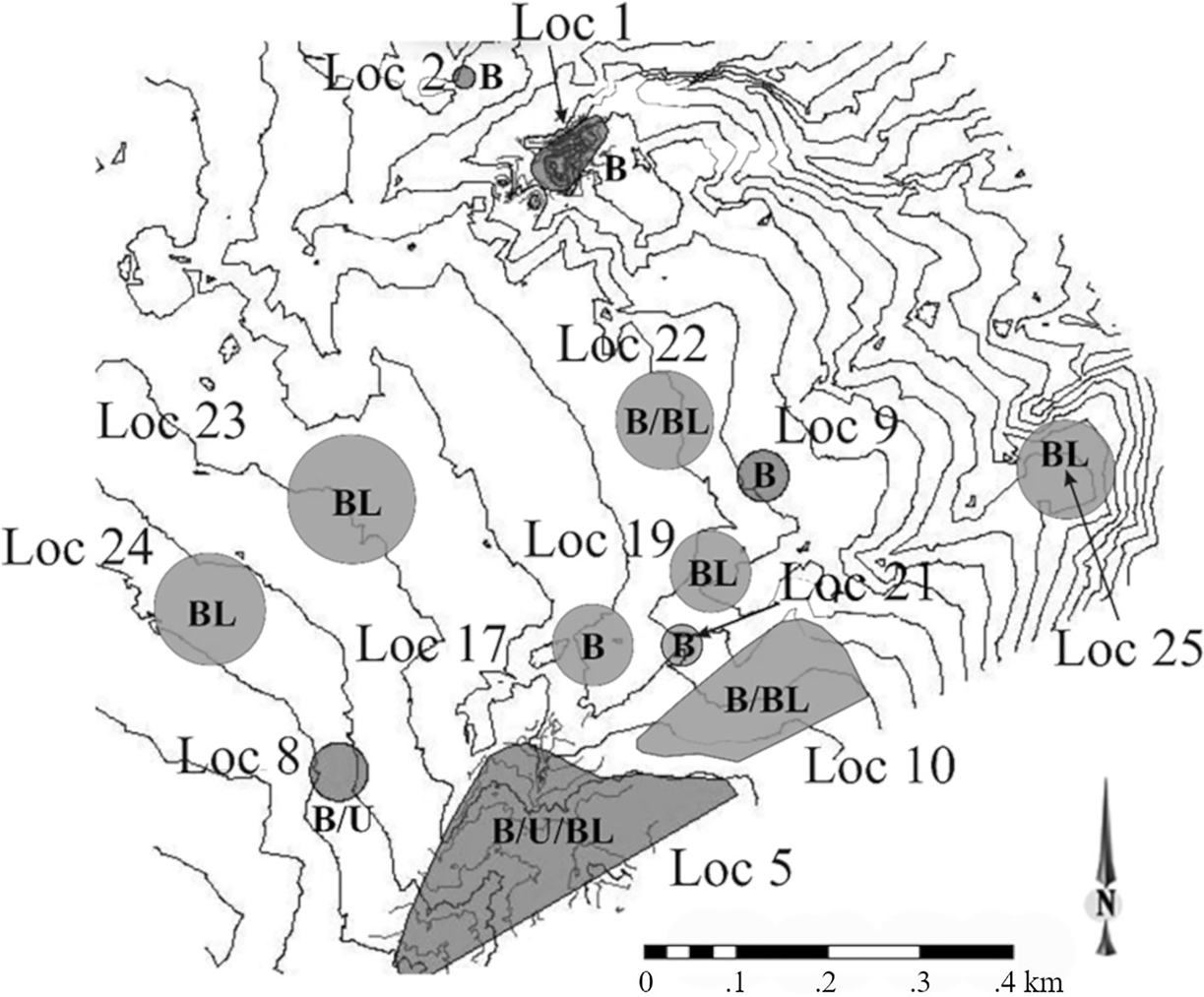
Locality 25 contains a primary source of rhyolite, which outcrops as medium- to large-size blocks (~0.5–1.0 m in maximum dimension) on the eastern edge of a low hill about 600 m southeast of Locality 1 and 300 m east of Locality 10 (Sánchez-Morales Reference Sánchez-Morales2018). Intensive exploitation of this outcrop is indicated by stone tool manufacture debris observed on the surface. Other lithic raw materials available at the site include basalt, quartzite, white quartz, quartz crystal, dacite, and jasper, which can be found in the form of cobbles and nodules in the streambeds that dissect the site.
Field and Data Collection Methods
Lithic materials that were not recovered during the excavation of Locality 1 were collected during systematic surveys. Given that most archaeological artifacts found at the site were recovered from surface contexts that contain a palimpsest of Paleoindian and Archaic occupations, we collected only diagnostic materials that could be associated with temporal/cultural horizons based on typology, technology, or both. Most of these diagnostic artifacts are projectile points. However, we also collected artifacts displaying technological traits that are characteristic of Clovis lithic technology and that are not observed in Archaic components from other sites in the region. The provenience information of every artifact, including UTM coordinates, was recorded.
The Clovis lithic artifacts were classified into three modes: biface mode, uniface mode, and blade mode. The micro-flakes from Locality 1 are not included in this description. Classifications were based on both technological features (i.e., retouch type, blank production technology) and typology/assumed function (i.e., Clovis point, end scraper) after Bradley and colleagues (Reference Agenbroad, Huckell, Haynes and Huckell2010), Collins (Reference Collins1999), and Huckell (Reference Huckell, Vance Haynes and Bruce2007). Databases containing all the technological, morphological, qualitative, metric, and provenience information of each artifact were developed following the format used by Sanchez (Reference Sanchez2010, Reference Sanchez2016) in her analysis of the Clovis lithics from the site of El Bajío. The identification of raw materials was based on macroscopic observations of texture, flaking quality, inclusions observable with a portable 10× magnifying glass, Munsell color, and comparisons of these features with those of selected specimens from the assemblage representing different raw materials identified using a binocular microscope.
The Clovis Lithic Assemblage from El Fin del Mundo
As of 2022, the diagnostic Clovis lithic tools from El Fin del Mundo include 150 artifacts that we classified as biface mode (n = 53), uniface mode (n = 33), and blade mode (n = 64; Table 1). The only artifacts recovered from a buried context are five Clovis points found during the excavation of Locality 1. The rest of the assemblage was collected from the surface of Locality 1 and the different upland localities. The densest concentration of Clovis artifacts on the surface (54% of the total assemblage) was identified in Locality 5, approximately 600 m south of Locality 1.
Technological Modes and Provenance Counts of the Clovis Stone Tools from El Fin del Mundo

Source: Modified from Sánchez-Morales Reference Sánchez-Morales2018:Table 1.
a Loc = Locality.
Biface Mode
The biface mode includes Clovis points (n = 19), Clovis point preforms or fluted secondary bifaces (n = 10), and secondary bifaces (n = 24). Most bifaces (n = 36), including 10 Clovis points, were recovered from the surface of the contiguous Localities 5 and 10. Seven Clovis points were found in Locality 1. The rest of the bifaces were recovered from other upland localities (Table 1). Rhyolite is the most common raw material among bifaces, representing 58.5% of the total biface collection. Chert represents 22.6%, and the remaining 18.9% includes other poorly represented raw materials (Table 2).
Clovis Stone Tools from El Fin del Mundo by Technological Modes and Raw Materials.

a N/I = not identified.
Secondary Bifaces
Artifacts classified as secondary bifaces display techno-morphological features, as listed by Huckell (Reference Huckell, Vance Haynes and Bruce2007:191–192), which suggest a more advanced stage of the manufacture process in comparison to the primary bifaces from the Murray Springs site. These features include smaller size, more closely spaced flake scars that were often removed in serial fashion, fewer irregularities in shape and thickness, a more elongated shape, and differentiated distal and proximal ends. The secondary bifaces from El Fin del Mundo are all fragmentary and exhibit technological and morphological features characteristic of Clovis biface reduction, including overshot flaking and large lanceolate morphology. Most (n = 15) were found in Locality 10. Thirteen are proximal fragments, six are distal, four are medial, and one is an indeterminate fragment (Figure 3). The distal and medial fragments exhibit slightly convex, parallel lateral margins (Figure 3a–g), and the proximal fragments display convex to straight basal morphologies. Most of these fragments broke transversely to their long axes during the manufacture process in angles that vary from 90° to 75°. One of the distal fragments (Figure 3s) was possibly made on vitrified basalt from the site of El Bajío, about 110 km to the east, where the primary source of this material was intensively exploited by Clovis groups (Sanchez Reference Sanchez2016).
Selected examples of secondary bifaces from El Fin del Mundo: (a–e) distal fragments; (f–g) medial fragments; (h–p) basal fragments; (q–r) secondary biface fragments showing overshot flaking; (s) secondary biface fragment possibly made on vitrified basalt. Arrows indicate direction of an overshot flake negative (modified from Sánchez-Morales Reference Sánchez-Morales2018:Figure 2). (Color online)
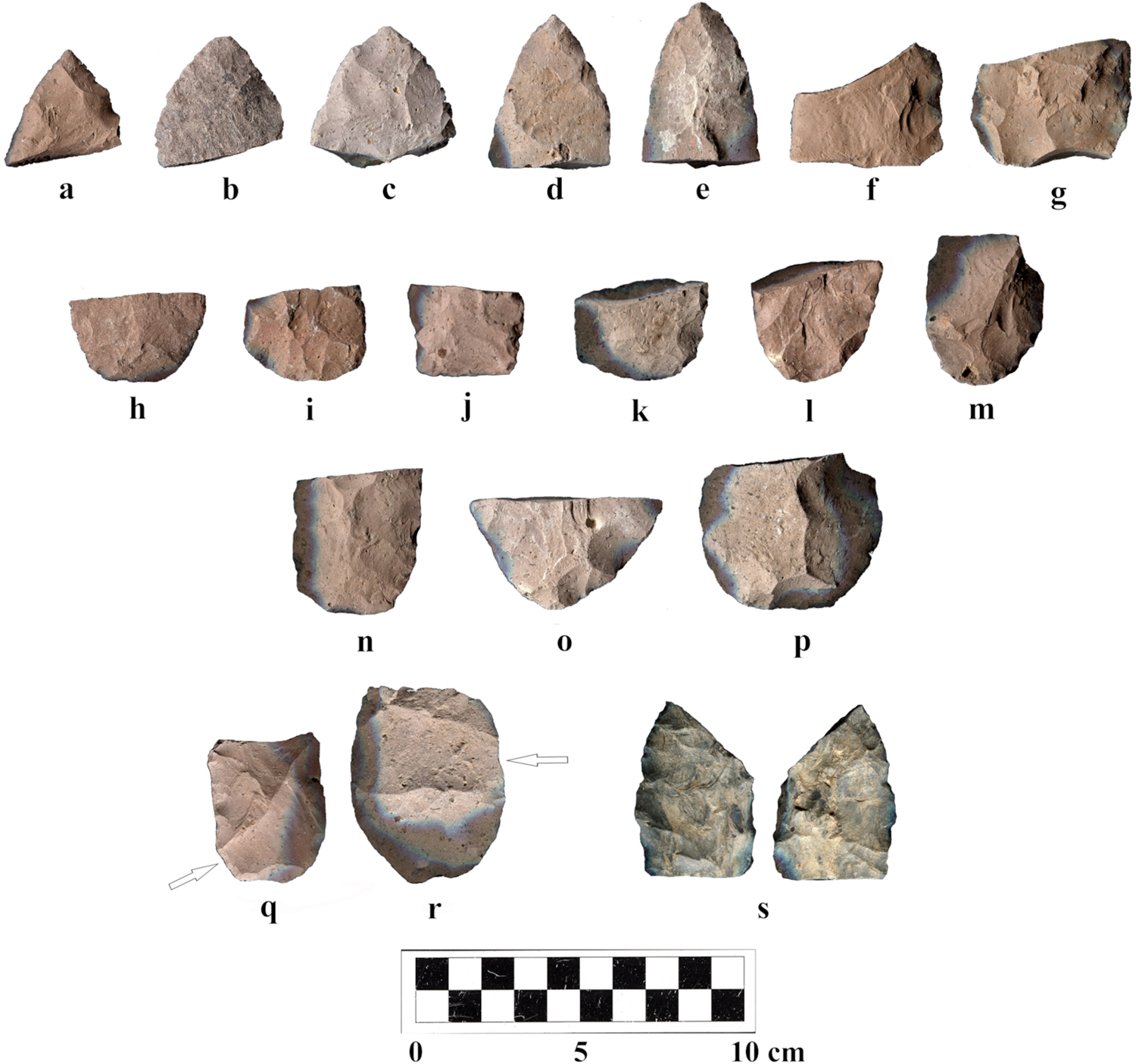
Although only four of these bifaces exhibit overshot flaking (Figure 3q–r), the rest were included in the Clovis assemblage due to their sizes and morphologies, which are comparable to those of some of the finished Clovis points and Clovis point preforms from the site (Supplemental Tables 1 and 3) and to Clovis secondary bifaces from El Bajío (Sánchez-Morales Reference Sánchez-Morales2018). Furthermore, no similar bifaces have been observed in other sites with Archaic lithic assemblages in the area, such as La Playa (Ochoa D'Aynés Reference Ochoa D'Aynés2004) and La Mona and La Hilareña (Martínez Ramírez Reference Martínez Ramírez2010), suggesting that these artifacts are less likely to be associated with the Archaic component of El Fin del Mundo (Sánchez-Morales Reference Sánchez-Morales2018).
Clovis Point Preforms/Fluted Secondary Bifaces
Ten bifaces have been classified as Clovis point preforms based on the presence of basal fluting on at least one face, dimensions comparable to those of the finished Clovis points (Supplemental Table 2), and, in some specimens, more regular edge morphology than secondary bifaces (Sánchez-Morales Reference Sánchez-Morales2018). However, they lack basal/lateral grinding, fine marginal retouch, and, in most cases, basal concavity characteristic of finished Clovis points. Nine of these fluted bifaces are basal fragments, and only one is a complete specimen broken into two fragments (Figure 4). Most of them (n = 6) were found in Localities 5 and 10.
Selected Clovis point preforms/fluted bifaces from El Fin del Mundo: (a–f) basal fragments of secondary bifaces that exhibit single fluting on only one face; (g) basal fragment of Clovis point preform that exhibits multiple fluting on both faces; (h) basal fragment of a possible unfluted Clovis point preform reworked on its distal end; (i) complete secondary biface displaying single fluting on only one face. Shading indicates the location and arrows indicate direction of a channel or overshot flake negative. Photographs by Ismael Sánchez-Morales. (Color online)
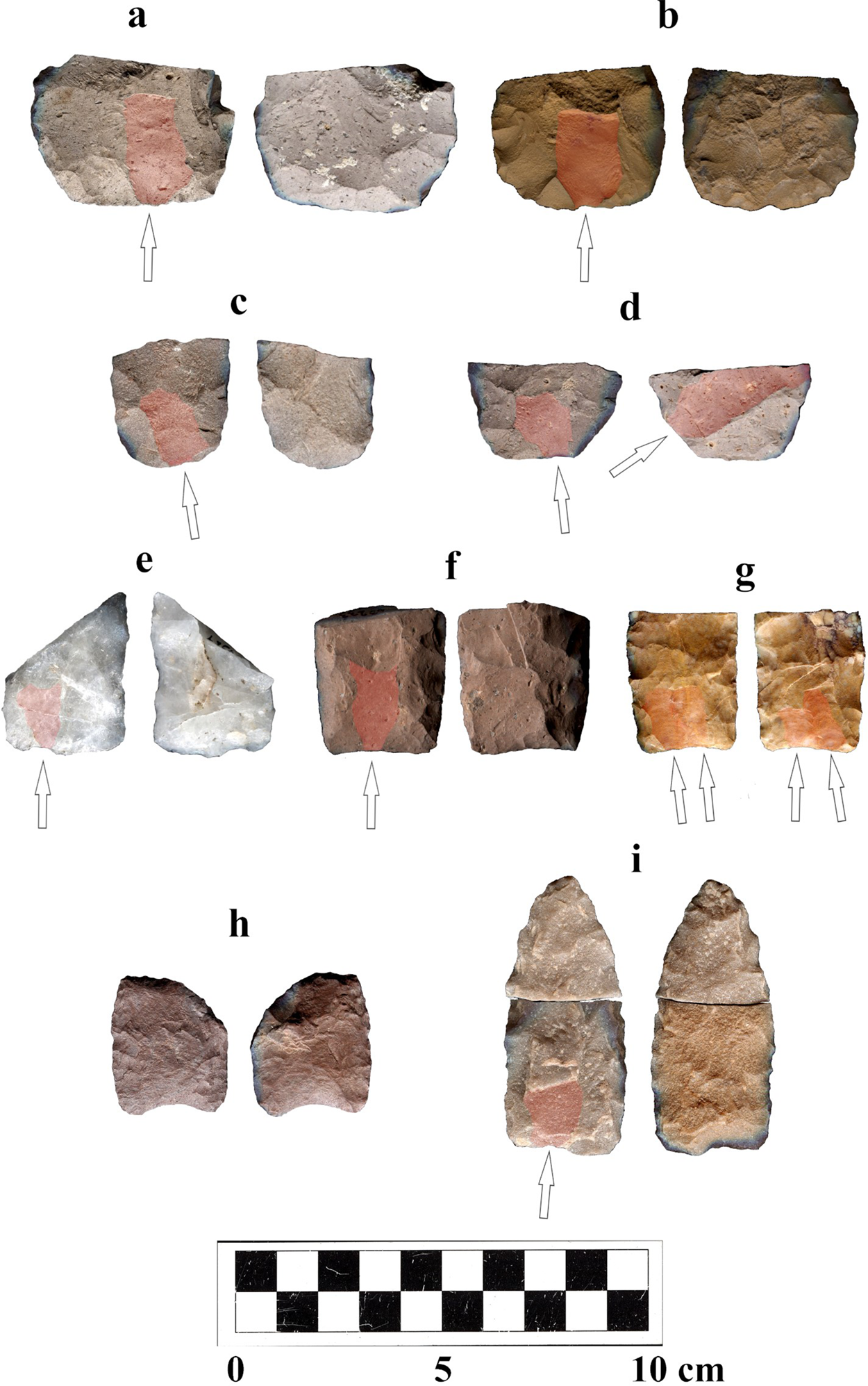
Four fluted bifaces made on rhyolite (Figure 4a, c, d, and f) exhibit basal thinning through a single channel flake on only one side. Only three of these specimens preserve the full length of the channel flake scar, and one (Figure 4d) exhibits overshot flaking. Another rhyolite biface is a possible basal fragment of a Clovis point preform (Figure 4h) that was reworked on its distal end. It broke diagonally around the mid-length of the body, and the resulting margin was retouched bifacially to create an asymmetrical convex edge.
Fluted bifaces made on jasper (Figure 4b), quartz (Figure 4e), and an unidentified igneous rock, probably dacite, exhibit a single flute on one face. The basal fragment of a preform made on chert (Figure 4g) exhibits multiple fluting on both faces, showing at least two channel flake scars on each side. It has a slightly concave base and straight lateral margins. The only complete Clovis point preform was made on quartzite (Figure 4i) and exhibits a transverse break. It displays a lanceolate morphology with an asymmetrical slightly concave base and shows a short channel flake scar on one face. The body has a thicker section toward its center on the same face as the flute. Apparent thinning of this thicker area of the body was intended through the detachment of flakes from the closest lateral margin, but the attempts were unsuccessful, terminating in step fractures.
Clovis Points
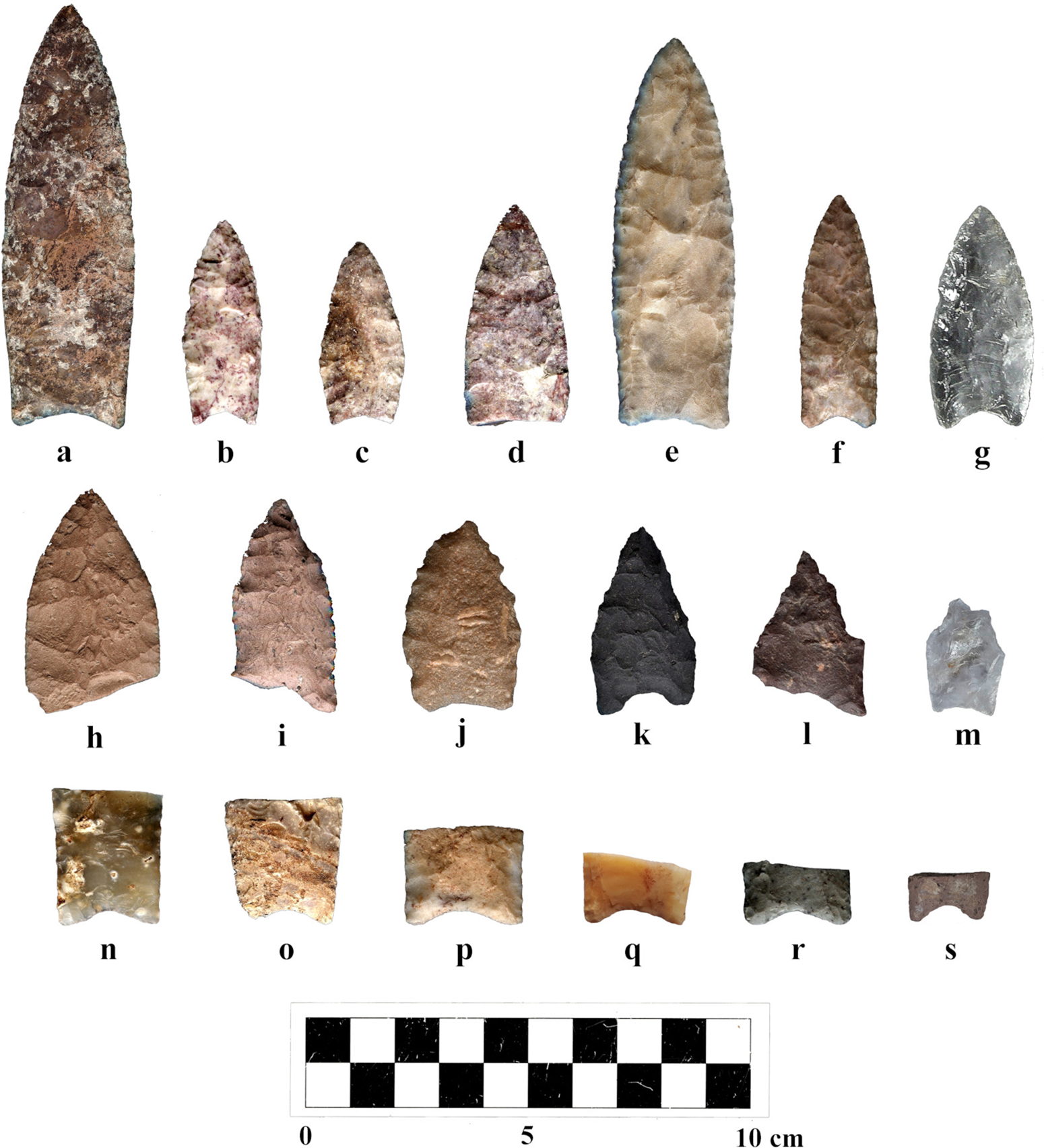
Nineteen whole and fragmentary Clovis points have been found at El Fin del Mundo (Figure 6). Seven points were recovered in Locality 1 (Figure 5a–g). Four of these were in direct association with the upper bone bed; of these, three are complete, and one is a distal fragment that exhibits a transverse snap break. The other three Clovis points from Locality 1 are complete specimens (Figure 6e–g). One was found in a bioturbated area of the excavation, and the other two were found on the surface in proximity to the landform.
Clovis points from El Fin del Mundo: (a–d) found in direct association with the bonebed in Locus 1; (e and g) found on the surface of Locus 1 near the excavated area; (f) found in a highly bioturbated context in Locus 1; (h–s) found on the surface of the upland campsite localities (modified from Sánchez-Morales Reference Sánchez-Morales2018:Figure 3). (Color online)
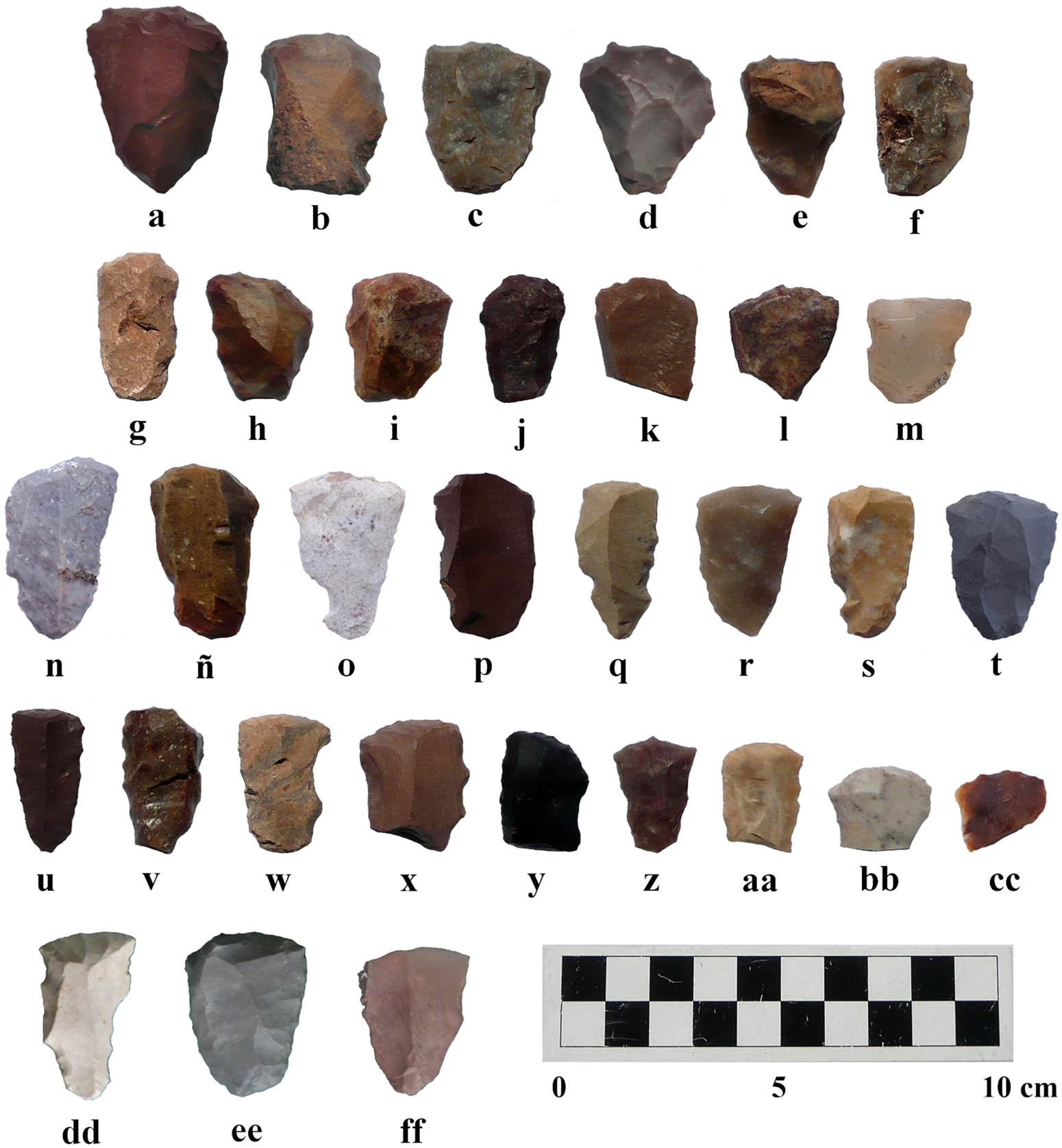
Clovis end scrapers from El Fin del Mundo: a–j, made on flakes; k–ff, made on blades. Scrapers k, l, and aa–cc are broken specimens (modified from Sánchez-Morales Reference Sánchez-Morales2018:Figure 4). (Color online)
All the Clovis points from Locality 1 exhibit fine retouch and symmetrical or nearly symmetrical bodies. Two are large (~9 cm long), finely made specimens (Figure 5a, e) that could be described as “classical Clovis”: they resemble in size and shape points from the San Pedro Valley (Huckell Reference Huckell, Vance Haynes and Bruce2007) and the Blackwater Draw site (Hester et al. Reference Hester, Lundelius and Fryxell1972). One of these large points (no. 63177) was found associated with the gomphothere bones, and the other one (no. 46023) was found on the surface a few meters to the south of the landform. The distal fragment associated with the bonebed (Figure 5d) probably belongs to a large point of similar dimensions, as indicated by its comparable width and thickness (Supplemental Table 3). The other two smaller points (< 5 cm long) also associated with the bonebed are probably reworked from distal fragments of larger points, as suggested by the width and thickness of their distal halves, which are comparable to those of the two complete large points (Supplemental Table 3), their low length-to-thickness (7.1:1 and 7.7:1) and low length-to-width ratios (2.1:1 and 2.5:1), and a high degree of basal tapering (Figure 5b and c).
The point found during the excavation of a bioturbated area is a complete small specimen (~5 cm long) that displays a fine and symmetrical outline with straight lateral margins and does not exhibit evidence of extensive resharpening, suggesting that it was made purposely smaller (Figure 5f). The remaining Clovis point from Locality 1 is made on clear quartz crystal and displays a short and wide body (Figure 5g). It was found during the inspection of the excavation units at the beginning of the 2008 field season on the surface of the north slope of the “island” and approximately 1 m from the north edge of the area excavated in 2007. It is likely that this point eroded out from a buried context in the upper bonebed between the 2007 and 2008 field seasons.
Twelve Clovis points were collected from the surface of the upland localities (Figure 5h–s). These include one distal and six basal fragments, four heavily refurbished points, and one point with a catastrophic impact fracture. The six proximal fragments exhibit transverse snap fractures nearly at 90° from the lateral margins (Figure 6n–s). The distal fragment exhibits a diagonal snap break and belongs to a large, finely retouched point (Figure 6h). The dimensions of this fragment suggest that the complete point was similar in size to the two largest complete specimens from Locality 1 (Supplemental Table 3). Given that the diagnostic elements of the base are not preserved in this specimen, its classification as Clovis was based on its dimensions, flaking pattern, fine craftsmanship, and morphology comparable to those of complete Clovis points from the site.
Four Clovis points from the upland localities are heavily refurbished and display very reduced distal halves. Two of these points (Figure 5k and l) display heavily refurbished distal portions that resulted in short and thick beveled bodies with irregular lateral margins. The other two heavily refurbished points are somewhat less reduced on their distal ends, and they are not beveled (Figure 5i and j). The last Clovis point from Locality 5 is a small proximal fragment that exhibits a complex fracture that probably resulted from a catastrophic impact, destroying the distal end and most of the medial section of the point (Figure 5m).
Chert was the raw material most often used in the manufacture of Clovis points (Table 2). Eleven points were made on chert, two of which were on the same variety (Figure 5e and p). The rest of the points were manufactured on rhyolite (n = 4), quartz crystal (n = 2), quartzite (n = 1), and an unidentified igneous rock, probably dacite (n = 1).
Uniface Mode
The uniface mode at El Fin del Mundo is represented by 33 end scrapers (Figure 6). Given that only diagnostic artifacts were collected from the surface during the systematic surveys, and because of the absence of unifacial tools in buried contexts of Clovis age at the site, the uniface mode includes only one artifact type. Assignment of these artifacts to the Clovis component of the site is based on the presence of features observed on end scrapers reported from several Clovis sites in different regions such as El Aigame and El Bajío in Sonora (Sanchez Reference Sanchez2016), Murray Springs in Arizona (Huckell Reference Huckell, Vance Haynes and Bruce2007), Gault in Texas (Waters et al. Reference Waters, Pevny and Carlson2011), and Paleo Crossing in Ohio (Eren and Redmond Reference Eren and Redmond2011). These features include the recurrent, though not exclusive, use of blades as blanks, small size, and the presence of gravers/spurs on one or both distal corners (Morrow Reference Morrow1997:71). The raw material was also considered, given that high-quality toolstones such as cherts are common among the Clovis points and blades from the site but are rare in the Archaic projectile point component (Sánchez-Morales Reference Sánchez-Morales2012).
Virtually all end scrapers from El Fin del Mundo were found in Locality 5, except for one recovered in Locality 8. Twenty-two were made on prismatic blades (Figure 6l–ff) and 11 on thick flakes with distally expanding lateral margins (Figure 6a–k). In almost all the specimens the bulb of percussion was removed through invasive flaking from one or both lateral margins (Sánchez-Morales Reference Sánchez-Morales2018). All exhibit fine abrupt or semi-abrupt marginal retouch on the distal end and a working edge angle that varies between 40° and 80°. Seventeen specimens also display continuous marginal retouch on one or both lateral margins (Sánchez-Morales Reference Sánchez-Morales2018). When retouch is present on the lateral margins, it is restricted to a section and is not on the full length of the edge; it is found most often on the distal half. Additionally, 19 specimens display a spur or short projection on one of their distal corners. Features suggestive of hafting are present in four scrapers that exhibit shallow notches on both lateral edges (Figure 6m, q, s, and dd) and on four others with a notch only on one lateral edge (Figure 6b, n, and o) on the proximal half.
Chert is the dominant raw material among end scrapers (81.8%; Table 2) with several varieties of this toolstone present in the collection. In fact, each chert end scraper is made on a different variety of chert, with the exception of two specimens made on the same variety. The remaining end scrapers were made on jasper, obsidian, and an unidentified raw material of sedimentary origin. The obsidian end scraper (Figure 6y) is the only diagnostic Clovis artifact made on this raw material recovered at the site.
Blade Mode
Blade production at El Fin del Mundo is represented by 52 blades classified into cortical (n = 5) and noncortical (n = 47). Additionally, 12 byproducts of blade manufacture have been recovered, including four blade-core platform rejuvenation tablet flakes, six crested blades, one wedge-shaped blade core, and one conical blade core (Figures 7 and 8). These materials were assigned to the Clovis assemblage based on the presence of technological features as described by Collins (Reference Collins1999:35–72), which include the production of “true” blades from conical and wedge-shaped cores, the preparation and detachment of crested blades to guide following detachments, and the rejuvenation of blade-core platforms through the detachment of tablet flakes. Additionally, the production of prismatic blades has not been documented in lithic assemblages from sites in the region with only Archaic or later components but is present at El Bajío (Sanchez Reference Sanchez2016) and Murray Springs (Huckell Reference Huckell, Vance Haynes and Bruce2007), suggesting that this technology is more likely associated with the Clovis occupation at El Fin del Mundo. More than half of the blade mode materials (51.6%) were collected from Locality 5, representing the entire blade production sequence.
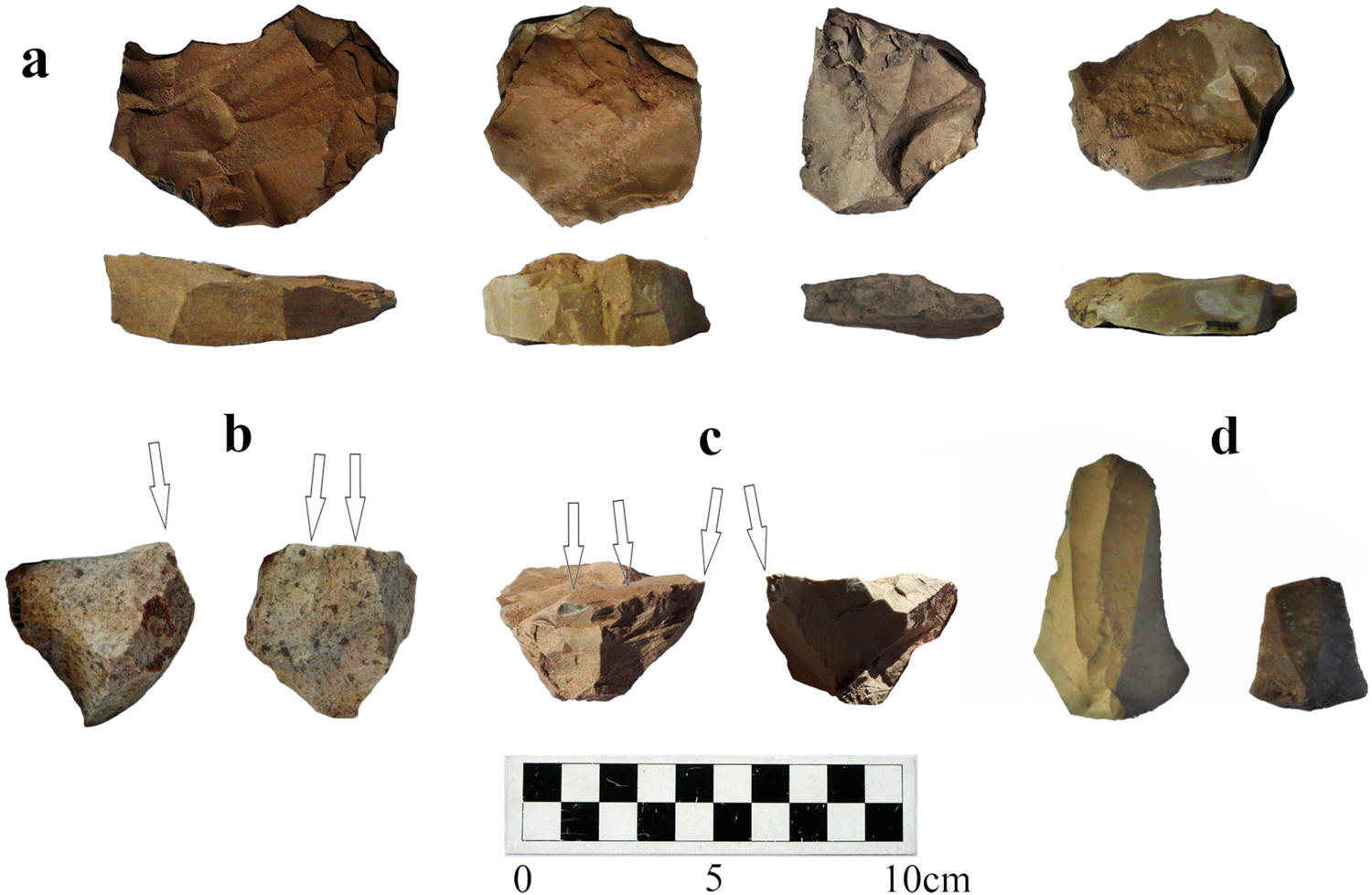
Blade manufacture byproducts: (a) blade-core rejuvenation tablet flakes; (b) wedge-shaped blade core; (c) exhausted conical blade core; (d) complete vitrified basalt blade from El Bajío (left) and distal fragment of quartzite blade from El Fin del Mundo (right). In both cases, the blade overpassed and removed the distal end of the core. Arrows indicate the location of the striking platform and direction of blade detachments. Photographs by Ismael Sánchez-Morales. (Color online)
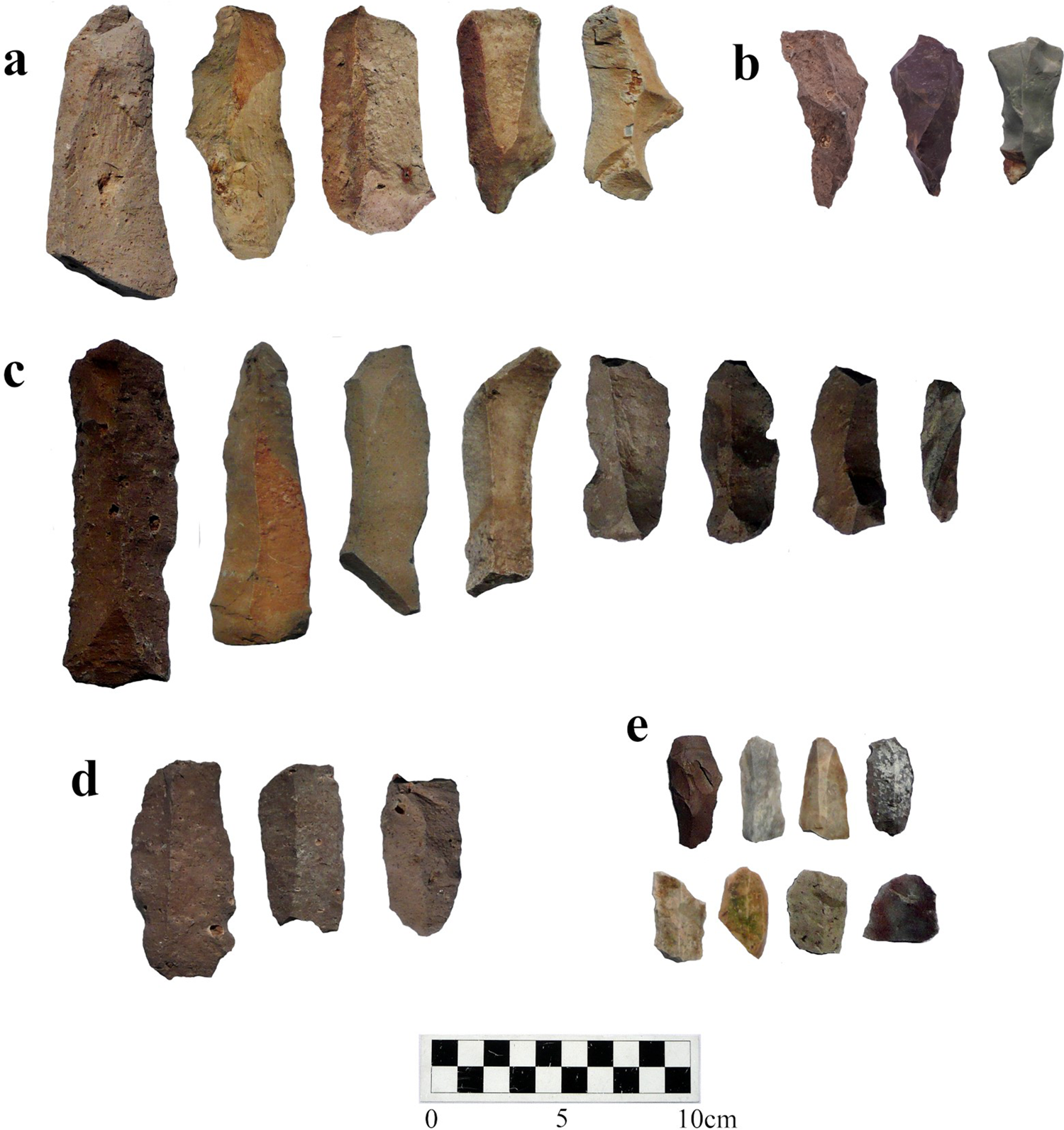
Selected blades from El Fin del Mundo: (a) complete and fragmentary rhyolite and quartzite cortical blades; (b) crested blades; (c) rhyolite and quartzite noncortical blades; (d) fragmentary rhyolite noncortical blades; (e) noncortical blades made on different varieties of chert (upper row are complete; lower row are fragments). Artifacts are oriented with the striking platform upward (modified from Sánchez-Morales Reference Sánchez-Morales2018:Figure 5). (Color online)
Rhyolite was the raw material most frequently used for blade production (34.4% of the blade mode). Chert (20.3%) and quartzite (20.3%) are also well represented among blades. Six artifacts (9.4%)—the only conical blade core, two tablet flakes, and three blades—were possibly made on vitrified basalt from El Bajío. The remaining blades were produced on other poorly represented raw materials (Table 2).
Wedge-Shaped Core
One wedge-shaped blade core made on yellow chert was collected from Locality 5 (Figure 7 b). Blades were obtained unidirectionally from only one face of the core, which exhibits four blade negatives. The core is small (~42 mm maximum dimension), and the angle between the platform and the last blade negatives on the exploited face is greater than 90°, suggesting that it was deemed exhausted and then discarded.
Conical Blade Core
One conical core made on vitrified basalt was found in Locality 5 (Figure 7c). The platform is relatively flat and semicircular in plan view. The dimensions and general shape of the platform are comparable to those of the blade-core rejuvenation tablet flakes also found in Locality 5. Blades were obtained in a unidirectional pattern, and four incomplete blade negatives are preserved. The core is short in lateral view and was likely discarded due to exhaustion, as suggested by its small dimensions (~52 mm maximum dimension), and the negatives of failed detachments ended in step fractures.
Blade-Core Rejuvenation Tablet Flakes
Four tablet flakes were identified in the collection, all of them from Locality 5 (Figure 7a). Two were detached from quartzite cores of the same yellowish-brown variety. The other two were detached from cores possibly made on vitrified basalt. All display plain platforms, prominent bulbs of percussion, and one convex multifaceted face that retains the negatives of blades and that covers approximately half the perimeter of the tablet.
Crested Blades
Six complete crested blades were collected at the site (Figure 8b): four made on rhyolite, one on jasper, and one on quartzite. Five of them exhibit plain platforms, triangular cross sections, and bifacial flaking, typical of the preparation of the crest on the core to produce the first blade and to set up the flaking face for subsequent blade detachments.
Cortical Blades
Five cortical blades—two made on quartzite, one on rhyolite, and two more on unidentified raw materials of sedimentary origin—were found in the upland localities. These blades exhibit cortex on about 25%–50% of their dorsal face and at least one negative of a previous blade detachment on their dorsal surface (Figure 8a).
Noncortical Blades
This category includes 47 blades, of which 26 are complete, 4 are semi-complete, and 17 are fragmentary (Figure 8c–e). Most were found in Locality 5 (n = 24) and 25 (n = 11). All specimens display at least two parallel unidirectional facets or negatives of previous blade detachments and triangular or trapezoidal cross sections; most have a plain platform. One distal fragment of a large prismatic blade made on quartzite distally overpassed the core and completely removed the core's distal end (Figure 7d). Similar examples of overpassed Clovis prismatic blades have been documented at El Bajío (Sanchez Reference Sanchez2016). Most noncortical blades were made on rhyolite (n = 17), chert (n = 12), and quartzite (n = 8). Additionally, three were possibly made on vitrified basalt. The other seven noncortical blades were made on other rare raw materials (Table 2).
Raw Materials
The Clovis lithic assemblage is largely dominated by rhyolite (35.3% of total assemblage) and chert (34.7%). Rhyolite is the most common raw material among bifaces and blades, representing more than half of the biface mode (Table 2). It is naturally abundant at the site and can be found in the primary source at Locality 25 and as cobbles in the nearby arroyos and riverbeds. Chert is most common among end scrapers, representing more than 80% of them, and is the second-most represented raw material in the biface and blade modes. Primary sources of chert are unknown in the region, and no secondary sources of this material were identified during the systematic surveys of the site area. Thus, we consider chert to be an exogenous toolstone. Geological maps indicate that the closest concentrations of limestone are present about 40 km to the southeast (González-León and Moreno-Hurtado Reference González-León and Moreno-Hurtado2021) in the region between El Fin del Mundo and El Bajío. Therefore, potentially undiscovered chert sources could be present in this area. Quartzite is the third most common raw material in the assemblage and is most often found among blades (Table 2). Quartzite is locally available in the form of cobbles that can be found in the nearby arroyos and riverbeds.
Other raw materials present in the assemblage, although poorly represented, include jasper, dacite, quartz crystal, quartz, and obsidian (Table 2). All these rocks are locally available, except for obsidian, which is an exogenous raw material of unknown provenance. Additionally, quartz crystal and white quartz can be found along a quartz vein that outcrops ~5 km southwest of the site and continues for approximately 2 km, reaching a nearby hill known as El Cerro del Cuarzo, 6.8 km to the southwest (Sánchez-Morales Reference Sánchez-Morales2018). Lastly, it is also possible that vitrified basalt from El Bajío is present at El Fin del Mundo, raising the possibility of links between the two sites.
Discussion
The Clovis lithic assemblage from El Fin del Mundo is one of the largest collections of early Paleoindian stone tools recovered in Mexico, second only to the collection from El Bajío (Sanchez Reference Sanchez2016), also in Sonora. The three technological modes in this assemblage—bifaces, unifaces, and blades—represent stone tool manufacture strategies observed in other Clovis sites such as El Bajío and El Aigame in Sonora (Sanchez Reference Sanchez2016), Murray Springs in Arizona (Huckell Reference Huckell, Vance Haynes and Bruce2007), Blackwater Draw in New Mexico (Hester et al.Reference Hester, Lundelius and Fryxell1972), Paleo Crossing in Ohio (Eren and Redmon Reference Eren and Redmond2011; Miller Reference Miller2013), and Gault in Texas (Bradley et al. Reference Bradley, Collins and Hemmings2010; Waters et al. Reference Waters, Pevny and Carlson2011).
Generally, the numerous complete and fragmentary bifaces showing evidence of different stages of the reduction process from blank preparation to finished, highly reduced, and discarded Clovis points conform to the idea that biface production was the mainstay of Clovis lithic technology (Huckell Reference Huckell, Vance Haynes and Bruce2007). The lack of primary bifaces and biface reduction debitage in the Clovis assemblage from the site is due to a biased field collection strategy that focused only on artifacts with diagnostic technological and typological features. However, five complete and fragmentary primary bifaces, mostly made on rhyolite, were collected from Locality 5 during the first field season at the site and could potentially be part of the Clovis assemblage.
The production of blades also appears to have been a major element of Clovis lithic technology at the site, as indicated by the abundant products and byproducts of this technological mode recovered from the upland localities. In fact, Clovis blade production is very well represented regionally in north-central Sonora: numerous blades, blade cores, and blade production byproducts have been reported from El Bajío (Sanchez Reference Sanchez2016).
The large number of end scrapers from the upland localities at El Fin del Mundo indicates that Clovis foragers relied heavily on these implements. End scrapers have also been found in large quantities in other sites with Clovis components in Sonora such as El Aigame (n = 40) and El Bajío (n =30; Gaines et al. Reference Gaines, Sánchez and Holliday2009; Sanchez Reference Sanchez2016). Additionally, four end scrapers were recovered during the excavation of the Clovis campsite at Murray Springs in the San Pedro Valley (Huckell Reference Huckell, Vance Haynes and Bruce2007), indicating that they were widespread implements in the Clovis tool kit of the region. The presence of these artifacts in a buried Clovis context at Murray Springs strengthens the association of the specimens found in El Fin del Mundo with the Clovis component of the site.
Exploitation of locally available raw materials is indicated by the dominance of rhyolite in the assemblage, which represents about 35% of the Clovis stone tools from the site. It has been suggested that the Clovis groups that inhabited north-central Sonora developed raw material exploitation strategies characterized by high utilization of lower-quality but locally available toolstones of igneous origin, reflected by the predominance of rocks such as rhyolite, basalt, and dacite in the Clovis point collection from the region (Gaines et al. Reference Gaines, Sánchez and Holliday2009; Sanchez Reference Sanchez2016). This strategy, which focused on locally available resources, contrasts with characterizations of Clovis groups in the United States that reflect high dependence on high-quality, cryptocrystalline raw materials of exogenous origins (Goodyear Reference Goodyear1979; Huckell Reference Huckell, Vance Haynes and Bruce2007; Kelly and Todd Reference Kelly and Todd1988). However, at El Fin del Mundo, exogenous chert constitutes the second most common raw material in the Clovis assemblage at virtually the same proportion as the local rhyolite (34.7% and 35.3%, respectively). Additionally, there is a striking predominance of chert in the Clovis point and end scraper collections from the site. Other exogenous raw materials of high flaking quality present at El Fin del Mundo include vitrified basalt and obsidian. Together, the exogenous high-quality toolstones represent 40% of the total lithic assemblage (Table 2). The large number of artifacts made of rhyolite is logical, because the source of this raw material is located in the site. The diversity of chert varieties observed in the collection is also potentially significant because it suggests that these artifacts were made in different places, carried, and eventually deposited at the site. These patterns are suggestive of wide-ranging, highly mobile strategies consistent with the characterization of Clovis groups from the San Pedro River Valley (Huckell Reference Huckell, Vance Haynes and Bruce2007).
Interpretations of Utilization and Links among Localities
The occurrence of Clovis points in Localities 1, 5, 8, 9, and 10 at El Fin del Mundo is evidence that Clovis foragers occupied the wetland environment that existed at the site during the terminal Pleistocene, as well as the surrounding uplands. The presence of bifaces and blades displaying Clovis technological features in virtually all the localities in the uplands further supports use of the areas surrounding Locality 1 by Clovis groups (Figure 2). The contemporaneity of these occupations cannot be unequivocally determined because no artifact refits were found between Locality 1 and any of the camp localities. However, use of the same unusual chert variety for one of the complete Clovis points from Locality 1 (Figure 5e) and one of the basal fragments from Locality 5 (Figure 5p) suggests occupations of the wetland in Locality 1 and the uplands by groups of foragers using the same sources of exogenous raw materials for tool making.
Rhyolite is abundant in the Clovis assemblage from El Fin del Mundo, but because it is present in the Archaic component as well (Sánchez-Morales Reference Sánchez-Morales2012), its occurrence cannot be used as evidence of linkage between localities. However, the outcrop in Locality 25 is the only area of the site from which rhyolite blocks big enough to produce large blanks for bifaces can be obtained. One of the Clovis points from Locality 1 (no. 63177), one of the Clovis points from Locality 5 (no. 63983), the Clovis point from Locality 9 (no. 59727), and other bifaces (22 secondary bifaces and five Clovis point preforms) were manufactured on this local rhyolite. This suggests a possible linkage between Locality 25, the rhyolite outcrop, and Locality 1 and the surrounding uplands.
Clovis groups have been traditionally characterized as wide-ranging, highly mobile foragers, setting up residential camps in known locations with access to natural resources including game and lithic raw materials, and using these locations in a short-term and redundant fashion (Kelly and Todd Reference Kelly and Todd1988). A wide range of activities would be expected at these residential sites, including resource processing and stone tool manufacture, maintenance, and discard (Binford Reference Binford1980). Several lines of evidence indicate that Localities 5 and 10 contain a Clovis residential camp or an accumulation of campsites with stone tool manufacture stations. Locality 5 contains the highest density of Clovis stone tools in the site, and it is the only area where all three technological modes are represented. Locality 10 is an extension of Locality 5 to the northeast and contains the second densest concentration of Clovis artifacts comprising bifaces and blades. Taken together, Localities 5 and 10 represent the core area of the Clovis occupation or episodes of occupation in the uplands (Figure 2).
The lithic component from these localities includes fragmentary, damaged, and heavily reworked Clovis points; broken Clovis point preforms; fragments of secondary bifaces; complete and fragmentary blades; blade production byproducts; and end scrapers. Implements that are not usable anymore due to breakage or exhaustion are often replaced and thrown away at campsites and at lithic workshops during retooling episodes (Walthall and Holley Reference Walthall and Holley1997). Taken together, the unfinished bifaces in various stages of the manufacturing process, discarded bifacial implements due to use wear or breakage, and tool breakage due to production failure are suggestive of biface production at these localities. Blade production is also indicated by blades and the exhausted wedge-shaped and conical cores, blade-core rejuvenation tablet flakes, crested blades, and numerous blades and blade fragments. This lithic assemblage suggests the presence of lithic workshops or knapping stations. However, the possibility of identifying discrete activity areas in these localities is hindered by the surface nature of the assemblage, the lack of buried contexts in the uplands, and the likely movement and mixing of archaeological materials through several episodes of burial and exposure. This conclusion is supported by the preliminary results of the spatial analysis of the Clovis stone tools and the Archaic projectile points from Locality 5, which indicate that no significant spatial patterning is discernible between both Clovis end scrapers and other Clovis tool types, and Clovis stone tools and Archaic projectile points (Allaun Reference Allaun2019).
More evidence of Clovis campsites in the uplands is provided by the numerous end scrapers recovered in these areas. Ethnographic and use-wear studies indicate that end scrapers were typically employed in hide working (Shott Reference Shott1995; Walthall and Holley Reference Walthall and Holley1997), which has been shown to be often carried out by women (Ruth Reference Ruth2013); the end scrapers’ presence is suggestive of nonhunting activities related to domestic tasks. Virtually all the end scrapers from El Fin del Mundo were found scattered in the central portion of Locality 5, suggesting that domestic activities were performed in this place. The presence of these artifacts, the variability of tool types, the fact that several tools seem to have been discarded due to manufacture breakage or exhaustion, and the high density of materials suggest that Localities 5 and 10 represent an aggregation of campsites near the wetland environment in Locality 1, where water and animal resources could be found close to the rhyolite source in Locality 25.
The rhyolite outcrop in Locality 25 contains large blocks of this raw material and thousands of pieces of lithic production debris on the surface. This rhyolite was used to manufacture Clovis bifaces and blades. However, the only artifacts of likely Clovis affiliation found in this locality are 12 blades, which were scattered across the area. Given the absence of cores, secondary bifaces, and finished Clovis points, it is possible that only the early stages of the manufacture process, such as the preparation of cores and blanks for transport, were carried out here. As for the other localities in the uplands, the quantity of Clovis materials recovered from them is too small to make any interpretations about the nature of these areas. Because of their location and proximity to Localities 5 and 10, they likely represent peripheral zones of the core area of the Clovis campsite in the uplands.
The lack of buried contexts in the uplands and the likelihood that lithic materials on the surface may have gone through several episodes of redeposition hinder some of our interpretations. For example, although the expansive area of the site and the great number of artifacts point to multiple occupational episodes, it is not possible to determine from our analysis whether the Clovis lithic component from El Fin del Mundo is the product of short-term, repeated use or resulted from a fewer number of long-term occupations. The undifferentiated scattering of artifacts on the surface and their mixture with materials from later periods could lead to biased interpretations related to the duration of the Clovis occupation of the site. Additionally, the identification of other elements of the Clovis stone tool component such as biface and uniface reduction flakes or any other artifacts that are not considered diagnostic is extremely difficult. A study based on technological features and raw materials of debitage and nondiagnostic tools on the surface could provide insights into their possible association with the Clovis assemblage from the site. However, this type of study would require large amounts of time in the field and in the laboratory, which is not practical given the funding and fieldwork time limitations of the project.
In a regional context, El Fin del Mundo is similar to other reported Clovis sites across the greater Southwest in having a megafauna kill in a stream, lake, or wetland setting (e.g., Haynes and Huckell Reference Haynes and Huckell2007). But it is distinctive in the Clovis record of Sonora and Arizona because most of the Clovis sites in the San Pedro River Valley, except for Lehner and Murray Springs, resulted from short-term, single events: the hunting and possible butchering of large game (Haury et al. Reference Haury, Sayles and Wasley1959; Haynes Reference Haynes, Haynes and Huckell2007; Hemmings Reference Hemmings, Haynes and Huckell2007). Murray Springs is the only site in Arizona that has yielded a lithic component comparable in size and tool type diversity to that identified at El Fin del Mundo. At the same time, El Fin del Mundo and Murray Springs contain a rare association of a Clovis megafauna kill in a wetland environment with a campsite in nearby uplands (Sánchez-Morales Reference Sánchez-Morales2015, Reference Sánchez-Morales2018). These sites offer the possibility of evaluating Clovis land-use strategies related to long-term or repeated use of one area. Results of the comparative analyses of the lithic technology and the land-use patterns from El Fin del Mundo and the San Pedro River Valley are in preparation for publication (Sánchez-Morales Reference Sánchez-Morales2015).
Conclusions
El Fin del Mundo has produced one of the largest assemblages of Clovis stone tools in Mexico. Most of the stone tools were recovered from surface scatters of lithic materials in uplands surrounding an in situ Clovis gomphothere kill. Technological and typological features of the lithic artifacts point to a large Clovis lithic assemblage that includes multiple bifaces, end scrapers, and blades, despite the undifferentiated scattering of artifacts on the surface and their mixture with materials from later periods. The Clovis occupation of the uplands concentrated around Localities 5 and 10 represents a campsite or an aggregation of campsites where stone tool production and possibly other domestic tasks took place. This is reflected in the large numbers of Clovis diagnostic materials representing different stages of the manufacture process of bifaces and blades; broken, exhausted, and refurbished artifacts; and tool types thought to be related to domestic tasks such as end scrapers. The contemporaneity of the kill and the campsite, however, cannot be established because no buried contexts that could provide dates have been found in the uplands and no stone tool refits linking both the kill and the camp have been identified. The assemblage is equally dominated by locally available rhyolite and exogenous varieties of chert. It appears that at El Fin del Mundo Clovis groups relied greatly on high-quality exogenous lithic raw materials and took advantage of lower-quality toolstones when they were available near campsites and hunting locations, patterns that are suggestive of high mobility. The configuration of the site characterized by a megafauna kill in a wetland environment and a campsite in the surrounding uplands indicates that Clovis groups in the region set up camps in elevated terrain near locations where water, animals, and lithic raw materials were readily available.
Future studies such as comparative analyses of lithic technology and land-use patterns at local and regional scales are necessary for a complete understanding of Clovis adaptations to the Pleistocene Sonoran landscape. El Fin del Mundo offers a unique opportunity to explore these questions because it contains a rare association of a megafauna kill and a campsite with numerous lithic artifacts reflecting multiple aspects of Clovis land use.
Acknowledgments
We would like to thank Kayla Worthey and Steven Kuhn for their comments on the original manuscript. We are grateful to Centro INAH Sonora in Hermosillo for granting access to facilities to conduct data analysis of the lithics. Raw material identifications of some artifacts were performed with the assistance of geologist Alejandra Gómez. This research was financially supported by the Argonaut Archaeological Research Fund (University of Arizona Foundation); the Traditions, Transitions, and Treasures scholarship (School of Anthropology, University of Arizona); and the 2015 SEP Beca Complemento (Secretaría de Educación Pública, Mexico). No permit was required to conduct this research.
Data Availability Statement
Tables containing the metric, technological, and qualitative information of the Clovis secondary bifaces, the Clovis point preforms, and the Clovis points from El Fin del Mundo are available as supplemental material. Databases containing this information for the rest of the lithics included in this research are available on request from the corresponding author. Field records and notes are available at Centro INAH Sonora, in Hermosillo, or on request from I. Sánchez-Morales and G. Sanchez.
Supplemental Material
For supplemental material accompanying this article, visit https://doi.org/10.1017/aaq.2022.2.
Supplemental Table 1. Attributes of Clovis Secondary Bifaces from El Fin del Mundo.
Supplemental Table 2. Attributes of Clovis Point Preforms/Fluted Bifaces from El Fin del Mundo.
Supplemental Table 3. Attributes of Clovis Points from El Fin del Mundo.


 Open access

