

The past is a popular place to play, and an increasing number of scholars have recognized the many intersections between games and archaeology (Ariese et al. Reference Ariese, Boom, van den Hout, Mol and Politopoulos2021; Mol et al. Reference Mol, Ariese-Vandemeulebroucke, Boom and Politopoulos2017; Reinhard Reference Reinhard2018, Reference Reinhard2024; Snyder Reference Snyder2022). There has been particular interest in how archaeology is portrayed in the narratives, mechanics, and character designs of games, as well as how this may influence the way our discipline is perceived by a wider public (Landa and Thompson Reference Landa and Thompson2023; Ploetz Reference Ploetz2023; Winter Reference Winter2021). While many see the faulty representations of archaeology as a teaching moment or a net positive for the popularity of our field, there are still concerns that inaccuracies, stereotypes, and common game mechanics can contribute to perpetuating colonial logic and harmful pseudoarchaeology themes (Martino Reference Martino2021; Mochocki Reference Mochocki2024; Mukherjee Reference Mukherjee2017; Reinhard Reference Reinhard2024; Thompson Reference Thompson2024).
One suggestion for addressing these issues has been for archaeologists to create their own games or offer their expertise as consultants (Rassalle Reference Rassalle2021). There are many cases of historians and heritage experts acting as topic consultants, as well as discussions of personal experiences, consultancy as a potential career path, specialized courses within programs, and the degree of influence consultants can have on a product (Mochocki and Kot Reference Mochocki and Kot2024a, Reference Mochocki and Kot2024b). The Assassin’s Creed franchise is a popular case to focus on, as Ubisoft has gone to great lengths to include scholars and specialists in their development process (Fillari Reference Fillari2024; Poiron Reference Poiron2021). However, historical consultants are largely brought in to improve or approve specific details, such as timelines or period-appropriate dress, architecture, and weaponry, rather than speak to the nuances of representing past cultures in present-day contexts.
Based on the above trends, archaeological games consultation runs the risk of focusing on fact-checking about past societies and current research practices. For this brief review, I want to emphasize that we should be equally (or more) concerned with how the “archaeological subject” is incorporated into games, which is in line with Mochocki and Kot’s (Reference Mochocki and Kot2024a) observation that historical consultants are increasingly responsible for flagging larger issues with biases and stereotypes. Ancient societies have long been popular in games, but they are often reduced to ethnic set-dressing and caricatures that normalize colonial worldviews. The harm this can do to descendant communities will not be properly addressed by focusing on accuracy, a concept that has already been questioned (Chapman Reference Chapman2016; Copplestone Reference Copplestone2017; Shaw Reference Shaw2015). Thus, a serious consideration of archaeological games consultation requires that we discuss what this labor entails and who should be involved. To begin, I offer my experiences as an early-career academic archaeologist working as a cultural consultant within the tabletop games industry. My goal is to provide insight into how games are made and what to consider if you are approached about consulting.
Fun and Labor: Consulting in the Games Industry
My first step into the world of cultural consultation came in 2020, during the height of the COVID-19 lockdown in Ontario. I was asked by a friend from grad school if I was interested in doing a recorded livestream reading of The Legend of the Five Rings rulebook, a well-known fantasy franchise heavily inspired by Japanese history. Over a span of 40 hours, I joined a team of Asian-identifying game enthusiasts, creators, and scholars from the Asians Represent! media group to critically comment on the representation of Japanese culture and society in the game, particularly from my perspective as a Nikkei scholar with expertise in the Japanese past. I saw this series as not only something fun to do with friends, but as a form of public engagement many academics are currently looking to do. I did not expect it to blossom into paid work; nor did I know just how much support many game products truly needed.
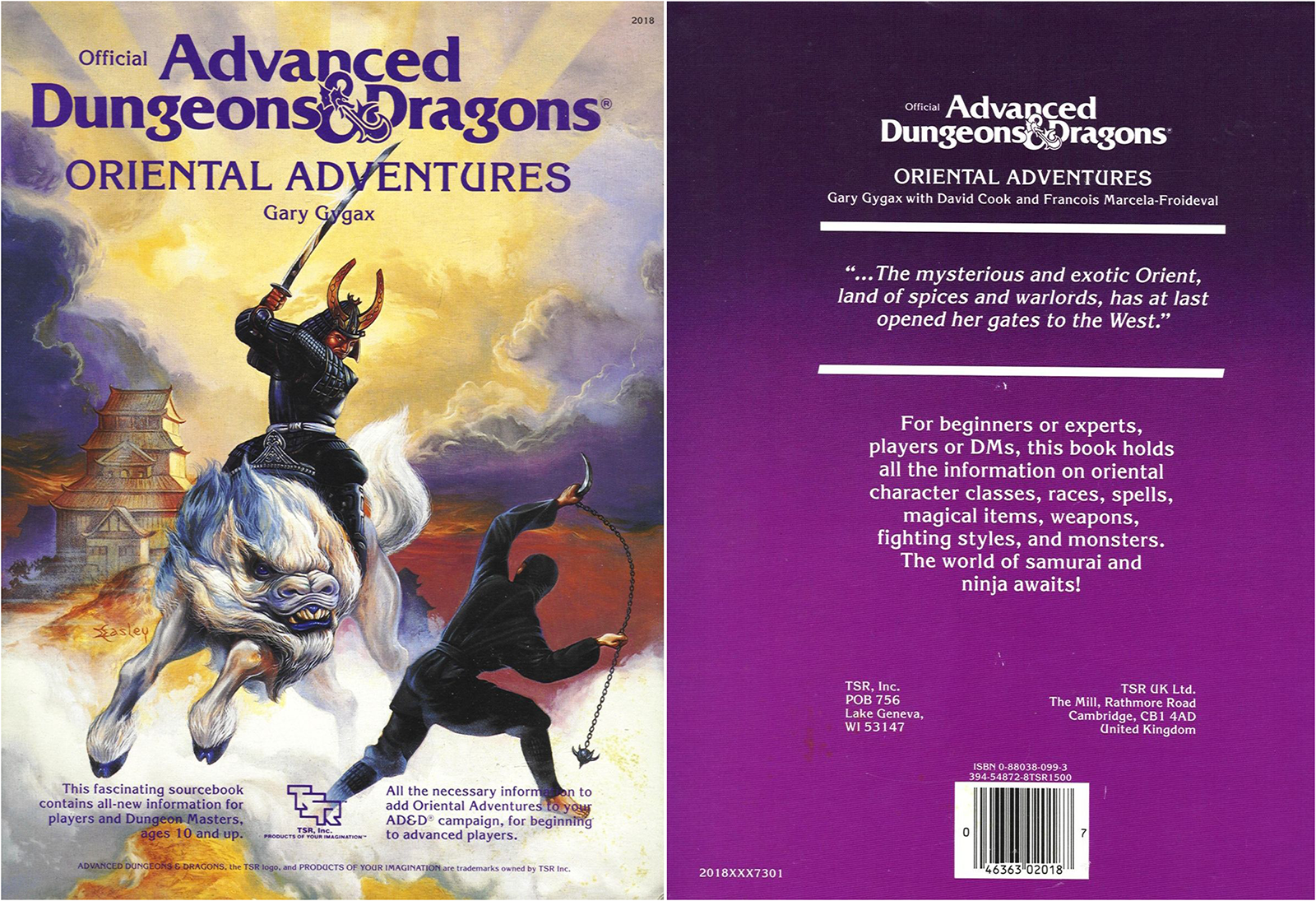
I now have six years of experience as a cultural consultant and freelancer in the tabletop games industry, working on everything from small, solo projects to large-scale game productions. But you are likely wondering, what exactly is a cultural consultant? While there are differing definitions, the general understanding is that they are someone who identifies as a member of a culture, society, or socially defined group that is being depicted or used as inspiration within a product. This differs from a more classic consultant, who is likely someone with topic expertise but no lived experience with the identities being portrayed. This is how we get Japan-inspired games with a high level of detail about samurai armor and weapons, but little consideration of how samurai tropes in Western media carry a heavy legacy of prejudice against Japanese people (Figure 1). While perpetuating stereotypes is typically not the goal of game creators and topic-based consultants, many have not experienced the histories of harm directly and simply do not know better.
Oriental Adventures was published by TSR in 1985; the franchise is now owned by Wizards of the Coast.

Figure 1 Long description
The image shows the front and back cover of the book 'Advanced Dungeons and Dragons: Oriental Adventures' by Gary Gygax. The front cover features a fantasy illustration of a warrior riding a horned creature against a swirling sky. The title 'Advanced Dungeons and Dragons' is prominently displayed at the top, with 'Oriental Adventures' below it. The author's name, Gary Gygax, is also visible. The back cover contains text describing the book's content: 'The mysterious and exotic Orient, land of spices and warlords, has at last opened her gates to the West.' It highlights the book's focus on oriental character classes, races, spells and more for players and dungeon masters. The text emphasizes the allure of the Orient and the world of samurai and ninja. The layout is a front-and-back cover spread, with the illustration on the left and text on the right, creating a fantasy and adventure tone.
My contracts have involved many tasks, such as narrative writing, text and art reviewing, creative development, asset building, concept and content advising, resource collecting, producing contributor guidelines, and giving feedback on game mechanics. Each contract has been unique, since the games industry does not yet have a standard consultation process. In some cases, I have been asked to evaluate games that have already been released, but it is increasingly common for consultants to be brought in during the earlier production stages. A few times, I have been contacted when developers only have a premise, but more often I receive access to incomplete drafts that need direction before further development. A contract can range between 30 minutes to multiple years; you may review a single paragraph or contribute to the ongoing creative process. On average, my contracts have taken 10–12 hours of focused work, including communication with project leads. For tabletop roleplaying games, it is common for an adventure module, world setting, or core rulebook to be between 100 and 300 pages once art and layout are complete, so academic reading skills certainly come in handy.
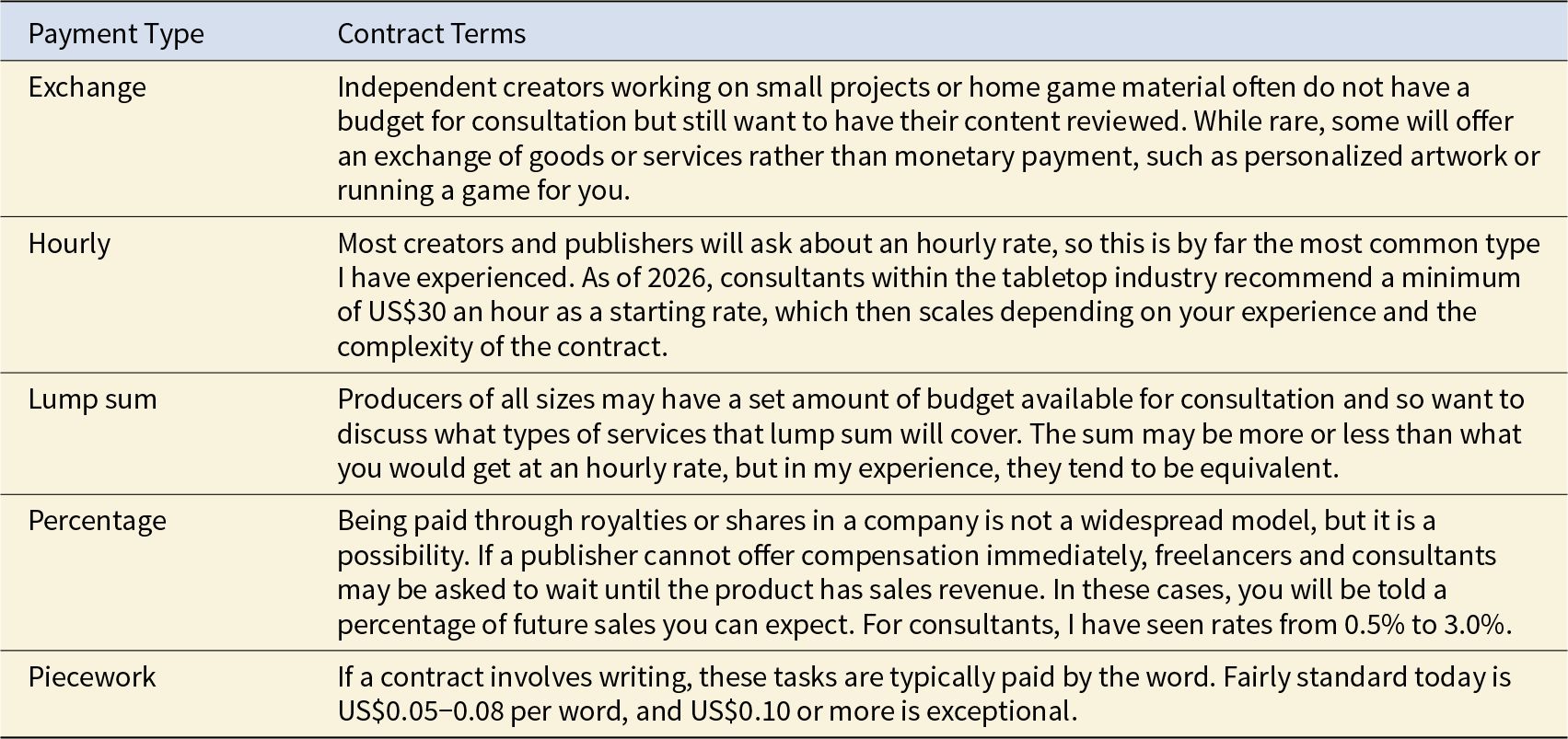
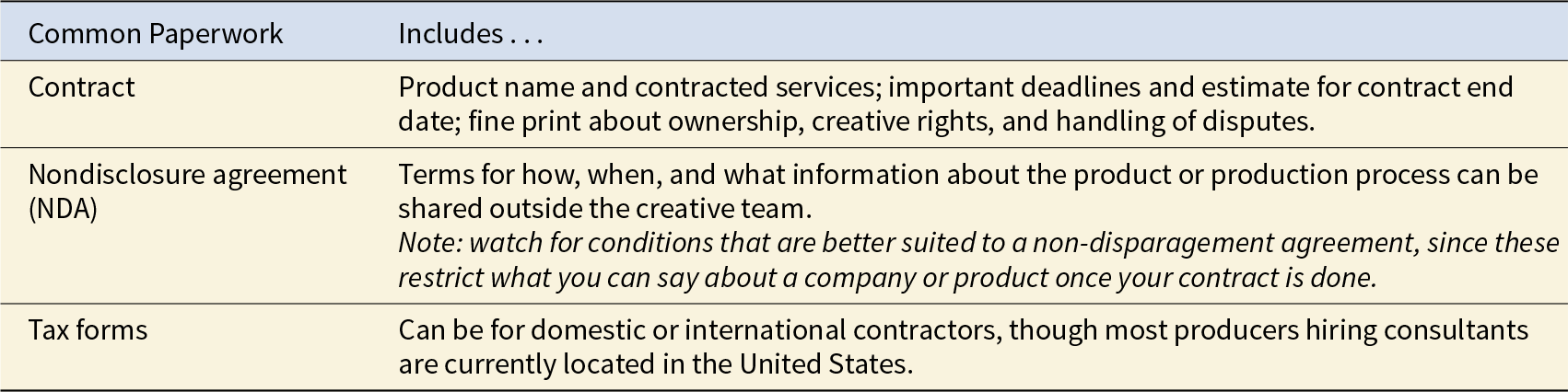
Since projects are quite diverse, compensation rates and payment methods are highly variable. Table 1 outlines the types of payment and contracts currently offered, as well as a general sense of how common they are today. Despite the different tasks and payment methods, there are fairly standard forms to complete before working with publishers or companies (Table 2). Project leads will give me a brief description to gauge my interest, but the game itself will only be shared once paperwork has been signed. Be aware that anything offered or created while under contract is no longer your intellectual property, and production companies are not obligated to attribute specific ideas to those who proposed them. This is one of the many things I have learned throughout the years.
Types of Payment in the Tabletop Games Industry as of 2026.

Table 1 Long description
The table summarizes common payment models for tabletop games consulting and the typical contract terms associated with each. Hourly billing is described as the most common approach, with an industry-recommended minimum starting rate of about US$30 per hour in 2026, increasing with experience and contract complexity. Lump-sum agreements are also common when a producer has a fixed budget, and the total often ends up roughly comparable to what hourly billing would yield. Exchange arrangements are noted as rare and usually occur with small or independent creators who may offer non-monetary compensation such as artwork or running a game. Percentage-based compensation (royalties or company shares) is uncommon and may require waiting for sales revenue; example consultant rates range from 0.5% to 3.0% of future sales. Piecework is tied to writing output and is typically paid per word, commonly around US$0.05–0.08 per word, with US$0.10+ per word described as exceptional. The figures are presented as typical recommendations or observed ranges rather than guaranteed rates, and actual terms can vary by project scope and negotiation.
Common Paperwork Completed before Starting a Consultation Contract.

Table 2 Long description
The table lists common paperwork completed before beginning a consultation contract and summarizes what each document typically includes. A contract covers the product name, contracted services, key deadlines, an estimated end date, and fine print on ownership, creative rights, and dispute handling. A non-disclosure agreement (NDA) sets rules for what information about the product or production process can be shared outside the creative team, and it cautions that some clauses may function more like non-disparagement restrictions after the work ends. Tax forms address payment and reporting needs for contractors, whether domestic or international, with a note that many producers hiring consultants are currently based in the United States. The entries describe typical contents rather than exhaustive legal requirements, so specific terms can vary by project and jurisdiction.
Things I Have Learned: The Good, the Bad, and the Ugly
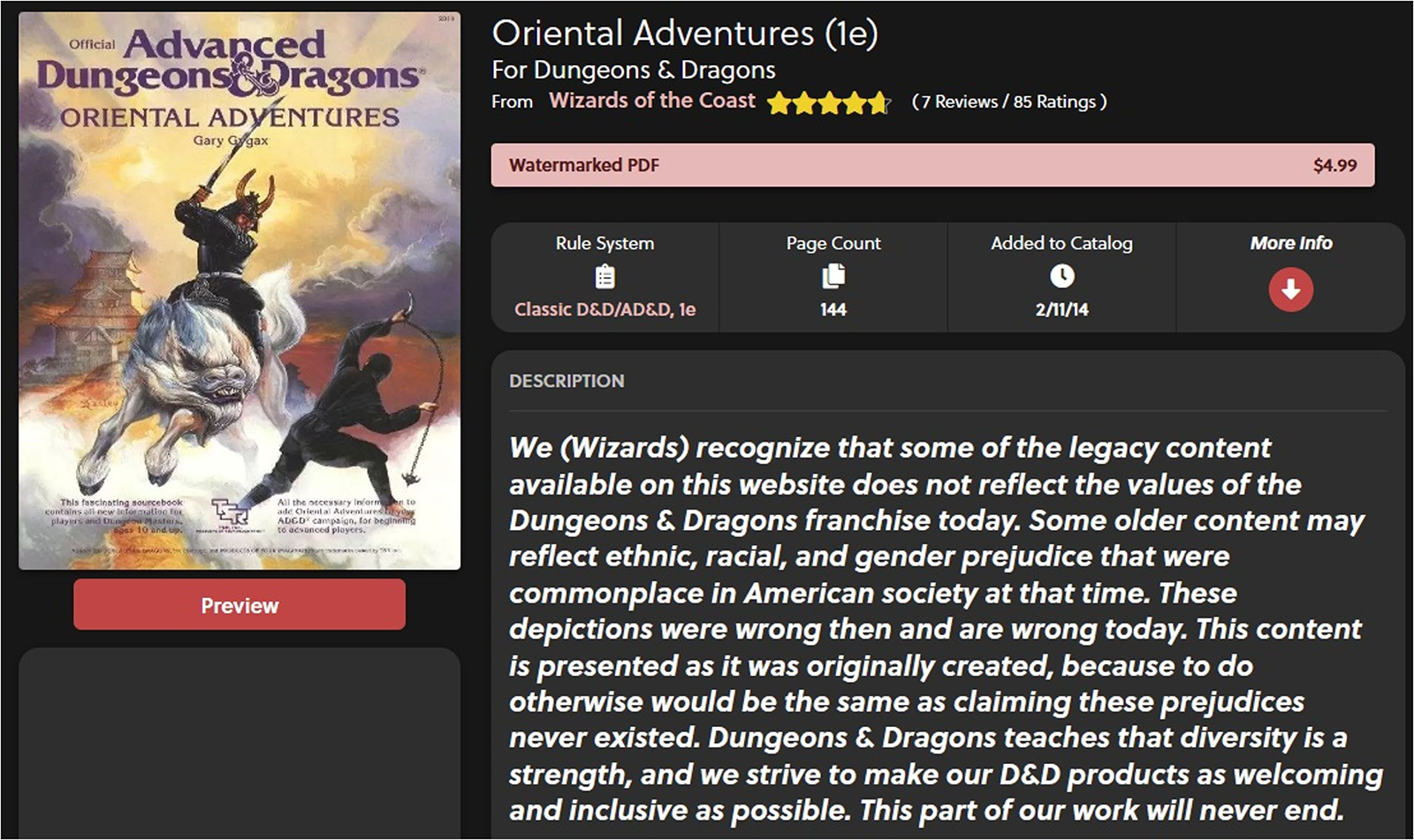
Let me start with the good. Project teams seeking consultation are usually prepared to learn how they can do better. I have experienced minimal pushback, but I was aware that I would have to balance cultural representation with creative vision and industry-based constraints. Sometimes changes simply cannot be made, either because consultants are added too late or because elements were co-created through community involvement. Players may have been asked to submit design concepts during different development stages to foster investment or attachment. There are also times when legacy content cannot be overturned, but, for all these cases, many creators are happy to include statements to preemptively address concerns (Figure 2). For example, many of the games I work on draw from the Sengoku period, so I encourage creators to openly acknowledge how popular media has created tropes and misrepresentations of Japanese people via questionable portrayals of Japanese history. Such statements can also make it clear that a game is not an opportunity to perform as caricatures of Japanese people, including exaggerated samurai accents or monologues about honor.
Screenshot from drivethrurpg.com showing an example of a statement that was issued by Wizards of the Coast in 2020 to address online criticisms that the publisher was profiting from an orientalist product.

Figure 2 Long description
The image shows a product page for Oriental Adventures (1e) for Dungeons and Dragons by Wizards of the Coast. The page includes a cover image of the product featuring a fantasy scene with characters. The price is listed as dollar 4.99 for a watermarked PDF. The description acknowledges that some legacy content does not reflect current values, mentioning ethnic, racial and gender prejudices. It states that the content is presented as originally created, not as an endorsement of past prejudices. The statement emphasizes the importance of diversity and inclusion in Dungeons and Dragons products.
Another positive is that many are excited to learn I am an archaeologist and are interested in evaluating how ancient cultures, artifacts, and ruins may be a cause for concern in their games. It is difficult to completely remove site exploration and artifact collection, but I find many producers are aware of the issues with looting and understand criticisms of “mysterious past” narratives. In Asia-inspired fantasy settings, I regularly need to steer creators away from using the names, descriptions, or images of real-world cultural heritage and prompt them to contemplate what these references do within their game. Developers have been rightly criticized for presenting past or present cultures as fantastical enough to be placed unaltered into fictional worlds, but they do not always know how to change. Consultants can help show how these references are loaded with sociopolitical or cultural significance, while helping find alternatives that are less fraught. I also encourage game developers to see history and archaeology as collections of stories told by specific people. This can make a big difference in the presence of essentialism within games, since it asks who says or believes something, rather than assuming one narrative represents objective reality.
Now for the bad. The demand for games has increased, especially since the pandemic led many to explore new hobbies. Certain sectors of the industry are highly lucrative, but oversaturation and a relatively small audience means there is intense competition. Developers know they need to be innovative to stand out, but they face constraints set by genre, finances, technological affordances, and the expectations of their perceived audience. Work focused on diverse representation is then added on top of this balancing act, and since consultation is a new frontier, not all producers have determined how it fits into their workflow. In addition, games labor is largely done by precarious contractors, which means substantial changes to the industry can be slow. Permanent, well-paying jobs are not standard, and those seeking to improve inclusion tend to be self-supported individuals or medium-sized companies that cannot typically guarantee stable employment. For this reason, most people require a primary job outside the industry or a collection of contracts to pay their bills.
As for the ugly, the games industry, as with many sectors today, is battling over the place of generative artificial intelligence (genAI) in commercial products. Currently, some large companies and independent creators are openly using genAI to produce text and art, which is met with critical backlash online. Contracts are already scarce, and work is often undercompensated, so artists, editors, narrative writers, designers, and consultants are quite unified in their stance against publishers who use genAI. Besides the issues with scraping and mimicking creators’ work without consent, there are also concerns about genAI relying on what is currently available. There are many older properties and intentionally hateful products that can easily lead to blatantly discriminatory and harmful content when generative programs lack any understanding of sociopolitical context.
Unfortunately, hateful products are a reality, given the current conditions of production and some fan communities. Turnover can be very high in game development, not only on account of tight finances but also harsh work environments. Creators and developers have shared how there are many highs and lows that come with challenging labor dynamics (DePass Reference DePass2018), though we need to be aware that the industry can take advantage of the perception that making games is simply fun. Many have heard about the unreasonable work hours and conditions right before a game launch, but there is a more steady and insidious toxicity that comes from the perception of gaming as a white, heteronormative, cis-male space (Legault and Weststar Reference Legault and Weststar2024). Many find that talent alone will not sustain them, because they must also be prepared to deal with companies and fan communities who see diversity, equity, anticolonialism, and antiracism as adversarial to fun. Cultural consultants are regularly accused of ruining games, which has led some development teams to protect their consultants by not openly crediting them.
Moving Forward: Representing the Past, Representing Ourselves
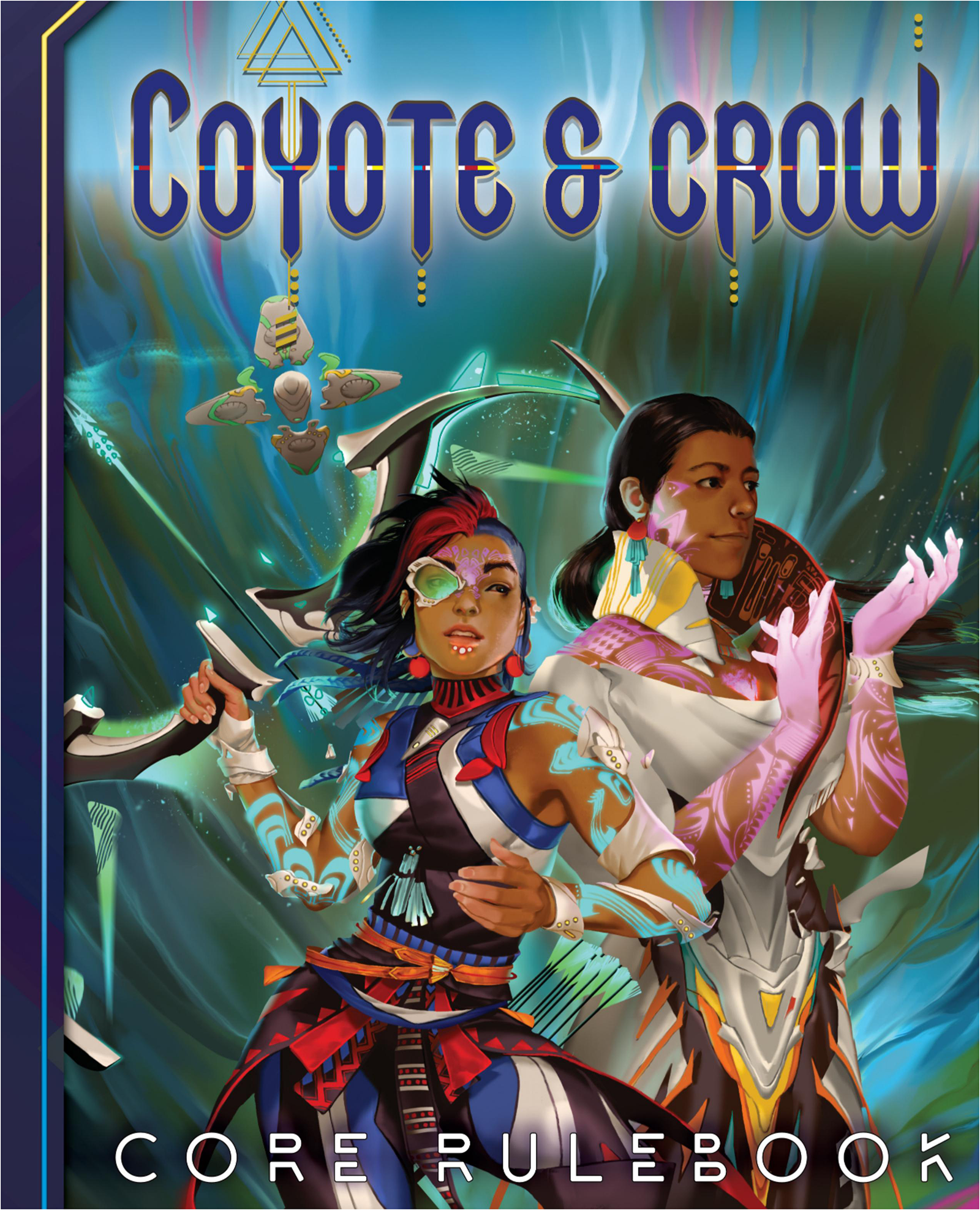
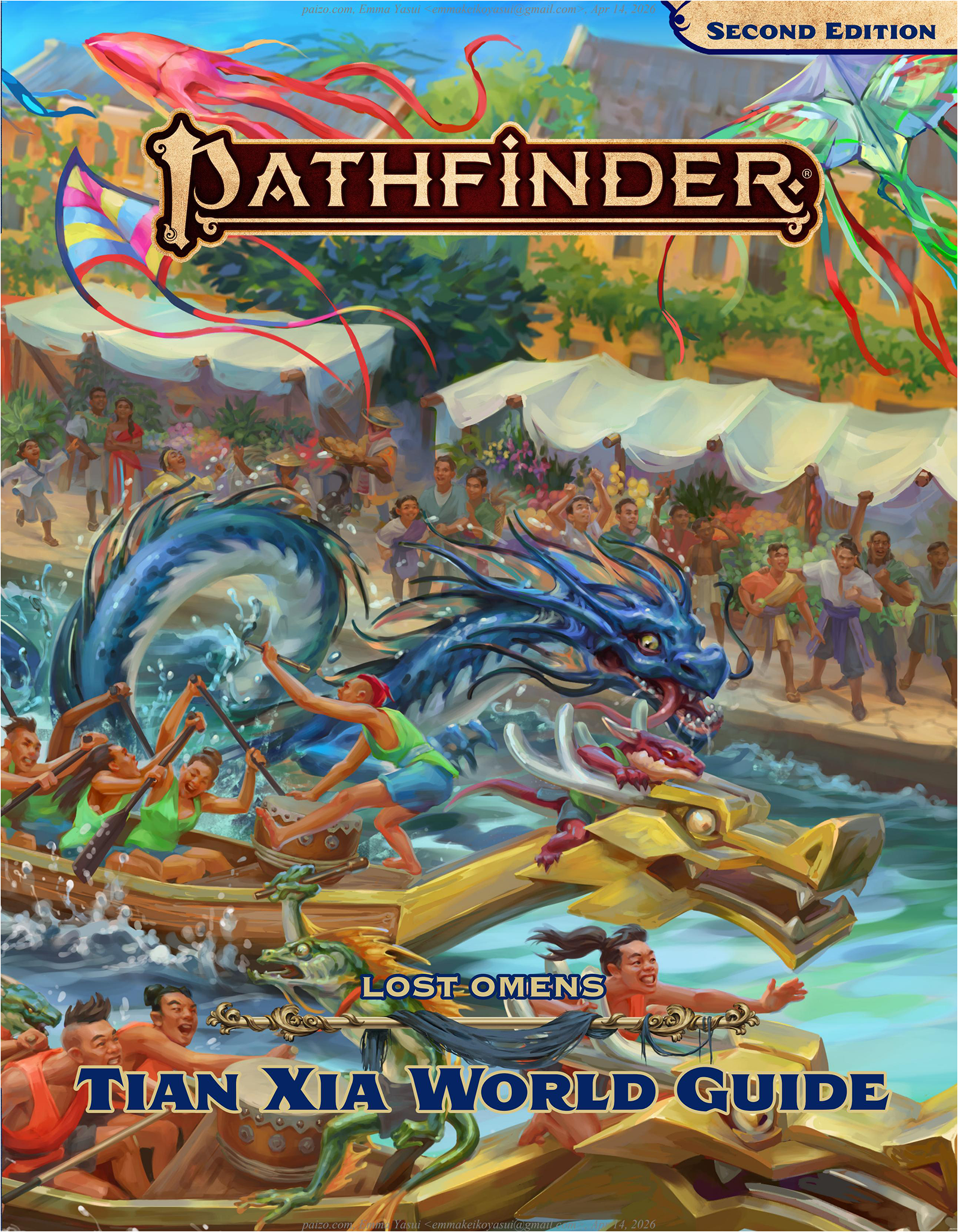
For decades, there have been calls to increase opportunities for underrepresented people in games, though it has yet to change how the industry is dominated by the Global North and products made with a limited audience in mind. It remains rare for a game to be made and consumed by the marginalized people who are portrayed, but there has been a rise in Indigenous, descendant, and historically excluded creatives pushing for self-representation. Some notable examples include Coyote & Crow, a tabletop game developed by an Indigenous team to explore an alternate history where colonialism did not happen in the Americas, and the Lost Omens: Tian Xia world-setting books for Pathfinder 2e, which were written by over 40 Asian-identifying designers who wanted to present a meaningful and thoughtful Asian-inspired fantasy world (Figures 3 and 4).
Cover of the Coyote & Crow Core Rulebook published by Coyote & Crow Games in 2021.

Figure 3 Long description
The cover of the Coyote & Crow Core Rulebook features two individuals dressed in vibrant, abstract attire. The person on the left is wearing a colorful outfit with intricate patterns and holding a weapon. The person on the right is dressed in a similarly elaborate outfit, with flowing elements and a dynamic pose. Above them, the title 'Coyote & Crow' is prominently displayed in stylized lettering. The background is a blend of abstract shapes and colors, creating a dynamic and immersive visual effect. At the bottom, the words 'Core Rulebook' are written in bold letters.
Cover of Pathfinder Lost Omens: Tian Xia World Guide, published by Paizo in 2024.

Figure 4 Long description
Large text at the top reads “SECOND EDITION.” A large title across the upper area reads “PATHFINDER.” An illustration shows a water scene with several boats. A long, dragon-like creature is in the water near the boats, with water splashing around it. Along the shoreline, a crowd stands near a row of canopy tents. Text near the lower middle reads “LOST OMENS.” Large text at the bottom reads “TIAN XIA WORLD GUIDE.”.
Within this context, history and archaeology game consultants need to consider the nature of expertise and how it relates to the product in front of them. Most developers will not know the inner workings of academia or how recent discussions of diversity and responsibility in archaeology have influenced our field. While this means that many archaeologists today will be able to address the colonial messaging hidden within games, not all will be able to identify or articulate the other questionable content that is best recognized by those who have felt the effects of tropes and misrepresentation. This is a reminder that academic credentials are meaningful but should not stand on their own, especially since marginalized folks are increasingly tired of topic expertise being prioritized over lived experience.
For this reason, I suggest that if you are not from the descendant community or identity group being portrayed, you should help developers locate experts who are, or ask if there are plans to hire cultural consultants. If you take a contract, keep in mind that the intended audience is also important. For example, games with Japanese themes that are made for a North American audience will have the greatest effect on the Japanese diaspora. You can always recommend further consultation if you recognize gaps in your understanding or find material you are not prepared to speak to. Intersectionality means we are all complex human beings with different experiences in the world, so no one person can be expected to “get it right” or speak for everyone.
Fun Labor Is Still Labor
Many people in the games industry are friendly, energetic, and creative. It is fun to work with them, so it is easy to forget that you should be paid for all your time and effort. Below is my advice to any who are considering being a consultant.
Protect yourself, your energy, and your time. Currently, social media is critical for being found by potential employers, as well as determining your place within the gaming community. The opportunities I have had were made possible by working with social media groups producing podcasts, YouTube videos, and Twitch streams. Engaging at this level takes a lot of energy, but knowledge about the companies, projects, communities, and creators is crucial before agreeing to a contract. The games industry has its own whisper network about bad actors with histories of exploitation, harassment, prejudice, or promoting hate, which you will not always learn unless you are present. Since you will likely need to balance consultation with other work, make sure to weigh the potential toll and benefits, particularly if gaming contracts will not translate into accepted outputs that contribute to advancing your chosen career.
Get everything in writing. Game creators are not typically looking to maliciously exploit you, but the industry relies on passion to keep people invested despite little to no pay. A written agreement is your opportunity to outline expectations related to the development process, crediting or attribution, balancing work obligations, and deadlines. You should also clarify how your name or information might be used in promotion efforts, since consultation adds value to, or addresses criticisms of, the final product. Be wary of developers who intend to use you as evidence of their due diligence, because this may make you a target for those who see diversity as degradation of the hobby. Know that you are not required to promote the games you work on, especially if you do not feel like your suggestions were taken seriously. Social media posts, news releases, interviews, or other forms of public promotion are rarely covered by contracts, and so are unpaid labor.
Get paid. Game developers use a range of payment methods, but US$ is currently the standard currency. I have most often been paid by invoicing finance departments or PayPal accounts (the latter is often preferred for remote contractors). Whether you plan to consult or not, be aware of the free labor economy on social media, where casual requests for feedback can prompt unpaid, emotional labor under the guise of social interaction. Larger game companies will sometimes release previews to garner excitement but also crowdsource feedback that should have been the paid work of cultural consultants. As educators and professional archaeologists, we may see online engagement as something expected of us today, but it is important to distinguish between responsible public outreach and inadvertently contributing to the development of commercial products. For other marginalized, early-career researchers like myself, though, I would like to emphasize that consultation work does not cease to be public engagement when it is fairly compensated.
And finally, remember that fun labor is still labor. I suspect that most of us were drawn to archaeology because we have a passion for exploring the past. There is an element of fun, even though we may find it intellectually challenging, physically demanding, and our efforts regularly misunderstood and devalued. In these ways, archaeology and the games industry have a lot in common.

 Open access

