




1. Introduction
An important fact in the characterization of a finite permutation group $G$ on a finite set $\Omega$
 is that all $2$
 -transitive groups are primitive. However, there is a large gap between primitivity and $2$
 -transitivity, in the sense that relatively few primitive groups are $2$
 -transitive. In [Reference Araújo, Cameron and Steinberg1], Araújo, Cameron and Steinberg introduced a hierarchy of classes of permutation groups that provides a finer characterization. These classes include spreading groups, defined in terms of sets and multisets of elements of $\Omega$
 (see § 2 for a precise definition); separating groups, defined in terms of subsets of $\Omega$
 , or graphs on $\Omega$
 preserved by $G$
 ; and synchronizing groups, originally defined in [Reference Arnold and Steinberg2] in terms of transformation semigroups on $\Omega$
 containing $G$
 . (See also [Reference Bamberg and Lansdown6] for equivalent definitions of these properties in terms of $G$
 -modules.) In particular, these members of the hierarchy are related as follows (see [Reference Araújo, Cameron and Steinberg1, p. 151]):

Moreover, the finite primitive groups can be divided into five types via the O'Nan–Scott Theorem, and by [Reference Araújo, Cameron and Steinberg1, Thereom 2.11 & Proposition 3.7], each synchronizing group is one of three types: almost simple, affine or diagonal (the relevant diagonal type groups will be defined in § 2). It is also well-known that each finite $2$ -transitive group is almost simple or affine.
Now, [Reference Araújo, Cameron and Steinberg1, § 6–7] classifies the affine spreading groups, and provides examples of almost simple groups that are spreading but not $2$ -transitive, separating but not spreading, or synchronizing but not separating, while [Reference Bamberg, Giudici, Lansdown and Royle5] describes affine synchronizing groups that are not spreading. In addition, [Reference Bray, Cai, Cameron, Spiga and Zhang8, Theorem 1.4] states that a primitive group that is not almost simple is synchronizing if and only if it is separating. The first (and so far only) known examples of synchronizing groups of diagonal type were presented in [Reference Bamberg, Giudici, Lansdown and Royle4]: the groups $\operatorname {{\mathrm {PSL}}}_2(q) \times \operatorname {{\mathrm {PSL}}}_2(q)$
 acting diagonally on $\operatorname {{\mathrm {PSL}}}_2(q)$
 , with $q = 13$
 and $q = 17$
 .
.
Many open questions involving this hierarchy of permutation groups remain, and in this paper, we work towards solving Problem 12.4 of [Reference Araújo, Cameron and Steinberg1], the classification of spreading groups (of almost simple or diagonal type). Specifically, we completely resolve the diagonal case, with the aid of the following theorem.
Theorem 1.1 [Reference Bray, Cai, Cameron, Spiga and Zhang8, Theorem 1.5]
Let $G$ be a synchronizing primitive group of diagonal type. Then $G$
 has socle $T \times T$
 , where $T$
 is a non-abelian finite simple group.
In addition, it is shown in [Reference Bamberg, Giudici, Lansdown and Royle4, Theorem 2] that the diagonal type group $\operatorname {{\mathrm {PSL}}}_2(q) \times \operatorname {{\mathrm {PSL}}}_2(q)$ is non-spreading for every prime power $q$
 . We generalize this result to all groups of diagonal type, as follows.
Theorem 1.2 Each primitive group of diagonal type is non-spreading.
Therefore, the types of spreading groups are precisely the types of finite $2$ -transitive groups: almost simple and affine.
For all but six possible socles $T \times T$ , we will prove Theorem 1.2 as a consequence of the following result, which may be of general interest, and which distinguishes six sporadic simple groups from all other non-abelian finite simple groups. For the six remaining socles, we employ elementary character theory.
Theorem 1.3 Let $T$ be a non-abelian finite simple group. Then the following are equivalent.
(i) There exists a proper subgroup $A$
 of $T$ and a proper normal subgroup $B$ of $A$ such that $A = B(A \cap A^\tau )$ for all $\tau \in \operatorname {{\mathrm {Aut}}}(T)$.
(ii) There exists a proper subgroup $A$
of $T$ and a proper normal subgroup $B$ of $A$ such that $A = B(A \cap A^t)$ for all $t \in T$.(iii) The group $T$
does not lie in the set $\{\mathrm {J}_1,\, \mathrm {M}_{22},\, \mathrm {J}_3,\, \mathrm {McL},\, \mathrm {Th},\, \mathbb {M}\}$ of sporadic groups.









Property (ii) of this theorem implies that, in the transitive action of $T$ on the set of right cosets of $A$
 , the proper normal subgroup $B$
 of the point stabilizer $A$
 is supplemented by all corresponding two-point stabilizers. This is a stronger property than all two-point stabilizers being nontrivial, which is equivalent to the action having base size at least three.
2. Background
In this section, we provide the background on spreading permutation groups, and on primitive groups of diagonal type, that will be necessary to prove Theorems 1.2 and 1.3.
Given a set $\Omega$ , a multiset (or set) $J$
 of elements of $\Omega$
 and a point $\omega \in \Omega$
 , we write $\mu _J(\omega )$
 to denote the multiplicity of $\omega$
 in $J$
 . We say that $J$
 is trivial if either $\mu _J$
 is constant on $\Omega$
 , or there exists a unique point $\omega \in \Omega$
 such that $\mu _J(\omega ) \ne 0$
 . Additionally, a sum $J+K$
 of multisets is defined so that $\mu _{J+K}(\omega ) = \mu _J(\omega ) + \mu _K(\omega )$
 for all $\omega$
 , and similarly for scalar products of multisets. As usual, the cardinality of $J$
 is $|J| := \sum _{\omega \in \Omega } \mu _J(\omega )$
 .
.
We are now able to define spreading permutation groups.
Definition 2.1 [Reference Araújo, Cameron and Steinberg1, § 5.5]
A transitive permutation group $G$ on $\Omega$
 is non-spreading if there exist a nontrivial subset $X$
 of $\Omega$
 and a nontrivial multiset $J$
 of elements of $\Omega$
 , such that $|J|$
 divides $|\Omega |$
 and $\sum _{x \in X^g} \mu _J(x)$
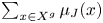 is constant for all $g \in G$
 . Otherwise, $G$
 is spreading.
We shall call a pair $(X,\,J)$ satisfying the above properties a witness to $G$
 being non-spreading. Recall from § 1 that each imprimitive group is non-spreading. It is also immediate from Definition 2.1 that if $G$
 is non-spreading, then so is each transitive subgroup of $G$
 . The following theorem provides a useful method for finding a witness to a group being non-spreading.
Theorem 2.2 [Reference Bamberg, Giudici, Lansdown and Royle3]
Let $G$ be a finite group acting transitively on a finite set $\Omega$
 , let $A$
 be a subgroup of $G$
 , and let $B$
 a proper normal subgroup of $A$
 . Additionally, let $\omega _1,\, \ldots,\, \omega _k \in \Omega$
 with $k\geqslant 2$
 , such that $\omega _i^B \neq \omega _j^B$
 for
$i \neq j$
for
$i \neq j$ , and
, and

Finally, let $\Delta := \{Y \in X^G \mid Y \cap \omega _1^A \neq \varnothing \}$ for some non-empty $X \subsetneq \Omega$
 . If $B$
 is transitive on each $A$
 -orbit of $\Delta$
 , then $(X,\,\Omega + k\omega _1^B - \omega _1^A)$
 is a witness to $G$
 being non-spreading.
Now, let $T$ be a non-abelian finite simple group. In the remainder of this section, we shall consider the primitive groups of diagonal type with socle $T \times T$
 . To define these groups, let $T \times T$
 act on the set $\Omega :=T$
 by $x^{(t_1,t_2)}:=t_1^{-1}xt_2$
 . In addition, let $\rho _1:T\times T \to \operatorname {{\mathrm {Sym}}}(\Omega )$
 be the corresponding permutation representation, and let $\rho _2:\operatorname {{\mathrm {Aut}}}(T) \to \operatorname {{\mathrm {Sym}}}(\Omega )$
 be the natural permutation representation of $\operatorname {{\mathrm {Aut}}}(T)$
 on $\Omega$
 . Then $\rho _2(\operatorname {{\mathrm {Inn}}}(T))=\rho _1(\{(t,\,t)\mid t\in T\})$
 . Finally, let $\sigma \in \operatorname {{\mathrm {Sym}}}(\Omega )$
 such that $x^\sigma =x^{-1}$
 for all $x\in T$
 . Define $W(T):=\langle \rho _1(T\times T),\,\rho _2(\operatorname {{\mathrm {Aut}}}(T)),\,\sigma \rangle \leqslant \operatorname {{\mathrm {Sym}}}(\Omega )$
 , and note that $W(T)\cong (T\times T).(\operatorname {{\mathrm {Out}}}(T) \times C_2)$
 . The groups of diagonal type with socle $T \times T$
 are precisely the subgroups of $W(T)$
 containing $\rho _1(T\times T)$
 (see, for example, [Reference Liebeck, Praeger and Saxl17, § 1]). We will often drop the use of $\rho _1$
 and $\rho _2$
 , and allow elements (and subgroups) of $T\times T$
 and $\operatorname {{\mathrm {Aut}}}(T)$
 to denote permutations (and subgroups) of $\operatorname {{\mathrm {Sym}}}(\Omega )$
 .
.
In order to derive Theorem 1.2 from Theorem 1.3 (for most non-abelian finite simple groups), we require the following corollary of Theorem 2.2. Throughout the remainder of this section, we will use the elementary fact that if $G$ is a transitive permutation group on a set $\Sigma$
 and $H\leqslant G$
 , then $H$
 acts transitively on $\Sigma$
 if and only if $G=HG_\alpha$
 for each $\alpha \in \Sigma$
 .
.
Corollary 2.3 Let $T$ be a non-abelian finite simple group, and suppose that there exists a proper subgroup $A$
 of $T$
 and a proper normal subgroup $B$
 of $A$
 such that $A = B(A \cap A^\tau )$
 for all $\tau \in \operatorname {{\mathrm {Aut}}}(T)$
 . Then $(A,\,\Omega +|A:B|B-A)$
 is a witness to the diagonal type group $W(T)$
 being non-spreading in its action on $\Omega = T$
 .
.
Proof. Let $G:=W(T)$ , $M:=\rho _1(1\times T)$
 , $\omega _1:=1_T$
 , and $D:=G_{\omega _1} = \langle \rho _2(\operatorname {{\mathrm {Aut}}}(T)), \sigma \rangle \cong \operatorname {{\mathrm {Aut}}}(T)\times C_2$
 . Note that $G=DM$
 , as $M$
 acts transitively on $\Omega$
 . Let $X:=A\subsetneq \Omega$
 . Then $\omega _1^{1 \times B} = B < A = \omega _1^{1 \times A}$
 , and $X^{G}=X^{DM}=\{A^\tau t\mid \tau \in \operatorname {{\mathrm {Aut}}}(T), t\in T\}$
 . Next, define $\Delta :={\{Y\in X^G\mid Y\cap \omega _1^{1\times A}\neq \varnothing \}}$
 , and observe that $\Delta = \{A^\tau a\mid \tau \in \operatorname {{\mathrm {Aut}}}(T),\,a\in A\}$
 . Thus the orbits of $1 \times A$
 on $\Delta$
 are $\Delta _\tau =\{A^\tau a\mid a\in A\}$
 for each $\tau \in \operatorname {{\mathrm {Aut}}}(T)$
 . Additionally, the stabilizer in $1\times A$
 of $A^\tau \in \Delta _\tau$
 is $1\times (A\cap A^\tau )$
 . As $A=B(A\cap A^\tau )$
 , we observe that $1\times B$
 is transitive on $\Delta _\tau$
 . The result now follows from Theorem 2.2, applied to the groups $G$
 , $1 \times A$
 and $1 \times B$
 .
.
Our next lemma translates Property (i) of Theorem 1.3 into the language of coset actions.
Lemma 2.4 Let $T$ be a non-abelian finite simple group, $R \in \{T,\,\operatorname {{\mathrm {Aut}}}(T)\}$
 , and $A$
 a proper subgroup of $T$
 . Suppose also that $A$
 has a proper normal subgroup $B$
 that acts transitively on each orbit of $A$
 in its action on the right cosets of $A$
 in $R$
 . If $R = \operatorname {{\mathrm {Aut}}}(T)$
 , or if all $\operatorname {{\mathrm {Aut}}}(T)$
 -conjugates of $A$
 are conjugate in $T$
 , then $A = B(A \cap A^\tau )$
 for all $\tau \in \operatorname {{\mathrm {Aut}}}(T)$
 .
.
Proof. Let $\Sigma$ be the set of right cosets of $A$
 in $R$
 . Then the point stabilizers in the action of $A$
 on $\Sigma$
 are precisely the subgroups $A \cap A^t$
 with $t \in R$
 . As $B$
 is transitive on each orbit in this action, it follows that $A = B(A \cap A^t)$
 for all $t \in R$
 . Hence we are done if $R = \operatorname {{\mathrm {Aut}}}(T)$
 . Assume therefore that all $\operatorname {{\mathrm {Aut}}}(T)$
 -conjugates of $A$
 are conjugate in $T$
 . Then for each $\tau \in \operatorname {{\mathrm {Aut}}}(T)$
 , there exists $t \in T$
 such that $A^\tau = A^t$
 , and so $B(A \cap A^\tau ) = B(A \cap A^t) = A$
 .
.
In the case where $T$ is one of the six sporadic groups listed in Property (iii) of Theorem 1.3, we will show that $W(T)$
 is non-spreading using the following lemma, which involves elementary character theory. The multiset in the witness here is similar to that of Theorem 2.2.
Lemma 2.5 Let $T$ be a non-abelian finite simple group, and let $\mathrm {Irr}(T)$
 be the set of irreducible complex characters of $T$
 . Suppose also that there exist pairwise non-conjugate elements $r$
 , $s_1$
 and $s_2$
 of $T$
 , such that:
(i) $|s_1^T| = |s_2^T|$
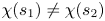
; and(ii) $\chi (r^\tau ) = 0$
for all $\tau \in \operatorname {{\mathrm {Aut}}}(T)$ and all $\chi \in \mathrm {Irr}(T)$ with $\chi (s_1) \ne \chi (s_2)$.


Then $(r^T,\,\Omega +s_1^T-s_2^T)$ is a witness to the diagonal type group $W(T)$
 being non-spreading in its action on $\Omega = T$
 .
.
Proof. The set $X:=r^T$ and the multiset $J:=\Omega +s_1^T-s_2^T$
 are clearly nontrivial, and (i) implies that $|J| = |\Omega |$
 . Thus by Definition 2.1, it remains to prove that $\sum _{x \in X^g} \mu _J(x)$
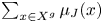 is constant for all $g \in G:=W(T)$
 . In fact, we will show that $|X^g \cap s_1^T| = |X^g \cap s_2^T|$
 for all $g$
 , and it will follow immediately that $\sum _{x \in X^g} \mu _J(x) = |X|$
 for all $g$
 .
.
As above, $G_{1_T} = \langle \rho _2(\operatorname {{\mathrm {Aut}}}(T)),\,\sigma \rangle$ , and the transitivity of $M:=\rho _1(1 \times T)$
 on $\Omega$
 implies that $G = G_{1_T}M$
 . Hence for each $g \in G$
 , there exist $\tau \in \operatorname {{\mathrm {Aut}}}(T)$
 , $\varepsilon = \pm 1$
 and $t \in T$
 such that $X^g = ((r^\tau )^{\varepsilon })^Tt$
 . Letting $m:=(r^\tau )^\varepsilon$
 , $i \in \{1,\,2\}$
 and $h \in s_i^T$
 , we observe from [Reference Isaacs16, Problem 3.9] that the set $\{(x,\,y) \mid x \in m^T,\, y \in t^T,\, xy = h\}$
 has size

where $\overline {\chi (s_i)}$ is the complex conjugate of $\chi (s_i)$
 . Since $a_{g,i}$
 is constant for all $h \in s_i^T$
 , and $|m^Tt^u \cap s_i^T|$
 is constant for all $u \in T$
 , it follows that $|X^g \cap s_i^T| = a_{g,i}|s_i^T|/|t^T|$
 . As $\chi ((r^\tau )^{-1})\,{=}\, \overline {\chi (r^\tau )}$
 for each character $\chi$
 of $T$
 , (i) and (ii) yield $|X^g \,{\cap}\, s_1^T| \,{=}\, |X^g \,{\cap}\, s_2^T|$
 for all $g \in G$
 , as required.
Remark 2.6 For many small non-abelian finite simple groups $T$ , it is possible to choose an element $r \in T$
 satisfying Property (ii) of Lemma 2.5 when $s_1$
 and $s_2$
 are non-conjugate elements of $T$
 such that $s_1^{-1} = s_2$
 , or more generally, such that $\langle s_1 \rangle = \langle s_2 \rangle$
 . The non-abelian finite simple groups with all elements conjugate to their inverses are classified in [Reference Tiep and Zalesski18, Theorem 1.2], and [Reference Feit and Seitz14, Corollary B.1] shows that $\operatorname {{\mathrm {PSp}}}_6(2)$
 and $\operatorname {{\mathrm {P}\Omega }}^+_8(2)$
 are the only such groups where $u,\,v \in T$
 are conjugate whenever $\langle u \rangle = \langle v \rangle$
 . Denoting conjugacy classes as in the Atlas [Reference Conway, Curtis, Norton, Parker and Wilson13], we observe by inspecting the Atlas character tables of these two groups that we can choose $r \in \mathrm {7A}$
 , $s_1 \in \mathrm {6A}$
 and $s_2 \in \mathrm {6B}$
 when $T = \operatorname {{\mathrm {PSp}}}_6(2)$
 , and $r \in \mathrm {7A}$
 , $s_1 \in \mathrm {15A}$
 and $s_2 \in \mathrm {15B}$
 when $T = \operatorname {{\mathrm {P}\Omega }}^+_8(2)$
 . We leave open the problem of determining which non-abelian finite simple groups, if any, do not contain pairwise non-conjugate elements $r$
 , $s_1$
 and $s_2$
 satisfying Properties (i) and (ii) of Lemma 2.5.
3. Non-abelian finite simple groups and groups of diagonal type
In this section, we show that Property (i) of Theorem 1.3 holds for all non-abelian finite simple groups other than the sporadic groups $\mathrm {J}_1$ , $\mathrm {M}_{22}$
 , $\mathrm {J}_3$
 , $\mathrm {McL}$
 , $\mathrm {Th}$
 and $\mathbb {M}$
 , and then prove Theorems 1.3 and 1.2. Note that we address the Tits group ${}^2F_{4}(2)'$
 together with the sporadic groups. Throughout, we use Atlas [Reference Conway, Curtis, Norton, Parker and Wilson13] notation for the structures of groups.
We first consider the finite simple groups of Lie type, beginning with the Chevalley groups (i.e. the untwisted groups of Lie type) defined over fields of size $q \ge 3$ , then the twisted groups of Lie type, and finally the Chevalley groups with $q = 2$
 .
.
Proposition 3.1 Let $T$ be a finite simple Chevalley group $X_\ell (q)$
 , with $q \ge 3$
 . Then Property (i) of Theorem 1.3 holds for $T$
 .
.
Proof. Let $p$ be the prime dividing $q$
 , and let $U$
 be a Sylow $p$
 -subgroup of $T$
 . Then $T$
 contains a subgroup $N$
 such that $A:=N_T(U)$
 and $N$
 form a $(B,\,N)$
 -pair, and the normal subgroup $H:=A \cap N$
 of $N$
 complements $U$
 in $A$
 (see [Reference Carter12, Ch. 7.2–9.4]). Since $q \ge 3$
 (and since $T$
 is not the soluble group $A_1(3) = \operatorname {{\mathrm {PSL}}}_2(3)$
 ), we observe from [Reference Carter12, pp. 121–122] that $|H| > 1$
 , and so $U$
 is a proper subgroup of $A$
 . Furthermore, as $A$
 is the normalizer in $T$
 of the Sylow subgroup $U$
 , all $\operatorname {{\mathrm {Aut}}}(T)$
 -conjugates of $A$
 are conjugate in $T$
 .
.
By Lemma 2.4, it suffices to show that $A$ and $U$
 have the same orbits in the action of $T$
 on the set of right cosets of $A$
 . For each element $w$
 of the Weyl group $W:=N/H$
 , fix a preimage $n_w \in N$
 of $w$
 under the natural homomorphism from $N$
 to $W$
 . In addition, let $x$
 and $y$
 be elements of $T$
 so that $Ax$
 and $Ay$
 lie in a common $A$
 -orbit. Then the double cosets $AxA$
 and $AyA$
 are equal. By [Reference Carter12, Theorem 8.4.3], there exist $a_x,\,a_y \in A$
 , $w_x,\,w_y \in W$
 and $u_x,\,u_y \in U < A$
 such that $x = a_x n_{w_x} u_x$
 and $y = a_y n_{w_y} u_y$
 . It follows that $A n_{w_x} A = A n_{w_y} A$
 . As $A$
 and $N$
 form a $(B,\,N)$
 -pair, [Reference Carter12, Proposition 8.2.3] yields $n_{w_x} = n_{w_y}$
 . Thus $AxU = An_{w_x}U = An_{w_y}U = AyU$
 , i.e. $Ax$
 and $Ay$
 lie in the same $U$
 -orbit, as required.
Proposition 3.2 Let $T$ be a finite simple twisted group of Lie type ${}^tX_\ell (q)$
 . Then Property (i) of Theorem 1.3 holds for $T$
 .
.
Proof. Note that $T \not \cong {}^2F_4(2)'$ . As above, let $p$
 be the prime dividing $q$
 , and let $U$
 be a Sylow $p$
 -subgroup of $T$
 . By [Reference Carter12, Ch. 13–14], $T$
 contains subgroups $N$
 , $H$
, $H$ and $W$
 analogous to those in the proof of Proposition 3.1, so that $A:=U \mkern 3mu{:}\mkern 3mu H$
 and $N$
 form a $(B,\,N)$
 -pair, and $W = N/H$
 . Furthermore, $H$
 is nontrivial for all $q$
 , as $T$
 is not isomorphic to ${}^2A_2(2) = \operatorname {{\mathrm {PSU}}}_3(2)$
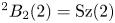
 , ${}^2B_2(2) = \mathrm {Sz}(2)$
 or ${}^2F_4(2)$
 . Although [Reference Carter12] directly states only that $A \le N_T(U)$
 , we can show that $A = N_T(U)$
 . Indeed, if this were not the case, then some preimage $n_w \in N$
 of a fundamental reflection $w \in W$
 would normalise $U$
 (see [Reference Carter12, Proposition 8.2.2 & Theorem 8.3.2]). However, we deduce from Proposition 13.6.1 and the proof of Theorem 13.5.4 in [Reference Carter12] that no such $w$
 exists, and so $A = N_T(U)$
 . We now proceed exactly as in the proof of Proposition 3.1, this time using Proposition 13.5.3 of [Reference Carter12] instead of Theorem 8.4.3.
Proposition 3.3 Let $T$ be a finite simple Chevalley group $X_\ell (2)$
 . Then Property (i) of Theorem 1.3 holds for $T$
 .
.
Proof. Since $A_2(2) = \operatorname {{\mathrm {PSL}}}_3(2) \cong \operatorname {{\mathrm {PSL}}}_2(7)$ is addressed by Proposition 3.1, and since the remaining groups $X_\ell (2)$
 with $\ell \le 2$
 are not simple, we shall assume that $\ell \ge 3$
 . Let $\Phi \subseteq \mathbb {R}^\ell$
 be a root system for $T$
 , with $\Phi ^+ \subseteq \Phi$
 a system of positive roots and $\Pi \subseteq \Phi ^+$
 a system of simple roots (see, for example, [Reference Carter12, Ch. 2]). Then $\Phi$
 is the disjoint union of $\Phi ^+$
 and $-\Phi ^+$
 , and each node in the Dynkin diagram $D$
 corresponding to $T$
 is associated with a unique root in $\Pi$
 (and vice versa). Hence each diagram automorphism of $D$
 induces a permutation of $\Pi$
 . Let $r$
 and $s$
 be the simple roots associated with a leaf in $D$
 and the adjacent node, respectively. Additionally, let $S$
 be the closure of the set $\{s\}$
 under the group of diagram automorphisms of $D$
 , so that $|S| \in \{1,\,2\}$
 .
.
Next, let $U$ , $N$
, $N$ and $W$
 be as in the proof of Proposition 3.1. In this case, the group $H$
 from that proof is trivial, and so $N_T(U) = U$
 and $W \cong N$
 . By [Reference Carter12, Proposition 2.1.8, p. 68 & p. 93], $T$
 is generated by a set $\{x_u \mid u \in \Phi \}$
 of involutions ($x_u$
 is written as $x_u(1)$
 in [Reference Carter12]), with $U = \langle x_u \mid u \in \Phi ^+ \rangle$
 , and $N$
 is generated by a set $\{n_v \mid v \in \Pi \}$
 of involutions. Let $A := \langle U,\, n_v \mid v \in \Pi \setminus S\rangle$
 be the parabolic subgroup of $T$
 corresponding to the subset $\Pi \setminus S$
 of $\Pi$
 . Then by [Reference Carter12, Ch. 8.5] and the well-known structure of parabolic subgroups of Chevalley groups, $A$
 has shape $[2^m]:(L_{\{r\}} \times L_{\Pi \setminus (\{r\} \cup S)})$
 for some positive integer $m$
 , where $L_{\{r\}} \cong A_1(2) \cong S_3$
 and $L_{\Pi \setminus (\{r\} \cup S)}$
 are Levi subgroups. Since $q = 2$
 , all automorphisms of $T$
 are products of inner and graph automorphisms. Moreover, $\Pi \setminus S$
 is fixed setwise by all diagram automorphisms of $D$
 , which correspond to the graph automorphisms of $T$
 , and so all $\operatorname {{\mathrm {Aut}}}(T)$
 -conjugates of $A$
 are conjugate in $T$
 . In addition, $A$
 contains an index two subgroup $B$
 of shape $[2^m]:(F \times L_{\Pi \setminus (\{r\} \cup S)})$
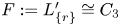
 , where $F := L_{\{r\}}' \cong C_3$
 . We will show that $AtA = AtB$
 for all $t \in T$
 , and the result will follow from Lemma 2.4.
Since $N_T(U) = U \le A$ , we deduce as in the proof of Proposition 3.1 that, for each $t \in T$
 , there exists $n \in N$
 such that $AtA = AnA$
 . Thus it suffices to prove that $AnA = AnB$
 for all $n \in N$
 (it will immediately follow that $AnB = AtB$
 for the corresponding $t \in T$
 ). We also observe using [Reference Carter12, Ch. 8.5] (and the fact that $F$
 has index two in $L_{\{r\}}$
 ) that $x_r \in A \setminus B$
 and $x_{-r} x_r \in B$
 . The former containment implies that $AnA = AnB \cup Anx_rB$
 . To complete the proof, we will show that $Anx_rB = AnB$
 .
.
The Weyl group $W$ acts linearly on $\mathbb {R}^\ell$
 and fixes $\Phi$
 . Let $w$
 be the element of $W$
 corresponding to $n$
 . By [Reference Carter12, Lemma 7.2.1(i)], $nx_r = x_{w(r)} n$
 and $x_{-w(r)} n = x_{w(-r)} n = nx_{-r}$
 . If $w(r) \in \Phi ^+$
 , then $x_{w(r)} \in \langle x_u \mid u \in \Phi ^+ \rangle = U \le A$
 , and so $Anx_r = An$
 . Otherwise, $-w(r) \in \Phi ^+$
 and $x_{-w(r)} \in A$
 , yielding $An = An x_{-r}$
 and hence $Anx_r = An x_{-r} x_r$
 , which lies in $AnB$
 by the previous paragraph. In either case, we see that $Anx_rB = AnB$
 , as required.
Next, we consider the alternating groups, followed by the sporadic groups and the Tits group.
Proposition 3.4 Let $T$ be a finite simple alternating group $A_n$
 . Then Property (i) of Theorem 1.3 holds for $T$
 .
.
Proof. Since $A_5 \cong \operatorname {{\mathrm {PSL}}}_2(4) = A_1(4)$ and $A_6 \cong \operatorname {{\mathrm {PSL}}}_2(9) = A_1(9)$
 are addressed by Proposition 3.1, we shall assume that $n \ge 7$
 . Let $\Sigma$
 be the set of $3$
 -subsets of a set of size $n$
 , and let $\alpha \in \Sigma$
 . Then $A:=T_\alpha =(S_3\times S_{n-3})\cap T$
 , and all $\operatorname {{\mathrm {Aut}}}(T)$
 -conjugates of $A$
 are conjugate in $T$
 . Additionally, $A$
 has four orbits on $\Sigma$
 , namely $\{\alpha \}$
 and $\{\beta \in \Sigma \mid |\beta \cap \alpha |=i\}$
 for $i \in \{0,\,1,\,2\}$
 . Since the index two subgroup $B:=A_3 \times A_{n-3}$
 of $A$
 acts transitively on each of these orbits, and since the action of $T$
 on $\Sigma$
 is equivalent to its action on the right cosets of $A$
 , the result follows from Lemma 2.4.
Proposition 3.5 Let $T$ be the Tits group ${}^2F_{4}(2)'$
 , or a sporadic simple group that does not lie in $\{\mathrm {J}_1,\, \mathrm {M}_{22},\, \mathrm {J}_3,\, \mathrm {McL},\, \mathrm {Th},\, \mathbb {M}\}$
 . Then Property (i) of Theorem 1.3 holds for $T$
 .
.
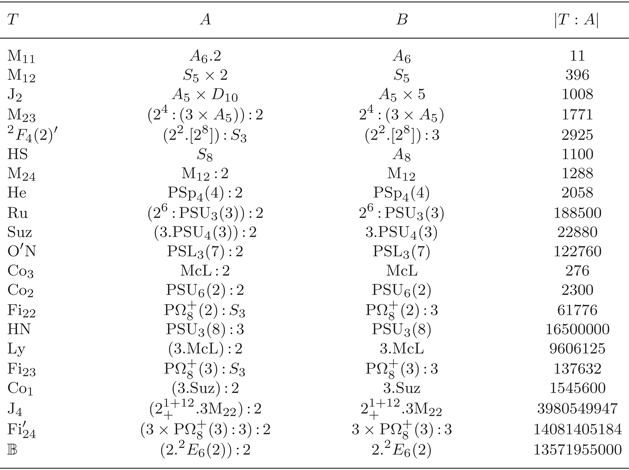
Proof. We observe from the Atlas [Reference Conway, Curtis, Norton, Parker and Wilson13] that $T$ has a maximal subgroup $A$
 , as specified in Table 1, such that either $T = \mathrm {O'N}$
 or all $\operatorname {{\mathrm {Aut}}}(T)$
 -conjugates of $T_\alpha$
 are conjugate in $T$
 . It is also clear that the group $B$
 in the table is a proper normal subgroup of $A$
 . Note that if $T = \mathrm {M}_{12}$
 , then $A$
 has two normal subgroups isomorphic to $S_5$
 ; in what follows, $B$
 may be chosen as either.
A maximal subgroup $A$ of a group $T$
 from Proposition 3.5, with $B$
 a proper normal subgroup of $A$

.
Now, let $R:=\operatorname {{\mathrm {Aut}}}(T)$ if $T = \mathrm {O'N}$
 , and $R:=T$
 otherwise. Additionally, let $\chi$
 be the permutation character corresponding to the action of $R$
 on the set $\Sigma$
 of right cosets of $A$
 in $R$
 . Then for each $t \in R$
 , the number of points in $\Sigma$
 fixed by $t$
 is equal to $\chi (t)$
 . By the Cauchy–Frobenius Lemma, $A$
 and $B$
 have $c_A:={1}/{|A|}\sum _{a \in A} \chi (a)$
 and $c_B:={1}/{|B|}\sum _{b \in B} \chi (b)$
 orbits on $\Sigma$
 , respectively. It is straightforward to compute $c_A$
 and $c_B$
 in GAP [15] using the Character Table Library [Reference Breuer9] ($c_A$
 is most readily calculated as the inner product $[\chi,\,\chi ]$
 ), and in each case we obtain $c_A = c_B$
 . Thus Lemma 2.4 yields the result.
We are now able to prove Theorem 1.3. Given a group $G$ and a non-trivial (core-free) subgroup $H$
 of $G$
 , we will write $b(G,\,H)$
 to denote the base size of $G$
 in its action on the set $\Sigma$
 of right cosets of $H$
 , i.e., the minimum size of a subset $\Delta$
 of $\Sigma$
 such that the pointwise stabilizer $G_{(\Delta )}$
 is trivial. Notice that $b(G,\,H) \ge 2$
 , as $H$
 is a point stabilizer in this action.
Proof of Theorem 1.3 Propositions 3.1–3.5 show that (iii) implies (i), which clearly implies (ii). To complete the proof, we will show that if (iii) does not hold, then neither does (ii). If $T \in \{\mathrm {J}_1,\, \mathrm {M}_{22},\, \mathrm {J}_3,\, \mathrm {McL}\}$ , then we construct $T$
 in Magma [Reference Bosma, Cannon and Playoust7] via the AutomorphismGroupSimpleGroup and Socle functions, and show that (ii) does not hold via fast, direct computations.
Suppose next that $T = \mathrm {Th}$ , let $C$
 be a proper subgroup of $T$
 , and let $A$
 be a subgroup of $C$
 . Observe that if $b(T,\,C) = 2$
 , then (as discussed below the statement of Theorem 1.3) the two-point stabilizer $C \cap C^t$
 is trivial for some $t$
 . Hence $A \,{\cap}\, A^t \,{=}\, 1$
 , and so $A$
 does not satisfy (ii). In general, $b(T,\,A) \le b(T,\,C)$
 . By [Reference Burness, O'Brien and Wilson11, Theorem 1], $T$
 has only two maximal subgroups (up to conjugacy) with corresponding base size greater than two, namely $M_1:={}^3D_4(2) \mkern 3mu{:}\mkern 3mu 3$
 and $M_2:=2^5.\operatorname {{\mathrm {PSL}}}_5(2)$
 , and $b(T,\,M_1) = b(T,\,M_2) = 3$
 . Hence any proper subgroup $A$
 of $T$
 satisfying (ii) is a non-simple subgroup of $M_1$
 or $M_2$
 with $b(T,\,A) = 3$
 .
.
Now, let $\Sigma$ be the set of right cosets in $T$
 of a proper subgroup $A$
 , and let $c$
 be the number of orbits of $A$
 on $\Sigma$
 . If $b(T,\,A) \ge 3$
 , then $|A \cap A^t| \ge 2$
 for all $t \in T$
 , and it follows from the Orbit-Stabiliser Theorem that $c|A|/2 \ge |\Sigma |$
 . If $A$
 is a maximal subgroup of either $M_1$
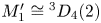
 or $M_1' \cong {}^3D_4(2)$
 , then the character table of $A$
 is included in The GAP Character Table Library. Thus for every such $A \ne M_1'$
 , we can compute $c$
 as in the proof of Proposition 3.5, and we see that in fact $c|A|/2 < |\Sigma |$
 , and hence $b(T,\,A) = 2$
 . To show that $b(T,\,A) = 2$
 for each maximal subgroup $A$
 of $M_2$
 , we construct $T$
 and $M_2$
 in Magma as subgroups of $\operatorname {{\mathrm {GL}}}_{248}(2)$
 using the respective generating pairs $\{x,\,y\}$
 and $\{w_1,\,w_2\}$
 given in [Reference Wilson, Walsh, Tripp, Suleiman, Parker, Norton, Nickerson, Linton, Bray and Abbott19]. Magma calculations (with a runtime of less than 10 minutes and a memory usage of 1.5 GB) then show that $A \cap A^y = 1$
 for all representatives $A$
 of the conjugacy classes of maximal subgroups of $M_2$
 returned by the MaximalSubgroups function. Therefore, $M_1$
 and $M_2$
 are the only non-simple subgroups of $T$
 with corresponding base size at least three. Further character table computations in GAP show that if $A \in \{M_1,\,M_2\}$
 , then for each proper normal subgroup $B$
 of $A$
 , the number of $B$
 -orbits on $\Sigma$
 is greater than the number of $A$
 -orbits. An additional application of the Orbit-Stabiliser Theorem yields $B(A \cap A^t) < A$
 for some $t \in T$
 . Therefore, (ii) does not hold.
Finally, suppose that $T = \mathbb {M}$ . As above, any proper subgroup $A$
 of $T$
 satisfying (ii) also satisfies $b(T,\,A) \ge 3$
 . By [Reference Burness10, Theorem 3.1], the unique (up to conjugacy) proper subgroup $A$
 of $T$
 with $b(T,\,A) \ge 3$
 is the maximal subgroup $K:=2.\mathbb {B}$
 , with $b(T,\,K) = 3$
 . Since $K$
 is quasisimple, its centre $Z$
 of order two is its unique nontrivial proper normal subgroup, and $Z$
 lies in each maximal subgroup of $K$
 . Hence $Z(K \cap K^t) < K$
 for all $t \in T \setminus K$
 , and so (ii) does not hold.
We now prove our main theorem.
Proof of Theorem 1.2 As each spreading primitive group is synchronizing, Theorem 1.1 implies that a spreading primitive group of diagonal type has socle $T \times T$ , for some non-abelian finite simple group $T$
 . For each $T$
 , let $\Omega := T$
 , and let $W(T)$
 be the subgroup of $\operatorname {{\mathrm {Sym}}}(\Omega )$
 defined in § 2. Recall also that each subgroup of a non-spreading group is non-spreading. Thus it suffices to show that $W(T)$
 is non-spreading for each $T$
 . If $T \notin \{\mathrm {J}_1,\,\mathrm {M}_{22},\, \mathrm {J}_3,\, \mathrm {McL},\,\mathrm {Th},\,\mathbb {M}\}$
 , then this is an immediate consequence of Theorem 1.3 and Corollary 2.3.
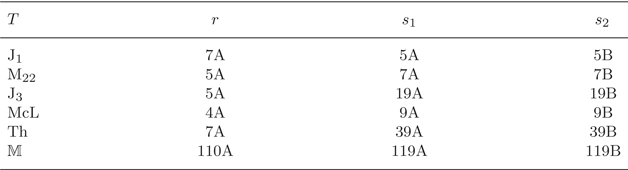
For each of the six remaining groups $T$ , let $r$
 , $s_1$
 and $s_2$
 be members of the conjugacy classes of $T$
 given in Table 2. By inspecting the character table for $T$
 in [Reference Conway, Curtis, Norton, Parker and Wilson13], we observe that these elements satisfy Properties (i) and (ii) of Lemma 2.5. Therefore, that lemma shows that $W(T)$
 is non-spreading.
Elements $r$ , $s_1$
 and $s_2$
 that satisfy Properties (i) and (ii) of Lemma 2.5, for each of six sporadic groups $T$
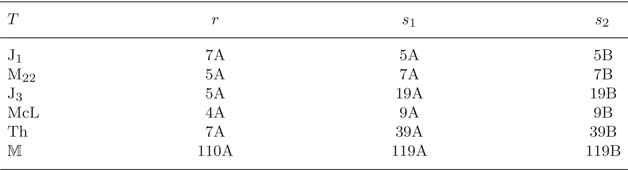
Each element is specified by its corresponding conjugacy class, labelled as in the Atlas [Reference Conway, Curtis, Norton, Parker and Wilson13].
Acknowledgements
This work forms part of an Australian Research Council Discovery Project DP200101951. We thank Tim Burness for drawing our attention to the result [Reference Burness10, Theorem 3.1], which helped us to resolve the $\mathbb {M}$ case of Theorem 1.3. We also thank the referee for some helpful suggestions.




 Open access

