





1. Introduction
When people speak, they sometimes produce manual gestures, that is, meaningful hand movements (Kendon, Reference Kendon2004; Kita, Reference Kita and McNeill2000; McNeill, Reference McNeill1992). For example, when describing how a magician sawed someone in two, a speaker might mimic the action of sawing when saying “sawing.” Speech and co-occurring gestures often convey similar meaning, suggesting that both modalities contribute to communication in a coordinated fashion (McNeill, Reference McNeill1992; McNeill & Duncan, Reference McNeill, Duncan, Guendouzi, Loncke and Williams2011). Hostetter and Alibali (Reference Hostetter and Alibali2019) have proposed one reason that gestures and speech may often convey similar meaning. According to their Gesture as Simulated Action theory, gestures are simulated (i.e., mimicked or imagined) actions that activate similar semantic information to words. So, in the example of a speaker mimicking the action of sawing while saying “sawing,” the speaker would be simulating the action of sawing, thereby activating the sensorimotor aspects of the semantics of “sawing,” along with other aspects of semantics associated with the word. The meaning that is conveyed (to both speaker and listener) includes the coordinated semantic properties activated by both gesture and word (Hostetter & Alibali, Reference Hostetter and Alibali2019). Gestures serve a variety of functions in communication, including making a message clear to an interlocutor or emphasizing important points of the message (Dimitrova et al., Reference Dimitrova, Chu, Wang, Özyürek and Hagoort2016; Iani & Bucciarelli, Reference Iani and Bucciarelli2017; Kendon, Reference Kendon2004). In this study, we focus on gesture use when performing a difficult task, namely speaking a language when one’s proficiency in that language is weak, such as when one is still in the process of learning a language or when one’s language skills have attrited.
Many previous studies have shown that people produce more gestures when performing a difficult task than an easy task (Kita & Davies, Reference Kita and Davies2009; Melinger & Kita, Reference Melinger and Kita2007; Suppes et al., Reference Suppes, Tzeng and Galguera2015; see reviews in Nicoladis, Reference Nicoladis2007; Sassenberg & Van Der Meer, Reference Sassenberg and Van Der Meer2010). Trying to communicate in a language when one’s proficiency in that language is weak can be conceptualized as a difficult task (Nicoladis, Reference Nicoladis2007). According to the Gesture as Simulated Action (Hostetter & Alibali, Reference Hostetter and Alibali2019), gestures are produced when a critical threshold is reached. It is possible that task difficulty lowers that threshold, making gestures more likely to be produced. However, as we will elaborate below, the relationship between task difficulty and gesture frequency might apply only to some kinds of gestures (Kita & Davies, Reference Kita and Davies2009). To better understand how task difficulty is thought to affect gesture use, we turn next to a discussion of different gesture types.
1.1. Gesture types
Different gesture types might play different roles in communication generally, and specifically in the context of speaking a weak language. Gestures can be referential, by either representing or referring to objects, actions or events (Kita, Reference Kita and McNeill2000). For example, pointing to something in the environment would be a referential gesture. Similarly, simulating the action of sawing (like in the magician example at the outset of this paper) would also be a referential gesture (these gestures are sometimes referred to as representational gestures; Hostetter & Alibali, Reference Hostetter and Alibali2019; Kita & Davies, Reference Kita and Davies2009). Referential gestures are strongly related to processing visuospatial information (Alibali, Reference Alibali2005; Hostetter & Alibali, Reference Hostetter and Alibali2019). For example, one study found that people produced more referential gestures when talking about visual images than when talking about an abstract subject (Feyereisen & Havard, Reference Feyereisen and Havard1999).
One important function of referential gestures is likely to lighten the cognitive load when tasks are difficult (Lin, Reference Lin2024; Ping & Goldin-Meadow, Reference Ping and Goldin-Meadow2010). This function is compatible with the idea that task difficulty may help raise the likelihood of gesture production according to the Gesture as Simulated Action theory (Hostetter & Alibali, Reference Hostetter and Alibali2019). Referential gestures might lighten cognitive load because speakers can off-load some of what has to be retained in working memory on their hands. For example, someone who was trying to remember a complex pattern of shapes she had seen could produce representational gestures that showed the outline while trying to describe the rest of the pattern. There is evidence supporting the argument that referential gestures lighten cognitive load. For instance, the frequency of referential gestures produced increases with task difficulty (Kita & Davies, Reference Kita and Davies2009; Melinger & Kita, Reference Melinger and Kita2007; Sassenberg & Van Der Meer, Reference Sassenberg and Van Der Meer2010; Suppes et al., Reference Suppes, Tzeng and Galguera2015). Furthermore, some studies have shown that referential gestures help people access words for production (Morsella & Krauss, Reference Morsella and Krauss2004), particularly in the moment when speakers are searching for words (Lin, Reference Lin2020). Referential gestures might help lexical access by activating the concept a speaker is trying to convey which, in turn, activates the word (Morett, Reference Morett2014; Morsella & Krauss, Reference Morsella and Krauss2004).
Gestures can be non-referential, such as a palm-up-open-hand gesture that can serve a variety of pragmatic functions, including indicating “you know [what I mean]” (Lopez-Ozieblo, Reference Lopez-Ozieblo2020). In previous studies using the kind of cartoon elicitation task that we used here, the most frequent non-referential gesture produced was beats (Laurent et al., Reference Laurent, Nicoladis and Marentette2015). We therefore focus here on previous research with beats. Beats are rhythmic hand movements that are often timed with prosodic rhythm of speech, particularly prosodic prominence (Gluhareva & Prieto, Reference Gluhareva and Prieto2017; Leonard & Cummins, Reference Leonard and Cummins2011; Shattuck-Hufnagel & Ren, Reference Shattuck-Hufnagel and Ren2018; Vilà-Giménez & Prieto, Reference Vilà-Giménez and Prieto2020). While beats likely serve several functions, research to date has focused on their role in emphasizing or highlighting information (Dimitrova et al., Reference Dimitrova, Chu, Wang, Özyürek and Hagoort2016; Kushch et al., Reference Kushch, Igualada and Prieto2018; Morett & Fraundorf, Reference Morett and Fraundorf2019). There is little theoretical work that would allow us to make predictions about the frequency of production of beats. There is, however, growing evidence that seeing co-speech beats can, like referential gestures, support memory (Llanes-Coromina et al., Reference Llanes-Coromina, Vilà-Giménez, Kushch, Borràs-Comes and Prieto2018; McCafferty, Reference McCafferty2006; Morett, Reference Morett2014; Pi et al., Reference Pi, Zhu, Zhang and Yang2024; So et al., Reference So, Sim Chen-Hui and Low Wei-Shan2012; Vilà-Giménez & Prieto, Reference Vilà-Giménez and Prieto2020). For example, Pi et al. (Reference Pi, Zhu, Zhang and Yang2024) found that watching an instructor’s beat gestures helped learning vocabulary in a foreign language. Other research suggests that the impact of viewing beat gestures differs according to language proficiency (Rohrer et al., Reference Rohrer, Delais-Roussarie and Prieto2020). In this same study, beat gestures had no impact on recall or comprehension among native listeners, but had a negative impact on recall and comprehension among non-native listeners. In other words, among language learners, the observation of beat gestures may increase cognitive load.
While there are fewer studies on the production of beats than on the comprehension of beats, producing beats may also support memory and/or attention in a second language (L2). Morett (Reference Morett2014) found that producing beats was associated with some speakers’ recall of foreign-language words. Zhao (Reference Zhao2006) found that Mandarin–English bilinguals produced more beats when speaking their L2 English than their first language (L1) Mandarin (see also Lopez-Ozieblo, Reference Lopez-Ozieblo2023, for similar results). Interpreters experience a significant cognitive load from having to evaluate meanings from two languages in a time pressured manner (Cienki & Iriskhanova, Reference Cienki and Iriskhanova2020). In assessing trainee and experienced interpreters on their use of beat and representational gestures, Cienki and Iriskhanova (Reference Cienki and Iriskhanova2020) found that both groups produced more beat gestures than representational gestures. It may be the case that cognitive load may be most successfully reduced with beat gestures as they may be less conceptually demanding to produce (Cienki & Iriskhanova, Reference Cienki and Iriskhanova2020).
In sum, the production of both referential and beat gestures might support speaking a language in which one’s proficiency is weak, perhaps through somewhat different mechanisms. Referential gestures might help speakers’ access words, by referring to referents with their hands, thereby activating concepts and/or by lightening the load on working memory. Beat gestures might particularly focus speakers’ attention to the concepts that they are trying to recall. Beats might then also lighten the cognitive load of language processing.
1.2. Gesture production and proficiency in bilinguals
Bilinguals have lower proficiency (on average) than monolinguals in both languages and lower proficiency in one language than the other (Bialystok & Feng, Reference Bialystok and Feng2009; Luk & Bialystok, Reference Luk and Bialystok2013; Scheele et al., Reference Scheele, Leseman and Mayo2010). In this paper, we use the term “bilingual” broadly, to refer to a person who has any proficiency in more than one language. When proficiency in a language is weak, it is often hard to access words for production in that language (Finkbeiner et al., Reference Finkbeiner, Gollan and Caramazza2006; Kastenbaum et al., Reference Kastenbaum, Bedore, Peña, Sheng, Mavis, Sebastian-Vaytadden, Rangamani, Vallila-Rohter and Kiran2019; Sullivan et al., Reference Sullivan, Poarch and Bialystok2018). If gestures are related to proficiency within a language, bilinguals should produce more gestures than monolinguals and more gestures in their weaker language than their stronger (see also Jarbou et al., Reference Jarbou, Guba and Rababah2022, for a review of the research on bilinguals’ seeing gestures).
Some results have supported these predictions (see review in Nicoladis & Smithson, Reference Nicoladis, Smithson, Morgenstern and Goldin-Meadow2022). In some studies, bilinguals produce more referential gestures than monolinguals (Nicoladis et al., Reference Nicoladis, Pika and Marentette2009; Pika et al., Reference Pika, Nicoladis and Marentette2006; So, Reference So2010; Wermelinger et al., Reference Wermelinger, Gampe, Helbling and Daum2020) and more referential gestures in their weaker language than their stronger language (Hadar et al., Reference Hadar, Dar and Teitelman2001; Nagpal et al., Reference Nagpal, Nicoladis and Marentette2011; Nicoladis, Reference Nicoladis2007). Lin (Reference Lin2020) found that language learners used a lot of referential gestures when they were in the act of planning to speak that language. Similarly, Kamyabi Gol and Aminzadeh (Reference Kamyabi Gol and Aminzadeh2015) found that Iranian adults learning English as a foreign language used fewer referential gestures at the upper intermediate level than at the intermediate level.
In contrast, other studies have found results that do not support the predictions that bilinguals’ gesture use is elevated when proficiency in a language is weak. For example, Arslan et al. (Reference Arslan, Aktan-Erciyes and Göksun2023) found that monolingual Turkish-speaking children produced more referential gestures than Turkish–English bilingual children of the same age. In that study, there was no difference between bilinguals and monolinguals on their use of beats. Similarly, among adults, some studies have found that bilinguals produce more referential gestures in their dominant language than in their nondominant language (Gregersen et al., Reference Gregersen, Olivares-Cuhat and Storm2009; Gullberg, Reference Gullberg1998). Still other studies have shown no difference on gesture frequency between their dominant and nondominant languages (Sherman & Nicoladis, Reference Sherman and Nicoladis2004; Smithson & Nicoladis, Reference Smithson and Nicoladis2013). Yet another study found no relationship between proficiency measures and referential gesture production among French–English bilinguals (Aziz & Nicoladis, Reference Aziz and Nicoladis2019).
It is not entirely clear why studies have shown such varied results. Researchers have considered a number of different reasons, including individual differences in cognitive abilities (Smithson & Nicoladis, Reference Smithson and Nicoladis2013) and individual differences in gesture frequency (Arslan et al., Reference Arslan, Aktan-Erciyes and Göksun2023). In the present study, we consider the possibility that gesture type might play a critical role. As might be apparent from the previous discussion, most previous studies on bilinguals’ gesture production have focused exclusively on referential gestures. In the present study, we expand the scope and also include beats. Before turning to a more detailed description of this study, we also consider the role of culture in the frequency of gesture production.
1.3. Cultural differences in the frequency of gesture production
Bilinguals often have access to two cultures and there may be cultural differences in how frequently gestures are produced (Kendon, Reference Kendon2004; So, Reference So2010). Some studies have found that speakers of some languages gesture frequently, like Romance languages and Turkish (Azar et al., Reference Azar, Backus and Özyürek2020; Graziano & Gullberg, Reference Graziano and Gullberg2024; Nicoladis et al., Reference Nicoladis, Nagpal, Marentette and Hauer2018; Pika et al., Reference Pika, Nicoladis and Marentette2006). We refer to these languages as high-gesture-frequency languages. In contrast, speakers of other languages, like Dutch, English, Hindi, Mandarin or Swedish, gesture infrequently (Azar et al., Reference Azar, Backus and Özyürek2020; Graziano & Gullberg, Reference Graziano and Gullberg2024; Nicoladis et al., Reference Nicoladis, Nagpal, Marentette and Hauer2018; So, Reference So2010).
Some studies have found that bilinguals’ gesture use reflects the cultural norms of the language that they are speaking at any given moment (Azar et al., Reference Azar, Backus and Özyürek2020; Emerson et al., Reference Emerson, Limia and Özçalışkan2021). However, one study found that learners of French did not increase their gesture frequency after a year of learning French (Casey et al., Reference Casey, Emmorey and Larrabee2012). Another study found that bilinguals (English L2 and one of four L1s: French, Spanish, Mandarin or Hindi) produced similar rates of gestures in their two languages (Nicoladis et al., Reference Nicoladis, Nagpal, Marentette and Hauer2018). Other studies have found that bilinguals who speak one high-gesture-frequency language and another low-gesture-frequency language produce a high rate of representational gestures in both of their languages (Pika et al., Reference Pika, Nicoladis and Marentette2006; So, Reference So2010). In other words, the bilinguals transferred the tendency to use a lot of gestures in the high-gesture-frequency language to the low-gesture-frequency language (Pika et al., Reference Pika, Nicoladis and Marentette2006; So, Reference So2010). This transfer toward high-gesture-frequency has been observed both when the high-gesture-frequency language is the L1 and when it is the L2 of the bilinguals (Pika et al., Reference Pika, Nicoladis and Marentette2006). To test for the possibility of transfer in this study, we tested whether there was a positive correlation between gesture rates in bilinguals’ two languages.
Another way we tested for possible effects of culture was to compare the gesture rates. The present study includes speakers of English and, in the case of the bilinguals, either Canadian French or Farsi. We expected the French–English bilinguals to use more referential gestures than English monolinguals, as French has been reported to be a high-gesture-frequency language with regard to referential gestures (see Pika et al., Reference Pika, Nicoladis and Marentette2006). We had no predictions about Farsi–English bilinguals, as we could find no previous study on Farsi speakers’ referential or beat gesture production (Matsumoto & Hwang, Reference Matsumoto and Hwang2013; Najarzadegan, Reference Najarzadegan2016 for studies on Farsi speakers’ conventional gestures). Kamyabi Gol & Aminzadeh (Reference Kamyabi Gol and Aminzadeh2015) found that Iranian students who were intermediate in English produced more referential gestures in English than students who were upper intermediate. However, that study did not include information about their gesture production in their L1.
1.4. This study
The purpose of the present study was to test how proficiency and culture affect referential and beat gestures production among bilinguals. We included four groups of participants: (1) English monolinguals, (2) L1 speakers of English who spoke Canadian French as an L2, (3) L1 speakers of Canadian French who spoke English as an L2 and (4) L1 speakers of Farsi who spoke English as an L2. We expected to find that proficiency impacted gesture production. Specifically, we predicted that bilinguals would produce more referential and beat gestures than monolinguals, particularly when speaking their L2. We also predicted that bilinguals would produce more gestures in their L2 than their L1.
In terms of culture, we predicted that the L1 French speakers would gesture more than L1 English speakers (including English monolinguals), following arguments by Pika et al. (Reference Pika, Nicoladis and Marentette2006) that French is a high-gesture-frequency language relative to English. We had no predictions about the L1 Farsi speakers. If bilinguals transfer their tendency to gesture at a particular rate across languages, we expected to find high positive correlations across languages.
2. Method
Prior to undertaking this study, we obtained approval for the study methods from the Research Ethics Board at the University of Alberta. Participants were primarily recruited by responding to posters advertising the study that were distributed across campus and then by snowballing. Participants were given a small honorarium at the end of each language session in which they participated.
A total of 133 adults participated in this study in four different language groups: English monolinguals (or Monolinguals), English L1–French L2 bilinguals (or Eng L1–Fre L2), French L1–English L2 bilinguals (or Fre L1–Eng L2) and Farsi L1–English L2 bilinguals (or Far L1–Eng L2). Some of the participants’ data have been published before in studies testing the link between proficiency and gesture production (Aziz & Nicoladis, Reference Aziz and Nicoladis2019), the link between working memory and gesture production (Smithson & Nicoladis, Reference Smithson and Nicoladis2013) and the possibility that there are task effects on gesture production (Khodadadi et al., Reference Khodadadi, Nicoladis, Shokrkon and Zarezadehkheibari2024). Other than some descriptive statistics, none of the analyses replicates the previously published results.
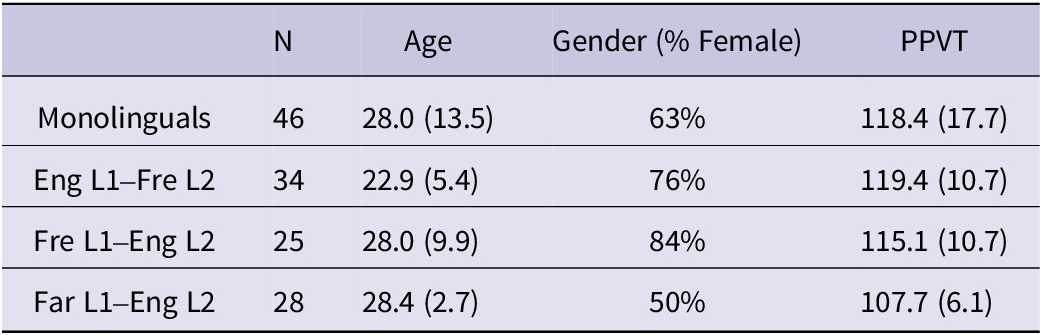
All of the participants lived in an English-majority-language part of western Canada. The English monolinguals spoke only English well enough to carry on a conversation; they were born and grew up in western Canada. The English L1–French L2 bilinguals spoke English at home and started learning French in a French immersion program, with an average age of acquisition of French of 5.9 (SD = 2.4) years. They, too, were born and grew up in western Canada. The French L1–English L2 bilinguals spoke Canadian French at home in a French-speaking part of Canada and started learning English at various ages and in various contexts (average age of acquisition = 8.7, SD = 2.5). The Farsi L1–English L2 bilinguals all spoke Farsi as an L1 at home and spoke English as an L2. The Farsi L1–English L2 bilinguals all started learning English at the onset of their schooling, between 5 and 6 years of age. All but one of the Farsi speakers were born in the Middle East and moved to Canada for their university studies as adults. The data from the one who was born and grew up in Canada were not noticeably different from those of the other participants on any of the measures included here. Two of the Farsi–English bilinguals participated only in the Farsi sessions and did not return for the English sessions; their data are included in the analyses whenever possible. Table 1 summarizes some of the demographic information for the participants. All participants identified either as female or male (i.e., no non-binary participants) so we report simply the percentage of participants who were female.
Descriptive statistics for demographics for participants in the four language groups

Table 1. Long description
The table consists of five columns and five rows including the header. The columns are labeled Group, N, Age, Gender percent Female, and PPVT. Values for Age and PPVT are presented as means with standard deviations in parentheses.
* Monolinguals. N is 46. Age is 28.0 mean, 13.5 standard deviation. Gender is 63 percent Female. PPVT is 118.4 mean, 17.7 standard deviation.
* Eng L 1 to Fre L 2. N is 34. Age is 22.9 mean, 5.4 standard deviation. Gender is 76 percent Female. PPVT is 119.4 mean, 10.7 standard deviation.
* Fre L 1 to Eng L 2. N is 25. Age is 28.0 mean, 9.9 standard deviation. Gender is 84 percent Female. PPVT is 115.1 mean, 10.7 standard deviation.
* Far L 1 to Eng L 2. N is 28. Age is 28.4 mean, 2.7 standard deviation. Gender is 50 percent Female. PPVT is 107.7 mean, 6.1 standard deviation.
Note. PPVT stands for Peabody Picture Vocabulary Test.
PPVT, Peabody Picture Vocabulary Test.
As can be seen in Table 1, the language groups were not perfectly equivalent in either age or gender distribution. We did not take either gender or age into account in recruiting participants as it is not yet clear whether these variables contribute significantly to predicting gesture frequency. While one small-scale study reported that females gestured more than males (Hostetter & Hopkins, Reference Hostetter and Hopkins2002), other larger studies did not report gender differences (Thakore et al., Reference Thakore, Das, Jahan and Sweller2024). As for age, all the participants in this study ranged between 18 years and 45 years, an age range that has not been reported to matter for gesture production (Thakore et al., Reference Thakore, Das, Jahan and Sweller2024). A set of preliminary analyses did not reveal any main effects or interactions with either gender or age in this study.
2.1. Materials and procedure
In order to elicit gestures, participants watched a cartoon and told the story back. Cartoon retell has long been shown to a context that elicits gestures (McNeill, Reference McNeill1992). All participants watched an eight-minute segment of the Pink Panther cartoon, which consisted of two stories. In the first story, Pink Panther is attempting to get rid of a bird in order to ensure a good night’s sleep, and in the second segment, he finds himself trying to fly a jet without having any prior training. These particular cartoons have been used successfully in previous studies to elicit gestures (Aziz & Nicoladis, Reference Aziz and Nicoladis2019; Nicoladis et al., Reference Nicoladis, Nagpal, Marentette and Hauer2018; Pika et al., Reference Pika, Nicoladis and Marentette2006; Sherman & Nicoladis, Reference Sherman and Nicoladis2004; Smithson & Nicoladis, Reference Smithson and Nicoladis2013).
Participants were asked to watch the cartoon closely and relay its stories to a research assistant once the cartoon was finished. A native speaker of the target language asked participants to recount all that they remembered from the cartoon. The research assistant claimed not to have seen the cartoon. The bilinguals participated in two sessions: one in each language. The two language sessions took place on different days, usually about a week apart, with different research assistants. The order of the language sessions was counterbalanced for the bilinguals. The monolinguals participated in only one session (in English). The participants’ stories were videotaped to allow for later transcription and coding.
For this study, we assumed that the bilinguals had stronger proficiency in their L1 than in their L2. To confirm participants’ English proficiency, all participants were invited to take the Peabody Picture Vocabulary Test (PPVT), the third edition, version A (Dunn & Dunn, Reference Dunn and Dunn1997). The average standard scores are presented in Table 1. PPVT scores were available for all the bilinguals who spoke English and French, but only 30 English monolinguals and 20 Farsi–English bilinguals, so we present these results for descriptive purposes only. As can be seen in Table 1, the Farsi–English bilinguals tended to score lower on the PPVT than any of the other participant groups, consistent with their self-reports of relatively recent arrival in an English-majority-language part of Canada. We had French vocabulary scores for all the bilinguals who spoke both English and French on the Echelle de Vocabulaire en Images Peabody (EVIP; Dunn et al., Reference Dunn, Dunn and Thériault-Whalen1993). The English L1–French L2 bilinguals averaged 105.2 (SD = 12.9) on the EVIP while the French L1–English L2 bilinguals averaged 116.4 (SD = 11.4). Note that the standard scores of French vocabulary for the English L1–French L2 bilinguals were roughly equivalent to the standard scores of English vocabulary for the Farsi L1–English L2 bilinguals (see Table 1). These results largely supported the assumption that the participants were more proficient in their L1 than in their L2. One notable exception is the French L1–English L2 bilinguals whose average standard scores were fairly equivalent in French and English.
2.2. Transcription and coding
All transcriptions were done by native speakers of the language. The basic unit of transcription was orthographic words. For each participant, we counted the number of word tokens they used to tell the story, excluding self-repetitions and false starts.
Referential gestures (i.e., iconic and deictic, following McNeill, Reference McNeill1992) and beats were coded. Iconic gestures represent the content of speech in some manner such as punching the air when talking about boxing. Deictic gestures usually revolve around pointing and indicate the location of something. Beat gestures do not possess a symbolic meaning and are used to regulate speech such as hitting the table at certain times during speech to put more emphasis on some words.
Some individuals told longer stories than others. In order to account for individual differences in story length (following Pika et al., Reference Pika, Nicoladis and Marentette2006, among others), the dependent variable for gestures is the gesture rate, or the number of gestures per 100 word tokens.
3. Results
3.1. English
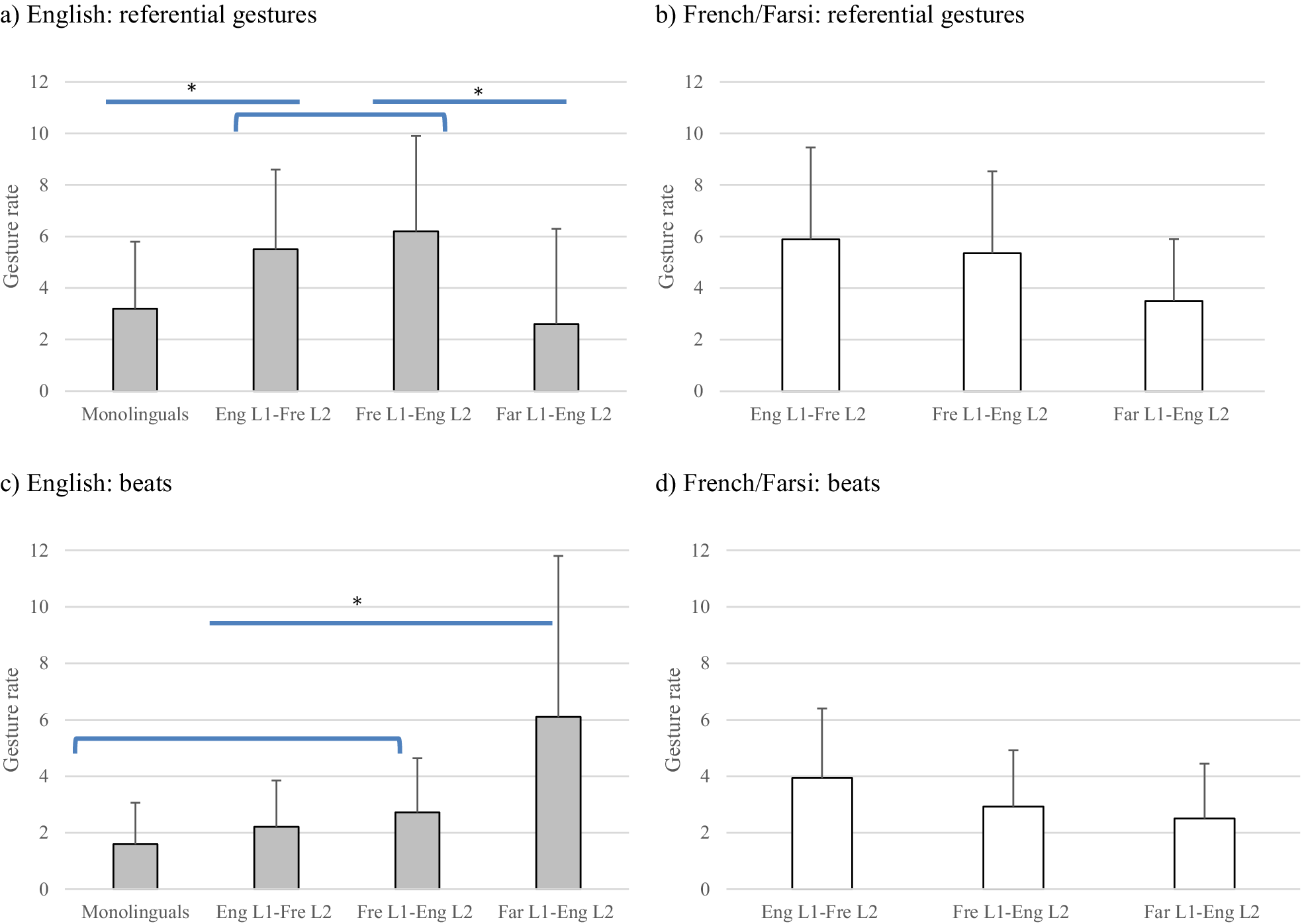
The gesture rate for the participants in English is summarized in Figure 1A (referential gestures) and Figure 1C (beats). The number of word tokens and gesture rate for the participants in English is summarized in the Supplementary Material. There were no significant differences between the four groups on word tokens in English, F (3, 127) = 0.34, p = .80, η 2p = .008.
Average (SD) gesture rate by language group, language and gesture type.

Figure 1. Long description
A multi-panel figure with four bar graphs labeled a through d. All graphs use a Y axis for Gesture rate from 0 to 12 and an X axis for language groups.
Panel a, English referential gestures, shows four grey bars. Monolinguals at approximately 3.2, Eng L 1-Fre L 2 at 5.5, Fre L 1-Eng L 2 at 6.2, and Far L 1-Eng L 2 at 2.6. Horizontal brackets with asterisks indicate significant differences between Monolinguals and Fre L 1-Eng L 2, and between Fre L 1-Eng L 2 and Far L 1-Eng L 2.
Panel b, French or Farsi referential gestures, shows three white bars. Eng L 1-Fre L 2 at 5.9, Fre L 1-Eng L 2 at 5.4, and Far L 1-Eng L 2 at 3.5.
Panel c, English beats, shows four grey bars. Monolinguals at 1.6, Eng L 1-Fre L 2 at 2.2, Fre L 1-Eng L 2 at 2.7, and Far L 1-Eng L 2 at 6.1. Brackets with asterisks show significant differences between Monolinguals and Fre L 1-Eng L 2, and between Eng L 1-Fre L 2 and Far L 1-Eng L 2.
Panel d, French or Farsi beats, shows three white bars. Eng L 1-Fre L 2 at 4.0, Fre L 1-Eng L 2 at 2.9, and Far L 1-Eng L 2 at 2.5.
All bars include vertical error bars representing standard deviation.
To compare the groups on gesture production in English, we performed a 2 x 4 [Gesture Type x Group] ANOVA with Gesture Type as a repeated measure. Overall, the participants produced more referential gestures (M = 4.3, SD = 3.2) than beats (M = 2.9, SD = 3.3), F (1, 127) = 11.85, p < .001, η2p = .085. There was also a significant main effect of Group, F (3, 127) = 7.53, p < .001, η 2p = .151. All the bilingual groups produced significantly more gestures than the English monolinguals based on LSD post-hoc tests: Eng L1–Fre L2 (p = .002), Fre L1–Eng L2 (p < .001) and Far L1–Eng L2 (p < .001). All other post-hoc comparisons did not reach significance, ps ≥ .30. There was also a significant interaction between Gesture Type and Group, F (3, 127) = 18.51, p < .001, η 2p = .304.
To better understand the interaction between Gesture Type and Group, we next analyzed only the referential gestures. There was a significant difference between the four groups on referential gestures in English, F (3, 127) = 11.15, p < .001, η 2p = .208. The French speakers produced more referential gestures than the English monolinguals (Eng L1–Fre L2, p < .001; Fre L1–Eng L2, p < .001) and the Farsi speakers (Eng L1–Fre L2, p < .001; Fre L1–Eng L2, p < .001). There was no difference between the two groups of French speakers (p = .39) or the Farsi speakers and English monolinguals (p = .35).
As for beats, there was a significant difference between the four groups, F (3, 127) = 14.13, p < .001, η2p = .250. The Farsi speakers produced more than the English L1 bilinguals (p < .001), the French L1 Bilinguals (p < .001) and the English monolinguals (p < .001). No other differences reached significance, ps ≥ .12.
In sum, in English, the bilinguals who spoke French (both as L1 and as L2) produced more referential gestures than the English monolinguals and the Farsi speakers. The Farsi speakers produced more beats than participants in any other language group.
3.2. French/Farsi
The gesture rate for the participants in French/Farsi is summarized in Figure 1B (referential gestures) and Figure 1D (beats). The descriptive statistics for French and Farsi are also summarized in the Supplementary Material. In French/Farsi, there was a significant difference between the three groups on word tokens, F (2, 84) = 3.22, p = .045, η 2p = .071. Post-hoc LSD tests revealed that the Farsi speakers used fewer words than the Fre L1–Eng L2 bilinguals (p = .02) and tended to produce fewer than the Eng L1–Fre L2 bilinguals (p = .07). Given the latter effect, this is likely simply that it takes fewer words to convey a message in Farsi than it does in French.
Just like in English, the participants produced more referential gestures (M = 5.0, SD = 3.2) than beats (M = 3.2, SD = 2.2), F (1, 84) = 24.49, p < .001, η 2p = .226. There was also a significant main effect of Group, F (2, 84) = 5.64, p = .005, η 2p = .118. Post-hoc LSD tests revealed that the Farsi speakers used significantly fewer gestures than the Eng L1–Fre L2 bilinguals (p = .001). There was a nonsignificant trend for the Farsi speakers to produce fewer gestures than the Fre L1–Eng L2 bilinguals (p = .08). There was no significant difference between the two French-speaking groups (p = .16). There was no significant interaction between Gesture Type and Group, F (1, 84) = 1.35, p = .26, η 2p = .031.
In sum, the Farsi-speaking participants used fewer gestures overall in Farsi than the French-speaking participants did in French, although this only reached significance in comparison to the Eng L1–Fre L2 group.
3.3. Bilinguals: L1 versus L2
In order to address the question of whether bilinguals produced more gestures in their L2 than in their L1, we next analyzed the gesture rate of the bilinguals with 2 × 2 [Language × Gesture Type] repeated-measures ANOVA. The results showed that the Eng L1–Fre L2 produced more gestures in French than in English, F (1, 33) = 8.62, p = .006, η 2 = .054, and more referential gestures than beats, F (1, 33) = 30.32, p < .001, η 2 = .287. There was an interaction between Language and Gesture Type, F (1, 33) = 4.39, p = .04, η 2 = .017. As can be seen in Figure 1, this was due to participants producing relatively equivalent rates of referential gestures in both languages and more beats in French than in English.
For the Fre L1–Eng L2, there was no main effect of Language, F (1, 24) = 0.29, p = .60, η 2 = .002. They produced more referential gestures than beats, F (1, 24) = 18.85, p < .001, η 2 = .345. The interaction between Language and Gesture Type did not reach significance, F (1, 24) = 3.07, p = .09, η 2 = .007.
The Far L1–Eng L2 bilinguals produced more gestures in English than in Farsi, F (1, 25) = 8.53, p = .007, η2 = .086. There was no main effect of Gesture Type, F (1, 25) = 1.21, p = .28, η 2 = .016. There was an interaction between Language and Gesture Type, F (1, 25) = 8.86, p = .006, η 2 = .083. As can be seen in Figure 1, the Far L1–Eng L2 bilinguals produced relatively equivalent rates of referential gestures in both languages but more beats in English than in Farsi.
In sum, the results showed that both the Eng L1–Fre L2 and the Far L1–Eng L2 bilinguals produced more gestures in their L2 than in their L1. Surprisingly, this result was largely due to a high rate of beat production in their L2 rather than referential gesture production.
3.4. Bilinguals: cross-language effects
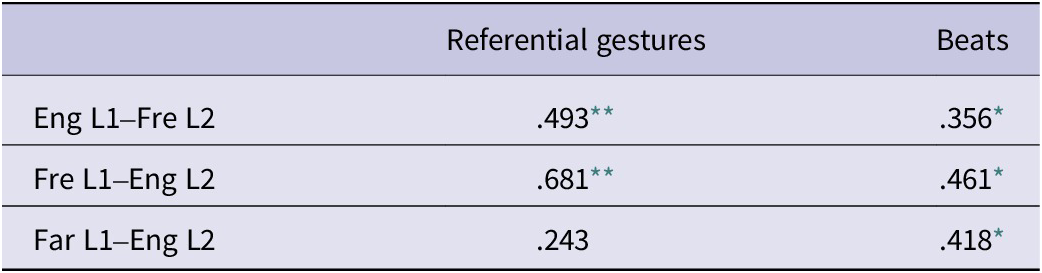
If bilinguals transferred a tendency to produce gestures at a particular rate across languages, there would be positive correlations across languages for the bilinguals’ gesture rate. Table 2 summarizes the correlations across languages. As can be seen in Table 2, the correlations were all positive, but one was not significant. The one nonsignificant correlation (for the Far L1–Eng L2 bilinguals’ referential gesture use) seemed to be particularly affected by one outlier. With that outlier removed, the correlation across languages for referential gestures was positive and significant, r (23) = .420, p = .036. We have no explanation for why this particular person may have been an outlier: her vocabulary score in English and her age of acquisition of English both fell within a standard deviation of the average and she was born in Iran.
Correlations across languages for referential and beat gesture rates for bilinguals
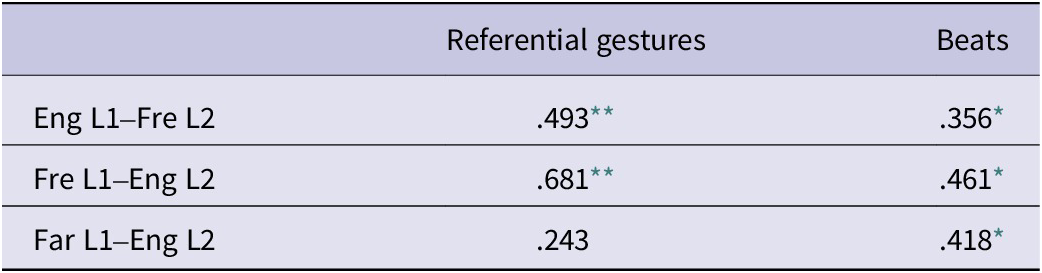
Table 2. Long description
The table consists of three columns and four rows. The header row contains the categories Referential gestures and Beats. The subsequent rows list language pairings and their corresponding correlation values.
Row 1: Eng L 1 to Fre L 2 shows a correlation of .493 with two asterisks for Referential gestures and .356 with one asterisk for Beats.
Row 2: Fre L 1 to Eng L 2 shows a correlation of .681 with two asterisks for Referential gestures and .461 with one asterisk for Beats.
Row 3: Far L 1 to Eng L 2 shows a correlation of .243 for Referential gestures and .418 with one asterisk for Beats.
Footnotes indicate that one asterisk represents p is less than .05 and two asterisks represent p is less than .01.
* p < .05.
** p < .01.
4. Discussion
We had predicted that participants would produce more gestures, particularly referential gestures, when their proficiency was weak (Kamyabi Gol & Aminzadeh, Reference Kamyabi Gol and Aminzadeh2015; Pika et al., Reference Pika, Nicoladis and Marentette2006; So, Reference So2010; Wermelinger et al., Reference Wermelinger, Gampe, Helbling and Daum2020). We first tested this prediction by comparing three groups of bilinguals to monolinguals when speaking English. We found that both English–French bilinguals and French–English bilinguals produced more referential gestures than English monolinguals. While these results could be consistent with the argument that referential gesture use is increased when proficiency is weak, there are at least two reasons to question that these results are related to proficiency. First, both the English–French bilinguals and French–English bilinguals were highly proficient in English (see vocabulary scores in English in Table 1). Moreover, the Farsi–English bilinguals, who scored lower than the monolinguals on the vocabulary test did not differ in their referential gesture rate from the monolinguals.
These results contradict the prediction generated from the Gesture as Simulated Action theory, namely that referential gestures would be more likely to be produced when the task was difficult, as in speaking an L2. As noted in the introduction, the results from previous studies have not uniformly supported the prediction that referential gestures would be used frequently when people were speaking a weak language. The results of the present study raise the possibility that previous studies may not have controlled for effects of culture. In the present study, we found that participants who spoke French (either as an L1 or as an L2) produced a lot of referential gestures when speaking English and when speaking French. Furthermore, these results support the argument put forth by Pika et al. (Reference Pika, Nicoladis and Marentette2006), namely that French is a high-gesture-frequency language and there can be transfer in referential gesture frequency from French to English. We will discuss the possible effects of culture in more detail below. At the moment, one important theoretical point to keep in mind is that our results do not necessarily undermine the Gesture as Simulated Action theory. Instead, they suggest that this theory does not extend to language proficiency as an indicator of task difficulty (Nicoladis, Reference Nicoladis2007).
In contrast to referential gestures, results with regard to beats were consistent with the argument that people produce a lot of beats when their proficiency was weak. The English–French bilinguals produced more beats in their L2 French than the other bilinguals (see Figure 1D). In addition, the Farsi speakers produced more beats when speaking English than speakers from any other language group that participated in this study (see Figure 1C) and more beats in their L2 English than in their L1 Farsi. Khodadadi et al. (Reference Khodadadi, Nicoladis, Shokrkon and Zarezadehkheibari2024) also reported that these Farsi–English bilinguals used more beats in their L2 English than in L1 Farsi when being interviewed about their language histories. Taken together, these results suggest that the participants’ weaker proficiency was associated with a greater use of beats. One result that was inconsistent with this line of reasoning is the L1 speakers of French in this study did not produce any more beats when speaking their L2 English than English monolinguals (see Figure 1C). However, these participants also had English vocabulary scores on par with those of monolinguals (see Table 1). It is possible that the use of beats diminishes when proficiency in an L2 because quite advanced. If so, the results of this study add to the growing evidence that speakers produce a lot of beats when their proficiency is weak (Lopez-Ozieblo, Reference Lopez-Ozieblo2023; McCafferty, Reference McCafferty2006; Zhao, Reference Zhao2006).
Why might participants produce a lot of beats when their proficiency is weak? In the introduction, we emphasized the role of beats in highlighting information and supporting memory (Llanes-Coromina et al., Reference Llanes-Coromina, Prieto, Rohrer, Klessa, Bachan, Wagner, Karpiński and Śledziński2018; Morett, Reference Morett2014; So et al., Reference So, Sim Chen-Hui and Low Wei-Shan2012; Vilà-Giménez & Prieto, Reference Vilà-Giménez and Prieto2020). However, several studies have shown that speakers produce beats while searching for a word (Lopez-Ozieblo, Reference Lopez-Ozieblo2023; McCafferty, Reference McCafferty2006). Beats could therefore help with accessing appropriate words (Morett, Reference Morett2014) and/or indicate to the listener that the speaker has not finished speaking and is having difficulty finding appropriate words (Lopez-Ozieblo, Reference Lopez-Ozieblo2023; McCafferty, Reference McCafferty2006). In everyday interactions, beats could then elicit suggestions from listeners for what the speaker wishes to convey. Additionally, cognitive load may be most successfully reduced when producing beat gestures as they may be less conceptually demanding to produce than referential gestures (Cienki & Iriskhanova, Reference Cienki and Iriskhanova2020). Future studies can test these interpretations, both in carefully designed experimental studies and naturalistic observational studies. Furthermore, our speculation that beats decrease in frequency as proficiency becomes advanced requires further testing, ideally from longitudinal studies.
While we have found evidence consistent with the argument that beat production increases when proficiency is weak, it is important to keep in mind that there could be other variables that contribute to the frequency of gesture production. We next consider the possibility of cultural differences before mentioning other possible variables that might contribute.
4.1. Cultural differences in the frequency of gesture production
A secondary purpose of this study was to test for the possibility of cultural differences in the frequency of gesture production, particularly referential gestures. Previous studies have characterized Romance languages as high-gesture-frequency languages, with a focus on referential or representational gestures (Graziano & Gullberg, Reference Graziano and Gullberg2024; Pika et al., Reference Pika, Nicoladis and Marentette2006). Pika et al. (Reference Pika, Nicoladis and Marentette2006) found that even L2 speakers of French produced a lot of referential gestures in their L1 English, suggesting transfer from French. The results of the present study replicated these results, showing that speakers of French (both as L1 and L2) produced more referential gestures than English monolinguals and Farsi–English bilinguals. A similar pattern was observed in French/Farsi, with the speakers of French (both as L1 and L2) tending to produce more referential gestures in French than Farsi–English bilinguals did in Farsi. These results are consistent with the claims of Pika et al. (Reference Pika, Nicoladis and Marentette2006) that speakers of one high-gesture-frequency language transfer that high-gesture-frequency into their lower-gesture-frequency language (see also So, Reference So2010, for similar arguments). Still, there are a number of unanswered questions whether this interpretation is correct. For example, it is not entirely clear why the transfer would only go in one direction (i.e., from high-gesture-frequency to low-gesture-frequency), as many studies have shown bidirectional transfer across languages among bilinguals with various aspects of spoken language (e.g., Muñoz & Cadierno, Reference Muñoz and Cadierno2019). Another open question is how proficient speakers have to be in order for this transfer to occur. The participants in this study had been learning their L2 for years and showed signs of transfer. In contrast, Casey et al. (Reference Casey, Emmorey and Larrabee2012) found that a year of exposure to French did not affect gesture production.
One important point to keep in mind in interpreting our results is that the design of this study also allows us some insight into what about gesture production might not be related to culture. Notably, the Farsi–English bilinguals showed a comparable rate of beats when speaking their L1 Farsi to French–English bilinguals speaking their L1 French. Similarly, the English–French bilinguals used a high rate of beats when speaking their L2 French but not a high rate when speaking their L1 English. Thus, rate of beat production is unlikely to be strongly linked to cultural norms associated with that language, at least among the groups who participated in this study.
4.2. Limitations and future directions
Some limitations of the present study can only be addressed by future studies. In the present study, we used the distinction between participants’ L1 and L2 as our primary indicator of their stronger and weaker languages, respectively. This approach did not take into account the current proficiency levels of participants. For example, while both the French–English bilinguals and the Farsi–English bilinguals spoke English as an L2, the French–English bilinguals were more likely more proficient in English, on average, than the Farsi–English bilinguals (see vocabulary scores in Table 1). Moreover, the French–English bilinguals had relatively equivalent standard receptive vocabulary scores in French and English. Future studies can adopt a more sensitive design by recruiting participants at a particular level of foreign-language learning (Gregersen et al., Reference Gregersen, Olivares-Cuhat and Storm2009; Lin, Reference Lin2020), adopting a longitudinal design (Lopez-Ozieblo, Reference Lopez-Ozieblo2023) or including continuous measures of proficiency, such as frequency of language use (So et al., Reference So, Kita and Goldin-Meadow2013). When including continuous measures of proficiency, future studies can consider including multiple measures, including age of acquisition and amount of time living in a particular country, to better reflect the complexity of the construct of language proficiency (Hulstijn, Reference Hulstijn2011).
Another important limitation of the present study is that we conflated culture with the specific language(s) that participants spoke. For example, we found that the participants who spoke French (either as L1 or as L2) used more referential gestures than the participants who did not speak French. We interpreted these results in terms of cultural norms for speaking French. Future studies could include more sensitive measures of culture, such as participants’ self-reports on degree of acculturation or cultural affiliation. Moreover, the groups may also have differed on any number of variables that could have affected their gesture rate, including motivation for learning/speaking each of their languages, if or how much one of their languages had attrited, and how much everyday interaction they had with English-speaking Canadians (see Gullberg et al., Reference Gullberg, De Bot and Volterra2008).
Future studies can also take into account the rhythmic patterns of languages, particularly in analyzing beats. As noted in the introduction, beats are often timed with the prosodic rhythm of speech (Gluhareva & Prieto, Reference Gluhareva and Prieto2017; Krahmer & Swerts, Reference Krahmer and Swerts2007; Shattuck-Hufnagel & Ren, Reference Shattuck-Hufnagel and Ren2018; Vilà-Giménez & Prieto, Reference Vilà-Giménez and Prieto2020). This link may help facilitate language comprehension (Biau et al., Reference Biau, Fernández, Holle, Avila and Soto-Faraco2016; Ferrari & Hagoort, Reference Ferrari and Hagoort2025). There are important prosodic differences across the languages studied here, including French (Mairano & Romano, Reference Mairano, Romano, Wai-Sum and Zee2011; Peperkamp et al., Reference Peperkamp, Vendelin, Dupoux, Levis and Munro2026) and Farsi (Asadi et al., Reference Asadi, Nourbakhsh, He, Pellegrino and Dellwo2018; Sadeghi, Reference Sadeghi2017). Prosodic patterns in an L1 have been shown to influence prosodic patterns in L2 (Zhu & Mok, Reference Zhu, Mok, Derwing, Munro and Thomson2022). It is possible that the rhythmic patterns of languages contribute to gesture frequency. The results of this particular study showed stronger effects of proficiency on the frequency of beat production than any clear effect of language-related prosodic patterns. Notably, the English–French bilinguals produced more beats in their L2 French than in their L1 English and the Farsi–English bilinguals produced more beats in their L2 English than in their L1 Farsi. Nevertheless, future studies could more systematically take language-related prosodic patterns into account. In doing so, researchers might consider taking into account individual speakers’ prosody, as some studies have detected prosodic differences among minority French-language speakers in Canada (Kaminskaïa, Reference Kaminskaïa2014).
Future studies can also test to what extent the results of the present study generalize to other sociocultural contexts, participants and discourse genres. This study took place in an English-majority-language part of Canada. It is important to test whether these results generalize to other sociocultural contexts. The language groups were not matched perfectly in terms of gender distribution or age. While we found no significant results related to gender or age in this study, it is possible that in studies with larger samples, these variables may play a role. Some previous studies have found gender differences in gesture frequency (Hostetter & Hopkins, Reference Hostetter and Hopkins2002). Yet another important factor here is the discourse genre. In this study, participants were asked to watch a cartoon and tell a story. This genre is known to elicit a lot of referential gestures (McNeill, Reference McNeill1992; Nicoladis et al., Reference Nicoladis, Khan, Li, Brown and Eskildsen2024). In contrast, other genres favor the production of other kinds of gestures. For example, Shattuck-Hufnagel & Ren (Reference Shattuck-Hufnagel and Ren2018) found that academic discourse elicited a lot of beats. Nicoladis et al. (Reference Nicoladis, Khan, Li, Brown and Eskildsen2024) found that casual conversation elicited a lot of non-referential gestures (particularly pragmatic gestures). One study with the Farsi–English bilinguals in the present study showed that the high frequency of beats in L2 English was manifest in an interview about the participants’ language history, in addition to the cartoon retell task (Khodadadi et al., Reference Khodadadi, Nicoladis, Shokrkon and Zarezadehkheibari2024). Nevertheless, more stories comparing gesture frequency across various discourse genres are necessary to better understand the limits of generalizability of the present findings.
5. Conclusion
This study found that the frequency of producing beats was linked with proficiency. Farsi–English bilinguals who were intermediate in spoken English produced more beats in English than participants with other language backgrounds. Moreover, both Farsi–English bilinguals and English–French bilinguals produced more beats in their L2 than their L1. These results contrast with predictions that referential gesture production would be particularly highly linked to proficiency. Furthermore, we found some evidence that gesture production was linked to cultural norms, in that speakers of French (either as L1 or L2) produced more referential gestures than participants who did not speak French. Future studies can test for the generalizability of these findings along with other possible predictors of gesture frequency.
Supplementary material
The supplementary material for this article can be found at http://doi.org/10.1017/S1366728926101515.


 Open access

