




1. Introduction
Lateral approximants – consonants produced with a central lingual constriction while the sides of the tongue are lowered – have attracted considerable attention in phonetics and phonology – given their typological richness in places of articulation and distinct patterning in allophonic variation and phonotactics (e.g., Bladon & Al-Bamerni Reference Bladon and Al-Bamerni1976; Sproat & Fujimura Reference Sproat and Fujimura1993; Narayanan, Alwan & Haker Reference Narayanan, Alwan and Haker1997; Rice & Avery Reference Rice, Avery, Paradis and Prunet1991; Walsh Dickey Reference Walsh Dickey1997; Gick et al. Reference Gick, Campbell, Oh and Tamburri-Watt2006; Yip Reference Yip, van Oostendorp, Ewen, Hume and Rice2011; Recasens Reference Recasens2012). Much of the articulatory phonetic work on laterals, however, has been conducted on English, and to a lesser extent on major Germanic and Romance languages. With a few notable exceptions (e.g., Tabain, Fletcher & Butcher Reference Tabain, Fletcher and Butcher2011; Tabain & Beare Reference Tabain and Beare2018 on Australian languages; Kirkham & Nance Reference Kirkham and Nance2022; Nance & Kirkham Reference Nance and Kirkham2024 on Scottish Gaelic), laterals in other languages have received limited attention. This is particularly the case for languages with more than one lateral phoneme, as opposed to a single dental/alveolar lateral /l/ in languages like English or French. This study seeks to provide a detailed articulatory and acoustic description of the Serbian (Slavic) contrast between the denti-alveolar /l/ and alveolopalatal lateral /ʎ/ and differences in the realization of these sounds as a function of position in the utterance and quality of adjacent vowels. This is done by using electropalatographic (EPG) data from four Serbian speakers, with close reference to previous phonetic work conducted on Serbian and Croatian laterals and in comparison to the positional and contextual patterning of similar sounds in Catalan (Recasens & Espinosa Reference Recasens and Espinosa2005, Reference Recasens and Espinosa2006).
1.1. The lateral contrast
Serbian, as well as the closely related Croatian, have two lateral approximant consonants: the apical dental or alveolar /l/ and a palatal or alveolopalatal /ʎ/, orthographically represented as <л> and <љ> in the Cyrillic script and <l> and <lj> in the Roman script (Miletić Reference Miletić1933; Browne Reference Browne, Comrie and Corbett1993; Morén Reference Morén2006; Petrović & Gudurić Reference Petrović and Gudurić2010; cf. Landau et al. Reference Landau, Lončarić, Horga and Škarić1995; Bakran Reference Bakran1996 on Croatian). The two laterals occur contrastively across different word and syllable positions, as can be exemplified in the words shown in Table 1. Historically, however, word-final /l/ has undergone vocalization and merger with /o/ (e.g., oral > orao ‘eagle’; Browne Reference Browne, Comrie and Corbett1993), and the cases of final /l/ in the modern language are limited to loanwords.
Words illustrating the /l/ vs. /ʎ/ contrast in Serbian (based on Popova Reference Popova1986; Browne Reference Browne, Comrie and Corbett1993; tone is omitted)

Images from Miletić (Reference Miletić1933): (a) the zoning of the palate used for the categorization of palatography data, with the alveolar zone under I (a = front, б = mid, b = back), the hard palate zone under II (a = front, б = back), the velum zone under III (a = front, б = back), and the uvular zone under Р), and the upper teeth indicated as c1, c2 = incisors, o = canines, and к1-к4 = molars (Figure 2, p. 17); (b) the views of the author’s artificial palate from the bottom and the left side (Figure 4b, pp. 18–19); (c) and (d) the author’s production of /l/ ala and /ʎ/ in malja (Figure 23, pp. 54–55; Figure 48, pp. 74–75) with the dark color indicating the contact with the tongue; (e) and (f) estimated vocal tract configurations for /l/ and /ʎ/ inferred by the author from palatograms, linguograms, and introspection (Figure 28, p. 58; Figure 50, p. 76). [Images reproduced from Branko Miletić, Izgovor srpskohrvatskih glasova (eksperimentalno-fonetska studija), Belgrade: Slovo, 1933. Public domain. Courtesy attribution to the author required under Serbian moral rights law.]

Below I will review previous articulatory examinations of Serbian and Croatian laterals, focusing first on the articulatory and acoustic aspects of the realization of the contrast and then on positional and contextual variation of the two consonants.
1.1.1. Place of articulation of /l/ and /ʎ/
An early – and remarkably extensive – phonetic instrumental study of Serbian and Croatian (referred to as ‘Serbo-Croatian’) consonants was conducted by Miletić (Reference Miletić1933). The author collected static palatography data on various consonants and vowels produced by 34 speakers of the language (17 females, 17 males).Footnote 1 To better understand his method, the image (a) in Figure 1 presents the zoning of the roof of the mouth used for the categorization of consonants in terms of place of articulation, with the areas I, II, and III corresponding to the alveolar, palatal, and velar zones, which are further subdivided into front, mid (for alveolar), and back sub-zones.Footnote 2 The image (b) in Figure 1 shows the shape of the artificial palate Miletić used for himself, viewed from the bottom and the left side. The images (c) and (d) in Figure 1 show the author’s own production of /l/ in ala ‘but’ and /ʎ/ in malja ‘hair’. We can see that /l/ was produced with a closure at the back of the front upper teeth and the front-mid part of the alveolar ridge, with some partial contact at the front upper teeth. This is indicative of a (denti-)alveolar constriction. The side contact for this consonant was largely limited to the alveolar zone, suggesting that the middle of the tongue was lowered, and so were the tongue sides, which is necessary to produce lateral airflow. /ʎ/, on the other hand, was produced with a more extensive closure spanning the front, middle, and back parts of the alveolar zone (i.e. alveolar-postalveolar in the modern terminology; see Recasens Reference Recasens2013) and substantial side contact going into the back portion of the hard palate. This indicates that the entire tongue was raised, while the sides were lowered further back, mainly in the velar region. Based on palatograms and linguograms of his own productions, supplemented with additional measurements, Miletić drew estimated vocal tract configurations for the laterals, as shown in (e) and (f) of Figure 1. The key differences between the two consonants appear to be both in the location of the constriction and the shape of the tongue, which is relatively flat, with some small lowering for /l/ and substantially fronted and raised towards the palate for /ʎ/.
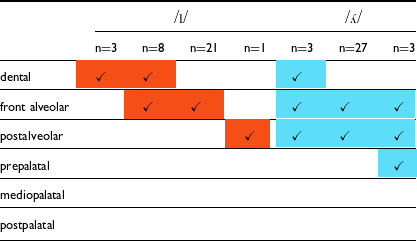
Static palatograms for the laterals collected by Miletić (Reference Miletić1933) from other 33 speakers producing the same words showed overall similar contact patterns, albeit with some variation. Based on my qualitative examination of the tracings, the closure for /l/ was commonly in the front and middle parts of the alveolar zone – exclusively (for 23 speakers) or in addition to some dental contact (for nine speakers; as was the case for the author); there were also some dental-only (for three speakers) and back alveolar (i.e., postalveolar; for one speaker) closures. Similar to the author’s pattern for /l/, the side contact rarely extended below the back alveolar region; if it did (as was the case for five speakers), the side contact did not go further than the second molar. The overwhelmingly common location of the closure for /ʎ/ was within the alveolar zone – covering its front, middle, and back parts (i.e., alveolar-postalveolar; for 30 speakers); for three of these speakers, the contact also covered some of the front teeth. For the three remaining speakers, the /ʎ/ closure had contact in the front part of the palatal zone, in addition to that of the alveolar zone (i.e., alveolar-postalveolar-prepalatal). All instances of this lateral showed extensive side contact, which went as far as the third molar (i.e. into the back part of the palatal zone; for 27 speakers). All these patterns are summarized in Table 2, including the numbers of speakers exhibiting them. We can conclude that the dominant places in the Miletić’s (Reference Miletić1933) data were dental-front alveolar or simply front alveolar for /l/ and front alveolar-postalveolar for /ʎ/. It is interesting that /ʎ/ rarely had the contact extending into the prepalatal zone, and never into the mediopalatal or postpalatal zones. This is despite the consonant being often referred to as ‘palatal’ (cf. Browne Reference Browne, Comrie and Corbett1993; Landau et al. Reference Landau, Lončarić, Horga and Škarić1995 for Croatian) or even ‘alveolopalatal’ (cf. Petrović & Gudurić Reference Petrović and Gudurić2010 on Serbian; but see Morén Reference Morén2006 on the use of ‘postalveolar’ for Serbian). For convenience and consistency with the IPA practice, I will continue to refer to the Serbian /ʎ/ as ‘alveolopalatal’ (see also Section 4); /l/ will be referred to as ‘denti-alveolar’.
A classification of Serbian laterals’ constrictions (in [a_a]) based on the data in Miletić (Reference Miletić1933), using the terminology in Recasens (Reference Recasens2013) with numbers of speakers provided for each pattern
More recently, a series of electropalatographic (EPG) studies were conducted on Croatian consonants by Marko Liker and colleagues. Although the two laterals have not been explicitly compared, both were described in detail in separate works: /ʎ/ (together with /ɲ/ in Liker & Horga (Reference Liker and Horga2015) and /l/ (together with other consonants) in Horga & Liker (Reference Horga and Liker2016). These studies were part of a larger research based on the simultaneous EPG and acoustic corpus of Croatian speech (CROELCO; Liker Reference Liker2009). Both /l/ and /ʎ/ were produced by six speakers of the language in nonsense words of the VCV type, with symmetrical vowel contexts (/a/, /i/, /u/). Based on the average linguopalatal contact profiles by speaker (provided to me by Marko Liker, p.c., September 2025), it can be inferred that /l/ was generally produced with a front alveolar or front-alveolar-postalveolar constriction, while /ʎ/ was produced with a constriction extending from front alveolar to postalveolar or prepalatal zones, as shown in Table 3. This is overall in agreement with the patterns found in Miletić (Reference Miletić1933) (see Table 2), leaving aside the lack of registration of purely dental contact by EPG. However, the occurrence of a postalveolar contact for /l/ and the prepalatal contact for /ʎ/ was more elevated in the Croatian data. The difference could have arisen due to the inclusion of high vowel contexts here, as these could cause some retraction of the constriction. It should be also noted that the two speakers who showed relatively posterior constrictions for /l/ in the Croatian dataset produced their /ʎ/ with a more posterior constriction. Thus, all speakers showed a robust difference in place for the two laterals. A similar kind of contrast is also evident in recent static MRI data from a heritage Croatian speaker in Badin et al. Reference Badin, Sawallis, Tabain and Lamalle2025; Marija Tabain, p.c., October 2025).
A classification of Croatian laterals’ constrictions (in [a_a], [i_i], [u_u]) based on the data from Liker & Horga (Reference Liker and Horga2015) and Horga & Liker (Reference Horga and Liker2016); assuming the contact of 50% or more per electrode), using the terminology in Recasens (Reference Recasens2013) with numbers of speakers provided for each pattern; the speakers wore Articulate-style artificial palates which only partially cover the upper teeth (Wrench Reference Wrench2007); hence the dental region is omitted

1.1.2. /l/: Clear or dark?
A question arises whether Serbian /l/ should be considered as clear or dark. A clear lateral is produced with a slightly or moderately raised tongue body towards the hard palate, while a dark lateral is produced with the tongue back raised towards the velum and/or retracted towards the pharyngeal wall (e.g., see Figure 1 in Recasens Reference Recasens2012). Palatography (static or EPG) cannot provide definitive answers to these questions. This is because the partial raising of the tongue (either towards the hard palate or the velum) does not produce central contact and hence is not detected by the method. The presence of side contact or the lack of it, on the other hand, can be interpreted as characteristic of relatively clear or dark laterals, respectively. Side contact can arise from raising the tongue towards the hard palate; the lack of it can result from lowering of the tongue middle, which is concomitant with the tongue back raising and retraction (Recasens Reference Recasens, Hardcastle and Hewlett1999).
As mentioned above, the static palatography data for /l/ provided by Miletić (Reference Miletić1933) shows hardly any side contact beyond the constriction (see e.g., Figure 1c). This suggests that the lateral is possibly dark, at least in the examined vowel context ([a_a]). This, however, contrasts with the inferred vocal tract configuration in Figure 1e, where the tongue shape lacks an obvious posterior raising or retraction; it also lacks the raising of the tongue front.Footnote 3 Thus the sound may be better described as ‘neutral’, intermediate between the prototypical clear and dark lateral categories. In line with this observation, Miletić (Reference Miletić1933: 55) comments that ‘our typical /l/ falls into the so called “middle l” category [AK: clear], but it is harder [AK: darker] than in German and, especially, than in French’. While not providing the same degree of nuance, Jazić (Reference Jazić1977: 44–45) classifies Serbo-Croatian /l/ as a clear, ‘middle European’ alveolar comparable to French or German laterals and contrasts it with the strongly velarized dental lateral in Russian (cf. Popova Reference Popova1986: 26–27). Petrović & Gudurić (Reference Petrović and Gudurić2010: 168), however, mentioned that this sound in standard Serbian ‘has a rather variable pronunciation’, ranging from ‘a very hard, “velar”, to a significantly softened articulation’, depending on the dialectal origin of its speakers. As the authors’ comment on the /l/ variability refers to the much earlier work by Miletić, it may not be representative of the current linguistic situation. Interestingly, two Serbo-Croatian speakers examined in Gick et al.’s (Reference Gick, Campbell, Oh and Tamburri-Watt2006) cross-language study of liquids exhibited a strong velarization of /l/. Specifically, the authors noted that the ‘nonpalatalized /l/ considered in this study sounds quite dark in all positions’, and they confirmed through the use of ultrasound that the consonant was produced with a ‘large dorsum backing gesture’ (p. 66). Anecdotally, however, native speakers of Serbian tend to consider their native /l/ as different from both the French or German clear /l/ and the English syllable-final dark /l/ (as in well) – something that often occurs in the acquisition of these languages (Ana Batas, Andrej Bjelaković, Biljana Čubrović, and Nikola Radosavljević, p.c., October 2025). This confirms the observation made by Miletić (Reference Miletić1933), while contrasting with Jazić (Reference Jazić1977). We will return to the question of clear/dark status in the next section.
1.1.3. Acoustics of laterals
There exist several accounts of the acoustics of Serbian or Croatian laterals, albeit somewhat partial in their coverage. In his monograph on the phonetics of Croatian, Bakran (Reference Bakran1996: 140, 147) provided formant averages for /l/ and /ʎ/ in several vowel contexts in male speech (with no information about numbers of speakers or the nature of the materials). In the monograph on the phonology of Serbian, Petrović & Gudurić (Reference Petrović and Gudurić2010: 184) reported formant measurements produced by two speakers (one female, one male; both from Novi Sad) in several words produced in isolation. The items for /l/ differed in the following vowel and the consonant position within the word (škola, pčela, xvala, fluid, fluor, list, with the data for the latter word given for the male speaker only); /ʎ/, on the other hand occurred, word-medially before /a/ (švalja and šilja). In a larger-sample study, Batas (Reference Batas2014) provided formant averages for nine female and five male speakers of Serbian (from various locations). The work provided formant averages for /l/ in three vowel contexts (in olakšaš, limenom, belutka) and for /ʎ/ across contexts, with the words produced within sentences. F1 and F2 values from these three studies are shown in Table 4.
Average F1 and F2 values for /l/ and /ʎ/ before the vowels /a, i, u/ by female and male speakers in studies of Serbian and Croatian laterals

We can see from the table that there is an overall agreement across the studies in that the denti-alveolar lateral is characterized by a higher F1 and a lower F2 than its alveolopalatal counterpart. F2 differences are particularly pronounced, ranging from 866 to 1049 Hz for females and 710 to 808 Hz for males. F2 for /ʎ/ was consistently high, being above 1700 Hz for males and above 2000 Hz for females, with vowel context differences (/i/ > /a/ > /u/, reported in Bakran Reference Bakran1996 only) being relatively minor. F2 for /l/, on the other hand, varied more across the studies and across following vowel contexts. Specifically, F2 averages for /l/ were at 1100 Hz or lower before /a/ for both females and males. They were also quite low before /u/ for males, while increasing substantially for females, and especially in Petrović & Gudurić (Reference Petrović and Gudurić2010). Before /i/, the averages were somewhat above 1100 Hz for males and females in Batas (Reference Batas2014), while being much higher for males in Petrović & Gudurić (Reference Petrović and Gudurić2010). This points to a likely cross-speaker or cross-dialect variation in the quality of /l/ and its susceptibility to vowel coarticulation.Footnote 4
The formant patterns reported for Serbian and Croatian /ʎ/ are rather similar to those for alveolopalatal laterals in other languages, such as, for example, Brazilian Portuguese (Charles & Lulich Reference Charles and Lulich2018, 1 male: F1 300 Hz, F2 1783 Hz) and the Australian Aboriginal languages Arrernte, Pitjantjatjara, and Warlpiri (Tabain et al. Reference Tabain, Butcher, Breen and Beare2016, 19 females and 3 males: F1 339 Hz, F2 2104 Hz).
On the other hand, it is less obvious how Serbian /l/ fits in the cross-linguistic typology of laterals. According to Recasens’s (Reference Recasens2012) study of dental/alveolar laterals across 23 languages, clear varieties of /l/ typically show F2 above 1000 Hz next to /a/ and above 1400 Hz next to /i/, for male speakers; dark laterals show F2 below 1000 Hz next to /a/ and below 1300 Hz next to /i/. Table 5 presents a sample of languages with clear and dark dental/alveolar laterals with their average F2 from that study. Note that the above-mentioned values for Serbian and Croatian /l/ before /a/ (by male speakers: F2 986–1100 Hz, on average 1047 Hz) are much lower than in the clear /l/ languages (mean F2 1404 Hz) and are approaching values for the dark /l/ languages (mean F2 945 Hz). This is also the case for the /i/ context in two of the three studies (F2 1109–1170 Hz; cf. F2 1152 Hz for dark /l/ languages and 1752 Hz for clear /l/ languages). In the other study (albeit based on a single speaker), the F2 value (1384 Hz) falls between the clear and dark types. Overall, this suggests that the quality of Serbian and Croatian /l/ is intermediate in quality, while being closer to the dark end of the continuum. It may be also more sensitive to vowel coarticulation than is typical for dark /l/ languages. If this is the case, it makes the language somewhat similar to British English, where the quality of /l/ also varies, but depending on syllable position (Recasens Reference Recasens2012: 1120 Hz before /a/ and 1600 Hz before /i/ in onset vs. 860 Hz and 1000 Hz in coda).
Average F2 values for male speakers’ productions of clear and dark /l/ before /a/ (both /la/ and /ala/) and /i/ (both /li/ and /ili/) in eight representative languages from Recasens (Reference Recasens2012)

In sum, based on the available data on Serbian and Croatian laterals, the two sounds appear to be well-distinguished by F1 and F2. /ʎ/ is characterized by low F1 and – especially – by high F2, the values that are overall similar to /ʎ/ in other languages. /l/ is characterized by a higher F1 and low/intermediate F2. The values for the latter are relatively low next to /a/, approaching those for a typical dark /l/ and – at least for some speakers – can rise substantially next to /i/, albeit not to the same degree as for a typical clear /l/. This – again – lends some support for Miletić’s (Reference Miletić1933) observation of the sound being somewhat darker than the ‘middle’ (clear) /l/, albeit without the nuance of contextual variation. It should be kept in mind that these generalizations are based on a handful of tokens from only two speakers and thus require further verification.
1.2. Positional and contextual variation in laterals
1.2.1. Serbian or Croatian laterals
Despite the presence of thorough articulatory descriptions of Serbian and Croatian laterals (as reviewed above), less is known about the contextual and especially positional variability of these sounds. Based on the palatographic data from one of his speakers, Miletić (Reference Miletić1933: 57–58) noted that /l/ showed almost no difference in the location of the closure among the contexts next to /a/, /i/, and /u/, both word-initially and word-medially (in ala, ili, bulu, lava, lipa, lupa). The side contact, however, was greater next to /i/, as would be expected given the considerable raising and fronting of the tongue for that vowel. Similarly, no clear contextual differences were observed in the contact patterns for the word-medial intervocalic /ʎ/ (pp. 77–78, in malja, pilji, mulju), apart from the additional side contact next to /i/ and /u/. Linguopalatal contact profiles for /l/ and /ʎ/ from Liker & Horga (Reference Liker and Horga2015) and Horga & Liker (Reference Horga and Liker2016) were based on averages across three vowel contexts, [a_a], [i_i], [u_u], and thus it is not possible to tease apart specific contextual effects. It is worth noting, however, that the speakers’ palates showed some moderate contact for /l/, and to an extent larger than in the palatograms in Miletić (Reference Miletić1933), which were based on a single context, [a_a].
The only examination of positional effects in Serbian or Croatian laterals I am aware of is Gick et al. (Reference Gick, Campbell, Oh and Tamburri-Watt2006). The authors used ultrasound to study the timing of the tongue tip and tongue body for /l/ as a function of syllable position (syllable-initial vs. syllable-final prevocalic and preconsonantal in [i_i]: vi lim ‘you (pl.) aluminum’, fil im ‘cream-filling them (dat.)’, fil vim ‘cream-filling floor-cleaner’), as produced by two ‘Serbo-Croatian’ speakers (among speakers of other languages). They found no significant timing differences between the positions: the two gestures (the tip alveolar closure and the body backing) were produced simultaneously and were similar in magnitude in both onset and coda. This result was markedly different from the patterns the authors observed for the other examined languages, including North American English, where the timing of the tongue tip and body varied depending on the position and the tip gesture showed coda reduction. The authors suggested that the lack of positional differences could be related to the presence of the contrastive lateral /ʎ/ in the language inventory.
From these three studies we can tentatively conclude that Serbian and Croatian laterals – and particularly /l/ – may be affected by adjacent vowels but not so much by syllable/word position. With respect to vowel effects, these are expected next to high vowels, and specially /i/, with changes involving side contact rather than the constriction per se. These predictions are further strengthened by the acoustic finding reviewed in the previous section.
1.2.2. Comparison with Catalan laterals
Considerably more articulatory and acoustic work has been done on positional and contextual variation in laterals in languages such as Catalan, English, and German. Out of these, the work on Catalan by Recasens and colleagues is particularly relevant, as the language has a lateral contrast similar to Serbian or Croatian – between the denti-alveolar /l/ and the alveolopalatal /ʎ/. The former consonant is realized as dark [ɫ] regardless of the position in Majorcan Catalan (MC) and as variable [l]∼[ɫ] in Valencian (Eastern) Catalan (VC): clear syllable-initially and dark syllable-finally. Given the methodological relevance of this work for the current study, I will review some of the results of these studies in detail.
Catalan /l/: Positional effects
Recasens & Espinosa (Reference Recasens and Espinosa2005) conducted an EPG and acoustic study of /l/ produced by five speakers of each dialect in three utterance positions (initial, medial intervocalic, and final) and three vowel contexts (next to /a/, /i/, /u/). They measured the lateral closure location (contact posteriority in the anterior region of the palate, CPa), amount of side contact in the posterior portion of the palate (Quotient of activation in posterior region, Qp), closure duration, and acoustic formants F1–F3.
The patterns of positional variation were somewhat different in the two dialects. In terms of the closure location (CPa), the MC /l/ showed more advanced closures medially than initially, and to a lesser extent more advanced medially than finally. The VC /l/, on the other hand, showed a progressive closure advancement in the order initial > medial > final (albeit with some context-dependent exceptions). If closure advancement or retraction are considered to reflect articulatory weakening or strengthening, the two dialects showed different patterns: utterance-medial weakening in MC and progressive non-initial (utterance and syllable) weakening in VC (or strengthening at utterance edges in MC and utterance and syllable-initial strengthening in VC). The authors’ examination of posterior side contact (Qp) showed that it was more affected by adjacent vowels than position. Nevertheless, there was a tendency for /l/ in both dialects to show more contact initially and medially than finally, thus corresponding to the relative strength of prosodic position. Medial position showed a considerably increased contact next to /i/. Overall, /l/ in VC had substantially more side contact than the same consonant in MC in the context of the high vowels, and especially /i/, which is indicative of greater coarticulatory effects in the former dialect. The formants during the lateral closure were overall relatively stable across positions for MC (with some increase medially next to /i/). Much greater positional differences were observed for VC, where the initial /l/ showed a higher F2 and lower F1 (i.e. clear) compared to the other positions (with the exception of the /i/ context medially), and especially compared to final position. In terms of closure duration, /l/ medially was considerably shorter in both dialects, with the initial consonant being somewhat longer than the final one.
Catalan /l/: Contextual effects
Considering vowel coarticulatory effects, MC showed relative stability in constriction location for /l/ as a function of adjacent vowel, apart from some closure fronting next to /a/ medially. VC showed /l/ closure fronting next to /a/ more consistently and, to some degree, in all three positions. In terms of posterior side contact, the difference in MC was between /i/ and the other two vowels, where the former vowel induced more contact. /l/ in VC, however, showed a three-way difference, with the contact progressively reducing in the order /i/ > /u/ > /a/. Moreover, the magnitude of the coarticulatory effects of high vowels was much greater in VC than MC. Very similar results were obtained for formants F1 and F2: contextual effects were greater and more refined /i/ > /u/ > /a/ in VC. No consistent contextual differences were found for closure duration.
Overall, these results showed more positional variability for VC than MC. The authors attributed this difference to the lateral allophony being present in VC and not in MC. As mentioned above, the former dialect has a clear lateral variant syllable-initially (prevocalically) and a dark one syllable-finally (word-finally and preconsonantally); the latter dialect, on the other hand, has dark variants in both positions. The backing and raising of the posterior portion of the tongue, which is required to produce dark laterals, constrains their articulation, leading to coarticulation resistance. Such resistance was evident for the more constrained /l/ in MC, while the less constrained /l/ of VC showed more positional and contextual variation.
Catalan /ʎ/: Positional and contextual effects
Positional and contextual variation of the MC alveolopalatal lateral /ʎ/ was examined by Recasens & Espinosa in a separate study (Reference Recasens and Espinosa2006), where this consonant was compared to other ‘palatals’ – the nasal /ɲ/ and the stop [c] (an allophone of /k/). The authors examined the consonants in terms of the patterns of their closures, the overall contact across the palate, contact anteriority (the relative onset of the closure along the front-back dimension), and duration. Focusing on the results for the lateral, five speakers involved in the study produced this consonant with a closure in the front alveolar and postalveolar zones of the artificial palate (cf. Liker & Horga Reference Liker and Horga2015 on Croatian /ʎ/), and the location of this closure was minimally affected by position (initial, medial, or final) or vowel context (/a/, /i/, /u/). In terms of positional differences, the overall amount of contact decreased from initial to final and then to medial position, thus in a similar way to /l/ in this dialect. This was also the case for contact anteriority, but only for the /i/ context.
In terms of contextual differences, the lateral was produced with a greater contact next to /i/ than next to the other vowels. Duration was shortened medially than at the word/utterance edges (initially and medially). Overall, the alveolopalatal /ʎ/ (and the other palatal consonants) was found to be highly resistant, yet not immune to positional and contextual coarticulatory effects. This resistance was attributed to the high articulatory demands imposed by the extensive alveolopalatal closure accompanied by the tongue side lowering (cf. Recasens Reference Recasens, Hardcastle and Hewlett1999). Greater coarticulatory effects next to /i/ can be explained by the greater interference of this vowel articulation with the positioning of the tongue for the alveolopalatal closure. Finally, positional differences can be attributed to strengthening at prosodic unit (syllable, word, or utterance) edges and/or possibly some articulatory weakening intervocalically.
The studies on positional and contextual variability reviewed above – on both Serbian or Croatian and Catalan – allow us to set up some predictions as to what may be expected of Serbian laterals in similar conditions. This is done in the next section.
1.3. This study
The goal of this study is to investigate articulatory and acoustic properties of Serbian laterals /l/ and /ʎ/, both in terms of their phonemic contrast and their positional/contextual variation. This is done using EPG, the method that captures fine-grained linguopalatal contact differences (Gibbon & Nicolaidis Reference Gibbon, Nicolaidis, Hardcastle and Hewlett1999), and has been successfully used for similar kinds of consonants (e.g., Liker & Horga Reference Liker and Horga2015 and Horga & Liker Reference Horga and Liker2016 on the Croatian /ʎ/) and their positional and coarticulatory behavior (Recasens & Espinosa Reference Recasens and Espinosa2005, Reference Recasens and Espinosa2006 on Catalan laterals). EPG data are also easily comparable to earlier static palatography data such as in Miletić (Reference Miletić1933). The study uses acoustic analysis of lateral closures in an attempt to relate formant patterns to articulatory data, as well as to compare to acoustic reports on laterals in other languages.
Based on the literature reviewed above, we would expect the two Serbian laterals to differ robustly in their linguopalatal contact profiles. Specifically, they should differ in the constriction locations (most likely front alveolar for /l/ vs. alveolar-postalveolar (-prepalatal) for /ʎ/) and the amount of dorsopalatal contact at the sides (less for /l/ than for /ʎ/). Overall, less side contact is expected if /l/ is of a dark variety. Acoustically, the two sounds should be well-differentiated by F1 (lower for /ʎ/) and F2 (higher for /ʎ/). A particularly low F2 (below 1000 Hz for male speech) would be characteristic of a dark variety of /l/. We may also expect some differences in the duration of lateral closures, and specifically a longer duration for /ʎ/. This is based on the duration averages in Bakran (Reference Bakran1996) for Croatian (35 ms for /l/ and 59 for /ʎ/). This was not, however, the case for Serbian laterals in connected speech, as reported by Batas (Reference Batas2014: 50), where the two categories showed considerable overlap in duration (56–62 ms for /l/ and 57–72 ms for /ʎ/).
Further, both sounds are expected to show some – possibly limited – positional variation, with utterance-medial position possibly showing some reduction compared to utterance-initial and utterance-final positions. Yet, these effects should be of greater magnitude for /l/ than /ʎ/, given the greater articulatory constraints on the latter. Similarly, we would expect greater contextual effects (coarticulation from /u/ and especially /i/) for /l/ than /ʎ/. In general, positional and contextual effects are expected to be greater for a clear /l/ compared to a dark one. To put it into a comparative perspective, it is reasonable to predict that Serbian /l/ would pattern more like /l/ in Valencian Catalan (where it is variable in terms of darkness) than /l/ in Majorcan Catalan (where it is uniformly dark).
2. Method
2.1. Speakers
The participants were four native speakers of Serbian, three females (SR1, SR3, SR4) and one male (SR2); their mean age was 38 (the range 29–45). Two of the speakers (SR1 and SR2) were from the city of Niš, which is the third largest city in the country and the capital of the Nišava District in Southeastern Serbia. The other two speakers (SR3 and SR4) were from Novi Sad, which is the second largest city and the capital of the autonomous province of Vojvodina in northern Serbia. The speakers arrived in Canada 4 to 8 years prior to the study and were residing in Toronto, Ontario. While fluent in English, they reported using Serbian on a daily basis. Admittedly, the current speaker sample is small; it is, however, comparable to other studies using this method (median 4, mean 5.7, SD 5, based on 54 published articles between 2000 and 2019 reviewed in Kochetov Reference Kochetov2020). This is primarily due to the cost of making custom-made palates and multiple recording sessions required for collecting data.
Materials used in the study

2.2. Materials
The materials included a set of 18 utterances with /l/ and /ʎ/ occurring in three positions (utterance-initial, medial, and final) and three vowel contexts (next to /a/, /i/, and /u/). This general experimental design was adopted from Recasens & Espinosa’s (Reference Recasens and Espinosa2005, Reference Recasens and Espinosa2006) EPG studies of Catalan /l/ and /ʎ/ (together with other palatal consonants). The materials are presented in Table 6. It should be noted that the utterance-medial position involved some cases of word-initial consonants (e.g., Ta ljaga), when it was difficult to find the same consonants word-medially.
The utterances were randomized, mixed with other sentences, and repeated nine times. This was expected to give us a total of 640 tokens (or 160 tokens per speaker). With a few recording errors, the total number of collected tokens was 632.
2.3. Procedure
A WinEPG system by Articulate Instruments (Wrench et al. Reference Wrench, Gibbon, McNeill, Wood, Hansen and Pellom2002) was used to collect articulatory data at a sampling rate of 100 Hz and audio data at 22,050 Hz. The system uses acrylic palates with 62 electrodes, custom-made for each participant (see Gibbon & Nicolaidis Reference Gibbon, Nicolaidis, Hardcastle and Hewlett1999 for a review of the method). The traditional (University of Reading-style) EPG palates were used for all four participants. Photos of these palates, together with the palate casts are shown in Figure 2a. A schematic zooming of the palate electrodes – arranged as a grid of eight rows and eight columns – is presented in Figure 2b. Note that rows 1 and 2 correspond to the front alveolar region, 3 and 4 to the postalveolar region, 5 and 6 to the prepalatal region, while 7 and 8 correspond to the mediopalatal and postpalatal regions respectively.
(a) Artificial palates and the accompanying palate casts of the speakers; (b) a schematic zoning of the palate electrodes and the general linguopalatal contact areas (after Recasens Reference Recasens2013); note that the ‘alveolar’ zone here roughly correspond to Miletić’s front and middle alveolar, postalveolar to his back alveolar, prepalatal to his front palatal, and medio/postpalatal to his back

2.4. Analysis
The lateral consonants /l/ and /ʎ/ were annotated based on the waveform and spectrogram using the Articulate Assistant software (version 1.18; Wrench et al. Reference Wrench, Gibbon, McNeill, Wood, Hansen and Pellom2002). Boundaries for the laterals were marked at the onset and offset of the acoustic closure, as often manifested by an abrupt change in intensity and formant patterns. These acoustic events typically corresponded well to articulatory closures, as evidenced by EPG frames. The left part of the image in Figure 3 presents a sample annotation – a waveform, a spectrogram, and a set of corresponding palate frames taken every 10 ms – for the [ala] intervals of the utterance Ta galama by SR3. The interval of the lateral closure is highlighted and indicated with a label “l”. In the right part of that image, we can see a schematic palate containing a grid of 62 cells (electrodes) arranged in 8 rows and 8 columns, with row 1 being the frontmost (front alveolar) and row 8 being the backmost (velar). The relative shading of the cells and numbers in them correspond to how much tongue contact a given cell had during the selected interval (with dark purple cells and 100 corresponding all frames having the contact and white cells and 0 corresponding to none of the frames having the contact). We can see here that the lateral closure involved contact at the alveolar ridge (rows 1 and 2) and slightly extended backwards along the sides. There was no contact in the posterior portion of the palate (rows 6–8), indicative of the tongue middle and the sides being lowered.
An example of the annotation of /l/ in Ta g[ala]ma by speaker SR3 showing the waveform, spectrogram, and palate frames; an average contact of the selection is shown on the right.

For each token, linguopalatal contact values (‘1’ or ‘0’ for each electrode) were automatically extracted from five equally distributed timepoints during the annotated lateral closure. This number of points was deemed appropriate given the range of lateral closure durations in the data (/l/: Mean 87 ms, SD 22); /ʎ/: Mean 90, SD 19).Footnote 5 At each timepoint, two kinds of articulatory indices were calculated. The first index was Contact Posteriority taken over the first five rows of the palate (CPa5; cf. Recasens & Espinosa Reference Recasens and Espinosa2005, Reference Recasens and Espinosa2006).Footnote 6 Following Fontdevila, Pallarès & Recasens (Reference Fontdevila, Pallarès and Recasens1994), it was calculated as follows, where R1–R5 are rows of the palate:
 \begin{align*} CPa5 & = \left[ \text{log} \right[\left[ {1\left( {\text{R}1/6} \right) + 9\left( {\text{R}2/8} \right) + 81\left( {\text{R}3/8} \right) + 729\left( {\text{R}4/8} \right)} \right] + 6561\left( {\text{R}5/8} \right) + 1]]/\\& \quad \left[ {\text{log}\left( {7381 + 1} \right)} \right]\end{align*}
The second index was Quotient of maximum activation in the last three rows of the palate (or the palatal zone; Qp3). It was calculated as the number of contacted cells at a particular frame divided by the total number of electrodes in that region, which is 24 (cf. Recasens & Espinosa Reference Recasens and Espinosa2005).
For the consonants at hand, /ʎ/ was expected to show higher values for both CPa5 and Qp3, as it was expected to be produced with a closure extending further back and more palatal contact, compared to /l/. Any positional and contextual variation, such as gestural reduction in final position, closure retraction, or coarticulation to a high vowel would also be captured by a combination of these variables. In addition to CPa5 and Qp3 (at five timepoints), measurements were performed for Duration of the annotated interval (i.e., the lateral closure). Apart from the expected between-consonant differences (see Section 1.3), lateral closure duration was expected to show some variation across positions (e.g., initial and medial > medial: cf. Recasens & Espinosa Reference Recasens and Espinosa2005, Reference Recasens and Espinosa2006).
Finally, acoustic measurements of F1 and F2 formants (in Hz) during the lateral closure were performed using the FastTrack plug-in by Barreda (Reference Barreda2021) for Praat (Boersma & Weenink Reference Boersma and Weenink2025). This method generates multiple formant contour candidates for a segment and then automatically selects the best analysis based on a number of criteria. Selected formant trackings were subsequently examined visually to confirm their validity. The algorithm had some difficulty with tracking formants for /l/ in utterance-final position, given the generally lower intensity of the lateral there and the proximity of F1 and F2. Cases of clear tracking errors were discarded (23 tokens of the final /l/); this, however, may not have eliminated all possible errors, and thus formant measurements in final position should be considered with caution. For each annotated lateral closure, formant values were extracted at 20 equidistant points and averaged across the middle 30% of the interval. Raw F1 and F2 in Hertz were further converted to the Bark psychoacoustic scale. As a measure of relative velarization/palatality, I used the difference between F2 and F1 in Bark (cf. Sproat & Fujimura Reference Sproat and Fujimura1993; Nance Reference Nance2014). /l/ and /ʎ/ were expected to show lower and higher values, respectively. Overall, these differences were expected to correspond to the articulatory differences in Qp3 (as high dorsopalatal contact resulting from the tongue body raising/fronting is expected to raise F2 and lower F1). F3 was also extracted but not analyzed. For reference, the raw F1 and F2 values, as well F3, are included in Tables A1 and A2 in the Appendix.
The R package ggplot2 (Wickham Reference Wickham2016) was used to visualize CPa5 and Qp3 trajectories throughout the lateral closure (smoothed using the ‘loess’ method), across positions and contexts; boxplots were used to illustrate Duration and F2–F1 differences. The data were analyzed using linear mixed effects regression (LMER) models implemented with the lme4 package (Bates et al. Reference Bates, Mächler, Bolker and Walker2015) using R (R Core Team 2014) separately for each variable. As the presentation of the results is organized into two parts – (i) the overall /l/ vs. /ʎ/ contrast and (ii) positional and contextual effects for each lateral – two separate sets of analyses were performed. The first set had LMER models with a single fixed factor, Segment (/l/, /ʎ/), and random intercepts for Position, Vowel Context, and Speaker.Footnote 7 The second set of models had the fixed factors Position (initial, medial, final) and Vowel Context (/a/, /i/, /u/), included as interactions, and random intercepts for Speaker (with random slopes for Segment).Footnote 8 Treatment contrast coding was used for categorical variables, with the baseline condition being /l/ in initial position next to /a/. Given the complexity of the second set of models, likelihood ratio tests were used to compare the full model to a nested model excluding the factor of interest, employing the Anova() function of the lmerTest package (Kuznetsova, Brockhoff & Christensen Reference Kuznetsova, Brockhoff and Christensen2017); pairwise comparisons and posthoc tests (with a Bonferroni correction for multiple comparisons) were performed using the phia package (De Rosario-Martinez Reference De Rosario-Martinez2015).
3. Results
The results in this section are presented in two main subsections. The first one focuses on the contrast – general differences between /l/ and /ʎ/ in the articulation and acoustics. The second subsection focuses on positional and contextual effects, separately for /l/ and /ʎ/. In each subsection, the presentation of quantitative analyses is preceded by qualitative observations.
3.1. The lateral contrast
3.1.1. Qualitative observations
Figure 4 presents linguopalatal contact profiles for /l/ and /ʎ/ by speaker averaged across all Positions, Vowel Contexts, and repetitions. We can see that /l/ was produced with a closure in the first two rows of the palate by all speakers except SR2, who showed considerable contact in rows 1–4. (For this speaker, the closure began in a more posterior position and gradually moved forward, resulting in the extended pattern observed in the figure.) The front closure was accompanied by partial side contact further behind. /ʎ/, on the other hand, was produced with an extensive closure spanning rows 1 to 4 or 5 and considerable side contact. This indicates that the constriction for /l/ was made with the tongue tip at the alveolar ridge and slightly further (and likely touching the upper front teeth) and the tongue sides partly lowered. /ʎ/ was produced with the entire tongue raised towards the hard palate and the blade making a firm closure at and behind the alveolar ridge.
Average linguopalatal contact profiles for /l/ and /ʎ/ produced by the four speakers (averaged over all positions and contexts, 160 tokens per speaker).

To further examine patterns of lateral closures, Figure 5 highlights the artificial palate rows that were most commonly contacted for the two consonants, as produced by four speakers. These calculations were based on presence or absence of at least three ‘on’ electrodes in the four central columns by row. Median values were then calculated for each row separately by segment, position, vowel context, and speaker. The terms used for specific places of articulation corresponding to artificial palate rows were based on Recasens & Espinosa (Reference Recasens and Espinosa2006). Consistent with our earlier observations, the difference between the laterals was in the location of the closures: /l/ was produced by SR1, SR3, and SR4 as front alveolar and by SR2 as front alveolar-postalveolar; /ʎ/ was produced by all speakers as front alveolar-postalveolar, occasionally extending into the prepalatal zone.
Median closure location for /l/ and /ʎ/ by speaker; blank cells represent contact of 0-49%.

Outputs of linear mixed models for CPa5 at timepoint 3, (b) Qp3 at timepoint 3, (3) F2-F1 (Bark) during the 30% of the closure, and (d) Duration (ms) of the closure by Segment; significance codes: ‘***’ < .001, ‘**’ < .01, ‘*’ < .05, ‘.’ < .1; the intercept is /l/

3.1.2. Quantitative analyses
Turning to quantitative results, Table 7 provides outputs of linear mixed effects models for all four variables. Note the CPa5 and Qp3 results are based on timepoint 3, which is the midpoint of the closure.Footnote 9 We can see that differences between /l/ and /ʎ/ were significant at the .0001 level for the first three variables, and significant at the .05 level for the last variable.
Boxplots illustrating differences between /l/ and /ʎ/ (‘lj’) in (a) CPa5 at timepoint 3, (b) Qp3 at timepoint 3, (c) F2-F1 (Bark) during the 30% of the closure, and (d) Duration (ms) of the closure.

These differences are illustrated in Figure 6 (and Figure A1 by speaker in the Appendix). Starting with CPa5 (a), values were almost ceiling-high for /ʎ/ and in the intermediate-high range for /l/. This indicates that the posterior edge of the alveolopalatal closure consistently approached the end of the examined region (rows 1–5, i.e., front alveolar to prepalatal), while the denti-alveolar closure was considerably less posterior (i.e., front alveolar). Notably, the placement of the closure for /l/ was also much more variable than for /ʎ/. On average CPa5 was .62 for /l/ and .96 for /ʎ/ (i.e., the difference of .34). The difference in Qp3 (b) was in the opposite direction: substantially higher for /ʎ/ than /l/, with the values for the latter approaching zero. This indicates that the tongue body/middle was raised for the alveolopalatal lateral and lowered for the alveolar one. The contrast in Qp3 was on average .09 vs. .42, that is the difference of .33, which corresponds to 8 out of 24 electrodes in rows 6–8. The difference in the tongue body position corresponded closely to the acoustic differences: F2–F1 (c) was considerably higher for /ʎ/ than /l/. On average, F2–F1 was 5.15 Bark for /l/ and 9.78 Bark for /ʎ/, resulting in the contrast of 4.63 Bark. In terms of raw values, /l/ had an average F1 of 454 Hz and F2 of 1226 Hz, while /ʎ/ had an F1 of 358 Hz and F2 of 2123 Hz.Footnote 10 Finally, although the Duration difference (d) reached significance, it was very small in magnitude (3.26 ms) and appeared to be driven by some of the speakers (see Figure A1d in the Appendix).
To summarize, the qualitative examination of linguopalatal contact patterns revealed a consistent place difference between the two laterals, with /l/ having a closure primarily in the front alveolar region and /ʎ/ in a wide area spanning the entire alveolar and postalveolar regions, often extending into the prepalatal region. The two sounds also differed considerably in the amount of posterior side contact, which is indicative of the relative height of the tongue body. These observations were confirmed by quantitative analyses of the CPa5 and Qp3 indices taken at the closure midpoint. As would be expected, the two segments were also significantly different in their formants: F2–F1 difference was much higher for /ʎ/ than /l/. This difference thus strongly reflected the difference observed in terms of Qp3, which corresponds to the relative raising and fronting of the tongue body. The alveolopalatal lateral was slightly longer than its denti-alveolar counterpart.
3.2. Positional and contextual effects
3.2.1. Qualitative observations
We will now turn to the question of positional and contextual variation in the two laterals. Figure 7 presents linguopalatal contact profiles for one of the speakers (SR3; see Figure A2 in the Appendix for the other speakers’ averages).
Average linguopalatal contact profiles for /l/ and /ʎ/ produced by Speaker SR3 by position and vowel context (averaged 9 repetitions).

It can be seen that the general patterns for /l/ were overall similar across positions and vowel contexts, with the exception of the side contact being largely absent next to /a/ and /u/ and strongly present next to /i/. This is undoubtedly a coarticulatory effect, as the raising and fronting of the tongue for /i/. It is of interest to note that the side contact was weaker for /l/ in final position (in April ) compared to the other two positions (in Lila and pilicj), indicative of a greater influence of the following rather than the preceding vowel. Contextual differences for /ʎ/ appeared to be more subtle, with only a slight increase in posterior contact next to /i/. The general constriction patterns for these contact profiles are further shown in Figure 8.
Median closure location for /l/ and /ʎ/ by (a) position and (b) vowel context for speaker SR3; blank cells represent contact of 0-49%.

Trajectories of (a) Contact Posteriority (CPa5) and (b) Amount of palatal contact (Qp3) over five timepoints during the /l/ closure and boxplots of (c) F2-F1 difference (Bark) around the /l/ closure midpoint, and (d) /l/ closure duration (ms) – by position and vowel context.

As we will see below, the general differences exhibited by speaker SR3 hold across the dataset, when examined quantitatively. This will be done separately for each consonant.
3.2.2. Quantitative analyses: /l/
Figure 9 presents the results for four variables for the denti-alveolar /l/, focusing on positional and contextual differences. Additionally, the plots in (a) and (b) present CPa5 and Qp3 values across five timepoints throughout the closure, in order to highlight the temporal extent of coarticulation or reduction. We can see in (a) that CPa4 trajectories for /l/ diverged considerably in most vowel contexts and positions; they also showed very wide confidence intervals. The largest positional difference for /l/ was in the /i/ context, where the contact was extended further back (higher CPa5) in medial and initial positions compared to final position. Similar, albeit smaller in magnitude, differences were also observed next to /a/, at least in the earlier part of the closure. There was a clear vowel effect: the closure was more retracted next to /i/ in medial and initial positions – and more so closer to the following vowel. Interestingly, /i/ had no apparent effect in final position. Differences between /a/ and /u/ were overall more limited, with /u/ leading to some moderate (and possibly non-significant) retraction of the closure. Qp3 values (b) for /l/ were very low, approaching zero in the context of /a/ and /u/, but elevated in the context of /i/. This was particularly the case in medial position. Initially next to /i/, there was a substantial increase in values towards the end of the closure; this was to some extent mirrored by a decrease in values at the beginning of the closure finally. It is thus clear that /i/ had a strong effect on the tongue sides for /l/; importantly, however, it was the following vowel that affected the articulation of the consonant the most. Notably, there was almost no positional variation next to /a/ and /u/, apart from somewhat higher values at the beginning of the closure medially. In terms of the vowel context, most contact was observed for /l/ next to /i/ and least contact next to /a/. F2–F1 (c), taken around the midpoint of /l/, showed strong vowel effects, reminiscent of Qp3: values were substantially higher next to /i/, especially initially and medially; they were also somewhat lower next to /a/ than to /u/. Relatedly, positional differences were evident mainly for /i/, with higher values medially and (to a lesser extent) initially compared to final position. Duration (d) of the /l/ closure was somewhat shorter medially than in the other positions, but mainly next to /a/ and /i/. Apart from the latter vowel difference medially, there were no apparent vowel context differences.
Linear mixed effect model comparisons for /l/ (with CPa5 and Qp3 taken at the midpoint), presented in Table 8, showed that both Position and Vowel Context influenced all four variables. Interactions between these two factors were also significant. (Means and standard deviations for the variables are presented in Table A1 in the Appendix.)
Model comparisons for CPa5, Qp3 (both at timepoint 3), F2-F1, and Duration for /l/ with the fixed factors Position, V_Context, and their interaction (Analysis of Deviance Table, Type II Wald $\chi^{{2}}$
tests); significance codes: *** p < .001, ** p < .01, * p < .05
$\chi^{{2}}$
tests); significance codes: *** p < .001, ** p < .01, * p < .05

To explore sources of these interactions, pairwise comparisons were performed, summaries of which are presented in Table 9. Significant positional differences were observed for CPa5 in the /a/ and /i/ contexts, where values were higher (i.e. a more posterior closure) initially (and medially for /i/) than finally. Positional differences for Qp3 were limited to the /i/ context, where values decreased (i.e., a lowered tongue body) in the order medial > initial > final. The same pattern was observed for /i/ in F2–F1; additionally, this variable showed lower values medially than finally next to /a/. Duration was shorter medially than initially and finally next to /a/ and /i/. Overall, the /u/ context showed no significant positional differences, while the /i/ context was most susceptible to this variation.
A summary of pairwise comparison results for CPa5, Qp3, F2-F1, and Duration for /l/ by Position and Vowel Context; ‘>’ = ‘greater than’; significant differences: *** p < .001, ** p < .01, * p < .05, ‘—’ = not significant, with the corresponding cells shaded

Contextual differences were found in all three positions for all variables other than Duration. Overall CPa5, Qp3, and F2–F1 were higher in the /i/ context than next to /a/ and /u/ in all cases except one (CPa5 finally). Additionally, values were higher for /u/ than /a/ in some of the cases: CPa5 finally, Qp3 medially, and F2–F1 initially and medially. These differences indicate that the high vowels, and especially the high front /i/, caused a retraction of the /l/ closure and raising of the tongue body. This, in turn, resulted in the lowering of F1 and raising of F2. In terms of Duration, the only significant contextual effect was lengthening of the /l/ closure next to /u/ (or its shortening next to /i/ and /a/).
Overall, the maximum positional differences for /l/ were .14 for CPa5, .09 for Qp3, .63 Bark for F2–F1, and 20 ms for Duration. In comparison, the maximum contextual differences were .14 for CPa5, .17 for Qp3, 3.64 Bark for F2–F1, and 11 ms for Duration. Thus, contextual differences were on average greater than positional differences in Qp3 and F2–F1, but not in the other variables. Both positional and contextual non-durational differences for /l/, however, were considerably smaller than segmental differences discussed in Section 3.1. Durational differences, on the other hand, were greater in the latter case.
3.2.3. Quantitative analyses: /ʎ/
Figure 10 presents the results for four variables for the alveolopalatal /ʎ/ across three positions and three vowel contexts. As before, the plots in (a) and (b) present CPa5 and Qp3 trajectories over five timepoints throughout the closure. We can see in (a) that CPa values were almost at the ceiling and hardly affected by Position and Vowel Context, apart from a minor lowering of CPa5 after /a/ and /u/ (i.e., closure fronting) at the onset of the closure. One may also note somewhat higher values (i.e., closure retraction) for /ʎ/ closure initially than in the other positions. QPa3 values (b) were around .50, which means that about half of the electrodes in the last three rows of the palate were affected – indicative of a substantial raising of the tongue body. In medial position, Qp3 was higher next to /i/, followed by /u/, and then by /a/ – that is, a similar effect found in the previous section for /l/. The difference between /a/ and the other vowels was also evident finally, but not clearly in initial position. There appeared to be some within-context positional differences: medial > initial, final next to /i/ and initial, medial > final next to /a/. F2–F1 values (c) for /ʎ/ were very high, reflecting the higher position of the tongue body captured by Qp3. There were some positional differences: somewhat higher values medially than initially and finally next to /i/ and initially than medially and finally next to /a/ and /u/. In terms of vowel context differences, Qp3 was higher next to /i/ than the other vowels, especially medially and finally. In terms of Duration (d), values were somewhat higher initially than medially and finally. Closures were also somewhat longer next to /a/ than next to the other vowels, at least in some positions.
Trajectories of (a) Contact Posteriority (CPa5) and (b) Amount of palatal contact (Qp3) over five timepoints during the /l/ closure and boxplots of (c) F2-F1 difference (Bark) around the /ʎ/ closure midpoint, and (d) /ʎ/ closure duration (ms) – by position and vowel context.

Linear mixed effect model comparisons for /ʎ/, presented in Table 10, showed that both Position and Vowel Context influenced all four variables, with the exception of Vowel Context for CPa5. Interactions between these two factors were also significant. (Means and standard deviations for the variables are presented in Table A2 in the Appendix.)
Model comparisons for CPa5, Qp3 (both at timepoint 3), F2-F1, and Duration for /ʎ/ with the fixed factors Position, V_Context, and their interaction (Analysis of Deviance Table, Type II Wald $\chi^{\textit{2}}$
tests); significance codes: *** p < .001, ** p < .01, * p < .05
$\chi^{\textit{2}}$
tests); significance codes: *** p < .001, ** p < .01, * p < .05

Pairwise comparisons exploring these interactions are summarized in Table 11. Significant positional differences in the /a/ context were observed for all four variables: the initial /ʎ/ had a more posterior closure, a higher tongue position, a higher F2–F1 difference, and a longer duration compared to the same consonant in final and (for two of the variables) medial positions. Similar differences between the initial and non-initial alveolopalatal lateral were found for the /u/ context, apart from Qp3. In the /i/ context, a partly reverse difference was observed for Qp3 and F2–F1, where values were higher medially than initially and finally. That is, /ʎ/ in /i_i/ was produced with a greater tongue body raising and a higher F2–F1 difference than in /_i/ and /i_/. The /i/ context did not influence the closure location (CPa5) or Duration of the lateral.
A summary of pairwise comparison results for CPa5, Qp3, F2-F1, and Duration for /ʎ/ by Position and Vowel Context; ‘>’ = ‘greater than’; significant differences: *** p < .001, ** p < .01, * p < .05, ‘—’ = not significant, with the corresponding cells shaded

Contextual differences for CPa5 were limited to initial position, where /i/ caused some closure retraction compared to /a/ and /u/. Higher values next to /i/ than /a/ or /u/ were observed medially and finally for Qp3 and in all three contexts for F2–F1. That is, /ʎ/ was produced with a higher tongue body position and, correspondingly, higher F2–F1 difference next to /i/. In initial position, however, higher Qp3 values were found next to /u/ than next to the other vowels. Duration was shorter next to /i/ initially and next to /u/ medially, compared to the other vowels.
Overall, the maximum positional differences for /ʎ/ were .02 for CPa5, .05 for Qp3, .50 Bark for F2–F1, and 13 ms for Duration. In comparison, the maximum contextual differences were less than .01 for CPa5, .08 for Qp3, 1.22 Bark for F2–F1, and 9 ms for Duration. The two sets of differences were thus comparable, apart from somewhat higher contextual differences for Qp3 and F2–F1. Notably, the differences for /ʎ/ were much smaller than those for /l/ discussed in the previous section. This points to the greater resistance of the alveolopalatal lateral to positional and contextual effects.
3.2.4. Summary of positional and contextual differences
Positional differences examined in the previous sections were not very robust for either /l/ or /ʎ/; they were also often conditioned by adjacent vowels. Thus, when compared to initial laterals, final laterals were sometimes produced with a lower CPa5 (but only for /l/ next to /a/ and /i/), lower Qp3 (but only for /l/ next to /i/ and /ʎ/ next to /a/ and /u/), lower F2–F1 (but only for /l/ next to /i/ and /ʎ/ next to /a/ and /u/), and shorter duration (but only for /ʎ/ next to /a/ and /u/). Compared to initial position, consonants in medial position were often produced with somewhat higher Qp3 and F2–F1 (both for /l/ and /ʎ/ but only in the /i/ context), and shorter duration (for both /l/ and /ʎ/ next to /a/ and /i/). Compared to medial position, final consonants tended to be produced with a lower CPa5 (but only for /l/ next to /i/), lower Qp3 (both for /l/ and /ʎ/ but only next to /i/), lower F2–F1 (for both /l/ and /ʎ/ but only in the /i/ context), and longer duration (but only for /l/ next to /a/ and /i/, and /ʎ/ next to /u/). Altogether, there were no positional effects shared across vowel contexts by either consonant. Those differences that were present, however, point to a broad trend initial, medial > final for non-durational variables and initial, final > medial for duration. The noted positional contextual effects were overall greater for /l/ than /ʎ/ (and especially for CPa5). These differences can be interpreted as reflecting some reduction of the lingual articulatory gesture in magnitude utterance-finally and in duration utterance-medially. Positional differences, however, appear to be strongly affected by vowel context, especially utterance-medially, which is a likely result of strong overlap with adjacent vowels.
Contextual differences were widely observed, yet strongly dependent on position. Compared to the /a/ context, consonants next to /i/ showed higher CPa5 (for /l/ initially and medially; but not the reverse for /ʎ/ initially), higher Qp3 (for /l/ in all positions and /ʎ/ medially and finally), and higher F2–F1 (for both /l/ and /ʎ/ in all contexts). Consonants next to /i/, when compared to the /u/ context, showed higher CPa5 (for /l/ medially; but the reverse for /ʎ/ initially), higher Qp3 (for /l/ initially and medially, and for /ʎ/ medially, while showing the reverse initially), and higher F2–F1 (for /l/ initially and medially, and for /ʎ/ medially and finally). Compared to the /a/ context, consonants next to /u/ showed higher CPa5 (for /l/ finally), higher Qp3 (for /l/ in medially and /ʎ/ initially and finally, while showing the reverse medially), and higher F2–F1 (for /l/ in all positions). Duration differences did not show any specific patterns.
Overall, we can conclude that non-durational variables tended to show a decrease in the order /i/ > /u/ > /a/, which is reflective of these vowels’ relative articulatory strengths (Recasens Reference Recasens, Hardcastle and Hewlett1999). It is important to note that these differences were most commonly observed medially and to a lesser extent initially; they were almost absent finally. Again, the contextual effects for /l/ were considerably more common and more robust in magnitude.
4. Discussion
The results are discussed in this section first in terms of the place of articulation contrast involving the two Serbian laterals as compared to previous studies (Miletić Reference Miletić1933; Liker & Horga Reference Liker and Horga2015; Horga & Liker Reference Horga and Liker2016) and further in terms of their positional and contextual variation, separately for /l/ and /ʎ/, with reference to the patterns identified for two varieties of Catalan in Recasens & Espinosa (Reference Recasens and Espinosa2005, Reference Recasens and Espinosa2006).
4.1. The place contrast in Serbian laterals
The results of the study revealed, as expected, that Serbian laterals were consistently distinguished by the location of their constriction. /l/ was produced with a closure solely in the front alveolar region (by three speakers) or extending into the postalveolar region (one speaker). The other lateral, /ʎ/, in contrast, had a closure spanning two or three regions – front alveolar and postalveolar (two speakers) or front alveolar, postalveolar and prepalatal (two speakers). These patterns are summarized in Table 12 (based on Figure 5) for the ease of comparison with the data from Miletić (Reference Miletić1933) earlier shown in Table 2 and Liker and Horga’s works shown in Table 3.Footnote 11 Note that the current results align perfectly with those from the latter study, which showed the same two general patterns for each of the laterals. There was more variation in the patterns apparent in Miletić (Reference Miletić1933) (see Table 2), which is not surprising given a much higher number of speakers and a larger spatial coverage of the method. Overall, however, constrictions in Miletić (Reference Miletić1933) were less posterior, which can be attributed to the use of a single vowel context, /a/, in contrast to the use of /a/, /i/, /u/ in Liker & Horga (Reference Liker and Horga2015) and Horga & Liker (Reference Horga and Liker2016) and the current study. Note also that the earlier studies had laterals occurring in medial intervocalic position only. The finding that laterals in the current study – where they occurred in three different positions – showed very similar constriction patters to Liker and Horga’s works further underscores these sounds’ relative stability with respect to position.
General patterns of constriction location for Serbian laterals in the current data (based on Figure 5 assuming 50% or more activation per electrode)

At first glance, the consistent presence of alveolar contact for Serbian (and Croatian) /ʎ/ is unexpected given the usual characterization of the sound as ‘palatal’. It is, however, in line with previous cross-linguistic articulatory results. In a survey of the so-called ‘palatal’ laterals occurring in 14 languages, Recasens (Reference Recasens2013) reported (based on X-rays, static palatography, and EPG) that this sound was always produced with some alveolar contact, in addition to the more posterior (postalveolar, prepalatal, or mediopalatal) contact. In this respect, the closure of /ʎ/ was on average more anterior than that of /ɲ/ and /c/, which can be explained for the need to lower the sides of the tongue to produce the lateral airflow. Given this, Recasens (Reference Recasens2013) proposed that the International Phonetic Alphabet (IPA) should exclusively use the term ‘alveolopalatal’ for /ʎ/, while either ‘alveolopalatal’ or ‘palatal’ could be used for the corresponding nasal and stop, depending on the language.
Apart from the constriction location differences, the two Serbian laterals in the current data differed robustly in term of posterior contact – reflecting differences in the position of the tongue body/middle: lowered for /l/ and raised for /ʎ/. These differences aligned well with the acoustic data – F2–F1 differences: /l/ was characterized by higher F1 and lower F2 (and thus smaller F2–F1 difference) while /ʎ/ showed lower F1 and higher F2 (and thus greater F2–F1 difference). These findings are consistent with previous acoustic reports on the realization of the contrast (Bakran Reference Bakran1996; Petrović & Gudurić Reference Petrović and Gudurić2010; Batas Reference Batas2014; but see more on this below).
Recall that there were some reasons to expect the /ʎ/ closure to be longer than that for /l/ (Bakran Reference Bakran1996; see also Section 2.4). The expected durational differences did come out significant in our results (/ʎ/ > /l/), but their magnitude was very small and there was some inconsistency across the speakers.Footnote 12 This result is largely consistent with Batas’ (Reference Batas2014) findings, where Serbian laterals produced by 14 speakers in connected speech had largely similar duration.
4.2. Positional and contextual effects for /l/
4.2.1. Position
The results revealed that /l/ was relatively resistant to positional effects, showing significant differences only in certain vowel contexts (mainly /i/). These differences can be broadly described as between the weaker final and the stronger non-final positions (initial, medial > final, with the notable exception of the /i/ context). This was observed for the closure location (CPa5), posterior side contact (Qp3), and F2–F1 variables (except next to /a/). In the /i/ context, there was also a medial > initial difference in Qp3 and F2–F1, as the two adjacent high front vowels had a stronger effect on the tongue body raising and formant differences. In terms of duration, the difference was primarily between medial and the other position, with smaller differences between initial and final (initial > final > medial).
The finding that positional effects for /l/, when present, tended to differentiate primarily final and non-final positions (in non-durational variables) is somewhat different from the results reported for Catalan dialects by Recasens & Espinosa (Reference Recasens and Espinosa2005). Recall from Section 1.2.2 that in terms of /l/ closure location, Majorcan Catalan (MC) showed advancement (and hence weakening) medially compared to initial and final positions, as well as advancement finally compared to initial position (initial > final > medial). Valencian Catalan (VC) showed a similar dominance of initial position, but to a much lesser degree (initial > medial, final). In the current results, however, weakening in closure location of /l/ was observed finally compared to initial and medial positions. As shown in Figure 11a, the Serbian results show a much greater closure advancement finally than in the Catalan dialects, albeit the general pattern is somewhat more similar to VC than MC.
Average (a) CPa, (b) Qp, and (c) F2-F1 (Bark) for /l/ by Position for the two Catalan varieties (based on Recasens and Espinosa Reference Recasens and Espinosa2005) and the current Serbian data.

On the other hand, the results of both studies, agree in terms of patterns of the posterior side contact reduction: when significant differences occurred, Qp for /l/ showed some reduction finally in both Catalan dialects and in the current Serbian data. Similarly, both studies showed an increase in Qp values medially – most notably in the /i/ context. As shown in Figure 11b, however, this increase in Serbian was larger than in MC, although not as large as in VC. More similarly to MC, on the other hand, the Serbian data showed relatively low values for initial position. This is in contrast to VC which had initial values approaching medial ones. Recall that this dialect has been described as having a clear allophone of /l/ prevocalically. This, in turn, suggests that Serbian /l/ can be considered relatively dark initially and finally, but not medially. As seen in Figure 11c, F2–F1 differences were largely parallel to those for Qp. An important point to note here is that values for Serbian were on average lower than for VC in all positions, even though most of the speakers in the former group were female. This points to a relatively dark – or at least intermediate – quality of Serbian /l/ in the current data.
Another point of agreement in terms of positional variation was in duration measurements: in both studies medial /l/ was considerably shorter than its initial and final counterparts.
In summary, the current results on positional variation are only partially consistent with those for two Catalan dialects in Recasens & Espinosa (Reference Recasens and Espinosa2005, Reference Recasens and Espinosa2006). This highlights the fact that, while there are certain general tendencies, positional effects in the realization of consonants are largely language-particular (see also Colantoni, Kochetov & Steele Reference Colantoni, Kochetov, Steele, Skarnitzl and Volín2023, Reference Colantoni, Kochetov and Steele2025 on positional variation in /l/ in French, Spanish, and L1 and L2 English). It is worth recalling that no gestural timing or magnitude differences were observed between word-initial and word-final Serbo-Croatian /l/ in Gick et al.’s (Reference Gick, Campbell, Oh and Tamburri-Watt2006) ultrasound study (see Section 1.2.1). This was in contrast to the realization of laterals in other languages, including North American English. The current results also showed that Serbian /l/ had overall more linguopalatal contact medially but not initially, which makes it partly different from both varieties of Catalan. Finally, Serbian /l/ appeared to be less clear in its quality than in Valencian Catalan, but seemingly not as dark as in Majorcan Catalan.
As proposed by Gick et al. (Reference Gick, Campbell, Oh and Tamburri-Watt2006), the relative positional stability of Serbian lateral can be explained by the need to maintain the contrast with the other lateral phoneme, /ʎ/. This may well be an important factor for the language, but this explanation would not hold for Valencian Catalan, where /l/ is positionally variable despite its contrast with /ʎ/. The presence of a phonemic contrast could thus constrain positional variability, but on a language/dialect-particular basis.
4.2.2. Vowel context
The current results showed substantial contextual – coarticulatory – differences for /l/, which were also partly dependent on position. Specifically, we saw a gradual decrease in closure posteriority (CPa5), posterior side contact (Qp3), and F2–F1 difference broadly in the order /i/ > /u/ > /a/. That is, the vowels tongue height and frontness were identified as key factors affecting non-durational properties of the lateral.
The relative scale of coarticulation ‘aggressiveness’ is exactly the same as reported for VC by Recasens & Espinosa (Reference Recasens and Espinosa2005), both in terms of Qp and F2–F1. The patterns for both studies are shown in Figure 12. We can see, however, that the Serbian data showed a greater retraction of the constriction (CPa) next to high vowels than the two Catalan varieties, possibly reflecting a greater coarticulation in the former case. The high back vowel /u/ and especially the high front vowel /i/ showed strong coarticulatory effects – manifested in high Qp and F2–F1 values – in both Serbian and VC data, but not on MC data. This suggests the Serbian /l/ here patterned more like a clear /l/, in contrast to its positional patterning described in the previous section. It is also important to note that contextual differences in Serbian were most evident medially and absent finally – the effects that were not reported for Catalan. Of note, Miletić (Reference Miletić1933) did not observe any contextual effects on closure location of /l/, which could perhaps be attributed to the difficulty detecting small-scale differences using static palatography.
Average (a) CPa, (b) Qp, and (c) F2-F1 (Bark) for /l/ by Context for the two Catalan varieties (based on Tables 3a and 3b in Recasens & Espinosa Reference Recasens and Espinosa2005) and the current Serbian data; (for consistency with Recasens & Espinosa Reference Recasens and Espinosa2005, CPa for the current data were re-calculated using four front rows)

Returning to the question of clear/dark categorization of Serbian /l/, the current acoustic results are overall similar to those in the three studies reviewed in Section 1.1 (see Table 5) but are more in line with Petrović & Gudurić (Reference Petrović and Gudurić2010) in terms of formant values across different vowel contexts. Considering raw F2 values for similar positions, /l/ in [a_a] was produced by the current male speaker at 1001 Hz and by the female speakers by on average 1086 Hz. In Petrović & Gudurić (Reference Petrović and Gudurić2010; in [o_a] and [e_a]]) these values were 936–1035 Hz for the male and 1052 Hz for the female speaker (see Section 1.1.4). Before /i/ initially ([_i]), the male speaker produced the lateral at 1331 Hz, and the female speakers did it at on average 1636 Hz. The male speaker in Petrović & Gudurić (Reference Petrović and Gudurić2010) produced the sound (also in [_i]) at 1384 Hz (while they did not provide data for the female). The raising of F2 before /i/ was not as large in the data in Bakran (Reference Bakran1996) and Batas (Reference Batas2014). The difference in the extent of coarticulation may be due to the languages or dialects of the participants. Thus, the speakers in Bakran (Reference Bakran1996) were Croatian, those in Batas were Serbians from various regions, while those in Petrović & Gudurić (Reference Petrović and Gudurić2010) were Serbians from Novi Sad. Notably, two of the speakers in the current study (SR3 and SR4) were also from Novi Sad. It should be noted, however, that the other two speakers (SR1 and SR2; from Niš), showed very a similar raising effect (see individual results in Table A1 in the Appendix). These coarticulatory patterns may therefore be more widespread and certainly require further investigation.
As mentioned in Section 1.2.3, the general boundaries between dark and clear lateral, as established by Recasens (Reference Recasens2012), are at about 1000 Hz next to /a/ and about 1400 Hz next to /i/, for male speakers. In both cases, thus, the Serbian /l/ in our data falls at the boundary between the two categories. In any case, F2 values found in this study (as well as reported in previous studies) are partly higher than for the prototypical dark /l/ (at least next to /i/) and lower than for prototypical clear /l/ (see Table 4 in Section 1.1.4). As mentioned earlier, this lends at least partial support to Miletić’s (Reference Miletić1933) astute observations and appears to match native speaker intuitions about /l/ in Serbian vs. other languages (see Section 1.1).
4.3. Positional and contextual effects for /ʎ/
The results showed that /ʎ/ in Serbian was strongly resistant to positional and contextual effects, compared to /l/. This was particularly true for the closure location (CPa5), which showed limited significant positional or contextual effects. Specifically, the consonant showed somewhat lesser closure retraction finally (next to /a/ and /u/), compared to the other position, and lesser retraction in /_i/ compared to the other vowels in the same position.
In terms of Qp3, /ʎ/ showed some reduction in posterior contact finally compared to initial or medial positions, but only in the context of /a/ and /i/. It also showed somewhat inconsistent effects of vowel context on posterior contact (more or less contact next to /u/ initially vs. medially respectively). Largely similar positional differences were observed for F2–F1; while contextual differences singled out the /i/ context, which consistently raised values for /ʎ/ regardless of the position. Finally, duration was the longest for the initial /ʎ/ (albeit only in a subset of vowel contexts); the contextual variation was rather inconsistent (and also limited to a subset of positions).
Overall, the relative stability of /ʎ/ is expected, as the consonant is characterized by high articulatory demands imposed by the extensive alveolopalatal closure accompanied by the tongue side lowering (cf. Recasens Reference Recasens, Hardcastle and Hewlett1999). The finding of initial vs. final position difference in posterior contact (Qp3) is consistent with the pattern observed for /l/, as well as with Recasens & Espinosa’s (Reference Recasens and Espinosa2006) results for /ʎ/ in MC. (Recall that the study did not include VC.) This is not the case, however, for medial position, which was most reduced in the latter study. The difference was explained by the authors by articulatory strengthening of constrictions at prosodic (word or utterance) edges and some weakening intervocalically. If strengthening was at play in the current data, it appears to have applied utterance-initially and to a lesser degree syllable-initially, resulting in the observed reduction pattern: initial > medial > final.
5. Conclusion
To conclude, this study presented a detailed articulatory and acoustic investigation of Serbian laterals /l/ and /ʎ/ produced by four speakers. The goal was to characterize these sounds in terms of their constriction location, posterior linguopalatal contact, formant patterns, and duration – both in general and depending on utterance position and adjacent vowels. While there have been previous articulatory investigations of Serbian and Croatian laterals, they focused primarily on place of articulation or differences with other consonants, while positional and contextual differences remained largely unexplored. Similarly, relatively little was known about the acoustics of laterals in the language, as well as on how these sounds fit into the broader cross-linguistic typology of lateral approximants. The results concerning place of articulation are largely consistent with earlier findings for Serbian and Croatian laterals; they also showed that Serbian /ʎ/ is alveolopalatal rather than palatal, which is consistent with the realization of this sound across languages. The results also showed that both laterals were relatively resistant to positional effects, indicative of their constrained articulations and in line with findings for similar sounds in Catalan. /ʎ/ was also found to be strongly resistant to effects of adjacent vowels, while /l/ showed strong coarticulation next to high vowels, and especially /i/, and particularly in medial intervocalic position. In this behavior, /l/ seemed to fall between a typical dark and clear varieties of the lateral, as manifested by dialects of Catalan. This further confirms the conclusion made by Recasens (Reference Recasens2012) that there is a continuum between clear and dark categories of dental/alveolar lateral, and that some languages exhibit intermediate patterns modulated by position (as in British English and Valencian Catalan). What the Serbian data, however, suggest is that intermediate patterns can be also modulated by vowel quality, as the dark variant appeared most consistently next to /a/ and the clear one next to /i/.
It is important to emphasize that the current findings were based on data from four speakers, with two of each representing varieties of Standard Serbian from different locations. More articulatory and acoustic data – from a larger sample of speakers balanced for dialect and gender – are certainly needed to confirm the current findings. It is hoped that the current study will stimulate further research on Serbian and Croatian laterals, and more broadly on these sounds in other understudied languages.
Acknowledgements
The author is grateful to two anonymous reviewers for insightful comments and helpful suggestions, and to Milica Radišić who was closely involved at the initial stages of this study and contributed particularly to the experimental design, participant recruitment, and data collection. He would also like to acknowledge help from the participants, Bojana Radovanović for assistance with the data annotation, and valuable feedback from the audiences of the talks presented at the conferences Formal Approaches to Slavic Linguistics 34 (FASL, Ithaca, NY, May 2025) and the International Conference on Phonetic Variation (ICPhoV, Granada, Spain, January 2026), as well as in the Philological Faculty of the University of Belgrade (Belgrade, October 2025) – with special thanks to Ana Batas, Andrej Bjelaković, Wales Browne, Biljana Čubrović, Aljoša Milenković, Nikola Radosavljević, and Daniel Recasens. Thanks also to Marko Liker and Marija Tabain for sharing their articulatory data on Croatian, and to Ana Batas for sharing her PhD dissertation. All errors or misinterpretations are my own. The work was supported by the Social Sciences and Humanities Research Council of Canada Standard Grant #416-2010-0959.
Appendix A. Individual results
Boxplots illustrating differences between /l/ and /ʎ/ (‘lj’) in (a) CPa5 at timepoint 3, (b) Qp3 at timepoint 3, (3) F2-F1 (Bark) during the 30% of the closure, and (d) Duration (ms) of the closure by speaker.

Average linguopalatal contact profiles for /l/ and /ʎ/ produced by speakers (a) SR1, (b) SR2, and (c) SR4 by position and vowel context (averaged 9 repetitions); for SR3 data see Figure 7.

Means and standard deviations (in italics) for /l/ by speaker, position, and vowel context

Means and standard deviations (in italics) for /ʎ/ (‘lj’) by speaker, position, and vowel context

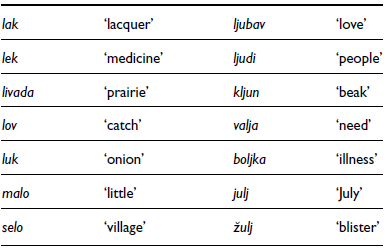
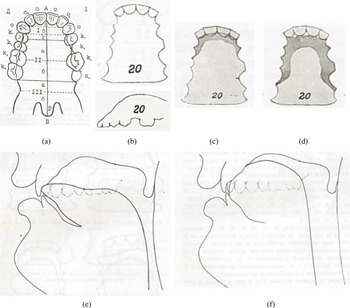
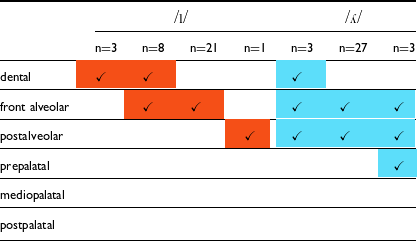
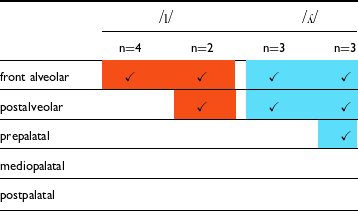
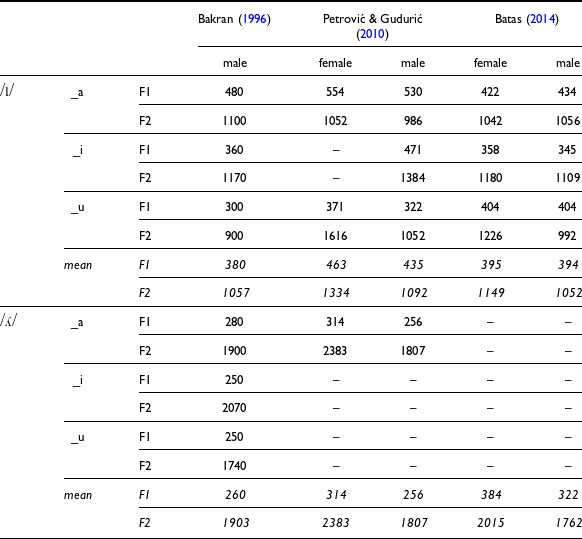
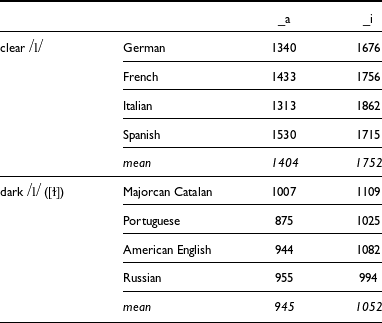
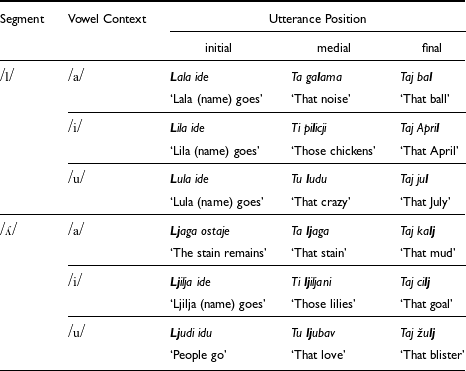
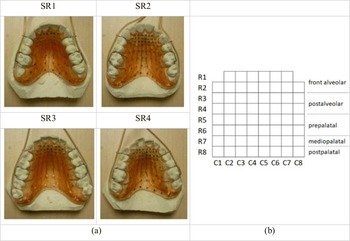
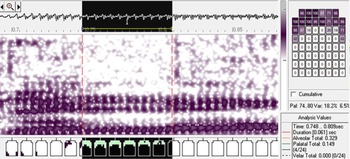
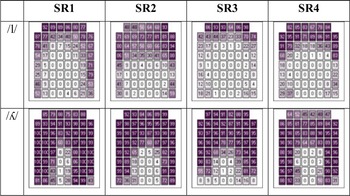
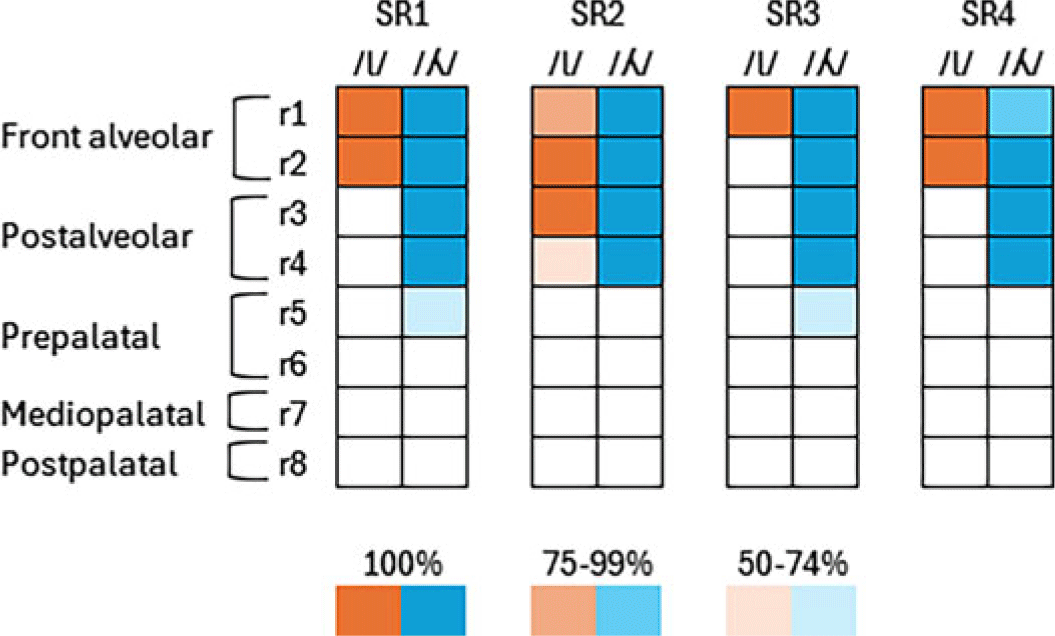
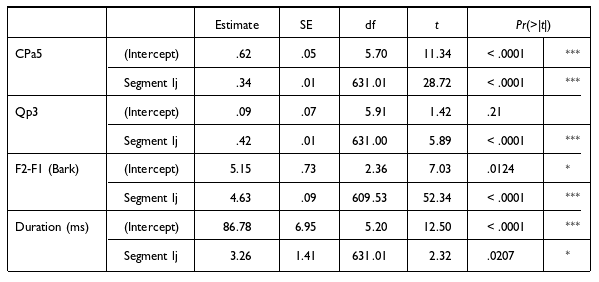
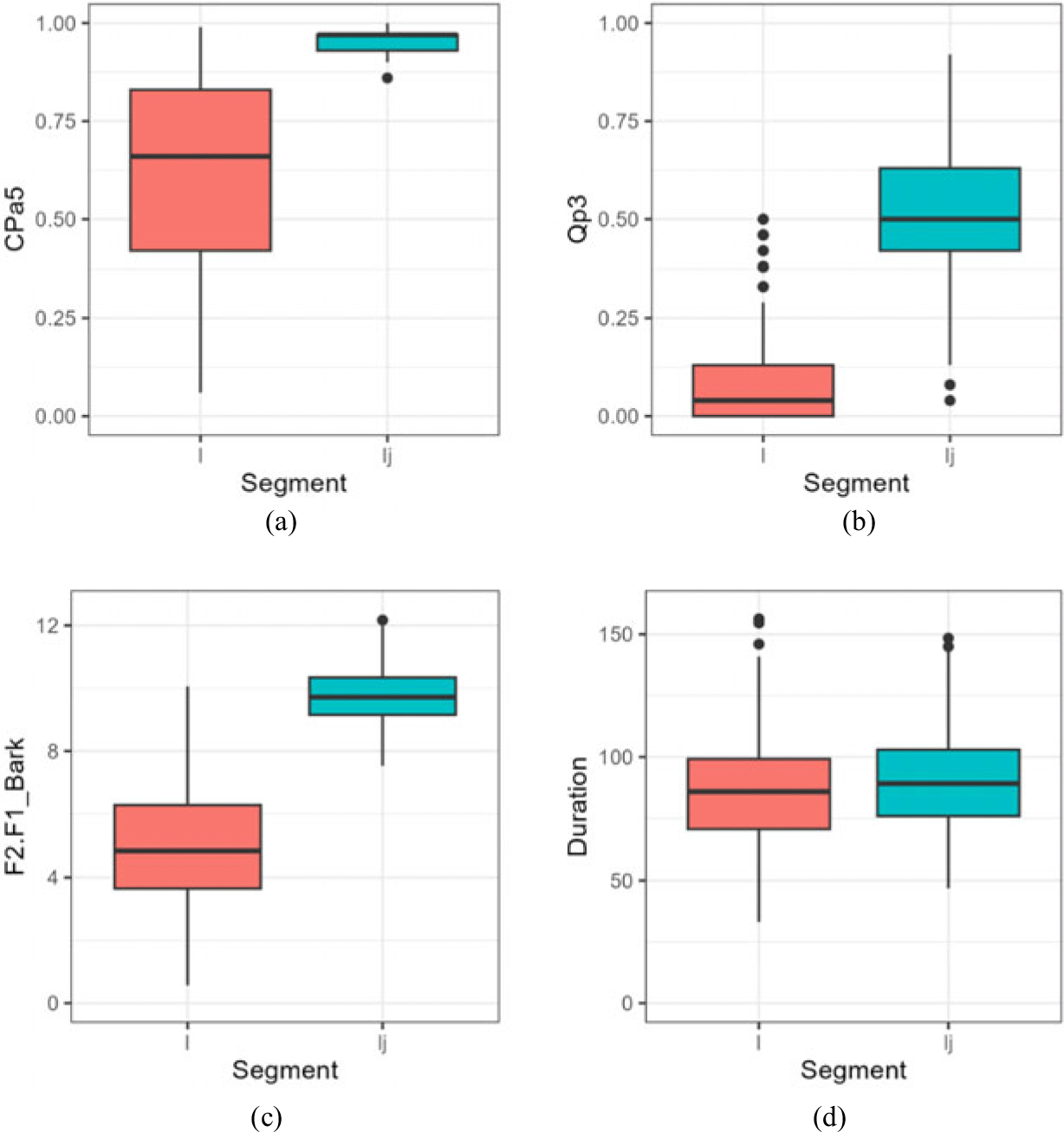
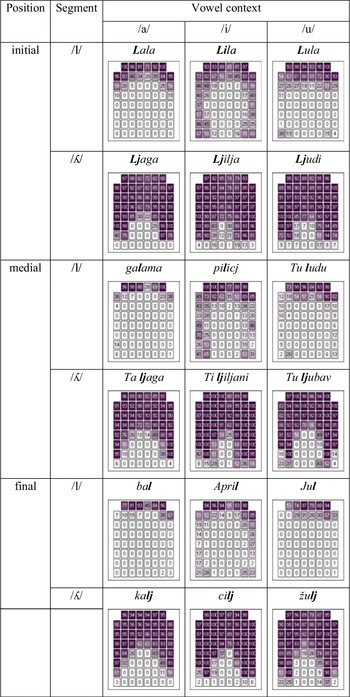
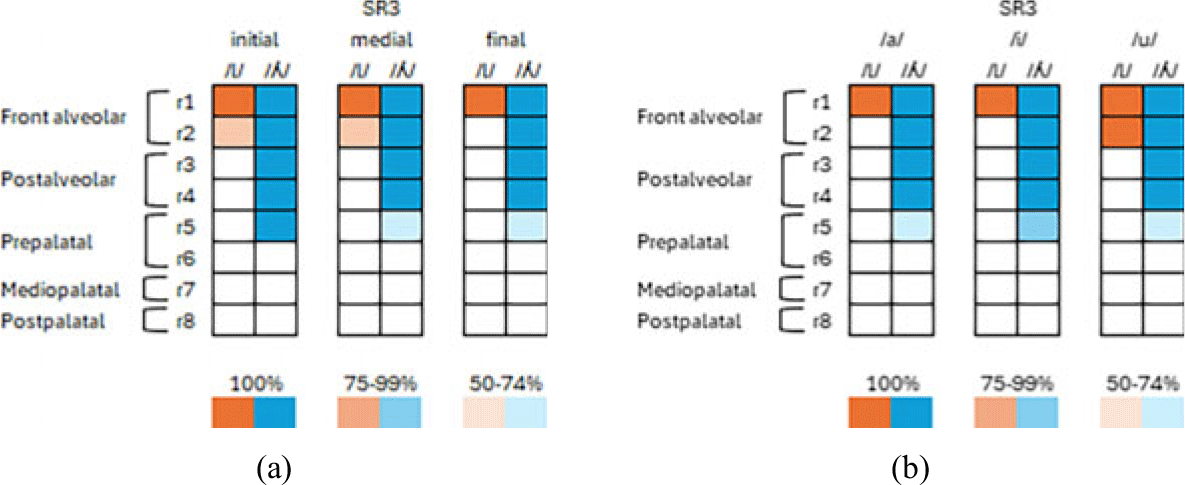
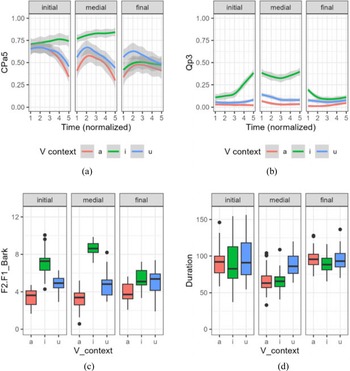
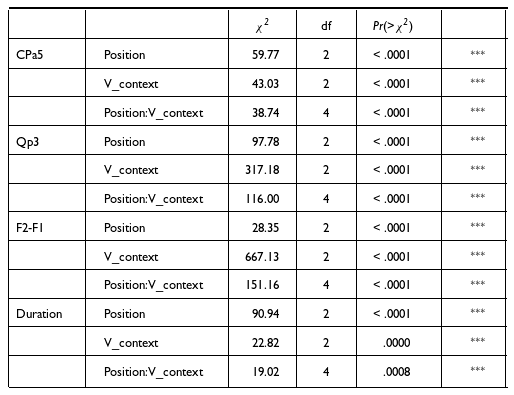

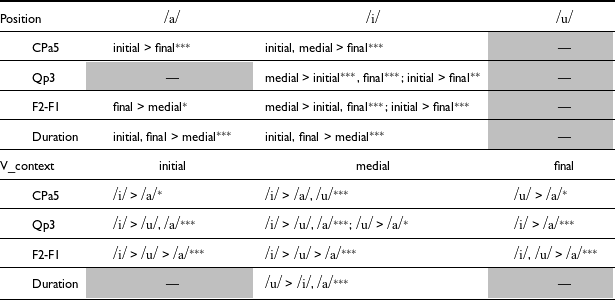
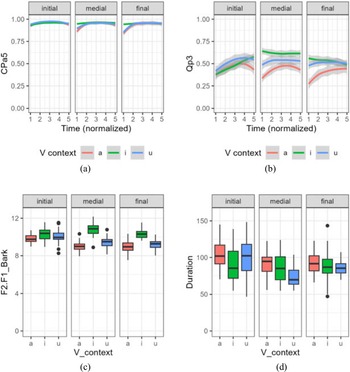
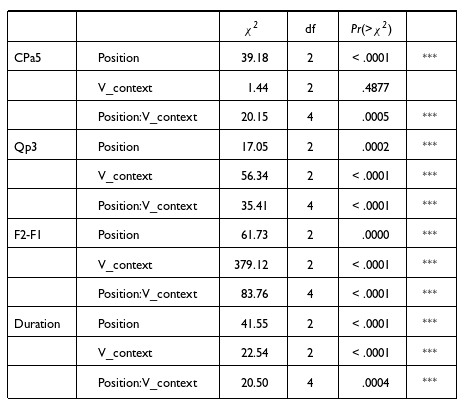

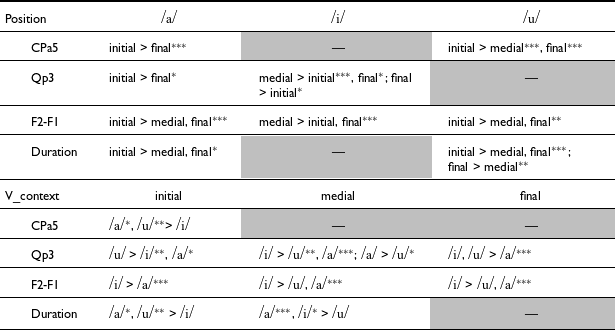
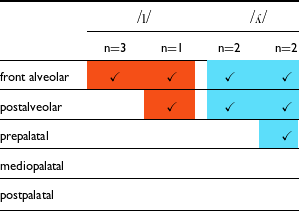
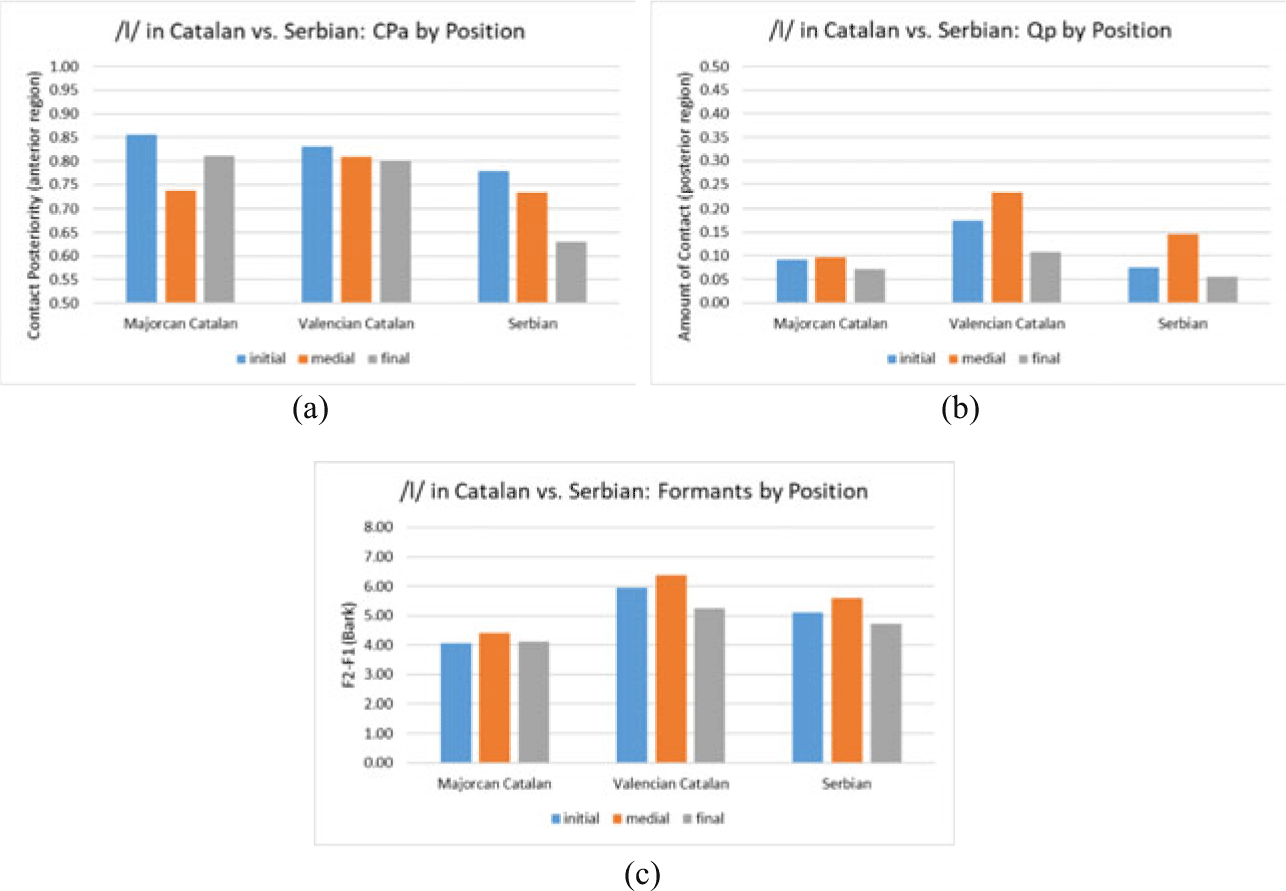
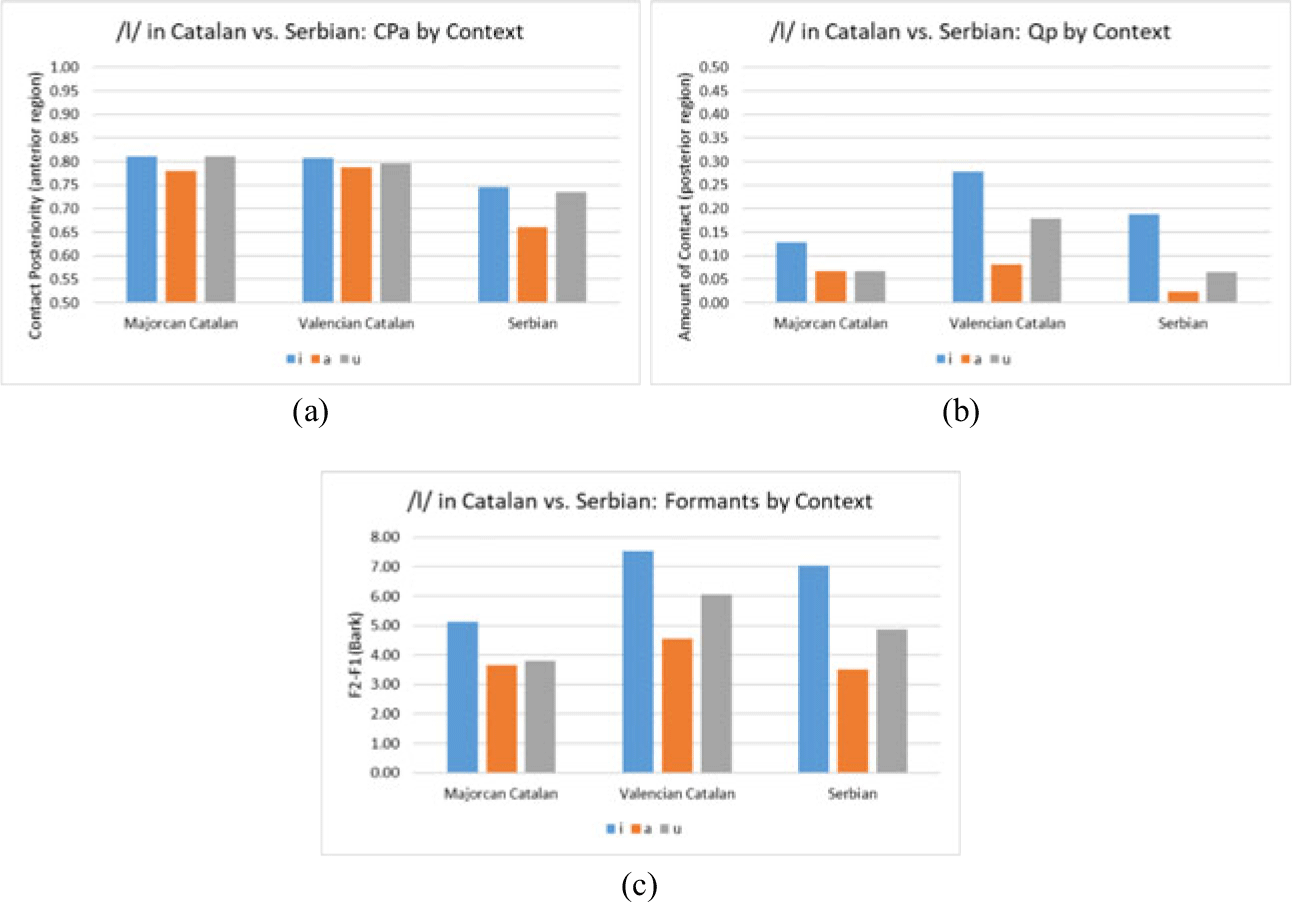
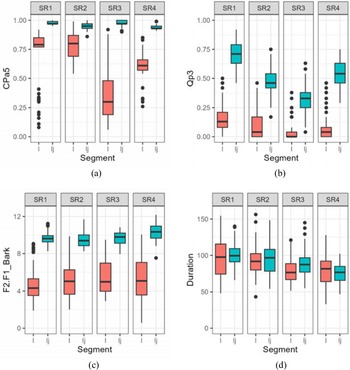

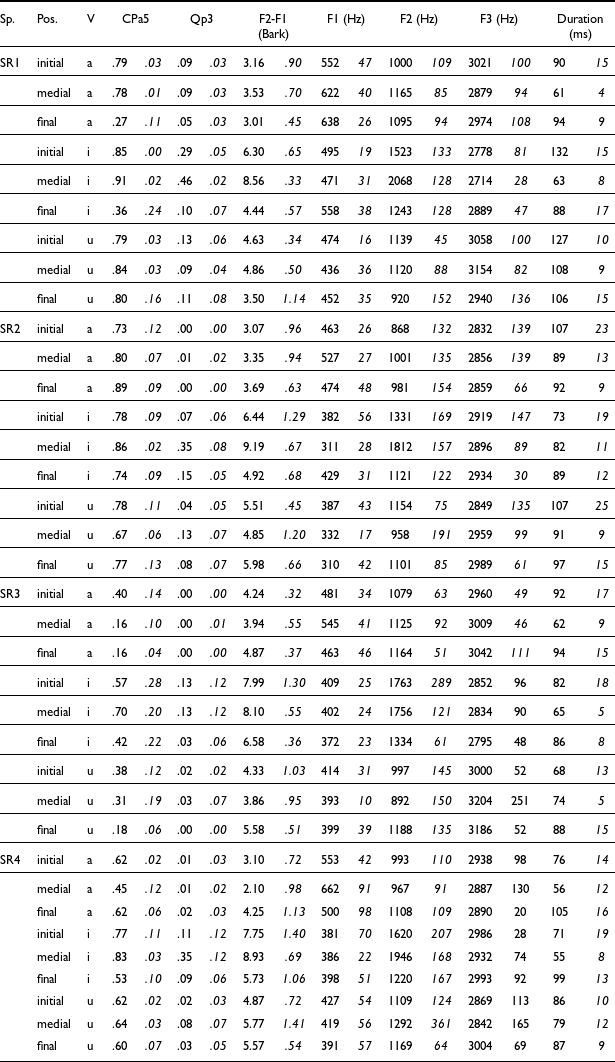
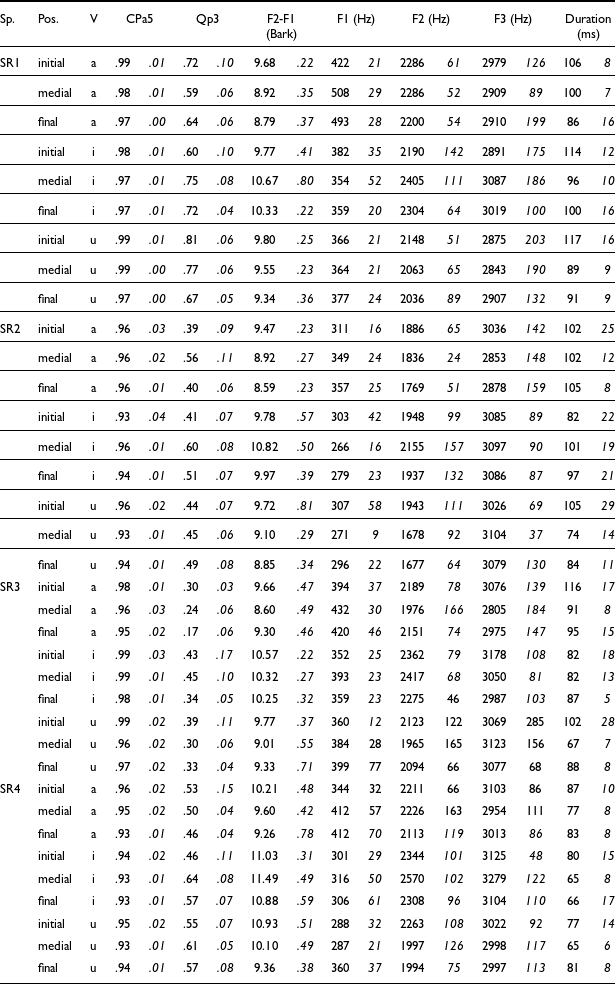

 Open access

