




The elderly woman depicted in Annibale Carracci’s Straordinario di Carne (Figure 1) has rarely attracted attention. Elderly women certainly had a significant presence in early modern marketplaces, often as sellers, licensed or otherwise.Footnote 1 However, the basket carried by Carracci’s old woman suggests that she has not been selling but rather shopping, a quotidian errand that drew her into the streets and piazze of her town, and prompted interactions with vendors and with others. Histories of early modern old age have tended to overlook this kind of mundane movement and have rarely attended to spaces such as the street or the marketplace. Yet these urban spaces are just as essential to understanding experiences of old age in early modern cities as the domestic spaces of the home or the hospital, the contexts in which scholarship more often situates old age and old age care.Footnote 2 Mobility, moreover, is now broadly acknowledged as a factor that shaped the early modern world at local as well as global scales. At intra-urban and neighbourhood scales, evocative studies have reconstructed experiences of and the social meanings attached to walking, and have examined the materiality of street space and its connection to street usage.Footnote 3 Much research has also emphasized the habitual and highly gendered nature of movement through urban spaces.Footnote 4 However, if street life and urban spaces are absent from histories of old age, age in general and the elderly in particular are similarly absent from current understandings of the early modern street and of early modern mobility, whether urban or global. If discussed at all, older people’s mobility is sometimes assumed to be a product of the decisions of younger family members, or of happenstance, rather than of choice or planning. The elderly otherwise tend to be addressed as somewhat bounded in place. Such an approach precludes investigation of life cyclical change as a category that affected how one might have physically navigated the early modern city, or occupied street space. More significantly, it erases the diverse ways in which elderly people interacted with their communities, clouding activities such as caregiving and other labour which formed part of old age for many, and skewing the questions we ask about ageing and agency in the early modern city.
Annibale Carracci, c. 1646. Straordinario di Carne, from Le arti di Bologna (Rome, 1740). Image: New York Library.

This article examines the relationship between everyday urban mobility and spaces, and old age. It takes as its primary case-study the city of Venice, focusing on the working and artisan population. Venetian attitudes to ageing have often been identified as unique – it is their supposed distinctiveness that underpins the ‘myth of Venice’, the city’s alleged long-term social and political stability.Footnote 5 However, research to date has focused on the role of old age in elite politics, eschewing questions about ageing among working and artisan Venetians, and of how the city’s material and social fabric affected the old age experienced by the majority of the population.Footnote 6 After examining ideas about the mobility of elderly men and women that circulated throughout Italy, the article examines the idiosyncrasies of Venetian public space in relation to age, and subsequently analyses court records to track elderly people’s paths and their motivations for movement in the city. Repopulating early modern streets with the elderly men and women who used them demonstrates how age might have affected street usage, how these experiences related to other characteristics such as class and gender and how the urban environment might have affected experiences of old age. Attending to the role of immobility in histories of movement, it demonstrates also how the elderly occupied street space in ways that, while static, were equally crucial to local networks. For many elderly people, presence in their neighbourhood, city or further afield was part of everyday life and served crucial relationships. Such an image of urban old age transforms understandings of how this life stage could have been experienced, shedding new light on how some elderly people established identity and agency, and on practices of work and care, in the early modern city. It adds also to our understanding of how everyday movement and the early modern street were integrated into quotidian practices across the life cycle.
Old age and (im)mobility in early modern Italy
Early modern Italians understood old age as a state, and as a dynamic process made up of bodily and social change. Old age was therefore usually conceptualized as falling into at least two stages, often labelled as vecchiezza (old age) and età decrepita (decrepit old age). Popular printed medical texts tended to place the chronological thresholds for these stages at around ages 50 and 70, respectively.Footnote 7 However, the chronological threshold could sometimes be placed at 40 or 45. Such earlier thresholds were applied especially to women. Rules for entry into homes for elderly women such as the Ospizio dei Crociferi in Venice, discussed below, sometimes used the threshold of 40.Footnote 8 Moreover, female old age was frequently understood as connected to decline in fertility and associated external physical changes.Footnote 9
Within the Galenic humoralist medical tradition, ageing was a process of the body cooling off and drying out, producing physical changes such as wrinkles, as well as general weakness (debolezza).Footnote 10 Declining mobility was one aspect of bodily change commonly associated with old age in a range of texts and imagery. A devotional manual On the Good of Old Age (Il libro del bene della vecchiezza) by the reforming Cardinal Gabriele Paleotti included ‘slow walking’ among a host of other physical changes.Footnote 11 Ages of Man prints which circulated in Italy and throughout Europe likewise emphasized changing mobility, sometimes as a cause of dependency. Prints produced in northern Italy by Cristofano Bertelli (c. 1560, Figure 2) and Giuseppe Maria Mitelli (1698, Figure 3) highlight decreasing mobility across the life cycle. In Mitelli’s image, in contrast to upright Virilità (Manhood), the figure of Vecchiezza uses a cane for balance. Decrepità in turn bends more heavily over two crutches, and Vecchiezza’s outdoor boots have been replaced with flat-soled slippers. Bertelli’s earlier print likewise made changes to mobility a crucial element of the visual descent into old age. On the right hand side of the staircases of the Ages of Man, the elderly man becomes hunched as he picks out spectacles, and then is seated with a coffin. In both pieces, movement forms a secondary arc across the life cycle, from a newborn stationary in the cradle and an infant learning to toddle in his girello (walker), through upright and active middle life, to seated and immobile old age. Characterization of old age as a return to childhood was a common trope, particularly in satirical material which sought to poke fun at a perceived decline in rationality among the elderly, especially men.Footnote 12 One implication of the visual trajectory of the prints by both Bertelli and Mitelli is that the cultural equation of old age with a return to childhood derived from a level of dependency associated with impeded movement, as much as from any perceived decline in rationality. Although from a different context, a seventeenth-century German print representing the age of 90 from a series of the Ages of Man makes the point about assistance overt. The elderly man and woman both use mobility aids and are, or have recently been, seated; the woman is physically assisted by another, younger woman to walk (Figure 4). An accompanying poem explicitly refers to the work of younger kin lifting and carrying elderly parents.Footnote 13
Cristofano Bertelli, c. 1560. Ages of Man. Engraving, 39.3 x 51.4 cm. Amsterdam, Rijksmuseum, RP-P-2017-889-1.

Figure 2. Long description
The central image is a sequence of nine male figures, each standing on a labeled platform representing a different age or stage of life, from infancy at the bottom left, to a man in his prime at the top, and old age at the bottom right. Each figure is accompanied beneath by symbolic objects and animals, such as a lion, a dog, and a lamb. In the top left, Christ is surrounded by angels, e with Italian inscriptions explaining their actions. In the top right, the Devil is surrounded by demons, with corresponding inscriptions. At the base, a large skeleton stands in a cave-like setting, flanked by demons, symbolizing death and the final stage of life. Additional narrative vignettes and animals are distributed around the lower edge, each with explanatory text. The overall structure emphasizes the moral and spiritual journey of man, with visual and textual contrasts between virtue and vice, salvation and damnation.
Giuseppe Maria Mitelli, 1698. La vita humana. Etching, 12.9 x 51 cm. London, The British Museum, 1852.0612.570. Old age is here divided into two stages, ‘Vecchiezza’ and ‘Decrepità’. © Trustees of the British Museum.

Figure 3. Long description
From the far left, a winged figure of Death with a scythe and hourglass stands over the Ages of Man. First, a swaddled infant and a seated toddlernext to a child with a hobby horse, all three labeled Infanzia. Moving right, a boy with a tambourine is labeled Puerizia. Next, an adolescent with a shuttlecock and racket is labeled Adolescenza. The fourth age stage, Gioventu, is a young man with a gun and a dog. The fifth, Virilita, is a man drawing.The next stage, Vecchiezza, is an elderly man with a cane, stooped posture, and wearing spectacles. The final figure, Decrepita, is a bent old man leaning on a cane in each hand, approaching a tomb. Each stage is labeled above and has a descriptive phrase below in Italian, corresponding to the activities or conditions of that age. The sequence visually narrates the progression from birth to death.
Conrad Meyer, seventeenth century. An Old Couple Are Assisted in Walking; Representing the Ninetieth Year of Life (detail). Engraving, 23.5 x 13.4 cm. London, Wellcome Collection 26390i. © Wellcome Collection. The woodcut accompanies a poem.

Figure 4. Long description
At the left foreground, an elderly man with a long beard sits hunched in a high-backed chair, his right hand gripping a cane that extends diagonally to the floor. His left hand is supported by a younger man standing beside him, who holds a goblet in his right hand and steadies the old man's arm with his left. Behind the chair, a large curtained bed fills the upper left background. To the right, an elderly woman with a cane is being gently supported from behind by a younger woman, who wraps her arms around the older woman's shoulders and waist. The elderly woman leans forward, her posture mirroring the frailty of the seated man. Both pairs are positioned on a tiled floor, with heavy drapery framing the background. The composition emphasizes the physical decline and dependence of old age, with the younger adults providing assistance and stability.
The elderly themselves also cited being ‘crippled’ (stroppiato, zotto), and more specifically claimed difficulties with walking, as critical concerns of old age when appealing for assistance. Marieta Alberti described herself to the Venetian Collegio in 1657 as ‘deprived of [my] sight and crippled at the age of 80’.Footnote 14 Similarly, in 1604 Lunardo Bognolo described his father as ‘in decrepit old age and crippled’; Lunardo, 50, stated that he himself was ‘infirm’.Footnote 15 More explicitly, in Bergamo in the Venetian mainland in 1605, Felicità Bucelleni, aged around 70, complained that she was ‘declined in such a way that she can only walk badly, propping herself up with a walking cane’.Footnote 16 Also in Bergamo, 15 years earlier, Luca described how he was ‘in extreme poverty and misery being more than 70 years of age, unable to gain his living…crippled from the waist down so that he cannot use his legs and must stay in bed’.Footnote 17 Luca’s petition specifically referenced his inability to work. However, the suggestion that Luca could only leave his bed when carried is unlikely to have been pulled from thin air, raising questions about assistance which are explored further below.
Despite these emphases on compromised mobility, early modern prescriptive texts encouraged the presence of the elderly in public spaces, although they too assumed difficulties with mobility. Leon Battista Alberti’s recommendations for the architecture of a city noted the potential inconvenience and discomfort of travel for the elderly and aimed to facilitate their presence in public life. Discussing Ornament to Sacred Buildings, Alberti remarked that the use of stairs at sacred spaces was ‘impractical and inconvenient’, particularly for ‘the old and the infirm’.Footnote 18 In Ornament to Secular Buildings, Alberti similarly discussed what he identified as an ancient precedent for public buildings to have two staircases, one of which ‘rises more sedately, with landings and breaks, to let the matrons and the aged climb slowly and pause during their ascent’.Footnote 19 Alberti also recommended the use of porticoes in public spaces where ‘elders may stroll or sit, take a nap or negotiate business’. Crucially, in such spaces ‘the presence of the elders will restrain the youth, as they play and sport in the open, and curb any misbehaviour or buffoonery resulting from the immaturity of their years’.Footnote 20 Moreover, as Carracci’s print of the Straordinario di Carne suggests, the visual record indicates that the elderly were present in a variety of public spaces where they interacted with people well beyond the confines of family or neighbourhood (Figure 1).
Urban space and age in Venice
Venice consists of a mass of small islands, connected by bridges and by canals and smaller rii (singular rio) which provide water-based routes through the city. The largest of these, the Canal Grande, cuts through the city’s middle (Figure 5). In the seventeenth century, the Canal could be crossed on foot only by the bridge at Rialto, or via small boats, traghetti. Their landing points were frequently used as geographical markers, suggesting the familiarity of many inhabitants with the boats.Footnote 21 Nevertheless, Venetians mostly travelled on foot, across bridges and through campi (parish squares), calli (streets) or fondamente (footways beside a canal).Footnote 22 These spaces varied materially, affecting how the city could be traversed and used. By the end of the sixteenth century, campi which were important sites for civic ritual were paved, as were significant thoroughfares.Footnote 23 The English traveller Thomas Coryat wrote in 1605 that the streets were all paved which often made them slippery when combined with the water, an important reminder of how the city’s materiality may have affected pedestrian movement.Footnote 24 The visual record suggests that even where paving was extant mud, dirt and grass may also have been present, making surfaces trickier to navigate (see Figures 6 and 7). Many of the city’s bridges, moreover, lacked handrails (Figure 6), and a bridge is one of the symbols that appears in the city’s death registers as a shorthand visual index for cause of death.Footnote 25
Disegno Della Pianta Di Venetia con tutti i Canalli, Rij, Chiese, Ponti, Isolette, division de sestieri. Opera nova et non più stampata. Stefano Scolari, Venice, 1677 [Alessandro Badoer, 1627].

Figure 5. Long description
At the top edge, ‘Tramontana’ marks the north, with a title in large serif text reading ‘Disegno della Pianta di Venetia con tutti i Canalli, Rij, Chiese, Ponti, Isolette, division de sestieri.’ The map is a detailed line drawing of Venice, with the Grand Canal forming a large S-shaped curve through the center. To the left (northwest), a boxed legend lists ‘Nomi d'i rii piu principali’ with Roman numerals I to XXV, naming major canals such as ‘Il rio della Misericordia’ and ‘Il rio di S. Marcuola.’ Each canal is labeled on the map with corresponding Roman numerals. The city is divided into six sestiere zones and subdivided by smaller canals and streets. Churches are depicted as small building icons with steeples, each labeled with names such as ‘S. Marco,’ ‘S. Maria Formosa,’ and ‘S. Giovanni e Paolo.’ Bridges are shown as short lines crossing canals, with some labeled, for example, ‘Ponte di Rialto.’ The Arsenale, a large shipyard complex, is detailed in the northeast, with docks and buildings. In the lower section, the island of Giudecca is drawn horizontally, labeled ‘La Giudecca,’ with its own network of canals and gardens. At the bottom right, the island of ‘S. Giorgio Maggiore’ is shown with a walled monastery complex and trees. The map includes compass directions: ‘Ponente’ (west) at left, ‘Levante’ (east) at right, and ‘Ostro’ (south) at the bottom. Decorative cartouches in the upper corners contain dedications and publication information, including the names Stefano Scolari and Alessandro Badoer. The map is densely annotated with Italian text labeling each feature, and the overall layout emphasizes the intricate waterway network and urban structure of 17th-century Venice.
Antonio da Canal, c. 1730. Campo dei Gesuiti a Venezia. Oil on canvas, 47 x 78 cm. Milan, private collection. Image: Wikicommons. The building in the centre of the canvas, with the cross and round window above its slightly ajar door, is the Ospizio dei Crociferi, a home for elderly women.

Figure 6. Long description
At the center is a low, rectangular building with a cross on its gable and a round window above a slightly open door, identified as the Ospizio dei Crociferi. To the left, a stone bridge crosses a canal, with several figures standing and conversing on the bridge and along the canal’s edge. The leftmost building is tall with arched windows and prominent chimneys. To the right of the central building, a large, ornate church facade with sculptural decoration and columns rises, casting shadows across the square. The rightmost structure is a long, red-toned building with rows of windows and people gathered near its base. The square is paved and features a stone wellhead at the lower right. Numerous figures in eighteenth-century dress are scattered throughout the scene, engaged in conversation or walking. The background opens to a blue sky with scattered clouds, and the far end of the square reveals a glimpse of water, suggesting proximity to a Venetian canal.
Antonio da Canal, c. 1720. Rio dei Mendicanti. Oil on canvas, 144 x 207 cm. Museo Ca’ Rezzonico, Venice. Image: Wikicommons.

Figure 7. Long description
Starting at the bottom left, a stone embankment with steps leads to the water, where several figures in eighteenth-century dress walk or converse. A gondola with a covered cabin is docked at the steps, while another gondola moves rightward along the canal. The left side is dominated by a large, pale building with arched windows and columns, receding into the distance. On the right, multi-story buildings with laundry hanging from upper floors and wooden scaffolding line the canal, their facades weathered and irregular. Several gondolas and small boats are moored or in motion, with figures rowing or working near the water. A wooden bridge spans the canal at mid-distance, connecting the two sides. Beyond the bridge, the canal narrows and is flanked by more densely packed buildings, receding toward the horizon. The sky above is filled with swirling clouds, with sunlight illuminating the scene from the right, casting shadows along the buildings and water. Human activity is distributed throughout, with clusters of people on both banks and in boats, emphasizing the vibrancy of daily life in Venice.
Venetian authorities carefully attended to the presence and movement of residents and visitors throughout the city. A range of regulations established places where particular groups were – theoretically – carefully segregated, sometimes with attention to age thresholds.Footnote 26 By creating legislated boundaries around minority groups, the Venetian government intended to support public health by enforcing order and stability.Footnote 27 Trades perceived as dangerous morally or physically (prostitutes, glassblowers, dyers, butchers) were contained, usually to the city’s edges.Footnote 28 Monasteries and convents separated female and male religious from the laity, fondachi kept foreign merchants and religious minority groups away from local populations for long-term stays as did inns and lodging houses for shorter ones.Footnote 29 The Ghetto in the northern sestiere of Cannaregio segregated the substantial Jewish population from Christian residents. Much of the legislation that established these latter boundaries privileged – even enforced – the mobility of elderly women and men, through allowing for their entry and exit. The Ghetto was locked overnight and guarded by two Christian guards.Footnote 30 However, licence for entry could be obtained and Christians entered on a regular basis in the daytime, primarily as workers such as street-sweepers, porters or food pedlars.Footnote 31 These professions required comparatively limited contact, and drew demographically varied workers. Professions like domestic service or other forms of regular employment that warranted extensive contact, however, were especially tightly regulated and were generally performed by elderly or at least middle-aged people.Footnote 32 In 1661, for instance, a Christian woman named Meneghina was granted permission to enter the Ghetto to work in service. She was described as being ‘of such an age’, suggesting that she met an age threshold not recorded in the licence itself but that was understood in practice.Footnote 33 In other instances, licences recorded that permission was granted with ‘it being understood that [Antonia] is over 60 years of age’.Footnote 34 Brian Pullan’s analysis of those who visited the Ghetto establishes that the authorities were reluctant to grant entry to youths, who were considered more susceptible to potential religious influence.Footnote 35
According to the same logic, older members of convent communities were afforded those roles that required them to cross the cloister walls. Most convent communities were made up of choir nuns, and of a smaller group of converse nuns accepted with a lower dowry as servants, and who usually came from families of less elite socio-economic status.Footnote 36 The Council of Trent (1545–63) attempted to enforce strict enclosure on all female religious communities, preventing movement into or out of the convent; however, the need for communities to interact with the world beyond the wall for survival was acknowledged in practice. Ordinarily, the oldest of the converse nuns, over age 40 or 42, were tasked with domestic labour that sent them beyond its confines, and ecclesiastical officials paid close attention to which women were granted such rights.Footnote 37 For instance, in 1708 the sisters at Spirito Santo in Venice received permission to have ‘two of the oldest converse leave clausura (enclosure) on Holy Saturday’; and again in 1714, converse over the age of 40 received permission to exit.Footnote 38 Converse nuns’ lower social status meant that movement throughout the city was already more acceptable for them than for elite women.Footnote 39 Nevertheless, it was older women, less likely to be viewed as potential targets for men’s sexual aggression, who were perceived as more suited to leaving convent confines than younger nuns. Paradoxically, given concerns about the physical mobility of the elderly, monasteries were reliant on the mobility of these older women: suppliche submitted to the papacy regularly highlight how immobility experienced by elderly and sick converse adversely affected their communities.Footnote 40
Attending closely to the ways in which old age impacted how people related to the social and physical urban boundaries of Venice shows, on the one hand, an underlying assumption that urban space would be experienced differently by elderly people, irrespective of their gender though often in relation to social status, compared to their younger neighbours.Footnote 41 But it also suggests a perception that the elderly – as good Christians, especially – were less susceptible to the potential instability of boundary spaces than were younger people. Thus, as in Alberti’s recommendations, their presence in public spaces could serve as a model for youths.
Aged geographies: tracing elderly people’s street usage
Against these cultural and legislative ideals, descriptions of movement found in witness statements from Sant’Uffizio (Inquisition) trials provide evidence for tracing the urban movements of the elderly, and show that this social cohort was a regular presence in early modern streets. In contrast with the Republic’s secular courts, the Sant’Uffizio routinely recorded the ages of witnesses and defendants alongside their trade, marital status and parish residence. While court narratives of where, when, why and with whom people moved around the city could be tainted with the need for honourable self-representation, potential lies nevertheless required credibility.Footnote 42 It is therefore reasonable to assume that when elderly people claimed to frequent a particular urban space, they were neither risking self-incrimination in the context of an Inquisitorial trial nor compromising their own honour, but were more likely invoking an urban geography in which it was usual and respectable to see the elderly. Less so, perhaps, some of the spaces in which other people accused elderly men and women of being present. Rather than focusing on the veracity of these records, I use their assumed plausibility to consider where, how far, when, with whom, by which means and for what purposes elderly people said they travelled or were described as travelling around and beyond the city.
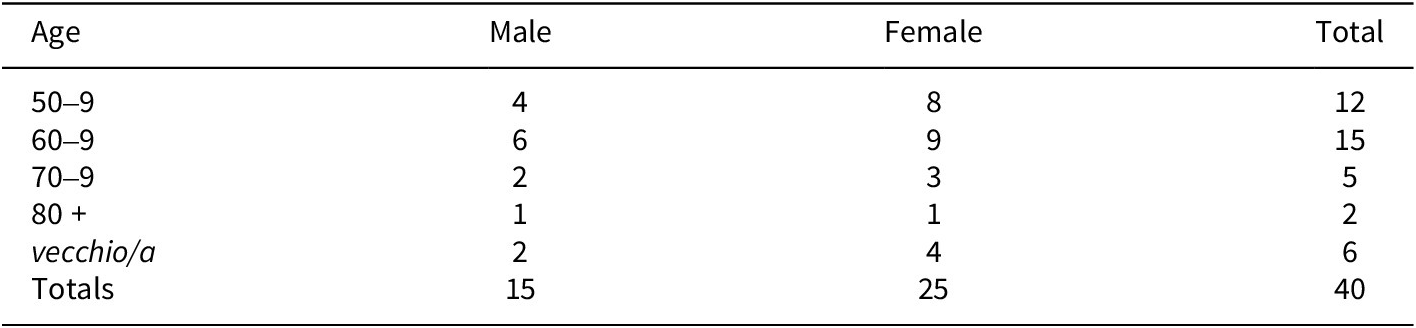
The trials examined were predominantly conducted in the seventeenth century, though some date from the later sixteenth. Both men and women were prosecuted, although women appear more frequently. Witnesses included people of both sexes and a broad variety of ages. Most were of working and artisan status, though some were drawn from the professional classes of doctors and merchants. A total of 87 instances of mobility have been studied, undertaken by 40 individuals and taken from 24 trials. Table 1 shows the breakdown of individual people included by age and gender. Women are over-represented, outnumbering men by almost two-thirds to one, with women in their fifties and sixties representing just over 40 per cent of the group. Journeys undertaken by women in their sixties make up slightly over one third of the total number of instances of movement considered (32 of the 87 journeys).
Individuals included, by age and gender

Table 1. Long description
The table has four columns labeled from left to right as Age, Male, Female, and Total. The first row under the header lists age group 50 to 59 with 4 males, 8 females, and a total of 12. The next row is age group 60 to 69 with 6 males, 9 females, and a total of 15. The third row is age group 70 to 79 with 2 males, 3 females, and a total of 5. The fourth row is age group 80 plus with 1 male, 1 female, and a total of 2. The fifth row is labeled vecchio slash a in italics, with 2 males, 4 females, and a total of 6. The final row is labeled Totals, with 15 males, 25 females, and a total of 40.
Analysis included descriptions of movement around and beyond the city by elderly people, whether narrated by an older person or by someone else. This approach is grounded in the methodologies proposed respectively by the Gender and Work project, and The Freedom of the Streets: Gender and Urban Space in Eurasia project. Both projects employ a ‘verb-oriented method’, focusing on verb-based descriptions of activities included in a broad range of archival material to attend to the frequency and gendered nature of, respectively, work and urban movement.Footnote 43 Such description is usually incidental to the purpose of a trial or other archival sources; the method allows for the recovery of a broad range of activities that might otherwise go unnoticed. Adapting these frameworks to centre age, rather than gender, descriptions of mobility were here recorded together with further available details about the person making the journey (name, age, gender, trade, marital status and bodily descriptions); the nature of the event (activity, location and the purpose of mobility such as work, social or devotional reasons); and the nature of the movement (the relative location such as between adjacent parishes, whether multiple people were present, the time or season and how the movement was conducted, for instance walking or, occasionally, by boat).Footnote 44 Journeys were included once for each elderly person who participated. Thus, if a man in his twenties and a woman in her seventies each described the woman’s visit to church, only the travel by the elderly woman is included, though the man’s presence and extra details gleaned from his testimony may have been used to flesh out the record. If, however, she visited with her 70-year-old husband, the outing is entered twice, once each for husband and wife, noting that they travelled together. The journey that produced each testimony studied – that is, from home to the Holy Office tribunal – has been excluded, as have ritual practices such as processions. Finally, as a rule, it is reasonable to assume that most people walked.Footnote 45 While the most used verb, andare, simply means ‘to go’, it can also be translated directly as ‘to walk’, and verbs such as camminare (‘to walk’) were also common.Footnote 46 Occasionally, witnesses comment that a boat was used, sometimes with a justification. For example, one older woman described accompanying her ill son and her daughter-in-law from their home to that of a healer, and noted that they had travelled by boat because her son’s sickness made him unable to walk.Footnote 47 In another instance, a witness explicitly described crossing the Canal Grande by traghetto, ferryboat. In that instance, the witness travelled with a man who was in his late eighties, and almost blind.Footnote 48
Reasons to move were many, but most described journeys fell into three categories of activity: those related to devotional practices, those related to socializing and familial interactions and those related to work. While it is certainly true that the selection of these spaces in witness testimony, and especially in first-person testimony, was shaped by the context of the Inquisitorial process, witnesses rarely expressed surprise at elderly people’s presence; it was relatively usual to find elderly people here. Moreover, the testimony sheds light on how mobility to and presence in these spaces shaped the communities in which elderly men and women participated.
Given that Inquisitorial trials focus on religious malpractices, it is unsurprising that church attendance is frequently described. There were 20 journeys relating to devotional practice included, made by 9 people aged from their early fifties to 88. As a rule, people attended their local parish church or one nearby regularly and ventured further, frequently across several parishes or the Canal Grande, if not the whole city, to attend one of the large convent churches less frequently, often for confession. Of the nine journeys for devotional purposes undertaken by people in their sixties, only three were made further than an adjacent parish. Around 1645, 66-year-old Giulia Cambelotto, the wife of a carpenter at the Arsenale (shipyard), recounted that she had seen Maria Battaglia, accused of stregheria (witchcraft), at the church of San Marcuola. Giulia lived in Calle del Forner in the parish of San Martino, adjacent to the shipyard; the church of San Marcuola was located in the sestiere of Cannaregio to the north, across a large part of the city from San Martino.Footnote 49 Likewise, witnesses in the 1649 investigation against the 80-year-old Isabella Malipiero stated that she regularly attended her parish church.Footnote 50 Isabella, accused of stregheria, was seen also ‘in the church of San Marco a few times, with a rosary’.Footnote 51 The Basilica di San Marco was a little under a kilometre from the parish of San Martino where Isabella lived. Compared with the rest of the cohort examined, 88-year-old Iseppo Parisio’s movements were more expansive, despite the fact that he was almost blind (Figure 8). A medical doctor and an astrologer (the activity which resulted in his arrest), he lived alone in a rented first-floor room in a larger complex of houses in San Polo.Footnote 52 In 1685 witness testimony, Iseppo appeared in his room praying, and defence witnesses – mostly his neighbours from the same building – placed Iseppo regularly in the local parish churches of San Polo and Sant’Aponal (points 1, 3 and 4 on the figure), and more sporadically in at least three convent churches throughout the city (points 5, 6 and 7). He also bumped into one witness travelling on the traghetto from Corpus Domini (towards San Simeone Piccolo), after which they walked together (2). Iseppo’s comparatively expansive movement and use of traghetti could have been related to his social status. But both his attendance at church spaces throughout the city, and his dependence almost exclusively on neighbours as defence witnesses, might also have been tied to Parisio’s status as a migrant. Originally from Modica in Sicily, he had lived in Rome for about 30 years, before relocating to Padua, and finally to Venice some 10 years previously. He had moved into his current house around three years before the trial.Footnote 53 Studies of neighbourhood have shown that social contacts with neighbours are likely to increase with increased mobility (with a concomitant diminution in family or other ties).Footnote 54 Iseppo’s migration pattern across the life cycle was perhaps one reason for his reliance on nearby neighbours.
Locations that Iseppo Parisio was said to have visited, showing (1, 3) the parish of San Polo where he lived and attended mass at the parish church; (2) the traghetto crossing the Canal Grande from Corpus Domini; (4) the parish church of Sant’Aponal; (5) the Dominican church of Santi Giovanni e Paolo; (6) the Franciscan church of San Francesco della Vigna; (7) the Benedictine church of San Giorgio Maggiore. Image: author’s annotations on Stefano Scolari’s Disegno Della Pianta Di Venetia.

Figure 8. Long description
At the center of the map, two adjacent labels numbered 1 and 3 mark the parish of San Polo, where Iseppo Parisio lived and attended mass at the parish church. To the west-northwest, label 2 marks the traghetto crossing the Canal Grande from Corpus Domini. Slightly northeast of the central cluster, label 4 marks the parish church of Sant’Aponal. Further northeast, label 5 marks the Dominican church of Santi Giovanni e Paolo. Directly east, label 6 marks the Franciscan church of San Francesco della Vigna. Southeast, on an island separated from the main city, label 7 marks the Benedictine church of San Giorgio Maggiore. The map background includes detailed canal, street, and building outlines, with a legend of principal canals at the upper left and decorative cartouches at the top.
Socializing and family interactions tended to draw the elderly somewhat further afield. Such journeys were recounted as being undertaken more frequently by women than by men: of 21 journeys, only 6 were by men. However, as with devotion, there was little gender distinction in patterns of actual movement, for instance in terms of distance. Primarily, men and women described visiting houses, whether of acquaintances, friends or family, and occasionally specifically referenced sharing a meal. The 66-year-old Giulia Cambelotto, discussed above, indicated that she had eaten two or three times over recent years with her neighbour Maria (though it is unclear from the evidence whether this was in one of their homes, or elsewhere).Footnote 55 Sanctina Rigatto, in her fifties, was fairly ordinary in travelling from her own home in the parish of San Giovanni Novo to her daughter’s home in the parish of San Giovanni in Bragorà regularly, where the latter lived with her husband whom she had accused of stregheria. Sanctina also received apparently regular visits from her son, a priest.Footnote 56
At other times, older people visited different social spaces together, or socialized in the street. The silk weaver Galvagno Bresciano, 53, recounted how he had gone from his house in San Marcuola to the local parish frutaruol (fruit seller) ‘at the two bridges’ to buy groceries one evening during the recent Carnevale in February of 1641.Footnote 57 The fruit seller seems to have been a social space where ideas were regularly discussed and exchanged: Galvagno commented that he had overheard Emmanuel Fernandes, accused of heresy, ‘disputing doctrine, faith and God’ there with another of Galvagno’s friends.Footnote 58 While Galvagno did not state so, such sociability, especially on an evening during Carnevale, was likely the reason for his visit. Research on communication in Venice has highlighted how churches, friends’ houses, shops and especially pharmacies were spaces in which information and gossip could be exchanged, and networks built.Footnote 59 Thus, undertaking a simple household chore ensured Galvagno’s regular presence in spaces of sociability and knowledge exchange. In contrast, Jacopo Rota, a canon aged 60, described how he had left his own home in the parish of Sant’Aponal to visit a friend Prospero Leoni (now under investigation for heretical ideas) in a house in an unknown location. The men then went to listen to music together at the Dominican convent church of San Zanipolo, a social interaction that was also devotional.Footnote 60 Jacopo also admitted that Prospero had blasphemed on another occasion, when they had simply been walking and conversing together ‘throughout the city’.Footnote 61 While the specific events were singular, Jacopo and Prospero seem to have socialized in public somewhat frequently. Elderly women’s social interactions were also not limited to indoor spaces. Several women recounted bumping into friends and acquaintances in the street, and conversing on doorsteps.Footnote 62 Lucietta, the wife of Giovanni Molderà who lived in Calle del Squero in Sant’Agnese, reported in a trial against one Francesco Giustiniano for abuse of sacraments that she had spoken with a woman named Chiara di Bianchi, whom she had met in the street. It is unclear where she bumped into Chiara, but the 67-year-old Lucietta had set off across the Canal Grande towards San Martino to seek Chiara out, and on another occasion the women together visited a priest in that parish (see Figure 13, below).Footnote 63
Work was the most common reason for movement described in the trial records. ‘Work’ has been understood as any task that may have contributed to the livelihood of an individual or their household.Footnote 64 In total, 32 journeys were identified. These were made by 18 people, 9 male and 9 female, aged between their early fifties and approximately 80. Compared to the other types of mobility already discussed, gender seems to have had a greater influence on the distances travelled for work, or at the very least on the distances as they were recounted, although trade status also influenced movement. As a rule, women relied on the parish and nearby areas for labour of varied sorts – but this by no means meant that older women were homebound. Men, especially those in their fifties and sixties, while working in the same and adjacent parishes, also travelled further afield. This finding seems broadly to reflect findings on gendered work in eighteenth-century Amsterdam where men (of all ages) were found to more often have worked outside and away from domestic space.Footnote 65 Nor did one situation preclude the other. For example, the bookseller Francesco Carbizza, who was in his sixties in 1686, had a fixed stall in Campo San Bartolomeo, close to Rialto, but also sold itinerantly throughout the city with a cestello, a basket or crate.Footnote 66 In contrast, the 52-year-old Christoforo di Toffolo, also a bookseller, in the same year sold from his shop located near to the parish church of Santi Apostoli, in which parish he also lived. The men seem to have been acquainted primarily as long-time practitioners of the same trade, an acquaintance perhaps facilitated by Carbizza’s itinerant selling. It was not uncommon for booksellers to participate in multiple modes of selling, and the shift from itinerancy to a fixed stall or shop could be life cyclical.Footnote 67
Some other trades and work status seem to have been bound to dictate movement. The case for heretical views against Paolo Baruffa, a goldsmith from Bergamo who lived in Venice at the Ponte di San Marziale, drew in several of his fellow tradesmen. Paolo himself had ‘no fixed shop of his own, but trade[d] here and there’.Footnote 68 He was around 50 when the case was brought to trial in 1643, and many of the witnesses called were likewise in their fifties and sixties. What is noticeable is the frequent trade mobility of these older goldsmiths, at least some of them masters, especially between Padua – another centre for goldsmithing – and Venice, and within Venice between Rialto (especially the Ruga degli Oresi, from Orefici; goldsmiths, where they traded) and Piazza San Marco, which seems to have been frequented more as a social space, where goldsmiths walked and conversed.Footnote 69 For example, the 60-year-old Paduan Gasparo Borela was regularly in Venice. Gasparo worked in his own bottega in the Portico degli Orefici in Padua, and interacted with other goldsmiths on its threshold under the Portico.Footnote 70 In addition to travel from Padua to Venice, he recounted taking a boat from Venice to Ferrara and also walking in both Piazza San Marco and around Rialto with the accused. He had spoken also with other goldsmiths in Ruga degli Oresi. Gasparo’s Venetian trips, like those of the other masters he engaged with, seem to have been relatively routine and longstanding. They were dictated primarily, but not exclusively, by the need to keep up business networks. To some extent, the frequency of movement of men apparently well established in this trade contrasts with research that has shown how movement between towns in northern Europe was crucial to the masculine identities of journeymen, men who had not attained the status of master. The latter status instead bound men to the fixed space of the household-workshop.Footnote 71 For Veneto goldsmiths, instead, moving between the region’s artisanal centres was crucial to maintaining their work into their old age.
The sample of older women studied here moved predominantly within their local areas, though it should be noted that this routinely meant beyond the boundaries of their parish. Indeed, of the six instances of work-related mobility included for people in their fifties (four men and two women), the farthest journey was made by Lucietta, the wife of a weaver, who travelled from San Moisè to the parish of San Giovanni in Bragorà, in the sestiere of Castello.Footnote 72 This she did in order to collect thread from Laura Malipiero (like her mother Isabella, accused of witchcraft), which Lucietta’s husband Sgualdo was to weave into fabric.Footnote 73 Travelling in the opposite direction, Laura’s mother Isabella, aged about 80, went from her house in the parish of San Martino to Sgualdo and Lucietta’s home, calling on Sgualdo for his labour on behalf of Laura (Figure 9).Footnote 74 She also visited Antonio dal Bezzo, another weaver, in the much-nearer parish of Santa Trinità for the same purpose, and was seen in Laura’s homes in San Biagio and later in San Giovanni in Bragorà.Footnote 75
Locations that Isabella was said to have travelled to, (1) the parish of San Martino where she lived; (2) her daughter’s house in the parish of San Giovanni Bragorà; (3) the Basilica di San Marco; (4) the parish of San Moisè; (5) the parish of San Ternità. Image: author’s annotations on Stefano Scolari’s Disegno Della Pianta Di Venetia.

Figure 9. Long description
The base is a detailed seventeenth-century map of Venice, oriented with north at the top. Five black-outlined white boxes numbered 1 to 5 are superimposed on the eastern and central sections. Box 1 is in the southeast, marking the parish of San Martino, Isabella’s residence. Adjacent and slightly west, box 2 marks her daughter’s house in the parish of San Giovanni Bragora. Box 3 is northwest of box 2, highlighting the Basilica di San Marco near the city’s central square. Box 4 is further west, indicating the parish of San Moisè. Box 5 is northeast of box 1, marking the parish of San Ternità. The annotations are distributed in a compact cluster in the eastern third of the city, with the rest of the map showing canals, churches, and other landmarks labeled in Italian. The map includes a legend in the upper left and a decorative cartouche in the upper right.
Carracci’s drawing with which this article opened, and Lucietta Molderà’s description of stopping to speak in the street mentioned above, are reminders that presence in urban space did not exclusively mean movement. In 1660, a 70-year-old and well-to-do man, Antonio Guarnier, complained in a petition to the Venetian Collegio of an assault which had occurred in the street in Adria in the Veneto. He recounted that his assailant had ‘found me in the street, seated on a chair [and] assaulted me’.Footnote 76 While he did not state so explicitly, the fact that Antonio did not offer an explanation for his presence seated in the street suggests that this would not have been interpreted as curious; certainly, it reflects Alberti’s suggestion that the elderly might have been found sitting or napping in porticoes, not merely strolling.Footnote 77 Antonio’s comment also raises questions about some of the other evidence found in the Holy Office trials. When elderly people – most frequently women – stated that they had conversed at or on a doorstep, they focused their description on their activity, conversing. It was the fact of information exchange that interested the Inquisitors. For example, the 70-year-old Caterina Mennini, who deposed against herself for using magic to seek a lost ring, stated that she had been taught the relevant spell by a neighbour, Margarita, ‘at her [Margarita’s] house, on the doorstep’.Footnote 78 But doorways, windowsills and other liminal domestic spaces were important sites of work, especially for women since light aided fine work such as sewing.Footnote 79 They were also significant sites of sociability, gossip and reputation, as were spaces that intruded into the street such as balconies.Footnote 80 Caterina’s phrasing is particularly evocative of visual material such as the seated woman working in Vermeer’s View of Houses in Delft, literally seated ‘on’ the doorstep (Figure 10). Caterina noted that another woman was also present for her exchange with Margarita. It is possible that the group of women was seated just in front of the door, simply socializing or perhaps sharing work. It is of course also possible that all three women stood and that the interaction was briefer, just long enough to exchange gossip. Nevertheless, even in that case they had stopped to talk in the liminal, but publicly visible, space between the street and the more private space of the home. While often more hidden in the archive than descriptions of movement, these were significant ways in which the elderly occupied early modern street space and participated in the neighbourhood.
Johannes Vermeer, c. 1658. View of Houses in Delft. Oil on canvas, 54.3 x 44 cm. Amsterdam, Rijksmuseum, SK-A-2860.

Figure 10. Long description
Starting at the bottom edge, a cobblestone street runs horizontally. In the lower right quadrant, a woman in a white cap and dark dress sits in a doorway. To the left, two children kneel near a wooden bench, facing away. The façade of the main house dominates the right half, constructed of red brick with whitewashed lower walls. Two large windows with green shutters occupy the ground floor, one open and one closed. Above, two smaller windows with leaded glass are set into the brick. To the left, a passageway leads inward, where a woman in a blue skirt and white cap bends over a tub. The leftmost section shows a smaller house with a flowering vine climbing the wall. In the background, rooftops recede into the distance under a sky filled with large, soft clouds.
Urban space and experiences of old age
Reading closely for how the elderly or those around them described mobility in Inquisition and in other material can shed new light on histories of old age and how space intersected with elderly identities, as well as on practices such as work structure and care. In 1655, Seconda Tempon and Jacopo dai Schioppi, both aged 65, travelled from their respective homes in the Carampane and San Salvador to the Frari, the church of the conventual Franciscans in the parish of San Polo, where they met.Footnote 81 In this instance, the travel and uses of space recounted were very clearly intended to cast Seconda, accused of witchcraft which included a form of allegedly false possession by a spirit, in a positive light (Figure 11). Partly, of course, this was to push against the accusation of witchcraft itself, but it was probably also to offset the connotations of the spaces in which Seconda lived and, allegedly, worked. The Carampane was an area of housing, essentially enclosing a courtyard, at the edge of the parish of San Cassiano.Footnote 82 It was not too distant from Rialto, and by the seventeenth century was well known for prostitution, though not part of the public brothel in Rialto.Footnote 83 The witnesses who admitted to visiting Seconda for stregherie were of varied social status. Almost all emphasized that her home was on the edge of the Carampane, rather than within it (that is, that they had not entered). This was not a salubrious area.
Locations mentioned in the trial against Seconda Tempon, (1) the Carampane and the parish of San Cassiano; (2) the Franciscan church of Santa Maria Gloriosa dei Frari; (3) the parish church of Sant’Aponal; (4) the parish church of San Luca. Image: author’s annotations on Stefano Scolari’s Disegno Della Pianta Di Venetia.

Figure 11. Long description
The map is an annotated historical plan of Venice with four black-bordered white squares labeled 1 through 4. Marker 1 is positioned in the northern central area, near the Carampane and the parish of San Cassiano. Marker 2 is to the west-southwest of marker 1, adjacent to the Franciscan church of Santa Maria Gloriosa dei Frari. Marker 3 is southeast of marker 1 and slightly east of marker 2, near the parish church of Sant’Aponal. Marker 4 is further southeast, close to the parish church of San Luca. Each marker is placed precisely over the corresponding church or parish, with the underlying map showing detailed street layouts, canals, and additional church icons. The annotations highlight the spatial relationship of these four trial-related sites within the urban fabric of Venice, emphasizing their distribution from the northern center toward the southeast.
Where Seconda lived, together with her age, would have raised suspicion that she was involved in sex work, most likely as a ruffiana, or procuress. Ruffiane were traditionally understood as older former prostitutes, and usually as exploitative of younger women.Footnote 84 When illustrated, as they regularly were in material such as alba amicorum, ruffiane were usually shown clothed, often richly, with facial features such as a hooked nose, wrinkled skin and sinking flesh (Figure 12), the kind of imagery that crossed into the figuration of the witch in northern Europe.Footnote 85 These women were also sometimes viewed as dissembling. Much like the fear that witches enticed younger women to the Sabbath, and likewise grounded in a fear of the infertile female body, ruffiane were thought to lure young girls into the profession, corrupting the sexuality of a city’s young women, as well as damaging its status as properly Christian. By carefully recounting her mobility around the city, Seconda and her defence witnesses created a mesh of everyday movement that placed the elderly woman in spaces which dissociated her from her likely status as a sex worker, and separated her from the inevitable image of the ruffiana that the Carampane evoked. In addition to the Frari, Seconda visited a parish church (either San Cassiano or Sant’Aponal, possibly both), and the church of San Luca. She was described as praying there, but also as being driven by a spirit.Footnote 86 This episode suggests that travelling to other churches may have been part of the advertising of Seconda’s inspired states. But recounting that travel in the trial nevertheless also served to separate her from the Carampane, positioning her inspiration in devotional spaces that might have rendered her experiences legitimate, rather than in the questionable space of the Carampane.Footnote 87 Seconda’s case suggests that for an elderly woman of working or artisan social status movement, including alone, could be invoked to legitimize her reputation, as suggested in the social attitudes towards older people crossing the boundaries of the convent or the Ghetto.
‘Ruffiana Venetiana’, 1585. Engraving. Detail from Dei veri ritratti degl’habiti … per opera di Bartolomeo Grassi. Amsterdam, Rijksmuseum, BI-1946-264-6.

Centring everyday mobility in an analysis of urban old age also brings to light how older women’s physical movement operated in crucial ways in networks of labour. The 67-year-old Lucietta Molderà (Figure 13), whose social visits to a woman named Chiara on the opposite side of the Canal Grande were referred to above, is a case in point. She lived in Sant’Agnese with her husband, Giovanni, a calzolaio or shoemaker. Lucietta stated in 1676 that she had ‘gone two or three times’ to the house of Andrea, also a calzolaio, to ‘bring shoes to [him] to be worked on, and to bring punto in aria [needlepoint lace] for working to [his wife] Caterina’.Footnote 88 The role of older women in arranging and putting out work within the Venetian textile industry is widely acknowledged.Footnote 89 But Lucietta’s evidence demonstrates how households with elderly members might have laboured to varying extents as a unit, and within intergenerational relationships. She managed two sets of work: she took shoes to a second shoemaker (Andrea), presumably for her husband Giovanni, and she also took lacework to Andrea’s wife. Lucietta’s language is intriguing. She stated that she took shoes to Andrea ‘da aconciar’. Acconciare usually means ‘to mend’, but this is not its only sense. Both Giovanni and Andrea were described as ‘shoemakers’. But acconciare can mean ‘to adorn’ or ‘to make handsome’, while associated words conciare and la concia refer specifically to aspects of leather preparation (John Florio’s Italian–English dictionary suggests ‘a washing or perfuming of leather’ for concia).Footnote 90 Possibly, the process referred to was in this vein of work: shoes made by Lucietta’s husband were sent out for some form of finishing. The lacework may have fitted into similar patterns of shared manufacture. Lucietta may have been delivering thread to be worked into lace. But punto in aria is especially intricate work. Women sometimes specialized in one kind of lace stitch, so a larger piece of work often passed through several hands.Footnote 91 Lucietta could therefore have been delivering a partially completed piece that moved within its own broader network of makers.
Locations that Lucietta Molderà was said to have visited during her trial, showing (1) the parish of Sant’Agnese where she lived; (2) the house of the shoemaker Andrea near to the Incurabili hospital; (3) the Ponte dei Gesuati where she recounted bumping into Andrea; (4) the parish of San Moisè; (5) the parish of San Martino. Image: author’s annotations on Stefano Scolari’s Disegno Della Pianta Di Venetia.

Figure 13. Long description
The map is a detailed seventeenth-century plan of Venice with black ink linework showing canals streets and major landmarks. Five white squares with black numbers indicate specific locations associated with Lucietta Molderà’s movements. Starting in the southwest quadrant near the Grand Canal square one marks the parish of Sant’Agnese where she lived. Directly southeast square two identifies the house of the shoemaker Andrea near the Incurabili hospital. Slightly northwest of square one square three marks the Ponte dei Gesuati where she reported meeting Andrea. Moving eastward toward the city center square four highlights the parish of San Moisè. The easternmost annotation square five is placed in the parish of San Martino. The map includes a labeled key to principal canals and churches in the upper left and a decorative title cartouche at the top center. All annotations are superimposed by the author and do not obscure the original map details.
Both cases may therefore exemplify trade specialization managed by an older woman who drew on neighbourhood networks to administer manufacture. Centring age, however, prompts an adjustment in approaches to specialization. Andrea and Caterina were in their late thirties, significantly younger than the 67-year-old Lucietta and her husband. It is possible that the younger Andrea’s and Caterina’s manual dexterity and likely better sight permitted each of them to complete fine and detailed work that was no longer easy for the older couple.Footnote 92 In this case, Lucietta’s arrangements would undermine the historiographically tenacious idea that women fared better in old age because their industries were ‘for life’.Footnote 93 In any case, even such ‘domestic’ work as textile preparation frequently required older women to move outside the home, and the relationships enabled by that movement were fundamental to household income. Her arrangements emphasize the significance of intergenerational relationships beyond the family and domestic space in underpinning self-sufficiency in old age. Lucietta’s activities highlight the need to pay close attention to division in manufacture as an intergenerational process that could take into account bodily decline, as much as skillsets.
Testimony from elderly women who lived at the Ospizio dei Crociferi in the sestiere of Cannaregio is similarly suggestive of how elderly people’s labour might have been embedded in reciprocal networks of care that depended on daily movement. The Ospizio (Figure 6) housed 14 women over 40, consistently referred to as vecchie, ‘old women’. While ages at entry were not recorded in extant material, paintings by Jacopo Palma il Giovane from the late sixteenth century depict the residents as older (Figure 14).Footnote 94 The Ospizio was overseen by a male prior assisted by a prioress (priora) chosen from among the women living in the Ospizio and who managed the day-to-day running of the house. The vecchie received spiritual direction and further oversight from the Crociferi friars, to whose convent the Ospizio was adjacent. A third level of male oversight came in the forms of the Procuratori di San Marco, the government body in charge of charitable houses. Each woman was usually elected to her room by the Crociferi brothers, though it was sometimes secured for them through the intervention of a (former) employer, usually a nobleman. In the late sixteenth century, several of the women were also related to the friars (some were their mothers, others were sisters).Footnote 95 Each resident was provided with a room, and an annual allowance. At the beginning of the seventeenth century, that was set at 24 ducats (or roughly half the annual wage of a labourer). By 1672, however, it had reduced to 20 ducats, and would be 10 by 1695.Footnote 96
Jacopo Palma il Giovane, 1568–87. Pasquale Cicogna Hearing Mass Celebrated in the Oratory of the Crociferi, detail. Oil on canvas, 369 x 262 cm. Oratory, Ospedaletto dei Crociferi, Venice. Image: Wikicommons.

Figure 14. Long description
In the lower center foreground, a bearded man in a voluminous red robe kneels on a patterned carpet, facing right. His hands are raised in a gesture of reverence or supplication. Slightly in front of him, an elderly female figure in a white veil kneels with her hands clasped in prayer. Behind her to the left, a cluster of older women in black and white veils stand closely together, their faces partially obscured, with hands clasped or held to their chests. At the upper right, an elevated figure, only partially visible, extends a hand downward offering a communion wafer to the kneeling woman. The background is composed of dark architectural panels, emphasizing the dramatic lighting on the figures’ garments and faces. The spatial arrangement directs attention from the kneeling man upward to the interaction with the elevated figure. The image is a detail of a painting of a mass.
In January of 1650, the Procuratori di San Marco, having heard of disturbance and scandal at the Ospizio, launched an investigation. In the process, the Procuratori interviewed, or attempted to interview, each of the residents about their living habits and the moral standing of themselves and their neighbours. The combined contents of the interviews elucidates that less than half of the women were permanently residing in their rooms at the Ospizio.Footnote 97 This might suggest that the income, rather than the room, was the most crucial form of support for the women.Footnote 98 However, the women’s descriptions of their own and others’ living circumstances and daily activities are indicative of how significant quotidian mobility could be for self-sufficiency in old age, even for women with a secure lodging. One woman, Giustina, stated that while she did live in her room, she usually spent the daytime at her daughter’s house because she had ‘expenses from her’.Footnote 99 Other women contradicted her, suggesting that she did not stay in her room, or only stayed sometimes, and (in either case) that another woman named Antonia Allegretti, who was about 60, instead regularly resided there, without paying and without having been selected by the Crociferi brothers.Footnote 100 Giustina rejected the suggestion that she did not sleep at the Ospizio when pressed by the Procuratori, but admitted that ‘sometimes I sleep at my daughter’s house’.Footnote 101 Giustina’s description of spending the day at her daughter’s house and of having ‘expenses’ (the term used was spese) from her is somewhat ambiguous. However, it might imply a kind of half-board, or alternatively could suggest that Giustina’s daughter subsidized her income. The reference might then imply reciprocity, that Giustina went to her daughter’s house for a particular purpose for which she received expenses in return, perhaps domestic work including watching children. At the very least, the arrangement as it was outlined by Giustina reflects scholarship that has shown that supporting an elderly relative in domestic space did not necessarily mean cohabitation, and suggests that families were expected to contribute to the upkeep of their vulnerable members.Footnote 102
The ‘mobility turn’ is increasingly interested in how bodily and social factors affect who had the ability to move, when and where.Footnote 103 In early modern Venice, the nature of the city space, and mobility in the sense of the physical ability to traverse space, affected how urban spaces were navigated and used by the elderly. Antonio da Canal’s c. 1720 Rio dei Mendicanti shows, along its left hand side, the façade of the Ospedale dei Mendicanti (Figure 7). Two elderly men are shown, one – judging by his clothes, hat and cane – a beggar, or perhaps a pilgrim, who hovers close to the portal of the hospital’s church. Another man is shown further down the fondamenta. Walking with a cane in his right hand, and shoulders hunched, he places his left hand against the wall of the Ospedale, seemingly steadying himself (Figure 15). Canaletto’s detail is an unusual hint at how busy, unevenly paved streets might have been negotiated by men and women whose balance and walking abilities were deteriorating. The evidence given to the Sant’Uffizio by a pair of older women in 1678 suggests that such bodily change was viewed as something which might reduce movement, at least over long distances, in old age, as suggested earlier. Domenica Rizza was aged 68 when she was called before the Sant’Uffizio on charges of witchcraft.Footnote 104 A widow, she lived in the parish of Santa Trinità, very near to the parish church, with her daughter and son-in-law (point 1 on Figure 16). Domenica described herself as poor and living from spinning, though she was accused of love magic. Domenica’s self-description contrasted with how her neighbours and acquaintances characterized her as: ‘poor…, and she is crippled, fat, short, and she walks with a crutch’.Footnote 105 It is unclear when Domenica’s impairment began to affect her; she insisted that she had been ‘crippled’ for several years, though another witness indicated that it was more recent. Despite that Domenica initially denied interacting with others, depositions from other witnesses indicate that she moved around the neighbourhood regularly.Footnote 106 She visited others, attended mass at Santa Trinità (1), and at San Francesco della Vigna (2), walked with a woman named Lucrezia to the house of a third woman, Maria, in the parish of Sant’Agostino (3) two or three times and, once Inquisitorial proceedings against her had begun, walked to Lucrezia’s house ‘in Quintavalle’ (4) to threaten her about the latter’s evidence. In that interaction, Domenica stressed her status as ‘crippled’. Lucrezia stated that Domenica had ordered her, should she be recalled by the Inquisitors, to emphasize that ‘It had been three years since [Domenica] had become crippled, and that she didn’t walk’; however, Lucrezia noted that ‘to tell the truth, I say that at the last [feast day of] San Giovanni Battista it was just a year since she had become crippled’.Footnote 107 Focusing on the consistent description of Domenica as ‘old and crippled’, Domenica’s own insistence that ‘I don’t visit anyone’, and her demand that Lucrezia should emphasize Domenica’s physical impairment suggests that Domenica thought that her physical status would be accepted as something that made her less able to cross the city, and thus exonerate her. Domenica’s evidence suggests that an elderly woman with altered mobility would plausibly be viewed as travelling little; that an aged body could indeed be considered to impair participation in daily life.
An elderly man steadying himself against a wall. Detail of Canaletto, Rio dei Mendicanti. Image: Author.

Locations that Domenica Rizza was said to have visited during her trial, showing (1) the parish church of Santa Trinità; (2) the convent church of San Francesco della Vigna; (3) the parish church of Sant’Agostino; and (4) the area called Quintavalle in San Pietro di Castello. Image: author’s annotations on Stefano Scolari’s Disegno Della Pianta Di Venetia.

Figure 16. Long description
The base is a detailed 1677 line map of Venice by Stefano Scolari, oriented with north at the top. Four white squares with black numbers indicate annotated sites. Label 1 is in the northeast, marking the parish church of Santa Trinità, situated near the large rectangular complex of San Pietro di Castello. Label 2 is immediately west of label 1, marking the convent church of San Francesco della Vigna, adjacent to the same complex. Label 3 is centrally located, marking the parish church of Sant’Agostino, positioned within the dense network of canals and streets in the city’s core. Label 4 is at the far eastern edge, marking the area called Quintavalle in San Pietro di Castello, near the map’s perimeter. The annotations are superimposed on the original map, which includes labeled canals, churches, and city divisions. The spatial distribution of the sites shows two locations clustered in the northeast, one in the center, and one at the eastern edge.
It is moreover telling of early modern practices of elder care. In the several travels recounted by Domenica herself and by other witnesses, the old and ‘crippled’ woman was always accompanied, including by an unnamed middle-aged woman, perhaps the daughter she lived with. Working Venetian women of all ages moved around the city alone.Footnote 108 It is therefore noteworthy that Domenica did not. In thinking about the public presence of elderly women, there is a tendency to emphasize the figure of ‘the chaperone’, a woman who moved with more ease than others largely on account of her age, and accompanied younger women for similar reasons to those discussed earlier in relation to the boundaries of the Ghetto and the convent. And yet in these instances, it was Domenica who was consistently accompanied, most likely on account of her age and her apparent difficulties with movement. Similar to the print examined above that celebrated children who assisted their parents’ mobility, Domenica’s apparent practices show that elder care could take place peripatetically throughout the city, and movement itself could be a care practice.
Conclusion
Mobility was significant in old age, emphasized visually in printed literature and in everyday language about what old age was and how it affected the bodies of men and women of varied social status. The elderly, especially working and artisan men and women, were a consistent presence in street space, whether actively moving or perhaps seated in streets or courtyards. To some extent, the urban movement of the elderly was expected, and legislation that created social boundaries within the city was more permeable for elderly residents than for their younger neighbours. These expectations and experiences intersected with both social status and gender; for women in particular, it is clear that social status affected the distances that they travelled away from domestic space in old age as much as at earlier life stages. Nevertheless, repopulating early modern streets with older men and women and centring their mobility helps bring to light the broad networks of exchange and sociability within which elderly men and women lived, as well as occasionally shedding light on how life cyclical bodily change could have affected how streets were navigated, and the care practices that may have facilitated such movement among working and artisan people. In this way, it highlights how urban spaces influenced experiences of old age. It moreover demonstrates the inequities of mobility in the early modern city and shows their connection to the life cycle, as well as to the better-studied categories of gender and social class. The life cycle affected, and was expected to affect, experiences of urban space, and how an individual’s presence in the street was perceived.
Acknowledgments
I would like to thank Mary Laven, Rosa Salzberg, Alex Bamji and Alex Walsham for their feedback on earlier versions of this article, and Deborah Howard for her help with maps. I would also like to thank the reviewers for their generous comments and suggestions.
Funding statement
Research for this article was supported by the Arts and Humanities Research Council [grant number 2645866]; and the Gladys Krieble Delmas Foundation.




 Open access

