


Introduction
Dementia is expected to become more prevalent as the global population ages [Reference Prince, Wimo, Guerchet, Ali, Wu and Prina1]. Identifying modifiable risk factors to prevent or delay its onset and progression has been a major focus of dementia research [Reference Livingston, Huntley, Liu, Costafreda, Selbæk and Alladi2]. Studies indicate that adverse childhood experiences (ACEs), including neglect and abuse [Reference Anda, Butchart, Felitti and Brown3, Reference Gilbert, Widom, Browne, Fergusson, Webb and Janson4], are associated with an increased risk of all-cause dementia [Reference Abouelmagd, AbdelMeseh, Elrosasy, Eldeeb and Nabil5, Reference Severs, James, Letrondo, Løvland, Marchant and Mukadam6]. Among the negative mental health consequences frequently linked to ACEs are depression [Reference Gardner, Thomas and Erskine7], post-traumatic stress disorder (PTSD) [Reference Messman-Moore and Bhuptani8], and dissociative disorders [Reference Şar9]. Although depression [Reference Livingston, Huntley, Liu, Costafreda, Selbæk and Alladi2] and PTSD [Reference Günak, Billings, Carratu, Marchant, Favarato and Orgeta10] have both been suggested as risk factors for dementia, no study to date has examined the role of dissociative disorders, which are frequently overlooked in research [Reference Şar11], nor the interrelationships among ACEs, PTSD, dissociative disorders, and depression in increasing dementia risk. Prior studies investigating the relationship between PTSD and incident dementia [Reference Bhattarai, Oehlert, Multon and Sumerall12–Reference Yaffe, Lwi, Hoang, Xia, Barnes and Maguen19] have typically adjusted for depression, which is often comorbid with PTSD [Reference Flory and Yehuda20] and dissociative disorders [Reference Şar9]. The associations adjusted for depression, while attenuated, have remained significant. However, potential mediational relationships have not been systematically examined despite evidence of the frequent comorbidity and sequential occurrence of ACEs, PTSD, dissociative disorders, and depression.
The aim of our study was to use prospective data from a large cohort of the general population in the United Kingdom (UK) to investigate the associations between ACEs and PTSD, dissociative disorders, depression, and subsequent dementia. Additionally, we sought to explore the interrelationships among these exposures and their link to dementia via mediational analyses. Three research questions were investigated: 1) Are ACEs, PTSD, dissociative disorders, and depression each associated with incident all-cause dementia? 2) Do PTSD and dissociative disorders each mediate the association between ACEs and dementia? and 3) Is depression a mediator of the associations between ACEs and dementia, PTSD and dementia, and dissociative disorders and dementia?
Methods
Data and participants
We analysed data from the UK Biobank, which is a population-based prospective cohort study that included more than half a million participants. Between 2006 and 2010 (baseline), individuals aged 37–73 years attended one of 22 assessment centres across England, Scotland, and Wales to complete a self-administered touchscreen questionnaire and a face-to-face interview inquiring about various aspects of life, such as sociodemographics and lifestyle. Trained staff conducted physical assessments and collected biological samples. These baseline data are linked to electronic health records from primary care, hospital admissions, and death registers, with retrospective data coverage extending to at least 10 years before the UK Biobank baseline. At the time of our analysis in May 2024, data were available until November 30, 2022. In 2016 and 2017, approximately one-third (n = 157 329, 31.32%) [Reference Davis, Coleman, Adams, Allen, Breen and Cullen21] of the overall sample completed an online mental health questionnaire capturing symptoms of possible mental disorders, as well as items on ACEs, including neglect and abuse. The UK Biobank received ethics approval from the North-West Multi-centre Research Ethics Committee (21/NW/0157), and all participants provided written informed consent at baseline and were free to withdraw at any time. Further information about the UK Biobank protocol can be found online (https://www.ukbiobank.ac.uk).
We calculated age at baseline using the date of birth and date of assessment. Sex, ethnicity, highest attained level of education, sleep duration, weekly alcohol consumption, smoking status, cardiovascular diseases, and traumatic brain injury (TBI) were self-reported at baseline. The Townsend deprivation index was derived from area-based aggregated data on unemployment, car and home ownership, and household overcrowding [Reference Townsend, Phillimore and Beattie22]. Weekly physical activity was assessed using the validated International Physical Activity Questionnaire (IPAQ) [Reference Craig, Marshall, Sjöström, Bauman, Booth and Ainsworth23]. We defined hypertension as a measured systolic blood pressure of at least 140 mmHg or self-reported prescription of antihypertensive medication at baseline. We specified the increasing risk of harm from alcohol consumption as 15–34 units per week for women and 15–49 units per week for men in accordance with the National Institute for Health and Care Excellence guidance [24]. Consumption below and above these ranges was considered lower and higher risk.
Measures
Adverse childhood experiences
Information on ACEs was collected by the UK Biobank in its online mental health questionnaire using the validated Childhood Trauma Screener (CTS) [Reference Glaesmer, Schulz, Häuser, Freyberger, Brähler and Grabe25], a shortened version of the Childhood Trauma Questionnaire (CTQ) [Reference Bernstein, Fink, Handelsman, Foote, Lovejoy and Wenzel26]. Respondents rate five types of child maltreatment (i.e., sexual, emotional, and physical abuse; emotional and physical neglect) on a five-point Likert scale. Cut-off scores were used to determine the presence or absence of each type of ACE, resulting in a total number of ACE types experienced (0–5) [Reference Glaesmer, Schulz, Häuser, Freyberger, Brähler and Grabe25]. In our analyses, we took into account the time points at which ACEs were measured.
PTSD, dissociative disorders, and depression
We identified diagnoses of PTSD, dissociative disorders, and depression through linked electronic health records. The date of diagnosis was based on the first recorded occurrence in primary care, hospital admissions, or death registers. We included only those participants who received any of the mentioned diagnoses before a dementia diagnosis or censoring (i.e., last date of observation). The comparison group comprised participants without any exposure diagnoses before any dementia diagnosis or censoring. We used International Classification of Diseases, Tenth Revision (ICD-10) [27] codes to identify a diagnosis of PTSD (F43.1), dissociative disorders (F44.x, F48.1), or depression (F32.0 to F32.3, F32.8, F32.9, F33.0 to F33.3, F33.8, F33.9).
An adapted five-item version of the PTSD Checklist – Civilian Version (PCL-C) [Reference Wilkins, Lang and Norman28] included in the online mental health survey was used as a self-report measure of past-month PTSD symptoms. Items assessed intrusive thoughts, distress when reminded of a trauma, avoidance, feeling distant from others, and irritability [Reference Davis, Coleman, Adams, Allen, Breen and Cullen21]. These were rated on a five-point Likert scale and summed to a total severity score. Participants who completed the adapted PCL-C were included if any dementia diagnosis was recorded only after the online mental health survey or not at all, until censoring.
Dementia
We also ascertained all-cause dementia incidence and date of first diagnosis through the linked electronic health records using the following ICD-10 [27] codes: A81.0, F00.x, F01.x, F02.x, F03, F05.1, F10.6, G30.x, G31.0, G31.1, G31.8.
Statistical analyses
We used Cox proportional hazard models to estimate the associations of ACEs, PTSD, dissociative disorders, and depression with incident all-cause dementia, reporting hazard ratios (HR) and 95% confidence intervals (CI). The outcome variable consisted of the event status and time-to-event. We adjusted our main model for age, sex, ethnicity (White versus Asian, Black, Mixed, or Other), education level (with vs. without a college or university degree), and Townsend deprivation index (≥ vs. < median) as potential confounders. These factors have been shown to influence the risk of dementia, trauma-related conditions, and depression [Reference Livingston, Huntley, Liu, Costafreda, Selbæk and Alladi2, Reference Sareen29, Reference Stansfeld, Rasul and Steptoe30]. We tested proportional hazard assumptions using statistical tests based on Schoenfeld residuals.
We conducted two sensitivity analyses. First, we repeated the main analyses but with an additional adjustment for lifestyle factors and medical comorbidities (i.e., sleep duration, weekly alcohol consumption, smoking status, weekly physical activity, cardiovascular conditions, TBI, and hypertension). These variables could be mediators between exposures and dementia and were therefore only adjusted for in sensitivity analyses. Second, we repeated the first sensitivity analysis but with an additional adjustment for depression in the models in which ACEs, PTSD, or dissociative disorders were the exposures. In the model in which depression was the exposure, we repeated the first sensitivity analysis but with an additional adjustment for ACEs, PTSD, and dissociative disorders combined (due to small numbers in the PTSD and dissociative disorder groups). Given the relatively low prevalence of diagnosed PTSD, we performed a post-hoc analysis of the association between self-reported PTSD symptoms and subsequent dementia incidence. Hereinafter, “PTSD” refers to diagnoses from electronic health records, while “self-reported PTSD symptoms” refer to self-reported PTSD symptoms from the online mental health survey. Additionally, we conducted two post-hoc subgroup analyses: one comprising participants with depression but no PTSD or dissociative disorders, and another comprising participants with depression but no ACEs, PTSD, or dissociative disorders.
We implemented two mediation models [Reference Shi, Choirat, Coull, VanderWeele and Valeri31]. First, we examined whether PTSD (diagnosis [binary] and symptoms [continuous]) and dissociative disorders (binary) mediated the relationship between ACEs (ordinal) as the exposure and incident all-cause dementia (binary) as the outcome. Second, we examined whether depression (binary) mediated the relationship between trauma-related conditions (ACEs, PTSD, self-reported PTSD symptoms, or dissociative disorders) as the exposure and incident all-cause dementia as the outcome. We regressed dementia (outcome) on the potential mediator, primary exposure variable, and covariates (i.e., age, sex, ethnicity, education level, area-based deprivation) using logistic models for binary mediators and multiple linear models for continuous mediators. We also regressed the potential mediators on the primary exposure and covariates. We then combined the results of the outcome and mediator regression models using the g-formula with bootstrapping to estimate the proportion of the total effect mediated. We considered the time sequence, coding the primary exposure and mediators as ‘present’ only if they occurred before the mediator and dementia diagnosis, respectively.
We included participants in the analyses only if they had complete data on all variables, except for the online survey measures (due to power issues). All analyses were conducted between January 2023 and May 2024 using R (version 4.2.0; details in Supplementary Material).
Results
Sample characteristics
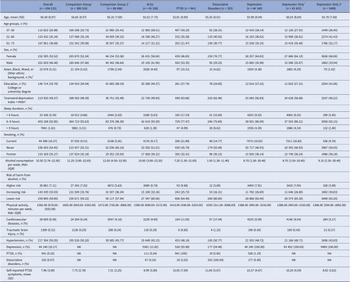
After excluding participants with missing values for any of the covariates included in the analyses (n = 68 140; Figure 1), the final cohort comprised 434 215 participants (mean (SD) age 56.58 (8.07) years, 53.52% female; Table 1). Median follow-up was 13.66 years (IQR = 12.87–14.39). In total, 941 (0.22%) participants were diagnosed with PTSD, 325 (0.07%) with any dissociative disorder, and 44 140 (10.17%) with depression before any dementia diagnosis or censoring. People with any of these diagnoses were generally less educated, more deprived, more often current smokers, and less physically active, and reported more sleep duration deviations and cardiovascular diseases (Table 1). Approximately one-third (n = 45 536) of the participants who took part in the online mental health survey (n = 140 251) experienced at least one type of ACE. Of these ACEs, emotional neglect was the most common (66.26%), followed by emotional abuse (27.82%), sexual abuse (26.37%), physical abuse (23.97%), and physical neglect (16.66%; Supplementary Table 1). Dementia developed in 266 individuals with ACEs (0.58%), 22 of those with PTSD (2.34%), 20 of those with any dissociative disorder (6.15%), and 1397 of those with depression (3.16%). In comparison, dementia occurred in 6703 individuals without PTSD, dissociative disorders, or depression (1.72%), and in 454 individuals without these diagnoses or ACEs (0.52%; Supplementary Tables 2 and 3).
Diagram of participants included in the analyses. ACEs, adverse childhood experiences; N, sample size; PTSD, post-traumatic stress disorder.

Baseline characteristics by group

Abbreviations: ACEs, adverse childhood experiences; IQR, interquartile range; Mdn, median; N, sample size; NA, not applicable; PTSD, post-traumatic stress disorder; SD, standard deviation; TBI, traumatic brain injury.
a “Comparison group” refers to participants without PTSD, dissociative disorders, or depression (PTSD–/Dissociative disorders–/Depression–).
b “Comparison group 2” refers to participants without PTSD, dissociative disorders, or depression, who self-reported as part of the online mental health survey that they had no ACEs (ACEs–/PTSD–/Dissociative disorders–/Depression–).
c “ACEs” group refers to participants who self-reported that they had at least one type of ACEs, as part of the online mental health survey (ACEs+).
d “Depression only” group refers to participants with depression but without PTSD or dissociative disorders (Depression+/ PTSD–/Dissociative disorders–).
e “Depression only 2” group refers to participants without PTSD, dissociative disorders, or depression, who self-reported as part of the online mental health survey that they had no ACEs (Depression+/ACEs–/PTSD–/Dissociative disorders–).
f Including Asian or Asian British, Black or Black British, Chinese, Mixed, or Other ethnic group.
g Median = −2.135.
ACEs, PTSD, dissociative disorders, depression, and dementia
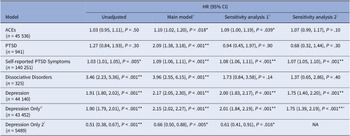
After adjusting for sociodemographic characteristics, we found that each additional type of ACE experienced was associated with a 10% increase in the risk of developing dementia (HR1point: 1.10; 95% CI 1.02–1.20; P = .018). The risk of all-cause dementia was 2.09 to 3.96 times higher in people with diagnosed PTSD (HR: 2.09; 95% CI 1.38–3.18; P < .001), any dissociative disorders (HR: 3.96; 95% CI 2.55–6.15; P < .001), or depression (HR: 2.17; 95% CI 2.05–2.30; P < .001) compared with people without the respective diagnosis (Table 2).
Unadjusted and adjusted risk of dementia by group

Abbreviations: ACEs, adverse childhood experiences; CI, confidence Interval; HR, hazard ratio; N, sample size; NA, not applicable; P, p-value; PTSD, post-traumatic stress disorder.
a Main Model: adjusted for demographics (i.e., age, sex, ethnicity, Townsend deprivation index, highest level of education attained).
b Sensitivity analysis 1: adjusted for demographics + lifestyle factors/medical comorbidities (i.e., sleep duration, smoking status, risk group of harm from alcohol consumption, physical activity per week, cardiovascular diseases, traumatic brain injury, hypertension).
c Sensitivity analysis 2: adjusted for demographics + lifestyle factors/medical comorbidities + depression (or ACEs, PTSD, and dissociative disorders when depression is the exposure).
d “Depression only” group refers to participants with depression but without PTSD or dissociative disorders (Depression+/ PTSD–/Dissociative disorders–).
e adjusted for demographics + lifestyle factors/medical comorbidities + ACEs.
f “Depression only 2” group refers to participants without PTSD, dissociative disorders, or depression, who self-reported as part of the online mental health survey that they had no ACEs (Depression+/ACEs–/PTSD–/Dissociative disorders–).
**P < .001, *P < .05.
Self-reported PTSD symptoms were significantly associated with PTSD diagnoses (odds ratio [OR] = 1.30, 95% CI 1.27, 1.32). See the Supplementary Material (Supplementary Figure 1) for boxplots illustrating the distribution of PTSD symptom severity in individuals with and without a PTSD diagnosis. Each one-point increase in the total PTSD severity score was associated with a 9% increase in the risk of dementia (HR1point: 1.09; 95% CI 1.06–1.11; P < .001). Compared with people without depression, those with depression but without diagnosed PTSD or dissociative disorder had a 2.15-fold increased risk of developing dementia (HR: 2.15; 95% CI 2.02–2.27; P < .001), whereas those with depression but without any ACEs, diagnosed PTSD, or dissociative disorder showed a decreased dementia risk (HR: 0.66; 95% CI 0.50–0.88; P = .005).
Lastly, our sensitivity analyses revealed that although the associations with dementia were generally attenuated, they remained significant for ACEs, self-reported PTSD symptoms, and depression (Table 2). When adjusting for depression in the models in which ACEs, PTSD, or dissociative disorders were the exposure variables, and when adjusting for ACEs, PTSD, and dissociative disorders in the model in which depression was the exposure variable, self-reported PTSD symptoms and depression remained significantly associated with incident all-cause dementia. Additionally, we conducted a post-hoc power analysis to detect the smallest observed effect size in the main model (i.e., HR = 1.09 for self-reported PTSD symptoms), which yielded an estimated power of 97%.
Mediation analyses
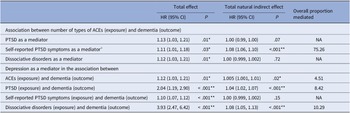
Our mediation analyses (Table 3) found little evidence to support PTSD diagnosis as a mediator between ACEs and dementia (P = .07), whereas self-reported PTSD symptoms significantly mediated the association (P < .001), accounting for 75.26% of the excess dementia risk associated with ACEs. Dissociative disorders were not a significant mediator between ACEs and dementia (P = .72).
Mediation analyses

Abbreviations: ACEs, adverse childhood experiences; CI, confidence interval; HR, hazard ratio; NA, not applicable; P, p-value; PTSD = post-traumatic stress disorder.
Note: Mediation analyses including self-reported ACEs or self-reported PTSD symptoms included 137 240 participants in the analyses. Adjusted for demographics (i.e., age, sex, ethnicity, Townsend deprivation index, highest level of education attained).
a ACEs and PTSD symptoms were self-reported concurrently during the online mental health survey.
**P < .001, *P < .05.
Depression was a significant mediator between ACEs and dementia (P = .02; 4.51%) as well as between diagnosed PTSD (P < .001; 8.42%) or dissociative disorders (P < .001; 10.29%) and dementia, but not between self-reported PTSD symptoms (P = .15) and dementia (Figure 2).
Significant mediators. ACEs, adverse childhood experiences; PTSD, post-traumatic stress disorder. Proposed associations based on mediation analyses. Direct associations were omitted for clarity.

Discussion
In this large UK Biobank cohort, ACEs, PTSD, dissociative disorders, and depression were significantly associated with an increased risk of all-cause dementia. After adjustment for sociodemographic characteristics, we found a dose–response relationship between the number of ACE types and dementia, and between PTSD symptom severity and dementia. The risk of dementia was 2.09, 3.96, and 2.17 times higher for those diagnosed with PTSD, any dissociative disorder, and depression compared to those without these diagnoses. For individuals with depression but without ACEs, PTSD, or dissociative disorders, the associated risk of dementia was reduced by 34%. Self-reported PTSD symptoms accounted for most of the excess dementia risk associated with ACEs. Depression mediated associations between ACEs, diagnosed PTSD, or dissociative disorders and dementia. Thus, self-reported PTSD symptoms were an important mediator of the relationship between ACEs and dementia risk, while depression played a smaller role in the observed associations of ACEs and trauma-related conditions with dementia risk.
Our finding that ACEs are associated with dementia is in line with a recent meta-analysis showing that childhood trauma increases dementia risk by 76% [Reference Severs, James, Letrondo, Løvland, Marchant and Mukadam6]. Another recent study using data from the UK Biobank found that the risk of all-cause dementia in later life was higher in people who experienced childhood trauma compared to adulthood trauma [Reference Xie, Li, Sun, Zhou, Fu and Wang32], although it included only ACEs related to abuse, not neglect. Moreover, our findings confirm those of a meta-analysis linking PTSD to increased dementia risk [Reference Günak, Billings, Carratu, Marchant, Favarato and Orgeta10]. Studies conducted since then have found further evidence that PTSD is a risk factor for dementia [Reference Kim, Park, Kim, Hurh, Kim and Park14, Reference Bergman, Mackay and Pell33, Reference Song, Sieurin, Wirdefeldt, Pedersen, Almqvist and Larsson34], with one exception [Reference Islamoska, Hansen, Ishtiak-Ahmed, Garde, Andersen and Garde35]. To the best of our knowledge, no studies to date have looked at PTSD symptom severity, rather than diagnosis, and dementia risk. Including self-reported PTSD symptoms post-hoc was relevant, given the relatively low prevalence of diagnosed PTSD, and importantly, it allowed us to take a dimensional approach (severity score) to complement the categorical one (diagnosis vs. no diagnosis). It is possible that some individuals experience PTSD symptoms at a subclinical level or do not seek help for various reasons and thus are never formally diagnosed. These individuals would be excluded from analyses that rely solely on diagnostic data. In our sample, higher levels of self-reported PTSD symptoms were significantly associated with recorded PTSD diagnoses, though the two were not identical. This suggests that self-report captures meaningful complementary information not reflected in diagnostic records (e.g., subthreshold symptoms, barriers to treatment). By including both measures – ensuring that each was assessed or diagnosed prior to any dementia diagnosis – we aimed to adopt both a dimensional and categorical perspective.
To the best of our knowledge, our study is the first to investigate the relationship between dissociative disorders and dementia. Our findings build on prior studies showing that higher levels of dissociative symptoms are correlated with reduced performance across various cognitive domains [Reference McKinnon, Boyd, Frewen, Lanius, Jetly and Richardson36, Reference Alexis, Géraldine, David, Camille and Wissam37]. While this is an intriguing result that highlights dissociative disorders as a potential – and potentially modifiable – risk factor for dementia, it must be interpreted with caution. The low prevalence of dissociative disorders in our sample underscores the need for replication in future studies, ideally with higher base rates and more systematic assessments of dissociation-related disorders.
Consistent with prior research [Reference Kuring, Mathias and Ward38–Reference Stafford, Chung, Sommerlad, Kirkbride and Howard41], we found depression to be a significant risk factor for dementia. While earlier studies indicate that later-life depression is associated with, and in fact might be a prodrome of, dementia [Reference Livingston, Huntley, Sommerlad, Ames, Ballard and Banerjee39, Reference Livingston, Sommerlad, Orgeta, Costafreda, Huntley and Ames42], the recent update from the Lancet Commission on dementia prevention, intervention and care found that depression increases the risk of dementia at all stages of adulthood and therefore classified mid-life depression as a risk factor for dementia [Reference Livingston, Huntley, Liu, Costafreda, Selbæk and Alladi2], which our results further support. Risk of dementia associated with depression, however, was reduced in individuals who reported not having had any ACEs. While this seems counterintuitive, particularly in light of strong evidence from the Lancet Commission on dementia prevention, intervention, and care [Reference Livingston, Huntley, Liu, Costafreda, Selbæk and Alladi2, Reference Livingston, Huntley, Sommerlad, Ames, Ballard and Banerjee39, Reference Livingston, Sommerlad, Orgeta, Costafreda, Huntley and Ames42], two possible reasons may account for this observation. First, ACEs might represent a key factor linking both depression and dementia, serving as a common cause that increases vulnerability to both conditions. This would not imply that depression is protective, but rather that the observed association between depression and dementia may attenuate or even reverse once shared aetiology with early-life adversity is accounted for. This perspective aligns with life course models that emphasize how dementia risk is influenced by factors such as lower educational attainment, physical inactivity, substance use (e.g., nicotine and alcohol), and hypertension [Reference Livingston, Huntley, Liu, Costafreda, Selbæk and Alladi2, Reference Livingston, Huntley, Sommerlad, Ames, Ballard and Banerjee39, Reference Livingston, Sommerlad, Orgeta, Costafreda, Huntley and Ames42]. Pathways, which themselves may be shaped by ACEs. Second, this finding may reflect a statistical suppressor effect, whereby adjusting for ACEs alters the observed relationship between depression and dementia by removing shared variance. This could result in a negative association in certain subgroups. Again, this would not imply that depression is protective; rather, it underscores the complex interplay between early-life adversity, mental health, and dementia risk. These findings should be interpreted with caution, and future research is needed to replicate our results and further elucidate these relationships.
To the best of our knowledge, our study is the first to systematically explore the interrelationships between ACEs, trauma-related conditions, and depression in their associations with dementia through mediational analyses. Previous studies have used different exposures or have focused on cognitive impairment as the outcome [Reference Singh, Zeig-Owens, Rabin, Schwartz, Webber and Appel43, Reference Cohn-Schwartz, Hoffman and Shrira44]. Their and our findings suggest that ACEs, PTSD, dissociative disorders, and depression likely have both shared and distinct associations leading to cognitive impairment and dementia.
Several mechanisms may explain our results. Early and chronic stress from ACEs, PTSD, dissociative disorders, and depression may cause structural and functional brain changes, increasing vulnerability to neuropathology [Reference McEwen45], including dementia. This might occur through prolonged activation of stress- and threat-related pathways [Reference McEwen45] and impaired development of brain areas like the hippocampus, amygdala, and frontal cortex [Reference Lupien, McEwen, Gunnar and Heim46, Reference Nilaweera, Freak-Poli and Ryan47]. ACEs, PTSD, dissociative disorders, and depression may also hinder cognitive reserve formation [Reference Stern48–Reference Tucker and Stern50] by reducing engagement in cognitively stimulating activities due to withdrawal from daily life, thereby diminishing the protective buffer against neurodegenerative pathology [Reference Almeida-Meza, Steptoe and Cadar51]. This may begin soon after ACEs through impoverished social networks [Reference McCrory, Foulkes and Viding52] and lower levels of educational attainment [Reference Blodgett and Lanigan53]. Engagement in repetitive negative thinking (RNT), a transdiagnostic process [Reference Ehring and Watkins54], may contribute to cognitive debt, heightening susceptibility to brain pathology [Reference Marchant and Howard55]. Higher RNT levels in cognitively intact older adults have been linked to faster declines in global cognition and memory, as well as higher levels of neuropathological markers of Alzheimer’s disease [Reference Marchant, Lovland, Jones, Pichet Binette, Gonneaud and Arenaza-Urquijo56]. Our mediation findings suggest that part of the association between ACEs and dementia may operate through self-reported PTSD symptoms and/or depression, and that part of the association between diagnosed PTSD or dissociative disorders and dementia may operate through depression. Certain lifestyle and psychosocial factors across the life course, such as lower educational attainment, social isolation, physical inactivity, smoking, hypertension, and excessive alcohol consumption, have been established as modifiable risk factors for dementia by the Lancet Commission on dementia prevention, intervention, and care [Reference Livingston, Huntley, Liu, Costafreda, Selbæk and Alladi2, Reference Livingston, Huntley, Sommerlad, Ames, Ballard and Banerjee39, Reference Livingston, Sommerlad, Orgeta, Costafreda, Huntley and Ames42]. These factors may function as mediators or confounders in the associations between early-life adversity, psychiatric conditions, and dementia risk. While our models adjusted for several of these variables, including education, area-based deprivation, physical activity, alcohol consumption, and smoking, future studies should investigate their potential role as mediators in the pathways linking trauma-related exposures and depression to cognitive decline and dementia.
Implications
It is important to consider ACEs, PTSD, dissociative disorders, and depression when assessing dementia risk. Evidence is sparse on population-level primary prevention strategies for addressing depression as a risk factor for dementia [Reference Walsh, Wallace, Kuhn, Mytton, Lafortune and Wills57]; an even greater gap exists for ACEs, PTSD, and dissociative disorders. There is currently no evidence on whether clinical interventions, such as trauma-focused therapy, reduce dementia risk. Future research should focus on developing and testing interventions to mitigate dementia risk among individuals with ACEs, trauma-related conditions, and depression. It should also disentangle specific dissociative disorder diagnoses and investigate whether the observed increased risk of dementia is causal or driven by a third variable, such as genetic disposition. Our findings cautiously suggest that ACEs, PTSD, dissociative disorders, and depression may each independently contribute to a higher risk of dementia.
Strengths and limitations
Strengths of our study include the use of a large, population-based cohort with clinical diagnoses of PTSD, dissociative disorders, and depression, enabling us to adjust for important confounders. Our mediation analyses accounted for the temporal sequence of diagnoses, ensuring that the predictor, mediator, and outcome occurred consecutively. Several limitations should be considered when interpreting our findings. Relatively few cases of PTSD and dissociative disorders were identified, possibly due to underdiagnosis or underreporting in the linked data, thus reducing statistical power. Our sensitivity analyses showed non-significant associations between diagnosed PTSD or dissociative disorders and the risk of dementia. The added exposures likely further reduced the power of these analyses, especially with high collinearity between trauma-related disorders and impaired sleep duration, smoking, cardiovascular diseases, and depression. In contrast, self-reported PTSD symptoms remained significantly associated with dementia in both sensitivity analyses, supporting this association’s robustness. While the overall sample size provided high power for most analyses, predictors with low prevalence, particularly dissociative disorders, may have been underpowered to detect modest effect sizes. Thus, findings related to these conditions should be interpreted with caution and require replication. Moreover, due to power issues, we were not able to adjust the mediation analyses for the remaining exposures. This is particularly relevant given ongoing theoretical debates about the conceptual and empirical overlap between PTSD and dissociation [27, 58–Reference Schalinski, Teicher, Nischk, Hinderer, Müller and Rockstroh61]. While some researchers view them as closely related but distinct conditions [Reference Dalenberg and Carlson62, Reference Kihlstrom63], others propose that PTSD may fall within the broader category of dissociative disorders [Reference Nijenhuis60]. Future research should pay closer attention to the comorbidity between PTSD and dissociative symptoms and disorders, and investigate newer diagnoses such as the dissociative subtype of PTSD (PTSD-DS), introduced in DSM-5 [58], and complex PTSD (cPTSD), introduced in the recently published ICD-11 [Reference Maercker, Brewin, Bryant, Cloitre, Van Ommeren and Jones64]. cPTSD includes core PTSD symptoms along with affective dysregulation, a negative self-concept, and difficulties in interpersonal relationships. It has been associated with higher levels of dissociative symptoms than PTSD alone or the absence of PTSD [Reference Hyland, Shevlin, Fyvie, Cloitre and Karatzias59]. Additionally, future studies should explore the dimensional nature of trauma-related psychopathology, which may yield more fine-grained insights into how trauma confers risk of dementia. Although our dataset, based on ICD-10, did not include PTSD-DS or cPTSD diagnoses, most individuals with dissociative disorder diagnoses in our sample did not have comorbid PTSD, and vice versa. This supports the rationale for examining these disorders separately. Future research should investigate the role of cPTSD in the risk of dementia, particularly given its relevance to early trauma and dissociation. Additionally, because ACEs were self-reported, recall bias may have influenced our results. People of ethnic minorities and people living with lower socioeconomic circumstances are underrepresented in the UK Biobank, limiting the generalizability of our findings.
Conclusions
Our study identifies dissociative disorders as a potentially modifiable risk factor for all-cause dementia and provides further evidence that ACEs, PTSD, and depression are risk factors as well. These conditions appear to have both overlapping and distinct associations with increased dementia risk and thus cannot be fully explained by the other investigated exposures. However, due to the low prevalence of some predictors, especially dissociative disorders, our analyses may have been underpowered to detect modest effects. As such, these findings should be interpreted with caution and replicated in future research. Further studies should also attempt to disentangle the underlying mechanisms, both transdiagnostic and disorder-specific, to aid in the development of timely interventions that mitigate the potentially increased risk of dementia associated with ACEs, PTSD, dissociative disorders, and depression.
Supplementary material
The supplementary material for this article can be found at http://doi.org/10.1192/j.eurpsy.2025.10128.
Data availability statement
The data that support the findings of this study are available from the UK Biobank. Access to UK Biobank data can be requested through a standard data access procedure (https://www.ukbiobank.ac.uk/enable-your-research/apply-for-access).
Acknowledgements
We are grateful to the UK Biobank participants. This research has been conducted using the UK Biobank Resource under application number 71392. We also thank our scientific language editor, Dr. Matthew Gaskins, for his invaluable contributions to refining the language of this manuscript.
Author contribution
F.K.H. and M.M.G. had full access to all the data in the study and took responsibility for the integrity of the data and the accuracy of the data analysis. All authors contributed to the conception and design of the study. M.M.G. and F.K.H. analysed and interpreted the data. M.M.G. drafted the manuscript. All authors critically revised the manuscript for important intellectual content. All authors made a significant contribution to finalizing the manuscript and approved the final version for publication.
Financial support
This work was supported by the Federal Ministry of Education and Research (Bundesministerium für Bildung und Forschung [BMBF]) within the German Center for Mental Health (DZPG) (TE, grant number 01EE2303A) and by the UCLH NIHR Biomedical Research Centre (VO).
Competing interests
The authors declare none.
Ethical standard
The authors assert that all procedures contributing to this work comply with the ethical standards of the relevant national and institutional committees on human experimentation and with the Helsinki Declaration of 1975, as revised in 2008. The authors assert that all procedures contributing to this work comply with the ethical standards of the relevant national and institutional guides on the care and use of laboratory animals.
Analytic code availability
The analytic code is available online (https://osf.io/b28y3/).
Portions of this manuscript were presented at the International Society for Traumatic Stress Studies Annual Meeting, Los Angeles, California, United States, November 3, 2023, and at the Deutscher Psychotherapie Kongress, Berlin, Germany, June 14, 2024.



 Open access


Comments
No Comments have been published for this article.